
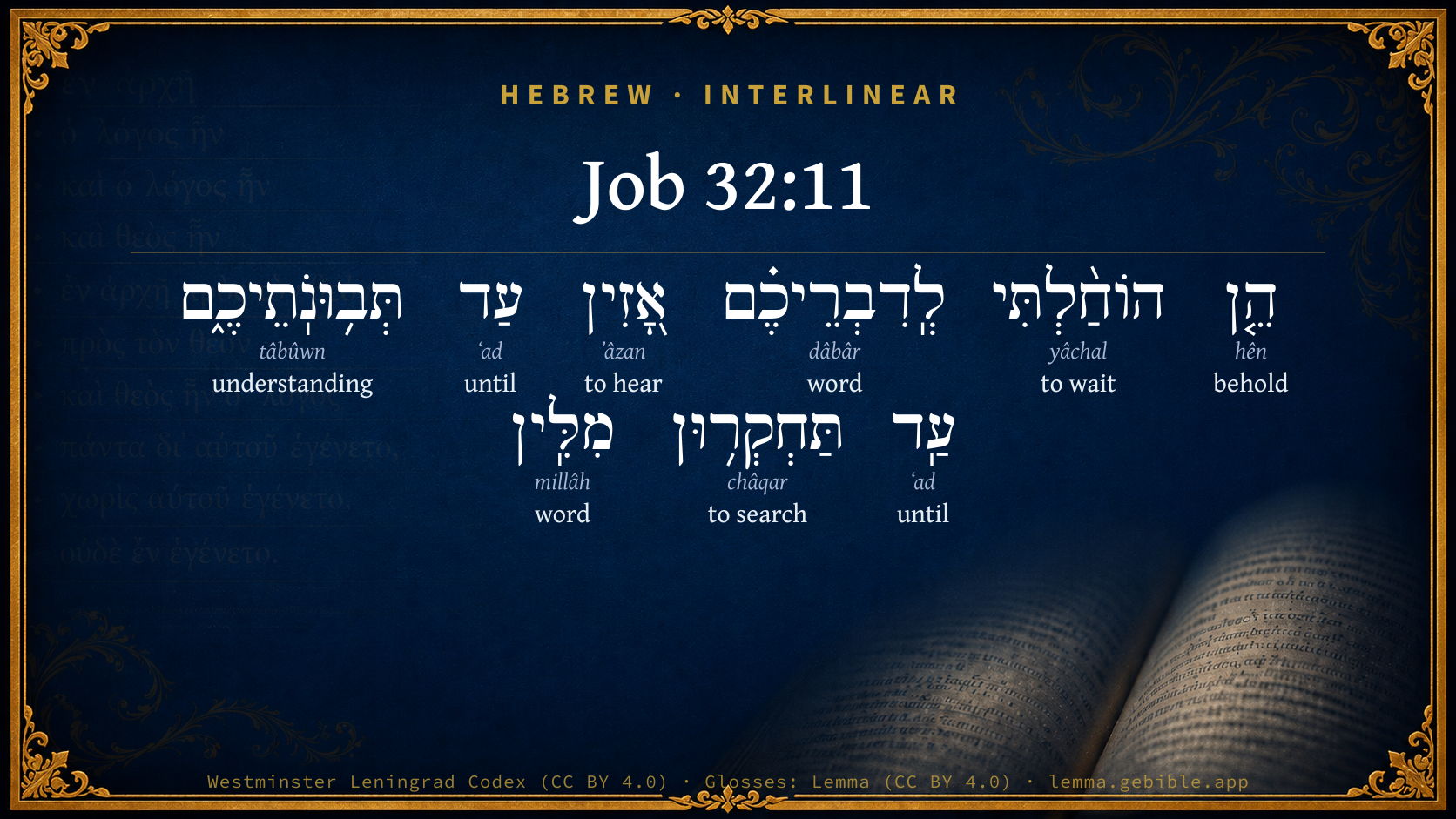
Job 32:11

Hebrew (Westminster Leningrad Codex) Job 32:11 appears in the Hebrew Old Testament. The text above is from the Westminster Leningrad Codex. Each word links to its Strong’s number, a concise gloss, and parsing drawn from the Open Scriptures Hebrew Bible morphology. Click any word for its full Brown-Driver-Briggs (BDB) entry.
Download image
Cite this verse

Job 32:11 (World English Bible). Public Domain. Lemma interlinear Bible study tool, https://lemma.gebible.app/v/job/32/11.

Show BibTeX & RIS
BibTeX
RIS
English Translation
"Behold, I waited for your words, And I listened for your reasoning, While you searched out what to say.
World English Bible · Public Domain
Download a study sheet

One document with this verse’s original text, its word-by-word gloss line, the meaning frame, cross-references with their text, attributed commentary, and full source and license credits — printable, and it pastes into notes with its structure intact.

This verse Autodidact and up

Study sheet (.html) Plain text (.txt)

A passage Seminary Student

Up to 50 verses in one chapter. A passage sheet keeps up to 6 commentary sources and 12 cross-references per verse, in the order this page ranks them, and says so on the sheet whenever that leaves anything out. Ask for a single verse and you get the Autodidact verse sheet above.

Everything on this page stays free to read, with no account — the sheet is a download of what is already on screen, not access to it.

Want to remove ads? Support Godless Engineer
Compare translations 3

The same verse in 3 English versions, stacked beneath the original-language interlinear above. Click any original word for its lexicon entry.

Each is an independent rendering of the whole verse — the interlinear is not word-aligned to these translations.

Highlighted words mark where these versions differ — a whole-verse word diff, not a word-by-word alignment.

  • World English Bible Public Domain
    "Behold, I waited for your words, And I listened for your reasoning, While you searched out what to say.
  • King James Version Public Domain
    Behold, I waited for your words; I gave ear to your reasons, whilst ye searched out what to say.
  • unfoldingWord Literal Text CC BY-SA 4.0
    Behold, I waited for your words; I listened to your reasonings while you searched words.

unfoldingWord Literal Text — © unfoldingWord, licensed CC BY-SA 4.0. Word-aligned USFM3 via Door43 (git.door43.org/unfoldingWord/en_ult).

Versions to compare (up to 4)

3 of 4 selected

Show all 18 translations

Every available English version of this verse, each an independent rendering of the whole verse.

  • World English Bible Public Domain
    "Behold, I waited for your words, And I listened for your reasoning, While you searched out what to say.
  • Berean Standard Bible Public Domain
    Indeed, I waited while you spoke; I listened to your reasoning; as you searched for words,
  • Majority Standard Bible Public Domain
    Indeed, I waited while you spoke; I listened to your reasoning; as you searched for words,
  • King James Version Public Domain
    Behold, I waited for your words; I gave ear to your reasons, whilst ye searched out what to say.
  • American Standard Version (1901) Public Domain
    Behold, I waited for your words, I listened for your reasonings, Whilst ye searched out what to say.
  • Revised Version (1885) Public Domain
    Behold, I waited for your words, I listened for your reasons, whilst ye searched out what to say.
  • Geneva Bible (1599) Public Domain
    Behold, I did waite vpon your wordes, and hearkened vnto your knowledge, whiles you sought out reasons.
  • Douay-Rheims (1899) Public Domain
    For I have waited for your words, I have given ear to your wisdom, as long as you were disputing in words.
  • Young's Literal Translation Public Domain
    Lo, I have waited for your words, I give ear unto your reasons, Till ye search out sayings.
  • Literal Standard Version CC BY-SA 4.0
    Behold, I have waited for your words, I give ear to your reasons, || Until you search out sayings.
  • Unlocked Literal Bible CC BY-SA 4.0
    See, I waited for your words; I listened to your arguments while you were thinking about what to say.
  • unfoldingWord Literal Text CC BY-SA 4.0
    Behold, I waited for your words; I listened to your reasonings while you searched words.
  • Darby Bible Public Domain
    Lo, I waited for your words; I gave ear to your reasonings, until ye searched out what to say.
  • World Messianic Bible Public Domain
    “Behold, I waited for your words, and I listened for your reasoning, while you searched out what to say.
  • Webster's Bible Public Domain
    Behold, I waited for your words; I gave ear to your reasons, whilst ye searched out what to say.
  • Free Bible Version CC BY-SA 4.0
    Well, I waited to hear what you had to say, listening for your insights as you looked for the right words to speak.
  • Bible in Basic English Public Domain
    I was waiting for your words, I was giving ear to your wise sayings; while you were searching out what to say,
  • JPS Tanakh (1917) Public Domain
    Behold, I waited for your words, I listened for your reasons, whilst ye searched out what to say.

Literal Standard Version (2020), Covenant Press — licensed CC BY-SA 4.0. Text via the HelloAO Bible API (eBible.org). Unlocked Literal Bible (unfoldingWord) — licensed CC BY-SA 4.0. Text via the HelloAO Bible API (eBible.org). unfoldingWord Literal Text — © unfoldingWord, licensed CC BY-SA 4.0. Word-aligned USFM3 via Door43 (git.door43.org/unfoldingWord/en_ult). Free Bible Version, Dr. Jonathan Gallagher — licensed CC BY-SA 4.0. Text via the HelloAO Bible API (eBible.org).

Word by word

More ways to search: Search by grammar → Find every occurrence → Compare this word →

Practice this passage: Drill this verse → Learn its vocabulary →

תַּחְקְר֥וּן
châqar
H2713
“to search”
Verb, Qal, Imperfect, 2nd Person, Masculine, Plural + Suffix, n
Part of Speech
Verb
Stem
Qal
Form
Imperfect
Person
2nd Person
Gender
Masculine
Number
Plural
Full BDB Definition

Origin: a primitive root

TWOT: 729

to search, search for, search out, examine, investigate - (Qal) - to search (for) - to search through, explore - to examine thoroughly - (Niphal) - to be searched out, be found out, be ascertained, be examined - (Piel) to search out, seek out
  1. הֵ֤ן hên H2005 “behold” Particle, Demonstrative
  2. הוֹחַ֨לְתִּי yâchal H3176 “to wait” Verb, Hiphil, Perfect, 1st Person, Common, Singular
  3. לְֽדִבְרֵיכֶ֗ם dâbâr H1697 “to/for · words · your” Preposition + Noun, Common, Masculine, Plural, Construct + Suffix, Personal, 2nd Person, Masculine, Plural
  4. אָ֭זִין ʼâzan H238 “to hear” Verb, Hiphil, Imperfect, 1st Person, Common, Singular
  5. עַד ʻad H5704 “until” Preposition
  6. תְּב֥וּנֹֽתֵיכֶ֑ם tâbûwn H8394 “understanding · your” Noun, Common, Feminine, Plural, Construct + Suffix, Personal, 2nd Person, Masculine, Plural
  7. עַֽד ʻad H5704 “until” Preposition
  8. מִלִּֽין millâh H4405 “words” Noun, Common, Feminine, Plural, Absolute

About this verse

These counts appear in no published source. They are computed here, from the morphology-tagged text and Lemma’s own curated glosses. What Lemma adds →

9
words
8
distinct lemmas
Wisdom
section

Shared distinctive vocabulary

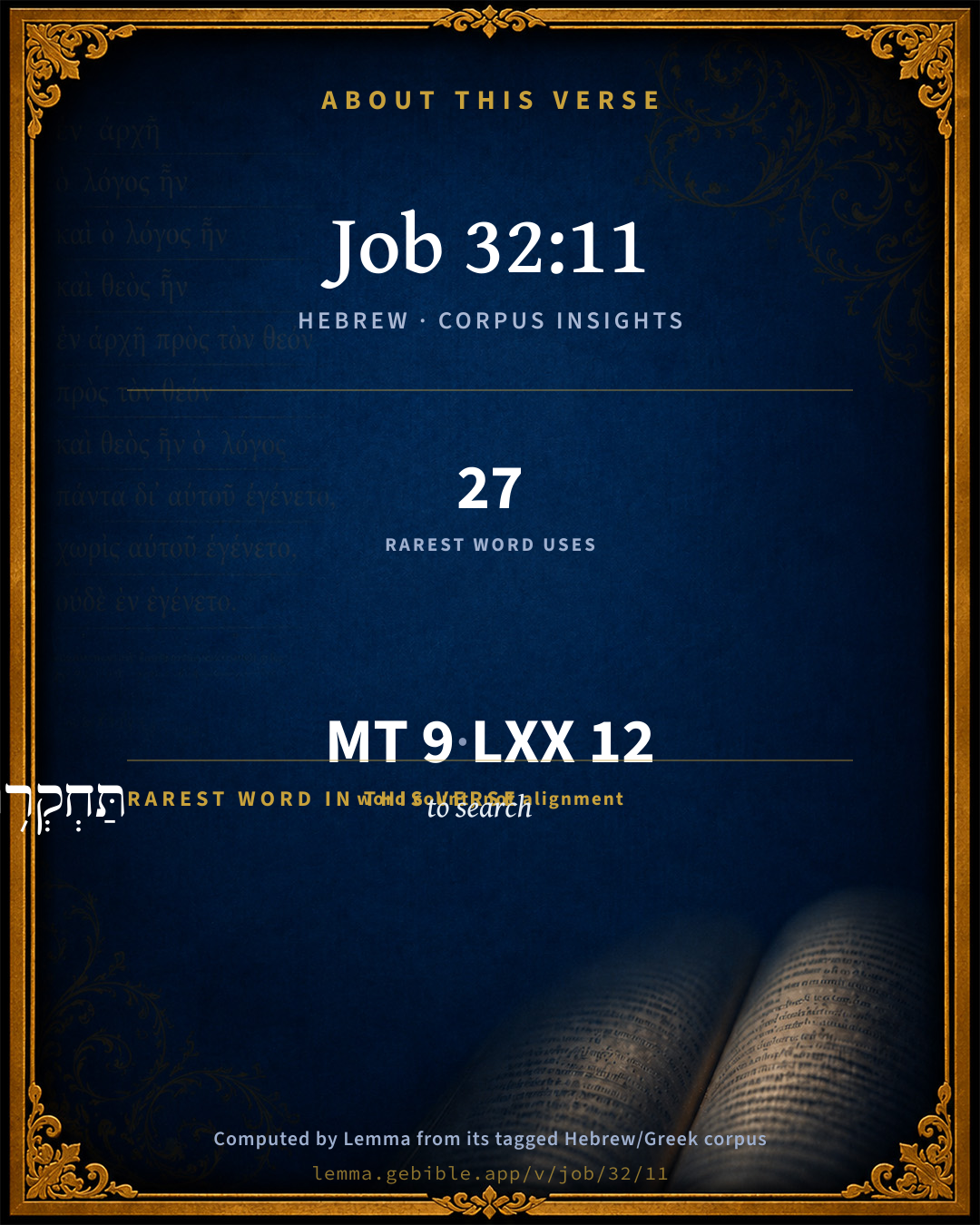
תַּחְקְר֥וּן to search H2713 occurs in 26 verses of the Hebrew Bible. Also found in:

Grammatical profile

  • 3 verbs
  • 3 nouns
  • 2 prepositions
  • 1 particle

Verb forms

  • הוֹחַ֨לְתִּי Hiphil · Perfect
  • אָ֭זִין Hiphil · Imperfect
  • תַּחְקְר֥וּן Qal · Imperfect

Repetition

A word recurs within this verse — often emphatic in Hebrew:

Hebrew & Septuagint length

In English translation the verse runs 19 words from the Hebrew and 20 from the Septuagint (LXX English) — closely comparable.

A rough comparison of the two English renderings, which tokenize alike — not a word-level alignment.

Word counts can differ between the Hebrew and the Greek without any difference in meaning — e.g. the Hebrew direct-object marker אֵת has no separate Greek word, and Greek often adds the article ὁ.

In the original languages it is 9 Hebrew tokens and 12 Greek tokens — but the two are counted differently (Hebrew bundles its prefixes and suffixes into one token; the Greek is in lemma form), so that isn’t a like-for-like length.

Cross-references

7

Topical passages linked to Job 32:11 in the Treasury of Scripture Knowledge — connected by theme and wording, ordered by reader-vote popularity; previews shown in the World English Bible.

  • Job 5:27 Look this, we have searched it, so it is; Hear it, and know it for your good."
  • Job 29:21 "Men listened to me, waited, And kept silence for my counsel.
  • Job 29:23 They waited for me as for the rain. Their mouths drank as with the spring rain.
  • Job 32:4 Now Elihu had waited to speak to Job, because they were elder than he.
  • Proverbs 18:17 He who pleads his cause first seems right; Until another comes and questions him.
  • Proverbs 28:11 The rich man is wise in his own eyes; But the poor who has understanding sees through him.
  • Ecclesiastes 12:9–10 Further, because the Preacher was wise, he still taught the people knowledge. Yes, he pondered, sought out, and set in order many proverbs.

Cross-references courtesy of OpenBible.info (CC BY 4.0).

Hebrew and Greek witnesses Masoretic Hebrew ↔ Greek Septuagint

The same verse in the two great witnesses to the Old Testament, shown verse-for-verse.

These are two independent witnesses, not word-aligned to each other, and the Septuagint is shown in lemma (dictionary) form.

Hebrew Job 32:11 Masoretic · Westminster Leningrad Codex

הֵ֤ן הוֹחַ֨לְתִּי לְֽדִבְרֵיכֶ֗ם אָ֭זִין עַד תְּב֥וּנֹֽתֵיכֶ֑ם עַֽד תַּחְקְר֥וּן מִלִּֽין

"Behold, I waited for your words, And I listened for your reasoning, While you searched out what to say.

World English Bible · Public Domain

Greek LXX Job 32:11 Septuagint · lemma form

ἐνὠτίζομαι ἐγώ ὁ ῥῆμα εἶπον γάρ σύ ἀκούω ἄχρι ὅς ἐτάζω λόγος

Listen to my words; for I will speak in your hearing, until you⌃ shall have tried the matter with words:

LXX2012 (modern English Septuagint) · Public Domain

Hebrew: Westminster Leningrad Codex (CC BY 4.0). Greek: Septuagint (public domain); English from LXX2012 (modern English Septuagint) (Public Domain). How the Septuagint differs from the Hebrew →

Commentary

Notes on Job 32:11 from classic Christian and Jewish commentators (each source and its license shown beneath its notes). The classic Christian expositions comment on the surrounding passage and are grouped to its opening verse, so a note may address several verses; the Jewish commentaries on the Tanakh (Rashi and others) are per-verse, so they appear only where the commentator wrote on this verse.

Lemma curates 59 commentaries, every one of them public domain or Creative Commons licensed, each selected and text-cleaned for this edition rather than reprinted as found. About our sources →

Trapp's Complete Commentary

John Trapp

Job 32:11 Behold, I waited for your words; I gave ear to your reasons, whilst ye searched out what to say.

Ver. 11. Behold, I waited for your words] While you had anything to say I was silent, and no way troublesome or obstreperous. This he speaketh to Job’s friends, who had free liberty to speak while they would without interruption; and should, therefore, now be content to hear (though perhaps what they would not) if God thereby might be glorified, and Job better convinced.

I gave ear to your reasons] Heb. To your understandings. Usque ad intelligentias vestras, to the utmost of your best arguments and most elaborated demonstrations, Ut cum dicitur, Redite usque ad me, Joe 2:12; for the which you has eviscerated your brains, and well nigh cracked your sconces, but all to no purpose; since you hover in generals; and, declining that which was the main matter in question (like lapwings, that cry farthest off from the nest), you brought only such reasons as were not cogent, and used such discourses as did nec coelum, nec terram attingere, to touch neither heave nor earth, never come at the business; which was no better than laborious loss of time.

John Trapp, A Commentary or Exposition upon All the Books of the Old and New Testament (1647–1656) — public domain. Text from a community e-Sword module.

Joseph Benson's Commentary

Job 32:11. Behold, I waited for your words — With silence, patience, and diligent attention, which therefore I now expect from you. I gave ear to your reasons — Or, reasonings; Hebrew, תבונותיכם, tebunotheichem, your understandings, or minds; the depth and strength of your discourses; your most intelligent and forcible arguments against Job. While you searched out what to say — While you put your inventions upon the rack, and studied to find out all that could be said against him, and to furnish yourselves with the most convincing words and reasons.

Joseph Benson's Commentary on the Old and New Testaments (1811–1818) — public domain. Text from a community e-Sword module.

Geneva Bible (1599)

Geneva Bible translators

To prove that Job’s affliction came for his sins.

Geneva Bible (1599) marginal notes — public domain. Text via Bolls.life.

Jamieson, Fausset & Brown

Robert Jamieson, A. R. Fausset & David Brown

Therefore Elihu was present from the first.

reasons--literally, "understandings," that is, the meaning intended by words.

whilst--I waited until you should discover a suitable reply to Job.

Jamieson, Fausset & Brown — Commentary Critical and Explanatory on the Whole Bible (1871) — public domain (CC PDM 1.0). Text via the HelloAO Bible API.

Adam Clarke's Commentary

Verse 11. I waited for your words; I gave ear to your reasons] Instead of תבונותיכם tebunotheychem, your reasons, תכונותיכם techunotheychem, your arguments, is the reading of nine of Kennicott's and De Rossi's MSS. The sense, however, is nearly the same.

Whilst ye searched out what to say.] עד תחקרון מלין ad tachkerun millin; "Whilst ye were searching up and down for words." A fine irony, which they must have felt.

Adam Clarke's Commentary on the Bible (1810–1826) — public domain. Text from a community e-Sword/MySword module.

The Cambridge Bible for Schools and Colleges

gen. ed. J. J. S. Perowne

11. I gave ear to your reasons] Or, I listened for your reasons, until ye should search out what to say. The meaning seems to be that Elihu looked for further and different arguments from the three friends.

11–14. Elihu, directly addressing the three friends, states more clearly his reasons for taking upon him to speak: he had hoped to hear them confute Job, and was disappointed in their arguments; Job may be shewn to be in the wrong, though with different arguments from those they had employed. In Elihu’s opinion the cause of the three friends was much better than their advocacy of it.

The Cambridge Bible for Schools and Colleges (gen. ed. J. J. S. Perowne; Cambridge University Press, 1878–1918) — public domain. Text from a community e-Sword module.

John Gill's Exposition

Behold, I waited for your words,.... With great desire, with great eagerness and earnestness, in hope of meeting with arguments fully satisfying and convincing; he waited for them, as for the rain, and the latter rain, to be revived, refreshed, and edified therewith; and he patiently waited until they had done speaking:

I gave ear to your reasons, or "understandings" (r); endeavoured to get into the sense and meaning of their words; not only attended to what they did say, but to what he thought they meant to say: some are not so happy in their expressions; and yet, by what they do say, with close attention it may be understood what they aim at, what is their drift and design; this Elihu was careful to attain unto, not barely to hear their words, but penetrate, if possible, into their meaning:

whilst ye searched out what to say; for they did not make their replies to Job immediately, and say what came uppermost at once, but they took time to think of things, and to search out for the most forcible arguments to refute Job, and strengthen their cause; it is very probable they made a pause at the end of every speech of Job's, and considered what was proper to be said in reply, and, perhaps, consulted each other.

(r) "usque ad intellignetias vestras", Pagninus, Montanus, Cocceius, Schultens; "usque ad sensa vestra", Beza, Junius & Tremellius.

John Gill's Exposition of the Whole Bible (1746–1763) — public domain (CC PDM 1.0). Text via the HelloAO Bible API.

Albert Barnes' Notes on the Bible

I gave ear to your reasons - Margin, “understandings.” The meaning is, that he had given the most respectful attention to the views which they had expressed, implying that he had been all along present, and had listened to the debate.

Whilst ye searched out what to say - Margin, as in Hebrew, words. It is implied here that they had bestowed much attention on what they had said. They had carefully sought out all the arguments at their command to confute Job, and still had been unsuccessful.

Albert Barnes' Notes on the Bible (1834–1885) — public domain. Text from a community e-Sword/MySword module.

Haydock's Catholic Bible Commentary

Disputing. Hebrew, "searching out words," or arguments. (Haydock)

George Leo Haydock (1774–1849), Haydock's Catholic Family Bible and Commentary, 1859 edition — public domain. Excludes Psalms (Douay-Rheims chapter numbering differs from Protestant) and Deuterocanonical books (Catholic canon only).

Matthew Poole's English Annotations

I waited with silence, and patience, and diligent attention; which therefore I now expect from you.

Your reasons; or, reasonings, Heb. understandings; or mind’s; the depth and strength of your discourses, your most intelligent and forcible arguments against Job; I searched and examined them to the bottom.

Whilst ye searched out what to say; whilst you put your inventions upon the rack, and studied to find out all that could be said against him, and to furnish yourselves with the most convincing words and reasons.

Matthew Poole's English Annotations on the Holy Bible (1683–1685) — public domain. Text from a community e-Sword/MySword module.

The Pulpit Commentary

Behold, I waited for your words; i.e. "I was full of expectation; I waited impatiently to hear what you would say." Then, while you spoke, I gave ear to your reasons or, your reasonings; I did my best to apprehend your meaning whilst ye searched out what to say. Professor Lee translates, "whilst ye examined Job"s conclusions; but the Authorized Version is probably correct. Elihu means that he listened carefully while the friends hunted out all the arguments they could think of in order to confute Job.

The Pulpit Commentary (1880–1919), ed. H.D.M. Spence-Jones & Joseph S. Exell — public domain. Text from a community e-Sword module.

Keil & Delitzsch

C. F. Keil & F. Delitzsch

11 Behold, I waited upon your words,

Hearkened to your perceptions,

While ye searched out replies.

12 And I attended closely to you,

Yet behold: there was no one who refuted Job,

Who answered his sentences, from you.

13 Lest ye should say: "We found wisdom,

God is able to smite him, not man!"

14 Now he hath not arranged his words against me,

And with your sentences I will not reply to him.

He has waited for their words, viz., that they might give utterance to such words as should tend to refute and silence Job. In what follows, עד still more emphatically than ל refers this aim to that to which Elihu had paid great attention: I hearkened to your understandings, i.e., explanations of the matter, that, or whether, they came forth, (I hearkened) to see if you searched or found out words, i.e., appropriate words. Such abbreviated forms as אזין = אאזין (comp. מזין = מיזין for מעזין, Pro 17:4, Ges. 68, rem. 1, if it does not signify nutriens, from זוּן) we shall frequently meet with in this Elihu section. In Job 32:12, Job 32:12 evidently is related as an antecedent to what follows: and I paid attention to you (עדיכם contrary to the analogy of the cognate praep. instead of עדיכם, moreover for עליכם, with the accompanying notion: intently, or, according to Aben-Duran: thoroughly, without allowing a word to escape me), and behold, intently as I paid attention: no one came forward to refute Job; there was no one from or among you who answered (met successfully) his assertions. Every unbiassed reader will have an impression of the remarkable expressions and constructions here, similar to that which one has in passing from the book of the Kings to the characteristic sections of the Chronicles. The three, Elihu goes on to say, shall not indeed think that in Job a wisdom has opposed them - a false wisdom, indeed - which only God and not any man can drive out of the field (נדף, Arab. ndf, discutere, dispellere, as the wind drives away chaff or dry leaves); while he has not, however (ולא followed directly by a v. fin. forming a subordinate clause, as Job 42:3; Psa 44:18, and freq., Ew. 341, a), arrayed (ערך in a military sense, Job 33:5; or forensic, Job 23:4; or even as Job 37:19, in the general sense of proponere) words against him (Elihu), i.e., utterances before which he would be compelled to confess himself affected and overcome. He will not then also answer him with such opinions as those so frequently repeated by them, i.e., he will take a totally different course from theirs in order to refute him.

Keil & Delitzsch — Biblical Commentary on the Old Testament (1861–1891) — public domain (CC PDM 1.0). Text via the HelloAO Bible API. (Old Testament only.)

unfoldingWord translationNotes

Door43 World Missions Community

See

Elihu uses this word here to draw the mens' attention to what he says next. AT: "Listen"

I waited for your words

"I waited to hear what you would say." The word "your" refers to Job's friends. (See: Forms of You)

who could respond to his words

Here the word "respond" does not just mean to answer, but to answer with a helpful response.

translationWords

word

unfoldingWord translationNotes — © Distant Shores Media and the Door43 World Missions Community, licensed CC BY-SA 4.0. Source: git.door43.org/Door43/en_tn.

Lesson kit

Teaching starters — assembled from the data on this page, not authored interpretation. Every prompt links to the verse data it draws on. Edit before teaching.

Job, in the Wisdom, opens this verse with 9 words (8 distinct Hebrew lemmas). Its most distinctive word is châqar (“to search”). A historical commentator’s framing appears above. Read the whole chapter for the surrounding context.

Discussion questions

  1. The word châqar carries the sense “to search.” How does it shape the verse?
  2. Deuteronomy 13:14 shares the word «to search» with this verse. How do the two illuminate each other?
  3. “until” occurs 2× in this one verse. What is the effect of the repetition?
  4. These translations render this verse differently; the difference is in the English rendering, not the original. What questions does that raise?
  5. The verb «הוֹחַ֨לְתִּי» is Hiphil Perfect. How does its form color the action?
  6. Reading how Trapp's Complete Commentary and Joseph Benson's Commentary read this verse, where do the two commentators agree and where do they part?

Things to notice

Reading settings

Reading text

Shown beneath each verse's original-language words.

Old Testament
Old Testament edition

Read the OT as the Masoretic Hebrew (MT) or the Greek Septuagint (LXX).

English shown for the Greek Septuagint (in the Hebrew ↔ Greek comparison).

Comparing translations? Open the Compare panel on any verse page to stack up to four side by side.