
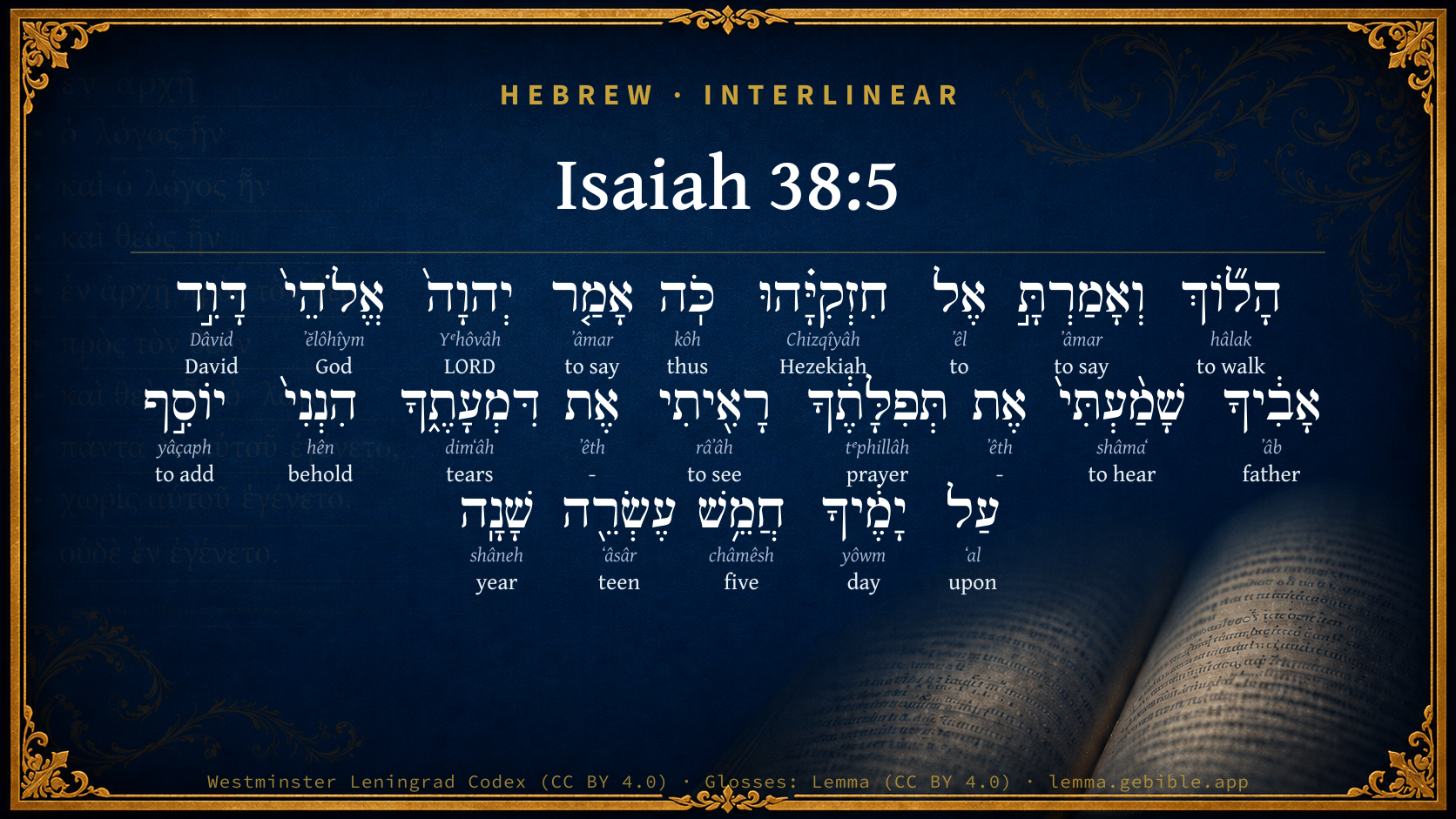
Isaiah 38:5

Hebrew (Westminster Leningrad Codex) Isaiah 38:5 appears in the Hebrew Old Testament. The text above is from the Westminster Leningrad Codex. Each word links to its Strong’s number, a concise gloss, and parsing drawn from the Open Scriptures Hebrew Bible morphology. Click any word for its full Brown-Driver-Briggs (BDB) entry.
Download image
Cite this verse

Isaiah 38:5 (World English Bible). Public Domain. Lemma interlinear Bible study tool, https://lemma.gebible.app/v/isaiah/38/5.

Show BibTeX & RIS
BibTeX
RIS
English Translation
Go, and tell Hezekiah, Thus says Yahweh, the God of David your father, I have heard your prayer, I have seen your tears: behold, I will add to your days fifteen years.
World English Bible · Public Domain
Download a study sheet

One document with this verse’s original text, its word-by-word gloss line, the meaning frame, cross-references with their text, attributed commentary, and full source and license credits — printable, and it pastes into notes with its structure intact.

This verse Autodidact and up

Study sheet (.html) Plain text (.txt)

A passage Seminary Student

Up to 50 verses in one chapter. A passage sheet keeps up to 6 commentary sources and 12 cross-references per verse, in the order this page ranks them, and says so on the sheet whenever that leaves anything out. Ask for a single verse and you get the Autodidact verse sheet above.

Everything on this page stays free to read, with no account — the sheet is a download of what is already on screen, not access to it.

Want to remove ads? Support Godless Engineer
Compare translations 3

The same verse in 3 English versions, stacked beneath the original-language interlinear above. Click any original word for its lexicon entry.

Each is an independent rendering of the whole verse — the interlinear is not word-aligned to these translations.

Highlighted words mark where these versions differ — a whole-verse word diff, not a word-by-word alignment.

  • World English Bible Public Domain
    Go, and tell Hezekiah, Thus says Yahweh, the God of David your father, I have heard your prayer, I have seen your tears: behold, I will add to your days fifteen years.
  • King James Version Public Domain
    Go, and say to Hezekiah, Thus saith the LORD, the God of David thy father, I have heard thy prayer, I have seen thy tears: behold, I will add unto thy days fifteen years.
  • unfoldingWord Literal Text CC BY-SA 4.0
    “Go, and you shall say to Hezekiah, ‘Thus says Yahweh, the God of David your father, “I have heard your prayer. I have seen your weeping. Behold me, one will add to your days 15 years.

unfoldingWord Literal Text — © unfoldingWord, licensed CC BY-SA 4.0. Word-aligned USFM3 via Door43 (git.door43.org/unfoldingWord/en_ult).

Versions to compare (up to 4)

3 of 4 selected

Show all 18 translations

Every available English version of this verse, each an independent rendering of the whole verse.

  • World English Bible Public Domain
    Go, and tell Hezekiah, Thus says Yahweh, the God of David your father, I have heard your prayer, I have seen your tears: behold, I will add to your days fifteen years.
  • Berean Standard Bible Public Domain
    “Go and tell Hezekiah that this is what the LORD, the God of your father David, says: ‘I have heard your prayer; I have seen your tears. Behold, I will add fifteen years to your life.
  • Majority Standard Bible Public Domain
    “Go and tell Hezekiah that this is what the LORD, the God of your father David, says: ‘I have heard your prayer; I have seen your tears. Behold, I will add fifteen years to your life.
  • King James Version Public Domain
    Go, and say to Hezekiah, Thus saith the LORD, the God of David thy father, I have heard thy prayer, I have seen thy tears: behold, I will add unto thy days fifteen years.
  • American Standard Version (1901) Public Domain
    Go, and say to Hezekiah, Thus saith Jehovah, the God of David thy father, I have heard thy prayer, I have seen thy tears: behold, I will add unto thy days fifteen years.
  • Revised Version (1885) Public Domain
    Go, and say to Hezekiah, Thus saith the LORD, the God of David thy father, I have heard thy prayer, I have seen thy tears: behold, I will add unto thy days fifteen years.
  • Geneva Bible (1599) Public Domain
    Goe, and say vnto Hezekiah, Thus saith the Lord God of Dauid thy father, I haue heard thy prayer, and seene thy teares: behold, I will adde vnto thy dayes fifteene yeeres.
  • Douay-Rheims (1899) Public Domain
    Go and say to Ezechias: Thus saith the Lord the God of David thy father: I have heard thy prayer, and I have seen thy tears: behold I will add to thy days fifteen years:
  • Young's Literal Translation Public Domain
    Go, and thou hast said to Hezekiah, Thus said Jehovah, God of David thy father, `I have heard thy prayer, I have seen thy tear, lo, I am adding to thy days fifteen years,
  • Literal Standard Version CC BY-SA 4.0
    “Go, and you have said to Hezekiah, Thus said YHWH, God of your father David: I have heard your prayer, I have seen your tear, behold, I am adding fifteen years to your days,
  • Unlocked Literal Bible CC BY-SA 4.0
    “Go and say to Hezekiah, the leader of my people, 'This is what Yahweh, the God of David your ancestor, says: I have heard your prayer, and I have seen your tears. See, I am about to add fifteen years to your life.
  • unfoldingWord Literal Text CC BY-SA 4.0
    “Go, and you shall say to Hezekiah, ‘Thus says Yahweh, the God of David your father, “I have heard your prayer. I have seen your weeping. Behold me, one will add to your days 15 years.
  • Darby Bible Public Domain
    Go and say to Hezekiah, Thus saith Jehovah, the God of David thy father: I have heard thy prayer, I have seen thy tears: behold, I will add to thy days fifteen years.
  • World Messianic Bible Public Domain
    “Go, and tell Hezekiah, ‘The LORD, the God of David your father, says, “I have heard your prayer. I have seen your tears. Behold, I will add fifteen years to your life.
  • Webster's Bible Public Domain
    Go and say to Hezekiah, Thus saith the LORD, the God of David thy father, I have heard thy prayer, I have seen thy tears: behold, I will add to thy days fifteen years.
  • Free Bible Version CC BY-SA 4.0
    “Go and tell Hezekiah, This is what the Lord, the God of your forefather David, says: I have heard your prayer, I have seen your tears. I will add fifteen years to your life.
  • Bible in Basic English Public Domain
    Go to Hezekiah, and say, The Lord, the God of David, your father, says, Your prayer has come to my ears, and I have seen your weeping: see, I will give you fifteen more years of life.
  • JPS Tanakh (1917) Public Domain
    'Go, and say to Hezekiah: Thus saith the LORD, the God of David thy father: I have heard thy prayer, I have seen thy tears; behold, I will add unto thy days fifteen years.

Literal Standard Version (2020), Covenant Press — licensed CC BY-SA 4.0. Text via the HelloAO Bible API (eBible.org). Unlocked Literal Bible (unfoldingWord) — licensed CC BY-SA 4.0. Text via the HelloAO Bible API (eBible.org). unfoldingWord Literal Text — © unfoldingWord, licensed CC BY-SA 4.0. Word-aligned USFM3 via Door43 (git.door43.org/unfoldingWord/en_ult). Free Bible Version, Dr. Jonathan Gallagher — licensed CC BY-SA 4.0. Text via the HelloAO Bible API (eBible.org).

Word by word

More ways to search: Search by grammar → Find every occurrence → Compare this word →

Practice this passage: Drill this verse → Learn its vocabulary →

דִּמְעָתֶ֑ךָ
dimʻâh
H1832
“tears · your”
Noun, Common, Feminine, Singular, Construct + Suffix, Personal, 2nd Person, Masculine, Singular
Part of Speech
Noun
Type
Common
Gender
Feminine
Number
Singular
State
Construct
Full BDB Definition

Origin: from H1831

TWOT: 442b

tears
  1. הָל֞וֹךְ hâlak H1980 “to walk” Verb, Qal, Infinitive Absolute
  2. וְאָמַרְתָּ֣ ʼâmar H559 “and · to say” Conjunction + Verb, Qal, Sequential Perfect, 2nd Person, Masculine, Singular
  3. אֶל ʼêl H413 “to” Preposition
  4. חִזְקִיָּ֗הוּ Chizqîyâh H2396 “Hezekiah” Noun, Proper
  5. כֹּֽה kôh H3541 “thus” Adverb
  6. אָמַ֤ר ʼâmar H559 “to say” Verb, Qal, Perfect, 3rd Person, Masculine, Singular
  7. יְהוָה֙ Yᵉhôvâh H3068 “LORD” Noun, Proper
  8. אֱלֹהֵי֙ ʼĕlôhîym H430 “God(s) of” Noun, Common, Masculine, Plural, Construct
  9. דָּוִ֣ד Dâvid H1732 “David” Noun, Proper
  10. אָבִ֔יךָ ʼâb H1 “father · your” Noun, Common, Masculine, Singular, Construct + Suffix, Personal, 2nd Person, Masculine, Singular
  11. שָׁמַ֨עְתִּי֙ shâmaʻ H8085 “to hear” Verb, Qal, Perfect, 1st Person, Common, Singular
  12. אֶת ʼêth H853 “-” Particle, Direct Object
  13. תְּפִלָּתֶ֔ךָ tᵉphillâh H8605 “prayer · your” Noun, Common, Feminine, Singular, Construct + Suffix, Personal, 2nd Person, Masculine, Singular
  14. רָאִ֖יתִי râʼâh H7200 “to see” Verb, Qal, Perfect, 1st Person, Common, Singular
  15. אֶת ʼêth H853 “-” Particle, Direct Object
  16. הִנְנִי֙ hên H2005 “behold · me” Particle, Demonstrative + Suffix, Personal, 1st Person, Common, Singular
  17. יוֹסִ֣ף yâçaph H3254 “to add” Verb, Hiphil, Imperfect, 3rd Person, Masculine, Singular
  18. עַל ʻal H5921 “upon” Preposition
  19. יָמֶ֔יךָ yôwm H3117 “days · your” Noun, Common, Masculine, Plural, Construct + Suffix, Personal, 2nd Person, Masculine, Singular
  20. חֲמֵ֥שׁ châmêsh H2568 “five” Adjective, Cardinal number, Feminine, Singular, Absolute
  21. עֶשְׂרֵ֖ה ʻâsâr H6240 “teen” Adjective, Cardinal number, Feminine, Singular, Absolute
  22. שָׁנָֽה shâneh H8141 “year” Noun, Common, Feminine, Singular, Absolute

About this verse

These counts appear in no published source. They are computed here, from the morphology-tagged text and Lemma’s own curated glosses. What Lemma adds →

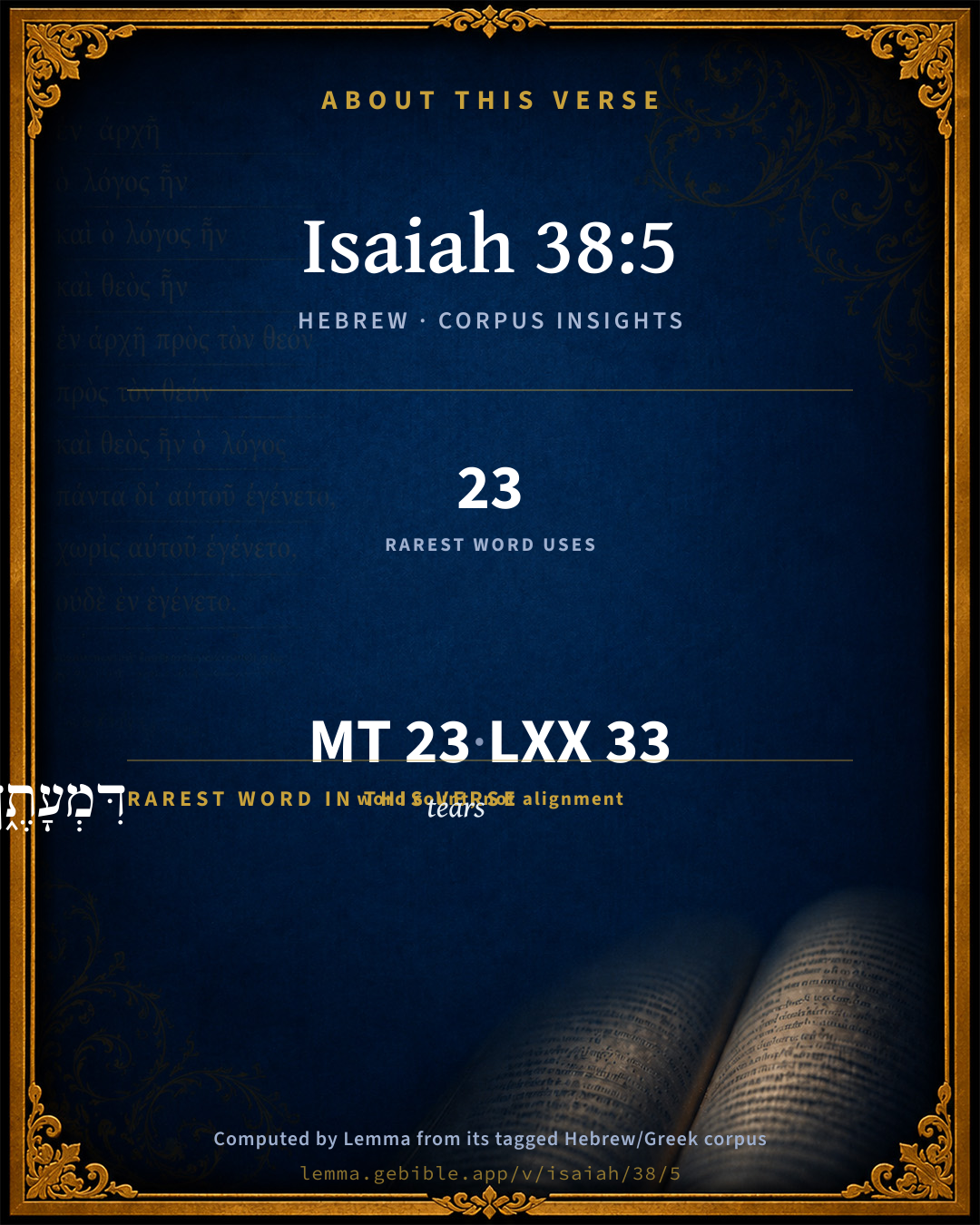
23
words
21
distinct lemmas
Prophets
section

Notable vocabulary

The rarest word here is דִּמְעָתֶ֑ךָ tears H1832 — appearing just 23 times in the whole Hebrew Bible.

Shared distinctive vocabulary

דִּמְעָתֶ֑ךָ tears H1832 occurs in 22 verses of the Hebrew Bible. Also found in:

Grammatical profile

  • 6 verbs
  • 9 nouns
  • 2 adjectives
  • 2 prepositions
  • 1 adverb
  • 3 particles

Verb forms

  • הָל֞וֹךְ Qal · Infinitive Absolute
  • וְאָמַרְתָּ֣ Qal · Sequential Perfect
  • אָמַ֤ר Qal · Perfect
  • שָׁמַ֨עְתִּי֙ Qal · Perfect
  • רָאִ֖יתִי Qal · Perfect
  • יוֹסִ֣ף Hiphil · Imperfect

Repetition

A word recurs within this verse — often emphatic in Hebrew:

  • וְאָמַרְתָּ֣ to say H559 ×2

Hebrew & Septuagint length

In English translation the verse runs 32 words from the Hebrew and 28 from the Septuagint (LXX English) — closely comparable.

A rough comparison of the two English renderings, which tokenize alike — not a word-level alignment.

Word counts can differ between the Hebrew and the Greek without any difference in meaning — e.g. the Hebrew direct-object marker אֵת has no separate Greek word, and Greek often adds the article ὁ.

In the original languages it is 23 Hebrew tokens and 33 Greek tokens — but the two are counted differently (Hebrew bundles its prefixes and suffixes into one token; the Greek is in lemma form), so that isn’t a like-for-like length.

Cross-references

24

Topical passages linked to Isaiah 38:5 in the Treasury of Scripture Knowledge — connected by theme and wording, ordered by reader-vote popularity; previews shown in the World English Bible.

  • Psalms 34:5–6 They looked to him, and were radiant. Their faces shall never be covered with shame.
  • 1 John 5:14–15 This is the boldness which we have toward him, that, if we ask anything according to his will, he listens to us.
  • Revelation 7:17 for the Lamb who is in the midst of the throne shepherds them, and leads them to springs of waters of life. And God will wipe away every tear from their eyes."
  • Luke 1:13 But the angel said to him, "Don't be afraid, Zacharias, because your request has been heard, and your wife, Elizabeth, will bear you a son, and you shall call his name John.
  • Psalms 147:3 He heals the broken in heart, And binds up their wounds.
  • Psalms 56:8 You number my wanderings. You put my tears into your bottle. Aren't they in your book?
  • 2 Kings 19:20 Then Isaiah the son of Amoz sent to Hezekiah, saying, Thus says Yahweh, the God of Israel, Whereas you have prayed to me against Sennacherib king of Assyria, I have heard [you].
  • Psalms 116:15 Precious in the sight of Yahweh is the death of his saints.
  • Matthew 22:32 'I am the God of Abraham, and the God of Isaac, and the God of Jacob?' God is not the God of the dead, but of the living."
  • 2 Corinthians 7:6 Nevertheless, he who comforts the lowly, God, comforted us by the coming of Titus;
  • Psalms 89:3–4 "I have made a covenant with my chosen one, I have sworn to David, my servant,
  • Isaiah 7:13–14 He said, "Listen now, house of David: Is it not enough for you to try the patience of men, that you will try the patience of my God also?
  • 1 Kings 9:4–5 As for you, if you will walk before me, as David your father walked, in integrity of heart, and in uprightness, to do according to all that I have commanded you, and will keep my statutes and my ordinances;
  • 2 Samuel 7:3–5 Nathan said to the king, Go, do all that is in your heart; for Yahweh is with you.
  • 1 Kings 8:25 Now therefore, Yahweh, the God of Israel, keep with your servant David my father that which you have promised him, saying, There shall not fail you a man in my sight to sit on the throne of Israel, if only your children take heed to their way, to walk before me as you have walked before me.
  • 1 Kings 11:12–13 Notwithstanding in your days I will not do it, for David your father's sake: but I will tear it out of the hand of your son.
  • 1 Kings 15:4 Nevertheless for David's sake did Yahweh his God give him a lamp in Jerusalem, to set up his son after him, and to establish Jerusalem;
  • 2 Kings 18:2 He was twenty-five years old when he began to reign; and he reigned twenty-nine years in Jerusalem: and his mother's name was Abi the daughter of Zechariah.
  • Acts 27:24 saying, 'Don't be afraid, Paul. You must stand before Caesar. Behold, God has granted you all those who sail with you.'
  • 2 Kings 18:13 Now in the fourteenth year of king Hezekiah did Sennacherib king of Assyria come up against all the fortified cities of Judah, and took them.
  • 1 Chronicles 17:2–4 Nathan said to David, Do all that is in your heart; for God is with you.
  • 2 Chronicles 34:3 For in the eighth year of his reign, while he was yet young, he began to seek after the God of David his father; and in the twelfth year he began to purge Judah and Jerusalem from the high places, and the Asherim, and the engraved images, and the molten images.
  • Job 14:5 Seeing his days are determined, The number of his months is with you, And you have appointed his bounds that he can't pass;
  • Psalms 39:12 "Hear my prayer, Yahweh, and give ear to my cry. Don't be silent at my tears. For I am a stranger with you, A foreigner, as all my fathers were.

Cross-references courtesy of OpenBible.info (CC BY 4.0).

Hebrew and Greek witnesses Masoretic Hebrew ↔ Greek Septuagint

The same verse in the two great witnesses to the Old Testament, shown verse-for-verse.

These are two independent witnesses, not word-aligned to each other, and the Septuagint is shown in lemma (dictionary) form.

Hebrew Isaiah 38:5 Masoretic · Westminster Leningrad Codex

הָל֞וֹךְ וְאָמַרְתָּ֣ אֶל חִזְקִיָּ֗הוּ כֹּֽה אָמַ֤ר יְהוָה֙ אֱלֹהֵי֙ דָּוִ֣ד אָבִ֔יךָ שָׁמַ֨עְתִּי֙ אֶת תְּפִלָּתֶ֔ךָ רָאִ֖יתִי אֶת דִּמְעָתֶ֑ךָ הִנְנִי֙ יוֹסִ֣ף עַל יָמֶ֔יךָ חֲמֵ֥שׁ עֶשְׂרֵ֖ה שָׁנָֽה

Go, and tell Hezekiah, Thus says Yahweh, the God of David your father, I have heard your prayer, I have seen your tears: behold, I will add to your days fifteen years.

World English Bible · Public Domain

Greek LXX Isaiah 38:5 Septuagint · lemma form

πορεύομαι καί εἶπον εζεκιας ὅδε λέγω κύριος ὁ θεός δαυίδ ὁ πατήρ σύ ἀκούω ὁ φωνή ὁ προσευχή σύ καί ὁράω ὁ δάκρυ σύ ἰδού προςτίθημι πρός ὁ χρόνος σύ ἔτος δέκα πέντε

Thus says the Lord, the God of David your father, I have heard your prayer, and seen your tears: behold, I will add to your time fifteen years.

LXX2012 (modern English Septuagint) · Public Domain

Hebrew: Westminster Leningrad Codex (CC BY 4.0). Greek: Septuagint (public domain); English from LXX2012 (modern English Septuagint) (Public Domain). How the Septuagint differs from the Hebrew →

Targum (Aramaic paraphrase)

1

The Targum is the ancient Jewish Aramaic paraphrase of the Hebrew Scriptures — an interpretive translation, not the Hebrew text itself. Onkelos (literal) and Pseudo-Jonathan (expansive) render the Torah, and Jonathan the Prophets. Coverage is partial: where no permissively-licensed English translation exists for a verse, only the Aramaic is shown. This is verse-level text, not a word-by-word alignment to the Hebrew.

  1. Targum Jonathan Prophets (Joshua–Malachi)
    אֱזֵיל וְתֵימַר לְחִזְקִיָה כִּדְנַן אֲמַר יְיָ אֱלָהֵיהּ דְדָוִד אָבוּךְ שְׁמִיעַ קֳדָמַי צְלוֹתָךְ גַלְיָא קֳדָמַי דִמְעֲתָךְ הָא אֲנָא מוֹסִיף עַל יוֹמָךְ חֲמֵשׁ עַסְרֵי שְׁנִין:

    Go, and say to Hezekiah, Thus saith the Lord, the God of David thy father, Thy prayer hath been heard by me, thy tears are observed by me: behold, I will add to thy days fifteen years;

    Targum Jonathan — Aramaic: “Mikraot Gedolot” (public domain). English: “Sefaria Community Translation” (CC0 1.0 (public-domain dedication)); “London "Chaldee Paraphrase," 1871” (public domain). Text via Sefaria.

Commentary

Notes on Isaiah 38:5 from classic Christian and Jewish commentators (each source and its license shown beneath its notes). The classic Christian expositions comment on the surrounding passage and are grouped to its opening verse, so a note may address several verses; the Jewish commentaries on the Tanakh (Rashi and others) are per-verse, so they appear only where the commentator wrote on this verse.

Lemma curates 59 commentaries, every one of them public domain or Creative Commons licensed, each selected and text-cleaned for this edition rather than reprinted as found. About our sources →

Trapp's Complete Commentary

John Trapp

Isa 38:5 Go, and say to Hezekiah, Thus saith the LORD, the God of David thy father, I have heard thy prayer, I have seen thy tears: behold, I will add unto thy days fifteen years.

Ver. 5. See 2Ki 20:5 {See Trapp on "2Ki 20:5"}

John Trapp, A Commentary or Exposition upon All the Books of the Old and New Testament (1647–1656) — public domain. Text from a community e-Sword module.

Tyndale Open Study Notes

Tyndale Open Resources

38:5 the God of your ancestor David: Hezekiah faithfully walked in David’s footsteps (see 37:35; 38:1-22).

Tyndale Open Study Notes — © Tyndale Open Resources, licensed CC BY-SA 4.0. Text via the HelloAO Bible API.

Jamieson, Fausset & Brown

Robert Jamieson, A. R. Fausset & David Brown

God of David thy father--God remembers the covenant with the father to the children (Exo 20:5; Psa 89:28-29).

tears-- (Psa 56:8).

days . . . years--Man's years, however many, are but as so many days (Gen 5:27).

Jamieson, Fausset & Brown — Commentary Critical and Explanatory on the Whole Bible (1871) — public domain (CC PDM 1.0). Text via the HelloAO Bible API.

Ellicott's Commentary for English Readers

(5) Fifteen years.—The words fix the date of the illness, taking the received chronology, as B.C. 713. The next verse shows that there was danger at the time to be apprehended from Assyria, but does not necessarily refer to Sennacherib’s invasion. Sargon’s attack (Isa_20:1) may have caused a general alarm.

A Bible Commentary for English Readers, edited by Charles John Ellicott (1878–1897) — public domain. Text from a community e-Sword module.

The Cambridge Bible for Schools and Colleges

gen. ed. J. J. S. Perowne

5. The verse is greatly abbreviated from 2Ki_20:5. After Hezekiah the words “the captain of my people” are omitted; and also the sentence “I will heal thee: on the third day thou shalt go up unto the house of the Lord,” which follows the word behold. It cannot be doubted that the historical book here preserves the original text.

the God of David thy father] for whose sake this special mercy is vouchsafed to the king (cf. ch. Isa_37:35; 2Ki_20:6).

fifteen years] That the number was arrived at by calculation on the part of the historian is not to be believed. If there be calculation in the case at all, it is in the date of ch. Isa_36:1, which may very possibly be an inference from this prediction combined with the statement of 2Ki_18:2. (See on ch. Isa_36:1) In any case the assumption that the prophecy was exactly fulfilled is a legitimate one, and the fourteenth year of Hezekiah must be accepted as the true date of this sickness. The only question is whether the writer of ch. Isa_36:1 may not have fallen into error by supposing that the date of Hezekiah’s sickness fixed the time of Sennacherib’s invasion. On that point see the Chronological Note, pp. lxxvi f. Since the king began to reign in his twenty-fifth year, it is after all not a long life that is here promised to him. His reign was to be doubled.

The Cambridge Bible for Schools and Colleges (gen. ed. J. J. S. Perowne; Cambridge University Press, 1878–1918) — public domain. Text from a community e-Sword module.

John Gill's Exposition

And I will deliver thee and this city out of the hand of the king of Assyria,.... So that it seems that Hezekiah's sickness was while the king of Assyria was near the city of Jerusalem, and about to besiege it, and before the destruction of the Assyrian army; unless this is said to secure Hezekiah and the inhabitants of Jerusalem from all fears of a return of that king, to give them fresh trouble:

and I will defend this city; from the present siege laid to it, ruin threatened it, or from any attack upon it, by the Assyrian monarch.

John Gill's Exposition of the Whole Bible (1746–1763) — public domain (CC PDM 1.0). Text via the HelloAO Bible API.

Albert Barnes' Notes on the Bible

The God of David thy father - David is mentioned here, probably, because Hezekiah had a strong resemblance to him 2Ki 18:3, and because a long and happy reign had been granted to David; and also because the promise had been made to David that there should not fail a man to sit on his throne (see the note at Isa 37:35). As Hezekiah resembled David, God promised that his reign should be lengthened out; and as he perhaps was then without a son and successor, God promised him a longer life, with the prospect that he might have an heir who should succeed him on the throne.

Behold, I will add unto thy days fifteen years - This is perhaps the only instance in which any man has been told exactly how long he would live. Why God specified the time cannot now be known. It was, however, a full answer to the prayer of Hezekiah, and the promise is a full demonstration that God is the hearer of prayer, and that he can answer it at once. We learn here, that it is right for a friend of God to pray for life. In times of sickness, and even when there are indications of a fatal disease, it is not improper to pray that the disease may be removed, and the life prolonged. If the desire be to do good; to advance the kingdom of God; to benefit others; or to perfect some plan of benevolence which is begun, it is not improper to pray that God would prolong the life. Who can tell but that he often thus spares useful lives when worn down with toil, and when the frame is apparently sinking to the grave, in answer to prayer? He does not indeed work miracles as he did in the case of Hezekiah, but he may direct to remedies which had not before occurred; or he may himself give a sudden and unlooked-for turn to the disease, and restore the sufferer again to health.

Albert Barnes' Notes on the Bible (1834–1885) — public domain. Text from a community e-Sword/MySword module.

The Pulpit Commentary

Thus saith the Lord,... I have heard thy prayer. According to the author of Kings, the full message sent to Hezekiah was, "I have heard thy prayer, I have seen thy tears: behold, I will heal thee: on the third day thou shalt go up unto the house of the Lord. And I will add unto thy clays fifteen years; and I will deliver time and this city out of the hand of the King of Assyria; and I will defend this city for mine own sake, and for my servant Davids sake". (2Ki_20:5, 2Ki_20:6) The words in italics are additional to those here reported by Isaiah. Fifteen years. This was doubling, or rather more than doubling, the length of Hezekiah"s reign, and allowing him a length of life exceeding that of the great majority of the kings of Judah, who seldom attained the age of fifty. Hezekiah lived to be fifty-four.

HOMILIES BY W.M. STATHAM Ver. 5. Hezekiah"s prayer heard.

"Thus saith the Lord, the God of David thy father, I have heard thy prayer, I have seen thy tears." These words were spoken to a heart riven with grief, and a life seemingly "sick unto death." At such times this man wants, above all else, to feel that he has been sincere. He says, not boastingly at all, but with real humility, "Remember now, O Lord, I beseech thee, how I have walked before thee in truth and with a perfect heart, and have done that which is good in thy sight." Words must be judged by the circumstances of the life. There is no self righteousness in them, but simple, guileless heart-speech.

I GOD"S SPEEDY CONSOLATION. "Go, and say to Hezekiah." For the Divine heart meets the human heart according to its moods. And there was no need to intensify Hezekiah"s sorrow or to test its sincerity. Just as our Saviour, remembering Peter"s fears after his denial, and knowing that the memory of his unfaithfulness and falsehood was a burning shame in his heart, said immediately after his resurrection, by the mouth of the angel, "Go your way, tell his disciples, and Peter", (Mar_16:7) that Peter might know that the "look" which struck out the fountain of tears, was turned into the look of forgiving grace and mercy. So here God would comfort Hezekiah at once in his true-hearted contrition.

II GOD"S TENDER REMEMBRANCE. "Thus saith the Lord, the God of David thy father." What music is that! Then there is something in a pious ancestry more than we think of at times. Your father was a man of God, perhaps. Then there are prayers treasured up for you in the greater Father"s memory. When we think of our Saviour, we "member his own words," For my sake." So God remembers also the sake of others: "For Zion"s sake;" "For Jerusalem"s sake." And as concerning Solomon God says, "Notwithstanding in thy days I will not rend the kingdom from thee, for David thy father"s sake." We read also in Genesis, "The Lord blessed the Egyptian"s house for Joseph"s sake." This is as touching as it is comforting. "The God of David thy father.

III GOD"S GRACIOUS SPEECH. "I have heard thy prayer, I have seen thy tears." The prayer that is heard is the prayer that is heartfelt. None need be ashamed of tears. They are not unmanly. "Jesus wept" When a man weeps we are accustomed to wonder, nay, sometimes to scorn. The world prefers the sternness of endurance and the courage of despair. God hears heavenly eloquence in sighs, and beautiful liturgies in tears. "A broken and a contrite heart, O Go!, thou wilt not despise." And the answer came: "I will add unto thy days fifteen years I will deliver thee and this city out of the hand of the King of Assyria." So God will save nations because of righteous souls, and will deliver us from worse Assyrians than those that imperilled Israel. W.M.S.

The Pulpit Commentary (1880–1919), ed. H.D.M. Spence-Jones & Joseph S. Exell — public domain. Text from a community e-Sword module.

J. A. Alexander on Isaiah

Joseph Addison Alexander

“Go and say to Hezekiah, Thus saith Jehovah, the God of David thy father, I have heard thy prayer, I have seen thy tears (or weeping); behold, I am adding (or about to add) unto thy days fifteen years.” The parallel passage (2Ki 20:5) has: ‘return and say to Hezekiah, the chief (or leader) of my people, Thus saith Jehovah etc.’ After tears it adds: ‘behold, (I am) healing (or about to heal) thee; on the third day thou shalt go up to the house of Jehovah.’ David is particularly mentioned as the person to whom the promise of perpetual succession had been given (2Sa 7:12). The threatening in v. 1 was conditional, and the second message was designed from the beginning no less than the first. The design of the whole proceeding was to let Hezekiah feel his obligation to a special divine interposition for a recovery which might otherwise have seemed the unavoidable effect of ordinary causes.

Joseph Addison Alexander, The Prophecies of Isaiah (1846–1847; New York: Scribner, 1870–1878) — public domain. Text from a community e-Sword module.

Rashi

Rabbi Shlomo Yitzchaki (Rashi)

Behold I will add (יוֹסִיף, lit., he will add.) Behold I am He Who will add to your life.

Rashi on the Tanakh — English translations: “The Judaica Press complete Tanach with Rashi, translated by A. J. Rosenberg” (CC BY 4.0); “Pentateuch with Rashi's commentary by M. Rosenbaum and A.M. Silbermann, 1929-1934” (public domain); “The Metsudah Tanach series, Lakewood, N.J” (CC BY 4.0); and “The Book of Joshua, Metsudah Publications, 1997” (CC BY 4.0). Text via Sefaria.

Lesson kit

Teaching starters — assembled from the data on this page, not authored interpretation. Every prompt links to the verse data it draws on. Edit before teaching.

Isaiah, in the Prophets, opens this verse with 23 words (21 distinct Hebrew lemmas). Its most distinctive word is dimʻâh (“tears”). A historical commentator’s framing appears above. Read the whole chapter for the surrounding context.

Discussion questions

  1. How does “tears” (dimʻâh) shape what this verse is saying?
  2. How does 2 Kings 20:5, which shares the word «tears», read alongside this verse?
  3. What does the repetition of “to say” (2× in this one verse) do in this verse?
  4. These translations render this verse differently; the difference is in the English rendering, not the original. What questions does that raise?
  5. «הָל֞וֹךְ» is a Qal Infinitive Absolute verb. How does that grammatical form shape the action described?
  6. Compare how Trapp's Complete Commentary and Tyndale Open Study Notes read this verse. Where do they agree or differ?

Things to notice

Reading settings

Reading text

Shown beneath each verse's original-language words.

Old Testament
Old Testament edition

Read the OT as the Masoretic Hebrew (MT) or the Greek Septuagint (LXX).

English shown for the Greek Septuagint (in the Hebrew ↔ Greek comparison).

Comparing translations? Open the Compare panel on any verse page to stack up to four side by side.