Jeremiah 8:17

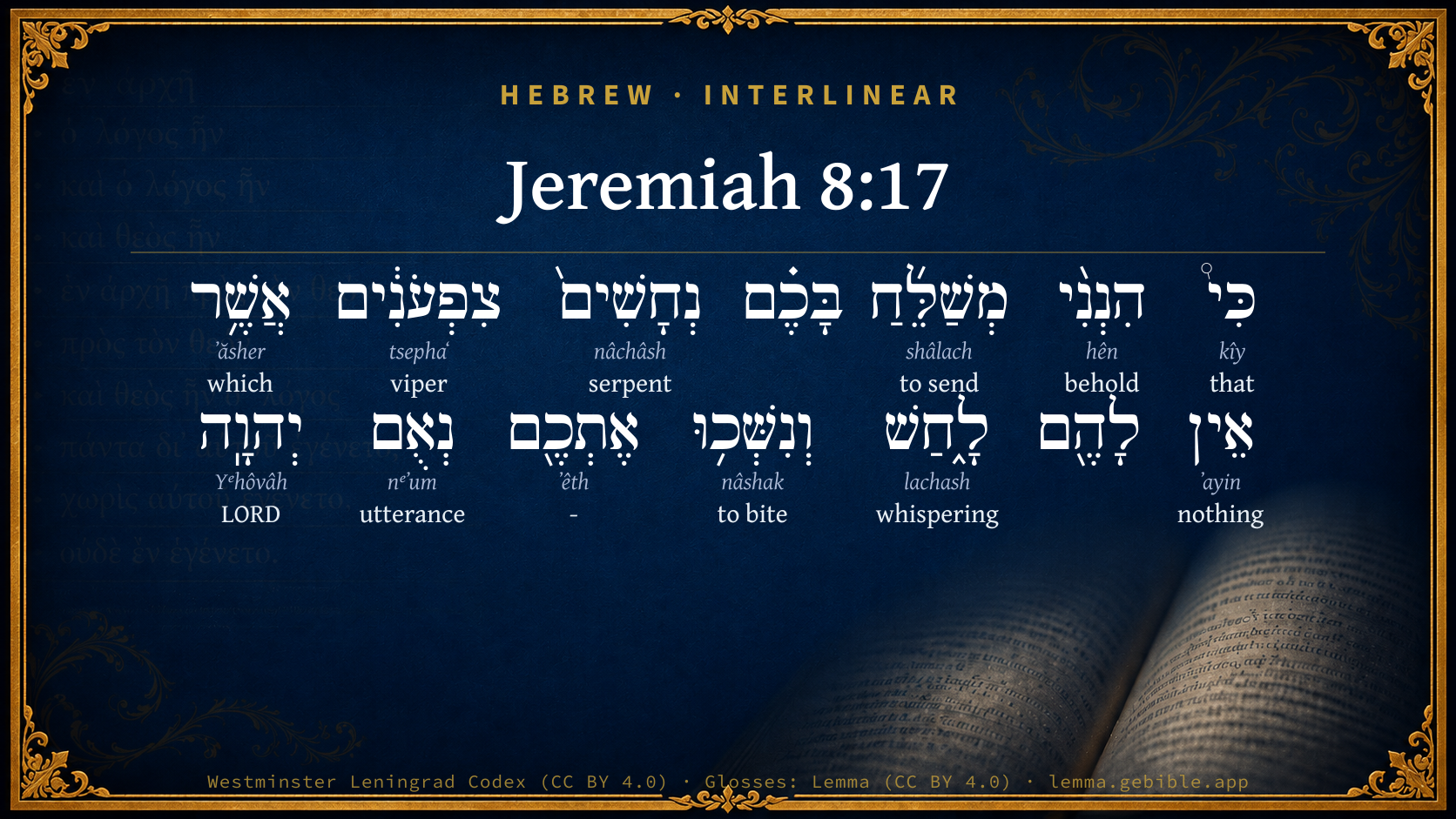
Hebrew (Westminster Leningrad Codex) Jeremiah 8:17 appears in the Hebrew Old Testament. The text above is from the Westminster Leningrad Codex. Each word links to its Strong’s number, a concise gloss, and parsing drawn from the Open Scriptures Hebrew Bible morphology. Click any word for its full Brown-Driver-Briggs (BDB) entry.
Download image
Cite this verse

Jeremiah 8:17 (World English Bible). Public Domain. Lemma interlinear Bible study tool, https://lemma.gebible.app/v/jeremiah/8/17.

Show BibTeX & RIS
BibTeX
RIS
English Translation
For, behold, I will send serpents, adders, among you, which will not be charmed; and they shall bite you, says Yahweh.
World English Bible · Public Domain
Download a study sheet

One document with this verse’s original text, its word-by-word gloss line, the meaning frame, cross-references with their text, attributed commentary, and full source and license credits — printable, and it pastes into notes with its structure intact.

This verse Autodidact and up

Study sheet (.html) Plain text (.txt)

A passage Seminary Student

Up to 50 verses in one chapter. A passage sheet keeps up to 6 commentary sources and 12 cross-references per verse, in the order this page ranks them, and says so on the sheet whenever that leaves anything out. Ask for a single verse and you get the Autodidact verse sheet above.

Everything on this page stays free to read, with no account — the sheet is a download of what is already on screen, not access to it.

Want to remove ads? Support Godless Engineer
Compare translations 3

The same verse in 3 English versions, stacked beneath the original-language interlinear above. Click any original word for its lexicon entry.

Each is an independent rendering of the whole verse — the interlinear is not word-aligned to these translations.

Highlighted words mark where these versions differ — a whole-verse word diff, not a word-by-word alignment.

  • World English Bible Public Domain
    For, behold, I will send serpents, adders, among you, which will not be charmed; and they shall bite you, says Yahweh.
  • King James Version Public Domain
    For, behold, I will send serpents, cockatrices, among you, which will not be charmed, and they shall bite you, saith the LORD.
  • unfoldingWord Literal Text CC BY-SA 4.0
    “For behold, I sending snakes among you, vipers that there is not for them a charm. And they will bite you“—the declaration of Yahweh.

unfoldingWord Literal Text — © unfoldingWord, licensed CC BY-SA 4.0. Word-aligned USFM3 via Door43 (git.door43.org/unfoldingWord/en_ult).

Versions to compare (up to 4)

3 of 4 selected

Show all 18 translations

Every available English version of this verse, each an independent rendering of the whole verse.

  • World English Bible Public Domain
    For, behold, I will send serpents, adders, among you, which will not be charmed; and they shall bite you, says Yahweh.
  • Berean Standard Bible Public Domain
    “For behold, I will send snakes among you, vipers that cannot be charmed, and they will bite you,” declares the LORD.
  • Majority Standard Bible Public Domain
    “For behold, I will send snakes among you, vipers that cannot be charmed, and they will bite you,” declares the LORD.
  • King James Version Public Domain
    For, behold, I will send serpents, cockatrices, among you, which will not be charmed, and they shall bite you, saith the LORD.
  • American Standard Version (1901) Public Domain
    For, behold, I will send serpents, adders, among you, which will not be charmed; and they shall bite you, saith Jehovah.
  • Revised Version (1885) Public Domain
    For, behold, I will send serpents, basilisks, among you, which will not be charmed; and they shall bite you, saith the LORD.
  • Geneva Bible (1599) Public Domain
    For beholde, I will sende serpents, and cockatrices among you, which will not be charmed, and they shall sting you, sayth the Lord.
  • Douay-Rheims (1899) Public Domain
    For behold I will send among you serpents, basilisks, against which there is no charm: and they shall bite you, saith the Lord.
  • Young's Literal Translation Public Domain
    For, lo, I am sending among you serpents, Vipers that have no charmer, And they have bitten you, an affirmation of Jehovah.
  • Literal Standard Version CC BY-SA 4.0
    For behold, I am sending serpents among you, || Vipers that have no charmer, || And they have bitten you,” || A declaration of YHWH.
  • Unlocked Literal Bible CC BY-SA 4.0
    For see, I am sending out snakes among you, vipers that you cannot charm. They will bite you—this is Yahweh's declaration.'”
  • unfoldingWord Literal Text CC BY-SA 4.0
    “For behold, I sending snakes among you, vipers that there is not for them a charm. And they will bite you“—the declaration of Yahweh.
  • Darby Bible Public Domain
    For behold, I send among you serpents, vipers against which there is no charm, and they shall bite you, saith Jehovah.
  • World Messianic Bible Public Domain
    “For, behold, I will send serpents, adders among you, which will not be charmed; and they will bite you,” says the LORD.
  • Webster's Bible Public Domain
    For behold, I will send serpents, cockatrices, among you, which will not be charmed, and they shall bite you, saith the LORD.
  • Free Bible Version CC BY-SA 4.0
    Watch out! I'm sending snakes among you, vipers that can't be charmed. They will come and bite you, declares the Lord.
  • Bible in Basic English Public Domain
    See, I will send snakes and poison-snakes among you, against which the wonder-worker has no power; and they will give you wounds which may not be made well, says the Lord.
  • JPS Tanakh (1917) Public Domain
    For, behold, I will send serpents, basilisks, among you, which will not be charmed; and they shall bite you, saith the LORD.

Literal Standard Version (2020), Covenant Press — licensed CC BY-SA 4.0. Text via the HelloAO Bible API (eBible.org). Unlocked Literal Bible (unfoldingWord) — licensed CC BY-SA 4.0. Text via the HelloAO Bible API (eBible.org). unfoldingWord Literal Text — © unfoldingWord, licensed CC BY-SA 4.0. Word-aligned USFM3 via Door43 (git.door43.org/unfoldingWord/en_ult). Free Bible Version, Dr. Jonathan Gallagher — licensed CC BY-SA 4.0. Text via the HelloAO Bible API (eBible.org).

Word by word

More ways to search: Search by grammar → Find every occurrence → Compare this word →

Practice this passage: Drill this verse → Learn its vocabulary →

צִפְעֹנִ֔ים
tsephaʻ
H6848
“vipers”
Noun, Common, Masculine, Plural, Absolute
Part of Speech
Noun
Type
Common
Gender
Masculine
Number
Plural
State
Absolute
Full BDB Definition

Origin: from an unused root meaning to extrude

TWOT: 1954a , 1954b

poisonous serpent - a viper snake or adder
  1. כִּי֩ kîy H3588 “that” Conjunction
  2. הִנְנִ֨י hên H2005 “behold · me” Particle, Demonstrative + Suffix, Personal, 1st Person, Common, Singular
  3. מְשַׁלֵּ֜חַ shâlach H7971 “sending” Verb, Piel, Participle Active, Masculine, Singular, Absolute
  4. נְחָשִׁים֙ nâchâsh H5175 “serpents” Noun, Common, Masculine, Plural, Absolute
  5. אֲשֶׁ֥ר ʼăsher H834 “which” Particle, Relative
  6. אֵין ʼayin H369 “nothing” Particle, Negative
  7. לָ֑חַשׁ lachash H3908 “whispering” Noun, Common, Masculine, Singular, Absolute
  8. וְנִשְּׁכ֥וּ nâshak H5391 “and · to bite” Conjunction + Verb, Piel, Sequential Perfect, 3rd Person, Common, Plural
  9. אֶתְכֶ֖ם ʼêth H853 “- · you” Particle, Direct Object + Suffix, Personal, 2nd Person, Masculine, Plural
  10. נְאֻם nᵉʼum H5002 “utterance of” Noun, Common, Masculine, Singular, Construct
  11. יְהוָֽה Yᵉhôvâh H3068 “LORD” Noun, Proper

About this verse

These counts appear in no published source. They are computed here, from the morphology-tagged text and Lemma’s own curated glosses. What Lemma adds →

14
words
12
distinct lemmas
Prophets
section

Notable vocabulary

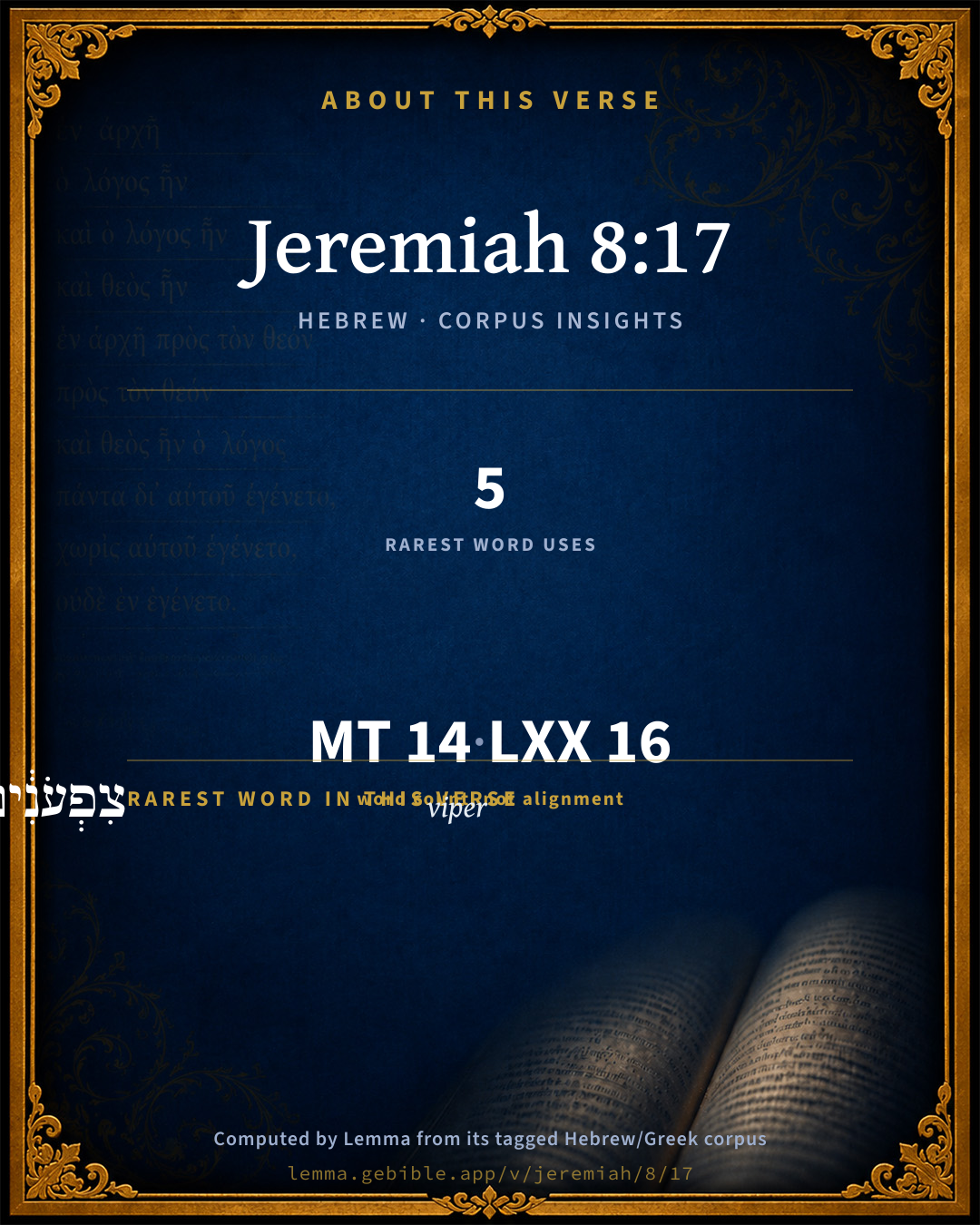
The rarest word here is צִפְעֹנִ֔ים viper H6848 — appearing just 5 times in the whole Hebrew Bible.

Shared distinctive vocabulary

צִפְעֹנִ֔ים viper H6848 occurs in 5 verses of the Hebrew Bible. Also found in:

Grammatical profile

  • 2 verbs
  • 5 nouns
  • 2 prepositions
  • 1 conjunction
  • 4 particles

Verb forms

  • מְשַׁלֵּ֜חַ Piel · Participle Active
  • וְנִשְּׁכ֥וּ Piel · Sequential Perfect

Hebrew & Septuagint length

In the original languages it is 14 Hebrew tokens and 16 Greek tokens — but the two are counted differently (Hebrew bundles its prefixes and suffixes into one token; the Greek is in lemma form), so that isn’t a like-for-like length.

Cross-references

8

Topical passages linked to Jeremiah 8:17 in the Treasury of Scripture Knowledge — connected by theme and wording, ordered by reader-vote popularity; previews shown in the World English Bible.

  • Ecclesiastes 10:11 If the snake bites before it is charmed, then is there no profit for the charmer's tongue.
  • Deuteronomy 32:24 [They shall be] wasted with hunger, and devoured with burning heat Bitter destruction; The teeth of animals will I send on them, With the poison of crawling things of the dust.
  • Psalms 58:4–5 Their poison is like the poison of a snake; Like a deaf cobra that stops its ear,
  • Numbers 21:6 Yahweh sent fiery serpents among the people, and they bit the people; and much people of Israel died.
  • Isaiah 14:29 Don't rejoice, O Philistia, all of you, because the rod that struck you is broken; for out of the serpent's root shall come forth an adder, and his fruit shall be a fiery flying serpent.
  • Amos 5:19 As if a man fled from a lion, And a bear met him; Or he went into the house and leaned his hand on the wall, And a snake bit him.
  • Amos 9:3 Though they hide themselves in the top of Carmel, I will search and take them out there; and though they be hid from my sight in the bottom of the sea, there I will command the serpent, and it will bite them.
  • Revelation 9:19 For the power of the horses is in their mouths, and in their tails. For their tails are like serpents, and have heads, and with them they harm.

Cross-references courtesy of OpenBible.info (CC BY 4.0).

Hebrew and Greek witnesses Masoretic Hebrew ↔ Greek Septuagint

The same verse in the two great witnesses to the Old Testament, shown verse-for-verse.

These are two independent witnesses, not word-aligned to each other, and the Septuagint is shown in lemma (dictionary) form.

Hebrew Jeremiah 8:17 Masoretic · Westminster Leningrad Codex

כִּי֩ הִנְנִ֨י מְשַׁלֵּ֜חַ בָּכֶ֗ם נְחָשִׁים֙ צִפְעֹנִ֔ים אֲשֶׁ֥ר אֵין לָהֶ֖ם לָ֑חַשׁ וְנִשְּׁכ֥וּ אֶתְכֶ֖ם נְאֻם יְהוָֽה

For, behold, I will send serpents, adders, among you, which will not be charmed; and they shall bite you, says Yahweh.

World English Bible · Public Domain

Greek LXX Structure differs

In the Septuagint, Jeremiah is about an eighth shorter than the Hebrew and arranges its material differently — the Oracles Against the Nations (Hebrew chapters 46–51) appear in the middle of the Greek book, after 25:13. Because the chapter and verse boundaries do not line up, a verse-for-verse comparison with the Hebrew is not shown.

A verse-for-verse comparison isn’t shown here because the chapters and verses don’t line up. Switch to the LXX edition with the MT / LXX toggle above to read the Greek directly.

On this verse, Trapp's Complete Commentary discusses the Septuagint’s reading. Read the note in Commentary ↓

Hebrew: Westminster Leningrad Codex (CC BY 4.0). Greek: Septuagint (public domain); English from a public-domain English Septuagint. How the Septuagint differs from the Hebrew →

Targum (Aramaic paraphrase)

1

The Targum is the ancient Jewish Aramaic paraphrase of the Hebrew Scriptures — an interpretive translation, not the Hebrew text itself. Onkelos (literal) and Pseudo-Jonathan (expansive) render the Torah, and Jonathan the Prophets. Coverage is partial: where no permissively-licensed English translation exists for a verse, only the Aramaic is shown. This is verse-level text, not a word-by-word alignment to the Hebrew.

  1. Targum Jonathan Prophets (Joshua–Malachi)
    אֲרֵי הָא אֲנָא מְגָרֵי בְּכוֹן עַמְמִין קְטוֹלִין כְּחֵיוִין חוּרְמָנִין דְלֵית לְהוֹן לַחְשָׁא וְיִקְטְלוּן יַתְכוֹן אֲמַר יְיָ:

    (no public-domain English translation for this verse)

    Targum Jonathan — Aramaic: “Mikraot Gedolot” (public domain). English: “Sefaria Community Translation” (CC0 1.0 (public-domain dedication)); “London "Chaldee Paraphrase," 1871” (public domain). Text via Sefaria.

Commentary

Notes on Jeremiah 8:17 from classic Christian and Jewish commentators (each source and its license shown beneath its notes). The classic Christian expositions comment on the surrounding passage and are grouped to its opening verse, so a note may address several verses; the Jewish commentaries on the Tanakh (Rashi and others) are per-verse, so they appear only where the commentator wrote on this verse.

Lemma curates 59 commentaries, every one of them public domain or Creative Commons licensed, each selected and text-cleaned for this edition rather than reprinted as found. About our sources →

Trapp's Complete Commentary

John Trapp

Jer 8:17 For, behold, I will send serpents, cockatrices, among you, which [will] not [be] charmed, and they shall bite you, saith the LORD.

Ver. 17. Behold, I will send serpents, cockatrices,] i.e., Chaldees, no less virulent than serpents, as violent as horses. Serpentum tot sunt venena quot genera, tot pernicies quot species, tot dolores quot colores, saith an ancient. {a} Serpents are of several sorts, but all poisonous and pernicious. The basilisk or cockatrice here instanced (the worst sort of serpents, say the Septuagint here) goeth not upon the belly, as other serpents, but erect from the middle part, and doth so infect the air, that by the pestilent breath coming therefrom fruits are killed, and men being but looked upon by it, and birds flying over it; stones also are broken thereby, and all other serpents put to flight.

And they shall bite you.] There is an elegance in the original. {b}

{a} Isidor., lib. xii. cap. 2.

{b} Diod., Piscator.

John Trapp, A Commentary or Exposition upon All the Books of the Old and New Testament (1647–1656) — public domain. Text from a community e-Sword module.

The Biblical Illustrator

Joseph S. Exell

Jer_8:17

I will send serpents, cockatrices, among you.

Penalty

There are countries that are desolated by animals; there have been harvests eaten by locusts; there have been vineyards stripped by insects; there is, therefore, no violence in the figure, and there is nothing of the nature of exaggeration. The animals have one keeper. God can make them live where tie likes. The sight of that cockatrice might make a man almost pray. It would turn many a blustering, blatant sinner in the city into a coward if he could but once catch sight of it on the counting house floor; then any prophet would be welcome who could charm the evil thing. But this cockatrice will not be charmed. It will look with proud disdain upon your traps and snares and all your offered flatteries, and all your bribes to its cruel dignity; it has come to do Gods judgment work and it will not accept the compromise the sinner proposes. These words are full of sadness, full of horribleness: but we must be horrible before we can be gracious; we must know what the law is before we can know what the Gospel is; we must preach--oh, sad confession, and hurtful to a dainty and irrational sentimentality!--we must preach hell, if haply men may, by the terror of the Lord, be brought to know the meaning of His grace. (J. Parker, D. D.)

The Biblical Illustrator, edited by Joseph S. Exell (c. 1880s–1900s) — public domain. Text from a community e-Sword module.

Joseph Benson's Commentary

Jer 8:17. For behold, I send serpents, &c., which shall not be charmed — Such enemies as you shall not be able to soften by any entreaties you can use. That some persons possessed the faculty of rendering serpents harmless, is a fact too well attested by historians and travellers to admit of contradiction: but by what means this effect was produced is not quite so clear. Pliny speaks of certain herbs which, being carried about, prevented the bite of serpents, Nat. Hist., lib. 20. sec. 16, lib. 22. sec. 25. Others tell surprising, but not altogether incredible stories, of the influence of musical sounds. See Shaw’s Travels, p. 429; and Sir John Chardin’s MS., cited by Harmer, chap. Jer 8:14. In this same MS. the author remarks, that “those who know how to tame serpents by their charms are wont commonly to break out their teeth; and supposes this to be alluded to, Psa 58:6, Break their teeth, O God, in their mouths.” But whatever were the methods commonly practised to charm serpents, the enemies of the Jews are here compared to such serpents as were not to be mollified nor disarmed by any of those means. They shall bite you, saith the Lord — See Blaney, and note on Psa 58:5.

Joseph Benson's Commentary on the Old and New Testaments (1811–1818) — public domain. Text from a community e-Sword module.

Geneva Bible (1599)

Geneva Bible translators

God threateneth to send the Babylonians among them, who shall utterly destroy them in such sort, as by no means they shall escape.

Geneva Bible (1599) marginal notes — public domain. Text via Bolls.life.

Jamieson, Fausset & Brown

Robert Jamieson, A. R. Fausset & David Brown

I--Jehovah.

cockatrices--basilisks (Isa 11:8), that is, enemies whose destructive power no means, by persuasion or otherwise, can counteract. Serpent-charmers in the East entice serpents by music, and by a particular pressure on the neck render them incapable of darting (Psa 58:4-5).

Jamieson, Fausset & Brown — Commentary Critical and Explanatory on the Whole Bible (1871) — public domain (CC PDM 1.0). Text via the HelloAO Bible API.

Adam Clarke's Commentary

Verse 17. I will send serpents] These were symbols of the enemies that were coming against them; a foe that would rather slay them and destroy the land than get booty and ransom.

Adam Clarke's Commentary on the Bible (1810–1826) — public domain. Text from a community e-Sword/MySword module.

John Calvin's Commentaries

He increases their terror by another comparison, — that not only enemies would violently attack them, but that their bitings would be venomous. He had spoken of horses, and mentioned their violent onsets; but he now expresses another thing, — that the Jews would have to carry on war with vipers and basilisks The Prophet no doubt only meant to shew that they could not possibly escape; for as from serpents men can hardly escape, especially when they are numerous, and assail them on every side, so he intimates, that the war would be fatal to the Jews, when attacked by serpents and vipers.

They shall bite you, he says, and for them there will be no incantation; that is, by no means can they be driven away from you. If one asks, Can serpents be driven away by incantations? the answer is, — that the Prophet here does not refer to what is true, but speaks according to the common opinions of men. It has been thought in all ages, that serpents can be driven away by incantations, or be killed, or be deprived of the power of hurting. “The deadly snake, “says Virgil, in Eclo. viii., “is dissolved in the meadows by singing.” What that heathen poet has said has been believed also by other nations; and as I have already said, it has been a commonly received opinion that serpents may be charmed. As then it was a common belief, the Prophet says, “If ye think that these serpents can be turned away, and the hurt that proceeds from them, ye are greatly deceived; for there will be for them no incantation.” There is also a mention made of incantation in Psalm 58:6: but as I have already said, the prophets accommodate their words to the comprehension of men. The Prophet does here also indirectly reprove the Jews, by comparing their false resources to incantations, as though he had said, — “Ye think that ye can soothe your enemies by flatteries and bribery, so that they may not hurt you; and ye also think that ye have ready at hand various means by which you may avert the evils which impend over you: in vain, he says, ye deceive yourselves with such hopes; for all your incantations as to these serpents shall be to no purpose, and wholly useless.”

We now then perceive the Prophet’s intention, and see that by this figure he ironically derides the crafty measures of the people, and all the remedies which they thought they had in readiness when assailed by their enemies. It follows —

John Calvin's Commentaries (1540-1563) — public domain. Text from the Calvin Translation Society English edition (1840s-50s) via the Christian Classics Ethereal Library (ccel.org). Calvin's coverage is partial (roughly two-thirds of the Bible); uncommented books and verses are honest gaps, never fabricated. The 19th-century editor's footnotes and remarks are omitted so the notes are faithfully Calvin's own voice.

Ellicott's Commentary for English Readers

(17) Serpents, cockatrices.—There is a sudden change of figure, one new image of terror starting from the history of the fiery serpents of Num_21:6, or, possibly, from the connection of Dan with the “serpent” and “adder” in Gen_49:17. It is not easy to identify the genus and species of the serpents of the Bible. Here the two words are in apposition. “Cockatrice,” however, cannot be right, that name belonging, as an English word, to legendary zoology. The Vulg. gives “basilisk.” In Pro_23:32 it is translated by “adder.” In any case it implies a hissing venomous snake (probably the cerastes or serpens regulus), and the symbolism which identified it with the Assyrian or Chaldæan power had already appeared in Isa_14:29.

Which will not be charmed.—The figure is that of Psa_58:4-5. The “deaf adder” that “refuseth to hear the voice of the charmer” represents an implacable enemy waging a pitiless war. Serpent-charming, as in the case of the Egyptian sorcerers (Exo_7:11), seems to have been from a very early time, as it is now, both in Egypt and India, one of the most prominent features of the natural magic of the East.

A Bible Commentary for English Readers, edited by Charles John Ellicott (1878–1897) — public domain. Text from a community e-Sword module.

The Cambridge Bible for Schools and Colleges

gen. ed. J. J. S. Perowne

17. basilisks] better (mg.) adders, for the basilisk was only fabulous. The creature here meant cannot be identified with certainty. See conjectures in Dr., pp. 351 f. No art of the charmer will avail against the foe here figured. The serpent-charming art is still kept up in the East. It is supposed that the sharp shrill sounds which the charmers produce by their voice or an instrument are the means by which the desired result is reached. They also “repeatedly breathe strongly into the face of the serpent and occasionally blow spittle, or some medicated composition upon them.” Thomson, op. cit. p. 154.

18–9:1. See summary at commencement of section.

The Cambridge Bible for Schools and Colleges (gen. ed. J. J. S. Perowne; Cambridge University Press, 1878–1918) — public domain. Text from a community e-Sword module.

John Gill's Exposition

When I would comfort myself against terror,.... Either naturally, by eating and drinking, the necessary and lawful means of refreshment; or spiritually, by reading the word of God, and looking over the promises in it:

my heart is faint in me; at the consideration of the calamities which were coming upon his people, and which were made known to him by a spirit of prophecy, of which he had no room to doubt. So the Targum takes them to be the words of the prophet, paraphrasing them,

"for them, saith the prophet, my heart grieves.''

John Gill's Exposition of the Whole Bible (1746–1763) — public domain (CC PDM 1.0). Text via the HelloAO Bible API.

Albert Barnes' Notes on the Bible

I will send - Or, am sending. No prophet changes his metaphors so suddenly as Jeremiah. The invading army is now compared to snakes, whom no charming can soothe, and whose bite is fatal. Compare Num 21:5-6.

Cockatrices - “Vipers.” See Isa 11:8 note.

Albert Barnes' Notes on the Bible (1834–1885) — public domain. Text from a community e-Sword/MySword module.

Haydock's Catholic Bible Commentary

Charm. The Chaldeans will not be moved to pity (Menochius) by any words. (Worthington)

George Leo Haydock (1774–1849), Haydock's Catholic Family Bible and Commentary, 1859 edition — public domain. Excludes Psalms (Douay-Rheims chapter numbering differs from Protestant) and Deuterocanonical books (Catholic canon only).

Matthew Poole's English Annotations

He proceeds in increasing of their terror: q.d. There will be no appeasing or allaying of their fury by any art or method; therefore represented by the cockatrice, called in Latin regulus, or king of serpents, as putting to flight all other serpents; but by apposition to

serpents, showing what kind of serpent they shall be, a sort that cannot be charmed, viz. such an enemy as by no entreaty can be made exorable: see on Isa 11:8. LXX. deadly serpents. They shall bite you; they shall afflict you with sore punishments, not only stings in their tails, as scorpions, but in their teeth, whereby they shall devour you, Jer 8:16.

Matthew Poole's English Annotations on the Holy Bible (1683–1685) — public domain. Text from a community e-Sword/MySword module.

The Pulpit Commentary

A new image to intensify the impression of dreadfulness. Serpents, cockatrices; rather, serpents (even) basilisks. The second noun is in apposition to the more general "serpents." "Basilisks" (Serpentes regulos) are the renderings of Aquila and the Vulgate. Some species of highly venomous serpent is clearly intended; more than this we cannot say. The root probably means "to hiss." Canon Tristram thinks of "a very beautifully marked yellow serpent, and the largest of the vipers found in the Holy Land," called the Daboia xantheina. He adds that it is one of the most dangerous ("Nat. Hist. of Palestine," p. 275).

The serpents which cannot be charmed.

I THERE ARE SERPENTS WHICH CAN BE CHARMED. Serpent-charming must have been a not unfamiliar sight to the Israelites (see "The Land and the Book," pp. 154, 155). This means, taking the figure away, that there were many great and pressing evils which lay within human resources to mitigate, perhaps to remove. Thus when sore famine fell upon Canaan, Jacob found corn, though he had to send as far as Egypt. The resources thus employed are, no doubt, exceptional, and need peculiar skill and aptitude to discover and use them; but still and this is the thing of importance here to remember they are within the reach of the natural man. To say that necessity is the mother of invention is only another way of saying that there are serpents which can be charmed. Man stands upon the known and the achieved, that he may reach forward and win something more from the unknown. Not everybody can charm a serpent, but some can. So there are a few physicians, one here and another there, who have wonderful skill in the cure of special diseases. Part of the ills of human life can be swept away by wise and timely legislation. Epidemics may be restrained and made comparatively mild by cleanliness and attention to sanitary rules. This which in one age have been thought beyond remedy, in the next age are perfectly understood as to their causes and their cure.

II THERE ARE SERPENTS WHICH CANNOT BE CHARMED. We may assume that it was so literally; that there were certain serpents which proved obdurate against every wile. And the danger of the serpent"s bite would in such an instance become most dreadful, Just from this very insensibility to everything in the shape of a charm. An enemy was to be brought on Israel whom no bribe, no promise, no art of persuasion whatever, could turn back. If he was to be turned back, it must be by main force or by Divine interposition. So we have to consider that, whatever ills we may succeed in neutralizing, there are others still left behind, unabated in their deadly efficiency by any resources we have in ourselves. It matters little that we can charm some serpents, if we cannot charm all If there be left only one superior, to our skill, that one is enough to ruin all. The most successful charmer among us will discover his match at last. He may charm poverty away, only to find, in a little while, ennui and possession without enjoyment. He may have the experience indicated in Pro_23:32: he may charm away, as he thinks, the peril of the wine-cup, and exult in assured mastery, only to discover at last that the foe with whom he has been trifling "bites like a serpent, and stings like an adder." So a man may achieve most of his purposes, charming away, as it were, obstacles on every side, only to find in the end that he cannot charm his conscience, that it will not be silent and sleep before the memory of much wrong-doing.

III THERE ARE SERPENTS WHICH CAN BE MORE THAN CHARMED. There is much in the conjecture that the reference to the serpent here is suggested by the mention of Dan in the previous verse. Jacob"s word for his son Dan was, "Dan shall be a serpent By the way, an adder in the path, that biteth the horse heels, so that his rider shall fall backwards". (Gen_49:17) But we shall do wisely in considering the reference as having a deeper connection with the work of him who is the serpent from the beginning. (Rev_20:2) All the painful serpent-bites of life, all the deadly ills, proceed from the brood which in some way or other originate with him. And thus thinking of him, the great dragon, the devil, the adversary, we must needs think of the correspondingly profound work of Jesus over against his work. Jesus was a serpent-charmer; and his efficacy as a charmer is most graciously manifested in the miracles which he wrought to remove physical defect, disease, and death. These miracles had in them something of the nature of a charm. They did not destroy the maleficent power, but they curbed it, made it for the time dormant and inoperative. But after having done all these miracles, Jesus is seen proceeding to a work which is more than that of the charmer. He who was lifted up to draw all men to him makes the victim of the serpent-bite impervious, for all future existence, to any further danger. The bite may come, in the sense of inflicting pain, but the peril is past. The serpent-poison becomes neutralized by the vigor and purity of that eternal life which is in Christ Jesus the Lord. Y.

The Pulpit Commentary (1880–1919), ed. H.D.M. Spence-Jones & Joseph S. Exell — public domain. Text from a community e-Sword module.

John Wesley's Explanatory Notes

Shall bite - There will be no appeasing their fury by any method.

John Wesley, Explanatory Notes Upon the Whole Bible (1754–1765) — public domain. Text via the GEBible commentary corpus.

Rashi

Rabbi Shlomo Yitzchaki (Rashi)

serpents, adders After seventy years, the snake becomes a צפע, which shuts its ear so that it will not hear the voice of the charmer who charms him, as it is stated (Psalms 58:5), “Like a deaf asp that shuts up its ear.” That is the meaning of “that cannot be charmed.”

Rashi on the Tanakh — English translations: “The Judaica Press complete Tanach with Rashi, translated by A. J. Rosenberg” (CC BY 4.0); “Pentateuch with Rashi's commentary by M. Rosenbaum and A.M. Silbermann, 1929-1934” (public domain); “The Metsudah Tanach series, Lakewood, N.J” (CC BY 4.0); and “The Book of Joshua, Metsudah Publications, 1997” (CC BY 4.0). Text via Sefaria.

Lesson kit

Teaching starters — assembled from the data on this page, not authored interpretation. Every prompt links to the verse data it draws on. Edit before teaching.

Jeremiah, in the Prophets, opens this verse with 14 words (12 distinct Hebrew lemmas). Its most distinctive word is tsephaʻ (“viper”). A historical commentator’s framing appears above. Read the whole chapter for the surrounding context.

Discussion questions

  1. The word tsephaʻ carries the sense “viper.” How does it shape the verse?
  2. How does Proverbs 23:32, which shares the word «viper», read alongside this verse?
  3. These translations render this verse differently. What is at stake in choosing one wording over another?
  4. «מְשַׁלֵּ֜חַ» is a Piel Participle Active verb. How does that grammatical form shape the action described?
  5. Compare how Trapp's Complete Commentary and The Biblical Illustrator read this verse. Where do they agree or differ?

Things to notice

Reading settings

Reading text

Shown beneath each verse's original-language words.

Old Testament
Old Testament edition

Read the OT as the Masoretic Hebrew (MT) or the Greek Septuagint (LXX).

English shown for the Greek Septuagint (in the Hebrew ↔ Greek comparison).

Comparing translations? Open the Compare panel on any verse page to stack up to four side by side.