
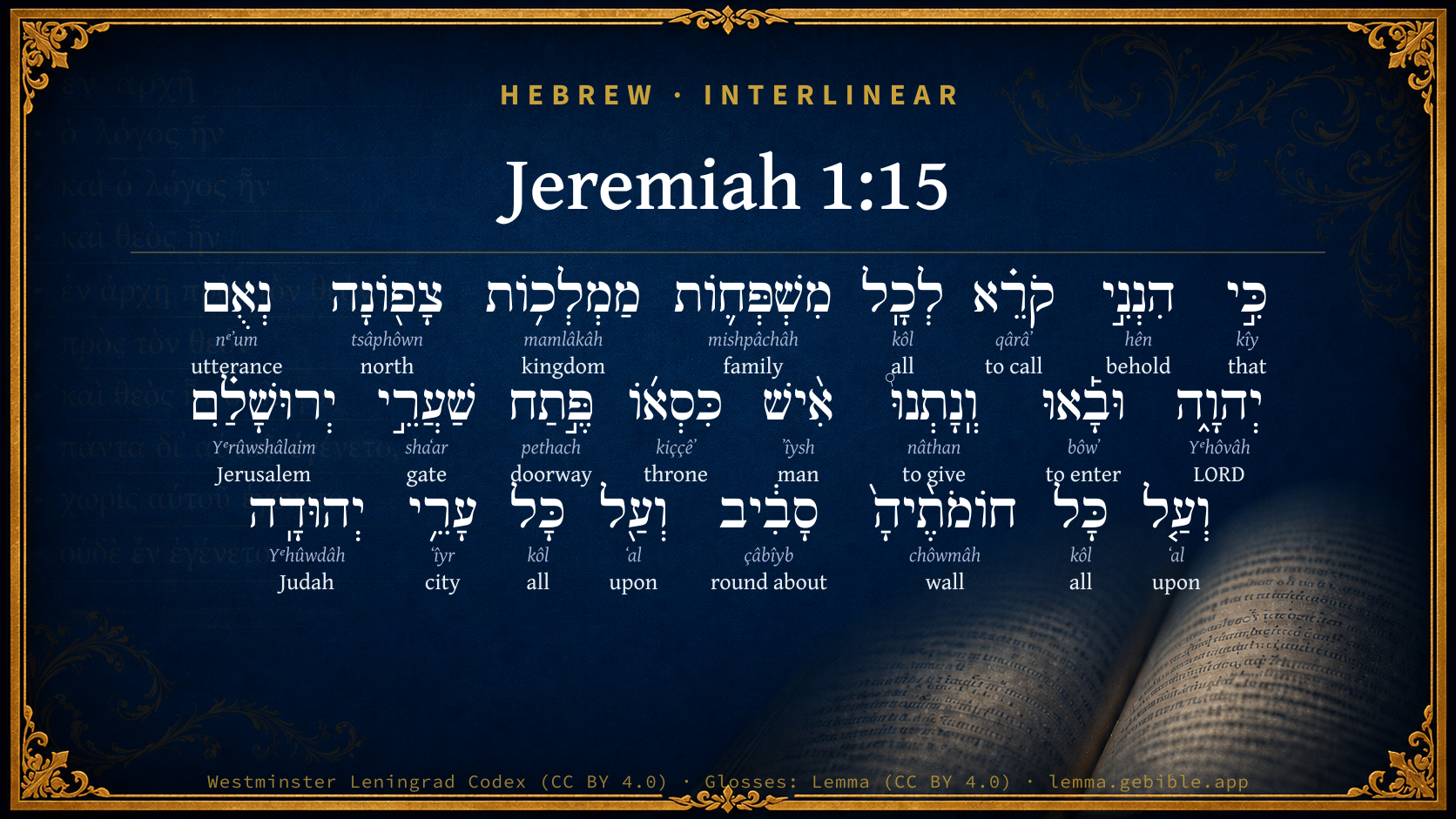
Jeremiah 1:15

Hebrew (Westminster Leningrad Codex) Jeremiah 1:15 appears in the Hebrew Old Testament. The text above is from the Westminster Leningrad Codex. Each word links to its Strong’s number, a concise gloss, and parsing drawn from the Open Scriptures Hebrew Bible morphology. Click any word for its full Brown-Driver-Briggs (BDB) entry.
Download image
Cite this verse

Jeremiah 1:15 (World English Bible). Public Domain. Lemma interlinear Bible study tool, https://lemma.gebible.app/v/jeremiah/1/15.

Show BibTeX & RIS
BibTeX
RIS
English Translation
For, behold, I will call all the families of the kingdoms of the north, says Yahweh; and they shall come, and they shall set everyone his throne at the entrance of the gates of Jerusalem, and against all the walls of it round about, and against all the cities of Judah.
World English Bible · Public Domain
Download a study sheet

One document with this verse’s original text, its word-by-word gloss line, the meaning frame, cross-references with their text, attributed commentary, and full source and license credits — printable, and it pastes into notes with its structure intact.

This verse Autodidact and up

Study sheet (.html) Plain text (.txt)

A passage Seminary Student

Up to 50 verses in one chapter. A passage sheet keeps up to 6 commentary sources and 12 cross-references per verse, in the order this page ranks them, and says so on the sheet whenever that leaves anything out. Ask for a single verse and you get the Autodidact verse sheet above.

Everything on this page stays free to read, with no account — the sheet is a download of what is already on screen, not access to it.

Want to remove ads? Support Godless Engineer
Compare translations 3

The same verse in 3 English versions, stacked beneath the original-language interlinear above. Click any original word for its lexicon entry.

Each is an independent rendering of the whole verse — the interlinear is not word-aligned to these translations.

Highlighted words mark where these versions differ — a whole-verse word diff, not a word-by-word alignment.

  • World English Bible Public Domain
    For, behold, I will call all the families of the kingdoms of the north, says Yahweh; and they shall come, and they shall set everyone his throne at the entrance of the gates of Jerusalem, and against all the walls of it round about, and against all the cities of Judah.
  • King James Version Public Domain
    For, lo, I will call all the families of the kingdoms of the north, saith the LORD; and they shall come, and they shall set every one his throne at the entering of the gates of Jerusalem, and against all the walls thereof round about, and against all the cities of Judah.
  • unfoldingWord Literal Text CC BY-SA 4.0
    For behold, I am calling to all the clans of the kingdoms of the north”—the declaration of Yahweh. “And they will come, and man will set his throne the entrance of the gates of Jerusalem and against all its surrounding walls and against all the cities of Judah.

unfoldingWord Literal Text — © unfoldingWord, licensed CC BY-SA 4.0. Word-aligned USFM3 via Door43 (git.door43.org/unfoldingWord/en_ult).

Versions to compare (up to 4)

3 of 4 selected

Show all 18 translations

Every available English version of this verse, each an independent rendering of the whole verse.

  • World English Bible Public Domain
    For, behold, I will call all the families of the kingdoms of the north, says Yahweh; and they shall come, and they shall set everyone his throne at the entrance of the gates of Jerusalem, and against all the walls of it round about, and against all the cities of Judah.
  • Berean Standard Bible Public Domain
    For I am about to summon all the clans and kingdoms of the north,” declares the LORD. “Their kings will come and set up their thrones at the entrance of the gates of Jerusalem. They will attack all her surrounding walls and all the other cities of Judah.
  • Majority Standard Bible Public Domain
    For I am about to summon all the clans and kingdoms of the north,” declares the LORD. “Their kings will come and set up their thrones at the entrance of the gates of Jerusalem. They will attack all her surrounding walls and all the other cities of Judah.
  • King James Version Public Domain
    For, lo, I will call all the families of the kingdoms of the north, saith the LORD; and they shall come, and they shall set every one his throne at the entering of the gates of Jerusalem, and against all the walls thereof round about, and against all the cities of Judah.
  • American Standard Version (1901) Public Domain
    For, lo, I will call all the families of the kingdoms of the north, saith Jehovah; and they shall come, and they shall set every one his throne at the entrance of the gates of Jerusalem, and against all the walls thereof round about, and against all the cities of Judah.
  • Revised Version (1885) Public Domain
    For, lo, I will call all the families of the kingdoms of the north, saith the LORD; and they shall come, and they shall set every one his throne at the entering of the gates of Jerusalem, and against all the walls thereof round about, and against all the cities of Judah.
  • Geneva Bible (1599) Public Domain
    For loe, I will call all the families of the kingdomes of the North, saith the Lord, and they shall come, and euery one shall set his throne in the entring of the gates of Ierusalem, and on all the walles thereof rounde about, and in all the cities of Iudah.
  • Douay-Rheims (1899) Public Domain
    For behold I will call together all the families of the kingdoms of the north: saith the Lord: and they shall come, and shall set every one his throne in the entrance of the gates of Jerusalem, and upon all the walls thereof round about, and upon all the cities of Juda,
  • Young's Literal Translation Public Domain
    For, lo, I am calling for all families of the kingdoms of the north, -- an affirmation of Jehovah -- and they have come, and put each his throne at the opening of the gates of Jerusalem, and by its walls round about, and by all cities of Judah.
  • Literal Standard Version CC BY-SA 4.0
    For behold, I am calling for all families of the kingdoms of the north,” a declaration of YHWH, “And they have come, and each put his throne at the opening of the gates of Jerusalem, and by its walls all around, and by all cities of Judah.
  • Unlocked Literal Bible CC BY-SA 4.0
    For I am calling all the tribes of the northern kingdoms, declares Yahweh. They will come, and everyone will set his throne at the entrance of the gates of Jerusalem, against all the walls that surround it, and against all the cities of Judah.
  • unfoldingWord Literal Text CC BY-SA 4.0
    For behold, I am calling to all the clans of the kingdoms of the north”—the declaration of Yahweh. “And they will come, and man will set his throne the entrance of the gates of Jerusalem and against all its surrounding walls and against all the cities of Judah.
  • Darby Bible Public Domain
    For behold, I am calling all the families of the kingdoms of the north, saith Jehovah, and they shall come, and they shall set every one his throne at the entering of the gates of Jerusalem, and against all the walls thereof round about, and against all the cities of Judah:
  • World Messianic Bible Public Domain
    For behold, I will call all the families of the kingdoms of the north,” says the LORD. “They will come, and they will each set his throne at the entrance of the gates of Jerusalem, and against all its walls all around, and against all the cities of Judah.
  • Webster's Bible Public Domain
    For lo, I will call all the families of the kingdoms of the north, saith the LORD; and they shall come, and they shall set every one his throne at the entrance of the gates of Jerusalem, and against all its walls around, and against all the cities of Judah.
  • Free Bible Version CC BY-SA 4.0
    Watch out! I'm going to summon all the nations and kings of the north,” declares the Lord. “Each of these kings will come and set up his throne right at the entrance of the gates of Jerusalem, and attack all its fortifications and all the towns in Judah.
  • Bible in Basic English Public Domain
    For see, I will send for all the families of the kingdoms of the north, says the Lord; and they will come, everyone placing his high seat at the way into Jerusalem, and against its walls on every side, and against all the towns of Judah.
  • JPS Tanakh (1917) Public Domain
    For, lo, I will call all the families of the kingdoms of the north, saith the LORD; and they shall come, and they shall set every one his throne at the entrance of the gates of Jerusalem, and against all the walls thereof round about, and against all the cities of Judah.

Literal Standard Version (2020), Covenant Press — licensed CC BY-SA 4.0. Text via the HelloAO Bible API (eBible.org). Unlocked Literal Bible (unfoldingWord) — licensed CC BY-SA 4.0. Text via the HelloAO Bible API (eBible.org). unfoldingWord Literal Text — © unfoldingWord, licensed CC BY-SA 4.0. Word-aligned USFM3 via Door43 (git.door43.org/unfoldingWord/en_ult). Free Bible Version, Dr. Jonathan Gallagher — licensed CC BY-SA 4.0. Text via the HelloAO Bible API (eBible.org).

Word by word

More ways to search: Search by grammar → Find every occurrence → Compare this word →

Practice this passage: Drill this verse → Learn its vocabulary →

מַמְלְכ֥וֹת
mamlâkâh
H4467
“kingdoms of”
Noun, Common, Feminine, Plural, Construct
Part of Speech
Noun
Type
Common
Gender
Feminine
Number
Plural
State
Construct
Full BDB Definition

Origin: from H4427

TWOT: 1199f

kingdom, dominion, reign, sovereignty - kingdom, realm - sovereignty, dominion - reign
  1. כִּ֣י kîy H3588 “that” Conjunction
  2. הִנְנִ֣י hên H2005 “behold · me” Particle, Demonstrative + Suffix, Personal, 1st Person, Common, Singular
  3. קֹרֵ֗א qârâʼ H7121 “calling” Verb, Qal, Participle Active, Masculine, Singular, Absolute
  4. לְכָֽל kôl H3605 “to/for · all of” Preposition + Noun, Common, Masculine, Singular, Construct
  5. מִשְׁפְּח֛וֹת mishpâchâh H4940 “families of” Noun, Common, Feminine, Plural, Construct
  6. צָפ֖וֹנָה tsâphôwn H6828 “north · toward” Noun, Common, Feminine, Singular, Absolute + Suffix, Demonstrative
  7. נְאֻם nᵉʼum H5002 “utterance of” Noun, Common, Masculine, Singular, Construct
  8. יְהוָ֑ה Yᵉhôvâh H3068 “LORD” Noun, Proper
  9. וּבָ֡אוּ bôwʼ H935 “and · to enter” Conjunction + Verb, Qal, Sequential Perfect, 3rd Person, Common, Plural
  10. וְֽנָתְנוּ֩ nâthan H5414 “and · to give” Conjunction + Verb, Qal, Sequential Perfect, 3rd Person, Common, Plural
  11. אִ֨ישׁ ʼîysh H376 “man” Noun, Common, Masculine, Singular, Absolute
  12. כִּסְא֜וֹ kiççêʼ H3678 “throne · his” Noun, Common, Masculine, Singular, Construct + Suffix, Personal, 3rd Person, Masculine, Singular
  13. פֶּ֣תַח pethach H6607 “doorway of” Noun, Common, Masculine, Singular, Construct
  14. שַׁעֲרֵ֣י shaʻar H8179 “gates of” Noun, Common, Masculine, Plural, Construct
  15. יְרוּשָׁלִַ֗ם Yᵉrûwshâlaim H3389 “Jerusalem” Noun, Proper
  16. וְעַ֤ל ʻal H5921 “and · upon” Conjunction + Preposition
  17. כָּל kôl H3605 “all of” Noun, Common, Masculine, Singular, Construct
  18. חוֹמֹתֶ֨יהָ֙ chôwmâh H2346 “walls · her” Noun, Common, Feminine, Plural, Construct + Suffix, Personal, 3rd Person, Feminine, Singular
  19. סָבִ֔יב çâbîyb H5439 “round about” Noun, Common, Both, Singular, Absolute
  20. וְעַ֖ל ʻal H5921 “and · upon” Conjunction + Preposition
  21. כָּל kôl H3605 “all of” Noun, Common, Masculine, Singular, Construct
  22. עָרֵ֥י ʻîyr H5892 “cities of” Noun, Common, Feminine, Plural, Construct
  23. יְהוּדָֽה Yᵉhûwdâh H3063 “Judah” Noun, Proper

About this verse

These counts appear in no published source. They are computed here, from the morphology-tagged text and Lemma’s own curated glosses. What Lemma adds →

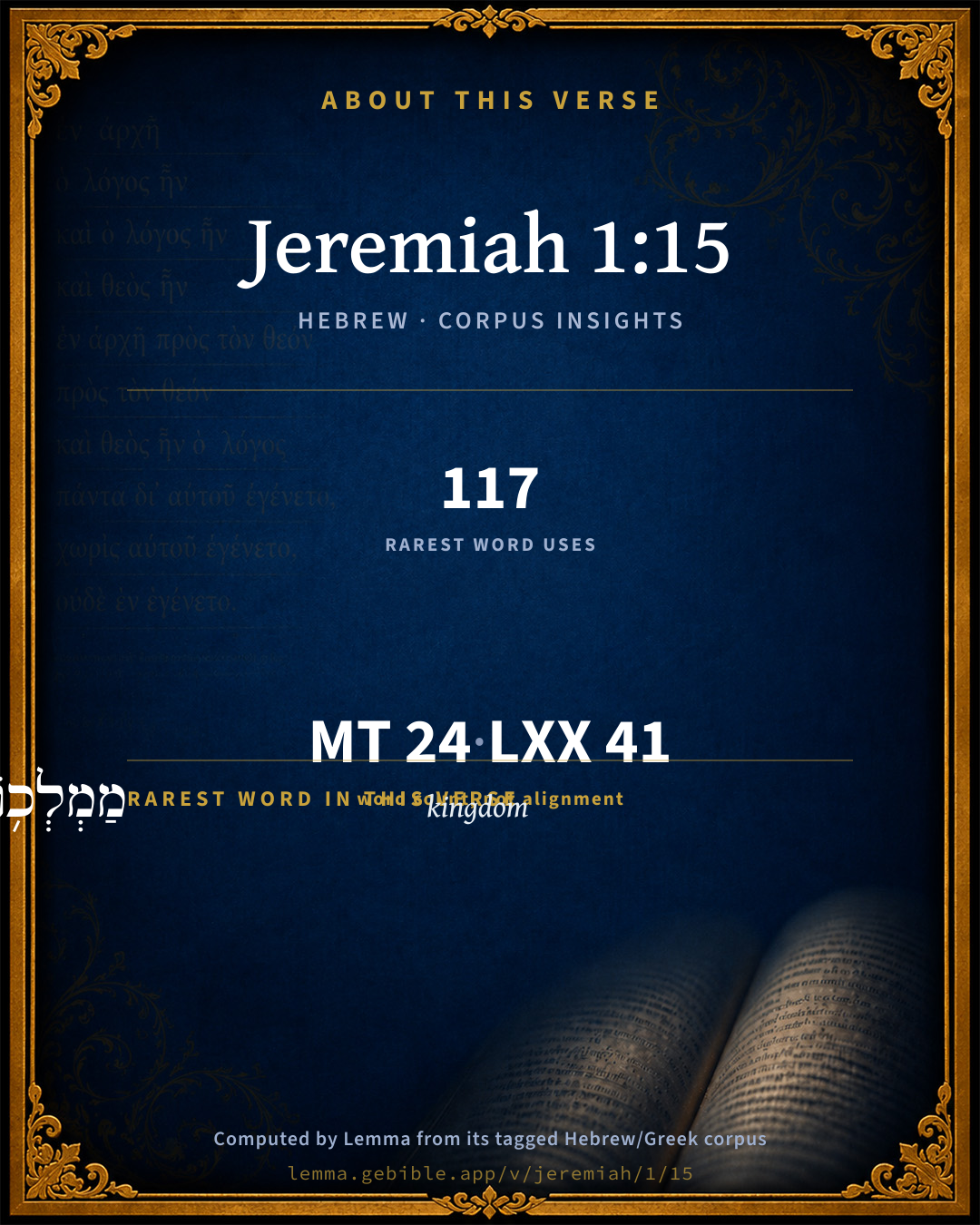
24
words
21
distinct lemmas
Prophets
section

Grammatical profile

  • 3 verbs
  • 17 nouns
  • 2 prepositions
  • 1 conjunction
  • 1 particle

Verb forms

  • קֹרֵ֗א Qal · Participle Active
  • וּבָ֡אוּ Qal · Sequential Perfect
  • וְֽנָתְנוּ֩ Qal · Sequential Perfect

Repetition

Words recur within this verse — often emphatic in Hebrew:

  • לְכָֽל all H3605 ×3
  • וְעַ֤ל upon H5921 ×2

Hebrew & Septuagint length

In the original languages it is 24 Hebrew tokens and 41 Greek tokens — but the two are counted differently (Hebrew bundles its prefixes and suffixes into one token; the Greek is in lemma form), so that isn’t a like-for-like length.

Cross-references

17

Topical passages linked to Jeremiah 1:15 in the Treasury of Scripture Knowledge — connected by theme and wording, ordered by reader-vote popularity; previews shown in the World English Bible.

  • Jeremiah 4:16 make you mention to the nations; behold, publish against Jerusalem, [that] watchers come from a far country, and give out their voice against the cities of Judah.
  • Jeremiah 9:11 I will make Jerusalem heaps, a dwelling-place of jackals; and I will make the cities of Judah a desolation, without inhabitant.
  • Jeremiah 25:9 behold, I will send and take all the families of the north, says Yahweh, and [I will send] to Nebuchadrezzar the king of Babylon, my servant, and will bring them against this land, and against the inhabitants of it, and against all these nations round about; and I will utterly destroy them, and make them an astonishment, and a hissing, and perpetual desolations.
  • Jeremiah 43:10 and tell them, Thus says Yahweh of Hosts, the God of Israel: Behold, I will send and take Nebuchadrezzar the king of Babylon, my servant, and will set his throne on these stones that I have hidden; and he shall spread his royal pavilion over them.
  • Isaiah 22:7 It happened that your choicest valleys were full of chariots, and the horsemen set themselves in array at the gate.
  • Jeremiah 10:25 Pour out your wrath on the nations that don't know you, and on the families that don't call on your name: for they have devoured Jacob, yes, they have devoured him and consumed him, and have laid waste his habitation.
  • Jeremiah 39:3 that all the princes of the king of Babylon came in, and sat in the middle gate, [to wit], Nergal Sharezer, Samgar-nebo, Sarsechim, Rabsaris, Nergal Sharezer, Rabmag, with all the rest of the princes of the king of Babylon.
  • Deuteronomy 28:49–53 Yahweh will bring a nation against you from far, from the end of the earth, as the eagle flies; a nation whose language you shall not understand;
  • Jeremiah 5:15 Behold, I will bring a nation on you from far, house of Israel, says Yahweh: it is a mighty nation, it is an ancient nation, a nation whose language you don't know, neither understand what they say.
  • Jeremiah 6:22 Thus says Yahweh, Behold, a people comes from the north country; and a great nation shall be stirred up from the uttermost parts of the earth.
  • Jeremiah 10:22 The voice of news, behold, it comes, and a great commotion out of the north country, to make the cities of Judah a desolation, a dwelling-place of jackals.
  • Jeremiah 25:28 It shall be, if they refuse to take the cup at your hand to drink, then shall you tell them, Thus says Yahweh of Hosts: You shall surely drink.
  • Jeremiah 25:31–32 A noise shall come even to the end of the earth; for Yahweh has a controversy with the nations; he will enter into judgment with all flesh: as for the wicked, he will give them to the sword, says Yahweh.
  • Jeremiah 33:10 Thus says Yahweh: Yet again there shall be heard in this place, about which you say, It is waste, without man and without animal, even in the cities of Judah, and in the streets of Jerusalem, that are desolate, without man and without inhabitant and without animal,
  • Jeremiah 34:22 Behold, I will command, says Yahweh, and cause them to return to this city; and they shall fight against it, and take it, and burn it with fire: and I will make the cities of Judah a desolation, without inhabitant.
  • Jeremiah 44:6 Therefore my wrath and my anger was poured forth, and was kindled in the cities of Judah and in the streets of Jerusalem; and they are wasted and desolate, as it is this day.
  • Lamentations 5:11 They ravished the women in Zion, The virgins in the cities of Judah.

Cross-references courtesy of OpenBible.info (CC BY 4.0).

Hebrew and Greek witnesses Masoretic Hebrew ↔ Greek Septuagint

The same verse in the two great witnesses to the Old Testament, shown verse-for-verse.

These are two independent witnesses, not word-aligned to each other, and the Septuagint is shown in lemma (dictionary) form.

Hebrew Jeremiah 1:15 Masoretic · Westminster Leningrad Codex

כִּ֣י הִנְנִ֣י קֹרֵ֗א לְכָֽל מִשְׁפְּח֛וֹת מַמְלְכ֥וֹת צָפ֖וֹנָה נְאֻם יְהוָ֑ה וּבָ֡אוּ וְֽנָתְנוּ֩ אִ֨ישׁ כִּסְא֜וֹ פֶּ֣תַח שַׁעֲרֵ֣י יְרוּשָׁלִַ֗ם וְעַ֤ל כָּל חוֹמֹתֶ֨יהָ֙ סָבִ֔יב וְעַ֖ל כָּל עָרֵ֥י יְהוּדָֽה

For, behold, I will call all the families of the kingdoms of the north, says Yahweh; and they shall come, and they shall set everyone his throne at the entrance of the gates of Jerusalem, and against all the walls of it round about, and against all the cities of Judah.

World English Bible · Public Domain

Greek LXX Structure differs

In the Septuagint, Jeremiah is about an eighth shorter than the Hebrew and arranges its material differently — the Oracles Against the Nations (Hebrew chapters 46–51) appear in the middle of the Greek book, after 25:13. Because the chapter and verse boundaries do not line up, a verse-for-verse comparison with the Hebrew is not shown.

A verse-for-verse comparison isn’t shown here because the chapters and verses don’t line up. Switch to the LXX edition with the MT / LXX toggle above to read the Greek directly.

On this verse, The Cambridge Bible for Schools and Colleges discusses the Septuagint’s reading. Read the note in Commentary ↓

Hebrew: Westminster Leningrad Codex (CC BY 4.0). Greek: Septuagint (public domain); English from a public-domain English Septuagint. How the Septuagint differs from the Hebrew →

Targum (Aramaic paraphrase)

1

The Targum is the ancient Jewish Aramaic paraphrase of the Hebrew Scriptures — an interpretive translation, not the Hebrew text itself. Onkelos (literal) and Pseudo-Jonathan (expansive) render the Torah, and Jonathan the Prophets. Coverage is partial: where no permissively-licensed English translation exists for a verse, only the Aramaic is shown. This is verse-level text, not a word-by-word alignment to the Hebrew.

  1. Targum Jonathan Prophets (Joshua–Malachi)
    אֲרֵי הָא אֲנָא מַכְלֵי לְכָל זַרְעִית מַלְכְּוַת צִפּוּנָא אֲמַר יְיָ וְיֵתוּן וְיִרְמוּן גְבַר כּוּרְסוֹהִי לִקָבֵּל תַּרְעֵי יְרוּשְׁלֵם וְעַל כָּל שׁוּרָהָא סְחוֹר סְחוֹר וְעַל כָּל קִרְוַיָא דְבֵית יְהוּדָה:

    (no public-domain English translation for this verse)

    Targum Jonathan — Aramaic: “Mikraot Gedolot” (public domain). English: “Sefaria Community Translation” (CC0 1.0 (public-domain dedication)); “London "Chaldee Paraphrase," 1871” (public domain). Text via Sefaria.

Commentary

Notes on Jeremiah 1:15 from classic Christian and Jewish commentators (each source and its license shown beneath its notes). The classic Christian expositions comment on the surrounding passage and are grouped to its opening verse, so a note may address several verses; the Jewish commentaries on the Tanakh (Rashi and others) are per-verse, so they appear only where the commentator wrote on this verse.

Lemma curates 59 commentaries, every one of them public domain or Creative Commons licensed, each selected and text-cleaned for this edition rather than reprinted as found. About our sources →

Trapp's Complete Commentary

John Trapp

Jer 1:15 For, lo, I will call all the families of the kingdoms of the north, saith the LORD; and they shall come, and they shall set every one his throne at the entering of the gates of Jerusalem, and against all the walls thereof round about, and against all the cities of Judah.

Ver. 15. And set every one his throne.] Judging such as in those very gates had unjustly judged others. See this performed, 2Ki 24:4; 2Ki 25:6 Jer 52:9

John Trapp, A Commentary or Exposition upon All the Books of the Old and New Testament (1647–1656) — public domain. Text from a community e-Sword module.

Joseph Benson's Commentary

Jer 1:15-16. For lo, I will call — Or, I am upon calling, or, about to call; all the families of the kingdoms of the north — By these seem to be meant the different nations who were subject to Nabopolassar and Nebuchadnezzar, and who served in their armies, such as the Medes, Armenians, Chaldeans, inhabitants of Mesopotamia, and Syrians. The kings of Assyria were formerly troublesome to the Jews, chiefly under Ahaz and Hezekiah; but they do not seem to be spoken of here, but only those people who, from the thirteenth year of Josiah, when Jeremiah had this vision, grievously harassed Judea, until the taking of Jerusalem by Nebuchadnezzar, to whom the kings of the north were either tributaries or auxiliaries. And they shall set every one his throne, &c. — To set up a throne in, or over, any place, denotes taking full possession of it, as appears from Jer 43:10; Jer 49:38 : but, by thrones here, seats, pavilions, or tents pitched, may be intended; and so this prophecy was fulfilled when the city was taken by Nebuchadnezzar: see Jer 39:3. And I will utter my judgments against them — Namely, against the Jews, for this is spoken of them, and not of the kings or people, mentioned in the foregoing verse; touching their wickedness — Then I will no longer speak unto them by my prophets, whose threatenings they have disregarded; but the judgments which I will bring upon them shall declare their wickedness, and the vengeance due unto them for it.

Joseph Benson's Commentary on the Old and New Testaments (1811–1818) — public domain. Text from a community e-Sword module.

Keil & Delitzsch

C. F. Keil & F. Delitzsch

Jer 1:15 is not the precise interpretation of the picture seen, but a direct statement of the afflictions about to fall on the inhabitants of Judah. "They will set each his throne." The representatives of the kingdoms are meant, the kings and generals. To set one's throne (נתן or שׂוּם; cf. Jer 43:10; Jer 49:38) is a figure for the establishing of sovereignty. כּסא, seat or throne, is not the seat of judgment, but the throne of the sovereign; cf. the expression: set the throne upon these stones, Jer 43:10; where a passing of judgment on the stones being out of the question, the only idea is the setting up of dominion, as is put beyond doubt by the parallel clause; to spread out his state carpet upon the stones. "Before the gates of Jerusalem:" not merely in order to besiege the city and occupy the outlets from it (Jerome and others), but to lord it over the city and its inhabitants. If we take the figurative expression in this sense, the further statement fits well into it, and we have no need to take refuge in Hitzig's unnatural view that these clauses are not dependent on נתנוּ וגו' but on וּבאוּ. For the words: they set up their dominion against the calls of Jerusalem, and against all cities of Judah, give the suitable sense, that they will use violence against the walls and cities.

Keil & Delitzsch — Biblical Commentary on the Old Testament (1861–1891) — public domain (CC PDM 1.0). Text via the HelloAO Bible API. (Old Testament only.)

Jamieson, Fausset & Brown

Robert Jamieson, A. R. Fausset & David Brown

families--the tribes or clans composing the various kingdoms of Babylon; the specification of these aggravates the picture of calamity (Jer 25:9).

throne at . . . gates--the usual place of administering justice. The conquering princes will set up their tribunal there (Jer 39:3, Jer 39:5; Jer 52:9). Or the reference is to the military pavilion (Jer 43:10) [MAURER].

Jamieson, Fausset & Brown — Commentary Critical and Explanatory on the Whole Bible (1871) — public domain (CC PDM 1.0). Text via the HelloAO Bible API.

Adam Clarke's Commentary

Verse 15. Shall set every one his throne at the entering of the gates] As the gates of the cities were the ordinary places where justice was administered, so the enemies of Jerusalem are here represented as conquering the whole land, assuming the reins of government, and laying the whole country under their own laws; so that the Jews should no longer possess any political power: they should be wholly subjugated by their enemies.

Adam Clarke's Commentary on the Bible (1810–1826) — public domain. Text from a community e-Sword/MySword module.

John Calvin's Commentaries

This verse contains an explanation of the last; for God more dearly and more specifically expresses what he had before referred to — that the evil would come from the north. He says that he would be the sender of this evil, and speaks thus of it: Behold, I call all the families of the kingdoms of the north The prediction would not have been so effectual had not this declaration been expressly added — that the Chaldeans would come by the authority of God; for men are ever wont to ascribe to fortune whatever takes place: and we shall hereafter see in the Book of Lamentations (Lamentations 3:37, 38) that the Jews were so besotted, that in their calamities they attributed to the events of fortune the destruction of the temple and city, and the ruin of the kingdom. Hence God sharply expostulated with them, because they were so blind in a matter so clear, and did not acknowledge his judgments. The Prophet, then, after having testified that the evil would come from the north, now adds, that this evil would by no means be by chance, but through that war which the Chaldeans would bring on them; that God would be the chief commander, who would gather soldiers from all parts, and prepare an army to destroy the Jews.

The Prophet uses the word, to cry: Behold, he says, I will cry to all the kindreds, or families, etc. God employs various modes of speaking, when he intends to teach us that all nations are in his hand, and subject to his will, so that he can excite wars whenever it pleases him. He says, “Behold, I will hiss (or whistle) for the Egyptians;” and he compares them sometimes to bees. (Isaiah 5:26; Isaiah 7:18.) Again, in another place he says, “Behold, I will blow with the trumpet, and assemble shall the Assyrians.” All these modes of speaking are intended to shew, that though men make a great stir, and disturb the whole world, yet God directs all things by his sovereign power, and that nothing takes place except under his guidance and authority. We then see that the Prophet does not speak as an historian; nor does he simply predict what was to be, but also adds a doctrine or a great truth. It would have been a naked prediction only, had he said, “An evil shall break forth from the north: “but he now, as I have already said, performs the office of a teacher, that his prediction might be useful, and says that God would be the chief commander in that war: Behold, then, I will cry to all the families of the kingdoms of the north.

There was then indeed but one monarchy; but as the self — confidence of the Jews was so great, and hence their sottishness, so that they dreaded no evil, God, in order to arouse them, says that he would assemble all the families of the kingdoms: and doubtless those belonged to many kingdoms whom God brought together against the Jews. A regard also was had to that vain confidence which the Jews entertained, in thinking that the Egyptians would be ever ready to supply them with help. As, then, they were wont to set up the Egyptians as their shield, or even as a mountain, God here exposes their folly, — that trusting in the Egyptians, they thought themselves sufficiently fortified against the power and arms of the whole Chaldean monarchy. For these reasons, then, he mentions the families, and then the kingdoms, of the north.

It follows, And they shall come, and set each (man, literally) his throne at the entrance of the gates The Prophet here means that the power of the Chaldeans would be such, that they would boldly pitch their tents before the gates, and not only so, but would also close up the smaller gates, for he mentions the doors (ostia) of the gates And by speaking of each of them, he meant the more sharply to touch the Jews: for they, relying on the help of Egypt, thought themselves capable of resisting, while yet the Chaldeans, who had conquered the Assyrians, would be irresistible. Hence he says, that not only the army itself would encamp before the gates, but that each individual would fix himself there, and set up his tent as in a place of safety. In short, God intimates that the Chaldeans and Assyrians would be victorious, that they would entirely rule and rest themselves as at their own homes, in the fields and before the gates of the city Jerusalem. These things are afterwards more distinctly expressed, and many circumstances are added: but God intended at first to announce this declaration, that the Jews might know that it would be all over with them.

He then says, On its walls around, and on all the cities of Judah The Prophet here declares, that the whole country would be laid waste, as though he had said, “The Jews in vain trust to their own resources, and help from others, for God will fight against them; and as the Chaldeans and the Assyrians shall be armed by him, they shall be victorious, whatever force the Jews may oppose to them.” It follows —

John Calvin's Commentaries (1540-1563) — public domain. Text from the Calvin Translation Society English edition (1840s-50s) via the Christian Classics Ethereal Library (ccel.org). Calvin's coverage is partial (roughly two-thirds of the Bible); uncommented books and verses are honest gaps, never fabricated. The 19th-century editor's footnotes and remarks are omitted so the notes are faithfully Calvin's own voice.

Ellicott's Commentary for English Readers

(15) I will call.—Literally, I am calling. The evil is not merely future, but is actually begun.

All the families of the kingdoms of the north.—In the Hebrew the words are in apposition, all the families, even the kingdoms of the north. The words point chiefly to the Chaldæans and other inhabitants of Babylonia, but may probably include also the Scythians, who about this time spread like a deluge over Asia Minor and Syria, and penetrated as far as Ascalou (Herod. i. 105).

They shall set every one his throne.—i.e., shall usurp the administration of justice, and set up their thrones of judgment in the space near the gates in which kings usually sat to hear complaints and decide causes (2Sa_15:2; Psa_127:5). In Jer_39:3 we have a literal fulfilment of the prediction.

Against all the walls.—As the previous words speak of a formal usurpation of power, so do these of invasion and attack, the storming of the lesser cities of Judah, while Jerusalem became the centre of the foreign government.

A Bible Commentary for English Readers, edited by Charles John Ellicott (1878–1897) — public domain. Text from a community e-Sword module.

The Cambridge Bible for Schools and Colleges

gen. ed. J. J. S. Perowne

15. all the families of the kingdoms] Probably we should read (with LXX) all the kingdoms, “families” in that case being in the first instance an explanatory gloss, afterwards taken into the text.

they shall set every one his throne] The chiefs of the invading army, having captured the city, will take their places to administer justice, and inflict punishment on the guilty. For this assemblage of nations against Jerusalem, cp. Isa_17:12 ff. The gate of the city, or rather a large space in its neighbourhood, was reserved free of buildings, and was the ordinary place at which trials were held and sentences declared. Cp. Deu_16:18; Deu_17:8; Rth_4:1. For the word throne as used to denote the judgement-seat, see Psa_9:4; Psa_122:5; Pro_20:8. The general sense of the verse is that it is not without reason, or as the blind act of ambitious and more powerful nations, that Jerusalem is to be overthrown. That overthrow will take place as a judicial act, as a consequence of wickedness, and after the case had been duly weighed in the balances.

and against all the walls thereof round about, and against all the cities of Judah] As the text now stands, the prophet mingles the two thoughts of a besieging army and of a judicial sentence and its execution. It is in point of fact by the scaling of the walls of Jerusalem and the capture of the other cities of the country that the sentence is to be carried out, and Jeremiah here as elsewhere (see Intr. iii. § 14 (d) and note) breaks off his simile or metaphor with abruptness and takes up anew the literal statement.

The Cambridge Bible for Schools and Colleges (gen. ed. J. J. S. Perowne; Cambridge University Press, 1878–1918) — public domain. Text from a community e-Sword module.

John Gill's Exposition

For, lo, I will call all the families of the kingdoms of the north, saith the Lord,.... Which belonged unto and were under the jurisdiction of Nebuchadnezzar king of Babylon; and the "call" of them, as Kimchi well observes, is no other than putting it into their hearts to come:

and they shall come; being influenced and directed by the providence of God, who had a principal concern in this matter:

and they shall set everyone his throne at the entering of the gates of Jerusalem; meaning, not only that they should pitch their military tents, and encamp about Jerusalem, and place themselves at the entering of the gates, in order to get in; but that they should sit down there in great safety and security, and be very successful, victorious, and triumphant:

and against all the walls thereof round about, and against all the cities of Judah; not only besiege Jerusalem, and take that, but also all the rest of the cities of the land.

John Gill's Exposition of the Whole Bible (1746–1763) — public domain (CC PDM 1.0). Text via the HelloAO Bible API.

Albert Barnes' Notes on the Bible

I will call - I am calling. The judgment has begun. God is summoning His hosts to the war.

Families - The various races by which the provinces of the Babylonian empire were populated.

They shall set every one his throne - The chiefs of these various races come as God’s ministers to hold solemn court, and give sentence in His name (see Jer 25:9). They therefore set each one his throne in the usual place for administering justice, namely, the entering in of the gates, where a large open space was always left in cities for the purpose. Viewed in one light war is the boiling caldron of human passion, upset by hazard, and bringing only ruin in its course; in the other it is God sitting in judgment, with the kings of the earth as His assessors, solemnly pronouncing sentence upon the guilty.

Against all the walls ... - Sentence judicially pronounced, the nations come to execute judgment by mounting as enemies upon her walls and storming her cities.

Albert Barnes' Notes on the Bible (1834–1885) — public domain. Text from a community e-Sword/MySword module.

Matthew Poole's English Annotations

I will call; or, I am upon calling, it is at hand, I am about to incline the northern countries to join together in this work, Jer 6:22; 10:22; 25:9,26.

The families, or kindreds, viz. those divers countries and nations that were under one lord, as a chief ruler is called the father of his country.

The kingdoms, viz. the Babylonians and their assistants, the Medes also being in confederacy with them, whose king’s daughter Nebuchadnezzar married.

They shall set every one his throne; their seats, pavilions, or tents shall be pitched, which shall be as so many thrones, where I will see my judgments executed by the Chaldeans, Jer 52:4.

At the entering of the gates; at the entering to the gates, or way leading to the gates, Jdg 9:35; 2Ki 7:3; Jer 43:9, which besiegers have always a special regard to, that there be no going in or coming out, Isa 22:7.

Against all the walls thereof round about; they shall begirt it round, noting the great multitude, power, and courage of the Chaldeans.

Against all the cities; there were none of them should fare any better than Jerusalem.

Matthew Poole's English Annotations on the Holy Bible (1683–1685) — public domain. Text from a community e-Sword/MySword module.

Whedon's Commentary on the Bible

Daniel D. Whedon

15. I will call — Literally, I am calling. The present tense shows that the judgment is at the very door, yea, has even now begun. The summons has already gone forth.

The kingdoms of the north — Not only those of Syria, which is the country lying immediately to the north of Palestine, but of the whole region of the Euphrates and the Tigris; for all armies coming from this region would enter Palestine from the north.

Shall set… his throne — Meaning, establish a hostile power, and so implies violence against Jerusalem and the cities of Judah. “The chiefs of these various races come as God’s ministers to hold solemn court, and to give sentence in his name.”

Daniel D. Whedon (gen. ed.), Commentary on the Old and New Testaments (1874–1909) — public domain. Text from a community e-Sword module.

The Pulpit Commentary

I will call; literally, I am calling; i.e. I am about to call. The kingdoms of the north; alluding possibly to the varied origin of the population of Assyria and Babylonia. But more probably it is simply a suggestive phrase, for the wide extent of the hostile empire referred to. (Jer_25:9) They shall set every one his throne, etc. The kings, or. the, generals, representing "all the families, etc., shall set up the high seat of power and judicial authority at the broad space within the gate of the city, which constituted the Oriental forum. (comp. Gen_23:10 Jos_20:4 Job_29:7 Job_31:21) Thither the besieged would have to come to surrender themselves (2Ki_24:12) and to hear their fate. A similar prediction is made with regard to Nebuchadnezzar. (Jer_43:9, Jer_43:10) It is true the seat of authority is there said to be placed at the entrance of the palace, but this was in fact another place where justice was wont to be administered. (Jer_22:2, Jer_22:3) Jerome"s view, adopted by Rosenm and Nagelsbach, that "to set one"s seat" means "to besiege" is against usage, and does not accord with the opening words of ver. 16. There is, however, an element of truth in it. The judgment executed ministerially by the northern kings or generals began with the siege of Jerusalem and the other cities, and hence the words with which the prophet continues. And against all the walls, etc. We should have expected something like "and shall set themselves in array against," etc.; (comp. Isa_22:7) see, however, last note.

The Pulpit Commentary (1880–1919), ed. H.D.M. Spence-Jones & Joseph S. Exell — public domain. Text from a community e-Sword module.

John Wesley's Explanatory Notes

The families - Those nations that were under one Lord. Kingdoms - The Babylonians, and their assistants; the Medes also being in confederacy with them, whose king's daughter Nebuchadnezzar married. His throne - Their seats, pavilions or tents shall be pitched, which shall be as so many thrones. Entering - Of the gates, or way leading to them.

John Wesley, Explanatory Notes Upon the Whole Bible (1754–1765) — public domain. Text via the GEBible commentary corpus.

unfoldingWord translationNotes

Door43 World Missions Community

Connecting Statement:

Yahweh continues speaking to Jeremiah about the disaster that would come from the north.

everyone

This generalization refers to the kings of the northern kingdoms. AT: "every king" or "all of the northern kings" (See: Hyperbole and Generalization)

will set his throne at the entrance of the gates of Jerusalem

Possible meanings are 1) this represents ruling over Jerusalem. AT: "will rule at the gates of Jerusalem" or 2) this represents judging Jerusalem. AT: "will judge Jerusalem" (See: Metaphor)

against all the walls that surround it

Setting their thrones "against all the walls that surround it" represents commanding their armies to destroy the walls surrounding Jerusalem. AT: "and they will command their armies to destroy the walls surrounding Judah" (See: Metonymy)

against all the cities of Judah

Setting their thrones "against all the cities of Judah" represents commanding their armies to destroy all the cities of Judah. (See: Metonymy)

I will pronounce sentence against them

"I will announce how I will punish them"

I will pronounce sentence against them

"I will pronounce sentence against the people of Judah"

worshiping what they made with their own hands

Since the people had made the idols with their own hands, they should have known that the idols are not worthy of worship.

translationWords

call

tribe

throne

gate

evil

forsake

incense

false god

worship

unfoldingWord translationNotes — © Distant Shores Media and the Door43 World Missions Community, licensed CC BY-SA 4.0. Source: git.door43.org/Door43/en_tn.

Lesson kit

Teaching starters — assembled from the data on this page, not authored interpretation. Every prompt links to the verse data it draws on. Edit before teaching.

Jeremiah, in the Prophets, opens this verse with 24 words (21 distinct Hebrew lemmas). Its most distinctive word is mamlâkâh (“kingdom”). A historical commentator’s framing appears above. Read the whole chapter for the surrounding context.

Discussion questions

  1. How does “kingdom” (mamlâkâh) shape what this verse is saying?
  2. Jeremiah 4:16 shares this passage’s theme. How do the two illuminate each other?
  3. “all” occurs 3× in this one verse. What is the effect of the repetition?
  4. These translations render this verse differently; the difference is in the English rendering, not the original. What questions does that raise?
  5. The verb «קֹרֵ֗א» is Qal Participle Active. How does its form color the action?
  6. Reading how Trapp's Complete Commentary and Joseph Benson's Commentary read this verse, where do the two commentators agree and where do they part?

Things to notice

Reading settings

Reading text

Shown beneath each verse's original-language words.

Old Testament
Old Testament edition

Read the OT as the Masoretic Hebrew (MT) or the Greek Septuagint (LXX).

English shown for the Greek Septuagint (in the Hebrew ↔ Greek comparison).

Comparing translations? Open the Compare panel on any verse page to stack up to four side by side.