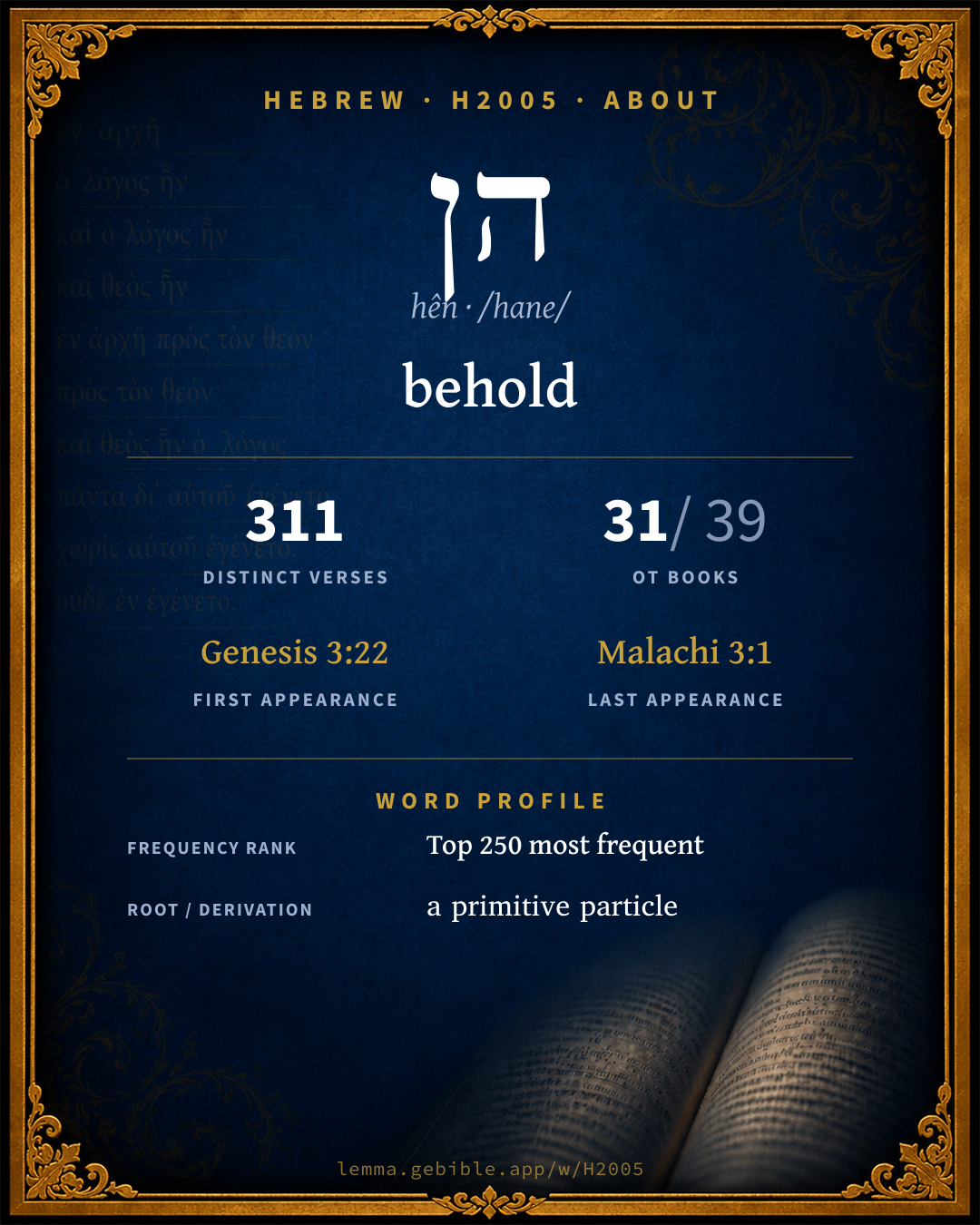
הֵן
behold
also: lo, though fuller range ↓
Full lexicon entry — Brown-Driver-Briggs (BDB)
From Brown-Driver-Briggs (BDB)
Where this word appears
Grammar key — what these labels mean
Part of speech
- Particle
- A short function word — article, negation, interrogative, the sign of the direct object, and the like.
Every verse where H2005 appears in the Book of Joshua — 1 distinct verse. Click any verse to open its interlinear word-by-word view. Verse text shown in the World English Bible for context — . Each verse’s Hebrew form is shown with its reference; the English is not keyword-highlighted, since the data carries no word-level English alignment. Use “Compare translations” on any verse to read it across multiple English versions. This concordance covers the Hebrew Bible; Septuagint (Greek Old Testament) occurrences are not indexed here.
Joshua
About this entry
At a glance — auto-summarized from this page’s data, not written by a person. Every figure links to its source below. This summary describes the numbers; it doesn’t interpret them.
“behold” is the headline sense of the Hebrew word הן (hên). First canonically at Genesis 3:22, it enters the text early. It turns up in 311 verses across 31 books, a common footprint. Not a single-sense word: its full sense range also takes in “lo” and “though”. From the same root come הן, הנה and להן. See the sense tree, 311-verse concordance, and the renderings breakdown below.
Gloss history
Strong's 1890 vs modern scholarship
About this word
Strong's H2005 catalogs a Hebrew word from the Hebrew Old Testament.
These counts are not copied from any lexicon or concordance. They are computed here, from the morphology-tagged Hebrew Old Testament. What Lemma adds →
- 311
- distinct verses
- The word appears in 311 distinct verses.
- 31 / 39
- OT books
- The word appears in 31 of 39 Old Testament books.
- #157
- by frequency
- Top 250 most frequent Hebrew words (rank 157 of 8,640 Hebrew words by occurrence).
View all 311 occurrences in the concordance →
By section of the Old Testament
By traditional corpus
Conventional, traditional groupings — biblical authorship is debated, so this is a traditional corpus grouping, not an authorship claim. Each share is this word’s portion of its verses in that division of the Hebrew canon. Each figure is a share of the word’s 311 distinct verses.
- Prophets (Nevi'im) 199 verses · 64%
- Writings (Ketuvim) 67 verses · 22%
- Torah (Pentateuch) 45 verses · 14%
How translations render this word
Counts come from each version’s own published word-to-Strong’s tagging or interlinear alignment — an approximate guide to how each version renders this word, not a word-level alignment the data otherwise carries. Because each total is that version’s own tagged count, the per-version totals vary from one another and need not match the appearance or distinct-verse counts above. These counts may also differ from a printed concordance because Lemma counts each distinctly tagged rendering and does not collapse phrase taggings into a single head-word total. This is a fixed set of word-tagged versions (KJV, ASV, BSB, ULT) and does not change with the reading translation you choose elsewhere. Each version’s license is shown beside its name below (and on Sources).
BDB lists this Strong’s number as 2 distinct words (homographs). Each count above pools all of them and is not split by sense — see the Senses section below. A low-frequency rendering may belong to a different one of those words, not the primary meaning.
- King James Version†: Behold 3×
- American Standard Version†: Behold 4×
- Berean Standard Bible†: Behold 107×, If 17×, I am 15×
- unfoldingWord Literal Text†: Behold 123×, Behold they 11×, If 6×
King James Version Public Domain
Renders H2005 across 7† tagged occurrences — most commonly:
Plus 4 renderings that appear only once — usually multi-word phrases or single function words the recovered tagging swept in, not distinct renderings.
American Standard Version Public Domain
Renders H2005 across 7† tagged occurrences — most commonly:
Plus 3 renderings that appear only once — usually multi-word phrases or single function words the recovered tagging swept in, not distinct renderings.
Berean Standard Bible Public Domain
Renders H2005 across 247† tagged occurrences — most commonly:
Plus other, less common renderings. Plus 37 renderings that appear only once — usually multi-word phrases or single function words the recovered tagging swept in, not distinct renderings. Not rendered by a distinct English word in 62 further occurrences.
unfoldingWord Literal Text CC BY-SA 4.0
Renders H2005 across 159† tagged occurrences — most commonly:
Plus 7 renderings that appear only once — usually multi-word phrases or single function words the recovered tagging swept in, not distinct renderings.
Senses in the full BDB
What do BDB’s symbols mean?
BDB uses these scholarly abbreviations:
| Symbol | Meaning |
|---|---|
| 𝔊 | the Septuagint (the ancient Greek translation, LXX) |
| 𝔙 | the Vulgate (the Latin translation) |
| 𝔖 | the Syriac version (the Peshitta) |
| 𝔗 | the Targum (the Aramaic translation) |
| ψ | the Psalms |
| √ | root (the underlying root or stem) |
| ‖ | parallel passage (a synonymous or contrasted parallel) |
| † | the dagger: every passage where the word occurs is cited |
The 3 senses and sub-senses the full Brown-Driver-Briggs lexicon distinguishes for this word, in lexicon order (not ranked by frequency), with BDB’s own verbatim wording and sub-sense lettering. Shown in Hebrew script with BDB’s own scholarly abbreviations. The condensed entry is in the Lexicon Entry tab. See also the Forms in the corpus table below.
הן I on. 3 pl.fem., often in NH, in Bibl. Heb. only with prefixes, בָּהֵן, etc.
הן II
- a. Gn 3:22 הֵן הָאָדָם הָיָה behold, the man is become as one of us, & now lest, etc., 4:14 behold, thou hast driven me forth etc., 11:6; 15:3; 19:34; 27:11; 29:7; 30:34 (nearly = yea), Ex 5:5; 6:12, 30 Lv 10:18, 19 Nu 17:27 Dt 5:21 (in prose only in Pent. (23 times) and Ez 18:4 in this usage); in poetry, used more freely, but chiefly in Is 2 & Jb,—Nu 23:9, 24 (Balaam) Is 23:13; 32:1; 33:7 ψ 51:7, 8; 68:34; 78:20; 139:4 Pr 11:31 (stating the premiss to a conclusion introduced by אַף כִּי, q.v.), 24:12: elsewhere (except in senses b, c) only in Is 2 (23 times) & Jb (31 times), as Is 40:15(×2); 41:11, 24, 29; 50:1, 2, 9(×2), 11 Jb 4:18; 15:15; 25:5 (in these three passages before אַף or אַף כִּי), 9:11, 12 etc. (v. supr.). e.g. Genesis 3:22
- b. as a hypoth. part., propounding a possibility, if (so NH Biblical Aramaic, Mand. Palm. (ZMG 1888, 404); on the contr. Syriac ܐܶܢ, Pal. 𝔗 אִין, also Palm. (ib. p. 415), Arabic إِنْ, with א), a special application or development of the use a: Ex 4:1 והן לא יאמינו לי and behold (= and suppose) they will not believe me?, Lv 10:8; 25:20 and if (וְכִי) ye say, What shall we eat the 7th year? הֵן לֹא נִזְרַע behold, we shall not sow etc. (i.e. supposing we do not sow), Is 54:15 Jb 9:12; 13:15; 40:23 2 Ch 7:13(×2) (v 13b וְאִם); stating ground on which a qu. is based, Ex 8:22 (וְלֹא = הֲלֹא), Je 3:1 Hg 2:12 (v. הֵן Aramaic b). e.g. Exodus 4:1
- c. if, whether, in an indirect question, Je 2:10 רְאוּ הֵן הָֽיְתָה כָּזֹאת (but Gr הֲנִהְיְתָה); cf. אִם 2 b, and הֵן Aramaic c. e.g. Jeremiah 2:10
Senses from the full Brown-Driver-Briggs lexicon (Brown, Driver, Briggs; Oxford 1906 — public domain), digitized via Sefaria, supplemented by the OpenScriptures HebrewLexicon (CC BY 4.0). Full attribution on Sources.
Word origin
I. pron. 3 pl.fem., often in NH, in Bibl. Heb. only with prefixes, בָּהֵן, etc.: see under הֵמָּה 8 d.
II. (הֶן־ †Nu 23:9, 24 Jb 8:19, 20; 13:1; 26:14; 33:6, 12, 29; 36:5, 22, 26; הֵן־ Jb 13:15; 36:30 41:1 +) demonstr. adv. or interj. lo! behold (on etym. v. הִנֵּה), less widely used than הִנֵּה, and in prose mostly confined to calling attention to some fact upon which action is to be taken, or a conclusion based;
— Brown-Driver-Briggs (Oxford 1906, public domain), digitized via Sefaria, supplemented by the OpenScriptures HebrewLexicon (CC BY 4.0). See Sources.
Origin: a primitive particle
Jastrow Dictionary
A second Hebrew/Aramaic lexicon for comparison, covering Aramaic and post-biblical (Talmudic, Targumic, Midrashic) usage that the biblical-Hebrew BDB does not. Matched by lemma rather than by Strong’s number, so a lemma may carry more than one Jastrow headword (shown separately below), and the entries cover usage well beyond the Bible.
הוּא ²
- , ch. same. Targ. Ex. I, 16; a. v. fr.—היא הדא, v. דָּא.—Y. Shebi. VII, 37ᶜ top בהוא אתר (R. S. to Shebi. VII, 3 בההוא אתרא) in the same place.—כל דהו whatsoever, v. preced. Arakh. 2ᵃ נפשות כל דהו human beings of any nature, v. כָּל.—Y. Kil. VI, 31ᵇ top כהיא דאמר וכ׳ (in Babli כי הא) as (that which) R. … said.—Pl. הֵן (perhaps only in Hebr. phrases); הִינוּן, הִינִין. Targ. Y. Ex. I, 10; Ib. 19 (O. אינ׳); a. fr.—With prefix ה: הַהוּא, הַהִיא. Targ. Y. Ex. XXI, 20; a. fr.—In Talmud frequ. used to introduce a case. Pes. 3ᵇ ה׳ ארמאה ד־ it occurred that a gentile &c. Keth. 78ᵇ ה׳ איתתא ד־ the case came up of a woman that &c.; a. v. fr.—ה׳ גברא, ה׳ איתתא frequ. euphemistically for myself, thyself (to avoid ominous speech or curse). Y. Maas. Sh. IV, 55ᵇ bot. אביו דה׳ ג׳ thy father. Ib.ᶜ top חמית ה׳ א׳ I saw; בעלה דה׳ א׳ thy husband; a. v. fr.—With prefix ד־: דהוא, דהיא, contr. דּוּ, דִּי, v. דְּ־ a. דּוּ.—With prefixed prep. בְּהוֹן, בּוֹן, לְהוֹן, לוֹן.
הֵן
- they, pl. of הוּא, הִיא.
הֵן ²
- (b. h. הֵן)
- 1. here is, behold. הִינָּם, הִינָּן behold, they are. Ned. V, 6 (48ᵃ) והי׳ לפניך אלא וכ׳ Bab. ed. (Mish. ואינן; Y. ed. והן בפניך עד) and behold they are before thee (thine), but only in order that my father &c.
- 2. (introducing a question or exclamation) how?, indeed! Y. Shek. I, 45ᵈ bot. הן נקרא ולא וכ׳ can we, indeed, read this and not feel ashamed? (Bab. ed. הניקרא, marginal correct. Ms. M. הן נק׳).
- 3. if. Dan. II, 5, sq.; a. fr.—הן—הן whether—or. Ezra VII, 26.—B. Bath. VII, 2 הן חסר הן יתר whether it be less (than a Beth Kor) or more. Ib. 3; a. e. e.g. Daniel 2:5
- 4. yes (cmp. אִין I). B. Mets. 49ᵃ, v. הִין II Mekh. Yithro s. 4 answer על לאו לאו ועל הן הן no to a prohibition and yes to a positive command. Ib. s. 5 ה׳ וה׳ yes, indeed; a fr.—Ned. 11ᵃ, a. fr. מכלל לאו אתה שומע הן from the negative we derive the affirmative by implication; Y. ib. I, end, 37ᵃ, a. e. ממשמע לאו וכ׳. Men. X, 3 (65ᵃ).
הָן
- 1. ה׳ ד־ he who. Targ. Prov. XIX, 1, a. fr. in Ms., ed. Lag. הֲווֹ q. v.—Pesik. Aḥaré, p. 169ᵇ, v. דְּחוּכָא; a. e.
- 2. this one, that one. Y. Meg. I, 72ᵃ היך … להן וכ׳ (Y. Succ. III, 54ᵃ top לדין), v. הֵיךְ. Y. Kil. IX, 32ᶜ top [read:] מה הן שאל להן וכ׳; Y. Keth. XII, 35ᵇ top מה הין דשאיל להון (corr. acc.) from all that this one asked that one &c.; a. fr.
- 3. what? Y. B. Mets. II, 8ᶜ לְהָן, v. אֲהָן.
- 4. where (relat.), where? Esth. R. to I, 12 [read:] הן דליסטאה מקפח וכ׳ where the robber waylays, there he is executed. Y. Snh. I, 19ᵃ top; Y. Ned. VI, 40ᵃ bot. הן דמטא מטא where he came to, he came to (and his order was obeyed). Y. Kil. IX, 32ᶜ bot. [read:] להן דאשתלחית מינסבינן to the place whither I was sent to take them; Y. Keth. XII, 35ᵇ להון דשלחית (read דאשתלחית). Gen. R. s. 78, v. בְּרָא. Y. Ber. II, 5ᶜ bot. להן ייזיל whither shall he go? Ib. II, 5ᵃ top מן הן הוא where is he from?; a. fr.—Pl. הַנְהוּ, הַנֵּי, הַנָּךְ those, these. Targ. Esth. I, 10; a. e.—Tam. 32ᵇ. B. Mets. 117ᵃ, v. הַהוּא.—Gitt. 6ᵃ הנך … דהני והני בדהנך וכ׳ those (the inhabitants of Ctesiphon) know the signatures of these (of Ardshir), but the latter do not know &c. Bets. 10ᵇ; a. v. fr.—*Fem. pl. הַנָּן. Y. Bets. V, 63ᵇ top רבנין … מפרשין לה׳ the Rabbis of Cæsarea report these (controversies) more explicitly (stating the opinion of each by name; Y. Pes. VIII, 36ᵃ top מפרשין להון).—הני מילי (abbrev. הנ"מ) these words (have been said), i.e. this is the case only &c. Ber. 21ᵃ bot. (הוה אמינא) הנ"מ יחיד ויחיד I might have thought this refers only to &c.—Ib. 15ᵃ והנ"מ לק"ש but this applies only to &c.; a. v. fr.—מנא הני מילי, v. מְנָא II.—Emphatic. הַנָּא, הַנָּה. Gen. R. s. 87 הנה טבא וכ׳ is this (slave) good? Is the omen favorable?; Yalk. ib. 145 הא טב וכ׳ (corr. acc.).
A Dictionary of the Targumim, the Talmud Babli and Yerushalmi, and the Midrashic Literature (Marcus Jastrow; London, Luzac, 1903) — Public Domain. Digitized via Sefaria. Digitized via Sefaria. Full attribution on Sources.
Forms in the corpus
The 71 distinct written forms H2005 takes in the Hebrew Bible, most frequent first — each parse links to that state’s occurrences in the concordance. Hebrew forms include their vowel points and cantillation, so a single lemma takes many written forms.
| Form | Parsing | Example | Uses |
|---|---|---|---|
| הִנְ/נִ֨י | Particle, Demonstrative | Amos 7:8 | 45 |
| הֵ֣ן | Particle, Demonstrative | Deuteronomy 5:24 | 33 |
| הִנְ/נִ֣י | Particle, Demonstrative | Daniel 8:19 | 25 |
| הִנְ/נִ֥י | Particle, Demonstrative | Ezekiel 5:8 | 25 |
| הֵ֤ן | Particle, Demonstrative | Exodus 6:12 | 21 |
| הִנְ/נִ֤י | Particle, Demonstrative | Exodus 9:18 | 20 |
| הֶן | Particle, Interjection | Job 8:19 | 12 |
| הִנְ/נִי֙ | Particle, Demonstrative | Ezekiel 23:28 | 10 |
| הִנְ/נִי֩ | Particle, Demonstrative | Amos 6:14 | 10 |
| הֵ֥ן | Particle, Demonstrative | Genesis 29:7 | 10 |
| הֵן | Particle, Demonstrative | Exodus 5:5 | 10 |
| הִנָּ֣/ם | Particle, Demonstrative | 2 Chronicles 20:34 | 9 |
| הִנְ/נִ֧י | Particle, Demonstrative | Exodus 34:11 | 7 |
| הִנְ/נִי | Particle, Demonstrative | Ezekiel 34:11 | 6 |
| הִנֵּֽ/נִי | Particle, Demonstrative | 1 Samuel 3:4 | 4 |
| הֵ֚ן | Particle, Demonstrative | Deuteronomy 10:14 | 4 |
| הִנְ/נִ֔י | Particle, Demonstrative | 1 Samuel 3:6 | 3 |
| הִנְ/נִ֛י | Particle, Demonstrative | Ezekiel 29:8 | 3 |
| הִנְנִ֥/י | Particle, Interjection | Genesis 9:9 | 2 |
| הִנְּ/ךָ֤ | Particle, Demonstrative | 1 Kings 20:36 | 2 |
| הִנְּ/ךָ֥ | Particle, Demonstrative | 1 Kings 22:25 | 2 |
| הִנָּ֕/ם | Particle, Demonstrative | 2 Chronicles 33:18 | 2 |
| הֵ֛ן | Particle, Demonstrative | Isaiah 55:4 | 2 |
| הֵן֩ | Particle, Demonstrative | Genesis 4:14 | 2 |
| וְ/הִנְּ/ךָ֥ | Particle, Interjection | 1 Kings 11:22 | 2 |
| וְ/הִנָּ֖/ם | Particle, Demonstrative | Genesis 40:6 | 2 |
| הִ֠נְ/נִי | Particle, Demonstrative | Jeremiah 23:32 | 1 |
| הִנְ/נ֛וּ | Particle, Interjection | 2 Samuel 5:1 | 1 |
| הִנְ/נ֣וּ | Particle, Interjection | Joshua 9:25 | 1 |
| הִנְ/נ֤וּ | Particle, Interjection | Ezra 9:15 | 1 |
| הִנְ/נִ֕י | Particle, Demonstrative | 2 Samuel 15:26 | 1 |
| הִנְ/נִ֖י | Particle, Demonstrative | 1 Samuel 25:19 | 1 |
| הִנְ/נוּ֙ | Particle, Interjection | Jeremiah 3:22 | 1 |
| הִנְנִ֨/י | Particle, Interjection | Numbers 25:12 | 1 |
| הִנּ֣/וֹ | Particle, Interjection | Job 2:6 | 1 |
| הִנּ֤/וֹ | Particle, Interjection | 1 Chronicles 11:25 | 1 |
| הִנְּ/ךָ֨ | Particle, Demonstrative | Song of Solomon 1:16 | 1 |
| הִנְּ/כָ֤ה | Particle, Demonstrative | 2 Kings 7:2 | 1 |
| הִנֵּ֑/נִי | Particle, Demonstrative | Isaiah 58:9 | 1 |
| הִנֵּ֔/נִי | Particle, Demonstrative | Isaiah 65:1 | 1 |
| הִנֵּ֣/נִי | Particle, Demonstrative | Isaiah 65:1 | 1 |
| הִנֵּ֤ה | Particle, Demonstrative | Isaiah 54:16 | 1 |
| הִנֵּֽ/נוּ | Particle, Demonstrative | Job 38:35 | 1 |
| הִנֶּ/נּ֤וּ | Particle, Demonstrative | Genesis 44:16 | 1 |
| הִנֶּ֗/נּוּ | Particle, Demonstrative | Numbers 14:40 | 1 |
| הִנֶּֽ/ךָּ | Particle, Demonstrative | Psalms 139:8 | 1 |
| הִנָּ/ם֙ | Particle, Demonstrative | Ezekiel 14:22 | 1 |
| הִנָּ֑/ם | Particle, Demonstrative | Isaiah 41:27 | 1 |
| הִנָּ֣/ךְ | Particle, Demonstrative | Song of Solomon 4:1 | 1 |
| הִנָּ֤/ךְ | Particle, Demonstrative | Song of Solomon 1:15 | 1 |
| הִנָּ֤/ם | Particle, Demonstrative | 2 Chronicles 16:11 | 1 |
| הִנָּ֥/ךְ | Particle, Demonstrative | Song of Solomon 1:15 | 1 |
| הִנָּ֥/ם | Particle, Demonstrative | 2 Chronicles 20:16 | 1 |
| הִנָּ֨/ךְ | Particle, Demonstrative | Song of Solomon 4:1 | 1 |
| הֵ֑ן | Particle, Demonstrative | Genesis 30:34 | 1 |
| הֵ֧ן | Particle, Demonstrative | Isaiah 50:11 | 1 |
| הֵן֮ | Particle, Demonstrative | Proverbs 24:12 | 1 |
| הן | Particle, Interjection | Isaiah 54:16 | 1 |
| וְ/הִנְ/נִ֣י | Particle, Interjection | 1 Kings 5:5 | 1 |
| וְ/הִנְ/נִ֥י | Particle, Interjection | Genesis 6:13 | 1 |
The 60 most common forms are shown; 11 rarer forms follow in the full concordance.
Same root — word family
Other BDB entries built from the same root as H2005, grouped by Strong’s listed origin. These share a root / origin per the lexicon — not necessarily a shared meaning. Each links to that word’s own entry.
Derived from this word
Compare all same-root words → They share a root, not necessarily a meaning.
Septuagint verse parallels
This word appears in 291 verses that also exist in the Greek Old Testament (Septuagint), out of the 311 Hebrew verses it occurs in. You can read those verses in Greek by switching the Old Testament edition to the Septuagint.
Read these verses in the Septuagint
- Genesis 3:22
- Exodus 4:1
- Leviticus 10:18
- Numbers 14:40
- Deuteronomy 5:24
- Joshua 9:25
- 1 Samuel 3:4
- 2 Samuel 1:7
- 1 Kings 11:22
- 2 Kings 7:2
- 1 Chronicles 11:25
- 2 Chronicles 7:13
This is a verse-level parallel only — the same verses exist in both the Hebrew and Greek Old Testaments. No word-level Hebrew↔Greek correspondence is claimed: the data carries no such alignment, so no Greek word is shown as this Hebrew word’s translation. Coverage is not total — the Septuagint omits the deuterocanon and renumbers the Psalms, so some Hebrew verses have no direct Greek parallel.