Numbers 24:14

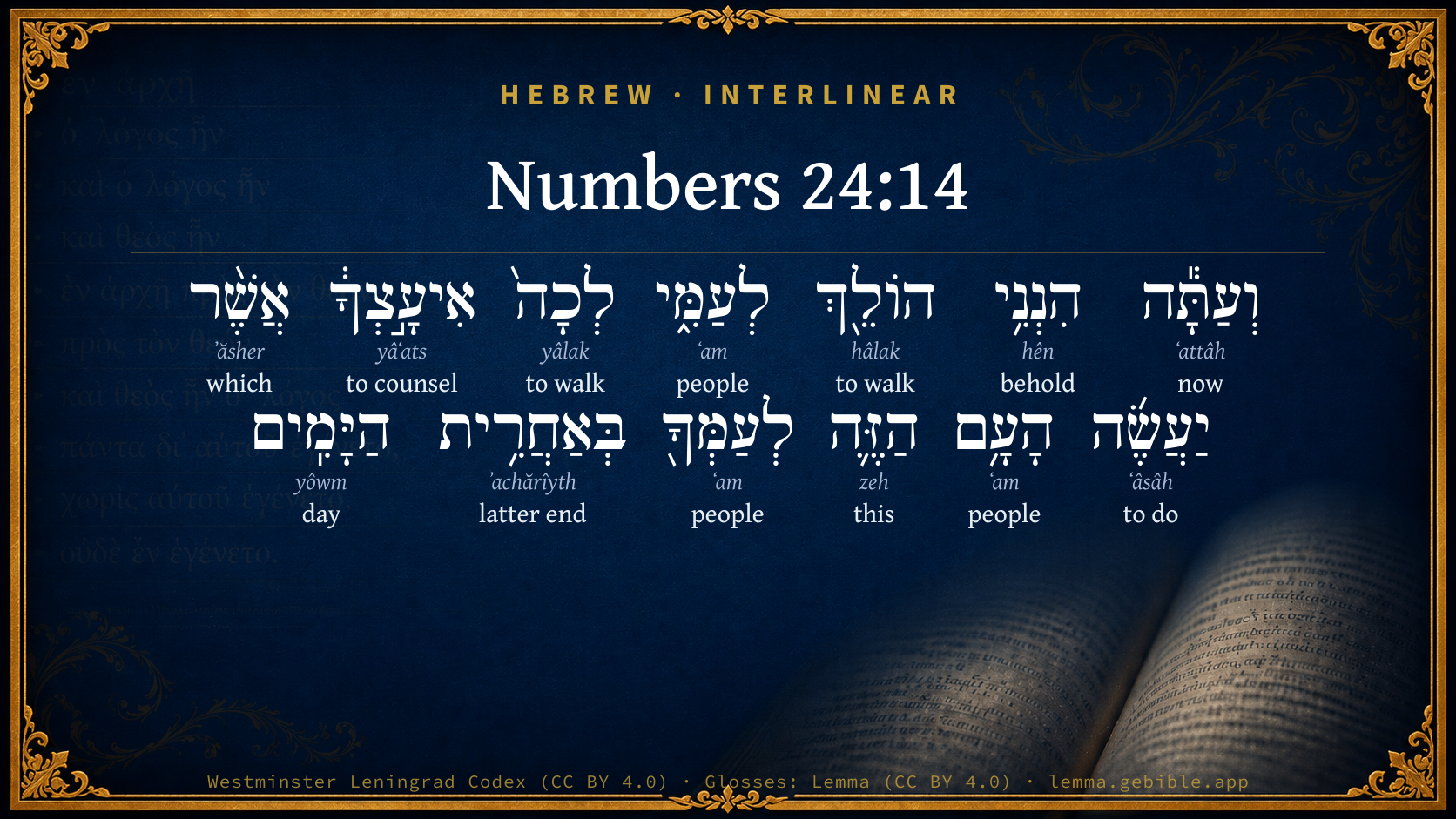
Hebrew (Westminster Leningrad Codex) Numbers 24:14 appears in the Hebrew Old Testament. The text above is from the Westminster Leningrad Codex. Each word links to its Strong’s number, a concise gloss, and parsing drawn from the Open Scriptures Hebrew Bible morphology. Click any word for its full Brown-Driver-Briggs (BDB) entry.
Download image
Cite this verse

Numbers 24:14 (World English Bible). Public Domain. Lemma interlinear Bible study tool, https://lemma.gebible.app/v/numbers/24/14.

Show BibTeX & RIS
BibTeX
RIS
English Translation
Now, behold, I go to my people: come, [and] I will advertise you what this people shall do to your people in the latter days.
World English Bible · Public Domain
Download a study sheet

One document with this verse’s original text, its word-by-word gloss line, the meaning frame, cross-references with their text, attributed commentary, and full source and license credits — printable, and it pastes into notes with its structure intact.

This verse Autodidact and up

Study sheet (.html) Plain text (.txt)

A passage Seminary Student

Up to 50 verses in one chapter. A passage sheet keeps up to 6 commentary sources and 12 cross-references per verse, in the order this page ranks them, and says so on the sheet whenever that leaves anything out. Ask for a single verse and you get the Autodidact verse sheet above.

Everything on this page stays free to read, with no account — the sheet is a download of what is already on screen, not access to it.

Want to remove ads? Support Godless Engineer
Compare translations 3

The same verse in 3 English versions, stacked beneath the original-language interlinear above. Click any original word for its lexicon entry.

Each is an independent rendering of the whole verse — the interlinear is not word-aligned to these translations.

Highlighted words mark where these versions differ — a whole-verse word diff, not a word-by-word alignment.

  • World English Bible Public Domain
    Now, behold, I go to my people: come, [and] I will advertise you what this people shall do to your people in the latter days.
  • King James Version Public Domain
    And now, behold, I go unto my people: come therefore, and I will advertise thee what this people shall do to thy people in the latter days.
  • unfoldingWord Literal Text CC BY-SA 4.0
    And now, behold I am about to go to my people. Come, I will advise you what this people will do to your people in the future days.”

unfoldingWord Literal Text — © unfoldingWord, licensed CC BY-SA 4.0. Word-aligned USFM3 via Door43 (git.door43.org/unfoldingWord/en_ult).

Versions to compare (up to 4)

3 of 4 selected

Show all 18 translations

Every available English version of this verse, each an independent rendering of the whole verse.

  • World English Bible Public Domain
    Now, behold, I go to my people: come, [and] I will advertise you what this people shall do to your people in the latter days.
  • Berean Standard Bible Public Domain
    Now I am going back to my people, but come, let me warn you what this people will do to your people in the days to come.”
  • Majority Standard Bible Public Domain
    Now I am going back to my people, but come, let me warn you what this people will do to your people in the days to come.”
  • King James Version Public Domain
    And now, behold, I go unto my people: come therefore, and I will advertise thee what this people shall do to thy people in the latter days.
  • American Standard Version (1901) Public Domain
    And now, behold, I go unto my people: come, `and' I will advertise thee what this people shall do to thy people in the latter days.
  • Revised Version (1885) Public Domain
    And now, behold, I go unto my people: come, and I will advertise thee what this people shall do to thy people in the latter days.
  • Geneva Bible (1599) Public Domain
    And nowe behold, I goe vnto my people: come, I will aduertise thee what this people shall doe to thy folke in the later dayes.
  • Douay-Rheims (1899) Public Domain
    But yet going to my people, I will give thee counsel, what this people shall do to thy people in the latter days.
  • Young's Literal Translation Public Domain
    and, now, lo, I am going to my people; come, I counsel thee `concerning' that which this people doth to thy people, in the latter end of the days.'
  • Literal Standard Version CC BY-SA 4.0
    And now, behold, I am going to my people; come, I counsel you [concerning] that which this people does to your people in the latter end of the days.”
  • Unlocked Literal Bible CC BY-SA 4.0
    So now, look, I will go back to my people. But first let me warn you what this people will do to your people in the days ahead.”
  • unfoldingWord Literal Text CC BY-SA 4.0
    And now, behold I am about to go to my people. Come, I will advise you what this people will do to your people in the future days.”
  • Darby Bible Public Domain
    And now behold, I go to my people: come, I will admonish thee what this people will do to thy people at the end of days.
  • World Messianic Bible Public Domain
    Now, behold, I go to my people. Come, I will inform you what this people shall do to your people in the latter days.”
  • Webster's Bible Public Domain
    And now, behold, I go to my people: come therefore, I will advertise thee what this people will do to thy people in the latter days.
  • Free Bible Version CC BY-SA 4.0
    Listen! I'm going back home now to my own people, but first let me warn you what these Israelites are going to do to your people in the future.”
  • Bible in Basic English Public Domain
    So now I will go back to my people: but first let me make clear to you what this people will do to your people in days to come.
  • JPS Tanakh (1917) Public Domain
    And now, behold, I go unto my people; come, and I will announce to thee what this people shall do to thy people in the end of days.'

Literal Standard Version (2020), Covenant Press — licensed CC BY-SA 4.0. Text via the HelloAO Bible API (eBible.org). Unlocked Literal Bible (unfoldingWord) — licensed CC BY-SA 4.0. Text via the HelloAO Bible API (eBible.org). unfoldingWord Literal Text — © unfoldingWord, licensed CC BY-SA 4.0. Word-aligned USFM3 via Door43 (git.door43.org/unfoldingWord/en_ult). Free Bible Version, Dr. Jonathan Gallagher — licensed CC BY-SA 4.0. Text via the HelloAO Bible API (eBible.org).

Word by word

More ways to search: Search by grammar → Find every occurrence → Compare this word →

Practice this passage: Drill this verse → Learn its vocabulary →

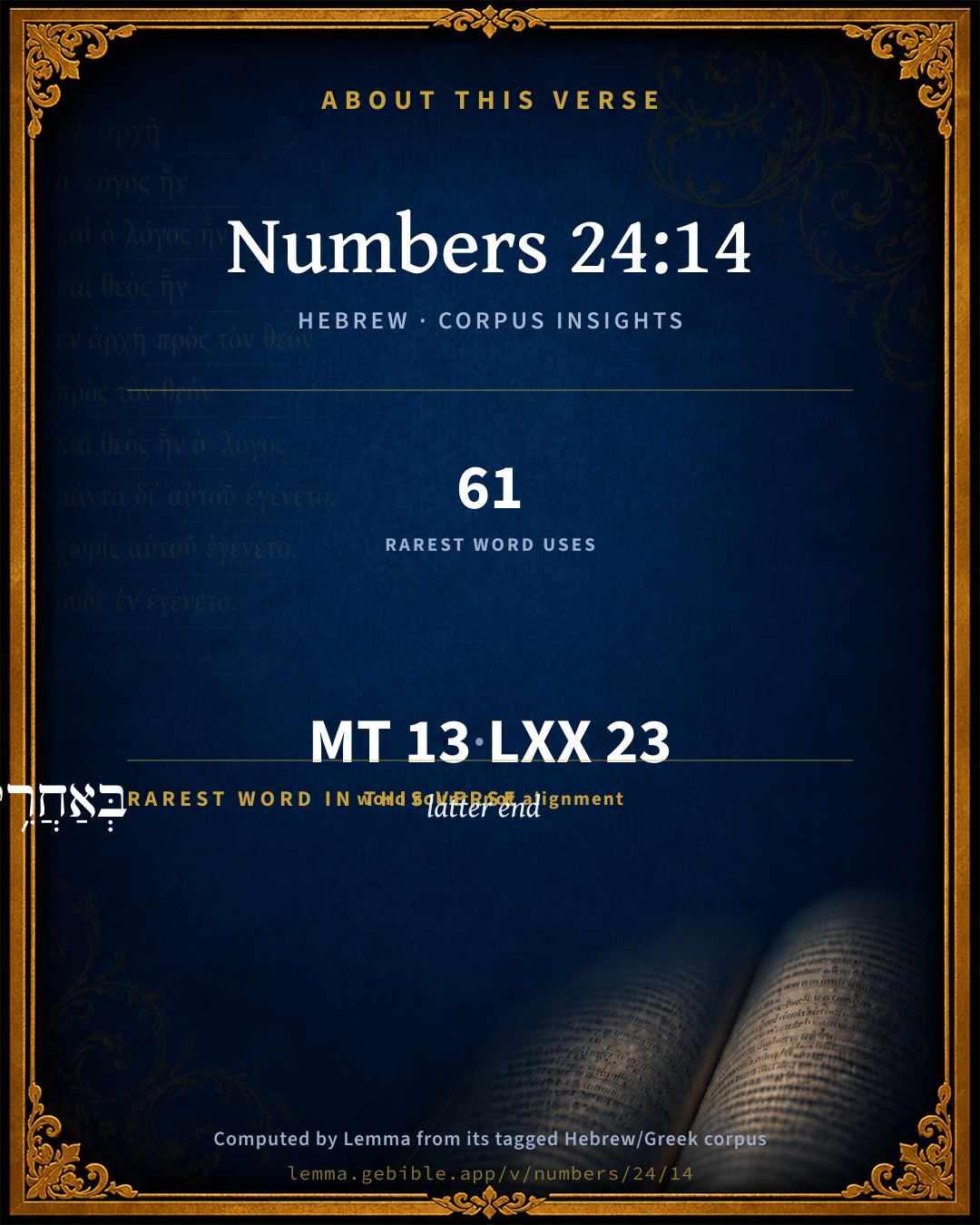
בְּאַחֲרִ֥ית
ʼachărîyth
H319
“in/at · latter end of”
Preposition + Noun, Common, Feminine, Singular, Construct
Part of Speech
Preposition + Noun
Type
Common
Gender
Feminine
Number
Singular
State
Construct
Full BDB Definition

Origin: from H310

TWOT: 68f

after part, end - end, issue, event - latter time (prophetic for future time) - posterity - last, hindermost
  1. וְעַתָּ֕ה ʻattâh H6258 “and · now” Conjunction + Adverb
  2. הִנְנִ֥י hên H2005 “behold · me” Particle, Interjection + Suffix, Personal, 1st Person, Common, Singular
  3. הוֹלֵ֖ךְ hâlak H1980 “walking” Verb, Qal, Participle Active, Masculine, Singular, Absolute
  4. לְעַמִּ֑י ʻam H5971 “to/for · people · my” Preposition + Noun, Common, Masculine, Singular, Construct + Suffix, Personal, 1st Person, Common, Singular
  5. לְכָה֙ yâlak H3212 “walk” Verb, Qal, Imperative, 2nd Person, Masculine, Singular + Suffix, h
  6. אִיעָ֣צְךָ֔ yâʻats H3289 “to counsel · you” Verb, Qal, Imperfect, 1st Person, Common, Singular + Suffix, Personal, 2nd Person, Masculine, Singular
  7. אֲשֶׁ֨ר ʼăsher H834 “which” Particle, Relative
  8. יַעֲשֶׂ֜ה ʻâsâh H6213 “to do” Verb, Qal, Imperfect, 3rd Person, Masculine, Singular
  9. הָעָ֥ם ʻam H5971 “the · people” Particle, Definite Article + Noun, Common, Masculine, Singular, Absolute
  10. הַזֶּ֛ה zeh H2088 “the · this” Particle, Definite Article + Pronoun, Demonstrative, Masculine, Singular
  11. לְעַמְּךָ֖ ʻam H5971 “to/for · people · your” Preposition + Noun, Common, Masculine, Singular, Construct + Suffix, Personal, 2nd Person, Masculine, Singular
  12. הַיָּמִֽים yôwm H3117 “the · days” Particle, Definite Article + Noun, Common, Masculine, Plural, Absolute

About this verse

These counts appear in no published source. They are computed here, from the morphology-tagged text and Lemma’s own curated glosses. What Lemma adds →

13
words
11
distinct lemmas
Pentateuch
section

Grammatical profile

  • 4 verbs
  • 5 nouns
  • 1 pronoun
  • 1 adverb
  • 2 particles

Verb forms

  • הוֹלֵ֖ךְ Qal · Participle Active
  • לְכָה֙ Qal · Imperative
  • אִיעָ֣צְךָ֔ Qal · Imperfect
  • יַעֲשֶׂ֜ה Qal · Imperfect

Repetition

A word recurs within this verse — often emphatic in Hebrew:

  • לְעַמִּ֑י people H5971 ×3

Hebrew & Septuagint length

In English translation the verse runs 25 words from the Hebrew and 26 from the Septuagint (LXX English) — closely comparable.

A rough comparison of the two English renderings, which tokenize alike — not a word-level alignment.

Word counts can differ between the Hebrew and the Greek without any difference in meaning — e.g. the Hebrew direct-object marker אֵת has no separate Greek word, and Greek often adds the article ὁ.

In the original languages it is 13 Hebrew tokens and 23 Greek tokens — but the two are counted differently (Hebrew bundles its prefixes and suffixes into one token; the Greek is in lemma form), so that isn’t a like-for-like length.

Cross-references

14

Topical passages linked to Numbers 24:14 in the Treasury of Scripture Knowledge — connected by theme and wording, ordered by reader-vote popularity; previews shown in the World English Bible.

  • Micah 6:5 My people, remember now what Balak king of Moab devised, And what Balaam the son of Beor answered him from Shittim to Gilgal, That you may know the righteous acts of Yahweh."
  • Genesis 49:1 Jacob called to his sons, and said: "Gather yourselves together, that I may tell you that which will happen to you in the days to come.
  • Revelation 2:14 But I have a few things against you, because you have there some who hold the teaching of Balaam, who taught Balak to throw a stumbling block before the children of Israel, to eat things sacrificed to idols, and to commit sexual immorality.
  • Daniel 2:28 but there is a God in heaven who reveals secrets, and he has made known to the king Nebuchadnezzar what shall be in the latter days. Your dream, and the visions of your head on your bed, are these:
  • 2 Timothy 3:1 But know this, that in the last days, grievous times will come.
  • Numbers 24:17 I see him, but not now; I see him, but not near: There shall come forth a star out of Jacob, A scepter shall rise out of Israel, Shall strike through the corners of Moab, Break down all the sons of tumult.
  • Numbers 31:7–18 They warred against Midian, as Yahweh commanded Moses; and they killed every male.
  • Isaiah 24:22 They shall be gathered together, as prisoners are gathered in the pit, and shall be shut up in the prison; and after many days shall they be visited.
  • Jeremiah 48:47 Yet will I bring back the captivity of Moab in the latter days, says Yahweh. Thus far is the judgment of Moab.
  • Jeremiah 49:39 But it shall happen in the latter days, that I will bring back the captivity of Elam, says Yahweh.
  • Daniel 10:14 Now I have come to make you understand what shall happen to your people in the latter days; for the vision is yet for [many] days:
  • Hosea 3:5 Afterward the children of Israel shall return, and seek Yahweh their God, and David their king, and shall come with trembling to Yahweh and to his blessings in the last days.
  • Acts 2:17 'It will be in the last days, says God, That I will pour out my Spirit on all flesh. Your sons and your daughters will prophesy. Your young men will see visions. Your old men will dream dreams.
  • Revelation 2:10 Don't be afraid of the things which you are about to suffer. Behold, the devil is about to throw some of you into prison, that you may be tested; and you will have oppression for ten days. Be faithful to death, and I will give you the crown of life.

Cross-references courtesy of OpenBible.info (CC BY 4.0).

Hebrew and Greek witnesses Masoretic Hebrew ↔ Greek Septuagint

The same verse in the two great witnesses to the Old Testament, shown verse-for-verse.

These are two independent witnesses, not word-aligned to each other, and the Septuagint is shown in lemma (dictionary) form.

Hebrew Numbers 24:14 Masoretic · Westminster Leningrad Codex

וְעַתָּ֕ה הִנְנִ֥י הוֹלֵ֖ךְ לְעַמִּ֑י לְכָה֙ אִיעָ֣צְךָ֔ אֲשֶׁ֨ר יַעֲשֶׂ֜ה הָעָ֥ם הַזֶּ֛ה לְעַמְּךָ֖ בְּאַחֲרִ֥ית הַיָּמִֽים

Now, behold, I go to my people: come, [and] I will advertise you what this people shall do to your people in the latter days.

World English Bible · Public Domain

Greek LXX Numbers 24:14 Septuagint · lemma form

καί νῦν ἰδού ἀποτρέχω εἰς ὁ τόπος ἐγώ δεῦρο συνβουλεύω σύ τίς ποιέω ὁ λαός οὗτος ὁ λαός σύ ἐπί ἔσχατο ὁ ἡμέρα

And now, behold, I return to my place; come, I will advise you of what this people shall do to your people in the last days.

LXX2012 (modern English Septuagint) · Public Domain

On this verse, The Pulpit Commentary discusses the Septuagint’s reading. Read the note in Commentary ↓

Hebrew: Westminster Leningrad Codex (CC BY 4.0). Greek: Septuagint (public domain); English from LXX2012 (modern English Septuagint) (Public Domain). How the Septuagint differs from the Hebrew →

Targum (Aramaic paraphrase)

2

The Targum is the ancient Jewish Aramaic paraphrase of the Hebrew Scriptures — an interpretive translation, not the Hebrew text itself. Onkelos (literal) and Pseudo-Jonathan (expansive) render the Torah, and Jonathan the Prophets. Coverage is partial: where no permissively-licensed English translation exists for a verse, only the Aramaic is shown. This is verse-level text, not a word-by-word alignment to the Hebrew.

  1. Targum Onkelos Torah (Genesis–Deuteronomy)
    וּכְעַן הָא אֲנָא אָזֵיל לְעַמִי אִיתָא אֲמַלְכִינָךְ מָה דְתַּעְבֵיד וַאֲחַוֵי לָךְ מָא דְיַעֲבֵד עַמָא הָדֵין לְעַמָךְ בְּסוֹף יוֹמַיָא

    (no public-domain English translation for this verse)

    Targum Onkelos — Aramaic: “Onkelos Genesis” (public domain); “Onkelos Exodus” (public domain); “Onkelos Leviticus” (public domain); “Onkelos Numbers” (public domain); “Onkelos Deuteronomy” (public domain). English: “Sefaria Community Translation” (CC0 1.0 (public-domain dedication)); “J.W. Etheridge. The Targums of Onkelos and Jonathan Ben Uzziel on the Pentateuch. London: Longmans, Green, 1862” (public domain). Text via Sefaria.

  2. Targum Pseudo-Jonathan Torah (Genesis–Deuteronomy)
    וּכְדוֹן הָאֲנָא מִתְפְנֵי וְאָזִיל לְעַמִי אִיתָא אֵימְלְכִינָךְ אִיזַל זַמִין פּוּנְדְקִין וּמַנֵי בְּהוֹן נְשַׁיָיא מַטְעֲיָיתָא זַבִּין מֵיכְלָא וּמִשְׁתַּיָיא בְּבָצִיר מִן טִימְהוֹן וְיֵיתוּן עַמָא הָדֵין וְיֵיכְלוּן וְיִשְׁתּוּן וִירַווּן וִישַׁמְשׁוּן עִמְהוֹן וִיכַפְרוּן בֶּאֱלָהָהוֹן וְיִתְמַסְרוּן בִּידָךְ בְּשָׁעָה קְּלִילָא וְיִפְּלוּן מִנְהוֹן סַגִיאִין בְּרַם בָּתַר כְּדֵין עֲתִידִין הִינוּן דְיִשְׁלְטוּן בְּעַמָךְ בְּסוֹף עֲקַב יוֹמַיָא

    And now, behold, I return to go to my people. Come, I will give thee counsel: Go, furnish tavern houses, and employ seductive women to sell food and drinks cheaply, and to bring this people together to eat and drink, and commit whoredom with them, that they may deny their God; then in a brief time will they be delivered into thy hand, and many of them fall. Nevertheless, after this they will still have dominion over thy people at the end of the days.

    Targum Pseudo-Jonathan — Aramaic: “Targum Jonathan on Genesis” (public domain); “Targum Jonathan on Exodus” (public domain); “Targum Jonathan on Leviticus” (public domain); “Targum Jonathan on Numbers” (public domain); “Targum Jonathan on Deuteronomy” (public domain). English: “The Targum of Jonathan ben Uzziel, trans. J. W. Etheridge, London, 1862” (public domain). Text via Sefaria.

Commentary

Notes on Numbers 24:14 from classic Christian and Jewish commentators (each source and its license shown beneath its notes). The classic Christian expositions comment on the surrounding passage and are grouped to its opening verse, so a note may address several verses; the Jewish commentaries on the Tanakh (Rashi and others) are per-verse, so they appear only where the commentator wrote on this verse.

Lemma curates 59 commentaries, every one of them public domain or Creative Commons licensed, each selected and text-cleaned for this edition rather than reprinted as found. About our sources →

Trapp's Complete Commentary

John Trapp

Num 24:14 And now, behold, I go unto my people: come [therefore, and] I will advertise thee what this people shall do to thy people in the latter days.

Ver. 14. I will advertise thee,] viz., What to do; as he did. {Num 31:16} Parasites propound to princes, suavia potius quam sana consilia, pleasing but pestilent counsel, and so do officiously mischieve them; as the dragon is said to bite the elephant’s ear, and there hence to suck his blood, that being the only place that he cannot reach with his trunk to defend.

John Trapp, A Commentary or Exposition upon All the Books of the Old and New Testament (1647–1656) — public domain. Text from a community e-Sword module.

Tyndale Open Study Notes

Tyndale Open Resources

24:14 let me tell you what the Israelites will do to your people in the future: Since Balak sought to curse Israel, he and his people would be cursed (24:9). The damage that Balak hoped to inflict on Israel would fall on Moab.

Tyndale Open Study Notes — © Tyndale Open Resources, licensed CC BY-SA 4.0. Text via the HelloAO Bible API.

Geneva Bible (1599)

Geneva Bible translators

Hebrew, counsel.

He gave also wicked counsel to cause the Israelites to sin, that thereby God might forsake them, Num. 31:16.

Geneva Bible (1599) marginal notes — public domain. Text via Bolls.life.

Ellicott's Commentary for English Readers

(14) I go unto my people.—Such was, probably, the intention of Balaam when he spoke these words. The account of the death of Balaam, however, shows that he still lingered amongst the Moabites.

I will advertise thee . . . —The word which is here employed generally means to advise. The announcement which Balaam made to Balak virtually included advice, inasmuch as it foretold the supremacy of Israel over all their foes, and, consequently, implied the folly of opposition to their progress. It does not appear whether it was or was not at this time that Balaam “taught Balac to cast a stumbling block before the children of Israel, to eat things sacrificed unto idols, and to commit fornication” (Rev_2:14). In any case, there does not appear to be any reference to such advice in this verse, although it is inserted in the Targum of Palestine in this place.

In the latter days.—Literally, in the end of the days. (See Gen_49:1, where the same expression occurs, and Note.) The prophecy which follows refers exclusively to the future; and it is divided into four parts by the recurrence of the words “He took up his parable” at Num_24:15; Num_24:20-21; Num_24:23.

A Bible Commentary for English Readers, edited by Charles John Ellicott (1878–1897) — public domain. Text from a community e-Sword module.

The Cambridge Bible for Schools and Colleges

gen. ed. J. J. S. Perowne

14. I will advertise thee] I will counsel thee. ‘Advertise’ is an archaism, meaning ‘inform’; cf. Rth_4:4 (A.V. [Note: .V. The Authorised Version.] ).

The Cambridge Bible for Schools and Colleges (gen. ed. J. J. S. Perowne; Cambridge University Press, 1878–1918) — public domain. Text from a community e-Sword module.

John Gill's Exposition

And now, behold, I go unto my people,.... According to thine order, I shall not stay to make thee uneasy with my company, only I crave thy patience to hear me a little before we part:

come therefore, and I will advertise thee; about some things that shall come to pass in future time, respecting this people, and thine, and other nations, both near and remote; and he hoped by this to bring him into a better temper, and part good friends: or "I will counsel thee"; what thou shall do, as the Targum of Onkelos, and so makes a sentence of this of itself, independent of, and distinct from what follows, beginning the next clause thus:

and I will show them what this people, &c. referring the former to the counsel Balaam gave to Balak, how to seduce the people into idolatry; and the Targum of Jonathan expresses it at large;"come, I will counsel thee, go and prepare victualling houses, and place lewd women there to sell food and drink at a low price, and bring this people to eat, and drink, and be drunken; and let them lie with them, and deny their God, and they will be delivered into thine hands in a little time, and many of them will fall;''which advice was followed, Num 25:1 and is referred to, Num 31:16 but though Balaam did give him such advice before he left him, which is highly probable, yet it is not what is intended here, since what follows is closely connected with the above clause, and contains the thing he advertised or advised him of:

what this people shall do to thy people in the latter days; not what the Moabites should do to the Israelites now, as the Vulgate Latin version, quite contrary to the original text, but what the Israelites should do to the Moabites in future times; not only in the times of David, by whom they were subdued, Sa2 8:2 but in much later times, even in the times of Alexander, or King Jannaeus, who overcame them, as Josephus (b) relates. Now this might be said to Balak to make him easy, that it would not be until the latter days, many hundreds of years hence, ere the people of Israel would fight with Moab, and subdue it; and therefore he need be under no concern about them, since he would meet with no trouble from them in his time, nor his people for years to come.

(b) Antiqu. l. 13. c. 13. sect. 5.

John Gill's Exposition of the Whole Bible (1746–1763) — public domain (CC PDM 1.0). Text via the HelloAO Bible API.

Albert Barnes' Notes on the Bible

I will advertise thee - i. e., “I will advise thee,” words which refer to the ensuing prophecy.

Albert Barnes' Notes on the Bible (1834–1885) — public domain. Text from a community e-Sword/MySword module.

Haydock's Catholic Bible Commentary

Counsel, out of my own head. This he was going to do, (Calmet) that he might not lose his reward, when again he found himself impelled by the Lord to speak what was contrary to his temporal interest. After complying reluctantly, God ceased to strive, as it were, with his rebellious will any longer, and left him to follow the bent of his corrupt heart. Upon which he proceeded to give that infernal counsel, which involved both many of the Israelites and himself in utter destruction. (Haydock) (Chap. xxxi. 16., and Apocalypse ii. 4. --- Days. Hebrew, "Come, I will admonish thee what this people shall do to thy people," &c. Onkelos and Origen (hom. 18. and 20.) give both senses. (Calmet) --- Indeed, the transactions of both people were so blended, when they were fighting together, that to give the history of one would be explaining the fortune of the other. (Haydock)

George Leo Haydock (1774–1849), Haydock's Catholic Family Bible and Commentary, 1859 edition — public domain. Excludes Psalms (Douay-Rheims chapter numbering differs from Protestant) and Deuterocanonical books (Catholic canon only).

Matthew Poole's English Annotations

Advertise thee, or inform thee, to wit, concerning future things, as it here follows, for this word seems inseparably joined with the following. Others, give thee counsel, and tell thee what this people, &c. So it is a short and defective speech, such as we have Exo 4:5; 13:8. And by counsel. they understand that which is related Num 25:1,2, which was done by Balaam’s counsel, Num 31:16; Rev 2:14. But the former sense is more unforced and agreeable to the following words as they lie.

In the latter days: not in thy time, therefore thou hast no reason to fear, but in succeeding ages, as 2Sa 8:2, &c.

Matthew Poole's English Annotations on the Holy Bible (1683–1685) — public domain. Text from a community e-Sword/MySword module.

Whedon's Commentary on the Bible

Daniel D. Whedon

14. I will advertise thee — Tell thee advisedly. Balaam here shows that he is conscious of a true prophetic vision.

In the latter days — Literally, at the end of the days. Not some indefinite future, but the beginning of the last future, the Messianic age from its commencement to its consummation. Gen_49:1, note.

Daniel D. Whedon (gen. ed.), Commentary on the Old and New Testaments (1874–1909) — public domain. Text from a community e-Sword module.

The Pulpit Commentary

I will advertise thee. has properly the meaning "advise" (Septuagint, sumbouleusw ), but it seems to have here the same subordinate sense of giving information which "advise" has with us. The Vulgate here has followed the surmise of the Jewish commentators, who saw nothing in Balaam but the arch-enemy of their race, and has actually altered the text into "dabo consilium quid populus tuus populo huic faciat". (cf. Num_31:16)

The Pulpit Commentary (1880–1919), ed. H.D.M. Spence-Jones & Joseph S. Exell — public domain. Text from a community e-Sword module.

Rashi

Rabbi Shlomo Yitzchaki (Rashi)

הולך לעמי [AND NOW, BEHOLD, I] GO TO MY PEOPLE — “From now on, behold, I am like the rest of my people”. He said this because he knew that the Holy One, blessed be He, had departed from him.

לך איעצך COME AND I WILL COUNSEL THEE what you have to do. And what is the counsel? The God of these people hates unchastity, therefore tempt them to sin by means of thy women-folk, as is related in the chapter חלק (Sanhedrin 106a) — You can know that it was Balaam who gave this counsel, to make them fall by the sin of unchastity, for it is stated, of the women of Midian (Numbers 31:16), “Behold, these were an enticement to the children of Israel through the word of Balaam”.

אשר יעשה העם הזה לעמך WHAT THIS PEOPLE SHALL DO TO THY PEOPLE — This is an elliptical verse, the meaning being: I will give thee counsel how to make them fall into sin, and I also will tell thee what evil they will once do to thy people Moab in later days: viz., (v. 17) “they will pierce the corners of Moab”. — The Targum explains at length what is implied by the terseness of the Hebrew text (“Come I will give thee counsel what thou shouldst do and I will show thee what this people etc.")

Rashi on the Tanakh — English translations: “The Judaica Press complete Tanach with Rashi, translated by A. J. Rosenberg” (CC BY 4.0); “Pentateuch with Rashi's commentary by M. Rosenbaum and A.M. Silbermann, 1929-1934” (public domain); “The Metsudah Tanach series, Lakewood, N.J” (CC BY 4.0); and “The Book of Joshua, Metsudah Publications, 1997” (CC BY 4.0). Text via Sefaria.

Ramban (Nachmanides)

Rabbi Moshe ben Nachman (Ramban / Nachmanides)

COME AND I WILL COUNSEL THEE. Since Balaam wanted to tell [Balak] about the punishment [that would befall] his people, as it is written, and he shall smite through the corners of Moab, therefore he told him, I will counsel thee, that is to say: “I will tell you ‘on the side’ an advice, so that others should not hear it.” “Come and I will counsel thee what you have to do [to revenge yourself upon Israel]. And what was the advice [that he gave him]? [He told him]: ‘The G-d of these [Israelites] hates immorality, etc., [therefore I advise you to seduce Israel into sin by means of the lure of the Moabite women],’ as is narrated in the Chapter Cheilek., meaning: “I will counsel thee how to lead the people astray, and I will tell you what this people shall do …” Ramban explains the phrase “I will counsel thee” differently. You may know that it was Balaam who gave them this counsel [to lead Israel astray] through immorality, for it is said, Behold, these [women] caused the children of Israel, through the counsel of Balaam, [to revolt so as to break faith with the Eternal]. WHAT THIS PEOPLE SHALL DO TO THY PEOPLE. This is an elliptical verse [which means as follows]: ‘I will counsel thee how to corrupt them, and I will [also] tell you what evil they are destined to do to Moab in the end of days.’” This is Rashi’s language.The correct interpretation [of the word i’atzcha, normally translated: I will counsel thee] seems to me to be that Balaam told Balak: “I will tell you the purpose that G-d has planned that this people shall do to thy people in the end of days,” this being similar to the expressions: This is the ‘eitzah’ (purpose) that is ‘y’utzah’ (purposed) upon the whole earth; Hear ye the ‘atzath’ (design) of the Eternal, that He hath ‘ya’atz’ (purposed) against Edom. Balaam said i’atzcha [which literally means “I will give you counsel”], because one who hears counsel, [as Balaam heard G-d’s counsel], is called a no’atz [he with whom counsel is taken]. (with whom took He counsel).And this prophecy [in the following verses], refers to Messianic times, for all of Balaam’s prophecies added [to the previous ones] in [speaking of more] distant events. Thus at first he said that Israel is [now] the portion of the Eternal and His inheritance; in the second prophecy he added that they would [later on] conquer the Land and kill its kings. In the third [prophecy] he saw them dwelling in the Land and increasing and multiplying therein, and that they would appoint a king [Saul] who would defeat Agag, and that the kingdom [of Israel] would be further exalted; for he saw David [whose kingdom] was exalted exceedingly, as it is said, And David perceived that the Eternal had established him king over Israel, and that He hath exalted his kingdom for His people Israel’s sake, that is to say, because He had promised them that their kingdom would be exalted. And now in this fourth prophecy Balaam continued [on the future] and saw the Messianic era; therefore he spoke of it as a very distant event, saying, I see him, but not now; I behold him, but not nigh, [a phrase] which he did not use in his first [three] prophecies. He stated that this is the purpose of G-d which He had planned, to come to pass in the end of days.

Ramban (Nachmanides) on the Tanakh — English translation: “Commentary on the Torah by Ramban (Nachmanides). Translated and annotated by Charles B. Chavel. New York, Shilo Pub. House, 1971-1976” (CC BY 4.0). Text via Sefaria.

Lesson kit

Teaching starters — assembled from the data on this page, not authored interpretation. Every prompt links to the verse data it draws on. Edit before teaching.

Numbers, in the Pentateuch, opens this verse with 13 words (11 distinct Hebrew lemmas). Its most distinctive word is ʼachărîyth (“latter end”). A historical commentator’s framing appears above. Read the whole chapter for the surrounding context.

Discussion questions

  1. How does “latter end” (ʼachărîyth) shape what this verse is saying?
  2. How does Micah 6:5, which shares this passage’s theme, read alongside this verse?
  3. What does the repetition of “people” (3× in this one verse) do in this verse?
  4. These translations render this verse differently; the difference is in the English rendering, not the original. What questions does that raise?
  5. «הוֹלֵ֖ךְ» is a Qal Participle Active verb. How does that grammatical form shape the action described?
  6. Compare how Trapp's Complete Commentary and Tyndale Open Study Notes read this verse. Where do they agree or differ?

Things to notice

Reading settings

Reading text

Shown beneath each verse's original-language words.

Old Testament
Old Testament edition

Read the OT as the Masoretic Hebrew (MT) or the Greek Septuagint (LXX).

English shown for the Greek Septuagint (in the Hebrew ↔ Greek comparison).

Comparing translations? Open the Compare panel on any verse page to stack up to four side by side.