
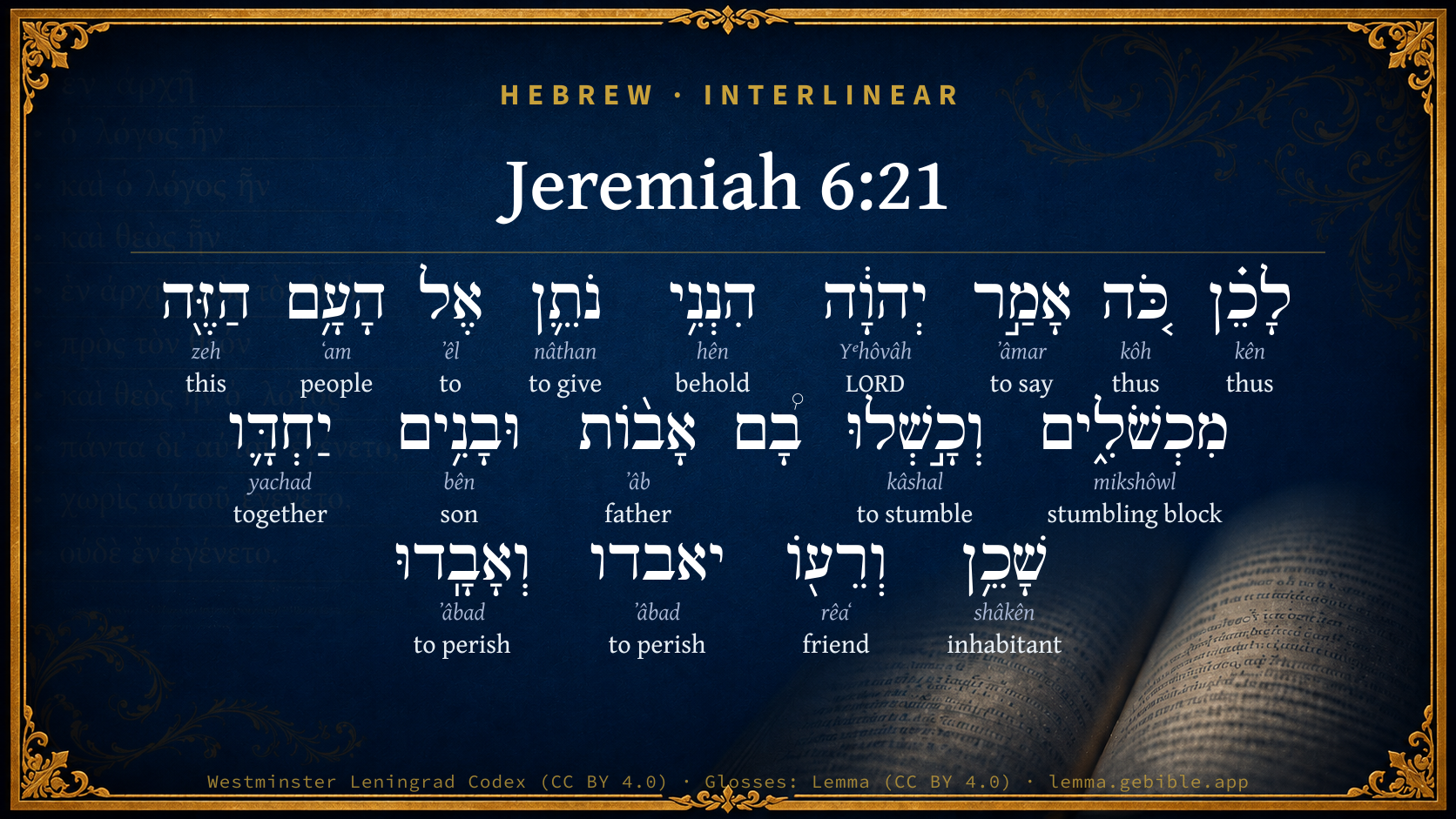
Jeremiah 6:21

Hebrew (Westminster Leningrad Codex) Jeremiah 6:21 appears in the Hebrew Old Testament. The text above is from the Westminster Leningrad Codex. Each word links to its Strong’s number, a concise gloss, and parsing drawn from the Open Scriptures Hebrew Bible morphology. Click any word for its full Brown-Driver-Briggs (BDB) entry.
Download image
Cite this verse

Jeremiah 6:21 (World English Bible). Public Domain. Lemma interlinear Bible study tool, https://lemma.gebible.app/v/jeremiah/6/21.

Show BibTeX & RIS
BibTeX
RIS
English Translation
Therefore thus says Yahweh, Behold, I will lay stumbling-blocks before this people; and the fathers and the sons together shall stumble against them; the neighbor and his friend shall perish.
World English Bible · Public Domain
Download a study sheet

One document with this verse’s original text, its word-by-word gloss line, the meaning frame, cross-references with their text, attributed commentary, and full source and license credits — printable, and it pastes into notes with its structure intact.

This verse Autodidact and up

Study sheet (.html) Plain text (.txt)

A passage Seminary Student

Up to 50 verses in one chapter. A passage sheet keeps up to 6 commentary sources and 12 cross-references per verse, in the order this page ranks them, and says so on the sheet whenever that leaves anything out. Ask for a single verse and you get the Autodidact verse sheet above.

Everything on this page stays free to read, with no account — the sheet is a download of what is already on screen, not access to it.

Want to remove ads? Support Godless Engineer
Compare translations 3

The same verse in 3 English versions, stacked beneath the original-language interlinear above. Click any original word for its lexicon entry.

Each is an independent rendering of the whole verse — the interlinear is not word-aligned to these translations.

Highlighted words mark where these versions differ — a whole-verse word diff, not a word-by-word alignment.

  • World English Bible Public Domain
    Therefore thus says Yahweh, Behold, I will lay stumbling-blocks before this people; and the fathers and the sons together shall stumble against them; the neighbor and his friend shall perish.
  • King James Version Public Domain
    Therefore thus saith the LORD, Behold, I will lay stumblingblocks before this people, and the fathers and the sons together shall fall upon them; the neighbour and his friend shall perish.
  • unfoldingWord Literal Text CC BY-SA 4.0
    Therefore thus says Yahweh, ‘Behold, I shall give stumbling blocks to this people, and they will stumble on them—fathers and sons together. A resident and his neighbor will perish.’

unfoldingWord Literal Text — © unfoldingWord, licensed CC BY-SA 4.0. Word-aligned USFM3 via Door43 (git.door43.org/unfoldingWord/en_ult).

Versions to compare (up to 4)

3 of 4 selected

Show all 18 translations

Every available English version of this verse, each an independent rendering of the whole verse.

  • World English Bible Public Domain
    Therefore thus says Yahweh, Behold, I will lay stumbling-blocks before this people; and the fathers and the sons together shall stumble against them; the neighbor and his friend shall perish.
  • Berean Standard Bible Public Domain
    Therefore this is what the LORD says: “I will lay stumbling blocks before this people; fathers and sons alike will be staggered; friends and neighbors will perish.”
  • Majority Standard Bible Public Domain
    Therefore this is what the LORD says: “I will lay stumbling blocks before this people; fathers and sons alike will be staggered; friends and neighbors will perish.”
  • King James Version Public Domain
    Therefore thus saith the LORD, Behold, I will lay stumblingblocks before this people, and the fathers and the sons together shall fall upon them; the neighbour and his friend shall perish.
  • American Standard Version (1901) Public Domain
    Therefore thus saith Jehovah, Behold, I will lay stumbling-blocks before this people; and the fathers and the sons together shall stumble against them; the neighbor and his friend shall perish.
  • Revised Version (1885) Public Domain
    Therefore thus saith the LORD, Behold, I will lay stumblingblocks before this people: and the fathers and the sons together shall stumble against them; the neighbour and his friend shall perish.
  • Geneva Bible (1599) Public Domain
    Therefore thus sayeth the Lord, Beholde, I will laie stumbling blockes before this people, and the fathers and the sonnes together shall fall vpon them: the neighbour and his friende shall perish.
  • Douay-Rheims (1899) Public Domain
    Therefore thus saith the Lord: Behold, I will bring destruction upon this people, by which fathers and sons together shall fall, neighbor and kinsman shall perish.
  • Young's Literal Translation Public Domain
    Therefore thus said Jehovah: Lo, I do give to this people stumbling blocks, And stumbled against them have fathers and sons together, The neighbour and his friend do perish.
  • Literal Standard Version CC BY-SA 4.0
    Therefore, thus said YHWH: “Behold, I give stumbling blocks to this people, || And fathers and sons have stumbled against them together, || The neighbor and his friend perish.”
  • Unlocked Literal Bible CC BY-SA 4.0
    So Yahweh says this, 'See, I am about to place a stumbling block against this people. They will stumble over it—fathers and sons together. Inhabitants and their neighbors will also perish.'
  • unfoldingWord Literal Text CC BY-SA 4.0
    Therefore thus says Yahweh, ‘Behold, I shall give stumbling blocks to this people, and they will stumble on them—fathers and sons together. A resident and his neighbor will perish.’
  • Darby Bible Public Domain
    Therefore thus saith Jehovah: Behold, I will lay stumbling-blocks before this people, and the fathers and the sons together shall fall over them; the neighbour and his friend shall perish.
  • World Messianic Bible Public Domain
    Therefore the LORD says, “Behold, I will lay stumbling blocks before this people. The fathers and the sons together will stumble against them. The neighbor and his friend will perish.”
  • Webster's Bible Public Domain
    Therefore thus saith the LORD, Behold, I will lay stumbling-blocks before this people, and the fathers and the sons together shall fall upon them; the neighbor and his friend shall perish.
  • Free Bible Version CC BY-SA 4.0
    So this is what the Lord says: I'm going to put blocks in front of these people to trip them up. Fathers and sons will fall down dead, friends and neighbors too.
  • Bible in Basic English Public Domain
    For this reason the Lord has said, See, I will put stones in the way of this people: and the fathers and the sons together will go falling over them; the neighbour and his friend will come to destruction.
  • JPS Tanakh (1917) Public Domain
    Therefore thus saith the LORD: Behold, I will lay stumblingblocks before this people, and the fathers and the sons together shall stumble against them, the neighbour and his friend, and they shall perish.

Literal Standard Version (2020), Covenant Press — licensed CC BY-SA 4.0. Text via the HelloAO Bible API (eBible.org). Unlocked Literal Bible (unfoldingWord) — licensed CC BY-SA 4.0. Text via the HelloAO Bible API (eBible.org). unfoldingWord Literal Text — © unfoldingWord, licensed CC BY-SA 4.0. Word-aligned USFM3 via Door43 (git.door43.org/unfoldingWord/en_ult). Free Bible Version, Dr. Jonathan Gallagher — licensed CC BY-SA 4.0. Text via the HelloAO Bible API (eBible.org).

Word by word

More ways to search: Search by grammar → Find every occurrence → Compare this word →

Practice this passage: Drill this verse → Learn its vocabulary →

מִכְשֹׁלִ֑ים
mikshôwl
H4383
“stumbling blocks”
Noun, Common, Masculine, Plural, Absolute
Part of Speech
Noun
Type
Common
Gender
Masculine
Number
Plural
State
Absolute
Full BDB Definition

Origin: from H3782

TWOT: 1050c

a stumbling, means or occasion of stumbling, stumbling block - stumbling, fall - means or occasion of stumbling, stumbling block
  1. לָכֵ֗ן kên H3651 “to/for · thus” Preposition + Adverb
  2. כֹּ֚ה kôh H3541 “thus” Adverb
  3. אָמַ֣ר ʼâmar H559 “to say” Verb, Qal, Perfect, 3rd Person, Masculine, Singular
  4. יְהוָ֔ה Yᵉhôvâh H3068 “LORD” Noun, Proper
  5. הִנְנִ֥י hên H2005 “behold · me” Particle, Demonstrative + Suffix, Personal, 1st Person, Common, Singular
  6. נֹתֵ֛ן nâthan H5414 “giving” Verb, Qal, Participle Active, Masculine, Singular, Absolute
  7. אֶל ʼêl H413 “to” Preposition
  8. הָעָ֥ם ʻam H5971 “the · people” Particle, Definite Article + Noun, Common, Masculine, Singular, Absolute
  9. הַזֶּ֖ה zeh H2088 “the · this” Particle, Definite Article + Pronoun, Demonstrative, Masculine, Singular
  10. וְכָ֣שְׁלוּ kâshal H3782 “and · to stumble” Conjunction + Verb, Qal, Sequential Perfect, 3rd Person, Common, Plural
  11. אָב֨וֹת ʼâb H1 “fathers” Noun, Common, Masculine, Plural, Absolute
  12. וּבָנִ֥ים bên H1121 “and · sons” Conjunction + Noun, Common, Masculine, Plural, Absolute
  13. יַחְדָּ֛ו yachad H3162 “together” Adverb
  14. שָׁכֵ֥ן shâkên H7934 “inhabitant” Adjective, Adjective, Masculine, Singular, Absolute
  15. וְרֵע֖וֹ rêaʻ H7453 “and · friend · his” Conjunction + Noun, Common, Masculine, Singular, Construct + Suffix, Personal, 3rd Person, Masculine, Singular
  16. יאבדו ʼâbad H6 “to perish” Verb, Qal, Imperfect, 3rd Person, Masculine, Plural
  17. וְאָבָֽדוּ ʼâbad H6 “and · to perish” Conjunction + Verb, Qal, Sequential Perfect, 3rd Person, Common, Plural

About this verse

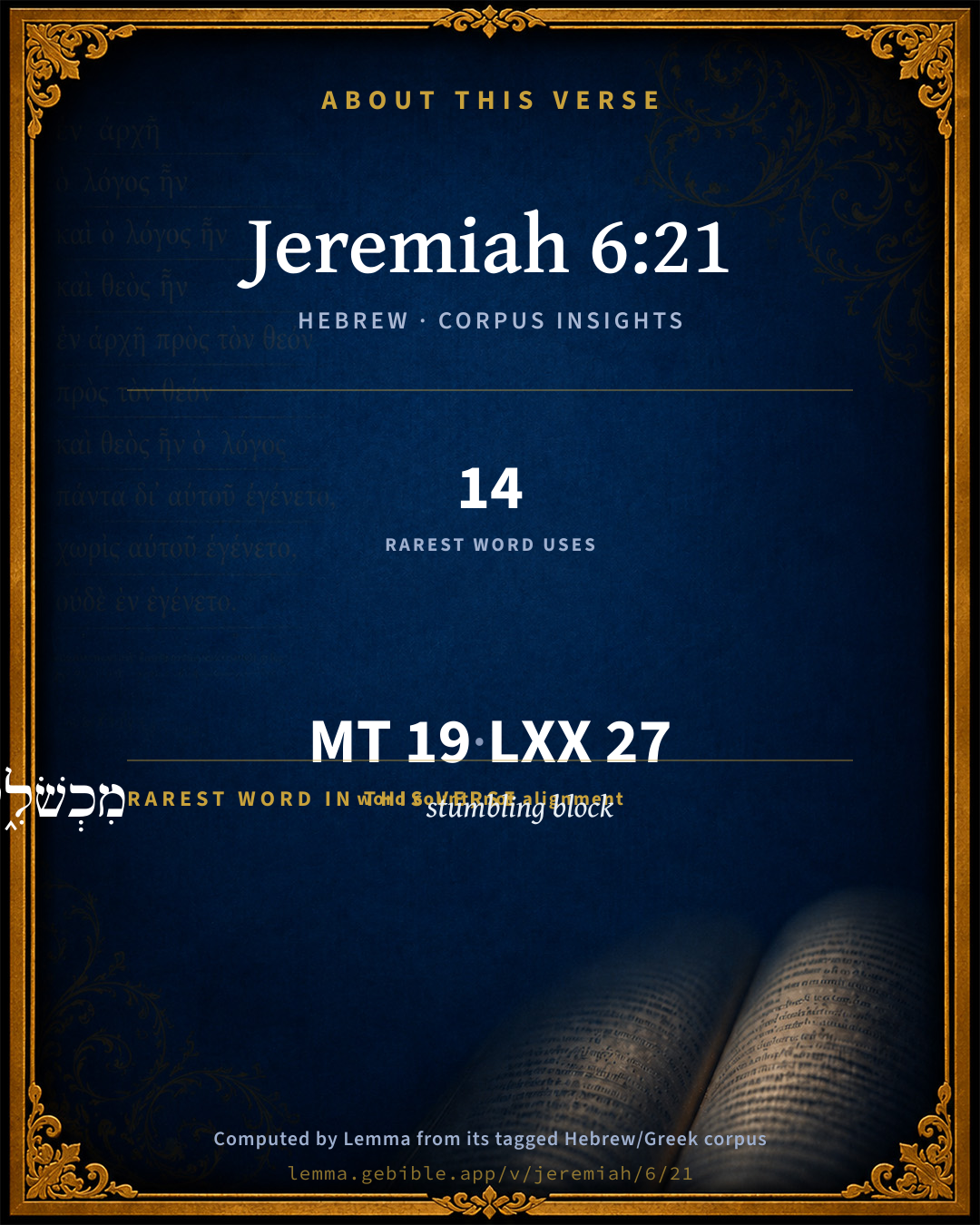
These counts appear in no published source. They are computed here, from the morphology-tagged text and Lemma’s own curated glosses. What Lemma adds →

19
words
17
distinct lemmas
Prophets
section

Notable vocabulary

The rarest word here is מִכְשֹׁלִ֑ים stumbling block H4383 — appearing just 14 times in the whole Hebrew Bible.

Shared distinctive vocabulary

מִכְשֹׁלִ֑ים stumbling block H4383 occurs in 14 verses of the Hebrew Bible. Also found in:

Grammatical profile

  • 5 verbs
  • 6 nouns
  • 1 adjective
  • 1 pronoun
  • 2 prepositions
  • 3 adverbs
  • 1 particle

Verb forms

  • אָמַ֣ר Qal · Perfect
  • נֹתֵ֛ן Qal · Participle Active
  • וְכָ֣שְׁלוּ Qal · Sequential Perfect
  • יאבדו Qal · Imperfect
  • וְאָבָֽדוּ Qal · Sequential Perfect

Repetition

A word recurs within this verse — often emphatic in Hebrew:

  • יאבדו to perish H6 ×2

Hebrew & Septuagint length

In the original languages it is 19 Hebrew tokens and 27 Greek tokens — but the two are counted differently (Hebrew bundles its prefixes and suffixes into one token; the Greek is in lemma form), so that isn’t a like-for-like length.

Cross-references

18

Topical passages linked to Jeremiah 6:21 in the Treasury of Scripture Knowledge — connected by theme and wording, ordered by reader-vote popularity; previews shown in the World English Bible.

  • Isaiah 8:14 He shall be for a sanctuary; but for a stone of stumbling and for a rock of offense to both the houses of Israel, for a gin and for a snare to the inhabitants of Jerusalem.
  • Jeremiah 13:16 Give glory to Yahweh your God, before he cause darkness, and before your feet stumble on the dark mountains, and, while you look for light, he turn it into the shadow of death, and make it gross darkness.
  • Ezekiel 3:20 Again, when a righteous man does turn from his righteousness, and commit iniquity, and I lay a stumbling block before him, he shall die: because you have not given him warning, he shall die in his sin, and his righteous deeds which he has done shall not be remembered; but his blood will I require at your hand.
  • Isaiah 9:14–17 Therefore Yahweh will cut off from Israel head and tail, palm-branch and rush, in one day.
  • 2 Chronicles 36:17 Therefore he brought on them the king of the Chaldeans, who killed their young men with the sword in the house of their sanctuary, and had no compassion on young man or virgin, old man or gray-headed: he gave them all into his hand.
  • Isaiah 24:2–3 It shall be, as with the people, so with the priest; as with the servant, so with his master; as with the maid, so with her mistress; as with the buyer, so with the seller; as with the creditor, so with the debtor; as with the taker of interest, so with the giver of interest to him.
  • Jeremiah 9:21–22 For death is come up into our windows, it is entered into our palaces; to cut off the children from outside, [and] the young men from the streets.
  • Jeremiah 15:2–9 It shall happen, when they tell you, Where shall we go forth? then you shall tell them, Thus says Yahweh: Such as are for death, to death; and such as are for the sword, to the sword; and such as are for the famine, to the famine; and such as are for captivity, to captivity.
  • Jeremiah 16:3–9 For thus says Yahweh concerning the sons and concerning the daughters who are born in this place, and concerning their mothers who bore them, and concerning their fathers who became the father of them in this land:
  • Jeremiah 18:21 Therefore deliver up their children to the famine, and give them over to the power of the sword; and let their wives become childless, and widows; and let their men be slain of death, [and] their young men struck of the sword in battle.
  • Jeremiah 19:7–9 I will make void the counsel of Judah and Jerusalem in this place; and I will cause them to fall by the sword before their enemies, and by the hand of those who seek their life: and their dead bodies will I give to be food for the birds of the sky, and for the animals of the earth.
  • Jeremiah 21:7 Afterward, says Yahweh, I will deliver Zedekiah king of Judah, and his servants, and the people, even such as are left in this city from the pestilence, from the sword, and from the famine, into the hand of Nebuchadrezzar king of Babylon, and into the hand of their enemies, and into the hand of those who seek their life: and he shall strike them with the edge of the sword; he shall not spare them, neither have pity, nor have mercy.
  • Lamentations 2:20–22 Look, Yahweh, and see to whom you have done thus! Shall the women eat their fruit, the children that are dandled in the hands? Shall the priest and the prophet be killed in the sanctuary of the Lord?
  • Ezekiel 5:10 Therefore the fathers shall eat the sons in the midst of you, and the sons shall eat their fathers; and I will execute judgments on you; and the whole remnant of you will I scatter to all the winds.
  • Ezekiel 9:5–7 To the others he said in my hearing, Go you through the city after him, and strike: don't let your eye spare, neither have you pity;
  • Romans 9:33 even as it is written, "Behold, I lay in Zion a stumbling stone and a rock of offense; And no one who believes in him will be disappointed."
  • Romans 11:9 David says, "Let their table be made a snare, and a trap, A stumbling block, and a retribution to them.
  • 1 Peter 2:8 and, "A stone of stumbling, and a rock of offense." For they stumble at the word, being disobedient, whereunto also they were appointed.

Cross-references courtesy of OpenBible.info (CC BY 4.0).

Hebrew and Greek witnesses Masoretic Hebrew ↔ Greek Septuagint

The same verse in the two great witnesses to the Old Testament, shown verse-for-verse.

These are two independent witnesses, not word-aligned to each other, and the Septuagint is shown in lemma (dictionary) form.

Hebrew Jeremiah 6:21 Masoretic · Westminster Leningrad Codex

לָכֵ֗ן כֹּ֚ה אָמַ֣ר יְהוָ֔ה הִנְנִ֥י נֹתֵ֛ן אֶל הָעָ֥ם הַזֶּ֖ה מִכְשֹׁלִ֑ים וְכָ֣שְׁלוּ בָ֠ם אָב֨וֹת וּבָנִ֥ים יַחְדָּ֛ו שָׁכֵ֥ן וְרֵע֖וֹ יאבדו וְאָבָֽדוּ

Therefore thus says Yahweh, Behold, I will lay stumbling-blocks before this people; and the fathers and the sons together shall stumble against them; the neighbor and his friend shall perish.

World English Bible · Public Domain

Greek LXX Structure differs

In the Septuagint, Jeremiah is about an eighth shorter than the Hebrew and arranges its material differently — the Oracles Against the Nations (Hebrew chapters 46–51) appear in the middle of the Greek book, after 25:13. Because the chapter and verse boundaries do not line up, a verse-for-verse comparison with the Hebrew is not shown.

A verse-for-verse comparison isn’t shown here because the chapters and verses don’t line up. Switch to the LXX edition with the MT / LXX toggle above to read the Greek directly.

On this verse, John Gill's Exposition discusses the Septuagint’s reading. Read the note in Commentary ↓

Hebrew: Westminster Leningrad Codex (CC BY 4.0). Greek: Septuagint (public domain); English from a public-domain English Septuagint. How the Septuagint differs from the Hebrew →

Targum (Aramaic paraphrase)

1

The Targum is the ancient Jewish Aramaic paraphrase of the Hebrew Scriptures — an interpretive translation, not the Hebrew text itself. Onkelos (literal) and Pseudo-Jonathan (expansive) render the Torah, and Jonathan the Prophets. Coverage is partial: where no permissively-licensed English translation exists for a verse, only the Aramaic is shown. This is verse-level text, not a word-by-word alignment to the Hebrew.

  1. Targum Jonathan Prophets (Joshua–Malachi)
    בְּכֵן כִּדְנַן אֲמַר יְיָ הָא אֲנָא מַיְתִי עַל עַמָא הָדֵין תַּקְלָן וְיִתְקְלוּן בְּהוֹן אֲבָהָן וּבְנִין כַּחֲדָא מָגֵיר וְקָרִיבֵיהּ יֵיבְדוּן:

    (no public-domain English translation for this verse)

    Targum Jonathan — Aramaic: “Mikraot Gedolot” (public domain). English: “Sefaria Community Translation” (CC0 1.0 (public-domain dedication)); “London "Chaldee Paraphrase," 1871” (public domain). Text via Sefaria.

Commentary

Notes on Jeremiah 6:21 from classic Christian and Jewish commentators (each source and its license shown beneath its notes). The classic Christian expositions comment on the surrounding passage and are grouped to its opening verse, so a note may address several verses; the Jewish commentaries on the Tanakh (Rashi and others) are per-verse, so they appear only where the commentator wrote on this verse.

Lemma curates 59 commentaries, every one of them public domain or Creative Commons licensed, each selected and text-cleaned for this edition rather than reprinted as found. About our sources →

Trapp's Complete Commentary

John Trapp

Jer 6:21 Therefore thus saith the LORD, Behold, I will lay stumblingblocks before this people, and the fathers and the sons together shall fall upon them; the neighbour and his friend shall perish.

Ver. 21. Behold, I will lay stumblingblocks.] {a} Heb., Stumblements - i.e., occasions, preparations, and means to work their ruth and ruin; what these are, see Jer 6:22.

{a} Strages - sc., et clades in quas incident et corruent. , Slaugher and defeat in which they fell and were riuned.

John Trapp, A Commentary or Exposition upon All the Books of the Old and New Testament (1647–1656) — public domain. Text from a community e-Sword module.

Joseph Benson's Commentary

Jer 6:21-26. Behold, I will lay stumbling-blocks before this people — I will suffer such things to be laid in their way as shall be the occasion of their destruction. Or, I will bring calamities upon them, by which they shall fall. The neighbour and his friend shall perish — Men of all sorts and conditions. Behold, a people cometh, &c. — The Chaldeans are here again described, as in Jer 5:15; a distant nation, violent, cruel, armed with bows and spears, and well mounted. A great nation from the sides of the earth — Or rather, from the coasts, ends, or extremities of the earth, as Dr. Waterland reads it. Their voice roareth like the sea — The shouts of hostile armies are fitly compared to the waves of the sea, which dash upon the shores with a great noise. And they ride upon horses — Of which there was a great scarcity in Judea, which was one reason that induced the Jews to enter into alliances with Egypt, that they might be furnished with horses from thence. We have heard the fame thereof — The prophet personates the people, and describes the very great consternation which Judah and Jerusalem should be in, upon the approach of this formidable enemy. Our hands wax feeble — We have no heart to make any resistance; anguish hath taken hold of us — We are in an extremity of pain, like that of a woman in travail. Go not forth into the fields, &c. — Thus he expresses the great danger that would be everywhere. O daughter of my people, &c. — Here the prophet calls upon them to lament the desolations that were coming upon them; as if he had said, Hear thy God calling thee to weeping and mourning, and answer his call. Gird thee with sackcloth — Not only put on sackcloth for a day, but gird it on thee to be worn constantly. Wallow thyself in ashes — Lie down among them; use all the tokens of the deepest mourning, and most bitter lamentation; and that not forced, and for show, but with the greatest sincerity, as parents mourn for an only son, and think themselves comfortless because they are childless. The expression, as for an only son, was proverbial among the Jews, to denote the greatest grief. For the spoiler shall suddenly come upon us — Though he is not come yet, he is coming; the decree is gone forth, let us therefore meet the execution of it with a suitable sadness.

Joseph Benson's Commentary on the Old and New Testaments (1811–1818) — public domain. Text from a community e-Sword module.

Jamieson, Fausset & Brown

Robert Jamieson, A. R. Fausset & David Brown

stumbling-blocks--instruments of the Jews' ruin (compare Mat 21:44; Isa 8:14; Pe1 2:8). God Himself ("I") lays them before the reprobate (Psa 69:22; Rom 1:28; Rom 11:9).

fathers . . . sons . . . neighbour . . . friend--indiscriminate ruin.

Jamieson, Fausset & Brown — Commentary Critical and Explanatory on the Whole Bible (1871) — public domain (CC PDM 1.0). Text via the HelloAO Bible API.

John Calvin's Commentaries

Here God, in plain words, declares what vengeance he would execute on the people. He says first, that he would lay for them stumbling blocks He no doubt compares the judgments which were nigh to nets or traps; for the Jews hoped to escape. He therefore says, that they would be ensnared: “Wherever ye go, “he says, “ye shall meet with those nets by which God will catch you: Fall, therefore, shall both fathers and sons, the neighbor and his friend ”

He means by these words, that however they might conspire together, they would yet be exposed to the same punishment. For when sons follow the examples of their fathers, they think themselves innocent; and also when any one has many associates, he thinks himself safe in his licentiousness. As, then, consent or society hardens the ungodly, so that they fear not the wrath of God, the Prophet on this account includes sons with their fathers, and a neighbor with his friend, as those who were to perish together, and without any difference. The word “stumbling blocks” is indeed metaphorical; but in the next verse the Prophet speaks without a figure, and says —

John Calvin's Commentaries (1540-1563) — public domain. Text from the Calvin Translation Society English edition (1840s-50s) via the Christian Classics Ethereal Library (ccel.org). Calvin's coverage is partial (roughly two-thirds of the Bible); uncommented books and verses are honest gaps, never fabricated. The 19th-century editor's footnotes and remarks are omitted so the notes are faithfully Calvin's own voice.

Ellicott's Commentary for English Readers

(21) And the fathers and the sons together . . .—Better, I give unto this people stumbling blocks, and they shall stumble over them: fathers and sons together, neighbour and his friend, shall perish.

A Bible Commentary for English Readers, edited by Charles John Ellicott (1878–1897) — public domain. Text from a community e-Sword module.

The Cambridge Bible for Schools and Colleges

gen. ed. J. J. S. Perowne

21. stumblingblocks] The enemy shall trip them up in their easygoing ways. Cp. Jer_6:15.

The Cambridge Bible for Schools and Colleges (gen. ed. J. J. S. Perowne; Cambridge University Press, 1878–1918) — public domain. Text from a community e-Sword module.

John Gill's Exposition

Therefore thus saith the Lord,.... Because of their immorality and hypocrisy, their contempt of his word, and confidence in legal rites and ceremonies:

behold, I will lay stumblingblocks before this people; by which may be meant the judgments of God upon them, raising up enemies against them, and suffering them to invade their land; particularly the Assyrians, as the following words show. Moreover, the prophecies of the false prophets, and the doctrines which they were permitted to spread among the people, were snares and stumblingblocks unto them, they being given up to believe their lies, and to be hardened by them; nay, even true doctrines, the doctrines of justification and salvation by Christ, yea, Christ himself, were a rock of offence, and a stumbling stone to these people, Isa 8:14.

and the fathers and the sons together shall fall upon them; or, "by them" (z); the latter following the examples of the forager; and so it denotes, that as the corruption was general, the punishment would be:

and the neighbour and his friend shall perish; in the same calamity, being involved in the guilt of the same iniquity, in which they encouraged and hardened one another. The Septuagint and Arabic versions by "stumblingblocks" understand an "infirmity" or "disease", which should come upon the people, and make a general desolation among them. Kimchi interprets the whole of the wickedness of fathers and children, neighbours and friends, and such as were in trade and partnership, and of their delight in mischief; that though they were aware of the stumblingblocks, yet would not give each other warning of them. The whole, according to the accents, should be rendered thus, "and they shall fall upon them, the fathers and the sons together, the neighbour and his friend, and they shall perish"; falling and perishing are said of them all.

(z) "in iis", Schmidt; "in eis", Cocceius, Pegnanius.

John Gill's Exposition of the Whole Bible (1746–1763) — public domain (CC PDM 1.0). Text via the HelloAO Bible API.

Albert Barnes' Notes on the Bible

“Behold,” I give unto “this people” causes of stumbling,

And they shall stumble against them:

Fathers and sons together,

“The neighbor and his friend shall perish.”

This is the natural consequence of their conduct. Their service of Yahweh was a systematic hypocrisy: how then could they walk uprightly with their fellow-men? When God lays stumblingblocks in men’s way, it is by the general action of His moral law Jam 1:13-14, by which willful sin in one point reacts upon the whole moral nature Jam 2:10.

Albert Barnes' Notes on the Bible (1834–1885) — public domain. Text from a community e-Sword/MySword module.

Matthew Poole's English Annotations

I will lay stumbling-blocks; God gives this name to all the occasions of the Jews’ ruin; he exposeth them, or suffereth such things to be laid in their way, as shall be the occasion of their destruction; such things which they shall not get over. Or an hypallage, I will bring destruction upon them; as the Hebrews use to speak, They have sent a city into the fire, i.e. They have sent fire into the city. Or God doth here compare his judgments to traps, wherein they shall be taken, which they thought easily to have evaded. What these stumbling-blocks are seem to be expressed in the following verses.

The fathers and the sons together; as well the fathers, that have more prudence and policy, as the children, that are more inadvertent, or possibly may count themselves less guilty, shall perish by these stumbling-blocks; no recovering for themselves, Isa 8:14,15.

The neighbour and his friend; men of all sorts and conditions, the greatest intimates and associates, though all lay their heads together for counsel, yet shall they not be able to help one another, but a promiscuous destruction there shall be, Jer 6:11; Jer 13:14.

Matthew Poole's English Annotations on the Holy Bible (1683–1685) — public domain. Text from a community e-Sword/MySword module.

Whedon's Commentary on the Bible

Daniel D. Whedon

21. I will lay stumblingblocks — God does this in two ways, neither of which is any impeachment of his holiness. First, by the general action of moral law by which sin reacts upon the nature of the sinner; and, second, by outward visitations in the realm of physical nature or human society. To these last there is here special reference.

Daniel D. Whedon (gen. ed.), Commentary on the Old and New Testaments (1874–1909) — public domain. Text from a community e-Sword module.

The Pulpit Commentary

I will lay stumbling-blocks, etc, Of the regenerate Israel of the future it is prophesied (Isa_54:15) that his enemies shall "fall upon him or, "by reason of him." Of the unregenerate Israel of the present, that he shall "fall" (i.e. come to ruin) upon the "stumbling-blocks" presented, not without God"s appointment, by the terrible northern invader.

The Pulpit Commentary (1880–1919), ed. H.D.M. Spence-Jones & Joseph S. Exell — public domain. Text from a community e-Sword module.

John Wesley's Explanatory Notes

I will say - I will suffer such things to be laid in their way, as shall be the occasion of their destruction. The neighbour - Men of all sorts and conditions.

John Wesley, Explanatory Notes Upon the Whole Bible (1754–1765) — public domain. Text via the GEBible commentary corpus.

Lesson kit

Teaching starters — assembled from the data on this page, not authored interpretation. Every prompt links to the verse data it draws on. Edit before teaching.

Jeremiah, in the Prophets, opens this verse with 19 words (17 distinct Hebrew lemmas). Its most distinctive word is mikshôwl (“stumbling block”). A historical commentator’s framing appears above. Read the whole chapter for the surrounding context.

Discussion questions

  1. The word mikshôwl carries the sense “stumbling block.” How does it shape the verse?
  2. Leviticus 19:14 shares the word «stumbling block» with this verse. How do the two illuminate each other?
  3. “to perish” occurs 2× in this one verse. What is the effect of the repetition?
  4. These translations render this verse differently. What is at stake in choosing one wording over another?
  5. The verb «אָמַ֣ר» is Qal Perfect. How does its form color the action?
  6. Reading how Trapp's Complete Commentary and Joseph Benson's Commentary read this verse, where do the two commentators agree and where do they part?

Things to notice

Reading settings

Reading text

Shown beneath each verse's original-language words.

Old Testament
Old Testament edition

Read the OT as the Masoretic Hebrew (MT) or the Greek Septuagint (LXX).

English shown for the Greek Septuagint (in the Hebrew ↔ Greek comparison).

Comparing translations? Open the Compare panel on any verse page to stack up to four side by side.