
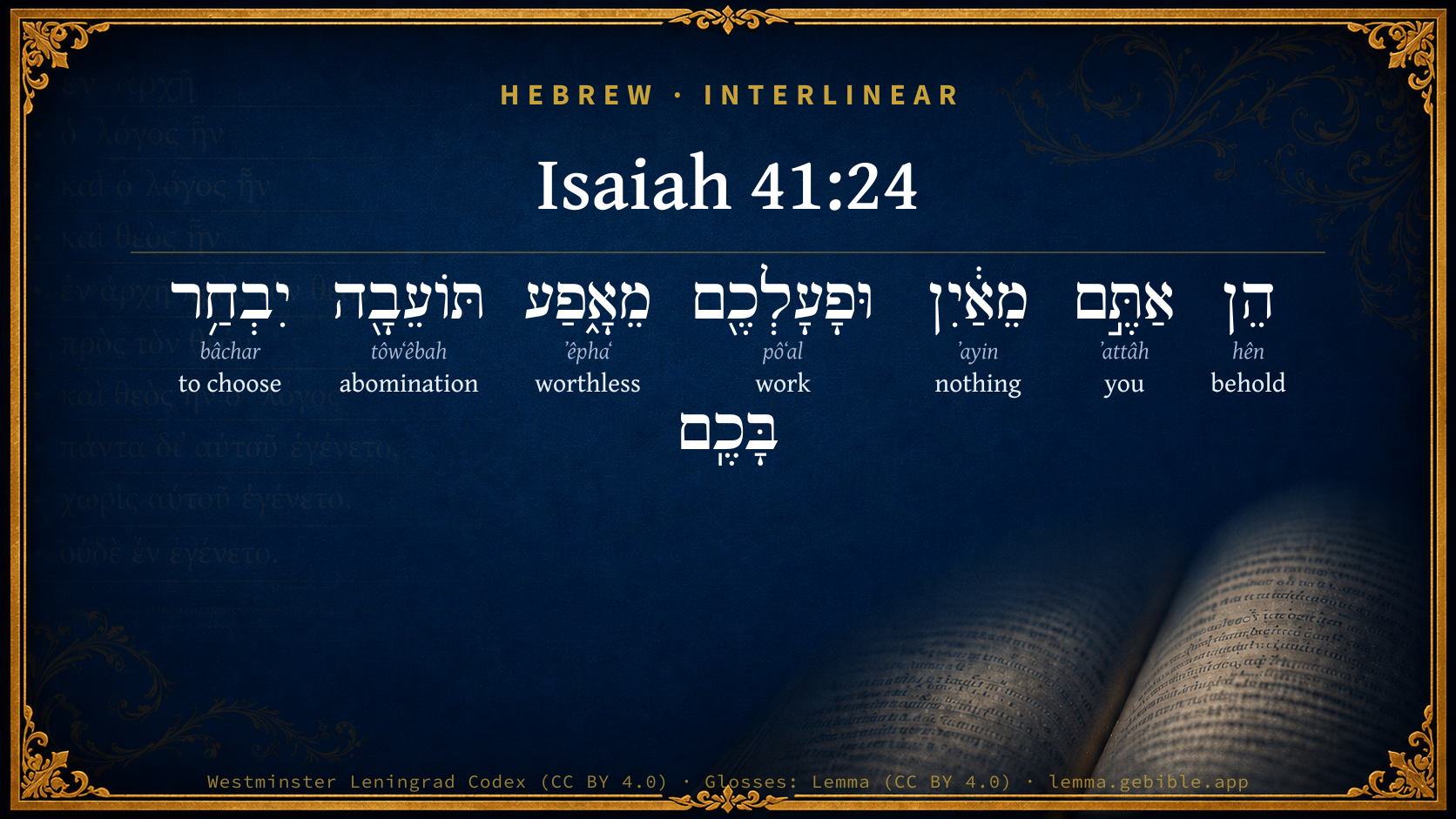
Isaiah 41:24

Hebrew (Westminster Leningrad Codex) Isaiah 41:24 appears in the Hebrew Old Testament. The text above is from the Westminster Leningrad Codex. Each word links to its Strong’s number, a concise gloss, and parsing drawn from the Open Scriptures Hebrew Bible morphology. Click any word for its full Brown-Driver-Briggs (BDB) entry.
Download image
Cite this verse

Isaiah 41:24 (World English Bible). Public Domain. Lemma interlinear Bible study tool, https://lemma.gebible.app/v/isaiah/41/24.

Show BibTeX & RIS
BibTeX
RIS
English Translation
Behold, you are of nothing, and your work is of nothing; an abomination is he who chooses you.
World English Bible · Public Domain
Highlights
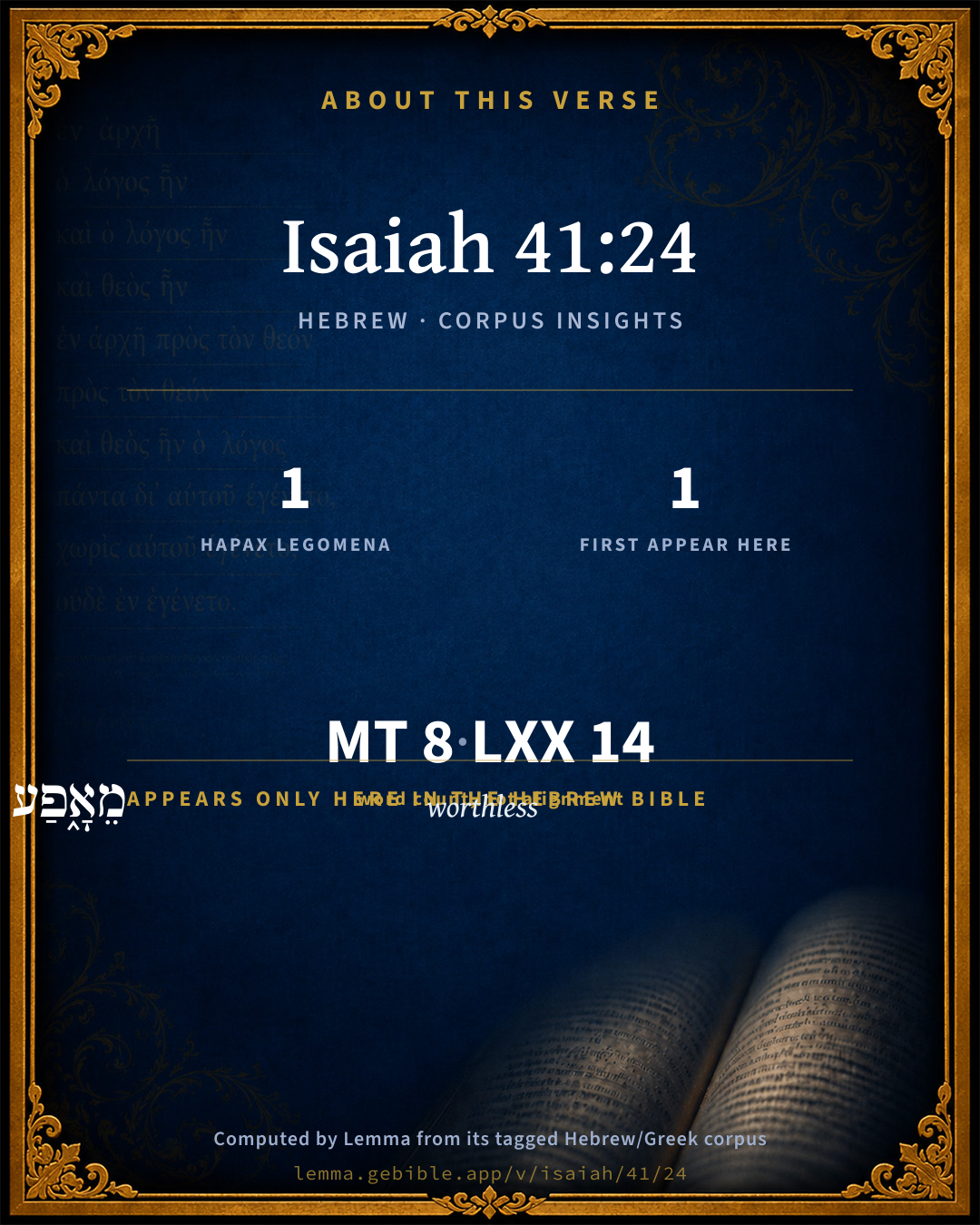
  • 1 hapax legomenon — only here in the Hebrew Bible
  • 1 first appearance in the Hebrew Bible
Full analysis ↓
Download a study sheet

One document with this verse’s original text, its word-by-word gloss line, the meaning frame, cross-references with their text, attributed commentary, and full source and license credits — printable, and it pastes into notes with its structure intact.

This verse Autodidact and up

Study sheet (.html) Plain text (.txt)

A passage Seminary Student

Up to 50 verses in one chapter. A passage sheet keeps up to 6 commentary sources and 12 cross-references per verse, in the order this page ranks them, and says so on the sheet whenever that leaves anything out. Ask for a single verse and you get the Autodidact verse sheet above.

Everything on this page stays free to read, with no account — the sheet is a download of what is already on screen, not access to it.

Want to remove ads? Support Godless Engineer
Compare translations 3

The same verse in 3 English versions, stacked beneath the original-language interlinear above. Click any original word for its lexicon entry.

Each is an independent rendering of the whole verse — the interlinear is not word-aligned to these translations.

Highlighted words mark where these versions differ — a whole-verse word diff, not a word-by-word alignment.

  • World English Bible Public Domain
    Behold, you are of nothing, and your work is of nothing; an abomination is he who chooses you.
  • King James Version Public Domain
    Behold, ye are of nothing, and your work of nought: an abomination is he that chooseth you.
  • unfoldingWord Literal Text CC BY-SA 4.0
    Behold, you less than nought, and your work less than nothing! He chooses you an abomination. q1

unfoldingWord Literal Text — © unfoldingWord, licensed CC BY-SA 4.0. Word-aligned USFM3 via Door43 (git.door43.org/unfoldingWord/en_ult).

Versions to compare (up to 4)

3 of 4 selected

Show all 18 translations

Every available English version of this verse, each an independent rendering of the whole verse.

  • World English Bible Public Domain
    Behold, you are of nothing, and your work is of nothing; an abomination is he who chooses you.
  • Berean Standard Bible Public Domain
    Behold, you are nothing and your work is of no value. Anyone who chooses you is detestable.
  • Majority Standard Bible Public Domain
    Behold, you are nothing and your work is of no value. Anyone who chooses you is detestable.
  • King James Version Public Domain
    Behold, ye are of nothing, and your work of nought: an abomination is he that chooseth you.
  • American Standard Version (1901) Public Domain
    Behold, ye are of nothing, and your work is of nought; an abomination is he that chooseth you.
  • Revised Version (1885) Public Domain
    Behold, ye are of nothing, and your work of nought: an abomination is he that chooseth you.
  • Geneva Bible (1599) Public Domain
    Beholde, ye are of no value, and your making is of naught: man hath chosen an abomination by them.
  • Douay-Rheims (1899) Public Domain
    Behold, you are of nothing, and your work of that which hath no being: he that hath chosen you is an abomination.
  • Young's Literal Translation Public Domain
    Lo, ye `are' of nothing, and your work of nought, An abomination -- it fixeth on you.
  • Literal Standard Version CC BY-SA 4.0
    Behold, you [are] of nothing, and your work of nothing, || An abomination—it fixes on you.
  • Unlocked Literal Bible CC BY-SA 4.0
    See, you idols are nothing and your deeds are nothing; the one who chooses you is detestable.
  • unfoldingWord Literal Text CC BY-SA 4.0
    Behold, you less than nought, and your work less than nothing! He chooses you an abomination. q1
  • Darby Bible Public Domain
    Behold, ye are less than nothing, and your work is of nought; an abomination is he that chooseth you....
  • World Messianic Bible Public Domain
    Behold, you are nothing, and your work is nothing. He who chooses you is an abomination.
  • Webster's Bible Public Domain
    Behold, ye are of nothing, and your work of naught: an abomination is he that chooseth you.
  • Free Bible Version CC BY-SA 4.0
    But look at you! You're nothing, and you can't do anything! Anyone who chooses you is disgusting!
  • Bible in Basic English Public Domain
    But you are nothing, and your work is of no value: foolish is he who takes you for his gods.
  • JPS Tanakh (1917) Public Domain
    Behold, ye are nothing, and your work a thing of nought; an abomination is he that chooseth you.

Literal Standard Version (2020), Covenant Press — licensed CC BY-SA 4.0. Text via the HelloAO Bible API (eBible.org). Unlocked Literal Bible (unfoldingWord) — licensed CC BY-SA 4.0. Text via the HelloAO Bible API (eBible.org). unfoldingWord Literal Text — © unfoldingWord, licensed CC BY-SA 4.0. Word-aligned USFM3 via Door43 (git.door43.org/unfoldingWord/en_ult). Free Bible Version, Dr. Jonathan Gallagher — licensed CC BY-SA 4.0. Text via the HelloAO Bible API (eBible.org).

Word by word

More ways to search: Search by grammar → Find every occurrence → Compare this word →

Practice this passage: Drill this verse → Learn its vocabulary →

About this verse

These counts appear in no published source. They are computed here, from the morphology-tagged text and Lemma’s own curated glosses. What Lemma adds →

8
words
7
distinct lemmas
Prophets
section

Notable vocabulary

1 hapax legomenon — a word that appears only here in the entire Hebrew Bible:

  • מֵאָ֑פַע worthless H659

First appearance in Scripture

This word makes its first canonical appearance in the Hebrew Bible here:

  • מֵאָ֑פַע worthless H659

Shared distinctive vocabulary

וּפָעָלְכֶ֖ם work H6467 occurs in 38 verses of the Hebrew Bible. Also found in:

Grammatical profile

  • 1 verb
  • 3 nouns
  • 1 pronoun
  • 1 preposition
  • 2 particles

Verb forms

  • יִבְחַ֥ר Qal · Imperfect

Hebrew & Septuagint length

In English translation the verse runs 18 words from the Hebrew and 18 from the Septuagint (LXX English) — the same length.

A rough comparison of the two English renderings, which tokenize alike — not a word-level alignment.

Word counts can differ between the Hebrew and the Greek without any difference in meaning — e.g. the Hebrew direct-object marker אֵת has no separate Greek word, and Greek often adds the article ὁ.

In the original languages it is 8 Hebrew tokens and 14 Greek tokens — but the two are counted differently (Hebrew bundles its prefixes and suffixes into one token; the Greek is in lemma form), so that isn’t a like-for-like length.

Cross-references

12

Topical passages linked to Isaiah 41:24 in the Treasury of Scripture Knowledge — connected by theme and wording, ordered by reader-vote popularity; previews shown in the World English Bible.

  • Psalms 115:8 Those who make them will be like them; Yes, everyone who trusts in them.
  • 1 Corinthians 8:4 Therefore concerning the eating of things sacrificed to idols, we know that no idol is anything in the world, and that there is no other God but one.
  • Isaiah 41:29 Behold, all of them, their works are vanity [and] nothing; their molten images are wind and confusion.
  • Jeremiah 10:8 But they are together brutish and foolish: the instruction of idols! it is but a stock.
  • Jeremiah 10:14 Every man is become brutish [and is] without knowledge; every goldsmith is disappointed by his engraved image; for his molten image is falsehood, and there is no breath in them.
  • Deuteronomy 7:26 You shall not bring an abomination into your house, and become a devoted thing like it: you shall utterly detest it, and you shall utterly abhor it; for it is a devoted thing.
  • Deuteronomy 27:15 Cursed be the man who makes an engraved or molten image, an abomination to Yahweh, the work of the hands of the craftsman, and sets it up in secret. All the people shall answer and say, Amen.
  • Isaiah 37:19 and have cast their gods into the fire: for they were no gods, but the work of men's hands, wood and stone; therefore they have destroyed them.
  • Isaiah 44:9–10 Those who fashion an engraved image are all of them vanity; and the things that they delight in shall not profit; and their own witnesses don't see, nor know: that they may be disappointed.
  • Isaiah 66:24 They shall go forth, and look on the dead bodies of the men who have transgressed against me: for their worm shall not die, neither shall their fire be quenched; and they shall be an abhorring to all flesh.
  • Jeremiah 51:17–18 Every man is become brutish [and is] without knowledge; every goldsmith is disappointed by his image; for his molten image is falsehood, and there is no breath in them.
  • Revelation 17:5 And on her forehead a name was written, "MYSTERY, BABYLON THE GREAT, THE MOTHER OF THE PROSTITUTES AND OF THE ABOMINATIONS OF THE EARTH."

Cross-references courtesy of OpenBible.info (CC BY 4.0).

Hebrew and Greek witnesses Masoretic Hebrew ↔ Greek Septuagint

The same verse in the two great witnesses to the Old Testament, shown verse-for-verse.

These are two independent witnesses, not word-aligned to each other, and the Septuagint is shown in lemma (dictionary) form.

Hebrew Isaiah 41:24 Masoretic · Westminster Leningrad Codex

הֵן אַתֶּ֣ם מֵאַ֔יִן וּפָעָלְכֶ֖ם מֵאָ֑פַע תּוֹעֵבָ֖ה יִבְחַ֥ר בָּכֶֽם

Behold, you are of nothing, and your work is of nothing; an abomination is he who chooses you.

World English Bible · Public Domain

Greek LXX Isaiah 41:24 Septuagint · lemma form

ὅτι πόθεν εἰμί σύ καί πόθεν ὁ ἐργασία σύ ἐκ γῆ βδέλυγμα ἐκλέγω σύ

whence you⌃ are, and whence is your works: they have chosen you an abomination out of the earth.

LXX2012 (modern English Septuagint) · Public Domain

Hebrew: Westminster Leningrad Codex (CC BY 4.0). Greek: Septuagint (public domain); English from LXX2012 (modern English Septuagint) (Public Domain). How the Septuagint differs from the Hebrew →

Targum (Aramaic paraphrase)

1

The Targum is the ancient Jewish Aramaic paraphrase of the Hebrew Scriptures — an interpretive translation, not the Hebrew text itself. Onkelos (literal) and Pseudo-Jonathan (expansive) render the Torah, and Jonathan the Prophets. Coverage is partial: where no permissively-licensed English translation exists for a verse, only the Aramaic is shown. This is verse-level text, not a word-by-word alignment to the Hebrew.

  1. Targum Jonathan Prophets (Joshua–Malachi)
    הָא אַתּוּן לְמָא וְעוֹבָדֵיכוֹן לָא מִדָעַם תּוֹעֵיבָא דְאַתְרְעִיתוּן בֵּיהּ לְכוֹן:

    Behold, ye are nothing, and your works are to no purpose; that in which ye delight is an abomination.

    Targum Jonathan — Aramaic: “Mikraot Gedolot” (public domain). English: “Sefaria Community Translation” (CC0 1.0 (public-domain dedication)); “London "Chaldee Paraphrase," 1871” (public domain). Text via Sefaria.

Commentary

Notes on Isaiah 41:24 from classic Christian and Jewish commentators (each source and its license shown beneath its notes). The classic Christian expositions comment on the surrounding passage and are grouped to its opening verse, so a note may address several verses; the Jewish commentaries on the Tanakh (Rashi and others) are per-verse, so they appear only where the commentator wrote on this verse.

Lemma curates 59 commentaries, every one of them public domain or Creative Commons licensed, each selected and text-cleaned for this edition rather than reprinted as found. About our sources →

Trapp's Complete Commentary

John Trapp

Isa 41:24 Behold, ye [are] of nothing, and your work of nought: an abomination [is he that] chooseth you.

Ver. 24. Behold, ye are of nothing.] Hence Paul took that assertion of his; {1Co 8:4} "we know that an idol is nothing in the world." For the matter of it, it is true, wood is wood, and stone is stone; but the relation and signification which is fastened thereunto, is nothing at all: all the being of an idol is nothing but the idolater’s imagination.

And your work of nought.] Or, Of the basilisk or viper; it will do you to death.

An abomination is he that curseth you.] Papists, therefore, must needs be abominable idolaters. Dr Rainolds’s work, De Idololatria Romana, is yet unanswered. Weston writes that his head ached in reading it.

John Trapp, A Commentary or Exposition upon All the Books of the Old and New Testament (1647–1656) — public domain. Text from a community e-Sword module.

Geneva Bible (1599)

Geneva Bible translators

So that a man cannot make an idol, but he must do that which God detesteth and abhoreth: for he chooseth his own devices and forsaketh the Lord’s.

Geneva Bible (1599) marginal notes — public domain. Text via Bolls.life.

Jamieson, Fausset & Brown

Robert Jamieson, A. R. Fausset & David Brown

of nothing--(See on Isa 40:17). The Hebrew text is here corrupt; so English Version treats it.

abomination--abstract for concrete: not merely abominable, but the essence of whatever is so (Deu 18:12).

chooseth you--as an object of worship.

Jamieson, Fausset & Brown — Commentary Critical and Explanatory on the Whole Bible (1871) — public domain (CC PDM 1.0). Text via the HelloAO Bible API.

Adam Clarke's Commentary

Verse 24. Your work of naught - "Your operation is less than naught"] For מאפע meepha, read מאפס meephes; so the Chaldee and Vulgate. A manifest error of the text; compare Isa 40:17. The rabbins acknowledge no such error, but say that the former word signifies the same with the latter, by a change of the two letters ס samech and ע ain. - Sal. ben Melec in loc.

Adam Clarke's Commentary on the Bible (1810–1826) — public domain. Text from a community e-Sword/MySword module.

Ellicott's Commentary for English Readers

(24) Behold, ye are of nothing.—This is the summing up of the prophet, speaking as in the Judge’s name. The idol was “nothing in the world” (1Co_8:4). The demonic view of the gods of the heathen does not appear, as in St. Paul’s argument (1Co_10:20), side by side with that of their nothingness.

A Bible Commentary for English Readers, edited by Charles John Ellicott (1878–1897) — public domain. Text from a community e-Sword module.

The Cambridge Bible for Schools and Colleges

gen. ed. J. J. S. Perowne

24. The silence of the idols settles the controversy.

of nothing … of nought] See on ch. Isa_40:17. The word ’épha‘ here is probably a copyist’s error for ’épheṣ.

he that chooseth you]—your worshipper.

The Cambridge Bible for Schools and Colleges (gen. ed. J. J. S. Perowne; Cambridge University Press, 1878–1918) — public domain. Text from a community e-Sword module.

John Gill's Exposition

Behold, ye are of nothing,.... Not as to the matter of them, for they were made of gold, silver, brass, &c. but as to the divinity of them: there was none in them, they were of no worth and value; they could do nothing, either good or evil, either help their friends, or hurt their enemies; yea, they were less than nothing; for the words may be rendered by way of comparison, "behold, ye are less than nothing"; (a). See Gill on Isa 40:17;

and your work of nought; the workmanship bestowed on them, in casting or carving them, was all to no purpose, and answered no end; or the work they did, or pretended to do, their feigned oracles, and false predictions: or, "worse than nothing": some render it, "worse than a viper" (b); a word like this is used for one, Isa 49:5 and so denotes the poisonous and pernicious effects of idolatry:

an abomination is he that chooseth you; as the object of his worship; he is not only abominable, but an abomination itself to God, and to all men of sense and religion; for the choice he makes of an idol to be his god shows him to be a man void of common sense and reason, and destitute of all true religion and godliness, and must be a stupid sottish creature. The Targum is,

"an abomination is that which ye have chosen for yourselves, or in which ye delight;''

meaning their idols. This is the final issue of the controversy, and the judgment passed both upon the idols and their worshippers.

(a) "vos minus quam nihil estis", Junius & Tremellius, Piscator. (b) "pejus opere viperae", Junius & Tremellius; "pejus est opere basilisci", Piscator.

John Gill's Exposition of the Whole Bible (1746–1763) — public domain (CC PDM 1.0). Text via the HelloAO Bible API.

Albert Barnes' Notes on the Bible

Behold, ye are of nothing - Margin, ‘Worse than nothing.’ This refers to idols; and the idea is, that they were utterly vain and powerless; they were as unable to render aid to their worshippers as absolute nothingness would be, and all their confidence in them was vain and foolish.

And your work - All that you do, or all that it is pretended that you do.

Of nought - Margin, ‘Worse than a viper.’ The word used here in the common Hebrew text (אפע 'epa‛) occurs in no other place. Gesenius supposes that this is a corrupt reading for אפס 'epes (nothing), and so our translators have regarded it, and in this opinion most expositors agree. Hahn has adopted this reading in his Hebrew Bible. The Jewish rabbis suppose generally that the word אפע 'epa‛ is the same word as אפעה 'eph‛eh, a viper, according to the reading in the margin. But this interpretation is contrary to the connection, as well as the ancient versions. The Vulgate and Chaldee render it, ‘Of nought.’ The Syriac renders it, ‘Your works are of the sword.’ This is probably one of the few instances in which there has been a corruption of the Hebrew text (compare Isa 40:17; Isa 41:12, Isa 41:19).

An abomination is he that chooseth you - They who select idols as the object of worship, and offer to them homage, are regarded as abominable by God.

Albert Barnes' Notes on the Bible (1834–1885) — public domain. Text from a community e-Sword/MySword module.

Haydock's Catholic Bible Commentary

Work. All that you can do or promise. Hebrew, "your work is worse than a viper."

George Leo Haydock (1774–1849), Haydock's Catholic Family Bible and Commentary, 1859 edition — public domain. Excludes Psalms (Douay-Rheims chapter numbering differs from Protestant) and Deuterocanonical books (Catholic canon only).

Matthew Poole's English Annotations

Ye are of nothing; you lately were nothing, without any being at all, and now you have nothing at all of divinity or virtue in you.

Your work; either,

1. Passively, your workmanship, all the cost and art which is laid out upon you. Or,

2. Actively, all that you can do. Your operations are like your beings; there is no reality in your beings, nor efficacy in your actions.

He that chooseth you; he that chooseth you for his gods, is most abominable for his folly as well as his wickedness.

Matthew Poole's English Annotations on the Holy Bible (1683–1685) — public domain. Text from a community e-Sword/MySword module.

Whedon's Commentary on the Bible

Daniel D. Whedon

24. Behold, ye are of nothing — Hebrew, worse than nothing.

And your work of naught — Hebrew, worse than a viper. If this be the true reading, they are not only worse than nothing but their work is venomous. Let us leave it so, rather than tinker with the text to make it mean (as Gesenius and others) something else. Idol adherents are venomous in their arts, and so they are an abomination.

Daniel D. Whedon (gen. ed.), Commentary on the Old and New Testaments (1874–1909) — public domain. Text from a community e-Sword module.

The Pulpit Commentary

A pause may be supposed between vers. 23 and 24, during which the idol-gods are given the opportunity of "bringing, forth their strong reasons," and, in one way or other, proving their Divinity. But they are stricken dumb; they say nothing. Accordingly, "judgment goes against them by default" (Cheyne), and Jehovah breaks out upon them with words of contempt and contumely, Behold, ye are of nothing, etc. "Ye are utterly vain and futile."

The Pulpit Commentary (1880–1919), ed. H.D.M. Spence-Jones & Joseph S. Exell — public domain. Text from a community e-Sword module.

John Wesley's Explanatory Notes

Your work - Your operations are like your beings: there is no reality in your beings, nor efficacy in your actions.

John Wesley, Explanatory Notes Upon the Whole Bible (1754–1765) — public domain. Text via the GEBible commentary corpus.

Keil & Delitzsch

C. F. Keil & F. Delitzsch

Jehovah has thus placed Himself in opposition to the heathen and their gods, as the God of history and prophecy. It now remains to be seen whether the idols will speak, to prove their deity. By no means; not only are they silent, but they cannot speak. Therefore Jehovah breaks out into words of wrath and contempt. "Behold, ye are of nothing, and your doing of nought: an abomination whoever chooseth you." The two מן are partitive, as in Isa 40:17; and מאפע is not an error of the pen for מאפס, as Gesenius and others suppose, but אפע from עפע = פּה (from which comes פּה), פּעה, Isa 42:14 (from which comes אפעה, Isa 59:5), to breathe, stands as a synonym to און, הבל, רוח. The attributive clause בּכם יבחר (supply אשׁר חוּא) is a virtual subject (Ewald, 333, b): ye and your doings are equally nil; and whoever chooses you for protectors, and makes you the objects of his worship, is morally the most degraded of beings.

Keil & Delitzsch — Biblical Commentary on the Old Testament (1861–1891) — public domain (CC PDM 1.0). Text via the HelloAO Bible API. (Old Testament only.)

J. A. Alexander on Isaiah

Joseph Addison Alexander

“Lo, ye are of nothing (or less than nothing) and your work of nought (or less than nought); an abomination (is he that) chooseth (or will choose) you.” This is the conclusion drawn from their failure or refusal to accept the challenge and to furnish the required proof of their deity. Abomination is a strong expression often used to describe an object of religious abhorrence. On the choosing of gods, compare Jdg 5:8.

Joseph Addison Alexander, The Prophecies of Isaiah (1846–1847; New York: Scribner, 1870–1878) — public domain. Text from a community e-Sword module.

Rashi

Rabbi Shlomo Yitzchaki (Rashi)

Behold you are of naught and how will your words be fulfilled.

and your deed is one of shouting Heb. מֵאָפַע. You shout and raise your voice only to mislead the people with lies.

the abominable one Heb. תּוֹעֵבָה [lit. an abomination.] The abominable ones select you, and not the Holy One, blessed be He, or His servants or His ministers.

Rashi on the Tanakh — English translations: “The Judaica Press complete Tanach with Rashi, translated by A. J. Rosenberg” (CC BY 4.0); “Pentateuch with Rashi's commentary by M. Rosenbaum and A.M. Silbermann, 1929-1934” (public domain); “The Metsudah Tanach series, Lakewood, N.J” (CC BY 4.0); and “The Book of Joshua, Metsudah Publications, 1997” (CC BY 4.0). Text via Sefaria.

Ibn Ezra

Rabbi Abraham ibn Ezra

Ye. The idols are adressed.

מאפע of nothing. It is hap. leg.

תועבה=איש תועבה "An abominable man," or it is the same as תועבה "for an abomination." יבחר בכם Chooseth you, for worship.

Ibn Ezra on the Tanakh — English translations: “Sefaria Community Translation” (CC0 1.0 (public-domain dedication)); “Yalkut, Sifsei Chachomim Chumash, Metsudah Publications, 2009” (CC BY 4.0); and “Commentary of Ibn Ezra on Isaiah - trans. by M. Friedlander, 1873” (public domain). Text via Sefaria.

Lesson kit

Teaching starters — assembled from the data on this page, not authored interpretation. Every prompt links to the verse data it draws on. Edit before teaching.

Isaiah, in the Prophets, opens this verse with 8 words (7 distinct Hebrew lemmas). Its most distinctive word is ʼêphaʻ (“worthless”). A historical commentator’s framing appears above. Read the whole chapter for the surrounding context.

Discussion questions

  1. What does “worthless” (ʼêphaʻ) contribute to the verse as a whole?
  2. This verse holds 1 word here found nowhere else in the Hebrew Bible. What might the rare word draw attention to?
  3. The word “worthless” first appears here in Scripture. What is being introduced at this debut?
  4. Deuteronomy 32:4 shares the word «work» with this verse. How do the two illuminate each other?
  5. The translations on this page render this verse differently — a whole-verse word diff, not a word-by-word alignment. What might account for the different wordings?
  6. The verb «יִבְחַ֥ר» is Qal Imperfect. How does its form color the action?
  7. Reading how Trapp's Complete Commentary and Geneva Bible (1599) read this verse, where do the two commentators agree and where do they part?

Things to notice

Reading settings

Reading text

Shown beneath each verse's original-language words.

Old Testament
Old Testament edition

Read the OT as the Masoretic Hebrew (MT) or the Greek Septuagint (LXX).

English shown for the Greek Septuagint (in the Hebrew ↔ Greek comparison).

Comparing translations? Open the Compare panel on any verse page to stack up to four side by side.