
2 Samuel 12:11

Hebrew (Westminster Leningrad Codex) 2 Samuel 12:11 appears in the Hebrew Old Testament. The text above is from the Westminster Leningrad Codex. Each word links to its Strong’s number, a concise gloss, and parsing drawn from the Open Scriptures Hebrew Bible morphology. Click any word for its full Brown-Driver-Briggs (BDB) entry.
Download image
Cite this verse

2 Samuel 12:11 (World English Bible). Public Domain. Lemma interlinear Bible study tool, https://lemma.gebible.app/v/2-samuel/12/11.

Show BibTeX & RIS
BibTeX
RIS
English Translation
This is what Yahweh says: 'Behold, I will raise up evil against you out of your own house; and I will take your wives before your eyes, and give them to your neighbor, and he will lie with your wives in the sight of this sun.
World English Bible · Public Domain
Download a study sheet

One document with this verse’s original text, its word-by-word gloss line, the meaning frame, cross-references with their text, attributed commentary, and full source and license credits — printable, and it pastes into notes with its structure intact.

This verse Autodidact and up

Study sheet (.html) Plain text (.txt)

A passage Seminary Student

Up to 50 verses in one chapter. A passage sheet keeps up to 6 commentary sources and 12 cross-references per verse, in the order this page ranks them, and says so on the sheet whenever that leaves anything out. Ask for a single verse and you get the Autodidact verse sheet above.

Everything on this page stays free to read, with no account — the sheet is a download of what is already on screen, not access to it.

Want to remove ads? Support Godless Engineer
Compare translations 3

The same verse in 3 English versions, stacked beneath the original-language interlinear above. Click any original word for its lexicon entry.

Each is an independent rendering of the whole verse — the interlinear is not word-aligned to these translations.

Highlighted words mark where these versions differ — a whole-verse word diff, not a word-by-word alignment.

  • World English Bible Public Domain
    This is what Yahweh says: 'Behold, I will raise up evil against you out of your own house; and I will take your wives before your eyes, and give them to your neighbor, and he will lie with your wives in the sight of this sun.
  • King James Version Public Domain
    Thus saith the LORD, Behold, I will raise up evil against thee out of thine own house, and I will take thy wives before thine eyes, and give them unto thy neighbor, and he shall lie with thy wives in the sight of this sun.
  • unfoldingWord Literal Text CC BY-SA 4.0
    Thus says Yahweh, ‘Behold me, raising up harm against you from your house. And I will take your wives to your eyes, and I will give to your neighbor. And he will lie with your wives to the eyes of this sun.

unfoldingWord Literal Text — © unfoldingWord, licensed CC BY-SA 4.0. Word-aligned USFM3 via Door43 (git.door43.org/unfoldingWord/en_ult).

Versions to compare (up to 4)

3 of 4 selected

Show all 18 translations

Every available English version of this verse, each an independent rendering of the whole verse.

  • World English Bible Public Domain
    This is what Yahweh says: 'Behold, I will raise up evil against you out of your own house; and I will take your wives before your eyes, and give them to your neighbor, and he will lie with your wives in the sight of this sun.
  • Berean Standard Bible Public Domain
    This is what the LORD says: ‘I will raise up adversity against you from your own house. Before your very eyes I will take your wives and give them to another, and he will lie with them in broad daylight.
  • Majority Standard Bible Public Domain
    This is what the LORD says: ‘I will raise up adversity against you from your own house. Before your very eyes I will take your wives and give them to another, and he will lie with them in broad daylight.
  • King James Version Public Domain
    Thus saith the LORD, Behold, I will raise up evil against thee out of thine own house, and I will take thy wives before thine eyes, and give them unto thy neighbor, and he shall lie with thy wives in the sight of this sun.
  • American Standard Version (1901) Public Domain
    Thus saith Jehovah, Behold, I will raise up evil against thee out of thine own house; and I will take thy wives before thine eyes, and give them unto thy neighbor, and he shall lie with thy wives in the sight of this sun.
  • Revised Version (1885) Public Domain
    Thus saith the LORD, Behold, I will raise up evil against thee out of thine own house, and I will take thy wives before thine eyes, and give them unto thy neighbour, and he shall lie with thy wives in the sight of this sun.
  • Geneva Bible (1599) Public Domain
    Thus sayth the Lord, Behold, I will rayse vp euil against thee out of thine owne house, and will take thy wiues before thine eyes, and giue them vnto thy neighbour, and he shall lie with thy wiues in the sight of this sunne.
  • Douay-Rheims (1899) Public Domain
    Thus saith the Lord: Behold, I will raise up evil against thee out of thy own house, and I will take thy wives before thy eyes I and give them to thy neighhour, and he shall lie with thy wives in the sight of this sun.
  • Young's Literal Translation Public Domain
    thus said Jehovah, Lo, I am raising up against thee evil, out of thy house, and have taken thy wives before thine eyes, and given to thy neighbour, and he hath lain with thy wives before the eyes of this sun;
  • Literal Standard Version CC BY-SA 4.0
    thus said YHWH: Behold, I am raising up calamity against you, out of your [own] house, and have taken your wives before your eyes, and given [them] to your neighbor, and he has lain with your wives before the eyes of this sun;
  • Unlocked Literal Bible CC BY-SA 4.0
    Yahweh says, 'Look, I will raise up disaster against you out of your own house. Before your own eyes, I will take your wives and give them to your neighbor, and he will sleep with your wives in broad daylight.
  • unfoldingWord Literal Text CC BY-SA 4.0
    Thus says Yahweh, ‘Behold me, raising up harm against you from your house. And I will take your wives to your eyes, and I will give to your neighbor. And he will lie with your wives to the eyes of this sun.
  • Darby Bible Public Domain
    Thus saith Jehovah: Behold, I will raise up evil against thee out of thine own house, and I will take thy wives before thine eyes, and give them unto thy neighbour, and he shall lie with thy wives in the sight of this sun.
  • World Messianic Bible Public Domain
    “This is what the LORD says: ‘Behold, I will raise up evil against you out of your own house; and I will take your wives before your eyes and give them to your neighbor, and he will lie with your wives in the sight of this sun.
  • Webster's Bible Public Domain
    Thus saith the LORD, Behold, I will raise up evil against thee out of thy own house, and I will take thy wives before thy eyes, and give them to thy neighbor, and he shall lie with thy wives in the sight of this sun.
  • Free Bible Version CC BY-SA 4.0
    This is what the Lord says: ‘I'm going to bring disaster on you from your own family. I will take your wives before your very eyes and give them to someone else, and he will sleep openly with your wives where everyone can see.
  • Bible in Basic English Public Domain
    The Lord says, From those of your family I will send evil against you, and before your very eyes I will take your wives and give them to your neighbour, and he will take your wives to his bed by the light of this sun.
  • JPS Tanakh (1917) Public Domain
    Thus saith the LORD: Behold, I will raise up evil against thee out of thine own house, and I will take thy wives before thine eyes, and give them unto thy neighbour, and he shall lie with thy wives in the sight of this sun.

Literal Standard Version (2020), Covenant Press — licensed CC BY-SA 4.0. Text via the HelloAO Bible API (eBible.org). Unlocked Literal Bible (unfoldingWord) — licensed CC BY-SA 4.0. Text via the HelloAO Bible API (eBible.org). unfoldingWord Literal Text — © unfoldingWord, licensed CC BY-SA 4.0. Word-aligned USFM3 via Door43 (git.door43.org/unfoldingWord/en_ult). Free Bible Version, Dr. Jonathan Gallagher — licensed CC BY-SA 4.0. Text via the HelloAO Bible API (eBible.org).

Word by word

More ways to search: Search by grammar → Find every occurrence → Compare this word →

Practice this passage: Drill this verse → Learn its vocabulary →

הַשֶּׁ֥מֶשׁ
shemesh
H8121
“the · sun”
Particle, Definite Article + Noun, Common, Both, Singular, Absolute
Part of Speech
Particle + Noun
Type
Common
Gender
Both
Number
Singular
State
Absolute
Full BDB Definition

Origin: from an unused root meaning to be brilliant

TWOT: 2417a

sun - sun - sunrise, sun-rising, east, sun-setting, west (of direction) - sun (as object of illicit worship) - openly, publicly (in other phrases) - pinnacles, battlements, shields (as glittering or shining)
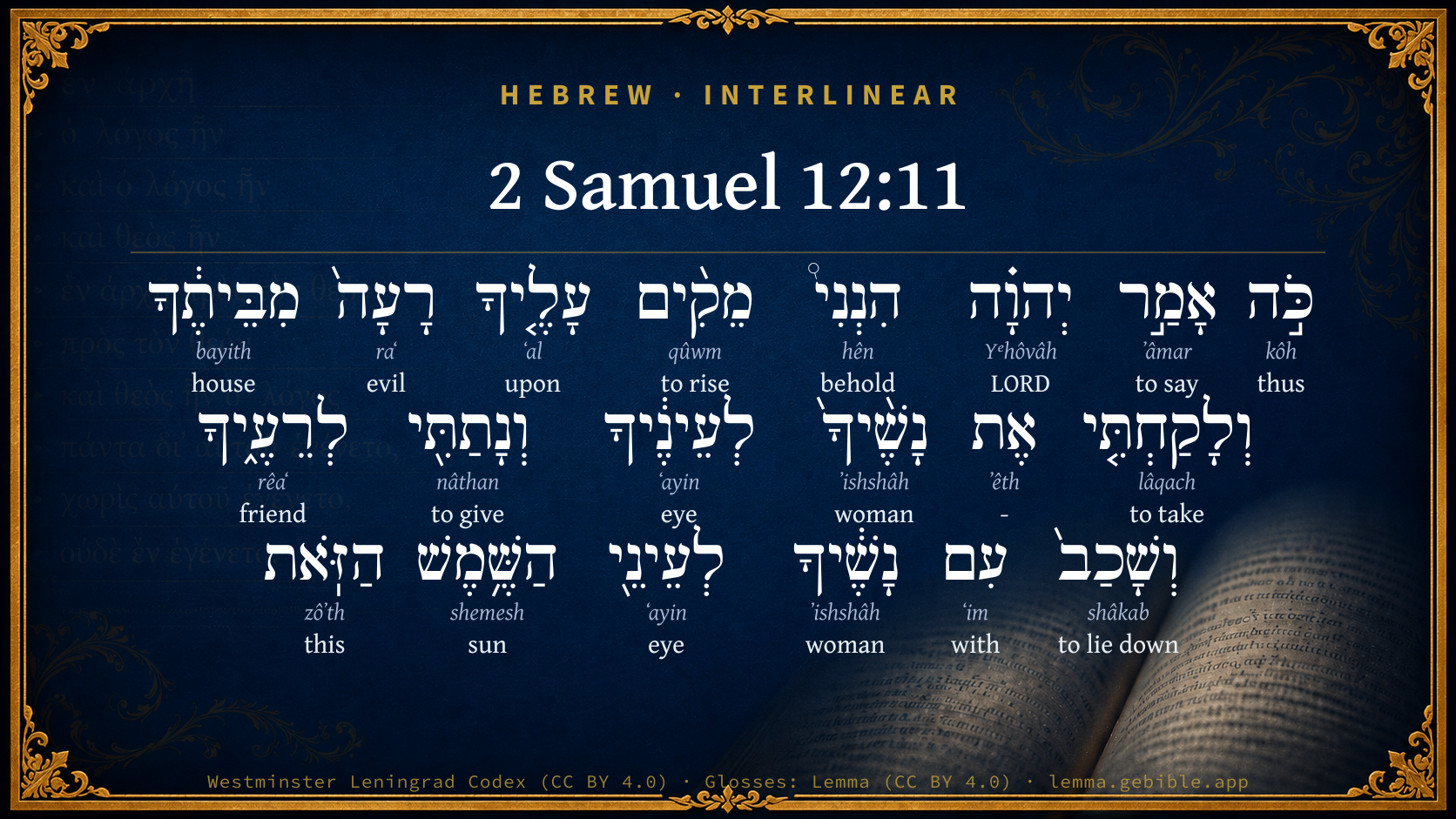
  1. כֹּ֣ה kôh H3541 “thus” Adverb
  2. אָמַ֣ר ʼâmar H559 “to say” Verb, Qal, Perfect, 3rd Person, Masculine, Singular
  3. יְהוָ֗ה Yᵉhôvâh H3068 “LORD” Noun, Proper
  4. הִנְנִי֩ hên H2005 “behold · me” Particle, Demonstrative + Suffix, Personal, 1st Person, Common, Singular
  5. מֵקִ֨ים qûwm H6965 “rising” Verb, Hiphil, Participle Active, Masculine, Singular, Absolute
  6. עָלֶ֤יךָ ʻal H5921 “upon · you” Preposition + Suffix, Personal, 2nd Person, Masculine, Singular
  7. רָעָה֙ raʻ H7451 “evil” Noun, Common, Feminine, Singular, Absolute
  8. מִבֵּיתֶ֔ךָ bayith H1004 “from · house · your” Preposition + Noun, Common, Masculine, Singular, Construct + Suffix, Personal, 2nd Person, Masculine, Singular
  9. וְלָקַחְתִּ֤י lâqach H3947 “and · to take” Conjunction + Verb, Qal, Sequential Perfect, 1st Person, Common, Singular
  10. אֶת ʼêth H853 “-” Particle, Direct Object
  11. נָשֶׁ֨יךָ֙ ʼishshâh H802 “women · your” Noun, Common, Feminine, Plural, Construct + Suffix, Personal, 2nd Person, Masculine, Singular
  12. לְעֵינֶ֔יךָ ʻayin H5869 “to/for · eyes · your” Preposition + Noun, Common, Both, Dual, Construct + Suffix, Personal, 2nd Person, Masculine, Singular
  13. וְנָתַתִּ֖י nâthan H5414 “and · to give” Conjunction + Verb, Qal, Sequential Perfect, 1st Person, Common, Singular
  14. לְרֵעֶ֑יךָ rêaʻ H7453 “to/for · friends · your” Preposition + Noun, Common, Masculine, Plural, Construct + Suffix, Personal, 2nd Person, Masculine, Singular
  15. וְשָׁכַב֙ shâkab H7901 “and · to lie down” Conjunction + Verb, Qal, Sequential Perfect, 3rd Person, Masculine, Singular
  16. עִם ʻim H5973 “with” Preposition
  17. נָשֶׁ֔יךָ ʼishshâh H802 “women · your” Noun, Common, Feminine, Plural, Construct + Suffix, Personal, 2nd Person, Masculine, Singular
  18. לְעֵינֵ֖י ʻayin H5869 “to/for · eyes of” Preposition + Noun, Common, Both, Dual, Construct
  19. הַזֹּֽאת zôʼth H2063 “the · this” Particle, Definite Article + Pronoun, Demonstrative, Feminine, Singular

About this verse

These counts appear in no published source. They are computed here, from the morphology-tagged text and Lemma’s own curated glosses. What Lemma adds →

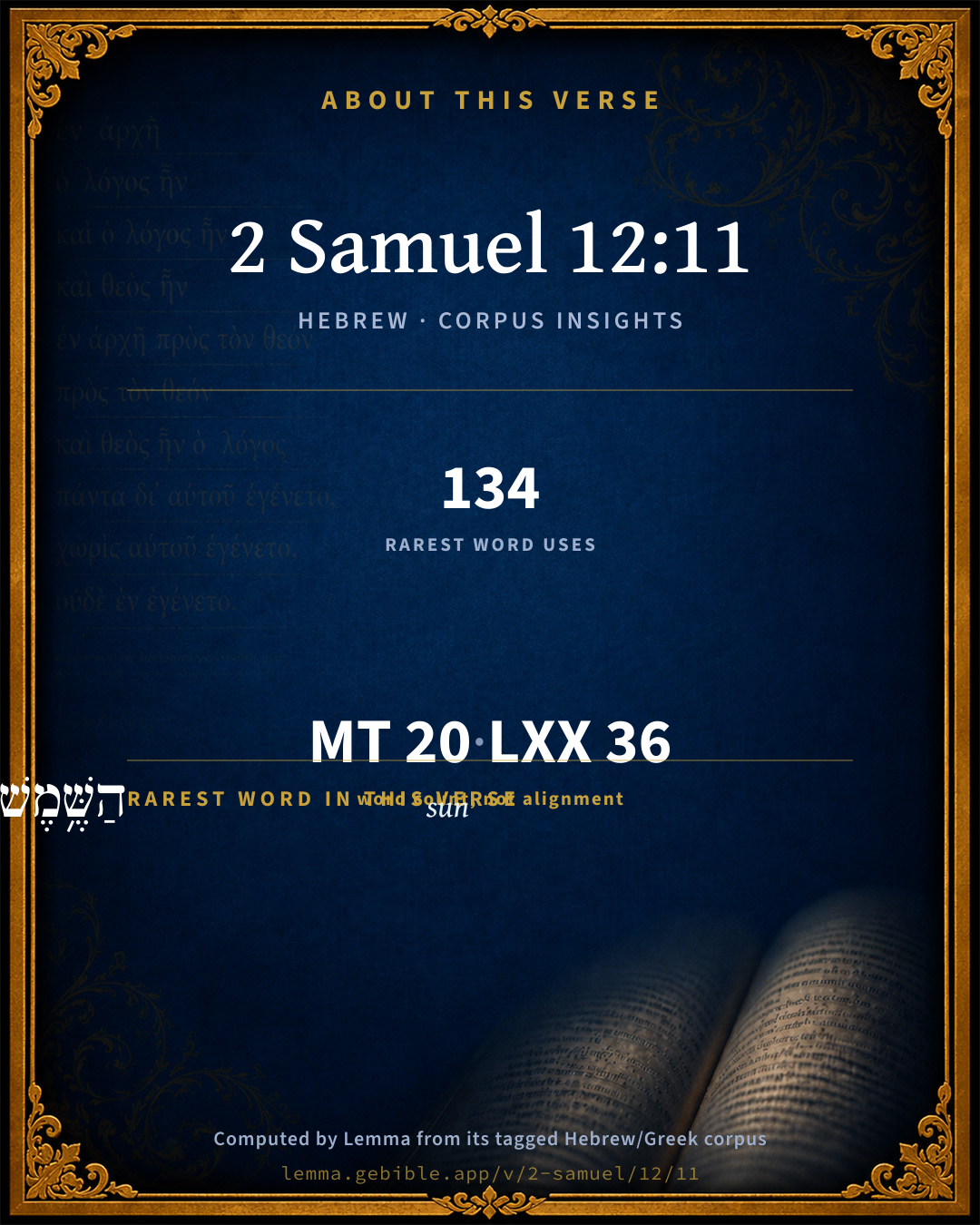
20
words
18
distinct lemmas
Historical
section

Grammatical profile

  • 5 verbs
  • 9 nouns
  • 1 pronoun
  • 2 prepositions
  • 1 adverb
  • 2 particles

Verb forms

  • אָמַ֣ר Qal · Perfect
  • מֵקִ֨ים Hiphil · Participle Active
  • וְלָקַחְתִּ֤י Qal · Sequential Perfect
  • וְנָתַתִּ֖י Qal · Sequential Perfect
  • וְשָׁכַב֙ Qal · Sequential Perfect

Repetition

Words recur within this verse — often emphatic in Hebrew:

  • נָשֶׁ֨יךָ֙ woman H802 ×2
  • לְעֵינֶ֔יךָ eye H5869 ×2

Hebrew & Septuagint length

In English translation the verse runs 46 words from the Hebrew and 45 from the Septuagint (LXX English) — closely comparable.

A rough comparison of the two English renderings, which tokenize alike — not a word-level alignment.

Word counts can differ between the Hebrew and the Greek without any difference in meaning — e.g. the Hebrew direct-object marker אֵת has no separate Greek word, and Greek often adds the article ὁ.

In the original languages it is 20 Hebrew tokens and 36 Greek tokens — but the two are counted differently (Hebrew bundles its prefixes and suffixes into one token; the Greek is in lemma form), so that isn’t a like-for-like length.

Cross-references

9

Topical passages linked to 2 Samuel 12:11 in the Treasury of Scripture Knowledge — connected by theme and wording, ordered by reader-vote popularity; previews shown in the World English Bible.

  • 2 Samuel 16:21–22 Ahithophel said to Absalom, Go in to your father's concubines, that he has left to keep the house; and all Israel will hear that you are abhorred of your father: then will the hands of all who are with you be strong.
  • Deuteronomy 28:30 You shall betroth a wife, and another man shall lie with her: you shall build a house, and you shall not dwell therein: you shall plant a vineyard, and shall not use the fruit of it.
  • 2 Samuel 13:1–14 It happened after this, that Absalom the son of David had a beautiful sister, whose name was Tamar; and Amnon the son of David loved her.
  • 2 Samuel 13:28–29 Absalom commanded his servants, saying, Mark you now, when Amnon's heart is merry with wine; and when I tell you, Smite Amnon, then kill him; don't be afraid; haven't I commanded you? be courageous, and be valiant.
  • 2 Samuel 15:6 In this manner Absalom did to all Israel who came to the king for judgment: so Absalom stole the hearts of the men of Israel.
  • 2 Samuel 15:10 But Absalom sent spies throughout all the tribes of Israel, saying, As soon as you hear the sound of the trumpet, then you shall say, Absalom is king in Hebron.
  • Ezekiel 14:9 If the prophet be deceived and speak a word, I, Yahweh, have deceived that prophet, and I will stretch out my hand on him, and will destroy him from the midst of my people Israel.
  • Ezekiel 20:25–26 Moreover also I gave them statutes that were not good, and ordinances in which they should not live;
  • Hosea 4:13–14 They sacrifice on the tops of the mountains, And burn incense on the hills, under oaks and poplars and terebinths, Because its shade is good. Therefore your daughters play the prostitute, And your brides commit adultery.

Cross-references courtesy of OpenBible.info (CC BY 4.0).

Hebrew and Greek witnesses Masoretic Hebrew ↔ Greek Septuagint

The same verse in the two great witnesses to the Old Testament, shown verse-for-verse.

These are two independent witnesses, not word-aligned to each other, and the Septuagint is shown in lemma (dictionary) form.

Hebrew 2 Samuel 12:11 Masoretic · Westminster Leningrad Codex

כֹּ֣ה אָמַ֣ר יְהוָ֗ה הִנְנִי֩ מֵקִ֨ים עָלֶ֤יךָ רָעָה֙ מִבֵּיתֶ֔ךָ וְלָקַחְתִּ֤י אֶת נָשֶׁ֨יךָ֙ לְעֵינֶ֔יךָ וְנָתַתִּ֖י לְרֵעֶ֑יךָ וְשָׁכַב֙ עִם נָשֶׁ֔יךָ לְעֵינֵ֖י הַשֶּׁ֥מֶשׁ הַזֹּֽאת

This is what Yahweh says: 'Behold, I will raise up evil against you out of your own house; and I will take your wives before your eyes, and give them to your neighbor, and he will lie with your wives in the sight of this sun.

World English Bible · Public Domain

Greek LXX 2 Samuel 12:11 Septuagint · lemma form

ὅδε λέγω κύριος ἰδού ἐγώ ἐκἐγείρω ἐπί σύ κακός ἐκ ὁ οἶκος σύ καί λαμβάνω ὁ γυνή σύ κατά ὀφθαλμός σύ καί δίδωμι ὁ πλησίον σύ καί κοιμάω μετά ὁ γυνή σύ ἐναντίος ὁ ἥλιος οὗτος

Thus says the Lord, Behold, I will raise up against you evil out of your house, and I will take your wives before your eyes, and will give them to your neighbor, and he shall lie with your wives in the sight of this sun.

LXX2012 (modern English Septuagint) · Public Domain

Hebrew: Westminster Leningrad Codex (CC BY 4.0). Greek: Septuagint (public domain); English from LXX2012 (modern English Septuagint) (Public Domain). How the Septuagint differs from the Hebrew →

Targum (Aramaic paraphrase)

1

The Targum is the ancient Jewish Aramaic paraphrase of the Hebrew Scriptures — an interpretive translation, not the Hebrew text itself. Onkelos (literal) and Pseudo-Jonathan (expansive) render the Torah, and Jonathan the Prophets. Coverage is partial: where no permissively-licensed English translation exists for a verse, only the Aramaic is shown. This is verse-level text, not a word-by-word alignment to the Hebrew.

  1. Targum Jonathan Prophets (Joshua–Malachi)
    כִּדְנַן אֲמַר יְיָ הָא אֲנָא מְקַיֵים עֲלָךְ בִּישָׁא מִבֵּיתָךְ וְאֶדְבַר יַת נְשָׁךְ לְעֵינָךְ וְאֶתֵּן לְחַבְרָךְ וְיִשְׁכּוֹב עִם נְשָׁךְ לְעֵינֵי שִׁמְשָׁא הָדָא:

    (no public-domain English translation for this verse)

    Targum Jonathan — Aramaic: “Mikraot Gedolot” (public domain). English: “Sefaria Community Translation” (CC0 1.0 (public-domain dedication)); “London "Chaldee Paraphrase," 1871” (public domain). Text via Sefaria.

Commentary

Notes on 2 Samuel 12:11 from classic Christian and Jewish commentators (each source and its license shown beneath its notes). The classic Christian expositions comment on the surrounding passage and are grouped to its opening verse, so a note may address several verses; the Jewish commentaries on the Tanakh (Rashi and others) are per-verse, so they appear only where the commentator wrote on this verse.

Lemma curates 59 commentaries, every one of them public domain or Creative Commons licensed, each selected and text-cleaned for this edition rather than reprinted as found. About our sources →

Trapp's Complete Commentary

John Trapp

2Sa 12:11 Thus saith the LORD, Behold, I will raise up evil against thee out of thine own house, and I will take thy wives before thine eyes, and give [them] unto thy neighbour, and he shall lie with thy wives in the sight of this sun.

Ver. 11. Behold, I will raise up evil against thee, &c.] God loveth to retaliate, as were easy to exemplify; take one instance for all. Valentinian the Emperor was slain in Mars’ field at Rome by the instigation of Maximus, whose wife he had defiled. This Maximus thereupon steppeth into the imperial throne, and first ravisheth and then marrieth Eudoxia, late wife to Valentinian. She, thus married, secretly sent for Genserieus, king of Vandals, who seized upon Italy, to the ruin of the Roman empire. Now God hath a holy hand in ordering all these disorders of the world to his own glory and the good of his people.

John Trapp, A Commentary or Exposition upon All the Books of the Old and New Testament (1647–1656) — public domain. Text from a community e-Sword module.

Joseph Benson's Commentary

2Sa 12:11-12. I will raise up evil against thee out of thine own house — Which was notoriously fulfilled in Absalom’s conspiracy against him. I will take thy wives before thine eyes — Openly, so that thou shalt know it as certainly as if thou didst see it, and yet shalt not be able to prevent it. For Absalom had a tent spread upon the house-top, and there went in unto them. And give them unto thy neighbour — I shall, by my providence, give power over them to one who is very near unto thee. But God expresseth this darkly, that the accomplishment of it might not be hindered. I will do this thing before all Israel — It was made notorious to all, that David fled in haste from his son, and left his wives and concubines behind him. “Whoever,” says Dr. Delaney, “considers the predictions of divine vengeance now denounced against David, must surely find them to be very extraordinary. His family to continue beyond any other regal race in the known world, and yet the sword to continue as long — never to depart from it! A king, the greatest of his time! his dominion thoroughly established, and his enemies under his feet: highly honoured and beloved at home, and as highly awful to all the neighbouring nations! — Such a king threatened to have his wives publicly prostituted before the face of all his people! And, what is yet stranger, more shocking, and more incredible, by one of his own race! and, as a sure proof of this, the darling offspring of his guilt to perish quickly, before his eyes! He alone who fills futurity could foresee this. He alone who sways the world, and knows what evil appetites and dispositions, unrestrained, will attempt and perpetrate, could pronounce it.”

Joseph Benson's Commentary on the Old and New Testaments (1811–1818) — public domain. Text from a community e-Sword module.

Tyndale Open Study Notes

Tyndale Open Resources

12:11 I will cause your own household to rebel against you: Absalom’s revolt against David (chs 14–19) fulfilled this promise.

Tyndale Open Study Notes — © Tyndale Open Resources, licensed CC BY-SA 4.0. Text via the HelloAO Bible API.

Geneva Bible (1599)

Geneva Bible translators

Meaning, openly, as at noon-days.

Geneva Bible (1599) marginal notes — public domain. Text via Bolls.life.

Jamieson, Fausset & Brown

Robert Jamieson, A. R. Fausset & David Brown

I will raise up evil against thee out of thine own house, &c.--The prophet speaks of God threatening to do what He only permitted to be done. The fact is, that David's loss of character by the discovery of his crimes, tended, in the natural course of things, to diminish the respect of his family, to weaken the authority of his government, and to encourage the prevalence of many disorders throughout his kingdom.

Jamieson, Fausset & Brown — Commentary Critical and Explanatory on the Whole Bible (1871) — public domain (CC PDM 1.0). Text via the HelloAO Bible API.

Adam Clarke's Commentary

Verse 11. I will take thy wives] That is, In the course of my providence I will permit all this to be done. Had David been faithful, God, by his providence, would have turned all this aside; but now, by his sin, he has made that providence his enemy which before was his friend.

Adam Clarke's Commentary on the Bible (1810–1826) — public domain. Text from a community e-Sword/MySword module.

The Cambridge Bible for Schools and Colleges

gen. ed. J. J. S. Perowne

11. I will take thy wives] See ch. 2Sa_16:21-22. “Having become the man of blood, of blood he was to drink deep; and having become the man of lust, by that same baneful passion in others was he himself to be scourged for ever.” Blunt’s Undesigned Coincidences, p. 134.

The Cambridge Bible for Schools and Colleges (gen. ed. J. J. S. Perowne; Cambridge University Press, 1878–1918) — public domain. Text from a community e-Sword module.

John Gill's Exposition

For thou didst it secretly,.... Committed adultery with Bathsheba privately, and endeavoured to conceal it, by getting her husband killed in battle, and then marrying her as soon as he could to hide the shame of it:

but one will do this thing before all Israel, and before the sun; as the above fact was; that is, he would suffer it to he done, and so order it in his providence, that everything should concur to the doing of it; as David's leaving his wives behind him, Ahithophel's wicked counsel he was suffered to give, and the lustful inclination Absalom was left unto, and not any of the people of Israel having religion, spirit, and courage enough to remonstrate against it.

John Gill's Exposition of the Whole Bible (1746–1763) — public domain (CC PDM 1.0). Text via the HelloAO Bible API.

Albert Barnes' Notes on the Bible

See the marginal references. In both the points of David’s crime the retribution was according to his sin. His adultery was punished by Absalom’s outrage, his murder by the bloodshed of domestic fights, which cost the lives of at least three of his favorite sons, Amnon, Absalom, and Adonijah.

Albert Barnes' Notes on the Bible (1834–1885) — public domain. Text from a community e-Sword/MySword module.

Haydock's Catholic Bible Commentary

I will raise, &c. All these evils, inasmuch as they were punishments, came upon Daivd by a just judgment of God, for his sin; and therefore God says, I will raise, &c. But inas much as they were sins, on the part of Absalom and his associates, God was not the author of them, but only permitted them. (Challoner) --- God permitted the wicked prince to succeed for some time, that he might punish David. (Calmet) --- Neighbour, most dearly beloved. To be treated ill by such a one, is doubly severe, Psalm liv. 15. (Menochius)

George Leo Haydock (1774–1849), Haydock's Catholic Family Bible and Commentary, 1859 edition — public domain. Excludes Psalms (Douay-Rheims chapter numbering differs from Protestant) and Deuterocanonical books (Catholic canon only).

Matthew Poole's English Annotations

I will raise up evil, to wit, the evil of punishment.

Out of thine own house; from thy own children and family.

Before thine eyes, i. e. openly, so as thou shalt know it as certainly as if thou didst see it, and yet not be able to hinder it.

Give them, i.e. I shall by my providence give him power over them, which I know he will abuse; and I shall not restrain him from so doing, either by my grace or providence.

Unto thy neighbour; to one who is very near to thee, even thy beloved son Absalom. But God expresseth this here darkly and doubtfully, that the accomplishment of it might not be hindered.

In the sight of the sun; in the open day, and in a public place. The accomplishment hereof, see 2Sa 16:22.

Matthew Poole's English Annotations on the Holy Bible (1683–1685) — public domain. Text from a community e-Sword/MySword module.

Whedon's Commentary on the Bible

Daniel D. Whedon

11. Evil against thee out of thine own house — This was realized especially in Absalom’s rebellion.

Take thy wives — See how this was fulfilled in 2Sa_16:22.

Thy neighbour — Absalom, who was also his son. 2Sa_3:3. But though a son, he became so bitterly alienated from his father by rebellion as to be significantly called neighbour.

Daniel D. Whedon (gen. ed.), Commentary on the Old and New Testaments (1874–1909) — public domain. Text from a community e-Sword module.

The Pulpit Commentary

He shall lie with thy wives. Fulfilled for political purposes by Absalom, under the advice of Bathsheba"s grandfather. (2Sa_16:22) The punishment was thus complete. For the murdered Uriah there was fourfold restitution, according to David"s own sentence. First there was Bathsheba"s child lately born, then Amnon, thirdly Absalom, and lastly Adonijah. For the adultery there was open disgrace wrought upon his royal dignity "before the sun," in open daylight. As he had brought shame and dishonour upon the family relations of his neighbour, so were his own family rights violated by his rebellious son. And, as is often the case, the sins which followed were worse than those which prepared the way. Vice begins as a small stream trickling through the opposing dam. but it quickly breaks down all moral restraints, and rushes along like a destroying flood.

The Pulpit Commentary (1880–1919), ed. H.D.M. Spence-Jones & Joseph S. Exell — public domain. Text from a community e-Sword module.

John Wesley's Explanatory Notes

Own house - From thy own children and family. Thine eyes - Openly, so that thou shalt know it as certainly as if thou didst see it, and yet not be able to hinder it. And give them - I shall by my providence, give him power over them. neighbour - To one who is very near thee. But God expresseth this darkly, that the accomplishment of it might not be hindered.

John Wesley, Explanatory Notes Upon the Whole Bible (1754–1765) — public domain. Text via the GEBible commentary corpus.

unfoldingWord translationNotes

Door43 World Missions Community

out of your own house

Here David's "house" refers to his family. AT: "from among your own family" (See: Metonymy)

Before your own eyes

Here David is referred to by his eyes to emphasize what he would see. AT: "While you are watching" (See: Synecdoche)

in broad daylight

"in full daylight." The idea of doing something "openly" or in a way that people are fully aware of what is happening is often spoken about as being done in the "daylight." AT: "openly" or "and everyone will see what is happening" (See: Metaphor)

committed your sin

"sinned"

before all Israel

This phrase speaks of the people of Israel knowing about what has happened to his wives as if they all actually witnessed it happening. AT: "before all the people of Israel" or "and all the people of Israel will know about it" (See: Metonymy and Metaphor)

passed over

Yahweh has forgiven David of his sin. This is spoken of here as Yahweh passing over his sin as if it were something that he walked by and disregarded. AT: "forgiven" (See: Metaphor)

You will not be killed

This can be stated in active form. Sometimes men died because of their sins, but he will not die because of his sin with the woman. This can be stated clearly. AT: "You will not die" or "you will not die because of this sin" (See: Active or Passive and Assumed Knowledge and Implicit Information)

translationWords

had relations with

sin

Israel

David

Nathan

Yahweh

unfoldingWord translationNotes — © Distant Shores Media and the Door43 World Missions Community, licensed CC BY-SA 4.0. Source: git.door43.org/Door43/en_tn.

Lesson kit

Teaching starters — assembled from the data on this page, not authored interpretation. Every prompt links to the verse data it draws on. Edit before teaching.

2 Samuel, in the Historical, opens this verse with 20 words (18 distinct Hebrew lemmas). Its most distinctive word is shemesh (“sun”). A historical commentator’s framing appears above. Read the whole chapter for the surrounding context.

Discussion questions

  1. The word shemesh carries the sense “sun.” How does it shape the verse?
  2. 2 Samuel 16:21–22 shares this passage’s theme. How do the two illuminate each other?
  3. “woman” occurs 2× in this one verse. What is the effect of the repetition?
  4. The translations on this page render this verse differently — a whole-verse word diff, not a word-by-word alignment. What might account for the different wordings?
  5. The verb «אָמַ֣ר» is Qal Perfect. How does its form color the action?
  6. Reading how Trapp's Complete Commentary and Joseph Benson's Commentary read this verse, where do the two commentators agree and where do they part?

Things to notice

Reading settings

Reading text

Shown beneath each verse's original-language words.

Old Testament
Old Testament edition

Read the OT as the Masoretic Hebrew (MT) or the Greek Septuagint (LXX).

English shown for the Greek Septuagint (in the Hebrew ↔ Greek comparison).

Comparing translations? Open the Compare panel on any verse page to stack up to four side by side.