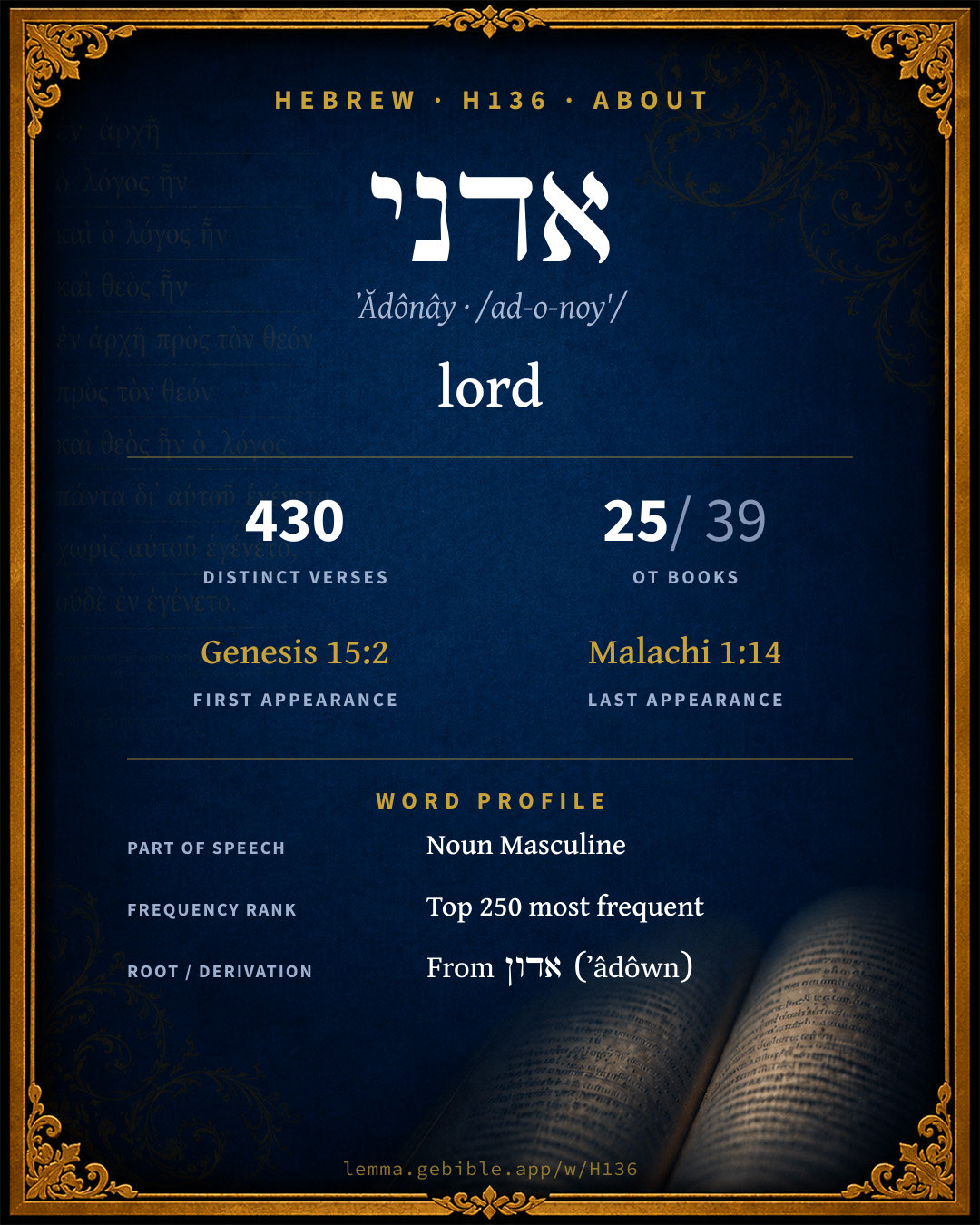
אֲדֹנָי
lord
‘lord’ is one of 2 main senses fuller range ↓
Full lexicon entry — Brown-Driver-Briggs (BDB)
From Brown-Driver-Briggs (BDB)
Where this word appears
Grammar key — what these labels mean
Part of speech
- Noun
- A naming word — a person, place, thing, or idea.
Noun type
- Common
- A common noun — a general class of person, place, or thing (“king,” “city,” “water”), not a specific name.
State
- Construct
- A noun bound to a following noun in a possessive / “of” relationship (the construct chain).
Gender
- Masculine
- Grammatically masculine.
Number
- Plural
- More than one (in Hebrew, generally three or more).
- Singular
- One.
Grammatical forms
- Noun, Common, Masculine, Plural, Construct 442 times (99%)
- Noun, Common, Masculine, Singular, Construct 3 times (1%)
Parsed forms decoded from the imported morphology (morphhb / Westminster Leningrad Codex — WLC text public domain, morphhb tagging CC BY 4.0), counted across 445 parsed occurrences — not distinct verses.
Page 1 of 3 — showing verses 1–200 of 430 distinct verses where H136 appears, across 25 books. Click any verse to open its interlinear word-by-word view. Verse text shown in the World English Bible for context — . Each verse’s Hebrew form is shown with its reference; the English is not keyword-highlighted, since the data carries no word-level English alignment. Use “Compare translations” on any verse to read it across multiple English versions. This concordance covers the Hebrew Bible; Septuagint (Greek Old Testament) occurrences are not indexed here.
Genesis 8 verses
- Genesis 15:2 אֲדֹנָ֤/י n c mp cs + sfx pers 1cs Abram said, "Lord Yahweh, what will you give me, seeing I go childless, and he who will inherit my estate is Eliezer of Damascus?"
- Genesis 15:8 אֲדֹנָ֣/י n c mp cs + sfx pers 1cs He said, "Lord Yahweh, how will I know that I will inherit it?"
- Genesis 18:27 אֲדֹנָ֔/י n c mp cs + sfx pers 1cs Abraham answered, "See now, I have taken it on myself to speak to the Lord, who am but dust and ashes.
- Genesis 18:30 לַֽ/אדֹנָ/י֙ prep + n c mp cs + sfx pers 1cs He said, "Oh don't let the Lord be angry, and I will speak. What if there are thirty found there?" He said, "I will not do it, if I find thirty there."
- Genesis 18:31 אֲדֹנָ֔/י n c mp cs + sfx pers 1cs He said, "See now, I have taken it on myself to speak to the Lord. What if there are twenty found there?" He said, "I will not destroy it for the twenty's sake."
- Genesis 18:32 לַֽ/אדֹנָ/י֙ prep + n c mp cs + sfx pers 1cs He said, "Oh don't let the Lord be angry, and I will speak yet but this once. What if ten are found there?" He said, "I will not destroy it for the ten's sake."
- Genesis 19:18 אֲדֹנָֽ/י n c mp cs + sfx pers 1cs Lot said to them, "Oh, not so, my lord.
- Genesis 20:4 אֲדֹנָ֕/י n c mp cs + sfx pers 1cs Now Abimelech had not come near her. He said, "Lord, will you kill even a righteous nation?
Exodus 5 verses
- Exodus 4:10 אֲדֹנָ/י֒ n c mp cs + sfx pers 1cs Moses said to Yahweh, "Oh, Lord, I am not eloquent, neither before now, nor since you have spoken to your servant; for I am slow of speech, and of a slow tongue."
- Exodus 4:13 אֲדֹנָ֑/י n c mp cs + sfx pers 1cs He said, "Oh, Lord, please send someone else."
- Exodus 5:22 אֲדֹנָ֗/י n c mp cs + sfx pers 1cs Moses returned to Yahweh, and said, "Lord, why have you brought trouble on this people? Why is it that you have sent me?
- Exodus 15:17 אֲדֹנָ֖/י n c mp cs + sfx pers 1cs You shall bring them in, and plant them in the mountain of your inheritance, The place, Yahweh, which you have made for yourself to dwell in; The sanctuary, Lord, which your hands have established.
- Exodus 34:9 אֲדֹנָ֔/י אֲדֹנָ֖/י n c mp cs + sfx pers 1cs n c mp cs + sfx pers 1cs He said, "If now I have found favor in your sight, Lord, please let the Lord go in the midst of us; although this is a stiff-necked people; pardon our iniquity and our sin, and take us for your inheritance."
Numbers 1 verse
Deuteronomy 3 verses
- Deuteronomy 3:24 אֲדֹנָ֣/י n c mp cs + sfx pers 1cs Lord Yahweh, you have begun to show your servant your greatness, and your strong hand: for what god is there in heaven or in earth, that can do according to your works, and according to your mighty acts?
- Deuteronomy 9:26 אֲדֹנָ֣/י n c mp cs + sfx pers 1cs I prayed to Yahweh, and said, Lord Yahweh, don't destroy your people and your inheritance, that you have redeemed through your greatness, that you have brought forth out of Egypt with a mighty hand.
- Deuteronomy 10:17 וַ/אֲדֹנֵ֖י conj + n c mp cs For Yahweh your God, he is God of gods, and Lord of lords, the great God, the mighty, and the awesome, who doesn't regard persons, nor takes reward.
Joshua 5 verses
- Joshua 3:11 אֲד֖וֹן n c ms cs Behold, the ark of the covenant of the Lord of all the earth passes over before you into the Jordan.
- Joshua 3:13 אֲד֤וֹן n c ms cs It shall come to pass, when the soles of the feet of the priests who bear the ark of Yahweh, the Lord of all the earth, shall rest in the waters of the Jordan, that the waters of the Jordan shall be cut off, even the waters that come down from above; and they shall stand in one heap.
- Joshua 5:14 אֲדֹנִ֖/י n c ms cs + sfx pers 1cs He said, No; but [as] prince of the host of Yahweh am I now come. Joshua fell on his face to the earth, and did worship, and said to him, What says my lord to his servant?
- Joshua 7:7 אֲדֹנָ֣/י n c mp cs + sfx pers 1cs Joshua said, Alas, Lord Yahweh, why have you at all brought this people over the Jordan, to deliver us into the hand of the Amorites, to cause us to perish? would that we had been content and lived beyond the Jordan!
- Joshua 7:8 אֲדֹנָ֑/י n c mp cs + sfx pers 1cs Oh, Lord, what shall I say, after that Israel has turned their backs before their enemies!
Judges 4 verses
- Judges 6:15 אֲדֹנָ֔/י n c mp cs + sfx pers 1cs He said to him, Oh, Lord, with which shall I save Israel? behold, my family is the poorest in Manasseh, and I am the least in my father's house.
- Judges 6:22 אֲדֹנָ֣/י n c mp cs + sfx pers 1cs Gideon saw that he was the angel of Yahweh; and Gideon said, Alas, Lord Yahweh! because I have seen the angel of Yahweh face to face.
- Judges 13:8 אֲדוֹנָ֔/י n c mp cs + sfx pers 1cs Then Manoah entreated Yahweh, and said, Oh, Lord, please let the man of God whom you did send come again to us, and teach us what we shall do to the child who shall be born.
- Judges 16:28 אֲדֹנָ֣/י n c mp cs + sfx pers 1cs Samson called to Yahweh, and said, Lord Yahweh, remember me, Please, and strengthen me, Please, only this once, God, that I may be at once avenged of the Philistines for my two eyes.
2 Samuel 6 verses
- 2 Samuel 7:18 אֲדֹנָ֤/י n c mp cs + sfx pers 1cs Then David the king went in, and sat before Yahweh; and he said, Who am I, Lord Yahweh, and what is my house, that you have brought me thus far?
- 2 Samuel 7:19 אֲדֹנָ֣/י אֲדֹנָ֥/י n c mp cs + sfx pers 1cs n c mp cs + sfx pers 1cs This was yet a small thing in your eyes, Lord Yahweh; but you have spoken also of your servant's house for a great while to come; and this [too] after the manner of men, Lord Yahweh!
- 2 Samuel 7:20 אֲדֹנָ֥/י n c mp cs + sfx pers 1cs What can David say more to you? for you know your servant, Lord Yahweh.
- 2 Samuel 7:22 אֲדֹנָ֣/י n c mp cs + sfx pers 1cs Therefore you are great, Yahweh God: for there is none like you, neither is there any God besides you, according to all that we have heard with our ears.
- 2 Samuel 7:28 אֲדֹנָ֣/י n c mp cs + sfx pers 1cs Now, O Lord Yahweh, you are God, and your words are truth, and you have promised this good thing to your servant:
- 2 Samuel 7:29 אֲדֹנָ֤/י n c mp cs + sfx pers 1cs now therefore let it please you to bless the house of your servant, that it may continue forever before you; for you, Lord Yahweh, have spoken it: and with your blessing let the house of your servant be blessed forever.
1 Kings 5 verses
- 1 Kings 2:26 אֲדֹנָ֤/י n c mp cs + sfx pers 1cs To Abiathar the priest said the king, Get you to Anathoth, to your own fields; for you are worthy of death: but I will not at this time put you to death, because you bear the ark of the Lord Yahweh before David my father, and because you were afflicted in all in which my father was afflicted.
- 1 Kings 3:10 אֲדֹנָ֑/י n c mp cs + sfx pers 1cs The speech pleased the Lord, that Solomon had asked this thing.
- 1 Kings 3:15 אֲדֹנָ֗/י n c mp cs + sfx pers 1cs Solomon awoke; and, behold, it was a dream: and he came to Jerusalem, and stood before the ark of the covenant of Yahweh, and offered up burnt offerings, and offered peace-offerings, and made a feast to all his servants.
- 1 Kings 8:53 אֲדֹנָ֥/י n c mp cs + sfx pers 1cs For you did separate them from among all the peoples of the earth, to be your inheritance, as you spoke by Moses your servant, when you brought our fathers out of Egypt, Lord Yahweh.
- 1 Kings 22:6 אֲדֹנָ֖/י n c mp cs + sfx pers 1cs Then the king of Israel gathered the prophets together, about four hundred men, and said to them, Shall I go against Ramoth-gilead to battle, or shall I forbear? They said, Go up; for the Lord will deliver it into the hand of the king.
2 Kings 2 verses
- 2 Kings 7:6 וַ/אדֹנָ֞/י conj + n c mp cs + sfx pers 1cs For the Lord had made the host of the Syrians to hear a noise of chariots, and a noise of horses, even the noise of a great host: and they said one to another, Behold, the king of Israel has hired against us the kings of the Hittites, and the kings of the Egyptians, to come on us.
- 2 Kings 19:23 אֲדֹנָ/י֒ n c mp cs + sfx pers 1cs By your messengers you have defied the Lord, and have said, With the multitude of my chariots am I come up to the height of the mountains, to the innermost parts of Lebanon; and I will cut down the tall cedars of it, and the choice fir trees of it; and I will enter into his farthest lodging-place, the forest of his fruitful field.
Nehemiah 4 verses
- Nehemiah 1:11 אֲדֹנָ֗/י n c mp cs + sfx pers 1cs Lord, I beg you, let now your ear be attentive to the prayer of your servant, and to the prayer of your servants, who delight to fear your name; and please prosper your servant this day, and grant him mercy in the sight of this man. Now I was cup bearer to the king.
- Nehemiah 4:14 אֲדֹנָ֞/י n c mp cs + sfx pers 1cs I looked, and rose up, and said to the nobles, and to the rulers, and to the rest of the people, Don't be you afraid of them: remember the Lord, who is great and awesome, and fight for your brothers, your sons, and your daughters, your wives, and your houses.
- Nehemiah 8:10 לַ/אֲדֹנֵ֑י/נוּ prep + n c mp cs + sfx pers 1cp Then he said to them, Go your way, eat the fat, and drink the sweet, and send portions to him for whom nothing is prepared; for this day is holy to our Lord: neither be you grieved; for the joy of Yahweh is your strength.
- Nehemiah 10:29 אֲדֹנֵ֔י/נוּ n c mp cs + sfx pers 1cp They joined with their brothers, their nobles, and entered into a curse, and into an oath, to walk in God's law, which was given by Moses the servant of God, and to observe and do all the commandments of Yahweh our Lord, and his ordinances and his statutes;
Job 1 verse
Psalms 55 verses
- Psalms 2:4 אֲ֝דֹנָ֗/י n c mp cs + sfx pers 1cs He who sits in the heavens will laugh. The Lord will have them in derision.
- Psalms 16:2 אֲדֹנָ֣/י n c mp cs + sfx pers 1cs My soul, you have said to Yahweh, "You are my Lord. Apart from you I have no good thing."
- Psalms 22:30 לַֽ/אדֹנָ֣/י prep + n c mp cs + sfx pers 1cs Posterity shall serve him. Future generations shall be told about the Lord.
- Psalms 30:8 אֲ֝דֹנָ֗/י n c mp cs + sfx pers 1cs I cried to you, Yahweh. To Yahweh I made supplication:
- Psalms 35:17 אֲדֹנָ/י֮ n c mp cs + sfx pers 1cs Lord, how long will you look on? Rescue my soul from their destruction, My precious life from the lions.
- Psalms 35:22 אֲ֝דֹנָ֗/י n c mp cs + sfx pers 1cs You have seen it, Yahweh. Don't keep silent. Lord, don't be far from me.
- Psalms 35:23 וַֽ/אדֹנָ֣/י conj + n c mp cs + sfx pers 1cs Wake up! Rise up to defend me, my God! My Lord, contend for me!
- Psalms 37:13 אֲדֹנָ֥/י n c mp cs + sfx pers 1cs The Lord will laugh at him, For he sees that his day is coming.
- Psalms 38:9 אֲֽדֹנָ/י n c mp cs + sfx pers 1cs Lord, all my desire is before you. My groaning is not hidden from you.
- Psalms 38:15 אֲדֹנָ֥/י n c mp cs + sfx pers 1cs For in you, Yahweh, do I hope. You will answer, Lord my God.
- Psalms 38:22 אֲ֝דֹנָ֗/י n c mp cs + sfx pers 1cs Hurry to help me, Lord, my salvation.
- Psalms 39:7 אֲדֹנָ֑/י n c mp cs + sfx pers 1cs Now, Lord, what do I wait for? My hope is in you.
- Psalms 40:17 אֲדֹנָ֪/י n c mp cs + sfx pers 1cs But I am poor and needy; May the Lord think about me. You are my help and my deliverer. Don't delay, my God.
- Psalms 44:23 אֲדֹנָ֑/י n c mp cs + sfx pers 1cs Wake up! Why do you sleep, Lord? Arise! Don't reject us forever.
- Psalms 51:15 אֲ֭דֹנָ/י n c mp cs + sfx pers 1cs Lord, open my lips. My mouth shall declare your praise.
- Psalms 54:4 אֲ֝דֹנָ֗/י n c mp cs + sfx pers 1cs Behold, God is my helper. The Lord is the one who sustains my soul.
- Psalms 55:9 אֲ֭דֹנָ/י n c mp cs + sfx pers 1cs Confuse them, Lord, and confound their language, For I have seen violence and strife in the city.
- Psalms 57:9 אֲדֹנָ֑/י n c mp cs + sfx pers 1cs I will give thanks to you, Lord, among the peoples. I will sing praises to you among the nations.
- Psalms 59:11 אֲדֹנָֽ/י n c mp cs + sfx pers 1cs Don't kill them, or my people may forget. Scatter them by your power, and bring them down, Lord our shield.
- Psalms 62:12 אֲדֹנָ֥/י n c mp cs + sfx pers 1cs Also to you, Lord, belongs loving kindness, For you reward every man according to his work.
- Psalms 66:18 אֲדֹנָֽ/י n c mp cs + sfx pers 1cs If I cherished sin in my heart, The Lord wouldn't have listened.
- Psalms 68:11 אֲדֹנָ֥/י n c mp cs + sfx pers 1cs The Lord announced the word. The ones who proclaim it are a great company.
- Psalms 68:17 אֲדֹנָ֥/י n c mp cs + sfx pers 1cs The chariots of God are tens of thousands and thousands of thousands. The Lord is among them, from Sinai, into the sanctuary.
- Psalms 68:19 אֲדֹנָ/י֮ n c mp cs + sfx pers 1cs Blessed be the Lord, who daily bears our burdens, Even the God who is our salvation. Selah.
- Psalms 68:20 אֲדֹנָ֑/י n c mp cs + sfx pers 1cs God is to us a God of deliverance. To Yahweh, the Lord, belongs escape from death.
- Psalms 68:22 אֲ֭דֹנָ/י n c mp cs + sfx pers 1cs The Lord said, "I will bring you again from Bashan, I will bring you again from the depths of the sea;
- Psalms 68:32 אֲדֹנָ֣/י n c mp cs + sfx pers 1cs Sing to God, you kingdoms of the earth! Sing praises to the Lord! Selah.
- Psalms 69:6 אֲדֹנָ֥/י n c mp cs + sfx pers 1cs Don't let those who wait for you be shamed through me, Lord Yahweh of Hosts. Don't let those who seek you be brought to dishonor through me, God of Israel.
- Psalms 71:5 אֲדֹנָ֥/י n c mp cs + sfx pers 1cs For you are my hope, Lord Yahweh; My confidence from my youth.
- Psalms 71:16 אֲדֹנָ֣/י n c mp cs + sfx pers 1cs I will come with the mighty acts of the Lord Yahweh. I will make mention of your righteousness, even of yours alone.
- Psalms 73:20 אֲ֝דֹנָ/י n c mp cs + sfx pers 1cs As a dream when one wakes up, So, Lord, when you awake, you will despise their fantasies.
- Psalms 73:28 בַּ/אדֹנָ֣/י prep + n c mp cs + sfx pers 1cs But it is good for me to come close to God. I have made the Lord Yahweh my refuge, That I may tell of all your works.
- Psalms 77:2 אֲדֹנָ֪/י n c mp cs + sfx pers 1cs In the day of my trouble I sought the Lord. My hand was stretched out in the night, and didn't get tired. My soul refused to be comforted.
- Psalms 77:7 אֲדֹנָ֑/י n c mp cs + sfx pers 1cs "Will the Lord reject us forever? Will he be favorable no more?
- Psalms 78:65 אֲדֹנָ֑/י n c mp cs + sfx pers 1cs Then the Lord awakened as one out of sleep, Like a mighty man who shouts by reason of wine.
- Psalms 79:12 אֲדֹנָֽ/י n c mp cs + sfx pers 1cs Pay back to our neighbors seven times into their bosom Their reproach with which they have reproached you, Lord.
- Psalms 86:3 אֲדֹנָ֑/י n c mp cs + sfx pers 1cs Be merciful to me, Lord, For I call to you all day long.
- Psalms 86:4 אֲ֝דֹנָ֗/י n c mp cs + sfx pers 1cs Bring joy to the soul of your servant, For to you, Lord, do I lift up my soul.
- Psalms 86:5 אֲ֭דֹנָ/י n c mp cs + sfx pers 1cs For you, Lord, are good, and ready to forgive; Abundant in loving kindness to all those who call on you.
- Psalms 86:8 אֲדֹנָ֗/י n c mp cs + sfx pers 1cs There is no one like you among the gods, Lord, Nor any deeds like your deeds.
- Psalms 86:9 אֲדֹנָ֑/י n c mp cs + sfx pers 1cs All nations you have made will come and worship before you, Lord. They shall glorify your name.
- Psalms 86:12 אֲדֹנָ֣/י n c mp cs + sfx pers 1cs I will praise you, Lord my God, with my whole heart. I will glorify your name forevermore.
- Psalms 86:15 אֲ֭דֹנָ/י n c mp cs + sfx pers 1cs But you, Lord, are a merciful and gracious God, Slow to anger, and abundant in loving kindness and truth.
- Psalms 89:49 אֲדֹנָ֑/י n c mp cs + sfx pers 1cs Lord, where are your former loving kindnesses, Which you swore to David in your faithfulness?
- Psalms 89:50 אֲ֭דֹנָ/י n c mp cs + sfx pers 1cs Remember, Lord, the reproach of your servants, How I bear in my heart the taunts of all the mighty peoples,
- Psalms 90:1 אֲֽדֹנָ֗/י n c mp cs + sfx pers 1cs Lord, you have been our dwelling place for all generations.
- Psalms 90:17 אֲדֹנָ֥/י n c mp cs + sfx pers 1cs Let the favor of the Lord our God be on us; Establish the work of our hands for us; Yes, establish the work of our hands.
- Psalms 109:21 אֲדֹנָ֗/י n c mp cs + sfx pers 1cs But deal with me, Yahweh the Lord, for your name's sake, Because your loving kindness is good, deliver me;
- Psalms 110:5 אֲדֹנָ֥/י n c mp cs + sfx pers 1cs The Lord is at your right hand. He will crush kings in the day of his wrath.
- Psalms 130:2 אֲדֹנָ/י֮ n c mp cs + sfx pers 1cs Lord, hear my voice. Let your ears be attentive to the voice of my petitions.
- Psalms 130:3 אֲ֝דֹנָ֗/י n c mp cs + sfx pers 1cs If you, Yah, kept a record of sins, Lord, who could stand?
- Psalms 130:6 לַֽ/אדֹנָ֑/י prep + n c mp cs + sfx pers 1cs My soul longs for the Lord more than watchmen long for the morning; More than watchmen for the morning.
- Psalms 135:5 וַ֝/אֲדֹנֵ֗י/נוּ conj + n c mp cs + sfx pers 1cp For I know that Yahweh is great, That our Lord is above all gods.
- Psalms 140:7 אֲ֭דֹנָ/י n c mp cs + sfx pers 1cs Yahweh, the Lord, the strength of my salvation, You have covered my head in the day of battle.
- Psalms 141:8 אֲדֹנָ֣/י n c mp cs + sfx pers 1cs For my eyes are on you, Yahweh, the Lord. In you, I take refuge. Don't leave my soul destitute.
Isaiah 48 verses
- Isaiah 3:15 אֲדֹנָ֥/י n c mp cs + sfx pers 1cs What do you mean that you crush my people, And grind the face of the poor?" says the Lord, Yahweh of Hosts.
- Isaiah 3:17 אֲדֹנָ֔/י n c mp cs + sfx pers 1cs Therefore the Lord brings sores on the crown of the head of the women of Zion, And Yahweh will make their scalps bald."
- Isaiah 3:18 אֲדֹנָ֗/י n c mp cs + sfx pers 1cs In that day the Lord will take away the beauty of their anklets, the headbands, the crescent necklaces,
- Isaiah 4:4 אֲדֹנָ֗/י n c mp cs + sfx pers 1cs when the Lord shall have washed away the filth of the daughters of Zion, and shall have purged the blood of Jerusalem from its midst, by the spirit of justice, and by the spirit of burning.
- Isaiah 6:1 אֲדֹנָ֛/י n c mp cs + sfx pers 1cs In the year that king Uzziah died, I saw the Lord sitting on a throne, high and lifted up; and his train filled the temple.
- Isaiah 6:8 אֲדֹנָ/י֙ n c mp cs + sfx pers 1cs I heard the Lord's voice, saying, "Whom shall I send, and who will go for us?" Then I said, "Here I am. Send me!"
- Isaiah 6:11 אֲדֹנָ֑/י n c mp cs + sfx pers 1cs Then I said, "Lord, how long?" He answered, "Until cities are waste without inhabitant, And houses without man, And the land becomes utterly waste,
- Isaiah 7:7 אֲדֹנָ֣/י n c mp cs + sfx pers 1cs This is what the Lord Yahweh says: "It shall not stand, neither shall it happen."
- Isaiah 7:14 אֲדֹנָ֥/י n c mp cs + sfx pers 1cs Therefore the Lord himself will give you a sign. Behold, the virgin will conceive, and bear a son, and shall call his name Immanuel.
- Isaiah 7:20 אֲדֹנָ/י֩ n c mp cs + sfx pers 1cs In that day the Lord will shave with a razor that is hired in the parts beyond the River, even with the king of Assyria, the head and the hair of the feet; and it shall also consume the beard.
- Isaiah 8:7 אֲדֹנָ/י֩ n c mp cs + sfx pers 1cs now therefore, behold, the Lord brings up on them the waters of the River, strong and many, [even] the king of Assyria and all his glory: and it shall come up over all its channels, and go over all its banks;
- Isaiah 9:8 אֲדֹנָ֖/י n c mp cs + sfx pers 1cs The Lord sent a word into Jacob, and it has lighted on Israel.
- Isaiah 9:17 אֲדֹנָ֗/י n c mp cs + sfx pers 1cs Therefore the Lord will not rejoice over their young men, neither will he have compassion on their fatherless and widows; for everyone is profane and an evil-doer, and every mouth speaks folly. For all this his anger is not turned away, but his hand is stretched out still.
- Isaiah 10:12 אֲדֹנָ/י֙ n c mp cs + sfx pers 1cs Therefore it shall happen that, when the Lord has performed his whole work on Mount Zion and on Jerusalem, I will punish the fruit of the stout heart of the king of Assyria, and the glory of his high looks.
- Isaiah 10:23 אֲדֹנָ֤/י n c mp cs + sfx pers 1cs For a full end, and that determined, will the Lord, Yahweh of Hosts, make in the midst of all the earth.
- Isaiah 10:24 אֲדֹנָ֤/י n c mp cs + sfx pers 1cs Therefore thus says the Lord, Yahweh of Hosts, my people who dwell in Zion, don't be afraid of the Assyrian, though he strike you with the rod, and lift up his staff against you, after the manner of Egypt.
- Isaiah 11:11 אֲדֹנָ֤/י n c mp cs + sfx pers 1cs It shall happen in that day, that the Lord will set his hand again the second time to recover the remnant of his people, who shall remain, from Assyria, and from Egypt, and from Pathros, and from Cush, and from Elam, and from Shinar, and from Hamath, and from the islands of the sea.
- Isaiah 21:6 אֲדֹנָ֑/י n c mp cs + sfx pers 1cs For thus has the Lord said to me, Go, set a watchman: let him declare what he sees:
- Isaiah 21:8 אֲדֹנָ֗/י n c mp cs + sfx pers 1cs He cried as a lion: Lord, I stand continually on the watch-tower in the day-time, and am set in my ward whole nights;
- Isaiah 21:16 אֲדֹנָ֖/י n c mp cs + sfx pers 1cs For thus has the Lord said to me, Within a year, according to the years of a hireling, all the glory of Kedar shall fail;
- Isaiah 22:5 לַֽ/אדֹנָ֧/י prep + n c mp cs + sfx pers 1cs For it is a day of confusion, and of treading down, and of perplexity, from the Lord, Yahweh of Hosts, in the valley of vision; a breaking down of the walls, and a crying to the mountains.
- Isaiah 22:12 אֲדֹנָ֧/י n c mp cs + sfx pers 1cs In that day did the Lord, Yahweh of Hosts, call to weeping, and to mourning, and to baldness, and to girding with sackcloth:
- Isaiah 22:14 אֲדֹנָ֥/י n c mp cs + sfx pers 1cs Yahweh of Hosts revealed himself in my ears, Surely this iniquity shall not be forgiven you until you die, says the Lord, Yahweh of Hosts.
- Isaiah 22:15 אֲדֹנָ֥/י n c mp cs + sfx pers 1cs Thus says the Lord, Yahweh of Hosts, Go, get yourself to this treasurer, even to Shebna, who is over the house, [and say],
- Isaiah 25:8 אֲדֹנָ֧/י n c mp cs + sfx pers 1cs He has swallowed up death forever; and the Lord Yahweh will wipe away tears from off all faces; and the reproach of his people will he take away from off all the earth: for Yahweh has spoken it.
- Isaiah 28:2 לַֽ/אדֹנָ֔/י prep + n c mp cs + sfx pers 1cs Behold, the Lord has a mighty and strong one; as a tempest of hail, a destroying storm, as a tempest of mighty waters overflowing, will he cast down to the earth with the hand.
- Isaiah 28:16 אֲדֹנָ֣/י n c mp cs + sfx pers 1cs therefore thus says the Lord Yahweh, Behold, I lay in Zion for a foundation a stone, a tried stone, a precious corner -[stone] of sure foundation: he who believes shall not be in haste.
- Isaiah 28:22 אֲדֹנָ֧/י n c mp cs + sfx pers 1cs Now therefore don't you be scoffers, lest your bonds be made strong; for a decree of destruction have I heard from the Lord, Yahweh of Hosts, on the whole earth.
- Isaiah 29:13 אֲדֹנָ֗/י n c mp cs + sfx pers 1cs The Lord said, Because this people draw near [to me], and with their mouth and with their lips to honor me, but have removed their heart far from me, and their fear of me is a commandment of men which has been taught [them];
- Isaiah 30:15 אֲדֹנָ֨/י n c mp cs + sfx pers 1cs For thus said the Lord Yahweh, the Holy One of Israel, In returning and rest shall you be saved; in quietness and in confidence shall be your strength. You would not:
- Isaiah 30:20 אֲדֹנָ֛/י n c mp cs + sfx pers 1cs Though the Lord give you the bread of adversity and the water of affliction, yet shall not your teachers be hidden anymore, but your eyes shall see your teachers;
- Isaiah 37:24 אֲדֹנָ/י֒ n c mp cs + sfx pers 1cs By your servants have you defied the Lord, and have said, With the multitude of my chariots am I come up to the height of the mountains, to the innermost parts of Lebanon; and I will cut down the tall cedars of it, and the choice fir trees of it; and I will enter into its farthest height, the forest of its fruitful field;
- Isaiah 38:14 אֲדֹנָ֖/י n c mp cs + sfx pers 1cs Like a swallow [or] a crane, so did I chatter; I did moan as a dove; my eyes fail [with looking] upward: Lord, I am oppressed, be my collateral.
- Isaiah 38:16 אֲדֹנָ֖/י n c mp cs + sfx pers 1cs Lord, by these things men live; Wholly therein is the life of my spirit: You restore me, and cause me to live.
- Isaiah 40:10 אֲדֹנָ֤/י n c mp cs + sfx pers 1cs Behold, the Lord Yahweh will come as a mighty one, and his arm will rule for him: Behold, his reward is with him, and his recompense before him.
- Isaiah 48:16 אֲדֹנָ֧/י n c mp cs + sfx pers 1cs Come you near to me, hear you this; from the beginning I have not spoken in secret; from the time that it was, there am I: and now the Lord Yahweh has sent me, and his Spirit.
- Isaiah 49:14 וַ/אדֹנָ֖/י conj + n c mp cs + sfx pers 1cs But Zion said, Yahweh has forsaken me, and the Lord has forgotten me.
- Isaiah 49:22 אֲדֹנָ֣/י n c mp cs + sfx pers 1cs Thus says the Lord Yahweh, Behold, I will lift up my hand to the nations, and set up my ensign to the peoples; and they shall bring your sons in their bosom, and your daughters shall be carried on their shoulders.
- Isaiah 50:4 אֲדֹנָ֣/י n c mp cs + sfx pers 1cs The Lord Yahweh has given me the tongue of those who are taught, that I may know how to sustain with words him who is weary: he wakens morning by morning, he wakens my ear to hear as those who are taught.
- Isaiah 50:5 אֲדֹנָ֤/י n c mp cs + sfx pers 1cs The Lord Yahweh has opened my ear, and I was not rebellious, neither turned away backward.
- Isaiah 50:7 וַ/אדֹנָ֤/י conj + n c mp cs + sfx pers 1cs For the Lord Yahweh will help me; therefore I have not been confounded: therefore have I set my face like a flint, and I know that I shall not be disappointed.
- Isaiah 50:9 אֲדֹנָ֤/י n c mp cs + sfx pers 1cs Behold, the Lord Yahweh will help me; who is he who shall condemn me? Behold, all they shall wax old as a garment, the moth shall eat them up.
- Isaiah 52:4 אֲדֹנָ֣/י n c mp cs + sfx pers 1cs For thus says the Lord Yahweh, My people went down at the first into Egypt to sojourn there: and the Assyrian has oppressed them without cause.
- Isaiah 56:8 אֲדֹנָ֣/י n c mp cs + sfx pers 1cs The Lord Yahweh, who gathers the outcasts of Israel, says, Yet will I gather [others] to him, besides his own who are gathered.
- Isaiah 61:1 אֲדֹנָ֥/י n c mp cs + sfx pers 1cs The Spirit of the Lord Yahweh is on me; because Yahweh has anointed me to preach good news to the humble; he has sent me to bind up the broken-hearted, to proclaim liberty to the captives, and the opening [of the prison] to those who are bound;
- Isaiah 61:11 אֲדֹנָ֣/י n c mp cs + sfx pers 1cs For as the earth brings forth its bud, and as the garden causes the things that are sown in it to spring forth; so the Lord Yahweh will cause righteousness and praise to spring forth before all the nations.
- Isaiah 65:13 אֲדֹנָ֣/י n c mp cs + sfx pers 1cs Therefore thus says the Lord Yahweh, Behold, my servants shall eat, but you shall be hungry; behold, my servants shall drink, but you shall be thirsty; behold, my servants shall rejoice, but you shall be disappointed;
- Isaiah 65:15 אֲדֹנָ֣/י n c mp cs + sfx pers 1cs You shall leave your name for a curse to my chosen; and the Lord Yahweh will kill you; and he will call his servants by another name:
Jeremiah 13 verses
- Jeremiah 1:6 אֲדֹנָ֣/י n c mp cs + sfx pers 1cs Then said I, Ah, Lord Yahweh! behold, I don't know how to speak; for I am a child.
- Jeremiah 2:19 אֲדֹנָ֥/י n c mp cs + sfx pers 1cs Your own wickedness shall correct you, and your backsliding shall reprove you: know therefore and see that it is an evil thing and a bitter, that you have forsaken Yahweh your God, and that my fear is not in you, says the Lord, Yahweh of Hosts.
- Jeremiah 2:22 אֲדֹנָ֥/י n c mp cs + sfx pers 1cs For though you wash yourself with lye, and use much soap, yet your iniquity is marked before me, says the Lord Yahweh.
- Jeremiah 4:10 אֲדֹנָ֣/י n c mp cs + sfx pers 1cs Then said I, Ah, Lord Yahweh! surely you have greatly deceived this people and Jerusalem, saying, You shall have peace; whereas the sword reaches to the life.
- Jeremiah 7:20 אֲדֹנָ֣/י n c mp cs + sfx pers 1cs Therefore thus says the Lord Yahweh: Behold, my anger and my wrath shall be poured out on this place, on man, and on animal, and on the trees of the field, and on the fruit of the ground; and it shall burn, and shall not be quenched.
- Jeremiah 14:13 אֲדֹנָ֣/י n c mp cs + sfx pers 1cs Then said I, Ah, Lord Yahweh! behold, the prophets tell them, You shall not see the sword, neither shall you have famine; but I will give you assured peace in this place.
- Jeremiah 32:17 אֲדֹנָ֣/י n c mp cs + sfx pers 1cs Ah Lord Yahweh! behold, you have made the heavens and the earth by your great power and by your outstretched arm; there is nothing too hard for you,
- Jeremiah 32:25 אֲדֹנָ֣/י n c mp cs + sfx pers 1cs You have said to me, Lord Yahweh, Buy you the field for money, and call witnesses; whereas the city is given into the hand of the Chaldeans.
- Jeremiah 44:26 אֲדֹנָ֥/י n c mp cs + sfx pers 1cs Therefore hear the word of Yahweh, all Judah who dwell in the land of Egypt: Behold, I have sworn by my great name, says Yahweh, that my name shall no more be named in the mouth of any man of Judah in all the land of Egypt, saying, As the Lord Yahweh lives.
- Jeremiah 46:10 לַ/אדֹנָ֧/י לַ/אדֹנָ֨/י prep + n c mp cs + sfx pers 1cs prep + n c mp cs + sfx pers 1cs For that day is [a day] of the Lord, Yahweh of Hosts, a day of vengeance, that he may avenge him of his adversaries: and the sword shall devour and be satiate, and shall drink its fill of their blood; for the Lord, Yahweh of hosts, has a sacrifice in the north country by the river Euphrates.
- Jeremiah 49:5 אֲדֹנָ֧/י n c mp cs + sfx pers 1cs Behold, I will bring a fear on you, says the Lord, Yahweh of Hosts, from all who are round about you; and you shall be driven out every man right forth, and there shall be none to gather together the fugitives.
- Jeremiah 50:25 לַֽ/אדֹנָ֧/י prep + n c mp cs + sfx pers 1cs Yahweh has opened his armory, and has brought forth the weapons of his indignation; for the Lord, Yahweh of Hosts, has a work [to do] in the land of the Chaldeans.
- Jeremiah 50:31 אֲדֹנָ֥/י n c mp cs + sfx pers 1cs Behold, I am against you, you proud one, says the Lord, Yahweh of Hosts; for your day is come, the time that I will visit you.
Lamentations 13 verses
- Lamentations 1:14 אֲדֹנָ֔/י n c mp cs + sfx pers 1cs The yoke of my transgressions is bound by his hand; They are knit together, they are come up on my neck; he has made my strength to fail: The Lord has delivered me into their hands, against whom I am not able to stand.
- Lamentations 1:15 אֲדֹנָ/י֙ אֲדֹנָ֔/י n c mp cs + sfx pers 1cs n c mp cs + sfx pers 1cs The Lord has set at nothing all my mighty men in the midst of me; He has called a solemn assembly against me to crush my young men: The Lord has trodden as in a winepress the virgin daughter of Judah.
- Lamentations 2:1 אֲדֹנָ/י֙ n c mp cs + sfx pers 1cs How has the Lord covered the daughter of Zion with a cloud in his anger! He has cast down from heaven to the earth the beauty of Israel, And hasn't remembered his footstool in the day of his anger.
- Lamentations 2:2 אֲדֹנָ֜/י n c mp cs + sfx pers 1cs The Lord has swallowed up all the habitations of Jacob, and has not pitied: He has thrown down in his wrath the strongholds of the daughter of Judah; He has brought them down to the ground; he has profaned the kingdom and the princes of it.
- Lamentations 2:5 אֲדֹנָ֤/י n c mp cs + sfx pers 1cs The Lord is become as an enemy, he has swallowed up Israel; He has swallowed up all her palaces, he has destroyed his strongholds; He has multiplied in the daughter of Judah mourning and lamentation.
- Lamentations 2:7 אֲדֹנָ֤/י n c mp cs + sfx pers 1cs The Lord has cast off his altar, he has abhorred his sanctuary; He has given up into the hand of the enemy the walls of her palaces: They have made a noise in the house of Yahweh, as in the day of a solemn assembly.
- Lamentations 2:18 אֲדֹנָ֑/י n c mp cs + sfx pers 1cs Their heart cried to the Lord: wall of the daughter of Zion, let tears run down like a river day and night; Give yourself no respite; don't let the apple of your eye cease.
- Lamentations 2:19 אֲדֹנָ֑/י n c mp cs + sfx pers 1cs Arise, cry out in the night, at the beginning of the watches; Pour out your heart like water before the face of the Lord: Lift up your hands toward him for the life of your young children, that faint for hunger at the head of every street.
- Lamentations 2:20 אֲדֹנָ֖/י n c mp cs + sfx pers 1cs Look, Yahweh, and see to whom you have done thus! Shall the women eat their fruit, the children that are dandled in the hands? Shall the priest and the prophet be killed in the sanctuary of the Lord?
- Lamentations 3:31 אֲדֹנָֽ/י n c mp cs + sfx pers 1cs For the Lord will not cast off forever.
- Lamentations 3:36 אֲדֹנָ֖/י n c mp cs + sfx pers 1cs To subvert a man in his cause, the Lord doesn't approve.
- Lamentations 3:37 אֲדֹנָ֖/י n c mp cs + sfx pers 1cs Who is he who says, and it comes to pass, when the Lord doesn't command it?
- Lamentations 3:58 אֲדֹנָ֛/י n c mp cs + sfx pers 1cs Lord, you have pleaded the causes of my soul; you have redeemed my life.
Ezekiel 215 verses
- Ezekiel 2:4 אֲדֹנָ֥/י n c mp cs + sfx pers 1cs The children are impudent and stiff-hearted: I do sent you to them; and you shall tell them, Thus says the Lord Yahweh.
- Ezekiel 3:11 אֲדֹנָ֣/י n c mp cs + sfx pers 1cs Go, get you to them of the captivity, to the children of your people, and speak to them, and tell them, Thus says the Lord Yahweh; whether they will hear, or whether they will forbear.
- Ezekiel 3:27 אֲדֹנָ֣/י n c mp cs + sfx pers 1cs But when I speak with you, I will open your mouth, and you shall tell them, Thus says the Lord Yahweh: He who hears, let him hear; and he who forbears, let him forbear: for they are a rebellious house.
- Ezekiel 4:14 אֲדֹנָ֣/י n c mp cs + sfx pers 1cs Then said I, Ah Lord Yahweh! behold, my soul has not been polluted; for from my youth up even until now have I not eaten of that which dies of itself, or is torn of animals; neither came there abominable flesh into my mouth.
- Ezekiel 5:5 אֲדֹנָ֣/י n c mp cs + sfx pers 1cs Thus says the Lord Yahweh: This is Jerusalem; I have set her in the midst of the nations, and countries are round about her.
- Ezekiel 5:7 אֲדֹנָ֣/י n c mp cs + sfx pers 1cs Therefore thus says the Lord Yahweh: Because you are turbulent more than the nations that are round about you, and have not walked in my statutes, neither have kept my ordinances, neither have done after the ordinances of the nations that are round about you;
- Ezekiel 5:8 אֲדֹנָ֣/י n c mp cs + sfx pers 1cs therefore thus says the Lord Yahweh: Behold, I, even I, am against you; and I will execute judgments in the midst of you in the sight of the nations.
- Ezekiel 5:11 אֲדֹנָ֣/י n c mp cs + sfx pers 1cs Therefore, as I live, says the Lord Yahweh, surely, because you have defiled my sanctuary with all your detestable things, and with all your abominations, therefore will I also diminish [you]; neither shall my eye spare, and I also will have no pity.
- Ezekiel 6:3 אֲדֹנָ֣/י אֲדֹנָ֣/י n c mp cs + sfx pers 1cs n c mp cs + sfx pers 1cs and say, You mountains of Israel, hear the word of the Lord Yahweh: Thus says the Lord Yahweh to the mountains and to the hills, to the watercourses and to the valleys: Behold, I, even I, will bring a sword on you, and I will destroy your high places.
- Ezekiel 6:11 אֲדֹנָ֣/י n c mp cs + sfx pers 1cs Thus says the Lord Yahweh: Smite with your hand, and stamp with your foot, and say, Alas! because of all the evil abominations of the house of Israel; for they shall fall by the sword, by the famine, and by the pestilence.
- Ezekiel 7:2 אֲדֹנָ֧/י n c mp cs + sfx pers 1cs You, son of man, thus says the Lord Yahweh to the land of Israel, An end: the end is come on the four corners of the land.
- Ezekiel 7:5 אֲדֹנָ֣/י n c mp cs + sfx pers 1cs Thus says the Lord Yahweh: An evil, an only evil; behold, it comes.
- Ezekiel 8:1 אֲדֹנָ֥/י n c mp cs + sfx pers 1cs It happened in the sixth year, in the sixth [month], in the fifth [day] of the month, as I sat in my house, and the elders of Judah sat before me, that the hand of the Lord Yahweh fell there on me.
- Ezekiel 9:8 אֲדֹנָ֣/י n c mp cs + sfx pers 1cs It happened, while they were smiting, and I was left, that I fell on my face, and cried, and said, Ah Lord Yahweh! will you destroy all the residue of Israel in your pouring out of your wrath on Jerusalem?
- Ezekiel 11:7 אֲדֹנָ֣/י n c mp cs + sfx pers 1cs Therefore thus says the Lord Yahweh: Your slain whom you have laid in the midst of it, they are the flesh, and this [city] is the caldron; but you shall be brought forth out of the midst of it.
- Ezekiel 11:8 אֲדֹנָ֥/י n c mp cs + sfx pers 1cs You have feared the sword; and I will bring the sword on you, says the Lord Yahweh.
- Ezekiel 11:13 אֲדֹנָ֣/י n c mp cs + sfx pers 1cs It happened, when I prophesied, that Pelatiah the son of Benaiah died. Then fell I down on my face, and cried with a loud voice, and said, Ah Lord Yahweh! will you make a full end of the remnant of Israel?
- Ezekiel 11:16 אֲדֹנָ֣/י n c mp cs + sfx pers 1cs Therefore say, Thus says the Lord Yahweh: Whereas I have removed them far off among the nations, and whereas I have scattered them among the countries, yet will I be to them a sanctuary for a little while in the countries where they are come.
- Ezekiel 11:17 אֲדֹנָ֣/י n c mp cs + sfx pers 1cs Therefore say, Thus says the Lord Yahweh: I will gather you from the peoples, and assemble you out of the countries where you have been scattered, and I will give you the land of Israel.
- Ezekiel 11:21 אֲדֹנָ֥/י n c mp cs + sfx pers 1cs But as for them whose heart walks after the heart of their detestable things and their abominations, I will bring their way on their own heads, says the Lord Yahweh.
- Ezekiel 12:10 אֲדֹנָ֣/י n c mp cs + sfx pers 1cs Say you to them, Thus says the Lord Yahweh: This burden [concerns] the prince in Jerusalem, and all the house of Israel among whom they are.
- Ezekiel 12:19 אֲדֹנָ֨/י n c mp cs + sfx pers 1cs and tell the people of the land, Thus says the Lord Yahweh concerning the inhabitants of Jerusalem, and the land of Israel: They shall eat their bread with fearfulness, and drink their water in dismay, that her land may be desolate, [and despoiled] of all that is therein, because of the violence of all those who dwell therein.
- Ezekiel 12:23 אֲדֹנָ֣/י n c mp cs + sfx pers 1cs Tell them therefore, Thus says the Lord Yahweh: I will make this proverb to cease, and they shall no more use it as a proverb in Israel; but tell them, The days are at hand, and the fulfillment of every vision.
- Ezekiel 12:25 אֲדֹנָ֥/י n c mp cs + sfx pers 1cs For I am Yahweh; I will speak, and the word that I shall speak shall be performed; it shall be no more deferred: for in your days, rebellious house, will I speak the word, and will perform it, says the Lord Yahweh.
- Ezekiel 12:28 אֲדֹנָ֣/י אֲדֹנָ֥/י n c mp cs + sfx pers 1cs n c mp cs + sfx pers 1cs Therefore tell them, Thus says the Lord Yahweh: There shall none of my words be deferred any more, but the word which I shall speak shall be performed, says the Lord Yahweh.
- Ezekiel 13:3 אֲדֹנָ֣/י n c mp cs + sfx pers 1cs Thus says the Lord Yahweh, Woe to the foolish prophets, who follow their own spirit, and have seen nothing!
- Ezekiel 13:8 אֲדֹנָ֣/י אֲדֹנָ֥/י n c mp cs + sfx pers 1cs n c mp cs + sfx pers 1cs Therefore thus says the Lord Yahweh: Because you have spoken falsehood, and seen lies, therefore, behold, I am against you, says the Lord Yahweh.
About this entry
At a glance — auto-summarized from this page’s data, not written by a person. Every figure links to its source below. This summary describes the numbers; it doesn’t interpret them.
אדני — transliterated ʼĂdônây — is a Hebrew noun carrying the sense “lord.” Its uses cluster heavily in Ezekiel (50% of all occurrences). Spanning 430 verses in 25 books, it ranks among the common words of the Hebrew Bible. Its earliest occurrence is Genesis 15:2. The lexicon spreads it across several senses; see its full sense range. See the sense tree, 430-verse concordance, and the renderings breakdown below.
Gloss history
Strong's 1890 vs modern scholarship
About this word
Strong's H136 catalogs a Hebrew word from the Hebrew Old Testament.
These counts are not copied from any lexicon or concordance. They are computed here, from the morphology-tagged Hebrew Old Testament. What Lemma adds →
- 430
- distinct verses
- The word appears in 430 distinct verses.
- 25 / 39
- OT books
- The word appears in 25 of 39 Old Testament books.
- #110
- by frequency
- Top 250 most frequent Hebrew words (rank 110 of 8,640 Hebrew words by occurrence).
View all 430 occurrences in the concordance →
By section of the Old Testament
By traditional corpus
Conventional, traditional groupings — biblical authorship is debated, so this is a traditional corpus grouping, not an authorship claim. Each share is this word’s portion of its verses in that division of the Hebrew canon. Each figure is a share of the word’s 430 distinct verses.
- Prophets (Nevi'im) 331 verses · 77%
- Writings (Ketuvim) 82 verses · 19%
- Torah (Pentateuch) 17 verses · 4%
How translations render this word
Counts come from each version’s own published word-to-Strong’s tagging or interlinear alignment — an approximate guide to how each version renders this word, not a word-level alignment the data otherwise carries. Because each total is that version’s own tagged count, the per-version totals vary from one another and need not match the appearance or distinct-verse counts above. These counts may also differ from a printed concordance because Lemma counts each distinctly tagged rendering and does not collapse phrase taggings into a single head-word total. This is a fixed set of word-tagged versions (KJV, ASV, BSB, ULT) and does not change with the reading translation you choose elsewhere. Each version’s license is shown beside its name below (and on Sources).
- King James Version: Lord 376×, Thee o lord 7×, Behold the lord 6×
- American Standard Version: Lord 305×, Jehovah 74×, Saith the lord 47×
- Berean Standard Bible: Lord 425×, Am the lord 5×, May the lord 4×
- unfoldingWord Literal Text: Lord 356×, Is the lord 68×, Am the lord 3×
King James Version Public Domain
Renders H136 across 434 tagged occurrences — most commonly:
Plus 28 renderings that appear only once — usually multi-word phrases or single function words the recovered tagging swept in, not distinct renderings.
American Standard Version Public Domain
Renders H136 across 502 tagged occurrences — most commonly:
Plus other, less common renderings. Plus 30 renderings that appear only once — usually multi-word phrases or single function words the recovered tagging swept in, not distinct renderings.
Berean Standard Bible Public Domain
Renders H136 across 440 tagged occurrences — most commonly:
Plus 6 renderings that appear only once — usually multi-word phrases or single function words the recovered tagging swept in, not distinct renderings.
unfoldingWord Literal Text CC BY-SA 4.0
Renders H136 across 442 tagged occurrences — most commonly:
Plus 10 renderings that appear only once — usually multi-word phrases or single function words the recovered tagging swept in, not distinct renderings.
8 senses and sub-senses in the full BDB
What do BDB’s symbols mean?
BDB uses these scholarly abbreviations:
| Symbol | Meaning |
|---|---|
| 𝔊 | the Septuagint (the ancient Greek translation, LXX) |
| 𝔙 | the Vulgate (the Latin translation) |
| 𝔖 | the Syriac version (the Peshitta) |
| 𝔗 | the Targum (the Aramaic translation) |
| ψ | the Psalms |
| √ | root (the underlying root or stem) |
| ‖ | parallel passage (a synonymous or contrasted parallel) |
| † | the dagger: every passage where the word occurs is cited |
The 8 senses and sub-senses the full Brown-Driver-Briggs lexicon distinguishes for this word, in lexicon order (not ranked by frequency), with BDB’s own verbatim wording and sub-sense lettering. Shown in Hebrew script with BDB’s own scholarly abbreviations. The condensed entry is in the Lexicon Entry tab. See also the Forms in the corpus table below.
- 1. sg. lord, master (1) ref. to men: (a) supt. of household, or of affairs Gn 45:8, 9 (E) = ψ 105:21; (b) master ψ 12:5; (c) king Je 22:18; 34:5; (2) ref. to God, הָאָדוֹן יהוה the Lord Yahweh (v. יהוה) Ex 23:17; 34:23 (Cov’t codes); אֲדוֹן כָּל־הָאָרֶץ Lord of the whole earth Jos 3:11, 13 (J) ψ 97:5 Zc 4:14; 6:5 Mi 4:13; צְבָאוֹת הָא׳ י׳, earlier Is 1:24; 3:1; 10:33; 19:4 (אֲדֹנָי Is 10:16 in common MT; not Massora, doubtless scrib. error); הָא׳ Mal 3:1; אָדוֹן ψ 114:7. e.g. Genesis 45:8
- 2. pl. lords, kings Dt 10:17 = ψ 136:3; Is 26:13 masters Am 4:1, elsewhere intens. pl. of rank, lord, master, (1) ref. to men: (a) proprietor of hill Samaria †1 K 16:24; (b) master Gn 40:7 (E) Ex 21:4(×2), 6, 8, 32 (Cov’t code) Gn 24:9 + (J, 11 times) Dt 23:16 Ju 19:11, 12 + 13 times S & K; Jb 3:19 ψ 123:2 Pr 25:13; 27:18; 30:10 Is 24:2 Zp 1:9 Mal 1:6(×2) (c) husband Ju 19:26, 27 ψ 45:12; (d) prophet 2 K 2:3, 5, 16; (e) governor Ne 3:5; (f) prince Gn 42:10, 30, 33 (E) 44:8 (J) 1 S 29:10; (g) king Gn 40:1 (E) Ju 3:25 + 40 times S & K; Ch only in sources 1 Ch 12:19 cf. 1 S 29:4; 2 Ch 13:6; 18:16 = 1 K 22:17; Is 19:4; 22:18; 36:12; 37:4, 6 Je 27:4; (2) ref. to God Mal 1:6; אֲדֹנֵי הָאֲדֹנִים Lord of lords Dt 10:17 = ψ 136:3; אֲדֹנֵינוּ ψ 135:5; 147:5 Ne 8:10; י׳אֲדֹנֵינוּ ψ 8:2, 10 Ne 10:30; אֲדֹנַיִךְ י׳ Is 51:22 (prob. = thy husband, Yahweh); אֲדֹנָיו Ho 12:15 (possibly error for אֲדֹנָי). e.g. Deuteronomy 10:17
- 3. sf. 1 s. אֲדֹנִי (אֲדֹנַי) (1) ref. to men: my lord, my master, (a) master Ex 21:5 (Cov’t code) Gn 24:12 +, 44:5 (J, 20 times) 1 S 30:13, 15 2 K 5:3, 20, 22; 6:15; (b) husband Gn 18:12 (J); (c) prophet 1 K 18:7, 13 2 K 2:19, 4:16, 28; 6:5; 8:5; (d) prince Gn 42:10 (E), 23:6, 11, 15 (P), 43:20; 44:18 +, 47:18, + (J, 12 times); Ju 4:18; (e) king 1 S 22:12 + (S & K 75 times); (f) father Gn 31:35 (E); (g) Moses Ex 32:22 Nu 11:28; 12:11; 32:25, 27 (J); 36:2(×2) (P); (h) priest 1 S 1:15, 26(×2); (i) theophanic angel Jos 5:14 Ju 6:13; (j) captain 2 S 11:11; (k) general recognition of superiority Gn 24:18; 32:5 +; 33:8 +; 44:7 + (J, 13 times), Ru 2:13 1 S 25:24 + (15 times); (2) ref. to God: אֲדֹנָי e.g. Exodus 21:5
- a. my Lord Gn 20:4 (?E) Ex 15:17 (Sam. יהוה) elsewhere in Hex, J; Gn 18:3(?), 27, 30, 31, 32; 19:2, 18(?) Ex 4:10, 13; 5:22; 34:9 Nu 14:17 Jos 7:8; also Ju 6:15; 13:8; not S; 1 K 22:6 2 K 19:23; noChron exc. memorials Ezr 10:3 (ref. to Ezra) Ne 1:11; 4:8; WisdLt only Jb 28:28 (doubtless scrib. error for יהוֹה of many MSS.); not Ho; Is 37:24; 38:16 (hist. part); exile Is 49:14 (cf. 51:22); Mi 1:2 ψ 16:2 + (47 times, chiefly this sense, exc. sub b.; cf. אֱלֹהַי וַאדֹנָי my Lord and my God ψ 35:23; (writers that use אֱלהִים seld. use אֲדֹנָי); e.g. Genesis 20:4
- b. Adonay n.pr. of God, parallel with Yahweh, substit. for it oft. by scrib. error, & eventually supplanting it. In earlier Is 3:17 + (19 times seeming to belong here), Am 7:7, 8; 9:1 Ez 18:25, 29; 33:17, 20; 21:12 (prob. אֲדֹנָי י׳ as in usual phrase); Zc 9:4 Mal 1:12, 14 La 1:14 + (14 times) ψ 2:4; 37:13; 78:65; 90:17 (? יהוה) 110:5 (Dalman puts most of these sub (a);—many cases are doubtful); 1 K 3:10, 15 (Mass. אדני for יהוה cf. Dalm. 2 K 7:6; Dalm. rightly questions; he reads יהוה). The phrases אֲדֹנָי אֱלֹהַי ψ 38:16; 86:12, Adonay my God; אֲדֹנָי הָאֱלֹהִים Dn 9:3, א׳ אֱלֹהֵינוּ 9:9, 15, א׳ הָאֵל Dn 9:4 favour taking א׳ Dn 1:2; 9:7, 8 (יהוה?) v 16, 17, 19(×3) as the divine name. e.g. Isaiah 3:17
- 4. אֲדֹנָי יהוה (a) my Lord Yahweh (v. יהוה) Gn 15:2, 8 (JE) Jos 7:7 (J, 𝔊 om. י׳) Dt 3:24; 9:26 Ju 6:22; 16:28 2 S 7 (6times) 1 K 2:26; 8:53; prob. Am 3:7, 8; 7:2, 4, 5; 9:8 Je 1:6; 4:10; 14:13; 32:17, 25 Ez 4:14; 8:1; 9:8; 11:13; 20:39; 37:3 (יָדַע כִּי אֲני א׳ י׳) 13:9; 23:49; 24:24; 28:24; 29:16 inappropriate in mouth of God; del. אֲדֹנָי (Co) or read י׳ אֱלֹהֵיכֶם (Dalm.); Mi 1:2 Zp 1:7 Ob 1 Zc 9:14 ψ 71:5, 16; 73:28; (b) appar. n.pr. Adonay Yahweh Is 25:8 Je 44:26; exil. Is 40:10 + (10 times, but 61:1, 11 read יהוה, 𝔊); (c) uncertain whether (a) or (b) in proph. formula אָמַר א׳ י׳ Is 7:7; 28:16; 30:15; 49:22; 52:4; 65:13 Je 7:20 Am 1:8; 3:11; 5:3; 7:6 Ob 1 Ez (131 times); נְאֻם א׳ י׳ Is 56:8 Je 2:22 Am 3:13; 4:5; 8:3, 9, 11 Ez (80 times); דְּבַר־א׳ י׳ Ez 6:3; 25:3; 36:4; נִשְׁבַּע א׳ י׳ Am 4:2; 6:8; כֹּה הִרְאַנִי א׳ י׳ Am 7:1, 4; 8:1. e.g. Genesis 15:2
- 5. יהוה אֲדֹנָי Yahweh my Lord ψ 68:21; 109:21; 140:8; 141:8 Hb 3:19. e.g. Psalms 68:21
- 6. אֲדֹנָי יהוה צְבָאוֹת (a) my Lord Yahweh Ṣ. (v. צבאות) ψ 69:7 Am 9:5 Is 10:23; 22:5, 12; 28:22 cf. י׳ אֱלֹהֵי הַצְבָאוֹת א׳, Yahweh, the God of Hosts my Lord Am 5:16; (b) a divine name, Adonay, Yahweh Ṣ. Je 46:10(×2); 50:25; (c) uncertain are כֹּה אָמַר א׳ י׳ צ׳ Is 10:24; 22:14, 15; נְאֻם א׳ י׳ צ׳ Is 3:15 Je 2:19; 49:5; 50:31. e.g. Psalms 69:7
Senses from the full Brown-Driver-Briggs lexicon (Brown, Driver, Briggs; Oxford 1906 — public domain), digitized via Sefaria, supplemented by the OpenScriptures HebrewLexicon (CC BY 4.0). Full attribution on Sources.
Word origin
n.m. Mal 3:1 lord (Ph. אדן)—א׳ ψ 12:5 + cstr. אֲדוֹן Jos 3:11 +; pl. אֲדֹנִים Is 26:13 +; cstr. אֲדֹנֵי Dt 10:17 +; sf. אֲדֹנֵינוּ 1 S 25:14 + etc.; (אֲדֹנִי, אֲדֹנַי, אֲדֹנָי are variations of Mass. pointing to distinguish divine reference fr. human. Pl., with few except an intens. pl. of rank; word takes sf. as pl. in all other pers.; so doubtless here. Orig. reading prob. in all cases אֲדֹנַי (v. DalmanDer Gottesname Adonaj; LagBN 188 makes אֲדֹנָי an Aramaic format.); אֲדֹנִי now found in J 51 textual; in E †Gn 31:35; 32:19; 42:10 Ex 21:5; in P †Gn 23:6, 11, 15 Nu 36:2(×2) often S & K in Chr only in sources, 1 Ch 21:3(×3), 23 (= 2 S 24:3, 22) 2 Ch 2:13, 14; Is & Je only in hist. parts Is 36:8, 9, 12 Je 37:20; 38:9; elsewhere †Dn 1:10; 10:16, 17, 19; 12:8 Zc 1:9; 4:4, 5, 13; 6:4 ψ 110:1 Ju 4:18; 6:13 Ru 2:13; בִּי אֲדנָי †Ex 4:10, 13; Jos 7:8 (J) Ju 6:15; 13:8 is referred to God, but בִּי אֲדנִי †Gn 43:20; 44:18 Nu 12:11 (J) 1 S 1:26; 25:24 (+ אני) 1 K 3:17, 26 to human superiors. There is doubt as to אֲדֹנָ֯י Gn 18:3; 19:18; אֲדֹ֯נַי 19:2)—
— Brown-Driver-Briggs (Oxford 1906, public domain), digitized via Sefaria, supplemented by the OpenScriptures HebrewLexicon (CC BY 4.0). See Sources.
Derived from אדון (ʼâdôwn) (H113) — lord.
Jastrow Dictionary
A second Hebrew/Aramaic lexicon for comparison, covering Aramaic and post-biblical (Talmudic, Targumic, Midrashic) usage that the biblical-Hebrew BDB does not. Matched by lemma rather than by Strong’s number, so a lemma may carry more than one Jastrow headword (shown separately below), and the entries cover usage well beyond the Bible.
אֲדֹנָי
- plur. excellentiæ) the Lord, Adonai. Gen. R. s. 17; Koh. R. to VII, 23.
אַדְנֵי
- name of a mythical animal, orangoutang(?). Kil. VII, 5, defined Y. ibid. 31ᶜ bot. בר נש דטור mountain-man, brought forth by the mountain and drawing nourishment from the ground (cmp. Job V, 23). Koh. R. to VI, 11. e.g. Job 5:23
אדני
- Sabb. 35ᵇ, v. אֲרוֹנֵי
A Dictionary of the Targumim, the Talmud Babli and Yerushalmi, and the Midrashic Literature (Marcus Jastrow; London, Luzac, 1903) — Public Domain. Digitized via Sefaria. Digitized via Sefaria. Full attribution on Sources.
Forms in the corpus
The 49 distinct written forms H136 takes in the Hebrew Bible, most frequent first — each parse links to that state’s occurrences in the concordance. Hebrew forms include their vowel points and cantillation, so a single lemma takes many written forms.
| Form | Parsing | Example | Uses |
|---|---|---|---|
| אֲדֹנָ֣/י | Noun, Common, Masculine, Plural, Construct | Amos 3:11 | 190 |
| אֲדֹנָ֥/י | Noun, Common, Masculine, Plural, Construct | Amos 1:8 | 92 |
| אֲדֹנָ֑/י | Noun, Common, Masculine, Plural, Construct | Exodus 4:13 | 22 |
| אֲדֹנָ֤/י | Noun, Common, Masculine, Plural, Construct | Amos 3:8 | 18 |
| אֲדֹנָ֗/י | Noun, Common, Masculine, Plural, Construct | Amos 7:8 | 12 |
| אֲדֹנָ֖/י | Noun, Common, Masculine, Plural, Construct | Exodus 15:17 | 11 |
| אֲדֹנָ/י֙ | Noun, Common, Masculine, Plural, Construct | Daniel 9:3 | 10 |
| אֲ֭דֹנָ/י | Noun, Common, Masculine, Plural, Construct | Job 28:28 | 8 |
| אֲדֹנָ֔/י | Noun, Common, Masculine, Plural, Construct | Amos 5:16 | 8 |
| אֲ֝דֹנָ֗/י | Noun, Common, Masculine, Plural, Construct | Psalms 2:4 | 7 |
| אֲדֹנָ֧/י | Noun, Common, Masculine, Plural, Construct | Ezekiel 7:2 | 6 |
| אֲדֹנָ֨/י | Noun, Common, Masculine, Plural, Construct | Amos 6:8 | 6 |
| אֲדֹנָ֛/י | Noun, Common, Masculine, Plural, Construct | Amos 7:7 | 5 |
| אֲדֹנָֽ/י | Noun, Common, Masculine, Plural, Construct | Daniel 9:17 | 5 |
| אֲדֹנָ/י֒ | Noun, Common, Masculine, Plural, Construct | Exodus 4:10 | 3 |
| אֲדֹנָ/י֮ | Noun, Common, Masculine, Plural, Construct | Psalms 35:17 | 3 |
| אֲדֹנָ/י֩ | Noun, Common, Masculine, Plural, Construct | Isaiah 7:20 | 2 |
| אֲדֹנָ֜/י | Noun, Common, Masculine, Plural, Construct | Amos 9:1 | 2 |
| אֲדֹנָ֪/י | Noun, Common, Masculine, Plural, Construct | Psalms 40:17 | 2 |
| לַֽ/אדֹנָ֑/י | Noun, Common, Masculine, Plural, Construct | Malachi 1:14 | 2 |
| לַֽ/אדֹנָ֣/י | Noun, Common, Masculine, Plural, Construct | Daniel 9:9 | 2 |
| לַֽ/אדֹנָ֧/י | Noun, Common, Masculine, Plural, Construct | Isaiah 22:5 | 2 |
| אֲ֝דֹנָ/י | Noun, Common, Masculine, Plural, Construct | Psalms 73:20 | 1 |
| אֲֽדֹנָ/י | Noun, Common, Masculine, Plural, Construct | Psalms 38:9 | 1 |
| אֲֽדֹנָ֗/י | Noun, Common, Masculine, Plural, Construct | Psalms 90:1 | 1 |
| אֲד֖וֹן | Noun, Common, Masculine, Singular, Construct | Joshua 3:11 | 1 |
| אֲד֤וֹן | Noun, Common, Masculine, Singular, Construct | Joshua 3:13 | 1 |
| אֲדֹנִ֖/י | Noun, Common, Masculine, Singular, Construct | Joshua 5:14 | 1 |
| אֲדֹנֵ֔י/נוּ | Noun, Common, Masculine, Plural, Construct | Nehemiah 10:29 | 1 |
| אֲדֹנָ֕/י | Noun, Common, Masculine, Plural, Construct | Genesis 20:4 | 1 |
| אֲדֹנָ֞/י | Noun, Common, Masculine, Plural, Construct | Nehemiah 4:14 | 1 |
| אֲדֹנָֽי/ו | Noun, Common, Masculine, Plural, Construct | Hosea 12:14 | 1 |
| אֲדֹנָֽ/י | Noun, Common, Masculine, Plural, Construct | Psalms 79:12 | 1 |
| אֲדוֹנָ֔/י | Noun, Common, Masculine, Plural, Construct | Judges 13:8 | 1 |
| בַּ/אדֹנָ֣/י | Noun, Common, Masculine, Plural, Construct | Psalms 73:28 | 1 |
| וַ/אֲדֹנֵ֖י | Noun, Common, Masculine, Plural, Construct | Deuteronomy 10:17 | 1 |
| וַ/אדֹנָ֖/י | Noun, Common, Masculine, Plural, Construct | Isaiah 49:14 | 1 |
| וַ/אדֹנָ֞/י | Noun, Common, Masculine, Plural, Construct | 2 Kings 7:6 | 1 |
| וַ/אדֹנָ֤/י | Noun, Common, Masculine, Plural, Construct | Isaiah 50:7 | 1 |
| וַ/אדֹנָ֨/י | Noun, Common, Masculine, Plural, Construct | Amos 9:5 | 1 |
| וַ֝/אֲדֹנֵ֗י/נוּ | Noun, Common, Masculine, Plural, Construct | Psalms 135:5 | 1 |
| וַֽ/אדֹנָ֣/י | Noun, Common, Masculine, Plural, Construct | Psalms 35:23 | 1 |
| וַֽ/אדֹנָ֤/י | Noun, Common, Masculine, Plural, Construct | Zechariah 9:14 | 1 |
| לַ/אֲדֹנֵ֑י/נוּ | Noun, Common, Masculine, Plural, Construct | Nehemiah 8:10 | 1 |
| לַ/אדֹנָ֧/י | Noun, Common, Masculine, Plural, Construct | Jeremiah 46:10 | 1 |
| לַ/אדֹנָ֨/י | Noun, Common, Masculine, Plural, Construct | Jeremiah 46:10 | 1 |
| לַֽ/אדֹנָ/י֙ | Noun, Common, Masculine, Plural, Construct | Genesis 18:32 | 1 |
| לַֽ/אדֹנָ֔/י | Noun, Common, Masculine, Plural, Construct | Isaiah 28:2 | 1 |
| לַֽ/אדֹנָ/י֙ | Noun, Common, Masculine, Plural, Construct | Genesis 18:30 | 1 |
Same root — word family
Other BDB entries built from the same root as H136, grouped by Strong’s listed origin. These share a root / origin per the lexicon — not necessarily a shared meaning. Each links to that word’s own entry.
Derives from
Shares the same root
Proper names from this root
People and places named from this root — a name, not an additional meaning of the word.
- אדון ʼAddôwn H114 Addon
- אדניבזק ʼĂdônîy-Bezeq H137 Adoni-Bezek
- אדניה ʼĂdônîyâh H138 Adonijah
- אדניצדק ʼĂdônîy-Tsedeq H139 Adoni-zedek
- אדניקם ʼĂdônîyqâm H140 Adonikam
- אדנירם ʼĂdônîyrâm H141 Adoniram
Compare all same-root words → Showing 4 of 10 — not the complete family. 6 of the same-root words are proper names (people or places). They share a root, not necessarily a meaning.
Septuagint verse parallels
This word appears in 399 verses that also exist in the Greek Old Testament (Septuagint), out of the 430 Hebrew verses it occurs in. You can read those verses in Greek by switching the Old Testament edition to the Septuagint.
Read these verses in the Septuagint
- Genesis 15:2
- Exodus 4:10
- Numbers 14:17
- Deuteronomy 3:24
- Joshua 3:11
- Judges 6:15
- 2 Samuel 7:18
- 1 Kings 2:26
- 2 Kings 7:6
- Job 28:28
- Psalms 2:4
- Isaiah 3:15
This is a verse-level parallel only — the same verses exist in both the Hebrew and Greek Old Testaments. No word-level Hebrew↔Greek correspondence is claimed: the data carries no such alignment, so no Greek word is shown as this Hebrew word’s translation. Coverage is not total — the Septuagint omits the deuterocanon and renumbers the Psalms, so some Hebrew verses have no direct Greek parallel.