
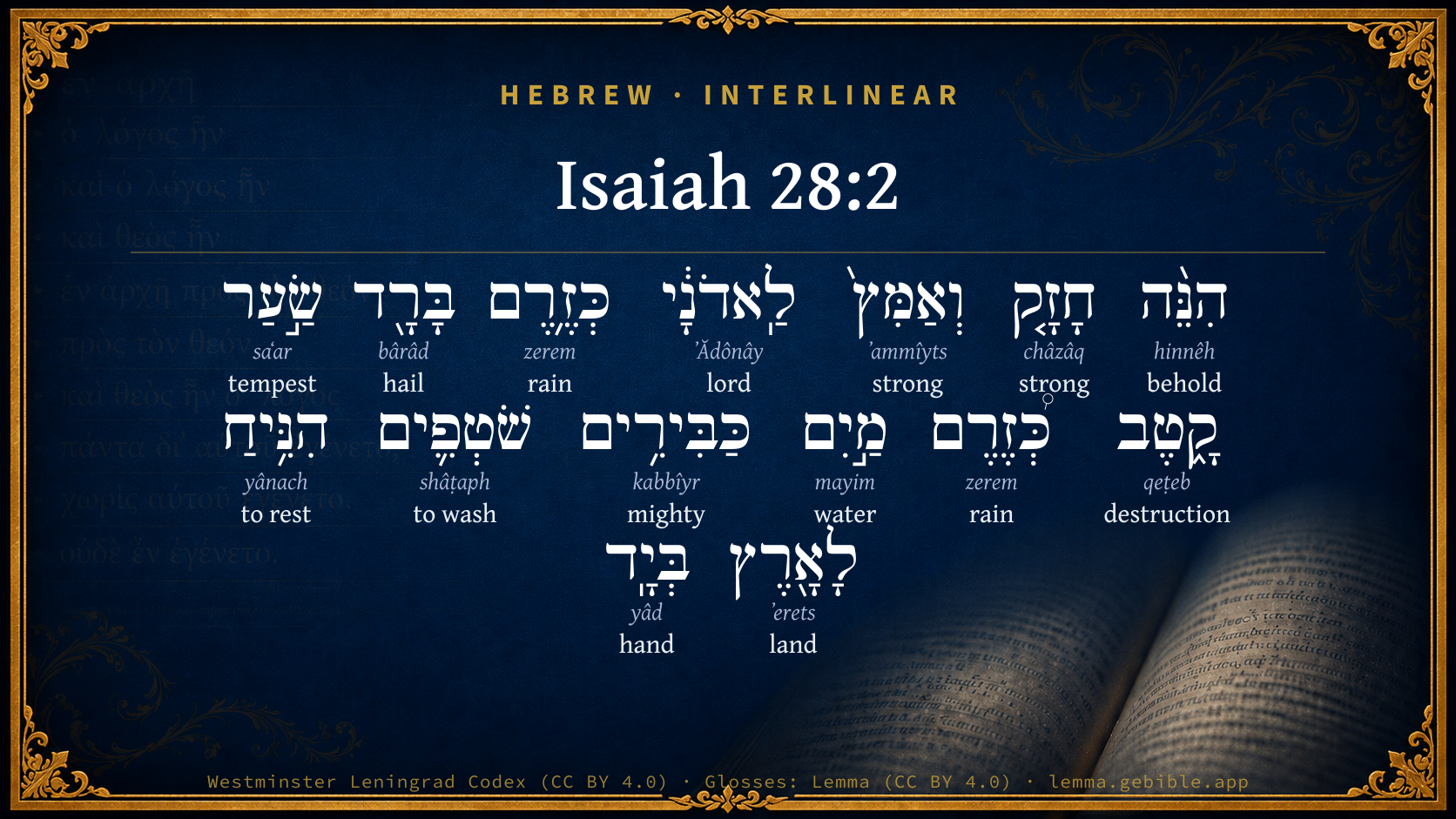
Isaiah 28:2

Hebrew (Westminster Leningrad Codex) Isaiah 28:2 appears in the Hebrew Old Testament. The text above is from the Westminster Leningrad Codex. Each word links to its Strong’s number, a concise gloss, and parsing drawn from the Open Scriptures Hebrew Bible morphology. Click any word for its full Brown-Driver-Briggs (BDB) entry.
Download image
Cite this verse

Isaiah 28:2 (World English Bible). Public Domain. Lemma interlinear Bible study tool, https://lemma.gebible.app/v/isaiah/28/2.

Show BibTeX & RIS
BibTeX
RIS
English Translation
Behold, the Lord has a mighty and strong one; as a tempest of hail, a destroying storm, as a tempest of mighty waters overflowing, will he cast down to the earth with the hand.
World English Bible · Public Domain
Download a study sheet

One document with this verse’s original text, its word-by-word gloss line, the meaning frame, cross-references with their text, attributed commentary, and full source and license credits — printable, and it pastes into notes with its structure intact.

This verse Autodidact and up

Study sheet (.html) Plain text (.txt)

A passage Seminary Student

Up to 50 verses in one chapter. A passage sheet keeps up to 6 commentary sources and 12 cross-references per verse, in the order this page ranks them, and says so on the sheet whenever that leaves anything out. Ask for a single verse and you get the Autodidact verse sheet above.

Everything on this page stays free to read, with no account — the sheet is a download of what is already on screen, not access to it.

Want to remove ads? Support Godless Engineer
Compare translations 3

The same verse in 3 English versions, stacked beneath the original-language interlinear above. Click any original word for its lexicon entry.

Each is an independent rendering of the whole verse — the interlinear is not word-aligned to these translations.

Highlighted words mark where these versions differ — a whole-verse word diff, not a word-by-word alignment.

  • World English Bible Public Domain
    Behold, the Lord has a mighty and strong one; as a tempest of hail, a destroying storm, as a tempest of mighty waters overflowing, will he cast down to the earth with the hand.
  • King James Version Public Domain
    Behold, the Lord hath a mighty and strong one, which as a tempest of hail and a destroying storm, as a flood of mighty waters overflowing, shall cast down to the earth with the hand.
  • unfoldingWord Literal Text CC BY-SA 4.0
    Behold, mighty and strong to the Lord. Like a storm of hail, a windstorm of destruction, like a storm of mighty, overflowing waters, he casts down to the earth by his hand.

unfoldingWord Literal Text — © unfoldingWord, licensed CC BY-SA 4.0. Word-aligned USFM3 via Door43 (git.door43.org/unfoldingWord/en_ult).

Versions to compare (up to 4)

3 of 4 selected

Show all 18 translations

Every available English version of this verse, each an independent rendering of the whole verse.

  • World English Bible Public Domain
    Behold, the Lord has a mighty and strong one; as a tempest of hail, a destroying storm, as a tempest of mighty waters overflowing, will he cast down to the earth with the hand.
  • Berean Standard Bible Public Domain
    Behold, the Lord has one who is strong and mighty. Like a hailstorm or destructive tempest, like a driving rain or flooding downpour, he will smash that crown to the ground.
  • Majority Standard Bible Public Domain
    Behold, the Lord has one who is strong and mighty. Like a hailstorm or destructive tempest, like a driving rain or flooding downpour, he will smash that crown to the ground.
  • King James Version Public Domain
    Behold, the Lord hath a mighty and strong one, which as a tempest of hail and a destroying storm, as a flood of mighty waters overflowing, shall cast down to the earth with the hand.
  • American Standard Version (1901) Public Domain
    Behold, the Lord hath a mighty and strong one; as a tempest of hail, a destroying storm, as a tempest of mighty waters overflowing, will he cast down to the earth with the hand.
  • Revised Version (1885) Public Domain
    Behold, the Lord hath a mighty and strong one; as a tempest of hail, a destroying storm, as a tempest of mighty waters overflowing, shall he cast down to the earth with the hand.
  • Geneva Bible (1599) Public Domain
    Beholde, the Lord hath a mightie and strong hoste, like a tempest of haile, and a whirlewinde that ouerthroweth, like a tempest of mightie waters that ouerflowe, which throwe to the ground mightily.
  • Douay-Rheims (1899) Public Domain
    Behold the Lord is mighty and strong, as a storm of hail: a destroying whirlwind, as the violence of many waters overflowing, and sent forth upon a spacious land.
  • Young's Literal Translation Public Domain
    Lo, a mighty and strong one `is' to the Lord, As a storm of hail -- a destructive shower, As an inundation of mighty waters overflowing, He cast down to the earth with the hand.
  • Literal Standard Version CC BY-SA 4.0
    Behold, a mighty and strong one [is] to the Lord, || As a storm of hail—a destructive shower, || As an inundation of mighty waters overflowing, || He cast down to the earth with the hand.
  • Unlocked Literal Bible CC BY-SA 4.0
    Behold, the Lord sends one who is mighty and strong; like a storm of hail and a destructive windstorm, like a driving rain and overflowing waters; and he will throw each garland crown down to the ground.
  • unfoldingWord Literal Text CC BY-SA 4.0
    Behold, mighty and strong to the Lord. Like a storm of hail, a windstorm of destruction, like a storm of mighty, overflowing waters, he casts down to the earth by his hand.
  • Darby Bible Public Domain
    Behold, the Lord hath a mighty and strong one, as a storm of hail [and] a destroying tempest; as a storm of mighty waters overflowing, shall he cast down to the earth with might.
  • World Messianic Bible Public Domain
    Behold, the Lord has one who is mighty and strong. Like a storm of hail, a destroying storm, and like a storm of mighty waters overflowing, he will cast them down to the earth with his hand.
  • Webster's Bible Public Domain
    Behold, the Lord hath a mighty and strong one, which as a tempest of hail and a destroying storm, as a flood of mighty waters overflowing, shall cast down to the earth with the hand.
  • Free Bible Version CC BY-SA 4.0
    Watch out, for the Lord has someone who is strong and powerful! He is going to smash it to the ground like a hailstorm and a tornado, like a torrential rain and an overwhelming flood.
  • Bible in Basic English Public Domain
    See, the Lord has a strong and cruel one; like a rain of ice, a storm of destruction, like the overflowing of a strong river, he will violently overcome them.
  • JPS Tanakh (1917) Public Domain
    Behold, the Lord hath a mighty and strong one, as a storm of hail, a tempest of destruction, as a storm of mighty waters overflowing, that casteth down to the earth with violence.

Literal Standard Version (2020), Covenant Press — licensed CC BY-SA 4.0. Text via the HelloAO Bible API (eBible.org). Unlocked Literal Bible (unfoldingWord) — licensed CC BY-SA 4.0. Text via the HelloAO Bible API (eBible.org). unfoldingWord Literal Text — © unfoldingWord, licensed CC BY-SA 4.0. Word-aligned USFM3 via Door43 (git.door43.org/unfoldingWord/en_ult). Free Bible Version, Dr. Jonathan Gallagher — licensed CC BY-SA 4.0. Text via the HelloAO Bible API (eBible.org).

Word by word

More ways to search: Search by grammar → Find every occurrence → Compare this word →

Practice this passage: Drill this verse → Learn its vocabulary →

קָ֑טֶב
qeṭeb
H6986
“destruction”
Noun, Common, Masculine, Singular, Absolute
Part of Speech
Noun
Type
Common
Gender
Masculine
Number
Singular
State
Absolute
Full BDB Definition

Origin: from an unused root meaning to cut off

TWOT: 2007a

destruction
  1. הִנֵּ֨ה hinnêh H2009 “behold” Particle, Demonstrative
  2. חָזָ֤ק châzâq H2389 “strong” Adjective, Adjective, Masculine, Singular, Absolute
  3. וְאַמִּץ֙ ʼammîyts H533 “and · strong” Conjunction + Adjective, Adjective, Masculine, Singular, Absolute
  4. לַֽאדֹנָ֔י ʼĂdônây H136 “to/for · Lord · my” Preposition + Noun, Common, Masculine, Plural, Construct + Suffix, Personal, 1st Person, Common, Singular
  5. כְּזֶ֥רֶם zerem H2230 “like/as · rain of” Preposition + Noun, Common, Masculine, Singular, Construct
  6. בָּרָ֖ד bârâd H1259 “hail” Noun, Common, Masculine, Singular, Absolute
  7. שַׂ֣עַר saʻar H8178 “tempest of” Noun, Common, Masculine, Singular, Construct
  8. כְּ֠זֶרֶם zerem H2230 “like/as · rain of” Preposition + Noun, Common, Masculine, Singular, Construct
  9. מַ֣יִם mayim H4325 “water(s)” Noun, Common, Masculine, Plural, Absolute
  10. כַּבִּירִ֥ים kabbîyr H3524 “mighty” Adjective, Adjective, Masculine, Plural, Absolute
  11. שֹׁטְפִ֛ים shâṭaph H7857 “washing” Verb, Qal, Participle Active, Masculine, Plural, Absolute
  12. הִנִּ֥יחַ yânach H3240 “to rest” Verb, Hiphil, Perfect, 3rd Person, Masculine, Singular
  13. לָאָ֖רֶץ ʼerets H776 “to/for the · land” Preposition, Determined + Noun, Common, Both, Singular, Absolute
  14. בְּיָֽד yâd H3027 “in/at · hand” Preposition + Noun, Common, Both, Singular, Absolute

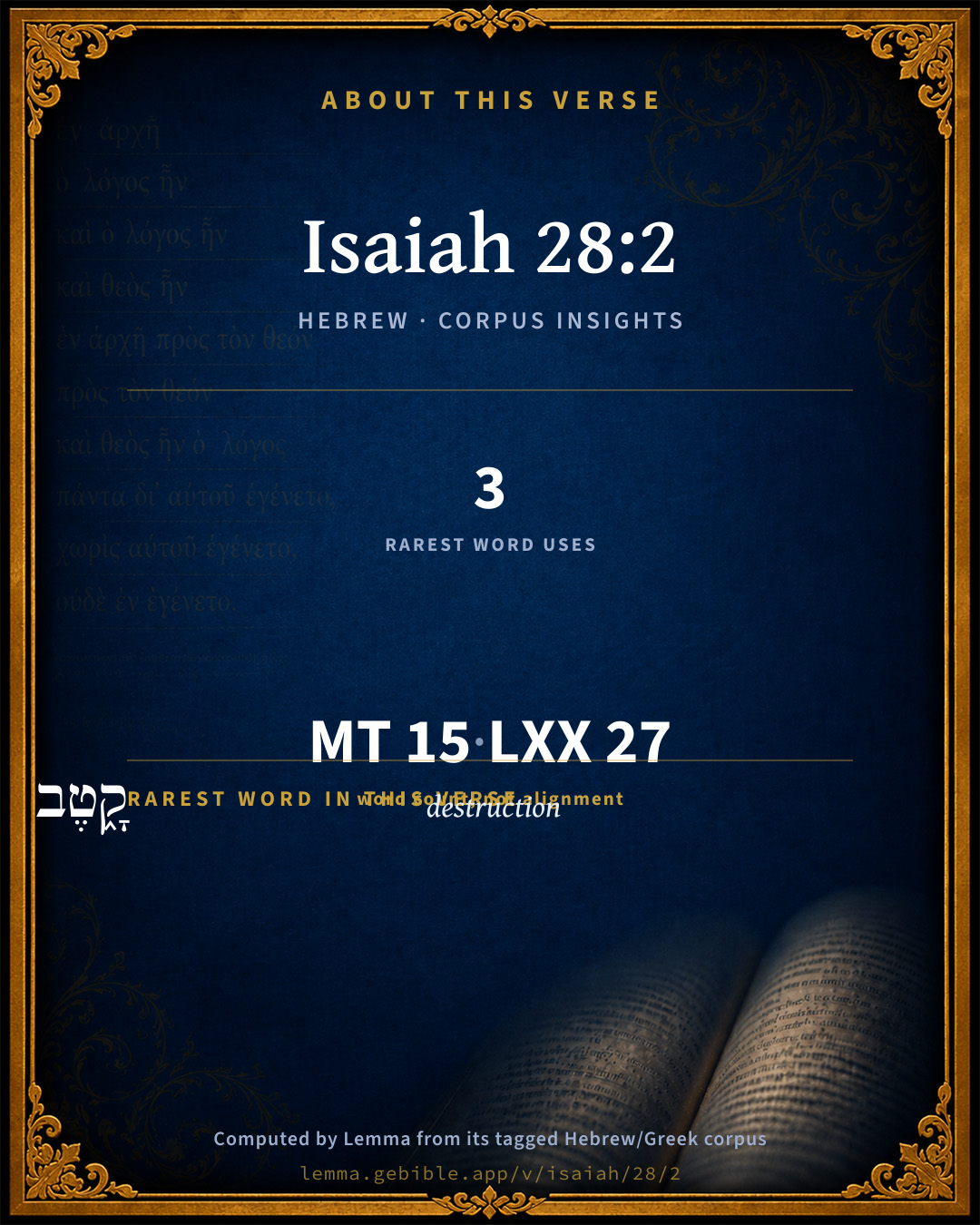
About this verse

These counts appear in no published source. They are computed here, from the morphology-tagged text and Lemma’s own curated glosses. What Lemma adds →

15
words
14
distinct lemmas
Prophets
section

Notable vocabulary

The rarest word here is קָ֑טֶב destruction H6986 — appearing just 3 times in the whole Hebrew Bible.

Shared distinctive vocabulary

קָ֑טֶב destruction H6986 occurs in 3 verses of the Hebrew Bible. Also found in:

Grammatical profile

  • 2 verbs
  • 9 nouns
  • 3 adjectives
  • 1 particle

Verb forms

  • שֹׁטְפִ֛ים Qal · Participle Active
  • הִנִּ֥יחַ Hiphil · Perfect

Repetition

A word recurs within this verse — often emphatic in Hebrew:

  • כְּזֶ֥רֶם rain H2230 ×2

Hebrew & Septuagint length

In English translation the verse runs 34 words from the Hebrew and 37 from the Septuagint (LXX English) — closely comparable.

A rough comparison of the two English renderings, which tokenize alike — not a word-level alignment.

Word counts can differ between the Hebrew and the Greek without any difference in meaning — e.g. the Hebrew direct-object marker אֵת has no separate Greek word, and Greek often adds the article ὁ.

In the original languages it is 15 Hebrew tokens and 27 Greek tokens — but the two are counted differently (Hebrew bundles its prefixes and suffixes into one token; the Greek is in lemma form), so that isn’t a like-for-like length.

Cross-references

13

Topical passages linked to Isaiah 28:2 in the Treasury of Scripture Knowledge — connected by theme and wording, ordered by reader-vote popularity; previews shown in the World English Bible.

  • Isaiah 30:30 Yahweh will cause his glorious voice to be heard, and will show the lighting down of his arm, with the indignation of [his] anger, and the flame of a devouring fire, with a blast, and tempest, and hailstones.
  • Ezekiel 13:11 tell those who daub it with whitewash, that it shall fall: there shall be an overflowing shower; and you, great hailstones, shall fall; and a stormy wind shall tear it.
  • Nahum 1:8 But with an overflowing flood, he will make a full end of her place, and will pursue his enemies into darkness.
  • Isaiah 27:1 In that day Yahweh with his hard and great and strong sword will punish leviathan the swift serpent, and leviathan the crooked serpent; and he will kill the monster that is in the sea.
  • Isaiah 29:6 She shall be visited of Yahweh of Hosts with thunder, and with earthquake, and great noise, with whirlwind and tempest, and the flame of a devouring fire.
  • Isaiah 8:7–8 now therefore, behold, the Lord brings up on them the waters of the River, strong and many, [even] the king of Assyria and all his glory: and it shall come up over all its channels, and go over all its banks;
  • Isaiah 9:9–12 All the people shall know, [even] Ephraim and the inhabitant of Samaria, who say in pride and in arrogance of heart,
  • Isaiah 25:4 For you have been a stronghold to the poor, a stronghold to the needy in his distress, a refuge from the storm, a shade from the heat, when the blast of the awesome ones is as a storm against the wall.
  • Isaiah 28:15–19 Because you have said, We have made a covenant with death, and with Sheol are we at agreement; when the overflowing scourge shall pass through, it shall not come to us; for we have made lies our refuge, and under falsehood have we hid ourselves:
  • Isaiah 40:10 Behold, the Lord Yahweh will come as a mighty one, and his arm will rule for him: Behold, his reward is with him, and his recompense before him.
  • Ezekiel 30:10–11 Thus says the Lord Yahweh: I will also make the multitude of Egypt to cease, by the hand of Nebuchadrezzar king of Babylon.
  • Matthew 7:25–27 The rain came down, the floods came, and the winds blew, and beat on that house; and it didn't fall, for it was founded on the rock.
  • Revelation 18:8 Therefore in one day her plagues will come: death, mourning, and famine; and she will be utterly burned with fire; for the Lord God who has judged her is strong.

Cross-references courtesy of OpenBible.info (CC BY 4.0).

Hebrew and Greek witnesses Masoretic Hebrew ↔ Greek Septuagint

The same verse in the two great witnesses to the Old Testament, shown verse-for-verse.

These are two independent witnesses, not word-aligned to each other, and the Septuagint is shown in lemma (dictionary) form.

Hebrew Isaiah 28:2 Masoretic · Westminster Leningrad Codex

הִנֵּ֨ה חָזָ֤ק וְאַמִּץ֙ לַֽאדֹנָ֔י כְּזֶ֥רֶם בָּרָ֖ד שַׂ֣עַר קָ֑טֶב כְּ֠זֶרֶם מַ֣יִם כַּבִּירִ֥ים שֹׁטְפִ֛ים הִנִּ֥יחַ לָאָ֖רֶץ בְּיָֽד

Behold, the Lord has a mighty and strong one; as a tempest of hail, a destroying storm, as a tempest of mighty waters overflowing, will he cast down to the earth with the hand.

World English Bible · Public Domain

Greek LXX Isaiah 28:2 Septuagint · lemma form

ἰδού ἰσχυρός καί σκληρός ὁ θυμός κύριος ὡς χάλαζα καταφέρω οὐ ἔχω σκέπης βία καταφέρω ὡς ὕδωρ πολύς πλῆθος σύρω χώρα ὁ γῆ ποιέω ἀνάπαυσις ὁ χείρ

Behold, the anger of the Lord is strong and severe, as descending hail where there is no shelter, violently descending; as a great body of water sweeping away the soil, he shall make rest for the land.

LXX2012 (modern English Septuagint) · Public Domain

On this verse, Ellicott's Commentary for English Readers discusses the Septuagint’s reading. Read the note in Commentary ↓

Hebrew: Westminster Leningrad Codex (CC BY 4.0). Greek: Septuagint (public domain); English from LXX2012 (modern English Septuagint) (Public Domain). How the Septuagint differs from the Hebrew →

Targum (Aramaic paraphrase)

1

The Targum is the ancient Jewish Aramaic paraphrase of the Hebrew Scriptures — an interpretive translation, not the Hebrew text itself. Onkelos (literal) and Pseudo-Jonathan (expansive) render the Torah, and Jonathan the Prophets. Coverage is partial: where no permissively-licensed English translation exists for a verse, only the Aramaic is shown. This is verse-level text, not a word-by-word alignment to the Hebrew.

  1. Targum Jonathan Prophets (Joshua–Malachi)
    הָא מָחָן תַּקִיפָן וַחֲסִינָן אַתְיָן מִן קֳדָם יְיָ כְּזַרְמִית בָּרָד כְּעַלְעוּל רוּחַ כְּזַרְמִית מַיָין תַּקִיפִין שָׁטְפִין כֵּן יֵתוּן עֲלֵיהוֹן עַמְמַיָא וְיִגְלוּנוּן מֵאַרְעֲהוֹן לְאַרְעָא אוֹחֲרִי בְּחוֹבַיָא דִי בִידֵהוֹן:

    Behold, plagues, strong and mighty, are coming from the Lord: like a storm of hail, like a whirlwind, like a storm of mighty waters, overflowing, thus the nations shall come upon them, and shall lead them into captivity to another land on account of the sins which are in their hands.

    Targum Jonathan — Aramaic: “Mikraot Gedolot” (public domain). English: “Sefaria Community Translation” (CC0 1.0 (public-domain dedication)); “London "Chaldee Paraphrase," 1871” (public domain). Text via Sefaria.

Commentary

Notes on Isaiah 28:2 from classic Christian and Jewish commentators (each source and its license shown beneath its notes). The classic Christian expositions comment on the surrounding passage and are grouped to its opening verse, so a note may address several verses; the Jewish commentaries on the Tanakh (Rashi and others) are per-verse, so they appear only where the commentator wrote on this verse.

Lemma curates 59 commentaries, every one of them public domain or Creative Commons licensed, each selected and text-cleaned for this edition rather than reprinted as found. About our sources →

Trapp's Complete Commentary

John Trapp

Isa 28:2 Behold, the Lord hath a mighty and strong one, [which] as a tempest of hail [and] a destroying storm, as a flood of mighty waters overflowing, shall cast down to the earth with the hand.

Ver. 2. Behold, the Lord hath a mighty and a strong one,] viz., Shalmaneser, king of Assyria. For whereas Ephraim might say, Who is there that can or dare pull off the flower of our goodly gallantry? God answereth that he hath at hand one that can do it, and do it with a turn of a hand, with little ado.

John Trapp, A Commentary or Exposition upon All the Books of the Old and New Testament (1647–1656) — public domain. Text from a community e-Sword module.

Joseph Benson's Commentary

Isa 28:2-4. Behold, the Lord hath — Namely, at his command, prepared and ready to execute his judgments; a mighty and strong one — Shalmaneser, the king of Assyria; which, as a tempest of hail, &c., shall cast down — The crown of pride, to the earth, by his hand — By the hand of God, which shall strengthen him in this work. The crown, the drunkards, shall be trodden under feet — The expression is emphatical; the crown which was upon their own heads shall be trodden under the feet of others; and they, whose drunkenness made them stagger and fall to the ground, shall be trodden down there. The glorious beauty shall be as the hasty fruit — That is, the first ripe fruit, which, coming before the season, and before other fruits, is most acceptable. Which he that seeth it eateth up — Which, as soon as a man sees, he plucks it off and devours it as soon as he can get it into his hand. And so shall it be with Ephraim’s glory, which his enemies shall covet and spoil, and devour greedily. “The image,” says Bishop Lowth, “expresses, in the strongest manner, the great ease with which the Assyrians should take the city and the whole kingdom, and the avidity with which they should seize the rich prey without resistance.”

Joseph Benson's Commentary on the Old and New Testaments (1811–1818) — public domain. Text from a community e-Sword module.

Tyndale Open Study Notes

Tyndale Open Resources

28:2 the Lord will send: The covenant God will act against his own people, whose behavior had effectively disqualified them as God’s people (see Hos 1:9). • The mighty army is that of the Assyrians, who destroyed Samaria in 722 BC.

Tyndale Open Study Notes — © Tyndale Open Resources, licensed CC BY-SA 4.0. Text via the HelloAO Bible API.

Geneva Bible (1599)

Geneva Bible translators

He seemeth to mean the Assyrians, by whom the ten tribes were carried away.

Geneva Bible (1599) marginal notes — public domain. Text via Bolls.life.

Jamieson, Fausset & Brown

Robert Jamieson, A. R. Fausset & David Brown

strong one--the Assyrian (Isa 10:5).

cast down--namely, Ephraim (Isa 28:1) and Samaria, its crown.

with . . . hand--with violence (Isa 8:11).

Jamieson, Fausset & Brown — Commentary Critical and Explanatory on the Whole Bible (1871) — public domain (CC PDM 1.0). Text via the HelloAO Bible API.

Adam Clarke's Commentary

Verse 2. Behold the Lord hath a mighty and strong one - "Behold the mighty one, the exceedingly strong one"] אמץ לאדני ammits ladonai, fortis Domino, i.e., fortissimmus, a Hebraism. For לאדני ladonai, to the Lord, thirty-eight MSS. Of Dr. Kennicott's and many of De Rossi's, with some of my own, and two editions, read ליהוה laihovah, to JEHOVAH.

Adam Clarke's Commentary on the Bible (1810–1826) — public domain. Text from a community e-Sword/MySword module.

Ellicott's Commentary for English Readers

(2) The Lord hath a mighty and strong one . . .—The Hebrew may be either neuter, as in the LXX. and Targum, or masculine, as in the Authorised Version. In either case it refers to the King of Assyria as the instrument of Jehovah’s vengeance, the similitudes employed to describe his action reproducing those of Isa_8:7-8; Isa_25:4. Here the picture is that of the “destroying storm,” the pestilent or blasting tempest withering, and the flood sweeping away, the beautiful “garland” of Samaria.

A Bible Commentary for English Readers, edited by Charles John Ellicott (1878–1897) — public domain. Text from a community e-Sword module.

The Cambridge Bible for Schools and Colleges

gen. ed. J. J. S. Perowne

2. The reason for the woe of Isa_28:1. Render: Behold Jehovah hath a mighty and strong one, like a tempest of hail, a destroying storm; like a flow of mighty overflowing waters, which casts down to the earth with violence.

a mighty and strong one] i.e. the Assyrian, Jehovah’s instrument (ch. Isa_10:5).

a destroying storm] Delitzsch renders, less suitably perhaps, “a pestilential wind.” The word occurs again only in Deu_32:24; Psa_91:6; but a closely related one in Hos_13:14 (A.V. “destruction”). The image of the storm, here presented in three forms, recurs in Isa_28:15; Isa_28:18 f.

shall cast] Better, casts (perf. of experience, Davidson, Synt. § 40, e) The subj. is the storm of waters.

with the hand] i.e. with force.

The Cambridge Bible for Schools and Colleges (gen. ed. J. J. S. Perowne; Cambridge University Press, 1878–1918) — public domain. Text from a community e-Sword module.

John Gill's Exposition

Behold, the Lord hath a mighty and strong one,.... That is, a powerful king, with a mighty army, meaning Shalmaneser king of Assyria; whom the Lord had at his beck and command, and could use at his pleasure, as his instrument, to bring down the towering pride of Ephraim, and chastise him for his sensuality:

which as a tempest of hail; that beats down herbs and plants, and branches of trees, and men and beasts:

and a destroying storm; which carries all before it, blows down houses and trees, and makes terrible devastation wherever it comes:

as a flood of mighty waters overflowing; whose torrent is so strong there is no stopping it: so this mighty and powerful prince

shall cast down to the earth with the hand; the crown of pride, the people of Israel, and the king of it; he shall take the crown from his head, and cast it to the ground with a strong hand, as the Jews interpret it, with great violence; or very easily, with one hand, as it were, without any trouble at all. The Targum is,

"so shall people come against them, and remove them out of their own land into another land, because of the sins which were in their hands;''

see Isa 8:7.

John Gill's Exposition of the Whole Bible (1746–1763) — public domain (CC PDM 1.0). Text via the HelloAO Bible API.

Albert Barnes' Notes on the Bible

Behold, the Lord hath a mighty and strong one - The Hebrew of this passage is, ‘Lo! there is to the Lord (לאדני la'donāy) mighty and strong.’ Lowth renders it,

‘Behold the mighty one, the exceedingly strong one,’

And supposes that it means the Lord himself. It is evident, however, that something must be understood as being that which the Lord ‘hath,’ for the Hebrew properly implies that there is something strong and mighty which is under his control, and with which, as with a tempest, he will sweep away and destroy Ephraim. Jarchi supposes that רוח rûach (“wind”) is understood; Kimchi thinks that the word is יום yôm (“day”); others believe that חיל chayil (“an army”) is understood. But I think the obvious interpretation is to refer it to the Assyrian king, as the agent by which Yahweh would destroy Samaria 2Ki 17:3-6. This power was entirely under the direction of Yahweh, and would be employed by him in accomplishing his purpose on that guilty people (compare the notes at Isa 10:5-6).

As a tempest of hail - A storm of hail is a most striking representation of the desolation that is produced by the ravages of an invading army (compare Job 27:21; the note at Isa 30:30; also Hos 13:15).

A flood of mighty waters - This is also a striking description of the devastating effects of an invading army (compare Psa 90:5; Jer 46:7-8)

Shall cast down to the earth - To cast it to the earth means that it should be entirely humbled and destroyed (see the note at Isa 25:12).

With the hand - Septuagint: βίᾳ bia - ‘Force,’ ‘violence.’ This is its meaning here; as if it were taken in the hand, like a cup, and dashed indignantly to the ground.

Albert Barnes' Notes on the Bible (1834–1885) — public domain. Text from a community e-Sword/MySword module.

Haydock's Catholic Bible Commentary

The Lord. By his instrument, Salmanasar. (Haydock) --- Hebrew, "behold the strong one, and the mighty to the Lord, as," &c. (Calmet) --- Septuagint, "behold the Lord’s fury....as," &c. (Haydock)

George Leo Haydock (1774–1849), Haydock's Catholic Family Bible and Commentary, 1859 edition — public domain. Excludes Psalms (Douay-Rheims chapter numbering differs from Protestant) and Deuterocanonical books (Catholic canon only).

Matthew Poole's English Annotations

The Lord hath, to wit, at his command, prepared and ready to execute his judgments,

a mighty and strong one; the king of Assyria.

Shall cast down; understand it, the crown of pride; or them, the drunkards of Ephraim.

With the hand; or, by his hand; either by that king’s force or strong hand; or by the hand of God, which shall strengthen and succeed him in this work.

Matthew Poole's English Annotations on the Holy Bible (1683–1685) — public domain. Text from a community e-Sword/MySword module.

Whedon's Commentary on the Bible

Daniel D. Whedon

2. A mighty and strong one — An invading army, no doubt, is meant. Ravages which this should make on the country would surely have a fiercer description than that furnished in the picture given below.

Tempest of hail — At times furious in that land, and occasionally lasting two or three days.

(This remark is from personal observation of the writer at Shechem, seven miles distant from Samaria, in the month of March, 1870.)

Cast… with the hand — The “hand” is the emblem of force, power, violence.

Daniel D. Whedon (gen. ed.), Commentary on the Old and New Testaments (1874–1909) — public domain. Text from a community e-Sword module.

The Pulpit Commentary

The Lord hath a mighty and strong one. God has in reserve a mighty power, which he will let loose upon Samaria. The wicked are "his sword", (Psa_17:13) and are employed to carry out his sentences. In the present ease the "mighty and strong one" is the Assyrian power. As a tempest of hail, etc. The fearfully devastating force of an Assyrian invasion is set forth under three distinct images a hailstorm, a furious tempest of wind, and a violent inundation as though so only could its full horror be depicted. War is always a horrible scourge; but in ancient times, and with a people so cruel as the Assyrians, it was a calamity exceeding in terribleness the utmost that the modern reader can conceive. It involved the wholesale burning of cities and villages, the wanton destruction of trees and crops, the slaughter of thousands in battles and sieges, the subsequent massacre of hundreds in cold blood, the plunder of all classes, and the deportation of tens of thousands of captives, who were carried into hopeless servitude in a strange land. With the hand; i.e. "with force," "violently." So in Assyrian constantly (compare the use of the Greek ceri ).

The Pulpit Commentary (1880–1919), ed. H.D.M. Spence-Jones & Joseph S. Exell — public domain. Text from a community e-Sword module.

John Wesley's Explanatory Notes

A strong one - The king of Assyria. Shall cast down - The crown of pride. The hand - By the hand of God, which shall strengthen him in this work.

John Wesley, Explanatory Notes Upon the Whole Bible (1754–1765) — public domain. Text via the GEBible commentary corpus.

Keil & Delitzsch

C. F. Keil & F. Delitzsch

In the next three vv. the hoi is expanded. "Behold, the Lord holds a strong and mighty thing like a hailstorm, a pestilent tempest; like a storm of mighty overflowing waters, He casts down to the earth with almighty hand. With feet they tread down the proud crown of the drunken of Ephraim. And it happens to the fading flower of its splendid ornament, which is upon the head of the luxuriant valley, as to an early fig before it is harvest, which whoever sees it looks at, and it is no sooner in his hand than he swallows it." "A strong and mighty thing:" ואמּי חזק we have rendered in the neuter (with the lxx and Targum) rather than in the masculine, as Luther does, although the strong and mighty thing which the Lord holds in readiness is no doubt the Assyrian. He is simply the medium of punishment in the hand of the Lord, which is called yâd absolutely, because it is absolute in power - as it were, the hand of all hands. This hand hurls Samaria to the ground (on the expression itself, compare Isa 25:12; Isa 26:5), so that they tread the proud crown to pieces with their feet (tērâmasnâh, the more pathetic plural form, instead of the singular tērâmēs; Ges. 47, Anm. 3, and Caspari on Oba 1:13). The noun sa‛ar, which is used elsewhere in the sense of shuddering, signifies here, like סערה, an awful tempest; and when connected with קטב, a tempest accompanied with a pestilential blast, spreading miasma. Such destructive power is held by the absolute hand. It is soon all over then with the splendid flower that has already begun to fade נבל ציצת, like הקּטן כּלי in Isa 22:24). It happens to it as to a bikkūrâh (according to the Masora, written with mappik here, as distinguished from Hos 9:10, equivalent to kebhikkūrâthâh; see Job 11:9, "like an early fig of this valley;" according to others, it is simply euphonic). The gathering of figs takes place about August. Now, if any one sees a fig as early as June, he fixes his eyes upon it, and hardly touches it with his hand before he swallows it, and that without waiting to masticate it long. Like such a dainty bit will the luxuriant Samaria vanish. The fact that Shalmanassar, or his successor Sargon, did not conquer Samaria till after the lapse of three years (Kg2 18:10), does not detract from the truth of the prophecy; it is enough that both the thirst of the conqueror and the utter destruction of Samaria answered to it.

Keil & Delitzsch — Biblical Commentary on the Old Testament (1861–1891) — public domain (CC PDM 1.0). Text via the HelloAO Bible API. (Old Testament only.)

J. A. Alexander on Isaiah

Joseph Addison Alexander

“Behold, there is to the Lord (i.e., the Lord has) a strong and mighty one, like a storm of hail, a destroying tempest, like a storm of mighty rushing waters, he has brought (it) to the ground with the hand.” The meaning to the earth or to the ground is clear from Isa 63:6, and other cases. The crown of Ephraim is described as torn from his head and thrown upon the ground by the hand of a victorious enemy. To this explanation no objection can be drawn from the previous mention of the hail and rain; for these are mere comparisons, descriptive of the violence with which the enemy should make his attack. It is as if he had said, a strong and mighty enemy, rushing upon you like a hail-storm or a driving rain, shall cast your crown upon the earth with his hand.

Joseph Addison Alexander, The Prophecies of Isaiah (1846–1847; New York: Scribner, 1870–1878) — public domain. Text from a community e-Sword module.

Rashi

Rabbi Shlomo Yitzchaki (Rashi)

Behold The Lord has a strong and powerful wind, which is like a downpour of hail and a storm of קֶטֶב מְרִירִי, bitter destruction.

He lays it on the land with [His] hand He shall place it on their land with His strong hand and cast down the inferior figs from fig trees.

Rashi on the Tanakh — English translations: “The Judaica Press complete Tanach with Rashi, translated by A. J. Rosenberg” (CC BY 4.0); “Pentateuch with Rashi's commentary by M. Rosenbaum and A.M. Silbermann, 1929-1934” (public domain); “The Metsudah Tanach series, Lakewood, N.J” (CC BY 4.0); and “The Book of Joshua, Metsudah Publications, 1997” (CC BY 4.0). Text via Sefaria.

Ibn Ezra

Rabbi Abraham ibn Ezra

חזק Mighty. Attribute to יום day, or חיל host, which is to be supplied.

שער קטב. The כ in כזרם refers also to שער: As a destroying wind.

קטב Destruction. Comp. קטבך thy destruction (Hos. 13:14).

הניח לארץ He cast down to the earth. God sent those storms and caused them to visit the earth. ביד With the hand. With His mighty hand.

Ibn Ezra on the Tanakh — English translations: “Sefaria Community Translation” (CC0 1.0 (public-domain dedication)); “Yalkut, Sifsei Chachomim Chumash, Metsudah Publications, 2009” (CC BY 4.0); and “Commentary of Ibn Ezra on Isaiah - trans. by M. Friedlander, 1873” (public domain). Text via Sefaria.

Lesson kit

Teaching starters — assembled from the data on this page, not authored interpretation. Every prompt links to the verse data it draws on. Edit before teaching.

Isaiah, in the Prophets, opens this verse with 15 words (14 distinct Hebrew lemmas). Its most distinctive word is qeṭeb (“destruction”). A historical commentator’s framing appears above. Read the whole chapter for the surrounding context.

Discussion questions

  1. The word qeṭeb carries the sense “destruction.” How does it shape the verse?
  2. How does Deuteronomy 32:24, which shares the word «destruction», read alongside this verse?
  3. What does the repetition of “rain” (2× in this one verse) do in this verse?
  4. These translations render this verse differently. What is at stake in choosing one wording over another?
  5. «שֹׁטְפִ֛ים» is a Qal Participle Active verb. How does that grammatical form shape the action described?
  6. Compare how Trapp's Complete Commentary and Joseph Benson's Commentary read this verse. Where do they agree or differ?

Things to notice

Reading settings

Reading text

Shown beneath each verse's original-language words.

Old Testament
Old Testament edition

Read the OT as the Masoretic Hebrew (MT) or the Greek Septuagint (LXX).

English shown for the Greek Septuagint (in the Hebrew ↔ Greek comparison).

Comparing translations? Open the Compare panel on any verse page to stack up to four side by side.