
Psalms 110:5

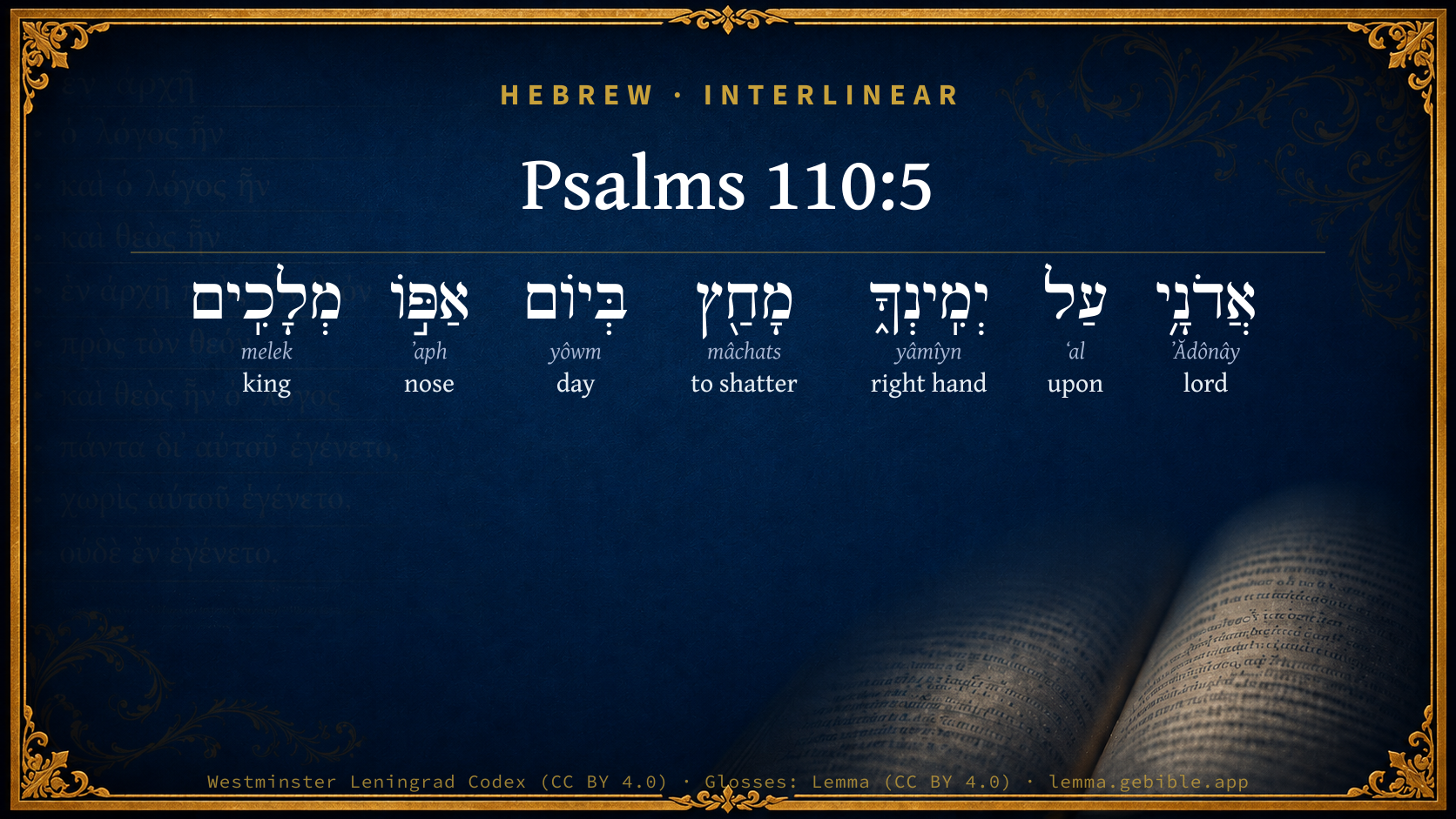
Hebrew (Westminster Leningrad Codex) Psalms 110:5 appears in the Hebrew Old Testament. The text above is from the Westminster Leningrad Codex. Each word links to its Strong’s number, a concise gloss, and parsing drawn from the Open Scriptures Hebrew Bible morphology. Click any word for its full Brown-Driver-Briggs (BDB) entry.
Download image
Cite this verse

Psalms 110:5 (World English Bible). Public Domain. Lemma interlinear Bible study tool, https://lemma.gebible.app/v/psalms/110/5.

Show BibTeX & RIS
BibTeX
RIS
English Translation
The Lord is at your right hand. He will crush kings in the day of his wrath.
World English Bible · Public Domain
Download a study sheet

One document with this verse’s original text, its word-by-word gloss line, the meaning frame, cross-references with their text, attributed commentary, and full source and license credits — printable, and it pastes into notes with its structure intact.

This verse Autodidact and up

Study sheet (.html) Plain text (.txt)

A passage Seminary Student

Up to 50 verses in one chapter. A passage sheet keeps up to 6 commentary sources and 12 cross-references per verse, in the order this page ranks them, and says so on the sheet whenever that leaves anything out. Ask for a single verse and you get the Autodidact verse sheet above.

Everything on this page stays free to read, with no account — the sheet is a download of what is already on screen, not access to it.

Want to remove ads? Support Godless Engineer
Compare translations 3

The same verse in 3 English versions, stacked beneath the original-language interlinear above. Click any original word for its lexicon entry.

Each is an independent rendering of the whole verse — the interlinear is not word-aligned to these translations.

Highlighted words mark where these versions differ — a whole-verse word diff, not a word-by-word alignment.

  • World English Bible Public Domain
    The Lord is at your right hand. He will crush kings in the day of his wrath.
  • King James Version Public Domain
    The Lord at thy right hand shall strike through kings in the day of his wrath.
  • unfoldingWord Literal Text CC BY-SA 4.0
    The Lord at your right hand. He crushes kings on the day of his nose.

unfoldingWord Literal Text — © unfoldingWord, licensed CC BY-SA 4.0. Word-aligned USFM3 via Door43 (git.door43.org/unfoldingWord/en_ult).

Versions to compare (up to 4)

3 of 4 selected

Show all 18 translations

Every available English version of this verse, each an independent rendering of the whole verse.

  • World English Bible Public Domain
    The Lord is at your right hand. He will crush kings in the day of his wrath.
  • Berean Standard Bible Public Domain
    The Lord is at Your right hand; He will crush kings in the day of His wrath.
  • Majority Standard Bible Public Domain
    The Lord is at Your right hand; He will crush kings in the day of His wrath.
  • King James Version Public Domain
    The Lord at thy right hand shall strike through kings in the day of his wrath.
  • American Standard Version (1901) Public Domain
    The Lord at thy right hand Will strike through kings in the day of his wrath.
  • Revised Version (1885) Public Domain
    The Lord at thy right hand shall strike through kings in the day of his wrath.
  • Geneva Bible (1599) Public Domain
    The Lord, that is at thy right hand, shall wound Kings in the day of his wrath.
  • Douay-Rheims (1899) Public Domain
    The Lord at thy right hand hath broken kings in the day of his wrath.
  • Young's Literal Translation Public Domain
    The Lord on thy right hand smote kings In the day of His anger.
  • Literal Standard Version CC BY-SA 4.0
    The Lord on Your right hand struck kings || In the day of His anger.
  • Unlocked Literal Bible CC BY-SA 4.0
    The Lord is at your right hand. He will kill kings on the day of his anger.
  • unfoldingWord Literal Text CC BY-SA 4.0
    The Lord at your right hand. He crushes kings on the day of his nose.
  • Darby Bible Public Domain
    The Lord at thy right hand will smite through kings in the day of his anger.
  • World Messianic Bible Public Domain
    The Lord is at your right hand. He will crush kings in the day of his wrath.
  • Webster's Bible Public Domain
    The Lord at thy right hand will strike through kings in the day of his wrath.
  • Free Bible Version CC BY-SA 4.0
    The Lord stands right beside you to support you; he will strike down kings in his anger.
  • Bible in Basic English Public Domain
    In the day of his wrath kings will be wounded by the Lord at your right hand.
  • JPS Tanakh (1917) Public Domain
    The Lord at thy right hand doth crush kings in the day of His wrath.

Literal Standard Version (2020), Covenant Press — licensed CC BY-SA 4.0. Text via the HelloAO Bible API (eBible.org). Unlocked Literal Bible (unfoldingWord) — licensed CC BY-SA 4.0. Text via the HelloAO Bible API (eBible.org). unfoldingWord Literal Text — © unfoldingWord, licensed CC BY-SA 4.0. Word-aligned USFM3 via Door43 (git.door43.org/unfoldingWord/en_ult). Free Bible Version, Dr. Jonathan Gallagher — licensed CC BY-SA 4.0. Text via the HelloAO Bible API (eBible.org).

Word by word

More ways to search: Search by grammar → Find every occurrence → Compare this word →

Practice this passage: Drill this verse → Learn its vocabulary →

About this verse

These counts appear in no published source. They are computed here, from the morphology-tagged text and Lemma’s own curated glosses. What Lemma adds →

7
words
7
distinct lemmas
Wisdom
section

Notable vocabulary

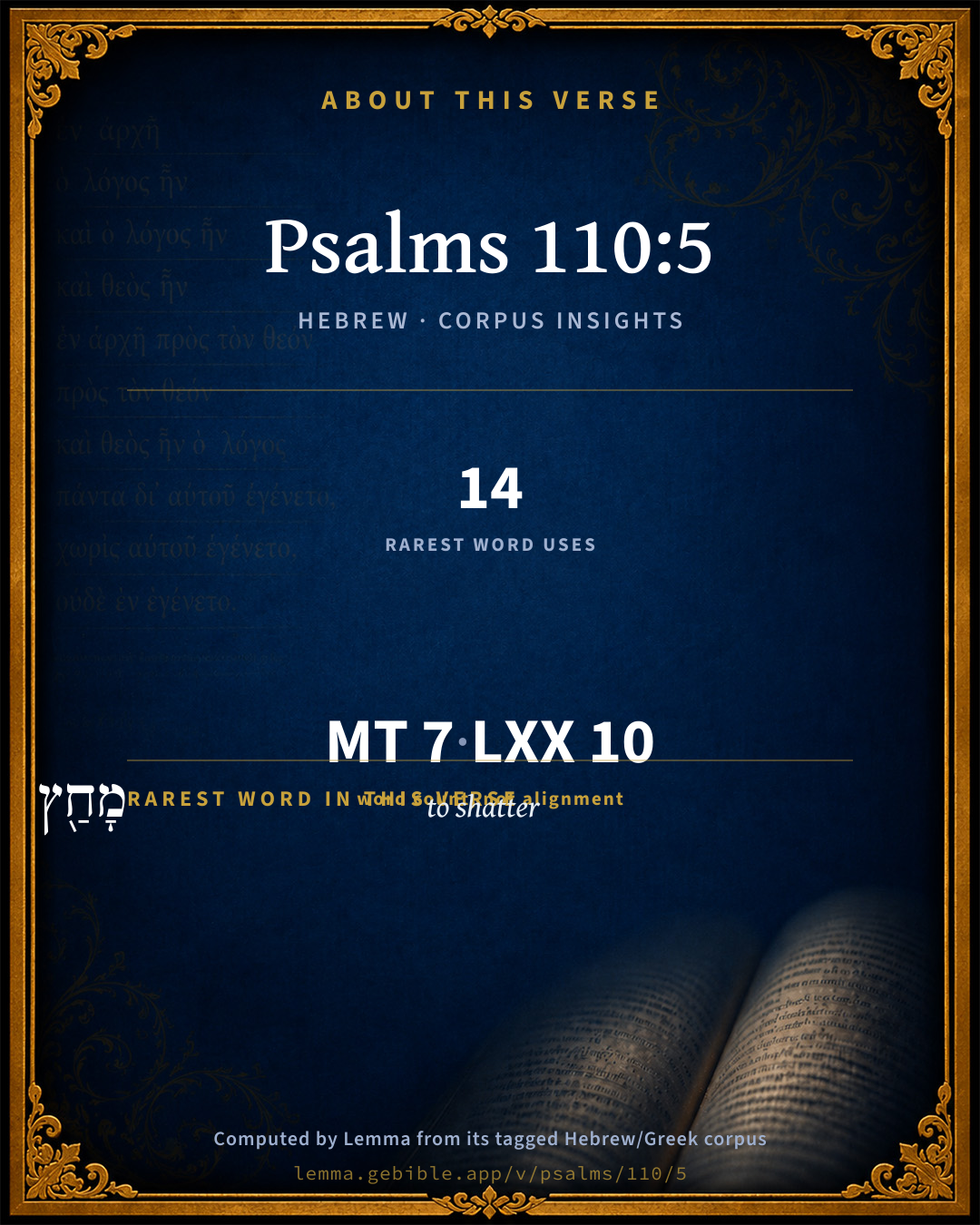
The rarest word here is מָחַ֖ץ to shatter H4272 — appearing just 14 times in the whole Hebrew Bible.

Shared distinctive vocabulary

מָחַ֖ץ to shatter H4272 occurs in 14 verses of the Hebrew Bible. Also found in:

Grammatical profile

  • 1 verb
  • 5 nouns
  • 1 preposition

Verb forms

  • מָחַ֖ץ Qal · Perfect

Hebrew & Septuagint length

In English translation the verse runs 17 words from the Hebrew and 17 from the Septuagint (LXX English) — the same length.

A rough comparison of the two English renderings, which tokenize alike — not a word-level alignment.

Word counts can differ between the Hebrew and the Greek without any difference in meaning — e.g. the Hebrew direct-object marker אֵת has no separate Greek word, and Greek often adds the article ὁ.

In the original languages it is 7 Hebrew tokens and 10 Greek tokens — but the two are counted differently (Hebrew bundles its prefixes and suffixes into one token; the Greek is in lemma form), so that isn’t a like-for-like length.

Cross-references

21

Topical passages linked to Psalms 110:5 in the Treasury of Scripture Knowledge — connected by theme and wording, ordered by reader-vote popularity; previews shown in the World English Bible.

  • Romans 2:5 But according to your hardness and unrepentant heart you are treasuring up for yourself wrath in the day of wrath, revelation, and of the righteous judgment of God;
  • Psalms 16:8 I have set Yahweh always before me. Because he is at my right hand, I shall not be moved.
  • Revelation 6:15–17 The kings of the earth, the princes, the commanding officers, the rich, the strong, and every slave and free person, hid themselves in the caves and in the rocks of the mountains.
  • Revelation 17:12–14 The ten horns that you saw are ten kings who have received no kingdom as yet, but they receive authority as kings, with the beast, for one hour.
  • Psalms 68:14 When the Almighty scattered kings in her, It snowed on Zalmon.
  • Psalms 2:2–6 The kings of the earth take a stand, And the rulers take counsel together, Against Yahweh, and against his anointed, saying,
  • Mark 16:19 So then the Lord Jesus, after he had spoken to them, was received up into heaven, and sat down at the right hand of God.
  • Acts 2:34–36 For David didn't ascend into the heavens, but he says himself, 'The Lord said to my Lord, "Sit by my right hand,
  • Acts 7:55–56 But he, being full of the Holy Spirit, looked up steadfastly into heaven, and saw the glory of God, and Jesus standing on the right hand of God,
  • Revelation 11:18 The nations were angry, and your wrath came, as did the time for the dead to be judged, and to give your bondservants the prophets, their reward, as well as to the saints, and those who fear your name, to the small and the great; and to destroy those who destroy the earth."
  • Revelation 19:11–21 I saw the heaven opened, and behold, a white horse, and he who sat on it is called Faithful and True. In righteousness he judges and makes war.
  • Psalms 2:9–12 You shall break them with a rod of iron. You shall dash them in pieces like a potter's vessel."
  • Psalms 21:8–9 Your hand will find out all of your enemies. Your right hand will find out those who hate you.
  • Psalms 68:30 Rebuke the wild animal of the reeds, The multitude of the bulls, with the calves of the peoples. Being humbled, may it bring bars of silver. Scatter the nations that delight in war.
  • Psalms 110:1 Yahweh says to my Lord, "Sit at my right hand, Until I make your enemies your footstool for your feet."
  • Psalms 149:7–9 To execute vengeance on the nations, And punishments on the peoples;
  • Ezekiel 38:18–19 It shall happen in that day, when Gog shall come against the land of Israel, says the Lord Yahweh, that my wrath shall come up into my nostrils.
  • Zechariah 9:13–15 For indeed I bend Judah as a bow for me. I have filled the bow with Ephraim; And I will stir up your sons, Zion, Against your sons, Greece, And will make you like the sword of a mighty man.
  • Revelation 20:8–9 and he will come out to deceive the nations which are in the four corners of the earth, Gog and Magog, to gather them together to the war; the number of whom is as the sand of the sea.
  • Psalms 45:4–5 In your majesty ride on victoriously on behalf of truth, humility, and righteousness. Let your right hand display awesome deeds.
  • Zechariah 9:9–10 Rejoice greatly, daughter of Zion! Shout, daughter of Jerusalem! Behold, your king comes to you! He is righteous, and having salvation; Lowly, and riding on a donkey, Even on a colt, the foal of a donkey.

Cross-references courtesy of OpenBible.info (CC BY 4.0).

Hebrew and Greek witnesses Masoretic Hebrew ↔ Greek Septuagint

The same verse in the two great witnesses to the Old Testament, shown verse-for-verse.

You’re reading Greek Psalm 109 (Hebrew Psalm 110). The Septuagint counts the superscription, so verse numbers can differ from the Hebrew — chapter-level alignment, not verse-by-verse. Numbering follows Rahlfs.

These are two independent witnesses, not word-aligned to each other, and the Septuagint is shown in lemma (dictionary) form.

Hebrew Psalms 110:5 Masoretic · Westminster Leningrad Codex

אֲדֹנָ֥י עַל יְמִֽינְךָ֑ מָחַ֖ץ בְּיוֹם אַפּ֣וֹ מְלָכִֽים

The Lord is at your right hand. He will crush kings in the day of his wrath.

World English Bible · Public Domain

Greek LXX Greek Psalm 109:5 Septuagint · lemma form

κύριος ἐκ δεξιός σύ συνθλάω ἐν ἡμέρα ὀργή αὐτός βασιλεύς

The Lord at your right hand has dashed in pieces kings in the day of his wrath.

LXX2012 (modern English Septuagint) · Public Domain

On this verse, Keil & Delitzsch discusses the Septuagint’s reading. Read the note in Commentary ↓

Hebrew: Westminster Leningrad Codex (CC BY 4.0). Greek: Septuagint (public domain); English from LXX2012 (modern English Septuagint) (Public Domain). How the Septuagint differs from the Hebrew →

Commentary

Notes on Psalms 110:5 from classic Christian and Jewish commentators (each source and its license shown beneath its notes). The classic Christian expositions comment on the surrounding passage and are grouped to its opening verse, so a note may address several verses; the Jewish commentaries on the Tanakh (Rashi and others) are per-verse, so they appear only where the commentator wrote on this verse.

Lemma curates 59 commentaries, every one of them public domain or Creative Commons licensed, each selected and text-cleaned for this edition rather than reprinted as found. About our sources →

Matthew Henry's Commentary

Here we have our great Redeemer,

I. Conquering his enemies (Psa 110:5, Psa 110:6) in order to the making of them his footstool, Psa 110:1. Our Lord Jesus will certainly bring to nought all the opposition made to his kingdom, and bring to ruin all those who make that opposition and persist in it. He will be too hard for those, whoever they may be, that fight against him, against his subjects and the interest of his kingdom among men, either by persecutions or by perverse disputings. Observe here,

1. The conqueror: The Lord - Adonai, the Lord Jesus, he to whom all judgment is committed, he shall make his own part good against his enemies. The Lord at thy right hand, O church! so some; that is, the Lord that is nigh unto his people, and a very present help to them, that is at their right hand, to strengthen and succour them, shall appear for them against his and their enemies. See Psa 109:31. He shall stand at the right hand of the poor, Psa 16:8. Some observe that when Christ is said to do his work at the right hand of his church it intimates that, if we would have Christ to appear for us, we must bestir ourselves, Sa2 5:24. Or, rather, At thy right hand, O God! referring to Sa2 5:1, in the dignity and dominion to which he is advanced. Note, Christ's sitting at the right hand of God speaks as much terror to his enemies as happiness to his people.

2. The time fixed for this victory: In the day of his wrath, that is, the time appointed for it, when the measure of their iniquities is full and they are ripe for ruin. When the day of his patience has expired, when the day of his wrath comes. Note, (1.) Christ has wrath of his own, as well as grace. It concerns us to kiss the Son, for he can be angry (Psa 2:12) and we read of the wrath of the Lamb, Rev 6:16. (2.) There is a day of wrath set, a year of recompences for the controversy of Zion, the year of the redeemed. The time is set for the destruction of particular enemies, and when that time shall come it shall be done, how unlikely soever it may seem; but the great day of his wrath will be at the end of time, Rev 6:17.

3. The extent of this victory. (1.) It shall reach very high: He shall strike through kings. The greatest of men, that set themselves against Christ, shall be made to fall before him. Though they be kings of the earth, and rulers, accustomed to carry their point, they cannot carry it against Christ, they do but make themselves ridiculous by the attempt, Psa 2:2-5. Be their power among men ever so despotic, Christ will call them to an account; be their strength ever so great, their policies ever so deep, Christ will be too hard for them, and wherein they deal proudly he will be above them. Satan is the prince of this world, Death the king of terrors, and we read of kings that make war with the Lamb; but they shall all be brought down and broken. (2.) It shall reach very far. The trophies of Christ's victories will be set up among the heathen, and in many countries, wherever any of his enemies are, not his eye only, but his hand, shall find them out (Psa 21:8) and his wrath shall follow them. He will plead with all nations, Joe 3:2.

4. The equity of this victory: He shall judge among them. It is not a military execution, which is done in fury, but a judicial one. Before he condemns and slays, he will judge; he will make it appear that they have brought this ruin upon themselves, and have themselves rolled the stone which returns upon them, that he may be justified when he speaks and the heavens may declare his righteousness. See Rev 19:1, Rev 19:2.

5. The effect of this victory; it shall be the complete and utter ruin of all his enemies. He shall strike them through, for he strikes home and gives an incurable wound: He shall wound the heads, which seems to refer to the first promise of the Messiah (Gen 3:15), that he should bruise the serpent's head. He shall wound the head of his enemies, Psa 68:21. Some read it, He shall wound him that is the head over many countries, either Satan or Antichrist, whom the Lord shall consume with the breath of his mouth. He shall make such destruction of his enemies that he shall fill the places with the dead bodies. The slain of the Lord shall be many. See Isa 34:3, etc.; Eze 39:12, Eze 39:14; Rev 14:20; Rev 19:17, Rev 19:18. The filling of the valleys (for so some read it) with dead bodies, perhaps denotes the filling of hell (which is sometimes compared to the valley of Hinnom, Isa 30:33; Jer 7:32) with damned souls, for that will be the portion of those that persist in their enmity to Christ.

II. We have here the Redeemer saving his friends and comforting them (Psa 110:7); for their benefit, 1. He shall be humbled: He shall drink of the brook in the way, that bitter cup which the Father put into his hand. He shall be so abased and impoverished, and withal so intent upon his work, that he shall drink puddle-water out of the lakes in the highway; so some. The wrath of God, running in the channel of the curse of the law, was the brook in the way, in the way of his undertaking, which must go through, or which ran in the way of our salvation and obstructed it, which lay between us and heaven. Christ drank of this brook when he was made a curse for us, and therefore, when he entered upon his suffering, he went over the brook Kidron, Joh 18:1. He drank deeply of this black brook (so Kidron signifies), this bloody brook, so drank of the brook in the way as to take it out of the way of our redemption and salvation. 2. He shall be exalted: Therefore shall he lift up the head. When he died he bowed the head (Joh 19:30), but he soon lifted up the head by his own power in his resurrection. He lifted up the head as a conqueror, yea, more than a conqueror. This denotes not only his exaltation, but his exultation; not only his elevation, but his triumph in it. Col 2:15, Having spoiled principalities and powers, he made a show of them. David spoke as a type of him in this (Psa 27:6), Now shall my head be lifted up above my enemies. His exaltation was the reward of his humiliation; because he humbled himself, therefore God also highly exalted him, Phi 2:9. Because he drank of the brook in the way therefore he lifted up his own head, and so lifted up the heads of all his faithful followers, who, if they suffer with him, shall also reign with him.

Matthew Henry's Commentary on the Whole Bible (1708–1710) — public domain (CC PDM 1.0). Text via the HelloAO Bible API.

Trapp's Complete Commentary

John Trapp

Psa 110:5 The Lord at thy right hand shall strike through kings in the day of his wrath.

Ver. 5. The Lord at thy right hand] Before, Christ was at the Father’s right hand; here, the Father at his; this is to show the equality of the Father and the Son, saith Jerome. Athanasius, by Lord here, understandeth the Holy Ghost. Others, by thy right hand, will have the Church to be meant, who is promised protection and victory. The Lord Christ shall slay her enemies in battle, Psa 110:5, compel them to flee and turn their backs, Psa 110:6, pursue them fleeing, Psa 110:7, as Jdg 7:5-7; Jdg 7:19-23

John Trapp, A Commentary or Exposition upon All the Books of the Old and New Testament (1647–1656) — public domain. Text from a community e-Sword module.

Joseph Benson's Commentary

Psa 110:5. The Lord at thy right hand — This, it seems, is to be understood of the Messiah, instated in his regal power at the right hand of his Father; and not of the Father himself, as his helper and defender, as the phrase is used Psa 16:8, and in some other places. Thus, this is an apostrophe to God the Father concerning his Son. This sense of the clause agrees best with the following verses; for it is evident that it is the same person who strikes through kings, and judges among the heathen, and fills the places, &c. Shall strike through kings — That is, shall break in pieces the greatest powers upon earth, who shall provoke his displeasure, by an obstinate opposition to his authority, and the establishment of his gospel. In the day of his wrath — In the day of battle, when he shall contend with them, and pour forth the floods of his wrath upon them.

Joseph Benson's Commentary on the Old and New Testaments (1811–1818) — public domain. Text from a community e-Sword module.

Keil & Delitzsch

C. F. Keil & F. Delitzsch

Just as in Psa 110:2 after Psa 110:1, so now here too after the divine utterance, the poet continues in a reflective strain. The Lord, says Psa 110:5, dashes in pieces kings at the right hand of this priest-king, in the day when His wrath is kindled (Psa 2:12, cf. Psa 21:10). אדני is rightly accented as subject. The fact that the victorious work of the person addressed is not his own work, but the work of Jahve on his behalf and through him, harmonizes with Psa 110:1. The sitting of the exalted one at the right hand of Jahve denotes his uniform participation in His high dignity and dominion. But in the fact that the Lord, standing at his right hand (cf. the counterpart in Psa 109:6), helps him to victory, that unchangeable relationship is shown in its historical working. The right hand of the exalted one is at the same time not inactive (see Num 24:17, cf. Num 24:8), and the Lord does not fail him when he is obliged to use his arm against his foes. The subject to ידין and to the two מחץ is the Lord as acting through him. "He shall judge among the peoples" is an eschatological hope, Psa 7:9; Psa 9:9; Psa 96:10, cf. Sa1 2:10. What the result of this judgment of the peoples is, is stated by the neutrally used verb מלא with its accusative גויּות (cf. on the construction Psa 65:10; Deu 34:9): it there becomes full of corpses, there is there a multitude of corpses covering everything. This is the same thought as in Isa 66:24, and wrought out in closely related connection in Rev 19:17; Rev 18:21. Like the first מחץ, the second (Psa 110:6) is also a perfect of the idea past. Accordingly ארץ רבּה seems to signify the earth or a country (cf. ארץ רחבה, Exo 3:8; Neh 9:35) broad and wide, like תּהום רבּה the great far-stretching deep. But it might also be understood the "land of Rabbah," as they say the "land of Jazer" (Num 32:1), the "country of Goshen" (Jos 10:41), and the like; therefore the land of the Ammonites, whose chief city is Rabbah. It is also questionable whether ראשׁ על־ארץ רבּה is to be taken like κεφαλὴν ὑπὲρ πάντα, Eph 1:22 (Hormann), or whether על־ארץ רבה belongs to מחץ as a designation of the battle-field. The parallels as to the word and the thing itself, Psa 68:22; Hab 3:13., speak for ראשׁ signifying not the chief, but the head; not, however, in a collective sense (lxx, Targum), but the head of the רשׁע κατ ̓ ἐξοχήν (vid., Isa 11:4). If this is the case, and the construction ראשׁ על is accordingly to be given up, neither is it now to be rendered: He breaks in pieces a head upon the land of Rabbah, but upon a great (broad) land; in connection with which, however, this designation of the place of battle takes its rise from the fact that the head of the ruler over this great territory is intended, and the choice of the word may have been determined by an allusion to David's Ammonitish war. The subject of Psa 110:7 is now not that arch-fiend, as he who in the course of history renews his youth, that shall rise up again (as we explained it formerly), but he whom the Psalm, which is thus rounded off with unity of plan, celebrates. Psa 110:7 expresses the toil of his battle, and Psa 110:7 the reward of undertaking the toil. על־כּן is therefore equivalent to ἀντὶ τούτου. בּדּרך, however, although it might belong to מגּחל (of the brook by the wayside, Psa 83:10; Psa 106:7), is correctly drawn to ישׁתּה by the accentuation: he shall on his arduous way, the way of his mission (cf. Psa 102:24), be satisfied with a drink from the brook. He will stand still only for a short time to refresh himself, and in order then to fight afresh; he will unceasingly pursue his work of victory without giving himself any time for rest and sojourn, and therefore (as the reward for it) it shall come to pass that he may lift his head on high as victor; and this, understood in a christological sense, harmonizes essentially with Phi 2:8., Heb 12:2, Rev 5:9.

Keil & Delitzsch — Biblical Commentary on the Old Testament (1861–1891) — public domain (CC PDM 1.0). Text via the HelloAO Bible API. (Old Testament only.)

J. A. Alexander on Psalms

Joseph Addison Alexander

5. (Psa 110:5) The Lord on thy right hand has smitten, in the day of his anger, kings. Some suppose this to be addressed to Jehovah, and the Lord to mean Messiah, on the ground that they could not each be on the right hand of the other. See above, Psalms 110; Psalms 1. That they could be so, however, only shows that the whole description is a figurative one, and that the principal figure has a twofold meaning. On the right hand has precisely the same meaning here as in Psa 109:31, where it denotes the place of protection or assistance, the figure being probably derived from the usages of war, in which one who succours or protects another may be said to strengthen his right hand as the member which he uses in his own defence. In one sense, therefore, the Lord is at the right hand of Jehovah; in another sense, Jehovah is at his. This assistance, far from excluding, presupposes his own action, or rather, what Jehovah is described as doing for him he does through him. See above, on Psa 110:1. The word translated smite is very strong and has repeatedly occurred before. See above, on Psa 18:38; Psa 68:21; Psa 68:23). The day of Jehovah's wrath is coincident with that of the Lord's strength in Psa 110:3. The strength of the Messiah, as a conqueror, is to be exerted in giving effect to Jehovah's wrath against his enemies. The position of the word kings at the end of the sentence, although harsh and almost ungrammatical in English, is retained in the translation for the sake of its effect upon the emphasis and point of the description. The objects of Jehovah's wrath and the Messiah's strokes are not to be mere ordinary men, but kings, if they continue to oppose themselves. See above, on Psa 2:2; Psa 2:10. The tense of the verb may be regarded as an instance of praeteritum, phropheticam, describing what is certainly to happen as already past.

Joseph Addison Alexander, The Psalms Translated and Explained (1850) — public domain. Text from a community e-Sword module.

Tyndale Open Study Notes

Tyndale Open Resources

110:5-7 The new priestly role of David’s descendant does not rescind his old role as conquering ruler. He must still bring the nations under his rule (110:2-3; see Ps 2).

110:5-6 at your right hand: This position brings help and protection (see 16:7-8; 108:13). • The Lord will strike down rebellious kings. Rebellion against the Lord is a capital offense (Ps 2; Rom 6:23).

Tyndale Open Study Notes — © Tyndale Open Resources, licensed CC BY-SA 4.0. Text via the HelloAO Bible API.

Adam Clarke's Commentary

Verse 5. The Lord at thy right hand] Here Venema thinks the Psalm speaks of David. As Jesus is at the right hand of God, so he will be at thy hand, giving thee all the support and comfort requisite.

Shall strike through kings] As he did in the case of Abraham, Ge 14:1-16, (for to this there seems to be an allusion,) where he smote four kings, and filled the pits with the dead bodies of their troops. That the allusion is to the above transaction seems the most probable; because in the same chapter, where the defeat of the four kings is mentioned, we have the account of Melchizedek coming to meet Abraham, and receiving the tenth of the spoils.

Adam Clarke's Commentary on the Bible (1810–1826) — public domain. Text from a community e-Sword/MySword module.

John Calvin's Commentaries

5. The Lord at thy right hand In these words David celebrates the dreadful nature of that power which Christ possesses for the dispersion and destruction of his enemies; and by this means he affirms, that though encompassed by bands of deadly foes, yet their malignant attempts would not prevent God from upholding the King whom he has set up. It is proper to consider the expression, in the day of his wrath, by which we are instructed patiently to endure the cross, if it happen that God, for a time, conceals himself during the prevalence of the cruelty and fury of enemies; for he knows well when the full and fit season arrives for executing vengeance upon them. Next, he invests Christ with power over the nations, and the people of uncircumcised lips; meaning, that he was not chosen King to reign over the inhabitants of Judea only, but also to keep under his sway distant nations, agreeably to what was predicated of him in Psalm 2:8. And because, in all parts of the earth, as well as in the confines of Judea, there would be many rebellious and disobedient persons, he adverts also to their destruction; thus intimating, that all who should set themselves in opposition to Christ, must be made to fall before him, and their obstinacy be subdued.

John Calvin's Commentaries (1540-1563) — public domain. Text from the Calvin Translation Society English edition (1840s-50s) via the Christian Classics Ethereal Library (ccel.org). Calvin's coverage is partial (roughly two-thirds of the Bible); uncommented books and verses are honest gaps, never fabricated. The 19th-century editor's footnotes and remarks are omitted so the notes are faithfully Calvin's own voice.

Ellicott's Commentary for English Readers

(5) The Lord at thy right hand.—We are naturally tempted to understand this as still of the king whom the first verse placed at Jehovah’s right hand. But the word for Lord here is Adonai, which is nowhere else used except of God. Moreover, God throughout has as yet appeared as the active agent. It is He who stretched out the sceptre and conferred the office of priest; and hitherto the king has been the person addressed. It is therefore necessary still to consider him as addressed, and suppose that the change of position of Jehovah from the king’s right hand to his left is simply due to the usage of the language. To sit at the right hand was an emblem of honour, to stand at the right hand was a figure of protecting might (Psa_16:8; Psa_109:31); and the imagery of a battle into which the song now plunges caused the change of expression.

A Bible Commentary for English Readers, edited by Charles John Ellicott (1878–1897) — public domain. Text from a community e-Sword module.

The Cambridge Bible for Schools and Colleges

gen. ed. J. J. S. Perowne

5. The Lord] Adônai, i.e. Jehovah. The king is still addressed. Jehovah stands at his right hand as his champion in the battle. Cp. Psa_16:8; Psa_121:5; Psa_109:31.

shall shatter kings] The verb is in the perfect tense, but the tenses in Psa_110:6-7 shew that it is to be regarded, according to a common Hebrew idiom, as a ‘prophetic’ perfect. The victory is still future, but the Psalmist regards it as already won.

in the day of his wrath] The day of judgement upon the surrounding heathen nations, which is further described in Psa_110:6. Cp. Psa_2:5; Psa_2:12; Psa_21:9; Job_20:28; Isa_13:9; Isa_13:13; Zep_2:3.

5–7. The scene changes to the battle-field. The king goes forth to war against his enemies. But he does not go in his own strength. Jehovah is at his right hand to fight his battles. In hot pursuit of his flying foes he halts but for a moment to refresh himself, and then presses on to his final triumph.

The Cambridge Bible for Schools and Colleges (gen. ed. J. J. S. Perowne; Cambridge University Press, 1878–1918) — public domain. Text from a community e-Sword module.

John Gill's Exposition

The Lord at thy right hand,.... These words are either directed to Christ, at whose right hand the Lord was to help and assist him, Psa 16:8 or to the church, consisting of the Lord's willing people, at whose right hand he is to save them; is ready to help them, and is a present help to them in time of need, Psa 109:31 or rather to Jehovah the Father, at whose right hand the "Adonai", or Lord, even David's Lord, and every believer's Lord, is, as in Psa 110:1, and who is spoken of in all the following clauses; and to whom the things mentioned are ascribed, and so what immediately follows:

shall strike through kings in the day of his wrath; not only strike at them, and strike them; but strike them through, utterly destroy them. This is to be understood of the kings and princes that stood up and set themselves against him, Psa 2:2, which is interpreted of Herod and Pontius Pilate, Act 4:26, who both died shameful deaths; as did another Herod, that set himself against the apostles and church of Christ, Act 12:1, and also of Heathens, kings and emperors, who persecuted the Christians; as Diocletian, Maximilian, and others; who are represented as fleeing to rocks and mountains, to hide them from the Lamb, the great day of his wrath being come, Rev 6:15, and also of the antichristian kings, that shall be gathered together to the battle of the Lord God Almighty, and shall be overcome and slain by Christ, Rev 16:14 which will be a time of wrath, when the vials of God's wrath shall be poured out upon the antichristian kings and states; see Rev 16:1. And may also reach the last and general judgment; when kings, as well as others, shall stand before him, and receive their awful doom from him; and shall perish when his wrath is kindled against them, Psa 2:11.

John Gill's Exposition of the Whole Bible (1746–1763) — public domain (CC PDM 1.0). Text via the HelloAO Bible API.

Albert Barnes' Notes on the Bible

The Lord at thy right hand - See the notes at Psa 16:8.

Shall strike through kings - The Hebrew word here rendered “shall strike,” - from מחץ mâchats - means “to shake, to agitate”; and then, “to shake in pieces, to dash in pieces, to crush”; and here it has the sense of dashing in pieces, smiting, wounding, crushing. The “kings” referred to are the enemies of God and the Messiah, and the idea is that all would be subdued before him; that he would set up a universal dominion; that none would be able to stand before him; or, that he would reign over all the earth. The “language” is that which is derived from conquests in war; from the subjugation of enemies by force of arms. Compare the notes at Psa 2:9-12; and the notes at Isa 11:4.

In the day of his wrath - Psa 2:12.

Albert Barnes' Notes on the Bible (1834–1885) — public domain. Text from a community e-Sword/MySword module.

Matthew Poole's English Annotations

The Lord; either,

1. God the Father, whose words and oath he last mentioned, Psa 110:4. So this is an apostrophe of the psalmist to Christ, Thy God and Father is at thy right hand, to wit, to defend and assist thee, as that phrase is used, Psa 16:8; 109:31, and elsewhere. See Poole "Psa 110:1".

And he, to wit, God the Father,

shall strike, & c., as it follows. Although this latter clause may belong to the Messias; and as in the former he spake to him, so in this he speaketh of him; such changes of persons being very frequent in this book. Or,

2. God the Son, or

the Lord, who is at thy right hand, as was said before, Psa 110:1,

shall strike, & c. So this is an apostrophe to God the Father concerning his Son. This seems best to agree with the following verses; for it is evident that it is the same person

who strikes through kings, and judgeth among the heathen, and filleth, &c. And so this whole verse, and those which follow, speak of one person, which seems most probable.

Shall strike through kings shall mortally wound and destroy all those kings and potentates who are obstinate enemies to him and to his church.

In the day of his wrath; in the day of battle, when he shall contend with them, and pour forth the floods of his wrath upon them.

Matthew Poole's English Annotations on the Holy Bible (1683–1685) — public domain. Text from a community e-Sword/MySword module.

The Treasury of David

Charles H. Spurgeon

Ver. 5. The Lord at thy right hand shall strike through kings in the day of his wrath. Now that he has come into the field of action, the infinite Jehovah comes with him as the strength of his right hand. Eternal power attends the coming of the Lord, and earthly power dies before it as though smitten through with a sword. In the last days all the kingdoms of the earth shall be overcome by the kingdom of heaven, and those who dare oppose shall meet with swift and overwhelming ruin. What are kings when they dare oppose the Son of God? A single stroke shall suffice for their destruction. When the angel of the Lord smote Herod there was no need of a second blow; he was eaten of worms and gave up the ghost. Concerning the last days, we read of the Faithful and True, who shall ride upon a white horse, and in righteousness judge and make war: "Out of his mouth goeth a sharp sword, that with it he should smite the nations: and he shall rule them with a rod of iron: and he treadeth the winepress of the fierceness and wrath of Almighty God."

Ver. 5. The Lord...shall strike through kings, etc. He really threatens such great heads in an awful manner, that if they will not hear, and cannot obey, they shall be terrified to death. And assuredly he would willingly, by these means, allure them to repentance, and persuade them to turn, and to cease from raging against the Lord. But if they will not, they shall know against whom it is that they go on... This is our consolation which upholds us, and makes our heart joyful and glad against the persecution and rage of the world, that we have such a Lord, who not only delivers us from sin and eternal death, but also protects us, and delivers us in sufferings and temptations, so that we do not sink under them. And though men rage in a most savage manner against Christians, yet neither the gospel nor Christianity shall perish; but their heads shall be destroyed against it. If their persecutions were to go on unceasingly Christianity could not remain, wherefore he gives them a time, and says he will connive at them for a while, but not longer than till the hour comes which he here calls the "day of his wrath" And if they will not now cease in the name of God, they must then cease in the name of the devil. Martin Luther.

Ver. 5. Shall strike through kings. To strike through notes a complete victory and full confusion of the enemy, all incurable wound, that they may stagger, and fall, and rise up no more, and that affliction may not arise a second time, Na 1:9; 1Sa 26:8. The only difficulty is what is meant by "kings". For which we must note that the kingdom of Christ is spiritual, and his war spiritual, and therefore his enemies for the most part spiritual. Edward Reynolds.

Ver. 5. ln the day of his wrath. Note that it is not simply said, he will strike through kings in his wrath, but in the day of his wrath. Therefore as there is a time of grace and patience, so there is also an appointed time of wrath and vengeance of God. Frequent mention is made of this in the sacred Scriptures, that we may be admonished that the wicked will not be left always unpunished, because they contemn the patience of God, aye, provoke his anger; but that there will be a time when they will experience the wrath of God. Thus, armed with patience, we should persevere in the practice of piety, nor be turned aside from it, either by the example of the wicked, or from fear of them. Wolfgang Museulus.

Ver. 5,6,7

The sentenced heathen he shall slay,

And fill with carcasses his way,

Till he hath struck earth's tyrants dead;

But in the highway brooks shall first,

Like a poor pilgrim, slake his thirst,

And then in triumph raise his head. N. Brady and N. Tate.

Ver. 5. The certain overthrow of every power which opposes the

gospel.

Psalms 110:6*

Charles H. Spurgeon's The Treasury of David (1869–1885) — public domain. Psalms only. Text from a community e-Sword/MySword module.

Whedon's Commentary on the Bible

Daniel D. Whedon

5. The military figure is here resumed, and continued to the end. The Lord at thy right hand—Hebrew, Adonah at thy right hand, that is, Adonah, here denoting Christ, at the right hand of Jehovah, as in Psa_110:1, which see.

Strike through kings—The dominion of the king, Christ, is not merely over individuals, as such, but over all offices and ranks of earthly power, so that wherever power centres, there the dominion of Christ must be confessed; or, the issue being taken and submission refused, the rod of judgment will “strike through” them. Wicked governments, in all ages, have been the seats and fountain heads of corruption and violence in the earth.

Day of his wrath—Christ is not only mediator, but judge. His gospel is not only a word of mercy, but a rule of judgment. Joh_12:48. His anger is only the expression of his judicial purpose to enforce law, and this is not foreign to the functions of his merciful mission. See Psa_2:12; Rev_6:16-17

Daniel D. Whedon (gen. ed.), Commentary on the Old and New Testaments (1874–1909) — public domain. Text from a community e-Sword module.

The Pulpit Commentary

The Lord at thy right hand shall strike through kings in the day of his wrath. "Adonai" here is certainly Jehovah (Cheyne). He stands at Messiah"s right hand (comp. Psa_16:8 Psa_121:5) to protect and defend him, and give him victory in the battle. Ver. 5 carries on the description of Messiah"s triumph begun in ver. 3. The kings to be "struck through" are those that resist the progress of the gospel Herod Agrippa, Galerius, Julian, and the like.

The Pulpit Commentary (1880–1919), ed. H.D.M. Spence-Jones & Joseph S. Exell — public domain. Text from a community e-Sword module.

John Wesley's Explanatory Notes

The Lord - God the son; the Lord, who is at thy right-hand. Strike - Shall destroy all those kings who are obstinate enemies to him.

John Wesley, Explanatory Notes Upon the Whole Bible (1754–1765) — public domain. Text via the GEBible commentary corpus.

unfoldingWord translationNotes

Door43 World Missions Community

The Lord is at your right hand

When the lord goes to battle, Yahweh stands at his right hand in order to help him. AT: "The Lord helps you in battle" (See: Idiom and Assumed Knowledge and Implicit Information)

The Lord

The word "Lord" refers to Yahweh.

He will kill

The word "He" refers to Yahweh. He will cause the kings to be defeated and die, but he will allow the king's armies to kill the enemy kings. AT: "He will cause the kings to die" or "He will allow your armies to kill the kings" (See: Metonymy)

kings

This refers to his enemies. AT: "enemy kings" (See: Assumed Knowledge and Implicit Information)

on the day of his anger

Here David speaks of the day when Yahweh will become angry and defeat the kings as "the day of his anger." AT: "on the day of judgment when his patience turns to anger" (See: Assumed Knowledge and Implicit Information)

he will fill the battlegrounds with dead bodies

This means that Yahweh will cause this to happen, not that he will personally kill all of the people who die on the battleground. AT: "he will cause the battlegrounds to be filled with death bodies" (See: Metonymy)

he will kill the leaders in many countries

This means that Yahweh will cause this to happen, not that he will personally kill the leaders. AT: "he will cause the leaders in many countries to be killed" or "he will allow the leaders in many countries to die" (See: Metonymy)

translationWords

lord

right hand

king

anger

judge

nation

die

unfoldingWord translationNotes — © Distant Shores Media and the Door43 World Missions Community, licensed CC BY-SA 4.0. Source: git.door43.org/Door43/en_tn.

Rashi

Rabbi Shlomo Yitzchaki (Rashi)

The Lord Who was on your right hand in battle.

has crushed kings on the day of His wrath The four kings. He... will execute justice upon the nations [into] a heap of corpses This is the tidings of the ‘covenant between the segments,’ [in] which was stated to him concerning Egypt (Gen. 15:14): “But also that nation whom they will serve do I judge.”

Rashi on the Tanakh — English translations: “The Judaica Press complete Tanach with Rashi, translated by A. J. Rosenberg” (CC BY 4.0); “Pentateuch with Rashi's commentary by M. Rosenbaum and A.M. Silbermann, 1929-1934” (public domain); “The Metsudah Tanach series, Lakewood, N.J” (CC BY 4.0); and “The Book of Joshua, Metsudah Publications, 1997” (CC BY 4.0). Text via Sefaria.

Lesson kit

Teaching starters — assembled from the data on this page, not authored interpretation. Every prompt links to the verse data it draws on. Edit before teaching.

Psalms, in the Wisdom, opens this verse with 7 words (7 distinct Hebrew lemmas). Its most distinctive word is mâchats (“to shatter”). A historical commentator’s framing appears above. Read the whole chapter for the surrounding context.

Discussion questions

  1. How does “to shatter” (mâchats) shape what this verse is saying?
  2. How does Numbers 24:8, which shares the word «to shatter», read alongside this verse?
  3. These translations render this verse differently. What is at stake in choosing one wording over another?
  4. «מָחַ֖ץ» is a Qal Perfect verb. How does that grammatical form shape the action described?
  5. Compare how Matthew Henry's Commentary and Trapp's Complete Commentary read this verse. Where do they agree or differ?

Things to notice

Reading settings

Reading text

Shown beneath each verse's original-language words.

Old Testament
Old Testament edition

Read the OT as the Masoretic Hebrew (MT) or the Greek Septuagint (LXX).

English shown for the Greek Septuagint (in the Hebrew ↔ Greek comparison).

Comparing translations? Open the Compare panel on any verse page to stack up to four side by side.