Isaiah 7:14

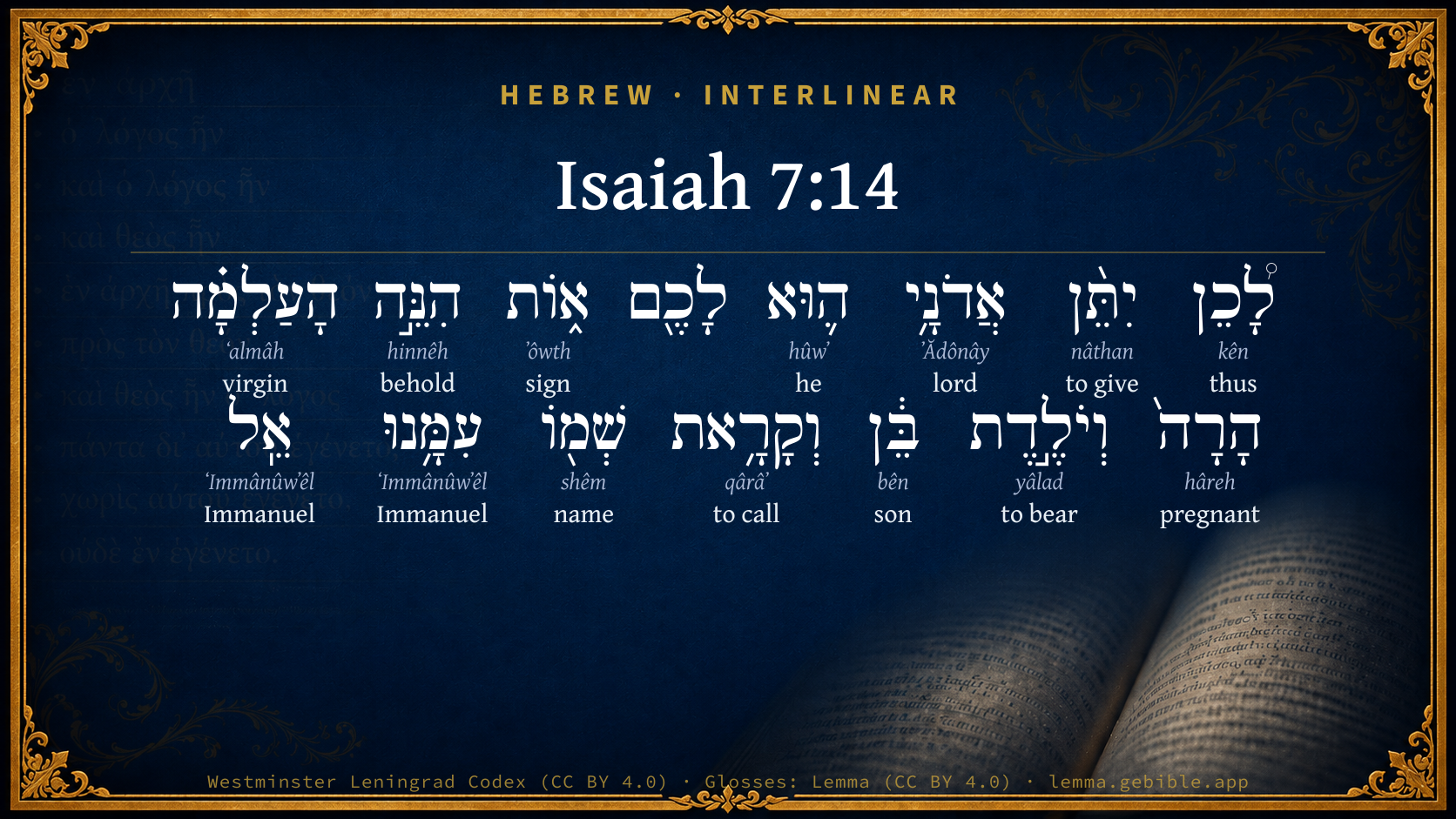
Hebrew (Westminster Leningrad Codex) Isaiah 7:14 appears in the Hebrew Old Testament. The text above is from the Westminster Leningrad Codex. Each word links to its Strong’s number, a concise gloss, and parsing drawn from the Open Scriptures Hebrew Bible morphology. Click any word for its full Brown-Driver-Briggs (BDB) entry.
Download image
Cite this verse

Isaiah 7:14 (World English Bible). Public Domain. Lemma interlinear Bible study tool, https://lemma.gebible.app/v/isaiah/7/14.

Show BibTeX & RIS
BibTeX
RIS
English Translation
Therefore the Lord himself will give you a sign. Behold, the virgin will conceive, and bear a son, and shall call his name Immanuel.
World English Bible · Public Domain
Highlights
  • 1 first appearance in the Hebrew Bible
Full analysis ↓
Download a study sheet

One document with this verse’s original text, its word-by-word gloss line, the meaning frame, cross-references with their text, attributed commentary, and full source and license credits — printable, and it pastes into notes with its structure intact.

This verse Autodidact and up

Study sheet (.html) Plain text (.txt)

A passage Seminary Student

Up to 50 verses in one chapter. A passage sheet keeps up to 6 commentary sources and 12 cross-references per verse, in the order this page ranks them, and says so on the sheet whenever that leaves anything out. Ask for a single verse and you get the Autodidact verse sheet above.

Everything on this page stays free to read, with no account — the sheet is a download of what is already on screen, not access to it.

Want to remove ads? Support Godless Engineer
Compare translations 3

The same verse in 3 English versions, stacked beneath the original-language interlinear above. Click any original word for its lexicon entry.

Each is an independent rendering of the whole verse — the interlinear is not word-aligned to these translations.

Highlighted words mark where these versions differ — a whole-verse word diff, not a word-by-word alignment.

  • World English Bible Public Domain
    Therefore the Lord himself will give you a sign. Behold, the virgin will conceive, and bear a son, and shall call his name Immanuel.
  • King James Version Public Domain
    Therefore the Lord himself shall give you a sign; Behold, a virgin shall conceive, and bear a son, and shall call his name Immanuel.
  • unfoldingWord Literal Text CC BY-SA 4.0
    Therefore, the Lord himself will give a sign to you. Behold, the young woman has conceived and is bearing a son, and she will call his name Immanuel.

unfoldingWord Literal Text — © unfoldingWord, licensed CC BY-SA 4.0. Word-aligned USFM3 via Door43 (git.door43.org/unfoldingWord/en_ult).

Versions to compare (up to 4)

3 of 4 selected

Show all 18 translations

Every available English version of this verse, each an independent rendering of the whole verse.

  • World English Bible Public Domain
    Therefore the Lord himself will give you a sign. Behold, the virgin will conceive, and bear a son, and shall call his name Immanuel.
  • Berean Standard Bible Public Domain
    Therefore the Lord Himself will give you a sign: Behold, the virgin will be with child and will give birth to a son, and will call Him Immanuel.
  • Majority Standard Bible Public Domain
    Therefore the Lord Himself will give you a sign: Behold, the virgin will be with child and give birth to a son, and will call Him Immanuel.
  • King James Version Public Domain
    Therefore the Lord himself shall give you a sign; Behold, a virgin shall conceive, and bear a son, and shall call his name Immanuel.
  • American Standard Version (1901) Public Domain
    Therefore the Lord himself will give you a sign: behold, a virgin shall conceive, and bear a son, and shall call his name Immanuel.
  • Revised Version (1885) Public Domain
    Therefore the Lord himself shall give you a sign; behold, a virgin shall conceive, and bear a son, and shall call his name Immanuel.
  • Geneva Bible (1599) Public Domain
    Therefore the Lord himselfe will giue you a signe. Beholde, the virgine shall conceiue and beare a sonne, and she shall call his name Immanu-el.
  • Douay-Rheims (1899) Public Domain
    Therefore the Lord himself shall give you a sign. Behold a virgin shall conceive, and bear a son, and his name shall be called Emmanuel.
  • Young's Literal Translation Public Domain
    Therefore the Lord Himself giveth to you a sign, Lo, the Virgin is conceiving, And is bringing forth a son, And hath called his name Immanuel,
  • Literal Standard Version CC BY-SA 4.0
    Therefore the Lord Himself gives a sign to you, || Behold, the virgin is conceiving, || And is bringing forth a Son, || And has called His Name Immanuel,
  • Unlocked Literal Bible CC BY-SA 4.0
    Therefore the Lord himself will give you people a sign: See, the young woman will conceive, bear a son, and will call his name Immanuel.
  • unfoldingWord Literal Text CC BY-SA 4.0
    Therefore, the Lord himself will give a sign to you. Behold, the young woman has conceived and is bearing a son, and she will call his name Immanuel.
  • Darby Bible Public Domain
    Therefore will the Lord himself give you a sign: Behold, the virgin shall conceive and shall bring forth a son, and call his name Immanuel.
  • World Messianic Bible Public Domain
    Therefore the Lord himself will give you a sign. Behold, the virgin will conceive, and bear a son, and shall call his name Immanuel.
  • Webster's Bible Public Domain
    Therefore the Lord himself will give you a sign; Behold, a virgin shall conceive, and bear a son, and shall call his name Immanuel.
  • Free Bible Version CC BY-SA 4.0
    This is why the Lord himself is going to give you a sign. Look! The virgin will become pregnant and give birth to a son, and she will call him Immanuel.
  • Bible in Basic English Public Domain
    For this cause the Lord himself will give you a sign; a young woman is now with child, and she will give birth to a son, and she will give him the name Immanuel.
  • JPS Tanakh (1917) Public Domain
    Therefore the Lord Himself shall give you a sign: behold, the young woman shall conceive, and bear a son, and shall call his name Immanuel.

Literal Standard Version (2020), Covenant Press — licensed CC BY-SA 4.0. Text via the HelloAO Bible API (eBible.org). Unlocked Literal Bible (unfoldingWord) — licensed CC BY-SA 4.0. Text via the HelloAO Bible API (eBible.org). unfoldingWord Literal Text — © unfoldingWord, licensed CC BY-SA 4.0. Word-aligned USFM3 via Door43 (git.door43.org/unfoldingWord/en_ult). Free Bible Version, Dr. Jonathan Gallagher — licensed CC BY-SA 4.0. Text via the HelloAO Bible API (eBible.org).

Word by word

More ways to search: Search by grammar → Find every occurrence → Compare this word →

Practice this passage: Drill this verse → Learn its vocabulary →

עִמָּ֥נוּ
ʻImmânûwʼêl
H6005
“Immanuel”
Noun, Proper
Part of Speech
Noun
Type
Proper
Full BDB Definition

Origin: from H5973 and H410 with a pronominal suffix inserted

TWOT: 1640d

Immanuel = "God with us" or " with us is God" - symbolic and prophetic name of the Messiah, the Christ, prophesying that He would be born of a virgin and would be 'God with us'
  1. לָ֠כֵן kên H3651 “to/for · thus” Preposition + Adverb
  2. יִתֵּ֨ן nâthan H5414 “to give” Verb, Qal, Imperfect, 3rd Person, Masculine, Singular
  3. אֲדֹנָ֥י ʼĂdônây H136 “Lord · my” Noun, Common, Masculine, Plural, Construct + Suffix, Personal, 1st Person, Common, Singular
  4. ה֛וּא hûwʼ H1931 “he” Pronoun, Personal, 3rd Person, Masculine, Singular
  5. א֑וֹת ʼôwth H226 “sign” Noun, Common, Both, Singular, Absolute
  6. הִנֵּ֣ה hinnêh H2009 “behold” Particle, Demonstrative
  7. הָעַלְמָ֗ה ʻalmâh H5959 “the · virgin” Particle, Definite Article + Noun, Common, Feminine, Singular, Absolute
  8. הָרָה֙ hâreh H2030 “pregnant” Adjective, Adjective, Feminine, Singular, Absolute
  9. וְיֹלֶ֣דֶת yâlad H3205 “and · bearing” Conjunction + Verb, Qal, Participle Active, Feminine, Singular, Absolute
  10. בֵּ֔ן bên H1121 “son” Noun, Common, Masculine, Singular, Absolute
  11. וְקָרָ֥את qârâʼ H7121 “and · to call” Conjunction + Verb, Qal, Sequential Perfect, 3rd Person, Feminine, Singular
  12. שְׁמ֖וֹ shêm H8034 “name · his” Noun, Common, Masculine, Singular, Construct + Suffix, Personal, 3rd Person, Masculine, Singular
  13. אֵֽל ʻImmânûwʼêl H6005 “Immanuel” Noun, Proper

About this verse

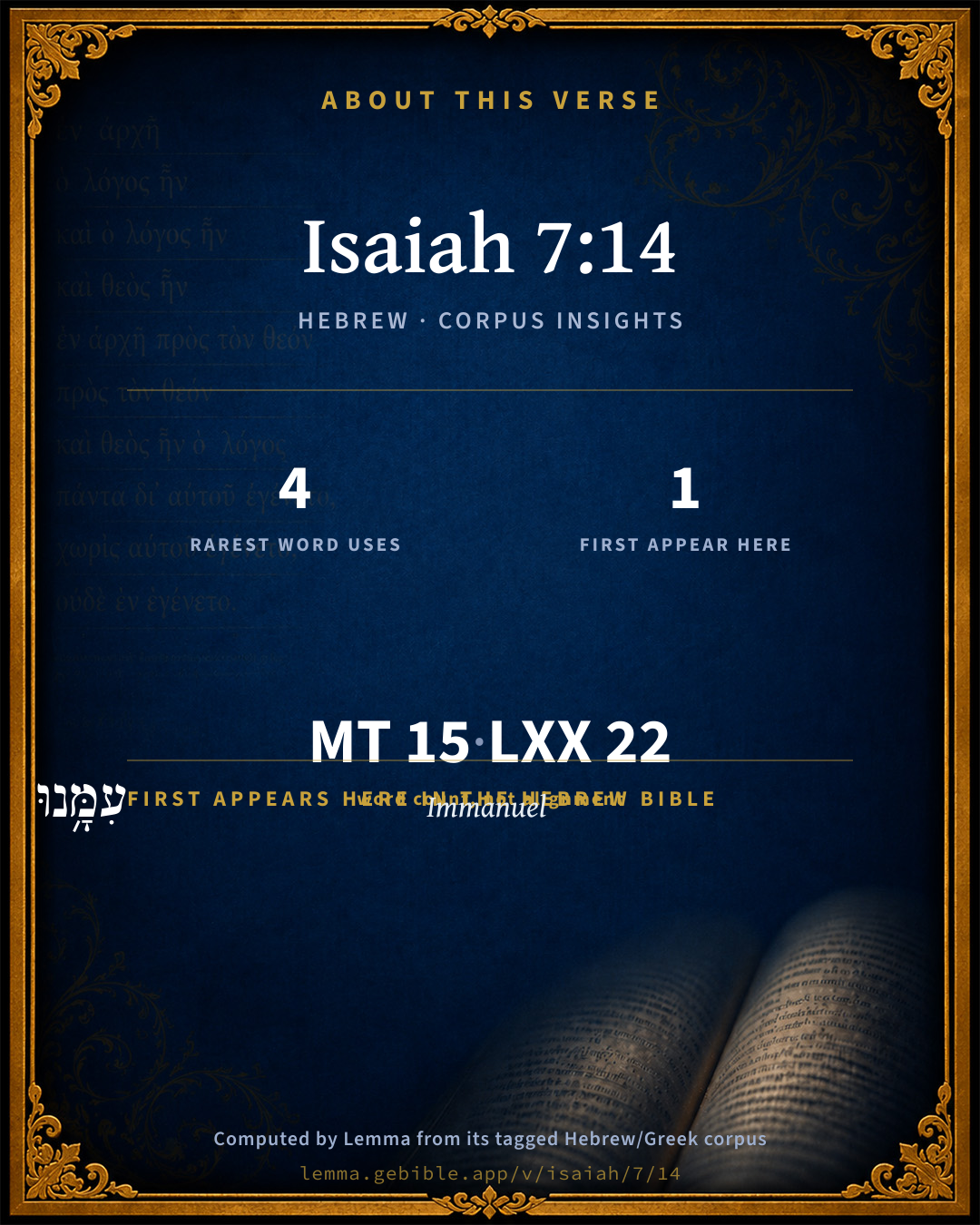
These counts appear in no published source. They are computed here, from the morphology-tagged text and Lemma’s own curated glosses. What Lemma adds →

15
words
13
distinct lemmas
Prophets
section

Notable vocabulary

The rarest word here is עִמָּ֥נוּ Immanuel H6005 — appearing just 4 times in the whole Hebrew Bible.

First appearance in Scripture

This word makes its first canonical appearance in the Hebrew Bible here:

  • עִמָּ֥נוּ Immanuel H6005

Shared distinctive vocabulary

עִמָּ֥נוּ Immanuel H6005 occurs in 2 verses of the Hebrew Bible. Also found in:

Grammatical profile

  • 3 verbs
  • 7 nouns
  • 1 adjective
  • 1 pronoun
  • 1 preposition
  • 1 adverb
  • 1 particle

Verb forms

  • יִתֵּ֨ן Qal · Imperfect
  • וְיֹלֶ֣דֶת Qal · Participle Active
  • וְקָרָ֥את Qal · Sequential Perfect

Repetition

A word recurs within this verse — often emphatic in Hebrew:

  • עִמָּ֥נוּ Immanuel H6005 ×2

Hebrew & Septuagint length

In English translation the verse runs 24 words from the Hebrew and 30 from the Septuagint (LXX English) — closely comparable.

A rough comparison of the two English renderings, which tokenize alike — not a word-level alignment.

Word counts can differ between the Hebrew and the Greek without any difference in meaning — e.g. the Hebrew direct-object marker אֵת has no separate Greek word, and Greek often adds the article ὁ.

In the original languages it is 15 Hebrew tokens and 22 Greek tokens — but the two are counted differently (Hebrew bundles its prefixes and suffixes into one token; the Greek is in lemma form), so that isn’t a like-for-like length.

Cross-references

18

Topical passages linked to Isaiah 7:14 in the Treasury of Scripture Knowledge — connected by theme and wording, ordered by reader-vote popularity; previews shown in the World English Bible.

  • Matthew 1:23 "Behold, the virgin shall be with child, And shall bring forth a son. They shall call his name Immanuel;" Which is, being interpreted, "God with us."
  • Isaiah 9:6 For to us a child is born, to us a son is given; and the government shall be on his shoulder: and his name shall be called Wonderful, Counselor, Mighty God, Everlasting Father, Prince of Peace.
  • Luke 1:31 Behold, you will conceive in your womb, and bring forth a son, and will call his name 'Jesus.'
  • John 1:1–2 In the beginning was the Word, and the Word was with God, and the Word was God.
  • John 1:14 The Word became flesh, and lived among us. We saw his glory, such glory as of the one and only Son of the Father, full of grace and truth.
  • Luke 1:35 The angel answered her, "The Holy Spirit will come on you, and the power of the Most High will overshadow you. Therefore also the holy one who is born from you will be called the Son of God.
  • 1 Timothy 3:16 Without controversy, the mystery of godliness is great: God was revealed in the flesh, Justified in the spirit, Seen by angels, Preached among the nations, Believed on in the world, And received up in glory.
  • Isaiah 8:8 and it shall sweep onward into Judah; it shall overflow and pass through; it shall reach even to the neck; and the stretching out of its wings shall fill the breadth of your land, Immanuel.
  • Genesis 3:15 I will put enmity between you and the woman, and between your offspring and her offspring. He will bruise your head, and you will bruise his heel."
  • Isaiah 8:10 Take counsel together, and it shall be brought to nothing; speak the word, and it shall not stand: for God is with us.
  • Romans 9:5 of whom are the fathers, and from whom is Christ as concerning the flesh, who is over all, God, blessed forever. Amen.
  • Jeremiah 31:22 How long will you go here and there, you backsliding daughter? for Yahweh has created a new thing in the earth: a woman shall encompass a man.
  • Genesis 4:1–2 The man knew Eve his wife. She conceived, and gave birth to Cain, and said, "I have gotten a man with Yahweh's help."
  • Genesis 29:32 Leah conceived, and bore a son, and she named him Reuben. For she said, "Because Yahweh has looked at my affliction. For now my husband will love me."
  • Genesis 30:6 Rachel said, "God has judged me, and has also heard my voice, and has given me a son." Therefore called she his name Dan.
  • Genesis 30:8 Rachel said, "With mighty wrestlings have I wrestled with my sister, and have prevailed." She named him Naphtali.
  • 1 Samuel 1:20 It happened, when the time was come about, that Hannah conceived, and bore a son; and she named him Samuel, [saying], Because I have asked him of Yahweh.
  • 1 Samuel 4:21 She named the child Ichabod, saying, The glory is departed from Israel; because the ark of God was taken, and because of her father-in-law and her husband.

Cross-references courtesy of OpenBible.info (CC BY 4.0).

Hebrew and Greek witnesses Masoretic Hebrew ↔ Greek Septuagint

The same verse in the two great witnesses to the Old Testament, shown verse-for-verse.

These are two independent witnesses, not word-aligned to each other, and the Septuagint is shown in lemma (dictionary) form.

Hebrew Isaiah 7:14 Masoretic · Westminster Leningrad Codex

לָ֠כֵן יִתֵּ֨ן אֲדֹנָ֥י ה֛וּא לָכֶ֖ם א֑וֹת הִנֵּ֣ה הָעַלְמָ֗ה הָרָה֙ וְיֹלֶ֣דֶת בֵּ֔ן וְקָרָ֥את שְׁמ֖וֹ עִמָּ֥נוּ אֵֽל

Therefore the Lord himself will give you a sign. Behold, the virgin will conceive, and bear a son, and shall call his name Immanuel.

World English Bible · Public Domain

Greek LXX Isaiah 7:14 Septuagint · lemma form

διά οὗτος δίδωμι κύριος αὐτός σύ σημεῖον ἰδού ὁ παρθένος ἐν γαστήρ ἕξις καί τίκτω υἱός καί καλέω ὁ ὄνομα αὐτός εμμανουηλ

Therefore the Lord himself shall give you a sign; behold, a virgin shall conceive in the womb, and shall bring forth a son, and you shall call his name Emmanuel.

LXX2012 (modern English Septuagint) · Public Domain

On this verse, The Cambridge Bible for Schools and Colleges discusses the Septuagint’s reading. Read the note in Commentary ↓

Hebrew: Westminster Leningrad Codex (CC BY 4.0). Greek: Septuagint (public domain); English from LXX2012 (modern English Septuagint) (Public Domain). How the Septuagint differs from the Hebrew →

Targum (Aramaic paraphrase)

1

The Targum is the ancient Jewish Aramaic paraphrase of the Hebrew Scriptures — an interpretive translation, not the Hebrew text itself. Onkelos (literal) and Pseudo-Jonathan (expansive) render the Torah, and Jonathan the Prophets. Coverage is partial: where no permissively-licensed English translation exists for a verse, only the Aramaic is shown. This is verse-level text, not a word-by-word alignment to the Hebrew.

  1. Targum Jonathan Prophets (Joshua–Malachi)
    בְּכֵן יִתֵּן יְיָ הוּא לְכוֹן אָתָא הָא עוּלֶמְתָּא מְעַדְיָא וּתְלִיד בַּר וְתִקְרֵי שְׁמֵיהּ עִמָנוּאֵל:

    Therefore the Lord Himself shall give you a sign; Behold, a young woman shall conceive, and bear a son, and she shall call His name Immanuel.

    Targum Jonathan — Aramaic: “Mikraot Gedolot” (public domain). English: “Sefaria Community Translation” (CC0 1.0 (public-domain dedication)); “London "Chaldee Paraphrase," 1871” (public domain). Text via Sefaria.

Commentary

Notes on Isaiah 7:14 from classic Christian and Jewish commentators (each source and its license shown beneath its notes). The classic Christian expositions comment on the surrounding passage and are grouped to its opening verse, so a note may address several verses; the Jewish commentaries on the Tanakh (Rashi and others) are per-verse, so they appear only where the commentator wrote on this verse.

Lemma curates 59 commentaries, every one of them public domain or Creative Commons licensed, each selected and text-cleaned for this edition rather than reprinted as found. About our sources →

The Cambridge Bible for Schools and Colleges

gen. ed. J. J. S. Perowne

14–16. The sign of Immanuel. See Additional Note at the end of this chapter. 14. Therefore] because of this act of unbelief. the Lord himself] The word is Adonai, as ch. Isa_6:1.

Behold, a virgin] (LXX. ἡ παρθένος, other Greek versions νεᾶνις.) The Hebrew word (‘almâh) means strictly “a young woman of marriageable age.” Both etymology and usage (cf. esp. Pro_30:19; Son_6:8) are adverse to the opinion, once prevalent among Christian interpreters and maintained by a few in recent times, that virginity is necessarily connoted (see Robertson Smith, Prophets, Revd. Ed. pp. 426 f.). To express that idea a different word (bìthûlâh) must have been employed, although even it might not be wholly free from ambiguity (? Joe_1:8). It is, of course, not disputed that ‘almâh may be used of a virgin (as Gen_24:43; Exo_2:8); but even if this usage were more uniform than it is, it would still be far from proving that virginity was an essential of the notion. It would appear, therefore, that the idea of a miraculous conception was not present to Isaiah’s mind at this time, since a prediction of such astounding import must surely have been clothed in unambiguous language. Nor does the def. art., which is used in the original, necessarily denote a particular individual. (Cf. 2Sa_17:17, and see Davidson, Synt. § 21 e.) So far as grammar and context go, the expression may mean any young woman, fit to become a mother, whether as yet married or unmarried.

shall conceive, and bear a son] The same phrase in Gen_16:11; Jdg_13:5. In the passage before us the verbs in the original are both participles, and might refer either to the present or the future. But it is doubtful if we can fairly apply one to the present and the other to the future, translating “is with child and shall bear.” Since the birth is certainly future, it seems natural to take the first verb in a future sense also.

and shall call] An archaic form, easily mistaken for 2nd pers. (so LXX. &c.). The mother names the child, as in Gen_4:1; Gen_4:25; Gen_19:37 f.; Gen_29:32, &c. An instructive parallel is the naming of the child Ichabod, born to Eli’s daughter-in-law on the dark day when the ark of God was taken and the glory departed from Israel (1Sa_4:19-22).

Immanuel] “With us is God.” The battle-cry of Gustavus Adolphus in the Thirty Years War, “Gott mit uns,” was also Isaiah’s watchword for the coming crisis (cf. ch. Isa_8:8; Isa_8:10); and like other great thoughts of his ministry he as it were gives it personal and concrete actuality by conceiving it as embodied in the name of a child.

Additional Note on Chap. Isa_7:14-16

Probably no single passage of the Old Testament has been so variously interpreted or has given rise to so much controversy as the prophecy contained in these verses. The difficulties arise mainly from the fact that while the terms of the prediction are so indefinite as to admit a wide range of possibilities, we have no record of its actual fulfilment in any contemporary event. The purpose of this note will be to indicate the chief lines along which a solution has been sought for, and to consider how far they satisfy the conditions of a reasonable historical exegesis. But before entering on this survey, it will be well to enquire what sort of fulfilment the context would lead us to expect, or in other words what kind of sign would serve the immediate objects of the prophet’s mission to Ahaz.

We are not entitled to assume as a matter of course that the sign here given will be in all respects such a sign as Ahaz might have asked at an earlier stage of the interview (Isa_7:11). In the first place it need not involve an objective miracle, although a miracle of the most stupendous order was originally put within the option of Ahaz. Any of the senses in which the word “sign” is used (see on Isa_7:11) in connexion with a prediction, would satisfy the requirements of Isa_7:14. But further there is a presumption that the import of the sign will have been changed by what has taken place in the interval. Isaiah’s first message to Ahaz is an unqualified assurance of deliverance from the designs of Rezin and Pekah, and the sign first offered would be a sign of that and that alone. The prospect of an Assyrian invasion was no doubt in the background of the prophet’s horizon, but his message to Ahaz is complete in itself and takes no account of that final catastrophe. It is manifest, however, that in Isaiah’s mind the whole aspect of affairs is altered by the king’s refusal. The Assyrian invasion is brought into immediate connexion with the attack of the allies, and a new forecast of the future is presented by the prophet in which three great events follow closely on one another: (1) the collapse of the project of the allied princes, (2) the total destruction of Syria and Ephraim by the Assyrians, and (3) the devastation of Judah by the same ruthless conquerors. And the most natural supposition is that the new sign will be an epitome of this new and darker outlook, that is to say it will be a pledge at once of the immediate deliverance and of the judgment that lies behind it. Indeed this view is so obviously implied by Isa_7:14-16 that we are shut up to it unless, with some critics, we remove Isa_7:15 as an interpolation.

Now there are three features of the prediction in which the import of the sign may be looked for: (i) the birth of the child, (ii) his name, and (iii) his history. And of these three the last is certainly an essential element of the prophecy, as is shewn by Isa_7:15-16. With regard to the other two we can only say that it is antecedently improbable that either of them should be without some special significance.

(i) If the import of the sign be sought mainly in the birth of the child it becomes almost necessary to assume that the terms of the prophecy point to something extraordinary and mysterious in the circumstances of the birth. This is the case with the traditional Christian interpretation, which finds in it a direct prediction of the miraculous conception of the Virgin Mother of our Lord. The chief support of this view has always been the authority of the Evangelist Matthew, who cites Isa_7:14 in relating the birth of Jesus (Isa_1:22-23). But it must be observed that such a citation is not decisive as to the original sense of the passage, any more than Mat_2:15 determines the original sense of Hos_11:1. The great difficulty of the interpretation is that such an event could by no means serve the purpose of a sign to Ahaz. It may be freely admitted, in view of Isa_7:11, that the expectation of a parthenogenesis is not too bold to be attributed to Isaiah in this moment of ecstatic inspiration. But if this be granted on the one hand it must be conceded on the other that he expected the miracle to be wrought in the immediate future; his language (“a virgin is about to conceive”) implies that the prediction is on the eve of fulfilment, and the assurance in Isa_7:16 is nugatory if the promised sign was not to happen for more than 700 years. Moreover, such an idea would require to be unambiguously expressed, and we have seen that the word ‘almâh does not connote virginity in the strict sense. Whatever element of truth, therefore, may underlie this exegesis, it can scarcely be held to afford an adequate solution of the problem presented by the oracle in its primary and historical application.

(ii) Another class of explanations regards the event as a sign to Ahaz and nothing more, and of these we may examine first those which find the chief significance of the sign in the naming of the child. Perhaps the most persuasive presentation of this view is that given by Duhm. According to that expositor, the ‘almâh is any young mother who may give birth to a child in the hour of Judah’s deliverance from Syria and Ephraim. “God (is) with us” will be the spontaneous exclamation of child-bearing women in that time; and to such utterances at the moment of birth a certain oracular significance was attached, which caused them to be perpetuated in the name of the child. The child (or children) bearing the name Immanuel will grow up as a sign to Ahaz, first of the genuineness of Isaiah’s inspiration, who foretold the event, and second of the yet future judgment threatened on the same occasion and his own rejection by Jehovah. To this theory no exception can be taken on grammatical or historical grounds. It is undoubtedly rendered easier by the excision of Isa_7:15, which Duhm advocates. If that verse be retained one feels that the sign is rather overloaded by a circumstance which is directly opposed to the meaning of the name. And apart from this there will perhaps remain an impression that justice has not been done to the emphasis with which the birth is announced. Why, on this view, should the mother be an ‘almâh—a young woman?

(iii) A third view (not to be sharply distinguished from ii) lays stress not so much on the birth or the naming as on the history of the child, which becomes a sort of chronological thread on which political events are strung. The meaning is: before the birth of a certain child Judah will have experienced a great deliverance (Isa_7:14), before he has emerged from infancy, Syria and Ephraim will have disappeared (Isa_7:16) and at a later stage of his development the land of Judah will be reduced to a pastoral wilderness (Isa_7:15). An interesting parallel is found in the child Pollio in Vergil’s fourth Eclogue, and another from the life of Mohammed has been lately pointed out by Mr Bevan[33]. And as in these two cases a particular child is the subject of the sign, so here expositors have hazarded several guesses as to the identity of the ‘almâh. She has been supposed to be (a) the wife of Isaiah, either the mother of Shearjashub, or a second wife (some identifying Immanuel with Maher-shalal-hash-baz, ch. Isa_8:3), (b) a damsel in the harem of Ahaz (the mother of Hezekiah is excluded by the chronology), or (c) a young woman among the bystanders, indicated by a gesture. None of these conjectures can be pronounced altogether happy. They are all alike discredited by a certain touch of vulgarity implied in the designation of some known individual as “the damsel.”

[33] Jewish Quarterly Review, Oct. 1893, pp. 220 ff. The incident is that of a Jew who was discoursing to an Arab tribe at Medina about the resurrection and the last judgment. “ ‘But,’ said they, ‘what is the sign (âyat, Hebr. אוֹת) of this?’ ‘A prophet,’ he answered, ‘sent from that country yonder,’ pointing with his hand towards Mecca and Yemen. ‘But when,’ they asked, ‘do you think he will come?’ Then he looked at me and said, ‘If this boy reaches the full term of life, he will see him.’ And in fact before another day had passed God sent His Apostle to dwell among us, and we believed on him, &c.”

An ingenious modification of the last two theories recently propounded by an American writer[34], differs from all others in excluding the prospect of deliverance from the import of the sign, whose significance is found in the contrast between the name of the child and his history. The name Immanuel embodies the religious optimism of the king and nation, their false trust in the protection of Jehovah; the hardships through which the child passes symbolise the providential course of events under which this delusive confidence must collapse. This interpretation, however, requires the excision of at least the latter part of Isa_7:16, and also the rejection of ch. Isa_8:9-10 as spurious.

[34] F. C. Porter, in the Journal of Biblical Literature, Vol. xiv. 1895, pp. 19–36.

(iv) Another line of exegesis which has commended itself to a large number of modern expositors starts from the idea that here for the first time the figure of the personal Messiah is flashed on Isaiah’s mind. On this view the prophecy is invested with profound religious significance, which is not the case with the two last-mentioned theories. Face to face with the craven-hearted monarch who had betrayed his trust as guardian of the liberty and independence of Judah, the prophet receives this revelation of the true King, as one born to his people in the hour of danger, sharing their poverty and affliction in his youth and waiting the time when “the government shall be upon his shoulder” and the perfect kingdom of God shall be established (Isa_9:6). The attention is concentrated on the mysterious personality of the child, that of the mother falls into the background. She may be some unknown daughter of the royal house, or a nameless maiden of lowly rank; the essential fact is that in the speedy advent of Immanuel, in his name, in his experience, men will recognise the God-given “sign” of the truth of the prophet’s words. This on the whole seems to be the theory which affords the most adequate solution of the complex difficulties of the passage. It satisfies tie claims of a truly historical interpretation, and at the same time it accounts, as none of the other modern theories do, for the impassioned fervour, the indefinable atmosphere of mystery and emotion with which the words are surrounded. It is no objection to it that the anticipation remained an unrealised ideal long after the opportunity for a sign to Ahaz had passed away; for a similar remark applies to the whole conception of a personal Messiah, whose appearance Isaiah certainly expected to synchronise with the Assyrian invasion. Not the least of its recommendations, indeed, is the fact that it brings this prophecy into line with the other great Messianic prophecies of ch. Isa_9:1-7 and Isa_11:1 ff.; and if the last words of ch. Isa_8:8 are rightly rendered “thy land, O Immanuel” (which however has been disputed, see on the verse below) a link would be supplied which would make the proof almost irresistible, since no ordinary child, born or unborn, could be naturally apostrophised as the owner of the land.

(v) An allegorical interpretation of the prophecy has been advanced by a few scholars, the “virgin” being taken as a personification of the Davidic house, or of the religious community, and the child either as the Messiah, or as a figure of the new generation; or else the birth is explained as merely a general symbol of deliverance. But all this is purely fanciful.

A few words may be added in conclusion on the pre-Christian acceptation of the passage. From a very early time it seems to have been recognised that a certain mystery clung to the words, that their significance was not exhausted by the circumstances in which they were originally spoken, but that they had an eschatological reference, pointing forward to the birth of the Messiah, as the wonderful event on which all the hope of the future hung. The first trace of this tendency is found in Mic_5:3 : “therefore will he (Jehovah) give them up until the time when a (certain) travailing woman hath brought forth, &c.” These words can hardly be explained otherwise than as a reference to Isa_7:14; and if it were certain that they were written by a contemporary of Isaiah they would go far to determine the sense in which the earlier prophecy should be understood. Since, however, they belong to a part of the book of Micah whose age is disputed, they may possibly represent a secondary application of Isaiah’s prophecy rather than its primary intention. A further advance in the same direction appears to be indicated by the rendering of our passage in the LXX. It is almost incredible that the use of the word παρθένος for ‘almâh in so important a connexion should be due to mere laxity on the part of the translator. More probably it expresses a belief current in Jewish circles that the Messiah was to be born of a virgin. A good deal of evidence has been adduced to shew that such an expectation actually prevailed amongst both Alexandrian and Palestinian Jews [35], and if it existed it could hardly fail to influence the exegesis of this prophecy. It was only when the prophecy was appealed to by the Christians in proof of the Messiahship of Jesus that the Jewish exegetes seem finally to have repudiated the Messianic interpretation. They refused to admit that the word ‘almâh could properly be translated “virgin” and fell back on one or other of the theories mentioned under (iii). The Christian Fathers on the other hand resolutely upheld the correctness of the LXX., although the post-Christian Greek versions of Aquila, Theodotion and Symmachus agree in rendering the word by νεᾶνις. The patristic view maintained an all but unquestioned ascendancy within the Church till the dawn of historical criticism in the eighteenth century, when it began to be recognised that on the philological question the Jews were right.

[35] See Mr F. P. Badham’s letter in the Academy of 8 June, 1895.

The Cambridge Bible for Schools and Colleges (gen. ed. J. J. S. Perowne; Cambridge University Press, 1878–1918) — public domain. Text from a community e-Sword module.

Trapp's Complete Commentary

John Trapp

Isa 7:14 Therefore the Lord himself shall give you a sign; Behold, a virgin shall conceive, and bear a son, and shall call his name Immanuel.

Ver. 14. Therefore the Lord himself shall give you a sign.] Give it you, ingratiis vestris, without your leave, of his own proffer. "If we believe not, yet God remaineth faithful." {2Ti 2:13 Rom 3:3} The house of David was as it were great with child with Christ and with God’s promises in him; therefore, to be sure, it could not be rooted out, as these two kings designed, before Christ were come into the world. Hence his wonderful conception and birth is made here a sign of his people’s safety here and salvation hereafter. And had Ahaz and his people believed this latter, they would not have much doubted of the former, but rather argued with St Paul, "Having given us his Son, how shall he not with him also freely give us all things?" {Rom 8:32}

A sign.] A singular sign - a sign both from above and from beneath; for he joined lumen suae aeternitatis limo tuae mortalitatis, {a} the light of his eternity to the mud of thy mortality, as a father hath it. {Joh 1:14 Php 2:6-7}

Behold.] A note of attention and admiration. One compareth it to the sounding of a trumpet before some notable proclamation; another to a hand in the margin pointing to some remarkable matter. So doth this Ecce to Christ’s incarnation as a thing in God’s decree and to his people’s faith already present.

A virgin.] Hagnalmah, that famous virgin, {b} so long since spoken of; {Gen 3:15} that female glory, the Virgin Mary, with whom the angel spake concerning man’s salvation, {Mat 1:18; Mat 1:23 Luk 1:27; Luk 1:35} as the devil before had done with the first woman, concerning the means of his destruction. Of this virgin mother the sybils are said thus to have prophesied also: -

“ Virginis in corpus voluit dimittere caelo

Ipse Deus prolem, cure nuntiat Angelus almae

Matri, quae miseros contracta sorde levabit. ”

See more in Virgil’s 4th Eclog., and Aug. de Civ. Dei, lib. x. cap. 27. Some tell us that when this blessed virgin brought forth there was seen at Rome about the sun the likeness of a woman carrying a child in her arms, and a voice heard saying, Pan, the great God, is born into the world.

Shall conceive and bear a son.] Shiloh, the son of her secundine {Gen 49:10} the true Melchizedek, as man without father, and as God without mother. {Heb 7:3 Luk 1:35} But how blank were the Jews when they saw the issue of their late Jewish virgin turned to a daughter! and how silly is that saying of theirs in their Tulmud; {c} For our sins, which are many, the coming of the Messiah is deferred. Jachiades, upon those words in Dan 12:4, would have us believe that God sealed up the time of Christ’s coming, revealing it to Daniel only. But why take they not notice that the very time of Messiah the prince’s coming is set down by Daniel? {Dan 9:24-27} and since that time is long since past, let them either condemn the prophet of vanity, or else confess with us that Christ is come already.

And shall call.] Or, Thou (virgin) shalt call, as having the right of nomination.

His name Immanuel.] That is, God with us. {as Mat 1:23} {See Trapp on "Mat 1:23"} Cuius nomen illius numen facile declarabit. Christ, indeed, was not called by this name Immanuel that we anywhere read of, as neither was Solomon by the name of Jedediah, {2Sa 12:25-26} unless it be Isa 8:8; but the import of this name is most truly affirmed and acknowledged to be fully made good in him.

{a} Bernard.

{b} Haec simul est genitrix, filia, sponsa Dei. Tot tibi sunt dotes Virgo, quot sidera caelo.

{c} Sanhed., cap. xi.

John Trapp, A Commentary or Exposition upon All the Books of the Old and New Testament (1647–1656) — public domain. Text from a community e-Sword module.

Albert Barnes' Notes on the Bible

Therefore - Since you will not “ask” a pledge that the land shall be safe, Yahweh will furnish one unasked. A sign or proof is desirable in the case, and Yahweh will not withhold it because a proud and contemptuous monarch refuses to seek it. Perhaps there is no prophecy in the Old Testament on which more has been written, and which has produced more perplexity among commentators than this. And after all, it still remains, in many respects, very obscure. Its general original meaning is not difficult. It is, that in a short time - within the time when a young woman, then a virgin, should conceive and bring forth a child, and that child should grow old enough to distinguish between good and evils - the calamity which Ahaz feared would be entirely removed. The confederacy would be broken up, and the land forsaken by both those kings. The conception and birth of a child - which could be known only by him who knows “all” future events - would be the evidence of such a result. His appropriate “name” would be such as would be a “sign,” or an indication that God was the protector of the nation, or was still with them. In the examination of this difficult prophecy, my first object will be to give an explanation of the meaning of the “words and phrases” as they occur in the passage, and then to show, as far as I may be able, what was the design of the passage.

The Lord himself - Hebrew, ‘Adonai;’ see this word explained in the the note at Isa 1:24. He will do it without being asked to do it; he will do it though it is rejected and despised; he will do it because it is important for the welfare of the nation, and for the confirmation of his religion, to furnish a demonstration to the people that he is the only true God. It is clearly implied here, that the sign should be such as Yahweh alone could give. It would be such as would be a demonstration that he presided over the interests of the people. If this refers to the birth of a child, then it means that this was an event which could be known only to God, and which could be accomplished only by his agency. If it refers to the miraculous conception and birth of the Messiah, then it means that that was an event which none but God could accomplish. The true meaning I shall endeavor to state in the notes, at the close of Isa 7:16.

Shall give you - Primarily to the house of David; the king and royal family of Judah. It was especially designed to assure the government that the kingdom would be safe. Doubtless, however, the word ‘you’ is designed to include the nation, or the people of the kingdom of Judah. It would be so public a sign, and so clear a demonstration, as to convince them that their city and land must be ultimately safe.

A sign - A pledge; a token; an evidence of the fulfillment of what is predicted. The word does not, of necessity, denote a miracle, though it is often so applied; see the notes at Isa 7:11. Here it means a proof, a demonstration, a certain indication that what he had said should be fulfilled. As that was to be such a demonstration as to show that he was “able” to deliver the land, the word “here” denotes that which was miraculous, or which could be effected “only” by Yahweh.

Behold - הנה hinnêh. This interjection is a very common one in the Old Testament. It is used to arrest attention; to indicate the importance of what was about to be said. It serves to designate persons and things; places and actions. It is used in lively descriptions, and animated discourse; when anything unusual was said, or occurred; or any thing which especially demanded attention; Gen 12:19; Gen 16:16; Gen 18:9; Gen 1:29; Gen 40:9; Psa 134:1. It means here, that an event was to occur which demanded the attention of the unbelieving monarch, and the regard of the people - an event which would be a full demonstration of what the prophet had said, that God would protect and save the nation.

A virgin - This word properly means a girl, maiden, virgin, a young woman who is unmarried, and who is of marriageable age. The word עלמה ‛almâh, is derived from the verb עלם ‛âlam, “to conceal, to hide, to cover.” The word עלם ‛elem, from the same verb, is applied to a “young man,” in 1Sa 17:56; 1Sa 20:22. The word here translated a virgin, is applied to Rebekah Gen 24:43, and to Miriam, the sister of Moses, Exo 2:8. It occurs in only seven places in the Old Testament. Besides those already mentioned, it is found in Psa 68:25; Son 1:3; Son 6:8; and Pro 30:19. In all these places, except, perhaps, in Proverbs, it is used in its obvious natural sense, to denote a young, unmarried female. In the Syriac, the word alĕm, means to grow up, juvenis factus est; juvenescere fecited. Hence, the derivatives are applied to youth; to young men; to young women - to those who “are growing up,” and becoming youths.

The etymology of the word requires us to suppose that it means one who is growing up to a marriageable state, or to the age of puberty. The word maiden, or virgin, expresses the correct idea. Hengstenberg contends, that it means one “in the unmarried state;” Gesenius, that it means simply the being of marriageable age, the age of puberty. The Hebrews usually employed the word בתולה bethûlâh, to denote a pure virgin (a word which the Syriac translation uses here); but the word here evidently denotes one who was “then” unmarried; and though its primary idea is that of one who is growing up, or in a marriageable state, yet the whole connection requires us to understand it of one who was “not then married,” and who was, therefore, regarded and designated as a virgin. The Vulgate renders it ‘virgo.’ The Septuagint, ἡ παρθένος hē parthenos, “a virgin” - a word which they use as a translation of the Hebrew בתולה bethûlâh in Exo 22:16-17; Lev 21:3, Lev 21:14; Deu 22:19, Deu 22:23, Deu 22:28; Deu 32:25; Jdg 19:24; Jdg 21:12; and in thirty-three other places (see Trommius’ Concordance); of נערה na‛ărâh, a girl, in Gen 24:14, Gen 24:16, Gen 24:55; Gen 34:3 (twice); 1Ki 1:2; and of עלמה ‛almâh, only in Gen 24:43; and in Isa 7:14.

The word, in the view of the Septuagint translators, therefore conveyed the proper idea of a virgin. The Chaldee uses substantially the same word as the Hebrew. The idea of a “virgin” is, therefore, the most obvious and natural idea in the use of this word. It does not, however, imply that the person spoken of should be a virgin “when the child” should be born; or that she should ever after be a virgin. It means simply that one who was “then” a virgin, but who was of marriageable age, should conceive, and bear a son. Whether she was “to be” a virgin “at the time” when the child was born, or was to remain such afterward, are inquiries which cannot be determined by a philological examination of the word. It is evident also, that the word is not opposed to “either” of these ideas. “Why” the name which is thus given to an unmarried woman was derived from the verb to “hide, to conceal,” is not agreed among lexicographers. The more probable opinion is, that it was because to the time of marriage, the daughter was supposed to be hidden or concealed in the family of the parents; she was kept shut up, as it were, in the paternal dwelling. This idea is given by Jerome, who says, ‘the name is given to a virgin because she is said to be hidden or secret; because she does not expose herself to the gaze of men, but is kept with great care under the custody of parents.’ The sum of the inquiry here, into the meaning of the word translated “virgin,” is, that it does not differ from that word as used by us. The expression means no more than that one who was then a virgin should have a son, and that this should be a sign to Ahaz.

And shall call his name - It was usual for “mothers” to give names to their children; Gen 4:1; Gen 19:37; Gen 29:32; Gen 30:18. There is, therefore, no reason to suppose, as many of the older interpreters did, that the fact that it is said the mother should give the name, was a proof that the child should have no human father. Such arguments are unworthy of notice; and only show to what means people have resorted in defending the doctrines, and in interpreting the pages of the Bible. The phrase, ‘she will name,’ is, moreover, the same as ‘they shall name,’ or he shall be named. ‘We are not, then, to suppose that the child should actually receive the name Immanuel as a proper name, since, according to the usage of the prophet, and especially of Isaiah, that is often ascribed to a person or thing as a name which belongs to him in an eminent degree as an attribute; see Isa 9:5; Isa 61:6; Isa 62:4.’ - “Hengstenberg.” The idea is, that that would be a name that might be “appropriately” given to the child. Another name was also given to this child, expressing substantially the same thing, with a circumstantial difference; see the note at Isa 8:3.

Immanuel - Hebrew ‘God with us’ - עמנואל ‛immânû'êl - from אל 'ĕl, “God,” and עמנוּ ‛ı̂mmânû, “with us.” The name is designed to denote that God would be with the nation as its protector, and the birth of this child would be a sign or pledge of it. The mere circumstance that this name is given, however, does not imply anything in regard to the nature or rank of the child, for nothing was more common among the Jews than to incorporate the name, or a part of the name, of the Deity with the names which they gave to their children. Thus, “Isaiah” denotes the salvation of Yahweh; “Jeremiah,” the exaltation or grandeur of Yahweh, each compounded of two words, in which the name Yahweh constitutes a part. Thus, also in “Elijah,” the two names of God are combined, and it means literally, “God the Yahweh.” Thus, also “Eliab,” God my faather; “Eliada,” knowledge of God; “Eliakim,” the resurrection of God; “Elihu,” he is my God; “Elisha,” salvation of God. In none of these instances is the fact, that the name of God is incorporated with the proper name of the individual, any argument in respect to his rank or character.

It is true, that Matthew Mat 1:23 uses this name as properly expressing the rank of the Messiah; but all that can be demonstrated from the use of the name by Matthew is, that it properly designated the nature and rank of the Lord Jesus. It was a pledge, then, that God was with his people, and the name designated by the prophet had a complete fulfillment in its use as applied to the Messiah. Whether the Messiah be regarded as himself a pledge and demonstration of the presence and protection of God, or whether the name be regarded as descriptive of his nature and dignity, yet there was an “appropriateness” in applying it to him. It was fully expressive of the event of the incarnation. Jerome supposes that the name, Immanuel, denotes nothing more than divine aid and protection. Others have supposed, however, that the name must denote the assumption of our nature by God in the person of the Messiah, that is, that God became man. So Theodoret, Irenaeus, Tertullian, Lactantius, Chrysostom. Calvin, Rosenmuller, and others. The true interpretation is, that no argument to prove that can be derived from the use of the name; but when the fact of the incarnation has been demonstrated from other sources, the “name is appropriately expressive of that event.” So it seems to be used by Matthew.

It may be quite true, that no argument can be founded on the bare name, Immanuel; yet that name, “in its connection here,” may certainly be regarded as a designed prediction of the incarnation of Christ. Such a design our author allows in the prophecy generally. ‘The prophet,’ says he, ‘designedly made use of language which would be appropriate to a future and most glorious event.’ Why, then, does he speak of the most pregnant word in the prophecy as if Matthew had accidentally stumbled on it, and, finding it would appropriately express the nature of Christ, accomodated it for that purpose? Having originally rejected the Messianic reference, and been convinced only by a more careful examination of the passage, that he was in error, something of his old view seems still to cling to this otherwise admirable exposition. ‘The name Immanuel,’ says Professor Alexander, ‘although it might be used to signify God’s providential presence merely Psa 46:8, 12; Psa 89:25; Jos 1:5; Jer 1:8; Isa 43:2, has a latitude and pregnancy of meaning which can scarcely be fortuitous; and which, combined with all the rest, makes the conclusion almost unavoidable, that it was here intended to express a personal, as well as a providential presence ... When we read in the Gospel of Matthew, that Jesus Christ was actually born of a virgin, and that all the circumstances of his birth came to pass that this very prophecy might be fulfilled, it has less the appearance of an unexpected application, than of a conclusion rendered necessary by a series of antecedent facts and reasonings, the last link in a long chain of intimations more or less explicit (referring to such prophecies as Gen 3:15; Mic 5:2).

The same considerations seem to show that the prophecy is not merely accommodated, which is, moreover, clear fram the emphatic form of the citation τοῦτο ὅλον γέγονεν ἵνα πληρωθῇ touto holon gegonen hina plēroothē, making it impossible to prove the existence of any quotation in the proper sense, if this be not one.’ But, indeed, the author himself admits all this, though his language is less decided and consistent than could be wished on so important a subject.

Albert Barnes' Notes on the Bible (1834–1885) — public domain. Text from a community e-Sword/MySword module.

The Biblical Illustrator

Joseph S. Exell

Isa_7:14

Therefore the Lord Himself shall give you a sign

Gods sign to King Ahaz

Perhaps more perplexity has been produced among commentators by this passage than by any other in Old Testament prophecy.

The chief difficulties of the passage may be stated as follows: Does the prophecy refer to some event which was soon to occur, or does it refer exclusively to some event in the distant future? If it refers to some event which was soon to occur, what event was it? Who was the child intended, and who the virgin who should bring forth the child?

1. The first step toward the unravelling of the prophets meaning is to determine the exact significance of the words. What, then, is the meaning of the word אוֹף, which is translated sign? Delitzsch defines the word as

a thing, event, or act which may serve to guarantee the Divine certainty of some other thing, event, or act. It does not of necessity denote a miracle. For example, in Gen_17:11, circumcision is said to be a sign, or token. The context, together with the nature of the thing, event, or act, must decide whether the אוֹח is a miracle or not. All that is necessary to constitute a sign to Ahaz is that some assurance shall be given which Jehovah alone can give. And the certain prediction of future events is the prerogative of Jehovah alone.

2. We turn now to the word עַלְסָח, translated virgin and shall try to find its exact meaning. The derivation of it from עָלִם, to hide, to conceal, is now generally abandoned. Its most probable derivation is from עָלִם, to grow, to be strong, and hence the word means one who has come to a mature or marriageable age. Hengstenberg contends that it means one in an unmarried state; Gesenius holds that it means simply being of marriageable age, the age of puberty. However this may be, it seems most natural to take the word in this place as meaning one who was then unmarried and who could be called a virgin. But we must guard against the exegetical error of supposing that the word here used implies that the person spoken of must be a virgin at the time when the child is born. All that is said is that she who is now a virgin shall bear a son.

3. Let us now proceed to consider the interpretation of the prophecy itself. The opinions which have generally prevailed with regard to it are three--

(1) That it has no reference to any Messianic fulfilment, but refers exclusively to some event in the time of the prophet.

(2) That it has exclusive and immediate reference to the Messiah, thus excluding any reference to any event which was then to occur. On this view, the future birth of the Messiah from a virgin is made the sign to Ahaz that Jerusalem shall he safe from a threatened invasion

(3) That the prophet is speaking of the birth of a child which would soon take place of someone who was then a virgin; but that the prophecy has also a higher fulfilment in Christ. This last view we regards the only tenable one, and the proof of it will be the refutation of the other two. The following reasons are presented to show that the prophecy refers to some event which was soon to occur.

1. The context demands it. If there was no allusion in the New Testament to the prophecy, and we should contemplate the narrative here in its surrounding circumstances, we should naturally feel that the prophet must mean this. If the seventh and eighth chapters, connected as they are, were all that we had, we should be compelled to admit a reference to something in the prophets time. The record in Isa_8:1-4, following in such close connection, seems to be intended as a public assurance of the fulfilment of what is here predicted respecting the deliverance of the land from the threatened invasion. The prediction was that she who is a virgin shall bear a son. Now Jehovah alone can foreknow this, and He pronounces the birth of this child as the sign which shall be given.

2. The thing to be given to Ahaz was a sign or token that a present danger would be averted. How could the fact that the Messiah would come seven hundred years later prove this?

Let us now look at the reasons for believing that it contains also a reference to the Messiah.

1. The first argument we present is derived from the passage in Is

9:7. There is an undoubted connection between that passage and the oneunder consideration, as almost all critical scholars admit. And it seems that nothing short of a Messianic reference will explain the words. Some have asserted that the undoubted and exclusive reference to Messiah in this verse (9:7) excludes any local reference in the prophecy in Isa_7:14.But so far from this being the ease, we believe it is an instance of what Bacon calls the springing, germinant fulfilment of prophecy. And we believe that it can be proved that all prophecies take their start from historical facts. Isaiah here (Isa_9:7) drops the historical drapery and rises to a mightier and more majestic strain.

2. The second and crowning argument is taken from the language of the inspired writer Matthew (Mat_1:22-23). (D. M. Sweets.)

Who was the virgin and who the son?

1. Some have supposed that the wife of Ahaz was meant by the virgin, and that his son Hezekiah was the child meant. There is an insuperable difficulty against this view. Ahazs reign extended over sixteen years (2Ki_16:2), and Hezekiah was twenty-five years old when he succeeded 2Ki_18:2). Consequently, at this time Hezekiah could not have been less than nine years old. It has been supposed that Ahaz had a second wife, and that the son was hers. This is a mere supposition, supported by nothing in the narrative, while it makes Isa_8:1-4 haveno connection with what precedes or follows.

2. Others have supposed that some virgin who was then present before Ahaz was designated, and they make the meaning this: As surely as this virgin shall conceive and bear a son, so surely shall the land be forsaken of its kings. This is too vague for the definite language used, and gives no explanation of the incident in chap. 8. about Maher-shalal-hash-baz.

3. Another opinion is that the virgin was not an actual but an ideal virgin. Michaelis thus presents this view: By the time when one who is yet a virgin can bring forth (i.e., in nine months)

, all will be happily changed and the present impending danger so completely passed away that if you were to name the child you would call him Immanuel. Surely this would not be a sign or pledge of anything to Ahaz. Besides, it was not a birth possible, but an actual birth, which was spoken of.

4. But the view which is most in keeping with the entire context, and which presents the fewest difficulties, is that the prophets own son is intended. This view does require the supposition that Isaiah married a second wife, who at the time of this prophecy was still a virgin and whom he subsequently married. But there is no improbability in the supposition that the mother of his son, Shear-jashub, was deceased, and that Isaiah was about again to be married. This is the only supposition which this view demands. Such an occurrence was surely not uncommon. All other explanations require more suppositions, and suppositions more unnatural than this. Our supposition does no violence to the narrative, and certainly falls in best with all the facts. We would then identify Immanuel (as Ahaz and his contemporaries would understand the name to be applied) with Maher-shalal-hash-baz. With this view harmonises what the prophet says in Isa_8:18 : Behold, I and the children whom Jehovah hath given meare for signs and for wonders in Israel from Jehovah of hosts, which dwelleth in Mount Zion. It is no objection to this view that another name than Immanuel was given to the child. It was a common thing to give two names to children, especially when one name was symbolic, as Immanuel was. Jesus Christ was never called Immanuel as a proper name, though almost all scholars agree that the prophecy referred to Him in some sense. (D. M. Sweets.)

A double tolerance in Isaiahs prophecies

The careful, critical student of Isaiah will find this thing common in his writings, namely, that he commences with a prophecy having reference to some remarkable delivery which was soon to occur, and terminates it by a statement of events connected with a higher deliverance under the Messiah. His mind becomes absorbed; the primary object is forgotten in the contemplation of the more remote and glorious event. (D. M. Sweets.)

The virgin

The Hebrew word rendered virgin in the A.V. would be more accurately rendered damsel. It means a young woman of marriageable age, and is not the word which would be naturally used for virgin, if that was the point which it was desired to emphasise. (Prof. A. F. Kirkpatrick.)

Our English word maiden comes as near, probably, as any to the Hebrew word. (Speakers Commentary.)

The Hebrew lexicons tell us that the word almah, here translated virgin, may denote any mature young woman, whether a virgin or not. So far as its derivation is concerned, this is undoubtedly the case; but in Biblical usage, the word denotes a virgin in every case where its meaning can be determined. The instances are, besides the text, that in the account of Rebekah (Gen_24:43), that of the sister of Moses (Exo_2:8), the word used in the plural (Psa_68:25-26; Son_1:3; Son_6:8), its use in the titles of Psalms (Psa_46:1-11; 1Ch_15:20), and its use in Pro_30:19. The last passage is the one chiefly relied on to prove that the word may denote a woman not a virgin; but, the way of a man with a maid there spoken of is something wonderful, incapable of being traced or understood, like the way of an eagle in the air, a serpent on a rock, a ship in the sea, and it is only in its application to that wonderful human experience, first love between a man and a virgin, that this description can find a full and complete significance. The use of the word in the Bible may not be full enough in itself to prove that almah necessarily means virgin, but it is sufficient to show that Septuagint translators probably chose deliberately and correctly, when they chose to translate the word, in this passage, by the Greek word that distinctively denotes a virgin, and that Matthew made no mistake in so understanding their translation. (Prof. W. J. Beecher, D. D.)

Deliverance by a lowly agent

Not Ahaz, not some high-born son of Ahazs house, is to have the honour of rescuing his country from its peril: a nameless maiden of lowly rank (Delitzsch) is to be the mother of the future deliverer. Ahaz and the royal house are thus put aside; it is not till Isa_9:7 --spoken at least a year subsequently--that we are able to gather that the Deliverer is to be a descendant of Davids line. (Prof. S. R. Driver, D. D.)

Gods sign to Ahaz

The king having refused to ask a sign, the prophet gives him one, by renewing the promise of deliverance (Isa_7:8-9), and connecting it with the birth of a child, whose significant name is made a symbol of the Divine interposition, and his progress a measure of the subsequent events. Instead of saying that God would be present with them to deliver them, he says the child shall be called Immanuel (God with us); instead of mentioning a term of years, he says, before the child is able to distinguish good from evil; instead of saying that until that time the land shall lie waste, he represents the child as eating curds and honey, spontaneous products, here put in opposition to the fruits of cultivation. At the same time, the form of expression is descriptive. Instead of saying that the child shall experience all this, he represents its birth and infancy as actually passing in his sight; he sees the child brought forth and named Immanuel; he sees the child eating curds and honey till a certain age. But very different opinions are held as to the child here alluded to. Some think it must be a child about to be born, in the course of nature, to the prophet himself. Others think that two distinct births are referred to, one that of Shear-jashub, the prophets son, and the other Christ, the Virgins Son. Yet others see only a prophetic reference to the birth of Messiah. (J. A. Alexander.)

A prediction of the miraculous conception of Jesus Christ

While some diversity of judgment ought to be expected and allowed, in relation to the secondary question (of the child of the period that is referred to), there is no ground, grammatical, historical, or logical, for doubt as to the main point, that the Church in all ages has been right in regarding this passage as a signal and explicit prediction of the miraculous conception and nativity of Jesus Christ. (J. A. Alexander.)

The figure of Immanuel an ideal one

The language of Isaiah forces upon us the conviction that the figure of Immanuel is an ideal one, projected by him upon the shifting future--upon the nearer future in chap. 7, upon the remoter future in chap. 9, but grasped by the prophet as a living and real personality, the guardian of his country now, its deliverer and governor hereafter. The circumstances under which the announcement is made to Ahaz are such as apparently exclude deliberation in the formation of the idea; it is the unpremeditated creation of his inspired imagination. This view satisfies all the requirements of the narrative. The birth of the child being conceived as immediate affords a substantial ground for the assurance conveyed to Ahaz; and the royal attributes with which the child speedily appears to be endued, and which forbid hit identification with any actual contemporary of the prophets, become at once intelligible. It is the Messianic King, whose portrait is here for the first time in the Old Testament sketched directly. (Prof. S. R. Driver, D. D.)

Immanuel, the Messiah

It is the Messiah whom the prophet here beholds as about to be born, then in chap. 9 as born, and in chap. 11 as reigning. (F. Delitzsch.)

What sign could the distant birth of Christ be to Ahaz?

The answer is plain, as evidenced by the prophet turning away from the king who repudiated, his privileges to the house of David, to which in all its generations the promise was given. The king was endeavouring to bring about the destruction of the land, but his efforts in that direction would be useless until the destiny of the house of David was fulfilled. The virgin must bear the promised Son; Judah is immortal till that event is accomplished. It matters not whether it is near or far, the family and lineage of David must survive till then. Hence the sign was plain enough, or ought to have been, to Ahaz and the people in general. The closing portion of this section of Scripture fully discloses the destruction that should befall Judah as well as Israel, but the final fall of Judah is after the birth of Immanuel. (F. T. Bassett, M. A.)

The virgin mother

To maintain that Isaiah did not mean to say that a certain Person in the future was to be born of a virgin, is not the same thing as to hold that Christ was not so born as a fact. (F. H. Woods, B. D.)

The mystery of the sign

The sign is on the one side a mystery staring threateningly at the house of David, and on the other side it is a mystery rich in comfort to the prophet and all believers; and it is couched in such enigmatic terms in order that they who harden themselves may not understand it, and in order that believers may so much the more long to understand it. (F. Delitzsch.)

A new thing in the earth

(Isa_7:10-16):--

I. THE PLEDGE PROPOSED.

1. The condescension which God displayed on this occasion was very remarkable.

2. There may be a semblance of regard for the honour of God, while the heart is in a state of hostility against Him.

3. God may sustain a certain relationship to those who are not His in reality.

II. THE INDIGNANT REBUKE ADMINISTERED. (Isa_7:13.)

1. The persons to whom it was addressed. Not the king only, but the whole nation; which shows that they, or a large portion of them, were like-minded with their ungodly ruler. They are called the house of David, a designation which was doubtless intended to remind them of his character, and the great things which God had done for him. Well would it have been if he by whom Davids throne was now occupied had been imbued with Davids spirit, and walked in Davids ways; and that his influence had been exerted in inducing his subjects to do so likewise.

2. The feeling by which it was prompted. It was evidently that of holy indignation.

3. The grounds on which it rested. There were two things especially by which God was dishonoured on this occasion.

(1) Unbelief. Nothing casts a greater indignity upon the Divine character than for His word to be distrusted.

(2) Hypocrisy. Far better to bid open defiance to the Most High, and say with Pharaoh, Who is the Lord, that I should obey His voice? than pretend to serve Him while we are resolved to act in opposition to His will.

III. THE GLORIOUS EVENT PREDICTED. As to this striking prediction, in itself considered, there are several particulars which it sets before us--

1. The miraculous conception of Christ.

2. The essential Deity of Christ.

3. The design of the coming of Christ. For Him to be called Immanuel, God with us, shows that He appeared to espouse our cause.

4. The lowly condition of Christ. Butter and honey shall He eat, etc.

5. The moral purity of Christ. Although the expression, before the child shall know to refuse the evil, and choose the good, has literal reference to His attaining the age of discernment, yet it may be applied with special propriety to the spotless sanctity of His character. He knew, in a sense in which no one else ever knew, how to refuse the evil and choose the good. (Anon.)

The birth of Christ

I. THE BIRTH OF CHRIST.

1. We see here a miraculous conception.

2. Notice next, the humble parentage. Though she was not a princess, yet her name, Mary, by interpretation, signifies a princess; and though she is not the queen of heaven, yet she has a right to be reckoned amongst the queens of earth; and though she is not the lady of our Lord, she does walk amongst the renowned and mighty women of Scripture. Yet Jesus Christs birth was a humble one. Strange that the Lord of glory was not born in a palace! Let us take courage here. If Jesus Christ was born in a manger in a rock, why should He not come and live in our rocky hearts? If He was born in a stable, why should not the stable of our souls be made into a habitation for Him? If He was born in poverty, may not the poor in spirit expect that He will be their Friend?

3. We must make one more remark upon this birth of Christ, and that remark shall be concerning a glorious birthday. With all the humility that surrounded the birth of Christ, there was yet very much that was glorious, very much that was honourable. No other man ever had such a birthday as Jesus Christ had. Of whom had prophets and seers ever written as they wrote of Him? Whose name is graven on so many tablets as His? Who had such a scroll of prophecy, all pointing to Him as Jesus Christ, the God- man? Then recollect, concerning His birth, when did God ever hang a fresh lamp in the sky to announce the birth of a Caesar? Caesars may come, and they may die, but stars shall never prophesy their birth. When did angels ever stoop from heaven, and sing choral symphonies on the birth of a mighty man? Christs birth is not despicable, even if we consider the visitors who came around His cradle.

II. THE FOOD OF CHRIST. Butter and honey shall He eat, that He may know to refuse the evil, and choose the good. Our translators were certainly very good Scholars, and God gave them much wisdom, so that they craned up our language to the majesty of the original, but here they were guilty of very great inconsistency. I do not see how butter and honey can make a child choose good, and refuse evil. If it is so, I am sure butter and honey ought to go up greatly in price, for good men are ver much required. But it does not say, in the original, Butter and honey shall He eat, that He may know to refuse the owl, and choose the good, but, Butter and honey shall He eat, till He shall know how to refuse the evil, and choose the good, or, better still, Butter and honey shall He eat, when He shall know how to refuse the evil, and choose the good. We shall take that translation, and just try to elucidate the meaning couched in the words. They should teach us--

1. Christs proper humanity. When He would convince His disciples that He was flesh, and not spirit, He took a piece of a broiled fish and of a honeycomb, and ate as others did.

2. The butter and honey teach us, again, that Christ was to be born in times of peace. Such products are not found in Judea in times of strife; the ravages of war sweep away all the fair fruits of industry.

3. There is another thought here. Butter and honey shall He eat when He shall know how to refuse the evil, and choose the good. This is to teach us the precocity of Christ, by which I mean that, even when He was a child, even when He lived upon butter and honey, which is the food of children, He Knew me evil from the good.

4. Perhaps it may seem somewhat playful, but I must say how sweet it is to my soul to believe that, as Christ lived upon butter and honey, surety butter and honey drop from His lips. Sweet are His words unto our souls, more to be desired than honey or the honeycomb.

5. And perhaps I ought not to have forgotten to say, that the effect of Christs eating butter and honey was to show us that He would not in His lifetime differ from other men in His outward guise. Butter and honey Christ ate, and butter and honey may His people eat; nay, whatsoever God in His providence gives unto them, that is to be the food of the child Christ.

III. THE NAME OF CHRIST. And shall call His name Immanuel.

1. The Virgin Mary called her son Immanuel that there might be a meaning in His name

2. Would you know this name most sweetly you must know it by the teaching of the Holy Spirit. (C. H. Spurgeon.)

The responsibility of revelation

1. This Annunciation to Ahaz was a great opportunity for him--a crisis in his spiritual life. He was getting entangled in idolatrous ways, involved in disloyal relations with the Assyrian monarchy, and had already seriously compromised himself in sacrilegious appropriation of temple treasure. And here was a golden opportunity to break through his bends, and cast himself loose, once for all from his unworthy associations. He was only asked to trust on for a little while longer, to watch events, and, as they fell out in a certain direction, to recognise that they were of Gods special ordering, and that they constituted a claim on his obedience and trust in God. But he was incapable of profiting by Gods goodwill towards him. He rejected the Divine overtures of prosperity and peace; and, while God still carried out the dictates of His purpose, they came to Ahaz without blessing and without relief. His enemies were removed, but a direr foe stood in their place; he could not but learn that God was faithful, but the word that he compelled God to keep was a word of retribution.

2. And if we were capable of the combined mental and spiritual effort that such a course would require, and were to sit down calmly and without prejudice to dissect our past lives, and with unerring judgment were to separate cause from effect in every case, and to trace each important issue of life to its true turning point, how often, probably, should we find that the unsatisfactory features of the past were largely due to our neglect of some revelation--some annunciation--of God! By experience, by example, by warning, by discipline; by difficulties significantly placed in our path, or by clearances unexpectedly but unmistakably made; by words in season, out of season; by a thousand things, and in countless ways, we have had annunciations from God--plain indications of His will and pleasure concerning us, and no indistinct prophecies of things that shall be hereafter. And our judgment upon a review of the whole is this--that our true happiness and our genuine success have been in very exact proportion to our faithfulness or our unfaithfulness in reading the signs of God. (E. T. Marshall, M. A.)

The mercy of God

The first word of this text joins the anger of God and His mercy together. God chides and rebukes the king Ahaz by the prophet; He is angry with him, and therefore He will give him a sign--a seal of mercy.

I. GOD TAKES ANY OCCASION TO SHOW MERCY.

II. THE PARTICULAR WAY OF HIS MERCY DECLARED HERE. The Lord shall give you a sign.

III. WHAT THIS SIGN WAS. Behold a virgin, etc. (J. Donne.)

Miracle of miracles

King Ahaz saith, I will not tempt God, and, making religion his pretence against religion, being a most wilful and wicked man, would not. We may learn by this wretched king that those that are least fearful before danger are most basely fearful in danger (Isa_7:2). We may see the conflict between the infinite goodness of God and the inflexible stubbornness of man; Gods goodness striving with mans badness. When they would have no sign, yet God will give them a sign. Behold.

(1) As a thing presented to the eye of faith.

(2) As a matter of great concernment.

(3) As a strange and admirable thing.

It is atheistical profaneness to despise any help that God in His wisdom thinketh necessary to support our weak faith withal. The house of David was afraid they should be extinct by these two great enemies of the Church; but, saith Isaiah, A virgin of the house of David shall conceive a son, and how then can the house of David be extinct? Heaven hath said it; earth cannot disannul it. God hath said it, and all the creatures in the world cannot annihilate it. How doth friendship between God and us arise from hence, that Christ is God in our nature?

1. Sin, the cause of division, is taken away.

2. Our nature is pure in Christ, and therefore in Christ God loveth us.

3. Christ being our head of influence conveyeth the same Spirit that is in Him to all His members, and, little by little, by that Spirit, purgeth His Church and maketh her fit for communion with Himself.

4. The second person is God in our nature for this end, to make God and us friends. (R. Sibbes.)

Christ in prophecy

You will find that the presence of one Person pervades the whole book If you go into a British navy yard, or on board a British vessel, and pick up a piece of rope, you will find that there is one little red thread which runs through the whole of it--through every foot of cordage which belongs to the British government; so, if a piece of rope is stolen, it may be cut rote inch pieces, but every piece has the mark which tells where it belongs. It is so with the Bible. You may separate it into a thousand parts, and yet you will find one thought--one great fact running through the whole of it. You will find it constantly pointing and referring to one great Personage. Around this one mighty Personage this whole book revolves. To Him give all the prophets witness. (H. L. Hastings.)

Immanuel

Shear-jashub; Maher-shalal-hash-baz; Immanuel

The three names taken together would mean this--the Assyrians would spoil the countries of Syria and Ephraim, and though they would threaten Judah, God would be with His people, and save them, and so a remnant would For left which would return at once to religious faith and to national prosperity. For these two last are almost always associated in the prophets view. (F. H. Woods, B. D.)

A prophecy of the Messiah

When Jesus claimed to be the Son of God, the Jews saw quite clearly that this was indeed nothing less than the claim to be Divine, and they cried out that this was blasphemy. And what was His reply? Jesus reminded His hearers that the earliest judges and leaders of the people of Israel, as testified by the language of their Scriptures, had been called gods. Jesus answered them, Is it not written in your law, I said, ye are gods? If He called them gods, unto whom the Word of God came, and the Scripture cannot be broken; say ye of Him, whom the Father hath sanctified and sent into the world, Thou blasphemest; because I said, I am the Son of God? The judges and rulers of the early days of Israel had been called gods because their office and function was just this--to represent God on earth to men, to reflect His character, and do His will, and lead His people. They often failed to do this because they were merely human. In some cases they were false to their trust, and then Gods vengeance overtook them. Yet they pointed to that one far-off Divine event when One who should perfectly fulfil that name was to interpose for the worlds deliverance. And thus, just as the implied prophecy in calling men gods was to be one day fulfilled, so the prophecy of Isaiah before us was also a prophecy of that same later far-off event, when one who was in every sense God with us should come to satisfy the needs and the longings of the human heart. (Canon Ainger.)

Immanuel, the Sympathiser

God with us. This means omnipotence with us, omniscience with us, perfection with us, and the love that never fails. Some of us, perhaps, have tried, in conformity with the passion for getting rid of the supernatural that marks the latest struggle of the scientific world, to construct a new religion out of the old, in which the same pathetic and lovely figure as before shall be placed beside us for our example, but from whom the aureole of Deity has been taken away; they have been trying to find all that life needs in the presence only of a fellow man, however superior to ourselves in holiness and purity. There are moments in our lives when we feel ourselves face to face with sin, in the presence of sorrow or of death from which no man can deliver us. In the sad hours of your life, it has been said, the recollection of that Man you read of in your childhood, the Man of sorrows, the great Sympathiser with human woes and sufferings, rises up before you. I know it is a reality for you then, for you feel it to be not only beautiful but true. In such moments does it seem to you as if Christ were merely a person who eighteen hundred years ago made certain journeying between Judea and Galilee? Can such a recollection fill up the blank which some present grief, the loss of some friend, has made in your heart? It does not. It never did this for you or for anyone. But the comfort that came to you from the thought of Him may be safely trusted not to betray you, for that voice that came to you in your anguish says, You may trust Me, you may lean upon Me, for I know all things in heaven and earth. I and My Father are one. (Canon Ainger.)

Immanuel

Nature, God, and Jesus are words often used to designate the same power or being, but are suggestive of very different associations. The word nature veils from our view the glory of the Godhead, and removes His personality from our consciousness. It removes the Deity to a distance from us, but Jesus, the newer and better name, the latest revelation, brings Him nearer to us. The associations of the name Jesus, as a name of God, are most tender and endearing. Jesus does not remind us of blind power or unfeeling skill, as the word nature does; nor yet of overwhelming greatness, distant force and vast intelligence, the conception of which strains our faculties, and the realisation of which crushes our power, as the word God does. The name of Jesus reminds us chiefly of sympathy, kindheartedness, brotherly tenderness, and one-ness with ourselves. The word God presents a picture of the Deity to the mind, in which those attributes of the Divine character which are in themselves most removed from us, occupy the most prominent position, and are bathed with a flood of light, while those features of character, by which the Divine Spirit touches the delicate chords of human affections, are dimly seen amid the darkening shadows of the background. The picture is reversed in Jesus. The great attributes are buried in the light of love, as the stars are covered by the light of day. (Evan Lewis, B. A.)

Immanuel, a stimulus to the prophet himself

Isaiah may have meant the Name to speak to him as well as to the nation. He may have desired to bring the message of the Name into his personal and family life. For, after all, a prophet is but a man of like passions with ourselves, subject to the same infirmities and fluctuations of spirit, warmed and cooled, by the same winter and summer. There were times, no doubt, when even Isaiah lost faith in his own function, in his own message, when the very man who had assured a sinful nation that God was with them could hardly believe that God was with him or could even cry out, Depart from me, O Lord, for I am a sinful man! And in such moments as these, when, weary of the world and weary of himself, he lost courage and hope, he may have felt that it would be well for him to have that in his very household which would help to recall the truths he had recognised and taught in hours of clearer insight, help to restore the faith with which he had first sprung up to greet the Divine message. We may believe that there were many darkened hours in his experience, hours of broken faith and defeated hope, when he would fall back on his earlier faith and brighter hopes; when he would call his little son to him, and, as he fondled him, would repeat his name, Immanuel, Immanuel--God-with-us, God-with-us,--and find in that Name a charm potent to restore his waning trust in the gracious presence and gracious will of Jehovah. (Niger in Expositor.)

The child Immanuel

Isaiah may have felt, as we feel, that God is with a little child in quite another sense, in a more pathetic sense, than He is with grown men. To him, as to us, their innocence, their loveliness, and, above all, their love, may have been the most exquisite revelation of the purity and love of God. Heaven lies about their infancy; and in this heaven the prophet may often have taken refuge from his cares, despondencies, and fears. Every child born into the world brings this message to us, reminds us that God is with us indeed and of a truth; for whence did this new, pure, tender life come if not from the central Fountain of life and purity and love? And from this point of view Isaiahs Immanuel is but the ancient analogue of our Lords tender words: Of such is the kingdom of heaven. (Niger in Expositor.)

Immanuel

The text is prophecy of the Messiah (Mat_1:23).

I. THE CIRCUMSTANCES UNDER WHICH IT WAS SPOKEN.

II. ITS FULFILMENT. For more than seven hundred years devout Jews waited for the Divinely predicted sign. Then came the day which Christmas commemorates,

III. ITS PRACTICAL IMPORT. To Christians this prophecy is significant of those blessings which are pledged to us in Christ. In Him we have the assurance of God being--

1. With us in the sense of on our side. Nature shows us God as above us; law shows us God as against us, because we have made ourselves His enemies; but the Gospel shows us God with us to defend us from the power of sin and to deliver us from the penalty of sin.

2. With us in the sense of in our nature. The Word was made flesh, and dwelt among us; became one of ourselves, shared with us--

(1) The trials of a human life;

(2) The temptations which assail us;

(3) The penalty of sin--death of the body, the hiding of Gods countenance. And so in Christ Jesus we the pledge of the three cardinal blessings of all Divine revelation--

(a) The Divine sympathy, because He is touched with the feeling of our infirmities.

(b) The Divine salvation, because He has put away sin by the sacrifice of Himself.

(c) The Divine succour, because He ever liveth to make intercession for us; and His parting word to His Church is, Lo, I am with you alway, even unto the end of the world. (T. H. Barnett.)

God with us, though His presence is not always realised

Professor Tyndall has told us how, as he wandered through the higher Alpine pastures in the earlier months of the present summer (1879), he was often surprised to find at evening lovely flowers in full bloom where in the morning he had seen only a wide thin sheet of snow. Struck with the strange phenomenon, unable to believe that a few hours of even the most fervent sunshine had drawn these exquisite flowers to their full maturity, he carefully scraped away the snow from a few inches of pasture and examined the plants that were growing beneath it. And, to his surprise and delight, he found that the powers of life had been with them even while they seemed wrapped in death; that the sun had reached them through the snow; that the snow itself had both held down the rising warmth of the earth upon them, and sheltered them from the cold biting winds which might else have destroyed them. There they stood, each full grown, every flower maturely developed, though the green calyx was carefully folded over the delicately coloured petals; and no sooner was the snow removed, no sooner did the rays of the sun touch the green enfolding calyx, than it opened and revealed the perfect beauty it had shrouded and preserved. And so, doubtless, we shall one day find that God, our Sun, has been with us even during the winter of our self-discontent, all through the hours of apparent failure and inertness, quickening in us a life of which we gave but little sign, maturing and making us perfect by the things we suffered; so that when the hindering veils are withdrawn, and the full light of His love shines upon us, at that gracious touch we too may disclose a beauty of which we had not dreamed, and of Which for long we gave no promise. (Niger in Expositor.)

Lifes best amulet

A Mohammedan negro in Africa was once taken prisoner in war. He wore suspended around his neck an amulet or charm. When this was taken from him he became almost frenzied with grief, and begged that it be returned to him He was willing to sacrifice his right hand for it. It was his peculiar treasure, which he valued as life itself. It was a very simple affair--A little leather case enclosing a slip of paper on which was inscribed in Arabic characters one word--God. He believed that the wearing of this charm secured for him a blessed immunity from ill. When it was returned to him he was so overjoyed that the tears streamed from his eyes, and falling to the ground he kissed the feet of the man who restored to him his treasure. That poor negro had but the bare name--we have God! Not a distant monarch seated lonesomely away from any human voice or footstep. There is one name that ought to be dearest of all to every Christian--Immanuel. It means not a Deity remote or hidden, but God with us. (Christian Endeavor.)

God with us

An old poet has represented the Son of God as having the stars for His crown, the sky for His azure mantle, the clouds for His bow, and the fire for His spear. He rode forth in His majestic robes of glory, but one day resolved to alight on the earth, and descended, undressing Himself on the way. When asked what He would wear, He replied, with a smile, that He had new clothes making down below. (Gates of Imagery.)

The Biblical Illustrator, edited by Joseph S. Exell (c. 1880s–1900s) — public domain. Text from a community e-Sword module.

The Preacher's Complete Homiletical Commentary

Joseph S. Exell (gen. ed.)

IMMANUEL

Isa_7:14. And shall call His name Immanuel.

His being “called so,” according to the usual dialect of the Hebrew, does not signify so much that this should be His usual name, as that this should be His real character.

I. Explain the meaning of this great and extraordinary title, IMMANUEL (cf. Isa_8:8 and Mat_1:23). This title may be considered under a double reference, either,

1. To the constitution of His person; or,

2. To His office and actings as mediator.

1. It is one of the great mysteries of the Christian revelation that “God was manifest in the flesh.” The eternal Son of God became man, and was both God and man in His own person. In a matter of pure revelation, and of so sublime a nature, it is certainly the wisest and safest course to keep close to the revelation, and make it the standard and measure of all our conceptions about it.

2. As mediator, He is Immanuel in this sense, that in Him the presence and favour of God with His people are most eminent and conspicuous. This has always been true, is true now, and always will be true.

(1.) As a distant friend is said to be “with us” whose heart and thoughts are with us (1Co_5:3), so Christ was Immanuel from all eternity as to His purpose and design of mercy, and as His heart was towards us with thoughts of pleasure (Pro_29:17).

(2.) All the appearances of God to His people under the Old Dispensation were appearances of Christ (Joh_1:18; Joh_5:37; 2Co_4:6).

3. As He took our nature and became man. This is the essential and highest meaning of our text. He took upon Him our nature, with all its parts and powers, all its natural affections and infirmities, sin only excepted.

4. As He conversed with men, and revealed the will of God to them.

5. As He offered Himself a sacrifice for sin, and reconciled God and man together. This is mentioned by the Evangelist in the same context (Mat_1:21). This was the great end of His taking our nature, and coming into the world (Heb_5:9).

6. As He gives His Spirit to every true believer, and is powerfully present with them to the end of the world. He is present in them, on the principle of Divine life in their souls (Joh_14:16; Eph_3:17). He is present with them whensoever they assemble to hear His Word or observe His ordinances (Mat_18:20; Joh_20:19). He is always present with His Church to preserve and succour it.

7. As He will be the visible Judge of the world at last; He will be Judge in our nature who was Saviour of our nature (Joh_5:22; Act_17:13).

8. He will be the glorious and triumphant Head of the redeemed world for ever. Their happiness will lie very much in being with Him and beholding His glory; and their employment in adoring love and triumphant praise.

II. Consider why this declaration fills the hearts of God’s people with joy.

1. God is here presented to us as we need Him. God absolutely considered is an awful name; the Divine majesty is bright and glorious, apt to strike an awe upon our minds, to awaken a sense of guilt, and keep us at a distance from Him (Gen_3:10; Deu_28:58; Job_13:21). But now He is God with us, God in our nature, conversing with sinful men, and concerned for their good; this abates the natural dread of our minds, and is a ground of holy freedom towards Him (Eph_2:18; Eph_3:12).

2. The union in Christ of all Divine and human perfections—

(1) Is the reason of our worship and adoration of Him;

(2) Is the proper ground of confidence and trust in Him. We may safely depend upon Him for the accomplishment of His promises and the salvation of our souls, for He is an all-sufficient Saviour.

3. By this great doctrine the solemnity of our future life is relieved. The consideration of Immanuel, or God, in our nature, has been found by pious and devout persons a great relief to their thoughts of the final blessedness; we can conceive with greater ease, and with a more sensible pleasure, of being with Christ than of being with the absolute Deity.

III. Consider some of the duties which arise out of this wonderful and glorious fact.

1. Let us adore the amazing condescension of our blessed Redeemer, who stooped from heaven to earth, consented to become a man, and submitted to die a sacrifice (Php_2:7-8).

2. Let us maintain constantly and boldly before all men the doctrine of His Deity. If He were only a man, or only a creature, of how a rank soever and however dignified, He could not be God with us; He could not restore the fallen world, or obtain by His sacrifice the pardon of sin, or give eternal life.

3. Be always ready to approach Him. Wait upon Him in all the ways of acceptable worship, for the manifestation of His favour and communication of His grace, for further discoveries of His will, and fresh supplies of His Spirit. Particularly attend upon Him at His table; here He is with us in a more familiar and sensible manner in the brightest displays of His mercy and the largest communications of His grace.

4. Regard His presence with you in all your use of the means of grace. ’Tis reckoned a rude affront among men, and a token of great disrespect, to take no notice of a great personage or overlook a superior. Regard His presence with you as a mark of condescending favour, and as the life and soul of all the ordinances you attend upon. This will hallow your thoughts in the use of them, and make them to you “means of grace” indeed.—W. Harris: Practical Discourses on the Principal Representations of the Messiah throughout the Old Testament, pp. 275–304.

The Preacher's Complete Homiletical Commentary (gen. ed. Joseph S. Exell; Funk & Wagnalls, c. 1892) — public domain (pre-1929). A full-Bible homiletical/sermon-outline anthology covering 65 of 66 books (2 John is absent from the source module). Text from a community e-Sword module.

Keil & Delitzsch

C. F. Keil & F. Delitzsch

"Therefore the Lord, He will give you a sign: Behold, the virgin conceives, and bears a son, and calls his name Immanuel. Butter and honey will he eat, at the time that he knows to refuse the evil and choose the good." In its form the prophecy reminds one of Gen 16:11, "Behold, thou art with child, and wilt bear a son, and call his name Ishmael." Here, however, the words are not addressed to the person about to bear the child, although Matthew gives this interpretation to the prophecy;

(Note: Jerome discusses this diversity in a very impartial and intelligent manner, in his ep. ad Pammachium de optimo genere interpretandi.)

for קראת is not the second person, but the third, and is synonymous with קראה (according to Ges. 74. Anm. 1), another form which is also met with in Gen 33:11; Lev 25:21; Deu 31:29, and Psa 118:23.

(Note: The pointing makes a distinction between קראת (she calls) and קראת, as Gen 16:11 should be pointed (thou callest); and Olshausen (35, b) is wrong in pronouncing the latter a mistake.)

Moreover, the condition of pregnancy, which is here designated by the participial adjective הרה (cf., Sa2 11:5), was not an already existing one in this instance, but (as in all probability also in Jdg 13:5, cf., Jdg 13:4) something future, as well as the act of bearing, since hinnēh is always used by Isaiah to introduce a future occurrence. This use of hinneh in Isaiah is a sufficient answer to Gesenius, Knobel, and others, who understand hâ‛almâh as referring to the young wife of the prophet himself, who was at that very time with child. But it is altogether improbable that the wife of the prophet himself should be intended. For if it were to her that he referred, he could hardly have expressed himself in a more ambiguous and unintelligible manner; and we cannot see why he should not much rather have said אשׁתּי or הנּביאה, to say nothing of the fact that there is no further allusion made to any son of the prophet of that name, and that a sign of this kind founded upon the prophet's own family affairs would have been one of a very precarious nature.

And the meaning and use of the word ‛almâh are also at variance with this. For whilst bethulâh (from bâtthal, related to bâdal, to separate, sejungere) signifies a maiden living in seclusion in her parents' house and still a long way from matrimony, ‛almâh (from ‛âlam, related to Châlam, and possibly also to אלם, to be strong, full of vigour, or arrived at the age of puberty) is applied to one fully mature, and approaching the time of her marriage.

(Note: On the development of the meanings of ‛âlam and Châlam, see Ges. Thes., and my Psychol. p. 282 (see also the commentary on Job 39:4). According to Jerome, alma was Punic also. In Arabic and Aramaean the diminutive form guleime, ‛alleimtah, was the favourite one, but in Syriac ‛alı̄mto (the ripened).)

The two terms could both be applied to persons who were betrothed, and even to such as were married (Joe 2:16; Pro 30:19 : see Hitzig on these passages). It is also admitted that the idea of spotless virginity was not necessarily connected with ‛almâh (as in Gen 24:43, cf., Gen 24:16), since there are passages - such, for example, as Sol 6:8 - where it can hardly be distinguished from the Arabic surrı̄je; and a person who had a very young-looking wife might be said to have an ‛almah for his wife. But it is inconceivable that in a well-considered style, and one of religious earnestness, a woman who had been long married, like the prophet's own wife, could be called hâ‛almâh without any reserve.

(Note: A young and newly-married wife might be called Callâh (as in Homer νύμφη = nubilis and nupta; Eng. bride); and even in Homer a married woman, if young, is sometimes called κουριδίη ἄλοχος, but neither κούρη nor νεῆνις.)

On the other hand, the expression itself warrants the assumption that by hâ‛almâh the prophet meant one of the ‛alâmoth of the king's harem (Luzzatto); and if we consider that the birth of the child was to take place, as the prophet foresaw, in the immediate future, his thoughts might very well have been fixed upon Abijah (Abi) bath-Zechariah (Kg2 18:2; Ch2 29:1), who became the mother of king Hezekiah, to whom apparently the virtues of the mother descended, in marked contrast with the vices of his father. This is certainly possible. At the same time, it is also certain that the child who was to be born was the Messiah, and not a new Israel (Hofmann, Schriftbeweis, ii. 1, 87, 88); that is to say, that he was no other than that "wonderful" heir of the throne of David, whose birth is hailed with joy in chapter 9, where even commentators like Knobel are obliged to admit that the Messiah is meant. It was the Messiah whom the prophet saw here as about to be born, then again in chapter 9 as actually born, and again in chapter 11 as reigning - an indivisible triad of consolatory images in three distinct states, interwoven with the three stages into which the future history of the nation unfolded itself in the prophet's view. If, therefore, his eye was directed towards the Abijah mentioned, he must have regarded her as the future mother of the Messiah, and her son as the future Messiah. Now it is no doubt true, that in the course of the sacred history Messianic expectations were often associated with individuals who did not answer to them, so that the Messianic prospect was moved further into the future; and it is not only possible, but even probable, and according to many indications an actual fact, that the believing portion of the nation did concentrate their Messianic wishes and hopes for a long time upon Hezekiah; but even if Isaiah's prophecy may have evoked such human conjectures and expectations, through the measure of time which it laid down, it would not be a prophecy at all, if it rested upon no better foundation than this, which would be the case if Isaiah had a particular maiden of his own day in his mind at the time.

Are we to conclude, then, that the prophet did not refer to any one individual, but that the "virgin" was a personification of the house of David? This view, which Hofmann propounded, and Stier appropriated, and which Ebrard has revived, notwithstanding the fact that Hofmann relinquished it, does not help us over the difficulty; for we should expect in that case to find "daughter of Zion," or something of the kind, since the term "virgin" is altogether unknown in a personification of this kind, and the house of David, as the prophet knew it, was by no means worthy of such an epithet.

No other course is left, therefore, than to assume that whilst, on the one hand, the prophet meant by "the virgin" a maiden belonging to the house of David, which the Messianic character of the prophecy requires; on the other hand, he neither thought of any particular maiden, nor associated the promised conception with any human father, who could not have been any other than Ahaz. The reference is the same as in Mic 5:3 ("she which travaileth," yōlēdah). The objection that hâ‛almâh (the virgin) cannot be a person belonging to the future, on account of the article (Hofmann, p. 86), does not affect the true explanation: it was the virgin whom the spirit of prophecy brought before the prophet's mind, and who, although he could not give her name, stood before him as singled out for an extraordinary end (compare the article in hanna‛ar in Num 11:27 etc.). With what exalted dignity this mother appeared to him to be invested, is evident from the fact that it is she who gives the name to her son, and that the name Immanuel. This name sounds full of promise. But if we look at the expression "therefore," and the circumstance which occasioned it, the sign cannot have been intended as a pure or simple promise. We naturally expect, first, that it will be an extraordinary fact which the prophet foretells; and secondly, that it will be a fact with a threatening front. Now a humiliation of the house of David was indeed involved in the fact that the God of whom it would know nothing would nevertheless mould its future history, as the emphatic הוּא implies, He (αὐτός, the Lord Himself), by His own impulse and unfettered choice. Moreover, this moulding of the future could not possibly be such an one as was desired, but would of necessity be as full of threatening to the unbelieving house of David as it was full of promise to the believers in Israel. And the threatening character of the "sign" is not to be sought for exclusively in Isa 7:15, since both the expressions "therefore" (lâcēn) and "behold" (hinnēh) place the main point of the sign in Isa 7:14, whilst the introduction of Isa 7:15 without any external connection is a clear proof that what is stated in Isa 7:14 is the chief thing, and not the reverse. But the only thing in Isa 7:14 which indicated any threatening element in the sign in question, must have been the fact that it would not be by Ahaz, or by a son of Ahaz, or by the house of David generally, which at that time had hardened itself against God, that God would save His people, but that a nameless maiden of low rank, whom God had singled out and now showed to the prophet in the mirror of His counsel, would give birth to the divine deliverer of His people in the midst of the approaching tribulations, which was a sufficient intimation that He who was to be the pledge of Judah's continuance would not arrive without the present degenerate house of David, which had brought Judah to the brink of ruin, being altogether set aside.

But the further question arises here, What constituted the extraordinary character of the fact here announced? It consisted in the fact, that, according to Isa 9:5, Immanuel Himself was to be a פּלא (wonder or wonderful). He would be God in corporeal self-manifestation, and therefore a "wonder" as being a superhuman person. We should not venture to assert this if it went beyond the line of Old Testament revelation, but the prophet asserts it himself in Isa 9:5 (cf., Isa 10:21): his words are as clear as possible; and we must not make them obscure, to favour any preconceived notions as to the development of history. The incarnation of Deity was unquestionably a secret that was not clearly unveiled in the Old Testament, but the veil was not so thick but that some rays could pass through. Such a ray, directed by the spirit of prophecy into the mind of the prophet, was the prediction of Immanuel. But if the Messiah was to be Immanuel in this sense, that He would Himself be El (God), as the prophet expressly affirms, His birth must also of necessity be a wonderful or miraculous one. The prophet does not affirm, indeed, that the "‛almâh," who had as yet known no man, would give birth to Immanuel without this taking place, so that he could not be born of the house of David as well as into it, but be a gift of Heaven itself; but this "‛almâh" or virgin continued throughout an enigma in the Old Testament, stimulating "inquiry" (Pe1 1:10-12), and waiting for the historical solution. Thus the sign in question was, on the one hand, a mystery glaring in the most threatening manner upon the house of David; and, on the other hand, a mystery smiling with which consolation upon the prophet and all believers, and couched in these enigmatical terms, in order that those who hardened themselves might not understand it, and that believers might increasingly long to comprehend its meaning.

In Isa 7:15 the threatening element of Isa 7:14 becomes the predominant one. It would not be so, indeed, if "butter (thickened milk) and honey" were mentioned here as the ordinary food of the tenderest age of childhood (as Gesenius, Hengstenberg, and others suppose). But the reason afterwards assigned in Isa 7:16, Isa 7:17, teaches the very opposite. Thickened milk and honey, the food of the desert, would be the only provisions furnished by the land at the time in which the ripening youth of Immanuel would fall. חמאה (from המא, to be thick) is a kind of butter which is still prepared by nomads by shaking milk in skins. It may probably include the cream, as the Arabic semen signifies both, but not the curds or cheese, the name of which (at least the more accurate name) if gebı̄nâh. The object to ידע is expressed in Isa 7:15, Isa 7:16 by infinitive absolutes (compare the more usual mode of expression in Isa 8:4). The Lamed prefixed to the verb does not mean "until" (Ges. 131, 1), for Lamed is never used as so definite an indication of the terminus ad quem; the meaning is either "towards the time when he understands" (Amo 4:7, cf., Lev 24:12, "to the end that"), or about the time, at the time when he understands (Isa 10:3; Gen 8:11; Job 24:14). This kind of food would coincide in time with his understanding, that is to say, would run parallel to it. Incapacity to distinguish between good and bad is characteristic of early childhood (Deu 1:39, etc.), and also of old age when it relapses into childish ways (Sa2 19:36). The commencement of the capacity to understand is equivalent to entering into the so-called years of discretion - the riper age of free and conscious self-determination. By the time that Immanuel reached this age, all the blessings of the land would have been so far reduced, that from a land full of luxuriant corn-fields and vineyards, it would have become a large wooded pasture-ground, supplying milk and honey, and nothing more. A thorough devastation of the land is therefore the reason for this limitation to the simplest, and, when compared with the fat of wheat and the cheering influence of wine, most meagre and miserable food. And this is the ground assigned in Isa 7:16, Isa 7:17. Two successive and closely connected events would occasion this universal desolation.

Keil & Delitzsch — Biblical Commentary on the Old Testament (1861–1891) — public domain (CC PDM 1.0). Text via the HelloAO Bible API. (Old Testament only.)

Tyndale Open Study Notes

Tyndale Open Resources

7:14 This prophecy received its ultimate fulfillment in the birth of Jesus Christ (Matt 1:18-24). Yet it is likely that it also had a partial fulfillment in Isaiah’s day, either with the birth of godly king Hezekiah, Ahaz’s son, or with the birth of one of Isaiah’s children. The similar sequence of the verbs in Isa 7:14 and 8:3 (conceive . . . give birth . . . call) and the link between Immanuel and Maher-shalal-hash-baz in 8:5-10 suggest that Immanuel and Maher-shalal-hash-baz were the same person. • The name Immanuel (which means ‘God is with us’) symbolized God’s presence and protection. God was with Judah during the attack by the alliance of Syria and Israel (734 BC), in the Assyrian crisis (701 BC), and throughout their prolonged existence until their fall in 586 BC. The kingdom of Israel fell during the time of Isaiah (722 BC). The assurance “I am with you” remained significant even in the exilic and postexilic periods (41:10; 43:2, 5). The greatest assurance ultimately came in Jesus Christ, the incarnate Son of God (Matt 1:23; see also Rev 12:5).

Tyndale Open Study Notes — © Tyndale Open Resources, licensed CC BY-SA 4.0. Text via the HelloAO Bible API.

Geneva Bible (1599)

Geneva Bible translators

Forasmuch as thou art unworthy, the Lord for his own promise sake will give a sign, which shall be that Christ the Savior of his Church, and the effect of all signs and miracles shall be revealed.

Or, God with us, which name can agree to none, but to him that is both God and man.

Geneva Bible (1599) marginal notes — public domain. Text via Bolls.life.

Jamieson, Fausset & Brown

Robert Jamieson, A. R. Fausset & David Brown

himself--since thou wilt not ask a sign, nay, rejectest the offer of one.

you--for the sake of the house of believing "David" (God remembering His everlasting covenant with David), not for unbelieving Ahaz' sake.

Behold--arresting attention to the extraordinary prophecy.

virgin--from a root, "to lie hid," virgins being closely kept from men's gaze in their parents' custody in the East. The Hebrew, and the Septuagint here, and Greek (Mat 1:23), have the article, the virgin, some definite one known to the speaker and his hearers; primarily, the woman, then a virgin, about immediately to become the second wife, and bear a child, whose attainment of the age of discrimination (about three years) should be preceded by the deliverance of Judah from its two invaders; its fullest significancy is realized in "the woman" (Gen 3:15), whose seed should bruise the serpent's head and deliver captive man (Jer 31:22; Mic 5:3). Language is selected such as, while partially applicable to the immediate event, receives its fullest, most appropriate, and exhaustive accomplishment in Messianic events. The New Testament application of such prophecies is not a strained "accommodation"; rather the temporary fulfilment of an adaptation of the far-reaching prophecy to the present passing event, which foreshadows typically the great central end of prophecy, Jesus Christ (Rev 19:10). Evidently the wording is such as to apply more fully to Jesus Christ than to the prophet's son; "virgin" applies, in its simplest sense, to the Virgin Mary, rather than to the prophetess who ceased to be a virgin when she "conceived"; "Immanuel," God with us (Joh 1:14; Rev 21:3), cannot in a strict sense apply to Isaiah's son, but only to Him who is presently called expressly (Isa 9:6), "the Child, the Son, Wonderful (compare Isa 8:18), the mighty God." Local and temporary features (as in Isa 7:15-16) are added in every type; otherwise it would be no type, but the thing itself. There are resemblances to the great Antitype sufficient to be recognized by those who seek them; dissimilarities enough to confound those who do not desire to discover them.

call--that is, "she shall," or as Margin, "thou, O Virgin, shalt call;" mothers often named their children (Gen 4:1, Gen 4:25; Gen 19:37; Gen 29:32). In Mat 1:23 the expression is strikingly changed into, "They shall call"; when the prophecy received its full accomplishment, no longer is the name Immanuel restricted to the prophetess' view of His character, as in its partial fulfilment in her son; all shall then call (that is, not literally), or regard Him as peculiarly and most fitly characterized by the descriptive name, "Immanuel" (Ti1 3:16; Col 2:9).

name--not mere appellation, which neither Isaiah's son nor Jesus Christ bore literally; but what describes His manifested attributes; His character (so Isa 9:6). The name in its proper destination was not arbitrary, but characteristic of the individual; sin destroyed the faculty of perceiving the internal being; hence the severance now between the name and the character; in the case of Jesus Christ and many in Scripture, the Holy Ghost has supplied this want [OLSHAUSEN].

Jamieson, Fausset & Brown — Commentary Critical and Explanatory on the Whole Bible (1871) — public domain (CC PDM 1.0). Text via the HelloAO Bible API.

Adam Clarke's Commentary

Verse 14. The Lord - "JEHOVAH"] For אדני Adonai, twenty-five of Kennicott's MSS., nine ancient, and fourteen of De Rossi's, read יהוה Jehovah. And so Isa 7:20, eighteen MSS.

Immanuel.] For עמנואל Immanuel, many MSS. and editions have עמנו אל immanu El, God with us.

Adam Clarke's Commentary on the Bible (1810–1826) — public domain. Text from a community e-Sword/MySword module.

Ellicott's Commentary for English Readers

(14) Behold, a virgin shall conceive, and bear a son . . .—Better, behold, the young woman, or perhaps the bride, shall conceive. The first noun has the definite article in the Hebrew, and the word, though commonly used of the unmarried, strictly speaking denotes rather one who has arrived at marriageable age. “Bride,” in the old English and German sense of the word as applied to one who is about to become a wife, or is still a young wife, will, perhaps, best express its relation to the two Hebrew words which respectively and distinctively are used for “virgin” and for “wife.” In Psa_68:26, the Authorised Version gives “damsels.” The mysterious prophecy which was thus delivered to Ahaz has been very differently interpreted.

A Bible Commentary for English Readers, edited by Charles John Ellicott (1878–1897) — public domain. Text from a community e-Sword module.

John Gill's Exposition

Therefore the Lord himself shall give you a sign,.... Whether they would ask one or not; a sign both in heaven and earth, namely, the promised Messiah; who being the Lord from heaven, would take flesh of a virgin on earth; and who as man, being buried in the heart of the earth, would be raised from thence, and ascend up into heaven; and whose birth, though it was to be many years after, was a sign of present deliverance to Judah from the confederacy of the two kings of Syria and Israel; and of future safety, since it was not possible that this kingdom should cease to be one until the Messiah was come, who was to spring from Judah, and be of the house of David; wherefore by how much the longer off was his birth, by so much the longer was their safety.

Behold, a virgin shall conceive, and bear a son; this is not to be understood of Hezekiah, the son of Ahaz, by his wife, as some Jewish writers interpret it; which interpretation Jarchi refutes, by observing that Hezekiah was nine years old when his father began to reign, and this being, as he says, the fourth year of his reign, he must be at this time thirteen years of age; in like manner, Aben Ezra and Kimchi object to it; and besides, his mother could not be called a "virgin": and for the same reason it cannot be understood of any other son of his either by his wife, as Kimchi thinks, or by some young woman; moreover, no other son of his was ever lord of Judea, as this Immanuel is represented to be, in Isa 8:8 nor can it be interpreted of Isaiah's wife and son, as Aben Ezra and Jarchi think; since the prophet could never call her a "virgin", who had bore him children, one of which was now with him; nor indeed a "young woman", but rather "the prophetess", as in Isa 8:3 nor was any son of his king of Judah, as this appears to be, in the place before cited: but the Messiah is here meant, who was to be born of a pure virgin; as the word here used signifies in all places where it is mentioned, as Gen 24:43 and even in Pro 30:19 which is the instance the Jews give of the word being used of a woman corrupted; since it does not appear that the maid and the adulterous woman are one and the same person; and if they were, she might, though vitiated, be called a maid or virgin, from her own profession of herself, or as she appeared to others who knew her not, or as she was antecedent to her defilement; which is no unusual thing in Scripture, see Deu 22:28 to which may be added, that not only the Evangelist Matthew renders the word by "a virgin"; but the Septuagint interpreters, who were Jews, so rendered the word hundreds of years before him; and best agrees with the Hebrew word, which comes from the root which signifies to "hide" or "cover"; virgins being covered and unknown to men; and in the eastern country were usually kept recluse, and were shut up from the public company and conversation of men: and now this was the sign that was to be given, and a miraculous one it was, that the Messiah should be born of a pure and incorrupt virgin; and therefore a "behold" is prefixed to it, as a note of admiration; and what else could be this sign or wonder? not surely that a young married woman, either Ahaz's or Isaiah's wife, should be with child, which is nothing surprising, and of which there are repeated instances every day; nor was it that the young woman was unfit for conception at the time of the prophecy, which was the fancy of some, as Jarchi reports, since no such intimation is given either in the text or context; nor did it lie in this, that it was a male child, and not a female, which was predicted, as R. Saadiah Gaon, in Aben Ezra, would have it; for the sign or wonder does not lie in the truth of the prophet's prediction, but in the greatness of the thing predicted; besides, the verification of this would not have given the prophet much credit, nor Ahaz and the house of David much comfort, since this might have been ascribed rather to a happy conjecture than to a spirit of prophecy; much less can the wonder be, that this child should eat butter and honey, as soon as it was born, as Aben Ezra and Kimchi suggest; since nothing is more natural to, and common with young children, than to take down any kind of liquids which are sweet and pleasant.

And shall call his name Immanuel; which is, by interpretation, "God with us", Mat 1:23 whence it appears that the Messiah is truly God, as well as truly man: the name is expressive of the union of the two natures, human and divine, in him; of his office as Mediator, who, being both God and man, is a middle person between both; of his converse with men on earth, and of his spiritual presence with his people. See Joh 1:14.

John Gill's Exposition of the Whole Bible (1746–1763) — public domain (CC PDM 1.0). Text via the HelloAO Bible API.

Haydock's Catholic Bible Commentary

Virgin, halma, (Haydock) one secluded from the company of men. Alma in Latin signifies "a holy person," and in Punic "a virgin." The term is never applied to any but "a young virgin." If it meant a young woman, what sort of a sign would this be? (St. Jerome) --- It was indeed above the sagacity of man to declare that the child to be born would be a boy, and live till the kings should be destroyed. But the prophet undoubtedly speaks of Jesus Christ, the wonderful, &c., (chap. ix. 5.) as well as of a boy, who should prefigure him, and be an earnest of the speedy destruction of the two kings. He was to be born of Isaias, (chap. viii. 4.) and of all the qualities belonging to the true Emmanuel, only that regards him, which intimates that the country should be delivered before he should come to years of discretion, ver. 16. (Calmet, Diss.) (Bossuet) --- The Fathers generally apply all to Christ. --- Called. Or shall be in effect, chap. i. 26. (Calmet) --- The king hardly trusted in God’s mercies, whereupon the incarnation of Christ, &c., is foretold. (Worthington)

George Leo Haydock (1774–1849), Haydock's Catholic Family Bible and Commentary, 1859 edition — public domain. Excludes Psalms (Douay-Rheims chapter numbering differs from Protestant) and Deuterocanonical books (Catholic canon only).

Matthew Poole's English Annotations

Therefore; because you despise me, and the sign which I now offer to you, God of his own free grace will send you a more honourable messenger, and give you a nobler sign, to try whether that will cure you of your infidelity. Or, nevertheless, as this particle seems to be understood, Isa 30:18; Jer 16:14; 30:16. Although you deserve no sign nor favour, yet, for the comfort of those few believers which are among you, and to leave you without excuse, I shall mind you or another and a greater sign, which God hath promised, and will in his due time perform; which also is a pledge of the certain accomplishment of all God’s promises. Or, surely, as this particle is sometimes used, as Gen 4:15; Jer 2:33; 5:2; Zec 11:7.

A sign, to wit, of your deliverance.

Quest. How was this birth of a virgin, which was not to come till many ages after, a sign of their deliverance from the present danger?

Answ.

1. Because this was a clear demonstration of God’s infinite power, and goodness, and faithfulness, and consequently of the certain truth of all God’s promises from time to time, which can never fill so long as those attributes of God stand; and men’s faith is either strong or weak, as they believe them or doubt of them; of which see Psa 77:8; 78:19,20; Ro 4:20,21. And so this was a proper remedy for Ahaz’s disease, which was a secret suspicion that God either could not or would not deliver them.

2. Because that promise, I say not only the actual giving, which was long after, but even the promise, of the Messiah, which had been made long since, and oft renewed, and was universally believed by all the people, was the foundation of all God’s mercies and promises unto them, 2Co 1:20, and a pledge of the accomplishment of them.

3. Because this promised birth did suppose and require the preservation of that city, and nation, and tribe, in and of which the Messiah was to be born; and therefore there was no cause to fear that utter ruin which their enemies now threatened to bring upon them.

4. This is one, but not the only sign here given, as we shall see at Isa 7:16.

Behold; you who will not believe that God alone is able to deliver you from the united force of Syria and Israel, take notice, for your full satisfaction, that God is not only able to do this work, but to do far greater and harder things, which he hath promised, and therefore both can and will accomplish.

A virgin; strictly and properly so called. The Jews, that they may obscure this plain text, and weaken this proof of the truth of Christian religion, pretend that this Hebrew word signifies a young woman, and not a virgin. But this corrupt translation is easily confuted,

1. Because this word constantly signifies a virgin in all other places of Scripture where it is used, which are Gen 24:43, compared with Isa 7:16; Exo 2:8; Psa 68:25; Son 1:3; 6:8; to which may be added Pro 30:19, The way of a man with a maid, or a virgin: for though it be supposed that he did design and desire to corrupt her, and afterwards did so; yet she may well be called a virgin, partly because he found her a virgin, and partly because she seemed and pretended to others to be such, which made her more careful to use all possible arts to preserve her reputation, and so made the discovery of her impure conversation with the man more difficult, whereas the filthy practices of common harlots are easily and vulgarly known.

2. From the scope of this place, which is to confirm their faith by a strange and prodigious sign, which surely could not be not a young woman should conceive a child, but that a virgin should conceive, &c.

Bear a Son; or rather, bring forth, as it is rendered, Mat 1:23, and as this Hebrew word is used, Gen 16:11; 17:19; Jdg 13:5.

And shall call; the virgin, last mentioned, shall call; which is added as a further evidence of her virginity, and that this Son had no human father, because the right of naming the child (which, being a sign of dominion, is primarily in the husband, and in the wife only by his consent or permission, as is evident from Gen 5:29; 35:18; Luk 1:60,63, and many other places of Scripture) is wholly appropriated to her.

Immanuel; which signifies, God with us; God dwelling among us, in our nature, Joh 1:14, God and man meeting in one person, and being a Mediator between God and men. For the design of these words is not so much to relate the name by which Christ should commonly be called, as to describe his nature and office; as we read that his name shall be called Wonderful, Counsellor, &c., Isa 9:6, and that this is said to be his (the Messiah’s) name whereby he shall be called, The Lord our Righteousness, Jer 23:6, although he be never called by these names in any other place of the Old or New Testament; but the meaning of these places is, He shall be wonderful, and our Counsellor, &c., and our Righteousness; for to be called is oft put for to be, as Isa 1:26 4:3, &c.

Matthew Poole's English Annotations on the Holy Bible (1683–1685) — public domain. Text from a community e-Sword/MySword module.

Whedon's Commentary on the Bible

Daniel D. Whedon

14. The Lord himself — Ahaz has refused to choose, and Jehovah will now present a “sign” of his own choosing. It will not be for Ahaz alone, but for the “house of David” and all believers in Judah. It will not be present and visible to the bodily eye, but will be vividly present to the eye of faith. It is the permanent “sign” of all past prophecy, type, and sacrifice furnished to God’s Israel — the MESSIAH. And the permanent consolation of that “sign” is, that the “house of David” is indestructible until that “sign” is verified. And so Simeon styles the Messiah, “A sign which shall be spoken against.” Luk_1:34. To those who ask how the future Messiah could be a present sign of the failure of the invaders of Judah we answer, such a sign was offered to Ahaz and refused. This does not claim to be such a sign; but it presents the standing sign of Messianic salvation to the “house of David,” brought out with a most resplendent clearness for the consolation of the faithful, and on it is based a prediction of the speedy overthrow of the enemy, the fulfilment of which will soon be another confirmation of a future Messianic salvation. Of that Messiah we have now these four predicates: that he is virgin-born, that he is incarnate, that his being born is now visionally present, and that his present advent is envisioned to form a measure and token of immediate salvation from these enemies of the theocracy.

[Our interpretation of this prophecy in Mat_1:23 (where see notes) was written near two decades ago, and remains essentially unchanged. Rejecting all different or secondary applications we affirm it as designating the Messiah alone.

Behold — Contemplate this sign with the eye of faith.

A virgin — Here comes the first misfortune, the substitution by our translators of “a” for THE. The “virgin!” What THE “virgin?” The virgin well known and notable to the “house of David” as predicted in the Edenic promise (Gen_3:5) to the woman that “her seed,” and not the man’s, should bruise the serpent’s head; “her seed” solely, because clearly his father is to be divine. And secondly, Isaiah’s contemporary prophet, Micah, says of Bethlehem:” Out of thee shall he come forth unto me that is to be ruler in Israel; whose goings forth have been from of old, from everlasting; therefore will he give them up, until the time that she which travaileth hath bought forth.” Mic_5:2-3. This bearer brings forth a divine offspring, and consequently not begotten by man, but the son of the virgin mother. And so a virgin birth is supposed wherever a divine paternity is supposed, as in Psa_2:7; Isa_9:6. The Hebrew word for “virgin,” here, is not indeed the specific word for a virgin in that language. The word signifies a girl of marriageable age, but unmarried. It sustains about the same relation as our word maiden does to “virgin.” But that a chaste and unmarried maiden is meant is plain from the fact that it is of this maiden that the conceiving and bringing forth are predicated. The prophet need not emphasize the virginity of the maiden mother of a divine Son. It is not a married woman once a maiden, but the unmarried maiden, that conceives. To have predicated the conceiving of a maiden, and yet omit the fact that she would be married before conceiving, would convey an offensive implication. The fact that the Septuagint translators rendered the word η παρθενος, the virgin, indicates that they knew that while the Hebrew word was not precisely “virgin,” yet what the prophet meant was “virgin,” and clearly evinces that what virgin was meant was matter of public notoriety.

Shall conceive, and bear — Here is the second misfortune, that the present is rendered in the future, the real rendering being, a virgin conceives and bears a son. And that the prophet consciously meant a present tense is clear from the fact that the next verb is truly future: shall call. The virgin now bears, afterward she will call his name. That is, the conceiving and bearing are ideally present; so present that the child’s birth and growth are easy measure of fulfilling of passing events. So the similar prophecy, in chap. Isa_9:6, may be brought into parallel:

The virgin conceives and bears a SON — And shall call his name IMMANUEL.

Unto us a Child is born, unto us a SON is given… shall be called…The mighty GOD.

Here are presented in both passages the virgin maternity, the present being born, the incarnate offspring.

Shall call his name Immanuel — God with us. That this expresses a true incarnation is evident from the virgin birth. For reciprocally as the birth of a divine Son implies, as above shown, a virgin mother, so a virgin mother implies and is, for the very purpose of an incarnation — a God-man. To those who accept Matthew as a conclusive interpreter, this meaning is of course decided. Those who think that Matthew simply reads into the words a desired meaning, may be reminded that the parallel passage (Isa_9:6) styles him “the mighty God.” The two passages read together are an unanswerable proof of a described incarnation. It confirms all this reasoning that, in Isa_8:8, Judah is called, “Thy land, O Immanuel,” as if he were even now its divine proprietor, by whom it is prevented from being completely deluged by its foes.

Daniel D. Whedon (gen. ed.), Commentary on the Old and New Testaments (1874–1909) — public domain. Text from a community e-Sword module.

The Pulpit Commentary

Therefore. To show that your perversity cannot change God"s designs, which will be accomplished, whether you hear or whether you forbear. The Lord himself; i.e. "the Lord himself, of his own free will, unasked." Will give you a sign. "Signs" were of various kinds. They might be actual miracles performed to attest a Divine commission; (Exo_4:3-9) or judgments of God, significative of his power and justice; (Exo_10:2) or memorials of something in the past; (Exo_13:9, Exo_13:16) or pledges of something still future. Signs of this last-mentioned kind might be miracles, (Jud 6:36-40 2Ki_20:8-11) or prophetic announcements. (Exo_3:12 1Sa_2:34 2Ki_19:29) These last would only have the effect of signs on those who witnessed their accomplishment. Behold. "A forewarning of a great event" (Cheyne). A virgin shall conceive. It is questioned whether the word translated "virgin," viz. almah, has necessarily that meaning; but it is admitted that the meaning is borne out by every other place in which the word occurs m the Old Testament. (Gen_24:43 Exo_2:8 Psa_68:25 Pro_30:19 Son_1:3 Son_6:8) The LXX, writing two centuries before the birth of Christ, translate by paryenov . The rendering "virgin" has the support of the best modern Hebraists, as Lowth, Gesenins, Ewald, Delitzsch, Kay. It is observed with reason that unless almah is translated "virgin," there is no announcement made worthy of the grand prelude: "The Lord himself shall give you a sign Behold!" The Hebrew, however, has not "a virgin," but "the virgin" (and so the Septuagint, h paryenov ), which points to some special virgin, pro-eminent above all others. And shall call; better than the marginal rendering, thou shalt call. It was regarded as the privilege of a mother to determine her child"s name, (Gen_4:25 Gen_16:11 Gen_29:32-35 Gen_30:6-13, Gen_30:18-21, 24 35:18, etc.) although formally the father gave it. (2Sa_12:24 Luk_1:62) Immanuel. Translated for us by St. Matthew (Mat_1:23) as "God with us" (mey hmwn o Yeov ). (Comp. Isa_8:8, Isa_8:10)

Note on the general purport of the Immanuel prophecy. Few prophecies have been the subject of so much controversy, or called forth such a variety of exegesis, as this prophecy of Immanuel. Rosenm gives a list of twenty-eight authors who have written dissertations upon it, and himself adds a twenty-ninth. Yet the subject is far from being exhausted. It is still asked:

(1) Were the mother and son persons belonging to the time of Isaiah himself, and if so, what persons? Or,

(2) Were they the Virgin Mary and her Son Jesus? Or,

(3) Had the prophecy a double fulfillment, first in certain persons who lived in Isaiah"s time, and secondly in Jesus and his mother?

I The first theory is that of the Jewish commentators. Originally, they suggested that the mother was Abi, the wife of Ahaz, (2Ki_18:2) and the son Hezekiah, who delivered Judah from the Assyrian power (see Justin, "Dial. cum Tryphon.," p. 262). But this was early disproved by showing that, according to the numbers of Kings, (2Ki_16:2 2Ki_18:2) Hezekiah was at least nine years old in the first year of Ahaz, before which this prophecy could not have been delivered. (Isa_7:1) The secondsuggestion made identified the mother with Isaiah"s wife, the "prophetess" Isa_8:3, and made the son a child of his, called actually Immanuel, or else his son Maher-shalal-hash-baz (Isa_8:1) under a symbolical designation. But ha-almah, "the virgin," would be a very strange title for Isaiah to have given his wife, and the rank assigned to Immanuel in Isa_8:8 would not suit any son of Isaiah"s. It remains to regard the almah as "some young woman actually present," name, rank, and position unknown, and Immanuel as her son, also otherwise unknown (Cheyne).

But the grand exordium, "The Lord himself shall give you a sign Behold!" and the rank of Immanuel, (Isa_8:8) are alike against this.

II The purely Messianic theory is maintained by Rosenm and Dr. Kay, but without any consideration of its difficulties. The birth of Christ was an event more than seven hundred years distant. In what sense and to what persons could it be a "sign" of the coming deliverance of the land from Rezin and Pekah? And, upon the purely Messianic theory, what is the meaning of ver. 16? Syria and Samaria were, in fact, crushed within a few years of the delivery of the prophecy. Why is their desolation put off, apparently, till the coming of the Messiah, and even till he has reached a certain age? Mr. Cheyne meets these difficulties by the startling statement that Isaiah expected the advent of the Messiah to synchronize with the Assyrian invasion, and consequently thought that before Rezin and Pekah were crushed he would have reached the age of discernment. But he does not seem to see that in this case the sigma was altogether disappointing and illusory. Time is an essential element of a prophecy which turns upon the word "before" (ver. 16). If this faith of Isaiah"s disciples was aroused and their hopes raised by the announcement that Immanuel was just about to be born (Mr. Cheyne translates, "A virgin is with child"), what would be the revulsion of feeling when no Immanuel appeared?

III May not the true account of the matter be that suggested by Bishop Lowth that the prophecy had a double bearing and a double fulfillment? "The obvious and literal meaning of the prophecy is this," he says: "that within the time that a young woman, now a virgin, should conceive and bring forth a child, and that child should arrive at such an age as to distinguish between good and evil, that is, within a few years, the enemies of Judah should be destroyed." But the prophecy was so worded, he adds, as to have a further meaning, which wan even "the original design and principal intention of the prophet," viz. the Messianic one. All the expressions of the prophecy do not suit both its intentions some are selected with reference to the first, others with reference to the second fulfillment but all suit one or the other, and some suit both. The first child may have received the name Immanuel (comp. Ittiel) from a faithful Jewish mother, who believed that God was with his people, whatever dangers threatened, and may have reached years of discretion about the time that Samaria was carried away captive. The second child is the true "Immanuel," "God with us," the king of Isa_8:8; it is his mother who is pointed at in the expression, "the virgin," and on his account is the grand preamble; through him the people of God, the true Israel, is delivered from its spiritual enemies, sin and Satan two kings who continually threaten it.

Jesus our Immanuel.

I REASONS FOR BELIEVING THIS.

1. None but Jesus was ever born of a pure virgin.

2. None but Jesus was ever "God with us.

3. None but Jesus ever knew truly "to refuse the evil and choose the good.

II DUTIES FLOWING FROM THE BELIEF.

1. If Jesus is "God with us," we must obey him.

2. If Jesus is "God with us," we must trust him.

3. If Jesus is "God with us," we must strive to imitate him.

4. If Jesus is "God with us," we must continually worship and pray to him.

5. If Jesus is "God with us," we must love him.

III DOCTRINES INCLUDED IN THE BELIEF.

1. The Divinity of Christ, since he is "God with us.

2. His humanity, since he is conceived and born of a woman, and eats earthly food.

3. His love and pardoning grace, since he is with us," not against us; on our side, not our adversary.

4. His atonement for our sins, since without atonement he could not pardon.

The presence of God.

We naturally ask the question In what ways is God ours? "Immanuel;" in what respect is he one of whom we can say that he is "God with us;" how and where is his presence to be found and to be felt? There are many answers to this question; there is

I THE ANSWER OF SACRED POETRY. That the presence of God is seen in the results of his Divine handiwork, in the foundations and pillars of the earth, in the "meanest flower that blows," in the varied forms of life; that it only needs a true imagination to see him in all the objects and scenes of his creative power; that "every bush"s afire with God, but only he who sees takes off his shoes.

II THE ANSWER OF PHILOSOPHY. That his presence is in all-surrounding nature, in which he is immanent; that though all nature does not include Deity, the Divine power is present in all things, sustaining, energizing, renewing; the "laws of nature" are the regular activities of God.

III THE ANSWER OF NATURAL RELIGION. That he is with us in his omnipresent and observant Spirit; that he fills immensity with his presence, being everywhere and observing everything, and taking notice of every human soul; that the Infinite One is he who cannot be absent from any sphere or be ignorant of any action.

IV THE ANSWER, OF THE EARLIER REVELATION. That his presence is in his overruling providence; that God is with us, not only "besetting us behind and before," not only "understanding our thought afar off," but also "laying his hand upon us," directing our course, ordering our, (Psa_37:23) making plain our path before our face, causing all things to work together for our good, defending us in danger, delivering us from trouble, establishing us in life and strength and joy. (see 1Sa_3:19 1Sa_18:12 2Ki_18:7 Mat_28:20)

V THE ANSWER OF THE LATER REVELATION. That his presence was in his Divine Son. The time came when the words of the text proved to have indeed "a springing and germinant fulfillment;" for a virgin did conceive, and bring forth a Son, and he was the "Immanuel" of the human race, God with us that One who dwelt amongst us, and could say, "He that hath seen me hath seen the Father." They who walked with him and watched his life, and who understood and appreciated him, recognized the spirit, the character, the life, of God himself. In his mind were the thoughts, in his words the truth, in his deeds the principles, in his death the love, in his mission the purpose, of God. When "Jesus was here among men," God was with us as never before, as never since.

VI THE ANSWER OF OUR OWN CONSCIOUSNESS. That his presence is in and through his Holy Spirit. God is with us because in us; present, therefore, in the deepest, truest, most potent, and influential of all ways and forms; in us, enlightening our minds, subduing our wills, enlarging our hearts, uplifting our souls, strengthening and sanctifying our spiritual nature. Then, indeed, is he nearest to us when he comes unto us and makes his abode with us, and thus "dwells in us and we in him." Our duty, which is our privilege, is

(1) to realize, increasingly, the nearness of the living God;

(2) to rejoice, practically, in the coming of God to man in the presence of the virgin-born Immanuel;

(3) to gain, by believing prayer, the presence of the Divine Spirit in the sanctuary of our own soul. C.

Vers. 14-16. The nature of the Messianic prophecies.

This being the first in the Book of Isaiah recognized as Messianic, the general subject may be illustrated in connection with it. Isaiah here gives a sign. Looking upon some woman in the king"s presence who at the time was a virgin, he, in effect, says, "You shall know that Jehovah is the living God, and the all-sufficient Helper of his people, by this. Before this woman can bear a son, and that son grow old enough to know good from evil, your land shall be delivered, and your enemies overthrown." Many Christian interpreters see in this a direct reference to Messiah, as the Virgin"s Son; a reference which makes them quite indifferent to the connection of the passage with events then transpiring. There are some cases in which we must admit that the prediction almost wholly concerns the Messiah. It is nearly impossible to exhaust Isaiah lift, for instance, by any local and historical references. But in most cases we shall find that the Messianic meaning of the passage is its second reference, its inner and less evident teaching. The words immediately relate to some existing condition or national prospects, and through these they have to reveal the higher truth. We ought not to be surprised at this; we should rather expect it, as in perfect harmony with the idea of revelation to the Jews. Their history was a series of deliverances and redemptions; a succession of types of the coming spiritual redemption. Their religion was a set of complicated signs, all more or less keeping up the expectation of him who was to come. What, then, could be more natural and proper than that the prophecies should do, what the history and the religion had before done bear within their external form a deeper meaning, and help to lift the soul of the nation on towards its great glory, the coming, as a member of the Isaiah race, of the long-promised, "Seed of the woman" who should "bruise the serpent"s head?" The general fact that many of the prophecies do refer to the life and times of Christ cannot reasonably be doubted; but difficulties will be found in the treatment of each particular case. The language must be carefully weighed, the figures skillfully considered, and the connections adequately explained, ere any decision can be arrived at. We illustrate the difficulties by considering the very perplexing passage now before us.

I The prophet gives a sign by renewing the promise of deliverance, and connecting it with the birth of a child, whose significant name is made a symbol of the Divine interposition, and his growth a measure of the subsequent events. Instead of saying that God would be present to deliver them, he says that the child shall be called "Immanuel," God with us. Instead of mentioning a term of years, he says, "Before the child is able to distinguish between good and evil." Instead of saying that until that time the land shall lie waste, he represents the child as eating curds and honey, spontaneous products, here put in opposition to the fruits of civilization. In a figurative manner, and using the large vague figures and metaphors characteristic of prophetic writing, Isaiah asserts that within some three or four years their deliverance would be effected.

II But the question which is found so difficult to answer is this Of what child does the prophet here speak? One class of writers suggest a child born in the ordinary course of nature, and in Isaiah"s days. Some say it was Hezekiah; others a younger son of Ahaz, by a second marriage; others refer the passage to the birth of the prophet"s own son, by a person then present, who is afterwards called "the prophetess." Another class of writers affirm that intentional reference is made to two distinct children, and two births that of Christ, as Immanuel, and that of Shear-Jashub, the son of Isaiah; and so a double meaning was given to the passage. Yet another class of writers refer these three verses directly and exclusively to the Messiah. One of this class says, "The passage describes the actual desolations of the early period of Christ"s life." Another skillfully paraphrases one of the sentences thus: "Before the Messiah, if he were born now , could know to distinguish between good and evil." And one suggests that Isaiah had a prophet"s vision of the birth of Messiah, and so spoke of it as though taking place then.

III The conclusion of a sober and careful examination of this, and other so-called Messianic prophecies, will probably be that the sign or the figure always relates, more or less distinctly, to passing events and passing interests; but that no local associations can exhaust their meaning and mission. The spiritually minded will always discern more in the Bible than appears to those who treat it only as a common book. The Spirit, who is given to us, "searcheth all things," even the deep things of God, the hidden references of his revelation. R.T.

The Immanuel-Child.

It is one of the most important facts concerning the manifestation of Christ, that he was "born of a virgin," or, as the "Te Deum" expresses it, "He did not abhor the Virgin"s womb." We dwell on two points.

I IN THE VIRGIN"S CHILD LIES HID THE MYSTERY OF THE INCARNATION. Isaiah could have had but faint and shadowy glimpses of those deeper meanings which we can find in his words. Reading his prophecy in the light of its fulfillment in the wonderful beginnings of Christianity, we can tell of a virgin unto whom the angel of the Lord came, saying, "The Holy Ghost shall come upon thee, and the power of the Highest shall overshadow thee: therefore also that holy thing which shall be born of thee shall be called the Son of God." That was the announcement of the coming of the one only true virgin"s Child. It is surely a surprising thing that we make so much of the great events of Christ"s life, and dwell with so much interest upon the circumstances of his death, and yet pay such comparatively slight attention to the original mystery, the wonder of his coming to earth at all, the marvel of the woman-born God. The Incarnation is the mystery of mysteries, and he who has received right impressions concerning it will find no further mysteries in our Redeemer"s life or death over which he will need to stumble. Men say Can there be such things as miracles? Is there not an antecedent improbability that the order of nature, as we know it, should ever be changed? To receive the record of Christ"s birth of a virgin-mother is to settle the whole question of the miraculous. The Incarnation is put before us at the very beginning of the gospel history; it is the vestibule of the temple of the Christ. He who can venture past that entrance-hall will find no grander mystery in any of the courts or holy places. That Incarnation is so distinct from the ordinary working of human laws, so manifestly the operation, in the human sphere, of higher and Divine laws, that he who can receive Christ as the Child of the virgin-mother and the Divine Father, will find no miracle wrought during our Lord"s life raise any disturbing doubts. The idea of incarnation is not, indeed, peculiar to Christianity. It is found in other religions, especially in those of India and China. But the contrast they present is most significant. In other religions the incarnation is transient; it is more like the angelophanies of the Old Testament times, than like the living Man, Christ Jesus, of the New Testament. Theirs is only into the appearance of a man; this is into the reality of human flesh. Theirs is usually into some monstrous form of man or beast; this is into the simple but perfect form of a true manhood. Our faith is asked for the incarnate God. Born in accordance with human times; coming into the world as every member of the race must come; nourished for months with a mother"s own life. At once Man and God: born of the earth, earthy; born of heaven, heavenly and Divine. Deity in the dress of the human flesh; the Creator become a creature; the Lord of heaven and earth in the form of a servant. Infinity pressed into the hour of a mortal life. Immortality submitting to die. A babe, yet a King. An infant, yet a God. He who was from everlasting consenting to begin in time. That being the awful mystery of the Christ, it is no longer strange that he should heal diseases, feed multitudes, still the raging seas, and waken the slumbering dead; all difficulties begin to fade before us when we can say, "This was the Son of God.

II IN THE NAME, IMMANUEL, LIES HID THE MYSTERY OF THE REDEMPTION. If God is with his creatures, it can only be to bless and save them, to deliver them from evil, to bring them into full unity with himself, to establish them in all good. If God, who is love, is with his sinful, rebellious, self-willed children, it can only be that he may deliver them from the consequences of their transgressions, and recover them from the denudation of their sinfulness. There is light and hope for humanity in this great name; the name by which prophecy pointed to him who should come; the name by which he was called when he came; the name which fits in with Jesus. The full name is Immanuel-Jehoshua "God with us, saving us from our sins. R.T.

The Pulpit Commentary (1880–1919), ed. H.D.M. Spence-Jones & Joseph S. Exell — public domain. Text from a community e-Sword module.

John Wesley's Explanatory Notes

Therefore - Because you despise me, and the sign which I now offer to you, God of his own free grace will send you a more honourable messenger, and give you a nobler sign. A sign - Of your deliverance. But how was this birth, which was not to happen 'till many ages after, a sign of their deliverance from present danger? This promised birth supposed the preservation of that city, and nation and tribe, in and of which the Messiah was to be born; and therefore there was no cause to fear that ruin which their enemies now threatened. Immanuel - God with us; God dwelling among us, in our nature, John i, 14. God and man meeting in one person, and being a mediator between God and men. For the design of these words is not so much to relate the name by which Christ should commonly he called, as to describe his nature and office.

John Wesley, Explanatory Notes Upon the Whole Bible (1754–1765) — public domain. Text via the GEBible commentary corpus.

J. A. Alexander on Isaiah

Joseph Addison Alexander

The king having refused to ask a sign, the Prophet gives him one, by renewing the promise of deliverance (vs. 8, 9) and connecting it with the birth of a child, whose significant name is made a symbol of the divine interposition, and his progress a measure of the subsequent events. Instead of saying that God would be present to deliver them, he says the child shall be called Immanuel (God with us); instead of mentioning a term of years, he says, before the child is able to distinguish good from evil; instead of saying that until that time the land shall lie waste, he represents the child as eating curds and honey, spontaneous products, here put in opposition to the fruits of cultivation. At the same time, the form of expression is descriptive. Instead of saying simply that the child shall experience all this, he represents its birth and infancy as actually passing in his sight; he sees the child brought forth and named Immanuel; he sees the child eating curds and honey till a certain age. “Therefore (because you have refused to choose) the Lord himself will give you a sign. Behold! the virgin pregnant and bringing forth a son, and she calls his name Immanuel (God with us); curds and honey shall he eat (because the land lies waste) until he shall know (how) to reject the evil and to choose the good (but no longer); for before the child shall know (how) to reject the evil and to choose the good, the land, of whose two kings thou art afraid (i.e., Syria and Israel), shall be forsaken (i.e., desolate),” which of course implies the previous deliverance of Judah. All interpreters appear to be agreed that these three verses contain a threatening of destruction to the enemies of Judah, if not a direct promise of deliverance, and that this event is connected, in some way, with the birth of a child, as the sign or pledge of its certain occurrence. But what child is meant, or who is the Immanuel here predicted? The various answers to this question may be all reduced to three fundamental hypotheses, each of which admits of several minor variations.

The first hypothesis is that the only birth and infancy referred to in these verses are the birth and infancy of a child born (or supposed to be born), in the ordinary course of nature, and in the days of Isaiah himself. The unessential variations, of which this hypothesis is susceptible, have reference chiefly to the question what particular child is intended. An objection to all the variations of this first hypothesis is, that although they may afford a sign, in one of the senses of that term, to wit, that of an emblem or symbol, they do not afford such a sign as the context would lead us to expect. Ahaz had been offered the privilege of choosing any sign whatever, in heaven or on earth. Had he actually chosen one, it would no doubt have been something out of the ordinary course of nature, as in the case of Gideon (Jdg 6:37-40) and Hezekiah (Isa 38:7-8). On his refusal to choose, a sign is given him unasked, and although it does not necessarily follow that it was precisely such as he would have selected - since the object was no longer simply to remove his doubts, but to verify the promise and to mark the event when it occurred as something which had been predicted, yet it seems very improbable that after such an offer, the sign bestowed would be merely a thing of every-day occurrence, or at most the application of a symbolical name. This presumption is strengthened by the solemnity with which the Prophet speaks of the predicted birth, not as a usual and natural event, but as something which excites his own astonishment, as he beholds it in prophetic vision. This may prove nothing by itself, but is significant when taken in connection with the other reasons. The same thing may be said of the address to Immanuel, in Isa 8:8, and the allusion to the name in v. 11, which, although they may admit of explanation in consistency with this hypothesis, agree much better with the supposition that the prophecy relates to something more than a natural and ordinary birth. A still stronger reason for the same conclusion is afforded by the parallel passage in Isa 9:5-6, occurring in the same connected series of prophecies. There, as here, the birth of a child is given as a pledge of safety and deliverance, but with the important addition of a full description, which, as we shall see below, is wholly inapplicable to any ordinary human child, however high in rank or full of promise. If led by these remarkable coincidences to examine more attentively the terms of the prophecy itself, we find the mother of the promised child described, not as a woman or as any particular woman merely, but by a term which, in the six places where it occurs elsewhere, is twice applied to young unmarried females certainly (Gen 24:43; Exo 2:8) and twice most probably (Psa 68:25; Son 1:3), while in the two remaining cases (Son 1:8; Pro 30:19) this application is at least as probable as any other. It would therefore naturally suggest the idea of a virgin, or at least of an unmarried woman. A virgin or unmarried woman is designated here as distinctly as she could be by a single word. Its use in this connection, especially when added to the other reasons previously mentioned, makes it, to say the least, extremely probable that the event foretold is something more than a birth in the ordinary course of nature. So too, the name Immanuel, although it might be used to signify God’s providential presence merely (Psa 46:8; Psa 46:11; Psa 89:25; Jos 1:5; Jer 1:8; Isa 43:2) has a latitude and pregnancy of meaning which can scarcely be fortuitous, and which, combined with all the rest, makes the conclusion almost unavoidable, that it was here intended to express a personal as well as a providential presence. If to this we add the early promise of salvation through the seed of the woman (Gen 3:15) rendered more definite by later revelations, and that remarkable expression of Isaiah’s contemporary prophet Micah (Mic 5:2) ‘until the time that she which travaileth hath brought forth,’ immediately following the promise of a ruler to be born in Bethlehem, but whose goings forth have been from old, front everlasting - the balance of probabilities, as furnished by the Old Testament exclusively, preponderates decidedly in favor of the supposition, that Isaiah’s words had reference to a miraculous conception and nativity. When we read, therefore, in the gospel of Matthew, that Jesus Christ was actually born of a virgin, and that all the circumstances of His birth came to pass that this very prophecy might be fulfilled, it has less the appearance of an unexpected application, than of a conclusion rendered necessary by a series of antecedent facts and reasons, the last link in a long chain of intimations more or less explicit. The question, however, still arises, how the birth of Christ, if here predicted, is to be connected with the promise made to Ahaz, as a sign of the event, or as a measure of the time of its fulfillment?

The second hypothesis removes this difficulty by supposing that the prophecy relates to two distinct births and two different children. Of this general theory there are two important modifications. 1. The first supposes one child to be mentioned in v. 14, and another in v. 16. Nothing but extreme exegetical necessity could justify the reference of vs. 15, 16, to any person not referred to in v. 14. 2. This difficulty is avoided in the second modification of the general hypothesis that the passage (as a whole) refers to two distinct births and to different children, by assuming that both are mentioned in the fourteenth verse itself. This is the supposition of a double sense, though some refuse to recognize it by that name. The essence of the theory is this, that while v. 14, in its obvious and primary sense, relates to the birth of a child in the ordinary course of nature, its terms are so selected as to be descriptive, in a higher sense, of the miraculous nativity of Christ. The minor variations of this general hypothesis have reference chiefly to the particular child intended by the prophecy in its lower sense, whether a son of Isaiah himself, or any child born within a certain time. The objections to it are its complexity, and what seems to be the arbitrary nature of the assumption upon which it rests. It seems to be a feeling common to learned and unlearned readers, that although a double sense is not impossible, and must in certain cases be assumed, it is unreasonable to assume it when any other explanation is admissible. The improbability in this case is increased by the want of similarity between the two events, supposed to be predicted in the very same words, the one miraculous, the other not only natural but common and of every-day occurrence. That two such occurrences should be described in the same words, simply because they were both signs or pledges of a promise, though not impossible, can only be made probable by strong corroborating proofs, especially if any simpler mode of exposition be at all admissible. Another objection, which lies equally against this hypothesis and the one first mentioned is, that in its primary and lower sense it does not afford such a sign as the context and the parallel passages would lead us to expect, unless we suppose that the higher secondary sense was fully understood at the time of the prediction, and in that case, though the birth of the Messiah from a virgin would be doubtless a sufficient sign, it would, for that very reason, seem to make the lower one superfluous. None of these reasons seem however to be decisive against the supposition of a double sense, as commonly understood, unless there be some other way in which its complexity and arbitrary character may be avoided, and at the same time the connection between the birth of the Messiah and the deliverance of Judah satisfactorily explained.

The third general hypothesis proposes to effect this by applying all three verses directly and exclusively to the Messiah, as the only child whose birth is there predicted, and His growth made the measure of the subsequent events. The minor variations of this general hypothesis relate to the time when these events were to occur, and to the sense in which the growth of the Messiah is adopted as the measure of them. The simplest form in which this theory has been applied, is that exhibited by those who suppose the prediction to relate to the real time of Christ’s appearance, and the thing foretold to be the desolation which should take place before the Savior reached a certain age. To this it is an obvious objection that it makes the event predicted too remote to answer the conditions of the context, or the purpose of the prophecy itself.

In expounding this difficult and interesting passage, it has been considered more important to present a tolerably full view of the different opinions, arranged according to the principles on which they rest, than to assert the exclusive truth of any one interpretation as to all its parts. In summing up the whole, however, it may be confidently stated, that the first hypothesis is false; that the first modifications of the second and third are untenable; and that the choice lies between the supposition of a double sense and that of a reference to Christ exclusively, but in connection with the promise of immediate deliverance to Ahaz. The two particular interpretations which appear to me most plausible and least beset with difficulties are these. Either the Prophet, while he foretells the birth of Christ, foretells that of another child, during whose infancy the promised deliverance shall be experienced; or else he makes the infancy of Christ himself, whether foreseen as still remote or not, the sign and measure of that same deliverance. While some diversity of judgment ought to be expected and allowed, in relation to this secondary question, there is no ground, grammatical, historical, or logical, for doubt as to the main point, that the church in all ages has been right in regarding this passage as a signal and explicit prediction of the miraculous conception and nativity of Jesus Christ.

Joseph Addison Alexander, The Prophecies of Isaiah (1846–1847; New York: Scribner, 1870–1878) — public domain. Text from a community e-Sword module.

Rashi

Rabbi Shlomo Yitzchaki (Rashi)

the Lord, of His own, shall give you a sign He will give you a sign by Himself, against Your will.

is with child This is actually the future, as we find concerning Manoah’s wife, that the angel said to her (Judges 13:3): “And you shall conceive and bear a son,” and it is written, “Behold, you are with child and shall bear a son.”

the young woman My wife will conceive this year. This was the fourth year of Ahaz.

and she shall call his name Divine inspiration will rest upon her.

Immanuel [lit. God is with us. That is] to say that our Rock shall be with us, and this is the sign, for she is a young girl, and she never prophesied, yet in this instance, Divine inspiration shall rest upon her. This is what is stated below (8:3): “And I was intimate with the prophetess, etc.,” and we do not find a prophet’s wife called a prophetess unless she prophesied. Some interpret this as being said about Hezekiah, but it is impossible, because, when you count his years, you find that Hezekiah was born nine years before his father’s reign. And some interpret that this is the sign, that she was a young girl and incapable of giving birth.

Rashi on the Tanakh — English translations: “The Judaica Press complete Tanach with Rashi, translated by A. J. Rosenberg” (CC BY 4.0); “Pentateuch with Rashi's commentary by M. Rosenbaum and A.M. Silbermann, 1929-1934” (public domain); “The Metsudah Tanach series, Lakewood, N.J” (CC BY 4.0); and “The Book of Joshua, Metsudah Publications, 1997” (CC BY 4.0). Text via Sefaria.

Ibn Ezra

Rabbi Abraham ibn Ezra

Therefore the Lord himself etc. Though you do not ask a sign, He will give it you. It is to me a matter of surprise that there are those who say the prophet here refers to Jesus, since the sign was given to Ahaz, and Jesus was born many years afterwards; besides, the prophet says, For before the child shall know to refuse the evil and choose the good, the land shall be forsaken; but the countries of Ephraim and Syria were wasted in the sixth year of Hezekiah, and it is distinctly said of whose two kings, etc. Many make the mistake of identifying Immanuel with Hezekiah; they cannot be the same, granting even this prophecy to have been uttered at the beginning of the reign of Ahaz; he reigned only sixteen years, and Hezekiah was at the death of Ahaz twenty-five years old. According to others, Immanuel is another son of Ahaz, and others again take the names (Immanuel, Maher Shalal and Shear Yashub) as symbolical of the kingdom; but if so, what meaning would be in the child’s knowing good and evil and in Maher Shalal calling father and mother? (8:4). I think that Immanuel is the son of Isaiah, as well as Maher Shalal; the latter is proved by And I went unto the prophetess, etc. (8:3). Shear Yashub is similarly related to the prophet (ver. 3); each of the three sons received a name that contained some hint at future events; Immanuel implied that God would help them and be with them during the troubles caused by the two kings; Maher Shalal, that the time for the exile of Samaria had arrived; and Shear Yashub, that the remnant of Israel would repent; this explanation is well borne out by the words, Behold, I and the children whom the Lord hath given me, are for signs and for wonders. Comp. The children which the Lord hath graciously given to thy servant (Gen. 33:5). Those that in the former passage regard children as equivalent to pupils must produce us some analogy from Scripture. Isaiah himself was a sign and an example concerning Egypt (20:3).—The Gaon says that the sign consisted in the child being a male child; but in my opinion the sign was that the child was to eat butter and honey; for it is not usual that children eat these things immediately after their birth. after its birth.

We know that a male child is called נער, a female child נערה or עלמה—the feminine of עֶלֶם—whether she be a virgin or not; for עלמה signifies a person of a certain age, like the masculine עלם; and in דרך גבר בעלמה the way of a man with a young woman (Prov. 30:19) עלמה is certainly not a virgin; because at the beginning of that passage it is said, which I know not (ibid. 18).

וקראת And shall call. Subject is, העלמה; comp. וחטאת And it sinneth (Ex. 5:16).

Ibn Ezra on the Tanakh — English translations: “Sefaria Community Translation” (CC0 1.0 (public-domain dedication)); “Yalkut, Sifsei Chachomim Chumash, Metsudah Publications, 2009” (CC BY 4.0); and “Commentary of Ibn Ezra on Isaiah - trans. by M. Friedlander, 1873” (public domain). Text via Sefaria.

Lesson kit

Teaching starters — assembled from the data on this page, not authored interpretation. Every prompt links to the verse data it draws on. Edit before teaching.

Isaiah, in the Prophets, opens this verse with 15 words (13 distinct Hebrew lemmas). Its most distinctive word is ʻImmânûwʼêl (“Immanuel”). A historical commentator’s framing appears above. Read the whole chapter for the surrounding context.

Discussion questions

  1. How does “Immanuel” (ʻImmânûwʼêl) shape what this verse is saying?
  2. This is the first place “Immanuel” appears in Scripture (first appears here). What does its debut here establish?
  3. How does Isaiah 8:8, which shares the word «Immanuel», read alongside this verse?
  4. What does the repetition of “Immanuel” (2× in this one verse) do in this verse?
  5. The translations on this page render this verse differently — a whole-verse word diff, not a word-by-word alignment. What might account for the different wordings?
  6. «יִתֵּ֨ן» is a Qal Imperfect verb. How does that grammatical form shape the action described?
  7. Compare how The Cambridge Bible for Schools and Colleges and Trapp's Complete Commentary read this verse. Where do they agree or differ?

Things to notice

Reading settings

Reading text

Shown beneath each verse's original-language words.

Old Testament
Old Testament edition

Read the OT as the Masoretic Hebrew (MT) or the Greek Septuagint (LXX).

English shown for the Greek Septuagint (in the Hebrew ↔ Greek comparison).

Comparing translations? Open the Compare panel on any verse page to stack up to four side by side.