Daniel 9:3

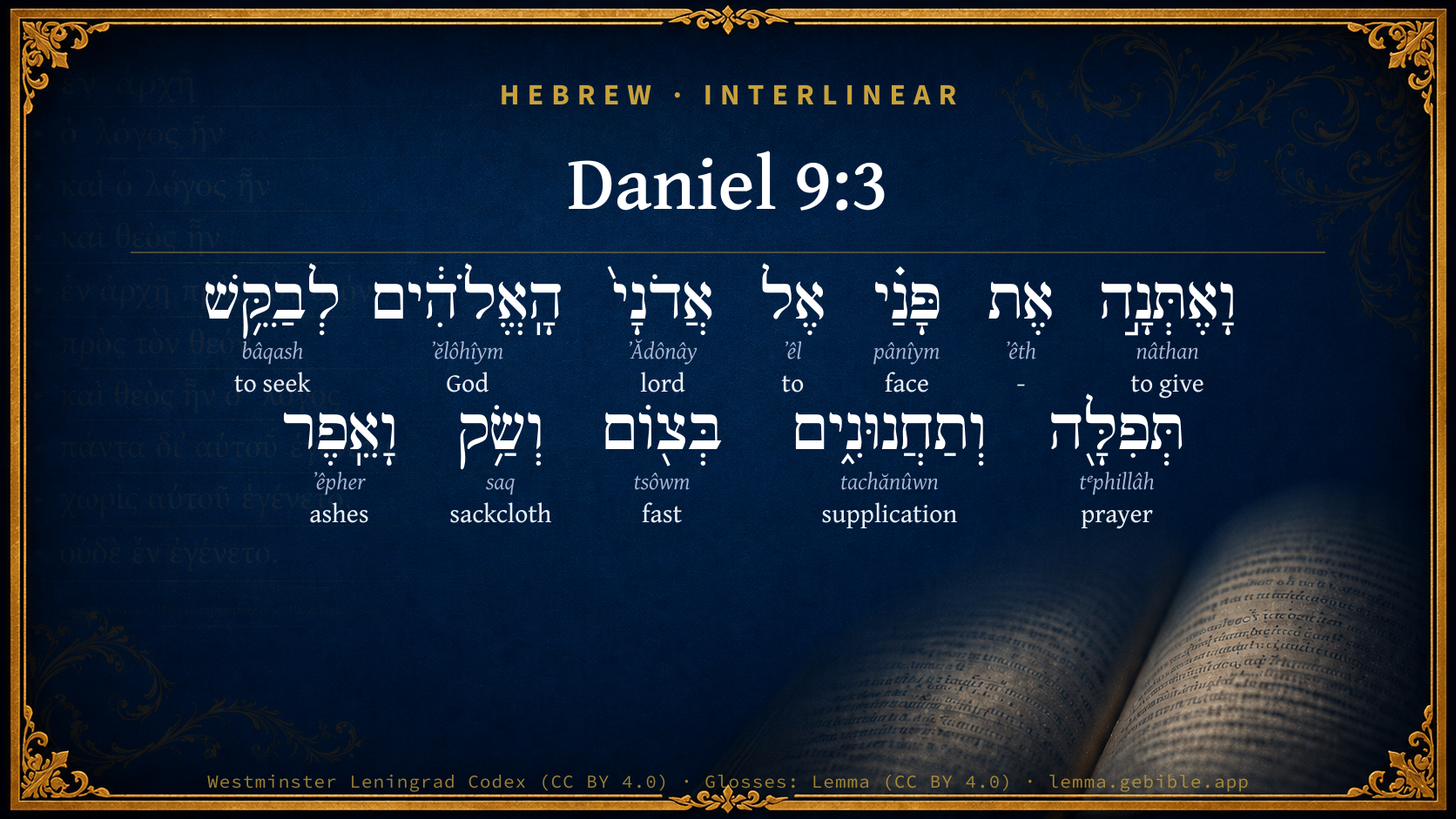
Hebrew (Westminster Leningrad Codex) Daniel 9:3 appears in the Hebrew Old Testament. The text above is from the Westminster Leningrad Codex. Each word links to its Strong’s number, a concise gloss, and parsing drawn from the Open Scriptures Hebrew Bible morphology. Click any word for its full Brown-Driver-Briggs (BDB) entry.
Download image
Cite this verse

Daniel 9:3 (World English Bible). Public Domain. Lemma interlinear Bible study tool, https://lemma.gebible.app/v/daniel/9/3.

Show BibTeX & RIS
BibTeX
RIS
English Translation
I set my face to the Lord God, to seek by prayer and petitions, with fasting and sackcloth and ashes.
World English Bible · Public Domain
Download a study sheet

One document with this verse’s original text, its word-by-word gloss line, the meaning frame, cross-references with their text, attributed commentary, and full source and license credits — printable, and it pastes into notes with its structure intact.

This verse Autodidact and up

Study sheet (.html) Plain text (.txt)

A passage Seminary Student

Up to 50 verses in one chapter. A passage sheet keeps up to 6 commentary sources and 12 cross-references per verse, in the order this page ranks them, and says so on the sheet whenever that leaves anything out. Ask for a single verse and you get the Autodidact verse sheet above.

Everything on this page stays free to read, with no account — the sheet is a download of what is already on screen, not access to it.

Want to remove ads? Support Godless Engineer
Compare translations 3

The same verse in 3 English versions, stacked beneath the original-language interlinear above. Click any original word for its lexicon entry.

Each is an independent rendering of the whole verse — the interlinear is not word-aligned to these translations.

Highlighted words mark where these versions differ — a whole-verse word diff, not a word-by-word alignment.

  • World English Bible Public Domain
    I set my face to the Lord God, to seek by prayer and petitions, with fasting and sackcloth and ashes.
  • King James Version Public Domain
    And I set my face unto the Lord God, to seek by prayer and supplications, with fasting, and sackcloth, and ashes:
  • unfoldingWord Literal Text CC BY-SA 4.0
    Then I turned my face to the Lord God, to seek him by prayer and supplications, with fasting, sackcloth, and ashes.

unfoldingWord Literal Text — © unfoldingWord, licensed CC BY-SA 4.0. Word-aligned USFM3 via Door43 (git.door43.org/unfoldingWord/en_ult).

Versions to compare (up to 4)

3 of 4 selected

Show all 18 translations

Every available English version of this verse, each an independent rendering of the whole verse.

  • World English Bible Public Domain
    I set my face to the Lord God, to seek by prayer and petitions, with fasting and sackcloth and ashes.
  • Berean Standard Bible Public Domain
    So I turned my attention to the Lord God to seek Him by prayer and petition, with fasting, sackcloth, and ashes.
  • Majority Standard Bible Public Domain
    So I turned my attention to the Lord God to seek Him by prayer and petition, with fasting, sackcloth, and ashes.
  • King James Version Public Domain
    And I set my face unto the Lord God, to seek by prayer and supplications, with fasting, and sackcloth, and ashes:
  • American Standard Version (1901) Public Domain
    And I set my face unto the Lord God, to seek by prayer and supplications, with fasting and sackcloth and ashes.
  • Revised Version (1885) Public Domain
    And I set my face unto the Lord God, to seek by prayer and supplications, with fasting, and sackcloth, and ashes.
  • Geneva Bible (1599) Public Domain
    And I turned my face vnto the Lord God, and sought by prayer and supplications with fasting and sackcloth and ashes.
  • Douay-Rheims (1899) Public Domain
    And I set my face to the Lord my God, to pray and make supplication with fasting, and sackcloth, and ashes.
  • Young's Literal Translation Public Domain
    and I set my face unto the Lord God, to seek `by' prayer and supplications, with fasting, and sackcloth, and ashes.
  • Literal Standard Version CC BY-SA 4.0
    and I set my face toward the Lord God, to seek [by] prayer and supplications, with fasting, and sackcloth, and ashes.
  • Unlocked Literal Bible CC BY-SA 4.0
    I turned my face to the Lord God, to seek him with prayer and requests, with fasting, wearing sackcloth, and sitting in ashes.
  • unfoldingWord Literal Text CC BY-SA 4.0
    Then I turned my face to the Lord God, to seek him by prayer and supplications, with fasting, sackcloth, and ashes.
  • Darby Bible Public Domain
    And I set my face unto the Lord God, to seek by prayer and supplications, with fasting, and sackcloth, and ashes;
  • World Messianic Bible Public Domain
    I set my face to the Lord God, to seek by prayer and petitions, with fasting and sackcloth and ashes.
  • Webster's Bible Public Domain
    And I set my face to the Lord God, to seek by prayer and supplications, with fasting, and sackcloth, and ashes:
  • Free Bible Version CC BY-SA 4.0
    So I turned to the Lord God in prayer. I fasted and wore sackcloth and ashes, and I pleaded with him in prayer to act.
  • Bible in Basic English Public Domain
    And turning my face to the Lord God, I gave myself up to prayer, requesting his grace, going without food, in haircloth and dust.
  • JPS Tanakh (1917) Public Domain
    And I set my face unto the Lord God, to seek by prayer and supplications, with fasting, and sackcloth, and ashes.

Literal Standard Version (2020), Covenant Press — licensed CC BY-SA 4.0. Text via the HelloAO Bible API (eBible.org). Unlocked Literal Bible (unfoldingWord) — licensed CC BY-SA 4.0. Text via the HelloAO Bible API (eBible.org). unfoldingWord Literal Text — © unfoldingWord, licensed CC BY-SA 4.0. Word-aligned USFM3 via Door43 (git.door43.org/unfoldingWord/en_ult). Free Bible Version, Dr. Jonathan Gallagher — licensed CC BY-SA 4.0. Text via the HelloAO Bible API (eBible.org).

Word by word

More ways to search: Search by grammar → Find every occurrence → Compare this word →

Practice this passage: Drill this verse → Learn its vocabulary →

וְתַחֲנוּנִ֑ים
tachănûwn
H8469
“and · supplications”
Conjunction + Noun, Common, Masculine, Plural, Absolute
Part of Speech
Conjunction + Noun
Type
Common
Gender
Masculine
Number
Plural
State
Absolute
Full BDB Definition

Origin: from H2603

TWOT: 694g

supplication, supplication for favour - to man - to God
  1. וָאֶתְּנָ֣ה nâthan H5414 “and · to give” Conjunction + Verb, Qal, Sequential Imperfect, 1st Person, Common, Singular + Suffix, h
  2. אֶת ʼêth H853 “-” Particle, Direct Object
  3. פָּנַ֗י pânîym H6440 “face(s) · my” Noun, Common, Both, Plural, Construct + Suffix, Personal, 1st Person, Common, Singular
  4. אֶל ʼêl H413 “to” Preposition
  5. אֲדֹנָי֙ ʼĂdônây H136 “Lord · my” Noun, Common, Masculine, Plural, Construct + Suffix, Personal, 1st Person, Common, Singular
  6. הָֽאֱלֹהִ֔ים ʼĕlôhîym H430 “the · God(s)” Particle, Definite Article + Noun, Common, Masculine, Plural, Absolute
  7. לְבַקֵּ֥שׁ bâqash H1245 “to seek” Preposition + Verb, Piel, Infinitive Construct
  8. תְּפִלָּ֖ה tᵉphillâh H8605 “prayer” Noun, Common, Feminine, Singular, Absolute
  9. בְּצ֖וֹם tsôwm H6685 “in/at · fast” Preposition + Noun, Common, Masculine, Singular, Absolute
  10. וְשַׂ֥ק saq H8242 “and · sackcloth” Conjunction + Noun, Common, Masculine, Singular, Absolute
  11. וָאֵֽפֶר ʼêpher H665 “and · ashes” Conjunction + Noun, Common, Masculine, Singular, Absolute

About this verse

These counts appear in no published source. They are computed here, from the morphology-tagged text and Lemma’s own curated glosses. What Lemma adds →

12
words
12
distinct lemmas
Prophets
section

Notable vocabulary

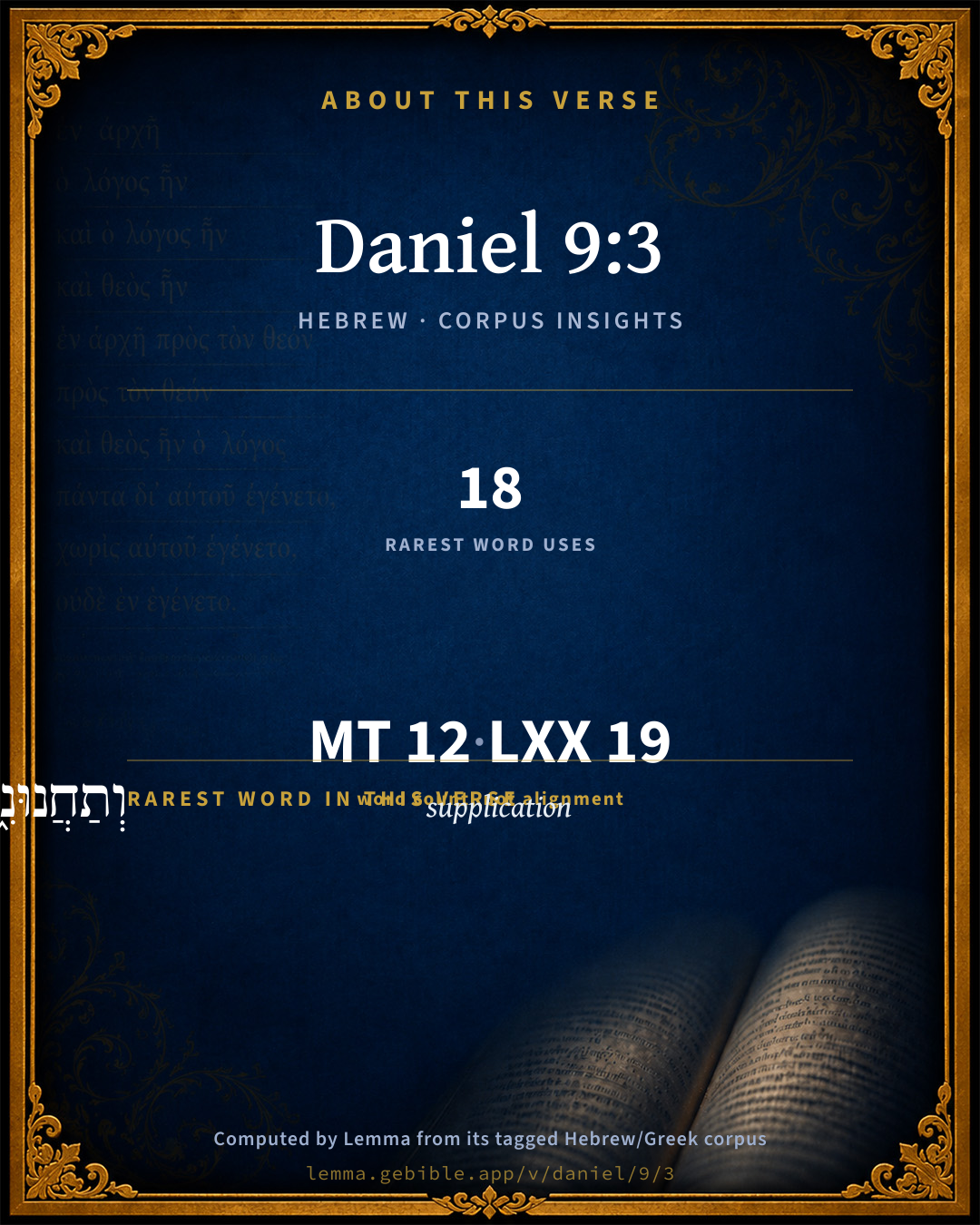
The rarest word here is וְתַחֲנוּנִ֑ים supplication H8469 — appearing just 18 times in the whole Hebrew Bible.

Shared distinctive vocabulary

וְתַחֲנוּנִ֑ים supplication H8469 occurs in 18 verses of the Hebrew Bible. Also found in:

Grammatical profile

  • 2 verbs
  • 8 nouns
  • 1 preposition
  • 1 particle

Verb forms

  • וָאֶתְּנָ֣ה Qal · Sequential Imperfect
  • לְבַקֵּ֥שׁ Piel · Infinitive Construct

Hebrew & Septuagint length

In English translation the verse runs 20 words from the Hebrew and 21 from the Septuagint (LXX English) — closely comparable.

A rough comparison of the two English renderings, which tokenize alike — not a word-level alignment.

Word counts can differ between the Hebrew and the Greek without any difference in meaning — e.g. the Hebrew direct-object marker אֵת has no separate Greek word, and Greek often adds the article ὁ.

In the original languages it is 12 Hebrew tokens and 19 Greek tokens — but the two are counted differently (Hebrew bundles its prefixes and suffixes into one token; the Greek is in lemma form), so that isn’t a like-for-like length.

Cross-references

23

Topical passages linked to Daniel 9:3 in the Treasury of Scripture Knowledge — connected by theme and wording, ordered by reader-vote popularity; previews shown in the World English Bible.

  • Jeremiah 29:10–13 For thus says Yahweh, After seventy years are accomplished for Babylon, I will visit you, and perform my good word toward you, in causing you to return to this place.
  • Jeremiah 33:3 Call to me, and I will answer you, and will show you great things, and difficult, which you don't know.
  • James 5:16–18 Confess your offenses to one another, and pray one for another, that you may be healed. The effective, earnest prayer of a righteous man is powerfully effective.
  • Nehemiah 1:4–11 It happened, when I heard these words, that I sat down and wept, and mourned certain days; and I fasted and prayed before the God of heaven,
  • Esther 4:16 Go, gather together all the Jews who are present in Shushan, and fast you for me, and neither eat nor drink three days, night or day: I also and my maidens will fast in like manner; and so will I go in to the king, which is not according to the law: and if I perish, I perish.
  • Ezra 8:21 Then I proclaimed a fast there, at the river Ahava, that we might humble ourselves before our God, to seek of him a straight way for us, and for our little ones, and for all our substance.
  • Ezra 9:5 At the evening offering I arose up from my humiliation, even with my garment and my robe torn; and I fell on my knees, and spread out my hands to Yahweh my God;
  • Ezra 10:6 Then Ezra rose up from before the house of God, and went into the chamber of Jehohanan the son of Eliashib: and [when] he came there, he ate no bread, nor drink water; for he mourned because of the trespass of them of the captivity.
  • James 4:8–10 Draw near to God, and he will draw near to you. Cleanse your hands, you sinners; and purify your hearts, you double-minded.
  • Psalms 35:13 But as for me, when they were sick, my clothing was sackcloth. I afflicted my soul with fasting. My prayer returned into my own bosom.
  • Psalms 69:10–11 When I wept and I fasted, That was to my reproach.
  • Psalms 102:13–17 You will arise and have mercy on Zion; For it is time to have pity on her. Yes, the set time has come.
  • Ezekiel 36:37 Thus says the Lord Yahweh: For this, moreover, will I be inquired of by the house of Israel, to do it for them: I will increase them with men like a flock.
  • Joel 1:13 Put on sackcloth and mourn, you priests! Wail, you ministers of the altar. Come, lie all night in sackcloth, you ministers of my God, For the meal offering and the drink offering are withheld from your God's house.
  • Joel 2:12 "Yet even now," says Yahweh, "turn to me with all your heart, And with fasting, and with weeping, and with mourning."
  • Luke 2:37 and she had been a widow for about eighty-four years), who didn't depart from the temple, worshipping with fastings and petitions night and day.
  • Acts 10:30 Cornelius said, "Four days ago, I was fasting until this hour, and at the ninth hour, I prayed in my house, and behold, a man stood before me in bright clothing,
  • Nehemiah 9:1 Now in the twenty-fourth day of this month the children of Israel were assembled with fasting, and with sackcloth, and earth on them.
  • Daniel 6:10 When Daniel knew that the writing was signed, he went into his house (now his windows were open in his chamber toward Jerusalem) and he kneeled on his knees three times a day, and prayed, and gave thanks before his God, as he did before.
  • Esther 4:1–3 Now when Mordecai knew all that was done, Mordecai tore his clothes, and put on sackcloth with ashes, and went out into the midst of the city, and cried with a loud and a bitter cry;
  • Jonah 3:6–9 The news reached the king of Nineveh, and he arose from his throne, and took off his royal robe, covered himself with sackcloth, and sat in ashes.
  • Isaiah 22:12 In that day did the Lord, Yahweh of Hosts, call to weeping, and to mourning, and to baldness, and to girding with sackcloth:
  • Daniel 10:2–3 In those days I, Daniel, was mourning three whole weeks.

Cross-references courtesy of OpenBible.info (CC BY 4.0).

Hebrew and Greek witnesses Masoretic Hebrew ↔ Greek Septuagint

The same verse in the two great witnesses to the Old Testament, shown verse-for-verse.

These are two independent witnesses, not word-aligned to each other, and the Septuagint is shown in lemma (dictionary) form.

Hebrew Daniel 9:3 Masoretic · Westminster Leningrad Codex

וָאֶתְּנָ֣ה אֶת פָּנַ֗י אֶל אֲדֹנָי֙ הָֽאֱלֹהִ֔ים לְבַקֵּ֥שׁ תְּפִלָּ֖ה וְתַחֲנוּנִ֑ים בְּצ֖וֹם וְשַׂ֥ק וָאֵֽפֶר

I set my face to the Lord God, to seek by prayer and petitions, with fasting and sackcloth and ashes.

World English Bible · Public Domain

Greek LXX Daniel 9:3 Septuagint · lemma form

καί δίδωμι ὁ πρόσωπον ἐγώ ἐπί κύριος ὁ θεός εὑρίσκω προσευχή καί ἔλεος ἐν νηστεία καί σάκκος καί σποδός

And I set my face toward the Lord God, to seek him diligently by prayer and supplications, with fastings and sackcloth.

LXX2012 (modern English Septuagint) · Public Domain

On this verse, John Gill's Exposition discusses the Septuagint’s reading. Read the note in Commentary ↓

Hebrew: Westminster Leningrad Codex (CC BY 4.0). Greek: Septuagint (public domain); English from LXX2012 (modern English Septuagint) (Public Domain). How the Septuagint differs from the Hebrew →

Commentary

Notes on Daniel 9:3 from classic Christian and Jewish commentators (each source and its license shown beneath its notes). The classic Christian expositions comment on the surrounding passage and are grouped to its opening verse, so a note may address several verses; the Jewish commentaries on the Tanakh (Rashi and others) are per-verse, so they appear only where the commentator wrote on this verse.

Lemma curates 59 commentaries, every one of them public domain or Creative Commons licensed, each selected and text-cleaned for this edition rather than reprinted as found. About our sources →

Trapp's Complete Commentary

John Trapp

Dan 9:3 And I set my face unto the Lord God, to seek by prayer and supplications, with fasting, and sackcloth, and ashes:

Ver. 3. And I set my face unto the Lord God,] i.e., Toward the habitation of his holiness at Jerusalem, but especially in heaven. I looked up unto the hills from whence I looked for help. This Daniel did daily, {Dan 6:10} but now with more than ordinary intention and devotion he presenteth δεησις ενεργουμενη, an inwrought prayer (as St James calleth it, Jas 5:16), edged with fasting and downright humiliation. He doubteth not thereby to set God to work, as David did {Psa 119:126} He knew that a long look toward God speedeth, {Psa 34:4-5 Jon 2:4-7} how much more an extraordinary prayer!

John Trapp, A Commentary or Exposition upon All the Books of the Old and New Testament (1647–1656) — public domain. Text from a community e-Sword module.

The Biblical Illustrator

Joseph S. Exell

Dan_9:3

And I met my face unto the Lord God.

Setting the Face unto the Lord

Daniel, when he would seek God, set his face unto the Lord God, to seek by prayer. He was an eminently holy man, and far advanced in piety. His example cannot be an unfitting one to follow.

1. There must be great difficulties to the proper and effectual seeking after God. Some things we do without difficulty; our mind goes naturally and easily to their performance. Before mans fall, his mind would as naturally turn to God rejoice in Him, and be lifted up towards Him, as he now delights in a bright and glorious day. It is not so now. It is a very difficult matter set ourselves rightly to seek God. Man cannot seek God aright unless the power of God works in him to bring him to do it. How can any bring a broken and a contrite heart, which is the proper offering before God, unless God the Spirit break it? Do we naturally give up sin, or naturally wish to do it? Is it easy to confess our sins, to find them out, to ascertain them, whether sins of the heart or life? Try earnestly and honestly to seek God, and you will soon find the difficulty. Various hindrances indeed there are, in coming to the Mercy Seat.

2. Multitudes are ever seeking God who do not set their faces to seek. Scripture is clear respecting wavers. There are many persons of this kind, earnest to-day, dead again to-morrow; by fits at prayer, and then prayerless again. Such obtain nothing of the Lord. Others, though seeking, will not give up every wilful sin. Who can he a Christian without a sacrifice? Who can enter the strait gate without a struggle? You seek in vain if you allow a worldly spirit; unless you come to God, and honestly and earnestly wish to have the love of the world destroyed in your heart. There is one way of approach to God, and but one; one name and one only to plead--the name of Jesus Christ.

3. Some hints on the setting of our face unto the Lord our God. You must give time for this. There must be going to work in right earnest; diligent inquiry for the sins of the life, and for the sins of the heart, and a confessing them with real sorrow before God. There must be, from the beginning of our seeking, a looking for, and a reliance upon, Gods help. And we may look for His help. The first honest and sincere cry or sigh of a returning sinner is noticed by a gracious God. That cry never goes up for help in vain.

4. The importance of thus setting our face unto the Lord God to seek. Remember that we cannot succeed without this. Think of the blessings which God bestows upon those who thus seek, what wonderful promises He has made to them. They deserve all such seeking and sacrifices as we have shown to be needful. You are commanded thus to seek God. Gods commands are the most gracious and beneficent things to us that there are.

5. Special reasons which may be given to different individuals why they should at once resolvedly, looking up to God for help, do this:

(1) Those who have never yet thus set their face unto the Lord God Your eternal happiness depends upon your seeking, or your everlasting perdition.

(2) Turn to some Christians. Some of you are hindered by something in your course. If you would follow Daniels example you might be freed from this hindrance. Again, someone is in a particular strait and difficulty. Does no door open? Is the way dark? Have recourse to thus seeking to God. Go to this duty at once. It must be done now. Let there be no delay. Begin now, earnestly, resolvedly, in prayer and dependence of Gods merciful help, and the result shall not be an early failure or disappointment. God will help the soul at its first really sincere and honest cry to Him for help. (J. E. Dalton, B.D.)

Righteousness not a Position but a Direction

That is a good word about the young Hebrew, Daniel--it says so much. I set my face to the Lord God. And that is the real question about life: which way are you facing; in which direction are you really looking and living? Righteousness, not a position, but a direction. Let me first make this distinction plain, and then you will see the importance of it. The common idea, then, of the difference between right and wrong is that right and wrong are two, separate territories as it were, and that there is a boundary line dividing them, like the frontier line between two countries, and that anywhere on the right side of that boundary line is right. Or, people figure particular sins as if they were separate provinces in the general territory of wrong, each sin with its own boundary line, on one side of which you are in sin--but that so long as you have not actually crossed that line into sin, you are all right. And a great deal of the moral discussion of the world has been spent on trying to map out these exact lines where the right ends and the wrong begins, the line up to which you may go without sinning. Well, that seems very plausible--and yet a glance into real life, and at some of the very commonest matters of right and wrong, is sufficient to show that at any rate there is a great deal of life in which it is quite impossible to draw any such distinct lines between right and wrong! Try to draw the line between industry and idleness, and to say exactly how industrious a man ought to be in order not to be counted an idler. But you cannot do it! Or, take selfishness. Who can lay down exactly how far I ought to consider myself, and mark the point at which selfishness begins; or how far I ought to do what I like, or how far give up to others? Why it cannot be done, if you were to argue about it for a year! Or, take such constantly present questions as that of right and wrong in eating and drinking, or any kind of indulgence. Is there any clear line to be drawn between what is temperate and what is intemperate? Certainly covetousness is a sin. But where exactly does it begin to be so? So it is, palpably, with regard to a great deal of right and wrong. But really, it is so even in things which at first sight look so clear and distinct in their moral outline that you are apt to say--that there can be no haziness or uncertainty in them. Take truth, for instance, or honesty. Truth is apt to look just as exact and precise as a mathematical figure--whether a thing is true or not true, whether you are telling the truth or not--it seems as if it ought to be possible to define that anyhow. And honesty! Is anyone going to say that honesty and dishonesty shade off into one another--why it seems like sapping the very clearest distinction of morality. And yet it is so. No exact line can be drawn in either matter. If you had been sheltering a fugitive slave in the old days of slavery, would truth make it your duty to answer the question if he was with you? Or, if you are bargaining about some goods you want to sell, does honesty require you to tell everything you know to their disadvantage, or is it enough if you answer truly every actual question that is asked you? Must truth be told to criminals when it will help them in a crime? And so I might go through every part of human conduct, and the more closely you look into it, the more you will find that there is no such thing as drawing any absolute line between right and wrong anywhere. But what does that mean? That, therefore, there is not any real difference between them, or that the distinction between them is imperceptible? Not for a moment. The difference between right and wrong is the most tremendous distinction in the world. No distinction of painful or pleasant can compare with it--only it is not of that sort There comes in the thought--and I think it is a helpful thought, that it is not a difference of place or position, but of direction. A single illustration gives it to you at once. It is simply like the difference between east and west. Is there any dividing line between east and west? No! Who can tell where the east stops and the west begins? No one; and yet does that mean that there is no difference between east and west, or that it is a hazy, obscure difference? Not at all. Simply it is this same difference not of two places, but of two directions. You cannot possibly draw a dividing line between east and west, but you can tell in a moment whether you are going east or west, or whether your face is set towards the east or towards the west. And so, though there never was a line drawn which could divide exactly right from wrong, you can tell in a moment whether you are living in the direction of right or in the direction of wrong. There, then, is thee true distinction--and now let us follow it out a little and see the importance of it. For it begins at the very beginning of life, and it lies at the root of all clear, strong righteousness. And, on the other hand, that idea that righteousness consists in not crossing some dividing line into wrong, is just the most treacherous and fertile source of wrong. As long as one fancies that sin only begins at some distinct line, one is tempted to go just as near that line as one can--while really the sin is begun, and going on all the time that one is facing that way! You can see how this works, from the cradle up. You mothers--you tell your little child, playing about you as you work, not to go out of the room. And it goes to the door--and it looks out--and if you speak it says, I didnt go out. And then it puts one foot just on the threshold--very likely looking at you all the while--and then ventures it a little further,--and still, when you shake your head, it says, I havent gone out! Do you know why it is so hard to teach children the true lesson--not merely to keep from crossing some actual line of wrong, but to keep from looking that way, or going that way at all? Because so many of those who want children to be taught that lesson have not learned it themselves! Men and women are constantly just like that little child. They do not intend to sin, or at least they feel they must not, and they think they will not. But they will look towards it, and they will go to the very edge of it, and look over, and perhaps put one foot on the very threshold--and yet if conscience brings them up with a round turn, they try to justify themselves by saying that they have not actually crossed the line! That is how nine-tenths of the worlds sinning comes! Young men, dont you know how this often works in a young mans life--this trying how near one can go to the edge of sin without actually going over the edge? A young fellow comes up from school, or from some country home, to take his place in the great world, and the false glamour of it by and by begins to get hold of him. But he does not mean to sin; he has grace enough to shrink from that. No--he wont sin, be says; but he begins to go with those who do; he hears them talk and brag of the pleasures they have; he half envies them the daring with which they sin--and he will go to places where it is all about--and still when conscience comes in, in quiet hours, he tries to take some poor comfort by making believe with himself that he has not actually sinned. Sinned? Why, his whole attitude is sin. His face and his heart are set towards sin all the time. And it is the same all through life. Just look up the record of any ten men who have got into jail, and you will find that nine out of the ten were led the first stops of the way which brought them there by that mischievous idea that there was some dead-line of sin, which if they did not cross, they would be right. And not only is this the source of actual crime--and of what the world definitely labels sin--but also it is the source of all the poor, unworthy life that there is in the world. The people who are not exactly thieves--but who will take an advantage of you if they can; the people who oven while they are working have not their hearts really set to work, but are facing towards idleness and amusement; that character which in business is always sailing rather close to the wind, and, still more common in the world, that kind of life which perhaps plumes itself on never breaking a commandment or doing anything wrong, and yet that has no real love of goodness, no genuine desire for goodness--that is the kind of life which keeps the world back, and keeps the church back, and keeps the tone of society low and mean. Friends, this is Gods call to us. Not just to keep from certain forbidden things, or from crossing some actual line of sin--but to set our faces clear the other way--towards right, towards allthe just, pure, kind, godly life. It is Christ and all His setting forth of life that have brought this out fully for us--no longer law, but love, no longer the mere keeping from a certain list of forbidden things, but, active, forward-looking service. That is the secret of effective life and of happy life to keep righteousness before us as the whole direction of our living. There is not a day, hardly an hour, but this principle--of righteousness being not a position, but a direction--comes in. It cuts right through the moral casuistry by which the steps of duty so easily get entangled, in discussing just how far this or that way may be pursued without some actual sin! Then does righteousness, in this thought of it, become not a drag, but a motive power, not a restraint, but an inspiration, not condemnation, but glory! I do not say that it is easy; there is no way of looking at it that can make righteousness easy. One may set ones face ever so earnestly in the right direction, and still the tempting passions will allure and the weak resolution will flag and stumble. The Roman moralist confessed that while he loved the better, he sometimes followed the worse--and even Paul himself says that though he delights in the law of God after the inward man, yet he finds another law in his members bringing him into captivity to sin and death. No! There is no grand moral victory even that way, even by facing the right way--and still, it is the only really onward way at all--and with the heart and face set really towards right and God, strength must keep growing--and the sense of a Divine help that will not give us up, and the upward way becomes not quite so hard; and even through clinging weakness and sin, to keep the heart still set towards the right is itself--no! not victory, but the promise of some final victory, the prophecy of how at last we may be lifted out of the bondage of corruption into the glorious liberty of the children of God! (Brooke Herford, D.D.)

Daniel, the Man of Prayer

The prophet Daniel became a great proficient both in penitential and in intercessory prayer as the years went on. And he came to that great proficiency just as a great proficiency is come to in any other science or art; that is to say, by constant, and unremitting, and enterprising practice. Lord teach us to pray, said a disciple on one occasion to our Lord. But not even our Lord, with all His willingness, and all His ability, can teach any of us to pray. Every man must teach himself this most personal, and most secret, and most experimental; this greatest and best of all the arts. Every man must find out the best ways of prayer for himself. There is no royal road; there is no short or easy road to proficiency in prayer. You must also have special and extraordinary seasons of prayer, as Daniel had, over and above his daily habit of prayer. Special and extraordinary; original and unparalleled seasons of prayer, when you literally do nothing else day nor night but pray. Now, it is plain that you cannot teach a lifetime of experiment and attainment like that to any chance man; and, especially, you cannot teach it to a man who still detests the very thought of such prayer. It was his yoke in his youth that first taught Daniel to pray. And Babylon taught Daniel and his three friends all to pray, and to pray together in their chambers as we read. To be arrested in their fathers houses by Nebuchadnezzars soldiers; to have Babylonian chains put on their hands and their feet; to see the towers of Zion for the last time: to be asked to sing some of the songs of Zion to amuse their masters as they toiled over the Assyrian sands--you would have been experts yourselves in a school of prayer like that Jeremiah, a great authority on why some men pray, and why other men never pray, has this about you in his book: Moab hath been at his ease from his youth up; he hath settled on his lees; he hath not been emptied from vessel to vessel: neither hath he gone into captivity; and, therefore, his taste remaineth in him, and his scent is not changed. The ninth chapter of Daniel is dear to every old devotional hand. It is delightful with a delight that is not known to neophytes. It is positively delightful to see the old prophet allying in his chamber and spelling out the book of the prophet Jeremiah, the first copy of which has just been smuggled across the wilderness from Jerusalem to Babylon. We sit over and spell out old authors in literature and religion, if they are sufficiently old; but it would not pay to make a contraband trade of the authors and the preachers of to-day to the authors of to-day or to the preachers either. We exploit and plagiarise the great preachers of the great past, but we do not find much to repay us in the pulpit of our day. Only Daniel studied Jeremiah as much as if Jeremiah had been Moses himself, and more. And he not only studied a prophet whom we would call his contemporary, and his colleague, but, old prophet and old priest as he himself was, he took a new start in fasting, and in sackcloth, and in ashes, and in prayer of all kinds as he sat over Jeremiahs now book, and felt on the floor of his chamber holding the book to his heart. Had we been in Daniels place, I will wager what we would have said as we read that seventy years passage on the new parchment: The Lords ways--if this is indeed the Lord--His ways are not equal, we would have said. Here am I getting on to old age in Babylon, and no intimation has come to me like this. Surely I was the man that needed it, and had earned it. Why Jeremiah? What has he done? And besides, has he not fallen sway to our oppressors? I have a feeling that I would not have been in such a meek temper as Daniel was over that book the ink of which was still wet. O Daniel, a man greatly beloved! and who deserved to be! Why, asks Pascal, why has God established prayer? And the first answer out of the three that Pascal gives to himself is this--To communicate to His creatures the dignity of causality. And Daniel was of Pascals deep, believing and original mind. For Daniel, just because he read and believed that deliverance was at the door, all the more see himself to pray as if his prayer was to be the alone and predestinated cause of the coming deliverance. Daniel put on sackcloth, and fasted, and prayed, and went back upon all his own and all his peoples sins in a way that confounds us to our face. We cannot understand Daniel. We are not deep enough. He prayed, and fasted, and returned to an agony of prayer, as if he had never heard of the near deliverance; he prayed in its very presence as if he despaired of ever seeing it. He fasted and prayed as he had not done all these seventy fasting and praying years. Read, all you experts in prayer, read with all your mind, and with all your heart, and with all your experience, and with all your imagination this great causality chapter. It is written by a proficient for proficients. It is written by a great saint of God for all such. Read it and think. Read it with your Pascal open before you. Read it and sink down into the deep things of God and the soul. Read it and practise it till you know by experiment and experience that decree, and covenant, and prophecy, and promise, and all, however sure, and however near, are all only fulfilled in immediate and dependent answer to penitential and importunate prayer. Read it and pray as never before after the answer has actually begun. See the answer out to the last syllable before you begin to restrain penitence and prayer. And after the answer is all fulfilled, still read it and the still deeper chapters that follow it, till you learn new fasting, and new sackcloth, and new ashes, and new repentance, away out to your saintliest old age. Read Daniels greatest prayer, and Know thy dread power--a creature yet a cause. (Alex.Whyte, D.D.)

Daniels Prayer

Acquainted as Daniel was with the word of God as delivered by the prophets who had foretold the captivity and restoration of Judah, and confiding in the unchangeable faithfulness of that word, as his whole life testified that he did, the return of his countrymen to Jerusalem was an event on which he must have assuredly reckoned, not only as certain, but as very near. Nor were there wanting other and very unequivocal intimations to give Daniel the assurance that this event was at hand. He saw, in the conqueror of Babylon, the very person who had been referred to by name in the prophecies of Isaiah, a hundred and seventy years before. If ever there was a future event which might have been reckoned on with absolute certainty, it was this restoration of the Jewish captives to the land and city of their fathers. And yet, so far from supposing that there was no place for prayer to occupy, among the various means that were employed to bring about that event, it was just his firm belief in the certainty and nearness of it that set Daniel upon fervent and persevering supplications for its accomplishment. Because he contemplated the near approach of this deliverance, he gave himself to special prayer for the fulfilment of the promise.

1. The prayer itself was just expressing or embodying in language the state of Daniels mind as directed towards an object, in the accomplishment of which he felt a most intense interest. The believer never can, without belying his principles, deliberately desire anything that he knows to be contrary to the will, and inconsistent with the glory of God. He supplicates conditionally--so qualifying his petition as that it may be given him, if agreeable to his Makers will, or conducive to the manifestation of his Makers glory. But, if true to his principles, he never can cease vehemently to desire what he does know to be accordant with the will, and subservient to the glory of God.

2. With regard to the rank which Daniels prayer occupied among the various agencies or means that were to be employed in bringing about the object of it, he had good reason to believe that it was neither without a definite place nor in itself devoid of efficacy. Daniel knew that the event for which he longed and prayed necessarily involved in it the spiritual amendment of Judah. He saw that the return of their heart to God was essential to their triumphant return to the land of their fathers; and he felt, therefore, that humiliation and confession of sin was not only a becoming exercise in him at such a moment, but, in reality, a fulfilment in part of the very promise in which he confided. The agency of prayer is indeed a less obvious and palpable thing than that outward co-operation, whereby mankind are rendered subservient to the accomplishment of the Divine purposes. But is it not an agency of an unspeakably loftier character? Is it not the co-operation of an immortal spirit, hearing the impress of the Divine image, and at the moment acting in unison with the Divine will? By some such views of prayer I would endeavour to remove the difficulties of those who may have been perplexed by subtle speculations on the place which it occupies, and the efficacy which belongs to it in the economy of grace; difficulties which, in reality, have nothing more to do with prayer than with anything else connected with human agency. (R. Gordon, D.D.)

Prayer for National Prosperity

As the prophet made the sins, the perils, and the needs of his nation his own, and confessed and supplicated as for his life, so should we. Our sins and transgressions are as great and as many as our mercies; our perils are as real and imminent and fearful as our exaltation and opportunity and overflowing outward prosperity.

I. Lot us name SOME OF OUR MERCIES, PRIVILEGES AND OPPORTUNITIES.

1. Take into view our national heritage--its locality, extent, richness, and abounding resources--unparalleled in the history of nations.

2. Our Providential history. Our ancestral stock, Puritan, Huguenot, etc. Our wondrous growth and development. Gods special interpositions, as in war.

3. The character of our institutions. A free ballot, a free Bible.

II. Let US NOT OVERLOOK OUR PERILS, for they are many and imminent.

1. The decadence of personal integrity and public morality.

2. The rapid influx of a foreign and alien element.

3. The enormous growth and corrupting influence of our great cities.

4. The increasing prevalence of vice, pauperism, and crime throughout the land.

5. The grasping policy and overshadowing influence of combinations and monopolies.

6. The growing alienation of the great labouring class from the Church and from Christianity.

7. The audacity and strength of the Rum Power, allied with corruption in politics, to legalise the traffic in making drunkards, and in gambling on race-courses, and to keep in office disreputable and wicked men in many of our leading cities. (J. M. Sherwood, D.D.)

Prayer

Prayer is often miconceived in all churches and by all parties.

1. The end of prayer, offered in private, is not to inform God. Many persons pray as if they wish to tell God what God does not know.

2. Prayer is not loud speaking, or much speaking, or any one special form whatever.

3. Prayer is not prescribed in the Scripture, or offered by a true believer, in order to work any change in God.

4. We must not associate prayer with any idea of atonement or expiation.

5. Some persons give up all hope, because God does not hear them. They say, Our prayers are so mixed with wandering and simple thoughts, and are so imperfect that we cannot pray aright. This implies a lingering notion that our prayers are expiatory, or a title to Heaven.

6. We must not pray, to be seen of men.

7. Prayer is not to be an excuse or apology for the neglect of duties.

8. It is not an exercise suited merely to a great crisis.

9. Prayer should be addressed unto God, as our Father; and in the name and through the mediation of Christ; and in the strength and with the guidance of the Holy Spirit. (John Cumming, D.D.)

Daniels Prayer

This chapter, more than any other in the Book of Daniel, lays open to us the inner life of the prophet. It shows that he who was so illustrious in his wisdom and public relations was no less noted for his wisdom and public relations, was no less noted for his deep spirituality and earnest private devotions, whilst it suggests that the former were largely the result of the latter. True faith and living piety help to make wise and great. It appears that Daniel was a student of prophecy, of unfulfilled prophecy, and especially of the numbers and dates contained in the sacred predictions. Many consider such studies and anxieties the most barren and dangerous to which we can give ourselves. There is much reason to suspect that one of the real causes of the superficiality and leanness of modern piety is that the professed people of God no longer understand or believe what the prophets have written, and refuse to study or hear about things to come as God has revealed them for our learning. There is abundant material in this prayer of Daniel on which to dwell with interest and pride. The manner of it was deliberate, reverent, humble, and self-chastening. The character and attributes which this piece of devotion ascribes to Deity are also very impressive and sublime. The grandeur and awfulness of Eternal Majesty are blended with unsearchable goodness and faithfulness, presenting to our contemplation the great and dreadful God, keeping covenant and mercy to them that love Him and keep His command-merits, whose almighty hand is in all the administrations on earth and in Heaven, and all whose ways are righteousness and truth. The prayer is also occupied with confession of sin as the cause of Israels miseries. The expressions on this point are the most explicit, unreserved, and contrite. The great subject of the prayer was not simply that affliction might be removed, but that the house and ordinances of God might be restored, and a true, spiritual recovery wrought; for it avails but little to be released from particular punishments of sin if the inner cause of them be not healed. So the plea upon which this prayer rests is the truest and only availing one--not and merit of man, not any right or claim on the sinners part, but alone and entirely the mercy of God and the honour of His great name. (Joseph A. Seiss, D.D.)

With fasting, and sackcloth and ashes.

Fast-Day Service

This is the first bright star which shines in the midst of the darkness of our sins. God is merciful. He is just--as just as if He were not merciful. He is merciful--as merciful as if He were not just, and in very deed more merciful than if He were too lenient, instead of blending a wise severity of justice with a gracious clemency of long suffering. We should rejoice that we have not this day to address the gods of the heathens. You have not to-day to bow down before the thundering Jove; you need not come before implacable deities, who delight in the blood of their creatures, or rather, of the creatures whom it is pretended that they have made. Our God delights in mercy, and in the deliverance of Britain from its ills. God will be as much pleased as Britain; yea, when Britain shall have forgotten it, and only the page of history shall record His mercies, God will still remember what He did for us in this day of our straits and difficulties. As to the hope that He will help us, that is a certainty. There is no fear that when we unite in prayer God will refuse to hear. It is as sure as that there is a God, that God will hear us; and if we ask Him aright, the day shall come when the world shall see what Britains God has done, and how He has heard her cry, and answered the voice of her supplications. (C. H. Spurgeon.)

Aids to Devotion

Calvin remarks that Daniel, though naturally alert in prayer to God, was yet conscious of the want of sufficiency in himself; and hence be adds the use of sackcloth and ashes and fasting. He observes that everyone conscious of his infirmity ought to collect all the aids he can command for the correction of his sluggishness, and thus to stimulate himself to ardour in supplicating God.

The Fast-Day

The necessity and practice of fasting and repentance is set forth both in the Old and New Testaments. From the text we learn that Daniel was wont to fast, and to supplicate the Majesty of Heaven for the pardon of those national sins which he knew would justly draw down the indignation of the Almighty. Notice the special duties of fasting, such as a serious inspection into our hearts, and close self-examination of ourselves. Closely connected with this is the confession of sin. How strikingly was this manifested in the prayer of the text. Again, holy resolutions of amendment should be found in the strength of Christ, and with a due regard to His glory. Intercession is also peculiarly a duty at this season of humiliation, not only in public prayer, but also in private. Mercy to others is a peculiarly suitable accompaniment to fasting and supplication. On these days of public humiliation, when we are called upon to prostrate our guilty souls before Almighty God, sure it must become us to take such a view of the ravages of sin, and its awful consequences upon the guilty sons of Adam, as shall direct our faith to that one great sacrifice which can alone be efficacious for the healing of the nations, and for the introduction of that dispensation wherein we learn something of the achievements of the Prince of Peace; which peace shall be brought about by the subjugation of sin, and the conquest of those passions which war against the soul, and prove so fatal to mans best interests, and so bedim his prospects of future happiness. Learn that the judgments of the Lord are calculated to teach the world righteousness. It ought never to be forgotten that, in the view of Omniscience, God sees the beginning and ending of all human events, from the hour of Natures nativity to the last moment of all earthly dissolution. We may refer the darkest dealings of the Almighty to the Eternal Wisdom. (Nat. Meeres, B.D.)

The Biblical Illustrator, edited by Joseph S. Exell (c. 1880s–1900s) — public domain. Text from a community e-Sword module.

Joseph Benson's Commentary

Dan 9:3. I set my face unto the Lord God — This expression does not merely mean, that he directed his face to the place where the temple had stood: it signifies also his resolution to apply to God with the utmost seriousness, fervency, importunity, and perseverance, for the accomplishment of his promises respecting the restoration of his people. It denotes, says Henry, “the intenseness of his mind in this prayer, the fixedness of his thoughts, the firmness of his faith, and the fervour of his devout affections in the duty.” To seek by prayer and supplication, &c. — God’s promises, in general, are conditional, and intended, not to supersede, but to excite and encourage our prayers: this was especially the case with regard to God’s promise of restoring the Jews from captivity after seventy years, and this condition was particularly expressed when the promise was made by Jer 29:10-14, where God says, Ye shall call upon me, and I will hearken unto you, &c., and will turn away your captivity, &c. Here we see Daniel complied with the condition; he sought unto the Lord with all his heart, (and undoubtedly excited others to do the same,) and the Lord was found of him. With fasting, and sackcloth, and ashes — In token of humiliation, sorrow for their sins, and grief for the duration of their captivity.

Joseph Benson's Commentary on the Old and New Testaments (1811–1818) — public domain. Text from a community e-Sword module.

Keil & Delitzsch

C. F. Keil & F. Delitzsch

Daniel's prayer. This prayer has been judged very severely by modern critics. According to Berth., v. Leng., Hitzig, Staeh., and Ewald, its matter and its whole design are constructed according to older patterns, in particular according to the prayers of Neh 9 and Ezr 9:1-15, since Dan 9:4 is borrowed from Neh 1:5; Neh 9:32; Dan 9:8 from Neh 9:34; Dan 9:14 from Neh 9:33; Dan 9:15 from Neh 1:10; Neh 9:10; and, finally, Dan 9:7, Dan 9:8 from Ezr 9:7. But if we consider this dependence more closely, we shall, it is true, find the expression הפנים בּשׁת (confusion of faces, Ezr 9:7, Ezr 9:8) in Ezr 9:7, but we also find it in Ch2 32:21; Jer 7:19, and also in Psa 44:16; סלחות (forgivenesses, Dan 9:9) we find in Neh 9:17, but also in Psa 130:4; and על תּתּך (is poured upon, spoken of the anger of God, Dan 9:11) is found not only in Ch2 12:7; Ch2 34:21, Ch2 34:25, but also Jer 42:18; Jer 44:6, and Nah 1:6. We have only to examine the other parallel common thoughts and words adduced in order at once to perceive that, without exception, they all have their roots in the Pentateuch, and afford not the slightest proof of the dependence of this chapter on Neh 9.

The thought, "great and dreadful God, keeping the covenant and mercy," etc., which is found in Dan 9:4 and in Neh 1:5, has its roots in Deu 7:21 and Dan 9:9, cf. Exo 20:6; Exo 34:7, and in the form found in Neh 9:32, in Deu 10:17; the expression (Dan 9:15), "Thou hast brought Thy people forth out of the land of Egypt with a mighty hand," has its origin in Deu 7:8; Deu 9:26, etc. But in those verses where single thoughts or words of this prayer so accord with Neh 9 or Ezr 9:1-15 as to show a dependence, a closer comparison will prove, not that Daniel borrows from Ezra or Nehemiah, but that they borrow from Daniel. This is put beyond a doubt by placing together the phrases: "our kings, our princes, our fathers" (Dan 9:5, Dan 9:8), compared with these: "our kings, our princes, our priests, and our fathers" (Neh 9:34, Neh 9:32), and "our kings and our priests" (Ezr 9:7). For here the naming of the "priests" along with the "kings and princes" is just as characteristic of the age of Ezra and Nehemiah as the omission of the "priests" is of the time of the Exile, in which, in consequence of the cessation of worship, the office of the priest was suspended. This circumstance tends to refute the argument of Sthelin (Einl. p. 349), that since the prayers in Chron., Ezra, and Nehem. greatly resemble each other, and probably proceed from one author, it is more likely that the author of Daniel 9 depended on the most recent historical writings, than that Daniel 9 was always before the eyes of the author of Chron. - a supposition the probability of which is not manifest.

If, without any preconceived opinion that this book is a product of the times of the Maccabees, the contents and the course of thought found in the prayer, Daniel 9, are compared with the prayers in Ezr 9:1-15 and Neh 9, we will not easily suppose it possible that Daniel depends on Ezra and Nehemiah. The prayer of Ezr 9:6-15 is a confession of the sins of the congregation from the days of the fathers down to the time of Ezra, in which Ezra scarcely ventures to raise his countenance to God, because as a member of the congregation he is borne down by the thought of their guilt; and therefore he does not pray for pardon, because his design is only "to show to the congregation how greatly they had gone astray, and to induce them on their part to do all to atone for their guilt, and to turn away the anger of God" (Bertheau).

The prayer, Neh 9:6-37, is, after the manner of Ps 105 and 106, an extended offering of praise for all the good which the Lord had manifested toward His people, notwithstanding that they had continually hardened their necks and revolted from His from the time of the call of Abraham down to the time of the exile, expressing itself in the confession, "God is righteous, but we are guilty," never rising to a prayer for deliverance from bondage, under which the people even then languished.

The prayer of Daniel 9, on the contrary, by its contents and form, not only creates the impression "of a fresh production adapted to the occasion," and also of great depth of thought and of earnest power in prayer, but it presents itself specially as the prayer of a man, a prophet, standing in a near relation to God, so that we perceive that the suppliant probably utters the confession of sin and of guilt in the name of the congregation in which he is included; but in the prayer for the turning away of God's anger his special relation to the Lord is seen, and is pleaded as a reason for his being heard, in the words, "Hear the prayer of Thy servant and his supplication (Dan 9:17); O my God, incline Thine ear" (Dan 9:18).

(Note: After the above remarks, Ewald's opinion, that this prayer is only an epitome of the prayer of Baruch (1:16-3:8), scarcely needs any special refutation. It is open before our eyes, and has been long known, that the prayer of Baruch in the whole course of its thoughts, and in many of the expressions found in it, fits closely to the prayer of Daniel; but also all interpreters not blinded by prejudice have long ago acknowledged that from the resemblances of this apocryphal product not merely to Daniel 9, but also much more to Jeremiah, nothing further follows than that the author of this late copy of ancient prophetic writings knew and used the book of Daniel, and was familiar with the writings of Daniel and Jeremiah, and of other prophets, so that he imitated them. This statement, that the pseudo-Baruch in ch. 1:15-3:8 presents an extended imitation of Daniel's prayer, Ewald has not refuted, and he has brought forward nothing more in support of his view than the assertion, resting on the groundless supposition that the mention of the "judges" in Dan 9:12 is derived from Bar. 2:1, and on the remark that the author of the book of Baruch would have nothing at all peculiar if he had formed that long prayer out of the book of Daniel, or had only wrought after this pattern - a remark which bears witness, indeed, of a compassionate concern for his protge, but manifestly says nothing for the critic.)

The prayer is divided into two parts. Dan 9:4-14 contain the confession of sin and guilt; Dan 9:15-19 the supplication for mercy, and the restoration of the holy city and its sanctuary lying in ruins.

The confession of sin divides itself into two strophes. Dan 9:4-10 state the transgression and the guilt, while Dan 9:11-14 refer to the punishment from God for this guilt. Dan 9:3 forms the introduction. The words, "Then I directed my face to the Lord," are commonly understood, after Dan 6:11, as meaning that Daniel turned his face toward the place of the temple, toward Jerusalem. This is possible. The words themselves, however, only say that he turned his face to God the Lord in heaven, to האלהים אדני, the Lord of the whole world, the true God, not to יהוה, although he meant the covenant God. "To seek prayer in (with) fasting," etc. "Fasting in sackcloth (penitential garment made of hair) and ashes," i.e., sprinkling the head with ashes as an outward sign of true humility and penitence, comes into consideration as a means of preparation for prayer, in order that one might place himself in the right frame of mind for prayer, which is an indispensable condition for the hearing of it - a result which is the aim in the seeking. In regard to this matter Jerome makes these excellent remarks: "In cinere igitur et sacco postulat impleri quod Deus promiserat, non quod esset incredulus futurorum, sed ne securitas negligentiam et negligentia pareret offensam." תּפלּה and תּחנוּנים = תּחנּה, cf. Kg1 8:38, Kg1 8:45, Kg1 8:49; Ch2 6:29, Ch2 6:35. תּפלּה is prayer in general; תּחנוּנים, prayer for mercy and compassion, as also a petition for something, such as the turning away of misfortune or evil (deprecari). The design of the prayer lying before us is to entreat God that He would look with pity on the desolation of the holy city and the temple,and fulfil His promise of their restoration. This prayer is found in Dan 9:15-19.

Dan 9:4

Since the desolation of the holy land and the exile of the people was a well-deserved punishment for their sins, and a removal of the punishment could not be hoped for without genuine humiliation under the righteous judgment of God, Daniel begins with a confession of the great transgression of the people, and of the righteousness of the divine dealings with them, that on the ground of this confession he might entreat of the divine compassion the fulfilment of the promised restoration of Jerusalem and Israel. He prays to Jehovah אלהי, my God. If we wish our prayers to be heard, then God, to whom we pray, must become our God. To אתודּה (I made confession) M. Geier applies Augustine's beautiful remark on Psa 29:1-11 : "Confession gemina est, aut peccati aut laudis. Quando nobis male est in tribulationibus, confiteamur peccata nostra; quando nobis bene est in exultatione justitiae, confiteamur laudem Deo: sine confessione tamen non simus." The address, "Thou great and dreadful God, who keepest the covenant," etc., points in its first part to the mighty acts of God in destroying His enemies (cf. Deu 7:21), and in the second part to the faithfulness of God toward those that fear Him in fulfilling His promises (cf. Deu 7:9). While the greatness and the terribleness of God, which Israel had now experienced, wrought repentance and sorrow, the reference to the covenant faithfulness of God served to awaken and strengthen their confidence in the help of the Almighty.

Dan 9:5

God is righteous and faithful, but Israel is unrighteous and faithless. The confession of the great guilt of Israel in Dan 9:5 connects itself with the praise of God. This guilt Daniel confesses in the strongest words. חטא, to make a false step, designates sin as an erring from the right; עוה, to be perverse, as unrighteousness; רשׁע, to do wrong, as a passionate rebellion against God. To these three words, which Solomon (Kg1 8:47) had already used as an exhaustive expression of a consciousness of sin and guilt, and the Psalmist (Psa 106:6) had repeated as the confession of the people in exile, Daniel yet further adds the expression מרדנוּ, we have rebelled against God, and סור, are departed, fallen away from His commandments; this latter word being in the inf. absol., thereby denotes that the action is presented with emphasis.

Dan 9:6

The guilt becomes the greater from the fact that God failed not to warn them, and that Israel would not hear the words of the prophets, who in His name spoke to high and low, - to kings and princes, i.e., the heads of tribes and families, and to the great men of the kingdom and to the fathers, i.e., to their ancestors, in this connection with the exclusion of kings and chiefs of the people, who are specially named, as Jer 44:17, cf. Neh 9:32, Neh 9:34; not perhaps the elders, heads of families (Cocceius, J. D. Michaelis, and others), or merely teachers (Ewald). To illustrate the meaning, there is added the expression "the whole people of the land," not merely the common people, so that no one might regard himself as exempted. Compare כּל־עמך, Neh 9:32. This expression, comprehending all, is omitted when the thought is repeated in Dan 9:8.

Dan 9:7

Thus to God belongeth righteousness, but to the sinful people only shame. הצדקה לך does not mean: Thine was the righteous cause (Hitzig). The interpolation of the was is arbitrary, and צדקה predicated of God is not righteous cause, but righteousness as a perfection which is manifested in His operations on the earth, or specially in His dealings toward Israel. הפנים בּשׁת, shame which reflects itself in the countenance, not because of disgraceful circumstances, Ezr 9:7 (Kranichfeld), but in the consciousness of well-deserved suffering. הזּה כּיום does not mean: at this time, to-day, now (Hv., v. Leng., and others); the interpretation of כ in the sense of circa stands opposed to the definite הזּה. In the formula הזּה כּיום the כ has always the meaning of a comparison; also in Jer 44:6, Jer 44:22-23; Sa1 22:8, and everywhere the expression has this meaning: as it happened this day, as experience has now shown or shows. See under Deu 2:30. Here it relates merely to הף/ ot yl בּשׁת לנוּ (to us shame, etc.), not also the first part of the verse. The לנוּ is particularized by the words, "the men of Judah" (אישׁ collectively, since the plur. אישׁים in this connection cannot be used; it occurs only three times in the O.T.), "and the inhabitants of Jerusalem." Both together are the citizens of the kingdom of Judah. ישׂראל, the whole of the rest of Israel, the members of the kingdom of the ten tribes. To both of these the further definition relates: "those that are near, and those that are far off, etc." With m' אשׁר בּמעלם (because of their trespass which," etc.), cf. Lev 26:40.

Dan 9:8

In this verse Daniel repeats the thoughts of Dan 9:7 in order to place the sin and shame of the people opposite to the divine compassion, and then to pass from confession of sin to supplication for the sin-forgiving grace of the covenant-keeping God.

Dan 9:9-10

Compassion and forgiveness are with the Lord our God; and these we need, for we have rebelled against Him. This thought is expanded in Dan 9:10-14. The rebellion against God, the refusing to hear the voice of the Lord through the prophets, the transgression of His law, of which all Israel of the twelve tribes were guilty, has brought the punishment on the whole people which the law of Moses threatened against transgressors.

Dan 9:11

ותּתּך with ו consec.: therefore has the curse poured itself out, and the oath, i.e., the curse strengthened with an oath. נתך, to pour forth, of storms of rain and hail (Exo 9:33), but especially of the destroying fire-rain of the divine wrath, cf. Nah 1:6 with Gen 19:24, and Jer 7:20; Jer 42:18; Jer 44:6. האלה is used, Deu 29:18., of the threatenings against the transgressors of the law in Lev 26:14., Deu 28:15., to which Daniel here makes reference. To strengthen the expression, he has added השּׁבעה (and the oath) to האלה, after Num 5:21; cf. also Neh 10:30.

Dan 9:12

In this verse the Kethiv דּבריו, in harmony with the ancient versions, is to be maintained, and the Keri only as an explanation inferred from the thought of a definite curse. "Our judges" is an expression comprehending the chiefs of the people, kings and princes, as in Ps. 20:10; Psa 148:11.

Dan 9:13

The thought of Dan 9:11 is again taken up once more to declare that God, by virtue of His righteousness, must carry out against the people the threatening contained in His law. את before כּל־הרעה is not, with Kranichfeld, to be explained from the construction of the passive כּתוּב with the accusative, for it does not depend on כּתוּב no, but serves to introduce the subject absolutely stated: as concerns all this evil, thus it has come upon us, as Eze 44:3; Jer 45:4; cf. Ewald's Lehrb. 277d. Regarding את־פּני חלּינוּ (we entreated the face, etc.), cf. Zac 7:2; Zac 8:21. להשׂכּיל בּאמתּך is not to be translated: to comprehend Thy faithfulness (Hitzig), for the construction with ב does not agree with this, and then אמת does not mean faithfulness (Treue), but truth (Warheit). The truth of God is His plan of salvation revealed in His word, according to which the sinner can only attain to happiness and salvation by turning to God and obeying His commands.

Dan 9:14

Because Israel did not do this, therefore the Lord watched upon the evil, i.e., continually thought thereon - an idea very frequently found in Jeremiah; cf. Jer 1:12; Jer 31:28; Jer 44:27. צדּיק with על following, righteous on the ground of all His works - a testimony from experience; cf. Neh 9:33 (Kranichfeld).

Dan 9:15-19

After this confession, there now follows the prayer for the turning away of the wrath (Dan 9:15 and Dan 9:16) of God, and for the manifestation of His grace toward His suppliant people (Dan 9:17-19).

Dan 9:15

This prayer Daniel founds on the great fact of the deliverance of Israel out of Egypt, by which the Lord made for Himself a name among the nations. Jerome has here rightly remarked, not exhausting the thought however: "memor est antiqui beneficii, ut ad similem Dei clementiam provocet." For Daniel does not view the deliverance of Israel out of Egypt merely as a good deed, but as an act of salvation by which God fulfilled His promise He had given to the patriarchs, ratified the covenant He made with Abraham, and by the miracles accompanying the exodus of the tribes of Israel from the land of Egypt, glorified His name before all nations (cf. Isa. 63:32, 13), so that Moses could appeal to this glorious revelation of God among the heathen as an argument, in his prayer for pardon to Israel, to mitigate the anger of God which burned against the apostasy and the rebellion of the people, and to turn away the threatened destruction, Exo 32:11., Num 14:13. Jeremiah, and also Isaiah, in like manner ground their prayer for mercy to Israel on the name of the Lord, Jer 32:20., Isa 63:11-15. Nehemiah (Neh 1:10 and Neh 9:10) in this agrees with Jeremiah and Daniel. הזּה כּיום, in the same connection in Jer 50, does not mean, then, at that time, but, as this day still: (hast gotten Thee) a name as Thou hast it still. In order to rest the prayer alone on the honour of the Lord, on the honour of His name, Daniel again repeats the confession, we have sinned, we have done wickedly; cf. Dan 9:5.

Dan 9:16

The prayer for the turning away of God's anger follows, and is introduced by a repetition of the address, "O Lord," and by a brief condensation of the motive developed in Dan 9:15, by the words כּכל־צדקתיך. צדקות does not mean in a gracious manner, and צדק is not grace, but proofs of the divine righteousness. The meaning of the words כּכל־צדקתיך is not: as all proofs of Thy righteousness have hitherto been always intimately connected with a return of Thy grace, so may it also now be (Kran.); but, according to all the proofs of Thy righteousness, i.e., to all that Thou hitherto, by virtue of Thy covenant faithfulness, hast done for Israel. צדקות means the great deeds done by the Lord for His people, among which the signs and wonders accompanying their exodus from Egypt take the first place, so far as therein Jehovah gave proof of the righteousness of His covenant promise. According to these, may God also now turn away His anger from His city of Jerusalem! The words in apposition, "Thy holy mountain," refer especially to the temple mountain, or Mount Zion, as the centre of the kingdom of God. The prayer is enforced not only by כּל־צדקריך, but also by the plea that Jerusalem is the city of God (Thy city). Compare Psa 79:4 and Psa 44:14.

Dan 9:17

In this verse the prayer is repeated in more earnest words. With פּניך האר (cause Thy face to shine) compare Psa 80:4 and Num 6:25. אדני למען, because Thou art Lord, is stronger than למענך. As the Lord κατ ̓ἐχοχήν, God cannot let the desolation of His sanctuary continue without doing injury to His honour; cf. Isa 48:11.

Dan 9:18-19

The argument by which the prayer is urged, derived from a reference to the desolations, is strengthened by the words in apposition: and the city over which Thy name is named; i.e., not which is named after Thy name, by which the meaning of this form of expression is enfeebled. The name of God is the revelation of His being. It is named over Jerusalem in so far as Jehovah gloriously revealed Himself in it; He has raised it, by choosing it as the place of His throne in Israel, to the glory of a city of God; cf. Psa 48:2., and regarding this form of expression, the remarks under Deu 28:10.

The expression: and laying down my supplication before God (cf. Dan 9:20), is derived from the custom of falling down before God in prayer, and is often met with in Jeremiah; cf. Jer 38:26; Jer 42:9, and Jer 36:7. The Kethiv פּקחה (Dan 9:18, open) is to be preferred to the Keri פּקח, because it is conformed to the imperative forms in Dan 9:19, and is in accordance with the energy of the prayer. This energy shows itself in the number of words used in Dan 9:18 and Dan 9:19. Chr. B. Mich., under Dan 9:19, has well remarked: "Fervorem precantis cognoscere licet cum ex anaphora, seu terna et mysterii plena nominis Adonai repetitione, tum ex eo, quod singulis hisce imperativis He paragogicum ad intensiorem adfectum significandum superaddidit, tum ex congerie illa verborum: Audi, Condona, Attende, reliqua."

Keil & Delitzsch — Biblical Commentary on the Old Testament (1861–1891) — public domain (CC PDM 1.0). Text via the HelloAO Bible API. (Old Testament only.)

Tyndale Open Study Notes

Tyndale Open Resources

9:3 Daniel realized that the seventy years were nearly at an end, so he turned to the Lord God seeking restoration for his people and the city of Jerusalem. • People in mourning often wore burlap and ashes (cp. Neh 9:1; Esth 4:1; Lam 2:10; Luke 10:13). • Focused prayer was often accompanied by fasting to put spiritual concerns ahead of physical needs.

Tyndale Open Study Notes — © Tyndale Open Resources, licensed CC BY-SA 4.0. Text via the HelloAO Bible API.

Geneva Bible (1599)

Geneva Bible translators

He speaketh not of that ordinary prayer, which he used in his house thrice a day, but of a rare and vehement prayer, least their sins should cause God to delay the time of their deliverance prophesied by Jeremiah.

Geneva Bible (1599) marginal notes — public domain. Text via Bolls.life.

Jamieson, Fausset & Brown

Robert Jamieson, A. R. Fausset & David Brown

prayer . . . supplications--literally, "intercessions . . . entreaties for mercy." Praying for blessings, and deprecating evils.

Jamieson, Fausset & Brown — Commentary Critical and Explanatory on the Whole Bible (1871) — public domain (CC PDM 1.0). Text via the HelloAO Bible API.

Adam Clarke's Commentary

Verse 3. I set my face - to seek by prayer] He found that the time of the promised deliverance could not be at any great distance; and as he saw nothing that indicated a speedy termination of their oppressive captivity, he was very much afflicted, and earnestly besought God to put a speedy end to it; and how earnestly he seeks, his own words show. He prayed, he supplicated, he fasted, he put sackcloth upon his body, and he put ashes upon his head. He uses that kind of prayer prescribed by Solomon in his prayer at the dedication of the temple. See 1Kg 8:47-48.

Adam Clarke's Commentary on the Bible (1810–1826) — public domain. Text from a community e-Sword/MySword module.

John Calvin's Commentaries

When they were cast out and dispersed throughout the various countries of the earth, it seemed as if the covenant of God had been abolished, and as if there was no further advantage in deriving their origin from those holy fathers to whom their land had been promised. For the purpose of meeting these temptations, God fixed beforehand a set time for their exile, and Daniel now recurs to this prediction. He adds, Then I raised my face It is properly אתנה, ath-neh, I placed; but as some interpreters seem to receive this word too fancifully, as if Daniel had then looked towards the sanctuary. I prefer rendering it, He raised his face to God It is quite true that while the altar was standing, and the ark of the covenant was in the sanctuary, God’s face was there, towards which the faithful ought to direct, both their vows and prayers; but now the circumstances were, different through the temple being overthrown. We have previously read of Daniel’s praying and turning his eyes in that direction, and towards Judea, but his object was not a desire to pray after the manner of his fathers. For there was then neither sanctuary nor ark of the covenant in existence. (Daniel 6:10.) His object in turning his face towards Jerusalem was openly to shew his profession of such mentally dwelling in that land which God had destined for the race of Abraham. By that outward gesture and ceremony the Prophet claimed possession of the Holy Land, although still a captive and an exile. With regard to the present passage, I simply understand it to mean, he raised his face towards God. That I might inquire, says he, by supplication and prayers Some translate, that I might seek supplication and prayer. Either is equally suitable to the sense, but the former version is less forced, because the Prophet sought God by supplication and prayers. And this form of speech is common enough in Scripture, as we are said to seek God when we testify our hope of his performing what he has promised. It now follows: —

John Calvin's Commentaries (1540-1563) — public domain. Text from the Calvin Translation Society English edition (1840s-50s) via the Christian Classics Ethereal Library (ccel.org). Calvin's coverage is partial (roughly two-thirds of the Bible); uncommented books and verses are honest gaps, never fabricated. The 19th-century editor's footnotes and remarks are omitted so the notes are faithfully Calvin's own voice.

Ellicott's Commentary for English Readers

(3) I set my face.—Comp. Dan_6:11. Probably he prayed, as on that occasion, with his face towards Jerusalem. The prayer of Daniel bears some resemblance to those offered by Ezra and Nehemiah, while that of Baruch resembles it much more closely. (On this see Excursus F.)

A Bible Commentary for English Readers, edited by Charles John Ellicott (1878–1897) — public domain. Text from a community e-Sword module.

The Cambridge Bible for Schools and Colleges

gen. ed. J. J. S. Perowne

3. set my face] i.e. directed myself: cf. 2Ch_20:3 (lit. ‘set his face to seek unto Jehovah’).

to seek prayer, &c.] i.e. to apply myself to prayer, &c.

with fasting, and sackcloth, and ashes] marks of mourning, and the usual accompaniments of supplication, penitence, and confession. Cf. Isa_58:5; Ezr_8:23; Neh_9:1; Jon_3:5-6; Est_4:1; Est_4:3; Est_4:16.

3–19. Daniel’s prayer, consisting (1) of a confession of national transgression, and of the justice of God’s punishment (Dan_9:4-14), and (2) of a supplication for mercy and restoration (Dan_9:15-19). The prayer evinces great depth and fervour of religious feeling. In style it is Deuteronomic; in fact, it is composed largely of reminiscences of Deut., the prayer of Solomon in 1 Kings 8, and (especially) of Jeremiah (in particular, of Jeremiah 26, 32, 44): there are also some noticeable parallels with the prayers in Nehemiah 1, 9, and Ezra 9 (see on Dan_9:4; Dan_9:6-7; Dan_9:9; Dan_9:14-15; Dan_9:18). The most striking resemblances are, however, with parts of the confession and supplication in Bar_1:15 to Bar_3:18; on which see further the Introd. p. lxxiv f.

The Cambridge Bible for Schools and Colleges (gen. ed. J. J. S. Perowne; Cambridge University Press, 1878–1918) — public domain. Text from a community e-Sword module.

John Gill's Exposition

And I set my face unto the Lord God, to seek by prayer and supplications,.... He set apart some time on purpose for this service, distinct from his usual stated times of prayer, as well as from his civil business and employment; and he not only set his face toward Jerusalem, as he used to do, Dan 6:10, the more to affect his mind with the desolations the city and temple lay in; but towards the Lord God, the sovereign Lord of all, who does according to his will in heaven and in earth, the Governor of the universe, the one true God, Father, Son, and Spirit: and this denotes the intenseness of his spirit in prayer; the fixedness of his heart; the ardour of his mind; the fervency of his soul; his holy confidence in God; the freedom and boldness he used in prayer, and his constancy and continuance in it; which is a principal means, and a proper manner of seeking God. The Septuagint version, agreeably to the Hebrew text (d), renders it, "to seek prayer and supplications"; such as were suitable and pertinent to the present case; most beneficial and interesting to him and his people, and most acceptable to the Lord:

with fasting, and sackcloth, and ashes; as was usual on extraordinary occasions, in times of public mourning; and this he did, to show his sense of the divine Being, and of his own unworthiness to ask or receive anything of him; his great humiliation for the sins of the people; and to distinguish this prayer of his from ordinary ones, and to affect his own heart in it, with the sad condition his nation, city, and temple were in; and therefore abstained from food for a time, put sackcloth on his loins, and ashes on his head, or sat in them.

(d) , Sept; "ad quaerendum orationem et deprecationes", Montanus; "ad quaerendam orationem et supplicationem", Cocceius.

John Gill's Exposition of the Whole Bible (1746–1763) — public domain (CC PDM 1.0). Text via the HelloAO Bible API.

Albert Barnes' Notes on the Bible

And I set my face unto the Lord God - Probably the meaning is, that he turned his face toward Jerusalem, the place where God had dwelt; the place of his holy abode on earth. See the notes at Dan 6:10. The language, however, would not be inappropriate to denote prayer without such a supposition. We turn to one whom we address, and so prayer may be described by “setting the face toward God.” The essential idea here is, that he engaged in a set and formal prayer; he engaged in earnest devotion. He evidently set apart a time for this, for he prepared himself by fasting, and by putting on sackcloth and ashes.

To seek by prayer and supplications - To seek his favor; to pray that he would accomplish his purposes. The words “prayer and supplications,” which are often found united, would seem to denote “earnest” prayer, or prayer when mercy was implored - the notion of “mercy” or “favor” implored entering into the meaning of the Hebrew word rendered “supplications.”

With fasting - In view of the desolations of the city and temple; the calamities that had come upon the people; their sins, etc.; and in order also that the mind might be prepared for earnest and fervent prayer. The occasion was one of great importance, and it was proper that the mind should be prepared for it by fasting. It was the purpose of Daniel to humble himself before God, and to recal the sins of the nation for which they now suffered, and fasting was an appropriate means of doing that.

And sackcloth - Sackcloth was a coarse kind of cloth, usually made of hair, and employed for the purpose of making sacks, bags, etc. As it was dark, and coarse, and rough, it was regarded as a proper badge of mourning and humiliation, and was worn as such usually by passing or girding it around the loins. See the notes at Isa 3:24; Job 16:15.

And ashes - It was customary to cast ashes on the head in a time of great grief and sorrow. The principles on which this was done seem to have been,

(a) that the external appearance should correspond with the state of the mind and the heart, and

(b) that such external circumstances would have a tendency to produce a state of heart corresponding to them - or would produce true humiliation and repentance for sin.

Compare the notes at Job 2:8. The practical truth taught in this verse, in connection with the preceding, is, that the fact that a thing is certainly predicted, and that God means to accomplish it, is an encouragement to prayer, and will lead to prayer. We could have no encouragement to pray except in the purposes and promises of God, for we have no power ourselves to accomplish the things for which we pray, and all must depend on his will. When that will is known it is the very thing to encourage us in our approaches to him, and is all the assurance that we need to induce us to pray.

Albert Barnes' Notes on the Bible (1834–1885) — public domain. Text from a community e-Sword/MySword module.

Matthew Poole's English Annotations

Observe two things:

1. That deep revolting, and deep afflictions, call for deep and solemn humiliation.

2. God’s decrees and promises do not excuse us from duty and prayer, but include it and require it. God will be inquired of for those things which he hath purposed and promised to give his people, Eze 36:37. And if it be objected by any, (as it is by Calovius,) that both God’s threats and promises are absolute, and not hypothetical, as they will prove by Jer 25:11,12; 29:10; it is answered that,

1. Though it be spoken peremptorily and absolutely, yet not without a tacit condition and secret reserve in God, Jon 3:4.

2. God often speaks positively to put sinners in the more awe of his judgments, and to drive them to repentance, Jer 18:7-10.

3. If God give a reason of his threatening, viz. because they have despised his word and abused his patience, 2Ch 36:15,16; Lu 19:42-44; then the threat is absolute.

4. And if God add upon his threatenings such words as these, I will not hear you, pray not for this people, of which we have many instances, then it is peremptory.

5. When the threat and the judgment threatened are the fruit of God’s decree, then it is irreversible; not else. Mind all these rules well in this case.

Matthew Poole's English Annotations on the Holy Bible (1683–1685) — public domain. Text from a community e-Sword/MySword module.

Whedon's Commentary on the Bible

Daniel D. Whedon

3. It was now nearly seventy years since Daniel had been carried captive to Babylon (Dan_1:1), and as the time of the captivity seemed drawing to a close he is represented as becoming deeply and solemnly interested in its fulfillment. Kautzsch’s idea that Daniel’s sadness proves that according to the writer’s calculation the time of fulfillment must have been already past (Beilagen, p. 205), curiously misinterprets the prophetic temperament. There is no necessary anachronism here. Daniel’s sorrow is not said to be because of Jehovah’s failure to keep his promise of deliverance, but because of his people’s sins which had brought upon them these terrible calamities. So earlier prophets, notably Jeremiah, had sorrowed with equal bitterness. (See also note Dan_10:2-4; Dan_10:15-16.) As the number “seventy” was the common symbolical number of perfection and fullness of time (see our Introduction to Ezekiel, VIII), no elaborate calculation is necessary as to the year when these “desolations” commenced. If they began with Jehoiachin’s captivity (598 B.C.) there were yet ten years before the seventy years of ruin would literally come to an end.

Daniel D. Whedon (gen. ed.), Commentary on the Old and New Testaments (1874–1909) — public domain. Text from a community e-Sword module.

The Pulpit Commentary

And I set my face unto the Lord God, to seek by prayer and supplications, with fasting, and sackcloth, and ashes. The Septuagint Version here is slavishly close; it renders anTa, (etruria) in accordance with its more common meaning, edwak, and the idiomatic phrase, "to seek prayer and supplication," is rendered euJrein proseuchn. The true rendering is, as Professor Bevan points out," to set to prayer." Theodotion is nearly as slavish; only he omits "ashes," and has "fastings." The Peshitta is close, but does not follow the change of construction in the last clause. Jerome seems to have read, "my God." The cessation of the temple-worship, with its sacrifices, was naturally fitted to bring prayer as a mode of worship into a prominence it bad not before. Yet we find prayers made while the first temple was yet standing, as the prayer of Hezekiah, (2Ki_19:15) of Jehoshaphat. (2Ch_20:6) The comparison more naturally stands with the prayers of Ezra and Nehemiah, as the subject of their supplication is similar to that of the prayer before us.

Vers. 3-8.

Confession of sin.

I THE DUTY OF CONFESSION. This implies, first, a recognition of guilt in our own consciousness; and second, an admission of it in the presence of God.

1. If we have sinned, it is wrong to ignore the fact or to forget it, till we have repented and have been forgiven. To do so will foster insincerity and self-deception, and will harden the heart in sin. We must first admit our guilt to ourselves.

2. If we have sinned, we are required to declare our guilt before God. The guilt must not be hidden in the secret darkness of our own consciousness. It must be confessed. Though we may confess our sins one to another, the supreme duty is to confess them to God, because

1. we have sinned against him;

2. he is our Judge;

3. he is our Father;

4. he only can deliver us from the consequences and power of sin.

II THE TESTS OF SINCERE CONFESSION. NO duty is more often obeyed only in outward form, and yet there is no duty in which unreality and superficiality are more fatal.

1. One test of sincerity is the presence of real grief (ver. 3). There may be a bald admission of guilt without any feeling of compunction. This is of no value.

2. Another test is the feeling of shame: "confusion of faces." There is a confession which glories in wickedness. True confession is self-humiliating. (Gen_3:7-10)

III THE GROUNDS OF CONFESSION.

1. A consideration of our conduct in the light of the nature and character of God.

(1) We shall realize our guilt by comparison with God"s righteousness, which is the standard of perfection. It is the daylight of God"s presence which reveals the defects of our work.

(2) We shall be prompted to confess our sin to God when we see his greatness, which cannot endure sin; his faithfulness, which is true to his side of the covenant, though we are false to ours (ver. 4); and his mercy, which pardons the penitent (ver. 9).

2. A consideration of our conduct in the light of our obligations.

(1) We are subjects of the great King; therefore our sin is treason: "we have rebelled.

(2) We live under spiritual government, and are not left to our own inclination to shape our conduct; therefore our wickedness is the breach of law: we have "departed from God"s precepts and judgments.

(3) We have been enlightened by Divine revelation. We cannot plead ignorance. Even the heathen have some light of conscience and nature. (Rom_1:18-20) We have the clearer light of prophecy, and our guilt is that "We have not hearkened to God"s servants the prophets

IV THE PERSONAL APPLICATION OF THE DUTY OF CONFESSION.

1. It is universal. Daniel includes men of all classes and in all situations. We cannot shake off our guilt by leaving the scenes of our sins. We carry this burden with us (ver. 7). The rich and great are not exempt (ver. 8).

2. It is personal. The prophet writes in the first person Confession must be individual.

(1) We should acknowledge and confess our special sins, our besetting sins, the sins which are particularly our own characteristic defects, the different kinds of sin, the separate acts of sin. Confession of general guilt is often vague, and does not associate itself closely with our experience.

(2) We should recognize the sinful condition of the heart of which these special sins are symptoms, and confess our sin as well as our sins. (Psa_51:5)

V THE ENDS OF CONFESSION.

1. It is right on its own account, as an evidence of sincerity. (1Jn_1:8)

2. It is a necessary condition of forgiveness. (1Jn_1:9)

3. It is the first step towards a better life. As we admit the evil of the pastwe are more able to do better for the future. (Psa_51:7-10)

The Pulpit Commentary (1880–1919), ed. H.D.M. Spence-Jones & Joseph S. Exell — public domain. Text from a community e-Sword module.

unfoldingWord translationNotes

Door43 World Missions Community

I turned my face to the Lord God

Here "face" represents Daniel's attention. AT: "I focused my attention on the Lord God" or "I directed my thoughts toward the Lord God" (See: Metonymy)

to seek him

Those who want to know Yahweh and please him are spoken of as if they are literally seeking to find Yahweh. (See: Metaphor)

fasting, wearing sackcloth, and sitting in ashes

These are symbolic acts of repentance and sorrow. (See: Symbolic Action)

I made confession of our sins

"I confessed our sins"

you are the one who keeps the covenant and is faithful to love those

"you do what what you said you would do in your covenant, and you faithfully love those"

translationWords

face

lord

God

pray

fast

sackcloth

Yahweh

confess

sin

awe

covenant

faithful

love

command

unfoldingWord translationNotes — © Distant Shores Media and the Door43 World Missions Community, licensed CC BY-SA 4.0. Source: git.door43.org/Door43/en_tn.

Lesson kit

Teaching starters — assembled from the data on this page, not authored interpretation. Every prompt links to the verse data it draws on. Edit before teaching.

Daniel, in the Prophets, opens this verse with 12 words (12 distinct Hebrew lemmas). Its most distinctive word is tachănûwn (“supplication”). A historical commentator’s framing appears above. Read the whole chapter for the surrounding context.

Discussion questions

  1. What does “supplication” (tachănûwn) contribute to the verse as a whole?
  2. How does 2 Chronicles 6:21, which shares the word «supplication», read alongside this verse?
  3. The translations on this page render this verse differently — a whole-verse word diff, not a word-by-word alignment. What might account for the different wordings?
  4. «וָאֶתְּנָ֣ה» is a Qal Sequential Imperfect verb. How does that grammatical form shape the action described?
  5. Compare how Trapp's Complete Commentary and The Biblical Illustrator read this verse. Where do they agree or differ?

Things to notice

Reading settings

Reading text

Shown beneath each verse's original-language words.

Old Testament
Old Testament edition

Read the OT as the Masoretic Hebrew (MT) or the Greek Septuagint (LXX).

English shown for the Greek Septuagint (in the Hebrew ↔ Greek comparison).

Comparing translations? Open the Compare panel on any verse page to stack up to four side by side.