
Malachi 1:14

Hebrew (Westminster Leningrad Codex) Malachi 1:14 appears in the Hebrew Old Testament. The text above is from the Westminster Leningrad Codex. Each word links to its Strong’s number, a concise gloss, and parsing drawn from the Open Scriptures Hebrew Bible morphology. Click any word for its full Brown-Driver-Briggs (BDB) entry.
Download image
Cite this verse

Malachi 1:14 (World English Bible). Public Domain. Lemma interlinear Bible study tool, https://lemma.gebible.app/v/malachi/1/14.

Show BibTeX & RIS
BibTeX
RIS
English Translation
"But the deceiver is cursed, who has in his flock a male, and vows, and sacrifices to the Lord a blemished thing; for I am a great King," says Yahweh of hosts, "and my name is awesome among the nations."
World English Bible · Public Domain
Download a study sheet

One document with this verse’s original text, its word-by-word gloss line, the meaning frame, cross-references with their text, attributed commentary, and full source and license credits — printable, and it pastes into notes with its structure intact.

This verse Autodidact and up

Study sheet (.html) Plain text (.txt)

A passage Seminary Student

Up to 50 verses in one chapter. A passage sheet keeps up to 6 commentary sources and 12 cross-references per verse, in the order this page ranks them, and says so on the sheet whenever that leaves anything out. Ask for a single verse and you get the Autodidact verse sheet above.

Everything on this page stays free to read, with no account — the sheet is a download of what is already on screen, not access to it.

Want to remove ads? Support Godless Engineer
Compare translations 3

The same verse in 3 English versions, stacked beneath the original-language interlinear above. Click any original word for its lexicon entry.

Each is an independent rendering of the whole verse — the interlinear is not word-aligned to these translations.

Highlighted words mark where these versions differ — a whole-verse word diff, not a word-by-word alignment.

  • World English Bible Public Domain
    "But the deceiver is cursed, who has in his flock a male, and vows, and sacrifices to the Lord a blemished thing; for I am a great King," says Yahweh of hosts, "and my name is awesome among the nations."
  • King James Version Public Domain
    But cursed be the deceiver, which hath in his flock a male, and voweth, and sacrificeth unto the LORD a corrupt thing: for I am a great King, saith the LORD of hosts, and my name is dreadful among the heathen.
  • unfoldingWord Literal Text CC BY-SA 4.0
    “But cursed the deceiver if a male is in his flock and he vows, but he sacrifices the blemished to the Lord. For I a great King, says Yahweh of Armies, and my name is feared among the nations.

unfoldingWord Literal Text — © unfoldingWord, licensed CC BY-SA 4.0. Word-aligned USFM3 via Door43 (git.door43.org/unfoldingWord/en_ult).

Versions to compare (up to 4)

3 of 4 selected

Show all 18 translations

Every available English version of this verse, each an independent rendering of the whole verse.

  • World English Bible Public Domain
    "But the deceiver is cursed, who has in his flock a male, and vows, and sacrifices to the Lord a blemished thing; for I am a great King," says Yahweh of hosts, "and my name is awesome among the nations."
  • Berean Standard Bible Public Domain
    “But cursed is the deceiver who has an acceptable male in his flock and vows to give it, but sacrifices a defective animal to the Lord. For I am a great King,” says the LORD of Hosts, “and My name is to be feared among the nations.
  • Majority Standard Bible Public Domain
    “But cursed is the deceiver who has an acceptable male in his flock and vows to give it, but sacrifices a defective animal to the Lord. For I am a great King,” says the LORD of Hosts, “and My name is to be feared among the nations.
  • King James Version Public Domain
    But cursed be the deceiver, which hath in his flock a male, and voweth, and sacrificeth unto the LORD a corrupt thing: for I am a great King, saith the LORD of hosts, and my name is dreadful among the heathen.
  • American Standard Version (1901) Public Domain
    But cursed be the deceiver, who hath in his flock a male, and voweth, and sacrificeth unto the Lord a blemished thing; for I am a great King, saith Jehovah of hosts, and my name is terrible among the Gentiles.
  • Revised Version (1885) Public Domain
    But cursed be the deceiver, which hath in his flock a male, and voweth, and sacrificeth unto the Lord a blemished thing: for I am a great king, saith the LORD of hosts, and my name is terrible among the Gentiles.
  • Geneva Bible (1599) Public Domain
    But cursed be the deceiuer, which hath in his flocke a male, and voweth, and sacrificeth vnto ye Lord a corrupt thing: for I am a great King, sayth the Lord of hostes, and my Name is terrible among the heathen.
  • Douay-Rheims (1899) Public Domain
    Cursed is the deceitful man that hath in his flock a male, and making a vow offereth in sacrifice that which is feeble to the Lord: for I am a great King, saith the Lord of hosts, and my name is dreadful among the Gentiles.
  • Young's Literal Translation Public Domain
    And cursed `is' a deceiver, who hath in his drove a male, And is vowing, and is sacrificing a marred thing to the Lord, For a great king `am' I, said Jehovah of Hosts, And My name `is' revered among nations!
  • Literal Standard Version CC BY-SA 4.0
    “And a deceiver [is] cursed, who has in his drove a male, || And is vowing, and is sacrificing a marred thing to the Lord, || For I [am] a great King,” said YHWH of Hosts, || “And My Name [is] revered among nations!”
  • Unlocked Literal Bible CC BY-SA 4.0
    “May the deceiver be cursed who has a male animal in his flock and vows to give it to me, and yet sacrifices to me, the Lord, what is flawed! For I am a great king,” says Yahweh of hosts, “and my name will be honored among the nations.”
  • unfoldingWord Literal Text CC BY-SA 4.0
    “But cursed the deceiver if a male is in his flock and he vows, but he sacrifices the blemished to the Lord. For I a great King, says Yahweh of Armies, and my name is feared among the nations.
  • Darby Bible Public Domain
    Yea, cursed be the deceiver, who hath in his flock a male, and voweth and sacrificeth unto the Lord a corrupt thing; for I am a great King, saith Jehovah of hosts, and my name is terrible among the nations.
  • World Messianic Bible Public Domain
    “But the deceiver is cursed who has in his flock a male, and vows and sacrifices to the Lord a defective thing; for I am a great King,” says the LORD of Hosts, “and my name is awesome among the nations.”
  • Webster's Bible Public Domain
    But cursed be the deceiver, who hath in his flock a male, and voweth, and sacrificeth to the Lord a corrupt thing: for I am a great King, saith the LORD of hosts, and my name is dreadful among the heathen.
  • Free Bible Version CC BY-SA 4.0
    Cursed are those who cheat by vowing to bring a ram as a sacrifice and then offers an imperfect animal to the Lord. For I am a great King, says the Lord Almighty, and I am respected among the nations!
  • Bible in Basic English Public Domain
    A curse on the false man who has a male in his flock, and takes his oath, and gives to the Lord a damaged thing: for I am a great King, says the Lord of armies, and my name is to be feared among the Gentiles.
  • JPS Tanakh (1917) Public Domain
    But cursed be he that dealeth craftily, whereas he hath in his flock a male, and voweth, and sacrificeth unto the Lord a blemished thing; for I am a great King, saith the LORD of hosts, and My name is feared among the nations.

Literal Standard Version (2020), Covenant Press — licensed CC BY-SA 4.0. Text via the HelloAO Bible API (eBible.org). Unlocked Literal Bible (unfoldingWord) — licensed CC BY-SA 4.0. Text via the HelloAO Bible API (eBible.org). unfoldingWord Literal Text — © unfoldingWord, licensed CC BY-SA 4.0. Word-aligned USFM3 via Door43 (git.door43.org/unfoldingWord/en_ult). Free Bible Version, Dr. Jonathan Gallagher — licensed CC BY-SA 4.0. Text via the HelloAO Bible API (eBible.org).

Word by word

More ways to search: Search by grammar → Find every occurrence → Compare this word →

Practice this passage: Drill this verse → Learn its vocabulary →

נוֹכֵ֗ל
nâkal
H5230
“deceiving”
Verb, Qal, Participle Active, Masculine, Singular, Absolute
Part of Speech
Verb
Stem
Qal
Form
Participle Active
Gender
Masculine
Number
Singular
State
Absolute
Full BDB Definition

Origin: a primary root

TWOT: 1366

to be deceitful, be crafty, be knavish - (Qal) - to be knavish - deceiver (participle) - (Piel) to beguile - (Hithpael) to act craftily, act knavishly, deal knavishly
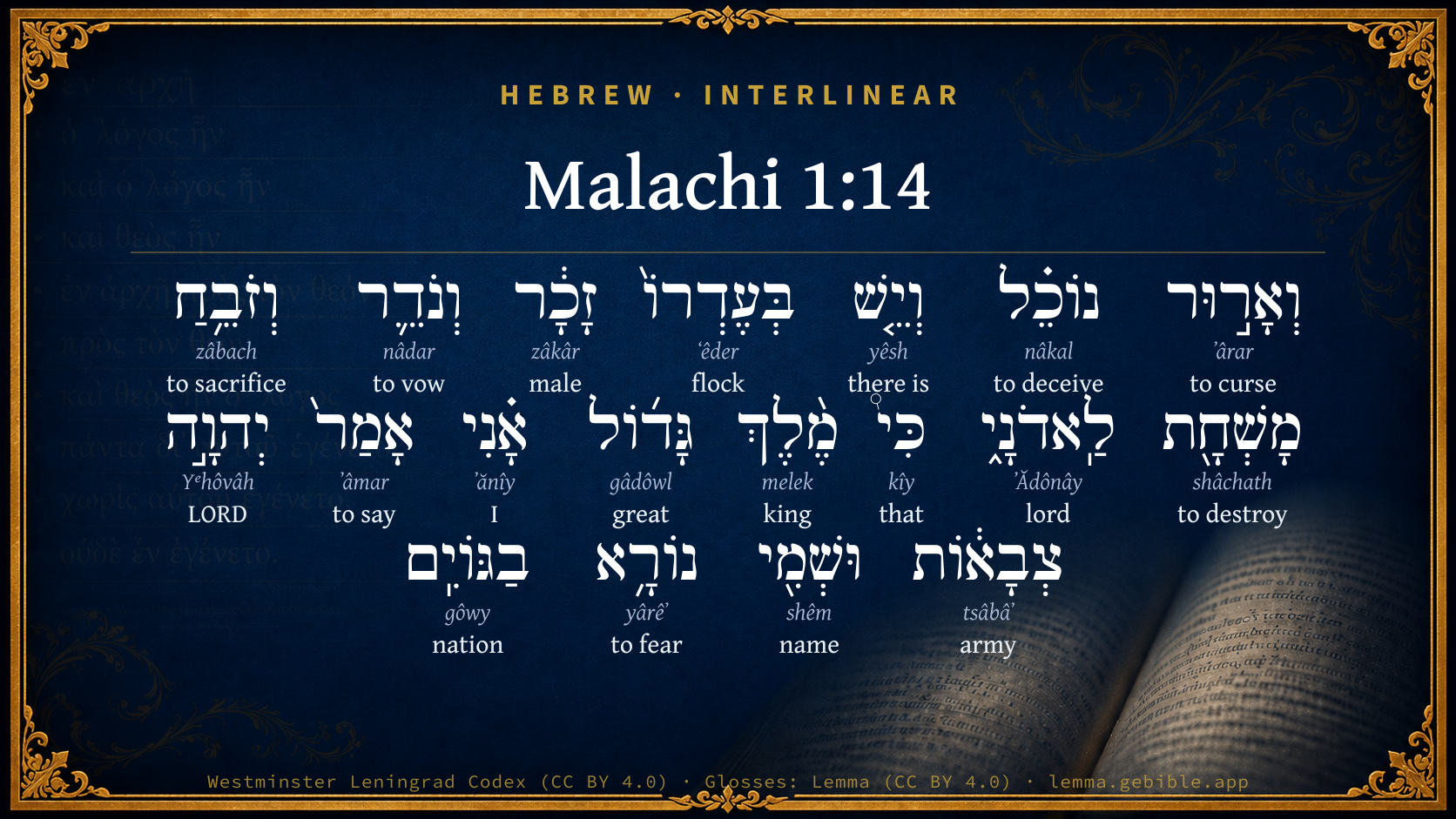
  1. וְאָר֣וּר ʼârar H779 “and · cursed” Conjunction + Verb, Qal, Participle Passive, Masculine, Singular, Absolute
  2. וְיֵ֤שׁ yêsh H3426 “and · there is” Conjunction + Particle, Demonstrative
  3. בְּעֶדְרוֹ֙ ʻêder H5739 “in/at · flock · his” Preposition + Noun, Common, Masculine, Singular, Construct + Suffix, Personal, 3rd Person, Masculine, Singular
  4. זָכָ֔ר zâkâr H2145 “male” Adjective, Adjective, Masculine, Singular, Absolute
  5. וְנֹדֵ֛ר nâdar H5087 “and · vowing” Conjunction + Verb, Qal, Participle Active, Masculine, Singular, Absolute
  6. וְזֹבֵ֥חַ zâbach H2076 “and · sacrificing” Conjunction + Verb, Qal, Participle Active, Masculine, Singular, Absolute
  7. מָשְׁחָ֖ת shâchath H7843 “destroyed” Verb, Hophal, Participle Passive, Masculine, Singular, Absolute
  8. לַֽאדֹנָ֑י ʼĂdônây H136 “to/for · Lord · my” Preposition + Noun, Common, Masculine, Plural, Construct + Suffix, Personal, 1st Person, Common, Singular
  9. כִּי֩ kîy H3588 “that” Conjunction
  10. מֶ֨לֶךְ melek H4428 “king” Noun, Common, Masculine, Singular, Absolute
  11. גָּד֜וֹל gâdôwl H1419 “great” Adjective, Adjective, Masculine, Singular, Absolute
  12. אָ֗נִי ʼănîy H589 “I” Pronoun, Personal, 1st Person, Common, Singular
  13. אָמַר֙ ʼâmar H559 “to say” Verb, Qal, Perfect, 3rd Person, Masculine, Singular
  14. יְהוָ֣ה Yᵉhôvâh H3068 “LORD” Noun, Proper
  15. צְבָא֔וֹת tsâbâʼ H6635 “armies” Noun, Common, Both, Plural, Absolute
  16. וּשְׁמִ֖י shêm H8034 “and · name · my” Conjunction + Noun, Common, Masculine, Singular, Construct + Suffix, Personal, 1st Person, Common, Singular
  17. נוֹרָ֥א yârêʼ H3372 “fearing” Verb, Niphal, Participle Active, Masculine, Singular, Absolute
  18. בַגּוֹיִֽם gôwy H1471 “in/at the · nations” Preposition, Determined + Noun, Common, Masculine, Plural, Absolute

About this verse

These counts appear in no published source. They are computed here, from the morphology-tagged text and Lemma’s own curated glosses. What Lemma adds →

19
words
19
distinct lemmas
Prophets
section

Notable vocabulary

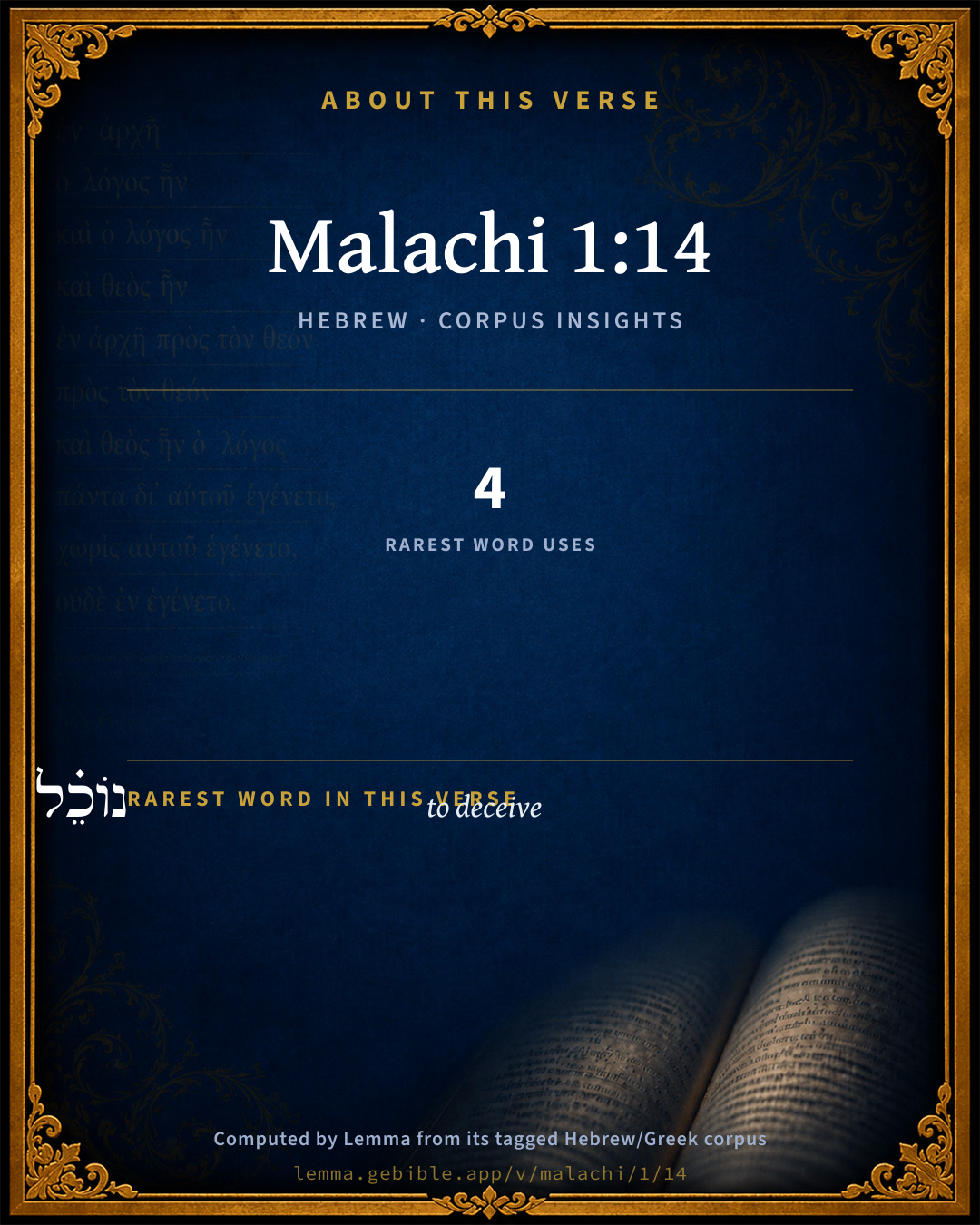
The rarest word here is נוֹכֵ֗ל to deceive H5230 — appearing just 4 times in the whole Hebrew Bible.

Shared distinctive vocabulary

נוֹכֵ֗ל to deceive H5230 occurs in 4 verses of the Hebrew Bible. Also found in:

Grammatical profile

  • 7 verbs
  • 7 nouns
  • 2 adjectives
  • 1 pronoun
  • 1 conjunction
  • 1 particle

Verb forms

  • וְאָר֣וּר Qal · Participle Passive
  • נוֹכֵ֗ל Qal · Participle Active
  • וְנֹדֵ֛ר Qal · Participle Active
  • וְזֹבֵ֥חַ Qal · Participle Active
  • מָשְׁחָ֖ת Hophal · Participle Passive
  • אָמַר֙ Qal · Perfect
  • נוֹרָ֥א Niphal · Participle Active

Hebrew & Septuagint length

In English translation the verse runs 40 words from the Hebrew and 49 from the Septuagint (LXX English) — closely comparable.

A rough comparison of the two English renderings, which tokenize alike — not a word-level alignment.

Word counts can differ between the Hebrew and the Greek without any difference in meaning — e.g. the Hebrew direct-object marker אֵת has no separate Greek word, and Greek often adds the article ὁ.

Cross-references

31

Topical passages linked to Malachi 1:14 in the Treasury of Scripture Knowledge — connected by theme and wording, ordered by reader-vote popularity; previews shown in the World English Bible.

  • Acts 5:1–10 But a certain man named Ananias, with Sapphira, his wife, sold a possession,
  • 2 Corinthians 8:12 For if the readiness is there, it is acceptable according to what you have, not according to what you don't have.
  • Ecclesiastes 5:4–5 When you vow a vow to God, don't defer to pay it; for he has no pleasure in fools. Pay that which you vow.
  • Psalms 76:12 He will cut off the spirit of princes. He is feared by the kings of the earth.
  • Malachi 1:8 When you offer the blind for sacrifice, isn't that evil? And when you offer the lame and sick, isn't that evil? Present it now to your governor! Will he be pleased with you? Or will he accept your person?" says Yahweh of Hosts.
  • Luke 12:46 then the lord of that servant will come in a day when he isn't expecting him, and in an hour that he doesn't know, and will cut him in two, and place his portion with the unfaithful.
  • Leviticus 22:18–21 "Speak to Aaron, and to his sons, and to all the children of Israel, and say to them, 'Whoever is of the house of Israel, or of the foreigners in Israel, who offers his offering, whether it be any of their vows, or any of their freewill offerings, which they offer to Yahweh for a burnt offering;
  • Joshua 7:11–12 Israel has sinned; yes, they have even transgressed my covenant which I commanded them: yes, they have even taken of the devoted thing, and have also stolen, and dissembled also; and they have even put it among their own stuff.
  • Psalms 47:2 For Yahweh Most High is awesome. He is a great King over all the earth.
  • Jeremiah 10:10 But Yahweh is the true God; he is the living God, and an everlasting King: at his wrath the earth trembles, and the nations are not able to abide his indignation.
  • Zechariah 14:9 Yahweh will be King over all the earth. In that day Yahweh will be one, and his name one.
  • Malachi 1:11 For from the rising of the sun even to the going down of the same, my name is great among the nations, and in every place incense will be offered to my name, and a pure offering: for my name is great among the nations," says Yahweh of Hosts.
  • Luke 12:1–2 Meanwhile, when a multitude of many thousands had gathered together, so much so that they trampled on each other, he began to tell his disciples first of all, "Beware of the yeast of the Pharisees, which is hypocrisy.
  • Revelation 21:8 But for the cowardly, unbelieving, sinners, abominable, murderers, sexually immoral, sorcerers, idolaters, and all liars, their part is in the lake that burns with fire and sulfur, which is the second death."
  • Genesis 27:12 What if my father touches me? I will seem to him as a deceiver, and I would bring a curse on myself, and not a blessing."
  • Deuteronomy 28:58 If you will not observe to do all the words of this law that are written in this book, that you may fear this glorious and fearful name, YAHWEH YOUR GOD;
  • Isaiah 57:15 For thus says the high and lofty One who inhabits eternity, whose name is Holy: I dwell in the high and holy place, with him also who is of a contrite and humble spirit, to revive the spirit of the humble, and to revive the heart of the contrite.
  • Jeremiah 48:10 Cursed be he who does the work of Yahweh negligently; and cursed be he who keeps back his sword from blood.
  • Daniel 4:37 Now I, Nebuchadnezzar, praise and extol and honor the King of heaven; for all his works are truth, and his ways justice; and those who walk in pride he is able to abase.
  • Daniel 9:4 I prayed to Yahweh my God, and made confession, and said, Oh, Lord, the great and dreadful God, who keeps covenant and loving kindness with those who love him and keep his commandments,
  • Mark 12:41–44 Jesus sat down opposite the treasury, and saw how the multitude cast money into the treasury. Many who were rich cast in much.
  • 1 Timothy 6:15 which in its own times he will show, who is the blessed and only Ruler, the King of kings, and Lord of lords;
  • Hebrews 12:29 for our God is a consuming fire.
  • Revelation 15:4 Who wouldn't fear you, Lord, And glorify your name? For you only are holy. For all the nations will come and worship before you. For your righteous acts have been revealed."
  • Psalms 48:2 Beautiful in elevation, the joy of the whole earth, Is Mount Zion, on the north sides, The city of the great King.
  • Psalms 68:35 You are awesome, God, in your sanctuaries. The God of Israel gives strength and power to his people. Praise be to God!
  • Psalms 95:3 For Yahweh is a great God, A great King above all gods.
  • Malachi 3:9 You are cursed with the curse; for you rob me, even this whole nation.
  • Matthew 5:35 nor by the earth, for it is the footstool of his feet; nor by Jerusalem, for it is the city of the great King.
  • Matthew 24:51 and will cut him in pieces, and appoint his portion with the hypocrites; there is where the weeping and grinding of teeth will be.
  • Mark 14:8 She has done what she could. She has anointed my body beforehand for the burying.

Cross-references courtesy of OpenBible.info (CC BY 4.0).

Hebrew and Greek witnesses Masoretic Hebrew ↔ Greek Septuagint

The same verse in the two great witnesses to the Old Testament, shown verse-for-verse.

These are two independent witnesses, not word-aligned to each other, and the Septuagint is shown in lemma (dictionary) form.

Hebrew Malachi 1:14 Masoretic · Westminster Leningrad Codex

וְאָר֣וּר נוֹכֵ֗ל וְיֵ֤שׁ בְּעֶדְרוֹ֙ זָכָ֔ר וְנֹדֵ֛ר וְזֹבֵ֥חַ מָשְׁחָ֖ת לַֽאדֹנָ֑י כִּי֩ מֶ֨לֶךְ גָּד֜וֹל אָ֗נִי אָמַר֙ יְהוָ֣ה צְבָא֔וֹת וּשְׁמִ֖י נוֹרָ֥א בַגּוֹיִֽם

"But the deceiver is cursed, who has in his flock a male, and vows, and sacrifices to the Lord a blemished thing; for I am a great King," says Yahweh of hosts, "and my name is awesome among the nations."

World English Bible · Public Domain

Greek LXX Malachi 1:14 Septuagint · lemma form

καί ἐπικατάρατος ὅς εἰμί δυνατός καί ὑποἄρχω ἐν ὁ ποίμνιον αὐτός ἄρσην καί εὐχή αὐτός ἐπί αὐτός καί θύω διαφθείρω ὁ κύριος διότι βασιλεύς μέγας ἐγώ εἰμί λέγω κύριος παντοκράτωρ καί ὁ ὄνομα ἐγώ ἐπιφανής ἐν ὁ ἔθνος

And cursed is the man who had the power, and possessed a male in his flock, and whose vow is upon him, and who sacrifices a corrupt thing to the Lord: for I am a great King, says the Lord Almighty, and my name is glorious among the nations.

LXX2012 (modern English Septuagint) · Public Domain

On this verse, John Gill's Exposition discusses the Septuagint’s reading. Read the note in Commentary ↓

Hebrew: Westminster Leningrad Codex (CC BY 4.0). Greek: Septuagint (public domain); English from LXX2012 (modern English Septuagint) (Public Domain). How the Septuagint differs from the Hebrew →

Targum (Aramaic paraphrase)

1

The Targum is the ancient Jewish Aramaic paraphrase of the Hebrew Scriptures — an interpretive translation, not the Hebrew text itself. Onkelos (literal) and Pseudo-Jonathan (expansive) render the Torah, and Jonathan the Prophets. Coverage is partial: where no permissively-licensed English translation exists for a verse, only the Aramaic is shown. This is verse-level text, not a word-by-word alignment to the Hebrew.

  1. Targum Jonathan Prophets (Joshua–Malachi)
    וְלִיט דְיַעְבֵּיד בִּנְכִיל וְאִית בְּעֶדְרֵיהּ דְכַר וְהוּא חַיָב לִנְדָר וּדְבַח דִמְחַבֵּל קֳדָם יְיָ אֲרֵי מְלַךְ רַב אֲנָא אֲמַר יְיָ צְבָאוֹת וּשְׁמִי חֲסִין בְּעַמְמַיָא:

    (no public-domain English translation for this verse)

    Targum Jonathan — Aramaic: “Mikraot Gedolot” (public domain). English: “Sefaria Community Translation” (CC0 1.0 (public-domain dedication)); “London "Chaldee Paraphrase," 1871” (public domain). Text via Sefaria.

Commentary

Notes on Malachi 1:14 from classic Christian and Jewish commentators (each source and its license shown beneath its notes). The classic Christian expositions comment on the surrounding passage and are grouped to its opening verse, so a note may address several verses; the Jewish commentaries on the Tanakh (Rashi and others) are per-verse, so they appear only where the commentator wrote on this verse.

Lemma curates 59 commentaries, every one of them public domain or Creative Commons licensed, each selected and text-cleaned for this edition rather than reprinted as found. About our sources →

Trapp's Complete Commentary

John Trapp

Mal 1:14 But cursed [be] the deceiver, which hath in his flock a male, and voweth, and sacrificeth unto the Lord a corrupt thing: for I [am] a great King, saith the LORD of hosts, and my name [is] dreadful among the heathen.

Ver. 14. But cursed be that deceiver] Cursed with a curse both verbal and penal; temporal and spiritual, Mal 3:9. These last light heavy, such as are hardness of heart and horror of conscience, though less observed; because they come into the deceiver’s bowels like water, and like oil into his bones; they soak and sink into his soul insensibly, Rom 1:28 Mat 27:5 Psa 109:18. He hath his death about him (as we say of one that hath drunk poison, or eaten an Italian fig), though he fall not down dead immediately. He is accursed, and he shall be so, as, in a contrary sense, Isaac said of his son Jacob, He is blessed, and he shall be blessed. But usually the visible vengeance of God dogs the deceiver at the heels; his sin finds him out, and lays him open to others, as an accursed person. This was Cain’s case and curse, Gen 4:15. God sets a mark upon him; probably it was the perpetual trembling of his hands and whole body, through the horror of his conscience. So, not long before, when Adam had played the deceiver, and hearkened to that old impostor, the subtle serpent, God spared him, but cursed the ground (as the Persians, when their noblemen’s sons had made a fault, hanged up their coats and whipped them in their presence): "Cursed is the ground for thy sake: thorns also and thistles shall it bring forth," Gen 3:17. And the truth is, it was never beautiful nor cheerful since that curse inflicted; but lies bedridden, waiting for the coming of the second Adam to free it from that heavy curse, Rom 8:20. The barren fig tree felt the power of Christ’s curse even to admiration, Mat 21:20 "For when the disciples saw it, they marvelled, saying, How soon is the fig tree withered away!" They might marvel well enough; for the fig tree is the most juiceful of any tree, and bears the brunt of winter-blasts without withering. But the blasts of Christ’s mouth are more powerful. He can blow men to destruction, Job 4:9., as so many dust-heaps; yea, frown, not some single fig tree only, but the whole vineyard to desolation. "It is burnt with fire, it is consumed: they perish at the rebuke of thy countenance," Psa 80:16. Men may curse, and no hurt follow; "the curse causeless shall not come," Pro 26:2. Micah’s mother cursed when she lost her money, Jdg 17:2; but who cared or fared the worse for that? And the like may be said of Julius Palmer the martyr’s mother, when he craved her blessing upon his knees, she drove him out of doors for a heretic, and said, God’s curse and mine go with thee.

What was David the worse for Shimei’s cursing of him, or Jeremiah for the people’s, Jer 15:10, or the reformed Churches for the Pope’s? The silly people in Italy are made to believe that ever since the Pope excommunicated Queen Elizabeth the people of England are all as black as devils. The Pope is like a wasp, no sooner angered but out comes a sting; which, being out, is like a fool’s dagger rattling and snapping without an edge. We may say of his curses (with bell, book, and candle), as Vogetius saith of chariots armed with scythes and hooks, that at first they were a terror, and after a scorn, lib. 1, cap. 24. But God’s curses are terrible, and light heavy. Together with word there goes forth a power (as it is said in another case), and what be speaketh with his mouth he maketh good with his hand. And it is a fearful thing to fall into the punishing hands of the living God: those that have felt his finger will say so. This the deceiver is sure to do if timely course be not taken. Currat ergo poenitentia, ne praecurrat sentontia.

That deceiver] That fraudulent fellow, that crafty companion, that fraud, quadruplator, machinator, that dealeth subtilly with the Lord, as the Egyptians did with his people, and thinks to outwit him, as the Midianites did the Israelites, {see Num 25:18 Psa 10:18, in both which places the same word is used as here} that casteth and fetcheth about ( versutulus et versatilis), how to deceive both God and man with shows of devotion; not afraid to be damned, so he may seem to be saved, and seeking so long to deceive others, that in fine he deceiveth his own soul (which is the worst kind of deceit, as self-murder is the worst sort of murder), winding himself into the fool’s paradise of a sublime dotage, and that in matters of greatest consequence and concern. Imposturam faciunt et patiuntur, as that emperor said of them that sold glass for pearl; they mock and are mocked, deceiving or being deceived, as Paul saith; like some drunken stage-player, they have acted a king’s part so long, that now they begin to think themselves kings indeed; and, like sleeping Sisera, they dream of a kingdom, when as Jael’s nail is nearer his temples than a crown. A curse he is sure of, set on by God (who then shall take it off?), and seconded by men, yea, by men that were without God in the world. Witness that law of the twelve tables in Rome, Sacrum, sacrove commendatum qui clepserit rapseritve, parricide este. Let him be punished for a parricide that shall commit sacrilege of any sort. Now, a hypocrite is by Basil rightly called ιεροσυλος, a sacrilegious church-robber; because he steals from God το του θεου αναθημα, himself dedicated to God by profession of Christianity; and so becomes Aναθημα, accursed, yea, Anathema, Maran-atha, double accursed, and put over to God to punish; who hath prepared the hottest fire in hell for such, because their sin is increased by their knowledge; as the sin of Solomon in honouring idols, which he knew to be no gods, was far greater than that of his wives’, which believed them to be gods, as Tostatus truly observeth.

Which hath in his flock a male] A flock he hath then, and is a sheep-master; able, perhaps, to say, as he in the poet - mille meis errant in montibus agni. Were he a poor man he might be the better excused; from a little God accepts a little. Again, he hath a male in his flock, a sound, tidy, fat lamb, or ram; and, reserving that for his own use, though he had voluntarily vowed it to God, he brings a corrupt carrion, or a lean starveling, for a sacrifice. This deceitful dealing is his sin, that subjects him to the curse. This was the sin (and became the calamity) of those in Jer 4:22, that served not God with the best of their understanding; of those in Hag 1:4, that dwelt in their ceiled houses, and let the Lord’s house lie waste; of Solomon (some think), that bestowed twice as much time in building his own house as God’s house; of all those that seek not God’s kingdom in the first place, that give not God the best of the best, the primrose of their age, the first thoughts in the morning, the fittest and freest times of the day for prayer, &c. Scipio went first to the Capitol every day, and then to the Senate House. David prevented the night watches to pray. Christ was at it a great while before day, Mar 1:35. Of Charles the Great it is reported, that he spoke and conversed more with God than with men. Our King Alfred cast the natural day into three parts: eight hours he spent in prayer, study, and writing; eight in the service of his body; and eight in the affairs of his state. The Jews divided the business of the day into three parts: the first, ad Tephilla, that is, for prayer; the second, ad Torah, for the study of the law; the third, ad Malchah, for work; this they did on working days; besides their weekly sabbath and other holy days strictly observed, which made Seneca (that profane heathen) say of them, that they lost more than a seventh part of their time. How much better might he have bewailed his own loss of time, and neglect of the one thing necessary, in the words of Bernard, Totum vitae meae tempus perdidi, quia perdire vixi, I have lost my whole life, because I have lived without God in the world! What a happiness had it been to him if he had observed Aristotle’s rule, and Thales’ examples, viz. that a philosopher may get riches, but that is not their main business (αλλ ου τουτ εστι περι ου σπουδαζουσι, Arist. Polit. lib. 1, cap. ult.). Many are so busied in the world, that they think not of God’s kingdom (which yet they vowed to do when they were baptized), as the Duke of Alva told the King of France, who asked him whether he had observed the late great eclipse? No, said he, I have so much to do upon earth, that I have no leisure to behold the heaven. How much better Anaxagoras, the philosopher, who, being asked why he came into the world? answered, Ut coelum contempler, that I may contemplate heaven! Men should certainly mind heaven most and first; and not suffer the lean kine to eat up the fat, the thin ears of corn the good; but honour God with the best of their substance and with the best of their abilities (if they stand bound by vow especially, if they have vowed a male to God). Let it not be according to the Italian proverb with us, Sciapat il morbo fraudato il Santo, when the danger is escaped the vow is neglected, lest else God curse them, as here, for a company of defrauders; and make them know and rue his breach of promise, Num 14:34. Surely if Jacob was afraid when he went about to seek a blessing, lest his blind father should discern him, and his deceit in dealing with him, and so he might get a curse instead of a blessing, Gen 26:12, how ought men to take heed and fear to dissemble or deal deceitfully with the all-seeing God! especially since he is so great a God (see him set forth in his greatness, Deu 10:17), and, therefore, less patient with affronts and indignities; he looks to be served like himself, and according to his excellent greatness.

For I am a great King, saith the Lord of hosts] Yea, a great King, because Lord of hosts. {See Trapp on "Mal 3:17"} παντοκρατωρ, παμβασιλευς, Aυτοκρατωρ. He is absolute monarch of the whole world; and by him it is that all other kings reign and princes rule, Pro 8:15. All other sovereigns are but his substitutes, his viceroys; he makes them and unmakes them at his pleasure, as proud Nebuchadnezzar was forced to acknowledge, Dan 4:37. Hence he is rightly styled a great King (a title anciently given to the kings of Persia, and now to the Grand Signior), yea, he is King of kings and Lord of lords, in another sense than Maximilian, the Emperor of Germany, said that he was, because the princes and cities of the empire were free states, and yielded him little obedience. God hath all the kings of the earth at his beck and check: Constantine the Great, Valentinian, and Theodosius, three emperors, called themselves Vasallos Christi, the vassals of Christ, as Socrates reporteth. And well they might; inasmuch as all nations (taken together) are, in comparison to him, but as a drop of a bucket, and as the dust of the balance: behold, he taketh up the isles as a very little thing, as one would take up a feather at his foot. And if a sacrifice fitting for him should be prepared, Lebanon would not be sufficient to burn, nor all the beasts thereof for a burnt offering. All nations to him are as nothing, Isa 40:15-16. Simon Magus gave out that he was some great matter; and the world hath been troubled with Alexander the Great, and Pompey the Great. But what is now become of all these grandees, with their swelling titles and loud brags? Hath not God long since cut off the spirits of these petty princes, and become terrible to the kings of the earth? Psa 76:12; where the word rendered cut off signifieth that he slips them off, as one would slip a flower between one’s fingers, or a bunch of grapes off the vine. The kings of Persia were wont to give laws to their people sitting in a chair of state, under a vine tree of gold, that had, as it were, bunches of grapes made up of smaragdites, or emeralds, and other stones of greatest price. The King of heaven sits upon a throne far more costly and stately; as may be seen, Eze 1:26 Isa 6:1-4 Dan 7:13-14 Omnino igitur oportet nos, orationis tempore, curium intrare coelestem, in qua Rex Regum stellato sedet solio, &c., as Bernard excellently inferreth, it behoveth us, therefore, at prayer time, to enter into the court of heaven, where the King of kings sits in his starry and stately throne, environed with an innumerable number of glorious angels and crowned saints; with how great reverence, therefore, with how great fears, with how great humility, ought a poor base toad, creeping and crawling out of his ditch, to approach so dreadful a presence!

And my name is dreadful among the heathen] It was ever so from the very distinction of men into Hebrews and heathens. At the first, before the covenant made with Abraham, all nations were alike before the Lord. But as soon as it was said, I will be thy God, and the God of thy seed after thee, the Church was evidently divided from the world, as light was from darkness at the first creation. The heathens God suffered to walk in their own ways. "Nevertheless, he left not himself without witness," Act 14:16-17; but his name was ever terrible and tremendous among them. The Hittites honoured Abraham as a prince of God; Pharaoh was raised up on purpose, that on him God might get him a name throughout all the earth, Exo 9:16. Jethro heard of his doings in Egypt, and became a proselyte. The hearts of the Canaanites melted, and they were made to say, "The Lord your God, he is God in heaven above, and in earth beneath," Jos 2:11. The Philistines were woe begone when they beheld the ark of the God of Israel brought into the field; and were ready, as worms, to wriggle into their holes. The King of Babylon sent ambassadors and a present to Hezekiah, because he had heard that for his sake God had caused the sun to go back. Daniel records what a name God had gotten him in his days all the world over. And after the captivity, near Malachi’s time, the famous victories gotten by the Maccabees were far and near discoursed of. Judas Maccabaeus had his name from the capital letters of this motto written in his ensign, Mi camocha Elohim Iehovah, who is like unto thee, O Lord, among the gods? But, besides, and above all this, God’s name is dreadful among the heathen in a special manner now; since the calling of the Gentiles, and the conversion of so many nations to the faith of Jesus Christ, defy the malice of earth and of hell. This made Calocerius, a heathen, say, Vere magnus est Deus Christianorum, the God of the Christians is a great God indeed. And another, Aξιωματικωτατος εστιν ο Yεος υμων, your God is a most majestic God. What a mouth of blasphemy then opened that desperate Papist, John Hunt, in his humble appeal to King James! The God of the Protestants, saith he (whom he knows to be the Father, Son, and Holy Ghost), is the most uncivil and evil mannered God of all those who have borne the name of gods upon the earth; yea, worse than Pan, God of the clowns, which can endure no ceremonies nor good manners at all. True it is, that human inventions in his service, and Popish will worships, our God will not away with. Such strange fire if any presume to bring before him, they may look to speed as Nadab and Abihu, Core and his complices, did; but he expects and requires that all his worshippers should come before him with reverence and godly fear: "For even our God" (no less than the Jews’ God) "is a consuming fire," Heb 12:28. He is terrible out of his holy places, Psa 68:35. And albeit he loves to be acquainted with his people in the walks of their obedience; yet, as a great King, he takes state upon him in his ordinances, and will be trembled at in his word and sacraments. Hence Chrysostom calls the Lord’s table that dreadful table (φρικωδης); and other ancients call sacraments τα φρικτα μυστηρια, terrible mysteries. He that comes to this table without his wedding garment may look to be taken from the table to the tormentor. That is a remarkable text, Exo 34:10-11, upon the nobles of the children of Israel he laid not his hand: also they saw God, and did eat and drink. So dreadful is God, and so infinite is the distance between him and the greatest noble that comes to his table, that it is an honour they may be suffered to live in his sight; how much more, then, to partake of his ordinances! Kings and judges are instructed to serve the Lord with fear, and to rejoice before him with trembling, Psa 2:10-11. This is horror sacer, holy awe, saith a Lapide upon this text, descanting upon their Vulgate interpreter, who rendereth the word dreadful horrible, Et nomen meum horribile. But what an odd conceit was that of a certain sophister at Paris, who would needs be called the horrible sophister, non minorem eam appellationem ratus quam Africani aut Asiatici, saith Vives. Perhaps he had read this text in the Vulgate translation. Unless they had the same law at Paris that they had in Italy, that none should read the Bible lest they should thereby be made heretics; but rather study Aristotle (whom Peter Lombard had brought into more request than St Paul, as the Sorbon at Paris complained), or the Canon Law, whereof Carolostadius had been eight years a doctor before he began to read the Scripture; and yet at the taking of his degree had been pronounced, Sufficientissimus.

John Trapp, A Commentary or Exposition upon All the Books of the Old and New Testament (1647–1656) — public domain. Text from a community e-Sword module.

The Biblical Illustrator

Joseph S. Exell

Mal_1:14

But cursed be the deceiver.

A cursed one

Curses are the echoes that sin awakens. All deceivers are cursed.

I. The deceiver. He may be a self-deceiver, or a deceiver of others, or both. Some may unconsciously deceive; others intentionally. It is the intentional deceiver that is cursed; he who aims to deceive others. These abound in--

1. Religious communities. The wily priest, the glib teacher of error, the hypocrite.

2. In the social circle. The liar, the seducer, the false friend.

3. In commerce. The unreliable employee, the concocter of lying prospectuses, the swindling merchant.

4. In political movements. The bribing agent, the self-seeking adventurer, the unscrupulous statesman. Men sometimes turn themselves into incarnate falsehoods for the sake of worldly success. The advantages gained are only seeming, not real. The deceiver is--

(1) Foolish. He injures himself for the sake of uncertain good.

(2) Despicable. Society treats the exposed deceiver with contempt. All honest men shun him.

(3) Treacherous. He is like a splintered staff, a rotten cable, a sandy foundation, a spiders web, a wreckers beacon, a flower-covered bog, a desert mirage, etc.

(4) Mischievous. He lays traps for the innocent. He destroys social confidence.

(5) Diabolical. Like Lucifer, he sins in wily guise. He is a true son of the father of lies.

II. HIS CURSE. This may be suspicion, discredit, fear of discovery, exposure, stings of conscience, spiritual blindness, the execrations of his victims; the contempt of all good men; the displeasure of the Almighty, hell-fires, etc. His curse is certain. In a universe where a God of truth and righteousness reigns, the deceiver is sure to be punished. The curse is terrible and eternal. Application--

1. Let us guard ourselves against all deceivers.

2. Let us beware of deceit.

3. Better be deceived than deceive. (W. Osborne Lilley.)

And sacrificeth unto the Lord a corrupt thing.

The service of God an unblemished offering

The prophets were Gods messengers, commissioned to witness in His name against the sins of the people. To understand this remonstrance aright, we must remember what were the laws respecting the offerings. The prime of each offering was to be presented to God. But these profane priests thought that anything would serve for a sacrifice, though never so coarse and mean. They picked out the worst they had, that which was neither fit for the market nor for their own tables, and offered that at Gods altar. With every sacrifice the law commanded them to bring a meat-offering of fine flour, mingled with bread: but they brought polluted bread, of coarse and refuse material. The principle illustrated is--that the service of God admits of nothing short of the most perfect offering that can be presented; and everything below this affixes upon the offerers the character of deceivers, and the condemnation of being cursed.

I. The service of religious worship.

1. It is profane service whenever it is not intelligent, whenever it is not founded on a right understanding of the object of worship. You, who have watched the movements or the torpidity of your minds at the time of supposed prayer, will bear me witness how often you have failed to recognise the simple being of the God before whom you bow down.

2. No offering of worship is acceptable which is not also solemn and reverential. This it could not fail to be if we were possessed by a just sense of the transcendent greatness of Him to whom prayer is presented. His majesty is infinite and ineffable, and therefore we stand at an immeasurable distance from Him. And yet to such a Being we address ourselves in prayer. Do any of us detect in ourselves the vacant gaze, the roving thought?

3. Acceptable worship must be spiritual. Why so? God is a Spirit, and they that worship Him must worship Him in spirit and in truth. They must so worship Him, because it is not possible that He should receive any other. Do you assert that God is a Spirit, then you contract Him into the narrow dimensions of your own being if you give Him no more than the devotions of the body, if you give Him not the ardent services of your soul.

4. If our worship be genuine, it will be marked by intentness of mind. Languor and laxness of the spirit are sure tokens that it is not a glad offering, but an irksome task. In all these cases what is the sin which we charge home but that very sin for which the prophet utters his rebuke? They have a better offering which they might offer. They are capable of a worship more worthy of God. Instead, they bring the lame, and the sick, and the torn, they sacrifice unto the Lord a corrupt thing.

II. The habitual service of the life. Here too the service of God admits of nothing short of the most perfect offering that can be presented. Our baptismal covenant, made for us in our unconscious infancy, when our own reason was not privy to the engagement, is sealed and confirmed in maturer age; and then it is that we deliberately and personally vow to give the choice thing in our flock. But where is he to be found that fully recognises and performs the baptismal oath? The baptised man, the communicant, and the parent for his child, and he who is in near danger, has vowed, deliberately, unto God, the male that is in his flock; but he leaves off with sacrificing unto the Lord a corrupt thing. (R. Eden, M. A.)

I am a great King, saith the Lord of hosts.--

Jehovah a king

What God is Himself, what constitutes His essence no language can describe. What God is to His creatures, and what relations He sustains with respect to them, may without difficulty be stated in language sufficiently intelligible. Sometimes God styles Himself a father, sometimes a master, and sometimes a king.

I. Jehovah is a king. A king is the political head or supreme ruler of a kingdom. There are kings by right, and kings in fact. The king by right has claim to the throne, though he may not possess it. The king in fact actually possesses the throne, though he may have no right to it. He alone who has both the right and the possession can properly be called a king. And such a king is Jehovah. His kingdom is the whole created universe, and of this kingdom He is in actual and full possession. And He is the rightful sovereign of the universe. All men were born into the dominions of Jehovah. Men cannot cease to be His subjects without ceasing to exist. He possesses all the insignia of royalty. He has a throne, a crown, royal robes, etc.

II. Jehovah is a great king. Great is the Lord, and His greatness is unsearchable. See the greatness, duration, and stability of His empire. His kingdom is an everlasting kingdom.

1. If God is a king, He is under obligations to make laws for His subjects. When He assumes any office He binds Himself to perform all the duties of that office. The first and most indispensable duty of an absolute sovereign is to make laws for his subjects. It is as much his duty to make laws, as it is their duty to obey them when made.

2. He is under obligations to make the wisest and best laws possible. It was incumbent on him to consult, not the private wishes and inclinations of individuals, but the great interests of his whole kingdom.

3. He is under obligations to annex some penalty to every violation of his law. A law without a penalty annexed is not a law, that is, it cannot answer the purpose of a law.

4. He is bound to enforce his laws, and to inflict the threatened punishment on all who transgress them. He must not bear the sword in vain, but be a terror to evil-doers. Justice in a sovereign ruler consists in treating his subjects according to their deserts. He may be guilty of injustice by treating them better than they deserve, as well as by treating them worse than they deserve. But God cannot act unjustly.

5. We may learn the necessity of an atonement for sin. Something which shall maintain the authority of Gods law, secure the great interests of His kingdom, and answer all the ends of government, no less effectually than the infliction of merited punishment upon transgressors. Without such an atonement God cannot consistently with justice, or His obligations as a sovereign, pardon a single offender.

6. If Jehovah is king, sin is treason and rebellion, and every impenitent sinner is a traitor and a rebel.

7. If Jehovah is king, it is requisite that He should have ambassadors, in order that His will should be communicated to His subjects. Gods inspired messengers, the prophets and apostles, were ambassadors extraordinary. His ministers are His ambassadors to-day. (E. Payson, D. D.)

God a great King

Men reveal their conceptions of God by the kind of homage they render to Him. God was dishonoured by the hypocritical worship of His own people; they were representing Jehovah as a senseless idol To reprove them He here declares His greatness.

I. This declaration which Jehovah makes respecting Himself. God places Himself towards us in various aspects. He is a king. He has in Himself all the qualities of kingly greatness. Kings should be the greatest of men. He has all the attributes of a great king. His power, authority, majesty, etc. His dominions are great. His kingdom is eternal.

II. What lessons may be learnt from this declaration. Learn--

1. To reverence Him.

2. The importance of securing His favour. He has shown us the way to secure it--by repentance, faith, and obedience.

3. To trust implicitly in His overruling providence.

4. To submit ourselves to His government.

5. To expect great blessings from His hands. Great expectancy in His creatures pleases Him. Great expectations from Him are never disappointed. (W. Osborne Lilley.)

God is a great king

In one country abroad, much plagued by invasions from heathens, a grand old custom sprang up in their churches. When the Apostles Creed was repeated the noblemen and men-at-arms drew their swords, and did not sheathe them again until the creed was over. They meant it as a sign that God was their king, and that they would show their earnestness in saying so, if need be, by fighting and dying for that God to whom they owed all, and that Church of God to which they belonged. (C. Kingsley.)

The Biblical Illustrator, edited by Joseph S. Exell (c. 1880s–1900s) — public domain. Text from a community e-Sword module.

Joseph Benson's Commentary

Mal 1:14. But cursed be the deceiver — The hypocrite, that deceives man, and seems as if he would be glad to deceive God; the false heart, that intends one thing and pretends another, would appear to offer a sacrifice of the best, but puts God off with the worst. Which hath in his flock a male — A perfect male, such as God requireth; and sacrificeth unto the Lord a corrupt thing — Such as the Lord hath declared he will not accept. The former reproofs related only to the priests; here the prophet reproves those in general who showed a contempt of God by vowing unto him, upon any occasion, the worst of their flock. It seems to be spoken of such offerings as any of the people, of their own accord, vowed to God: see Lev 22:19. And if they did not think fit to vow such things as God directed, they would have done less dishonour to him not to have vowed at all. For I am a great King, saith the Lord, and my name is, or shall be, dreadful — As God is the great King over all the earth, and will be acknowledged as such among the Gentiles under the gospel, (Mal 1:11,) so men’s religious services ought to be performed with a reverence suitable to the greatness of his majesty.

Joseph Benson's Commentary on the Old and New Testaments (1811–1818) — public domain. Text from a community e-Sword module.

Keil & Delitzsch

C. F. Keil & F. Delitzsch

"And cursed is he who deceives whilst there is in his flock a male animal, and he who vows and sacrifices to the Lord that which is corrupt; for I am a great King, saith Jehovah of hosts, and my name is feared among the nations." This verse is not attached adversatively to Mal 1:13, but Vav is the simple copula, for the question in Mal 1:13 has a negative sense, or is to be answered by "No." To this answer there is attached the curse upon all the Israelites who offer such sacrifices to God as have not the characteristics required by the law. Two cases are mentioned. In the first place, that when according to the law a male animal ought to have been sacrificed, the person offering the sacrifice offered a female, i.e., one of less value, under the pretence that he did not possess or could not procure a male. The prophet calls this nâkhal, cheating. The second case refers to votive sacrifices; for which as zebhach shelâmı̄m (Lev 22:21) both male and female animals could be used, though only such as were free from faults, inasmuch as animals having any moshchâth are declared in Lev 22:25 to be not acceptable. Moshchâth, according to the Masoretic pointing, is the feminine of the hophal participle for משׁחתתּ, like משׁרת for משׁרתת in Kg1 1:15 (cf. Ewald, 188, b, and Olshausen, p. 393), according to which we should have to think of a female animal in bad condition. This pointing, however, is probably connected with the view still defended by Ewald, Maurer, and Hitzig, that the words ונדר וזבח are a continuation of the circumstantial clause וישׁ וגו, and that Mal 1:14 only refers to votive sacrifices: Cursed is the deceiver who has in his flock a male, but vows and sacrifices a corrupt female. This view, however, is evidently opposed to the meaning of the words. If לונדר were a circumstantial clause, we should expect והוּא נדר. Moreover, since even female animals were admissible for votive sacrifices, the vowing and offering of a female animal could not be blamed in itself, and therefore what was reprehensible was not that a female animal was vowed and offered in sacrifice by any one, but that, instead of offering a faultless animal (tâmı̄m), he presented a blemished one. We must therefore follow the ancient translators and many commentators, who read moshchâth (masc.), according to which the curse is pronounced upon any one who vowed a sacrifice and afterwards redeemed his vow with a faulty and unsuitable animal. An animal was moshchâth, corrupt, when it had any fault, which rendered it unsuitable for sacrifice. The reason for the curse is explained by reminding them of the greatness of God. Because Jehovah is a great King and His name is feared among the nations, to offer a corrupt animal in sacrifice is an offence against His majesty.

Keil & Delitzsch — Biblical Commentary on the Old Testament (1861–1891) — public domain (CC PDM 1.0). Text via the HelloAO Bible API. (Old Testament only.)

Tyndale Open Study Notes

Tyndale Open Resources

1:14 Cursed: To “bind with a curse” was to deliver an individual over to misfortune as punishment for a serious crime against the community (see Deut 27:15-26; Jer 48:10). Malachi spoke for the Lord, so the curse was a pronouncement of doom.

Tyndale Open Study Notes — © Tyndale Open Resources, licensed CC BY-SA 4.0. Text via the HelloAO Bible API.

Geneva Bible (1599)

Geneva Bible translators

That is, hath ability to serve the Lord according to his word, and yet will serve him according to his covetous mind.

Geneva Bible (1599) marginal notes — public domain. Text via Bolls.life.

Jamieson, Fausset & Brown

Robert Jamieson, A. R. Fausset & David Brown

deceiver--hypocrite. Not poverty, but avarice was the cause of their mean offerings.

male--required by law (Lev 1:3, Lev 1:10).

great King-- (Psa 48:2; Mat 5:35).

my name . . . dreadful among . . . heathen--Even the heathen dread Me because of My judgments; what a reproach this is to you, My people, who fear Me not (Mal 1:6)! Also it may be translated, "shall be feared among," &c. agreeing with the prophecy of the call of the Gentiles (Mal 1:11).

Next: Malachi Chapter 2

Jamieson, Fausset & Brown — Commentary Critical and Explanatory on the Whole Bible (1871) — public domain (CC PDM 1.0). Text via the HelloAO Bible API.

Adam Clarke's Commentary

Verse 14. Cursed be the deceiver] Those who act thus, as they cannot elude God's notice, so neither shall they escape his curse.

And voweth, and sacrificeth - a corrupt thing] The history of Ananias and Sapphira, Ac 5:1, c., is a complete comment on this. It was high time to break up this corrupt service and after this time God does not appear to have paid any regard to it, for he sent them no other prophet.

Adam Clarke's Commentary on the Bible (1810–1826) — public domain. Text from a community e-Sword/MySword module.

John Calvin's Commentaries

I come now to the kind of fraud they practiced, If there be, he says, in his flock a male, that is, a lamb or a ram, when he vows, then what is corrupt he offers to Jehovah. He then means, that though they pretended some religion, yet nothing was done by them with a sincere and honest heart; for they immediately repented of the vow made to God; they thought that they might be reduced to poverty, if they were too bountiful in their sacrifices. Hence then the Prophet proves that they offered to God with a double mind, and that whatever they thus offered was polluted, because it did not proceed from a right motive.

We said yesterday, that the Prophet did not require fat or lean beasts, because God valued either the blood or flesh of animals on its own account, but for the end in view; for these were the performances of religion by which God designed to train up the Jews for the end contemplated, and in the duty of repentance. As then they were so sordid as to these sacrifices, it was easy to conclude, that they were gross and profane despisers of God, and had no concern for religion.

The reason follows, For a great king am I, saith Jehovah, and my name is terrible among the nations. God declares here that his majesty was of no account among the Jews, as though he had said, “With whom do you think that you have to do?” And this is what we ought carefully to consider when engaged in God’s service. We indeed know that it is a vice which has prevailed in all ages, that all nations and individuals thought that they worshipped God, when they devised foolish and frivolous rites according to their own fancies. If then we have a desire to worship God aright, we must remember how great he is; for his majesty will raise us up above the whole world, and cease will that audacity which possesses almost all mankind; for they think that their own will is a law, when they presumptuously obtrude anything on God. The greatness of God then ought to humble us, that we may not worship him according to the perceptions of our flesh, but offer him only what is worthy of his celestial glory.

He again repeats what we have before observed, though it was disregarded by the Jews, — that he was a great king through the whole world. As then the Jews thought that sacrifices could not be offered to God, such as he would accept, in any other place but at Jerusalem, and in the temple on Mount Sion, he testifies that he is a great king even in the farthest parts of the world. It hence follows, that God’s worship would not be confined to Judea, or to any other particular part of the world; for by the gospel the Lord would receive to himself all nations, and come into the possession of his kingdom. Now follows

John Calvin's Commentaries (1540-1563) — public domain. Text from the Calvin Translation Society English edition (1840s-50s) via the Christian Classics Ethereal Library (ccel.org). Calvin's coverage is partial (roughly two-thirds of the Bible); uncommented books and verses are honest gaps, never fabricated. The 19th-century editor's footnotes and remarks are omitted so the notes are faithfully Calvin's own voice.

Ellicott's Commentary for English Readers

(14) Some consider that two cases are mentioned in this verse. (1) One who acts deceitfully (by offering a female as a burnt offering, which is contrary to the Law, while there is in his flock a male); (2) and one who makes a vow (to offer a sacrifice of peace offerings, for which either a male or a female was allowable, provided it were without a blemish: Lev_22:23), and then offers an animal that has a blemish. But it is better to understand but one case to be mentioned—viz., that of a man who vows, and while he has a male in his flock offers a female with a blemish. A female without blemish would be admissible as a vow offering, but a male without blemish would be the most valuable, because it could be offered as a burnt offering, whereas a female could not; while a female with a blemish would be the very worst, and actually illegal. A man is not bound to make a vow, but if he make one his offering should be of the very best, just as he would not dare to offer to a king or to his ruler (Mal_1:6) anything but the best. How cursed, then, must he be who, while he possesses the best, deliberately makes a vow to God, and then offers Him the very worst.

A Bible Commentary for English Readers, edited by Charles John Ellicott (1878–1897) — public domain. Text from a community e-Sword module.

The Cambridge Bible for Schools and Colleges

gen. ed. J. J. S. Perowne

14. a corrupt thing] or, a blemished thing, R.V. The word is feminine, and the meaning may perhaps be, that for a perfect male, which he has in his flock and therefore could offer, as the law required (Lev_22:18-19), he substituted a blemished female.

The Cambridge Bible for Schools and Colleges (gen. ed. J. J. S. Perowne; Cambridge University Press, 1878–1918) — public domain. Text from a community e-Sword module.

John Gill's Exposition

But cursed be the deceiver,.... A cunning, crafty, subtle man, who thinks and contrives, speaks and acts, in a very artful and deceiving manner; though some derive the word from "to be able"; and so the Septuagint and Arabic versions render it, "who is able"; to bring a proper offering, a perfect lamb, as it follows:

which hath in his flock a male; without spot and blemish, as the law requires:

and voweth and sacrificeth to the Lord a corrupt thing; that was a female, or had blemishes in it; for the law required what was perfect and without a blemish for a vow; what was superfluous or deficient in its parts might do for a freewill offering, but not for a vow, Lev 22:18 wherefore such a man must be accursed, and such conduct must be highly resented by the Lord; had he it not in his power to do better, it might be excusable; but then it would be better not to have vowed at all; but to vow a sacrifice to the Lord, and deal deceitfully with him, when he could have brought an offering agreeable to his vow, and to the law, this is aggravated wickedness:

for I am a great King, saith the Lord of hosts; the King of the whole world, the King of kings, and Lord of lords; and therefore to be honoured and reverenced suitable to his dignity and greatness:

and my name is dreadful among the heathen; because of his judgments executed among them; or rather because of his Gospel preached unto them; for this may be considered as a prophecy of what would be when the Gospel should be spread in the Gentile world; and therefore if they, when he was made known to them, would fear and reverence him; then the Israelites, to whom he had given such instances and proofs of his love, ought to have shown a greater regard unto him.

Next: Malachi Chapter 2

John Gill's Exposition of the Whole Bible (1746–1763) — public domain (CC PDM 1.0). Text via the HelloAO Bible API.

Albert Barnes' Notes on the Bible

Cursed is the deceiver - o “The fraudulent, hypocritical, false or deceitful dealer, who makes a show of one thing, and doth or intends another, nor doth to his power what he would make a show of doing; as if he could deceive God in doing in His service otherwise than He required, and yet be accepted by Him.” The whole habit of these men was not to break with God, but to keep well with Him on as easy terms as they could. They even went beyond what the law required in making vows, probably for some temporal end, and then substituted for that which had typical perfection, the less valuable animal, the ewe and that, diseased. It was probably, to prevent self-deceit, that the law commanded that the oblation for a vow should be Lev 22:19, Lev 22:21, “a male without blemish, perfect;” lest (which may be a temptation in impulsive vows) repenting of their vow, they should persuade themselves, that they had vowed less than they had. Ordinarily, then, it would not have been allowed to one, who had not the best to offer, to vow at all. But, in their alleged poverty, the prophet supposes that God would so far dispense with His own law, and accept the best which anyone had, although it did not come up to that law. Hence the clause, “which hath in his flock a male.” “If thou hast not a male, that curse in no wise injureth thee. But saying this, he showeth, that they have what is best, and offer what is bad.”

They sinned, not against religion only, but against justice also. “For as a merchant, who offers his goods at a certain price, if he supply them afterward adulterated and corrupted, is guilty of fraud and is unjust, so he who promised to God a sacrifice worthy of God, and, according to the law, perfect and sound, is fraudulent and sins against justice, if he afterward gives one, defective, mutilated, vitiated, and is guilty of theft in a sacred thing, and so of sacrilege.”

Clergy or “all who have vowed, should learn hence, that what they have vowed should be given to God, entire, manly, perfect, the best. For, reverence for the Supreme and Divine Majesty to whom they consecrate themselves demandeth this, that they should offer Him the highest, best and most perfect, making themselves a whole-burnt-offering to God.”

, “They who abandon all things of the world, and kindle their whole mind with the fire of divine love, these become a sacrifice and a whole-burnt-offering to Almighty God.” , “Man himself, consecrated and devoted in the name of God, is a sacrifice.” He then offers a corrupt thing who, like Ananias, keeps back “part of the price,” and is the more guilty, because, while it was his own, it was in his own power.

I am a great King - o “As God is Alone Lord through His universal Providence and His intrinsic authority, so He Alone is King, and a King so great, that of His greatness or dignity and perfection there is no end.”

My Name is dreadful among the pagan - Absence of any awe of God was a central defect of these Jews. They treated Him, as they would not a fellow-creature, for whom they had any respect or awe or fear. Some remaining instinct kept them from parting with Him; but they yielded a cold, wearisome, heartless service. Malachi points to the root of the evil, the ignorance, how awful God is. This is the root of so much irreverence in people’s theories, thoughts, conversations, systems, acts, of the present day also. They know neither God or themselves. The relation is summed up in those words to a saint , “Knowest thou well, Who I am, and who thou art? I am He Who Is, and thou art she who is not.” So Job says in the presence of God Job 42:5-6, “I have heard of Thee by the hearing of the ear, but now mine eye seeth Thee: wherefore I abhor myself and repent in dust and ashes.” To correct this, God, from the beginning, insists on the title which He gives Himself. (Deu 10:16-17; Deu 7:21. Nehemiah uses it in his prayers Neh 1:5; Neh 9:32 and Daniel Dan 9:4. It occurs also Neh 4:8 (14 English) Psa 47:3; 68:36; Psa 89:8; Psa 96:4; Psa 99:3; Psa 111:9; Zep 2:11. “Circumcise the foreskin of your hearts and be no more stiff-necked: for the Lord your God is God of gods and Lord of lords, the great God, the mighty and the terrible;” and in warning Deu 28:58-59, “If thou wilt not observe to do all the words of this law that are written in this book, that thou mayest fear this glorious and fearful name, The Lord thy God, then the Lord thy God will make thy plagues wonderful” etc.

Albert Barnes' Notes on the Bible (1834–1885) — public domain. Text from a community e-Sword/MySword module.

Haydock's Catholic Bible Commentary

Male. So better things are styled mascula thura. (Virgil; Pliny, [Natural History?] xii. 14.) --- It was unlawful to offer a female by vow, but not out of devotion, Leviticus xxii. 18, 23. (Calmet) --- King. So the Persian monarchs were called. --- Dreadful. Greek, "Epiphanes." (Haydock)

George Leo Haydock (1774–1849), Haydock's Catholic Family Bible and Commentary, 1859 edition — public domain. Excludes Psalms (Douay-Rheims chapter numbering differs from Protestant) and Deuterocanonical books (Catholic canon only).

Matthew Poole's English Annotations

Now comes a thunder-clap from heaven against sinners, who were before reproved.

Cursed be the deceiver; the hypocrite, that doth deceive man, and would deceive God; the false heart, that intends one thing and pretends another, would seem to offer a sacrifice of the best, but puts God off with the worst.

A male; a perfect male, such as God requireth and accepteth.

Voweth: in vows God required very perfect and unblemished offerings, Lev 22:18,19; but there are jugglers that vow corrupt things, when they have what is perfect, and should vow that.

And sacrificeth unto the Lord a corrupt thing; solemnly sacrificeth the worst, wholly unfit for acceptance. Any thing but the best we have is this corrupt thing, for the best we have is justly commanded, and that only is acceptable to the Lord.

I am a great King; very full of majesty, and therefore will by no means be slighted.

My name is dreadful among the heathen: heathens reverence this name, and will do so when converted, and you Jews ought not to undervalue it.

Matthew Poole's English Annotations on the Holy Bible (1683–1685) — public domain. Text from a community e-Sword/MySword module.

Whedon's Commentary on the Bible

Daniel D. Whedon

14. To the specific condemnation of the priests is added a curse upon all Israelites whose worship is insincere.

The deceiver — One who seeks to deceive Jehovah in the manner described in the succeeding clauses. Keil sees here two kinds of deception: (1) when according to the law a male animal should have been sacrificed, and the person offering the sacrifice substituted a female, that is, one of less value, under the pretense that he did not have a male; (2) when one made a vow that demanded a perfect sacrifice, but offered one that was faulty and therefore unfit. To get this distinction from the present text requires considerable stretching of the Hebrew as well as of the imagination. Was there any occasion on which a diseased animal could be vowed? It is better, therefore, to understand the words of only one kind of deception. The thought becomes clearer if, following LXX., the pronominal suffix is added to the verb voweth, “who hath in his flock a male and voweth it, and sacrificeth unto the Lord a blemished thing.”

Voweth — Only perfect animals could be offered in fulfillment of a vow (Lev_22:21).

A corrupt thing — R.V., “blemished.” Instead of the perfect animal, which, though vowed, he retains in the flock. Such hypocrisy the great and terrible God of the universe cannot endure (compare Isa_1:13).

A great King — Over all the earth. As such he has the right to demand the best.

My name — See on Mal_1:6, and references there.

Is dreadful among the heathen — R.V., “terrible among the Gentiles” (see on Zep_2:11); but here the word seems to be used rather in the sense of “is feared” — held in reverence. Jehovah who is reverenced even among the nations (Mal_1:11), cannot, in justice to himself and to the nations, permit himself to be treated with contempt by his own people.

Daniel D. Whedon (gen. ed.), Commentary on the Old and New Testaments (1874–1909) — public domain. Text from a community e-Sword module.

The Pulpit Commentary

But (and) cursed be the deceiver. The curse is fulminated against all who are guilty of these violations of the Law. The prophet mentions two instances out of many. The first is of one who offers a female victim, on pretence that he has no male in his flock. This will be clearer if we translate, with Keil, "And cursed is he who deceives, whereas there is in his flock a male animal." Septuagint, "Cursed is he who was able and bad in his flock a male." And voweth...a corrupt (blemished) thing. The second case is of one who in some emergency vows an offering, and then pays it by presenting a blemished animal. (Lev_3:1, Lev_3:6) With a slightly altered punctuation, some editors give, "a faulty female." For I am a great King. This is the reason that they are cursed who dishonour him. Dreadful. Held in awe and reverence. Septuagint, epifanev , notable." He whom the Gentiles honour will not permit his own people to profane his Name.

The great and dreadful Name.

The idea in the word "dreadful" would be better conveyed by "awe-ful," if that were a word in familiar use. "Dreadful" we reserve for something that is unusually calamitous and destructive. Awe of God; reverence of his august majesty; fear which leads to the symbolic removal of the shoes; these things are essential to right and acceptable worship, and these things are absolutely befitting to man the creature, and much more to man the sinner. A man may be tested by the measure of his reverent awe of the Divine Name. (comp. Jos_7:9) "With a startling reiteration, after every specific denunciation of the sins of priests and people, they are represented as asking, as if in utter unconsciousness of their sin," "Wherein have we polluted thee? Wherein have we despised thy Name?" They have fallen into the last stage of selfish formalism when conscience ceases to do its work as an accusing witness, into the hypocrisy which does not even know itself to be hypocritical; the hypocrisy, in other words, of the scribes and Pharisees.

I REVERENCE FOR THE DIVINE NAME IS A SIGN OF SPIRITUAL LIFE. It was necessary that God should demand reverence for his Divine Name in one of his ten great commandments, "Thou shalt not take the Name of the Lord thy God in vain; for the Lord will not hold him guiltless that taketh his Name in vain." But that law is never needed by any man who has and cherishes right thoughts of God; he simply cannot take his Name in vain. All worship is truly reverent according to the spiritual life that is at the heart of it. Therefore we train children in reverence for the Divine Name, because it is the basis of spiritual religion.

II FAILING REVERENCE FOR THE DIVINE NAME IS A SIGN OF FALLING SPIRITUAL LIFE. It is one of the first, and one of the surest, signs. A light tone of speech, in reference to the infinitely Holy One, at once tells of lost spiritual health. Leech the sense of awe, and innumerable evils can creep in. Reverence for the great Name keeps the gate of the soul safe shut against intruders; and it is our continual inspiration to pare and holy living. R.T.

The Pulpit Commentary (1880–1919), ed. H.D.M. Spence-Jones & Joseph S. Exell — public domain. Text from a community e-Sword module.

John Wesley's Explanatory Notes

The deceiver - The hypocrite that would seem to offer a sacrifice of the best, but puts God off with the worst. A male - A perfect male, such as God requireth.

John Wesley, Explanatory Notes Upon the Whole Bible (1754–1765) — public domain. Text via the GEBible commentary corpus.

Rashi

Rabbi Shlomo Yitzchaki (Rashi)

he who deals craftily Plots deceitfully, with guile, before Me, saying, “I have none better than this.”

a ram a ram fit for a burnt offering;

and he vows and sacrifices a blemished one as in (Lev. 22:25), “their corruption is in them; a blemish is in them.”

Rashi on the Tanakh — English translations: “The Judaica Press complete Tanach with Rashi, translated by A. J. Rosenberg” (CC BY 4.0); “Pentateuch with Rashi's commentary by M. Rosenbaum and A.M. Silbermann, 1929-1934” (public domain); “The Metsudah Tanach series, Lakewood, N.J” (CC BY 4.0); and “The Book of Joshua, Metsudah Publications, 1997” (CC BY 4.0). Text via Sefaria.

Lesson kit

Teaching starters — assembled from the data on this page, not authored interpretation. Every prompt links to the verse data it draws on. Edit before teaching.

Malachi, in the Prophets, opens this verse with 19 words (19 distinct Hebrew lemmas). Its most distinctive word is nâkal (“to deceive”). A historical commentator’s framing appears above. Read the whole chapter for the surrounding context.

Discussion questions

  1. The word nâkal carries the sense “to deceive.” How does it shape the verse?
  2. How does Genesis 37:18, which shares the word «to deceive», read alongside this verse?
  3. The translations on this page render this verse differently — a whole-verse word diff, not a word-by-word alignment. What might account for the different wordings?
  4. «וְאָר֣וּר» is a Qal Participle Passive verb. How does that grammatical form shape the action described?
  5. Compare how Trapp's Complete Commentary and The Biblical Illustrator read this verse. Where do they agree or differ?

Things to notice

Reading settings

Reading text

Shown beneath each verse's original-language words.

Old Testament
Old Testament edition

Read the OT as the Masoretic Hebrew (MT) or the Greek Septuagint (LXX).

English shown for the Greek Septuagint (in the Hebrew ↔ Greek comparison).

Comparing translations? Open the Compare panel on any verse page to stack up to four side by side.