Zechariah 9:14

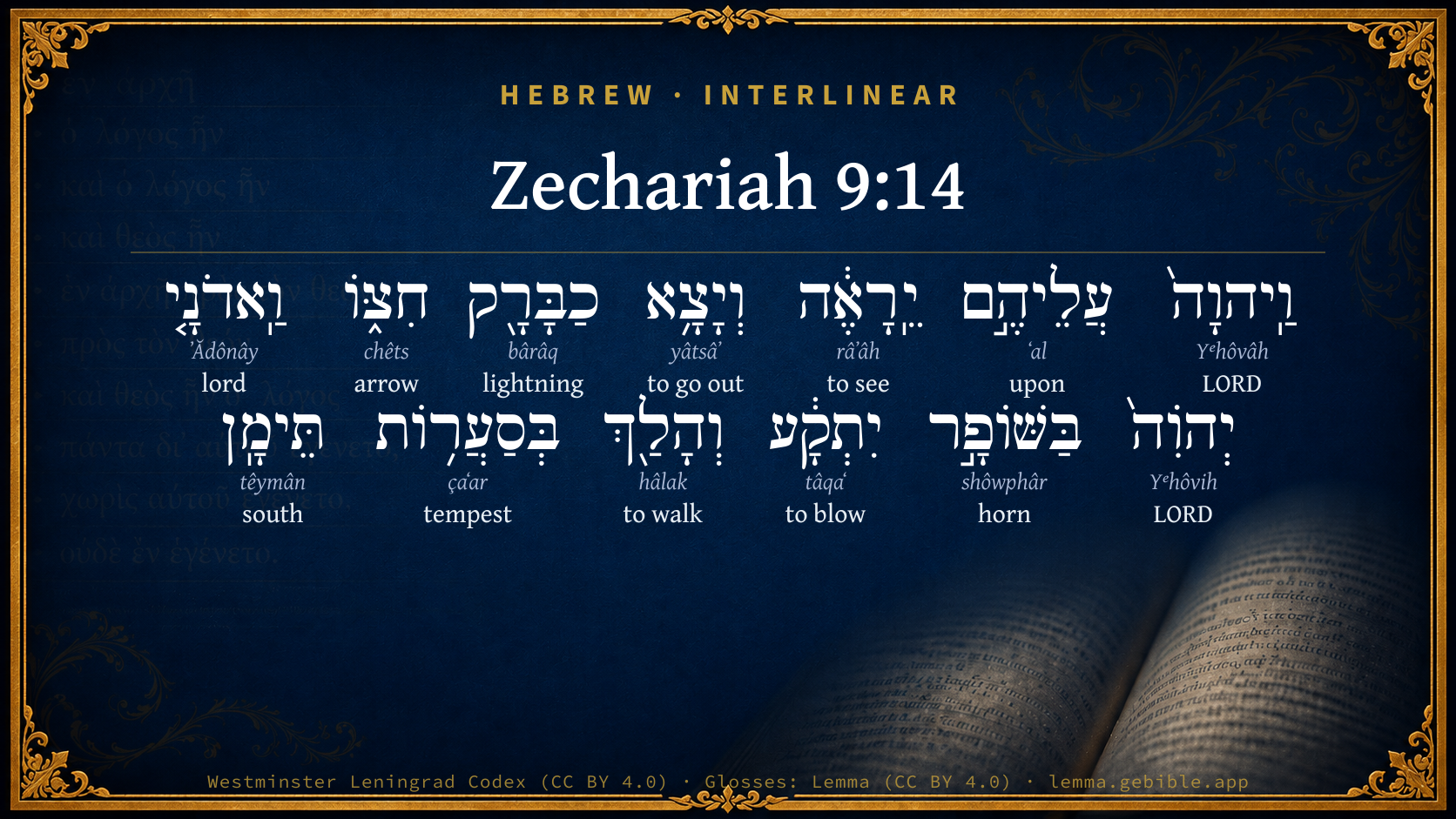
Hebrew (Westminster Leningrad Codex) Zechariah 9:14 appears in the Hebrew Old Testament. The text above is from the Westminster Leningrad Codex. Each word links to its Strong’s number, a concise gloss, and parsing drawn from the Open Scriptures Hebrew Bible morphology. Click any word for its full Brown-Driver-Briggs (BDB) entry.
Download image
Cite this verse

Zechariah 9:14 (World English Bible). Public Domain. Lemma interlinear Bible study tool, https://lemma.gebible.app/v/zechariah/9/14.

Show BibTeX & RIS
BibTeX
RIS
English Translation
Yahweh will be seen over them; And his arrow will go flash like lightning; And the Lord Yahweh will blow the trumpet, And will go with whirlwinds of the south.
World English Bible · Public Domain
Download a study sheet

One document with this verse’s original text, its word-by-word gloss line, the meaning frame, cross-references with their text, attributed commentary, and full source and license credits — printable, and it pastes into notes with its structure intact.

This verse Autodidact and up

Study sheet (.html) Plain text (.txt)

A passage Seminary Student

Up to 50 verses in one chapter. A passage sheet keeps up to 6 commentary sources and 12 cross-references per verse, in the order this page ranks them, and says so on the sheet whenever that leaves anything out. Ask for a single verse and you get the Autodidact verse sheet above.

Everything on this page stays free to read, with no account — the sheet is a download of what is already on screen, not access to it.

Want to remove ads? Support Godless Engineer
Compare translations 3

The same verse in 3 English versions, stacked beneath the original-language interlinear above. Click any original word for its lexicon entry.

Each is an independent rendering of the whole verse — the interlinear is not word-aligned to these translations.

Highlighted words mark where these versions differ — a whole-verse word diff, not a word-by-word alignment.

  • World English Bible Public Domain
    Yahweh will be seen over them; And his arrow will go flash like lightning; And the Lord Yahweh will blow the trumpet, And will go with whirlwinds of the south.
  • King James Version Public Domain
    And the LORD shall be seen over them, and his arrow shall go forth as the lightning: and the LORD God shall blow the trumpet, and shall go with whirlwinds of the south.
  • unfoldingWord Literal Text CC BY-SA 4.0
    Yahweh will appear to them, and his arrows will shoot out like lightning! For my Lord Yahweh will blow the trumpet and will advance with the storms from Teman.

unfoldingWord Literal Text — © unfoldingWord, licensed CC BY-SA 4.0. Word-aligned USFM3 via Door43 (git.door43.org/unfoldingWord/en_ult).

Versions to compare (up to 4)

3 of 4 selected

Show all 18 translations

Every available English version of this verse, each an independent rendering of the whole verse.

  • World English Bible Public Domain
    Yahweh will be seen over them; And his arrow will go flash like lightning; And the Lord Yahweh will blow the trumpet, And will go with whirlwinds of the south.
  • Berean Standard Bible Public Domain
    Then the LORD will appear over them, and His arrow will go forth like lightning. The Lord GOD will sound the ram’s horn and advance in the whirlwinds of the south.
  • Majority Standard Bible Public Domain
    Then the LORD will appear over them, and His arrow will go forth like lightning. The Lord GOD will sound the ram’s horn and advance in the whirlwinds of the south.
  • King James Version Public Domain
    And the LORD shall be seen over them, and his arrow shall go forth as the lightning: and the LORD God shall blow the trumpet, and shall go with whirlwinds of the south.
  • American Standard Version (1901) Public Domain
    And Jehovah shall be seen over them; and his arrow shall go forth as the lightning; and the Lord Jehovah will blow the trumpet, and will go with whirlwinds of the south.
  • Revised Version (1885) Public Domain
    And the LORD shall be seen over them, and his arrow shall go forth as the lightning: and the Lord GOD shall blow the trumpet, and shall go with whirlwinds of the south.
  • Geneva Bible (1599) Public Domain
    And the Lord shalbe seene ouer them, and his arrowe shall go forth as the lightning: and the Lord God shall blowe the trumpet, and shall come forth with the whirlewindes of the South.
  • Douay-Rheims (1899) Public Domain
    And the Lord God shall be seen over them, and his dart shall go forth as lightning: and the Lord God will sound the trumpet, and go in the whirlwind of the south.
  • Young's Literal Translation Public Domain
    And Jehovah doth appear for them, And gone forth as lightning hath His arrow, And the Lord Jehovah with a trumpet bloweth, And He hath gone with whirlwinds of the south.
  • Literal Standard Version CC BY-SA 4.0
    And YHWH appears for them, || And His arrow has gone forth as lightning, || And Lord YHWH blows with a horn, || And He has gone with whirlwinds of the south.
  • Unlocked Literal Bible CC BY-SA 4.0
    Yahweh will appear to them, and his arrows will shoot out like lightning! For my Lord Yahweh will blow the trumpet and will advance with the storms from Teman.
  • unfoldingWord Literal Text CC BY-SA 4.0
    Yahweh will appear to them, and his arrows will shoot out like lightning! For my Lord Yahweh will blow the trumpet and will advance with the storms from Teman.
  • Darby Bible Public Domain
    And Jehovah shall be seen over them, and his arrow shall go forth as the lightning; and the Lord Jehovah will blow the trumpet, and will march with whirlwinds of the south.
  • World Messianic Bible Public Domain
    The LORD will be seen over them. His arrow will flash like lightning. The Lord GOD will blow the shofar, and will go with whirlwinds of the south.
  • Webster's Bible Public Domain
    And the LORD shall be seen over them, and his arrow shall go forth as the lightning: and the Lord GOD will blow the trumpet, and will go with whirlwinds of the south.
  • Free Bible Version CC BY-SA 4.0
    Then the Lord will appear over his people and his arrow will flash like lightning! The Lord God will blow the trumpet and march out like a windstorm from the south.
  • Bible in Basic English Public Domain
    And the Lord will be seen over them, and his arrow will go out like the thunder-flame: and the Lord God, sounding the war-horn, will go in the storm-winds of the South.
  • JPS Tanakh (1917) Public Domain
    And the LORD shall be seen over them, and His arrow shall go forth as the lightning; and the Lord GOD will blow the horn, and will go with whirlwinds of the south.

Literal Standard Version (2020), Covenant Press — licensed CC BY-SA 4.0. Text via the HelloAO Bible API (eBible.org). Unlocked Literal Bible (unfoldingWord) — licensed CC BY-SA 4.0. Text via the HelloAO Bible API (eBible.org). unfoldingWord Literal Text — © unfoldingWord, licensed CC BY-SA 4.0. Word-aligned USFM3 via Door43 (git.door43.org/unfoldingWord/en_ult). Free Bible Version, Dr. Jonathan Gallagher — licensed CC BY-SA 4.0. Text via the HelloAO Bible API (eBible.org).

Word by word

More ways to search: Search by grammar → Find every occurrence → Compare this word →

Practice this passage: Drill this verse → Learn its vocabulary →

כַבָּרָ֖ק
bârâq
H1300
“like/as the · lightning”
Preposition, Determined + Noun, Common, Masculine, Singular, Absolute
Part of Speech
Preposition + Noun
Type
Common
Gender
Masculine
Number
Singular
State
Absolute
Full BDB Definition

Origin: from H1299

TWOT: 287a

lightning - lightnings, lightning flashes - of flashing arrow-head (figuratively)
  1. וַֽיהוָה֙ Yᵉhôvâh H3068 “and · LORD” Conjunction + Noun, Proper
  2. עֲלֵיהֶ֣ם ʻal H5921 “upon · them” Preposition + Suffix, Personal, 3rd Person, Masculine, Plural
  3. יֵֽרָאֶ֔ה râʼâh H7200 “to see” Verb, Niphal, Imperfect, 3rd Person, Masculine, Singular
  4. וְיָצָ֥א yâtsâʼ H3318 “and · to go out” Conjunction + Verb, Qal, Perfect, 3rd Person, Masculine, Singular
  5. חִצּ֑וֹ chêts H2671 “arrow · his” Noun, Common, Masculine, Singular, Construct + Suffix, Personal, 3rd Person, Masculine, Singular
  6. וַֽאדֹנָ֤י ʼĂdônây H136 “and · Lord · my” Conjunction + Noun, Common, Masculine, Plural, Construct + Suffix, Personal, 1st Person, Common, Singular
  7. יְהֹוִה֙ Yᵉhôvih H3069 “LORD” Noun, Proper
  8. בַּשּׁוֹפָ֣ר shôwphâr H7782 “in/at the · horn” Preposition, Determined + Noun, Common, Masculine, Singular, Absolute
  9. יִתְקָ֔ע tâqaʻ H8628 “to blow” Verb, Qal, Imperfect, 3rd Person, Masculine, Singular
  10. וְהָלַ֖ךְ hâlak H1980 “and · to walk” Conjunction + Verb, Qal, Perfect, 3rd Person, Masculine, Singular
  11. בְּסַעֲר֥וֹת çaʻar H5591 “in/at · tempests of” Preposition + Noun, Common, Feminine, Plural, Construct
  12. תֵּימָֽן têymân H8486 “south” Noun, Common, Feminine, Singular, Absolute

About this verse

These counts appear in no published source. They are computed here, from the morphology-tagged text and Lemma’s own curated glosses. What Lemma adds →

13
words
13
distinct lemmas
Prophets
section

Notable vocabulary

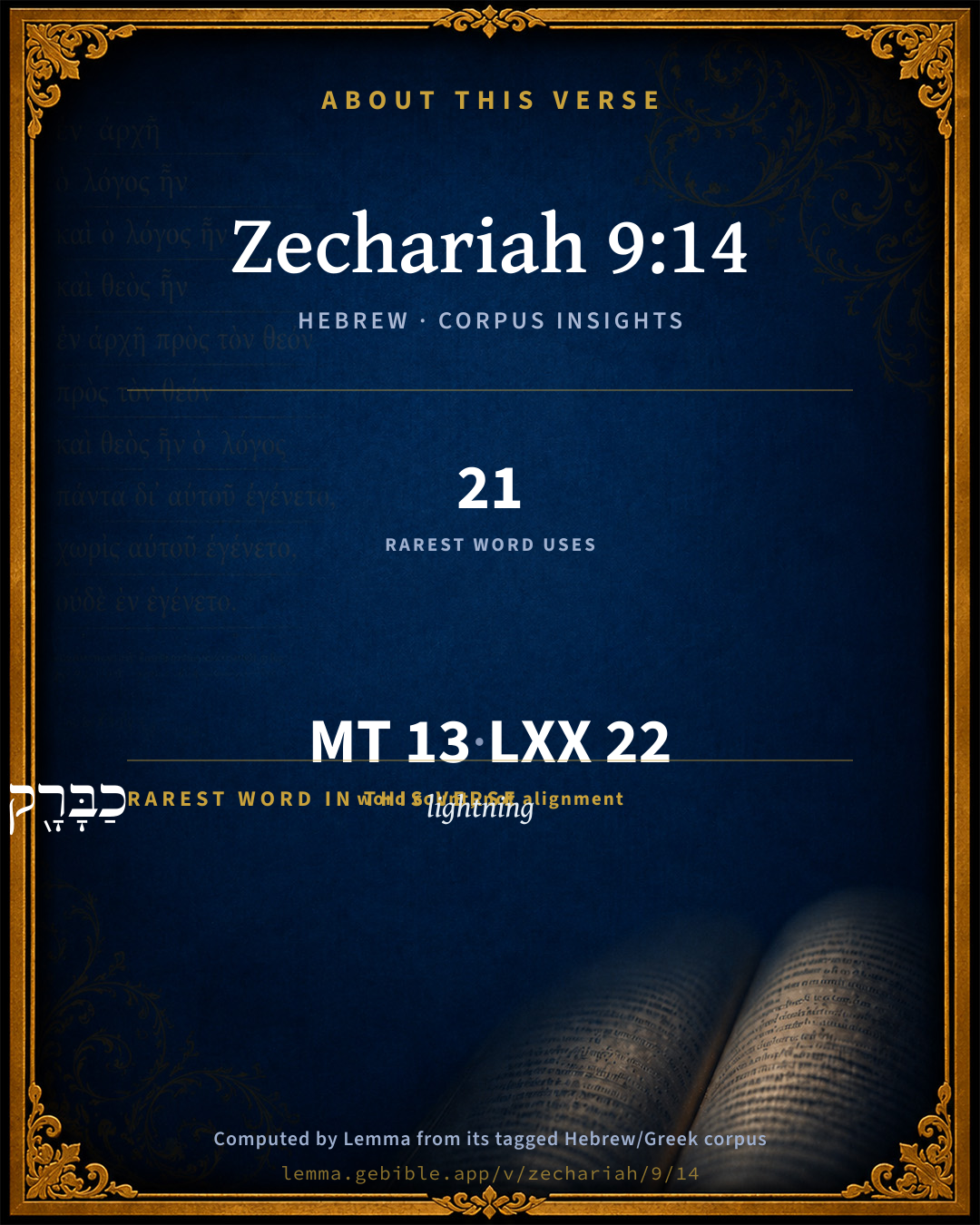
The rarest word here is כַבָּרָ֖ק lightning H1300 — appearing just 21 times in the whole Hebrew Bible.

Shared distinctive vocabulary

כַבָּרָ֖ק lightning H1300 occurs in 21 verses of the Hebrew Bible. Also found in:

Grammatical profile

  • 4 verbs
  • 8 nouns
  • 1 preposition

Verb forms

  • יֵֽרָאֶ֔ה Niphal · Imperfect
  • וְיָצָ֥א Qal · Perfect
  • יִתְקָ֔ע Qal · Imperfect
  • וְהָלַ֖ךְ Qal · Perfect

Hebrew & Septuagint length

In English translation the verse runs 30 words from the Hebrew and 33 from the Septuagint (LXX English) — closely comparable.

A rough comparison of the two English renderings, which tokenize alike — not a word-level alignment.

Word counts can differ between the Hebrew and the Greek without any difference in meaning — e.g. the Hebrew direct-object marker אֵת has no separate Greek word, and Greek often adds the article ὁ.

In the original languages it is 13 Hebrew tokens and 22 Greek tokens — but the two are counted differently (Hebrew bundles its prefixes and suffixes into one token; the Greek is in lemma form), so that isn’t a like-for-like length.

Cross-references

24

Topical passages linked to Zechariah 9:14 in the Treasury of Scripture Knowledge — connected by theme and wording, ordered by reader-vote popularity; previews shown in the World English Bible.

  • Psalms 18:14 He sent out his arrows, and scattered them; Yes, great lightning bolts, and routed them.
  • Isaiah 66:15 For, behold, Yahweh will come with fire, and his chariots shall be like the whirlwind; to render his anger with fierceness, and his rebuke with flames of fire.
  • Psalms 144:5–6 Part your heavens, Yahweh, and come down. Touch the mountains, and they will smoke.
  • Isaiah 21:1 The burden of the wilderness of the sea. As whirlwinds in the South sweep through, it comes from the wilderness, from an awesome land.
  • Isaiah 27:13 It shall happen in that day, that a great trumpet shall be blown; and they shall come who were ready to perish in the land of Assyria, and those who were outcasts in the land of Egypt; and they shall worship Yahweh in the holy mountain at Jerusalem.
  • Habakkuk 3:11 The sun and moon stood still in the sky, At the light of your arrows as they went, At the shining of your glittering spear.
  • Zechariah 2:5 For I,' says Yahweh, 'will be to her a wall of fire around it, and I will be the glory in the midst of her.
  • Zechariah 14:3 Then Yahweh will go out and fight against those nations, as when he fought in the day of battle.
  • Isaiah 30:30 Yahweh will cause his glorious voice to be heard, and will show the lighting down of his arm, with the indignation of [his] anger, and the flame of a devouring fire, with a blast, and tempest, and hailstones.
  • Exodus 14:24–25 It happened in the morning watch, that Yahweh looked out on the host of the Egyptians through the pillar of fire and of cloud, and confused the Egyptian army.
  • Joshua 6:4–5 Seven priests shall bear seven trumpets of rams' horns before the ark: and the seventh day you shall compass the city seven times, and the priests shall blow the trumpets.
  • Joshua 10:11–14 It happened, as they fled from before Israel, while they were at the descent of Beth Horon, that Yahweh cast down great stones from the sky on them to Azekah, and they died: they were more who died with the hailstones than they whom the children of Israel killed with the sword.
  • Joshua 10:42 All these kings and their land did Joshua take at one time, because Yahweh, the God of Israel, fought for Israel.
  • Psalms 45:3–5 Gird your sword on your thigh, mighty one: Your splendor and your majesty.
  • Psalms 77:17–18 The clouds poured out water. The skies resounded with thunder. Your arrows also flashed around.
  • Isaiah 18:3 All you inhabitants of the world, and you dwellers on the earth, when an ensign is lifted up on the mountains, look; and when the trumpet is blown, listen.
  • Isaiah 31:5 As birds hovering, so will Yahweh of Hosts protect Jerusalem; he will protect and deliver [it], he will pass over and preserve [it].
  • Zechariah 12:8 In that day Yahweh will defend the inhabitants of Jerusalem. He who is feeble among them at that day will be like David, and the house of David will be like God, like the angel of Yahweh before them.
  • Matthew 28:20 teaching them to observe all things that I commanded you. Behold, I am with you always, even to the end of the age." Amen.
  • Acts 4:10–11 be it known to you all, and to all the people of Israel, that in the name of Jesus Christ of Nazareth, whom you crucified, whom God raised from the dead, in him does this man stand here before you whole.
  • Romans 15:19 in the power of signs and wonders, in the power of God's Spirit; so that from Jerusalem, and around as far as to Illyricum, I have fully preached the Gospel of Christ;
  • 2 Corinthians 10:4–5 for the weapons of our warfare are not of the flesh, but mighty before God to the throwing down of strongholds,
  • Hebrews 2:4 God also bearing witness with them, both by signs and wonders, and by various works of power, and by gifts of the Holy Spirit, according to his own will?
  • Revelation 6:2 And behold, a white horse, and he who sat on it had a bow. A crown was given to him, and he came forth conquering, and to conquer.

Cross-references courtesy of OpenBible.info (CC BY 4.0).

Hebrew and Greek witnesses Masoretic Hebrew ↔ Greek Septuagint

The same verse in the two great witnesses to the Old Testament, shown verse-for-verse.

These are two independent witnesses, not word-aligned to each other, and the Septuagint is shown in lemma (dictionary) form.

Hebrew Zechariah 9:14 Masoretic · Westminster Leningrad Codex

וַֽיהוָה֙ עֲלֵיהֶ֣ם יֵֽרָאֶ֔ה וְיָצָ֥א כַבָּרָ֖ק חִצּ֑וֹ וַֽאדֹנָ֤י יְהֹוִה֙ בַּשּׁוֹפָ֣ר יִתְקָ֔ע וְהָלַ֖ךְ בְּסַעֲר֥וֹת תֵּימָֽן

Yahweh will be seen over them; And his arrow will go flash like lightning; And the Lord Yahweh will blow the trumpet, And will go with whirlwinds of the south.

World English Bible · Public Domain

Greek LXX Zechariah 9:14 Septuagint · lemma form

καί κύριος εἰμί ἐπί αὐτός καί ἐκἔρχομαι ὡς ἀστραπή βολίς καί κύριος παντοκράτωρ ἐν σάλπιγξ σαλπίζω καί πορεύομαι ἐν σάλος ἀπειλή αὐτός

And the Lord shall be over them, and his arrow shall go forth as lightning: and the Lord Almighty shall blow with the trumpet; and shall proceed with the tumult of his threatening.

LXX2012 (modern English Septuagint) · Public Domain

On this verse, Whedon's Commentary on the Bible discusses the Septuagint’s reading. Read the note in Commentary ↓

Hebrew: Westminster Leningrad Codex (CC BY 4.0). Greek: Septuagint (public domain); English from LXX2012 (modern English Septuagint) (Public Domain). How the Septuagint differs from the Hebrew →

Targum (Aramaic paraphrase)

1

The Targum is the ancient Jewish Aramaic paraphrase of the Hebrew Scriptures — an interpretive translation, not the Hebrew text itself. Onkelos (literal) and Pseudo-Jonathan (expansive) render the Torah, and Jonathan the Prophets. Coverage is partial: where no permissively-licensed English translation exists for a verse, only the Aramaic is shown. This is verse-level text, not a word-by-word alignment to the Hebrew.

  1. Targum Jonathan Prophets (Joshua–Malachi)
    וַיָי עֲלֵיהוֹן יִתְגְלֵי וִיהוֹן נַפְקִין כִּבְרָקִין פִּתְגָמוֹהִי וּמִן קֳדָם יְיָ אֱלֹהִים בְּשׁוֹפָרָא יִתְקַע וִידַבֵּר בְּעַלְעוֹל רוּחַ מִדָרוֹמָא:

    (no public-domain English translation for this verse)

    Targum Jonathan — Aramaic: “Mikraot Gedolot” (public domain). English: “Sefaria Community Translation” (CC0 1.0 (public-domain dedication)); “London "Chaldee Paraphrase," 1871” (public domain). Text via Sefaria.

Commentary

Notes on Zechariah 9:14 from classic Christian and Jewish commentators (each source and its license shown beneath its notes). The classic Christian expositions comment on the surrounding passage and are grouped to its opening verse, so a note may address several verses; the Jewish commentaries on the Tanakh (Rashi and others) are per-verse, so they appear only where the commentator wrote on this verse.

Lemma curates 59 commentaries, every one of them public domain or Creative Commons licensed, each selected and text-cleaned for this edition rather than reprinted as found. About our sources →

Trapp's Complete Commentary

John Trapp

Zec 9:14 And the LORD shall be seen over them, and his arrow shall go forth as the lightning: and the Lord GOD shall blow the trumpet, and shall go with whirlwinds of the south.

Ver. 14. And the Lord shall be seen over them] Shall be conspicuous among them; he shall appear for them in the high places of the field, he shall make bare his arm, and bathe his sword in blood. How many do you reckon me at? said Antigonus to his soldier’s, when they feared the multitudes of their enemies. May not God say so much more to his? Hath ever any waxed fierce against him and prospered? If he but arise only, his enemies shall be scattered, and those that hate him shall flee before him, Psa 68:1.

His arrow shall go forth with the lightning] Here the former matter is illustrated by many lofty tropes and allusions either to those ancient deliverances at the Red Sea, and against the Canaanites and Philistines, by thunders, lightning, and tempest, or else, as Calvin rather thinks, to the terrible delivery of the Law, with thunderings and lightnings, and sound of trumpets, to the great amazement of the people, insomuch as Moses himself said, "I exceedingly fear and quake." He confers Hab 3:3-5, and further allegeth that Teman, here rendered the South, was the same with Sinai, and lies south from Judaea. Lightning, thunder, and whirlwinds are a part of God’s armies, which he can draw forth at his pleasure against his enemies. Such things as these happened often times in the wars of the Maccabees. And how the Lord mightily assisted his apostles, whose arrows went forth as the lightning, swiftly, suddenly, irresistibly, and whose thunder gave a loud alarm to all nations, I need not relate, Paulum quotiescunque lego, non verba mihi audire videor sod tonitrua.

John Trapp, A Commentary or Exposition upon All the Books of the Old and New Testament (1647–1656) — public domain. Text from a community e-Sword module.

Tyndale Open Study Notes

Tyndale Open Resources

9:14 appear above his people: Zechariah borrows the image of a winged sun disk that artists pictured as protectively hovering over the Persian king. The Lord will protect Israel, go before them in battle, and show them his power. • The ram’s horn issues a summons (Num 10:2-3, 7-10; Isa 27:13) and declares God’s presence and power (Exod 19:19; 20:18). • The whirlwind depicts God as a warrior of devastating power and unpredictable swiftness (Ps 77:18; Isa 21:1; 29:6; 66:15). References to lightning bring Mount Sinai to mind (Exod 19:16) and with it God’s covenant promises to Israel.

Tyndale Open Study Notes — © Tyndale Open Resources, licensed CC BY-SA 4.0. Text via the HelloAO Bible API.

Jamieson, Fausset & Brown

Robert Jamieson, A. R. Fausset & David Brown

Another image: "Jehovah shall be seen (conspicuously manifesting His power) over them" (that is, in behalf of the Jews and against their foes), as formerly He appeared in a cloud over the Israelites against the Egyptians (Exo 14:19, Exo 14:24).

his arrow . . . as . . . lightning--flashing forth instantaneous destruction to the foe (Psa 18:14).

blow . . . trumpet--to summon and incite His people to battle for the destruction of their foe.

go with whirlwinds of the south--that is, go forth in the most furious storm, such as is one from the south (Isa 21:1). Alluding, perhaps, to Jehovah's ancient miracles at Sinai coming "from Teman" ("the south," in the Margin).

Jamieson, Fausset & Brown — Commentary Critical and Explanatory on the Whole Bible (1871) — public domain (CC PDM 1.0). Text via the HelloAO Bible API.

Adam Clarke's Commentary

Verse 14. The Lord shall be seen over them] Shadowing and refreshing them, as the cloud did the camp in the wilderness.

His arrow shall go forth as the lightning] They shall be conquered in a way that will show that God fights for his followers.

The description here is very sublime; we have a good imitation of it in Nonnus: -

Και τοτε γαιαν ἁπασαν επεκλυσεν ὑετιος Ζευς,

Πυκνωσας νεφεεσσιν ὁλον πολον· ουρανιη γαρ

Βρονταιοις παταγοισι Διος μυκησατο σαλπιγξ.

NONN. DIONYS., lib. 6. ver. 229.

"When heaven's dread trumpet, sounding from on high,

Breaks forth in thunders through the darken'd sky;

The pregnant clouds to floods of rain give birth.

And stormy Jove o'erwhelms the solid earth."

J. B. B. C.

In these two verses there is a fine image, and an allusion to a particular fact, which have escaped the notice of every commentator. I must repeat the verses:

Zec 9:13: When I have bent Judah for me, filled the bow with Ephraim, and raised up thy sons, O Zion, against thy sons, O Greece, and made thee as the sword of a mighty man.

Zec 9:14: And the LORD shall be seen over them, and his arrows shall go forth like lightning.

The reader will consult what is said on Ho 7:16, relative to the oriental bow, which resembles a [figure "C"] in its quiescent state, and must be recurved in order to be strung. Here, Judah is represented as the recurved bow; Ephraim, as an arrow placed on the string, and then discharged against the Javanites or Greeks with the momentum of lightning; the arrow kindling in its course through the air, and thus becoming the bolt of death to them against whom it was directed.

Volat illud, et incandescit eundo,

Et quos non habuit, sub nubibus invenit ignes.

"It flies apace; and, heating, mounts on high,

Glows in its course, and burns along the sky."

Adam Clarke's Commentary on the Bible (1810–1826) — public domain. Text from a community e-Sword/MySword module.

John Calvin's Commentaries

He goes on with the same subject, but explains what I have said — that victory is promised to the Jews, not that which they could gain by their own power, but that which should happen to them beyond their expectation; for this is what is meant when he says, that God would be seen over them. For though the events of all wars depend on God, yet he is said to be seen where there is a remarkable victory, which cannot be accounted for by men. When unequal armies engage, it is no wonder when one becomes victorious; and it may sometimes be that a less number overcomes a greater, even because it exceeded the other in courage, in counsel, in skill, or in some other way, or because the larger army fought from a disadvantageous position, or trusting in its own strength rushed on inconsiderately. But when consternation alone dejects one party and renders the other victorious, in this case the power of God becomes evident. And even heathens have thought that men are confounded from above when courage fails them; and this is most true. We now then understand why the Prophet says, that God would be seen over the Jews, even because they would conquer their enemies, not by usual means, not after an earthly manner, but in a wonderful way, so that it would appear evident to be the work of God.

He then adds, Go forth shall his arrow as lightning. He again repeats and confirms what we have already observed that there would be no movement among the Jews, no celerity, but what would be like the sword, which lies quiet on the ground, except it be taken up by the hand of man, and what also would be like the arrow, which can do no harm except it be thrown by some one. We then see that the victory mentioned before is ascribed to God alone. And for the same reason he adds what follows, that Jehovah would come with the shout of a trumpet, and also, with the whirlwind of the south. In a word, he means that the work of God would be evident when the Jews went forth against the enemies by whom they had been oppressed and would still be oppressed. That they might not then compare their own with their enemies’ strength, the Prophet here brings God before them, by whose authority, guidance, and power this war was to be carried on. And then, that he might extol God’s power, he says, that he would come with the shout of a trumpet, and with the whirlwind of the south

Interpreters take the whirlwinds of the south simply for violent storms; for we know that the most impetuous whirlwinds arise from the south. But as the Prophet joins the whirlwinds of the south to the shout of a trumpet, he seems to me to allude to those miracles by which God showed to the Jews in a terrific manner his power on Mount Sinai, for the desert of Teman and Mount Paran were in that vicinity. We have seen a similar passage in the third chapter of Habakkuk Habakkuk 3:1, “God,” he said, “shall come from Teman, the Holy One from Mount Paran.” The Prophet’s object was to encourage the Jews to entertain hope; for God, who had long concealed himself and refrained from helping them, would at length come forth to their aid. How? He reminded them in that passage of the records of ancient history, for God had made known his power on Mount Sinai, in the desert of Teman, and it was the south region with regard to Judea; and we also know that trumpets sounded in the air, and that all this was done that the Jews might reverently receive the law, and also that they might feel certain that they would be always safe under God’s hand, since he thus shook the elements by his nod, and filled the air with lightnings and storms and whirlwinds, and also made the air to ring with the shouts of trumpets. It is for the same reason that the Prophet speaks in this passage, when he says, that God would make himself known as formerly, when he astonished the people by the shouts of trumpets, and also when he appeared in whirlwinds on Mount Sinai. He then adds —

John Calvin's Commentaries (1540-1563) — public domain. Text from the Calvin Translation Society English edition (1840s-50s) via the Christian Classics Ethereal Library (ccel.org). Calvin's coverage is partial (roughly two-thirds of the Bible); uncommented books and verses are honest gaps, never fabricated. The 19th-century editor's footnotes and remarks are omitted so the notes are faithfully Calvin's own voice.

Ellicott's Commentary for English Readers

(14) Shall be seen over them.—Perhaps better, on their behalf shall He manifest Himself.

Of the south.—Whence the most violent storms frequently came from over the desert. (Comp. Psa_21:1.)

A Bible Commentary for English Readers, edited by Charles John Ellicott (1878–1897) — public domain. Text from a community e-Sword module.

The Cambridge Bible for Schools and Colleges

gen. ed. J. J. S. Perowne

14. whirlwinds of the south] which were the most vehement and destructive. Isa_21:1; Job_37:9.

The Cambridge Bible for Schools and Colleges (gen. ed. J. J. S. Perowne; Cambridge University Press, 1878–1918) — public domain. Text from a community e-Sword module.

John Gill's Exposition

And the Lord shall be seen over them,.... His apostles and ministers: or, "shall appear to them" (q); and be seen by them, as he was in the days of his flesh; they saw his person, his miracles, his sorrows, and sufferings; they saw him after his resurrection, and some have seen him since his ascension, with the eyes of their bodies, as well as with the eyes of their understandings; and so were fit to be witnesses of him: or, "the Lord shall appear over them", or "upon them" (r); he was seen over, and above them, when he ascended up to heaven; and upon them, by the descent of his Spirit on them at the day of Pentecost, and in other miraculous gifts bestowed upon them: or, "the Lord shall appear unto", or "for them" (s); by giving strength of body, and fortitude of mind; by protecting and preserving them, and by succeeding their labours:

and his arrow shall go forth as the lightning: meaning the Gospel, and the swift progress of it, as well as the light it communicates, and the glory that goes along with it, and the efficacy of it:

and the Lord God shall blow the trumpet; of the Gospel, so called, in allusion to the jubilee trumpet, which proclaimed liberty to servants, and restoration of inheritances: or to the trumpets made for the congregation of Israel to gather them together, and to express their joy at feasts: or to the trumpet used to proclaim war, and as an alarm for it; and this was blown by the Lord himself in person when here on earth, and by his ministers in his name:

and shall go with whirlwinds of the south; that is, the Lord in the ministration of the Gospel shall go forth with the efficacy and energy of the Spirit: the Spirit is compared to "wind", because he works in a sovereign way where he listeth, and oftentimes imperceptibly, and ever powerfully; and to the "south" wind, because that brings warmth, serenity, and calmness, produces rain, and makes fruitful; and he it is which makes the Gospel efficacious; see Sol 4:16.

(q) "aderit illis", Vatablus, Drusius. (r) "Super cos", V. L. Calvin; "super eis", Montanus, Piscator; "super illis", Cocceius. (s) So the particle is sometimes used; see Noldius, p. 690, 703.

John Gill's Exposition of the Whole Bible (1746–1763) — public domain (CC PDM 1.0). Text via the HelloAO Bible API.

Albert Barnes' Notes on the Bible

And the Lord shall be seen over them - o “He will reveal himself,” protecting them. Cyril: “He says plainly, that the Lord God will be with them and will fight in serried array with them and will with them subdue those who resist them.” It is as if he would say, “When they go forth and preach everywhere, the Lord shall work with them and confirm the word with signs following” Mar 16:20. “And His arrow shall go forth as the lightning.” Habakkuk directly calls the lightnings the arrows of God: “at the light of Thine arrows they went” . Here it is probably of an invisible agency, and so compared to that awful symbol of His presence, the lightning.

And the Lord God shall blow with the trumpet - As their Commander, ordering their goings. The blowing of the trumpet by the priests in war was commanded, as a reminiscence of themselves before God, “If ye go to war in your land against the enemy that oppresseth you, then ye shall blow an alarm with the trumpets, and ye shall be remembered before the Lord your God, and ye shall be saved from your enemies” Num 10:9. Abijah said, “God Himself is with us for our captain, and His priests with sounding trumpets to cry alarm against you” 2Ch 13:12.

And shall go with whirlwinds of the south - As being the most vehement and destructive. So Isaiah, “As whirlwinds in the south sweep by, He cometh from a desert, from a terrible land” Isa 21:1. Such smote the four corners of the house where Job’s children were , and they perished.

Albert Barnes' Notes on the Bible (1834–1885) — public domain. Text from a community e-Sword/MySword module.

Haydock's Catholic Bible Commentary

Seen. God miraculously interposed in favour of the Machabees, and his angels appeared at their head, 1 Machabees ii. 22., and v. 2., and x. 29., and xi. 8., and xv. 15. A handful of men thus routed vast armies, and asserted their independence, avenging religion and the state, which they restored to greater splendour. --- South, whence storms usually arise in that country, Job xxxvii. 9. The angels confounded the enemy, 1 Machabees x. 30.

George Leo Haydock (1774–1849), Haydock's Catholic Family Bible and Commentary, 1859 edition — public domain. Excludes Psalms (Douay-Rheims chapter numbering differs from Protestant) and Deuterocanonical books (Catholic canon only).

Matthew Poole's English Annotations

The Lord, the Almighty God, the God of Israel, Lord of hosts,

shall be seen over them; shall manifestly appear for them by his works of power against their enemies.

His arrow; alluding to warriors, that then used the bow: God’s judgments, which slew his church’s enemies, were swift, irresistible, and sudden in striking and killing them.

Shall go forth as the lightning; which breaks forth with violence, and runs from east to west in a moment, which is very terrible many times.

The Lord God; their God, the God of Israel,

shall blow the trumpet, give the alarm to them to provide for the war, sound the call to bring them together, and the march also for their moving, and sound the charge too; God will infuse new courage, and give directions.

And shall go, in the head of them as Captain-general,

with whirlwinds, with fury and strength like that of whirlwinds,

of the south, in which the mightiest whirlwinds are raised; or whirlwinds of Teman: some think the prophet alludes to the tempest about Sinai at the delivery of the law, when all Israel, and Moses too, quaked for fear, Deu 5:23-25; yea, quaked exceedingly, and desired to see no more such sight.

Matthew Poole's English Annotations on the Holy Bible (1683–1685) — public domain. Text from a community e-Sword/MySword module.

Whedon's Commentary on the Bible

Daniel D. Whedon

14. Jehovah himself will take a hand in the conflict.

Shall be seen — Better, manifests himself.

Over them — Over the sons of Zion; he comes from heaven and fights for them (Psa_24:8; Hab_3:11). The imagery of the description is borrowed from the thunderstorm (compare Psa_18:7-15).

His arrow — Compare Zec_9:13.

As the lightning — Lightning flashes are called the arrows of Jehovah (Psa_18:14); here his arrow Ephraim (Zec_9:13) is likened, in speed and destructiveness, to lightning.

Trumpet — Better, horn (see on Hos_5:8). Jehovah gives the signal to advance; then he himself rushes, at the head of his forces, against the enemy.

With whirlwinds of the south — Instead of with we should perhaps read like, which involves the interchange of two similar letters, that are confused in other places in the Old Testament. The storms coming from the south, from across the broad desert, are peculiarly severe (compare Isa_21:1; Job_37:9). Some have thought that there is here an allusion to the south (Sinai) as the original dwelling place of Jehovah, from which he was thought to proceed to assist his people (see on Hab_3:3; compare Jdg_5:4-5).

Zec_9:15 contains a vivid description of the bloody conflict. The sons of Zion need have no fear, for Jehovah will be their shield.

Devour,… drink — Like wild beasts they will fall upon their enemies to consume their flesh and drink their blood. A picture of utter destruction (compare Num_23:24).

Subdue with sling stones — R.V., “tread down the sling stones.” A.V. follows LXX. in taking sling stones as an instrumental accusative; they will subdue the enemies by the use of sling stones. However, the Revisers are probably correct in taking sling stones as the object. They may be regarded as representing all the missiles and weapons that are hurled by the enemies; these the sons of Zion will disregard entirely and trample under foot, and thus they will subdue the enemy and make a complete end of him (compare Job_41:28). Drink is separated from devour, so as to bring it into close connection with the next clause, with which it is logically connected.

Make a noise as through wine — They roar, as if they were intoxicated, in wild excitement over the wonderful triumph. The close connection of this clause with the preceding would be brought out more clearly if it were rendered as a circumstantial clause, “They shall drink, while making a noise as through wine.”

And they shall be filled like bowls — The bowls in which the blood of the sacrificial victims was caught (Exo_38:3; Num_4:14). As these are filled with the blood of sacrificial animals, so the Jews will be filled with the blood of their enemies.

As the corners of the altar — The reference is not to the putting of blood on the horns (Exo_29:12), but to the sprinkling of blood against the altar (Lev_1:5; Lev_1:11). According to rabbinical tradition this was done in such a manner that the four sides were covered with two sprinklings. In order to do this the bowls containing the blood had to be swung against two opposite corners with considerable force; therefore the corners and the space on either side of them were covered most thickly. To be covered with blood is a symbol of triumph (Isa_63:1-3).

Daniel D. Whedon (gen. ed.), Commentary on the Old and New Testaments (1874–1909) — public domain. Text from a community e-Sword module.

The Pulpit Commentary

The Lord shall be seen over them. To encourage the chosen people in the contest, the Lord shall make iris presence manifest as their Leader. His arrow. God"s arrows are the judgments which he inflicts upon his enemies, which come forth suddenly as the lightning flash, and cannot be avoided. (Psa_18:14 Hab_3:11) Shall blow the trumpet. As the signal of battle and calamity. (Num_10:9 Jud_1:7:19, 20 Eze_7:14 Amo_3:6 Zep_1:16) Whirlwinds of the south. He shall come upon the enemy and sweep them away with irresistible force. Storms from the south were the most violent, coming from the Arabian desert. (Job_37:9 Isa_21:1 Hos_13:15) Septuagint, Poreusetai en salw apeilhv autou ," He shall go in the surge of his menace."

The Pulpit Commentary (1880–1919), ed. H.D.M. Spence-Jones & Joseph S. Exell — public domain. Text from a community e-Sword module.

John Wesley's Explanatory Notes

Shall be seen - Shall manifestly appear for them. His arrow - His judgments, swift, irresistible, and sudden. As the lightning - Which breaks forth with violence, and runs from east to west in a moment. The Lord God - Their God, the God of Israel, shall give the alarm to them, and sound the call to bring them together. Of the south - In which the mightiest whirlwinds are raised; some think the prophet alludes to the tempest at the delivery of the law.

John Wesley, Explanatory Notes Upon the Whole Bible (1754–1765) — public domain. Text via the GEBible commentary corpus.

unfoldingWord translationNotes

Door43 World Missions Community

General Information:

In verses 14-16, Zechariah describes how Yahweh will rescue Israel from their enemies.

will appear to them

The word "them" refers to God's people. AT: "will be seen in the sky by his people" or "will come to his people"

his arrows will shoot out like lightning!

The Israelites sometimes thought of lightning bolts as arrows that God shot. (See: Simile)

blow the trumpet

The trumpets were rams' horns. People blew into them to give signals in battle and on other occasions. Here the trumpet is blown as a military signal.

will advance with the storms from Teman

Team was located to the south of Judah. The Israelites sometimes thought of God as traveling on violent storms coming from the south. AT: "will march from Teman with the storm winds"

they will devour them

"the people of Judah will devour their enemies"

will devour

To completely defeat enemies is spoken of as devouring them as a wild animal eats its prey. AT: "will completely defeat" (See: Metaphor)

defeat the stones of the slings

Slings to throw stones were a common weapon in the days of Zechariah. Here the "stones of the slings" represent the soldiers who were using them to attack Israel. AT: "defeat the enemies who attack them with slings and stones" (See: Metonymy)

Then they will drink and shout like men drunk on wine

The people of Judah will shout and celebrate their victory over their enemies as if they were noisy drunks. AT: "Then they will shout and celebrate their victory as loudly as if they were drunk" (See: Simile)

they will be filled with wine like bowls

This probably refers to the bowls that the priests used to carry animal's blood to the altar. AT: "they will be as full of wine as the basins with which priests carry blood to the altar" (See: Simile and Assumed Knowledge and Implicit Information)

like the corners of the altar

Altars had projecting corners that were drenched in animal blood. AT: "they will be drenched as the corners of the altar are covered in blood" (See: Simile and Assumed Knowledge and Implicit Information)

translationWords

Yahweh

Lord Yahweh

trumpet

Yahweh of hosts

devour

wine

altar

unfoldingWord translationNotes — © Distant Shores Media and the Door43 World Missions Community, licensed CC BY-SA 4.0. Source: git.door43.org/Door43/en_tn.

Rashi

Rabbi Shlomo Yitzchaki (Rashi)

And the Lord shall appear over them In the book of Josippon (chap. 18), we find that at that time a sign appeared to the people of Jerusalem.

shall sound the shofar He shall thunder.

and He shall go with the whirlwinds of the south To storm the people of the south; they are the Greeks. And some of our Sages interpreted [the phrase] as referring to Edom in the future.

Rashi on the Tanakh — English translations: “The Judaica Press complete Tanach with Rashi, translated by A. J. Rosenberg” (CC BY 4.0); “Pentateuch with Rashi's commentary by M. Rosenbaum and A.M. Silbermann, 1929-1934” (public domain); “The Metsudah Tanach series, Lakewood, N.J” (CC BY 4.0); and “The Book of Joshua, Metsudah Publications, 1997” (CC BY 4.0). Text via Sefaria.

Lesson kit

Teaching starters — assembled from the data on this page, not authored interpretation. Every prompt links to the verse data it draws on. Edit before teaching.

Zechariah, in the Prophets, opens this verse with 13 words (13 distinct Hebrew lemmas). Its most distinctive word is bârâq (“lightning”). A historical commentator’s framing appears above. Read the whole chapter for the surrounding context.

Discussion questions

  1. How does “lightning” (bârâq) shape what this verse is saying?
  2. How does Exodus 19:16, which shares the word «lightning», read alongside this verse?
  3. These translations render this verse differently. What is at stake in choosing one wording over another?
  4. «יֵֽרָאֶ֔ה» is a Niphal Imperfect verb. How does that grammatical form shape the action described?
  5. Compare how Trapp's Complete Commentary and Tyndale Open Study Notes read this verse. Where do they agree or differ?

Things to notice

Reading settings

Reading text

Shown beneath each verse's original-language words.

Old Testament
Old Testament edition

Read the OT as the Masoretic Hebrew (MT) or the Greek Septuagint (LXX).

English shown for the Greek Septuagint (in the Hebrew ↔ Greek comparison).

Comparing translations? Open the Compare panel on any verse page to stack up to four side by side.