
1 Kings 3:15

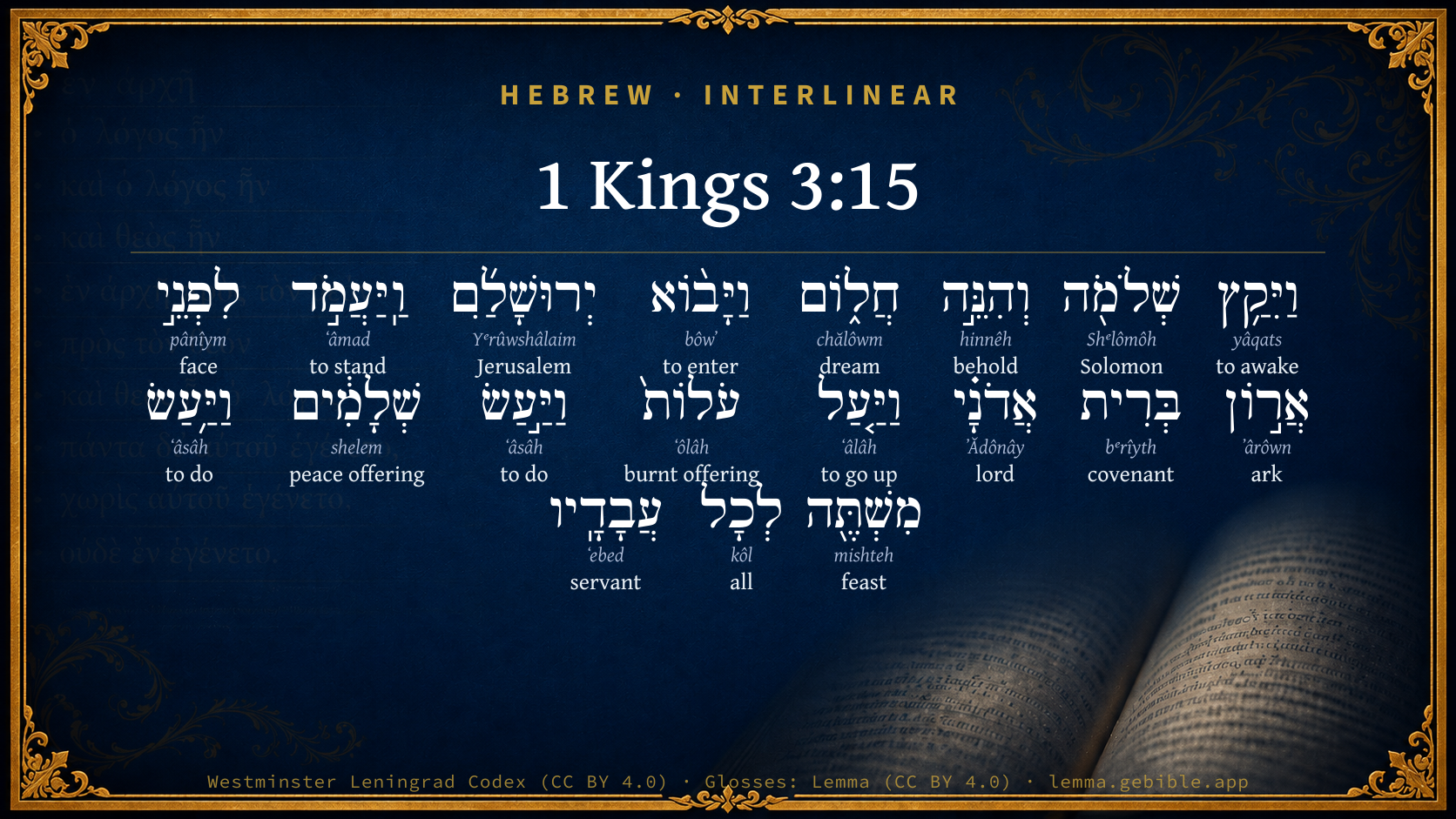
Hebrew (Westminster Leningrad Codex) 1 Kings 3:15 appears in the Hebrew Old Testament. The text above is from the Westminster Leningrad Codex. Each word links to its Strong’s number, a concise gloss, and parsing drawn from the Open Scriptures Hebrew Bible morphology. Click any word for its full Brown-Driver-Briggs (BDB) entry.
Download image
Cite this verse

1 Kings 3:15 (World English Bible). Public Domain. Lemma interlinear Bible study tool, https://lemma.gebible.app/v/1-kings/3/15.

Show BibTeX & RIS
BibTeX
RIS
English Translation
Solomon awoke; and, behold, it was a dream: and he came to Jerusalem, and stood before the ark of the covenant of Yahweh, and offered up burnt offerings, and offered peace-offerings, and made a feast to all his servants.
World English Bible · Public Domain
Download a study sheet

One document with this verse’s original text, its word-by-word gloss line, the meaning frame, cross-references with their text, attributed commentary, and full source and license credits — printable, and it pastes into notes with its structure intact.

This verse Autodidact and up

Study sheet (.html) Plain text (.txt)

A passage Seminary Student

Up to 50 verses in one chapter. A passage sheet keeps up to 6 commentary sources and 12 cross-references per verse, in the order this page ranks them, and says so on the sheet whenever that leaves anything out. Ask for a single verse and you get the Autodidact verse sheet above.

Everything on this page stays free to read, with no account — the sheet is a download of what is already on screen, not access to it.

Want to remove ads? Support Godless Engineer
Compare translations 3

The same verse in 3 English versions, stacked beneath the original-language interlinear above. Click any original word for its lexicon entry.

Each is an independent rendering of the whole verse — the interlinear is not word-aligned to these translations.

Highlighted words mark where these versions differ — a whole-verse word diff, not a word-by-word alignment.

  • World English Bible Public Domain
    Solomon awoke; and, behold, it was a dream: and he came to Jerusalem, and stood before the ark of the covenant of Yahweh, and offered up burnt offerings, and offered peace-offerings, and made a feast to all his servants.
  • King James Version Public Domain
    And Solomon awoke; and, behold, it was a dream. And he came to Jerusalem, and stood before the ark of the covenant of the LORD, and offered up burnt offerings, and offered peace offerings, and made a feast to all his servants.
  • unfoldingWord Literal Text CC BY-SA 4.0
    And Solomon awoke, and behold, a dream. And he entered Jerusalem, and he stood to the face of the Box of the Covenant of the Lord. And he offered burnt offerings, and he made peace offerings. And he made a feast for all of his servants.

unfoldingWord Literal Text — © unfoldingWord, licensed CC BY-SA 4.0. Word-aligned USFM3 via Door43 (git.door43.org/unfoldingWord/en_ult).

Versions to compare (up to 4)

3 of 4 selected

Show all 18 translations

Every available English version of this verse, each an independent rendering of the whole verse.

  • World English Bible Public Domain
    Solomon awoke; and, behold, it was a dream: and he came to Jerusalem, and stood before the ark of the covenant of Yahweh, and offered up burnt offerings, and offered peace-offerings, and made a feast to all his servants.
  • Berean Standard Bible Public Domain
    Then Solomon awoke, and indeed it had been a dream. So he returned to Jerusalem, stood before the ark of the covenant of the Lord, and offered burnt offerings and peace offerings. Then he held a feast for all his servants.
  • Majority Standard Bible Public Domain
    Then Solomon awoke, and indeed it had been a dream. So he returned to Jerusalem, stood before the ark of the covenant of the Lord, and offered burnt offerings and peace offerings. Then he held a feast for all his servants.
  • King James Version Public Domain
    And Solomon awoke; and, behold, it was a dream. And he came to Jerusalem, and stood before the ark of the covenant of the LORD, and offered up burnt offerings, and offered peace offerings, and made a feast to all his servants.
  • American Standard Version (1901) Public Domain
    And Solomon awoke; and, behold, it was a dream: and he came to Jerusalem, and stood before the ark of the covenant of Jehovah, and offered up burnt-offerings, and offered peace-offerings, and made a feast to all his servants.
  • Revised Version (1885) Public Domain
    And Solomon awoke, and, behold, it was a dream: and he came to Jerusalem, and stood before the ark of the covenant of the LORD, and offered up burnt offerings, and offered peace offerings, and made a feast to all his servants.
  • Geneva Bible (1599) Public Domain
    And when Salomon awoke, behold, it was a dreame, and he came to Ierusalem, and stoode before the Arke of the couenant of the Lord, and offred burnt offrings and made peace offrings, and made a feast to all his seruants.
  • Douay-Rheims (1899) Public Domain
    And Solomon awaked, and perceived that it was a dream: and when he was come to Jerusalem, he stood before the ark of the covenant of the Lord, and offered holocausts, and sacrificed victims of peace offerings, and made a great feast for all his servants.
  • Young's Literal Translation Public Domain
    And Solomon awaketh, and lo, a dream; and he cometh in to Jerusalem, and standeth before the ark of the covenant of Jehovah, and causeth to ascend burnt-offerings, and maketh peace-offerings. And he maketh a banquet for all his servants,
  • Literal Standard Version CC BY-SA 4.0
    And Solomon awakens, and behold, [it was] a dream; and he comes to Jerusalem, and stands before the Ark of the Covenant of YHWH, and causes burnt-offerings to ascend, and makes peace-offerings, and he makes a banquet for all his servants.
  • Unlocked Literal Bible CC BY-SA 4.0
    Then Solomon awoke, and behold, it was a dream. He came to Jerusalem and stood before the ark of the covenant of the Lord. He offered up burnt offerings and peace offerings, and made a feast for all his servants.
  • unfoldingWord Literal Text CC BY-SA 4.0
    And Solomon awoke, and behold, a dream. And he entered Jerusalem, and he stood to the face of the Box of the Covenant of the Lord. And he offered burnt offerings, and he made peace offerings. And he made a feast for all of his servants.
  • Darby Bible Public Domain
    And Solomon awoke, and behold, it was a dream. And he came to Jerusalem, and stood before the ark of the covenant of Jehovah, and offered up burnt-offerings, and offered peace-offerings, and made a feast to all his servants.
  • World Messianic Bible Public Domain
    Solomon awoke; and behold, it was a dream. Then he came to Jerusalem and stood before the ark of the LORD’s covenant, and offered up burnt offerings, offered peace offerings, and made a feast for all his servants.
  • Webster's Bible Public Domain
    And Solomon awoke; and behold, it was a dream. And he came to Jerusalem, and stood before the ark of the covenant of the LORD, and offered up burnt-offerings, and offered peace-offerings, and made a feast to all his servants.
  • Free Bible Version CC BY-SA 4.0
    Then Solomon woke up and realized he'd had a dream. He went back to Jerusalem, and stood in front of the Ark of the Lord's Agreement and he presented burnt offerings and friendship offerings, and he held a feast for all his officials.
  • Bible in Basic English Public Domain
    And Solomon, awakening, saw that it was a dream; then he came to Jerusalem, where he went before the ark of the agreement of the Lord, offering burned offerings and peace-offerings; and he made a feast for all his servants.
  • JPS Tanakh (1917) Public Domain
    And Solomon awoke, and, behold, it was a dream; and he came to Jerusalem, and stood before the ark of the covenant of the LORD, and offered up burnt-offerings, and offered peace-offerings, and made a feast to all his servants.

Literal Standard Version (2020), Covenant Press — licensed CC BY-SA 4.0. Text via the HelloAO Bible API (eBible.org). Unlocked Literal Bible (unfoldingWord) — licensed CC BY-SA 4.0. Text via the HelloAO Bible API (eBible.org). unfoldingWord Literal Text — © unfoldingWord, licensed CC BY-SA 4.0. Word-aligned USFM3 via Door43 (git.door43.org/unfoldingWord/en_ult). Free Bible Version, Dr. Jonathan Gallagher — licensed CC BY-SA 4.0. Text via the HelloAO Bible API (eBible.org).

Word by word

More ways to search: Search by grammar → Find every occurrence → Compare this word →

Practice this passage: Drill this verse → Learn its vocabulary →

וַיִּקַ֥ץ
yâqats
H3364
“and · to awake”
Conjunction + Verb, Qal, Sequential Imperfect, 3rd Person, Masculine, Singular
Part of Speech
Conjunction + Verb
Stem
Qal
Form
Sequential Imperfect
Person
3rd Person
Gender
Masculine
Number
Singular
Full BDB Definition

Origin: a primitive root

TWOT: 904

(Qal) to awake, awaken, become active
  1. שְׁלֹמֹ֖ה Shᵉlômôh H8010 “Solomon” Noun, Proper
  2. וְהִנֵּ֣ה hinnêh H2009 “and · behold” Conjunction + Particle, Demonstrative
  3. חֲל֑וֹם chălôwm H2472 “dream” Noun, Common, Masculine, Singular, Absolute
  4. וַיָּב֨וֹא bôwʼ H935 “and · to enter” Conjunction + Verb, Qal, Sequential Imperfect, 3rd Person, Masculine, Singular
  5. יְרוּשָׁלִַ֜ם Yᵉrûwshâlaim H3389 “Jerusalem” Noun, Proper
  6. וַֽיַּעֲמֹ֣ד ʻâmad H5975 “and · to stand” Conjunction + Verb, Qal, Sequential Imperfect, 3rd Person, Masculine, Singular
  7. לִפְנֵ֣י pânîym H6440 “to/for · face(s) of” Preposition + Noun, Common, Both, Plural, Construct
  8. אֲר֣וֹן ʼârôwn H727 “ark of” Noun, Common, Both, Singular, Construct
  9. בְּרִית bᵉrîyth H1285 “covenant of” Noun, Common, Feminine, Singular, Construct
  10. אֲדֹנָ֗י ʼĂdônây H136 “Lord · my” Noun, Common, Masculine, Plural, Construct + Suffix, Personal, 1st Person, Common, Singular
  11. וַיַּ֤עַל ʻâlâh H5927 “and · to go up” Conjunction + Verb, Hiphil, Sequential Imperfect, 3rd Person, Masculine, Singular
  12. עֹלוֹת֙ ʻôlâh H5930 “burnt offerings” Noun, Common, Feminine, Plural, Absolute
  13. וַיַּ֣עַשׂ ʻâsâh H6213 “and · to do” Conjunction + Verb, Qal, Sequential Imperfect, 3rd Person, Masculine, Singular
  14. שְׁלָמִ֔ים shelem H8002 “peace offerings” Noun, Common, Masculine, Plural, Absolute
  15. וַיַּ֥עַשׂ ʻâsâh H6213 “and · to do” Conjunction + Verb, Qal, Sequential Imperfect, 3rd Person, Masculine, Singular
  16. מִשְׁתֶּ֖ה mishteh H4960 “feast” Noun, Common, Masculine, Singular, Absolute
  17. לְכָל kôl H3605 “to/for · all of” Preposition + Noun, Common, Masculine, Singular, Construct
  18. עֲבָדָֽיו ʻebed H5650 “servants · his” Noun, Common, Masculine, Plural, Construct + Suffix, Personal, 3rd Person, Masculine, Singular

About this verse

These counts appear in no published source. They are computed here, from the morphology-tagged text and Lemma’s own curated glosses. What Lemma adds →

19
words
18
distinct lemmas
Historical
section

Notable vocabulary

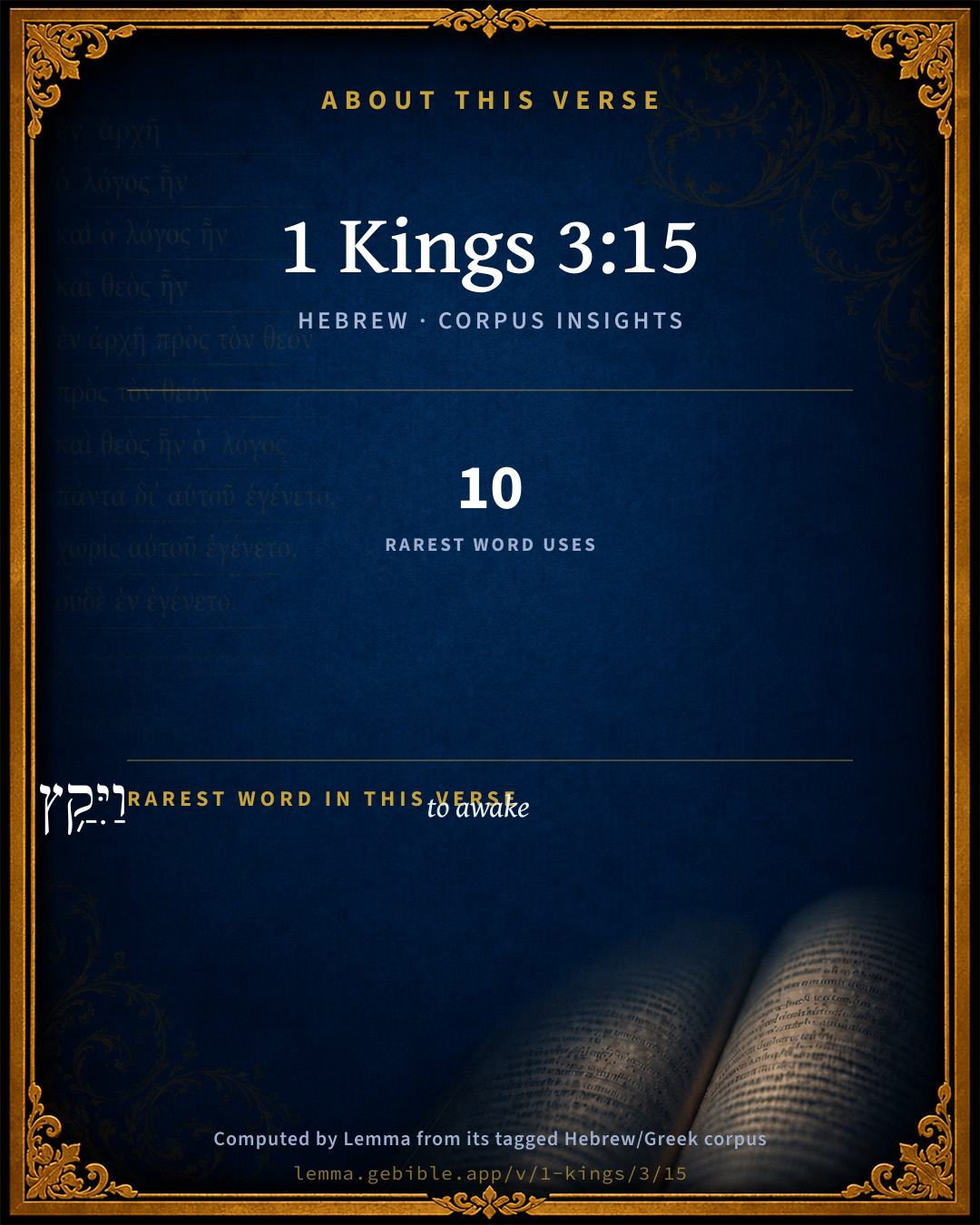
The rarest word here is וַיִּקַ֥ץ to awake H3364 — appearing just 10 times in the whole Hebrew Bible.

Shared distinctive vocabulary

וַיִּקַ֥ץ to awake H3364 occurs in 10 verses of the Hebrew Bible. Also found in:

Grammatical profile

  • 6 verbs
  • 12 nouns
  • 1 particle

Verb forms

  • וַיִּקַ֥ץ Qal · Sequential Imperfect
  • וַיָּב֨וֹא Qal · Sequential Imperfect
  • וַֽיַּעֲמֹ֣ד Qal · Sequential Imperfect
  • וַיַּ֤עַל Hiphil · Sequential Imperfect
  • וַיַּ֣עַשׂ Qal · Sequential Imperfect
  • וַיַּ֥עַשׂ Qal · Sequential Imperfect

Repetition

A word recurs within this verse — often emphatic in Hebrew:

  • וַיַּ֣עַשׂ to do H6213 ×2

Hebrew & Septuagint length

In English translation the verse runs 39 words from the Hebrew and 56 from the Septuagint (LXX English) — the Septuagint runs noticeably longer here. See the side-by-side →

A rough comparison of the two English renderings, which tokenize alike — not a word-level alignment.

Word counts can differ between the Hebrew and the Greek without any difference in meaning — e.g. the Hebrew direct-object marker אֵת has no separate Greek word, and Greek often adds the article ὁ.

Cross-references

16

Topical passages linked to 1 Kings 3:15 in the Treasury of Scripture Knowledge — connected by theme and wording, ordered by reader-vote popularity; previews shown in the World English Bible.

  • Genesis 41:7 The thin heads of grain swallowed up the seven healthy and full ears. Pharaoh awoke, and, behold, it was a dream.
  • 1 Kings 8:65 So Solomon held the feast at that time, and all Israel with him, a great assembly, from the entrance of Hamath to the brook of Egypt, before Yahweh our God, seven days and seven days, even fourteen days.
  • Esther 1:3 in the third year of his reign, he made a feast to all his princes and his servants; the power of Persia and Media, the nobles and princes of the provinces, being before him;
  • Daniel 5:1 Belshazzar the king made a great feast to a thousand of his lords, and drank wine before the thousand.
  • Genesis 31:54 Jacob offered a sacrifice in the mountain, and called his relatives to eat bread. They ate bread, and stayed all night in the mountain.
  • Genesis 40:20 It happened the third day, which was Pharaoh's birthday, that he made a feast for all his servants, and he lifted up the head of the chief cupbearer and the head of the chief baker among his servants.
  • Leviticus 3:1–17 "'If his offering is a sacrifice of peace offerings; if he offers it from the herd, whether male or female, he shall offer it without blemish before Yahweh.
  • Leviticus 7:11–19 "'This is the law of the sacrifice of peace offerings, which one shall offer to Yahweh.
  • 2 Samuel 6:17–19 They brought in the ark of Yahweh, and set it in its place, in the midst of the tent that David had pitched for it; and David offered burnt offerings and peace-offerings before Yahweh.
  • 1 Kings 8:63 Solomon offered for the sacrifice of peace-offerings, which he offered to Yahweh, two and twenty thousand oxen, and one hundred twenty thousand sheep. So the king and all the children of Israel dedicated the house of Yahweh.
  • 1 Chronicles 16:1–2 They brought in the ark of God, and set it in the midst of the tent that David had pitched for it: and they offered burnt offerings and peace-offerings before God.
  • 2 Chronicles 7:5 King Solomon offered a sacrifice of twenty-two thousand oxen, and a hundred and twenty thousand sheep. So the king and all the people dedicated the house of God.
  • 2 Chronicles 7:7–10 Moreover Solomon made the middle of the court holy that was before the house of Yahweh; for there he offered the burnt offerings, and the fat of the peace-offerings, because the brazen altar which Solomon had made was not able to receive the burnt offering, and the meal-offering, and the fat.
  • 2 Chronicles 30:22–26 Hezekiah spoke comfortably to all the Levites who had good understanding [in the service] of Yahweh. So they ate throughout the feast for the seven days, offering sacrifices of peace-offerings, and making confession to Yahweh, the God of their fathers.
  • Jeremiah 31:26 On this I awakened, and saw; and my sleep was sweet to me.
  • Mark 6:21 Then a convenient day came, that Herod on his birthday made a supper for his nobles, the high officers, and the chief men of Galilee.

Cross-references courtesy of OpenBible.info (CC BY 4.0).

Hebrew and Greek witnesses Masoretic Hebrew ↔ Greek Septuagint

The same verse in the two great witnesses to the Old Testament, shown verse-for-verse.

Here the Septuagint runs noticeably longer than the Hebrew — LXX2012 (modern English Septuagint) 56 words vs World English Bible 39. A rough length comparison of the two English translations, not a word-level alignment — read both below.

These are two independent witnesses, not word-aligned to each other, and the Septuagint is shown in lemma (dictionary) form.

Hebrew 1 Kings 3:15 Masoretic · Westminster Leningrad Codex

וַיִּקַ֥ץ שְׁלֹמֹ֖ה וְהִנֵּ֣ה חֲל֑וֹם וַיָּב֨וֹא יְרוּשָׁלִַ֜ם וַֽיַּעֲמֹ֣ד לִפְנֵ֣י אֲר֣וֹן בְּרִית אֲדֹנָ֗י וַיַּ֤עַל עֹלוֹת֙ וַיַּ֣עַשׂ שְׁלָמִ֔ים וַיַּ֥עַשׂ מִשְׁתֶּ֖ה לְכָל עֲבָדָֽיו

Solomon awoke; and, behold, it was a dream: and he came to Jerusalem, and stood before the ark of the covenant of Yahweh, and offered up burnt offerings, and offered peace-offerings, and made a feast to all his servants.

World English Bible · Public Domain

Greek LXX 1 Kings 3:15 Septuagint · lemma form

καί ἐκὑπνίζω σαλωμών καί ἰδού ἐνύπνιον καί ἀναἵστημι καί παραγίγνομαι εἰς ἰερουσαλήμ καί ἵστημι κατά πρόσωπον ὁ θυσιαστήριον ὁ κατά πρόσωπον κιβωτός διαθήκη κύριος ἐν σιων καί ἀναἄγω ὁλοκαύτωσις καί ποιέω εἰρηνικός καί ποιέω πότος μέγας ἑαυτοῦ καί πᾶς ὁ παῖς αὐτός

And Solomon awoke, and, behold, it was a dream: and he arose and came to Jerusalem, and stood before the altar that was in front of the ark of the covenant of the Lord in Sion: and he offered whole burnt offerings, and sacrificed peace-offerings, and made a great banquet for himself and all his servants.

LXX2012 (modern English Septuagint) · Public Domain

On this verse, The Cambridge Bible for Schools and Colleges discusses the Septuagint’s reading. Read the note in Commentary ↓

Hebrew: Westminster Leningrad Codex (CC BY 4.0). Greek: Septuagint (public domain); English from LXX2012 (modern English Septuagint) (Public Domain). How the Septuagint differs from the Hebrew →

Targum (Aramaic paraphrase)

1

The Targum is the ancient Jewish Aramaic paraphrase of the Hebrew Scriptures — an interpretive translation, not the Hebrew text itself. Onkelos (literal) and Pseudo-Jonathan (expansive) render the Torah, and Jonathan the Prophets. Coverage is partial: where no permissively-licensed English translation exists for a verse, only the Aramaic is shown. This is verse-level text, not a word-by-word alignment to the Hebrew.

  1. Targum Jonathan Prophets (Joshua–Malachi)
    וְאִתְעַר שְׁלֹמֹה וְהָא חֶלְמָא וַאֲתָא לִירוּשְׁלֵם וְקָם קֳדָם אֲרוֹנָא קְיָמָא דַייָ וְאַסֵיק עֲלַוָן וּנְכִיס נִכְסַת קוּדְשִׁין וַעֲבַד מִשְׁתַּיָא לְכָל עַבְדוֹהִי:

    (no public-domain English translation for this verse)

    Targum Jonathan — Aramaic: “Mikraot Gedolot” (public domain). English: “Sefaria Community Translation” (CC0 1.0 (public-domain dedication)); “London "Chaldee Paraphrase," 1871” (public domain). Text via Sefaria.

Commentary

Notes on 1 Kings 3:15 from classic Christian and Jewish commentators (each source and its license shown beneath its notes). The classic Christian expositions comment on the surrounding passage and are grouped to its opening verse, so a note may address several verses; the Jewish commentaries on the Tanakh (Rashi and others) are per-verse, so they appear only where the commentator wrote on this verse.

Lemma curates 59 commentaries, every one of them public domain or Creative Commons licensed, each selected and text-cleaned for this edition rather than reprinted as found. About our sources →

Trapp's Complete Commentary

John Trapp

1Ki 3:15 And Solomon awoke; and, behold, [it was] a dream. And he came to Jerusalem, and stood before the ark of the covenant of the LORD, and offered up burnt offerings, and offered peace offerings, and made a feast to all his servants.

Ver. 15. And behold it was a dream.] But a divine dream, very well worth the heeding. There are also dreams diabolical. Eusebius writeth that Simon Magus had his devils ονειροπομποι, by whom he caused people to dream great matters of him, and highly to admire him. That was a strange dream which Jerome {a} had, when he was not only reproved but beaten black and blue for reading Cicero rather than the Holy Scriptures; this voice being uttered, as he perfectly remembered, Ciceronianus es, non Christianus, - Thou art a better Ciceronian than Christian.

{a} Epist. 18, ad Eustoch.

John Trapp, A Commentary or Exposition upon All the Books of the Old and New Testament (1647–1656) — public domain. Text from a community e-Sword module.

Joseph Benson's Commentary

1Ki 3:15. Behold, it was a dream — He perceived that it was a dream; not a vain dream, such as those wherewith men are commonly deluded, but a divine dream, assuring him of the things promised, which he knew, by a divine impression, after he was awaked, and by the vast alteration which he presently found within himself in point of wisdom and knowledge. And stood before the ark — Which was there in the city of David, (2Sa 6:17,) before which he presented himself in a way of holy adoration. And offered up burnt-offerings — Chiefly for the expiation of his and his people’s sin, through the blood of Christ, manifestly signified in these sacrifices. And peace-offerings — Solemnly to praise God for all his mercies, and especially for giving him quiet possession of the kingdom, and for his glorious appearance to him in the dream, and for the promise therein made to him, and the actual accomplishment of it.

Joseph Benson's Commentary on the Old and New Testaments (1811–1818) — public domain. Text from a community e-Sword module.

Tyndale Open Study Notes

Tyndale Open Resources

3:15 Solomon’s sacrifice after the dream completes the narrative.

Tyndale Open Study Notes — © Tyndale Open Resources, licensed CC BY-SA 4.0. Text via the HelloAO Bible API.

Geneva Bible (1599)

Geneva Bible translators

He knew that God had appeared unto him in a dream.

Geneva Bible (1599) marginal notes — public domain. Text via Bolls.life.

Jamieson, Fausset & Brown

Robert Jamieson, A. R. Fausset & David Brown

behold, it was a dream--The vivid impression, the indelible recollection he had of this dream, together with the new and increased energy communicated to his mind, and the flow of worldly prosperity that rushed upon him, gave him assurance that it came by divine inspiration and originated in the grace of God. The wisdom, however, that was asked and obtained was not so much of the heart as of the head--it was wisdom not for himself personally, but for his office, such as would qualify him for the administration of justice, the government of a kingdom, and for the attainment of general scientific knowledge.

Jamieson, Fausset & Brown — Commentary Critical and Explanatory on the Whole Bible (1871) — public domain (CC PDM 1.0). Text via the HelloAO Bible API.

Ellicott's Commentary for English Readers

(15) Stood before the ark of the covenant, in its Tabernacle on Mount Sion, which now constituted a second, and probably still more sacred, place of worship. The great sacrifice—now distinctly a thank-offering, followed as usual by a sacred feast—is naturally repeated there.

A Bible Commentary for English Readers, edited by Charles John Ellicott (1878–1897) — public domain. Text from a community e-Sword module.

The Cambridge Bible for Schools and Colleges

gen. ed. J. J. S. Perowne

15. behold it was a dream] So of Pharaoh (Gen_41:7). This expression does not imply, as at first sight might be supposed, that the vision was something illusory and not to be trusted to. On the contrary, the dream was one of the recognized modes whereby men expected to receive knowledge of the divine will. (See above on 1Ki_3:5.) Hence in this case, Solomon goes to Jerusalem and offers there a solemn sacrifice; while Pharaoh deemed his dream of so much concern, that ‘his spirit was troubled’ until he could find some one to interpret it.

before the ark of the covenant of the Lord] Which David had brought and set up on Mt Zion in the city of David. See 2Sa_6:12; 1Ch_15:1; 1Ch_16:1.

The king’s burnt offerings, peace offerings, and the feast to his servants were tokens of his faith in, and joy over, the promises which had been made to him in his dream.

The LXX. by way of comment says ‘he stood before the altar which was before the ark of the covenant of the Lord on Zion.’ In the Chronicles (2Ch_1:13) there is no mention of this second sacrifice on Zion. Probably the compiler deemed the splendid ceremonial and sacrifices at Gibeon, before the tabernacle of the congregation, to be so much the most important as to render the service on Zion not needful to be recorded.

The Cambridge Bible for Schools and Colleges (gen. ed. J. J. S. Perowne; Cambridge University Press, 1878–1918) — public domain. Text from a community e-Sword module.

John Gill's Exposition

Then came there two women that were harlots unto the king,.... The same day, as Abarbinel thinks, the night before which the Lord had appeared to Solomon; this came to pass through the providence of God, that there should be immediately an instance and proof of the wisdom and understanding the Lord had given to Solomon; these women, according to the Targum, were victuallers or inn keepers; and so Ben Gersom thinks they were sellers of food, as Rahab; though he observes it is possible they might, prostitute themselves: this may be said in their favour, that common prostitutes do not usually bear children, or, when they do, take no care of them, have no affection for them, and much less are fond of them, as these seem to be; but, on the other hand, no mention being made of their husbands, and living together in one house, and alone, and being impudent, brawling, and litigious, give great suspicion of the truth of the character they bear in our version and others:

and stood before him; to lay their case before him, and each plead their own cause; it may be, it had been tried in another court before, and could not be determined, and so was brought to the king; and, if so, the wisdom of Solomon was the more conspicuous, in deciding it in the manner he did.

John Gill's Exposition of the Whole Bible (1746–1763) — public domain (CC PDM 1.0). Text via the HelloAO Bible API.

Albert Barnes' Notes on the Bible

Solomon determined to inaugurate his reign by a grand religious ceremonial at each of the two holy places which at this time divided between them the reverence of the Jews. Having completed the religious service at Gibeon, where was the tabernacle of the congregation, he proceeded to Jerusalem, and sacrificed before the ark of the covenant, which was in Mount Zion 2Sa 6:12. A great feast naturally followed on a large sacrifice of peace-offerings. In these the sacrificer always partook of the flesh of the victim, and he was commanded to call in to the feast the Levite, the stranger, the fatherless, and the widow Deu 14:29. Compare 2Sa 6:19; 1Ch 16:3.

Albert Barnes' Notes on the Bible (1834–1885) — public domain. Text from a community e-Sword/MySword module.

Haydock's Catholic Bible Commentary

Dream. Sent by God, as [in] Genesis xli. 1. (Calmet)

George Leo Haydock (1774–1849), Haydock's Catholic Family Bible and Commentary, 1859 edition — public domain. Excludes Psalms (Douay-Rheims chapter numbering differs from Protestant) and Deuterocanonical books (Catholic canon only).

Matthew Poole's English Annotations

It was a dream, i.e. he perceived that it was a dream; not a vain dream, wherewith men are commonly deluded; but a Divine knew, dream, assuring him of the thing; which he partly by a Divine impression and inspiration thereof in his mind after he was awakened; and partly by the vast alteration which he presently found within himself in point of wisdom and knowledge.

The ark of the covenant of the Lord was there in the city of David, 2Sa 6:17, before which he presented himself in the way of holy ministration and adoration, which may be noted by the word stood. Or that word may note his abode there for some consider able time, as the offering of so many sacrifices required.

Offered up burnt-offerings, chiefly for the expiation of his and his people’s sins, through the blood of Christ, manifestly signified in these sacrifices.

And offered peace-offerings, solemnly to praise God for all his mercies, and especially for giving him a quiet and fixed possession of the kingdom, and for his glorious appearance to him in a dream, and for the great promise therein made to him, and the actual accomplishment of it since wrought in him.

Matthew Poole's English Annotations on the Holy Bible (1683–1685) — public domain. Text from a community e-Sword/MySword module.

Whedon's Commentary on the Bible

Daniel D. Whedon

15. Behold, it was a dream — Nevertheless it was a real Divine communication, given by inspiration of God. See note on 1Ki_3:5.

Came to Jerusalem — The tabernacle was at Gibeon, the ark at Jerusalem, and Solomon’s going from the former to the latter place with sacrificial offerings was a most significant act, opening a new epoch in the history of Israelitish worship. It was, probably, the last public service of the kind at Gibeon, and so, in effect, was a public transfer of sacrificial worship from the wandering, unsettled tabernacle, to that divinely chosen spot where alone henceforth Jehovah would be pleased to accept the more public offerings and vows of Israel. See Deu_12:5. It also symbolized that coming hour when, under the “greater than Solomon,” all separation of tabernacle and ark would be forever past, and the true worshippers would advance from a cultus that made locality a test, to find their great altar in the inner temple of the spirit, and to worship the Father in spirit and in truth. Joh_4:21-24.

Daniel D. Whedon (gen. ed.), Commentary on the Old and New Testaments (1874–1909) — public domain. Text from a community e-Sword module.

The Pulpit Commentary

And Solomon awoke; and, behold, it was a dream That is to say, this passed while Solomon slept; but it was more than a dream. The same words are used of Pharaoh (Gen_41:7) when God showed him what He was about to do, (vers. 25, 28, cf. Gen_40:8) and this was such a dream as Pharaoh"s and as Joseph"s. (Mat_1:20 Mat_2:19) It was a dream, i.e., in which a Divine revelation was made to him. Words refers to Solomon"s words, "I sleep, but my heart waketh, (Son_5:2) and "He giveth to his beloved (Jedidiah) in sleep". (Psa_127:2) And he came to Jerusalem, and stood before the ark of the covenant the other sanctuary of that period (1Ch_16:37-40) and offered up burnt offerings (probably in continuation of the sacrifices of Gibeon, ver. 4), and offered peace offerings (in testimony of his thankfulness for the signal favour recently vouchsafed to him) and made a feast lit., a drinking. After the example of David, 1Ch_16:3. Cf. 1Ki_8:65. It was not exclusively a symposium. The flesh of the animals offered in sacrifice was eaten by the worshippers and their guests. (Lev_7:15, 31 1Sa_2:16 1Co_8:13) This was "a sacrificial meal of the (Keil). (See on 1Ki_6:17 1Ki_8:63) to all his servants.

The Pulpit Commentary (1880–1919), ed. H.D.M. Spence-Jones & Joseph S. Exell — public domain. Text from a community e-Sword module.

John Wesley's Explanatory Notes

A dream - Not a vain dream, wherewith men are commonly deluded; but a divine dream, assuring him of the thing: which he knew, by a divine impression after he was awakened: and by the vast alteration which he presently found within himself in point of wisdom and knowledge. The ark - Which was there in the city of David, 2 Sam. vi, 17, before which he presented himself in a way of holy adoration. Burnt offerings - Chiefly for the expiation of his and his peoples sin, through the blood of Christ, manifestly signified in these sacrifices. Peace offerings - Solemnly to praise God for all his mercies, and especially for giving him quiet possession of the kingdom, and for his glorious appearance to him in the dream, and for the promise therein made to him, and the actual accomplishment of it.

John Wesley, Explanatory Notes Upon the Whole Bible (1754–1765) — public domain. Text via the GEBible commentary corpus.

unfoldingWord translationNotes

Door43 World Missions Community

behold

The word "behold" here shows that Solomon saw something interesting.

translationWords

dream

Jerusalem

ark of the covenant

lord

burnt offering

peace offering

feast

servant

unfoldingWord translationNotes — © Distant Shores Media and the Door43 World Missions Community, licensed CC BY-SA 4.0. Source: git.door43.org/Door43/en_tn.

Rashi

Rabbi Shlomo Yitzchaki (Rashi)

Shlomo woke up and behold it was a dream. And behold he understood that his dream was true. He heard a bird chirping and understood its language, a dog barking and he understood its language.

And [he] made a feast. Out of his heart’s happiness [he celebrated] because he realized that his dream was true.

Rashi on the Tanakh — English translations: “The Judaica Press complete Tanach with Rashi, translated by A. J. Rosenberg” (CC BY 4.0); “Pentateuch with Rashi's commentary by M. Rosenbaum and A.M. Silbermann, 1929-1934” (public domain); “The Metsudah Tanach series, Lakewood, N.J” (CC BY 4.0); and “The Book of Joshua, Metsudah Publications, 1997” (CC BY 4.0). Text via Sefaria.

Lesson kit

Teaching starters — assembled from the data on this page, not authored interpretation. Every prompt links to the verse data it draws on. Edit before teaching.

1 Kings, in the Historical, opens this verse with 19 words (18 distinct Hebrew lemmas). Its most distinctive word is yâqats (“to awake”). The Greek Septuagint runs longer here. A historical commentator’s framing appears above. Read the whole chapter for the surrounding context.

Discussion questions

  1. What does “to awake” (yâqats) contribute to the verse as a whole?
  2. Genesis 9:24 shares the word «to awake» with this verse. How do the two illuminate each other?
  3. “to do” occurs 2× in this one verse. What is the effect of the repetition?
  4. Compared with the Hebrew, the Septuagint runs longer here. What questions does that raise?
  5. These translations render this verse differently; the difference is in the English rendering, not the original. What questions does that raise?
  6. The verb «וַיִּקַ֥ץ» is Qal Sequential Imperfect. How does its form color the action?
  7. Reading how Trapp's Complete Commentary and Joseph Benson's Commentary read this verse, where do the two commentators agree and where do they part?

Things to notice

Reading settings

Reading text

Shown beneath each verse's original-language words.

Old Testament
Old Testament edition

Read the OT as the Masoretic Hebrew (MT) or the Greek Septuagint (LXX).

English shown for the Greek Septuagint (in the Hebrew ↔ Greek comparison).

Comparing translations? Open the Compare panel on any verse page to stack up to four side by side.