
Isaiah 22:5

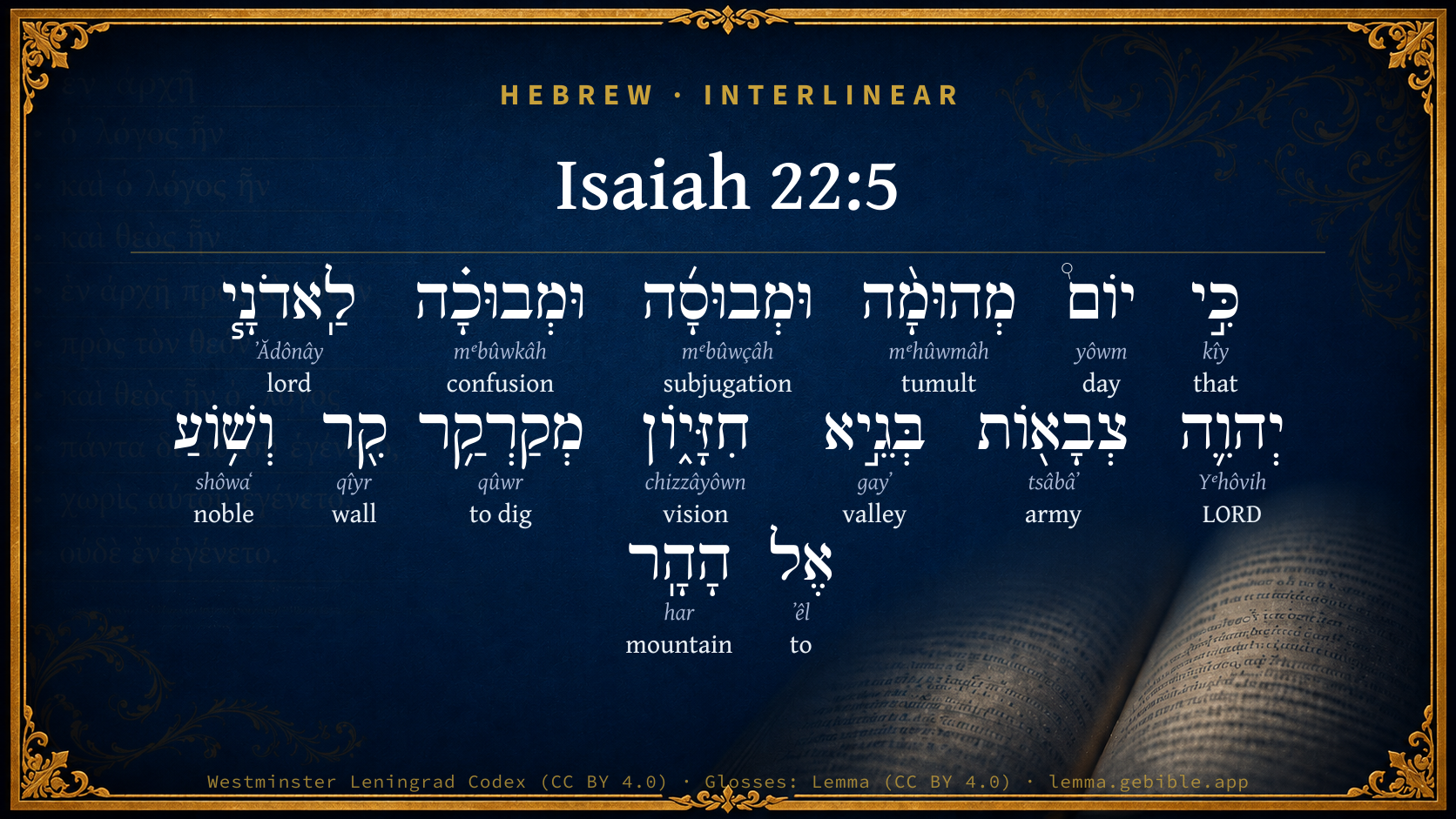
Hebrew (Westminster Leningrad Codex) Isaiah 22:5 appears in the Hebrew Old Testament. The text above is from the Westminster Leningrad Codex. Each word links to its Strong’s number, a concise gloss, and parsing drawn from the Open Scriptures Hebrew Bible morphology. Click any word for its full Brown-Driver-Briggs (BDB) entry.
Download image
Cite this verse

Isaiah 22:5 (World English Bible). Public Domain. Lemma interlinear Bible study tool, https://lemma.gebible.app/v/isaiah/22/5.

Show BibTeX & RIS
BibTeX
RIS
English Translation
For it is a day of confusion, and of treading down, and of perplexity, from the Lord, Yahweh of Hosts, in the valley of vision; a breaking down of the walls, and a crying to the mountains.
World English Bible · Public Domain
Highlights
  • 1 first appearance in the Hebrew Bible
Full analysis ↓
Download a study sheet

One document with this verse’s original text, its word-by-word gloss line, the meaning frame, cross-references with their text, attributed commentary, and full source and license credits — printable, and it pastes into notes with its structure intact.

This verse Autodidact and up

Study sheet (.html) Plain text (.txt)

A passage Seminary Student

Up to 50 verses in one chapter. A passage sheet keeps up to 6 commentary sources and 12 cross-references per verse, in the order this page ranks them, and says so on the sheet whenever that leaves anything out. Ask for a single verse and you get the Autodidact verse sheet above.

Everything on this page stays free to read, with no account — the sheet is a download of what is already on screen, not access to it.

Want to remove ads? Support Godless Engineer
Compare translations 3

The same verse in 3 English versions, stacked beneath the original-language interlinear above. Click any original word for its lexicon entry.

Each is an independent rendering of the whole verse — the interlinear is not word-aligned to these translations.

Highlighted words mark where these versions differ — a whole-verse word diff, not a word-by-word alignment.

  • World English Bible Public Domain
    For it is a day of confusion, and of treading down, and of perplexity, from the Lord, Yahweh of Hosts, in the valley of vision; a breaking down of the walls, and a crying to the mountains.
  • King James Version Public Domain
    For it is a day of trouble, and of treading down, and of perplexity by the Lord GOD of hosts in the valley of vision, breaking down the walls, and of crying to the mountains.
  • unfoldingWord Literal Text CC BY-SA 4.0
    For a day of tumult and trampling and confusion for the Lord, Yahweh of Armies, in the Valley of Vision, a breaking down of a wall and an outcry to the mountain.

unfoldingWord Literal Text — © unfoldingWord, licensed CC BY-SA 4.0. Word-aligned USFM3 via Door43 (git.door43.org/unfoldingWord/en_ult).

Versions to compare (up to 4)

3 of 4 selected

Show all 18 translations

Every available English version of this verse, each an independent rendering of the whole verse.

  • World English Bible Public Domain
    For it is a day of confusion, and of treading down, and of perplexity, from the Lord, Yahweh of Hosts, in the valley of vision; a breaking down of the walls, and a crying to the mountains.
  • Berean Standard Bible Public Domain
    For the Lord GOD of Hosts has set a day of tumult and trampling and confusion in the Valley of Vision—of breaking down the walls and crying to the mountains.
  • Majority Standard Bible Public Domain
    For the Lord GOD of Hosts has set a day of tumult and trampling and confusion in the Valley of Vision—of breaking down the walls and crying to the mountains.
  • King James Version Public Domain
    For it is a day of trouble, and of treading down, and of perplexity by the Lord GOD of hosts in the valley of vision, breaking down the walls, and of crying to the mountains.
  • American Standard Version (1901) Public Domain
    For it is a day of discomfiture, and of treading down, and of perplexity, from the Lord, Jehovah of hosts, in the valley of vision; a breaking down of the walls, and a crying to the mountains.
  • Revised Version (1885) Public Domain
    For it is a day of discomfiture, and of treading down, and of perplexity, from the Lord, the LORD of hosts, in the valley of vision; a breaking down of the walls, and a crying to the mountains.
  • Geneva Bible (1599) Public Domain
    For it is a day of trouble, and of ruine, and of perplexitie by the Lord God of hostes in the valley of vision, breaking downe the citie: and a crying vnto the mountaines.
  • Douay-Rheims (1899) Public Domain
    For it is a day of slaughter and of treading down, and of weeping to the Lord the God of hosts in the valley of vision, searching the wall, and magnificent upon the mountain.
  • Young's Literal Translation Public Domain
    For a day of noise, and of treading down, And of perplexity, `is' to the Lord, Jehovah of Hosts, In the valley of vision, digging down a wall, And crying unto the mountain.
  • Literal Standard Version CC BY-SA 4.0
    For a day of noise, and of treading down, || And of perplexity, [is] to the Lord, YHWH of Hosts, || In the Valley of Vision, digging down a wall, || And crying to the mountain.
  • Unlocked Literal Bible CC BY-SA 4.0
    For there is a day of tumult, treading down, and confusion for the Lord Yahweh of hosts, in the Valley of Vision, a breaking down of the walls, and people crying out to the mountains.
  • unfoldingWord Literal Text CC BY-SA 4.0
    For a day of tumult and trampling and confusion for the Lord, Yahweh of Armies, in the Valley of Vision, a breaking down of a wall and an outcry to the mountain.
  • Darby Bible Public Domain
    For it is a day of trouble, and of treading down, and of perplexity, from the Lord, Jehovah of hosts, in the valley of vision; [a day of] breaking down the wall, and of crying to the mountain:
  • World Messianic Bible Public Domain
    For it is a day of confusion, and of treading down, and of perplexity from the Lord, GOD of Hosts, in the valley of vision, a breaking down of the walls, and a crying to the mountains.”
  • Webster's Bible Public Domain
    For it is a day of trouble, and of treading down, and of perplexity by the Lord GOD of hosts in the valley of vision, breaking down the walls, and of crying to the mountains.
  • Free Bible Version CC BY-SA 4.0
    For the Lord has a day of defeat, of panic and confusion in the Valley of Vision, a day of tearing down walls and crying for help to the mountains.
  • Bible in Basic English Public Domain
    For it is a day of trouble and of crushing down and of destruction from the Lord, the Lord of armies, in the valley of vision;...
  • JPS Tanakh (1917) Public Domain
    For it is a day of trouble, and of trampling, and of perplexity, from the Lord, the GOD of hosts, in the Valley of Vision; Kir shouting, and Shoa at the mount.

Literal Standard Version (2020), Covenant Press — licensed CC BY-SA 4.0. Text via the HelloAO Bible API (eBible.org). Unlocked Literal Bible (unfoldingWord) — licensed CC BY-SA 4.0. Text via the HelloAO Bible API (eBible.org). unfoldingWord Literal Text — © unfoldingWord, licensed CC BY-SA 4.0. Word-aligned USFM3 via Door43 (git.door43.org/unfoldingWord/en_ult). Free Bible Version, Dr. Jonathan Gallagher — licensed CC BY-SA 4.0. Text via the HelloAO Bible API (eBible.org).

Word by word

More ways to search: Search by grammar → Find every occurrence → Compare this word →

Practice this passage: Drill this verse → Learn its vocabulary →

וּמְבוּכָ֗ה
mᵉbûwkâh
H3998
“and · confusion”
Conjunction + Noun, Common, Feminine, Singular, Absolute
Part of Speech
Conjunction + Noun
Type
Common
Gender
Feminine
Number
Singular
State
Absolute
Full BDB Definition

Origin: from H943

TWOT: 214a

confusion, perplexity, confounding
  1. כִּ֣י kîy H3588 “that” Conjunction
  2. יוֹם֩ yôwm H3117 “day of” Noun, Common, Masculine, Singular, Construct
  3. מְהוּמָ֨ה mᵉhûwmâh H4103 “tumult” Noun, Common, Feminine, Singular, Absolute
  4. וּמְבוּסָ֜ה mᵉbûwçâh H4001 “and · subjugation” Conjunction + Noun, Common, Feminine, Singular, Absolute
  5. לַֽאדֹנָ֧י ʼĂdônây H136 “to/for · Lord · my” Preposition + Noun, Common, Masculine, Plural, Construct + Suffix, Personal, 1st Person, Common, Singular
  6. יְהוִ֛ה Yᵉhôvih H3069 “LORD” Noun, Proper
  7. צְבָא֖וֹת tsâbâʼ H6635 “armies” Noun, Common, Both, Plural, Absolute
  8. בְּגֵ֣יא gayʼ H1516 “in/at · valley of” Preposition + Noun, Common, Both, Singular, Construct
  9. חִזָּי֑וֹן chizzâyôwn H2384 “vision” Noun, Common, Masculine, Singular, Absolute
  10. מְקַרְקַ֥ר qûwr H6979 “digging” Verb, Pilpel, Participle Active, Masculine, Singular, Construct
  11. קִ֖ר qîyr H7023 “wall” Noun, Common, Masculine, Singular, Absolute
  12. וְשׁ֥וֹעַ shôwaʻ H7771 “and · noble” Conjunction + Noun, Common, Masculine, Singular, Absolute
  13. אֶל ʼêl H413 “to” Preposition
  14. הָהָֽר har H2022 “the · mountain” Particle, Definite Article + Noun, Common, Masculine, Singular, Absolute

About this verse

These counts appear in no published source. They are computed here, from the morphology-tagged text and Lemma’s own curated glosses. What Lemma adds →

15
words
15
distinct lemmas
Prophets
section

Notable vocabulary

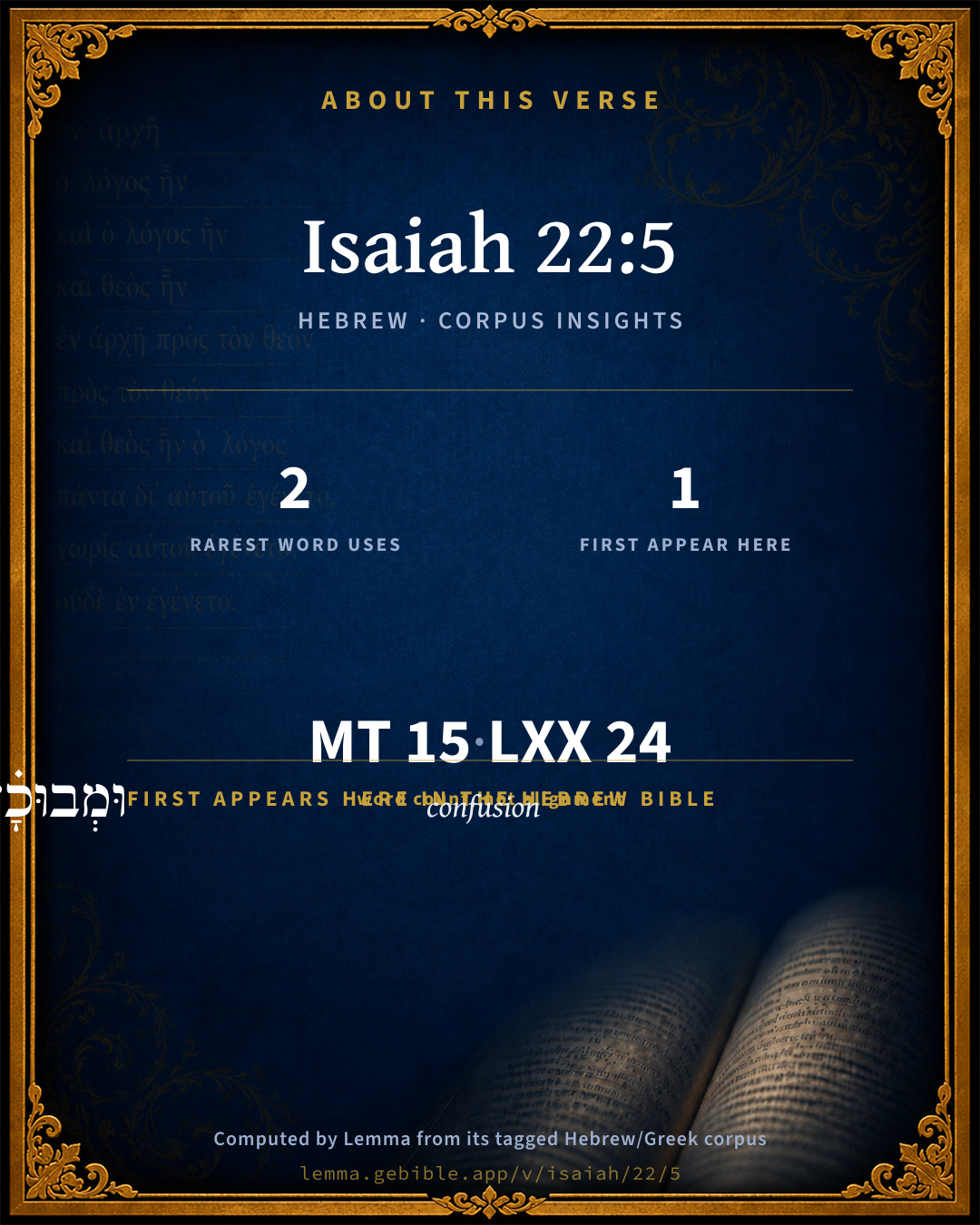
The rarest word here is וּמְבוּכָ֗ה confusion H3998 — appearing just 2 times in the whole Hebrew Bible.

First appearance in Scripture

This word makes its first canonical appearance in the Hebrew Bible here:

  • וּמְבוּכָ֗ה confusion H3998

Shared distinctive vocabulary

וּמְבוּכָ֗ה confusion H3998 occurs in 2 verses of the Hebrew Bible. Also found in:

Grammatical profile

  • 1 verb
  • 12 nouns
  • 1 preposition
  • 1 conjunction

Verb forms

  • מְקַרְקַ֥ר Pilpel · Participle Active

Hebrew & Septuagint length

In English translation the verse runs 37 words from the Hebrew and 42 from the Septuagint (LXX English) — closely comparable.

A rough comparison of the two English renderings, which tokenize alike — not a word-level alignment.

Word counts can differ between the Hebrew and the Greek without any difference in meaning — e.g. the Hebrew direct-object marker אֵת has no separate Greek word, and Greek often adds the article ὁ.

In the original languages it is 15 Hebrew tokens and 24 Greek tokens — but the two are counted differently (Hebrew bundles its prefixes and suffixes into one token; the Greek is in lemma form), so that isn’t a like-for-like length.

Cross-references

17

Topical passages linked to Isaiah 22:5 in the Treasury of Scripture Knowledge — connected by theme and wording, ordered by reader-vote popularity; previews shown in the World English Bible.

  • Isaiah 10:6 I will send him against a profane nation, and against the people of my wrath will I give him a charge, to take the spoil, and to take the prey, and to tread them down like the mire of the streets.
  • Isaiah 37:3 They said to him, Thus says Hezekiah, This day is a day of trouble, and of rebuke, and of rejection; for the children have come to the birth, and there is no strength to bring forth.
  • Lamentations 1:5 Her adversaries are become the head, her enemies prosper; For Yahweh has afflicted her for the multitude of her transgressions: Her young children are gone into captivity before the adversary.
  • Micah 7:4 The best of them is like a brier. The most upright is worse than a thorn hedge. The day of your watchmen, Even your visitation, has come; Now is the time of their confusion.
  • Luke 23:30 Then they will begin to tell the mountains, 'Fall on us!' and tell the hills, 'Cover us.'
  • Isaiah 22:1 The burden of the valley of vision. What ails you now, that you are wholly gone up to the housetops?
  • Jeremiah 30:7 Alas! for that day is great, so that none is like it: it is even the time of Jacob's trouble; but he shall be saved out of it.
  • Lamentations 2:2 The Lord has swallowed up all the habitations of Jacob, and has not pitied: He has thrown down in his wrath the strongholds of the daughter of Judah; He has brought them down to the ground; he has profaned the kingdom and the princes of it.
  • Hosea 10:8 The high places also of Aven, the sin of Israel, will be destroyed. The thorn and the thistle will come up on their altars. They will tell the mountains, "Cover us!" and the hills, "Fall on us!"
  • Amos 5:18–20 "Woe to you who desire the day of Yahweh! Why do you long for the day of Yahweh? It is darkness, And not light.
  • 2 Kings 19:3 They said to him, Thus says Hezekiah, This day is a day of trouble, and of rebuke, and of rejection; for the children are come to the birth, and there is not strength to bring forth.
  • 2 Kings 25:10 All the army of the Chaldeans, who were [with] the captain of the guard, broke down the walls of Jerusalem round about.
  • Esther 3:15 The posts went forth in haste by the king's commandment, and the decree was given out in Shushan the palace. The king and Haman sat down to drink; but the city of Shushan was perplexed.
  • Isaiah 5:5 Now I will tell you what I will do to my vineyard. I will take away its hedge, and it will be eaten up. I will break down its wall of it, and it will be trampled down.
  • Isaiah 25:10 For in this mountain will the hand of Yahweh rest; and Moab shall be trodden down in his place, even as straw is trodden down in the water of the dung-hill.
  • Matthew 24:16 then let those who are in Judea flee to the mountains.
  • Revelation 6:16–17 They told the mountains and the rocks, "Fall on us, and hide us from the face of him who sits on the throne, and from the wrath of the Lamb,

Cross-references courtesy of OpenBible.info (CC BY 4.0).

Hebrew and Greek witnesses Masoretic Hebrew ↔ Greek Septuagint

The same verse in the two great witnesses to the Old Testament, shown verse-for-verse.

These are two independent witnesses, not word-aligned to each other, and the Septuagint is shown in lemma (dictionary) form.

Hebrew Isaiah 22:5 Masoretic · Westminster Leningrad Codex

כִּ֣י יוֹם֩ מְהוּמָ֨ה וּמְבוּסָ֜ה וּמְבוּכָ֗ה לַֽאדֹנָ֧י יְהוִ֛ה צְבָא֖וֹת בְּגֵ֣יא חִזָּי֑וֹן מְקַרְקַ֥ר קִ֖ר וְשׁ֥וֹעַ אֶל הָהָֽר

For it is a day of confusion, and of treading down, and of perplexity, from the Lord, Yahweh of Hosts, in the valley of vision; a breaking down of the walls, and a crying to the mountains.

World English Bible · Public Domain

Greek LXX Isaiah 22:5 Septuagint · lemma form

ὅτι ἡμέρα ταραχή καί ἀπώλεια καί καταπάτημα καί πλάνησις παρά κύριος σαβαωθ ἐν φάραγξ σιων πλανάω ἀπό μικρός ἕως μέγας πλανάω ἐπί ὁ ὄρος

For it is a day of trouble, and of destruction, and of treading down, and there is perplexity sent from the Lord of hosts: they wander in the valley of Sion; they wander from the least to the greatest on the mountains.

LXX2012 (modern English Septuagint) · Public Domain

On this verse, Albert Barnes' Notes on the Bible discusses the Septuagint’s reading. Read the note in Commentary ↓

Hebrew: Westminster Leningrad Codex (CC BY 4.0). Greek: Septuagint (public domain); English from LXX2012 (modern English Septuagint) (Public Domain). How the Septuagint differs from the Hebrew →

Targum (Aramaic paraphrase)

1

The Targum is the ancient Jewish Aramaic paraphrase of the Hebrew Scriptures — an interpretive translation, not the Hebrew text itself. Onkelos (literal) and Pseudo-Jonathan (expansive) render the Torah, and Jonathan the Prophets. Coverage is partial: where no permissively-licensed English translation exists for a verse, only the Aramaic is shown. This is verse-level text, not a word-by-word alignment to the Hebrew.

  1. Targum Jonathan Prophets (Joshua–Malachi)
    אֲרֵי יוֹם רְגוּשׁ וְאִתְּדָשָׁא וּקְטוֹל קֳדָם יְיָ אֱלָהֵי צְבָאוֹת עַל קַרְתָּא דְיַתְבָא בְחֵילְתָא דְאִתְנַבִּיאוּ עֲלָהּ נְבִיַיָא מַבְלְשִׁין בָּתַּיָא מַקְפִין מִגְדְלַיָא בְּרֵישֵׁי טוּרַיָא:

    For it is a day of tumult, and of treading under foot, and of slaughter before the Lord, the God of hosts, against the city that dwelleth in the valley, against which the prophets prophesied. Thy search the houses, they encompass the towers which are on the tops of the mountains.

    Targum Jonathan — Aramaic: “Mikraot Gedolot” (public domain). English: “Sefaria Community Translation” (CC0 1.0 (public-domain dedication)); “London "Chaldee Paraphrase," 1871” (public domain). Text via Sefaria.

Commentary

Notes on Isaiah 22:5 from classic Christian and Jewish commentators (each source and its license shown beneath its notes). The classic Christian expositions comment on the surrounding passage and are grouped to its opening verse, so a note may address several verses; the Jewish commentaries on the Tanakh (Rashi and others) are per-verse, so they appear only where the commentator wrote on this verse.

Lemma curates 59 commentaries, every one of them public domain or Creative Commons licensed, each selected and text-cleaned for this edition rather than reprinted as found. About our sources →

The Cambridge Bible for Schools and Colleges

gen. ed. J. J. S. Perowne

5. The first half of the verse reads: For a day of tumult and trampling and confusion hath Jehovah of hosts,—“a series of inimitable assonances” (Cheyne) in the Hebr. (cf. Nah_2:10 [Hebrews 11]). The form of the sentence is the same as in Isa_2:12.

The words in the valley of vision belong (in spite of the accents) to the second half; render: in the valley of vision (they are) battering down the wall, and a cry (of distress rises) to the mountain. “Valley of vision” is taken by some as a proper name (valley of Ḥizzâyôn), though no such place is known; by others as a mystic name for Jerusalem (like Ariel, Isa_29:1), which is hardly possible, since the word for “valley” denotes a deep and narrow ravine. Some particular valley round Jerusalem must be meant, most probably the Tyropœon; but why it is called the “valley of (prophetic) vision” we cannot tell. The suggestion that Isaiah lived and had his visions there is very far-fetched.

5–7. The connexion here becomes very uncertain. It seems clear that Isa_22:5 (from its form) must refer to the future, while Isa_22:8-11 undoubtedly go back to what is past. The transition must apparently take place either at Isa_22:6 or Isa_22:8. Now the tenses in Isa_22:6-7 would be naturally construed as historic perfects, and at first sight it seems obvious that these verses are intimately connected with Isa_22:8 ff., and belong like them to the past. But on the other hand it has to be considered that (a) Isa_22:5 is too short to stand alone; (b) the preparations for the siege (8 ff.) are in any case distinct from (if not prior to) the assault described in 6 f.; and (c) there is no evidence of an attempt to carry Jerusalem by storm during the first blockade. Hence it seems better, in spite of the violence of the transition at Isa_22:8, to regard Isa_22:5-7 as an account of what Isaiah has seen in vision, viz., the return of the enemy in force to the city.

The Cambridge Bible for Schools and Colleges (gen. ed. J. J. S. Perowne; Cambridge University Press, 1878–1918) — public domain. Text from a community e-Sword module.

Trapp's Complete Commentary

John Trapp

Isa 22:5 For [it is] a day of trouble, and of treading down, and of perplexity by the Lord GOD of hosts in the valley of vision, breaking down the walls, and of crying to the mountains.

Ver. 5. For it is a day of trouble, and of treading down.] Great is the woe of war; no words how wide soever can set forth to the full the distress and destruction thereof.

And of perplexity.] Mebusah samebucah, so the original elegantly, as in the last words of the verse, rythmically.

Breaking down the walls.] {a} According to Isa 5:5.

{a} Dominus exparietavit. - Vatab.

John Trapp, A Commentary or Exposition upon All the Books of the Old and New Testament (1647–1656) — public domain. Text from a community e-Sword module.

Tyndale Open Study Notes

Tyndale Open Resources

22:5-8 The defeat of Judah would be a manifestation of the yet-future day of the Lord (see study note on 2:5-22). Jerusalem would be impotent in the day of disaster.

22:5 Jerusalem’s walls were broken by the invading Babylonians, who breached them with battering rams (2 Kgs 25:4).

Tyndale Open Study Notes — © Tyndale Open Resources, licensed CC BY-SA 4.0. Text via the HelloAO Bible API.

Geneva Bible (1599)

Geneva Bible translators

That is, the shout of the enemies whom God had appointed to destroy the city.

Geneva Bible (1599) marginal notes — public domain. Text via Bolls.life.

Jamieson, Fausset & Brown

Robert Jamieson, A. R. Fausset & David Brown

trouble . . . by the Lord--that is, sent by or from the Lord (see on Isa 19:15; Luk 21:22-24).

valley of vision--(See on Isa 22:1). Some think a valley near Ophel is meant as about to be the scene of devastation (compare see on Isa 32:13-14).

breaking . . . walls--that is, "a day of breaking the walls" of the city.

crying to the mountains--the mournful cry of the townsmen "reaches" to (MAURER translates, towards) the mountains, and is echoed back by them. JOSEPHUS describes in the very same language the scene at the assault of Jerusalem under Titus. To this the prophecy, probably, refers ultimately. If, as some think, the "cry" is that of those escaping to the mountains, compare Mat 13:14; Mat 24:16, with this.

Jamieson, Fausset & Brown — Commentary Critical and Explanatory on the Whole Bible (1871) — public domain (CC PDM 1.0). Text via the HelloAO Bible API.

Ellicott's Commentary for English Readers

(5) For it is a day of trouble.—The earlier clauses paint the mental emotions of the coming day of judgment. In the latter we hear the actual crash of the battering-rams across the walls. The cry of the panic-stricken people shall rise to the surrounding mountains, possibly as to the hills from whence they expected help, either as true worshippers looking to Mount Zion (Psa_121:1), or to the high places which were so long the objects of their worship, and which led their enemies to say that their gods were “gods of the hills, and not of the valleys” (1Ki_20:23).

A Bible Commentary for English Readers, edited by Charles John Ellicott (1878–1897) — public domain. Text from a community e-Sword module.

John Gill's Exposition

For it is a day of trouble,.... To Hezekiah, and also Jerusalem, and all the inhabitants of the land:

and of treading down; the people of it by Sennacherib's army, like mire in the streets, when their cities were taken by him:

and of perplexity by the Lord of hosts in the valley of vision; in Jerusalem, besieged, and threatened with desolation; which threw the king and his nobles, and all the inhabitants, into the utmost perplexity, confusion, and distress; and all this was not merely from men, nor was it by chance, but by the permission and appointment of God, to humble his people for their sins, and bring them to a sense and acknowledgment of them:

breaking down the walls: of the fenced cities, with their battering rams, at the time they besieged and took them, Kg2 18:13,

and of crying to the mountains: looking and running to them for help and succour, for shelter and protection; and crying so loud, by reason of their distress, as that it reached the distant mountains, and made them echo with it.

John Gill's Exposition of the Whole Bible (1746–1763) — public domain (CC PDM 1.0). Text via the HelloAO Bible API.

Albert Barnes' Notes on the Bible

For it is a day of trouble and of treading down - When our enemies trample on everything sacred and dear to us, and endanger all our best interests (see Psa 44:6; Luk 21:24).

And of perplexity - In which we know not what to do. We are embarrassed, and know not where to look for relief.

By the Lord God of hosts - That is, he is the efficient cause of all this. It has come upon us under his providence, and by his direction (see the note at Isa 10:5).

In the valley of vision - In Jerusalem (see the note at Isa 22:1).

Breaking down the walls - There has been much variety in the interpretation of this place. The Septuagint renders it, ‘In the valley of Zion they wander, from the least to the greatest; they wander upon the mountains.’ See a discussion of the various senses which the Hebrew phrase may admit, in Rosenmuller and Gesenius. Probably our common version has given the true sense, and the reference is to the fact that the walls of the city became thrown down, either in the siege or from some other cause. If this refers to the invasion of Sennacherib, though his army was destroyed, and he was unable to take the city, yet there is no improbability in the supposition that he made some breaches in the walls. Indeed this is implied in the account in 2Ch 32:5.

And of crying to the mountains - Either for help, or more probably of such a loud lamentation that it reached the surrounding hills, and was re-echoed back to the city. Or perhaps it may mean that the shout or clamor of those engaged in building or defending the walls, reached to the mountains. Compare Virg. “AEncid,” iv. 668:

- resonat magnis plangoribus aether.

Rosenmuller renders it, ‘A cry - to the mountains!’ That is, a cry among the people to escape to the hills, and to seek refuge in the caves and fastnesses there (compare Jdg 6:2; Mat 24:16; Mar 13:14).

Albert Barnes' Notes on the Bible (1834–1885) — public domain. Text from a community e-Sword/MySword module.

Haydock's Catholic Bible Commentary

Searching. That day beheld the Assyrians (Haydock) undermining the wall, and behaving with haughtiness (Calmet) on Mount Sion. (Haydock)

George Leo Haydock (1774–1849), Haydock's Catholic Family Bible and Commentary, 1859 edition — public domain. Excludes Psalms (Douay-Rheims chapter numbering differs from Protestant) and Deuterocanonical books (Catholic canon only).

Matthew Poole's English Annotations

Of treading down; in which my people are trodden under foot by their insolent enemies.

Of perplexity by the Lord God of hosts: this is added, partly to show that this did not happen without God’s providence; and partly to aggravate their calamity, because not only men, but God himself, fought against them.

Breaking down the walls of the strong cities of Judah; which was done by Sennacherib, 2Ki 25:10.

Crying to the mountains, with such loud and dismal outcries as should reach to the neighbouring mountains, and make them ring again therewith.

Matthew Poole's English Annotations on the Holy Bible (1683–1685) — public domain. Text from a community e-Sword/MySword module.

The Pulpit Commentary

It is a day... By the Lord; rather, there is a day to the Lord; or, the Lord has a day. God has in reserve such a day; and it will assuredly arrive in due course. Hence the prophet"s grief. In the valley of vision. We may suppose that Hezekiah, before he made the submission recorded in 2Ki_18:14 and in the "Cylinder of Sennacherib," Col_4:11. 28, 29, tried the chances of battle against the Assyrians in this valley, and that Isaiah had a prophetic vision of the fight. Breaking down the walls; rather, undermining. The Assyrian sculptures show numerous examples of this practice. Sometimes swords or spears are used to dislodge the stones of the wall, sometimes crow-bars or axes (see "Ancient Monarchies," vol. 2. p. 82). Crying. Some regard this word, and also that translated "the walls" in the preceding clause, as proper names, and render the passage, "Kir undermineth, and Shoa is at the mount" (Ewald, Cheyne, Luzzatto). But it seems unlikely that "Kit" would be mentioned twice.

The Pulpit Commentary (1880–1919), ed. H.D.M. Spence-Jones & Joseph S. Exell — public domain. Text from a community e-Sword module.

John Wesley's Explanatory Notes

Treading down - In which my people are trodden under foot by their enemies. By the Lord - Not only men, but God himself fought against them. Walls - Of the strong cities of Judah. Mountains - With such loud and dismal outcries as should reach to the neighbouring mountains.

John Wesley, Explanatory Notes Upon the Whole Bible (1754–1765) — public domain. Text via the GEBible commentary corpus.

J. A. Alexander on Isaiah

Joseph Addison Alexander

“For there is a day of confusion and trampling and perplexity to the Lord Jehovah of Hosts in the valley of vision, breaking the wall and crying to the mountain.” He has a day (i.e., He has it appointed, or has it in reserve). (See above, Isa 2:12). Trampling does not refer to the treading down of the fields and gardens, but of men in battle, or at least in a general commotion and confusion. ‘To the mountain’ are not the words of the cry, but its direction. The mountain is not Jerusalem or Zion as the residence of God, but the mountains round about Jerusalem (Psa 125:1). The meaning is not that the people are heard crying on their way to the mountain, but rather that their cries are reverberated from it. The whole verse is a vivid poetical description of the confusion of a siege.

Joseph Addison Alexander, The Prophecies of Isaiah (1846–1847; New York: Scribner, 1870–1878) — public domain. Text from a community e-Sword module.

unfoldingWord translationNotes

Door43 World Missions Community

For there is a day

"For there will be a time"

of tumult, treading down, and confusion for the Lord Yahweh of hosts

"when the Lord Yahweh of hosts will cause panic, treading down, and confusion"

treading down

Possible meanings are 1) this refers to soldiers marching or 2) people in general are running in panic and not sure where to go.

in the Valley of Vision

This refers to Jerusalem. See how you translated this in Isaiah 22:1.

people crying out to the mountains

Possible meanings are 1) "people in the mountains will hear their cries" or 2) "the people's cries will echo off the mountains"

Elam takes up the quiver

The quiver is a bag to carry arrows and represents the archer's weapons. AT: "The soldiers of Elam take their bows and arrows" (See: Metonymy)

Kir lays the shield bare

Here "Kir" represents the soldiers. AT: "the soldiers of Kir will take their shields out of their covers" (See: Metonymy)

Kir

Kir is a city in Media. (See: How to Translate Names)

your choicest valleys

Here "your" refers to the people of Jerusalem. Isaiah does include himself as one of the people of Jerusalem. AT: "our best valleys"

translationWords

lord

Yahweh of hosts

vision

cry

Elam

chariot

shield

gate

unfoldingWord translationNotes — © Distant Shores Media and the Door43 World Missions Community, licensed CC BY-SA 4.0. Source: git.door43.org/Door43/en_tn.

Rashi

Rabbi Shlomo Yitzchaki (Rashi)

trampling (מְבוּסָה), trampling. Comp. (Jer. 12:10) “They trampled (בּוֹסְסוּ) My heritage.” Comp. also (Zech. 10:5): “And they shall be like heroes, trampling (בּוֹסִים) in the mire of the streets.”

destroying the wall a day of destroying the wall.

and shouting, “To the mountain!” (וְשׁוֹעַ). And the voice of a shout to flee to the mountains to escape.

Rashi on the Tanakh — English translations: “The Judaica Press complete Tanach with Rashi, translated by A. J. Rosenberg” (CC BY 4.0); “Pentateuch with Rashi's commentary by M. Rosenbaum and A.M. Silbermann, 1929-1934” (public domain); “The Metsudah Tanach series, Lakewood, N.J” (CC BY 4.0); and “The Book of Joshua, Metsudah Publications, 1997” (CC BY 4.0). Text via Sefaria.

Ibn Ezra

Rabbi Abraham ibn Ezra

ומבוכה And of perplexity. Comp. נבוכים entangled (Ex. 14:3).

מקרקר overthrowing, or pulling down, derived from קיר wall, with a negative sense; comp. ושרשך, and he will take away thy root (Ps. 52:7), derived from שרש root.

ושוע אל ההר And of crying to the mountains. Some say that this phrase means the same as ישעו ואין מושיע they look, but there is none to save (2 Sam. 22:42); others, their cry will reach the mountains.

Ibn Ezra on the Tanakh — English translations: “Sefaria Community Translation” (CC0 1.0 (public-domain dedication)); “Yalkut, Sifsei Chachomim Chumash, Metsudah Publications, 2009” (CC BY 4.0); and “Commentary of Ibn Ezra on Isaiah - trans. by M. Friedlander, 1873” (public domain). Text via Sefaria.

Lesson kit

Teaching starters — assembled from the data on this page, not authored interpretation. Every prompt links to the verse data it draws on. Edit before teaching.

Isaiah, in the Prophets, opens this verse with 15 words (15 distinct Hebrew lemmas). Its most distinctive word is mᵉbûwkâh (“confusion”). A historical commentator’s framing appears above. Read the whole chapter for the surrounding context.

Discussion questions

  1. The word mᵉbûwkâh carries the sense “confusion.” How does it shape the verse?
  2. The word “confusion” first appears here in Scripture. What is being introduced at this debut?
  3. Micah 7:4 shares the word «confusion» with this verse. How do the two illuminate each other?
  4. These translations render this verse differently; the difference is in the English rendering, not the original. What questions does that raise?
  5. The verb «מְקַרְקַ֥ר» is Pilpel Participle Active. How does its form color the action?
  6. Reading how The Cambridge Bible for Schools and Colleges and Trapp's Complete Commentary read this verse, where do the two commentators agree and where do they part?

Things to notice

Reading settings

Reading text

Shown beneath each verse's original-language words.

Old Testament
Old Testament edition

Read the OT as the Masoretic Hebrew (MT) or the Greek Septuagint (LXX).

English shown for the Greek Septuagint (in the Hebrew ↔ Greek comparison).

Comparing translations? Open the Compare panel on any verse page to stack up to four side by side.