
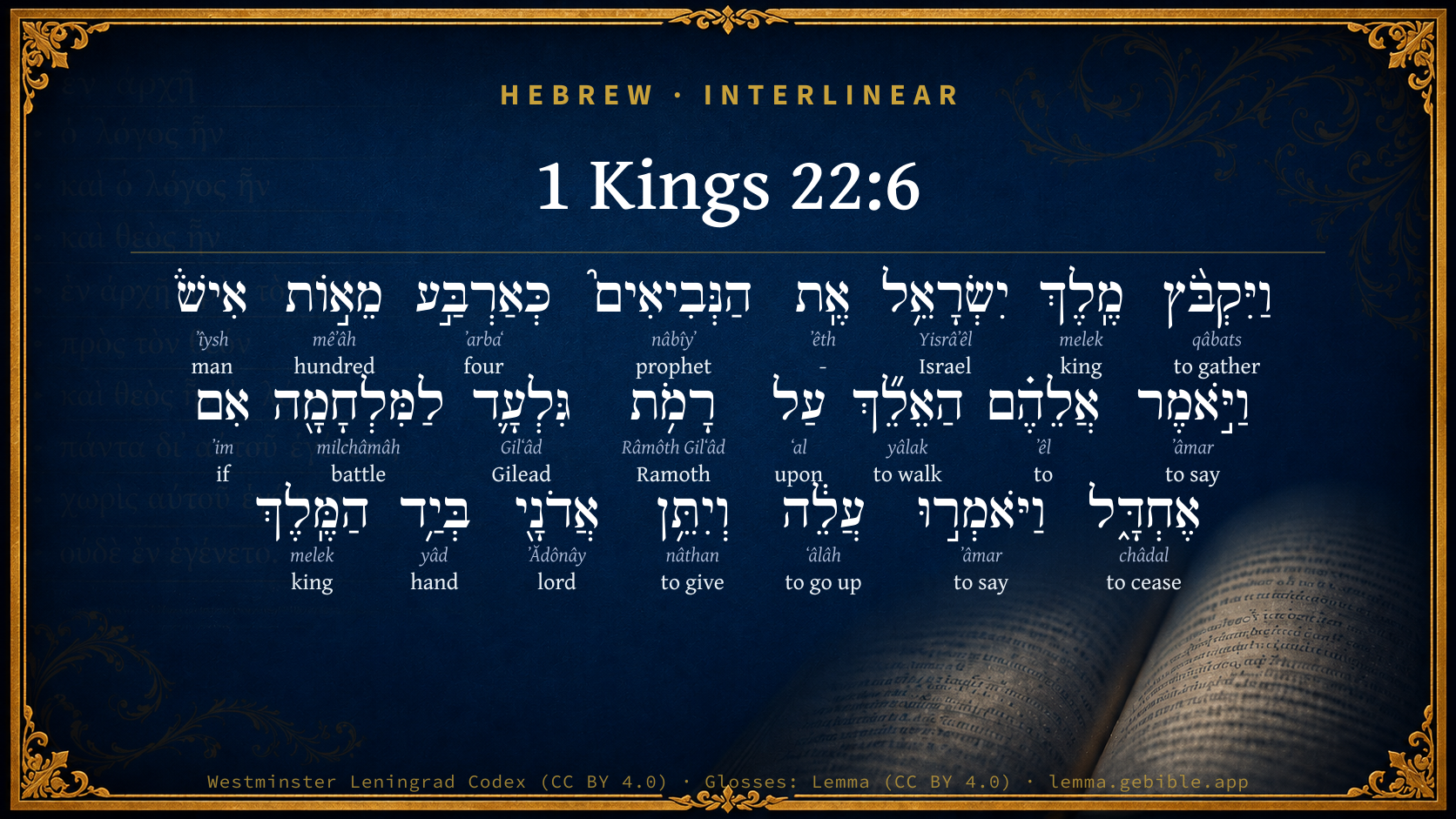
1 Kings 22:6

Hebrew (Westminster Leningrad Codex) 1 Kings 22:6 appears in the Hebrew Old Testament. The text above is from the Westminster Leningrad Codex. Each word links to its Strong’s number, a concise gloss, and parsing drawn from the Open Scriptures Hebrew Bible morphology. Click any word for its full Brown-Driver-Briggs (BDB) entry.
Download image
Cite this verse

1 Kings 22:6 (World English Bible). Public Domain. Lemma interlinear Bible study tool, https://lemma.gebible.app/v/1-kings/22/6.

Show BibTeX & RIS
BibTeX
RIS
English Translation
Then the king of Israel gathered the prophets together, about four hundred men, and said to them, Shall I go against Ramoth-gilead to battle, or shall I forbear? They said, Go up; for the Lord will deliver it into the hand of the king.
World English Bible · Public Domain
Download a study sheet

One document with this verse’s original text, its word-by-word gloss line, the meaning frame, cross-references with their text, attributed commentary, and full source and license credits — printable, and it pastes into notes with its structure intact.

This verse Autodidact and up

Study sheet (.html) Plain text (.txt)

A passage Seminary Student

Up to 50 verses in one chapter. A passage sheet keeps up to 6 commentary sources and 12 cross-references per verse, in the order this page ranks them, and says so on the sheet whenever that leaves anything out. Ask for a single verse and you get the Autodidact verse sheet above.

Everything on this page stays free to read, with no account — the sheet is a download of what is already on screen, not access to it.

Want to remove ads? Support Godless Engineer
Compare translations 3

The same verse in 3 English versions, stacked beneath the original-language interlinear above. Click any original word for its lexicon entry.

Each is an independent rendering of the whole verse — the interlinear is not word-aligned to these translations.

Highlighted words mark where these versions differ — a whole-verse word diff, not a word-by-word alignment.

  • World English Bible Public Domain
    Then the king of Israel gathered the prophets together, about four hundred men, and said to them, Shall I go against Ramoth-gilead to battle, or shall I forbear? They said, Go up; for the Lord will deliver it into the hand of the king.
  • King James Version Public Domain
    Then the king of Israel gathered the prophets together, about four hundred men, and said unto them, Shall I go against Ramothgilead to battle, or shall I forbear? And they said, Go up; for the LORD shall deliver it into the hand of the king.
  • unfoldingWord Literal Text CC BY-SA 4.0
    And the king of Israel gathered the prophets, about 400 men, and he said to them, “Shall I go to war against Ramoth Gilead, or shall I refrain?” And they said, “Go up, for the Lord will give into the hand of the king.”

unfoldingWord Literal Text — © unfoldingWord, licensed CC BY-SA 4.0. Word-aligned USFM3 via Door43 (git.door43.org/unfoldingWord/en_ult).

Versions to compare (up to 4)

3 of 4 selected

Show all 18 translations

Every available English version of this verse, each an independent rendering of the whole verse.

  • World English Bible Public Domain
    Then the king of Israel gathered the prophets together, about four hundred men, and said to them, Shall I go against Ramoth-gilead to battle, or shall I forbear? They said, Go up; for the Lord will deliver it into the hand of the king.
  • Berean Standard Bible Public Domain
    So the king of Israel assembled the prophets, about four hundred men, and asked them, “Should I go to war against Ramoth-gilead, or should I refrain?” “Go up,” they replied, “and the Lord will deliver it into the hand of the king.”
  • Majority Standard Bible Public Domain
    So the king of Israel assembled the prophets, about four hundred men, and asked them, “Should I go to war against Ramoth-gilead, or should I refrain?” “Go up,” they replied, “and the Lord will deliver it into the hand of the king.”
  • King James Version Public Domain
    Then the king of Israel gathered the prophets together, about four hundred men, and said unto them, Shall I go against Ramothgilead to battle, or shall I forbear? And they said, Go up; for the LORD shall deliver it into the hand of the king.
  • American Standard Version (1901) Public Domain
    Then the king of Israel gathered the prophets together, about four hundred men, and said unto them, Shall I go against Ramoth-gilead to battle, or shall I forbear? And they said, Go up; for the Lord will deliver it into the hand of the king.
  • Revised Version (1885) Public Domain
    Then the king of Israel gathered the prophets together, about four hundred men, and said unto them, Shall I go against Ramoth-gilead to battle, or shall I forbear? And they said, Go up; for the Lord shall deliver it into the hand of the king.
  • Geneva Bible (1599) Public Domain
    Then the King of Israel gathered the prophets vpon a foure hundreth men, and said vnto them, Shal I go against Ramoth Gilead to battel, or shall I let it alone? And they said, Go vp: for ye Lord shall deliuer it into the hands of the King.
  • Douay-Rheims (1899) Public Domain
    Then the king of Israel assembled the prophets, about four hundred men, and he said to them: Shall I go to Ramoth Galaad to fight, or shall I forbear? They answered: Go up, and the Lord will deliver it into the hand of the king.
  • Young's Literal Translation Public Domain
    and the king of Israel gathereth the prophets, about four hundred men, and saith unto them, `Do I go against Ramoth-Gilead to battle, or do I forbear?' and they say, `Go up, and the Lord doth give `it' into the hand of the king.'
  • Literal Standard Version CC BY-SA 4.0
    and the king of Israel gathers the prophets, about four hundred men, and says to them, “Do I go to battle against Ramoth-Gilead, or do I refrain?” And they say, “Go up, and the Lord gives [it] into the hand of the king.”
  • Unlocked Literal Bible CC BY-SA 4.0
    Then the king of Israel gathered the prophets together, four hundred men, and said to them, “Should I go to Ramoth Gilead to battle, or should I not?” They said, “Attack, for the Lord will give it into the hand of the king.”
  • unfoldingWord Literal Text CC BY-SA 4.0
    And the king of Israel gathered the prophets, about 400 men, and he said to them, “Shall I go to war against Ramoth Gilead, or shall I refrain?” And they said, “Go up, for the Lord will give into the hand of the king.”
  • Darby Bible Public Domain
    And the king of Israel assembled the prophets, about four hundred men, and said to them, Shall I go against Ramoth-Gilead to battle, or shall I forbear? And they said, Go up, and the Lord will give it into the king's hand.
  • World Messianic Bible Public Domain
    Then the king of Israel gathered the prophets together, about four hundred men, and said to them, “Should I go against Ramoth Gilead to battle, or should I refrain?” They said, “Go up; for the Lord will deliver it into the hand of the king.”
  • Webster's Bible Public Domain
    Then the king of Israel assembled the prophets, about four hundred men, and said to them, Shall I go against Ramoth-gilead to battle, or shall I forbear? And they said, Go up; for the Lord will deliver it into the hand of the king.
  • Free Bible Version CC BY-SA 4.0
    So the king of Israel brought out the prophets—four hundred of them—and he asked them, “Should I go up and attack Ramoth-gilead, or should I not?” “Yes, go ahead,” they replied, “for the Lord will hand it over to the king.”
  • Bible in Basic English Public Domain
    So the king of Israel got all the prophets together, about four hundred men, and said to them, Am I to go to Ramoth-gilead to make war or not? And they said, Go up: for the Lord will give it into the hands of the king.
  • JPS Tanakh (1917) Public Domain
    Then the king of Israel gathered the prophets together, about four hundred men, and said unto them: 'Shall I go against Ramoth-gilead to battle, or shall I forbear?' And they said: 'Go up; for the LORD will deliver it into the hand of the king.'

Literal Standard Version (2020), Covenant Press — licensed CC BY-SA 4.0. Text via the HelloAO Bible API (eBible.org). Unlocked Literal Bible (unfoldingWord) — licensed CC BY-SA 4.0. Text via the HelloAO Bible API (eBible.org). unfoldingWord Literal Text — © unfoldingWord, licensed CC BY-SA 4.0. Word-aligned USFM3 via Door43 (git.door43.org/unfoldingWord/en_ult). Free Bible Version, Dr. Jonathan Gallagher — licensed CC BY-SA 4.0. Text via the HelloAO Bible API (eBible.org).

Word by word

More ways to search: Search by grammar → Find every occurrence → Compare this word →

Practice this passage: Drill this verse → Learn its vocabulary →

רָמֹ֥ת
Râmôth Gilʻâd
H7433
“Ramoth”
Noun, Proper
Part of Speech
Noun
Type
Proper
Full BDB Definition

Origin: from the pl. of H7413 and H1568

TWOT: None

Ramoth = "heights" - an Israelite who had a foreign wife in the time of Ezra (noun proper masculine) - Ramoth-gilead - a place in Gilead (noun proper locative) - site dubious
  1. וַיִּקְבֹּ֨ץ qâbats H6908 “and · to gather” Conjunction + Verb, Qal, Sequential Imperfect, 3rd Person, Masculine, Singular
  2. מֶֽלֶךְ melek H4428 “king of” Noun, Common, Masculine, Singular, Construct
  3. יִשְׂרָאֵ֥ל Yisrâʼêl H3478 “Israel” Noun, Proper
  4. אֶֽת ʼêth H853 “-” Particle, Direct Object
  5. הַנְּבִיאִים֮ nâbîyʼ H5030 “the · prophets” Particle, Definite Article + Noun, Common, Masculine, Plural, Absolute
  6. כְּאַרְבַּ֣ע ʼarbaʻ H702 “like/as · four” Preposition + Adjective, Cardinal number, Feminine, Singular, Absolute
  7. מֵא֣וֹת mêʼâh H3967 “hundred” Adjective, Cardinal number, Both, Plural, Absolute
  8. אִישׁ֒ ʼîysh H376 “man” Noun, Common, Masculine, Singular, Absolute
  9. וַיֹּ֣אמֶר ʼâmar H559 “and · to say” Conjunction + Verb, Qal, Sequential Imperfect, 3rd Person, Masculine, Singular
  10. אֲלֵהֶ֗ם ʼêl H413 “to · them” Preposition + Suffix, Personal, 3rd Person, Masculine, Plural
  11. הַאֵלֵ֞ךְ yâlak H3212 “to walk” Particle, Interrogative + Verb, Qal, Imperfect, 1st Person, Common, Singular
  12. עַל ʻal H5921 “upon” Preposition
  13. גִּלְעָ֛ד Gilʻâd H1568 “Gilead” Noun, Proper
  14. לַמִּלְחָמָ֖ה milchâmâh H4421 “to/for the · battle” Preposition, Determined + Noun, Common, Feminine, Singular, Absolute
  15. אִם ʼim H518 “if” Conjunction
  16. אֶחְדָּ֑ל châdal H2308 “to cease” Verb, Qal, Imperfect, 1st Person, Common, Singular
  17. וַיֹּאמְר֣וּ ʼâmar H559 “and · to say” Conjunction + Verb, Qal, Sequential Imperfect, 3rd Person, Masculine, Plural
  18. עֲלֵ֔ה ʻâlâh H5927 “go up” Verb, Qal, Imperative, 2nd Person, Masculine, Singular
  19. וְיִתֵּ֥ן nâthan H5414 “and · to give” Conjunction + Verb, Qal, Jussive, 3rd Person, Masculine, Singular
  20. אֲדֹנָ֖י ʼĂdônây H136 “Lord · my” Noun, Common, Masculine, Plural, Construct + Suffix, Personal, 1st Person, Common, Singular
  21. בְּיַ֥ד yâd H3027 “in/at · hand of” Preposition + Noun, Common, Both, Singular, Construct
  22. הַמֶּֽלֶךְ melek H4428 “the · king” Particle, Definite Article + Noun, Common, Masculine, Singular, Absolute

About this verse

These counts appear in no published source. They are computed here, from the morphology-tagged text and Lemma’s own curated glosses. What Lemma adds →

23
words
21
distinct lemmas
Historical
section

Notable vocabulary

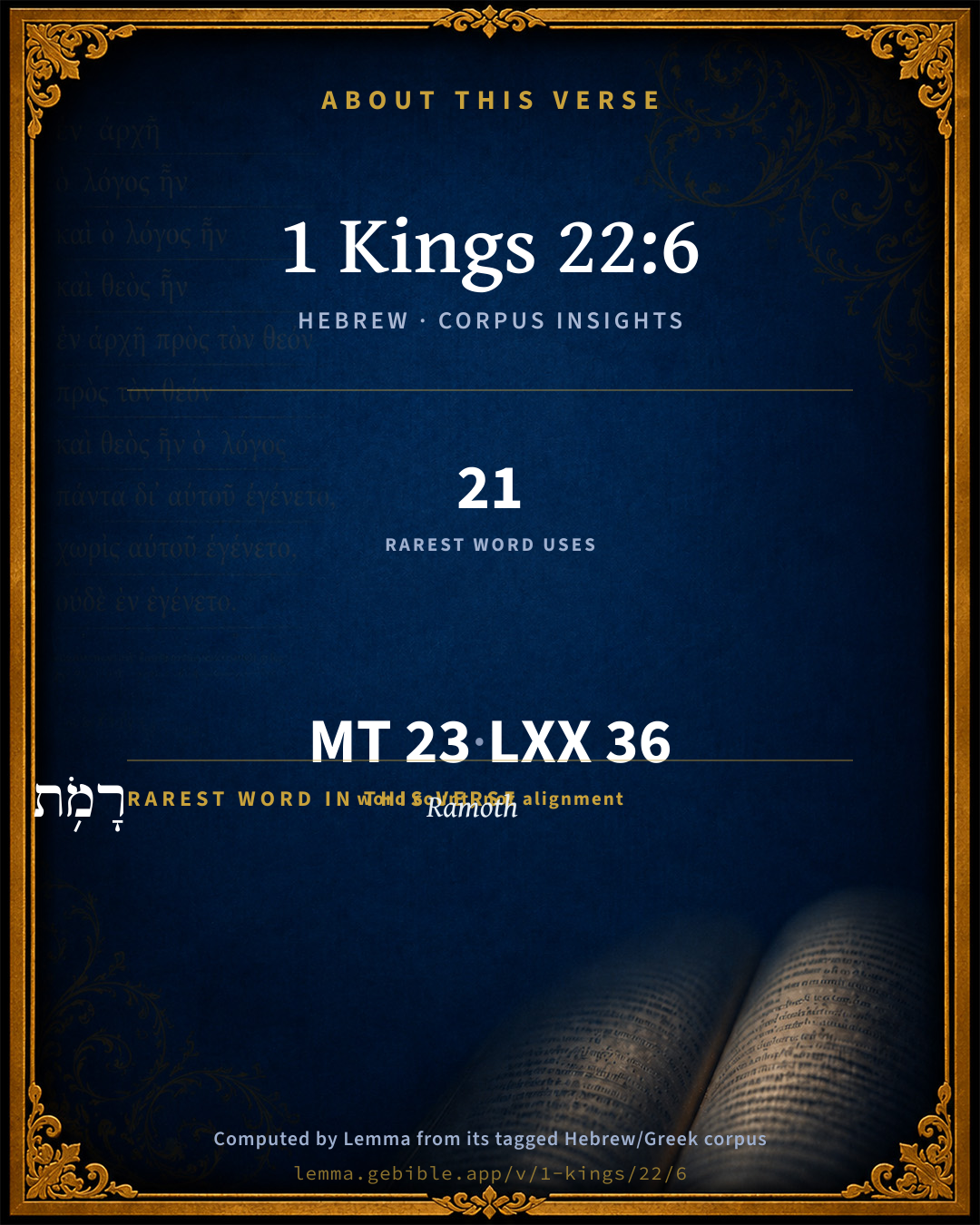
The rarest word here is רָמֹ֥ת Ramoth H7433 — appearing just 21 times in the whole Hebrew Bible.

Shared distinctive vocabulary

רָמֹ֥ת Ramoth H7433 occurs in 21 verses of the Hebrew Bible. Also found in:

Grammatical profile

  • 7 verbs
  • 10 nouns
  • 2 adjectives
  • 2 prepositions
  • 1 conjunction
  • 1 particle

Verb forms

  • וַיִּקְבֹּ֨ץ Qal · Sequential Imperfect
  • וַיֹּ֣אמֶר Qal · Sequential Imperfect
  • הַאֵלֵ֞ךְ Qal · Imperfect
  • אֶחְדָּ֑ל Qal · Imperfect
  • וַיֹּאמְר֣וּ Qal · Sequential Imperfect
  • עֲלֵ֔ה Qal · Imperative
  • וְיִתֵּ֥ן Qal · Jussive

Repetition

Words recur within this verse — often emphatic in Hebrew:

  • מֶֽלֶךְ king H4428 ×2
  • וַיֹּ֣אמֶר to say H559 ×2

Hebrew & Septuagint length

In English translation the verse runs 44 words from the Hebrew and 51 from the Septuagint (LXX English) — closely comparable.

A rough comparison of the two English renderings, which tokenize alike — not a word-level alignment.

Word counts can differ between the Hebrew and the Greek without any difference in meaning — e.g. the Hebrew direct-object marker אֵת has no separate Greek word, and Greek often adds the article ὁ.

In the original languages it is 23 Hebrew tokens and 36 Greek tokens — but the two are counted differently (Hebrew bundles its prefixes and suffixes into one token; the Greek is in lemma form), so that isn’t a like-for-like length.

Cross-references

15

Topical passages linked to 1 Kings 22:6 in the Treasury of Scripture Knowledge — connected by theme and wording, ordered by reader-vote popularity; previews shown in the World English Bible.

  • 1 Kings 18:19 Now therefore send, and gather to me all Israel to Mount Carmel, and the prophets of Baal four hundred fifty, and the prophets of the Asherah four hundred, who eat at Jezebel's table.
  • Jeremiah 23:14–17 In the prophets of Jerusalem also I have seen a horrible thing: they commit adultery, and walk in lies; and they strengthen the hands of evil-doers, so that none does return from his wickedness: they are all of them become to me as Sodom, and the inhabitants of it as Gomorrah.
  • Ezekiel 13:7–16 Haven't you seen a false vision, and haven't you spoken a lying divination, in that you say, Yahweh says; but I have not spoken?
  • Ezekiel 13:22 Because with lies you have grieved the heart of the righteous, whom I have not made sad; and strengthened the hands of the wicked, that he should not return from his wicked way, and be saved alive:
  • 1 Kings 22:15 When he was come to the king, the king said to him, Micaiah, shall we go to Ramoth-gilead to battle, or shall we forbear? He answered him, Go up and prosper; and Yahweh will deliver it into the hand of the king.
  • 1 Kings 22:22–23 Yahweh said to him, 'How?' He said, 'I will go forth, and will be a lying spirit in the mouth of all his prophets.' He said, 'You shall entice him, and shall prevail also: go forth, and do so.'
  • 2 Chronicles 18:14 When he was come to the king, the king said to him, Micaiah, shall we go to Ramoth-gilead to battle, or shall I forbear? He said, Go up, and prosper; and they shall be delivered into your hand.
  • Jeremiah 5:31 the prophets prophesy falsely, and the priests bear rule by their means; and my people love to have it so: and what will you do in the end of it?
  • Jeremiah 8:10–11 Therefore will I give their wives to others, and their fields to those who shall possess them: for everyone from the least even to the greatest is given to covetousness; from the prophet even to the priest every one deals falsely.
  • Jeremiah 14:13–14 Then said I, Ah, Lord Yahweh! behold, the prophets tell them, You shall not see the sword, neither shall you have famine; but I will give you assured peace in this place.
  • Jeremiah 28:1–9 It happened the same year, in the beginning of the reign of Zedekiah king of Judah, in the fourth year, in the fifth month, that Hananiah the son of Azzur, the prophet, who was of Gibeon, spoke to me in the house of Yahweh, in the presence of the priests and of all the people, saying,
  • Matthew 7:15 "Beware of false prophets, who come to you in sheep's clothing, but inwardly are ravening wolves.
  • 2 Timothy 4:3 For the time will come when they will not listen to the sound doctrine, but, having itching ears, will heap up for themselves teachers after their own lusts;
  • 2 Peter 2:1–3 But there also arose false prophets among the people, as among you also there will be false teachers, who will secretly bring in destructive heresies, denying even the Master who bought them, bringing on themselves swift destruction.
  • Revelation 19:20 The beast was taken, and with him the false prophet who worked the signs in his sight, with which he deceived those who had received the mark of the beast and those who worshiped his image. These two were thrown alive into the lake of fire that burns with sulfur.

Cross-references courtesy of OpenBible.info (CC BY 4.0).

Hebrew and Greek witnesses Masoretic Hebrew ↔ Greek Septuagint

The same verse in the two great witnesses to the Old Testament, shown verse-for-verse.

These are two independent witnesses, not word-aligned to each other, and the Septuagint is shown in lemma (dictionary) form.

Hebrew 1 Kings 22:6 Masoretic · Westminster Leningrad Codex

וַיִּקְבֹּ֨ץ מֶֽלֶךְ יִשְׂרָאֵ֥ל אֶֽת הַנְּבִיאִים֮ כְּאַרְבַּ֣ע מֵא֣וֹת אִישׁ֒ וַיֹּ֣אמֶר אֲלֵהֶ֗ם הַאֵלֵ֞ךְ עַל רָמֹ֥ת גִּלְעָ֛ד לַמִּלְחָמָ֖ה אִם אֶחְדָּ֑ל וַיֹּאמְר֣וּ עֲלֵ֔ה וְיִתֵּ֥ן אֲדֹנָ֖י בְּיַ֥ד הַמֶּֽלֶךְ

Then the king of Israel gathered the prophets together, about four hundred men, and said to them, Shall I go against Ramoth-gilead to battle, or shall I forbear? They said, Go up; for the Lord will deliver it into the hand of the king.

World English Bible · Public Domain

Greek LXX 1 Kings 22:6 Septuagint · lemma form

καί συνἀθροίζω ὁ βασιλεύς ἰσραήλ πᾶς ὁ προφήτης ὡς τετρακόσιοι ἀνήρ καί εἶπον αὐτός ὁ βασιλεύς εἰ πορεύομαι εἰς ρεμμαθ γαλαάδ εἰς πόλεμος ἤ ἐπιἔχω καί εἶπον ἀναβαίνω καί δίδωμι δίδωμι κύριος εἰς χείρ ὁ βασιλεύς

And the king of Israel gathered all the prophets together, about four hundred men; and the king said to them, Shall I go up to Remmath Galaad to battle, or shall I forbear? and they said, Go up, and the Lord will surely give it into the hands of the king.

LXX2012 (modern English Septuagint) · Public Domain

On this verse, The Pulpit Commentary discusses the Septuagint’s reading. Read the note in Commentary ↓

Hebrew: Westminster Leningrad Codex (CC BY 4.0). Greek: Septuagint (public domain); English from LXX2012 (modern English Septuagint) (Public Domain). How the Septuagint differs from the Hebrew →

Targum (Aramaic paraphrase)

1

The Targum is the ancient Jewish Aramaic paraphrase of the Hebrew Scriptures — an interpretive translation, not the Hebrew text itself. Onkelos (literal) and Pseudo-Jonathan (expansive) render the Torah, and Jonathan the Prophets. Coverage is partial: where no permissively-licensed English translation exists for a verse, only the Aramaic is shown. This is verse-level text, not a word-by-word alignment to the Hebrew.

  1. Targum Jonathan Prophets (Joshua–Malachi)
    וּכְנַשׁ מַלְכָּא דְיִשְׂרָאֵל יַת נְבִיֵי שִׁקְרָא כְּאַרְבַּע מֵאָה גַבְרָא וַאֲמַר לְהוֹן הַאֵיזִיל בְּרָמוֹת גִלְעָד לְאַגָחָא קְרָבָא אִם אִתְמְנַע וַאֲמַרוּ סַק וְיִמְסַר יְיָ בְּיַד מַלְכָּא:

    (no public-domain English translation for this verse)

    Targum Jonathan — Aramaic: “Mikraot Gedolot” (public domain). English: “Sefaria Community Translation” (CC0 1.0 (public-domain dedication)); “London "Chaldee Paraphrase," 1871” (public domain). Text via Sefaria.

Commentary

Notes on 1 Kings 22:6 from classic Christian and Jewish commentators (each source and its license shown beneath its notes). The classic Christian expositions comment on the surrounding passage and are grouped to its opening verse, so a note may address several verses; the Jewish commentaries on the Tanakh (Rashi and others) are per-verse, so they appear only where the commentator wrote on this verse.

Lemma curates 59 commentaries, every one of them public domain or Creative Commons licensed, each selected and text-cleaned for this edition rather than reprinted as found. About our sources →

Trapp's Complete Commentary

John Trapp

1Ki 22:6 Then the king of Israel gathered the prophets together, about four hundred men, and said unto them, Shall I go against Ramothgilead to battle, or shall I forbear? And they said, Go up; for the Lord shall deliver [it] into the hand of the king.

Ver. 6. About four hundred men.] Baal’s prophets all; perhaps those prophets of the groves, Jezebel’s trencher-flies, {1Ki 18:19} who yet pretended the name of the Lord. Their number showeth that truth may not ever be measured by the poll: Non numeranda sed expendenda suffragia. A solid verity in one mouth is worthy to preponderate light falsehood in a thousand.

Go up.] Pithanologiae nunquam desunt pseudotheologis. The devil had deceived these prophets, and they deceive Ahab: quem in decipulam caedis quasi murem inducunt, who perished by his credulity and for his cruelty. {1Ki 21:5-16}

For the Lord shall deliver it into the hand of the king.] Yea, but of which king, thou lying spirit? Of Ahab, or of Benhadad? The particle ‘it’ is not in the original; the word ‘thee’ may be as well supplied. This answer, therefore, was ambiguous, like that Aio te Aeacida Romanos vincere posse: or that Croesus Halyn penetrans magnam disperdet opum vim. Howbeit the devil here hath more ingenuousness than have the Jesuits; for he confesseth his equivocating oracle to be a lie. "I will go and be a lying spirit," saith he, "in the mouth of all his prophets." {1Ki 22:22}

John Trapp, A Commentary or Exposition upon All the Books of the Old and New Testament (1647–1656) — public domain. Text from a community e-Sword module.

Joseph Benson's Commentary

1Ki 22:6. The king of Israel gathered the prophets together — Doubtless his own false prophets, such as he had set up by rewards and promises, and who accordingly knew how to suit his humour, and flatter his vanity, and who yet gave in their answer in the name of Jehovah; either in compliance with Jehoshaphat, or by Ahab’s direction, that Jehoshaphat might be deceived by them into a good opinion of the war.

Joseph Benson's Commentary on the Old and New Testaments (1811–1818) — public domain. Text from a community e-Sword module.

Geneva Bible (1599)

Geneva Bible translators

Meaning, the false prophets, which were flatterers and served for lucre, whom Jezebel had assembled and kept after the death of those whom Elijah slew.

Geneva Bible (1599) marginal notes — public domain. Text via Bolls.life.

Adam Clarke's Commentary

Verse 6. About four hundred men] These were probably the prophets of Asherah or Venus, maintained by Jezebel, who were not present at the contention on Mount Carmel. See 1Kg 18:19, &c.

Adam Clarke's Commentary on the Bible (1810–1826) — public domain. Text from a community e-Sword/MySword module.

Ellicott's Commentary for English Readers

(6) Prophets . . . four hundred.—These were clearly not avowed prophets of Baal, or the Asherah (“groves”), as is obvious from the context and from their words in 1Ki_22:12. But Jehoshaphat’s discontent makes it equally clear that they were not in his view true prophets of Jehovah. Probably they were devoted, like the old prophet of Bethel, to the service of the idolatry of Jeroboam.

A Bible Commentary for English Readers, edited by Charles John Ellicott (1878–1897) — public domain. Text from a community e-Sword module.

The Cambridge Bible for Schools and Colleges

gen. ed. J. J. S. Perowne

6. gathered the prophets together, about four hundred] These cannot have been the prophets of Baal, for their ringleader, Zedekiah, in 1Ki_22:11, begins his speech, ‘Thus saith Jehovah,’ and in 1Ki_22:24 speaks of ‘the spirit of Jehovah’ as being with him. But they were not true adherents of the Lord, otherwise Jehoshaphat would certainly have been content with their words. He went on with the project of the expedition even after Micaiah’s prophetic warning; he never would have sought for more satisfaction, had he heard four hundred true prophets of Jehovah say, ‘the Lord shall deliver it into the hand of the king.’ These men were therefore the prophets who served in the worship of the calves. They would use Jehovah’s name, just as constantly as the men who had not forsaken His commandment, and throughout the whole of Israel this number of them could no doubt be readily gathered, and these, though not his Baal-priests, Ahab would bring before Jehoshaphat.

Go up] The land of Gilead was all mountainous.

the Lord shall deliver it] It is remarkable that in this first form of answer, the word for “Lord” is Adonai, not the word which we represent by Jehovah, and which is generally rendered Lord. In the repetition, in 1Ki_22:12, Jehovah is used, and of course in Micaiah’s speech. This word ‘Adonai’ is what the Jews use now instead of pronouncing the sacred name, but their reason could not have weighed with Ahab’s priests in Israel. In the parallel place in Chronicles ‘God’, Elohim, is used in the first answer, and ‘Jehovah’ in the others.

The Cambridge Bible for Schools and Colleges (gen. ed. J. J. S. Perowne; Cambridge University Press, 1878–1918) — public domain. Text from a community e-Sword module.

John Gill's Exposition

Then the king of Israel called an officer,.... An eunuch, as the word is sometimes used, one of pages:

and said, hasten hither Micaiah the son of Imlah; who, as it seems from Kg1 22:26 was in prison, where perhaps Ahab had cast him for his last prophecy to him, and where he had lain ever since; and this gives a reason why he could so readily send for him, knowing where he was.

John Gill's Exposition of the Whole Bible (1746–1763) — public domain (CC PDM 1.0). Text via the HelloAO Bible API.

Albert Barnes' Notes on the Bible

The prophets - i. e., In all probability the prophets attached to the worship of the calves; not real prophets of Yahweh. This seems evident both from Jehoshaphat’s dissatisfaction 1Ki 22:7, and from the strong antagonism apparent between the true Yahweh-prophet Micaiah, and these self-styled “prophets of the Lord” 1Ki 22:22-25.

The Lord shall deliver it - In the Hebrew the word here used for “Lord” is אדני 'ǎdonāy. Later (i. e., in 1Ki 22:11-12) Lord or יהוה yehovâh is used. It would seem as if the idolatrous prophets shrank from employing the latter title until they found that Jehoshaphat insisted on learning the will of Yahweh in the matter.

Albert Barnes' Notes on the Bible (1834–1885) — public domain. Text from a community e-Sword/MySword module.

Haydock's Catholic Bible Commentary

Men, probably the prophets of the groves, who had not gone to Carmel, chap. xviii. 19, 22. (Calmet) --- The recent slaughter had not deterred others from imitating the example of the false prophets. (Haydock)

George Leo Haydock (1774–1849), Haydock's Catholic Family Bible and Commentary, 1859 edition — public domain. Excludes Psalms (Douay-Rheims chapter numbering differs from Protestant) and Deuterocanonical books (Catholic canon only).

Matthew Poole's English Annotations

The prophets doubtless were his own false prophets, or the priests of Baal; probably those very four hundred men whom Jezebel preserved from that great slaughter, 1Ki 18, who yet gave in their answer in the name of Jehovah, not of Baal; either in compliance with Jehoshaphat; or rather, by Ahab’s direction, that good Jehoshaphat might be deceived by them into a good opinion of the war.

Matthew Poole's English Annotations on the Holy Bible (1683–1685) — public domain. Text from a community e-Sword/MySword module.

Whedon's Commentary on the Bible

Daniel D. Whedon

6. About four hundred men — “These four hundred prophets were neither the four hundred prophets of Asherah, (1Ki_18:19,) who did not appear before Elijah on Carmel, nor the prophets of Baal, as many old expositors thought, for by these Ahab could not inquire at the word of the Lord; but they were the prophets of the calves, that is, prophets of the kingdom of Israel, who complied with the calf worship, and gave themselves out as prophets of Jehovah, worshipped under the symbol of the calves.” — Keil.

Daniel D. Whedon (gen. ed.), Commentary on the Old and New Testaments (1874–1909) — public domain. Text from a community e-Sword module.

The Pulpit Commentary

Then the king of Israel gathered the prophets Called by Micaiah "his prophets" (ver. 22), and "thy prophets" (ver. 23) together, about four hundred men From the number (cf. 1Ki_18:19) it has been concluded that these were "the prophets of the groves," i.e., of Astarte, who escaped the massacre of the Baal prophets. (1Ki_18:40) Others have supposed that they were prophets of Baal. But both these suppositions are negatived

(1) by the fact that Jehoshaphat asks Ahab to "inquire at the word of Jehovah," and

(2) that these prophets profess to speak in the name and by the Spirit of Jehovah (vers. 11, 12, 24). Moreover

(3) Ahab would hardly have insulted Jehoshaphat by bringing the prophets of Baal or Astarte before him (Waterland in Wordsworth).

And yet that they were not true prophets of the Lord, or of the" sons of the prophets," appears

(1) from ver. 7, where Jehoshaphat asks for a "prophet of the Lord;" and

(2) from ver. 20 sqq., where Micaiah disclaims them, and is found in direct opposition to them. The only conclusion open to us, consequently and it is now generally adopted is that they were the priests of the high places of Bethel and Dan, the successors of those whom Jeroboam had introduced into the priestly office. It need cause us no surprise to find these priests here described as "prophets" (of Jer_22:13; Eze_13:1) and as claiming prophetic gifts, for the priests of Baal bore the same name, (1Ki_18:19, 1Ki_18:22, etc.) and apparently pretended to similar powers. "No ancient people considered any cultus complete without a class of men through whom the god might be questioned" (Bahr). The existence of so large a number of prophets of the calves proves that the inroads of idolatry had by no means destroyed the calf worship. If its priests were so many, its worshippers cannot have been few, and said unto them, Shall I go against Ramoth-Gilead to battle, or shall I forbear? And they said, Go up; for the Lord yndoa. It is very significant that at first they hesitate to use the ineffable name. It was probably this circumstance excited Jehoshaphat"s suspicions. It has been said that the reason why he was dissatisfied with this answer is unexplained; hut when we remember how careful the true prophet was to speak in the name of Jehovah, (1Ki_14:7 1Ki_17:1, 14 20:13, 14, 28) we can hardly doubt that it was their mention of "Adonai "occasioned his misgivings. The chronicler gives the word as Elohim shall deliver it LXX didousei, shall surely give it into the hand of the king.

The Pulpit Commentary (1880–1919), ed. H.D.M. Spence-Jones & Joseph S. Exell — public domain. Text from a community e-Sword module.

John Wesley's Explanatory Notes

The prophets - Doubtless his own false prophets, or the priests of the groves; who yet gave in their answer in the name of Jehovah; either, in compliance with Jehoshaphat, or by Ahab's direction, that Jehoshaphat might be deceived by them, into a good opinion of the war.

John Wesley, Explanatory Notes Upon the Whole Bible (1754–1765) — public domain. Text via the GEBible commentary corpus.

Lesson kit

Teaching starters — assembled from the data on this page, not authored interpretation. Every prompt links to the verse data it draws on. Edit before teaching.

1 Kings, in the Historical, opens this verse with 23 words (21 distinct Hebrew lemmas). Its most distinctive word is Râmôth Gilʻâd (“Ramoth”). A historical commentator’s framing appears above. Read the whole chapter for the surrounding context.

Discussion questions

  1. The word Râmôth Gilʻâd carries the sense “Ramoth.” How does it shape the verse?
  2. How does Joshua 21:38, which shares the word «Ramoth», read alongside this verse?
  3. What does the repetition of “king” (2× in this one verse) do in this verse?
  4. These translations render this verse differently. What is at stake in choosing one wording over another?
  5. «וַיִּקְבֹּ֨ץ» is a Qal Sequential Imperfect verb. How does that grammatical form shape the action described?
  6. Compare how Trapp's Complete Commentary and Joseph Benson's Commentary read this verse. Where do they agree or differ?

Things to notice

Reading settings

Reading text

Shown beneath each verse's original-language words.

Old Testament
Old Testament edition

Read the OT as the Masoretic Hebrew (MT) or the Greek Septuagint (LXX).

English shown for the Greek Septuagint (in the Hebrew ↔ Greek comparison).

Comparing translations? Open the Compare panel on any verse page to stack up to four side by side.