Ezekiel 13:8

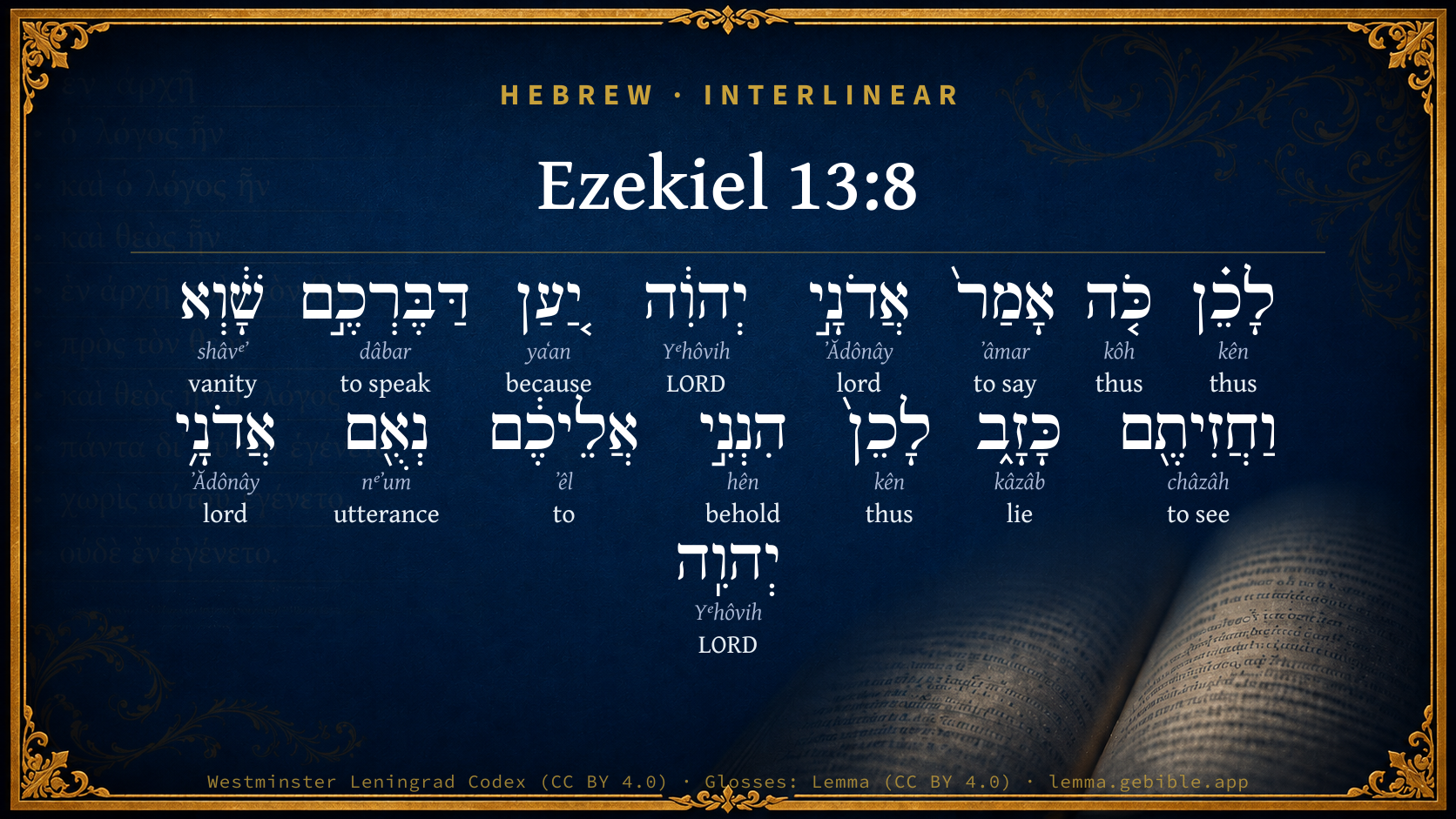
Hebrew (Westminster Leningrad Codex) Ezekiel 13:8 appears in the Hebrew Old Testament. The text above is from the Westminster Leningrad Codex. Each word links to its Strong’s number, a concise gloss, and parsing drawn from the Open Scriptures Hebrew Bible morphology. Click any word for its full Brown-Driver-Briggs (BDB) entry.
Download image
Cite this verse

Ezekiel 13:8 (World English Bible). Public Domain. Lemma interlinear Bible study tool, https://lemma.gebible.app/v/ezekiel/13/8.

Show BibTeX & RIS
BibTeX
RIS
English Translation
Therefore thus says the Lord Yahweh: Because you have spoken falsehood, and seen lies, therefore, behold, I am against you, says the Lord Yahweh.
World English Bible · Public Domain
Download a study sheet

One document with this verse’s original text, its word-by-word gloss line, the meaning frame, cross-references with their text, attributed commentary, and full source and license credits — printable, and it pastes into notes with its structure intact.

This verse Autodidact and up

Study sheet (.html) Plain text (.txt)

A passage Seminary Student

Up to 50 verses in one chapter. A passage sheet keeps up to 6 commentary sources and 12 cross-references per verse, in the order this page ranks them, and says so on the sheet whenever that leaves anything out. Ask for a single verse and you get the Autodidact verse sheet above.

Everything on this page stays free to read, with no account — the sheet is a download of what is already on screen, not access to it.

Want to remove ads? Support Godless Engineer
Compare translations 3

The same verse in 3 English versions, stacked beneath the original-language interlinear above. Click any original word for its lexicon entry.

Each is an independent rendering of the whole verse — the interlinear is not word-aligned to these translations.

Highlighted words mark where these versions differ — a whole-verse word diff, not a word-by-word alignment.

  • World English Bible Public Domain
    Therefore thus says the Lord Yahweh: Because you have spoken falsehood, and seen lies, therefore, behold, I am against you, says the Lord Yahweh.
  • King James Version Public Domain
    Therefore thus saith the Lord GOD; Because ye have spoken vanity, and seen lies, therefore, behold, I am against you, saith the Lord GOD.
  • unfoldingWord Literal Text CC BY-SA 4.0
    Therefore the Lord Yahweh says this, ‘Because you have had false visions and have told lies—therefore this is the Lord Yahweh’s declaration against you:

unfoldingWord Literal Text — © unfoldingWord, licensed CC BY-SA 4.0. Word-aligned USFM3 via Door43 (git.door43.org/unfoldingWord/en_ult).

Versions to compare (up to 4)

3 of 4 selected

Show all 18 translations

Every available English version of this verse, each an independent rendering of the whole verse.

  • World English Bible Public Domain
    Therefore thus says the Lord Yahweh: Because you have spoken falsehood, and seen lies, therefore, behold, I am against you, says the Lord Yahweh.
  • Berean Standard Bible Public Domain
    Therefore this is what the Lord GOD says: Because you have uttered vain words and seen false visions, I am against you, declares the Lord GOD.
  • Majority Standard Bible Public Domain
    Therefore this is what the Lord GOD says: Because you have uttered vain words and seen false visions, I am against you, declares the Lord GOD.
  • King James Version Public Domain
    Therefore thus saith the Lord GOD; Because ye have spoken vanity, and seen lies, therefore, behold, I am against you, saith the Lord GOD.
  • American Standard Version (1901) Public Domain
    Therefore thus saith the Lord Jehovah: Because ye have spoken falsehood, and seen lies, therefore, behold, I am against you, saith the Lord Jehovah.
  • Revised Version (1885) Public Domain
    Therefore thus saith the Lord GOD: Because ye have spoken vanity, and seen lies, therefore, behold, I am against you, saith the Lord GOD.
  • Geneva Bible (1599) Public Domain
    Therefore thus sayth the Lord God, Because ye haue spoken vanytie and haue seene lyes, therefore beholde, I am agaynst you, sayth the Lord God,
  • Douay-Rheims (1899) Public Domain
    Therefore thus saith the Lord God: Because you have spoken vain things, and have seen lies: therefore behold I come against you, saith the Lord God.
  • Young's Literal Translation Public Domain
    Therefore, thus said the Lord Jehovah: Because ye have spoken vanity, and seen a lie, Therefore, lo, I `am' against you, An affirmation of the Lord Jehovah.
  • Literal Standard Version CC BY-SA 4.0
    Therefore, thus said Lord YHWH: Because you have spoken vanity, and seen a lie, || Therefore, behold, I [am] against you, || A declaration of Lord YHWH.
  • Unlocked Literal Bible CC BY-SA 4.0
    Therefore the Lord Yahweh says this, 'Because you have had false visions and have told lies—therefore this is the Lord Yahweh's declaration against you:
  • unfoldingWord Literal Text CC BY-SA 4.0
    Therefore the Lord Yahweh says this, ‘Because you have had false visions and have told lies—therefore this is the Lord Yahweh’s declaration against you:
  • Darby Bible Public Domain
    Therefore thus saith the Lord Jehovah: Because ye speak vanity, and have seen lies, therefore behold, I am against you, saith the Lord Jehovah.
  • World Messianic Bible Public Domain
    “‘Therefore the Lord GOD says: “Because you have spoken falsehood and seen lies, therefore, behold, I am against you,” says the Lord GOD.
  • Webster's Bible Public Domain
    Therefore thus saith the Lord GOD; Because ye have spoken vanity, and seen lies, therefore, behold, I am against you, saith the Lord GOD.
  • Free Bible Version CC BY-SA 4.0
    So this is what the Lord God says: Since you've spoken lies and claimed to see false visions, then watch out, because I'm against you, declares the Lord God.
  • Bible in Basic English Public Domain
    So this is what the Lord has said: Because your words are without substance and your visions are false, see, I am against you, says the Lord.
  • JPS Tanakh (1917) Public Domain
    Therefore thus saith the Lord GOD: Because ye have spoken vanity, and seen lies, therefore, behold, I am against you, saith the Lord GOD.

Literal Standard Version (2020), Covenant Press — licensed CC BY-SA 4.0. Text via the HelloAO Bible API (eBible.org). Unlocked Literal Bible (unfoldingWord) — licensed CC BY-SA 4.0. Text via the HelloAO Bible API (eBible.org). unfoldingWord Literal Text — © unfoldingWord, licensed CC BY-SA 4.0. Word-aligned USFM3 via Door43 (git.door43.org/unfoldingWord/en_ult). Free Bible Version, Dr. Jonathan Gallagher — licensed CC BY-SA 4.0. Text via the HelloAO Bible API (eBible.org).

Word by word

More ways to search: Search by grammar → Find every occurrence → Compare this word →

Practice this passage: Drill this verse → Learn its vocabulary →

כָּזָ֑ב
kâzâb
H3577
“lie”
Noun, Common, Masculine, Singular, Absolute
Part of Speech
Noun
Type
Common
Gender
Masculine
Number
Singular
State
Absolute
Full BDB Definition

Origin: from H3576

TWOT: 970a

a lie, untruth, falsehood, deceptive thing
  1. לָכֵ֗ן kên H3651 “to/for · thus” Preposition + Adverb
  2. כֹּ֤ה kôh H3541 “thus” Adverb
  3. אָמַר֙ ʼâmar H559 “to say” Verb, Qal, Perfect, 3rd Person, Masculine, Singular
  4. אֲדֹנָ֣י ʼĂdônây H136 “Lord · my” Noun, Common, Masculine, Plural, Construct + Suffix, Personal, 1st Person, Common, Singular
  5. יְהוִ֔ה Yᵉhôvih H3069 “LORD” Noun, Proper
  6. יַ֚עַן yaʻan H3282 “because” Conjunction
  7. דַּבֶּרְכֶ֣ם dâbar H1696 “to speak · you” Verb, Piel, Infinitive Construct + Suffix, Personal, 2nd Person, Masculine, Plural
  8. שָׁ֔וְא shâvᵉʼ H7723 “vanity” Noun, Common, Masculine, Singular, Absolute
  9. וַחֲזִיתֶ֖ם châzâh H2372 “and · to see” Conjunction + Verb, Qal, Perfect, 2nd Person, Masculine, Plural
  10. לָכֵן֙ kên H3651 “to/for · thus” Preposition + Adverb
  11. הִנְנִ֣י hên H2005 “behold · me” Particle, Demonstrative + Suffix, Personal, 1st Person, Common, Singular
  12. אֲלֵיכֶ֔ם ʼêl H413 “to · you” Preposition + Suffix, Personal, 2nd Person, Masculine, Plural
  13. נְאֻ֖ם nᵉʼum H5002 “utterance of” Noun, Common, Masculine, Singular, Construct
  14. אֲדֹנָ֥י ʼĂdônây H136 “Lord · my” Noun, Common, Masculine, Plural, Construct + Suffix, Personal, 1st Person, Common, Singular
  15. יְהוִֽה Yᵉhôvih H3069 “LORD” Noun, Proper

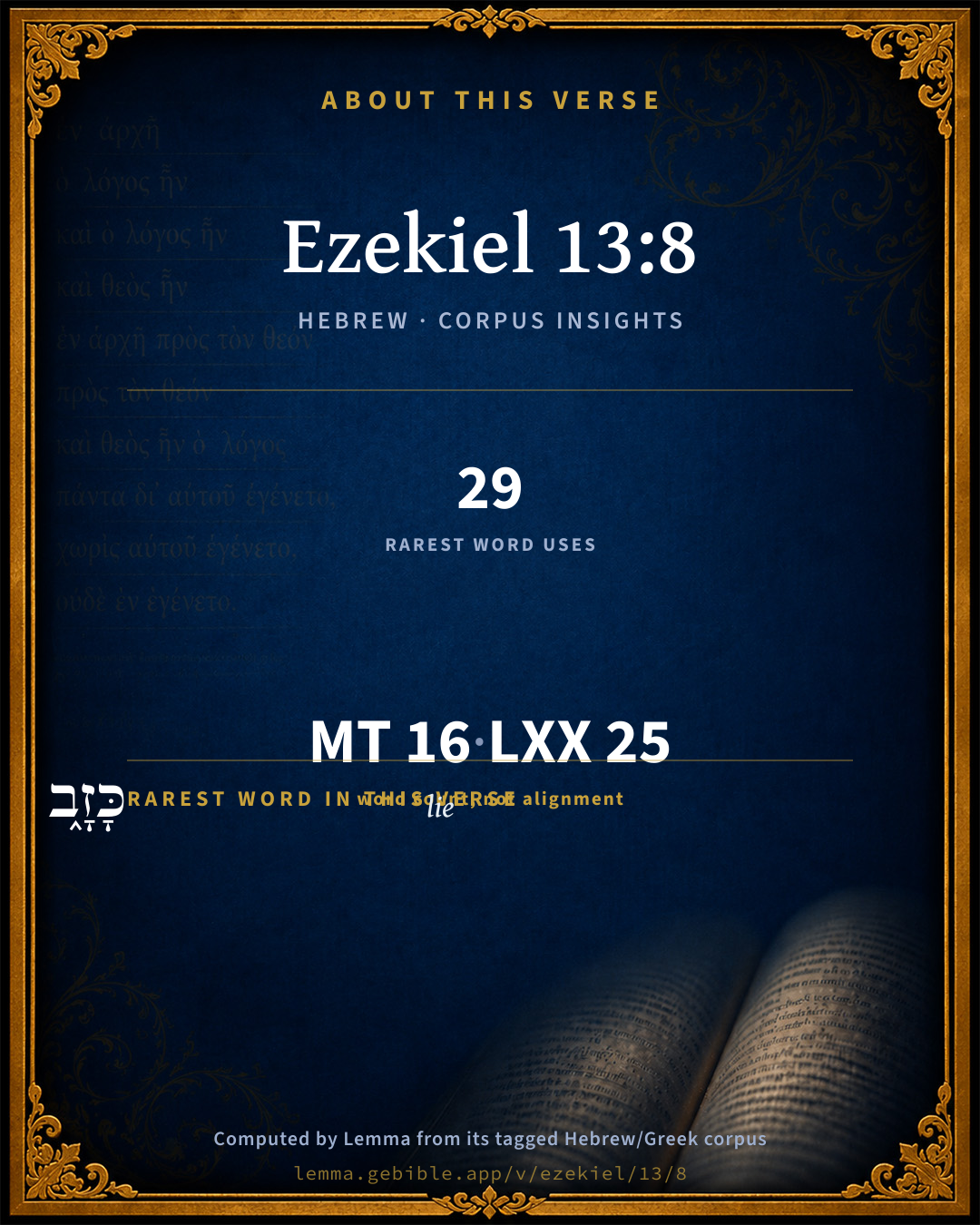
About this verse

These counts appear in no published source. They are computed here, from the morphology-tagged text and Lemma’s own curated glosses. What Lemma adds →

16
words
13
distinct lemmas
Prophets
section

Shared distinctive vocabulary

כָּזָ֑ב lie H3577 occurs in 29 verses of the Hebrew Bible. Also found in:

Grammatical profile

  • 3 verbs
  • 7 nouns
  • 1 preposition
  • 1 conjunction
  • 3 adverbs
  • 1 particle

Verb forms

  • אָמַר֙ Qal · Perfect
  • דַּבֶּרְכֶ֣ם Piel · Infinitive Construct
  • וַחֲזִיתֶ֖ם Qal · Perfect

Repetition

Words recur within this verse — often emphatic in Hebrew:

  • לָכֵ֗ן thus H3651 ×2
  • אֲדֹנָ֣י lord H136 ×2
  • יְהוִ֔ה LORD H3069 ×2

Hebrew & Septuagint length

In English translation the verse runs 24 words from the Hebrew and 26 from the Septuagint (LXX English) — closely comparable.

A rough comparison of the two English renderings, which tokenize alike — not a word-level alignment.

Word counts can differ between the Hebrew and the Greek without any difference in meaning — e.g. the Hebrew direct-object marker אֵת has no separate Greek word, and Greek often adds the article ὁ.

In the original languages it is 16 Hebrew tokens and 25 Greek tokens — but the two are counted differently (Hebrew bundles its prefixes and suffixes into one token; the Greek is in lemma form), so that isn’t a like-for-like length.

Cross-references

16

Topical passages linked to Ezekiel 13:8 in the Treasury of Scripture Knowledge — connected by theme and wording, ordered by reader-vote popularity; previews shown in the World English Bible.

  • Ezekiel 5:8 therefore thus says the Lord Yahweh: Behold, I, even I, am against you; and I will execute judgments in the midst of you in the sight of the nations.
  • Ezekiel 21:3 and tell the land of Israel, Thus says Yahweh: Behold, I am against you, and will draw forth my sword out of its sheath, and will cut off from you the righteous and the wicked.
  • Ezekiel 26:3 therefore thus says the Lord Yahweh, Behold, I am against you, Tyre, and will cause many nations to come up against you, as the sea causes its waves to come up.
  • Ezekiel 28:22 and say, Thus says the Lord Yahweh: Behold, I am against you, Sidon; and I will be glorified in the midst of you; and they shall know that I am Yahweh, when I shall have executed judgments in her, and shall be sanctified in her.
  • Ezekiel 35:3 and tell it, Thus says the Lord Yahweh: Behold, I am against you, Mount Seir, and I will stretch out my hand against you, and I will make you a desolation and an astonishment.
  • Nahum 2:13 "Behold, I am against you," says Yahweh of Hosts, "and I will burn her chariots in the smoke, and the sword will devour your young lions; and I will cut off your prey from the earth, and the voice of your messengers will no longer be heard."
  • Jeremiah 50:31–32 Behold, I am against you, you proud one, says the Lord, Yahweh of Hosts; for your day is come, the time that I will visit you.
  • Jeremiah 51:25 Behold, I am against you, destroying mountain, says Yahweh, which destroy all the earth; and I will stretch out my hand on you, and roll you down from the rocks, and will make you a burnt mountain.
  • Ezekiel 29:3–4 speak, and say, Thus says the Lord Yahweh: Behold, I am against you, Pharaoh king of Egypt, the great monster that lies in the midst of his rivers, that has said, My river is my own, and I have made it for myself.
  • Ezekiel 29:10 therefore, behold, I am against you, and against your rivers, and I will make the land of Egypt an utter waste and desolation, from the tower of Seveneh even to the border of Ethiopia.
  • Ezekiel 38:3–4 and say, Thus says the Lord Yahweh: Behold, I am against you, Gog, prince of Rosh, Meshech, and Tubal:
  • Ezekiel 39:1 You, son of man, prophesy against Gog, and say, Thus says the Lord Yahweh: Behold, I am against you, Gog, prince of Rosh, Meshech, and Tubal:
  • Nahum 3:5–6 "Behold, I am against you," says Yahweh of Hosts, "and I will lift your skirts over your face. I will show the nations your nakedness, and the kingdoms your shame.
  • 1 Timothy 4:1 But the Spirit says expressly that in later times some will fall away from the faith, paying attention to seducing spirits and doctrines of demons,
  • 1 Timothy 4:8 For bodily exercise has some value, but godliness has value for all things, having the promise of the life which is now, and of that which is to come.
  • 1 Peter 3:12 For the eyes of the Lord are on the righteous, And his ears open to their prayer; But the face of the Lord is against those who do evil."

Cross-references courtesy of OpenBible.info (CC BY 4.0).

Hebrew and Greek witnesses Masoretic Hebrew ↔ Greek Septuagint

The same verse in the two great witnesses to the Old Testament, shown verse-for-verse.

These are two independent witnesses, not word-aligned to each other, and the Septuagint is shown in lemma (dictionary) form.

Hebrew Ezekiel 13:8 Masoretic · Westminster Leningrad Codex

לָכֵ֗ן כֹּ֤ה אָמַר֙ אֲדֹנָ֣י יְהוִ֔ה יַ֚עַן דַּבֶּרְכֶ֣ם שָׁ֔וְא וַחֲזִיתֶ֖ם כָּזָ֑ב לָכֵן֙ הִנְנִ֣י אֲלֵיכֶ֔ם נְאֻ֖ם אֲדֹנָ֥י יְהוִֽה

Therefore thus says the Lord Yahweh: Because you have spoken falsehood, and seen lies, therefore, behold, I am against you, says the Lord Yahweh.

World English Bible · Public Domain

Greek LXX Ezekiel 13:8 Septuagint · lemma form

διά οὗτος εἶπον ὅδε λέγω κύριος ἀντί ὅς ὁ λόγος σύ ψευδής καί ὁ μαντεία σύ μάταιος διά οὗτος ἰδού ἐγώ ἐπί σύ λέγω κύριος

And therefore say, Thus says the Lord; Because your words are false, and your prophecies are vain, therefore, behold, I am against you, says the Lord.

LXX2012 (modern English Septuagint) · Public Domain

Hebrew: Westminster Leningrad Codex (CC BY 4.0). Greek: Septuagint (public domain); English from LXX2012 (modern English Septuagint) (Public Domain). How the Septuagint differs from the Hebrew →

Targum (Aramaic paraphrase)

1

The Targum is the ancient Jewish Aramaic paraphrase of the Hebrew Scriptures — an interpretive translation, not the Hebrew text itself. Onkelos (literal) and Pseudo-Jonathan (expansive) render the Torah, and Jonathan the Prophets. Coverage is partial: where no permissively-licensed English translation exists for a verse, only the Aramaic is shown. This is verse-level text, not a word-by-word alignment to the Hebrew.

  1. Targum Jonathan Prophets (Joshua–Malachi)
    בְּכֵן כִּדְנַן יְיָ אֱלֹהִים חֲלַף דְאִתְנַבֵּיתוּן שְׁקַר וַאֲלַפְתּוּן כַּדְבִין בְּכֵן הָא אֲנָא שְׁלַח רוּגְזִי עֲלֵיכוֹן אֲמַר יְיָ אֱלֹהִים:

    (no public-domain English translation for this verse)

    Targum Jonathan — Aramaic: “Mikraot Gedolot” (public domain). English: “Sefaria Community Translation” (CC0 1.0 (public-domain dedication)); “London "Chaldee Paraphrase," 1871” (public domain). Text via Sefaria.

Commentary

Notes on Ezekiel 13:8 from classic Christian and Jewish commentators (each source and its license shown beneath its notes). The classic Christian expositions comment on the surrounding passage and are grouped to its opening verse, so a note may address several verses; the Jewish commentaries on the Tanakh (Rashi and others) are per-verse, so they appear only where the commentator wrote on this verse.

Lemma curates 59 commentaries, every one of them public domain or Creative Commons licensed, each selected and text-cleaned for this edition rather than reprinted as found. About our sources →

Trapp's Complete Commentary

John Trapp

Eze 13:8 Therefore thus saith the Lord GOD; Because ye have spoken vanity, and seen lies, therefore, behold, I [am] against you, saith the Lord GOD.

Ver. 8. Behold, I am against you.] Heb., Be hold I against you, by an angry aposiopesis. {a} The Chaldee hath it, I will send my wrath against; you, and that is an evil messenger; for who knoweth the power of thy wrath? saith Moses. {Psa 90:11}

{a} A rhetorical artifice, in which the speaker comes to a sudden halt, as if unable or unwilling to proceed. ŒD

John Trapp, A Commentary or Exposition upon All the Books of the Old and New Testament (1647–1656) — public domain. Text from a community e-Sword module.

Keil & Delitzsch

C. F. Keil & F. Delitzsch

Punishment of the False Prophets

Eze 13:8. Therefore thus saith the Lord Jehovah, Because ye speak vanity and prophesy lying, therefore, behold, I will deal with you, is the saying of the Lord Jehovah. Eze 13:9. And my hand shall be against the prophets who see vanity and divine lies: in the council of my people they shall not be, and in the register of the house of Israel they shall not be registered, and into the land of Israel shall they not come; and ye shall learn that I am the Lord Jehovah. Eze 13:10. Because, yea because they lead my people astray, and say, "Peace," though there is no peace; and when it (my people) build a wall, behold, they plaster it with cement: Eze 13:11. Say to the plasterers, that it will fall: there cometh a pouring rain; and ye hailstones fall, and thou stormy wind break loose! Eze 13:12. And, behold, the wall falleth; will men not say to you, Where is the plaster with which ye have plastered it? Eze 13:13. Therefore thus saith the Lord Jehovah, I cause a stormy wind to break forth in my wrath, and a pouring rain will come in my anger, and hailstones in wrath, for destruction. Eze 13:14. And I demolish the wall which ye have plastered, and cast it to the ground, that its foundation may be exposed, and it shall fall, and ye shall perish in the midst of it; and shall learn that I am Jehovah. Eze 13:15. And I will exhaust my wrath upon the wall, and upon those who plaster it; and will say to you, It is all over with the wall, and all over with those who plastered it; Eze 13:16. With the prophets of Israel who prophesied to Jerusalem, and saw visions of peace for her, though there is no peace, is the saying of the Lord Jehovah. - In Eze 13:8 the punishment which is to fall upon the false prophets is threatened in general terms; and in Eze 13:9 it is more specifically described in the form of a climax, rising higher and higher in the severity of its announcements. (1) They are no longer to form part of the council of the people of God; that is to say, they will lose their influential position among the people. (סוד is the sphere of counsellors, not the social sphere.) (2) Their names shall not be registered in the book of the house of Israel. The book of the house of Israel is the register in which the citizens of the kingdom of God are entered. Any one whose name was not admitted into this book, or was struck out of it, was separated thereby from the citizenship of Israel, and lost all the privileges which citizenship conferred. The figure of the book of life is a similar one (cf. Exo 32:32). For Israel is not referred to here with regard to its outward nationality, but as the people of God; so that exclusion from Israel was also exclusion from fellowship with God. The circumstance that it is not the erasure of their names from the book that is mentioned here, but their not being entered in the book at all, may be accounted for from the reference contained in the words to the founding of the new kingdom of God. The old theocracy was abolished, although Jerusalem was not yet destroyed. The covenant nation had fallen under the judgment; but out of that portion of Israel which was dispersed among the heathen, a remnant would be gathered together again, and having been brought back to its own land, would be made anew into a holy people of God (cf. Eze 11:17.). But the false prophets are not to be received into the citizenship of the new kingdom. (3) They are not even to come into the land of Israel; i.e., they are not merely to remain in exile, but to lose all share in the privileges and blessings of the kingdom of God. This judgment will come upon them because they lead astray the people of God, by proclaiming peace where there is no peace; i.e., by raising and cherishing false hopes of prosperity and peace, by which they encourage the people in their sinful lives, and lead them to imagine that all is well, and there is no judgment to be feared (cf. Jer 23:17 and Mic 3:5). The exposure of this offence is introduced by the solemn יען וּביען, because and because (cf. Lev 26:43); and the offence itself is exhibited by means of a figure.

When the people build a wall, the false prophets plaster the wall with lime. והוּא (Eze 13:10) refers to עמּי, and the clause is a circumstantial one. תּפל signifies the plaster coating or cement of a wall, probably from the primary meaning of תּפל, to stick or plaster over (= טפל, conglutinare, to glue, or fasten together), from which the secondary meaning of weak, insipid, has sprung. The proper word for plaster or cement is טיח (Eze 13:12), and תּפל is probably chosen with an allusion to the tropical signification of that which is silly or absurd (Jer 23:13; Lam 2:14). The meaning of the figure is intelligible enough. The people build up foolish hopes, and the prophets not only paint these hopes for them in splendid colours, but even predict their fulfilment, instead of denouncing their folly, pointing out to the people the perversity of their ways, and showing them that such sinful conduct must inevitably be followed by punishment and ruin. The plastering is therefore a figurative description of deceitful flattery or hypocrisy, i.e., the covering up of inward corruption by means of outward appearance (as in Mat 23:27 and Act 23:3). This figure leads the prophet to describe the judgment which they are bringing upon the nation and themselves, as a tempest accompanied with hail and pouring rain, which throws down the wall that has been erected and plastered over; and in connection with this figure he opens out this double thought: (1) the conduct of the people, which is encouraged by the false prophets, cannot last (Eze 13:11 and Eze 13:12); and (2) when this work of theirs is overthrown, the false prophets themselves will also meet with the fate they deserve (Eze 13:13-16). The threat of judgment commences with the short, energetic ויפּל, let it (the wall) fall, or it shall fall, with Vav to indicate the train of thought (Ewald, 347a). The subject is תּפל, to which יפּל suggests a resemblance in sound. In Eze 13:12 this is predicted as the fate awaiting the plastered wall. In the description of the bursting storm the account passes with ואתּנה (and ye) into a direct address; in other words, the description assumes the form of an appeal to the destructive forces of nature to burst forth with all their violence against the work plastered over by the prophets, and to destroy it. גּשׁם שׁוטף ., pouring rain; cf. Eze 38:22. אבני אלגּבישׁ here and Eze 38:22 are hailstones. The word אלגּבישׁ, which is peculiar to Ezekiel, is probably גּבישׁ (Job 28:18), with the Arabic article אל; ice, then crystal. רוּח , wind of storms, a hurricane or tempest. תּבקּע (Eze 13:11) is used intransitively, to break loose; but in Eze 13:13 it is transitive, to cause to break loose. The active rendering adopted by Kliefoth, "the storm will rend," sc. the plaster of the wall, is inappropriate in Eze 13:11; for a tempest does not rend either the plaster or the wall, but throws the wall down. The translation which Kliefoth gives in Eze 13:13, "I will rend by tempest," is at variance with both the language and the sense. Jehovah will cause this tempest to burst forth in His wrath and destroy the wall, and lay it level with the ground. The suffix in בּתוכהּ refers (ad sensum) to Jerusalem not to קיר (the wall), which is masculine, and has no תּוך (midst). The words pass from the figure to the reality here; for the plastered wall is a symbol of Jerusalem, as the centre of the theocracy, which is to be destroyed, and to bury the lying prophets in its ruins. וכלּיתי (Eze 13:15) contains a play upon the word לכלה in Eze 13:13. By a new turn given to klh כלה, Ezekiel repeats the thought that the wrath of God is to destroy the wall and its plasterers; and through this repetition he rounds off the threat with the express declaration, that the false prophets who are ever preaching peace are the plasterers to whom he refers.

Keil & Delitzsch — Biblical Commentary on the Old Testament (1861–1891) — public domain (CC PDM 1.0). Text via the HelloAO Bible API. (Old Testament only.)

Tyndale Open Study Notes

Tyndale Open Resources

13:8-9 The false prophets’ desire for personal safety would be counterproductive. They would be banished from the community and would never again set foot in their own land.

Tyndale Open Study Notes — © Tyndale Open Resources, licensed CC BY-SA 4.0. Text via the HelloAO Bible API.

Jamieson, Fausset & Brown

Robert Jamieson, A. R. Fausset & David Brown

I am against you--rather understand, "I come against you," to punish your wicked profanation of My name (compare Rev 2:5, Rev 2:16).

Jamieson, Fausset & Brown — Commentary Critical and Explanatory on the Whole Bible (1871) — public domain (CC PDM 1.0). Text via the HelloAO Bible API.

John Calvin's Commentaries

Here at length he begins to pronounce judgment against the false prophets. Hitherto, under the form of a complaint, he shows how wickedly they had corrupted and profaned his sacred name: then how impiously they had rendered prophecies contemptible by their lies, and how cruel they were to the people whose safety ought to be their first care, and how they drew on the miserable to destruction. For after God has so narrated their sins, he now denounces punishment; and, first, generally he says that he was their adversary. This clause is by no means superfluous, since such carelessness would not have besotted the impious, unless they thought themselves free from all dealings with God; hence they utterly reject all fear and sin with freedom. But this could not happen, unless they determined that God either sleeps, or does not behold human affairs or trifles as they do. Since, therefore, false prophets very licentiously corrupt God’s word, when they pretend it to be a pleasant sport; God, on the other hand, pronounces Himself their adversary; as if he said, your contest shall not be with men, but I will be the avenger of so wicked a profanation of my name.

John Calvin's Commentaries (1540-1563) — public domain. Text from the Calvin Translation Society English edition (1840s-50s) via the Christian Classics Ethereal Library (ccel.org). Calvin's coverage is partial (roughly two-thirds of the Bible); uncommented books and verses are honest gaps, never fabricated. The 19th-century editor's footnotes and remarks are omitted so the notes are faithfully Calvin's own voice.

John Gill's Exposition

Because, even because they have seduced my people,.... Who were so by profession; otherwise such who are truly the people of God, though they may be deceived in civil things, yet not in religious matters, at least not totally and finally; in this sense it is impossible to deceive the elect of God; but as false teachers are deceivers, they lie in wait, and use all means to deceive them, and do deceive nominal professors, which is resented by the Lord; and this is given as a reason of their punishment; and which is doubled, as in Lev 26:43; to show the heinousness of their sin, and the certainty of their punishment:

saying, peace, and there was no peace; giving out that peace would be made with the king of Babylon; that the captives would return to their own land, where, with those that were in it, they would enjoy great prosperity; when no such thing came to pass, nor would; but the contrary was certain, by the predictions of the true prophets sent by the Lord:

and one built up a wall; one of the false prophets, and of the chief of them, gave out that Jerusalem would continue a walled city, and abide firm and impregnable against the Chaldean army, and would never be taken:

and, lo, others daubed it with untempered mortar; others of the false prophets, observing that what the first had delivered out was pleasing to the people, not only assented to it, but strongly affirmed it; and, with colourings and specious arguments, made it look more plausible and probable; when, alas! the whole was no other than like putting a parcel of loose stones or bricks together, and throwing some slushy stuff upon them, as, moistened sand without lime, or clay without straw, as the Targum and Vulgate Latin versions render it; which would never cement the bricks or stones together. R. Joseph Kimchi interprets it of bricks not burnt: so false teachers imitate the true ministers of the word, in preaching peace; but then they do not direct aright where it is to be had, which is only in Christ; or the proper persons, sinners pressed with the guilt of sin, and seeking for ease and peace in a right way; but publish it to those to whom it does not belong, for there is no peace to the wicked; and put them upon making peace themselves by their own works of righteousness, and their legal repentance, and outward humiliation; or promise it to them, though they have no faith in Christ, and are not sensible of their sin and danger: these men are builders, but not wise master builders; they do not build upon the foundation Christ, but build up a wall without him; leaving him out of the building who is the chief corner stone; deliver out some loose and unconnected doctrines, that are not according to the Scriptures, nor consistent with each other; and encourage the people to perform some loose duties and cold services, without the cement of faith and love; and which is no other than building upon the sand, or with it; though they fancy it to be a wall, a shelter, and protection to them, from the wrath and justice of God, and by which they shall climb up to heaven; which will prove a bowing wall, and a tottering fence; and in these mistakes they are buoyed up by false teachers, and are flattered as being in a fair way for eternal happiness.

John Gill's Exposition of the Whole Bible (1746–1763) — public domain (CC PDM 1.0). Text via the HelloAO Bible API.

Matthew Poole's English Annotations

The whole verse speaks the dreadful anger of God against those false prophets. It is unspeakable wrath, and we are left to guess at it by the manner of speech here used, which is minatory, Eze 21:3; 26:3, concealing the greater part intended; an aposiopesis.

I am against you: this is more particularly exemplified in the next verse.

Matthew Poole's English Annotations on the Holy Bible (1683–1685) — public domain. Text from a community e-Sword/MySword module.

Whedon's Commentary on the Bible

Daniel D. Whedon

8. I am against you — How clearly this is an echo of Jer_23:31 : “Behold, I am against the prophets, saith the Lord, that use their tongues, and say, He saith.”

Daniel D. Whedon (gen. ed.), Commentary on the Old and New Testaments (1874–1909) — public domain. Text from a community e-Sword module.

unfoldingWord translationNotes

Door43 World Missions Community

this is the Lord Yahweh's declaration

Yahweh speaks of himself by name to express the certainty of what he is declaring. See how you translated this in Ezekiel 5:11. AT: "this is what the Lord Yahweh has declared" or "this is what I, the Lord Yahweh, have declared" (See: First, Second, or Third Person)

My hand will be against the prophets

Here the word "hand" represents Yahweh's power. That his hand will be against them is a metaphor that means that he will punish them with his power. AT: "I will punish the prophets" (See: Metonymy and Metaphor)

They will not be in the assembly of my people

This means that Yahweh will not consider these false prophets to be part of the people of Israel.

or enrolled in the record of the house of Israel

This probably refers to an official record of the citizens of Israel. This can be stated in active form. AT: "nor will anyone enroll their names in the record of the house of Israel" (See: Active or Passive)

the house of Israel

The word "house" is a metonym for the family that lives in the house, in this case the Israelites, the descendants of Jacob over many years. See how you translated this in Ezekiel 3:1. AT: "the Israelite people group" (See: Metonymy)

know that I am the Lord Yahweh

When Yahweh says that people will know that he is Yahweh, he is implying that they will know that he is the one true God who has supreme authority and power. See how you translated this in Ezekiel 6:7. AT: "understand that I am the Lord Yahweh, the one true God" or "realize that I, the Lord Yahweh, have supreme power and authority" (See: Assumed Knowledge and Implicit Information)

translationWords

Lord Yahweh

vision

declare

hand

prophet

assembly

unfoldingWord translationNotes — © Distant Shores Media and the Door43 World Missions Community, licensed CC BY-SA 4.0. Source: git.door43.org/Door43/en_tn.

Lesson kit

Teaching starters — assembled from the data on this page, not authored interpretation. Every prompt links to the verse data it draws on. Edit before teaching.

Ezekiel, in the Prophets, opens this verse with 16 words (13 distinct Hebrew lemmas). Its most distinctive word is kâzâb (“lie”). A historical commentator’s framing appears above. Read the whole chapter for the surrounding context.

Discussion questions

  1. How does “lie” (kâzâb) shape what this verse is saying?
  2. How does Psalms 4:2, which shares the word «lie», read alongside this verse?
  3. What does the repetition of “thus” (2× in this one verse) do in this verse?
  4. The translations on this page render this verse differently — a whole-verse word diff, not a word-by-word alignment. What might account for the different wordings?
  5. «אָמַר֙» is a Qal Perfect verb. How does that grammatical form shape the action described?
  6. Compare how Trapp's Complete Commentary and Keil & Delitzsch read this verse. Where do they agree or differ?

Things to notice

Reading settings

Reading text

Shown beneath each verse's original-language words.

Old Testament
Old Testament edition

Read the OT as the Masoretic Hebrew (MT) or the Greek Septuagint (LXX).

English shown for the Greek Septuagint (in the Hebrew ↔ Greek comparison).

Comparing translations? Open the Compare panel on any verse page to stack up to four side by side.