
Psalms 86:15

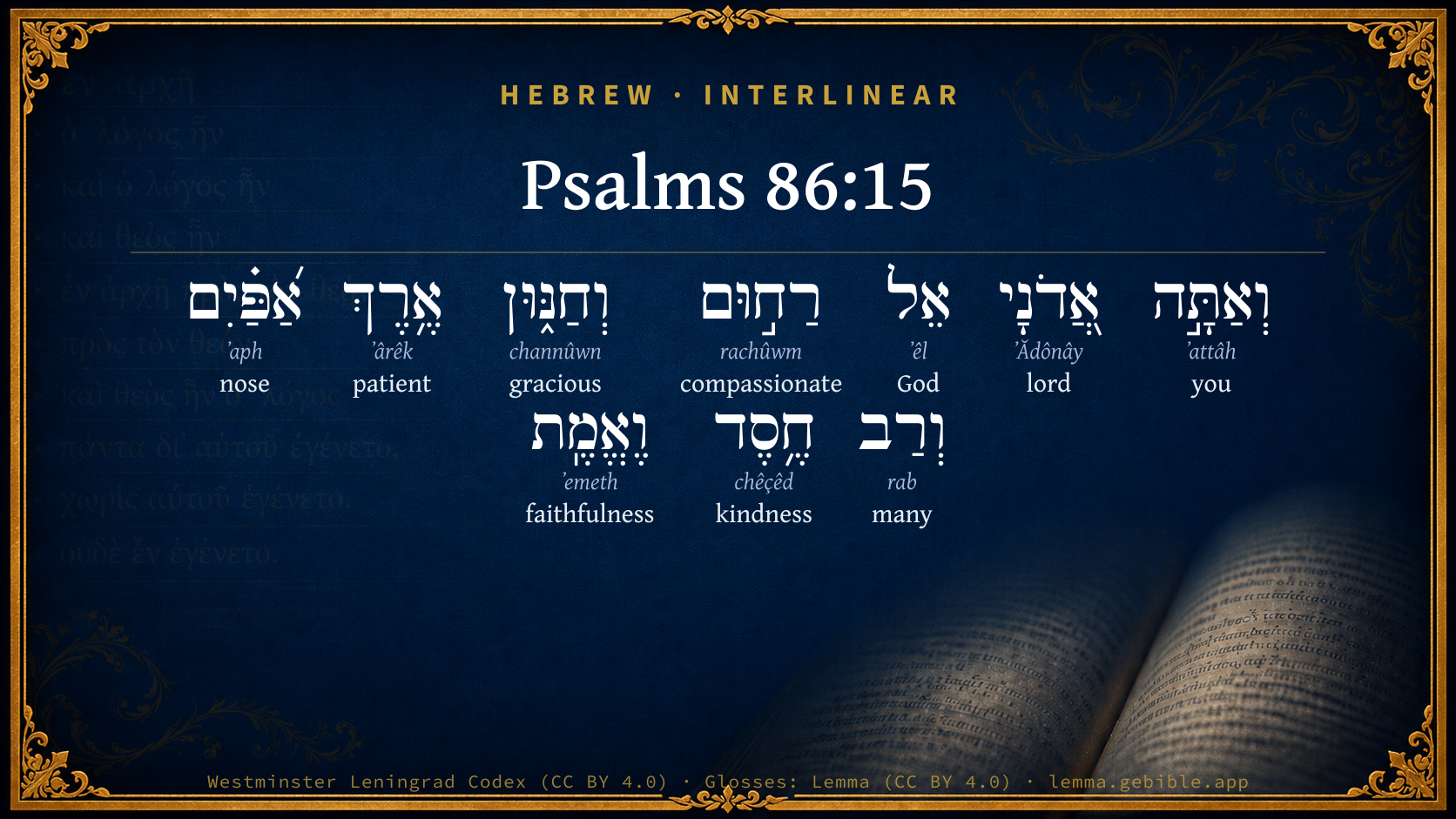
Hebrew (Westminster Leningrad Codex) Psalms 86:15 appears in the Hebrew Old Testament. The text above is from the Westminster Leningrad Codex. Each word links to its Strong’s number, a concise gloss, and parsing drawn from the Open Scriptures Hebrew Bible morphology. Click any word for its full Brown-Driver-Briggs (BDB) entry.
Download image
Cite this verse

Psalms 86:15 (World English Bible). Public Domain. Lemma interlinear Bible study tool, https://lemma.gebible.app/v/psalms/86/15.

Show BibTeX & RIS
BibTeX
RIS
English Translation
But you, Lord, are a merciful and gracious God, Slow to anger, and abundant in loving kindness and truth.
World English Bible · Public Domain
Download a study sheet

One document with this verse’s original text, its word-by-word gloss line, the meaning frame, cross-references with their text, attributed commentary, and full source and license credits — printable, and it pastes into notes with its structure intact.

This verse Autodidact and up

Study sheet (.html) Plain text (.txt)

A passage Seminary Student

Up to 50 verses in one chapter. A passage sheet keeps up to 6 commentary sources and 12 cross-references per verse, in the order this page ranks them, and says so on the sheet whenever that leaves anything out. Ask for a single verse and you get the Autodidact verse sheet above.

Everything on this page stays free to read, with no account — the sheet is a download of what is already on screen, not access to it.

Want to remove ads? Support Godless Engineer
Compare translations 3

The same verse in 3 English versions, stacked beneath the original-language interlinear above. Click any original word for its lexicon entry.

Each is an independent rendering of the whole verse — the interlinear is not word-aligned to these translations.

Highlighted words mark where these versions differ — a whole-verse word diff, not a word-by-word alignment.

  • World English Bible Public Domain
    But you, Lord, are a merciful and gracious God, Slow to anger, and abundant in loving kindness and truth.
  • King James Version Public Domain
    But thou, O Lord, art a God full of compassion, and gracious, longsuffering, and plenteous in mercy and truth.
  • unfoldingWord Literal Text CC BY-SA 4.0
    But you, Lord, a merciful and gracious God, long of nostrils and plentiful of covenant faithfulness and truth.

unfoldingWord Literal Text — © unfoldingWord, licensed CC BY-SA 4.0. Word-aligned USFM3 via Door43 (git.door43.org/unfoldingWord/en_ult).

Versions to compare (up to 4)

3 of 4 selected

Show all 18 translations

Every available English version of this verse, each an independent rendering of the whole verse.

  • World English Bible Public Domain
    But you, Lord, are a merciful and gracious God, Slow to anger, and abundant in loving kindness and truth.
  • Berean Standard Bible Public Domain
    But You, O Lord, are a compassionate and gracious God, slow to anger, abounding in loving devotion and faithfulness.
  • Majority Standard Bible Public Domain
    But You, O Lord, are a compassionate and gracious God, slow to anger, abounding in loving devotion and faithfulness.
  • King James Version Public Domain
    But thou, O Lord, art a God full of compassion, and gracious, longsuffering, and plenteous in mercy and truth.
  • American Standard Version (1901) Public Domain
    But thou, O Lord, art a God merciful and gracious, Slow to anger, and abundant in lovingkindness and truth.
  • Revised Version (1885) Public Domain
    But thou, O Lord, art a God full of compassion and gracious, slow to anger, and plenteous in mercy and truth.
  • Geneva Bible (1599) Public Domain
    But thou, O Lord, art a pitifull God and mercifull, slowe to anger and great in kindenes and trueth.
  • Douay-Rheims (1899) Public Domain
    And thou, O Lord, art a God of compassion, and merciful, patient, and of much mercy, and true.
  • Young's Literal Translation Public Domain
    And Thou, O Lord, `art' God, merciful and gracious, Slow to anger, and abundant in kindness and truth.
  • Literal Standard Version CC BY-SA 4.0
    And You, O Lord, [are] God, merciful and gracious, || Slow to anger, and abundant in kindness and truth.
  • Unlocked Literal Bible CC BY-SA 4.0
    But you, Lord, are a merciful and gracious God, slow to anger, and abundant in covenant faithfulness and trustworthiness.
  • unfoldingWord Literal Text CC BY-SA 4.0
    But you, Lord, a merciful and gracious God, long of nostrils and plentiful of covenant faithfulness and truth.
  • Darby Bible Public Domain
    But thou, Lord, art a ùGod merciful and gracious, slow to anger, and abundant in goodness and truth.
  • World Messianic Bible Public Domain
    But you, Lord, are a merciful and gracious God, slow to anger, and abundant in loving kindness and truth.
  • Webster's Bible Public Domain
    But thou, O Lord, art a God full of compassion, and gracious; long-suffering, and abundant in mercy and truth.
  • Free Bible Version CC BY-SA 4.0
    But you, Lord, are a compassionate and gracious God, slow to become angry, full of trustworthy love and faithfulness.
  • Bible in Basic English Public Domain
    But you, O Lord, are a God full of pity and forgiveness, slow to get angry, great in mercy and wisdom.
  • JPS Tanakh (1917) Public Domain
    But Thou, O Lord, art a God full of compassion and gracious, slow to anger, and plenteous in mercy and truth.

Literal Standard Version (2020), Covenant Press — licensed CC BY-SA 4.0. Text via the HelloAO Bible API (eBible.org). Unlocked Literal Bible (unfoldingWord) — licensed CC BY-SA 4.0. Text via the HelloAO Bible API (eBible.org). unfoldingWord Literal Text — © unfoldingWord, licensed CC BY-SA 4.0. Word-aligned USFM3 via Door43 (git.door43.org/unfoldingWord/en_ult). Free Bible Version, Dr. Jonathan Gallagher — licensed CC BY-SA 4.0. Text via the HelloAO Bible API (eBible.org).

Word by word

More ways to search: Search by grammar → Find every occurrence → Compare this word →

Practice this passage: Drill this verse → Learn its vocabulary →

רַח֣וּם
rachûwm
H7349
“compassionate”
Adjective, Adjective, Masculine, Singular, Absolute
Part of Speech
Adjective
Type
Adjective
Gender
Masculine
Number
Singular
State
Absolute
Full BDB Definition

Origin: from H7355

TWOT: 2146c

compassionate - always of God with one possible exception
  1. וְאַתָּ֣ה ʼattâh H859 “and · you” Conjunction + Pronoun, Personal, 2nd Person, Masculine, Singular
  2. אֲ֭דֹנָי ʼĂdônây H136 “Lord · my” Noun, Common, Masculine, Plural, Construct + Suffix, Personal, 1st Person, Common, Singular
  3. אֵל ʼêl H410 “God” Noun, Common, Masculine, Singular, Absolute
  4. וְחַנּ֑וּן channûwn H2587 “and · gracious” Conjunction + Adjective, Adjective, Masculine, Singular, Absolute
  5. אֶ֥רֶךְ ʼârêk H750 “patient of” Adjective, Adjective, Masculine, Singular, Construct
  6. אַ֝פַּ֗יִם ʼaph H639 “nostrils” Noun, Common, Masculine, Dual, Absolute
  7. וְרַב rab H7227 “and · many of” Conjunction + Adjective, Adjective, Masculine, Singular, Construct
  8. חֶ֥סֶד chêçêd H2617 “kindness” Noun, Common, Masculine, Singular, Absolute
  9. וֶאֱמֶֽת ʼemeth H571 “and · faithfulness” Conjunction + Noun, Common, Feminine, Singular, Absolute

About this verse

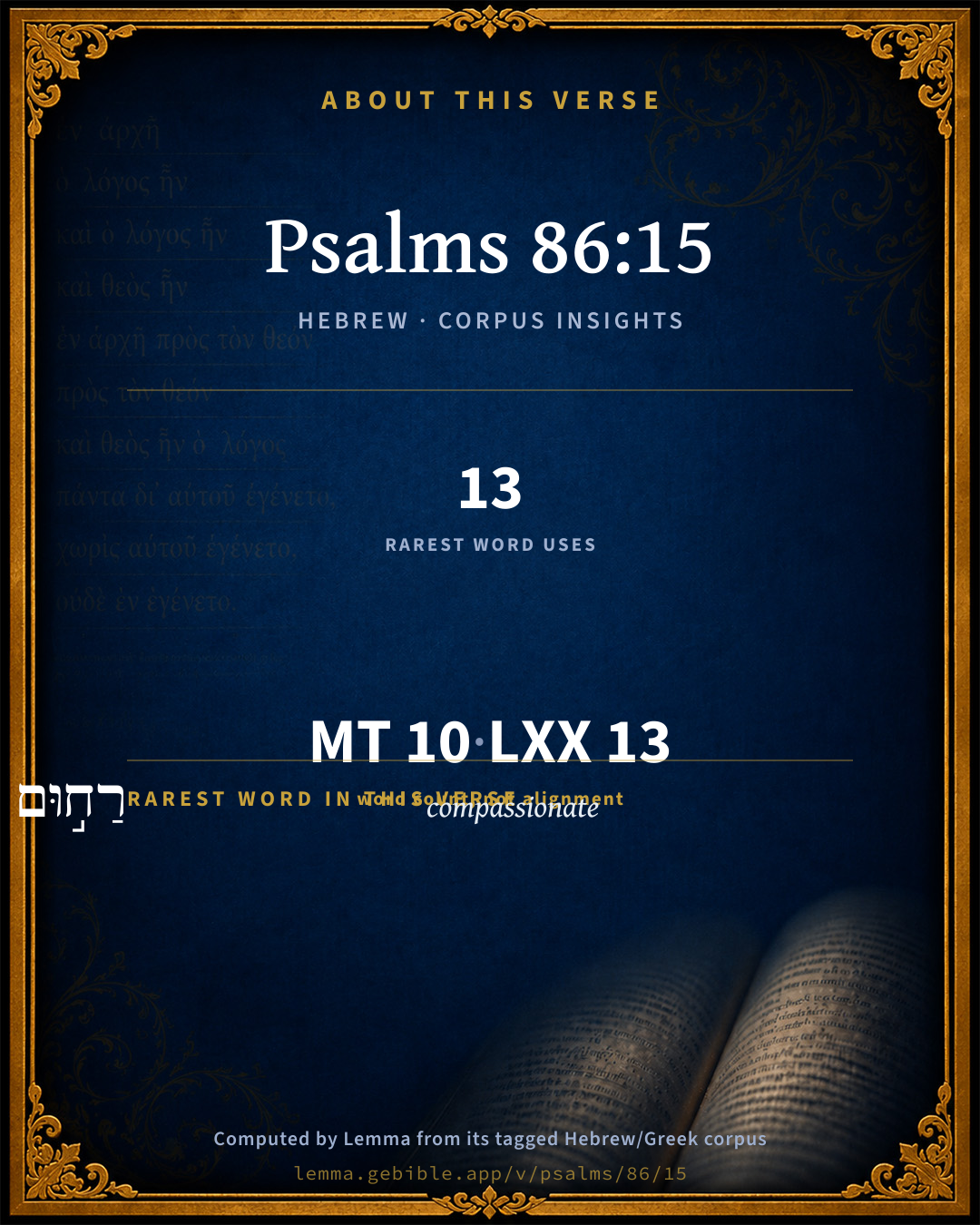
These counts appear in no published source. They are computed here, from the morphology-tagged text and Lemma’s own curated glosses. What Lemma adds →

10
words
10
distinct lemmas
Wisdom
section

Notable vocabulary

The rarest word here is רַח֣וּם compassionate H7349 — appearing just 13 times in the whole Hebrew Bible.

Shared distinctive vocabulary

רַח֣וּם compassionate H7349 occurs in 13 verses of the Hebrew Bible. Also found in:

Grammatical profile

  • 5 nouns
  • 4 adjectives
  • 1 pronoun

Hebrew & Septuagint length

In English translation the verse runs 19 words from the Hebrew and 16 from the Septuagint (LXX English) — closely comparable.

A rough comparison of the two English renderings, which tokenize alike — not a word-level alignment.

Word counts can differ between the Hebrew and the Greek without any difference in meaning — e.g. the Hebrew direct-object marker אֵת has no separate Greek word, and Greek often adds the article ὁ.

In the original languages it is 10 Hebrew tokens and 13 Greek tokens — but the two are counted differently (Hebrew bundles its prefixes and suffixes into one token; the Greek is in lemma form), so that isn’t a like-for-like length.

Cross-references

18

Topical passages linked to Psalms 86:15 in the Treasury of Scripture Knowledge — connected by theme and wording, ordered by reader-vote popularity; previews shown in the World English Bible.

  • Ephesians 2:4–7 But God, being rich in mercy, for his great love with which he loved us,
  • Psalms 130:7 Israel, hope in Yahweh, For with Yahweh there is loving kindness. With him is abundant redemption.
  • Psalms 103:8 Yahweh is merciful and gracious, Slow to anger, and abundant in loving kindness.
  • Ephesians 1:7 in whom we have our redemption through his blood, the forgiveness of our trespasses, according to the riches of his grace,
  • Psalms 86:5 For you, Lord, are good, and ready to forgive; Abundant in loving kindness to all those who call on you.
  • Psalms 145:8 Yahweh is gracious, merciful, Slow to anger, and of great loving kindness.
  • Nehemiah 9:17 and refused to obey, neither were mindful of your wonders that you did among them, but hardened their neck, and in their rebellion appointed a captain to return to their bondage. But you are a God ready to pardon, gracious and merciful, slow to anger, and abundant in loving kindness, and didn't forsake them.
  • Joel 2:13 Tear your heart, and not your garments, And turn to Yahweh, your God; For he is gracious and merciful, Slow to anger, and abundant in loving kindness, And relents from sending calamity.
  • Psalms 85:10 Mercy and truth meet together. Righteousness and peace have kissed each other.
  • Psalms 111:4 He has caused his wonderful works to be remembered. Yahweh is gracious and merciful.
  • Micah 7:18 Who is a God like you, who pardons iniquity, And passes over the disobedience of the remnant of his heritage? He doesn't retain his anger forever, Because he delights in loving kindness.
  • Numbers 14:18 Yahweh is slow to anger, and abundant in loving kindness, forgiving iniquity and disobedience; and that will by no means clear [the guilty], visiting the iniquity of the fathers on the children, on the third and on the fourth generation.
  • Psalms 98:3 He has remembered his loving kindness and his faithfulness toward the house of Israel. All the ends of the earth have seen the salvation of our God.
  • Psalms 130:4 But there is forgiveness with you, Therefore you are feared.
  • Exodus 31:6–7 I, behold, I have appointed with him Oholiab, the son of Ahisamach, of the tribe of Dan; and in the heart of all who are wise-hearted I have put wisdom, that they may make all that I have commanded you:
  • Romans 5:20–21 The law came in besides, that the trespass might abound; but where sin abounded, grace did abound more exceedingly;
  • John 1:17 For the law was given through Moses. Grace and truth came through Jesus Christ.
  • Romans 15:8–9 Now I say that Christ has been made a minister of the circumcision for the truth of God, that he might confirm the promises given to the fathers,

Cross-references courtesy of OpenBible.info (CC BY 4.0).

Hebrew and Greek witnesses Masoretic Hebrew ↔ Greek Septuagint

The same verse in the two great witnesses to the Old Testament, shown verse-for-verse.

You’re reading Greek Psalm 85 (Hebrew Psalm 86). The Septuagint counts the superscription, so verse numbers can differ from the Hebrew — chapter-level alignment, not verse-by-verse. Numbering follows Rahlfs.

These are two independent witnesses, not word-aligned to each other, and the Septuagint is shown in lemma (dictionary) form.

Hebrew Psalms 86:15 Masoretic · Westminster Leningrad Codex

וְאַתָּ֣ה אֲ֭דֹנָי אֵל רַח֣וּם וְחַנּ֑וּן אֶ֥רֶךְ אַ֝פַּ֗יִם וְרַב חֶ֥סֶד וֶאֱמֶֽת

But you, Lord, are a merciful and gracious God, Slow to anger, and abundant in loving kindness and truth.

World English Bible · Public Domain

Greek LXX Greek Psalm 85:15 Septuagint · lemma form

καί σύ κύριος ὁ θεός οἰκτίρμων καί ἐλεήμων μακρόθυμος καί πολυέλεος καί ἀληθινός

But you, O Lord God, are compassionate and merciful, longsuffering, and abundant in mercy and true.

LXX2012 (modern English Septuagint) · Public Domain

Hebrew: Westminster Leningrad Codex (CC BY 4.0). Greek: Septuagint (public domain); English from LXX2012 (modern English Septuagint) (Public Domain). How the Septuagint differs from the Hebrew →

Commentary

Notes on Psalms 86:15 from classic Christian and Jewish commentators (each source and its license shown beneath its notes). The classic Christian expositions comment on the surrounding passage and are grouped to its opening verse, so a note may address several verses; the Jewish commentaries on the Tanakh (Rashi and others) are per-verse, so they appear only where the commentator wrote on this verse.

Lemma curates 59 commentaries, every one of them public domain or Creative Commons licensed, each selected and text-cleaned for this edition rather than reprinted as found. About our sources →

Trapp's Complete Commentary

John Trapp

Psa 86:15 But thou, O Lord, [art] a God full of compassion, and gracious, longsuffering, and plenteous in mercy and truth.

Ver. 15. But thou, O Lord, art a God full, &c.] These are part of those thirteen attributes of Almighty God, set down and proclaimed by himself, Exo 24:6. Middoth, the Rabbis call them, that is, properties.

John Trapp, A Commentary or Exposition upon All the Books of the Old and New Testament (1647–1656) — public domain. Text from a community e-Sword module.

J. A. Alexander on Psalms

Joseph Addison Alexander

15. (Psa 86:15) And thou, Lord, (art) a God merciful and gracious, long-suffering, and plenteous in mercy and truth. He here appeals to God's description of himself as warranting his prayer for mercy. See Exo 34:6, and the imitations or quotations of it by Joel (Joe 2:13) and Jonah (Jon 4:2). See also Psa 85:10.

Joseph Addison Alexander, The Psalms Translated and Explained (1850) — public domain. Text from a community e-Sword module.

Tyndale Open Study Notes

Tyndale Open Resources

86:15 God has mercy on his people (51:1); he is gracious (25:6), slow to get angry (103:8; 145:8), and filled with unfailing love and faithfulness (Hebrew khesed and ’emeth; 143:1). This verse repeats a theme first expressed in Exod 34:7; Num 14:18 (cp. Pss 103:8; 145:8; Neh 9:17; Joel 2:13; Jon 4:2).

Tyndale Open Study Notes — © Tyndale Open Resources, licensed CC BY-SA 4.0. Text via the HelloAO Bible API.

Adam Clarke's Commentary

Verse 15. But thou, O Lord] What a wonderful character of God is given in this verse! אדני Adonai, the Director, Judge, and Support; - but instead of אדני Adonai, thirty-four of Kennicott's MSS. have יהוה Jehovah, the self-existent and eternal Being; - אל El, the strong God; רחום rachum, tenderly compassionate; חנון channun, the Dispenser of grace or favour; ארך אפים erech appayim, suffering long, not easily provoked; רב חמד rab chesed, abundant in blessings; and אמת emeth, faithful and true. Such is the God who has made himself more particularly known to us in Christ. The scanty language of our ancestors was not adequate to a full rendering of the original words: [---Anglo-Saxon---]. "And thu driht God gemildsiend , and mildheort, gethyldig and mucel mildheortnysse and sothfaest. - And thou, Lord God, art mild, and mildhearted, patient, and of much mildheartedness, and soothfast," - steady in truth.

In the old Psalter the language is but little improved: And thou Lorde God mercier, and mercyful, sufferand, and of mykel mercy, and sothefast.

The word mercier is interpreted, doand dede of mercy.

Adam Clarke's Commentary on the Bible (1810–1826) — public domain. Text from a community e-Sword/MySword module.

John Calvin's Commentaries

15. And thou, O Lord! art God, merciful, ready to forgive. By immediately passing on to the celebration of these divine attributes, he would intimate, that we have adequate strength and protection against the audacity and rage of the wicked, in the divine goodness, mercy, and faithfulness. Perhaps, also, from his feeling that the wicked were scourges in the hand of God, he set before himself the divine goodness and mercy, to allay the excess of terror with which he might be seized; for this is the true and the only source of comfort, that although God chastise us he does not forget his mercy. This sentence, as is well known, is taken from Exodus 34:6, where we meet with a very remarkable description of the nature of God. First, he is called merciful; in the next place, ready to forgive, which he manifests by compassionating our distresses. In the third place, he is described as long-suffering; for he is not angry whenever an offense is committed against him, but pardons us according to the greatness of his loving-kindness. In short, he is said to be abundant in mercy and truth; by which I understand, that his beneficence is continually exercised, and that he is always true. He is indeed no less worthy to be praised on account of his rigour, than on account of his mercy; but as it is our wilful obstinacy alone which makes him severe, compelling him, as it were, to punish us, the Scriptures, in representing him as by nature merciful and ready to forgive, teach us, that if he is at any time rigorous and severe, this is, as it were, accidental to him. I am speaking, it is true, in popular language, and such as is not strictly correct; but still, these terms by which the divine character is described amount in effect to this, That God is by nature so gracious and ready to forgive, that he seems to connive at our sins, delays the infliction of punishment, and never proceeds to execute vengeance unless compelled by our obstinate wickedness. Why the truth of God is joined with his mercy has been considered in another place. As even those who are most generous sometimes desire to retract the promises which they have made, repenting of their too great facility, we who are accustomed unreasonably to judge of God by ourselves, distrust his promises. God therefore declares, that he is unlike men, because he is as firm to his purpose in abundantly performing whatever he has promised, as he is distinguished for promising liberally.

John Calvin's Commentaries (1540-1563) — public domain. Text from the Calvin Translation Society English edition (1840s-50s) via the Christian Classics Ethereal Library (ccel.org). Calvin's coverage is partial (roughly two-thirds of the Bible); uncommented books and verses are honest gaps, never fabricated. The 19th-century editor's footnotes and remarks are omitted so the notes are faithfully Calvin's own voice.

The Cambridge Bible for Schools and Colleges

gen. ed. J. J. S. Perowne

15. Word for word from Exo_34:6. With his proud and merciless enemies he contrasts the revealed character of God, as the ground of the prayer which follows. Though he may have deserved punishment, God cannot surely abandon him to them.

longsuffering] Or, slow to anger (R.V.).

The Cambridge Bible for Schools and Colleges (gen. ed. J. J. S. Perowne; Cambridge University Press, 1878–1918) — public domain. Text from a community e-Sword module.

John Gill's Exposition

But thou, O Lord, art a God full of compassion,.... Or merciful (t), in the most affectionate and tender manner, as a parent to its child, or particularly as a mother to the son of her womb; and is rich and plenteous in his mercy, and freely bestows it; and this was the support of the psalmist under his troubles from his enemies, that though they were cruel the Lord was merciful:

and gracious; so he has been in eternity, as appears by his election of grace, by the covenant of his grace, and the provisions of it in his Son; and so he is in time, as is manifest from his kindness in Christ Jesus, from his justification, pardon, adoption, effectual calling and salvation of his people, which are all of grace;

longsuffering; not only to wicked men, but to his chosen ones; which longsuffering of his is salvation to them; he bears with them, and waits to be gracious to them, to bring them to repentance, and save them, Pe2 3:9,

plenteous in mercy; or goodness; See Gill on Psa 86:5, and truth: in fulfilling promises; see Exo 34:6, to which these words refer.

(t) "misericors", Pagninus, Montanus, Junius & Tremellius, Piscator, &c.

John Gill's Exposition of the Whole Bible (1746–1763) — public domain (CC PDM 1.0). Text via the HelloAO Bible API.

Albert Barnes' Notes on the Bible

But thou, O Lord, art a God full of compassion ... - See the notes at Psa 86:5. The words rendered “long-suffering” mean that there was and would be delay in his anger; that it was not soon excited; that he did not act from passion or sudden resentment; that he endured the conduct of sinners long without rising up to punish them; that he was not quick to take vengeance, but bore with them patiently. On this account the psalmist, though conscious that he was a sinner, hoped and pleaded that God would save him.

Plenteous in ... truth - That is, in faithfulness. When thou hast made a promise, thou wilt faithfully keep it.

Albert Barnes' Notes on the Bible (1834–1885) — public domain. Text from a community e-Sword/MySword module.

Matthew Poole's English Annotations

To wit, to thy people, and to me in particular; and therefore thou wilt forget and forgive my manifold sins, for which thou mightest justly reject me, and make me to know thy breach of promise; and therefore thou wilt save me from my cruel enemies.

Matthew Poole's English Annotations on the Holy Bible (1683–1685) — public domain. Text from a community e-Sword/MySword module.

The Treasury of David

Charles H. Spurgeon

Ver. 15. But thou, O Lord. What a contrast! We get away from the hectorings and blusterings of proud but puny men to the glory and goodness of the Lord. We turn from the boisterous foam of chafing waves to the sea of glass mingled with fire, calm and serene. "Art a God full of compassion, and gracious, long suffering, and plenteous in mercy and truth." A truly glorious doxology, in which there is not one redundant word. As we have before observed, it is mainly transcribed from Ex 34:6. Here is compassion for the weak and sorrowing, grace for the undeserving, longsuffering for the provoking, mercy for the guilty, and truth for the tried. God's love assumes many forms, and is lovely in them all. Into whatsoever state we may be cast, there is a peculiar hue in the light of love which will harmonize with our condition; love is one and yet sevenfold, its white ray contains the chromatic scale. Are we sorrowful? We find the Lord full of compassion. Are we contending with temptation? His grace comes to our aid. Do we err? He is patient with us. Have we sinned? He is plenteous in mercy. Are we resting on his promise? He will fulfil it with abundant truth.

Ver. 15. Thou, O Lord, Adonai, art a God; El, the strong God, full of compassion; the same words as Moses useth. Instead of Jehovah, Adonai is used, "O Lord"; but then El, strong God, is the same word.

The meaning is, let all the strength and power thou the strong God hast in thee be for my advantage. Now, is it not a bold request to say, Lord, wilt thou give me all thy strength to help me? A very bold request indeed; but his mercy moves him to grant it. Thus then petition him: Thou art a God merciful and gracious, give thy strength to me! Thou, O God, givest all thy attributes up to thy children, to serve their advantage, as well as to serve thy own glory; give me thy strength! Thomas Goodwin.

Ver. 15. Full of compassion. The original word Rachum is very emphatical; it signifies such tenderness as parents have toward their children when their bowels yearn within them. "Critical and Practical Exposition of the Pentateuch." 1748.

Ver. 15. The shades of the light of love. Compassion upon suffering, grace towards unworthiness, long suffering to provocation, mercy towards sin, truth towards the promise.

Psalms 86:16*

Charles H. Spurgeon's The Treasury of David (1869–1885) — public domain. Psalms only. Text from a community e-Sword/MySword module.

Whedon's Commentary on the Bible

Daniel D. Whedon

15. But thou, O Lord, art… full of compassion—In contrast with the godless characters who had seized the reins of power. This ascription—the glory of the divine character—is a re-iteration of Exo_34:6

Daniel D. Whedon (gen. ed.), Commentary on the Old and New Testaments (1874–1909) — public domain. Text from a community e-Sword module.

The Pulpit Commentary

But thou, O Lord, art a God full of compassion. The appeal is to God"s own revelation of himself. He had declared that he was "merciful and gracious, long suffering, and abundant in goodness and truth, keeping mercy for thousands, forgiving iniquity and transgression and sin"; (Exo_34:6, Exo_34:7) he could not, therefore, desert the psalmist in his need. And gracious, long suffering, and plenteous in mercy and truth. (comp. above, ver. 5; and see also Num_14:18 Joe_2:13Jo Joe 4:2)

God"s graciousness.

"Full of compassion, and gracious, slow to anger, and plenteous in mercy and truth" The term "gracious," as applied to God, brings in ideas of tenderness, gentleness, considerateness, in dealing with those who are frail and weak. It is like "pitiful," but does not imply conditions of special poverty or distress. "Gracious" fits into God"s ordinary ways with ordinary people. If we used the term of our fellow men, we should single out those who were sympathetic and sweet mannered and gentle toned. It brings in a somewhat fresh, and a very attractive, view of God, thus to associate the word "gracious" with him. The precise shades of meaning that may be attached to the term will come to view upon a study of the following passages: Exo_22:27, "And it shall come to pass, when he crieth unto me, that I will hear; for I am gracious;" Exo_34:6, "And the Lord passed by before him, and proclaimed, The Lord, the Lord God, merciful and gracious;" 2Sa_12:22, "Who can tell whether God will be gracious to me, that the child may live?" Neh_9:17, "A God ready to pardon, gracious and merciful;" Psa_4:1, margin, "Be gracious unto me, and hear my prayer;" Isa_30:18, "And therefore will the Lord wait, that he may be gracious unto you;" Jon_4:2, "For I knew that thou art a gracious God, and merciful, slow to anger, and of great kindness, and repentest thee of the evil." Evidently the term is used to express God"s relations with sinners, as distinct from his relations with sin; and it especially describes the Divine response to penitent sinners. "Grace," as favour, mercy, was the highest blessing under the Old Testament dispensation. Joseph, in the fulness of his feelings on seeing his brother Benjamin, cried, "God be gracious to thee, my son!" The synonyms of the term "gracious" may be found suggestive kindly, beneficent, benignant, condescending, pleasing. Bring out the point that not only does God save and sanctify, but he saves and sanctifies in a gentle, considerate, and delightful way. Put into a figure, he never "breaks the bruised reed, or quenches the smoking flax. R.T.

The Pulpit Commentary (1880–1919), ed. H.D.M. Spence-Jones & Joseph S. Exell — public domain. Text from a community e-Sword module.

unfoldingWord translationNotes

Door43 World Missions Community

and abundant in covenant faithfulness and trustworthiness

God constantly being faithful and trustworthy is spoken of as if faithfulness and trustworthiness were objects of which God has a large quantity. The two abstract nouns can be translated as adjectives. AT: "always faithful to your covenant and very worthy of people trusting you" (See: Metaphor and Abstract Nouns)

Turn toward me

Asking God to consider him is spoken of as if he wanted God to turn and look at him. (See: Metaphor)

give your strength to your servant

The abstract noun "strength" can be stated as a verb or an adjective. AT: "strengthen your servant" or "make your servant strong" (See: Abstract Nouns)

your servant ... the son of your servant woman

The writer is speaking about himself in the third person. (See: First, Second, or Third Person)

be put to shame

This can be stated in active form. AT: "they will be ashamed" (See: Active or Passive)

translationWords

lord

mercy

grace

God

anger

covenant faithfulness

trust

turn

servant

save

son

sign

favor

shame

Yahweh

comfort

unfoldingWord translationNotes — © Distant Shores Media and the Door43 World Missions Community, licensed CC BY-SA 4.0. Source: git.door43.org/Door43/en_tn.

Lesson kit

Teaching starters — assembled from the data on this page, not authored interpretation. Every prompt links to the verse data it draws on. Edit before teaching.

Psalms, in the Wisdom, opens this verse with 10 words (10 distinct Hebrew lemmas). Its most distinctive word is rachûwm (“compassionate”). A historical commentator’s framing appears above. Read the whole chapter for the surrounding context.

Discussion questions

  1. The word rachûwm carries the sense “compassionate.” How does it shape the verse?
  2. Exodus 34:6 shares the word «compassionate» with this verse. How do the two illuminate each other?
  3. The translations on this page render this verse differently — a whole-verse word diff, not a word-by-word alignment. What might account for the different wordings?
  4. Reading how Trapp's Complete Commentary and J. A. Alexander on Psalms read this verse, where do the two commentators agree and where do they part?

Things to notice

Reading settings

Reading text

Shown beneath each verse's original-language words.

Old Testament
Old Testament edition

Read the OT as the Masoretic Hebrew (MT) or the Greek Septuagint (LXX).

English shown for the Greek Septuagint (in the Hebrew ↔ Greek comparison).

Comparing translations? Open the Compare panel on any verse page to stack up to four side by side.