
Isaiah 21:6

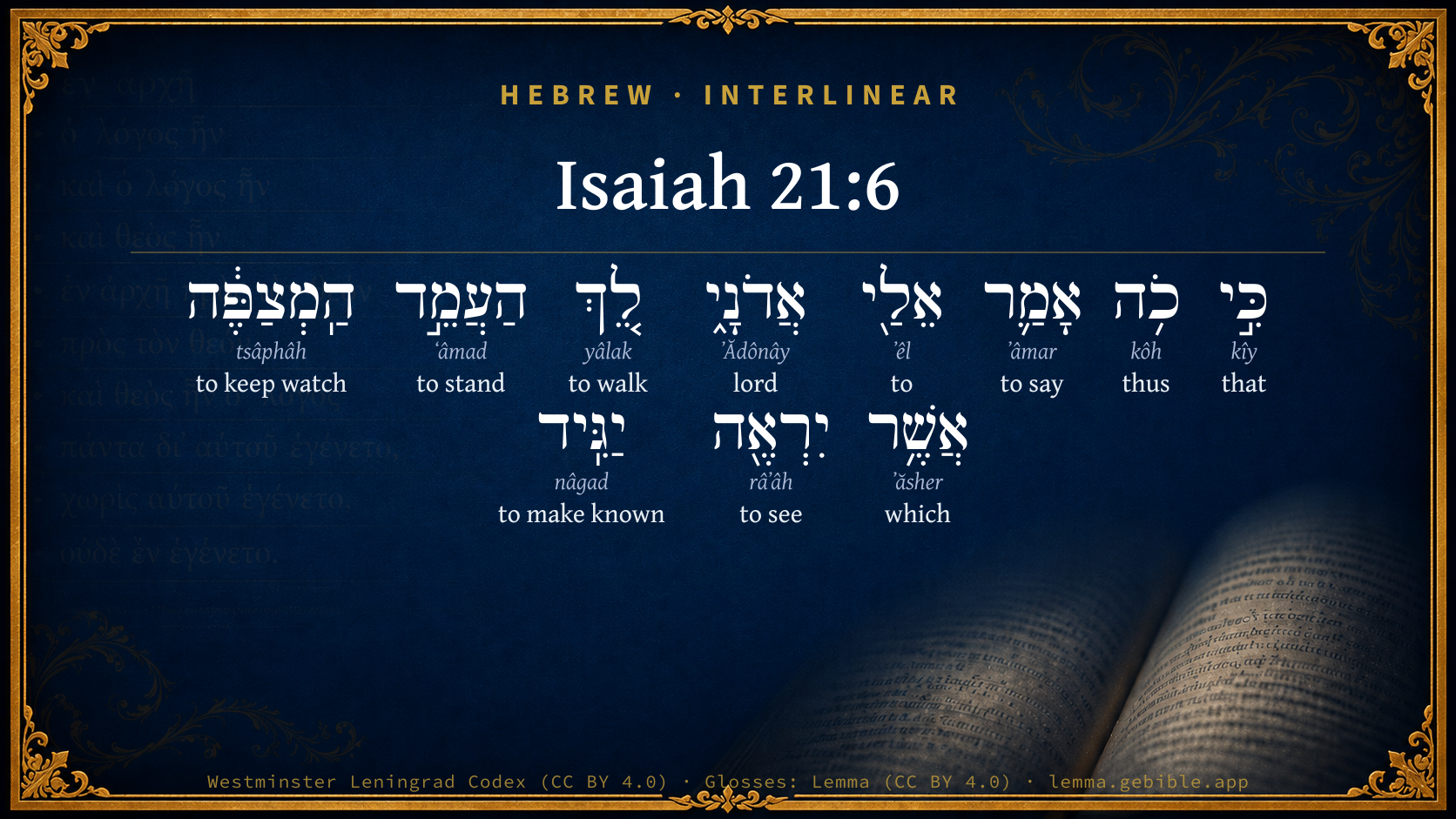
Hebrew (Westminster Leningrad Codex) Isaiah 21:6 appears in the Hebrew Old Testament. The text above is from the Westminster Leningrad Codex. Each word links to its Strong’s number, a concise gloss, and parsing drawn from the Open Scriptures Hebrew Bible morphology. Click any word for its full Brown-Driver-Briggs (BDB) entry.
Download image
Cite this verse

Isaiah 21:6 (World English Bible). Public Domain. Lemma interlinear Bible study tool, https://lemma.gebible.app/v/isaiah/21/6.

Show BibTeX & RIS
BibTeX
RIS
English Translation
For thus has the Lord said to me, Go, set a watchman: let him declare what he sees:
World English Bible · Public Domain
Download a study sheet

One document with this verse’s original text, its word-by-word gloss line, the meaning frame, cross-references with their text, attributed commentary, and full source and license credits — printable, and it pastes into notes with its structure intact.

This verse Autodidact and up

Study sheet (.html) Plain text (.txt)

A passage Seminary Student

Up to 50 verses in one chapter. A passage sheet keeps up to 6 commentary sources and 12 cross-references per verse, in the order this page ranks them, and says so on the sheet whenever that leaves anything out. Ask for a single verse and you get the Autodidact verse sheet above.

Everything on this page stays free to read, with no account — the sheet is a download of what is already on screen, not access to it.

Want to remove ads? Support Godless Engineer
Compare translations 3

The same verse in 3 English versions, stacked beneath the original-language interlinear above. Click any original word for its lexicon entry.

Each is an independent rendering of the whole verse — the interlinear is not word-aligned to these translations.

Highlighted words mark where these versions differ — a whole-verse word diff, not a word-by-word alignment.

  • World English Bible Public Domain
    For thus has the Lord said to me, Go, set a watchman: let him declare what he sees:
  • King James Version Public Domain
    For thus hath the LORD said unto me, Go, set a watchman, let him declare what he seeth.
  • unfoldingWord Literal Text CC BY-SA 4.0
    For thus the Lord said to me: “Go, post a watchman. What he sees, let him declare.

unfoldingWord Literal Text — © unfoldingWord, licensed CC BY-SA 4.0. Word-aligned USFM3 via Door43 (git.door43.org/unfoldingWord/en_ult).

Versions to compare (up to 4)

3 of 4 selected

Show all 18 translations

Every available English version of this verse, each an independent rendering of the whole verse.

  • World English Bible Public Domain
    For thus has the Lord said to me, Go, set a watchman: let him declare what he sees:
  • Berean Standard Bible Public Domain
    For this is what the Lord says to me: “Go, post a lookout and have him report what he sees.
  • Majority Standard Bible Public Domain
    For this is what the Lord says to me: “Go, post a lookout and have him report what he sees.
  • King James Version Public Domain
    For thus hath the LORD said unto me, Go, set a watchman, let him declare what he seeth.
  • American Standard Version (1901) Public Domain
    For thus hath the Lord said unto me, Go, set a watchman: let him declare what he seeth:
  • Revised Version (1885) Public Domain
    For thus hath the Lord said unto me, Go, set a watchman; let him declare what he seeth:
  • Geneva Bible (1599) Public Domain
    For thus hath the Lord said vnto me, Go, set a watchman, to tell what he seeth.
  • Douay-Rheims (1899) Public Domain
    For thus hath the Lord said to me: Go, and set a watchman: and whatsoever he shall see, let him tell.
  • Young's Literal Translation Public Domain
    For thus said the Lord unto me: `Go, station the watchman, That which he seeth let him declare.'
  • Literal Standard Version CC BY-SA 4.0
    For thus said the Lord to me: “Go, station the watchman, || Let him declare that which he sees.”
  • Unlocked Literal Bible CC BY-SA 4.0
    For this is what the Lord said to me, “Go, post a watchman; he must report what he sees.
  • unfoldingWord Literal Text CC BY-SA 4.0
    For thus the Lord said to me: “Go, post a watchman. What he sees, let him declare.
  • Darby Bible Public Domain
    For thus hath the Lord said unto me: Go, set a watchman, let him declare what he seeth.
  • World Messianic Bible Public Domain
    For the Lord said to me, “Go, set a watchman. Let him declare what he sees.
  • Webster's Bible Public Domain
    For thus hath the Lord said to me, Go, set a watchman, let him declare what he seeth.
  • Free Bible Version CC BY-SA 4.0
    This is what the Lord told me: “Go! Have a lookout keep watch, and make sure he reports what he sees.
  • Bible in Basic English Public Domain
    For so has the Lord said to me, Go, let a watchman be placed; let him give word of what he sees:
  • JPS Tanakh (1917) Public Domain
    For thus hath the Lord said unto me: Go, set a watchman; let him declare what he seeth!

Literal Standard Version (2020), Covenant Press — licensed CC BY-SA 4.0. Text via the HelloAO Bible API (eBible.org). Unlocked Literal Bible (unfoldingWord) — licensed CC BY-SA 4.0. Text via the HelloAO Bible API (eBible.org). unfoldingWord Literal Text — © unfoldingWord, licensed CC BY-SA 4.0. Word-aligned USFM3 via Door43 (git.door43.org/unfoldingWord/en_ult). Free Bible Version, Dr. Jonathan Gallagher — licensed CC BY-SA 4.0. Text via the HelloAO Bible API (eBible.org).

Word by word

More ways to search: Search by grammar → Find every occurrence → Compare this word →

Practice this passage: Drill this verse → Learn its vocabulary →

הַֽמְצַפֶּ֔ה
tsâphâh
H6822
“the · keeping watch”
Particle, Definite Article + Verb, Piel, Participle Active, Masculine, Singular, Absolute
Part of Speech
Particle + Verb
Stem
Piel
Form
Participle Active
Gender
Masculine
Number
Singular
State
Absolute
Full BDB Definition

Origin: a primitive root

TWOT: 1950

to look out or about, spy, keep watch, observe, watch - (Qal) to keep watch, spy - (Piel) to watch, watch closely
  1. כִּ֣י kîy H3588 “that” Conjunction
  2. כֹ֥ה kôh H3541 “thus” Adverb
  3. אָמַ֛ר ʼâmar H559 “to say” Verb, Qal, Perfect, 3rd Person, Masculine, Singular
  4. אֵלַ֖י ʼêl H413 “to · me” Preposition + Suffix, Personal, 1st Person, Common, Singular
  5. אֲדֹנָ֑י ʼĂdônây H136 “Lord · my” Noun, Common, Masculine, Plural, Construct + Suffix, Personal, 1st Person, Common, Singular
  6. לֵ֚ךְ yâlak H3212 “walk” Verb, Qal, Imperative, 2nd Person, Masculine, Singular
  7. הַעֲמֵ֣ד ʻâmad H5975 “stand” Verb, Hiphil, Imperative, 2nd Person, Masculine, Singular
  8. אֲשֶׁ֥ר ʼăsher H834 “which” Particle, Relative
  9. יִרְאֶ֖ה râʼâh H7200 “to see” Verb, Qal, Imperfect, 3rd Person, Masculine, Singular
  10. יַגִּֽיד nâgad H5046 “to make known” Verb, Hiphil, Imperfect, 3rd Person, Masculine, Singular

About this verse

These counts appear in no published source. They are computed here, from the morphology-tagged text and Lemma’s own curated glosses. What Lemma adds →

11
words
11
distinct lemmas
Prophets
section

Shared distinctive vocabulary

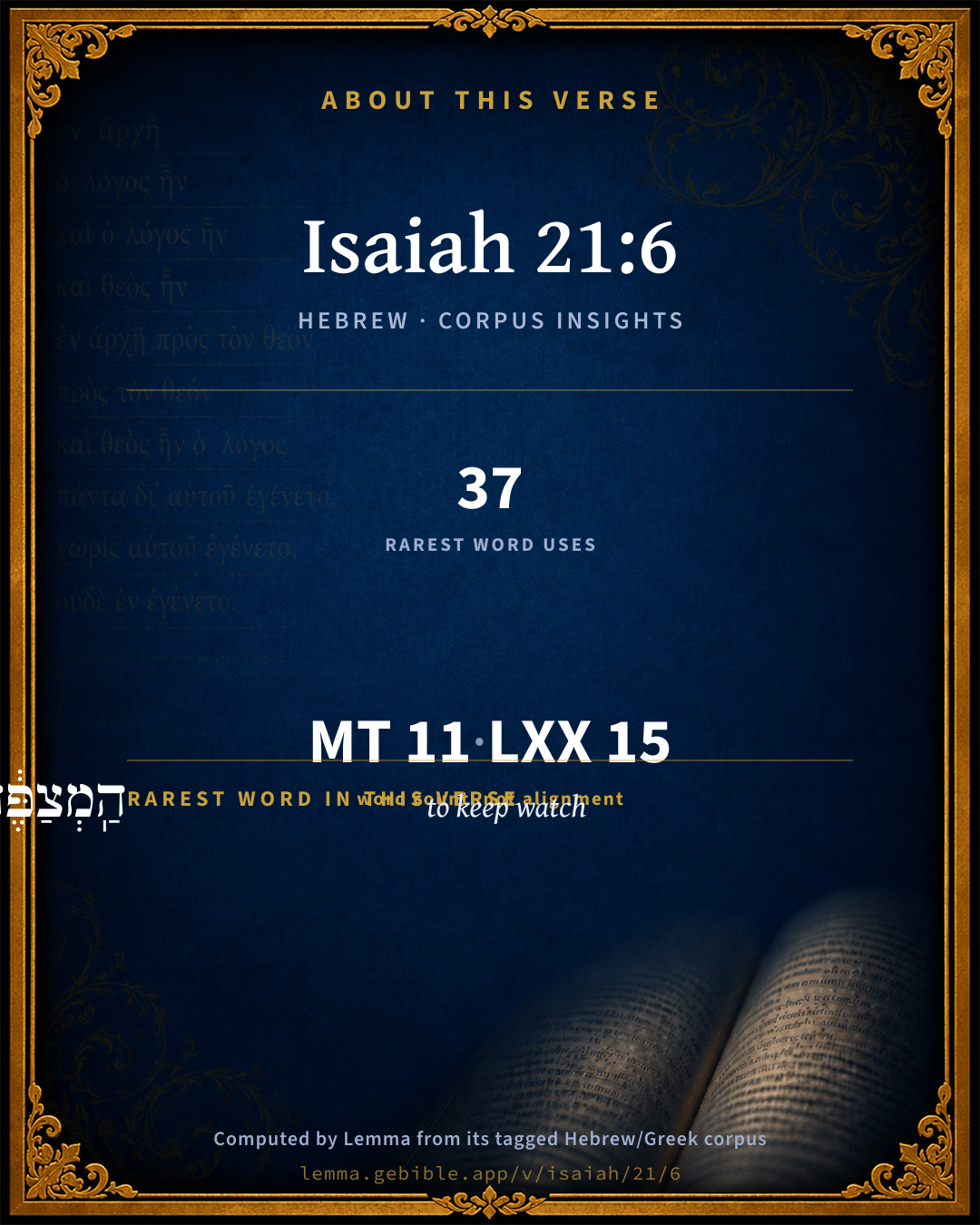
הַֽמְצַפֶּ֔ה to keep watch H6822 occurs in 33 verses of the Hebrew Bible. Also found in:

Grammatical profile

  • 6 verbs
  • 1 noun
  • 1 preposition
  • 1 conjunction
  • 1 adverb
  • 1 particle

Verb forms

  • אָמַ֛ר Qal · Perfect
  • לֵ֚ךְ Qal · Imperative
  • הַעֲמֵ֣ד Hiphil · Imperative
  • הַֽמְצַפֶּ֔ה Piel · Participle Active
  • יִרְאֶ֖ה Qal · Imperfect
  • יַגִּֽיד Hiphil · Imperfect

Hebrew & Septuagint length

In English translation the verse runs 18 words from the Hebrew and 20 from the Septuagint (LXX English) — closely comparable.

A rough comparison of the two English renderings, which tokenize alike — not a word-level alignment.

Word counts can differ between the Hebrew and the Greek without any difference in meaning — e.g. the Hebrew direct-object marker אֵת has no separate Greek word, and Greek often adds the article ὁ.

In the original languages it is 11 Hebrew tokens and 15 Greek tokens — but the two are counted differently (Hebrew bundles its prefixes and suffixes into one token; the Greek is in lemma form), so that isn’t a like-for-like length.

Cross-references

6

Topical passages linked to Isaiah 21:6 in the Treasury of Scripture Knowledge — connected by theme and wording, ordered by reader-vote popularity; previews shown in the World English Bible.

  • Ezekiel 33:2–7 Son of man, speak to the children of your people, and tell them, When I bring the sword on a land, and the people of the land take a man from among them, and set him for their watchman;
  • Ezekiel 3:17 Son of man, I have made you a watchman to the house of Israel: therefore hear the word at my mouth, and give them warning from me.
  • Habakkuk 2:1–2 I will stand at my watch, and set myself on the ramparts, and will look out to see what he will say to me, and what I will answer concerning my complaint.
  • 2 Kings 9:17–20 Now the watchman was standing on the tower in Jezreel, and he spied the company of Jehu as he came, and said, I see a company. Joram said, Take a horseman, and send to meet them, and let him say, Is it peace?
  • Isaiah 62:6 I have set watchmen on your walls, Jerusalem; they shall never hold their peace day nor night: you who call on Yahweh, take no rest,
  • Jeremiah 51:12–13 Set up a standard against the walls of Babylon, make the watch strong, set the watchmen, prepare the ambushes; for Yahweh has both purposed and done that which he spoke concerning the inhabitants of Babylon.

Cross-references courtesy of OpenBible.info (CC BY 4.0).

Hebrew and Greek witnesses Masoretic Hebrew ↔ Greek Septuagint

The same verse in the two great witnesses to the Old Testament, shown verse-for-verse.

These are two independent witnesses, not word-aligned to each other, and the Septuagint is shown in lemma (dictionary) form.

Hebrew Isaiah 21:6 Masoretic · Westminster Leningrad Codex

כִּ֣י כֹ֥ה אָמַ֛ר אֵלַ֖י אֲדֹנָ֑י לֵ֚ךְ הַעֲמֵ֣ד הַֽמְצַפֶּ֔ה אֲשֶׁ֥ר יִרְאֶ֖ה יַגִּֽיד

For thus has the Lord said to me, Go, set a watchman: let him declare what he sees:

World English Bible · Public Domain

Greek LXX Isaiah 21:6 Septuagint · lemma form

ὅτι οὕτως εἶπον κύριος πρός ἐγώ βαδίζω σεαυτοῦ ἵστημι σκοπός καί ὅς ἄν ὁράω ἀναἀγγέλλω

For thus said the Lord to me, Go and station a watchman for yourself, and declare whatever you shall see.

LXX2012 (modern English Septuagint) · Public Domain

On this verse, John Gill's Exposition discusses the Septuagint’s reading. Read the note in Commentary ↓

Hebrew: Westminster Leningrad Codex (CC BY 4.0). Greek: Septuagint (public domain); English from LXX2012 (modern English Septuagint) (Public Domain). How the Septuagint differs from the Hebrew →

Targum (Aramaic paraphrase)

1

The Targum is the ancient Jewish Aramaic paraphrase of the Hebrew Scriptures — an interpretive translation, not the Hebrew text itself. Onkelos (literal) and Pseudo-Jonathan (expansive) render the Torah, and Jonathan the Prophets. Coverage is partial: where no permissively-licensed English translation exists for a verse, only the Aramaic is shown. This is verse-level text, not a word-by-word alignment to the Hebrew.

  1. Targum Jonathan Prophets (Joshua–Malachi)
    אֲרֵי כִדְנַן אֲמַר לִי יְיָ אֱזֵיל אֲקֵים סַכְוָאָה דְיֶחֱזֵי חַוֵי:

    For thus hath the Lord said unto me: Go, set a watchman, let him report what he seeth.

    Targum Jonathan — Aramaic: “Mikraot Gedolot” (public domain). English: “Sefaria Community Translation” (CC0 1.0 (public-domain dedication)); “London "Chaldee Paraphrase," 1871” (public domain). Text via Sefaria.

Commentary

Notes on Isaiah 21:6 from classic Christian and Jewish commentators (each source and its license shown beneath its notes). The classic Christian expositions comment on the surrounding passage and are grouped to its opening verse, so a note may address several verses; the Jewish commentaries on the Tanakh (Rashi and others) are per-verse, so they appear only where the commentator wrote on this verse.

Lemma curates 59 commentaries, every one of them public domain or Creative Commons licensed, each selected and text-cleaned for this edition rather than reprinted as found. About our sources →

Trapp's Complete Commentary

John Trapp

Isa 21:6 For thus hath the Lord said unto me, Go, set a watchman, let him declare what he seeth.

Ver. 6. For thus hath the Lord said unto me.] Confirming, by a prophetic vision, what I had foretold concerning the calamity of the Chaldees.

John Trapp, A Commentary or Exposition upon All the Books of the Old and New Testament (1647–1656) — public domain. Text from a community e-Sword module.

Joseph Benson's Commentary

Isa 21:6. For thus hath the Lord said unto me — I speak only what God hath caused me to see and hear in a vision, the particulars whereof are related in the following verses. “The Holy Spirit, to make Isaiah, and, by him, the church, most certain of this memorable event, confirms the preceding revelation by an elegant emblem, offered to the prophet in vision. This emblem exhibits to us the prophet commanded by God to set a watchman, in this verse; and, in what follows, the consequence of the execution of the command, namely, that the watchman attended accurately to the least motion of the nations against Babylon, and, after long expectation, had discovered” what is afterward related. See Vitringa. The reader will observe, that as the command to set a watchman was given to the prophet in a vision, so it was executed by him only in a vision. It signified, however, what should really be done afterward, namely, when the Medes and Persians should march to besiege and attack Babylon.

Joseph Benson's Commentary on the Old and New Testaments (1811–1818) — public domain. Text from a community e-Sword module.

Geneva Bible (1599)

Geneva Bible translators

To wit, in a vision by the spirit of prophecy.

Geneva Bible (1599) marginal notes — public domain. Text via Bolls.life.

Jamieson, Fausset & Brown

Robert Jamieson, A. R. Fausset & David Brown

Go, set a watchman, let him declare what he seeth--God's direction to Isaiah to set a watchman to "declare" what he sees. But as in Isa 21:10, Isaiah himself is represented as the one who "declared." HORSLEY makes him the "watchman," and translates, "Come, let him who standeth on the watchtower report what he seeth."

Jamieson, Fausset & Brown — Commentary Critical and Explanatory on the Whole Bible (1871) — public domain (CC PDM 1.0). Text via the HelloAO Bible API.

Ellicott's Commentary for English Readers

(6) Go, set a watchman . . .—The prophet is, as it were, placed in vision on a lofty watch-tower, and reports what meets his gaze, or that of the watchman with whom he identifies himself (Eze_33:7). (Comp. the striking parallel of Hab_2:1-2.)

A Bible Commentary for English Readers, edited by Charles John Ellicott (1878–1897) — public domain. Text from a community e-Sword module.

The Cambridge Bible for Schools and Colleges

gen. ed. J. J. S. Perowne

6. Go, set, &c.] Render, Go set the watchman, what he seeth he shall declare.

6–9. Hitherto the prophet has spoken of his vision as a thing “announced” to him; now he proceeds to describe, in a very interesting passage, the method of its communication. The delineation is figurative, but seems in some sense to imply a dual consciousness of the writer. The watchman is the prophet himself in the ecstatic condition; he then sees and hears things beyond human ken. Meanwhile his ordinary waking consciousness is not suspended, but is ready to receive and transmit to the world the “watchman’s” report. The same figure is somewhat differently applied in Hab_2:1. For the expression, cf. Jer_6:17; Eze_3:17; Eze_33:7.

The Cambridge Bible for Schools and Colleges (gen. ed. J. J. S. Perowne; Cambridge University Press, 1878–1918) — public domain. Text from a community e-Sword module.

John Gill's Exposition

For thus hath the Lord said unto me,.... This is a confirmation of the above prophecy from the Lord himself, he showing to the prophet, in a visionary way, the ruin of Babylon, and the means and instruments of it:

go, set a watchman; not Habakkuk, as Jarchi; nor Urias, as the Septuagint; nor Jeremiah, as others; but himself, who, in a way of vision, represented a watchman on the walls of Babylon; and which was no way unsuitable to his character and office as a prophet:

let him declare what he seeth; what he sees coming at a distance, or at hand, let him faithfully and publicly make it known: these are not the words of the king of Babylon to one of his watchmen; but of the Lord of hosts to his prophet.

John Gill's Exposition of the Whole Bible (1746–1763) — public domain (CC PDM 1.0). Text via the HelloAO Bible API.

Albert Barnes' Notes on the Bible

Go, set a watchman - This was said to Isaiah in the vision. He represents himself as in Babylon, and as hearing God command him to set a watchman on the watch-tower who would announce what was to come to pass. All this is designed merely to bring the manner of the destruction of the city more vividly before the eye.

Albert Barnes' Notes on the Bible (1834–1885) — public domain. Text from a community e-Sword/MySword module.

Matthew Poole's English Annotations

Thus hath the Lord said unto me; I speak not my own fancies, but what God hath made me to see and hear in a vision; the particulars whereof are related in the following verses.

A watchman; either,

1. A prophet; such being oft so called, as Eze 3:17; 33:2. Or rather,

2. A military watchman. For this was now done only in a vision, which yet did foresignify what should be done really afterwards.

Let him declare, to thee in vision, to them really.

Matthew Poole's English Annotations on the Holy Bible (1683–1685) — public domain. Text from a community e-Sword/MySword module.

Whedon's Commentary on the Bible

Daniel D. Whedon

6. Go, set a watchman — As if a degree of languor was already coming on the scene. The watchman, to look, apparently, into the distance, then to report the on-coming of Persian troops, and of successive events of the war upon Babylon.

Daniel D. Whedon (gen. ed.), Commentary on the Old and New Testaments (1874–1909) — public domain. Text from a community e-Sword module.

The Pulpit Commentary

Go, set a watchman. The event is not to be immediate, it is to be watched for; and Isaiah is not to watch himself, but to set the watchman. Moreover, the watchman waits long before he sees anything (ver. 8). These unusual features of the narrative seem to mark a remote, not a near, accomplishment of the prophecy.

The Pulpit Commentary (1880–1919), ed. H.D.M. Spence-Jones & Joseph S. Exell — public domain. Text from a community e-Sword module.

John Wesley's Explanatory Notes

Go set - This was now done only in a vision, but it signified what should be done really afterwards.

John Wesley, Explanatory Notes Upon the Whole Bible (1754–1765) — public domain. Text via the GEBible commentary corpus.

Keil & Delitzsch

C. F. Keil & F. Delitzsch

The prophecy is continued with the conjunction "for" (ci). The tacit link in the train of thought is this: they act thus in Babylon, because the destruction of Babylon is determined. The form in which this thought is embodied is the following: the prophet receives instruction in the vision to set a metzappeh upon the watch-tower, who was to look out and see what more took place. "For thus said the Lord to me, Go, set a spy; what he seeth, let him declare." In other cases it is the prophet himself who stands upon the watch-tower (Isa 21:11; Hab 2:1-2); but here in the vision a distinction is made between the prophet and the person whom he stations upon the watch-tower (specula). The prophet divides himself, as it were, into two persons (compare Isa 18:4 for the introduction; and for the expression "go," Isa 20:2). He now sees through the medium of a spy, just as Zechariah sees by means of the angel speaking in him; with this difference, however, that here the spy is the instrument employed by the prophet, whereas there the prophet is the instrument employed by the angel.

Keil & Delitzsch — Biblical Commentary on the Old Testament (1861–1891) — public domain (CC PDM 1.0). Text via the HelloAO Bible API. (Old Testament only.)

J. A. Alexander on Isaiah

Joseph Addison Alexander

“For thus saith the Lord to me: Go set (or cause to stand) the watchman (or sentinel); that which he sees let him tell.” Instead of simply predicting or describing the approach of the enemy, the Prophet introduces an ideal watchman, as announcing what he actually sees.

Joseph Addison Alexander, The Prophecies of Isaiah (1846–1847; New York: Scribner, 1870–1878) — public domain. Text from a community e-Sword module.

unfoldingWord translationNotes

Door43 World Missions Community

post a watchman

"tell a watchman to stand on the wall of Jerusalem"

a chariot, a pair of horsemen

"a soldier riding in a chariot, a pair of horses pulling it"

translationWords

lord

watch

chariot

donkey

camel

unfoldingWord translationNotes — © Distant Shores Media and the Door43 World Missions Community, licensed CC BY-SA 4.0. Source: git.door43.org/Door43/en_tn.

Rashi

Rabbi Shlomo Yitzchaki (Rashi)

Go set up the lookout One of your disciples is destined to complain about My attribute, concerning the long prosperity of Babylon, and that was Habakkuk who made a circle and stood inside it, and said (Habakkuk 2:1), “On my watch will I stand, and I will look out to see what He will speak within me.” Said the Holy One, blessed be He, “Put up that lookout and promise him in My Name that he will stand on his watch and what he sees in the downfall of Babylon he will tell.”

Rashi on the Tanakh — English translations: “The Judaica Press complete Tanach with Rashi, translated by A. J. Rosenberg” (CC BY 4.0); “Pentateuch with Rashi's commentary by M. Rosenbaum and A.M. Silbermann, 1929-1934” (public domain); “The Metsudah Tanach series, Lakewood, N.J” (CC BY 4.0); and “The Book of Joshua, Metsudah Publications, 1997” (CC BY 4.0). Text via Sefaria.

Ibn Ezra

Rabbi Abraham ibn Ezra

For thus hath the Lord said unto me. These are the words of the prophet.

Set the watchman. This is not to be done really, but only to be seen in a vision.

Ibn Ezra on the Tanakh — English translations: “Sefaria Community Translation” (CC0 1.0 (public-domain dedication)); “Yalkut, Sifsei Chachomim Chumash, Metsudah Publications, 2009” (CC BY 4.0); and “Commentary of Ibn Ezra on Isaiah - trans. by M. Friedlander, 1873” (public domain). Text via Sefaria.

Lesson kit

Teaching starters — assembled from the data on this page, not authored interpretation. Every prompt links to the verse data it draws on. Edit before teaching.

Isaiah, in the Prophets, opens this verse with 11 words (11 distinct Hebrew lemmas). Its most distinctive word is tsâphâh (“to keep watch”). A historical commentator’s framing appears above. Read the whole chapter for the surrounding context.

Discussion questions

  1. The word tsâphâh carries the sense “to keep watch.” How does it shape the verse?
  2. Genesis 31:49 shares the word «to keep watch» with this verse. How do the two illuminate each other?
  3. These translations render this verse differently; the difference is in the English rendering, not the original. What questions does that raise?
  4. The verb «אָמַ֛ר» is Qal Perfect. How does its form color the action?
  5. Reading how Trapp's Complete Commentary and Joseph Benson's Commentary read this verse, where do the two commentators agree and where do they part?

Things to notice

Reading settings

Reading text

Shown beneath each verse's original-language words.

Old Testament
Old Testament edition

Read the OT as the Masoretic Hebrew (MT) or the Greek Septuagint (LXX).

English shown for the Greek Septuagint (in the Hebrew ↔ Greek comparison).

Comparing translations? Open the Compare panel on any verse page to stack up to four side by side.