
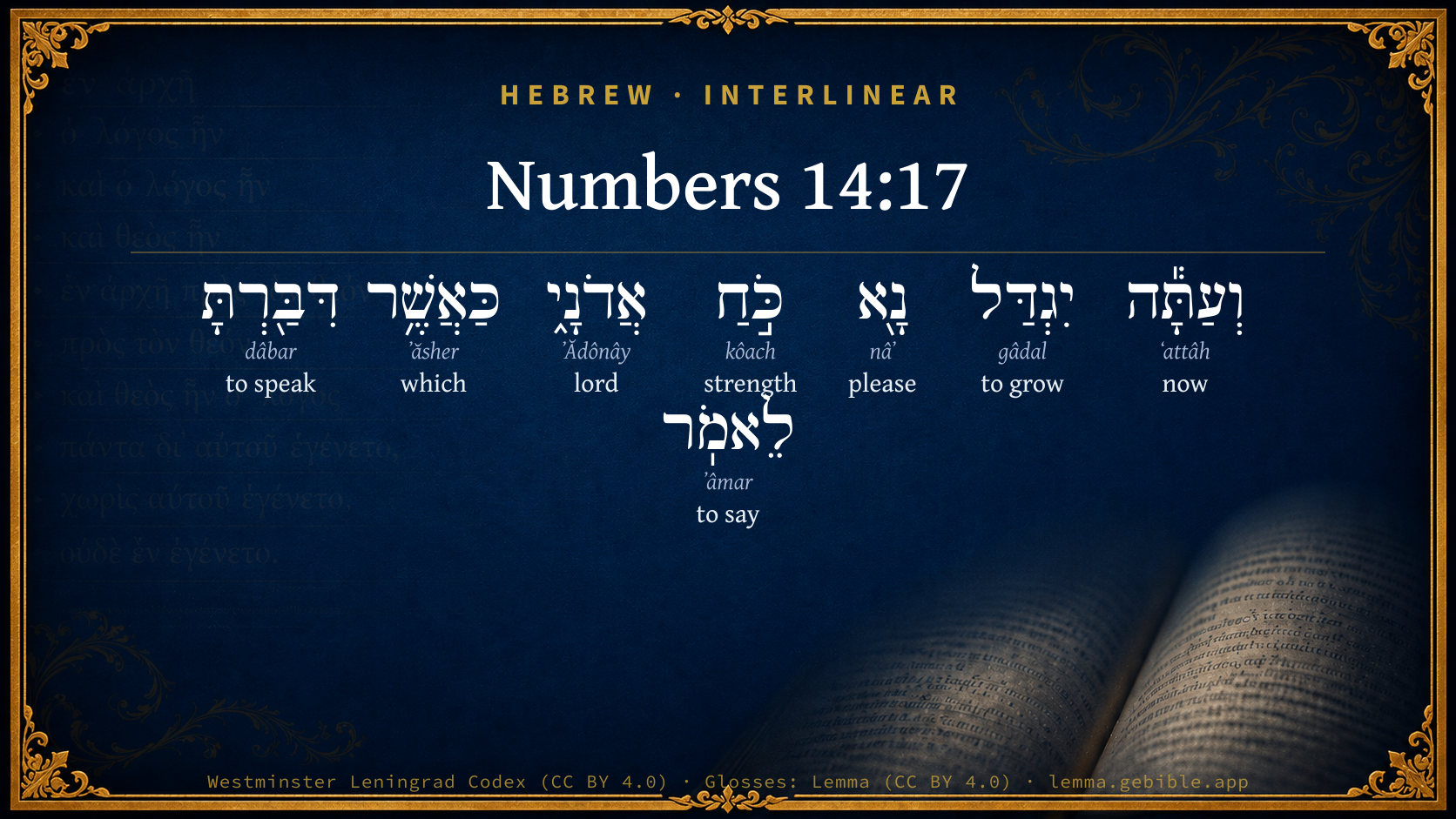
Numbers 14:17

Hebrew (Westminster Leningrad Codex) Numbers 14:17 appears in the Hebrew Old Testament. The text above is from the Westminster Leningrad Codex. Each word links to its Strong’s number, a concise gloss, and parsing drawn from the Open Scriptures Hebrew Bible morphology. Click any word for its full Brown-Driver-Briggs (BDB) entry.
Download image
Cite this verse

Numbers 14:17 (World English Bible). Public Domain. Lemma interlinear Bible study tool, https://lemma.gebible.app/v/numbers/14/17.

Show BibTeX & RIS
BibTeX
RIS
English Translation
Now please let the power of the Lord be great, according as you have spoken, saying,
World English Bible · Public Domain
Download a study sheet

One document with this verse’s original text, its word-by-word gloss line, the meaning frame, cross-references with their text, attributed commentary, and full source and license credits — printable, and it pastes into notes with its structure intact.

This verse Autodidact and up

Study sheet (.html) Plain text (.txt)

A passage Seminary Student

Up to 50 verses in one chapter. A passage sheet keeps up to 6 commentary sources and 12 cross-references per verse, in the order this page ranks them, and says so on the sheet whenever that leaves anything out. Ask for a single verse and you get the Autodidact verse sheet above.

Everything on this page stays free to read, with no account — the sheet is a download of what is already on screen, not access to it.

Want to remove ads? Support Godless Engineer
Compare translations 3

The same verse in 3 English versions, stacked beneath the original-language interlinear above. Click any original word for its lexicon entry.

Each is an independent rendering of the whole verse — the interlinear is not word-aligned to these translations.

Highlighted words mark where these versions differ — a whole-verse word diff, not a word-by-word alignment.

  • World English Bible Public Domain
    Now please let the power of the Lord be great, according as you have spoken, saying,
  • King James Version Public Domain
    And now, I beseech thee, let the power of my Lord be great, according as thou hast spoken, saying,
  • unfoldingWord Literal Text CC BY-SA 4.0
    And now, please may the power of my Lord be great, just as you spoke, saying,

unfoldingWord Literal Text — © unfoldingWord, licensed CC BY-SA 4.0. Word-aligned USFM3 via Door43 (git.door43.org/unfoldingWord/en_ult).

Versions to compare (up to 4)

3 of 4 selected

Show all 18 translations

Every available English version of this verse, each an independent rendering of the whole verse.

  • World English Bible Public Domain
    Now please let the power of the Lord be great, according as you have spoken, saying,
  • Berean Standard Bible Public Domain
    So now I pray, may the power of my Lord be magnified, just as You have declared:
  • Majority Standard Bible Public Domain
    So now I pray, may the power of my Lord be magnified, just as You have declared:
  • King James Version Public Domain
    And now, I beseech thee, let the power of my Lord be great, according as thou hast spoken, saying,
  • American Standard Version (1901) Public Domain
    And now, I pray thee, let the power of the Lord be great, according as thou hast spoken, saying,
  • Revised Version (1885) Public Domain
    And now, I pray thee, let the power of the Lord be great, according as thou hast spoken, saying,
  • Geneva Bible (1599) Public Domain
    And now, I beseech thee, let the power of my Lord be great, according as thou hast spoken, saying,
  • Douay-Rheims (1899) Public Domain
    Let their the strength of the Lord be magnified, as thou hast sworn, saying:
  • Young's Literal Translation Public Domain
    `And now, let, I pray Thee, the power of my Lord be great, as Thou hast spoken, saying:
  • Literal Standard Version CC BY-SA 4.0
    And now, please let the power of my Lord be great, as You have spoken, saying,
  • Unlocked Literal Bible CC BY-SA 4.0
    Now, I beg you, use your great power. For you have said,
  • unfoldingWord Literal Text CC BY-SA 4.0
    And now, please may the power of my Lord be great, just as you spoke, saying,
  • Darby Bible Public Domain
    And now, I beseech thee, let the power of the Lord be great, according as thou hast spoken, saying,
  • World Messianic Bible Public Domain
    Now please let the power of the Lord be great, according as you have spoken, saying,
  • Webster's Bible Public Domain
    And now, I beseech thee, let the power of my Lord be great, according as thou hast spoken, saying,
  • Free Bible Version CC BY-SA 4.0
    Now, Lord, please demonstrate the extent of your power just as you have said:
  • Bible in Basic English Public Domain
    So now, may my prayer come before you, and let the power of the Lord be great, as you said:
  • JPS Tanakh (1917) Public Domain
    And now, I pray Thee, let the power of the Lord be great, according as Thou hast spoken, saying:

Literal Standard Version (2020), Covenant Press — licensed CC BY-SA 4.0. Text via the HelloAO Bible API (eBible.org). Unlocked Literal Bible (unfoldingWord) — licensed CC BY-SA 4.0. Text via the HelloAO Bible API (eBible.org). unfoldingWord Literal Text — © unfoldingWord, licensed CC BY-SA 4.0. Word-aligned USFM3 via Door43 (git.door43.org/unfoldingWord/en_ult). Free Bible Version, Dr. Jonathan Gallagher — licensed CC BY-SA 4.0. Text via the HelloAO Bible API (eBible.org).

Word by word

More ways to search: Search by grammar → Find every occurrence → Compare this word →

Practice this passage: Drill this verse → Learn its vocabulary →

יִגְדַּל
gâdal
H1431
“to grow”
Verb, Qal, Jussive, 3rd Person, Masculine, Singular
Part of Speech
Verb
Stem
Qal
Form
Jussive
Person
3rd Person
Gender
Masculine
Number
Singular
Full BDB Definition

Origin: a primitive root

TWOT: 315

to grow, become great or important, promote, make powerful, praise, magnify, do great things - (Qal) - to grow up - to become great - to be magnified - (Piel) - to cause to grow - to make great, powerful - to magnify - (Pual) to be brought up - (Hiphil) - to make great - to magnify - to do great things - (Hithpael) to magnify oneself
  1. וְעַתָּ֕ה ʻattâh H6258 “and · now” Conjunction + Adverb
  2. נָ֖א nâʼ H4994 “please” Particle, Exhortation
  3. כֹּ֣חַ kôach H3581 “strength of” Noun, Common, Masculine, Singular, Construct
  4. אֲדֹנָ֑י ʼĂdônây H136 “Lord · my” Noun, Common, Masculine, Plural, Construct + Suffix, Personal, 1st Person, Common, Singular
  5. כַּאֲשֶׁ֥ר ʼăsher H834 “like/as · which” Preposition + Particle, Relative
  6. דִּבַּ֖רְתָּ dâbar H1696 “to speak” Verb, Piel, Perfect, 2nd Person, Masculine, Singular
  7. לֵאמֹֽר ʼâmar H559 “to say” Preposition + Verb, Qal, Infinitive Construct

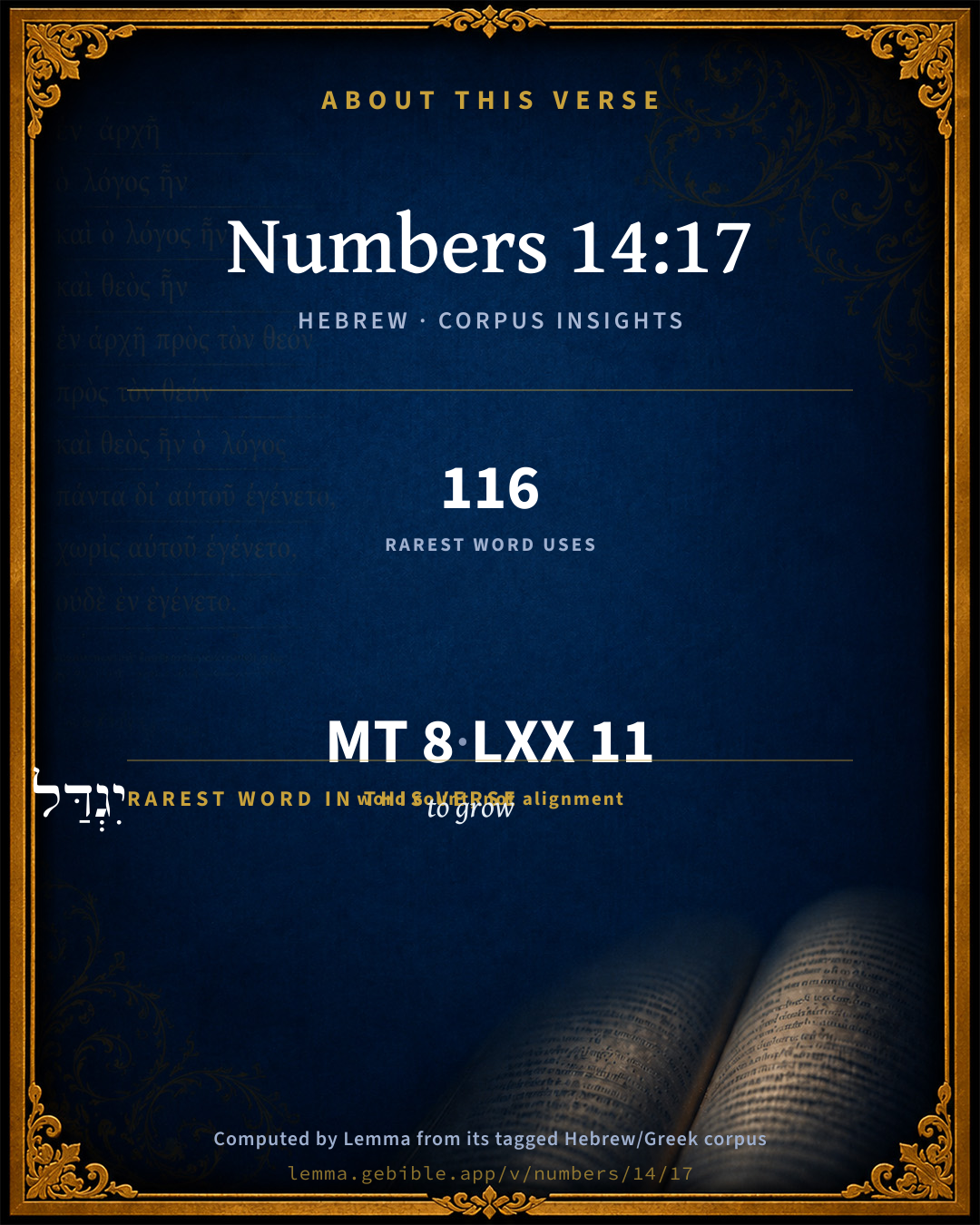
About this verse

These counts appear in no published source. They are computed here, from the morphology-tagged text and Lemma’s own curated glosses. What Lemma adds →

8
words
8
distinct lemmas
Pentateuch
section

Grammatical profile

  • 3 verbs
  • 2 nouns
  • 1 adverb
  • 2 particles

Verb forms

  • יִגְדַּל Qal · Jussive
  • דִּבַּ֖רְתָּ Piel · Perfect
  • לֵאמֹֽר Qal · Infinitive Construct

Hebrew & Septuagint length

In English translation the verse runs 16 words from the Hebrew and 13 from the Septuagint (LXX English) — closely comparable.

A rough comparison of the two English renderings, which tokenize alike — not a word-level alignment.

Word counts can differ between the Hebrew and the Greek without any difference in meaning — e.g. the Hebrew direct-object marker אֵת has no separate Greek word, and Greek often adds the article ὁ.

In the original languages it is 8 Hebrew tokens and 11 Greek tokens — but the two are counted differently (Hebrew bundles its prefixes and suffixes into one token; the Greek is in lemma form), so that isn’t a like-for-like length.

Cross-references

3

Topical passages linked to Numbers 14:17 in the Treasury of Scripture Knowledge — connected by theme and wording, ordered by reader-vote popularity; previews shown in the World English Bible.

  • Micah 3:8 But as for me, I am full of power by the Spirit of Yahweh, And of judgment, and of might, To declare to Jacob his disobedience, And to Israel his sin.
  • Matthew 9:6 But that you may know that the Son of Man has authority on earth to forgive sins..." (then he said to the paralytic), "Get up, and take up your mat, and go up to your house."
  • Matthew 9:8 But when the multitudes saw it, they marveled and glorified God, who had given such authority to men.

Cross-references courtesy of OpenBible.info (CC BY 4.0).

Hebrew and Greek witnesses Masoretic Hebrew ↔ Greek Septuagint

The same verse in the two great witnesses to the Old Testament, shown verse-for-verse.

These are two independent witnesses, not word-aligned to each other, and the Septuagint is shown in lemma (dictionary) form.

Hebrew Numbers 14:17 Masoretic · Westminster Leningrad Codex

וְעַתָּ֕ה יִגְדַּל נָ֖א כֹּ֣חַ אֲדֹנָ֑י כַּאֲשֶׁ֥ר דִּבַּ֖רְתָּ לֵאמֹֽר

Now please let the power of the Lord be great, according as you have spoken, saying,

World English Bible · Public Domain

Greek LXX Numbers 14:17 Septuagint · lemma form

καί νῦν ὑψόω ὁ ἰσχύς σύ κύριος ὅς τρόπος εἶπον λέγω

And now, O Lord, let your strength be exalted, as you spoke, saying,

LXX2012 (modern English Septuagint) · Public Domain

Hebrew: Westminster Leningrad Codex (CC BY 4.0). Greek: Septuagint (public domain); English from LXX2012 (modern English Septuagint) (Public Domain). How the Septuagint differs from the Hebrew →

Targum (Aramaic paraphrase)

2

The Targum is the ancient Jewish Aramaic paraphrase of the Hebrew Scriptures — an interpretive translation, not the Hebrew text itself. Onkelos (literal) and Pseudo-Jonathan (expansive) render the Torah, and Jonathan the Prophets. Coverage is partial: where no permissively-licensed English translation exists for a verse, only the Aramaic is shown. This is verse-level text, not a word-by-word alignment to the Hebrew.

  1. Targum Onkelos Torah (Genesis–Deuteronomy)
    וּכְעַן סַגִי כְעַן חֵילָא (מִן) קֳדָם יְיָ כְּמָא דִי מַלֵילְתָּא לְמֵימָר

    (no public-domain English translation for this verse)

    Targum Onkelos — Aramaic: “Onkelos Genesis” (public domain); “Onkelos Exodus” (public domain); “Onkelos Leviticus” (public domain); “Onkelos Numbers” (public domain); “Onkelos Deuteronomy” (public domain). English: “Sefaria Community Translation” (CC0 1.0 (public-domain dedication)); “J.W. Etheridge. The Targums of Onkelos and Jonathan Ben Uzziel on the Pentateuch. London: Longmans, Green, 1862” (public domain). Text via Sefaria.

  2. Targum Pseudo-Jonathan Torah (Genesis–Deuteronomy)
    וּכְדוּן יַסְגֵי כְדוּן חֵילָא קֳדָמָךְ יְיָ וְתִתְמְלֵי רַחֲמִין עֲלֵיהוֹן וְיָתִי תְשַׁוֵי לְעַם רַב הֵיכְמָא דְמַלֵילְתָּא לְמֵימָר

    And now, I beseech Thee, magnify Thy power, O Lord, and let mercies be fulfilled upon us, and appoint me for (this) great people, as Thou hast spoken, saying:

    Targum Pseudo-Jonathan — Aramaic: “Targum Jonathan on Genesis” (public domain); “Targum Jonathan on Exodus” (public domain); “Targum Jonathan on Leviticus” (public domain); “Targum Jonathan on Numbers” (public domain); “Targum Jonathan on Deuteronomy” (public domain). English: “The Targum of Jonathan ben Uzziel, trans. J. W. Etheridge, London, 1862” (public domain). Text via Sefaria.

Commentary

Notes on Numbers 14:17 from classic Christian and Jewish commentators (each source and its license shown beneath its notes). The classic Christian expositions comment on the surrounding passage and are grouped to its opening verse, so a note may address several verses; the Jewish commentaries on the Tanakh (Rashi and others) are per-verse, so they appear only where the commentator wrote on this verse.

Lemma curates 59 commentaries, every one of them public domain or Creative Commons licensed, each selected and text-cleaned for this edition rather than reprinted as found. About our sources →

Ellicott's Commentary for English Readers

(17, 18) And now, I beseech thee, let the power of my Lord be great.—The word Lord in Num_14:17 should not be printed in large capitals in this place, as in the Authorised Version of 1611, inasmuch as it is the rendering of Adonai, not of Jehovah, as in Num_14:18. Moses here employs a second argument, founded on the revelation of God’s name (i.e., His nature), as made to him on Mount Sinai (Exo_34:6-7), the substance of which he here recites in the same terms.

A Bible Commentary for English Readers, edited by Charles John Ellicott (1878–1897) — public domain. Text from a community e-Sword module.

Trapp's Complete Commentary

John Trapp

Num 14:17 And now, I beseech thee, let the power of my Lord be great, according as thou hast spoken, saying,

Ver. 17. Let the power of my Lord be great.] In multiplying pardons, {Isa 55:8} in passing by the many and bony, or "mighty sins of" {a} this people, such sins as none else could or would pardon: "For who is a God like unto thee, that pardoneth such iniquity?" &c. {Mic 7:18} Hebricians have observed, that in the word jidgal here used in the original text, there is a great jod, which in numbering is ten, to show, that if the people should murmur ten times more against God than they had done, yet out of tender respect to his own great name, which would otherwise be basely blasphemed, he should pardon and spare them. {Hebrew Text Note}

{a} Amo 5:12. Heb., Bony sins, fortia peccata.

John Trapp, A Commentary or Exposition upon All the Books of the Old and New Testament (1647–1656) — public domain. Text from a community e-Sword module.

Tyndale Open Study Notes

Tyndale Open Resources

14:17-18 Moses had used this same argument earlier when he sought pardon for Israel’s rebellion (Exod 32:10-14). Moses knew that God would not let the Israelites off without punishment (Deut 7:9-10).

Tyndale Open Study Notes — © Tyndale Open Resources, licensed CC BY-SA 4.0. Text via the HelloAO Bible API.

Jamieson, Fausset & Brown

Robert Jamieson, A. R. Fausset & David Brown

let the power of my Lord be great--be magnified.

Jamieson, Fausset & Brown — Commentary Critical and Explanatory on the Whole Bible (1871) — public domain (CC PDM 1.0). Text via the HelloAO Bible API.

The Cambridge Bible for Schools and Colleges

gen. ed. J. J. S. Perowne

17. let the power of my Lord be great] The title Adonai is employed, not (as in Num_14:16; Num_14:18) the personal name Jehovah.

according as thou hast spoken] i.e. in Exo_34:6-7, which is here slightly abbreviated. Moses means that the divine power can shew itself in Jehovah’s ability to pardon and punish according to His supreme will.

The Cambridge Bible for Schools and Colleges (gen. ed. J. J. S. Perowne; Cambridge University Press, 1878–1918) — public domain. Text from a community e-Sword module.

John Gill's Exposition

And now, I beseech thee, let the power of Lord be great,.... That is, appear to be great; the power of God is great, not only mighty, but almighty; it knows no bounds, nothing is impossible with him, he can do whatever he pleases, Psa 147:5; his power, and the greatness of it, had been seen in bringing the children of Israel out of Egypt, and through the Red sea, and in providing for them, protecting and defending them in the wilderness; and the request of Moses is, that it might appear greater and greater in bringing them into the land of promise; or else he means an exceeding great display of the grace and mercy of God in the forgiveness of the sins of the people; for as the power of God is seen in his forbearance and longsuffering with the wicked, Rom 9:22; much more in the forgiveness of the sins of men, there being more power and virtue in grace to pardon, than there is in sin to damn; and as it is an indication of strength in men, and of their power over themselves, when they can rule their own spirits, keep under their passions, and restrain their wrath, and show a forgiving temper, Pro 16:32; so it is an instance of the power of God to overcome his wrath and anger stirred up by the sins of men; and, notwithstanding their provocations, freely to forgive: pardon of sin is an act of power, as well as of grace and mercy, see Mat 9:6; and this sense agrees with what follows. The first letter in the word for "great" is larger than usual, that it might be taken notice of; and to signify the exceeding greatness of the power of God, Moses desired might be displayed in this case: and the letter numerically signifies ten, and has been thought to respect the ten times that Israel tempted the Lord, Num 14:22; and to suggest, that though they had so done, yet the grace and mercy of God should ten times exceed the ingratitude of the people (u):

according as thou hast spoken, saying; as in Exo 34:6; and is as follows.

(u) Baal Hatturim in loc. & Buxtorf. Tiberias, c. 14. p. 38.

John Gill's Exposition of the Whole Bible (1746–1763) — public domain (CC PDM 1.0). Text via the HelloAO Bible API.

Haydock's Catholic Bible Commentary

Lord, in overcoming all difficulties, raised either by the enemy, or by thy rebellious people.

George Leo Haydock (1774–1849), Haydock's Catholic Family Bible and Commentary, 1859 edition — public domain. Excludes Psalms (Douay-Rheims chapter numbering differs from Protestant) and Deuterocanonical books (Catholic canon only).

Matthew Poole's English Annotations

Be great, i.e. appear to be great, discover its greatness; a real verb put for a declarative, or the thing for the manifestation of the thing. And this may be understood either,

1. Of God’s power in preserving the people, and carrying them on into Canaan, which sense may seem to be favoured by the foregoing verse, where the Egyptians deny that God had power to do so. And according to that sense he adds the following words, not as an explication of this power, but as an argument to move him to show forth his power for his people notwithstanding their sins, according as, or rather because, (as the Hebrew word is oft rendered,) he had spoken, saying, &c., and so he should maintain the honour and the truth of his own name, or of those titles which he had ascribed to himself. Or,

2. The power of his grace and mercy, or the greatness of his mercy, as he calls it, Num 14:19, in pardoning of this and their other sins; for to this the following words manifestly restrain it,

according as thou hast spoken, & c., where the pardon of their sins is the only instance of this power both described in God’s titles, Num 14:18, and prayed for by Moses, Num 14:19, pardon, I beseech thee, &c., and granted by God in answer to him, Num 14:20, I have pardoned, &c. Nor is it strange that the pardon of sin, especially of such great sins, be spoken of as an act of power in God, because undoubtedly it is an act of omnipotent and infinite goodness; whence despairing sinners sometimes cry out that their sins are greater than God can pardon, as some translate Cain’s words, Gen 4:13. And since power is applied to God’s wrath in punishing sin, Rom 9:22, why may it not as well be attributed to God’s mercy in forgiving it? especially if it be considered that even in men revenge is an act of impotency, and consequently it must needs be an act of power to conquer their passions and inclinations to revenge, and to pardon those enemies whom they could destroy.

Matthew Poole's English Annotations on the Holy Bible (1683–1685) — public domain. Text from a community e-Sword/MySword module.

The Pulpit Commentary

And now, I beseech thee, let the power of my Lord be great. Here the argument of Moses rises to a higher level; he ventures to put God in mind of what he had himself declared to Moses in the fullest revelation which he had ever made of his own unchangeable character, viz., that of all Divine prerogatives, the most Divine was that of forgiving sins and showing mercy. According as thou hast spoken. See on Exo_34:6, Exo_34:7. The words are not quoted exactly as there given, but are substantially the same.

The Pulpit Commentary (1880–1919), ed. H.D.M. Spence-Jones & Joseph S. Exell — public domain. Text from a community e-Sword module.

John Wesley's Explanatory Notes

Be great - That is appear to be great, discover its greatness: namely, the power of his grace and mercy, or the greatness of his mercy, in pardoning this and their other sins: for to this the following words manifestly restrain it, where the pardon of their sins is the only instance of this power both described in God's titles, ver. 18, and prayed for by Moses ver. 19, and granted by God in answer to him, xiv, 20. Nor is it strange that the pardon of sin, especially such great sins, is spoken of as an act of power in God, because undoubtedly it is an act of omnipotent and infinite goodness.

John Wesley, Explanatory Notes Upon the Whole Bible (1754–1765) — public domain. Text via the GEBible commentary corpus.

unfoldingWord translationNotes

Door43 World Missions Community

abundant in covenant faithfulness

The abstract noun "faithfulness" can be stated as "faithful" or "faithfully." AT: "always faithful to his covenant" or "always faithfully loves his people" (See: Abstract Nouns)

He will by no means clear the guilty

"he will certainly not clear guilty people." Clearing away people's sin is a metaphor for refusing to punish them. God would not clear away the sin of guilty people. AT: "He will always punish the guilty" (See: Metaphor)

when he brings the punishment of the ancestors' sin on their descendants

Punishing people is spoken of as if punishment were an object that could be brought and put on people. AT: "when he punishes the guilty people's descendants for the guilty people's sins" (See: Metaphor)

translationWords

beg

power

Yahweh

anger

covenant faithfulness

forgive

iniquity

transgress

guilt

punish

sin

descend

generation

forgive

unfoldingWord translationNotes — © Distant Shores Media and the Door43 World Missions Community, licensed CC BY-SA 4.0. Source: git.door43.org/Door43/en_tn.

Rashi

Rabbi Shlomo Yitzchaki (Rashi)

('יגדל נא כח ה — LET THE STRENGTH OF MY LORD BE GREAT — by fulfilling Your statement.)

כאשר דברת לאמר ACCORDING AS THOU HAST SPOKEN, SAYING — And what is the utterance which Thou hast spoken?

Rashi on the Tanakh — English translations: “The Judaica Press complete Tanach with Rashi, translated by A. J. Rosenberg” (CC BY 4.0); “Pentateuch with Rashi's commentary by M. Rosenbaum and A.M. Silbermann, 1929-1934” (public domain); “The Metsudah Tanach series, Lakewood, N.J” (CC BY 4.0); and “The Book of Joshua, Metsudah Publications, 1997” (CC BY 4.0). Text via Sefaria.

Ramban (Nachmanides)

Rabbi Moshe ben Nachman (Ramban / Nachmanides)

AND NOW, I PRAY THEE, LET THE POWER OF THE ETERNAL BE GREAT, ACCORDING AS THOU HAST SPOKEN, SAYING. “And what is that utterance? The Eternal is long-suffering — both to the righteous and to the wicked. When Moses ascended to heaven [to receive the Torah], he found the Holy One, blessed be He, writing: The Eternal is long-suffering. Whereupon he [Moses] said to Him: ‘To the righteous.’ But G-d answered him, ‘Also to the wicked!’ Moses then said, ‘The wicked — let them perish!’ Whereupon G-d said to him: ‘By your life! You will [eventually] need to resort to this’ [attribute — that G-d is long-suffering even with sinners]. When the Israelites had sinned because of the golden calf and spies, and Moses prayed to G-d that He be long-suffering with them, the Holy One, blessed be He, said to him, ‘Did you not tell Me that this is [only] for the righteous!’ Whereupon Moses answered Him, ‘But did You not tell me that it is also for the wicked. Let then the power of the Eternal be great to do as You have spoken.’” These are the words of Rashi, based on the interpretation of Agadah. The way of Truth you will recognize because G-d’s Name in this context is written with Aleph Daleth (A-donoy) — [a Name which alludes to the attribute of judgment], and Moses meant to say that the greatness be in the power which is mercy, since it was the attribute of judgment that was directed against them.Now Moses mentioned among the [Divine] attributes long-suffering, and plenteous in loving kindness, but he did not mention “truth” [although it is also one of the Thirteen Attributes], for according to the attribute of truth they would have been guilty. Nor did Moses mention keeping mercy unto the thousandth generation, Verse 7. because Moses did not pray [for mercy] here on the basis of the merit of the patriarchs, and [therefore] he did not mention Abraham, Isaac, and Jacob at all in this prayer. The reason [for not mentioning them] was because the Land was given to the patriarchs, and it is from them that they were to inherit it, but they rebelled against their ancestors, and did not want the gift which the patriarchs desired very much, so how could he say now, [Remember Abraham, Isaac, and Israel, Thy servants,] to whom Thou didst swear by Thine own self, … and all this Land that I have spoken of will I give to your seed, 32:13. since they were saying: “We do not want this gift!”Moses [mentioned here the attribute of forgiving iniquity and transgression but he] did not say and sin, as well as iniquity and transgression. See the verse in Exodus 34:7, where all three are mentioned: forgiving iniquity and transgression and sin. The question then arises: Why did not Moses mention here sin? because these people were wilful transgressors and sinners. But I do not know why he did not mention [the attributes] merciful and gracious. Perhaps Moses knew that judgment was directed against them and He would never forgive them; therefore he prayed only that [G-d be] long-suffering, and should not destroy them as one man, and should not slay them like sheep in the wilderness where they would die in a plague. And since Moses only prayed now for [G-d to be] long-suffering, G-d said to him, I have pardoned according to thy word, meaning that “I will be long-suffering towards them and great in loving kindness.” He [Moses] mentioned visiting the iniquity of the fathers, meaning to say that [even] if He should see fit not to erase their iniquity, He should [at least] visit the iniquity of the fathers upon their children, [thereby mitigating the severity of the punishment from upon one generation], and he should be long-suffering with them in meting out punishment upon them. It was because of this [prayer of Moses] that there was a [Divine] decree to fix a weeping for them on that night throughout their generations, since He visited their sins upon their seed.And Rabbi Abraham ibn Ezra commented that “since we find the verse, Surely they shall not see the Land after G-d said, I have pardoned according to thy word, we know that the expression ‘s’lach na’ (pardon, I pray Thee) (Verse 20), He yet continues to state, Surely they shall not see the Land (Verse 23), it follows that Moses’ request, Pardon, I pray Thee (Verse 19) must mean only that G-d be long-suffering to them, but not that they be totally forgiven. Such is the interpretation of Ibn Ezra. Ramban will suggest another explanation of Moses’ request. [is a prayer that G-d be] long-suffering to them [but not that they be totally forgiven]. The same meaning also applies to ‘v’nislach lo’ (and he shall be pardoned), means that G-d will be patient and will not punish him until he has had a chance to repent. which implies [that G-d will be long-suffering with him] until he repents sincerely.”The correct interpretation appears to me to be that the term s’lichah means remittance of punishment, as Onkelos rendered it: [s’lach na — “Let go please”]. And the offerings [which one brings for a sin committed in error] remove the punishment for the error from him [the person who brings the offering]. (ibid.) stated in connection with bringing a sin-offering means that “his punishment will be remitted.” So also, For Thou, Eternal, art good ‘v’salach’ indicates that the term s’lichah does not merely mean being long-suffering and patient [as Ibn Ezra has it] but expresses a complete remittance of punishment. [means “and are ready to remit punishment”]. And G-d said, ‘salachti’ according to thy word meaning [that He has remitted punishment] from the people as a whole, and will not smite them with a pestilence and destroy them, and make of Moses a nation greater and mightier than they while they and their seed will perish from the earth; instead, He will pardon them — so that their children [at least] will inherit the Land, and they [themselves] will not die in a plague, for He decreed that their carcasses perish in the wilderness and that each will die when his day comes.Now in the Book of Deuteronomy in mentioning the sin of the golden calf Moses recalled the prayer which he had prayed on their behalf, saying, And I fell down before the Eternal, as at the first etc. and he explained there what the prayer was, And I prayed unto the Eternal, and said etc., Verse 26. and he also mentioned his prayer on behalf of Aaron. But in [recounting] the affair of the spies he did not mention at all that he had interceded on their behalf. All this is for the reason that I have mentioned, namely, that he did not pray that G-d should forgive them [completely], but rather that He should remit their punishment and be long-suffering with them, and should visit the iniquity of the fathers upon the children. Thus his prayer on their behalf was not a complete one [inasmuch as he was not able to intercede for total forgiveness], and therefore [when speaking to the second generation in the Book of Deuteronomy] he did not mention it to them, since they might have complained against him [for not praying for total forgiveness, without realizing that he could not do so because of the greatness of their parents’ sin].

Ramban (Nachmanides) on the Tanakh — English translation: “Commentary on the Torah by Ramban (Nachmanides). Translated and annotated by Charles B. Chavel. New York, Shilo Pub. House, 1971-1976” (CC BY 4.0). Text via Sefaria.

Lesson kit

Teaching starters — assembled from the data on this page, not authored interpretation. Every prompt links to the verse data it draws on. Edit before teaching.

Numbers, in the Pentateuch, opens this verse with 8 words (8 distinct Hebrew lemmas). Its most distinctive word is gâdal (“to grow”). A historical commentator’s framing appears above. Read the whole chapter for the surrounding context.

Discussion questions

  1. What does “to grow” (gâdal) contribute to the verse as a whole?
  2. How does Micah 3:8, which shares this passage’s theme, read alongside this verse?
  3. These translations render this verse differently; the difference is in the English rendering, not the original. What questions does that raise?
  4. «יִגְדַּל» is a Qal Jussive verb. How does that grammatical form shape the action described?
  5. Compare how Ellicott's Commentary for English Readers and Trapp's Complete Commentary read this verse. Where do they agree or differ?

Things to notice

Reading settings

Reading text

Shown beneath each verse's original-language words.

Old Testament
Old Testament edition

Read the OT as the Masoretic Hebrew (MT) or the Greek Septuagint (LXX).

English shown for the Greek Septuagint (in the Hebrew ↔ Greek comparison).

Comparing translations? Open the Compare panel on any verse page to stack up to four side by side.