
Psalms 38:22

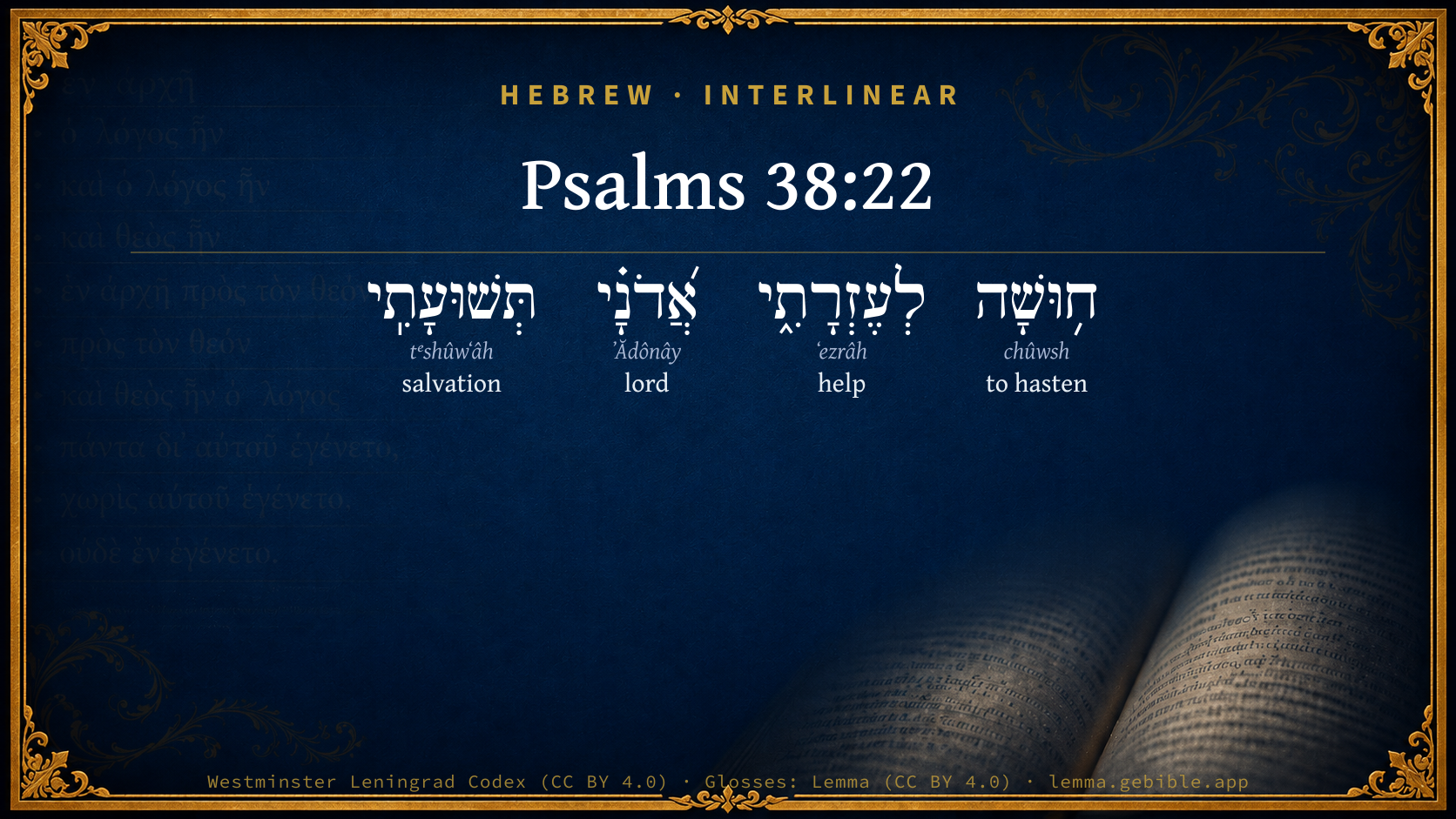
Hebrew (Westminster Leningrad Codex) Psalms 38:22 appears in the Hebrew Old Testament. The text above is from the Westminster Leningrad Codex. Each word links to its Strong’s number, a concise gloss, and parsing drawn from the Open Scriptures Hebrew Bible morphology. Click any word for its full Brown-Driver-Briggs (BDB) entry.
Download image
Cite this verse

Psalms 38:22 (World English Bible). Public Domain. Lemma interlinear Bible study tool, https://lemma.gebible.app/v/psalms/38/22.

Show BibTeX & RIS
BibTeX
RIS
English Translation
Hurry to help me, Lord, my salvation.
World English Bible · Public Domain
Download a study sheet

One document with this verse’s original text, its word-by-word gloss line, the meaning frame, cross-references with their text, attributed commentary, and full source and license credits — printable, and it pastes into notes with its structure intact.

This verse Autodidact and up

Study sheet (.html) Plain text (.txt)

A passage Seminary Student

Up to 50 verses in one chapter. A passage sheet keeps up to 6 commentary sources and 12 cross-references per verse, in the order this page ranks them, and says so on the sheet whenever that leaves anything out. Ask for a single verse and you get the Autodidact verse sheet above.

Everything on this page stays free to read, with no account — the sheet is a download of what is already on screen, not access to it.

Want to remove ads? Support Godless Engineer
Compare translations 3

The same verse in 3 English versions, stacked beneath the original-language interlinear above. Click any original word for its lexicon entry.

Each is an independent rendering of the whole verse — the interlinear is not word-aligned to these translations.

Highlighted words mark where these versions differ — a whole-verse word diff, not a word-by-word alignment.

  • World English Bible Public Domain
    Hurry to help me, Lord, my salvation.
  • King James Version Public Domain
    Make haste to help me, O Lord my salvation.
  • unfoldingWord Literal Text CC BY-SA 4.0
    Hurry to my help, Lord, my salvation.

unfoldingWord Literal Text — © unfoldingWord, licensed CC BY-SA 4.0. Word-aligned USFM3 via Door43 (git.door43.org/unfoldingWord/en_ult).

Versions to compare (up to 4)

3 of 4 selected

Show all 18 translations

Every available English version of this verse, each an independent rendering of the whole verse.

  • World English Bible Public Domain
    Hurry to help me, Lord, my salvation.
  • Berean Standard Bible Public Domain
    Come quickly to help me, O Lord my Savior.
  • Majority Standard Bible Public Domain
    Come quickly to help me, O Lord my Savior.
  • King James Version Public Domain
    Make haste to help me, O Lord my salvation.
  • American Standard Version (1901) Public Domain
    Make haste to help me, O Lord, my salvation. Psalm 39 For the Chief Musician, Jeduthun. A Psalm of David.
  • Revised Version (1885) Public Domain
    Make haste to help me, O Lord my salvation.
  • Geneva Bible (1599) Public Domain
    Haste thee to helpe mee, O my Lord, my saluation.
  • Douay-Rheims (1899) Public Domain
    Forsake me not, O Lord my God: do not thou depart from me.
  • Young's Literal Translation Public Domain
    Haste to help me, O Lord, my salvation!
  • Literal Standard Version CC BY-SA 4.0
    Hurry to help me, O Lord, my salvation!
  • Unlocked Literal Bible CC BY-SA 4.0
    Come quickly to help me, Lord, my salvation.
  • unfoldingWord Literal Text CC BY-SA 4.0
    Hurry to my help, Lord, my salvation.
  • Darby Bible Public Domain
    Make haste to help me, O Lord, my salvation.
  • World Messianic Bible Public Domain
    Hurry to help me, Lord, my salvation.
  • Webster's Bible Public Domain
    \\38:21\\Forsake me not, O LORD: O my God, be not far from me.
  • Free Bible Version CC BY-SA 4.0
    Hurry, come and help me, Lord my salvation.
  • Bible in Basic English Public Domain
    Come quickly to give me help, O Lord, my salvation.
  • JPS Tanakh (1917) Public Domain
    (38-23) Make haste to help me, O LORD, my salvation.

Literal Standard Version (2020), Covenant Press — licensed CC BY-SA 4.0. Text via the HelloAO Bible API (eBible.org). Unlocked Literal Bible (unfoldingWord) — licensed CC BY-SA 4.0. Text via the HelloAO Bible API (eBible.org). unfoldingWord Literal Text — © unfoldingWord, licensed CC BY-SA 4.0. Word-aligned USFM3 via Door43 (git.door43.org/unfoldingWord/en_ult). Free Bible Version, Dr. Jonathan Gallagher — licensed CC BY-SA 4.0. Text via the HelloAO Bible API (eBible.org).

Word by word

More ways to search: Search by grammar → Find every occurrence → Compare this word →

Practice this passage: Drill this verse → Learn its vocabulary →

About this verse

These counts appear in no published source. They are computed here, from the morphology-tagged text and Lemma’s own curated glosses. What Lemma adds →

4
words
4
distinct lemmas
Wisdom
section

Notable vocabulary

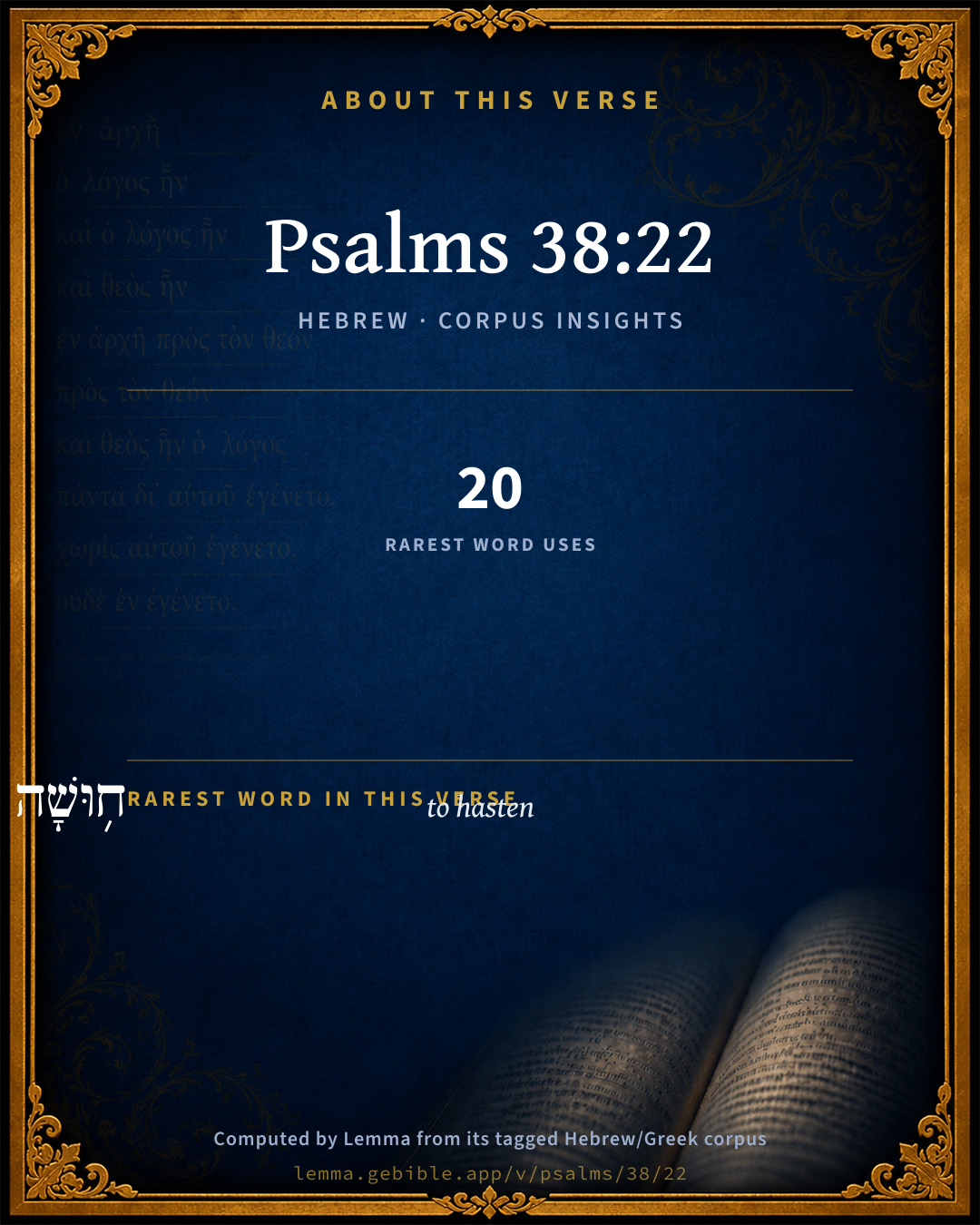
The rarest word here is ח֥וּשָׁה to hasten H2363 — appearing just 20 times in the whole Hebrew Bible.

Shared distinctive vocabulary

ח֥וּשָׁה to hasten H2363 occurs in 20 verses of the Hebrew Bible. Also found in:

Grammatical profile

  • 1 verb
  • 3 nouns

Verb forms

  • ח֥וּשָׁה Qal · Imperative

Hebrew & Septuagint length

In English translation the verse runs 7 words from the Hebrew and 10 from the Septuagint (LXX English) — closely comparable.

A rough comparison of the two English renderings, which tokenize alike — not a word-level alignment.

Word counts can differ between the Hebrew and the Greek without any difference in meaning — e.g. the Hebrew direct-object marker אֵת has no separate Greek word, and Greek often adds the article ὁ.

Cross-references

10

Topical passages linked to Psalms 38:22 in the Treasury of Scripture Knowledge — connected by theme and wording, ordered by reader-vote popularity; previews shown in the World English Bible.

  • Psalms 40:13 Be pleased, Yahweh, to deliver me. Hurry to help me, Yahweh.
  • Psalms 27:1 Yahweh is my light and my salvation. Whom shall I fear? Yahweh is the strength of my life. Of whom shall I be afraid?
  • Isaiah 12:2 Behold, God is my salvation. I will trust, and will not be afraid; for Yah, Yahweh, is my strength and song; and he has become my salvation."
  • Psalms 71:12 God, don't be far from me. My God, hurry to help me.
  • Psalms 141:1 Yahweh, I have called on you. Come to me quickly! Listen to my voice when I call to you.
  • Psalms 40:17 But I am poor and needy; May the Lord think about me. You are my help and my deliverer. Don't delay, my God.
  • Psalms 62:6 He alone is my rock and my salvation, my fortress. I will not be shaken.
  • Psalms 70:1 Hurry, God, to deliver me. Come quickly to help me, Yahweh.
  • Psalms 70:5 But I am poor and needy. Come to me quickly, God. You are my help and my deliverer. Yahweh, don't delay.
  • Psalms 62:2 He alone is my rock and my salvation, my fortress-- I will never be greatly shaken.

Cross-references courtesy of OpenBible.info (CC BY 4.0).

Hebrew and Greek witnesses Masoretic Hebrew ↔ Greek Septuagint

The same verse in the two great witnesses to the Old Testament, shown verse-for-verse.

You’re reading Greek Psalm 37 (Hebrew Psalm 38). The Septuagint counts the superscription, so verse numbers can differ from the Hebrew — chapter-level alignment, not verse-by-verse. Numbering follows Rahlfs.

These are two independent witnesses, not word-aligned to each other, and the Septuagint is shown in lemma (dictionary) form.

Hebrew Psalms 38:22 Masoretic · Westminster Leningrad Codex

ח֥וּשָׁה לְעֶזְרָתִ֑י אֲ֝דֹנָ֗י תְּשׁוּעָתִֽי

Hurry to help me, Lord, my salvation.

World English Bible · Public Domain

Greek LXX Greek Psalm 37:22 Septuagint · lemma form

μή ἐν καταλείπω ἐγώ κύριος ὁ θεός ἐγώ μή ἀποἵστημι ἀπό ἐγώ

Draw near to my help, O Lord of my salvation.

LXX2012 (modern English Septuagint) · Public Domain

Hebrew: Westminster Leningrad Codex (CC BY 4.0). Greek: Septuagint (public domain); English from LXX2012 (modern English Septuagint) (Public Domain). How the Septuagint differs from the Hebrew →

Commentary

Notes on Psalms 38:22 from classic Christian and Jewish commentators (each source and its license shown beneath its notes). The classic Christian expositions comment on the surrounding passage and are grouped to its opening verse, so a note may address several verses; the Jewish commentaries on the Tanakh (Rashi and others) are per-verse, so they appear only where the commentator wrote on this verse.

Lemma curates 59 commentaries, every one of them public domain or Creative Commons licensed, each selected and text-cleaned for this edition rather than reprinted as found. About our sources →

Trapp's Complete Commentary

John Trapp

Psa 38:22 Make haste to help me, O Lord my salvation.

Ver. 22. Make haste to help me] Nam mora frangit etiam fortes, God oft delayeth, that he may set an edge on our desires; he holdeth us in request, that he may commend his blessings to us.

John Trapp, A Commentary or Exposition upon All the Books of the Old and New Testament (1647–1656) — public domain. Text from a community e-Sword module.

J. A. Alexander on Psalms

Joseph Addison Alexander

23. (Psa 38:22). Hasten to help me, (O) Lord, my salvation! The literal meaning of the first clause is hasten to (or for) my help. The same words form the last clause of Psa 22:20 (19). My salvation, my deliverer, my saviour. This form of address bears a strong resemblance to the prayer in Psa 35:3 : Say unto my soul, I am thy salvation.

Joseph Addison Alexander, The Psalms Translated and Explained (1850) — public domain. Text from a community e-Sword module.

Tyndale Open Study Notes

Tyndale Open Resources

38:22 Asking the Lord to act quickly in times of great need is common in the Psalter (22:19; 31:2; 40:13; 69:17; 70:1; 71:12; 79:8; 102:2; 141:1; 143:7). However, wisdom and experience teach that God’s people must often wait for him to act (27:14; 37:7; Isa 8:17; 40:31).

Tyndale Open Study Notes — © Tyndale Open Resources, licensed CC BY-SA 4.0. Text via the HelloAO Bible API.

Geneva Bible (1599)

Geneva Bible translators

Which are the author of my salvation: and this declareth that he prayed with sure hope of deliverance.

Geneva Bible (1599) marginal notes — public domain. Text via Bolls.life.

Adam Clarke's Commentary

Verse 22. Make haste to help me] I am dying; save, Lord, or I perish. Whoever carefully reads over this Psalm will see what a grievous and bitter thing it is to sin against the Lord, and especially to sin after having known his mercy, and after having escaped from the corruption that is in the world. Reader, be on thy guard; a life of righteousness may be lost by giving way to a moment's temptation, and a fair character sullied for ever! Let him that most assuredly standeth take heed lest he fall.

'Tis but a grain of sweet that one can sow,

To reap a harvest of wide-wasting wo.

ANALYSIS OF THE THIRTY-EIGHTH PSALM

This Psalm may be divided into two parts: - I. A deprecation; begun Ps 38:1, and continued in Ps 38:21-22.

II. A grievous complaint of sin, disease misery, God's anger, the ingratitude of his friends, coldness of his acquaintances, and cruelty of his enemies; all which he uses as arguments to induce God to help him; continued, Ps 38:2-20.

I. In the first part he deprecates God's anger, and entreats a mitigation of it; though rebuked, let it not be in wrath; if corrected, let it not be in rigour: "O Lord, rebuke me not in thy wrath," c.

II. His complaint, on which he falls instantly, and amplifies in a variety of ways.

1. From the prime cause, GOD: "Thine arrows stick fast in me," c.

2. From the impulsive cause: "His sin, his iniquities," Ps 38:4 "His foolishness," Ps 38:5.

3. From the weight of his afflictions, which were, in general, "the arrows of God which stuck in him the hand of God, by which he was pressed;" which were so grievous "that there was no soundness in his flesh - no rest in his bones."

4. By an induction of particulars, where he declares many effects of the disease: -

1. Putrefaction of his flesh: "My wounds stink, and are corrupt."

2. The uncomfortable posture of his body: "I am troubled, I am bowed down greatly."

3. Torment in his bowels, c.: "My loins are filled with a loathsome disease."

4. Diseases through the whole system: "There is no soundness in my flesh."

5. Debility and grievous plague: "I am feeble," c.

6. Anguish that forced him to cry out: "I have roared," &c.

7. His heart was disquieted: "The disquietness of my heart." But that it might appear that he had not lost his hold of his hope and his confidence in God, he directs his speech to him, and says: "Lord, all my desire is before thee, and my groaning is not hidden from thee."

8. He had a palpitation or trembling of heart: "My heart pants."

9. His strength decayed: "My strength fails."

10. A defect of sight: "The sight of my eyes is gone from me."

All these calamities David suffered from within. He was tormented in body and mind but had he any comfort from without? Not any.

1. None from his friends: "My lovers and my friends stand aloof." 2. As for his enemies, they even then added to his affliction: "They also that seek after my life lay snares for me." In purpose, word, and deed, they sought to undo him.

He next shows his behaviour in these sufferings he murmured not, but was silent and patient. "I was as a deaf man; - I was as a dumb man." He made no defence.

This he uses as an argument to induce the Lord to mitigate his sufferings; and of his patience he gives the following reasons: -

1. His reliance on God for audience and redress: "For in thee, O Lord, do I hope; thou wilt hear me."

2. For this he petitions; for to God he was not silent, though deaf and dumb to man. For I said, Hear me! and the assurance that he should be heard made him patient; for if not heard, his enemies would triumph: "Hear me, lest otherwise they should rejoice over me."

3. He was thus patient when his grief was extreme: "For I am ready to halt, and my sorrow is continually before me." I am under a bitter cross; and I know that if I be thy servant, I must bear my cross; therefore, I take it up, and suffer patiently.

4. This cross I have deserved to bear; it comes on account of mine iniquity, and I will not conceal it: "I will declare mine iniquity; I will be sorry for my sin." I suffer justly, and therefore have reason to be patient.

He complains again of his enemies. Though he suffered justly, yet this was no excuse for their cruelty; he complains of their strength, their number, and their hatred. My enemies are living, while I am at death's door; they are multiplied while I am minished; they render me evil for the good I have done them.

Then he concludes with a petition to God, in which he begs three things: -

1. God's presence: forsake me not, O Lord; my God, be not far from me."

2. He begs for help: "Help me, O Lord."

3. And prays that this help may come speedily: "Make haste to help me."

And these three petitions are directed to the Most High, as the God of his salvation: "O Lord, my salvation;" my deliverer from sin, guilt, pain, death, and hell.

In this Psalm, deeply descriptive of the anguish of a penitent soul, most persons, who feel distress on account of sin, may meet with something suitable to their case.

Adam Clarke's Commentary on the Bible (1810–1826) — public domain. Text from a community e-Sword/MySword module.

The Cambridge Bible for Schools and Colleges

gen. ed. J. J. S. Perowne

22. Make haste &c.] Cp. Psa_22:19; Psa_40:13.

O Lord my salvation] Cp. Psa_62:2; Psa_51:14.

The Cambridge Bible for Schools and Colleges (gen. ed. J. J. S. Perowne; Cambridge University Press, 1878–1918) — public domain. Text from a community e-Sword module.

Albert Barnes' Notes on the Bible

Make haste to help me - Margin, as in Hebrew: “for my help.” This is an earnest prayer that God would come immediately to his rescue.

O Lord my salvation - See the notes at Psa 27:1. The effect, therefore, of the trials that came upon the psalmist was to lead him to cry most earnestly to God. Those sorrows led him to God. This is one of the designed effects of affliction. Trouble never accomplishes its proper effect unless it leads us to God; and anything that “will” lead us to him is a gain in the end. The deeper our trouble, therefore, the greater may be the ultimate good to us; and at the end of life, when we come to look over all that has happened in our journey through this world, that on which we may look back with most satisfaction and gratitude may be the sorrows and afflictions that have befallen us - for these will be then seen to have been among the chief instrumentalities by which we were weaned from sin; by which we were led to the Saviour; by which we were induced to seek a preparation for heaven. No Christian, when he comes to die, ever feels that he has been too much afflicted, or that any trial has come upon him for which there was not occasion, and which was not designed and adapted to do him good.

Albert Barnes' Notes on the Bible (1834–1885) — public domain. Text from a community e-Sword/MySword module.

The Treasury of David

Charles H. Spurgeon

Ver. 22. Make haste to help me. Delay would prove destruction. The poor pleader was far gone and ready to expire, only speedy help would serve his turn. See how sorrow quickens the importunity of prayer! Here is one of the sweet results of affliction, it gives new life to our pleading, and drives us with eagerness to our God. O Lord my salvation. Not my Saviour only, but my salvation. He who has the Lord on his side has salvation in present possession. Faith foresees the blessed issue of all her pleas, and in this verse begins to ascribe to God the glory of the expected mercy. We shall not be left of the Lord. His grace will succour us most opportunely, and in heaven we shall see that we had not one trial too many, or one pang too severe. A sense of sin shall melt into the joy of salvation; grief shall lead on to gratitude, and gratitude to joy unspeakable and full of glory.

Ver. 22. O Lord my salvation. Faith the suppliant is now made faith triumphant. Franz Delitzsch.

Ver. 22. Faith tried, faith trembling, faith crying, faith grasping, faith conquering.

Charles H. Spurgeon's The Treasury of David (1869–1885) — public domain. Psalms only. Text from a community e-Sword/MySword module.

The Pulpit Commentary

Make haste to help me, O Lord my Salvation. (see Psa_22:19 Psa_31:2 Psa_40:13 Psa_70:1 Psa_71:12, etc.) This so frequent cry always shows imminent peril; or at any rate, a belief in it. The writer hero was in danger doubly from disease and from his enemies. Thus he might well cry out.

The Pulpit Commentary (1880–1919), ed. H.D.M. Spence-Jones & Joseph S. Exell — public domain. Text from a community e-Sword module.

Lesson kit

Teaching starters — assembled from the data on this page, not authored interpretation. Every prompt links to the verse data it draws on. Edit before teaching.

Psalms, in the Wisdom, opens this verse with 4 words (4 distinct Hebrew lemmas). Its most distinctive word is chûwsh (“to hasten”). A historical commentator’s framing appears above. Read the whole chapter for the surrounding context.

Discussion questions

  1. How does “to hasten” (chûwsh) shape what this verse is saying?
  2. How does Numbers 32:17, which shares the word «to hasten», read alongside this verse?
  3. These translations render this verse differently; the difference is in the English rendering, not the original. What questions does that raise?
  4. «ח֥וּשָׁה» is a Qal Imperative verb. How does that grammatical form shape the action described?
  5. Compare how Trapp's Complete Commentary and J. A. Alexander on Psalms read this verse. Where do they agree or differ?

Things to notice

Reading settings

Reading text

Shown beneath each verse's original-language words.

Old Testament
Old Testament edition

Read the OT as the Masoretic Hebrew (MT) or the Greek Septuagint (LXX).

English shown for the Greek Septuagint (in the Hebrew ↔ Greek comparison).

Comparing translations? Open the Compare panel on any verse page to stack up to four side by side.