
Deuteronomy 3:24

Hebrew (Westminster Leningrad Codex) Deuteronomy 3:24 appears in the Hebrew Old Testament. The text above is from the Westminster Leningrad Codex. Each word links to its Strong’s number, a concise gloss, and parsing drawn from the Open Scriptures Hebrew Bible morphology. Click any word for its full Brown-Driver-Briggs (BDB) entry.
Download image
Cite this verse

Deuteronomy 3:24 (World English Bible). Public Domain. Lemma interlinear Bible study tool, https://lemma.gebible.app/v/deuteronomy/3/24.

Show BibTeX & RIS
BibTeX
RIS
English Translation
Lord Yahweh, you have begun to show your servant your greatness, and your strong hand: for what god is there in heaven or in earth, that can do according to your works, and according to your mighty acts?
World English Bible · Public Domain
Download a study sheet

One document with this verse’s original text, its word-by-word gloss line, the meaning frame, cross-references with their text, attributed commentary, and full source and license credits — printable, and it pastes into notes with its structure intact.

This verse Autodidact and up

Study sheet (.html) Plain text (.txt)

A passage Seminary Student

Up to 50 verses in one chapter. A passage sheet keeps up to 6 commentary sources and 12 cross-references per verse, in the order this page ranks them, and says so on the sheet whenever that leaves anything out. Ask for a single verse and you get the Autodidact verse sheet above.

Everything on this page stays free to read, with no account — the sheet is a download of what is already on screen, not access to it.

Want to remove ads? Support Godless Engineer
Compare translations 3

The same verse in 3 English versions, stacked beneath the original-language interlinear above. Click any original word for its lexicon entry.

Each is an independent rendering of the whole verse — the interlinear is not word-aligned to these translations.

Highlighted words mark where these versions differ — a whole-verse word diff, not a word-by-word alignment.

  • World English Bible Public Domain
    Lord Yahweh, you have begun to show your servant your greatness, and your strong hand: for what god is there in heaven or in earth, that can do according to your works, and according to your mighty acts?
  • King James Version Public Domain
    O Lord GOD, thou hast begun to show thy servant thy greatness, and thy mighty hand: for what God is there in heaven or in earth, that can do according to thy works, and according to thy might?
  • unfoldingWord Literal Text CC BY-SA 4.0
    ‘My Lord Yahweh, you, you have begun to show your servant your greatness and your strong hand. What god in heaven or on earth that does works as your works and as your mighty deeds?

unfoldingWord Literal Text — © unfoldingWord, licensed CC BY-SA 4.0. Word-aligned USFM3 via Door43 (git.door43.org/unfoldingWord/en_ult).

Versions to compare (up to 4)

3 of 4 selected

Show all 18 translations

Every available English version of this verse, each an independent rendering of the whole verse.

  • World English Bible Public Domain
    Lord Yahweh, you have begun to show your servant your greatness, and your strong hand: for what god is there in heaven or in earth, that can do according to your works, and according to your mighty acts?
  • Berean Standard Bible Public Domain
    “O Lord GOD, You have begun to show Your greatness and power to Your servant. For what god in heaven or on earth can perform such works and mighty acts as Yours?
  • Majority Standard Bible Public Domain
    “O Lord GOD, You have begun to show Your greatness and power to Your servant. For what god in heaven or on earth can perform such works and mighty acts as Yours?
  • King James Version Public Domain
    O Lord GOD, thou hast begun to show thy servant thy greatness, and thy mighty hand: for what God is there in heaven or in earth, that can do according to thy works, and according to thy might?
  • American Standard Version (1901) Public Domain
    O Lord Jehovah, thou hast begun to show thy servant thy greatness, and thy strong hand: for what god is there in heaven or in earth, that can do according to thy works, and according to thy mighty acts?
  • Revised Version (1885) Public Domain
    O Lord GOD, thou hast begun to shew thy servant thy greatness, and thy strong hand: for what god is there in heaven or in earth, that can do according to thy works, and according to thy mighty acts?
  • Geneva Bible (1599) Public Domain
    O Lord God, thou hast begunne to shewe thy seruant thy greatnesse and thy mightie hande: for where is there a God in heauen or in earth, that can do like thy workes, and like thy power?
  • Douay-Rheims (1899) Public Domain
    Lord God, thou hast begun to shew unto thy servant thy greatness, and most mighty hand, for there is no other God either in heaven or earth, that is able to do thy works, or to be compared to thy strength.
  • Young's Literal Translation Public Domain
    Lord Jehovah, Thou -- Thou hast begun to shew Thy servant Thy greatness, and Thy strong hand; for who `is' a God in the heavens or in earth who doth according to Thy works, and according to Thy might?
  • Literal Standard Version CC BY-SA 4.0
    Lord YHWH, You have begun to show Your servant Your greatness and Your strong hand; for who [is] a god in the heavens or in earth who does according to Your works and according to Your might?
  • Unlocked Literal Bible CC BY-SA 4.0
    'O Lord Yahweh, you have begun to show your servant your greatness and your strong hand; for what god is there in heaven or in earth that can do the same works as you have done, and the same mighty acts?
  • unfoldingWord Literal Text CC BY-SA 4.0
    ‘My Lord Yahweh, you, you have begun to show your servant your greatness and your strong hand. What god in heaven or on earth that does works as your works and as your mighty deeds?
  • Darby Bible Public Domain
    Lord Jehovah, thou hast begun to shew thy servant thy greatness, and thy powerful hand; for what ùGod is in the heavens or in the earth that can do like to thy works, and like to thy might?
  • World Messianic Bible Public Domain
    “Lord GOD, you have begun to show your servant your greatness, and your strong hand. For what god is there in heaven or in earth that can do works like yours, and mighty acts like yours?
  • Webster's Bible Public Domain
    O Lord GOD, thou hast begun to show thy servant thy greatness, and thy mighty hand: for what God is there in heaven or in earth, that can do according to thy works, and according to thy might?
  • Free Bible Version CC BY-SA 4.0
    “Lord God, you've really only just begun to show your power and greatness to me, your servant. What god in heaven or on earth has the incredible ability to do the mighty acts you do?
  • Bible in Basic English Public Domain
    O Lord God, you have now for the first time let your servant see your great power and the strength of your hand; for what god is there in heaven or on earth able to do such great works and such acts of power?
  • JPS Tanakh (1917) Public Domain
    'O Lord GOD, Thou hast begun to show Thy servant Thy greatness, and Thy strong hand; for what god is there in heaven or on earth, that can do according to Thy works, and according to Thy mighty acts?

Literal Standard Version (2020), Covenant Press — licensed CC BY-SA 4.0. Text via the HelloAO Bible API (eBible.org). Unlocked Literal Bible (unfoldingWord) — licensed CC BY-SA 4.0. Text via the HelloAO Bible API (eBible.org). unfoldingWord Literal Text — © unfoldingWord, licensed CC BY-SA 4.0. Word-aligned USFM3 via Door43 (git.door43.org/unfoldingWord/en_ult). Free Bible Version, Dr. Jonathan Gallagher — licensed CC BY-SA 4.0. Text via the HelloAO Bible API (eBible.org).

Word by word

More ways to search: Search by grammar → Find every occurrence → Compare this word →

Practice this passage: Drill this verse → Learn its vocabulary →

גָּדְלְךָ֔
gôdel
H1433
“greatness · your”
Noun, Common, Masculine, Singular, Construct + Suffix, Personal, 2nd Person, Masculine, Singular
Part of Speech
Noun
Type
Common
Gender
Masculine
Number
Singular
State
Construct
Full BDB Definition

Origin: from H1431

TWOT: 315b

greatness - greatness, magnitude - magnificence - pride, insolence (bad sense)
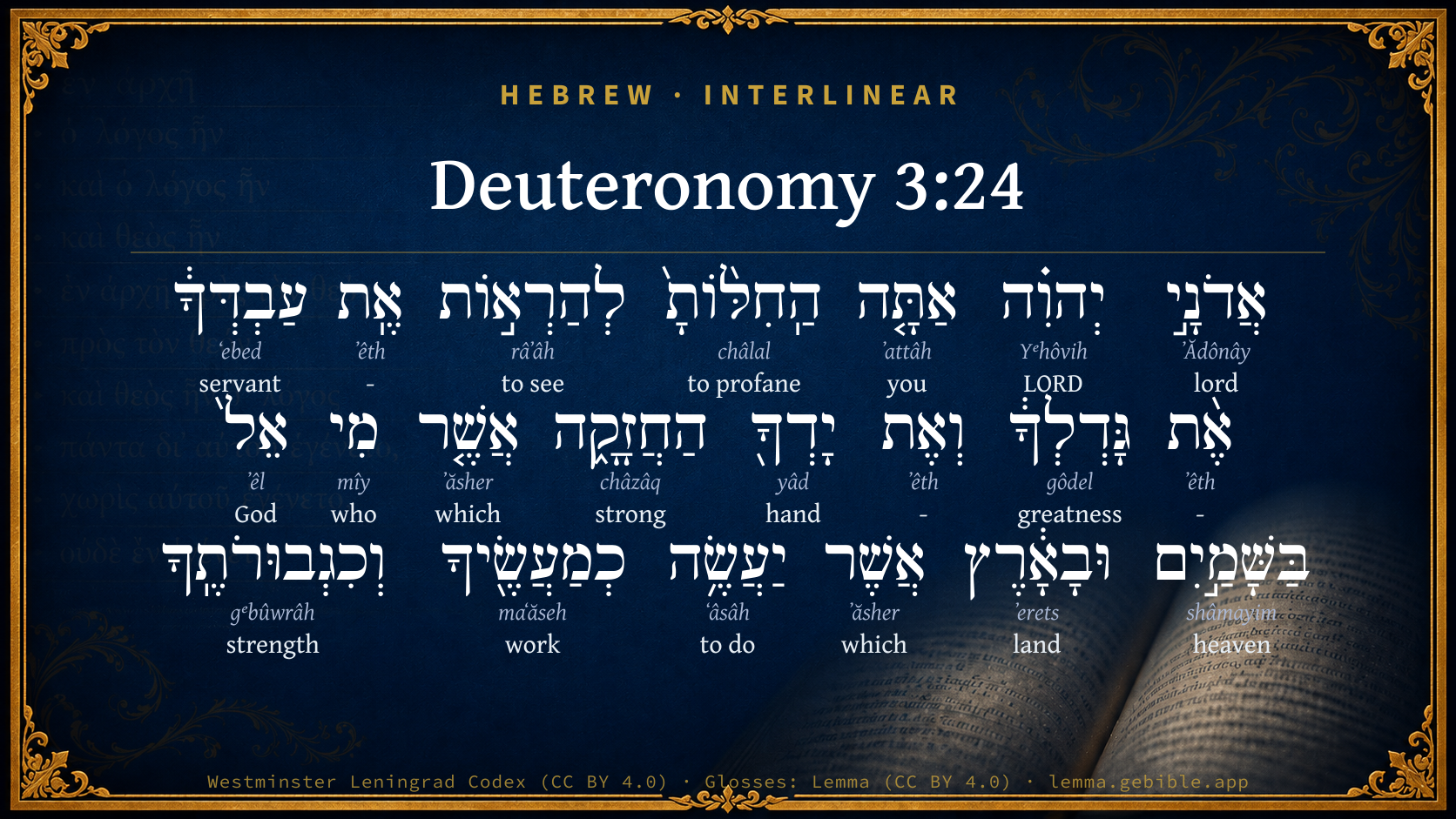
  1. אֲדֹנָ֣י ʼĂdônây H136 “Lord · my” Noun, Common, Masculine, Plural, Construct + Suffix, Personal, 1st Person, Common, Singular
  2. יְהוִ֗ה Yᵉhôvih H3069 “LORD” Noun, Proper
  3. אַתָּ֤ה ʼattâh H859 “you” Pronoun, Personal, 2nd Person, Masculine, Singular
  4. הַֽחִלּ֨וֹתָ֙ châlal H2490 “to profane” Verb, Hiphil, Perfect, 2nd Person, Masculine, Singular
  5. לְהַרְא֣וֹת râʼâh H7200 “to see” Preposition + Verb, Hiphil, Infinitive Construct
  6. אֶֽת ʼêth H853 “-” Particle, Direct Object
  7. עַבְדְּךָ֔ ʻebed H5650 “servant · your” Noun, Common, Masculine, Singular, Construct + Suffix, Personal, 2nd Person, Masculine, Singular
  8. אֶ֨ת ʼêth H853 “-” Particle, Direct Object
  9. וְאֶת ʼêth H853 “and · -” Conjunction + Particle, Direct Object
  10. יָדְךָ֖ yâd H3027 “hand · your” Noun, Common, Both, Singular, Construct + Suffix, Personal, 2nd Person, Masculine, Singular
  11. הַחֲזָקָ֑ה châzâq H2389 “the · strong” Particle, Definite Article + Adjective, Adjective, Feminine, Singular, Absolute
  12. אֲשֶׁ֤ר ʼăsher H834 “which” Particle, Relative
  13. מִי mîy H4310 “who” Particle, Interrogative
  14. אֵל֙ ʼêl H410 “God” Noun, Common, Masculine, Singular, Absolute
  15. בַּשָּׁמַ֣יִם shâmayim H8064 “in/at the · heaven(s)” Preposition, Determined + Noun, Common, Masculine, Plural, Absolute
  16. וּבָאָ֔רֶץ ʼerets H776 “and · in/at the · land” Conjunction + Preposition, Determined + Noun, Common, Both, Singular, Absolute
  17. אֲשֶׁר ʼăsher H834 “which” Particle, Relative
  18. יַעֲשֶׂ֥ה ʻâsâh H6213 “to do” Verb, Qal, Imperfect, 3rd Person, Masculine, Singular
  19. כְמַעֲשֶׂ֖יךָ maʻăseh H4639 “like/as · works · your” Preposition + Noun, Common, Masculine, Plural, Construct + Suffix, Personal, 2nd Person, Masculine, Singular
  20. וְכִגְבוּרֹתֶֽךָ gᵉbûwrâh H1369 “and · like/as · mighty deeds · your” Conjunction + Preposition + Noun, Common, Feminine, Plural, Construct + Suffix, Personal, 2nd Person, Masculine, Singular

About this verse

These counts appear in no published source. They are computed here, from the morphology-tagged text and Lemma’s own curated glosses. What Lemma adds →

21
words
18
distinct lemmas
Pentateuch
section

Notable vocabulary

The rarest word here is גָּדְלְךָ֔ greatness H1433 — appearing just 13 times in the whole Hebrew Bible.

Shared distinctive vocabulary

גָּדְלְךָ֔ greatness H1433 occurs in 13 verses of the Hebrew Bible. Also found in:

Grammatical profile

  • 3 verbs
  • 10 nouns
  • 1 adjective
  • 1 pronoun
  • 6 particles

Verb forms

  • הַֽחִלּ֨וֹתָ֙ Hiphil · Perfect
  • לְהַרְא֣וֹת Hiphil · Infinitive Construct
  • יַעֲשֶׂ֥ה Qal · Imperfect

Repetition

A word recurs within this verse — often emphatic in Hebrew:

  • אֲשֶׁ֤ר which H834 ×2

Hebrew & Septuagint length

In English translation the verse runs 38 words from the Hebrew and 46 from the Septuagint (LXX English) — closely comparable.

A rough comparison of the two English renderings, which tokenize alike — not a word-level alignment.

Word counts can differ between the Hebrew and the Greek without any difference in meaning — e.g. the Hebrew direct-object marker אֵת has no separate Greek word, and Greek often adds the article ὁ.

Cross-references

17

Topical passages linked to Deuteronomy 3:24 in the Treasury of Scripture Knowledge — connected by theme and wording, ordered by reader-vote popularity; previews shown in the World English Bible.

  • Exodus 15:11 Who is like you, Yahweh, among the gods? Who is like you, glorious in holiness, Fearful in praises, doing wonders?
  • Deuteronomy 11:2 Know you this day: for I don't speak with your children who have not known, and who have not seen the chastisement of Yahweh your God, his greatness, his mighty hand, and his outstretched arm,
  • Psalms 71:19 Your righteousness also, God, reaches to the heavens; You have done great things. God, who is like you?
  • 2 Samuel 7:22 Therefore you are great, Yahweh God: for there is none like you, neither is there any God besides you, according to all that we have heard with our ears.
  • Psalms 86:8 There is no one like you among the gods, Lord, Nor any deeds like your deeds.
  • Jeremiah 32:18–21 who show loving kindness to thousands, and recompense the iniquity of the fathers into the bosom of their children after them; the great, the mighty God, Yahweh of Hosts is his name;
  • Nehemiah 9:32 Now therefore, our God, the great, the mighty, and the awesome God, who keep covenant and loving kindness, don't let all the travail seem little before you, that has come on us, on our kings, on our princes, and on our priests, and on our prophets, and on our fathers, and on all your people, since the time of the kings of Assyria to this day.
  • Psalms 35:10 All my bones shall say, "Yahweh, who is like you, Who delivers the poor from him who is too strong for him, Yes, the poor and the needy from him who robs him?"
  • Psalms 89:6 For who in the skies can be compared to Yahweh? Who among the sons of the heavenly beings is like Yahweh,
  • Psalms 89:8 Yahweh, God of hosts, who is a mighty one, like you? Yah, your faithfulness is around you.
  • Psalms 106:2 Who can utter the mighty acts of Yahweh, Or fully declare all his praise?
  • Psalms 145:6 Men will speak of the might of your awesome acts. I will declare your greatness.
  • Isaiah 40:25 To whom then will you liken me, that I should be equal [to him]? says the Holy One.
  • Jeremiah 10:6 There is none like you, Yahweh; you are great, and your name is great in might.
  • Daniel 3:29 Therefore I make a decree, that every people, nation, and language, which speak anything evil against the God of Shadrach, Meshach, and Abednego, shall be cut in pieces, and their houses shall be made a dunghill; because there is no other god who is able to deliver after this sort.
  • Psalms 145:3 Great is Yahweh, and greatly to be praised! His greatness is unsearchable.
  • Isaiah 40:18 To whom then will you liken God? or what likeness will you compare to him?

Cross-references courtesy of OpenBible.info (CC BY 4.0).

Hebrew and Greek witnesses Masoretic Hebrew ↔ Greek Septuagint

The same verse in the two great witnesses to the Old Testament, shown verse-for-verse.

These are two independent witnesses, not word-aligned to each other, and the Septuagint is shown in lemma (dictionary) form.

Hebrew Deuteronomy 3:24 Masoretic · Westminster Leningrad Codex

אֲדֹנָ֣י יְהוִ֗ה אַתָּ֤ה הַֽחִלּ֨וֹתָ֙ לְהַרְא֣וֹת אֶֽת עַבְדְּךָ֔ אֶ֨ת גָּדְלְךָ֔ וְאֶת יָדְךָ֖ הַחֲזָקָ֑ה אֲשֶׁ֤ר מִי אֵל֙ בַּשָּׁמַ֣יִם וּבָאָ֔רֶץ אֲשֶׁר יַעֲשֶׂ֥ה כְמַעֲשֶׂ֖יךָ וְכִגְבוּרֹתֶֽךָ

Lord Yahweh, you have begun to show your servant your greatness, and your strong hand: for what god is there in heaven or in earth, that can do according to your works, and according to your mighty acts?

World English Bible · Public Domain

Greek LXX Deuteronomy 3:24 Septuagint · lemma form

κύριος κύριος σύ ἄρχω δεικνύω ὁ σός θεράπων ὁ ἰσχύς σύ καί ὁ δύναμις σύ καί ὁ χείρ ὁ κραταιός καί ὁ βραχίων ὁ ὑψηλός τίς γάρ εἰμί θεός ἐν ὁ οὐρανός ἤ ἐπί ὁ γῆ ὅστις ποιέω καθά σύ ποιέω καί κατά ὁ ἰσχύς σύ

Lord God, you have begun to show to your servant your strength, and your power, and your mighty hand, and your high arm: for what God is there in heaven or on the earth, who will do as you have done, and according to your might?

LXX2012 (modern English Septuagint) · Public Domain

On this verse, John Gill's Exposition discusses the Septuagint’s reading. Read the note in Commentary ↓

Hebrew: Westminster Leningrad Codex (CC BY 4.0). Greek: Septuagint (public domain); English from LXX2012 (modern English Septuagint) (Public Domain). How the Septuagint differs from the Hebrew →

Targum (Aramaic paraphrase)

2

The Targum is the ancient Jewish Aramaic paraphrase of the Hebrew Scriptures — an interpretive translation, not the Hebrew text itself. Onkelos (literal) and Pseudo-Jonathan (expansive) render the Torah, and Jonathan the Prophets. Coverage is partial: where no permissively-licensed English translation exists for a verse, only the Aramaic is shown. This is verse-level text, not a word-by-word alignment to the Hebrew.

  1. Targum Onkelos Torah (Genesis–Deuteronomy)
    יְיָ אֱלֹהִים אַתְּ שָׁרֵיתָא לְאַחֲזָאָה יָת עַבְדָךְ יָת רְבוּתָךְ וְיָת יְדָךְ תַּקֶפְתָּא דִי אַתְּ הוּא אֱלָהָא דִשְׁכִנְתָּךְ בִּשְׁמַיָא מִלְעֵלָא וְשַׁלִיט בְּאַרְעָא וְלֵית דְיַעְבֵּד כְּעוֹבְדָיךְ וּכְגִבָּרְתָּךְ

    (no public-domain English translation for this verse)

    Targum Onkelos — Aramaic: “Onkelos Genesis” (public domain); “Onkelos Exodus” (public domain); “Onkelos Leviticus” (public domain); “Onkelos Numbers” (public domain); “Onkelos Deuteronomy” (public domain). English: “Sefaria Community Translation” (CC0 1.0 (public-domain dedication)); “J.W. Etheridge. The Targums of Onkelos and Jonathan Ben Uzziel on the Pentateuch. London: Longmans, Green, 1862” (public domain). Text via Sefaria.

  2. Targum Pseudo-Jonathan Torah (Genesis–Deuteronomy)
    בְּבָעוּ בְּרַחֲמִין מִן קֳדָמָךְ יְיָ אֱלהִים אַנְתְּ שָׁרִיתָ לְאַחֲזָאָה יַת עַבְדָךְ יַת רְבוּתָךְ וְיַת גְּבוּרַת יְדָךְ תַּקִיפְתָּא דְאַתְּ הוּא אֱלָהָא וְלָא אִית בַּר מִינָךְ דִּשְׁכִינְתָּךְ שַׁרְיָא בִּשְׁמַיָא מִלְעֵילָא וְשַׁלִּיט בְּאַרְעָא לָא דְיַעֲבֵיד כְּעוֹבָדָךְ וְכִגְבוּרָתָךְ

    I supplicate compassion before Thee, O Lord God: Thou hast begun to show unto Thy servant Thy greatness and the power of Thy mighty hand; for Thou art God, and there is none beside Thee; for Thy glory dwelleth in the heavens on high, and Thou rulest upon the earth; there is none who can work according to Thy working or Thy power.

    Targum Pseudo-Jonathan — Aramaic: “Targum Jonathan on Genesis” (public domain); “Targum Jonathan on Exodus” (public domain); “Targum Jonathan on Leviticus” (public domain); “Targum Jonathan on Numbers” (public domain); “Targum Jonathan on Deuteronomy” (public domain). English: “The Targum of Jonathan ben Uzziel, trans. J. W. Etheridge, London, 1862” (public domain). Text via Sefaria.

Commentary

Notes on Deuteronomy 3:24 from classic Christian and Jewish commentators (each source and its license shown beneath its notes). The classic Christian expositions comment on the surrounding passage and are grouped to its opening verse, so a note may address several verses; the Jewish commentaries on the Tanakh (Rashi and others) are per-verse, so they appear only where the commentator wrote on this verse.

Lemma curates 59 commentaries, every one of them public domain or Creative Commons licensed, each selected and text-cleaned for this edition rather than reprinted as found. About our sources →

Trapp's Complete Commentary

John Trapp

Deu 3:24 O Lord GOD, thou hast begun to shew thy servant thy greatness, and thy mighty hand: for what God [is there] in heaven or in earth, that can do according to thy works, and according to thy might?

Ver. 24. What god is there?] Whether deputed or reputed?

John Trapp, A Commentary or Exposition upon All the Books of the Old and New Testament (1647–1656) — public domain. Text from a community e-Sword module.

Tyndale Open Study Notes

Tyndale Open Resources

3:24 Is there any god? Moses did not believe that other gods existed; he was simply affirming that only the Lord is God. Nothing and no one else, real or imaginary, can rival the one true God.

Tyndale Open Study Notes — © Tyndale Open Resources, licensed CC BY-SA 4.0. Text via the HelloAO Bible API.

Geneva Bible (1599)

Geneva Bible translators

Or, wonders.

He speaketh according to the common and corrupt speech of them which attribute that power unto idols that only appertaineth unto God.

Geneva Bible (1599) marginal notes — public domain. Text via Bolls.life.

Adam Clarke's Commentary

Verses 24. - 25. The prayer of Moses recorded in these two verses, and his own reflections on it, De 3:26, are very affecting. He had suffered much both in body and mind in bringing the people to the borders of the promised land; and it was natural enough for him to wish to see them established in it, and to enjoy a portion of that inheritance himself, which he knew was a type of the heavenly country. But notwithstanding his very earnest prayer, and God's especial favour towards him, he was not permitted to go over Jordan! He had grieved the Spirit of God, and he passed a sentence against him of exclusion from the promised land. Yet he permitted him to see it, and gave him the fullest assurances that the people whom he had brought out of Egypt should possess it. Thus God may choose to deprive those of earthly possessions to whom he is nevertheless determined to give a heavenly inheritance.

Adam Clarke's Commentary on the Bible (1810–1826) — public domain. Text from a community e-Sword/MySword module.

The Cambridge Bible for Schools and Colleges

gen. ed. J. J. S. Perowne

24. O Lord God] Heb. my Lord Jehovah.

thou hast begun] But not fulfilled in my sight! A pathetic emphasis. Moses prayed to see with his own eyes the completion of the great Providence carried so far at his hands. This temper is characteristic of all Deuteronomy: the passion to experience the full-rounded Providence of God in this life, absolutely no hope of another! As time went on a nobler trust was born. The servant of Jehovah cut off from the land of the living, yet sees of the travail of his soul and is satisfied (Isa_53:11); and Jesus becoming obedient even unto death (Php_2:8), for the joy set before him endured the cross, despising the shame (Heb_12:2). Let this cup pass from me … nevertheless … thy will be done.

thy greatness] Deu_5:24, Deu_9:26, Deu_11:2; and thy strong hand, see Deu_4:34.

what god is there, etc.] Exo_15:11.

The Cambridge Bible for Schools and Colleges (gen. ed. J. J. S. Perowne; Cambridge University Press, 1878–1918) — public domain. Text from a community e-Sword module.

John Gill's Exposition

I pray thee, let me go over and see the good land that is beyond Jordan,.... The land of Canaan, the land flowing with milk and honey; a land which he describes as a most excellent one, Deu 8:7. To see this land, he was very desirous of going over the river Jordan, beyond which it lay with respect to the place where he now was:

that goodly mountain, and Lebanon; or, "that goodly mountain, even Lebanon"; which lay to the north of the land of Canaan, and was famous for cedar and odoriferous trees. But if two distinct mountains are meant, the goodly mountain may design Mount Moriah, on which the temple was afterwards built, and of which Moses might have a foresight; and some by Lebanon think that is meant, which was built of the cedars of Lebanon, and therefore goes by that name, Zac 11:1 and a foreview of this made the mountain so precious to Moses, and desirable to be seen by him. So the Targum of Jonathan;"that goodly mountain in which is built the city of Jerusalem, and Mount Lebanon, in which the Shechinah shall dwell''to which agrees the note of Aben Ezra, who interprets the goodly mountain of Jerusalem, and Lebanon of the house of the sanctuary. In the Septuagint it is called Antilibanus. Mount Libanus had its name not from frankincense growing upon it, as some have thought; for it does not appear that any did grow upon it, for that came from Seba in Arabia Felix; but from the whiteness of it, through the continual snows that were on it, just as the Alps have their name for the same reason; and so Jerom says (b) of Lebanon, that the snow never leaves from the tops of it, or is ever so overcome by the heat of the sun as wholly to melt; to the same purpose also Tacitus (c) says, and Mr. Maundrell (d), who was there in May, speaks of deep snow on it, and represents the cedars as standing in snow.

(b) In Hieremiam, c. 18. 14. (c) Hist. l. 5. c. 6. (d) Journey from Aleppo, p. 139, 140.

John Gill's Exposition of the Whole Bible (1746–1763) — public domain (CC PDM 1.0). Text via the HelloAO Bible API.

The Pulpit Commentary

O Lord God: O Lord Jehovah. For what God, etc.. (comp. Exo_15:11; Psa_86:8 Psa_89:6 Psa_113:5, etc.) "The contrast drawn between Jehovah and other gods does not involve the reality of heathen deities, but simply presupposes a belief in the existence of other gods, without deciding as to the truth of that belief" (Keil).

The Pulpit Commentary (1880–1919), ed. H.D.M. Spence-Jones & Joseph S. Exell — public domain. Text from a community e-Sword module.

John Wesley's Explanatory Notes

Thou hast begun to shew thy servant thy greatness - Lord, perfect what thou hast begun. The more we see of God's glory in his works, the more we desire to see. And the more we are affected with what we have seen of God, the better we are prepared for farther discoveries.

John Wesley, Explanatory Notes Upon the Whole Bible (1754–1765) — public domain. Text via the GEBible commentary corpus.

Rashi

Rabbi Shlomo Yitzchaki (Rashi)

אדני אלהים O LORD, GOD — O Thou Who art. merciful (ה׳) in judgment (אלהים) (cf. Sifrei Devarim 26:10).

אתה החלות להראות את עבדך THOU DIDST BEGIN TO SHOW THY SERVANT an opening to stand and offer prayer, although the decree has been enacted; he said to Him: I learned to do so from Thee, for Thou didst say to me, (Exodus 32:10; cf. Rashi thereon) "And now, leave Me alone”. Was I, then, holding Thee? But Thou didst say this to open the door and to show that it depended upon me to pray for them. Just so do I think to act now (Sifrei Devarim 27:2).

את גדלך [TO SHOW] THY GREATNESS — This means Thy attribute of goodness. Similarly it states, (Numbers 14:17, 18) "And now, I beseech Thee, let the strength of my Lord be great, [according as thou hast spoken, saying: The Lord is long-suffering and of much mercy, etc."].

ואת ידך AND THY [STRONG] HAND — This refers to Thy right hand which is extended to all who enter the world (all human beings) [to receive them in penitence] (Sifrei Bamidbar 134:5).

החזקה [THY] STRONG [HAND] — I speak of it as Thy strong hand, because by showing mercy Thou forcibly (בחזקה) subduest the attribute of strict justice (Sifrei Bamidbar 134:5).

אשר מי אל וגו׳ FOR WHAT GOD IS THERE [… WHO CAN DO ACCORDING TO THY WORKS] — Thou art unlike a mortal king who has counsellors and assessors who would prevent him when he wishes to show kindness and to forgo, what is due to him: Thou, however, — there is none who can prevent Thee if Thou pardonest me and dost annul Thy decree (Sifrei Devarim 27:6). But according to its plain sense it means: "Thou hast begun to show Thy servant the war with Sihon and Og, as it is written, (Deuteronomy 2:31) “Behold I have begun to give [Sihon and his land] before thee"; let me behold also the war with the thirty-one kings of Canaan.

Rashi on the Tanakh — English translations: “The Judaica Press complete Tanach with Rashi, translated by A. J. Rosenberg” (CC BY 4.0); “Pentateuch with Rashi's commentary by M. Rosenbaum and A.M. Silbermann, 1929-1934” (public domain); “The Metsudah Tanach series, Lakewood, N.J” (CC BY 4.0); and “The Book of Joshua, Metsudah Publications, 1997” (CC BY 4.0). Text via Sefaria.

Ramban (Nachmanides)

Rabbi Moshe ben Nachman (Ramban / Nachmanides)

G-D THE ETERNAL — “merciful in judgment.” This is Rashi’s language. Now, the Rabbi did not consider that the first Divine Name is spelled with the letters Aleph Dalet and the second Name is spelled with the letters Yod Hei [i.e., the Tetragrammaton]. represents the attribute of justice; the Name beginning with the letters Yod Hei signifies the attribute of mercy. Since of the two Divine Names mentioned here in the verse, the first one is with Aleph Dalet and the second one with Yod Hei, Rashi should have interpreted them to mean, “Lord of judgment in the attribute of mercy,” instead of writing, “merciful in judgment,” implying that the first Name signifies mercy and the second one judgment. See further in Vol. II, p. 67. In this regard [i.e., the Tetragrammaton], the Rabbis have said: “Wherever Scripture states ‘the Eternal’ [i.e., the Tetragrammaton] it signifies the attribute of mercy, and [wherever it mentions] ‘G-d’ (Elokim) it indicates the attribute of judgment.” of the two Divine Names that indicates the attribute of mercy, why then did Rashi put it first, writing “merciful in judgment?” Rather, the Divine Names written here mean: “Lord but Ado noy (Lord), Ramban writes: “Lord etc.” in the attribute of mercy.” And so the Rabbis have said in [Midrash] Yelamdeinu: “Moses said to G-d: ‘Master of the worlds! If it is justly requested by me [that You grant my supplication] give it to me, and if it is not justly requested by me, have mercy on me,’ just as Abraham said, O Lord Eternal, what wilt Thou give me etc.” Also in the case of Abraham, the Divine Names are written in this order: the first one with Aleph Dalet, and the second with Yod Hei. And the purport of the section [before us] will be understood [by the fact that the Divine Names are written in this particular order]. For Moses stated va’ethchanan (and I besought) and he did not say va’ethpaleil (and I prayed), since he spoke in “supplication” [to the Glorious Name], saying: “O Lord in Whom is the mercy, Thou hast begun to show Thy servant. Such was the beginning of my prophecy that You showed me Your glory — as it is written [at Moses’ first vision of G-d’s glory], And Moses hid his face, for he was afraid to look upon G-d — together with the greatness and the power,. and I learned to know what deity is there in heaven or on earth from whom could come forth like Thy great works and Thy mighty prowess?” From here you will further understand the matter concerning which the Glorious Name was angry with Moses. However, the language of the Sifre is as follows: 26. The text substantiates Ramban’s interpretation, that the first Divine Name mentioned here in the verse represents judgment, while the second one signifies mercy. Ramban introduces the text with the word aval (“however,” or “but”) as if to say: “while the text of the Midrash Yelamdeinu (mentioned above) is not so lucid on this problem — although this is surely its meaning — ‘however’ the text in the Sifre clearly states it to be so.” “Wherever Scripture mentions ‘the Eternal’ it signifies the attribute of mercy, as it is said, The Eternal, G-d, gracious and merciful, [and wherever it mentions] G-d (Elokim) it indicates the attribute of judgment, as it is said, before ‘ha’elohim’ (the judges) shall come the word of both. ”, 22:8. And the intent [of the Sifre] is to explain that the second [Divine] Name mentioned here indicates the attribute of mercy, this being the Proper Divine Name, while all other Names signify the attribute of judgment, like Elokim which is also a term for judges, and certainly the Name Aleph Dalet which is an expression of lordship.Thus Moses completed the words of reproof with this episode in which he informed the people that their fathers caused themselves evil, and also caused him [Moses] to suffer punishment preventing them from going over into the Land. They, the children, however, will go over and inherit it, if they will not be as their fathers, a stubborn and rebellious generation. Therefore he now began to warn them about the principles of the commandments that they should not add to them, neither diminish from them.

Ramban (Nachmanides) on the Tanakh — English translation: “Commentary on the Torah by Ramban (Nachmanides). Translated and annotated by Charles B. Chavel. New York, Shilo Pub. House, 1971-1976” (CC BY 4.0). Text via Sefaria.

Lesson kit

Teaching starters — assembled from the data on this page, not authored interpretation. Every prompt links to the verse data it draws on. Edit before teaching.

Deuteronomy, in the Pentateuch, opens this verse with 21 words (18 distinct Hebrew lemmas). Its most distinctive word is gôdel (“greatness”). A historical commentator’s framing appears above. Read the whole chapter for the surrounding context.

Discussion questions

  1. How does “greatness” (gôdel) shape what this verse is saying?
  2. Numbers 14:19 shares the word «greatness» with this verse. How do the two illuminate each other?
  3. “which” occurs 2× in this one verse. What is the effect of the repetition?
  4. These translations render this verse differently. What is at stake in choosing one wording over another?
  5. The verb «הַֽחִלּ֨וֹתָ֙» is Hiphil Perfect. How does its form color the action?
  6. Reading how Trapp's Complete Commentary and Tyndale Open Study Notes read this verse, where do the two commentators agree and where do they part?

Things to notice

Reading settings

Reading text

Shown beneath each verse's original-language words.

Old Testament
Old Testament edition

Read the OT as the Masoretic Hebrew (MT) or the Greek Septuagint (LXX).

English shown for the Greek Septuagint (in the Hebrew ↔ Greek comparison).

Comparing translations? Open the Compare panel on any verse page to stack up to four side by side.