
Amos 5:16

Hebrew (Westminster Leningrad Codex) Amos 5:16 appears in the Hebrew Old Testament. The text above is from the Westminster Leningrad Codex. Each word links to its Strong’s number, a concise gloss, and parsing drawn from the Open Scriptures Hebrew Bible morphology. Click any word for its full Brown-Driver-Briggs (BDB) entry.
Download image
Cite this verse

Amos 5:16 (World English Bible). Public Domain. Lemma interlinear Bible study tool, https://lemma.gebible.app/v/amos/5/16.

Show BibTeX & RIS
BibTeX
RIS
English Translation
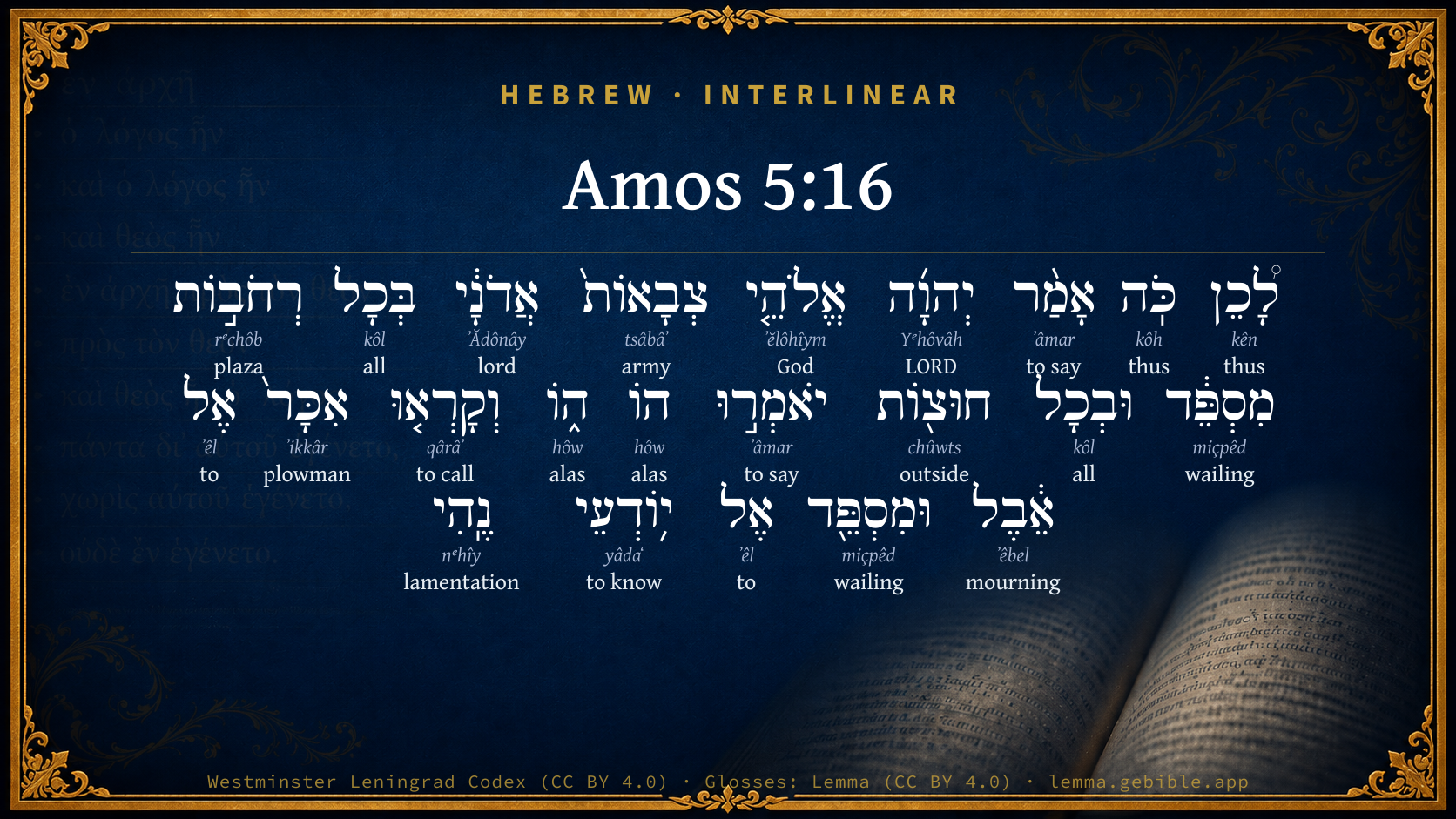
Therefore thus says Yahweh, the God of hosts, the Lord: "Wailing will be in all the broad ways; And they will say in all the streets, 'Alas! Alas!' And they will call the farmer to mourning, And those who are skillful in lamentation to wailing.
World English Bible · Public Domain
Highlights
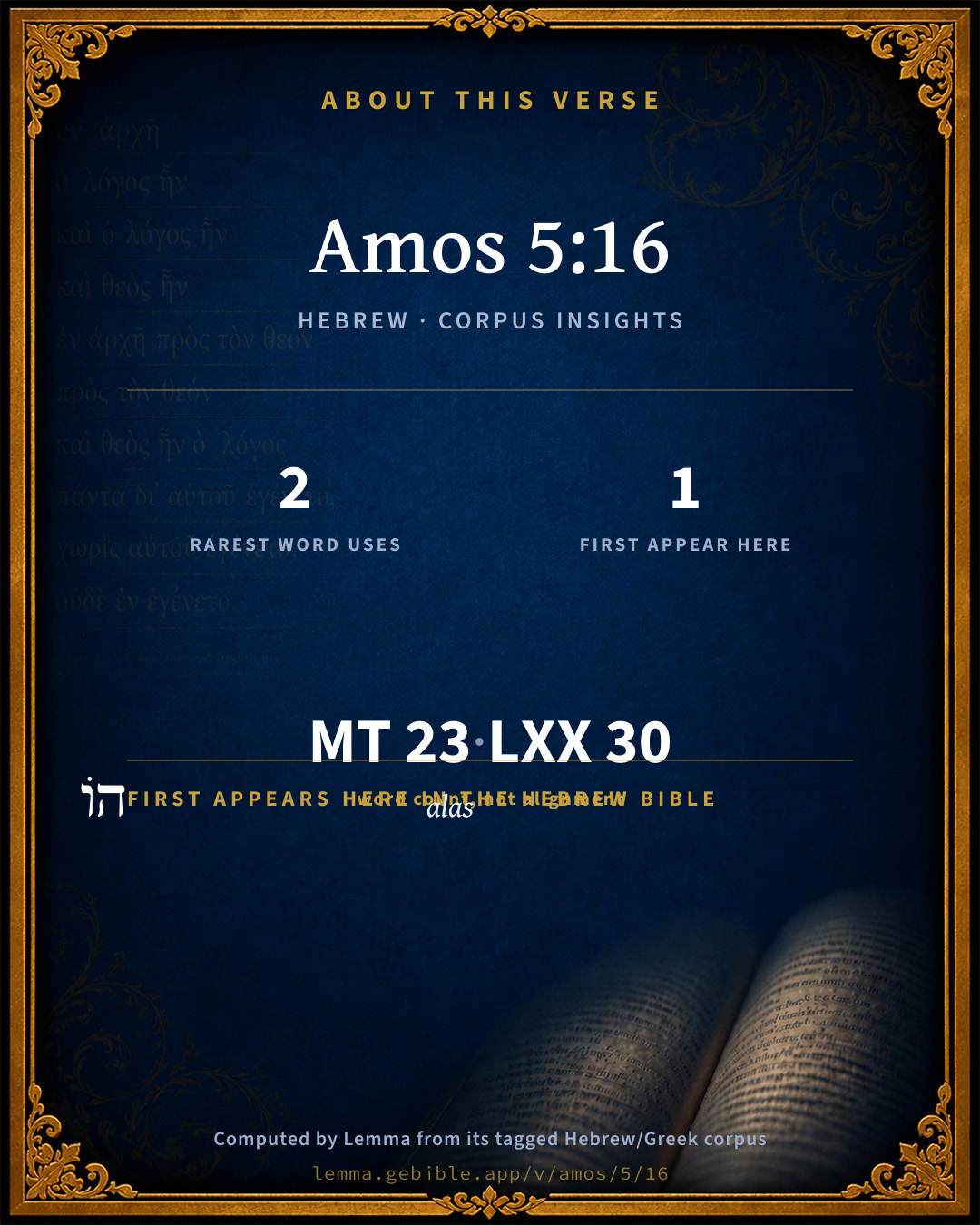
  • 1 first appearance in the Hebrew Bible
Full analysis ↓
Download a study sheet

One document with this verse’s original text, its word-by-word gloss line, the meaning frame, cross-references with their text, attributed commentary, and full source and license credits — printable, and it pastes into notes with its structure intact.

This verse Autodidact and up

Study sheet (.html) Plain text (.txt)

A passage Seminary Student

Up to 50 verses in one chapter. A passage sheet keeps up to 6 commentary sources and 12 cross-references per verse, in the order this page ranks them, and says so on the sheet whenever that leaves anything out. Ask for a single verse and you get the Autodidact verse sheet above.

Everything on this page stays free to read, with no account — the sheet is a download of what is already on screen, not access to it.

Want to remove ads? Support Godless Engineer
Compare translations 3

The same verse in 3 English versions, stacked beneath the original-language interlinear above. Click any original word for its lexicon entry.

Each is an independent rendering of the whole verse — the interlinear is not word-aligned to these translations.

Highlighted words mark where these versions differ — a whole-verse word diff, not a word-by-word alignment.

  • World English Bible Public Domain
    Therefore thus says Yahweh, the God of hosts, the Lord: "Wailing will be in all the broad ways; And they will say in all the streets, 'Alas! Alas!' And they will call the farmer to mourning, And those who are skillful in lamentation to wailing.
  • King James Version Public Domain
    Therefore the LORD, the God of hosts, the LORD, saith thus; Wailing shall be in all streets; and they shall say in all the highways, Alas! alas! and they shall call the husbandman to mourning, and such as are skilful of lamentation to wailing.
  • unfoldingWord Literal Text CC BY-SA 4.0
    Therefore, this is what Yahweh says, the God of hosts, the Lord, “Wailing will be in all the squares, and they will say in all the streets, ‘Woe! Woe!’ They will call the farmers to mourning and the mourners to wail.

unfoldingWord Literal Text — © unfoldingWord, licensed CC BY-SA 4.0. Word-aligned USFM3 via Door43 (git.door43.org/unfoldingWord/en_ult).

Versions to compare (up to 4)

3 of 4 selected

Show all 18 translations

Every available English version of this verse, each an independent rendering of the whole verse.

  • World English Bible Public Domain
    Therefore thus says Yahweh, the God of hosts, the Lord: "Wailing will be in all the broad ways; And they will say in all the streets, 'Alas! Alas!' And they will call the farmer to mourning, And those who are skillful in lamentation to wailing.
  • Berean Standard Bible Public Domain
    Therefore this is what the LORD, the God of Hosts, the Lord, says: “There will be wailing in all the public squares and cries of ‘Alas! Alas!’ in all the streets. The farmer will be summoned to mourn, and the mourners to wail.
  • Majority Standard Bible Public Domain
    Therefore this is what the LORD, the God of Hosts, the Lord, says: “There will be wailing in all the public squares and cries of ‘Alas! Alas!’ in all the streets. The farmer will be summoned to mourn, and the mourners to wail.
  • King James Version Public Domain
    Therefore the LORD, the God of hosts, the LORD, saith thus; Wailing shall be in all streets; and they shall say in all the highways, Alas! alas! and they shall call the husbandman to mourning, and such as are skilful of lamentation to wailing.
  • American Standard Version (1901) Public Domain
    Therefore thus saith Jehovah, the God of hosts, the Lord: Wailing shall be in all the broad ways; and they shall say in all the streets, Alas! Alas! and they shall call the husbandman to mourning, and such as are skilful in lamentation to wailing.
  • Revised Version (1885) Public Domain
    Therefore thus saith the LORD, the God of hosts, the Lord: Wailing shall be in all the broad ways; and they shall say in all the streets, Alas! alas! and they shall call the husbandman to mourning, and such as are skilful of lamentation to wailing.
  • Geneva Bible (1599) Public Domain
    Therfore the Lord God of hosts, the Lord saith thus, Mourning shalbe in all streetes: and they shall say in al the hie wayes, Alas, alas: and they shall call the husbandman to lamentation, and such as can mourne, to mourning.
  • Douay-Rheims (1899) Public Domain
    Therefore thus saith the Lord the God of hosts the sovereign Lord: In every street there shall be wailing: and in all places that are without, they shall say: Alas, alas! and they shall call the husbandman to mourning, and such as are skilful in lamentation to lament.
  • Young's Literal Translation Public Domain
    Therefore, thus said Jehovah, God of Hosts, the Lord, In all broad places `is' lamentation, And in all out-places they say, `Alas, alas,' And called the husbandman to mourning, And to lamentation the skilful of wailing.
  • Literal Standard Version CC BY-SA 4.0
    Therefore, thus said YHWH, God of Hosts, the Lord: “Lamentation is in all broad places, || And in all out-places they say, Oh! Oh! And called the farmer to mourning, || And the skillful of wailing to lamentation.
  • Unlocked Literal Bible CC BY-SA 4.0
    Therefore, this is what Yahweh says, the God of hosts, the Lord, “Wailing will be in all the squares, and they will say in all the streets, 'Woe! Woe!' They will call the farmers to mourning and the mourners to wail.
  • unfoldingWord Literal Text CC BY-SA 4.0
    Therefore, this is what Yahweh says, the God of hosts, the Lord, “Wailing will be in all the squares, and they will say in all the streets, ‘Woe! Woe!’ They will call the farmers to mourning and the mourners to wail.
  • Darby Bible Public Domain
    Therefore thus saith Jehovah, the God of hosts, the Lord: Wailing shall be in all broadways; and they shall say in all the streets, Alas! alas! And they shall call the husbandman to mourning, and such as are skilful of lamentation to wailing.
  • World Messianic Bible Public Domain
    Therefore the LORD, the God of Hosts, the Lord, says: “Wailing will be in all the wide ways. They will say in all the streets, ‘Alas! Alas!’ They will call the farmer to mourning, and those who are skillful in lamentation to wailing.
  • Webster's Bible Public Domain
    Therefore the LORD, the God of hosts, the Lord, saith thus; Wailing shall be in all streets; and they shall say in all the highways, Alas! alas! and they shall call the husbandman to mourning, and such as are skillful in lamentation to wailing.
  • Free Bible Version CC BY-SA 4.0
    For this is what the Lord, the Lord God of power says: There will be weeping in the city squares and wailing in the streets. They will call even the farmers to grieve, as well as the professional mourners.
  • Bible in Basic English Public Domain
    So these are the words of the Lord, the God of armies, the Lord: There will be weeping in all the open spaces; and in all the streets they will say, Sorrow! sorrow! and they will get in the farmer to the weeping, and the makers of sad songs to give cries of grief.
  • JPS Tanakh (1917) Public Domain
    Therefore thus saith the LORD, the God of hosts, the Lord: Lamentation shall be in all the broad places, and they shall say in all the streets: 'Alas! alas!' and they shall call the husbandman to mourning, and proclaim lamentation to such as are skilful of wailing.

Literal Standard Version (2020), Covenant Press — licensed CC BY-SA 4.0. Text via the HelloAO Bible API (eBible.org). Unlocked Literal Bible (unfoldingWord) — licensed CC BY-SA 4.0. Text via the HelloAO Bible API (eBible.org). unfoldingWord Literal Text — © unfoldingWord, licensed CC BY-SA 4.0. Word-aligned USFM3 via Door43 (git.door43.org/unfoldingWord/en_ult). Free Bible Version, Dr. Jonathan Gallagher — licensed CC BY-SA 4.0. Text via the HelloAO Bible API (eBible.org).

Word by word

More ways to search: Search by grammar → Find every occurrence → Compare this word →

Practice this passage: Drill this verse → Learn its vocabulary →

הוֹ
hôw
H1930
“alas”
Particle, Interjection
Part of Speech
Particle
Type
Interjection
Full BDB Definition

Origin: by permutation from H1929

TWOT: 479

alas!, ah!
  1. לָ֠כֵן kên H3651 “to/for · thus” Preposition + Adverb
  2. כֹּֽה kôh H3541 “thus” Adverb
  3. אָמַ֨ר ʼâmar H559 “to say” Verb, Qal, Perfect, 3rd Person, Masculine, Singular
  4. יְהוָ֜ה Yᵉhôvâh H3068 “LORD” Noun, Proper
  5. אֱלֹהֵ֤י ʼĕlôhîym H430 “God(s) of” Noun, Common, Masculine, Plural, Construct
  6. צְבָאוֹת֙ tsâbâʼ H6635 “armies” Noun, Common, Both, Plural, Absolute
  7. אֲדֹנָ֔י ʼĂdônây H136 “Lord · my” Noun, Common, Masculine, Plural, Construct + Suffix, Personal, 1st Person, Common, Singular
  8. בְּכָל kôl H3605 “in/at · all of” Preposition + Noun, Common, Masculine, Singular, Construct
  9. רְחֹב֣וֹת rᵉchôb H7339 “plazas” Noun, Common, Feminine, Plural, Absolute
  10. מִסְפֵּ֔ד miçpêd H4553 “wailing” Noun, Common, Masculine, Singular, Absolute
  11. וּבְכָל kôl H3605 “and · in/at · all of” Conjunction + Preposition + Noun, Common, Masculine, Singular, Construct
  12. חוּצ֖וֹת chûwts H2351 “streets” Noun, Common, Masculine, Plural, Absolute
  13. יֹאמְר֣וּ ʼâmar H559 “to say” Verb, Qal, Imperfect, 3rd Person, Masculine, Plural
  14. ה֑וֹ hôw H1930 “alas” Particle, Interjection
  15. וְקָרְא֤וּ qârâʼ H7121 “and · to call” Conjunction + Verb, Qal, Sequential Perfect, 3rd Person, Common, Plural
  16. אִכָּר֙ ʼikkâr H406 “plowman” Noun, Common, Masculine, Singular, Absolute
  17. אֶל ʼêl H413 “to” Preposition
  18. אֵ֔בֶל ʼêbel H60 “mourning” Noun, Common, Masculine, Singular, Absolute
  19. וּמִסְפֵּ֖ד miçpêd H4553 “and · wailing” Conjunction + Noun, Common, Masculine, Singular, Absolute
  20. אֶל ʼêl H413 “to” Preposition
  21. י֥וֹדְעֵי yâdaʻ H3045 “knowing” Verb, Qal, Participle Active, Masculine, Plural, Construct
  22. נֶֽהִי nᵉhîy H5092 “lamentation” Noun, Common, Masculine, Singular, Absolute

About this verse

These counts appear in no published source. They are computed here, from the morphology-tagged text and Lemma’s own curated glosses. What Lemma adds →

23
words
18
distinct lemmas
Prophets
section

Notable vocabulary

The rarest word here is הוֹ alas H1930 — appearing just 2 times in the whole Hebrew Bible.

First appearance in Scripture

This word makes its first canonical appearance in the Hebrew Bible here:

Grammatical profile

  • 4 verbs
  • 13 nouns
  • 2 prepositions
  • 2 adverbs
  • 2 particles

Verb forms

  • אָמַ֨ר Qal · Perfect
  • יֹאמְר֣וּ Qal · Imperfect
  • וְקָרְא֤וּ Qal · Sequential Perfect
  • י֥וֹדְעֵי Qal · Participle Active

Repetition

Words recur within this verse — often emphatic in Hebrew:

  • אָמַ֨ר to say H559 ×2
  • בְּכָל all H3605 ×2
  • מִסְפֵּ֔ד wailing H4553 ×2
  • הוֹ alas H1930 ×2
  • אֶל to H413 ×2

Hebrew & Septuagint length

In English translation the verse runs 45 words from the Hebrew and 42 from the Septuagint (LXX English) — closely comparable.

A rough comparison of the two English renderings, which tokenize alike — not a word-level alignment.

Word counts can differ between the Hebrew and the Greek without any difference in meaning — e.g. the Hebrew direct-object marker אֵת has no separate Greek word, and Greek often adds the article ὁ.

In the original languages it is 23 Hebrew tokens and 30 Greek tokens — but the two are counted differently (Hebrew bundles its prefixes and suffixes into one token; the Greek is in lemma form), so that isn’t a like-for-like length.

Cross-references

17

Topical passages linked to Amos 5:16 in the Treasury of Scripture Knowledge — connected by theme and wording, ordered by reader-vote popularity; previews shown in the World English Bible.

  • Joel 1:11 Be confounded, you farmers! Wail, you vineyard keepers; For the wheat and for the barley; For the harvest of the field has perished.
  • Jeremiah 9:17–20 Thus says Yahweh of Hosts, Consider you, and call for the mourning women, that they may come; and send for the skillful women, that they may come:
  • Jeremiah 9:10 For the mountains will I take up a weeping and wailing, and for the pastures of the wilderness a lamentation, because they are burned up, so that none passes through; neither can men hear the voice of the cattle; both the birds of the sky and the animals are fled, they are gone.
  • Isaiah 15:2–5 They are gone up to Bayith, and to Dibon, to the high places, to weep: Moab wails over Nebo, and over Medeba; on all their heads is baldness, every beard is cut off.
  • Isaiah 15:8 For the cry is gone round about the borders of Moab; the wailing of it to Eglaim, and the wailing of it to Beer-elim.
  • Isaiah 22:12 In that day did the Lord, Yahweh of Hosts, call to weeping, and to mourning, and to baldness, and to girding with sackcloth:
  • Jeremiah 4:31 For I have heard a voice as of a woman in travail, the anguish as of her who brings forth her first child, the voice of the daughter of Zion, who gasps for breath, who spreads her hands, [saying], Woe is me now! for my soul faints before the murderers.
  • Joel 1:8 Mourn like a virgin dressed in sackcloth for the husband of her youth!
  • Joel 1:14 Sanctify a fast. Call a solemn assembly. Gather the elders, And all the inhabitants of the land, to the house of Yahweh, your God, And cry to Yahweh.
  • Amos 3:13 "Listen, and testify against the house of Jacob," says the Lord Yahweh, the God of hosts.
  • Amos 5:27 Therefore will I cause you to go into captivity beyond Damascus," says Yahweh, whose name is the God of hosts.
  • Amos 8:10 I will turn your feasts into mourning, And all your songs into lamentation; And I will make you wear sackcloth on all your bodies, And baldness on every head. I will make it like the mourning for an only son, And the end of it like a bitter day.
  • Micah 1:8 For this I will lament and wail; I will go stripped and naked; I will howl like the jackals, And moan like the daughters of owls.
  • Micah 2:4 In that day they will take up a parable against you, And lament with a doleful lamentation, saying, 'We are utterly ruined! My people's possession is divided up. Indeed he takes it from me and assigns our fields to traitors!'"
  • Revelation 18:10 standing far away for the fear of her torment, saying, 'Woe, woe, the great city, Babylon, the strong city! For your judgment has come in one hour.'
  • Revelation 18:15–16 The merchants of these things, who were made rich by her, will stand far away for the fear of her torment, weeping and mourning;
  • Revelation 18:19 They cast dust on their heads, and cried, weeping and mourning, saying, 'Woe, woe, the great city, in which all who had their ships in the sea were made rich by reason of her great wealth!' For in one hour is she made desolate.

Cross-references courtesy of OpenBible.info (CC BY 4.0).

Hebrew and Greek witnesses Masoretic Hebrew ↔ Greek Septuagint

The same verse in the two great witnesses to the Old Testament, shown verse-for-verse.

These are two independent witnesses, not word-aligned to each other, and the Septuagint is shown in lemma (dictionary) form.

Hebrew Amos 5:16 Masoretic · Westminster Leningrad Codex

לָ֠כֵן כֹּֽה אָמַ֨ר יְהוָ֜ה אֱלֹהֵ֤י צְבָאוֹת֙ אֲדֹנָ֔י בְּכָל רְחֹב֣וֹת מִסְפֵּ֔ד וּבְכָל חוּצ֖וֹת יֹאמְר֣וּ הוֹ ה֑וֹ וְקָרְא֤וּ אִכָּר֙ אֶל אֵ֔בֶל וּמִסְפֵּ֖ד אֶל י֥וֹדְעֵי נֶֽהִי

Therefore thus says Yahweh, the God of hosts, the Lord: "Wailing will be in all the broad ways; And they will say in all the streets, 'Alas! Alas!' And they will call the farmer to mourning, And those who are skillful in lamentation to wailing.

World English Bible · Public Domain

Greek LXX Amos 5:16 Septuagint · lemma form

διά οὗτος ὅδε λέγω κύριος ὁ θεός ὁ παντοκράτωρ ἐν πᾶς πλατύς κοπετός καί ἐν πᾶς ὁδός εἶπον οὐαί οὐαί καλέω γεωργός εἰς πένθος καί κοπετός καί εἰς ὁράω θρῆνος

Therefore thus says the Lord God Almighty; In all the streets shall be lamentations; and in all the ways shall it be said, Woe, woe! the husbandman shall be called to mourning and lamentation, and to them that are skilled in complaining.

LXX2012 (modern English Septuagint) · Public Domain

On this verse, The Pulpit Commentary discusses the Septuagint’s reading. Read the note in Commentary ↓

Hebrew: Westminster Leningrad Codex (CC BY 4.0). Greek: Septuagint (public domain); English from LXX2012 (modern English Septuagint) (Public Domain). How the Septuagint differs from the Hebrew →

Targum (Aramaic paraphrase)

1

The Targum is the ancient Jewish Aramaic paraphrase of the Hebrew Scriptures — an interpretive translation, not the Hebrew text itself. Onkelos (literal) and Pseudo-Jonathan (expansive) render the Torah, and Jonathan the Prophets. Coverage is partial: where no permissively-licensed English translation exists for a verse, only the Aramaic is shown. This is verse-level text, not a word-by-word alignment to the Hebrew.

  1. Targum Jonathan Prophets (Joshua–Malachi)
    בְּכֵן כִּדְנַן אֲמַר יְיָ אֱלֹהֵי צְבָאוֹת יְיָ בְּכָל רְחוֹבַיָא מִסְפְּדָא וּבְכָל שׁוּקַיָא יֵימְרוּן וַי וַי וִיעָרְעוּן אִכָּר לְאֵבָל וְעָבַד מִסְפְּדָא לִדְיָרְעֵי אִלְיָא:

    (no public-domain English translation for this verse)

    Targum Jonathan — Aramaic: “Mikraot Gedolot” (public domain). English: “Sefaria Community Translation” (CC0 1.0 (public-domain dedication)); “London "Chaldee Paraphrase," 1871” (public domain). Text via Sefaria.

Commentary

Notes on Amos 5:16 from classic Christian and Jewish commentators (each source and its license shown beneath its notes). The classic Christian expositions comment on the surrounding passage and are grouped to its opening verse, so a note may address several verses; the Jewish commentaries on the Tanakh (Rashi and others) are per-verse, so they appear only where the commentator wrote on this verse.

Lemma curates 59 commentaries, every one of them public domain or Creative Commons licensed, each selected and text-cleaned for this edition rather than reprinted as found. About our sources →

Matthew Henry's Commentary

Here is, I. A very terrible threatening of destruction approaching, Amo 5:16, Amo 5:17. Since they would not take the right course to obtain the favour of God, God would take an effectual course to make them feel the weight of his displeasure. The threatening is introduced with more than ordinary solemnity, to strike an awe upon them; it is not the word of the prophet only (if so, it might be made light of) but it is the Lord Jehovah, who has an infinite eternal being; it is the God of hosts, who has a boundless irresistible power, and it is Adonai - the Lord, who has an absolute incontestable sovereignty, and a universal dominion; it is he who says it, who can and will make his words good, and he has said, 1. That the land of Israel shall be put in mourning, true mourning, that all places shall be filled with lamentation for the calamities coming upon them. Look into the cities, and wailing shall be in all streets, in the great streets, in the by-streets. Look into the country, and they shall say in all the highways, Alas! alas! we are all undone! The lamentation shall be so great as not to be confined within doors, nor kept within the bounds of decency, but it shall be proclaimed in the streets and highways, and shall run wild. The husbandman shall be called from the plough by the calamities of his country to the natural expressions of mourning; and, because those who will come short of the merits of the cause, such as are skilful of lamentation shall be called to artificial mourning, to put accents upon the lamentations of the real mourners with their Ahone, ahone. Even in all vineyards, where there used to be nothing but mirth and pleasure, there shall be general wailing, when a foreign force invades the country, lays all waste, and there is no making any head against it, no weapons left but prayers and tears. 2. That the land of Israel shall be brought to ruin, and the advances of that ruin are the occasion of all this wailing: I will pass through thee, as the destroying angel passed through the land of Egypt to destroy the first-born, but then passed over the houses of the Israelites. God's judgments had often passed by them, but now they shall pass through them, shall run them through.

II. A just and severe reproof to those who made light of these threatenings, and impudently bade defiance to the justice of God and his judgments, Amo 5:18. Woe unto you that desire the day of the Lord, that really wish for times of war and confusion, as some do who have restless spirits, and long for changes, or who choose to fish in troubled waters, hoping to raise their families, as some had done, upon the ruins of their country; but the prophet tells them that this should be so great a desolation that nobody could get by it. Or it is spoken to those who, in their wailings and lamentations for the calamities they were in, wished they might die, and be delivered out of their misery, as Job did, with passion. The prophet shows them the folly of this. Do they know what death is to those who are unprepared for it, and how much more terrible it will be than any thing that can befal them in this life? Or, rather, it is spoken to those who speak jestingly of that day of the Lord which the prophet spoke so seriously of; they desired it, that is, they challenged it; they said, Let him do his worst; let him make speed, and hasten his work, Isa 5:19. Where is the promise of his coming? Pe2 3:4. It intimates, 1. That they do not believe it. They say that they wish it would come because they do not believe it will ever come; nor will they believe it unless they see it. 2. That they do not fear it; though they may have some belief of it, yet they had so little consideration of it, and their mind is so intent upon other things, that they are under no apprehension at all of peril from it; instead of having the conscience to dread it, they have the curiosity to desire it. In answer to this, (1.) He shows the folly of those who impudently wished for any of God's judgments, and made a jest of any of the terrors of the Lord: "To what end is it for you that the day of the Lord should come? You will find it both certain and sad; not a thing to be bantered, for it is neither a thing to be questioned whether it will come or no nor a thing to be turned off with a slight when it does come. The day of the Lord is darkness, and not light, Amo 5:18. Shall it not be so? Amo 5:20. Do not your own consciences tell you that it will be so, that it will be very dark, and no brightness in it?" Note, The day of the Lord will be a dark, dismal, gloomy day to all impenitent sinners; the day of judgment will be so; and sometimes the day of their present trouble. And, when God makes a day dark, all the world cannot make it light. (2.) He shows the folly of those who impatiently wished for a change of God's judgment, in hopes that the next would be better and more tolerable. They desire the day of the Lord, in hopes to better themselves (though their hearts and lives be not amended), or, at least, to know the worst. But the prophet tells them that they know not what they ask, Amo 5:19. It is as if a man did flee from a lion and a bear met him, a beast of prey more cruel and ravenous than a lion, or as if a man, to escape all dangers abroad, went into the house for security, and leaned his hand on the wall to rest himself, and there a serpent bit him. Note, Those who are not reformed by the judgments of God will be pursued by them; and, if they escape one, another stands ready to seize them; fear and the pit and snare surround them, Isa 24:17, Isa 24:18. It is madness therefore to defy the day of the Lord.

Matthew Henry's Commentary on the Whole Bible (1708–1710) — public domain (CC PDM 1.0). Text via the HelloAO Bible API.

The Cambridge Bible for Schools and Colleges

gen. ed. J. J. S. Perowne

16. Therefore] because of Israel’s obduracy in wrong-doing.

wailing] loud cries of grief: comp. Mic_1:8, “I will make a mispçd like the jackals”—in allusion to their doleful cries. The Orientals, especially women, on occasions of grief, are very demonstrative, and the ‘wailing’ is a public ceremony (Ecc_12:5, ‘And the wailers go about in the streets’). Thomson, op. cit. i. 245 f., describes the funeral of a Moslem sheikh: in a corner of the cemetery was gathered a large company of women in three concentric circles; the outer circle consisted of sober, aged matrons, seated on the ground, who took but little active part in the solemnities; those constituting the inner circles were young women and girls, who “flung their arms and handkerchiefs about in wild frenzy, screamed and wailed like maniacs”; from time to time they would go in parties to the tomb of the departed sheikh, and there “dance and shriek around the grave in the wildest and most frantic manner.”

streets … highways] broad places … streets—the ‘broad place’ (we might say ‘square’) being the open space in an Eastern city, especially near the gate (Neh_8:1). The same two words often stand in parallelism: e.g. Isa_15:3 (also in a picture of national mourning).

shall say … Alas! alas!] The Heb. (hô, hô—elsewhere hôy, hôy) is onomatopoetic; and Ah! Ah! would correspond more closely. It must have been a common cry of lamentation. Comp. 1Ki_13:30, “And they wailed over him, (saying,) Hôy, my brother!” Jer_22:18, “They shall not wail for him, Hôy, my brother! or Hôy, sister! They shall not wail for him, Hôy, master! or Hôy, his glory!” Jer_34:5, “And Hôy, master! will they wail for thee.” In the modern Syriac dialect of Urmia, ú hú, ú hú, is the cry of a lament.

and they shall call the husbandman to mourning] The husbandman will be summoned from his occupation in the fields to take part in the general lamentation.

and such as are skilful of lamentation to wailing] The Heb. is “And wailing to those skilled in lamentation,” the construction being changed for variety, and the word ‘call’ being understood from the preceding clause, in the sense of proclaim (which it also has in Hebrew, as Jer_34:8). By those ‘skilled in (lit. understanding) lamentation’ are meant professional mourners, such as were called in to assist at a funeral. They were usually women (Jer_9:17 f. “call to the women who chant dirges that they may come, and send for the cunning (lit. wise) women that they may come; and let them hasten and take up a lamentation (same word as here) for us” &c.; cf. Amo_5:20, “And teach, O women, your daughters a lamentation, and every one her neighbour a dirge”), but might also, as here (where the gender is masc.), be men (cf. Ecc_12:5; 2Ch_35:25). How the nĕhî (‘lamentation’) differed from the ḳînâh (‘dirge’) of Amo_5:1 is not certain: the passages in which it occurs make it probable that it was a slightly more general term of similar import: Jer_9:10, “I will take up a weeping and lamentation for the mountains, and a dirge for the pastures of the wilderness”; Amo_5:18; Amo_5:20 just quoted; 19, “a voice of lamentation is heard out of Zion, (saying,) ‘How are we spoiled’ &c.”; Mic_2:4; Eze_27:32, “And they shall take up a dirge over thee in their lamentation, and chant a dirge over thee, (saying,) ‘Who is like Tyre?’ &c.” (comp. the verb, Mic_2:4; Eze_32:18). See further the Additional Note, p. 232.

Additional Note on Chap. Amo_5:16 (Mourning ceremonies)

Mourning ceremonies belong to a class of institutions which change little from generation to generation; and Wetzstein, for many years Prussian Consul at Damascus, has given an account of them as observed in modern Syria, which throws light upon various allusions in the O.T.[222] The corpse, having immediately after death been washed, dressed, and bestrewed with spices, is laid out upon the ‘threshing-board’ mentioned above (p. 227), on which, as it were, it lies in state, the head being supported on the end which is curved upwards: on the following morning a tent of black goats’ skin is erected, sometimes, if the deceased was wealthy, on the flat open house-top, but usually, at least in Syria, on the village threshing-floor: thither the corpse is brought on the threshing-board; soon after, a procession of the female relatives of the deceased, unveiled, with bare heads and feet, and wearing long black goats’-hair mourning tunics, advance from his house and form a circle round the tent. The professional mourners now begin to play their part. In the cities these consist of a chorus of women (laṭṭâmât, ‘those who smite themselves on the face’), of whom one after another successively takes the lead; in the country a single singer, called the ḳawwâla, or “speaker,” sometimes supported by one or two others, is deemed sufficient: in either case the singer must be able either to recite from memory, or to extemporise for the occasion, funeral dirges of sufficient length. Standing, if in Damascus, in the open court of the house, if in villages, round the tent just spoken of, in which the corpse lay, these women chant their ma‘îd, or dirge (which must have a definite poetical form, with metre and rhyme), recounting the virtues of the deceased—his goodness, his nobleness, his hospitality, &c.,—or the circumstances of his death,—perhaps in defence of the cattle of his tribe against a raid of Bedawin,—and bewailing the pain of separation: at the end of each dirge, or, if it be a long one, at the end of each stanza of it, the female relatives of the deceased, who form another chorus, called reddâdât, the ‘answerers,’ or neddâbât, or nawwâḥât, the ‘mourners,’ reply with the refrain, uttered with a prolonged note, into which much feeling is thrown, wêlî, “Woe is me!” The dirges for those who have fallen bravely consist of 30 or 40 stanzas, and are often, says Wetzstein, of great beauty. The dirges continue for two or three hours: at the end of this time invited guests from the neighbouring villages come in order, men and women forming two processions, to pay their last respects to the deceased and to offer their condolences to his relations. The interment then takes place. The ceremony of singing the dirges is repeated on the next day, and if the family be a wealthy one is continued during a whole week[223].

[222] In Bastian’s Zeitschrift für Ethnologie, 1873, pp. 295–301: some particulars are quoted by Budde in the Zeitsch. für die alttest. Wiss., 1882, p. 26 f. Mariti, an Italian priest, witnessed a similar ceremonial near Jaffa in 1767; extracts from his description are given by Budde in the Zeitsch. des Deutschen Palästina-Vereins, 1883, p. 184 ff., and compared in detail with the particulars stated by Wetzstein.

[223] The ‘threshing-board’ is regarded by the Syrian peasant with a superstitious reverence. It is used not only at funerals, but also at marriages: covered with a decorated cloth, it is arranged to form a throne, on which a newly-wedded couple, during the seven days (the “King’s week”) following their marriage, play king and queen, and songs are sung before them by the villagers and others (see the writer’s Introduction, ed. 5, p. 537, ed. 6, under the Song of Songs). A threshing-board, it is said, is never stolen: the would-be thief, when he sees it, is reminded of the day when he will be laid upon it himself, and dreads to touch it.

A clear distinction, it will be here noticed, is drawn between the ‘dirge,’ which is an ode sung solely by the professional mourners, and the wailing refrain, which is joined in by all the others, whenever a pause is made by the singers. The ma‘îd corresponds to the ḳînâh, or artistically constructed ‘dirge,’ of the O.T. (comp. on Amo_5:1), the professional mourning women correspond to the ‘wise’ women (i.e. those instructed in their art), who ‘chant dirges,’ to whom Jeremiah alludes (Jer_9:17)[224]: the refrain of woe reminds us of the hôy, hôy (or hô, hô), quoted in the note on Amo_5:16.

[224] In later times such dirges were accompanied by the flute: see Mat_9:23; Joseph. B. J. iii:9, § 5.

16–17. But Amos sees that his exhortation will not be listened to, and again therefore he draws a dark picture of the future to which the nation is hastening: so great will be the slaughter wrought by the foe (cf. Amo_5:27; Amo_2:14-16, Amo_4:2-3, &c.), that universal lamentation will prevail throughout the land.

The Cambridge Bible for Schools and Colleges (gen. ed. J. J. S. Perowne; Cambridge University Press, 1878–1918) — public domain. Text from a community e-Sword module.

Trapp's Complete Commentary

John Trapp

Amo 5:16 Therefore the LORD, the God of hosts, the Lord, saith thus; Wailing [shall be] in all streets; and they shall say in all the highways, Alas! alas! and they shall call the husbandman to mourning, and such as are skilful of lamentation to wailing.

Ver. 16. Therefore the Lord God of hosts, the Lord, saith thus] Therefore? wherefore? because neither promises of mercy nor menaces of misery will work upon you, stand forth, and hear your doom, your sentence of condemnation; and it beginneth, as is usual, In nomine Dei: In the name of God, neither can you say, as that martyr did, when wrongfully sentenced, ye begin in a wrong name. To assure the matter, the prophet here heapeth up three majestic names of God; that they might tremble and turn, considering the greatness of him with whom they here have to do, being "glorious in holiness, fearful in praises, doing wonders," Exo 15:11.

Wailing shall be in all streets, &c.] A general outcry, as once in Egypt, when in every house there was a dead corpse; or, as at the taking and sacking of Troy there was

“ Luctus ubique, pavor, et plurima morris imago ”( Virg.).

And they shall say in all the highways, Alas, alas] Man is a creature apt to overly grieve for crosses, and to fill the air with moans and complaints of his misery. The Latin word Aeger, for a sick person, is judged to come from Aι, αι, the doleful expression of his grief. The Greek word ουαι is as much as ουκ αει, Not ever. We are soon weary of suffering, and would fain see an end of it; and therefore cry out for help. The Hebrew word here used, He, He, is the same with our Oh, Oh; it is dolentis particula, it is eiulantis, the broken speech of one in great dolour and durance. Nature need not to be taught to tell her own tale when in distress, then men are apt to be eloquent even beyond truth; they add, they multiply, they rise in their discourse, like him in the poet, I am thrice miserable, nay, ten times, nay, a hundred, ten hundred times: τρις κακοδαιμων, και τετρακις και μυριακις (Aristoph.): whereas they should correct their excessive complaints with that other, οιμοι τι δ οιμοιο, Alas, alas. But why alas? Nothing hath befallen us but what is human, common to men and our betters, 1Co 10:13.

And they shall call the husbandman to mourning] For the marring of his grain by the enemy, or by the vermin. Others read it thus, The husbandman shall send for those that are skilful in lamentation to mourning and wailing.

And such as are skilful of lamentation] An ordinary practice in those eastern parts (as now also in Ireland) to hire artificial mourners at funerals to sing doleful ditties. Ut qui conducti plorant in funere. See Jer 9:17 Mat 9:23. {See Trapp on "Jer 9:17"} {See Trapp on "Mat 9:23"} Of the lawfulness of this custom the prophet speaketh not. Many things are mentioned in Scripture and made use of but not approved, as usury, Mat 25:27; dancing, Mat 11:17; theft, 1Th 5:2; injustice, Luk 16:1; the Isthmian games, 1Co 9:24.

John Trapp, A Commentary or Exposition upon All the Books of the Old and New Testament (1647–1656) — public domain. Text from a community e-Sword module.

Joseph Benson's Commentary

Amo 5:16-17. Therefore the Lord saith thus — The prophet, foreseeing their obstinacy, proceeds in denouncing judgments against them: and the word therefore, which introduces his threatenings, is to be referred to the twelfth verse, and not to the verses immediately foregoing. As if he had said, It is on account of your evil deeds, and because you will not be persuaded to hate the evil and love the good, that the Lord saith thus. Wailing shall be in all streets, and in all the highways — There shall be a general lamentation of all orders and degrees of men; of the citizens, for the loss of their wealth and substance, plundered by the conquerors; of the husbandmen and vine-dressers, for the loss of the fruits of the earth, destroyed or eaten up by the enemies’ army. And such as are skilful of lamentation — Let those, whose profession it is to make lamentation at funerals, join in this public mourning, to make it more solemn. And in all vineyards shall be wailing — Where there used to be shouting and rejoicing, when the summer-fruits were gathered in. For I will pass through thee, saith the Lord — To punish all everywhere: I will act like an enemy that invades and destroys a country as he marches through it.

Joseph Benson's Commentary on the Old and New Testaments (1811–1818) — public domain. Text from a community e-Sword module.

The Preacher's Complete Homiletical Commentary

Joseph S. Exell (gen. ed.)

CRITICAL NOTES.]

Amo_5:16. Therefore] if ye seek not God, there will be lamentation not only by professional mourners, but in the streets of the city, in all towns of the kingdom, and in places where joy is expected.

Amo_5:17. Pass through] as in Egypt (Exo_12:12; Nah_1:12), taking vengeance and creating death wail.

Amo_5:18. Woe] to the confident who deceive themselves with false hopes. Desire] Deriding the prediction of the prophet (Jer_17:15; Eze_12:22). “It was an impious daring of God to do his worst” [Elzas].

Amo_5:19.] Two figures from pastoral life illustrate the false hope of escape. Fleeing from a lion to meet a bear means that whoever escapes one danger will fall into another. The bear spares none, and the serpent’s bite in the hand is fatal. “In that day every place is full of danger and death; neither in-doors nor out-of-doors is any one safe; for out-of-doors lions and bears prowl about and in-doors snakes lie hidden, even in the holes of the walls” [Corn, a Lap.].

Amo_5:20. Bright.] i.e. to those who do not turn from evil.

HOMILETICS

THE DAY OF THE LORD.—Amo_5:16-20

Amo_5:16. “Therefore.” God foreseeing that they will not forsake sin continues the threatening (Amo_5:13). Israel misapplied the words of Joel (Joe_2:31; Joe_3:4), thought that the day of the Lord would be deliverance to them and destruction to their enemies. The prophet warns them of false security. In blind infatuation they long for its approach, but it would be a day of unmitigated evil.

I. The day of the Lord described. A day of universal darkness and distress. The judgments were extensive as the manifold guilt.

1. A day of Divine displeasure. God would be with them not in the way they expected and boasted; in judgment, not mercy. “I will pass through thee.” There would be a repetition of the events in Egypt. He would not pass over them in forgiving love, as the angel passed by the blood-stained doors; but through them in punishment severe and exact. Some as stubble or wood are ripe for Divine judgments (Nah_1:10; Jas_3:5). God may have passed by them, but soon will pass through them. Nations may escape at one time and fearfully suffer at another. “For there was not a house where there was not one dead” (Exo_12:12; Exo_12:30).

2. A day of universal mourning. “Wailing shall be in all the streets.” (a) Mourning in all places. In the streets of the city, the vineyards of the fields, and the highways of the country; in centres of business and scenes of joy, would be lamentation and wailing. The hum of men and the mirth of children were turned into grief. There was “a vintage not of wine, but of woe.” God’s displeasure turns joy into mourning and robes all things with darkness and death. (b) Mourning by all persons. “The skilful” the professionals of lamentation, and the real mourners, the husbandmen called from the country, blended their cries together. Alas! Alas! The punishment was unequalled and the grief beyond expression. Sorrow will find all that are guilty, and none can escape. “Take up a wailing for us, that our eyes may run down with tears, and our eyelids gush out with waters. For a voice of wailing is heard out of Zion, How are we spoiled!”

3. A day of darkness without light (Amo_5:18-20). Calamities darken the brightest day. The day of present trouble is often without light. But no day so gloomy to impenitent sinners as the day of judgment. The word of God and the voice of conscience darken the prospects of the wicked. Unless they flee to Christ the future will be “even very dark, and no brightness in it.”

4. A day of calamity without escape. Two comparisons illustrate this. (a) No escape by flight. To flee from the lion would only be to meet a bear. To escape from one danger was only to fall into another (cf. Jer_48:44; Isa_24:18). “He shall flee from the iron weapon, and the bow of steel shall strike him through.” (b) No escape by shelter. If a man rushed into a house and leaned in confidence upon the wall a serpent would bite him. Men often meet with destruction where they expect safety. “Evil shall hunt the wicked man to overthrow him.” If men escape present they cannot the future judgment. It is vain to expect mercy at that day if we despise it now. Come to God instead of fleeing from him. “Who may abide the day of his coming? and who shall stand when he appeareth?”

II. The day of the Lord threatened. “The Lord saith thus”—

1. Though long delayed it will come. To prove his love and give time for repentance God delays his promise. But he is not slack and forgetful. Threatening may not suddenly be executed, for “he is long-suffering to usward, not willing that any should perish.” Remember the nature of God and his determination to punish. “Beloved, be not ignorant of this one thing, that one day is with the Lord as a thousand years, and a thousand years as one day.”

2. Though apparently far off it will come. All things continue as they were, but may unexpectedly change. The flood interrupted the order of nature. If we realize the past, it will help us to believe the future. “The day of the Lord will come as a thief in the night.”

3. Though ridiculed by ungodly men it will come. “Scoffers walking after their own lusts” cry, “Where is the promise of his coming?” Join not their ranks. Heed not their ridicule. The promise is uttered and cannot be retracted. The coming is gradual, certain, and will soon be felt. Atheists should beware and presumptuous sinners should fear. The primeval world has changed, the deluge of Noah swept the earth, and a terrible day awaits impenitent sinners. “A little while, and he that shall come will come and will not tarry.”

III. The day of the Lord desired. “You that desire the day of the Lord.” Their previous history would lead them to desire this time, and their subsequent life proved the spirit in which they did so.

1. The day may be desired in a wrong spirit. Israel applied the glowing descriptions of future times in a carnal sense. They expected a temporal Messiah, and knew neither their own character nor the nature of the day coming. They were not prepared for it, and what should have been a blessing turned out to be a woe to the nation. “Darkness and not light.” Men desire the day—(a) In a spirit of contempt. The Israelites sarcastically might wish for the day (Isa_5:19; Jer_17:15). Who cares for the day? let it come. (b) In a spirit of delusion. They desired some change, and thought the next would be for the better. The prophet seeks to undeceive them. Self-deluded sinners will find out their mistake at last. (c) In a spirit of folly. “To what end is it for you?” What will it profit you? Are you ready for it? Many would be glad to leave this world who are not fit for the next. They have but little reason to desire what will be darkness and not light to them.

2. The day may be desired in a right spirit. Some are ready for the day, delighting themselves in God and his service. They are preparing for death and waiting for the coming of Christ. In the common events and mysterious providences of life they pray not in scorn, “Let him make speed and hasten his work that we may see it; and let the counsel of the Holy One of Israel draw nigh and come, that we may know it.” Woe to him who desires when he should dread the day of the Lord! “Blessed is that servant” who is ready and waiting, “and whom his lord when he cometh shall find so doing.”

DEATH NOT ALWAYS DESIRABLE.—Amo_5:18

We may apply this to the day of death. Often in trouble and disappointment men express a wish that God would take away their life, supposing that it is better for them to die than to live. We cannot be sure of the sincerity of their desire; and they may not be sure of it themselves. Under the pressure of present feeling, they imagine death would be welcome, and perhaps if it actually came they would decline its aid. If they would not they ought. For their fleeing from trouble is as if a man did flee from a lion and a boar met him, &c. Let me beg these sons of sorrow to inquire—Whether the event they long for will be a real remedy for their complaints. Are they sure that death will be annihilation? perfectly sure that there is nothing beyond the grave? Can they prove that there is no future? or that in this state there is only happiness and no misery? Judas hanged himself, went to his own place, which was worse than his former condition, with all the horrors of its remorse. If Scripture be true all are not happy at death; none are then happy without a title to heaven and a meetness for it. Have you this title? this meetness? Do you love holiness? Without this could you be happy in a holy place? in a holy state? in holy employments, &c.? Is the Redeemer precious to your souls? Nothing can make us happy but what relieves our wants, fulfils our desires, and satisfies our hope. Without holiness no man can see the Lord.

How absurd, then, to wish to leave this world for another, before you are sure the exchange will be for your advantage. For advantage it cannot be if you die unpardoned and unrenewed. Blessed are the dead that die in the Lord. Out of him, out of refuge, and the avenger of blood is upon you. Out of him, you are out of the Ark and exposed to the Deluge. The day of your death is not better than the day of your birth. Your privations and distresses here are only the beginnings of sorrow, a drop to the ocean compared with hell. And once gone from time, no return. Therefore instead of wishing this important period ended, be thankful that it is prolonged, even in a vale of tears; account that the long-suffering of God is your salvation, for he is not willing that any should perish.

Remember also that disappointment and sorrow, which make you impatient, may prove the greatest blessing; the valley of Achor a door of hope. God does not afflict willingly. He renders earth desolate to induce you to seek a better country. Away, then, with every thought of desperation. Arise and go unto your Father, waiting to receive graciously and love freely. If tempted to despair, cry, “Lord, I am oppressed; undertake for me.” “Come unto me, all ye that labour,” &c. The Athenian said, “I should have been lost, if I had not been lost.” In affliction Manasseh found his father’s God, We often pity those who have seen better days. But if they forgot God in prosperity, and in their adversity have thrown themselves into his arms—these are the best days they ever saw. This will be your case, suffering friend, if you seek God and commit your cause to him. He will turn the shadow of death into the morning, and you shall join the multitude who say—It is good for me that I have been afflicted [Jay].

HOMILETIC HINTS AND OUTLINES

Amo_5:16. It costs men nothing to own God as a Creator, the Cause of causes, the Orderer of all things by certain fixed laws. It satisfies certain intellects so to own him. What man, a sinner, shrinks from, is that God is Lord, the absolute disposer and master of his sinful self [Pusey].

Woe, woe, going up from every street of a metropolis, in one unmitigated, unchanging, ever-repeated monotony of grief. Such were the present fruits of sin. Yet what a mere shadow of the inward grief is its outward utterance [Ib.].

Amo_5:17. If there were joy in any place it would be in the vineyards; vineyards are places of mirth and refreshing, grapes make the wine, which makes glad the heart of man. Therefore when he threatens, that in all vineyards there shall be wailing, it is as much as if he said, There shall be sorrow in those places where usually the greatest joy is found, or there shall be sorrow in every place. Joy shall dislodge and give place to sorrow, for I will pass through thee, saith the Lord [Caryl].

Amo_5:17-18. I. The certainty of the day. Saith the Lord.” II. The method of its approach. “I will pass through.” III. The consequences of its arrival. “Darkness and not light.”

Amo_5:18. To what end is it for you? Self-examination would teach—that they would gain nothing in the day—that it should be delayed, rather than desired, if not prepared for it—that the evil spirit in which it is longed for should be eradicated, and that men should seriously consider their ways and submit to God.

Amo_5:19. The path of light would prove a path of increased danger—the place of confidence, expected shelter and repose, would become the place of pain and wounding unto death [Ryan]. From both lion and bear there might be escape by flight. When the man had leaned his hand trustfully on the wall of his own house, and the serpent bit him, there was no escape. He had fled from death to death, from peril to destruction [Pusey].

Amo_5:20. Shall not? He appeals to their own consciences, “Is it not so, as I have said?” Men’s consciences are truer than their intellects. However they may employ the subtlety of their intellect to dull their conscience, they feel, in their heart of hearts, that there is a Judge, that guilt is punished, that they are guilty. The soul is a witness to its own deathlessness, its own accountableness, and its own punishableness [Pusey].

The godly will have some light in trouble (though temptation hide it from them, Isa_50:10), and may sometimes attain to some measure of allowance (Psa_112:4); and may certainly expect that there will be a clear and comfortable issue from their troubles (Mic_7:8); yet it is terrible to think how dreadful a day of vengeance will be to the wicked, how grieving and perplexing their miseries will be, and how destitute of present comfort and future hope they are [Hutcheson].

ILLUSTRATIONS TO CHAPTER 5

Amo_5:16-20. Ill-gotten gains are a dangerous and uncertain possession. God can easily take them away, and turn our joy into mourning. “That which is dyed with many dippings is in the grain, and can very hardly be washed out” [Jer. Taylor]. Men do not love to be brought into contact with realities, or be reminded of coming “days of darkness.” There is an unwelcome message to the conscience, Art thou ready to meet this solemn—this hastening season? If you regard death as a friend, prepare to entertain it; if an enemy, prepare to overcome it.

The Preacher's Complete Homiletical Commentary (gen. ed. Joseph S. Exell; Funk & Wagnalls, c. 1892) — public domain (pre-1929). A full-Bible homiletical/sermon-outline anthology covering 65 of 66 books (2 John is absent from the source module). Text from a community e-Sword module.

Keil & Delitzsch

C. F. Keil & F. Delitzsch

This judgment is announced in Amo 5:16, Amo 5:17. Amo 5:16. "Therefore thus saith Jehovah the God of hosts, the Lord: In all roads lamentation! and in all streets will men say, Alas! alas! and they call the husbandman to mourning, and lamentation to those skilled in lamenting. Amo 5:17. And in all vineyards lamentation, because I go through the midst of thee, saith Jehovah." Lâkhēn (therefore) is not connected with the admonitions in Amo 5:14, Amo 5:15, nor can it point back to the reproaches in Amo 5:7, Amo 5:10-12, since they are too far off: it rather links on to the substance of Amo 5:13, which involves the thought that all admonition to return is fruitless, and the ungodly still persist in their unrighteousness, - a thought which also forms the background of Amo 5:14, Amo 5:15. The meaning of Amo 5:16, Amo 5:17 is, that mourning and lamentation for the dead will fill both city and land. On every hand will there be dead to weep for, because Jehovah will go judging through the land. The roads and streets are not merely those of the capital, although these are primarily to be thought of, but those of all the towns in the kingdom. Mispēd is the death-wail. This is evident from the parallel 'âmar hō hō, saying, Alas, alas! i.e., striking up the death-wail (cf. Jer 22:18). And this death-wail will not be heard in all the streets of the towns only, but the husbandman will also be called from the field to mourn, i.e., to seep for one who has died in his house. The verb קראוּ, they call, belongs to מספּד אל י, they call lamentation to those skilled in mourning: for they call out the word mispēd to the professional mourners; in other words, they send for them to strike up their wailing for the dead. ידעי נהי (those skilled in mourning) are the public wailing women, who were hired when a death occurred to sing mourning songs (compare Jer 9:16; Mat 9:23, and my Bibl. Archologie, ii. p. 105). Even in all the vineyards, the places where rejoicing is generally looked for (Amo 5:11; Isa 16:10), the death-wail will be heard. Amo 5:17 mentions the event which occasions the lamentation everywhere. כּי, for (not "if") I go through the midst of thee. These words are easily explained from Exo 12:12, from which Amos has taken them. Jehovah there says to Moses, "I pass through the land of Egypt, and smite all the first-born." And just as the Lord once passed through Egypt, so will He now pass judicially through Israel, and slay the ungodly. For Israel is no longer the nation of the covenant, which He passes over and spares (Amo 7:8; Amo 8:2), but has become an Egypt, which He will pass through as a judge to punish it. This threat is carried out still further in the next two sections, commencing with hōi.

Keil & Delitzsch — Biblical Commentary on the Old Testament (1861–1891) — public domain (CC PDM 1.0). Text via the HelloAO Bible API. (Old Testament only.)

Tyndale Open Study Notes

Tyndale Open Resources

5:16-17 crying . . . mourning . . . wailing: Grief would result from the widespread and certain destruction that lay ahead (5:1-2).

5:16 farmers . . . professional mourners: This expression is a graphic way of describing that everyone would grieve.

Tyndale Open Study Notes — © Tyndale Open Resources, licensed CC BY-SA 4.0. Text via the HelloAO Bible API.

Geneva Bible (1599)

Geneva Bible translators

So that all degrees shall have matter of lamentation for the great plagues.

Geneva Bible (1599) marginal notes — public domain. Text via Bolls.life.

Jamieson, Fausset & Brown

Robert Jamieson, A. R. Fausset & David Brown

Therefore--resumed from Amo 5:13. God foresees they will not obey the exhortation (Amo 5:14-15), but will persevere in the unrighteousness stigmatized (Amo 5:7, Amo 5:10, Amo 5:12).

the Lord--JEHOVAH.

the God of hosts, the Lord--an accumulation of titles, of which His lordship over all things is the climax, to mark that from His judgment there is no appeal.

streets . . . highways--the broad open spaces and the narrow streets common in the East.

call the husbandman to mourning--The citizens shall call the inexperienced husbandmen to act the part usually performed by professional mourners, as there will not be enough of the latter for the universal mourning which prevails.

such as are skilful of lamentation--professional mourners hired to lead off the lamentations for the deceased; alluded to in Ecc 12:5; generally women (Jer 9:17-19).

Jamieson, Fausset & Brown — Commentary Critical and Explanatory on the Whole Bible (1871) — public domain (CC PDM 1.0). Text via the HelloAO Bible API.

Adam Clarke's Commentary

Verse 16. They shall call the husbandman to mourning] Because the crops have failed, and the ground has been tilled in vain.

Such as are skilful of lamentation] See Clarke on Jer 9:17.

Adam Clarke's Commentary on the Bible (1810–1826) — public domain. Text from a community e-Sword/MySword module.

John Calvin's Commentaries

The particle of inference, set down here, confirms what has been already said, — that the Israelites vainly flattered themselves, though they were in the worst condition. And as the Prophet knew that there would be no end to their evasions, being, as they were, perverse hypocrites, he cuts off all their subterfuges by saying, that God had now announced his purpose concerning them, and that however they might object this or that, God’s judgment could no longer be deferred by delay, for their iniquity was more than sufficiently proved.

Therefore Jehovah, he says, God of hosts, the Lord, saith. He again repeats the attributes of God, in order to set forth his supreme power; as though he had said, that the Israelites gained nothing by acting the part of sophisters with God; for that he is the supreme judge, against whom there is no appeal, and whose sentence cannot be revoked. Hence we see that what is here checked is that waywardness which deceived the Israelites, while they continued to clamor against God. Thus then saith Jehovah; this was said, that they might understand that they were depraved in their disposition, corrupt in morals, wholly given to wickedness, and without a particle of goodness in them.

Thus then saith God, In all the streets of concourse there shall be lamentation, and in all the highways they shall say, Woe! Woe! The Prophet disputes not here with them, nor denounces their vices, but speaks only of punishment; as though he had said, that the litigation was decided, that there was no need of an accuser; for nothing now remained but that God should execute his vengeance on them, inasmuch as he had already contended more than enough with them. And this mode of teaching frequently occurs in the Prophets; and it ought to be observed, that we may not think that we can gain anything by our evasions, when the Lord regards us as guilty. Let us then dread the punishment, which is prepared for all the intractable and the obstinate. They shall say, he says, in all the highways, Woe! Woe! They now prattle and think to prevail by their loquacity: when they murmur against God, they think that a delay is thus attained, that he dares not to inflict punishment; but God nevertheless proceeds with his judgment; they shall cry, Woe! Woe! there will be no time then for devising shifts, but they will be wholly taken up with wailing.

They shall call, he says, the husbandman to mourning Some think אכר, acar, derived from נכר, nucar, which is to own, or, to make, one’s self a stranger: and they are induced to regard it so only for this reason, because the Prophet immediately mentions those who were skillful in mourning. But, as all the Hebrews agree as to the meaning of this word, I am unwilling, without authority to make any change: and it also harmonizes well with what the Prophet says. At the same time, those Hebrew interpreters are wrong, who think that the order is inverted, as though it ought to have been thus, “The skillful in lamentation shall call husband men to mourning.” But the Prophet, I doubt not, meant, that all were to be led together to mourning; for, though the manner was different, yet, in the first place, he appoints mourning to husbandmen, and then he shows that it would be common to all those who were wont to mourn.

Let us then consider what the Prophet says, Lamentation to all the skillful in mourning. Eastern nations we know, exercised themselves in acting grief, and so they do at this day. We find, indeed, that they practiced all manner of gesticulations: a greater moderation at least is seen among us, however heavy the grief may be. And this custom in former times came also into Europe; for we know that there were women hired to mourn at Rome; and we know that there were everywhere those who lamented. They therefore mourned for wages. This vicious custom the Prophet notices: but it is not discussed here whether this was done rightly or foolishly: for the Prophet here only refers to a common custom; ‘There will be lamentations’ he says, ‘to all the skillful in mourning;’ that is, all who are wont to employ their labor in weeping will now be fully occupied. This is the first, though the last in order, at least it is the middle between two other clauses. Now, the two others follow, which are these, — that the very husbandmen would be led to mourning, — and then that there would be lamentation in all the highways. But why does the Prophet say, that all the skillful in mourning were to be occupied in lamentation? Because the common calamity would thus constrain them. He further adds, that this grief would not be feigned; but that as destruction would prevail through the cities and fields none would be exempt. However much the husbandmen were unaccustomed to such rites, they would yet wail and learn this new art, says the Prophet. We now then see what these words mean: but the next verse must be joined to them —

John Calvin's Commentaries (1540-1563) — public domain. Text from the Calvin Translation Society English edition (1840s-50s) via the Christian Classics Ethereal Library (ccel.org). Calvin's coverage is partial (roughly two-thirds of the Bible); uncommented books and verses are honest gaps, never fabricated. The 19th-century editor's footnotes and remarks are omitted so the notes are faithfully Calvin's own voice.

Ellicott's Commentary for English Readers

(16) Therefore.—Probably a pause occurs here, for once more the words of the prophet assume a more mournful tone. “Therefore” points back to the transgressions condemned in Amo_5:11-13. On the Divine name “Lord of hosts,” see note on Hos_12:5, and Oehler, Biblical Theology of the Old Testament, §§ 194-8. It is a grand phrase to denote the antithesis. between “the Portion of Jacob,” and all heathen deities.

The “streets” are the open wide squares near the gates, and the “highways” are more properly the narrow alleys of the crowded cities of the Easu. The word for wailing (mispçd) denotes properly the beating of the breast, the Oriental symptom of grief. The calling of the husbandman from his agricultural pursuits to lamentation is an indication that the disaster was universal. Those “skilled in wailing” were generally, and are still, women who tear their hair and dress, throw dust over the head, and utter the monotonous wail and piercing cry of distress. The last clause should properly be inverted, And wailing to such as are skilful of lamentation. (Ecc_12:5; Jer_9:17-19.

Pass through thee.—Properly through the midst of thee. Whenever Jehovah is said to pass through a land or a city, heavy punishment is intended. (Comp. Exo_12:12.) The reference to the “vineyards” adds to the terror of the picture.

A Bible Commentary for English Readers, edited by Charles John Ellicott (1878–1897) — public domain. Text from a community e-Sword module.

John Gill's Exposition

Therefore the Lord, the God of hosts, the Lord, saith thus,.... The connection of these words is not with those that immediately precede, but with the whole context; seeing neither promises nor threats, exhortations, good advice, and intimations of grace and mercy, had no effect, at least upon the generality of the people, therefore the Lord declared as follows:

wailing shall be in all streets; in all the streets of the towns and cities of Israel, because of the slain and wounded in them:

and they shall say in all the highways, alas! alas! in the several roads throughout the country, as travellers pass on, and persons flee from the enemy; they shall lament the state of the kingdom, and cry Woe, woe, unto it; in what a miserable condition and circumstances it is in:

and they shall call the husbandmen to mourning: who used to be better employed in tilling their land, ploughing, sowing, reaping, and gathering in the fruits of the earth; but now should have no work to do, all being destroyed, either by the hand of God, by blasting, and mildew, and vermin, or by the trampling and forage of the enemy; and so there would be just occasion for mourning:

and such as are skilful of lamentation to wailing; that have got the art of mourning, and were expert in making moans, and using plaintive tones, and who assisted at funerals, and other doleful occasions; and who are made use of to this day in some countries, particularly in Ireland; and were the old Romans, by whom they were called "siticines", "praefici", and "praeficae" and these mourning men and women were also employed among the Jews at such times; see Mat 9:23; in Jer 9:17, the mourning women are called "cunning women"; and so Lucian (h) calls: them , "sophists at lamentations", artists: at them, well skilled therein, such as those are here directed to be called for. Mr. Lively, our countryman, puts both clauses together, and renders them thus, "the husbandmen shall call to mourning and wailing such as are skilful of lamentation"; to assist them therein, because of the loss of the fruits of the earth; and such a version is confirmed by Jarchi, though he paraphrases it to a different sense;

"companies of husbandmen shall meet those that plough in the fields with the voice of mourners that cry in the streets.''

(h) Dialog. .

John Gill's Exposition of the Whole Bible (1746–1763) — public domain (CC PDM 1.0). Text via the HelloAO Bible API.

Albert Barnes' Notes on the Bible

Therefore the Lord, the God of Hosts, the Lord - For the third time in these three last verses Amos again reminds them, by whose authority he speaks, His who had revealed Himself as “I am,” the self-existent God, God by nature and of nature, the Creator and Ruler and Lord of all, visible or invisible, against their false gods, or fictitious substitutes for the true God. Here, over and above those titles, “He is,” that is, He alone is, the “God of Hosts, God of all things, in heaven and earth,” the heavenly bodies from whose influences the idolaters hoped for good, and the unseen evil beings Isa 24:21, who seduced them, he adds the title, which people most shrink from, “Lord.” He who so threatened, was the Same who had absolute power over His creatures, to dispose of them, as He willed. It costs people nothing to own God, as a Creator, the Cause of causes, the Orderer of all things by certain fixed laws. It satisfies certain intellects, so to own Him. What man, a sinner, shrinks from, is that the God is Lord, the absolute disposer and Master of his sinful self.

Wailing in all streets - Literally, “broad places,” that is, market-places. “There,” where judgments were held, where were the markets, where consequently had been all the manifold oppressions through injustice in judgments and in dealings, and the wailings of the oppressed; “wailing” should come on them.

They shall say in all-the highways - that is, “streets, alas! alas!” our, “woe, woe.” It is the word so often used by our Lord; “woe unto you.” This is no imagery. Truth has a more awful, sterner, reality than any imagery. The terribleness of the prophecy lies in its truth. When war pressed without on the walls of Samaria, and within was famine and pestilence, woe, woe, woe, must have echoed in every street, for in every street was death and fear of worse. Yet imagine every sound of joy or din or hum of people, or mirth of children, hushed in the streets, and woe, woe, going up from every street of a metropolis, in one unmitigated, unchanging, ever-repeated monotony of grief. Such were the present fruits of sin. Yet what a mere shadow of the inward grief is its outward utterance!

And they shall call the farmer to mourning - To cultivate the fields would then only be to provide food for the enemy. His occupation would be gone. One universal sorrow would give one universal employment. To this, they would call those unskilled, with their deep strong voices; they would, by a public act, “proclaim wailing to those skillful in lamentation.” It was, as it were, a dirge over the funeral of their country. As, at funerals, they employed minstrels, both men and women , who, by mournful anthems and the touching plaintiveness of the human voice, should stir up deeper depths of sorrow, so here, over the whole of Israel. And as at the funeral of one respected or beloved, they used exclamations of woe, “ah my brother!” and “ah sister, ah lord, ah his glory,” so Jeremiah bids them, “call and make haste and take up a wailing for us, that our eyes may run down with tears: for a voice of wailing is heard out of Zion. How are we spoiled!” Jer 9:17-19. : “In joy, men long to impart their joys to others, and exhort them to joy with them. Our Lord sanctions this, in speaking of the Good Shepherd, who called His friends and neighbors together, “rejoice with Me, for I have found the sheep which I had lost.”

Nor is it anything new, that, when we have received any great benefit from God, we call even the inanimate creation to thank and praise God. So did David ofttimes and the three children. So too in sorrow. When anything adverse has befallen us, we invite even senseless things to grieve with us, as though our own tears sufficed not for so great a sorrow.” The same feeling makes the rich now clothe those of their household in mourning, which made those of old hire mourners, that all might be in harmony with their grief.

Albert Barnes' Notes on the Bible (1834–1885) — public domain. Text from a community e-Sword/MySword module.

Haydock's Catholic Bible Commentary

Lament. Such hired mourners often seemed more grieved than those who were really affected. (Horace, art.) All were invited to join in the common sorrow, Jeremias ix. 17., and xlviii. 31.

George Leo Haydock (1774–1849), Haydock's Catholic Family Bible and Commentary, 1859 edition — public domain. Excludes Psalms (Douay-Rheims chapter numbering differs from Protestant) and Deuterocanonical books (Catholic canon only).

Matthew Poole's English Annotations

The prophet foreseeing their obstinacy in their sins, and their refusing to obey his counsel from the Lord, doth proceed to denounce judgment against them.

The Lord, the God of hosts, the Lord, saith thus: that there might be no doubt made of the truth of the prophet’s words, he doth in most solemn manner attest it to be from the Lord; and that he might awake them to repentance and humiliation, he proclaims the majesty and power of God who calls them to it.

Wailing; lamentations uttered in words and gestures, Ecc 12:5; Jer 4:8; Zec 12:10, shall every where be seen and heard in the broad streets of your cities, as when the Assyrians prevailed and cut off the forces of Israel, besieged and took their strong holds. Shall be in all streets of great towns or cities.

They shall say in all the highways, abroad in the country, and on the road, all shall cry out, as undone, dispirited, and hopeless men,

Alas! alas! They shall call the husbandman to mourning: this sort of men are little used to such ceremonies of mourning, but now such shall their state be, that they shall be called upon; Leave your toil, betake yourselves to public mourning.

And such as are skilful of lamentation; and to make all sound doleful, call in those whose art lieth in acting the part of mourners, and can move hardest hearts to lament and bewail. See these Jer 9:17,18; Mt 9:23.

Matthew Poole's English Annotations on the Holy Bible (1683–1685) — public domain. Text from a community e-Sword/MySword module.

The Pulpit Commentary

Vers. 16, 17. The retribution for their incorrigible iniquity is here announced. For "they that would not be reformed by that correction, wherein he dallied with them, shall feel a judgment worthy of God". (RAPC Wis 12:26) Therefore. The prophet returns to what was said in ver. 13 about the uselessness of reproof; yore. 14 and 15 being a kind of parenthetical exhortation which his love for his nation forced from him. "Jehovah, the God of hosts, the Lord," Adonai, saith what follows, these solemn titles being used to add solemnity, certainty, and weight to the announcement. Wailing; misped, "the death wail." Streets; broad places; plateiaiv (Septuagint); plateis (Vulgate). Highways; the narrower streets; oJdoiv (Septuagint); in cunctis quae foris sunt (Vulgate). Everywhere in town and country shall the wail be heard. Alas! alas! ho! ho! This is the death wail, (comp. Jer_22:18) which should soundabroad when Samaria was besieged and taken. They shall call the husbandman to mourning. The husbandman shall be called from his labour in the fields to mourn for a calamity in his house. Pusey thinks the mourning is for his occupation gone, his tillage now only furnishing food for the enemy; but the context involves the notion of death. And such as are skilful of lamentation to wailing; literally, proclaim wailing to such, etc. These are the hired mourners, both male and female, who sang mournful songs at deaths. (comp. 2Ch_35:25; Mat_9:23)

Vers. 16, 17.

The track of the destroyer.

Each name of God is a guarantor of his action. It expresses a character, or relation, or operation, in which he thereby reveals himself. The multiplication of his names and titles here is a cumulative argument for the sureness of the matter revealed. He who is God of hosts or the Omnipotent One, Lord or the Absolute One, and Jehovah or the Self-existent One, is the Being with whom to decide is to act, and to will is to accomplish. Of the deliverance so emphasized observe

I THE MORAL CERTAINTY THAT THE WARNING TO AN APOSTATE WILL BE VAIN. The possibility of a happy end, by the grace of God, to Israel"s sin and troubles is held out in the previous verse. Yet here the falling of the judgments denounced is assumed to be inevitable. Paul declares that it is impossible to restore to repentance those who might fall away from a high degree of spiritual attainment. The apostate is a hopeless case:

1. Because he loves sin more than other men. They love it knowing nothing better, but he does so with experimental knowledge of the way of peace. He loves it under a less impulse than they, and in the face of stronger deterrents than they, and must therefore love it more than they. The fuel that kindles with the least fire, and burns in spite of most water, is clearly the most inflammable.

2. Because he is harder than other men. The strain is proportioned to the wrench. All sin hantens, and hardens in proportion as we are active and resolute in it. Sinning against more light, and more deterrent influence than others, the apostate"s sin involves a more decided act of will, and so a more violently hardening effect. The more firmly the branding-iron is applied, the more deeply it scars. The more violently the moral sense is sinned against, the more the organ is indurated and injured.

3. Because his day of grace will be shorter than that of other men. The only chance of men"s turning at all is God"s striving with them. This he does with all men during a longer or shorter period. In the case of the antediluvians the striving was for a hundred and twenty years. (Gen_6:3) In the case of Jerusalem it was three years. (Mat_23:39) In the case of Saul, King of Israel, it was till within about seven years of his. (1Sa_18:12) In the case of many it is during the entire life. (Mat_20:6-9) Thus each man has his day of grace, during which God strives with him to bring him to repentance. In the nature of the case the day of grace for the apostate must be far advanced. He has been more and longer striven with than other men, and so is presumably nearer the limit beyond which the process does not go.

II A THREAT THE OBVERSE OF A CONDITIONAL PROMISE. "For I will pass through the midst of thee;" i.e. as elsewhere (Exo_12:12) in judgment. The language is a threat. God, so far from dwelling with them, as under other circumstances he was ready to do (ver. 14), would pass through them in wrath and destroying power. Underlying the announcement of this alternative is the fact:

1. That compromise is impossible with God. He will save or he will destroy. There is no half-way house between the good of his promise and the evil of his threat. He can yield nothing and abate nothing of either. He will come as a Friend to abide and bless unspeakably, or he will pass through as an invading Foe, making desolation in his track.

2. That the incentive to repentance must be double-edged. There are people who must be led, and others who must be driven. "The mercies of God" are the strongest motive power with some minds, whilst "the terrors of the Lord" are most potent with others. The Divine machinery of impulsion, to be perfect in itself and for its purpose, must include both. Hence men are plied with each in turn and often with both together (Joh_3:36) in connection with the salvation which they ultimately embrace. Israel"s case would not be abandoned as hopeless until both menace and promise had made their contribution to the work of its persuasion.

III CREATION LANGUISHING WHEN THE CREATOR FROWNS. The connection between man and the creation is very close. The judgment on Israel would mean evil:

1. In the fields. They would not be fertile as heretofore. Their crops would fail to grow, or be blighted before they could he gathered. (Amo_4:7) Enemies would devastate the country and destroy the fruit of the ground. Rapacious officials would confiscate the earnings of honest industry. In each calamity, much more in all together, was enough to quench the joy of harvest, and cause the husbandman to mourn.

2. In the vineyards. The whole food of the people, the corn, the wine together, would be swept away. The grape gathering was a proverbial occasion of joy. (Isa_16:10) But with no vintage to gather, or no chance to gather it for the lawful owner, the "vintage shouting" would cease, and for the usual singing in the vineyards would be substituted a universal wail.

3. In the streets. "God made the country, and man made the town." And the human depends on the Divine. Trade and commerce draw from agriculture their chief materials, and so when it fails they fail with it. When the husbandman has cause to weep there can be no dry eye in the community. The wail that begins in the fields, and spreads through the vineyards, will rise to a mighty roar when it reaches the streets, where the sufferers herd and lament together.

IV THE LAMENTATION SYMPTOMATIC OF A GREAT DISASTER.

1. This is universal. In all "streets and vineyards; etc. The judgment affecting all classes in the community, all should mourn.

2. It is in concert. Men would call their fellows to lamentation. Not as individuals merely, but as a community, they sinned and suffer, and so as a community they should wail

3. It is worked up. "And lamentation to those skilled in lamenting." The mourning would not be left to take any form that happened. It would be appointed and organized, and then observed according to programme. All this implies an intelligent and vivid idea of the significance of the occasion. God"s judgments, however long despised, will make themselves to be understood and respected at last. In hell there is no misappreciation of the nature and strength of Divine retribution; and on earth appreciation comes infallibly with experience.

The Pulpit Commentary (1880–1919), ed. H.D.M. Spence-Jones & Joseph S. Exell — public domain. Text from a community e-Sword module.

John Wesley's Explanatory Notes

Therefore - The prophet foreseeing their obstinacy, proceeds to denounce judgment against them. The husbandman - This sort of men are little used to such ceremonies of mourning, but now such also shall be called upon; leave your toil, betake yourselves to publick mourning.

John Wesley, Explanatory Notes Upon the Whole Bible (1754–1765) — public domain. Text via the GEBible commentary corpus.

unfoldingWord translationNotes

Door43 World Missions Community

this is what Yahweh says, the God of hosts, the Lord

"this is what Yahweh, the God of hosts, the Lord says"

Wailing will be in all the squares

"People will wail in all the town squares"

Wailing

long, loud, sad cries

the squares

broad open places in the town where people gather

the mourners to wail

The phrase "they will call" is understood from the beginning of the sentence. AT: "they will call the mourners to wail" (See: Ellipsis)

I will pass through your midst

God speaks of punishing the people as if he were to come and punish them while walking through the group of them. AT: "I will come and punish you" or "I will punish you"

translationWords

lord

woe

mourn

unfoldingWord translationNotes — © Distant Shores Media and the Door43 World Missions Community, licensed CC BY-SA 4.0. Source: git.door43.org/Door43/en_tn.

Rashi

Rabbi Shlomo Yitzchaki (Rashi)

Alas! Alas! Heb. הוֹ הוֹ, an expression of a cry.

and they shall meet the plowman with mourning Heb. וְקָרְאוּ. They shall meet companies of plowmen, plowing in the fields, with the voice of the lamentation of the mourners crying in the streets.

and lamentation with those who know to wail—[Jonathan renders:] And the one who makes a lamentation shall meet one who makes a wailing. And this is only a repetitious expression. Cf. (Ps. 9:5) “My right and my cause (מִשְׁפָּטִי וְדִינִי).”

Rashi on the Tanakh — English translations: “The Judaica Press complete Tanach with Rashi, translated by A. J. Rosenberg” (CC BY 4.0); “Pentateuch with Rashi's commentary by M. Rosenbaum and A.M. Silbermann, 1929-1934” (public domain); “The Metsudah Tanach series, Lakewood, N.J” (CC BY 4.0); and “The Book of Joshua, Metsudah Publications, 1997” (CC BY 4.0). Text via Sefaria.

Lesson kit

Teaching starters — assembled from the data on this page, not authored interpretation. Every prompt links to the verse data it draws on. Edit before teaching.

Amos, in the Prophets, opens this verse with 23 words (18 distinct Hebrew lemmas). Its most distinctive word is hôw (“alas”). A historical commentator’s framing appears above. Read the whole chapter for the surrounding context.

Discussion questions

  1. How does “alas” (hôw) shape what this verse is saying?
  2. The word “alas” first appears here in Scripture. What is being introduced at this debut?
  3. Joel 1:11 shares this passage’s theme. How do the two illuminate each other?
  4. “to say” occurs 2× in this one verse. What is the effect of the repetition?
  5. The translations on this page render this verse differently — a whole-verse word diff, not a word-by-word alignment. What might account for the different wordings?
  6. The verb «אָמַ֨ר» is Qal Perfect. How does its form color the action?
  7. Reading how Matthew Henry's Commentary and The Cambridge Bible for Schools and Colleges read this verse, where do the two commentators agree and where do they part?

Things to notice

Reading settings

Reading text

Shown beneath each verse's original-language words.

Old Testament
Old Testament edition

Read the OT as the Masoretic Hebrew (MT) or the Greek Septuagint (LXX).

English shown for the Greek Septuagint (in the Hebrew ↔ Greek comparison).

Comparing translations? Open the Compare panel on any verse page to stack up to four side by side.