Isaiah 40:10

Hebrew (Westminster Leningrad Codex) Isaiah 40:10 appears in the Hebrew Old Testament. The text above is from the Westminster Leningrad Codex. Each word links to its Strong’s number, a concise gloss, and parsing drawn from the Open Scriptures Hebrew Bible morphology. Click any word for its full Brown-Driver-Briggs (BDB) entry.
Download image
Cite this verse

Isaiah 40:10 (World English Bible). Public Domain. Lemma interlinear Bible study tool, https://lemma.gebible.app/v/isaiah/40/10.

Show BibTeX & RIS
BibTeX
RIS
English Translation
Behold, the Lord Yahweh will come as a mighty one, and his arm will rule for him: Behold, his reward is with him, and his recompense before him.
World English Bible · Public Domain
Download a study sheet

One document with this verse’s original text, its word-by-word gloss line, the meaning frame, cross-references with their text, attributed commentary, and full source and license credits — printable, and it pastes into notes with its structure intact.

This verse Autodidact and up

Study sheet (.html) Plain text (.txt)

A passage Seminary Student

Up to 50 verses in one chapter. A passage sheet keeps up to 6 commentary sources and 12 cross-references per verse, in the order this page ranks them, and says so on the sheet whenever that leaves anything out. Ask for a single verse and you get the Autodidact verse sheet above.

Everything on this page stays free to read, with no account — the sheet is a download of what is already on screen, not access to it.

Want to remove ads? Support Godless Engineer
Compare translations 3

The same verse in 3 English versions, stacked beneath the original-language interlinear above. Click any original word for its lexicon entry.

Each is an independent rendering of the whole verse — the interlinear is not word-aligned to these translations.

Highlighted words mark where these versions differ — a whole-verse word diff, not a word-by-word alignment.

  • World English Bible Public Domain
    Behold, the Lord Yahweh will come as a mighty one, and his arm will rule for him: Behold, his reward is with him, and his recompense before him.
  • King James Version Public Domain
    Behold, the Lord GOD will come with strong hand, and his arm shall rule for him: behold, his reward is with him, and his work before him.
  • unfoldingWord Literal Text CC BY-SA 4.0
    Behold, the Lord Yahweh comes with strength, and his arm is ruling for him. Behold, his reward with him, and his recompense to his face.

unfoldingWord Literal Text — © unfoldingWord, licensed CC BY-SA 4.0. Word-aligned USFM3 via Door43 (git.door43.org/unfoldingWord/en_ult).

Versions to compare (up to 4)

3 of 4 selected

Show all 18 translations

Every available English version of this verse, each an independent rendering of the whole verse.

  • World English Bible Public Domain
    Behold, the Lord Yahweh will come as a mighty one, and his arm will rule for him: Behold, his reward is with him, and his recompense before him.
  • Berean Standard Bible Public Domain
    Behold, the Lord GOD comes with might, and His arm establishes His rule. His reward is with Him, and His recompense accompanies Him.
  • Majority Standard Bible Public Domain
    Behold, the Lord GOD comes with might, and His arm establishes His rule. His reward is with Him, and His recompense accompanies Him.
  • King James Version Public Domain
    Behold, the Lord GOD will come with strong hand, and his arm shall rule for him: behold, his reward is with him, and his work before him.
  • American Standard Version (1901) Public Domain
    Behold, the Lord Jehovah will come as a mighty one, and his arm will rule for him: Behold, his reward is with him, and his recompense before him.
  • Revised Version (1885) Public Domain
    Behold, the Lord GOD will come as a mighty one, and his arm shall rule for him: behold, his reward is with him, and his recompence before him.
  • Geneva Bible (1599) Public Domain
    Beholde, the Lord God will come with power, and his arme shall rule for him: beholde, his rewarde is with him, and his worke before him,
  • Douay-Rheims (1899) Public Domain
    Behold the Lord God shall come with strength, and his arm shall rule: Behold his reward is with him and his work is before him.
  • Young's Literal Translation Public Domain
    Lo, the Lord Jehovah with strength cometh, And His arm is ruling for Him, Lo, His hire `is' with Him, and His wage before Him.
  • Literal Standard Version CC BY-SA 4.0
    Behold, Lord YHWH comes with strength, || And His arm is ruling for Him, || Behold, His hire [is] with Him, and His wage before Him.
  • Unlocked Literal Bible CC BY-SA 4.0
    Look, the Lord Yahweh comes as a victorious warrior, and his strong arm rules for him. See, his reward is with him, and those he has rescued go before him.
  • unfoldingWord Literal Text CC BY-SA 4.0
    Behold, the Lord Yahweh comes with strength, and his arm is ruling for him. Behold, his reward with him, and his recompense to his face.
  • Darby Bible Public Domain
    Behold, the Lord Jehovah will come with might, and his arm shall rule for him; behold, his reward is with him, and his recompence before him.
  • World Messianic Bible Public Domain
    Behold, the Lord GOD will come as a mighty one, and his arm will rule for him. Behold, his reward is with him, and his recompense before him.
  • Webster's Bible Public Domain
    Behold, the Lord GOD will come with strong hand, and his arm will rule for him: behold, his reward is with him, and his work before him.
  • Free Bible Version CC BY-SA 4.0
    Look! The Lord God is coming with power! He will rule with a firm hand. Look! He's bringing his reward with him, coming to give his gift.
  • Bible in Basic English Public Domain
    See, the Lord God will come as a strong one, ruling in power: see, those made free by him are with him, and those whom he has made safe go before him.
  • JPS Tanakh (1917) Public Domain
    Behold, the Lord GOD will come as a Mighty One, and His arm will rule for Him; behold, His reward is with Him, and His recompense before Him.

Literal Standard Version (2020), Covenant Press — licensed CC BY-SA 4.0. Text via the HelloAO Bible API (eBible.org). Unlocked Literal Bible (unfoldingWord) — licensed CC BY-SA 4.0. Text via the HelloAO Bible API (eBible.org). unfoldingWord Literal Text — © unfoldingWord, licensed CC BY-SA 4.0. Word-aligned USFM3 via Door43 (git.door43.org/unfoldingWord/en_ult). Free Bible Version, Dr. Jonathan Gallagher — licensed CC BY-SA 4.0. Text via the HelloAO Bible API (eBible.org).

Word by word

More ways to search: Search by grammar → Find every occurrence → Compare this word →

Practice this passage: Drill this verse → Learn its vocabulary →

וּפְעֻלָּת֖וֹ
pᵉʻullâh
H6468
“and · wages · his”
Conjunction + Noun, Common, Feminine, Singular, Construct + Suffix, Personal, 3rd Person, Masculine, Singular
Part of Speech
Conjunction + Noun
Type
Common
Gender
Feminine
Number
Singular
State
Construct
Full BDB Definition

Origin: pass part of H6466

TWOT: 1792b

work, recompense, reward - work - wages
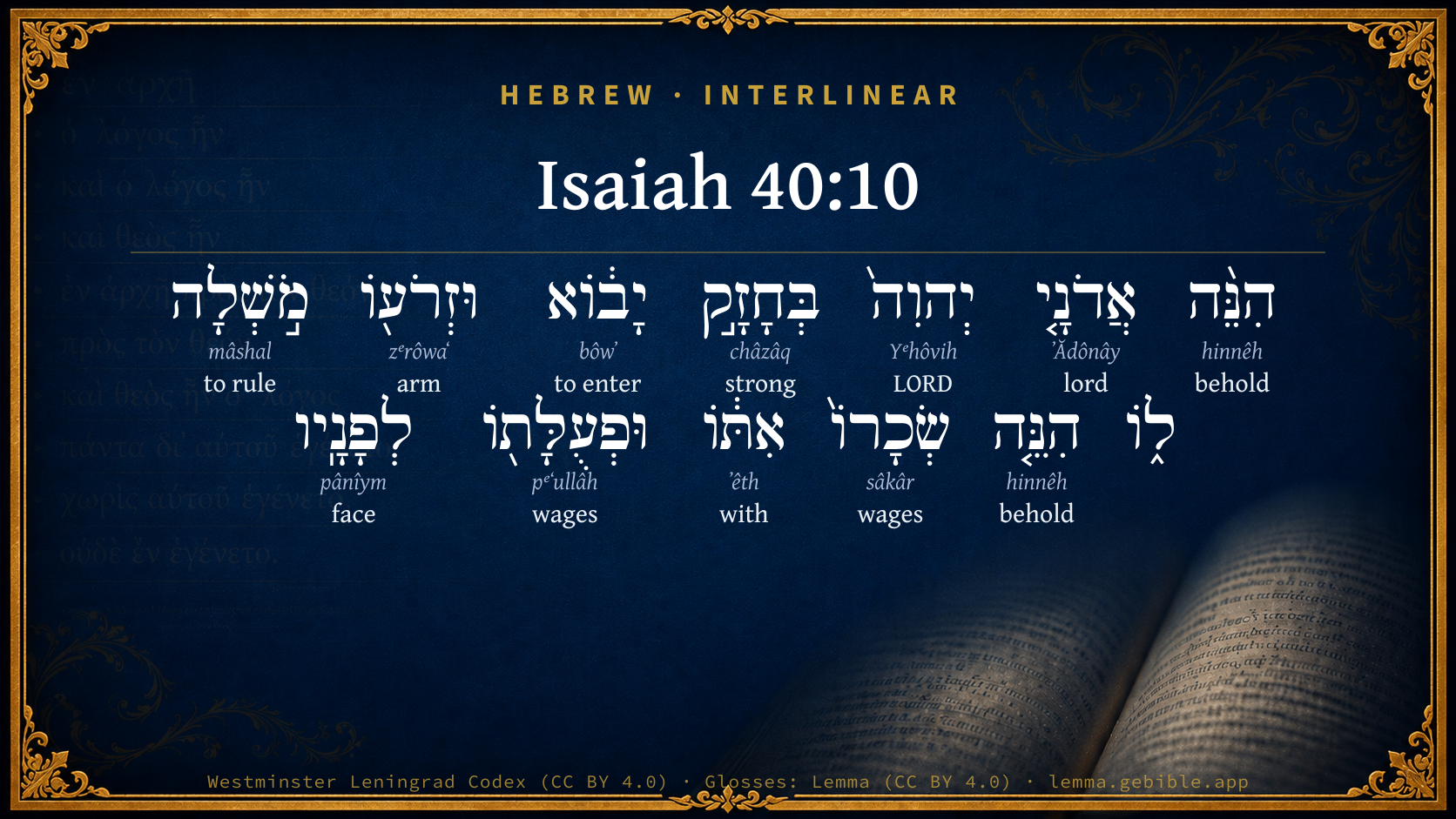
  1. הִנֵּ֨ה hinnêh H2009 “behold” Particle, Demonstrative
  2. אֲדֹנָ֤י ʼĂdônây H136 “Lord · my” Noun, Common, Masculine, Plural, Construct + Suffix, Personal, 1st Person, Common, Singular
  3. יְהוִה֙ Yᵉhôvih H3069 “LORD” Noun, Proper
  4. בְּחָזָ֣ק châzâq H2389 “in/at · strong” Preposition + Adjective, Adjective, Masculine, Singular, Absolute
  5. יָב֔וֹא bôwʼ H935 “to enter” Verb, Qal, Imperfect, 3rd Person, Masculine, Singular
  6. וּזְרֹע֖וֹ zᵉrôwaʻ H2220 “and · arm · his” Conjunction + Noun, Common, Both, Singular, Construct + Suffix, Personal, 3rd Person, Masculine, Singular
  7. מֹ֣שְׁלָה mâshal H4910 “ruling” Verb, Qal, Participle Active, Feminine, Singular, Absolute
  8. הִנֵּ֤ה hinnêh H2009 “behold” Particle, Demonstrative
  9. שְׂכָרוֹ֙ sâkâr H7939 “wages · his” Noun, Common, Masculine, Singular, Construct + Suffix, Personal, 3rd Person, Masculine, Singular
  10. אִתּ֔וֹ ʼêth H854 “with · him” Preposition + Suffix, Personal, 3rd Person, Masculine, Singular
  11. לְפָנָֽיו pânîym H6440 “to/for · face(s) · his” Preposition + Noun, Common, Both, Plural, Construct + Suffix, Personal, 3rd Person, Masculine, Singular

About this verse

These counts appear in no published source. They are computed here, from the morphology-tagged text and Lemma’s own curated glosses. What Lemma adds →

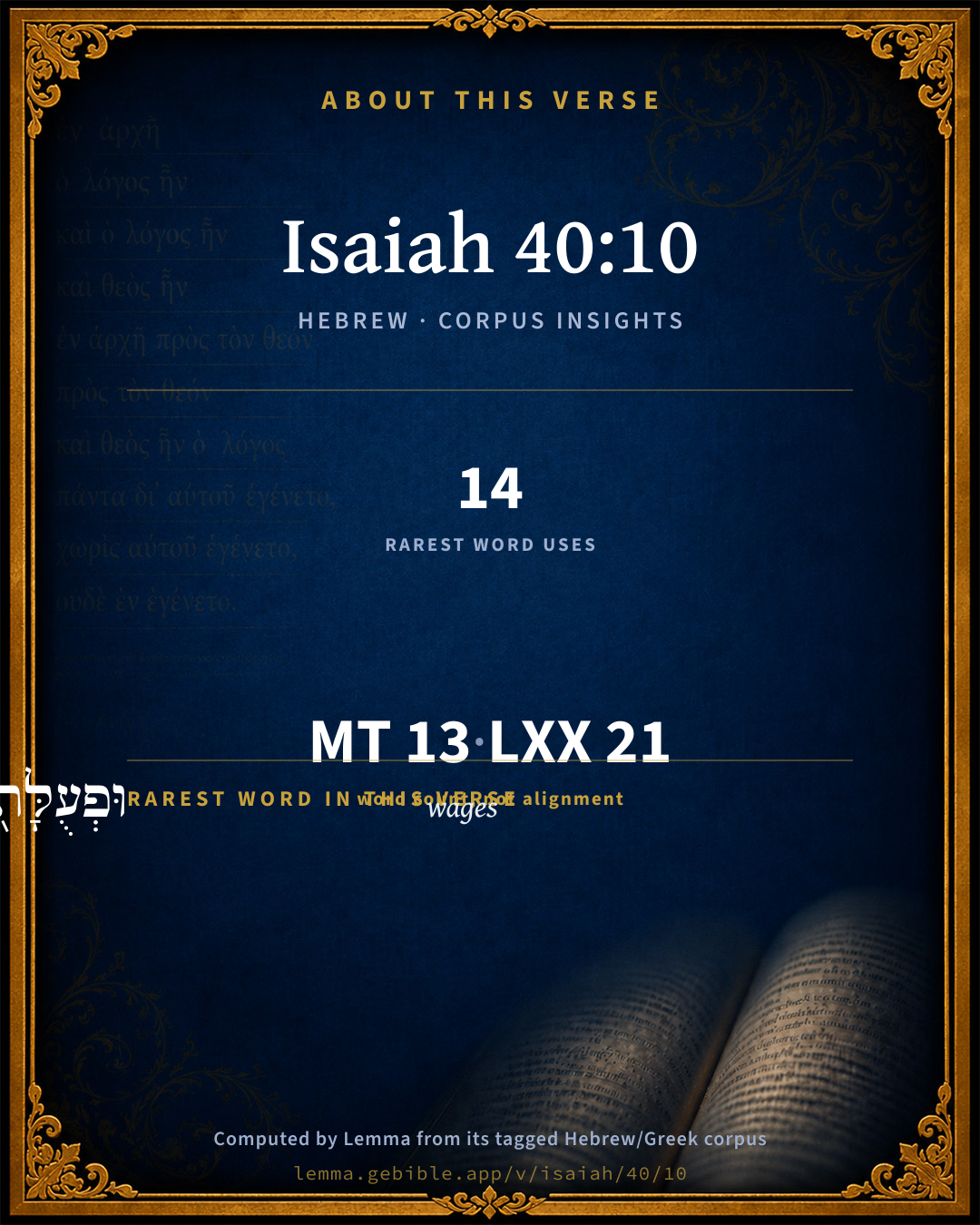
13
words
11
distinct lemmas
Prophets
section

Notable vocabulary

The rarest word here is וּפְעֻלָּת֖וֹ wages H6468 — appearing just 14 times in the whole Hebrew Bible.

Shared distinctive vocabulary

וּפְעֻלָּת֖וֹ wages H6468 occurs in 14 verses of the Hebrew Bible. Also found in:

Grammatical profile

  • 2 verbs
  • 6 nouns
  • 1 adjective
  • 2 prepositions
  • 2 particles

Verb forms

  • יָב֔וֹא Qal · Imperfect
  • מֹ֣שְׁלָה Qal · Participle Active

Repetition

A word recurs within this verse — often emphatic in Hebrew:

  • הִנֵּ֨ה behold H2009 ×2

Hebrew & Septuagint length

In English translation the verse runs 28 words from the Hebrew and 26 from the Septuagint (LXX English) — closely comparable.

A rough comparison of the two English renderings, which tokenize alike — not a word-level alignment.

Word counts can differ between the Hebrew and the Greek without any difference in meaning — e.g. the Hebrew direct-object marker אֵת has no separate Greek word, and Greek often adds the article ὁ.

In the original languages it is 13 Hebrew tokens and 21 Greek tokens — but the two are counted differently (Hebrew bundles its prefixes and suffixes into one token; the Greek is in lemma form), so that isn’t a like-for-like length.

Cross-references

24

Topical passages linked to Isaiah 40:10 in the Treasury of Scripture Knowledge — connected by theme and wording, ordered by reader-vote popularity; previews shown in the World English Bible.

  • Revelation 22:12 "Behold, I come quickly. My reward is with me, to repay to each man according to his work.
  • Isaiah 62:11 Behold, Yahweh has proclaimed to the end of the earth, Say you to the daughter of Zion, Behold, your salvation comes; behold, his reward is with him, and his recompense before him.
  • Revelation 17:14 These will war against the Lamb, and the Lamb will overcome them, for he is Lord of lords, and King of kings. They also will overcome who are with him, called and chosen and faithful."
  • Matthew 28:18 Jesus came to them and spoke to them, saying, "All authority has been given to me in heaven and on earth.
  • Isaiah 49:4 But I said, I have labored in vain, I have spent my strength for nothing and vanity; yet surely the justice [due] to me is with Yahweh, and my recompense with my God.
  • Isaiah 9:6–7 For to us a child is born, to us a son is given; and the government shall be on his shoulder: and his name shall be called Wonderful, Counselor, Mighty God, Everlasting Father, Prince of Peace.
  • Philippians 2:10–11 that at the name of Jesus every knee should bow, of those in heaven, those on earth, and those under the earth,
  • John 12:15 "Don't be afraid, daughter of Zion. Behold, your King comes, sitting on a donkey's colt."
  • Isaiah 59:15–60:22 Yes, truth is lacking; and he who departs from evil makes himself a prey. Yahweh saw it, and it displeased him who there was no justice.
  • Ephesians 1:20–22 which he worked in Christ, when he raised him from the dead, and made him to sit at his right hand in the heavenly places,
  • 1 John 3:8 He who sins is of the devil, for the devil has been sinning from the beginning. To this end the Son of God was revealed, that he might destroy the works of the devil.
  • Psalms 110:6 He will judge among the nations. He will heap up dead bodies. He will crush the ruler of the whole earth.
  • Zechariah 2:8–11 For thus says Yahweh of hosts: 'For honor he has sent me to the nations which plundered you; for he who touches you touches the apple of his eye.
  • Psalms 2:8–9 Ask of me, and I will give the nations for your inheritance, The uttermost parts of the earth for your possession.
  • Psalms 66:3 Tell God, "How awesome are your deeds! Through the greatness of your power, your enemies submit themselves to you.
  • Psalms 110:1–2 Yahweh says to my Lord, "Sit at my right hand, Until I make your enemies your footstool for your feet."
  • Isaiah 49:24–25 Shall the prey be taken from the mighty, or the lawful captives be delivered?
  • Isaiah 53:12 Therefore will I divide him a portion with the great, and he shall divide the spoil with the strong; because he poured out his soul to death, and was numbered with the transgressors: yet he bore the sin of many, and made intercession for the transgressors.
  • John 12:13 they took the branches of the palm trees, and went out to meet him, and cried out, "Hosanna! Blessed is he who comes in the name of the Lord, the King of Israel!"
  • Hebrews 2:14 Since then the children have shared in flesh and blood, he also himself in like manner partook of the same, that through death he might bring to nothing him who had the power of death, that is, the devil,
  • Revelation 2:26–27 He who overcomes, and he who keeps my works to the end, to him I will give authority over the nations.
  • Malachi 3:1 "Behold, I send my messenger, and he will prepare the way before me; and the Lord, whom you seek, will suddenly come to his temple; and the messenger of the covenant, whom you desire, behold, he comes!" says Yahweh of hosts.
  • Revelation 20:11 I saw a great white throne, and him who sat on it, from whose face the earth and the heaven fled away. There was found no place for them.
  • Revelation 19:11–16 I saw the heaven opened, and behold, a white horse, and he who sat on it is called Faithful and True. In righteousness he judges and makes war.

Cross-references courtesy of OpenBible.info (CC BY 4.0).

Hebrew and Greek witnesses Masoretic Hebrew ↔ Greek Septuagint

The same verse in the two great witnesses to the Old Testament, shown verse-for-verse.

These are two independent witnesses, not word-aligned to each other, and the Septuagint is shown in lemma (dictionary) form.

Hebrew Isaiah 40:10 Masoretic · Westminster Leningrad Codex

הִנֵּ֨ה אֲדֹנָ֤י יְהוִה֙ בְּחָזָ֣ק יָב֔וֹא וּזְרֹע֖וֹ מֹ֣שְׁלָה ל֑וֹ הִנֵּ֤ה שְׂכָרוֹ֙ אִתּ֔וֹ וּפְעֻלָּת֖וֹ לְפָנָֽיו

Behold, the Lord Yahweh will come as a mighty one, and his arm will rule for him: Behold, his reward is with him, and his recompense before him.

World English Bible · Public Domain

Greek LXX Isaiah 40:10 Septuagint · lemma form

ἰδού κύριος μετά ἰσχύς ἔρχομαι καί ὁ βραχίων μετά κυριεία ἰδού ὁ μισθός αὐτός μετά αὐτός καί ὁ ἔργον ἐναντίον αὐτός

Behold the Lord! The Lord is coming with strength, and his arm is with power: behold, his reward is with him, and his work before him.

LXX2012 (modern English Septuagint) · Public Domain

On this verse, Keil & Delitzsch discusses the Septuagint’s reading. Read the note in Commentary ↓

Hebrew: Westminster Leningrad Codex (CC BY 4.0). Greek: Septuagint (public domain); English from LXX2012 (modern English Septuagint) (Public Domain). How the Septuagint differs from the Hebrew →

Targum (Aramaic paraphrase)

1

The Targum is the ancient Jewish Aramaic paraphrase of the Hebrew Scriptures — an interpretive translation, not the Hebrew text itself. Onkelos (literal) and Pseudo-Jonathan (expansive) render the Torah, and Jonathan the Prophets. Coverage is partial: where no permissively-licensed English translation exists for a verse, only the Aramaic is shown. This is verse-level text, not a word-by-word alignment to the Hebrew.

  1. Targum Jonathan Prophets (Joshua–Malachi)
    הָא יְיָ אֱלֹהִים בִּתְקוֹף מִתְגְלֵי וּתְקוֹף דְרַע גְבוּרְתֵּהּ שַׁלְטָא קֳדָמוֹהִי הָא אֲגַר עָבְדֵי מֵימְרֵהּ עִמֵהּ דְכָל עוֹבָדֵיהוֹן גְלַן קֳדָמוֹהִי:

    Behold, the Lord God shall be revealed, and the strength of the arm of His might shall rule before Him: behold, the reward of those who perform His word is with Him, because their works are manifest to Him.

    Targum Jonathan — Aramaic: “Mikraot Gedolot” (public domain). English: “Sefaria Community Translation” (CC0 1.0 (public-domain dedication)); “London "Chaldee Paraphrase," 1871” (public domain). Text via Sefaria.

Commentary

Notes on Isaiah 40:10 from classic Christian and Jewish commentators (each source and its license shown beneath its notes). The classic Christian expositions comment on the surrounding passage and are grouped to its opening verse, so a note may address several verses; the Jewish commentaries on the Tanakh (Rashi and others) are per-verse, so they appear only where the commentator wrote on this verse.

Lemma curates 59 commentaries, every one of them public domain or Creative Commons licensed, each selected and text-cleaned for this edition rather than reprinted as found. About our sources →

Trapp's Complete Commentary

John Trapp

Isa 40:10 Behold, the Lord GOD will come with strong [hand], and his arm shall rule for him: behold, his reward [is] with him, and his work before him.

Ver. 10. Behold, the Lord God will come with strong hand.] Or, The Lord God will come against the mighty {a} - i.e., Christ against the devil and his agents, whom he shall vanquish, and give them their due. See 1Jn 3:6 Mat 12:29 Joh 12:31 Col 2:15 Heb 2:14).

And his arm shall rule for him.] Or, His arm shall rule over him - i.e., over Satan.

{a} Piscat., Diod.

John Trapp, A Commentary or Exposition upon All the Books of the Old and New Testament (1647–1656) — public domain. Text from a community e-Sword module.

The Biblical Illustrator

Joseph S. Exell

Isa_40:10-12

Behold, the Lord God will come with strong hand

Power and tenderness

The beauty and peculiarity of these words consist in the combination of the might of Adonai-Jehovah (Isa_40:10), with the gentleness of the Shepherd, carrying in His bosom the weak and weary of the flock (Isa_40:11).

I. Behold your God, FULL OF MIGHT AND MAJESTY (Isa_40:10). To Christ all power has been committed. He is the arm of God (Isa_51:9), the Man of Jehovahs right hand, etc. (Psa_80:17). His name is Immanuel.

II. HE COMBINES WITH THE POWER OF THE VICTORIOUS KING, THE GENTLENESS OF THE TENDER AND LOVING SHEPHERD. He shall feed His flock. That word is a comprehensive one. It means that He shall act all the part of a shepherd towards them; leading them, protecting them, providing alike the green pastures and the still waters, Nay, as if this were not enough, He is beautifully represented as gathering the lambs in His arms;--making a pillow for them in the folds of the loose abbeh, or shepherds mantle, as they nestle close in His bosom. And while thus He deals with the tender lambs, He is equally merciful and considerate not to overdrive their nursing mothers. Exult in this twofold word of comfort, Behold thy King cometh, meek and lowly. Behold your God! Behold your Shepherd!, strong to smite, strong to save. (J. R. Macduff, D. D.)

Characteristics of the great Saviour

These words exhibit to our view some of the most lively characteristics of that illustrious Saviour by whose incarnation our fallen race are become again entitled to that long-lost inheritance which had been forfeited by sin, and by whose redeeming process in their souls they are rendered capable of enjoying it. The illuminated prophet proceeds to point out the personal character of this great Deliverer.

1. Behold! the LORD GOD shall come with strong hand, and His arm shall rule for Him. The mistaken Israelites vainly ascribed to these words a temporal interpretation, and looked for a deliverer whose conquering arm should effectually rescue them from the earthly powers to which they were tributary. But the true children of faithful Abraham wait for the spiritual accomplishment of this prophecy in their hearts; and see and feel the strong hand of their Redeemer in that inward opposition which He raises in their breasts to all the evil desires and corrupt passions of human nature.

2. Behold! His reward is with Him, and His work before Him. This work is no other than the complete deliverance of man from the captivity of sin and Satan. This reward is no other than the glorious acquisition of those lost or wandering souls, who were originally His by creation, and are now doubly so by redemption. The prophet seems to dwell upon the power and majesty of this Deliverer. He represents Him as coming with a strong hand: and indeed, such is usually His first appearance in the sinners heart. David speaks of this first appearance in the most alarming terms: The arrows of the Almighty stick fast in me, and His hand presseth me sore. The first feelings of an awakened and convicted conscience are agonising indeed; for they are the breaking forth of heavens majestic light upon the benighted soul, which shakes nature to her very centre, and discloses every hidden recess to which conscious guilt flies from its approach. But when viewed with composure, and received with cheerfulness, it soon becomes as mild and sweet as the radiance of the risen day after a dark and tempestuous night. Hence it is that in the next verse we find the dignity and majesty of this august Personage sweetly tempered with condescension and love, and melting into heavenly meekness, gentleness, and compassion.

3. He shall feed His flock like a shepherd, etc.

(1) The flock here mentioned can be no other than our whole fallen race, who by virtue of that incorruptible seed that was inspoken into the first Adam, are put into a capacity of regaining eternal life through the redeeming power of Christ, their second Adam.

(2) But though the Shepherds love is thus universal, and all men are the objects of His pastoral care; though they are all His children by redemption, yet all do not alike follow the Shepherd s voice; all are not equally willing to be fed with His bread of life.

(3) Let the humble-minded Christian lift up his head and look up. He need not, as the Psalmist expresses it, run here and there for food; and grudge, because he is not satisfied: the wants he feels, reason, he well knows, cannot supply; the comforts he aspires after, are such as the world cannot give. Wherever his Shepherd leads, he is content to follow: he is sensible of His presence, in darkness as well as in light. The evils by which he is oppressed he is satisfied to bear because his Deliverer is ever at his side. (J. Duche, M. A.)

The magnitude and tenderness of Divine dealings

We find frequent reference in Scripture to the Divine hand, arm, and bosom, by which God is brought the nearer to the level of our comprehension, and within touch of our love and confidence. In these verses there is a striking combination in the use made of these figures.

I. THE MAGNITUDE OF GODS POWER AND RULE. Who hath measured the waters in the hollow of His hand, and meted out heaven with the span? etc. The reference to the Divine hand is essentially human, man being the only creature on Gods earth who has a hand. How wonderful is its construction! It is marvellously adapted for skill, power, and authority. It is that which in happy combination with other endowments gives man dominion over creation. It is his hand which, in more senses than one, sways the sceptre. It is his hand that asserts his royal nature, his power and authority to rule. Again, the arm is that which gives leverage to the hand, and without which the hand would be useless. The hand and arm of God are spoken of here. We read elsewhere that the heavens are the work of His fingers, that in His hands are the deep places of the earth, and that His hands formed the dry land. Here we read, Who hath measured the waters in the hollow of His hand, and meted out heaven with the span? The great Architect and Framer of the universe is represented as forming and adjusting earth, sea, and sky with His hand. This is the graphic representation of the Divine Worker at work. The one implement used is the hand of the Great Worker--its hollow for the seas, its span for the heavens! What sublime poetry descriptive of creative skill! The illustrations are taken from primitive life. The truest poetry comes from primitive simplicity.

1. Who hath measured the waters in the hollow of His hand? What is the sublime truth which this richly figurative speech conveys? One truth at least is the self-sufficiency of God in His creative work. He needed not to go beyond Himself. All creation is the outcome of His own power and skill, independent of the shifts of machinery and tools. When this has been stated, the prophet proceeds to draw other figures from, primitive life in the simplicity of its operations to describe Gods creative work. Comprehended the dust of the earth in a measure that is a tierce, or the third of an ephah. It is the same word as that used in Psa_80:5, Thou givest them tears to drink in great measure. As Delitzsch beautifully expresses it, it is a small measure for the dust of the earth, but a great measure for tears. Weighed the mountains in scales, that is, a steel-yard, that by which the greater loads are weighed; and the hills in a balance--the tradesmans balances which weigh smaller things, but with greater accuracy than the steel-yard. Nothing has been done by haphazard. Every world has been balanced, and the equilibrium of the universe adjusted with infinite wisdom and skill. Astronomical observation leads to this conclusion; Isaiah asserted it with regard to this earth before astronomy was born.

2. So far we have dwelt upon Isaiahs statement of what God had done. Now we notice the prophetic announcement of what God would do. The former refers to His creative power, the latter to His providential rule. The Lord God will come with strong hand, and His arm shall rule for Him. There is here a prediction of a special Divine advent in power, but I take this as typical of all Divine advents and interventions throughout the ages. We have read of the Divine hand in the record of God forming and adjusting the earth, but now we read of the Divine arm in His personal advent and providential rule. There is a Providence as well as a creation. God has not completed His work by His creative skill and power. He worketh hitherto. The hand that formed and adjusted is moved by the arm that rules and governs. It is the arm that wields the hand. The Scriptures abound with emphatic references to the Divine arm. Hast thou an arm like Job_40:9) asked God out of the whirlwind of Job. Thou hast a mighty arm (Psa_89:13), exclaimed the Psalmist; and again, His holy arm hath gotten Him the victory (Psa_98:1). Isaiah wrote, The Lord hath sworn by the arm of His strength (Isa_62:8), and again, Therefore His arm brought salvation (Isa_59:16). In these andsimilar passages the arm of God is the symbol of His power in providential and redemptive works. His arm shall rule for Him,--that is, shall bring all foes submissive, and make all subjects obedient to His sovereignty and command. It is instructive to notice the different names applied to God in the Scriptures to show various aspects of His character and work. Observe the names by which God is called here. The Lord God (Adonai-Jehovah)--a combination of the two greatest names by which God was knownunder the Old Dispensation. The consequent announcement is that of the advent of the Mighty One (R.V.). Yet these words, expressive of power and dominion, are followed by others which have all the tenderness and grace of a pastoral symphony.

II. THE TENDERNESS OF HIS SHEPHERDLY CARE. He shall feed His flock like a shepherd, etc. The hand that meted out the heavens and measured the waters of the deep is that which feeds the flock, and the arm that rules for Him is the arm that gathers the lambs. And carry them in His bosom. Ah! I have not read of His bosom in this context before now. I heard no mention of His bosom when He was spoken of as measuring the waters in the hollow of His hand, and meting out heaven with the span; it is only when the prophet speaks of the lambs that he mentions not only Gods arm but also His bosom. The hollow of His hand is good enough for the waters, His span for the heavens, His arm for His subjects, but only His bosom for the lambs. This is a tenderness specially adapted to the peculiar need. And shall gently lead those that are with young, or. those that give suck (R.V.). The great Shepherd will not forget motherhood with its cares and burdens. God s omnipotence can only be equalled by His compassion. He is not only Almighty, but also Almighty to save. Our God who created the heavens has also lifted up the Cross. (D. Davies.)

The grandeur and pathos of theology

In those words, His arm shall rule for Him, we have the grandeur of theology; but in these words, He shall feed His flock like a Shepherd, we have the pathos of theology. (D. Davies.)

Consolation from the thought of Gods omnipotence

In his autobiography, Goethe tells us that the earthquake in Lisbon fairly stumbled his faith and awakened his alarm at the time when he first heard the news of it. The notion of Divine reliability fell under his suspicion; how could anyone trust a God who would suffer that 70,000 people should be overwhelmed by one awful tide of the ocean, rushing up and back as the earth rose in imperious strength of upheaval; where was His goodness? What might He not do next? The young man was frightened at the manifestation of so much almightiness. Later on in life he saw how fine it was to have for his God a being who could rock the world at His will. (C. S.Robinson, D. D.)

The Biblical Illustrator, edited by Joseph S. Exell (c. 1880s–1900s) — public domain. Text from a community e-Sword module.

Joseph Benson's Commentary

Isa 40:10-11. Behold, the Lord God will come with a strong hand — With invincible strength, to deliver his people from their most powerful enemies; and his arm shall rule for him — His own power shall be sufficient, without any other help, to overcome all opposition. His reward is with him — He comes furnished with recompenses, as well of mercy and blessings for his friends and followers, as of justice and vengeance for his enemies: or, “the reward and the recompense which he bestows, and which he will pay to his faithful servants, he has ready at hand with him, and holds out before him to encourage those who trust in him, and wait for him; and his work before him — He is ready to execute what he hath undertaken; or, he carries on his work effectually; for that is said in Scripture to be before a man which is in his power. He shall feed his flock like a shepherd, &c. — He shall perform all the offices of a tender and faithful shepherd toward his people, conducting himself with great wisdom, condescension, and compassion to every one of them, according to their several capacities and infirmities. And shall gently lead those that are with young — Or, those that give suck, as the word עלות, may be rendered. Bishop Lowth translates the clause, The nursing ewes shall he gently lead; observing, that “it is a beautiful image, expressing, with the utmost propriety, as well as elegance, the tender attention of the shepherd to his flock.”

Joseph Benson's Commentary on the Old and New Testaments (1811–1818) — public domain. Text from a community e-Sword module.

Keil & Delitzsch

C. F. Keil & F. Delitzsch

In Isa 40:10 the prophet goes back from the standpoint of the fulfilment to that of the prophecy. "Behold the Lord, Jehovah, as a mighty one will He come, His arm ruling for Him; behold, His reward is with Him, and His retribution before Him." We must not render the first clause "with strong," i.e., with strength, as the lxx and Targum do. The Beth is Beth essentiae (cf., Isa 26:4; Ges. 154, 3, a). He will come in the essence, strength, and energy of a strong one; and this is still further defined by the participial, circumstantial clause, "His arm ruling for Him" (brachio suo ipsi dominante). It is His arm that rules for Him, i.e., that either brings into subjection to Him, or else overthrows whatever opposes Him. Nevertheless, Isa 40:10 does not present Him merely in one aspect, namely as coming to judge and punish, but in both aspects, viz., that of the law and that of the gospel, as a righteous rewarder; hence the double name of God, Adonai Jehovah (compare Isa 3:15; Isa 28:16; Isa 30:15, all in the first part), which is used even in the Pentateuch, and most frequently by Amos and Ezekiel, and which forms, as it were, an anagram. פּעלּה is already met with in Lev 19:13 as a synonym of שׂכר, passing from the general idea of work to that of something earned and forfeited. Jehovah brings with Him the penal reward of the enemies of His people, and also the gracious reward of the faithful of His people, whom He will compensate for their previous sufferings with far exceeding joys (see Isa 62:11).

Keil & Delitzsch — Biblical Commentary on the Old Testament (1861–1891) — public domain (CC PDM 1.0). Text via the HelloAO Bible API. (Old Testament only.)

Tyndale Open Study Notes

Tyndale Open Resources

40:10 The Lord’s rule is not like that of the unjust and powerless rulers whom he will judge. It is compassionate, just, righteous, and powerful. • with a powerful arm: God manifested his power in events such as the defeat of the Egyptians (63:12), the judgment of his enemies (30:30; 48:14; 51:9), and the rescue of his people (59:16).

Tyndale Open Study Notes — © Tyndale Open Resources, licensed CC BY-SA 4.0. Text via the HelloAO Bible API.

Geneva Bible (1599)

Geneva Bible translators

His power shall be sufficient without help of any other, and shall have all means in himself to bring his will to pass.

Geneva Bible (1599) marginal notes — public domain. Text via Bolls.life.

Jamieson, Fausset & Brown

Robert Jamieson, A. R. Fausset & David Brown

with strong hand--or, "against the strong"; rather, "as a strong one" [MAURER]. Or, against the strong one, namely, Satan (Mat 12:29; Rev 20:2-3, Rev 20:10) [VITRINGA].

arm--power (Psa 89:13; Psa 98:1).

for him--that is, He needs not to seek help for Himself from any external source, but by His own inherent power He gains rule for Himself (so Isa 40:14).

work--or, "recompense for his work"; rather, "recompense which He gives for work" (Isa 62:11; Rev 22:12).

Jamieson, Fausset & Brown — Commentary Critical and Explanatory on the Whole Bible (1871) — public domain (CC PDM 1.0). Text via the HelloAO Bible API.

Adam Clarke's Commentary

Verse 10. His reward is with him, and his work before him. - "His reward is with him, and the recompense of his work before him."] That is, the reward and the recompense which he bestows, and which he will pay to his faithful servants; this he has ready at hand with him, and holds it out before him, to encourage those who trust in him and wait for him.

Adam Clarke's Commentary on the Bible (1810–1826) — public domain. Text from a community e-Sword/MySword module.

Ellicott's Commentary for English Readers

(10) The Lord God.—Adonai Jehovah; each word commonly translated Lord. The combination is characteristic both of 1 and 2 Isaiah (Isa_3:15; Isa_28:16; Isa_30:15).

With strong hand.—Literally, with, or in strength of hand, as the essence of His being. The “arm” of the Lord is a favourite phrase of Isaiah (Isa_51:5; Isa_51:9; Isa_52:10) for His power.

His reward is with him . . .—The noun “work” has also the sense of recompense for the faithful worker (Lev_19:13; Deu_24:15, and is rightly taken in that sense here and in Isa_62:11).

A Bible Commentary for English Readers, edited by Charles John Ellicott (1878–1897) — public domain. Text from a community e-Sword module.

The Cambridge Bible for Schools and Colleges

gen. ed. J. J. S. Perowne

10. with strong hand] R.V. as a mighty one; lit., “in (the capacity of) a strong one” (Bêth essentiae). The chief ancient versions vocalised the word as an abstract noun bìhôzeq (“with strength”), which yields an even better sense. and his arm shall rule] or His arm ruling;—the “arm,” the symbol of strength.

For work render recompence (as R.V.) (see Lev_19:13). The idea is somewhat uncertain. It might mean, (1) the reward (lit. “hire”) which Jehovah has earned by His victory over the Chaldæans, in which case the redeemed exiles themselves are the reward, which He brings with Him through the desert (Isa_40:11). Or (2) it may refer to the reward which Jehovah is prepared to bestow on His people,—the blessings of His salvation. The last is perhaps the better sense, and is supported by the similar passage, ch. Isa_62:11.

10, 11. These words are spoken by the prophet in his own person.

The Cambridge Bible for Schools and Colleges (gen. ed. J. J. S. Perowne; Cambridge University Press, 1878–1918) — public domain. Text from a community e-Sword module.

John Gill's Exposition

Behold, the Lord God will come with a strong hand,.... Some understand this of the second coming of Christ, which coming is certain, such assurances being given of it by promise and prophecy; and will be attended with power, which will be requisite to raise the dead, summon all nations before him, and pass and execute the proper sentence on them; when his arm shall openly bear rule, he will take to himself his great power, and reign; when his reward will be with him, to give to every man according to their works; and his own work will be before him, to judge the world in righteousness: see Rev 22:12, but it is more agreeable to the context, which foretells the coming of John the Baptist, points out the ministers of the Gospel, and describes Christ in his office, as a shepherd feeding his flock, to understand it of his first coming; for not God the Father, but the Son of God, is meant by the Lord God, who is truly God, and so able to save, and which was the end of his coming. He is said to come "with a strong hand", or with great power, which his work required; which was to fulfil the law, satisfy divine justice, atone for sin, grapple and conflict with innumerable enemies, undergo the death of the cross, bear the curse of the law, and the wrath of God, and all in order to obtain eternal redemption for his people; for this he came from heaven to earth, not by change of place, but by assumption of nature. Some render it, "against a strong one" (p); the strong man armed, the devil, whose head he came to break, whose works he came to destroy, with whom he fought, and whom he conquered and destroyed. Jarchi's note is,

"against the wicked, to take vengeance on them;''

but Aben Ezra and Kimchi supply the word hand, as we do:

and his arm shall rule for him; or he shall have sufficient power of himself to do the work he comes about; his own arm or power wrought salvation for him and for his people; see Isa 63:5. Some render it, "over him (q)"; that is, over the strong and mighty one, against whom he came, whom he conquered, subdued, and ruled over:

behold, his reward is with him; to give to those that trust in him, as Kimchi; or to those that do his word, as the Targum; that believe in him, embrace his Gospel, and act according to it: or this may respect his own reward, which should follow his work; which he was as sure of as if it was in his hands; namely, his exaltation in his human nature, his glory with his Father, and the enjoyment of his spiritual seed to all eternity:

and his work before him; the work of redemption and salvation, which he was called unto, sent to do, and which, being given him, he agreed to do, was very toilsome and laborious, yet he took great delight in it, and has finished it; this is said to be "before him", being proposed in council, and cut out in covenant for him, was well known unto him, and in his power to effect, and what he could easily do, and did. The Targum understands this of the works of men being before him, for whom he has a reward.

(p) "contra robustum", Junius & Tremellius, Piscator, Vitringa. (q) "in illum", ibid.

John Gill's Exposition of the Whole Bible (1746–1763) — public domain (CC PDM 1.0). Text via the HelloAO Bible API.

Albert Barnes' Notes on the Bible

Behold, the Lord God will come - (See the note at Isa 40:3) Applied to the condition of the Jews in exile, this means that God would come to deliver them. Applied to the times of the Messiah, it means that God would manifest himself in a powerful manner as mighty to save.

With strong hand - (בחזק bechâzâq). Margin, ‘Against the strong.’ So Vitringa and others understand it; and regard it as referring to the mighty enemies of the people of God, or, as Vitringa particularly supposes, to the great foe of God and his people - the prince of darkness - the devil. Lowth also translates it in this manner, ‘Against the strong one.’ The Septuagint renders it, Μετά ἰσχύος Meta ischuos - ‘With strength.’ This is the more probable meaning - that the Lord would come with the manifestation of strength and power, able to subdue and vanquish all the enemies of his people, and to effect their complete and final salvation.

And his arm - The arm is a symbol of strength, because it is by that that we accomplish our purposes; by that a conqueror slays his enemies in battle, etc. Thus, ‘Break thou the arm of the wicked;’ that is, diminish or destroy his power Psa 10:15. ‘I have broken the arm of Pharaoh king of Egypt’ (Eze 30:21; compare Jer 48:25). Thus it is said of God, ‘Thou hast a mighty arm’ Psa 89:13, and, ‘His holy arm hath gotten him the victory’ (Psa 98:1; compare Exo 6:6). The metaphor is taken from the act of stretching out the arm to fight in battle, where the arm is the effective instrument in subduing an enemy.

Shall rule for him - Lowth renders the phrase, לו lō, ‘for him,’ ‘over him:’ - ‘And his arm shall prevail over him;’ that is, over the strong and mighty foe. The Septuagint renders it, Μετά κυρίας Meta kurias - ‘With dominion.’ But the meaning seems to be, ‘God is mighty by himself; his power resides in his own arm; he is not dependent on others; he will accomplish the deliverance in such a manner that it shall be seen that he did it alone; and he shall rule for himself, without any aid, and so that it shall be manifest that he is the sovereign.’ In the deliverance of his people from their captivity, he so directed it, that it was manifest that he was their deliverer and sovereign; and in the redemption of man, the same thing is apparent, that the arm of God effects the deliverance, and that it is his own power that establishes the dominion.

Behold, his reward is with him - He will be ready to confer the appropriate reward on his own people. The idea seems to be taken from the custom of a conqueror, who distributes rewards among his followers and soldiers after a signal victory. This was always done in ancient wars, apparently because it seemed to be an act of justice that those who had gained the victory should share also in the result, and this participation of the booty was a stimulus to future effort, as well as a compensation for their valor. The rewards distributed consisted generally of that which was taken from the conquered; gold, and silver, and raiment, as well as captives or slaves (see Gen 49:7; Exo 15:9; 1Sa 30:26; and particularly Jdg 5:30):

Have they not sped?

Have they not divided the prey;

To every man a damsel or two’;

To Sisera a prey of divers colors,

A prey of divers colors of needle-work,

Of divers colors of needle-work on both sides,

Meet for the necks of them that take the spoil.

The idea here is -

1. That Yahweh would bestow appropriate rewards on his people.

2. That they would be conferred on his coming, and not be delayed.

3. That it should be done by the hand of God himself.

This language was applicable to the interposition of God to save his people from their long exile, and the ‘reward’ would be ample in the restoration to their own land, and the re-establishment of his worship. It is applicable in a higher sense to the coming of the Messiah to bless the world. His reward was with him. He blessed his faithful followers on earth; he will bless them more abundantly in heaven. It will be assuredly applicable to him when he shall come to gather his people to himself in the great and last day, and the language before us is used with reference to that: ‘And behold, I come quickly; and my reward is with me, to give every man according as his work shall be’ Rev 22:12.

And his work - Margin, ‘Recompense for his work.’ The margin here is the correct rendering. The Hebrew word strictly indeed denotes work, labor, business; but it also denotes the wages for work Lev 19:13; Psa 109:20.

Albert Barnes' Notes on the Bible (1834–1885) — public domain. Text from a community e-Sword/MySword module.

Haydock's Catholic Bible Commentary

Him. Christ will reward and punish, Jeremias xxxi. 16., and Luke ii. 34.

George Leo Haydock (1774–1849), Haydock's Catholic Family Bible and Commentary, 1859 edition — public domain. Excludes Psalms (Douay-Rheims chapter numbering differs from Protestant) and Deuterocanonical books (Catholic canon only).

Matthew Poole's English Annotations

With strong hand; with invincible strength, conquering all his enemies. The word hand or arm may very well be understood out of the following clause.

His arm shall rule for him; he shall need no succours, for his own power shall be sufficient to govern his people, and to destroy his adversaries.

His reward is with him; he comes furnished with recompences, as well of mercy and blessings for his friends and followers, as of justice and vengeance for his enemies.

His work before him; he carrieth on his work or design effectually, so as none can hinder him; for that is said in Scripture to be before a man which is in his power, as Gen 20:15; 24:51, &c. Or work is here put for the reward of the work, as it is Isa 49:4; 65:7, and elsewhere. And so the same thing is repeated in other words, as is very usual.

Matthew Poole's English Annotations on the Holy Bible (1683–1685) — public domain. Text from a community e-Sword/MySword module.

Whedon's Commentary on the Bible

Daniel D. Whedon

10, 11. Behold — Serious attention is again challenged. Amplification of last words in preceding verse.

With strong hand — The Lord is coming “against the strong,” (see margin;) — soon his great power shall appear — “hand” is evidently implied, and is in itself the symbol of power: “strong hand” is extra power. “Behold” him and trust in him. He is, as it were, commended here as a trustful and safe leader to his returning people; as himself the Almighty Strongest One, and will show himself to be such. Adversaries, earthly or spiritual, shall not stand before him.

His reward — “Reward,” taken in a good sense, is freely to be bestowed on his purified ones returning from exile.

His work — Taken in an evil sense, “his work” is to be exercised in the way of punishing those who antagonize him. Though absolutely strong, and a powerful ruler, he is gentle as a tender shepherd to the weak and dependent of the flock which he is to conduct across the arid wastes to Jerusalem and Zion.

Lambs — Children.

With young — Tender women soon to be mothers, or who have lately become such. How beautiful the image!

The theory respecting the turn which the thought now takes (Isa_40:12-26) is that of Nagelsbach, and it is one most easy to approve. It is this: “The exceedingly comforting introduction, (Isa_40:1-11,) does not at once cheer up Israel. Doubts arise. Is the Lord in earnest when he promises? and, Can he do it? Shall He that did not uphold us when we stood, lift us up again when we have fallen?” The thought is, God’s infinite incomparableness with any other being possible to conceive of; and hence his infinite ability and willingness to do what he promises leave no ground for doubt.

Daniel D. Whedon (gen. ed.), Commentary on the Old and New Testaments (1874–1909) — public domain. Text from a community e-Sword module.

The Pulpit Commentary

The Lord God; literally, the Lord Jehovah. With strong hand; or, with strength. His arm shall rule for him. Kay translates, "His arm shall get him rule;" i.e. the manifestation, which he shall make of his power, shall cause his kingdom to be extended far and wide upon the earth. "The Lord"s arm," "the Lord"s hand," are favourite expressions of Isaiah"s. (Isa_5:25 Isa_9:12 Isa_10:4 Isa_11:11 Isa_31:3 Isa_51:9 Isa_53:1 62:3, etc.) His reward is with him, and his work before him; rather, his wage is with him, and his recompense before him a case of synonymous parallelism. The phrase is repeated in Isa_62:11. Mr. Cheyne understands "the reward which God gives to his faithful ones" to be meant. But perhaps it is better to understand, with Dr. Kay, that in the "little flock" which he restores to Palestine God finds his own reward and recompense the compensation for all his care and trouble.

Present reward.

"His reward is with him." There is a glory to be revealed. There is a day of the manifestation of the sons of God a day of august solemnity, when the King shall say, "Come, ye blessed." But the Christian dispensation is not fairly represented when its rewards and punishments are declared to be future only. These words speak of a present reward.

I CHRIST JESUS HAD HIS REWARD HERE. SO says the prophet, speaking here of Christ. And the apostle says, "For the joy set before him he endured the cross;" and Jesus gives this legacy to his disciples: "My joy." We are apt to think of Jesus only as the "Man of sorrows." And so our artists have painted him. In their pictures there is often no light of triumph in his eye. How he went about doing good! What a reward it was, every day to comfort the mourner and to heal the broken-hearted! Think of all that Jesus said in the synagogue of Nazareth that he came to do, and you will understand that beneath this sorrow and suffering there was a still deeper joy. His reward was with him. So it was, even on the cross, strange as that may appear. Still the prophet says," When thou shall make his soul an offering for sin, he shall see his seed,... the pleasure of the Lord shall prosper in his hand. He shall see of the travail of his soul, and be satisfied.

II CHRISTIAN EXPERIENCE ENDORSES THIS TRUTH. The Christian"s reward is with him. True duty is not discharged for the sake of reward. Men in this world never get happiness by seeking for it alone. It must come, not as an end, but as an accompaniment of duty. Besides, we should be open to the criticism that the gospel appealed to selfishness if we invited men and women to become Christians for the sake of heaven. No; we invite them to take up their cross and follow him, and therein they will find their reward. Strange as it may seem, they too will find blessedness where they least expected it in doing the will of God; and then heaven will come as the culmination and perfection of sacrificial and spiritual life. W.M.S.

The Pulpit Commentary (1880–1919), ed. H.D.M. Spence-Jones & Joseph S. Exell — public domain. Text from a community e-Sword module.

John Wesley's Explanatory Notes

His arm - He shall need no succors, for his own power shall be sufficient to govern his people, and to destroy his adversaries. His reward - He comes furnished with recompences as well of blessings for his friends, as of vengeance for his enemies. His work - He carries on his work effectually: for that is said in scripture to be before a man which is in his power.

John Wesley, Explanatory Notes Upon the Whole Bible (1754–1765) — public domain. Text via the GEBible commentary corpus.

J. A. Alexander on Isaiah

Joseph Addison Alexander

“Lo, the Lord Jehovah will come (or is coming) in (the person of) a strong one, and His arm (is) ruling for Him. Lo, His hire is with Him and His wages before Him. The double ‘lo’ represents the object as already appearing or in sight. What God is said to do Himself in one case, He is represented in the other as accomplishing by means of a powerful instrument or agent, which, however, is defined no further. The essential meaning is that Jehovah was about to make a signal exhibition of His power. The participle ruling, in the next clause, is expressive of continuous action. The clause is a poetical description of the arm as acting independently of its possessor, and as it were in His behalf. The two verses may be readily connected, without any change of figure, by supposing that the lost sheep which He has recovered are the recompense referred to in the verse before us. Thus understood, the passage may have furnished the occasion and the basis of our Savior’s beautiful description of Himself as the true shepherd, who lays down His life for the sheep, as well as the figure drawn from the recovery of a lost sheep to illustrate the rejoicing in heaven over one repentant sinner. It is probable, not only that Jehovah is here represented as receiving a reward, but that there is special reference to the recompense of the Messiah’s sufferings and obedience by the redemption of His people. According to the view which has been taken of the nexus between these two verses, ‘before Him’ may possibly contain an allusion to the shepherd’s following his flock; but it admits of a more obvious and simple explanation, as denoting that His recompense is not only sure but actually realized, being already in His sight or presence, and with Him, (i.e., in immediate possession).

Joseph Addison Alexander, The Prophecies of Isaiah (1846–1847; New York: Scribner, 1870–1878) — public domain. Text from a community e-Sword module.

Rashi

Rabbi Shlomo Yitzchaki (Rashi)

shall come with a strong [hand] to mete out retribution upon the heathens. ([Mss. read:] Upon the nations.)

behold His reward is with Him It is prepared with Him for the righteous.

and His recompense [lit. His deed,] the recompense for the deed, which He is obliged to give them.

Rashi on the Tanakh — English translations: “The Judaica Press complete Tanach with Rashi, translated by A. J. Rosenberg” (CC BY 4.0); “Pentateuch with Rashi's commentary by M. Rosenbaum and A.M. Silbermann, 1929-1934” (public domain); “The Metsudah Tanach series, Lakewood, N.J” (CC BY 4.0); and “The Book of Joshua, Metsudah Publications, 1997” (CC BY 4.0). Text via Sefaria.

Ibn Ezra

Rabbi Abraham ibn Ezra

בחזק With strong hand, יד hand is to be supplied; as to the use of יד as a masculine noun, comp. Ez. 2:9.

שכרו His reward, that is, the reward which He will give to him that hopes for Him. ופעלתו And his wages. Comp. פעלת שכיר the wages of him that is hired; פעלה lit. work signifies also the wages for the work.—I think that this explanation is not supported by the context, and that the sense of the sentence is: God does not ask for any wages; He is not like a hired shepherd, but כרעה עדרו (next verse) like one, that feeds his own flock.

Ibn Ezra on the Tanakh — English translations: “Sefaria Community Translation” (CC0 1.0 (public-domain dedication)); “Yalkut, Sifsei Chachomim Chumash, Metsudah Publications, 2009” (CC BY 4.0); and “Commentary of Ibn Ezra on Isaiah - trans. by M. Friedlander, 1873” (public domain). Text via Sefaria.

Lesson kit

Teaching starters — assembled from the data on this page, not authored interpretation. Every prompt links to the verse data it draws on. Edit before teaching.

Isaiah, in the Prophets, opens this verse with 13 words (11 distinct Hebrew lemmas). Its most distinctive word is pᵉʻullâh (“wages”). A historical commentator’s framing appears above. Read the whole chapter for the surrounding context.

Discussion questions

  1. The word pᵉʻullâh carries the sense “wages.” How does it shape the verse?
  2. Leviticus 19:13 shares the word «wages» with this verse. How do the two illuminate each other?
  3. “behold” occurs 2× in this one verse. What is the effect of the repetition?
  4. These translations render this verse differently; the difference is in the English rendering, not the original. What questions does that raise?
  5. The verb «יָב֔וֹא» is Qal Imperfect. How does its form color the action?
  6. Reading how Trapp's Complete Commentary and The Biblical Illustrator read this verse, where do the two commentators agree and where do they part?

Things to notice

Reading settings

Reading text

Shown beneath each verse's original-language words.

Old Testament
Old Testament edition

Read the OT as the Masoretic Hebrew (MT) or the Greek Septuagint (LXX).

English shown for the Greek Septuagint (in the Hebrew ↔ Greek comparison).

Comparing translations? Open the Compare panel on any verse page to stack up to four side by side.