
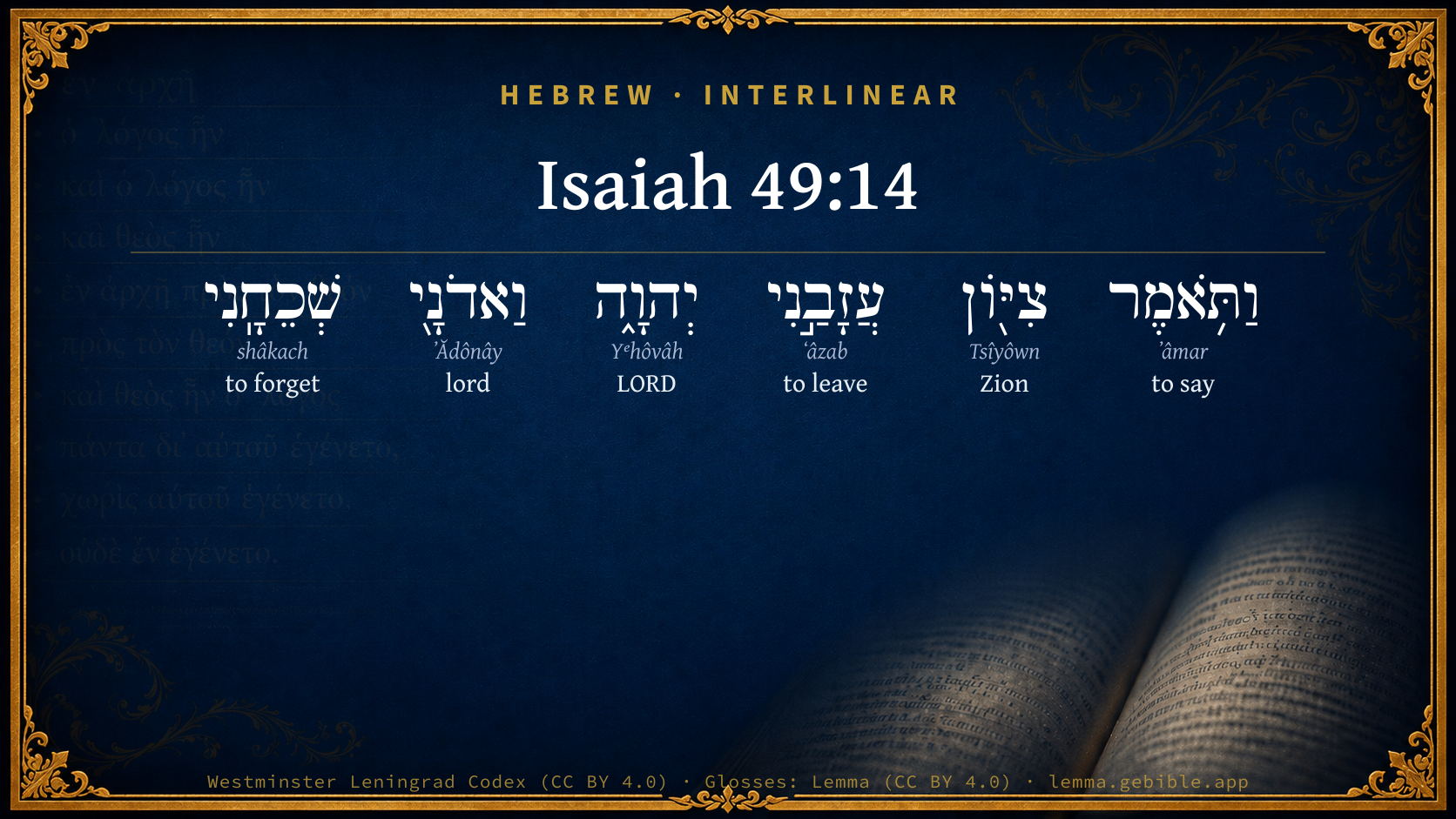
Isaiah 49:14

Hebrew (Westminster Leningrad Codex) Isaiah 49:14 appears in the Hebrew Old Testament. The text above is from the Westminster Leningrad Codex. Each word links to its Strong’s number, a concise gloss, and parsing drawn from the Open Scriptures Hebrew Bible morphology. Click any word for its full Brown-Driver-Briggs (BDB) entry.
Download image
Cite this verse

Isaiah 49:14 (World English Bible). Public Domain. Lemma interlinear Bible study tool, https://lemma.gebible.app/v/isaiah/49/14.

Show BibTeX & RIS
BibTeX
RIS
English Translation
But Zion said, Yahweh has forsaken me, and the Lord has forgotten me.
World English Bible · Public Domain
Download a study sheet

One document with this verse’s original text, its word-by-word gloss line, the meaning frame, cross-references with their text, attributed commentary, and full source and license credits — printable, and it pastes into notes with its structure intact.

This verse Autodidact and up

Study sheet (.html) Plain text (.txt)

A passage Seminary Student

Up to 50 verses in one chapter. A passage sheet keeps up to 6 commentary sources and 12 cross-references per verse, in the order this page ranks them, and says so on the sheet whenever that leaves anything out. Ask for a single verse and you get the Autodidact verse sheet above.

Everything on this page stays free to read, with no account — the sheet is a download of what is already on screen, not access to it.

Want to remove ads? Support Godless Engineer
Compare translations 3

The same verse in 3 English versions, stacked beneath the original-language interlinear above. Click any original word for its lexicon entry.

Each is an independent rendering of the whole verse — the interlinear is not word-aligned to these translations.

Highlighted words mark where these versions differ — a whole-verse word diff, not a word-by-word alignment.

  • World English Bible Public Domain
    But Zion said, Yahweh has forsaken me, and the Lord has forgotten me.
  • King James Version Public Domain
    But Zion said, The LORD hath forsaken me, and my Lord hath forgotten me.
  • unfoldingWord Literal Text CC BY-SA 4.0
    But Zion says, “Yahweh has forsaken me, and the Lord has forgotten me.” q1

unfoldingWord Literal Text — © unfoldingWord, licensed CC BY-SA 4.0. Word-aligned USFM3 via Door43 (git.door43.org/unfoldingWord/en_ult).

Versions to compare (up to 4)

3 of 4 selected

Show all 18 translations

Every available English version of this verse, each an independent rendering of the whole verse.

  • World English Bible Public Domain
    But Zion said, Yahweh has forsaken me, and the Lord has forgotten me.
  • Berean Standard Bible Public Domain
    But Zion said, “The LORD has forsaken me; the Lord has forgotten me!”
  • Majority Standard Bible Public Domain
    But Zion said, “The LORD has forsaken me; the Lord has forgotten me!”
  • King James Version Public Domain
    But Zion said, The LORD hath forsaken me, and my Lord hath forgotten me.
  • American Standard Version (1901) Public Domain
    But Zion said, Jehovah hath forsaken me, and the Lord hath forgotten me.
  • Revised Version (1885) Public Domain
    But Zion said, Jehovah hath forsaken me, and the Lord hath forgotten me.
  • Geneva Bible (1599) Public Domain
    But Zion saide, The Lord hath forsaken me, and my Lord hath forgotten me.
  • Douay-Rheims (1899) Public Domain
    And Sion said: The Lord hath forsaken me, and the Lord hath forgotten me.
  • Young's Literal Translation Public Domain
    And Zion saith, `Jehovah hath forsaken me, And my Lord hath forgotten me.'
  • Literal Standard Version CC BY-SA 4.0
    And Zion says, “YHWH has forsaken me, || And my Lord has forgotten me.”
  • Unlocked Literal Bible CC BY-SA 4.0
    But Zion said, “Yahweh has forsaken me, and the Lord has forgotten me.”
  • unfoldingWord Literal Text CC BY-SA 4.0
    But Zion says, “Yahweh has forsaken me, and the Lord has forgotten me.” q1
  • Darby Bible Public Domain
    But Zion said, Jehovah hath forsaken me, and the Lord hath forgotten me.
  • World Messianic Bible Public Domain
    But Zion said, “The LORD has forsaken me, and the Lord has forgotten me.”
  • Webster's Bible Public Domain
    But Zion said, The LORD hath forsaken me, and my Lord hath forgotten me.
  • Free Bible Version CC BY-SA 4.0
    But Zion said, “The Lord has given up on me; the Lord has forgotten about me.”
  • Bible in Basic English Public Domain
    But Zion said, The Lord has given me up, I have gone from his memory.
  • JPS Tanakh (1917) Public Domain
    But Zion said: 'The LORD hath forsaken me, and the Lord hath forgotten me.'

Literal Standard Version (2020), Covenant Press — licensed CC BY-SA 4.0. Text via the HelloAO Bible API (eBible.org). Unlocked Literal Bible (unfoldingWord) — licensed CC BY-SA 4.0. Text via the HelloAO Bible API (eBible.org). unfoldingWord Literal Text — © unfoldingWord, licensed CC BY-SA 4.0. Word-aligned USFM3 via Door43 (git.door43.org/unfoldingWord/en_ult). Free Bible Version, Dr. Jonathan Gallagher — licensed CC BY-SA 4.0. Text via the HelloAO Bible API (eBible.org).

Word by word

More ways to search: Search by grammar → Find every occurrence → Compare this word →

Practice this passage: Drill this verse → Learn its vocabulary →

About this verse

These counts appear in no published source. They are computed here, from the morphology-tagged text and Lemma’s own curated glosses. What Lemma adds →

6
words
6
distinct lemmas
Prophets
section

Grammatical profile

  • 3 verbs
  • 3 nouns

Verb forms

  • וַתֹּ֥אמֶר Qal · Sequential Imperfect
  • עֲזָבַ֣נִי Qal · Perfect
  • שְׁכֵחָֽנִי Qal · Perfect

Hebrew & Septuagint length

In English translation the verse runs 13 words from the Hebrew and 14 from the Septuagint (LXX English) — closely comparable.

A rough comparison of the two English renderings, which tokenize alike — not a word-level alignment.

Word counts can differ between the Hebrew and the Greek without any difference in meaning — e.g. the Hebrew direct-object marker אֵת has no separate Greek word, and Greek often adds the article ὁ.

Cross-references

9

Topical passages linked to Isaiah 49:14 in the Treasury of Scripture Knowledge — connected by theme and wording, ordered by reader-vote popularity; previews shown in the World English Bible.

  • Isaiah 40:27 Why say you, Jacob, and speak, Israel, My way is hid from Yahweh, and the justice [due] to me is passed away from my God?
  • Romans 11:1–5 I ask then, Did God reject his people? May it never be! For I also am an Israelite, a descendant of Abraham, of the tribe of Benjamin.
  • Psalms 22:1 My God, my God, why have you forsaken me? Why are you so far from helping me, and from the words of my groaning?
  • Psalms 31:22 As for me, I said in my haste, "I am cut off from before your eyes." Nevertheless you heard the voice of my petitions when I cried to you.
  • Psalms 89:38–46 But you have rejected and spurned. You have been angry with your anointed.
  • Jeremiah 23:39 therefore, behold, I will utterly forget you, and I will cast you off, and the city that I gave to you and to your fathers, away from my presence:
  • Lamentations 5:20 Why do you forget us forever, [And] forsake us so long time?
  • Psalms 13:1 How long, Yahweh? Will you forget me forever? How long will you hide your face from me?
  • Psalms 77:6–9 I remember my song in the night. I consider in my own heart; My spirit diligently inquires:

Cross-references courtesy of OpenBible.info (CC BY 4.0).

Hebrew and Greek witnesses Masoretic Hebrew ↔ Greek Septuagint

The same verse in the two great witnesses to the Old Testament, shown verse-for-verse.

These are two independent witnesses, not word-aligned to each other, and the Septuagint is shown in lemma (dictionary) form.

Hebrew Isaiah 49:14 Masoretic · Westminster Leningrad Codex

וַתֹּ֥אמֶר צִיּ֖וֹן עֲזָבַ֣נִי יְהוָ֑ה וַאדֹנָ֖י שְׁכֵחָֽנִי

But Zion said, Yahweh has forsaken me, and the Lord has forgotten me.

World English Bible · Public Domain

Greek LXX Isaiah 49:14 Septuagint · lemma form

εἶπον δέ σιων ἐν καταλείπω ἐγώ κύριος καί ὁ κύριος ἐπιλανθάνω ἐγώ

But Sion said, The Lord has forsaken me, and, The Lord has forgotten me.

LXX2012 (modern English Septuagint) · Public Domain

Hebrew: Westminster Leningrad Codex (CC BY 4.0). Greek: Septuagint (public domain); English from LXX2012 (modern English Septuagint) (Public Domain). How the Septuagint differs from the Hebrew →

Targum (Aramaic paraphrase)

1

The Targum is the ancient Jewish Aramaic paraphrase of the Hebrew Scriptures — an interpretive translation, not the Hebrew text itself. Onkelos (literal) and Pseudo-Jonathan (expansive) render the Torah, and Jonathan the Prophets. Coverage is partial: where no permissively-licensed English translation exists for a verse, only the Aramaic is shown. This is verse-level text, not a word-by-word alignment to the Hebrew.

  1. Targum Jonathan Prophets (Joshua–Malachi)
    וַאֲמַרֵת צִיוֹן סַלֵיק שְׁכִינְתֵּהּ יְיָ מִנִי וַיָי רַחֲקָנִי:

    But Zion said, The Lord hath taken His Shekinah from me, and the Lord hath cast me away.

    Targum Jonathan — Aramaic: “Mikraot Gedolot” (public domain). English: “Sefaria Community Translation” (CC0 1.0 (public-domain dedication)); “London "Chaldee Paraphrase," 1871” (public domain). Text via Sefaria.

Commentary

Notes on Isaiah 49:14 from classic Christian and Jewish commentators (each source and its license shown beneath its notes). The classic Christian expositions comment on the surrounding passage and are grouped to its opening verse, so a note may address several verses; the Jewish commentaries on the Tanakh (Rashi and others) are per-verse, so they appear only where the commentator wrote on this verse.

Lemma curates 59 commentaries, every one of them public domain or Creative Commons licensed, each selected and text-cleaned for this edition rather than reprinted as found. About our sources →

The Cambridge Bible for Schools and Colleges

gen. ed. J. J. S. Perowne

14. But Zion said] Zion is the city of Jerusalem personified (cf. Isa_49:16) and, by a common O.T. figure, conceived as the mother of the citizens (see further on Isa_49:21). This is no doubt the primary reference of the figure, but since the city derives its religious significance from its being the centre of the national life, Zion really represents the nation of Israel, as in ch. Isa_40:2. Hence the complaint of this verse is the same as was previously heard from the lips of Israel (ch. Isa_40:27).

my Lord] Better, as R.V. the Lord. The word when pointed, as here (’Adônâi), is always equivalent to Jehovah. The suggestion that it may be used in the sense of “husband” (as Gen_18:12) would demand a different vocalisation (’Adônî). But although the idea of Jehovah as the husband of Zion was undoubtedly present to the prophet’s mind (Isa_50:1, Isa_54:6) it does not emerge in this verse.

Ch. Isa_49:14 to Isa_50:3. The Consolation of Zion

(i) Isa_49:14-21. In an apostrophe to Jerusalem the prophet announces the speedy return of her population and the rebuilding of her waste places. The poetry of the passage is singularly beautiful, and charged with tender emotion. Zion, the idealised city, is the wife of Jehovah, and the mother of her inhabitants. Although she now thinks of herself as rejected and barren (Isa_49:14), she is assured of the unchanging love of her God (Isa_49:15-16) which will soon be manifested in her restoration to the joy of motherhood (17–20). The ecstasy of amazement and delight with which she recognises and welcomes her children (Isa_49:21) is finely opposed to the opening picture of her desolation and despondency. Note also the contrast between the whole conception and the fate of the “virgin daughter of Babylon” (Isa_47:8-9).

(ii) Ch. Isa_49:22 to Isa_50:3. Three oracles, confirming the promise to Zion.

(1) Isa_49:22-23. On a signal from Jehovah the nations shall bring home the scattered children of Zion; nay, their kings and queens shall esteem it an honour to foster the newly-formed community.

(2) Isa_49:24-26. No earthly power can interpose between Jehovah and the deliverance of His people; Israel is His lawful prey, and none shall pluck them from Him (see the notes below). In thus representing the deliverance as effected by force, the prophet no doubt has in view the one nation that would not obey the signal of Isa_49:22.

(3) Isa_50:1-3. Lastly, there exists no legal impediment to the redemption of Israel; Jehovah has issued no sentence of formal rejection against His people, nor has anyone acquired the rights of a creditor over them (Isa_49:1). He therefore expresses surprise that there is so little response to the promise of salvation, so little faith in His almighty power.

The Cambridge Bible for Schools and Colleges (gen. ed. J. J. S. Perowne; Cambridge University Press, 1878–1918) — public domain. Text from a community e-Sword module.

Trapp's Complete Commentary

John Trapp

Isa 49:14 But Zion said, The LORD hath forsaken me, and my Lord hath forgotten me.

Ver. 14. But Zion said.] The Church hath her vicissitudes of joy and sorrow; mercies and crosses are interwoven; God checkereth his providences white and black; he speckleth his work. {as Zec 1:8}

The Lord hath forsaken me.] No, never: Non deserit Deus, etiamsi deserere videatur; non deserit etiamsi deserat, {a} God may withdraw, but not utterly desert his; he may change his dispensation, not his disposition toward them.

My Lord hath forgotten me.] My Lord still, though little enjoyed at present. So Psa 22:1. Plato could say that a man might believe, and yet not believe. "I believe," saith he in the gospel, "help mine unbelief" - that is, my weak and wavering faith.

{a} Augustine.

John Trapp, A Commentary or Exposition upon All the Books of the Old and New Testament (1647–1656) — public domain. Text from a community e-Sword module.

The Biblical Illustrator

Joseph S. Exell

Isa_49:14-16

But Zion said, The Lord hath forsaken me

The more than parental love of God

I.

ZIONS BUILDING. Zion here signifies the true Church. Elsewhere she is called Jerusalem; and very frequently is she spoken of as a city or building.

1. If we inquire who is her builder, we find that there is but one who can properly be called by this name. The founder of the true Church is He by whom God made the worlds; therefore she is called The city of the Lord, the Zion of the Holy One of Israel (Isa_60:14). The plan of Zionsbuilding is older than the world itself. The Lord buildeth up Zion, and He alone. Whenever He uses any of us as His under-builders, He first makes us sensible of our own weakness; the excellency of the power is of Him, and not of us.

2. If we inquire concerning the foundation of the true Church, an apostle meets us with an answer: Other foundation can no man lay than that is laid, which is Jesus Christ.

3. If we consider the building itself, it consists of lively stones.

4. The operations of the great Master-builder are not uniform, but marked by diversity. Some stones are separated from their quarry, and brought off by a preparatory process, in a gradual and gentle manner. Others again, are shivered from their worldly holds, as by the explosion of rocks. If we closely inspect the building, we find the lively stones admirable for their unity, evenness, and mutual conformity.

II. ZIONS COMPLAINT. We have heard of Zion, the city and dwelling-place of our God: and that the Lord loveth the gates of Zion (Psa_87:2). But how faithfully and ardently He loves her, she herself does not always consider. Why else that complaint which now comes under our notice? It is acknowledged that circumstances may arise, under which nothing may appear more just than this complaint of Zion.

III. GODS PROMISE. Can a woman forget, &c. (F. W.Krummacher, D. D.)

The complainings of Zion silenced

I. WHAT THERE IS IN OURSELVES TO MAKE US FEAR LEST GOD SHOULD FORSAKE US. Our very fears have often a great show of reason in them; though they may be excessive, they are not wholly unfounded. As--

1. When we recollect how often we have forgotten and forsaken Him.

2. When the aspect of providence is dark and mysterious.

3. When the mind appears to be bereft of its ordinary supports and consolations.

4. When a great and prevailing doubt obtains as to the safety of our state after all.

II. WHAT THERE IS IN GOD TO CONVINCE HIS CHURCH THAT HE NEVER WILL FORSAKE HER.

1. It is contrary to His nature--as contrary to His nature to forget and forsake His Church as it is contrary to the nature of a kind and tender mother to forget and forsake her child. Our Lord teaches us to reason from the less to the greater. If ye, being evil, know how to give, how shall not your Father, &c.

2. It is contrary to His promise. Yet will I not forget thee.

3. It is contrary to the character of His dispensations, for He never has forsaken His Church.

4. It is contrary to His peoples own sober expectations. For Zion does not in her heart believe her own prophetic forebodings. She still speaks of Him, not only as the Lord in one part of the verse, but as my Lord in the other--which she would never do, as a reasonable person, had she finally forgotten or forsaken God, or believed that God had finally forgotten and forsaken her. (S. Thodey.)

The saints final perseverance secured by the love of God

I. THERE ARE MANY THINGS THAT OFTEN CONDUCE TO SUSPICIONS ON THE PART OF THE CHILDREN OF GOD CONCERNING THE LORDS GOODNESS.

1. Times of deep affliction; of dark and mysterious providences; days in which there is no light.

2. These are seasons oftentimes, in which, through our frailty, imperfection, sin, and sinfulness, the weakness of our faith and the strength of unbelief, the believer may be led to form some suspicions concerning the goodness of God.

3. Besides this, there may be periods of deep spiritual temptation.

4. Some laxity in the walk will oftentimes briny strength to a mans suspicions here.

5. He may be in a state of spiritual captivity.

II. THE GREAT SECURITY THAT IS HERE PLACED BEFORE US. Can a woman forget her sucking child, &c. There cannot be a figure more tender, more comprehensive. It is the figure of a helpless babe: there is the tenderness of the tie; there is the helplessness of the child; and there is the very posture of the child; and they are all full of great and important truth; and yet according to those last words--they may forget; yet will I not forget thee--this is not enough. As though the Lord would say, If My love were not more than this, it would not be enough to secure thee.

III. GOD DOES GIVE PROOF THAT THIS TENDER LOVE DOES NOT FORGET. They may forget; yet will I not forget thee. He does not forget their persons. Behold, I have graven thee upon the palms of My hands. They are borne upon the heart of the great High Priest. He forgets not the work of grace that is in them. He forgetteth not the trials of His saints. He forgetteth not the returns of His people He forgetteth not the walk of His saints. He forgetteth them not in death. (J. H. Evans, M. A.)

A mournful complaint and satisfactory answer

What a difference is there between the judgment of God, and the judgment of men! We have a very striking instance of this in the passage before us.

I. A MOURNFUL COMPLAINT. Zion said, The Lord hath forsaken me, He exercises no care over me; and my Lord hath forgotten me, He feels towards me no affection. Let us look into this. The wicked think too much of the goodness of God; they mistake the evidences of His general bounty for the evidences of His peculiar friendship. While they live regardless of His praise, they yet hope in His mercy, and persuade themselves that He will not be rigorous to mark what they have done. The very reverse of this is the disposition of all the subjects of Divine grace. They know that self-deception is tremendous; and therefore they are afraid of self-deception; and they often carry their solicitudes here beyond the point of duty, and in reading and in hearing they will apply to themselves what was intended only for others; for, as an old divine says, There is no beating the dogs out without making the children cry. Let us try to trace up this complaint to its source; and to see the wretchedness that conclusion must produce in the minds of all Gods people. There is a philosophical notion, which is of a semi-infidel character, which supposes that the providence of God is general, and not particular. He regards the whole, and therefore must regard the parts; for the whole is always made up of parts; and He does regard the most minute parts. It is a religious despondency that affects Christians. It is not the influence of infidelity, but it is the influence, first, of unbelief, or weakness of faith. It arises also from ignorance. It springs sometimes from the suspension of Divine manifestation We may also mention conflicting with the troubles of life. We remark once more, the delay of God in the accomplishment of prayer. But who can find language properly to describe the wretchedness that such a conclusion as this, The Lord hath forsaken me, and my God hath forgotten me, must ever produce in the minds of the godly? The misery that the child of God feels from such a conclusion, may be accounted for by three things.

1. That he loves God.

2. He entirely relies upon Him.

3. He has enjoyed Him already. He has tasted that the Lord is gracious, and therefore prays, Evermore give us this bread.

II. THE SATISFACTORY ANSWER.

1. The improbability of the fear. This is metaphorically expressed: Can a woman forget her sucking child, &c. There are two supposable cases here. She may be bereft of reason, or not survive, and so not be able to remember it. She may be criminally, unnaturally, led to hide herself from her own flesh.

2. The certainty of the assurance, Yet will I not forget thee.

3. The all-sufficiency of the truth established, i.e the perpetual regard of God towards us.

Conclusion--

1. Distresses and discouragements are not incompatible with religion.

2. How concerned God is, not only for His peoples safety, but for their comfort also.

3. Let His people fall in with His designs. Let them be humbled, and mourn over their ignorance, perverseness, impatience, and unbelief; that they have entertained such hard thoughts of God; that they have so often charged Him foolishly, and unrighteously, and unkindly.

4. Do not take the comfort belonging to a gracious state, unless you are the subjects of a gracious character. (W. Jay.)

Unworthy doubts of God

How common is this weakness of unbelief in man; how natural are these unworthy doubts of God to us. Nor is it difficult to perceive the sources from which this inability to trust in Gods goodness springs.

1. There is the guilt of which we are conscious in our own hearts; the sense of evil desert m ourselves.

2. Then there comes in the undeniable fact of suffering in himself and all around him, which apparently, at first sight, justifies this attitude of mind, and certainly confirms it.

3. We thus discover a third source from which distrust in God springs; the perversions which have been substituted for the pure Gospel by different branches of the Christian Church (J. N. Bennie, LL. B.)

The Biblical Illustrator, edited by Joseph S. Exell (c. 1880s–1900s) — public domain. Text from a community e-Sword module.

Joseph Benson's Commentary

Isa 49:14. But Zion said, &c. — This is an objection against all these glorious predictions and promises. How can these things be true when the condition of God’s church is now so sad and desperate? Most commentators understand by Zion here, the Jewish Church, and suppose that the complaint which she is here represented as uttering, refers either to her desolate state when in Babylon, or to the time of her long dispersion and desolation in the days of the Messiah. But Vitringa is of opinion that the Christian Church is rather intended, and that the time referred to is that of her cruel persecution under the Romans. Be it which it may, God here declares that he will show her mercy, and destroy her mighty oppressors, Isa 49:24-26.

Joseph Benson's Commentary on the Old and New Testaments (1811–1818) — public domain. Text from a community e-Sword module.

Keil & Delitzsch

C. F. Keil & F. Delitzsch

The prophet, looking back at the period of suffering from the standpoint of the deliverance, exclaims from the midst of this train of thought: Isa 49:14 "Zion said, Jehovah hath forsaken me, and the Lord hath forgotten me." The period of suffering which forces out this lamentation still continues. What follows, therefore, applies to the church of the present, i.e., of the captivity. Isa 49:15, Isa 49:16 "Does a woman forget her sucking child, so as not to have compassion upon the child of her womb? Even though mothers should forget, I will not forget thee. Behold, I have graven thee upon the palms of my hands; thy walls stand continually before me." In reply to the complaining church, which knows that her home is in Zion-Jerusalem, and which has been kept so long away from her home, Jehovah sets forth His love, which is as inalienable as a mother's love, yea, far greater than even maternal love. On עוּל, the min in mērachēm is equivalent to ὥστε μή, as in Isa 23:1; Isa 24:10; Isa 33:15, etc. גּם, so far as the actual sense is concerned, is equivalent to גּם־כּי (Ewald, 362, b): "granted that such (mothers) should forget, i.e., disown, their love." The picture of Zion (not merely the name, as Isa 49:16 clearly shows) is drawn in the inside of Jehovah's hands, just as men are accustomed to burn or puncture ornamental figures and mementoes upon the hand, the arm, and the forehead, and to colour the punctures with alhenna or indigo (see Tafel, xii., in vol. ii. pp. 33-35 of Lane's Manners and Customs of the Modern Egyptians). There is the figure of Zion, unapproachable to every creature, as close to Him as He is to Himself, and facing Him amidst all the emotions of His divine life. There has He the walls of Zion constantly before Him (on neged, see at Isa 1:15; Isa 24:23); and even if for a time they are broken down here below, with Him they have an eternal ideal existence, which must be realized again and again in an increasingly glorious form.

Keil & Delitzsch — Biblical Commentary on the Old Testament (1861–1891) — public domain (CC PDM 1.0). Text via the HelloAO Bible API. (Old Testament only.)

Tyndale Open Study Notes

Tyndale Open Resources

49:14 Although the prophet announced cause for rejoicing (49:8-13), the exiles continued to ponder the calamity that came upon them when Babylon invaded the land, destroyed Jerusalem, and carried the people of Judah into exile where they felt deserted and forgotten.

Tyndale Open Study Notes — © Tyndale Open Resources, licensed CC BY-SA 4.0. Text via the HelloAO Bible API.

Geneva Bible (1599)

Geneva Bible translators

He objecteth what the faithful might say in their long affliction, and answereth thereunto to comfort them, with a most proper similitude, and full of consolation.

Geneva Bible (1599) marginal notes — public domain. Text via Bolls.life.

Jamieson, Fausset & Brown

Robert Jamieson, A. R. Fausset & David Brown

Zion--the literal Israel's complaint, as if God had forsaken her in the Babylonian captivity; also in their dispersion previous to their future restoration; thereby God's mercy shall be called forth (Isa 63:15-19; Psa 77:9-10; Psa 102:17).

Jamieson, Fausset & Brown — Commentary Critical and Explanatory on the Whole Bible (1871) — public domain (CC PDM 1.0). Text via the HelloAO Bible API.

Adam Clarke's Commentary

Verse 14. The Lord (יהוה Yehovah) hath forsaken me, and my Lord (אדני Adonai) hath forgotten me.] But a multitude of MSS. and several ancient editions read יהוה Yehovah in both places.

Adam Clarke's Commentary on the Bible (1810–1826) — public domain. Text from a community e-Sword/MySword module.

Ellicott's Commentary for English Readers

(14) But Zion said . . .—In the midst of all that Jehovah was doing for his people they were still showing their little faith, and thinking of themselves as forsaken. They shared the misgivings which were felt even by the Servant, but they did not rise out of them as quickly as He did into the full assurance of faith.

A Bible Commentary for English Readers, edited by Charles John Ellicott (1878–1897) — public domain. Text from a community e-Sword module.

John Gill's Exposition

But Zion said,.... By way of objection, as some think, to the above prophecies of glorious and comfortable times; she being now in a very disconsolate condition, and could not tell how to take it in, how it should thus be, when the case was with her as it was; though I rather think the words should be rendered, "for Zion had said"; and which is mentioned to show the uncomfortable condition she had been in, and to observe the method the Lord took to comfort her, as he before promises. Reference may be had to the Jews in the times of the Babylonish captivity, mentioned under the name of Zion; because, as Kimchi says, that was the chief city of the kingdom of Israel; who, because of the length of their captivity, might think themselves forsaken and forgotten by the Lord: yet, by Zion is meant the church under the Gospel dispensation, the saints that meet at Mount Zion, the hundred and forty and four thousand, with the Lamb there, Heb 12:22,

the Lord hath forsaken me, and my Lord hath forgotten me: so the church might be tempted to conclude, during the persecutions under Rome Pagan, and the long reign of antichrist not yet at an end, and because of his oppressions and cruelties; and because of the low and declining state of the interest of Christ, as it now is; few being converted by the ministry of the word; great opposition made to the truths of the Gospel with success; the ordinances of it perverted or neglected; the presence of God in them very little enjoyed; great indifference and lukewarmness among professors of religion, and discord and dissensions in churches. And so it is with particular believers, when they do not enjoy the presence of God as formerly, either in private or in public ordinances; have not had a promise for a long time; nor are favoured with the discoveries of the love of God, or with any visit from him; then they are apt to say they are forsaken by the Lord, though they cannot give up their interest in him, and therefore call him "my Lord".

John Gill's Exposition of the Whole Bible (1746–1763) — public domain (CC PDM 1.0). Text via the HelloAO Bible API.

Albert Barnes' Notes on the Bible

But Zion said - On the word ‘Zion,’ see the note at Isa 1:8. The language here is that of complaint, and expresses the deep feeling of the people of God amidst many calamities, afflictions, and trials. It may be applicable to the exile Jews in Babylon during their long captivity, as if God had forsaken them; or to those who were waiting for the coming of the Messiah, and who were sighing for the divine interposition under him to restore the beauty of Zion, and to extend his kingdom; or in general, to the church when wickedness triumphs in a community, and when God seems to have forsaken Zion, and to have forgotten its interests. The language here was suggested, doubtless, by a view of the desolations of Jerusalem and Judea, and of the long and painful captivity in Babylon; but it is general, and is applicable to the people of God, in all times of similar oppression and distress. The object of the prophet is to furnish the assurance that, whatever might be the trials and the sufferings of his people, God had not forgotten them, and he neither could nor would forsake them. For this purpose, he makes use of two most striking and forcible arguments Isa 49:15-16, to show in the strongest possible manner that the interests of his people were safe.

Albert Barnes' Notes on the Bible (1834–1885) — public domain. Text from a community e-Sword/MySword module.

Haydock's Catholic Bible Commentary

Sion, the Jews, who will at last be converted in great numbers. (Houbigant)

George Leo Haydock (1774–1849), Haydock's Catholic Family Bible and Commentary, 1859 edition — public domain. Excludes Psalms (Douay-Rheims chapter numbering differs from Protestant) and Deuterocanonical books (Catholic canon only).

Matthew Poole's English Annotations

This is an objection against all these glorious predictions and promises hitherto mentioned. How can these things be true, when the condition of God’s church is now so sad and desperate? as it was when the Jews were captives in Babylon, in which the prophet here supposeth them to be.

Matthew Poole's English Annotations on the Holy Bible (1683–1685) — public domain. Text from a community e-Sword/MySword module.

Whedon's Commentary on the Bible

Daniel D. Whedon

14-21. But Zion — Probably the literal Zion, after such a paean or shout of praise that the Gentile world is seen rushing from every quarter into the number of the true Israel, or spiritual Zion. The literal Zion at Jerusalem (or the old faithless representatives of the covenant) says,

The Lord hath forsaken me — The complaint is altogether unjust. It is not Jehovah’s fault at all. Faithless Zion is the one at fault. She had broken covenant and driven Jehovah from her, yet not so but he still yearns for her. He desires Zion to repent and return to him.

Daniel D. Whedon (gen. ed.), Commentary on the Old and New Testaments (1874–1909) — public domain. Text from a community e-Sword module.

The Pulpit Commentary

But Zion said. "Zion" is here the "daughter of Zion," or the people of Israel, as in Isa_51:16. The meaning is a rare one. The Lord hath forsaken me. (comp. Isa_40:27) It is not surprising that Israel even faithful Israel sometimes desponded, or perhaps despaired, during the long and weary time of the Captivity. Even the "Servant of the Lord" knew moments of despondency (see above, ver. 4, with the comment).

Vers. 14-26. Despondency comforted.

I THE TEMPTATION. "Jehovah hath forsaken me, and the Lord hath forgotten me." The temptation is to ascribe the cause of feeling in our own mind to a Being outside us; forgetting that in ourselves that we are thus or thus." It does not follow, because our hearts are dry, that the fountain of comfort is sealed. It does not follow, because we feel ourselves lonely, that the good God has deserted us; nor, because we do not realize the Divine presence, that God has forgotten us. But the mind naturally leans on signs and symbols and outward manifestations. The act of faith so simple to speak about the "walk by faith, not by sight," is really most difficult. There are times when even the noblest of mankind are unequal to such an effort. Reason will hardly meet the case. "He that despairs," it has been said, "limits an infinite Power to a finite apprehension, and measures Providence by his own little contracted model." True; and the truth is not consoling. The sense and assurance of love alone can console.

II DESPONDENCY MET. Not by censure, not by argument, but by the assurance of uninterrupted and undying love. It is a Divine love; surpassing, therefore, the noblest manifestations of human love that of father or moth, or. A woman may, like a Lady Macbeth, allow some mightier passion to get the better even of maternal love. But there is no mightier passion in the heart of God than the love to his children. Human memory is infirm; but God cannot forget. The picture of Israel is graven on the palms of his hands. "It is indelible, like the sacred marks of devotees. Jehovah inverts the usual order. A worshipper needs a consecrating mark to remind him of his relation to God. Zion"s God, though not needing such reminder, has condescended to grave Jerusalem on the palms of his hands. The objects of human interest are changing; God concentrates his thought on his people. "Thy walls are ever before me." The visible city was indeed destroyed, but God had his eye upon the preservation of the spiritual building for eternity. "Dost thou think that that is the city of which I said, "I engraved thee on the palms of my hands"? Nay; that building is not now built in the midst of you. It is that which shall be revealed in my presence; it was prepared from the time when I meditated to produce a Paradise, and I showed it to Adam before he sinned; when he cast away my command, it was removed from him. And now, lo! it hath been kept by me, even as Paradise." Men"s thoughts decline to the material; God is concerned with the ideal and eternal. And in this truth lies profound encouragement. Forms decay, institutions come down with a mighty crash; the building of the ages is ever going on. And it must go on by means of the labours of Zion"s children. The desolate city will yet be clothed with ornaments like a lonely bride; and she who has been as a desolate widow will have a family too numerous to be contained within present narrow bounds.

III UNFAILING HOPE IN JEHOVAH. At his bidding, and with the hearty aid of the Gentiles, the exiles shall return to their own houses, as the foster-father carries the child in the bosom of his garment. The custom is Oriental (see on 2Ki 10). The meaning is that the princes of the Gentiles shall favour and respect Israel. Some fulfilment may be seen in the conduct of the Persian kings, of Alexander and his successors towards the Jews; another kind of fulfilment in the patronage of the Church by Constantine. But the full accomplishment of the prediction remains for the future. But incredulity breaks in. "Can the tyrant be made to disgorge his prey?" This shall take place. Jehovah shall appear in battle-might, as Avenger and Hero of Jacob, and the foes shall be put to shame. Jehovah those that hope in him shall not be ashamed. The strain that began with the mutterings of despondency ends in the triumph of confidence and exultation. Hope in the Eternal this must be our sure stay in the times of the nation"s, the Church"s, the individual"s need. Our conduct cannot rise higher than our hopes, no more than the water in the pipe can rise higher than the spring-head. He who lives by the hopes of the present and passing world, acts and suffers with a strength that is less than might be his. Nothing in this world can support us against trials which threaten the loss of our worldly all. We can only be borne up by something mightier and greater than this world, not to be found in it, but in the Eternal himself. J.

Ever-recurring doubts.

What God has to complain of in every age is our "little faith." "He cannot do many mighty works among us because of our unbelief." The reproach here is of the great proportion of the Jewish people, who had become utterly despondent under their long captivity, and even began to complain, not to God, that would be right, but of God, which was wrong, saying, "The Lord hath forsaken me, and my Lord hath forgotten me." Consider

I THE HUMAN REASONABLENESS OF DOUBT. Days went on for those captives, the days made years, the years passed by the score, and with the utmost straining not one gleam of light could be seen in the nation"s sky. Indeed, the political conditions and combinations made the hope of return more vain than ever. From the human point of view it was time indeed to doubt. "See how deplorable the case of God"s people may be sometimes, such that they may seem to be forsaken and forgotten of their God; and at such times their temptations may be alarmingly violent. Weak believers, in their despondency, are ready to say, "God has forsaken his Church, and forgotten the sorrows of his people (Matthew Henry). This text is "not an expression of absolute unbelief; it is the pain of seemingly unreturned affection, which borrows the language of scepticism. The highest act of faith is to see God with the heart when all outward tokens of his presence are removed. There are times when even the noblest of mankind are unequal to such an effort" (Cheyne). So long as we are dependent on the senses, and our knowledge is strictly limited, for disciplinary purposes, so long there is a good sense in which it is reasonable for us to doubt.

II THE DIVINE UNREASONABLENESS OF DOUBT. Knowing what he is, and what he is purposing and doing, man"s doubt must always seem unreasonable to God; and his one response to every doubter is, "Cannot you trust me?" It is the love of God, the unchangeable love of God, which puts our best-grounded doubts and fears to shame. Exactly this is pressed on the attention of despondent Israel by God"s comparing himself to a mother whose child is daily feeding on her own life. Such mothers have a most sacrificing, passionate love for their children, and no intenser simile could have been found. "Thou art more than mother dear;" then how can we doubt? Why not rest in the love, and be at peace? Illustrating the strength of mother-love, Lander says he frequently met, during his journey in Africa, with mothers who carried about their persons little wooden images of their deceased infants, to whose lips they presented a portion of food whenever they partook of it themselves, and nothing could induce them to part with these inanimate memorials. R.T.

The Pulpit Commentary (1880–1919), ed. H.D.M. Spence-Jones & Joseph S. Exell — public domain. Text from a community e-Sword module.

John Wesley's Explanatory Notes

But - This is an objection. How can these things be true, when the condition of God's church is now so desperate?

John Wesley, Explanatory Notes Upon the Whole Bible (1754–1765) — public domain. Text via the GEBible commentary corpus.

J. A. Alexander on Isaiah

Joseph Addison Alexander

“And (yet) Zion said, Jehovah hath forsaken me, and the Lord hath forgotten me.” So far was this glorious change from having been procured by confidence in God, that Zion thought herself forsaken and forgotten. Those who restrict these prophecies to the Babylonish exile are compelled to understand this either of the captive inhabitants of Zion, as distinguished from the other exiles, or of Jerusalem itself, complaining of its desolation. But the former distinction is as arbitrary here as in Isa 40:9, and the long argumentative expostulation which ensues would be absurd if addressed to the bare walls of an empty town. The only satisfactory conclusion is, that Zion or Jerusalem is mentioned as the capital of Israel, the center of the true religion, the earthly residence of God himself, and therefore an appropriate and natural emblem of His chosen people or the ancient church, just as we speak of the corruptions or spiritual tyranny of Rome, meaning not the city but the great ecclesiastical society or corporation which it represents and of which it is the center.

Joseph Addison Alexander, The Prophecies of Isaiah (1846–1847; New York: Scribner, 1870–1878) — public domain. Text from a community e-Sword module.

Kretzmann's Popular Commentary

Paul E. Kretzmann

The Glorification of Zion by Jehovah’s Servant

v. 14. But Zion, the capital of the chosen people as type of the Church of God, said, The Lord hath forsaken me, the God of the covenant having apparently turned against her, and my Lord hath forgotten me, her Bridegroom and Husband was utterly estranged from her. It is an expression of the deepest affliction of the soul, which is obsessed by the fear and terror of hell. Upon this the Lord Himself answers with words of glorious consolation,

v. 15. Can a woman forget her sucking child, the tiny infant in her arms; that she should not have compassion on the son of her womb? It is the strongest comparison which the Lord can find for human understanding. But His love and mercy surpass even the intense love of the fondest mother. Yea, they may forget, it may so happen that a human mother will so far forget herself and deny the call of natural affection, yet will I not forget thee, the heavenly Father’s love is so inexpressibly great and burning that He actually finds it impossible not to feel the compassion of love toward those that are His

v. 16. Behold, I have graven thee upon the palms of My hands, as a token that the picture of the Lord’s pity is indelibly impressed upon His heart and mind, that He has it before the eyes of His mind always; thy walls are continually before Me, He has them before Him in their proper and correct reconstruction; He sees His Church as a beautiful and perfect building, a habitation of His Holy Spirit.

v. 17. Thy children shall make haste, hurrying to the side of their mother as though they could not come fast enough to save and to glorify her; thy destroyers and they that made thee waste shall go forth of thee, leaving Zion in undisturbed possession of her city.

v. 18. Lift up thine eyes round about and behold, so the Lord’s consoling admonition proclaims, all these, the people gained for the Lord by the proclamation of the Gospel, gather themselves together and come to thee, to join the Church. As I live, saith the Lord, with a solemn oath of reassurance, thou shalt surely clothe thee with them all, like a bride putting on her rich garments, as with an ornament, and bind them on thee as a bride doeth, as she girds her robes about her. The Church is pictured with a host of her children about her, their great number serving as her choicest ornament.

v. 19. For thy waste and thy desolate places and the land of thy destruction, the land of Judah with its many sacked cities and ruined farms being a type of the Church’s desolation in consequence of the Babylonian captivity, shall even now be too narrow by reason of the inhabitants, and they that swallowed thee up shall be far away, the destroyers of the land being crowded out of the land by the increasing number of Jerusalem’s children, by the growing number of believers in the Messianic era.

v. 20. The children which thou shalt have, the spiritual offspring of Zion, after thou hast lost the other, those that were born to her during the time of the exile, shall say again in thine ears, this would surely come to pass once more that they would clamor, The place is too strait for me, too narrow for their increasing number; give place to me that I may dwell, providing enough room for those who would be born anew by the Spirit of God in the Word.

v. 21. Then shalt thou say in thine heart, in joyful surprise, Who hath begotten me these, seeing I have lost my children, before and during the Babylonian captivity, and am desolate, a captive, and removing to and fro? Zion was childless and unfruitful, rejected of her Lord and left by the wayside; she thought she had been utterly forsaken. And who hath brought up these? the children which now come with the demand that they be given sufficient room to spread out in the land. And once more her surprised question is sounded, Behold, I was left alone; these, where had they been? The Church cannot grasp the mercy of the Lord as it is revealed in this rich blessing. The Lord now gives a most solemn answer:

v. 22. Thus saith the Lord God, the all-powerful Ruler and Sovereign of the universe, Behold, I will lift up Mine hand to the Gentiles, in a signal which bids them come, and set up My standard to the people, a guide directing them in the right way; and they shall bring thy sons in their arms, the spiritual children of Israel born in the midst of heathenism, and thy daughters shall be carried upon their shoulders, in eager submission to the rule of the King of Peace.

v. 23. And kings shall be thy nursing fathers, protecting and nurturing the Church, and their queens thy nursing mothers, fostering the cause of the believers in every conceivable manner; they shall bow down to thee with their face toward the earth, in the attitude of submission and worship, and lick up the dust of thy feet, giving due homage to the Church on account of the obvious protection which the Lord gives to those that trust in Him; and thou shalt know, by the powerful proof thus given, that I am the Lord, the evidence to that effect being continuous and overwhelming; for they shall not be ashamed that wait for Me, this being a promise which applies to the believers of all times. Moreover, the Lord now answers an objection which might be made in view of the fact that the children of Zion were still in the power of the enemies:

v. 24. Shall the prey be taken from the mighty or the lawful captive, the entire band of captives, delivered? this being the somewhat dubious question put by the more timid, who see nothing of the promised deliverance.

v. 25. But thus saith the Lord, Even the captives of the mighty, those whom the enemies thought they were holding most securely, shall be taken away, and the prey of the terrible shall be delivered; for I will contend with him that contendeth with thee, overcoming those who made war on His chosen people, and I will save thy children, therefore the future is so secure.

v. 26. And I will feed them that oppress thee with their own flesh, in revenging the wrongs done to His people; and they shall be drunken with their own blood, as with sweet wine, in a slaughter brought upon them by Jehovah; and all flesh, all people of the world, shall know that I, the Lord, am thy Savior and thy Redeemer, the Mighty One of Jacob, invincible in His power. Thus the Lord promises to bring Zion to the knowledge of His grace and love by imparting His salvation, while His judgment upon the enemies of His Church causes them to acknowledge His sovereign power and covenant faithfulness.

Paul E. Kretzmann, Popular Commentary of the Bible (1921–1924) — public domain. Text from a community e-Sword module.

unfoldingWord translationNotes

Door43 World Missions Community

But Zion said

The word "Zion" is another name for Jerusalem. Isaiah speaks of the city as if it were a woman who complains that Yahweh has forgotten her. (See: Personification)

Can a woman forget her baby, nursing at her breast, so she does not have compassion on the son she has borne?

Yahweh uses a question to help his people understand that he will never forget about them or stop caring for them. AT: "A woman would not forget her nursing baby or stop caring for the son she bore." (See: Rhetorical Question)

translationWords

Zion

Yahweh

forsake

lord

unfoldingWord translationNotes — © Distant Shores Media and the Door43 World Missions Community, licensed CC BY-SA 4.0. Source: git.door43.org/Door43/en_tn.

Rashi

Rabbi Shlomo Yitzchaki (Rashi)

And Zion said She thought that I had forgotten her.

Rashi on the Tanakh — English translations: “The Judaica Press complete Tanach with Rashi, translated by A. J. Rosenberg” (CC BY 4.0); “Pentateuch with Rashi's commentary by M. Rosenbaum and A.M. Silbermann, 1929-1934” (public domain); “The Metsudah Tanach series, Lakewood, N.J” (CC BY 4.0); and “The Book of Joshua, Metsudah Publications, 1997” (CC BY 4.0). Text via Sefaria.

Ibn Ezra

Rabbi Abraham ibn Ezra

But Zion said before the redemption, that the Lord forgot her. Zion. The congregation of Israel.

Ibn Ezra on the Tanakh — English translations: “Sefaria Community Translation” (CC0 1.0 (public-domain dedication)); “Yalkut, Sifsei Chachomim Chumash, Metsudah Publications, 2009” (CC BY 4.0); and “Commentary of Ibn Ezra on Isaiah - trans. by M. Friedlander, 1873” (public domain). Text via Sefaria.

Lesson kit

Teaching starters — assembled from the data on this page, not authored interpretation. Every prompt links to the verse data it draws on. Edit before teaching.

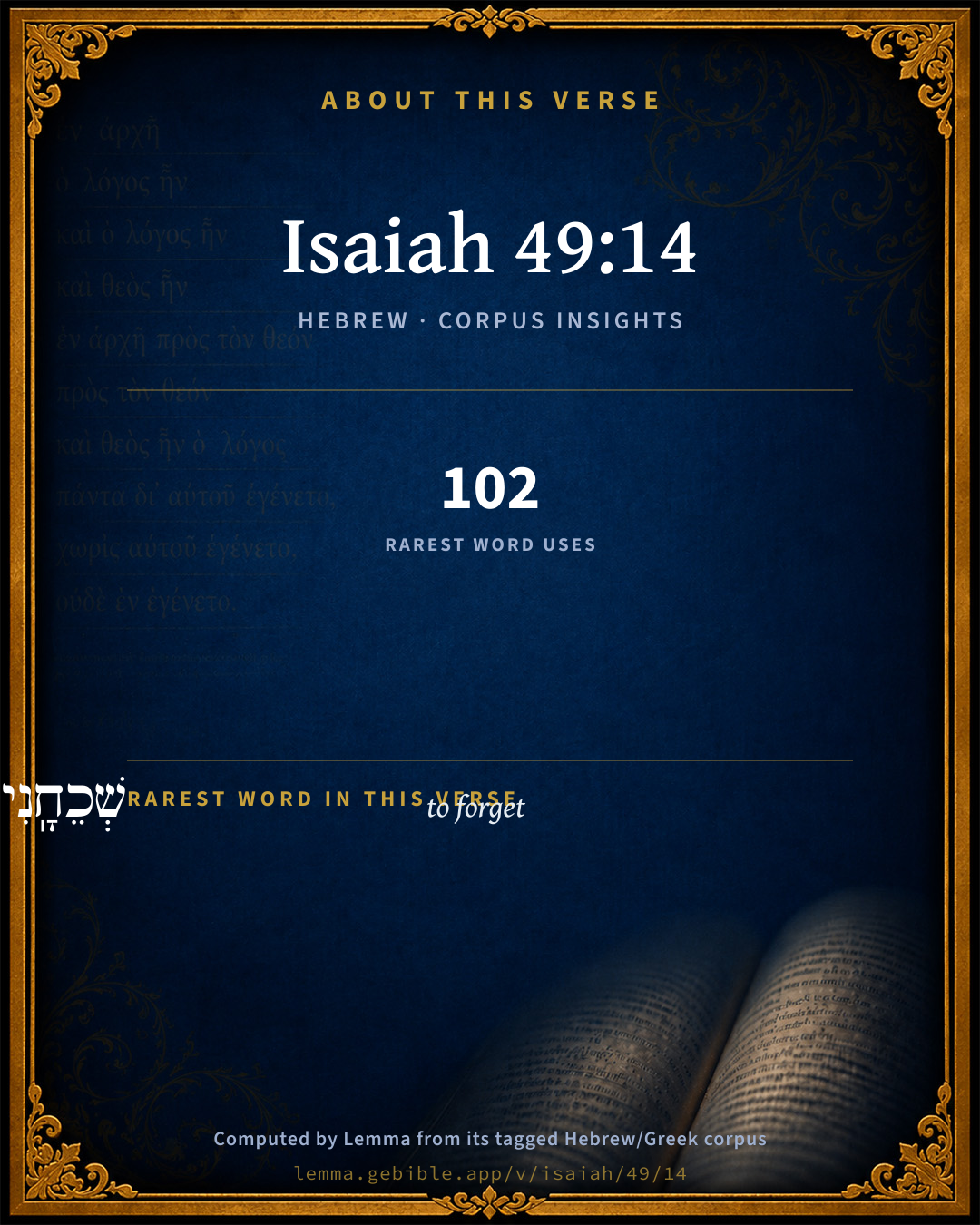
Isaiah, in the Prophets, opens this verse with 6 words (6 distinct Hebrew lemmas). Its most distinctive word is shâkach (“to forget”). A historical commentator’s framing appears above. Read the whole chapter for the surrounding context.

Discussion questions

  1. How does “to forget” (shâkach) shape what this verse is saying?
  2. How does Isaiah 40:27, which shares this passage’s theme, read alongside this verse?
  3. These translations render this verse differently; the difference is in the English rendering, not the original. What questions does that raise?
  4. «וַתֹּ֥אמֶר» is a Qal Sequential Imperfect verb. How does that grammatical form shape the action described?
  5. Compare how The Cambridge Bible for Schools and Colleges and Trapp's Complete Commentary read this verse. Where do they agree or differ?

Things to notice

Reading settings

Reading text

Shown beneath each verse's original-language words.

Old Testament
Old Testament edition

Read the OT as the Masoretic Hebrew (MT) or the Greek Septuagint (LXX).

English shown for the Greek Septuagint (in the Hebrew ↔ Greek comparison).

Comparing translations? Open the Compare panel on any verse page to stack up to four side by side.