
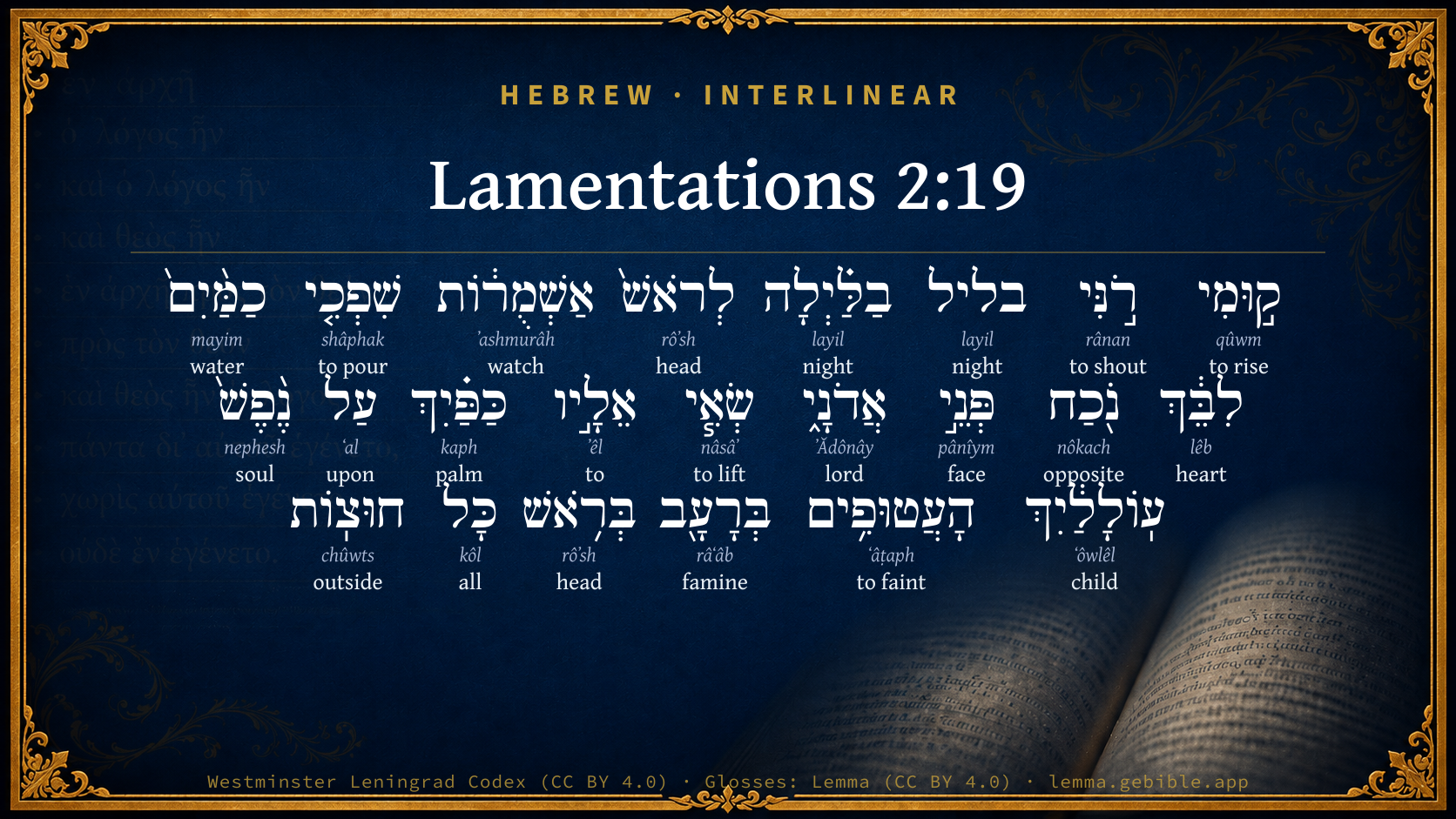
Lamentations 2:19

Hebrew (Westminster Leningrad Codex) Lamentations 2:19 appears in the Hebrew Old Testament. The text above is from the Westminster Leningrad Codex. Each word links to its Strong’s number, a concise gloss, and parsing drawn from the Open Scriptures Hebrew Bible morphology. Click any word for its full Brown-Driver-Briggs (BDB) entry.
Download image
Cite this verse

Lamentations 2:19 (World English Bible). Public Domain. Lemma interlinear Bible study tool, https://lemma.gebible.app/v/lamentations/2/19.

Show BibTeX & RIS
BibTeX
RIS
English Translation
Arise, cry out in the night, at the beginning of the watches; Pour out your heart like water before the face of the Lord: Lift up your hands toward him for the life of your young children, that faint for hunger at the head of every street.
World English Bible · Public Domain
Download a study sheet

One document with this verse’s original text, its word-by-word gloss line, the meaning frame, cross-references with their text, attributed commentary, and full source and license credits — printable, and it pastes into notes with its structure intact.

This verse Autodidact and up

Study sheet (.html) Plain text (.txt)

A passage Seminary Student

Up to 50 verses in one chapter. A passage sheet keeps up to 6 commentary sources and 12 cross-references per verse, in the order this page ranks them, and says so on the sheet whenever that leaves anything out. Ask for a single verse and you get the Autodidact verse sheet above.

Everything on this page stays free to read, with no account — the sheet is a download of what is already on screen, not access to it.

Want to remove ads? Support Godless Engineer
Compare translations 3

The same verse in 3 English versions, stacked beneath the original-language interlinear above. Click any original word for its lexicon entry.

Each is an independent rendering of the whole verse — the interlinear is not word-aligned to these translations.

Highlighted words mark where these versions differ — a whole-verse word diff, not a word-by-word alignment.

  • World English Bible Public Domain
    Arise, cry out in the night, at the beginning of the watches; Pour out your heart like water before the face of the Lord: Lift up your hands toward him for the life of your young children, that faint for hunger at the head of every street.
  • King James Version Public Domain
    Arise, cry out in the night: in the beginning of the watches pour out thine heart like water before the face of the LORD: lift up thy hands toward him for the life of thy young children, that faint for hunger in the top of every street.
  • unfoldingWord Literal Text CC BY-SA 4.0
    Arise, cry out in the night, at the beginning of the night watches! Pour out your heart like water before the face of the Lord. Lift up your hands to him for the life of your children, who are fainting with hunger at the head of every street. RESH

unfoldingWord Literal Text — © unfoldingWord, licensed CC BY-SA 4.0. Word-aligned USFM3 via Door43 (git.door43.org/unfoldingWord/en_ult).

Versions to compare (up to 4)

3 of 4 selected

Show all 18 translations

Every available English version of this verse, each an independent rendering of the whole verse.

  • World English Bible Public Domain
    Arise, cry out in the night, at the beginning of the watches; Pour out your heart like water before the face of the Lord: Lift up your hands toward him for the life of your young children, that faint for hunger at the head of every street.
  • Berean Standard Bible Public Domain
    Arise, cry out in the night from the first watch of the night. Pour out your heart like water in the presence of the Lord. Lift up your hands to Him for the lives of your children who are fainting from hunger on the corner of every street.
  • Majority Standard Bible Public Domain
    Arise, cry out in the night from the first watch of the night. Pour out your heart like water in the presence of the Lord. Lift up your hands to Him for the lives of your children who are fainting from hunger on the corner of every street.
  • King James Version Public Domain
    Arise, cry out in the night: in the beginning of the watches pour out thine heart like water before the face of the LORD: lift up thy hands toward him for the life of thy young children, that faint for hunger in the top of every street.
  • American Standard Version (1901) Public Domain
    Arise, cry out in the night, at the beginning of the watches; Pour out thy heart like water before the face of the Lord: Lift up thy hands toward him for the life of thy young children, that faint for hunger at the head of every street.
  • Revised Version (1885) Public Domain
    Arise, cry out in the night, at the beginning of the watches; pour out thine heart like water before the face of the Lord: lift up thy hands toward him for the life of thy young children, that faint for hunger at the top of every street.
  • Geneva Bible (1599) Public Domain
    Arise, cry in the night: in the beginning of the watches powre out thine heart like water before the face of the Lord: lift vp thine handes towarde him for the life of thy yong children, that faint for hunger in the corners of all the streetes.
  • Douay-Rheims (1899) Public Domain
    Coph. Arise, give praise in the night, in the beginning of the watches: pour out thy heart like water before the face of the Lord: lift up thy hands to him for the life of thy little children, that have fainted for hunger at the top of all the streets.
  • Young's Literal Translation Public Domain
    Arise, cry aloud in the night, At the beginning of the watches. Pour out as water thy heart, Over against the face of the Lord, Lift up unto Him thy hands, for the soul of thine infants, Who are feeble with hunger at the head of all out-places.
  • Literal Standard Version CC BY-SA 4.0
    Arise, cry aloud in the night, || At the beginning of the watches. Pour out your heart as water, || Before the face of the Lord, || Lift up to Him your hands, for the soul of your infants, || Who are feeble with hunger at the head of all out-places.
  • Unlocked Literal Bible CC BY-SA 4.0
    Arise, cry out in the night, at the beginning of the night watches! Pour out your heart like water before the face of the Lord. Lift up your hands to him for the lives of your children who faint with hunger at the corner of every street.”
  • unfoldingWord Literal Text CC BY-SA 4.0
    Arise, cry out in the night, at the beginning of the night watches! Pour out your heart like water before the face of the Lord. Lift up your hands to him for the life of your children, who are fainting with hunger at the head of every street. RESH
  • Darby Bible Public Domain
    Arise, cry out in the night, in the beginning of the watches; pour out thy heart like water before the face of the Lord: lift up thy hands toward him for the life of thy young children, who faint from hunger at the top of all the streets.
  • World Messianic Bible Public Domain
    Arise, cry out in the night, at the beginning of the watches! Pour out your heart like water before the face of the Lord. Lift up your hands toward him for the life of your young children, who faint for hunger at the head of every street.
  • Webster's Bible Public Domain
    Arise, cry out in the night: in the beginning of the watches pour out thy heart like water before the face of the Lord: lift up thy hands towards him for the life of thy young children, that faint for hunger at the head of every street.
  • Free Bible Version CC BY-SA 4.0
    Get up and cry out as the night begins. Pour out your sad thoughts like water before the Lord. Hold up your hands to him in prayer for the lives of your children who are fainting from hunger at every street corner.
  • Bible in Basic English Public Domain
    Up! give cries in the night, at the starting of the night-watches; let your heart be flowing out like water before the face of the Lord, lifting up your hands to him for the life of your young children who are falling down, feeble for need of food, at the top of every street.
  • JPS Tanakh (1917) Public Domain
    Arise, cry out in the night, at the beginning of the watches; pour out thy heart like water before the face of the Lord; lift up thy hands toward Him for the life of thy young children, that faint for hunger at the head of every street.'

Literal Standard Version (2020), Covenant Press — licensed CC BY-SA 4.0. Text via the HelloAO Bible API (eBible.org). Unlocked Literal Bible (unfoldingWord) — licensed CC BY-SA 4.0. Text via the HelloAO Bible API (eBible.org). unfoldingWord Literal Text — © unfoldingWord, licensed CC BY-SA 4.0. Word-aligned USFM3 via Door43 (git.door43.org/unfoldingWord/en_ult). Free Bible Version, Dr. Jonathan Gallagher — licensed CC BY-SA 4.0. Text via the HelloAO Bible API (eBible.org).

Word by word

More ways to search: Search by grammar → Find every occurrence → Compare this word →

Practice this passage: Drill this verse → Learn its vocabulary →

אַשְׁמֻר֔וֹת
ʼashmurâh
H821
“watches”
Noun, Common, Feminine, Plural, Absolute
Part of Speech
Noun
Type
Common
Gender
Feminine
Number
Plural
State
Absolute
Full BDB Definition

Origin: from H8104

TWOT: 2414e

watch (a period of time), night-watch
  1. ק֣וּמִי qûwm H6965 “rise” Verb, Qal, Imperative, 2nd Person, Feminine, Singular
  2. רֹ֣נִּי rânan H7442 “shout” Verb, Qal, Imperative, 2nd Person, Feminine, Singular
  3. בליל layil H3915 “in/at the · night” Preposition, Determined + Noun, Common, Masculine, Singular, Absolute
  4. בַלַּ֗יְלָה layil H3915 “in/at the · night” Preposition, Determined + Noun, Common, Masculine, Singular, Absolute
  5. לְרֹאשׁ֙ rôʼsh H7218 “to/for · head of” Preposition + Noun, Common, Masculine, Singular, Construct
  6. שִׁפְכִ֤י shâphak H8210 “pour” Verb, Qal, Imperative, 2nd Person, Feminine, Singular
  7. כַמַּ֨יִם֙ mayim H4325 “like/as the · water(s)” Preposition, Determined + Noun, Common, Masculine, Plural, Absolute
  8. לִבֵּ֔ךְ lêb H3820 “heart · your” Noun, Common, Masculine, Singular, Construct + Suffix, Personal, 2nd Person, Feminine, Singular
  9. נֹ֖כַח nôkach H5227 “opposite” Preposition
  10. פְּנֵ֣י pânîym H6440 “face(s) of” Noun, Common, Both, Plural, Construct
  11. אֲדֹנָ֑י ʼĂdônây H136 “Lord · my” Noun, Common, Masculine, Plural, Construct + Suffix, Personal, 1st Person, Common, Singular
  12. שְׂאִ֧י nâsâʼ H5375 “lift” Verb, Qal, Imperative, 2nd Person, Feminine, Singular
  13. אֵלָ֣יו ʼêl H413 “to · him” Preposition + Suffix, Personal, 3rd Person, Masculine, Singular
  14. כַּפַּ֗יִךְ kaph H3709 “palms · your” Noun, Common, Feminine, Dual, Construct + Suffix, Personal, 2nd Person, Feminine, Singular
  15. עַל ʻal H5921 “upon” Preposition
  16. נֶ֨פֶשׁ֙ nephesh H5315 “soul of” Noun, Common, Both, Singular, Construct
  17. עֽוֹלָלַ֔יִךְ ʻôwlêl H5768 “children · your” Noun, Common, Masculine, Plural, Construct + Suffix, Personal, 2nd Person, Feminine, Singular
  18. הָעֲטוּפִ֥ים ʻâṭaph H5848 “the · fainted” Particle, Definite Article + Verb, Qal, Participle Passive, Masculine, Plural, Absolute
  19. בְּרָעָ֖ב râʻâb H7458 “in/at · famine” Preposition + Noun, Common, Masculine, Singular, Absolute
  20. בְּרֹ֥אשׁ rôʼsh H7218 “in/at · head of” Preposition + Noun, Common, Masculine, Singular, Construct
  21. כָּל kôl H3605 “all of” Noun, Common, Masculine, Singular, Construct
  22. חוּצֽוֹת chûwts H2351 “streets” Noun, Common, Masculine, Plural, Absolute

About this verse

These counts appear in no published source. They are computed here, from the morphology-tagged text and Lemma’s own curated glosses. What Lemma adds →

23
words
21
distinct lemmas
Prophets
section

Notable vocabulary

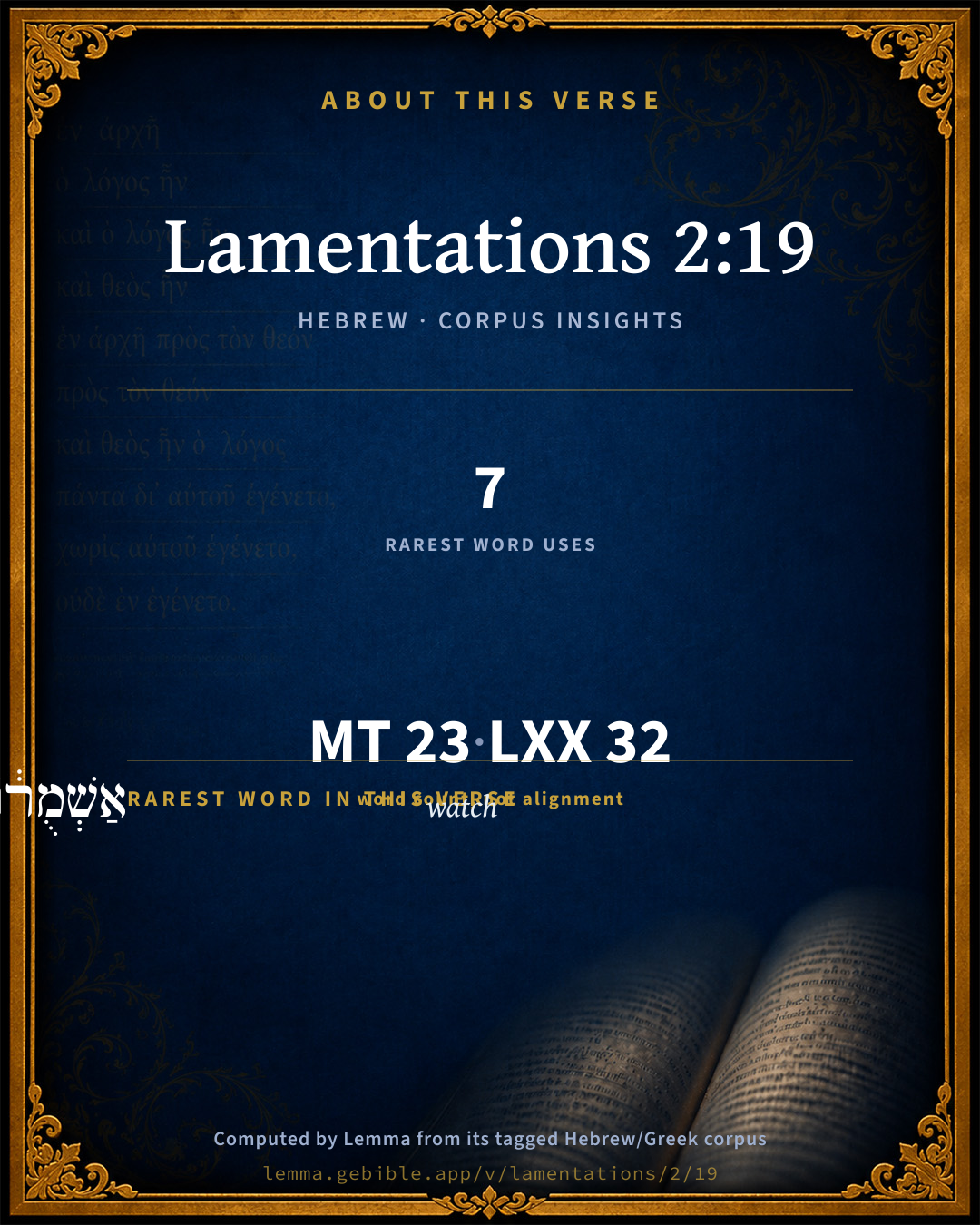
The rarest word here is אַשְׁמֻר֔וֹת watch H821 — appearing just 7 times in the whole Hebrew Bible.

Shared distinctive vocabulary

אַשְׁמֻר֔וֹת watch H821 occurs in 7 verses of the Hebrew Bible. Also found in:

Grammatical profile

  • 5 verbs
  • 15 nouns
  • 3 prepositions

Verb forms

  • ק֣וּמִי Qal · Imperative
  • רֹ֣נִּי Qal · Imperative
  • שִׁפְכִ֤י Qal · Imperative
  • שְׂאִ֧י Qal · Imperative
  • הָעֲטוּפִ֥ים Qal · Participle Passive

Repetition

Words recur within this verse — often emphatic in Hebrew:

  • בליל night H3915 ×2
  • לְרֹאשׁ֙ head H7218 ×2

Hebrew & Septuagint length

In English translation the verse runs 47 words from the Hebrew and 47 from the Septuagint (LXX English) — the same length.

A rough comparison of the two English renderings, which tokenize alike — not a word-level alignment.

Word counts can differ between the Hebrew and the Greek without any difference in meaning — e.g. the Hebrew direct-object marker אֵת has no separate Greek word, and Greek often adds the article ὁ.

In the original languages it is 23 Hebrew tokens and 32 Greek tokens — but the two are counted differently (Hebrew bundles its prefixes and suffixes into one token; the Greek is in lemma form), so that isn’t a like-for-like length.

Cross-references

25

Topical passages linked to Lamentations 2:19 in the Treasury of Scripture Knowledge — connected by theme and wording, ordered by reader-vote popularity; previews shown in the World English Bible.

  • Psalms 62:8 Trust in him at all times, you people. Pour out your heart before him. God is a refuge for us. Selah.
  • Psalms 119:147–148 I rise before dawn and cry for help. I put my hope in your words.
  • Isaiah 26:9 With my soul have I desired you in the night; yes, with my spirit within me will I seek you earnestly: for when your judgments are in the earth, the inhabitants of the world learn righteousness.
  • Psalms 142:2 I pour out my complaint before him. I tell him my troubles.
  • Mark 1:35 Early in the night, he rose up and went out, and departed into a deserted place, and prayed there.
  • 1 Samuel 1:15 Hannah answered, No, my lord, I am a woman of a sorrowful spirit: I have drunk neither wine nor strong drink, but I poured out my soul before Yahweh.
  • Psalms 141:2 Let my prayer be set before you like incense; The lifting up of my hands like the evening sacrifice.
  • Lamentations 2:11–12 My eyes do fail with tears, my heart is troubled; My liver is poured on the earth, because of the destruction of the daughter of my people, Because the young children and the infants swoon in the streets of the city.
  • Judges 7:19 So Gideon, and the hundred men who were with him, came to the outermost part of the camp in the beginning of the middle watch, when they had but newly set the watch: and they blew the trumpets, and broke in pieces the pitchers that were in their hands.
  • Psalms 42:8 Yahweh will command his loving kindness in the daytime. In the night his song shall be with me: A prayer to the God of my life.
  • Luke 6:12 It happened in these days, that he went out to the mountain to pray, and he continued all night in prayer to God.
  • Matthew 14:25 In the fourth watch of the night, Jesus came to them, walking on the sea.
  • Psalms 28:2 Hear the voice of my petitions, when I cry to you, When I lift up my hands toward your Most Holy Place.
  • Mark 13:35 Watch therefore, for you don't know when the lord of the house is coming, whether at evening, or at midnight, or when the rooster crows, or in the morning;
  • Psalms 119:55 I have remembered your name, Yahweh, in the night, And I obey your law.
  • Isaiah 51:20 Your sons have fainted, they lie at the head of all the streets, as an antelope in a net; they are full of the wrath of Yahweh, the rebuke of your God.
  • Lamentations 4:1–9 How is the gold become dim! [how] is the most pure gold changed! The stones of the sanctuary are poured out at the head of every street.
  • 1 Timothy 2:8 I desire therefore that the men in every place pray, lifting up holy hands without wrath and doubting.
  • 1 Samuel 7:6 They gathered together to Mizpah, and drew water, and poured it out before Yahweh, and fasted on that day, and said there, We have sinned against Yahweh. Samuel judged the children of Israel in Mizpah.
  • Job 3:24 For my sighing comes before I eat, My groanings are poured out like water.
  • Psalms 63:4 So I will bless you while I live. I will lift up my hands in your name.
  • Psalms 134:2 Lift up your hands in the sanctuary. Praise Yahweh!
  • Ezekiel 5:10 Therefore the fathers shall eat the sons in the midst of you, and the sons shall eat their fathers; and I will execute judgments on you; and the whole remnant of you will I scatter to all the winds.
  • Ezekiel 5:16 when I shall send on them the evil arrows of famine, that are for destruction, which I will send to destroy you: and I will increase the famine on you, and will break your staff of bread;
  • Nahum 3:10 Yet was she carried away. She went into captivity. Her young children also were dashed in pieces at the head of all the streets, and they cast lots for her honorable men, and all her great men were bound in chains.

Cross-references courtesy of OpenBible.info (CC BY 4.0).

Hebrew and Greek witnesses Masoretic Hebrew ↔ Greek Septuagint

The same verse in the two great witnesses to the Old Testament, shown verse-for-verse.

These are two independent witnesses, not word-aligned to each other, and the Septuagint is shown in lemma (dictionary) form.

Hebrew Lamentations 2:19 Masoretic · Westminster Leningrad Codex

ק֣וּמִי רֹ֣נִּי בליל בַלַּ֗יְלָה לְרֹאשׁ֙ אַשְׁמֻר֔וֹת שִׁפְכִ֤י כַמַּ֨יִם֙ לִבֵּ֔ךְ נֹ֖כַח פְּנֵ֣י אֲדֹנָ֑י שְׂאִ֧י אֵלָ֣יו כַּפַּ֗יִךְ עַל נֶ֨פֶשׁ֙ עֽוֹלָלַ֔יִךְ הָעֲטוּפִ֥ים בְּרָעָ֖ב בְּרֹ֥אשׁ כָּל חוּצֽוֹת

Arise, cry out in the night, at the beginning of the watches; Pour out your heart like water before the face of the Lord: Lift up your hands toward him for the life of your young children, that faint for hunger at the head of every street.

World English Bible · Public Domain

Greek LXX Lamentations 2:19 Septuagint · lemma form

ἀναἵστημι ἀγαλλιάομαι ἐν νύξ εἰς ἀρχή φυλακή σύ ἐκχέω ὡς ὕδωρ καρδία σύ ἀπέναντι πρόσωπον κύριος αἴρω πρός αὐτός χείρ σύ περί ψυχή νήπιος σύ ὁ ἐκλύω λιμός ἐπί ἀρχή πᾶς ἔξοδος

KOPH. Arise, rejoice in the night at the beginning of your watch: pour out your heart as water before the face of the Lord; lift up your hands to him for the life of your infants, who faint for hunger at the top of all the streets.

LXX2012 (modern English Septuagint) · Public Domain

Hebrew: Westminster Leningrad Codex (CC BY 4.0). Greek: Septuagint (public domain); English from LXX2012 (modern English Septuagint) (Public Domain). How the Septuagint differs from the Hebrew →

Commentary

Notes on Lamentations 2:19 from classic Christian and Jewish commentators (each source and its license shown beneath its notes). The classic Christian expositions comment on the surrounding passage and are grouped to its opening verse, so a note may address several verses; the Jewish commentaries on the Tanakh (Rashi and others) are per-verse, so they appear only where the commentator wrote on this verse.

Lemma curates 59 commentaries, every one of them public domain or Creative Commons licensed, each selected and text-cleaned for this edition rather than reprinted as found. About our sources →

Trapp's Complete Commentary

John Trapp

Lam 2:19 Arise, cry out in the night: in the beginning of the watches pour out thine heart like water before the face of the Lord: lift up thy hands toward him for the life of thy young children, that faint for hunger in the top of every street.

Ver. 19. Arise, cry in the night.] A fit time for meditation and prayer, as we read of David, {Psa 119:55; Psa 119:148} and of the Son of David. {Luk 21:37}

In the beginning of the watches.]. When others are in their first - which is their deepest and sweetest - sleep, break thyself of thy rest, that thou mayest give God no rest. {Isa 62:6-7} Omnibus signis et modis miseriam tuam expone Domino; bestir thee every way, all is but little enough.

Pour out thine heart like water.] That is, saith Sanchez, Weep till thou hast wept thy very heart out, if it were possible. Or as others, Pour out thine heart to God in humble and ingenuous confession and supplication; but then pour it forth as water (whereof every drop will come out), and not as oil, whereof some will still stick to the sides of the vessel. Tundens pectus et non effundens vitia, ea consolidat, saith Augustine. He who pretendeth to repent, and yet parteth not with his sins, doth but increase them.

Lift up thine hands toward him.] But with thy heart. {Lam 3:41}

For the life of thy young children.] See on Lam 2:11-12.

John Trapp, A Commentary or Exposition upon All the Books of the Old and New Testament (1647–1656) — public domain. Text from a community e-Sword module.

The Biblical Illustrator

Joseph S. Exell

Lam_2:19

Arise, cry out in the night.

Watchnight service

Methinks I might become a Jeremiah tonight, and weep as he, for surely the Church at large is in almost as evil a condition. Oh, Zion, how hast thou been veiled in a cloud, and how is thy honour trodden in the dust! Arise, ye sons of Zion, and weep for your mother, yea, weep bitterly, for she hath given herself to other lovers, and forsaken the Lord that bought her. We leave Zion, however, to speak to those who need exhortation more than Zion does; to speak to those who are Zions enemies, or followers of Zion, and yet not belonging to her ranks.

1. It is never too soon to pray. You are lying on your bed; the gracious Splint whispers--Arise, and pray to God. Well, there is no reason why you should, delay till the morning light; in the beginning of the watches pour out thine heart like water before the face of the Lord. Need we remind, you that delays are dangerous? Need we tell you that those are the workings of Satan? For the Holy Ghost, when He strives with man, says, Today, if ye will hear His voice, harden not your heart.

2. Again, it is not too late to cry to the Lord; for if the sun be set, and the watches of the night have commenced their round, the mercy seat is open. There have been some older than you can be; some as sinful and vile, and heinously wicked, who have provoked God as much, who have shined against him as frequently, and yet they have found pardon.

3. We cannot pray too vehemently, for the text says, Arise, cry out in the night. God loves earnest prayers. He loves impetuous prayers--vehement prayers. Arise, cry out in the night, and God will hear you, if you cry out with all your souls, and pour out your hearts before Him.

4. We cannot pray too simply. Just hear how the Psalmist has it: Pour out your hearts before Him. Not pour out your fine words, not pour out your beautiful periods, but pour out your hearts. Pour out your heart like water. How does water run out? The quickest way it can; thats all. It never stops much about how it runs. That is the way the Lord loves to have it. Pour out your heart like water; pour it out by confessing all your sins; pour it out by begging the Lord to have mercy upon you for Christs sake; pour it out like water. And when it is all poured out, He will come and fill it again with wines on the lees, well refined. (C. H. Spurgeon.)

Night cries

Pull the night bell. This is the inscription we often see written on the doorpost of the shop in which medicines are sold. Some of us have had our experiences with night bells when sudden illness has overtaken some member of our households, or when sickness has rapidly grown worse. How have we hurried through the silent streets, when only here and there a light glimmered from some chamber window! How eagerly have we pulled the night bell at our physicians door, and then, with prescription in hand, have sounded the alarm at the place where the remedy was to be procured. Those of us who have had these lovely midnight walks, and have given the summons for quick relief, know the meaning of that text, Arise, cry out in the night. (T. L. Cuyler.)

The Biblical Illustrator, edited by Joseph S. Exell (c. 1880s–1900s) — public domain. Text from a community e-Sword module.

Jamieson, Fausset & Brown

Robert Jamieson, A. R. Fausset & David Brown

cry . . . in . . . night-- (Psa 119:147).

beginning of . . . watches--that is, the first of the three equal divisions (four hours each) into which the ancient Jews divided the night; namely, from sunset to ten o'clock. The second was called "the middle watch" (Jdg 7:19), from ten till two o'clock. The third, "the morning watch," from two to sunrise (Exo 14:24; Sa1 11:11). Afterwards, under the Romans, they had four watches (Mat 14:25; Luk 12:38).

for . . . thy . . . children--that God, if He will not spare thee, may at least preserve "thy young children."

top of . . . street-- (Isa 51:20; Nah 3:10).

Jamieson, Fausset & Brown — Commentary Critical and Explanatory on the Whole Bible (1871) — public domain (CC PDM 1.0). Text via the HelloAO Bible API.

Adam Clarke's Commentary

Verse 19. Arise, cry out in the night] This seems to refer to Jerusalem besieged. Ye who keep the night watches, pour out your hearts before the Lord, instead of calling the time of night, c. or, when you call it, send up a fervent prayer to God for the safety and relief of the place.

Adam Clarke's Commentary on the Bible (1810–1826) — public domain. Text from a community e-Sword/MySword module.

John Calvin's Commentaries

The Prophet now explains himself more clearly, and confirms what I have lately said, that he mentioned not the calamities of the people except for this end, that those who were almost stupid might begin to raise up their eyes to God, and also to examine their life, and willingly to condemn themselves, that thus they might escape from the wrath of God.

The Prophet then bids them to rise and to cry. Doubtless they had been by force constrained by their enemies to undertake a long journey: why then does he bid them to rise, who had become fugitives from their own country, and had been driven away like sheep? He regards, as I have said, the slothfulness of their minds, because they were still lying torpid in their sins. It was then necessary to rouse them from this insensibility; and this is what the Prophet had in view by saying, Rise And then he bids them to cry at the beginning of the watches, even when sleep begins to creep on, and the time is quieter; for when men go to bed, then sleep comes on, and that is the main rest. But the Prophet bids here the Jews to cry, and in their uneasiness to utter their complaints at the very time when others take their rest. et he did not wish them heedlessly to pour forth into the air their wailings, but bade them to present their prayers to God. Then as to the circumstances of that time, he repeats what we have already seen, that so great was their mass of evils, that it allowed the people no relaxation; in short, he intimates that it was a continual sorrow.

But, as I have said, he would have the Jews not simply to cry, but after having exhorted them to pour out their hearts like waters, he adds, before the face of Jehovah. For the unbelieving make themselves almost hoarse by crying, but they are only like brute beasts; or if they call on God’s name, they do this, as it has been said, through a rash and indiscriminate impulse. Hence the Prophet here makes a difference between the elect of God and the reprobate, when he bids them to pour forth their hearts and their cries before God, so as to seek alleviation from him, which could not have been done, were they not convinced that he was the author of all their calamities; and hence, also, arises repentance, for there is a mutual relation between God’s judgment and men’s sins. Whosoever, then, acknowledges God as a judge, is at the same time compelled to examine himself and to inquire as to his own sins. We now understand the meaning of the Prophet’s words.

For the same purpose he adds, Raise up to him thy hands. This practice of itself is, indeed, not sufficient; but the Scripture often points out the real thing by external signs. Then the elevation of the hands, in this place and others, means the same thing as prayer; and it has been usual in all ages to raise up the hands to heaven, and the expression often occurs in the Psalms, (Psalm 28:2; Psalm 134:2;) and when Paul bids prayers to be made everywhere, he says,

“I would have men to raise up pure hands without contention.” (1 Timothy 2:8.)

God has no doubt suggested this practice to men, that they may first go beyond the whole world when they seek him; and, secondly, that they may thus stimulate themselves to entertain confidence, and also to divest themselves of all earthly desires; for except this practice were to raise up our minds, (as we are by nature inclined to superstition,) every one would seek God either at his feet or by his side. Then God has planted in men this feeling, even to raise upwards their hands, in order that they may go, as I have said, beyond the whole world, and that having thus divested themselves of all vain superstition, they may ascend above the heavens. This custom, I allow, is indeed common among the unbelieving; and thus all excuse has been taken away from them. Though, then, the unbelieving have been imbued with gross and delirious fantasies, so as to connect God with statues and pictures, yet this habit of raising up the hands to heaven ought to have been sufficient to confute all their erroneous notions. But it would not be enough to seek God beyond this world, so that no superstition should possess our minds, except our minds were also freed from all worldly desires. For we are held entangled in our lusts, and then we seek what pleases the flesh, and thus, for the most part, men strive, to subject God to themselves. Then the elevation of the hands does also shew that we are to deny ourselves, and to go forth, as it were, out of ourselves whenever we call on God. These are briefly the things which may be said of the use of this ceremony or practice.

But we must remember what I have referred to, that the Prophet designates the thing itself by an outward sign, when he bids them to raise up the hands to God. He afterwards shews the necessity of this, because of the soul of thy little ones, who faint in famine; but the ב, beth, is redundant here, — who, then, through famine faint or fail, and that openly. For it might have happened that those who had no food pined away at home, and thus fainted because no one gave them aid, because their want was not known. But when infants in public places breathed out their souls through famine, hence was evident that extreme state of despair, which the Prophet intended here to set forth by mentioning at the head of all the streets. It follows, —

John Calvin's Commentaries (1540-1563) — public domain. Text from the Calvin Translation Society English edition (1840s-50s) via the Christian Classics Ethereal Library (ccel.org). Calvin's coverage is partial (roughly two-thirds of the Bible); uncommented books and verses are honest gaps, never fabricated. The 19th-century editor's footnotes and remarks are omitted so the notes are faithfully Calvin's own voice.

Ellicott's Commentary for English Readers

(19) In the beginning of the watches—i.e., of each watch, so that the lamentation was continued throughout the night.

Lift up thy hands.—The wall is still addressed in its character as a mourner, beholding the children dying of hunger and lifting up her hands as in despairing supplication for them.

A Bible Commentary for English Readers, edited by Charles John Ellicott (1878–1897) — public domain. Text from a community e-Sword module.

The Cambridge Bible for Schools and Colleges

gen. ed. J. J. S. Perowne

19. The v. consists of four lines. Ewald and Budde (followed by Löhr) conclude independently that the last is a gloss suggested by Lam_2:12.

at the beginning of the watches] i.e. of each watch. In New Testament times the Jews had adopted the Roman division of the night into four watches of three hours each (see Mat_14:25; Mar_13:35). Up to that time the division was threefold, each consisting of four hours. Cp. Exo_14:24; Psa_63:6, etc. The watchman’s cry would rouse the sleeper to realise afresh the miseries of the situation.

Pour out thine heart like water] Cp. Lam_2:11.

Lift up thy hands] in supplication.

The Cambridge Bible for Schools and Colleges (gen. ed. J. J. S. Perowne; Cambridge University Press, 1878–1918) — public domain. Text from a community e-Sword module.

John Gill's Exposition

Arise, cry out in the night,.... That is, O daughter of Zion, or congregation of Israel, as the Targum; who are addressed and called upon by the prophet to arise from their beds, and shake off their sleep, and sloth, and stupidity, and cry to God in the night season; and be earnest and importunate with him for help and assistance. Aben Ezra rightly observes, that the word used signifies a lifting up of the voice both in singing and in lamentation; here it is used in the latter sense; and denotes great vehemency and earnestness in crying unto God, arising from deep distress and sorrow, which prevents sleep:

in the beginning of the watches; either at the first of them; so Broughton renders it, "at the first watch"; which began at the time of going to bed: or at the beginning of each of them; for with the ancient Jews there were three of them; in later times four: or in the beginning of the morning watch, as the Targum; very early in the morning, before sun rising; as they are called upon to pray late at night, so betimes in the mottling:

pour out thine heart like water before the face of the Lord; use the utmost freedom with him; tell him, in the fullest manner, thy whole case, fit thy complaints; unbosom thyself to him; keep nothing from him; speak out freely all lily soul needs; do all this publicly, and in the most affectionate way and manner, thy soul melted in floods of tears, under a sense of sin, and pressing evils for it. The Targum is,

"pour out as water the perverseness of thine heart, and return by repentance, and pray in the house of the congregation (or synagogue) before the face of the Lord:''

lift up thine hands towards him; in prayer, as the Targum adds; for this is a prayer gesture, as in Lam 3:41;

for the life of thy young children that faint for hunger in the top of every street; pray for them, that they might have food and sustenance, to preserve them alive; who, for want of it, were ready to swoon and die the public streets; in the top of them, where they met, and where was the greatest concourse of people, and yet none able to relieve them.

John Gill's Exposition of the Whole Bible (1746–1763) — public domain (CC PDM 1.0). Text via the HelloAO Bible API.

Albert Barnes' Notes on the Bible

In - (or at) the beginning of the watches “At the beginning of each night-watch” means all the night through. The Hebrews divided the night into three watches.

Albert Barnes' Notes on the Bible (1834–1885) — public domain. Text from a community e-Sword/MySword module.

Haydock's Catholic Bible Commentary

Watches. Jerusalem is here represented in the midst of danger and misery. (Calmet)

George Leo Haydock (1774–1849), Haydock's Catholic Family Bible and Commentary, 1859 edition — public domain. Excludes Psalms (Douay-Rheims chapter numbering differs from Protestant) and Deuterocanonical books (Catholic canon only).

Matthew Poole's English Annotations

The prophet calls upon the Jews not to be slothful in this their very evil day, but to rise up from their beds, and either at the beginning of the four watches, or at the beginning of each watch, at all times in the night, to betake themselves to God by prayer, and that not in a cold, lazy manner, but so as to pour out their hearts with their words; and he moveth them to it, as for their own sake, so for the sake of their young children, who every where were starved to death.

Matthew Poole's English Annotations on the Holy Bible (1683–1685) — public domain. Text from a community e-Sword/MySword module.

Whedon's Commentary on the Bible

Daniel D. Whedon

19. Cry out in the night — Better, wail. Not a cry for relief, but a wail of distress, is meant.

Daniel D. Whedon (gen. ed.), Commentary on the Old and New Testaments (1874–1909) — public domain. Text from a community e-Sword module.

The Pulpit Commentary

In the beginning of the watches. This would seem to be most naturally explained as referring to the first watch of the night. When most are wrapped in their first and sweetest sleep, the daughter of Zion is to "arise and cry." Others explain, "at the beginning of each of the night watches;" i.e. all the night through. Previously to the Roman times, the Jews had divided the night into three watches. (comp. Jud_1:3:19) Pour out thine heart like water; i.e. give free course to thy complaint, shedding tears meanwhile. The expression is parallel partly to phrases like "I am poured out like water", (Psa_22:14) partly to "Pour out your heart before him". (Psa_62:8) In the top of every street; rather, at every street corner. (and so Lam_4:1)

A cry to God in the night watches.

A fearful picture! Jerusalem is besieged. Famine is becoming fatal. Young children are seen fainting for hunger at the top of every street. The hearts of their parents are rent with anguish, as the little ones beg piteously of their mothers for food and drink (ver. 12), and none can be had, so that they swoon for very weakness. Suddenly a new turn is taken. The citizens have sunk down in sullen despair. Night has come like a cloak to cover the scenes of misery and death. Then a voice rings through the darkness, "Arise, cry out." This voice bids all hearers pour out their hearts in prayer to God.

I THE CRY IS TO GOD. Hitherto we have had nothing but doleful lamentations. The language has been that of hopeless grief and bitter reset. No relief has been found or even sought. But there is one refuge in the direst trouble, and now that refuge is remembered. When we can do nothing else we can cry to God, for he is near though hidden from view, and merciful though striking in wrath, and able to save though no way of escape seems possible. It needs some rousing of the soul thus to seek God. We must "Arise." Spiritual lethargy is the worst consequence of sorrow. Let us beware lest our troubles paralyze our prayers. Prayer implies spiritual wakefulness.

II THE CRY IS IN THE NIGHT.

1. The time when trouble seems most hopeless. It is in the night that the mourner weeps his most bitter tears.

2. The time of reflection. In lonely night watches the troubled soul has time for thought, and thought is then pain.

3. The time of earthly darkness. Then, perhaps, the spirit may feel most closely the nearness of the Father of spirits. The cry is to be in the beginning of the watches either at the first watch or at the opening of each of the three watches. Let prayer come first. Let us not waste time in lamenting before we seek relief from God.

III THE CRY IS HEARTFELT AND CONFIDENTIAL. "Pour out thine heart like water before the face of the Lord.

1. It comes from the heart. All real prayer must be the outcome of true and deep feelings.

2. It is a full and free confidence in God. The heart is poured out like water. This is in itself a relief. God expects our complete confidence and will hear prayer only when we give it to him.

3. It is no more than the pouring out of the heart before God. There is no definite request. Perhaps it is difficult to know how to ask for relief. Perhaps the grief is too overwhelming for any such thoughts of aid to be entertained. But it is enough that the whole trouble is poured out before God and left with him. Prayer is too often a dictating to God. It should be more of a simple confidence in God. It would be better if there were more confession and confidence, and less exact petition and definition of what God is to do in order to please us. We are to pour out our hearts and leave all with him. Then he will do the best for us.

4. In deep trouble heartfelt prayer is wrung out of the sufferer. Then he must be real. Sorrow melts the stony heart which has held itself in proud reserve, and thus it pours out itself like water. We have the example of Christ, whose agony passed into prayer, to urge us to find the relief of confiding fully in God.

The Pulpit Commentary (1880–1919), ed. H.D.M. Spence-Jones & Joseph S. Exell — public domain. Text from a community e-Sword module.

Rashi

Rabbi Shlomo Yitzchaki (Rashi)

at the beginning of the watches [i.e., at the beginning of the final] two parts of the night, for the night is divided into three parts, as our Rabbis stated in Tractate Berachoth (3).

who faint pגmיs in French, faint, swooning.

Rashi on the Tanakh — English translations: “The Judaica Press complete Tanach with Rashi, translated by A. J. Rosenberg” (CC BY 4.0); “Pentateuch with Rashi's commentary by M. Rosenbaum and A.M. Silbermann, 1929-1934” (public domain); “The Metsudah Tanach series, Lakewood, N.J” (CC BY 4.0); and “The Book of Joshua, Metsudah Publications, 1997” (CC BY 4.0). Text via Sefaria.

Lesson kit

Teaching starters — assembled from the data on this page, not authored interpretation. Every prompt links to the verse data it draws on. Edit before teaching.

Lamentations, in the Prophets, opens this verse with 23 words (21 distinct Hebrew lemmas). Its most distinctive word is ʼashmurâh (“watch”). A historical commentator’s framing appears above. Read the whole chapter for the surrounding context.

Discussion questions

  1. What does “watch” (ʼashmurâh) contribute to the verse as a whole?
  2. How does Exodus 14:24, which shares the word «watch», read alongside this verse?
  3. What does the repetition of “night” (2× in this one verse) do in this verse?
  4. These translations render this verse differently. What is at stake in choosing one wording over another?
  5. «ק֣וּמִי» is a Qal Imperative verb. How does that grammatical form shape the action described?
  6. Compare how Trapp's Complete Commentary and The Biblical Illustrator read this verse. Where do they agree or differ?

Things to notice

Reading settings

Reading text

Shown beneath each verse's original-language words.

Old Testament
Old Testament edition

Read the OT as the Masoretic Hebrew (MT) or the Greek Septuagint (LXX).

English shown for the Greek Septuagint (in the Hebrew ↔ Greek comparison).

Comparing translations? Open the Compare panel on any verse page to stack up to four side by side.