Isaiah 21:8

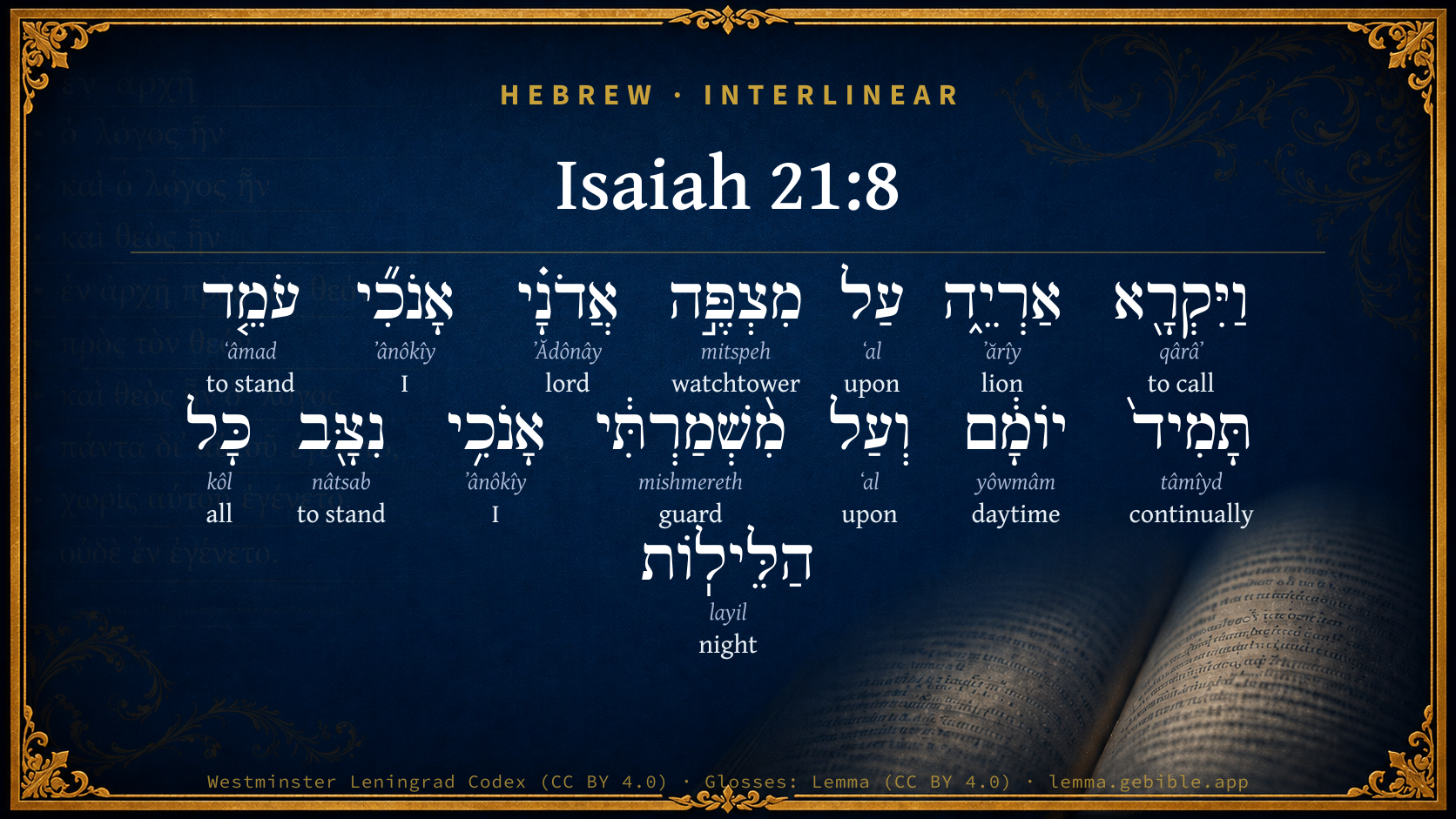
Hebrew (Westminster Leningrad Codex) Isaiah 21:8 appears in the Hebrew Old Testament. The text above is from the Westminster Leningrad Codex. Each word links to its Strong’s number, a concise gloss, and parsing drawn from the Open Scriptures Hebrew Bible morphology. Click any word for its full Brown-Driver-Briggs (BDB) entry.
Download image
Cite this verse

Isaiah 21:8 (World English Bible). Public Domain. Lemma interlinear Bible study tool, https://lemma.gebible.app/v/isaiah/21/8.

Show BibTeX & RIS
BibTeX
RIS
English Translation
He cried as a lion: Lord, I stand continually on the watch-tower in the day-time, and am set in my ward whole nights;
World English Bible · Public Domain
Download a study sheet

One document with this verse’s original text, its word-by-word gloss line, the meaning frame, cross-references with their text, attributed commentary, and full source and license credits — printable, and it pastes into notes with its structure intact.

This verse Autodidact and up

Study sheet (.html) Plain text (.txt)

A passage Seminary Student

Up to 50 verses in one chapter. A passage sheet keeps up to 6 commentary sources and 12 cross-references per verse, in the order this page ranks them, and says so on the sheet whenever that leaves anything out. Ask for a single verse and you get the Autodidact verse sheet above.

Everything on this page stays free to read, with no account — the sheet is a download of what is already on screen, not access to it.

Want to remove ads? Support Godless Engineer
Compare translations 3

The same verse in 3 English versions, stacked beneath the original-language interlinear above. Click any original word for its lexicon entry.

Each is an independent rendering of the whole verse — the interlinear is not word-aligned to these translations.

Highlighted words mark where these versions differ — a whole-verse word diff, not a word-by-word alignment.

  • World English Bible Public Domain
    He cried as a lion: Lord, I stand continually on the watch-tower in the day-time, and am set in my ward whole nights;
  • King James Version Public Domain
    And he cried, A lion: My lord, I stand continually upon the watchtower in the daytime, and I am set in my ward whole nights:
  • unfoldingWord Literal Text CC BY-SA 4.0
    And he called out a lion, “Upon the watchtower, lord, I, I am standing continually by day, and at my guard post I, I am stationed all of the night.

unfoldingWord Literal Text — © unfoldingWord, licensed CC BY-SA 4.0. Word-aligned USFM3 via Door43 (git.door43.org/unfoldingWord/en_ult).

Versions to compare (up to 4)

3 of 4 selected

Show all 18 translations

Every available English version of this verse, each an independent rendering of the whole verse.

  • World English Bible Public Domain
    He cried as a lion: Lord, I stand continually on the watch-tower in the day-time, and am set in my ward whole nights;
  • Berean Standard Bible Public Domain
    Then the lookout shouted: “Day after day, my lord, I stand on the watchtower; night after night I stay at my post.
  • Majority Standard Bible Public Domain
    Then the lookout shouted: “Day after day, my lord, I stand on the watchtower; night after night I stay at my post.
  • King James Version Public Domain
    And he cried, A lion: My lord, I stand continually upon the watchtower in the daytime, and I am set in my ward whole nights:
  • American Standard Version (1901) Public Domain
    And he cried as a lion: O Lord, I stand continually upon the watch-tower in the day-time, and am set in my ward whole nights;
  • Revised Version (1885) Public Domain
    And he cried as a lion: O Lord, I stand continually upon the watchtower in the day-time, and am set in my ward whole nights:
  • Geneva Bible (1599) Public Domain
    And he cryed, A lyon: my lorde, I stand continually vpon ye watche towre in the day time, and I am set in my watche euery night:
  • Douay-Rheims (1899) Public Domain
    And a lion cried out: I am upon the watchtower of the Lord, standing continually by day: and I am upon my ward, standing whole nights.
  • Young's Literal Translation Public Domain
    And he crieth -- a lion, `On a watch-tower my lord, I am standing continually by day, And on my ward I am stationed whole nights.
  • Literal Standard Version CC BY-SA 4.0
    And he cries, “A lion, my lord! I am continually standing on a watchtower by day, || And I am stationed on my ward whole nights.
  • Unlocked Literal Bible CC BY-SA 4.0
    The watchman cries out, “Lord, on the watchtower I stand all day, every day, and at my post I stand all night long.”
  • unfoldingWord Literal Text CC BY-SA 4.0
    And he called out a lion, “Upon the watchtower, lord, I, I am standing continually by day, and at my guard post I, I am stationed all of the night.
  • Darby Bible Public Domain
    And he cried [as] a lion, Lord, I stand continually upon the watchtower in the daytime, and I am set in my ward whole nights.
  • World Messianic Bible Public Domain
    He cried like a lion: “Lord, I stand continually on the watchtower in the daytime, and every night I stay at my post.
  • Webster's Bible Public Domain
    And he cried, a lion: My lord, I stand continually upon the watch-tower in the day time, and I am set in my ward whole nights.
  • Free Bible Version CC BY-SA 4.0
    Then the lookout shouted “Sir, I've stood here on the watchtower day after day; night after night I've remained at my post.
  • Bible in Basic English Public Domain
    And the watchman gave a loud cry, O my lord, I am on the watchtower all day, and am placed in my watch every night:
  • JPS Tanakh (1917) Public Domain
    And he cried as a lion: 'Upon the watch-tower, O Lord, I stand continually in the daytime, and I am set in my ward all the nights.'

Literal Standard Version (2020), Covenant Press — licensed CC BY-SA 4.0. Text via the HelloAO Bible API (eBible.org). Unlocked Literal Bible (unfoldingWord) — licensed CC BY-SA 4.0. Text via the HelloAO Bible API (eBible.org). unfoldingWord Literal Text — © unfoldingWord, licensed CC BY-SA 4.0. Word-aligned USFM3 via Door43 (git.door43.org/unfoldingWord/en_ult). Free Bible Version, Dr. Jonathan Gallagher — licensed CC BY-SA 4.0. Text via the HelloAO Bible API (eBible.org).

Word by word

More ways to search: Search by grammar → Find every occurrence → Compare this word →

Practice this passage: Drill this verse → Learn its vocabulary →

מִצְפֶּ֣ה
mitspeh
H4707
“watchtower”
Noun, Common, Masculine, Singular, Absolute
Part of Speech
Noun
Type
Common
Gender
Masculine
Number
Singular
State
Absolute
Full BDB Definition

Origin: from H6822

TWOT: 1950b

watchtower, lookout point
  1. וַיִּקְרָ֖א qârâʼ H7121 “and · to call” Conjunction + Verb, Qal, Sequential Imperfect, 3rd Person, Masculine, Singular
  2. אַרְיֵ֑ה ʼărîy H738 “lion” Noun, Common, Masculine, Singular, Absolute
  3. עַל ʻal H5921 “upon” Preposition
  4. אֲדֹנָ֗י ʼĂdônây H136 “Lord · my” Noun, Common, Masculine, Plural, Construct + Suffix, Personal, 1st Person, Common, Singular
  5. אָנֹכִ֞י ʼânôkîy H595 “I” Pronoun, Personal, 1st Person, Common, Singular
  6. עֹמֵ֤ד ʻâmad H5975 “standing” Verb, Qal, Participle Active, Masculine, Singular, Absolute
  7. תָּמִיד֙ tâmîyd H8548 “continually” Noun, Common, Masculine, Singular, Absolute
  8. יוֹמָ֔ם yôwmâm H3119 “daytime” Adverb
  9. וְעַל ʻal H5921 “and · upon” Conjunction + Preposition
  10. מִ֨שְׁמַרְתִּ֔י mishmereth H4931 “guard · my” Noun, Common, Feminine, Singular, Construct + Suffix, Personal, 1st Person, Common, Singular
  11. אָנֹכִ֥י ʼânôkîy H595 “I” Pronoun, Personal, 1st Person, Common, Singular
  12. נִצָּ֖ב nâtsab H5324 “standing” Verb, Niphal, Participle Active, Masculine, Singular, Absolute
  13. כָּל kôl H3605 “all of” Noun, Common, Masculine, Singular, Construct
  14. הַלֵּילֽוֹת layil H3915 “the · nights” Particle, Definite Article + Noun, Common, Masculine, Plural, Absolute

About this verse

These counts appear in no published source. They are computed here, from the morphology-tagged text and Lemma’s own curated glosses. What Lemma adds →

15
words
13
distinct lemmas
Prophets
section

Notable vocabulary

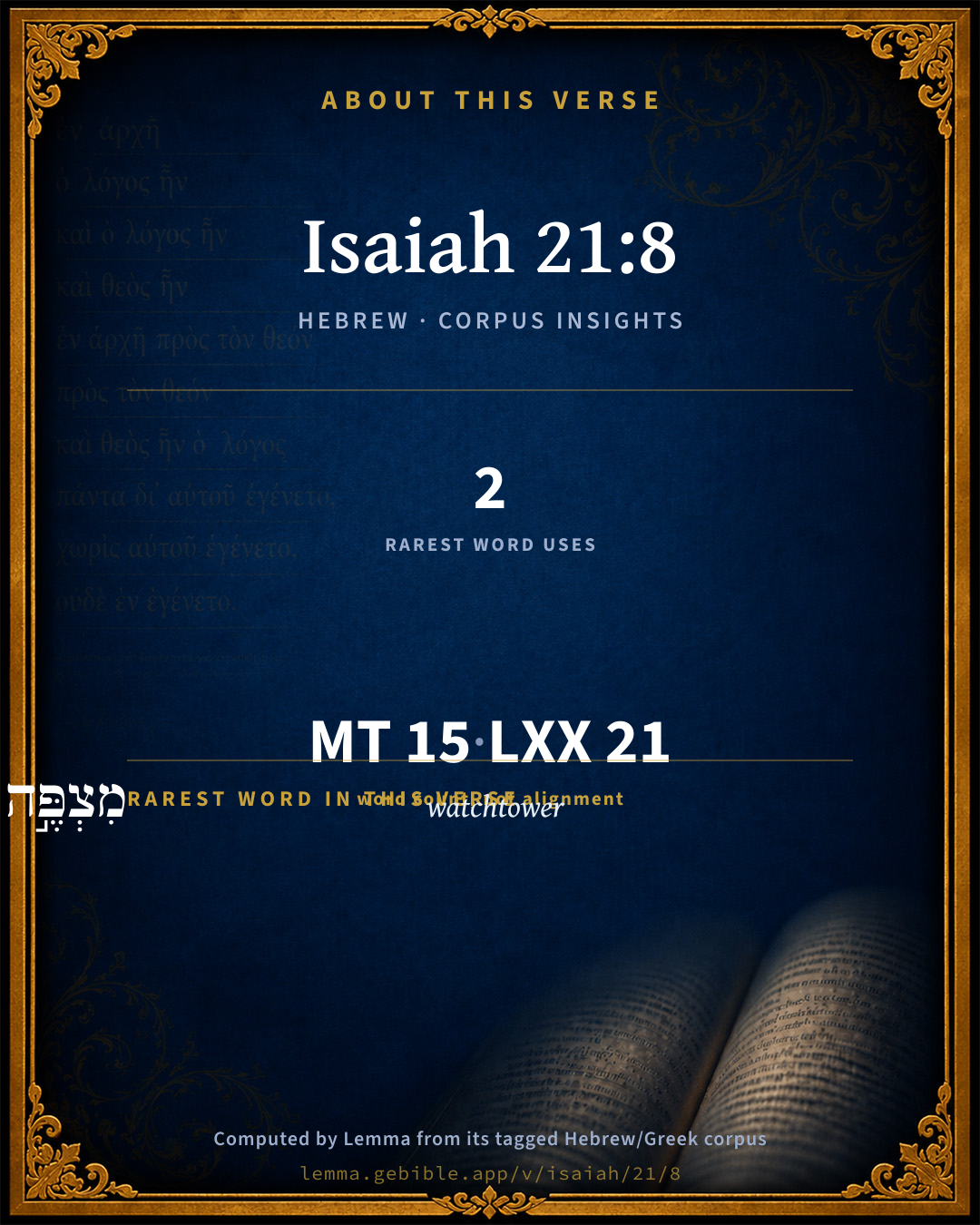
The rarest word here is מִצְפֶּ֣ה watchtower H4707 — appearing just 2 times in the whole Hebrew Bible.

Shared distinctive vocabulary

מִצְפֶּ֣ה watchtower H4707 occurs in 2 verses of the Hebrew Bible. Also found in:

Grammatical profile

  • 3 verbs
  • 7 nouns
  • 2 pronouns
  • 2 prepositions
  • 1 adverb

Verb forms

  • וַיִּקְרָ֖א Qal · Sequential Imperfect
  • עֹמֵ֤ד Qal · Participle Active
  • נִצָּ֖ב Niphal · Participle Active

Repetition

Words recur within this verse — often emphatic in Hebrew:

  • עַל upon H5921 ×2
  • אָנֹכִ֞י I H595 ×2

Hebrew & Septuagint length

In English translation the verse runs 23 words from the Hebrew and 29 from the Septuagint (LXX English) — closely comparable.

A rough comparison of the two English renderings, which tokenize alike — not a word-level alignment.

Word counts can differ between the Hebrew and the Greek without any difference in meaning — e.g. the Hebrew direct-object marker אֵת has no separate Greek word, and Greek often adds the article ὁ.

In the original languages it is 15 Hebrew tokens and 21 Greek tokens — but the two are counted differently (Hebrew bundles its prefixes and suffixes into one token; the Greek is in lemma form), so that isn’t a like-for-like length.

Cross-references

11

Topical passages linked to Isaiah 21:8 in the Treasury of Scripture Knowledge — connected by theme and wording, ordered by reader-vote popularity; previews shown in the World English Bible.

  • Habakkuk 2:1–2 I will stand at my watch, and set myself on the ramparts, and will look out to see what he will say to me, and what I will answer concerning my complaint.
  • Psalms 63:6 When I remember you on my bed, And think about you in the night watches.
  • Psalms 127:1 Unless Yahweh builds the house, They labor in vain who build it. Unless Yahweh watches over the city, The watchman guards it in vain.
  • Isaiah 5:29 Their roaring will be like a lioness. They will roar like young lions. Yes, they shall roar, And seize their prey and carry it off, And there will be no one to deliver.
  • Isaiah 56:10 His watchmen are blind, they are all without knowledge; they are all mute dogs, they can't bark; dreaming, lying down, loving to slumber.
  • Isaiah 62:6 I have set watchmen on your walls, Jerusalem; they shall never hold their peace day nor night: you who call on Yahweh, take no rest,
  • Jeremiah 4:7 A lion is gone up from his thicket, and a destroyer of nations; he is on his way, he is gone forth from his place, to make your land desolate, that your cities be laid waste, without inhabitant.
  • Jeremiah 25:38 He has left his covert, as the lion; for their land is become an astonishment because of the fierceness of the oppressing [sword], and because of his fierce anger.
  • Jeremiah 49:19 Behold, he shall come up like a lion from the pride of the Jordan against the strong habitation: for I will suddenly make them run away from it; and whoever is chosen, him will I appoint over it: for who is like me? and who will appoint me a time? and who is the shepherd who will stand before me?
  • Jeremiah 50:44 Behold, [the enemy] shall come up like a lion from the pride of the Jordan against the strong habitation: for I will suddenly make them run away from it; and whoever is chosen, him will I appoint over it: for who is like me? and who will appoint me a time? and who is the shepherd who can stand before me?
  • 1 Peter 5:8 Be sober and self-controlled. Be watchful. Your adversary the devil, walks around like a roaring lion, seeking whom he may devour.

Cross-references courtesy of OpenBible.info (CC BY 4.0).

Hebrew and Greek witnesses Masoretic Hebrew ↔ Greek Septuagint

The same verse in the two great witnesses to the Old Testament, shown verse-for-verse.

These are two independent witnesses, not word-aligned to each other, and the Septuagint is shown in lemma (dictionary) form.

Hebrew Isaiah 21:8 Masoretic · Westminster Leningrad Codex

וַיִּקְרָ֖א אַרְיֵ֑ה עַל מִצְפֶּ֣ה אֲדֹנָ֗י אָנֹכִ֞י עֹמֵ֤ד תָּמִיד֙ יוֹמָ֔ם וְעַל מִ֨שְׁמַרְתִּ֔י אָנֹכִ֥י נִצָּ֖ב כָּל הַלֵּילֽוֹת

He cried as a lion: Lord, I stand continually on the watch-tower in the day-time, and am set in my ward whole nights;

World English Bible · Public Domain

Greek LXX Isaiah 21:8 Septuagint · lemma form

καί καλέω ουριας εἰς ὁ σκοπιά κύριος καί εἶπον ἵστημι διά πᾶς ἡμέρα καί ἐπί ὁ παρεμβολή ἵστημι ὅλος ὁ νύξ

Listen with great attention, and call you Urias to the watch-tower: the Lord has spoken. I stood continually during the day, and I stood in the camp all night:

LXX2012 (modern English Septuagint) · Public Domain

On this verse, John Gill's Exposition discusses the Septuagint’s reading. Read the note in Commentary ↓

Hebrew: Westminster Leningrad Codex (CC BY 4.0). Greek: Septuagint (public domain); English from LXX2012 (modern English Septuagint) (Public Domain). How the Septuagint differs from the Hebrew →

Targum (Aramaic paraphrase)

1

The Targum is the ancient Jewish Aramaic paraphrase of the Hebrew Scriptures — an interpretive translation, not the Hebrew text itself. Onkelos (literal) and Pseudo-Jonathan (expansive) render the Torah, and Jonathan the Prophets. Coverage is partial: where no permissively-licensed English translation exists for a verse, only the Aramaic is shown. This is verse-level text, not a word-by-word alignment to the Hebrew.

  1. Targum Jonathan Prophets (Joshua–Malachi)
    אֲמַר נְבִיָא קַל מַשִׁרְיָן דְאַתְיָן בְּסִיטוּנֵיהוֹן כְּאַרְיָא וְעַל סָכוּתָא קֳדָם יְיָ אֲנָא קָאִים תְּדִירָא בִּימָמָא וְעַל מַטַרְתִּי אֲנָא מְעַתַּד כָּל לֵילְיָא:

    The prophet said, the voice of armies, coming with coats of mail, is as a lion; and I stand continually upon the watchtower before the Lord in the day, and as a guard I stand all the night.

    Targum Jonathan — Aramaic: “Mikraot Gedolot” (public domain). English: “Sefaria Community Translation” (CC0 1.0 (public-domain dedication)); “London "Chaldee Paraphrase," 1871” (public domain). Text via Sefaria.

Commentary

Notes on Isaiah 21:8 from classic Christian and Jewish commentators (each source and its license shown beneath its notes). The classic Christian expositions comment on the surrounding passage and are grouped to its opening verse, so a note may address several verses; the Jewish commentaries on the Tanakh (Rashi and others) are per-verse, so they appear only where the commentator wrote on this verse.

Lemma curates 59 commentaries, every one of them public domain or Creative Commons licensed, each selected and text-cleaned for this edition rather than reprinted as found. About our sources →

Trapp's Complete Commentary

John Trapp

Isa 21:8 And he cried, A lion: My lord, I stand continually upon the watchtower in the daytime, and I am set in my ward whole nights:

Ver. 8. And he cried, A lion,] i.e., A stout and cruel enemy is upon us. Or, He cried as a lion, so some render it - that is, the watchman cried aloud, professing his utmost vigilance in performance of his duty.

John Trapp, A Commentary or Exposition upon All the Books of the Old and New Testament (1647–1656) — public domain. Text from a community e-Sword module.

Joseph Benson's Commentary

Isa 21:8-9. And he cried, A lion — “The present reading, אריה, a lion, is so unintelligible,” says Bishop Lowth, “and the mistake so obvious, that I make no doubt that the true reading is הראה,” (he that saw, or looked out,) “as the Syriac translator manifestly found it in his copy, who renders it by רוקא, speculator,” the observer, or watchman. The bishop, therefore, renders the clause, He that looked out on the watch cried aloud. My lord, I stand continually upon the watch-tower — The watchman speaks these words to the prophet, who, by command from God, had set him in this station; to whom, therefore he gives the following account of his discharge of the office wherewith he was intrusted. In the daytime, &c., whole nights — According to thy command I have stood, and do stand continually, both day and night, in my ward. This is said to express his great care and attention, and thereby to confirm the truth of the prediction which follows, as that which would as certainly come to pass, as if a watchman had descried the approach of an enemy afar off. And behold, here cometh a chariot, &c. — Or, as in Isa 21:7, a cavalcade of men; two file of horse, &c. Bishop Lowth renders it, from the Syriac and Ephraim Syrus, Behold, here cometh a man, one of the two riders: and he answered — Answered to the prophet, who set him to watch, or the Lord, by whose command he was set. Babylon is fallen, is fallen — The expression is doubled, to show the certainty of the event. It is usual, likewise, for the prophets to speak of a thing future as if it were already accomplished, to signify that it will certainly be accomplished; and all the graven images of her gods he hath broken, &c. — “It is remarkable that Xerxes, after his return from his unfortunate expedition into Greece, partly out of religious zeal, being a professed enemy to image-worship, and partly to reimburse himself after his immense expenses, seized the sacred treasures, plundered or destroyed the temples and idols of Babylon, and thereby accomplished this prophecy.” — Bishop Newton.

Joseph Benson's Commentary on the Old and New Testaments (1811–1818) — public domain. Text from a community e-Sword module.

Geneva Bible (1599)

Geneva Bible translators

Meaning, Darius, which overcame Babylon.

Geneva Bible (1599) marginal notes — public domain. Text via Bolls.life.

Jamieson, Fausset & Brown

Robert Jamieson, A. R. Fausset & David Brown

A lion--rather, "(The watchman) cried, I am as a lion"; so as is understood (Isa 62:5; Psa 11:1). The point of comparison to "a lion" is in Rev 10:3, the loudness of the cry. But here it is rather his vigilance. The lion's eyelids are short, so that, even when asleep, he seems to be on the watch, awake; hence he was painted on doors of temples as the symbol of watchfulness, guarding the place (Hor. Apollo) [HORSLEY].

Jamieson, Fausset & Brown — Commentary Critical and Explanatory on the Whole Bible (1871) — public domain (CC PDM 1.0). Text via the HelloAO Bible API.

Adam Clarke's Commentary

Verse 8. And he cried, A lion - "He that looked out on the watch"] The present reading, אריה aryeh, a lion, is so unintelligible, and the mistake so obvious, that I make no doubt that the true reading is הראה haroeh, the seer; as the Syriac translator manifestly found it in his copy, who renders it by דקוא duka, a watchman.

Adam Clarke's Commentary on the Bible (1810–1826) — public domain. Text from a community e-Sword/MySword module.

Ellicott's Commentary for English Readers

(8) And he cried, A lion.—Better, As a lion. The cry seems to be the low murmur of the eager, almost angry, impatience by which the prophet or the ideal watchman was stirred.

A Bible Commentary for English Readers, edited by Charles John Ellicott (1878–1897) — public domain. Text from a community e-Sword module.

The Cambridge Bible for Schools and Colleges

gen. ed. J. J. S. Perowne

8. If the text be right, the first clause must read: And he cried (like) a lion (Rev_10:3).

My lord] The A.V. seems here to assume that the prophet is addressed by his watchman. R.V. and most interpreters render “O Lord” (addressed to Jehovah). Nevertheless A.V. may be right, although it requires the substitution of ’Ǎdônî for ’Ǎdônâi.

in my ward] i.e. “at my post.”

For whole nights read “all the nights.”

The Cambridge Bible for Schools and Colleges (gen. ed. J. J. S. Perowne; Cambridge University Press, 1878–1918) — public domain. Text from a community e-Sword module.

John Gill's Exposition

And he cried, a lion,.... That is, the watchman cried, a lion, or that he saw a lion; not Uriah the priest, as the Septuagint; nor Habakkuk, as some Jewish writers; but Cyrus, at the head of the Persian and Median armies, compared to a lion for his fierceness, courage, and strength; see Ti2 4:17 a type of Christ, the Lion of the tribe of Judah, by whom antichrist, or mystical Babylon, will be destroyed, Rev 5:5. The Targum is,

"the prophet said, the voice of armies, coming with coats of mail, as a lion.''

Aben Ezra interprets it, the watchman cried as a lion, with a great voice; upon sight of the chariots and horsemen, he lifted up his voice, and roared like a lion, to express the terror he was in, and the greatness of the calamity that was coming upon the city.

I stand continually upon the watchtower in the daytime: so that nothing could escape his notice:

and I am set in my ward whole nights: which expresses his diligence, vigilance, and constancy, in the discharge of his duty; and therefore what he said he saw might be depended on.

John Gill's Exposition of the Whole Bible (1746–1763) — public domain (CC PDM 1.0). Text via the HelloAO Bible API.

Albert Barnes' Notes on the Bible

And he cried, A lion - Margin, ‘As a lion.’ This is the correct rendering. The particle כ (k) - ‘as,’ is not unfrequently omitted (see Isa 62:5; Psa 11:1). That is, ‘I see them approach with the fierceness, rapidity, and terror of a lion (compare Rev 10:3).

My lord, I stand continually upon the watch-tower - This is the speech of the watchman, and is addressed, not to Yahweh, but to him that appointed him. It is designed to show the “diligence” with which he had attended to the object for which he was appointed. He had been unceasing in his observation; and the result was, that now at length he saw the enemy approach like a lion, and it was certain that Babylon now must fall. The language used here has a striking resemblance to the opening of the “Agamemnon” of AEschylus; being the speech of the watchman, who had been very long upon his tower looking for the signal which should make known that Troy had fallen. It thus commences:

‘Forever thus! O keep me not, ye gods,

Forever thus, fixed in the lonely tower

Of Atreus’ palace, from whose height I gaze

O’er watched and weary, like a night-dog, still

Fixed to my post; meanwhile the rolling year

Moves on, and I my wakeful vigils keep

By the cold star-light sheen of spangled skies.’

Symmons, quoted in the “Pictorial Bible.”

I am set in my ward - My place where one keeps watch. It does not mean that he was confined or imprisoned, but that he had kept his watch station (משׁמרת mishemeret from שׁמר shâmar “to watch, to keep, to attend to”).

Whole nights - Margin, ‘Every night.’ It means that he had not left his post day or night.

Albert Barnes' Notes on the Bible (1834–1885) — public domain. Text from a community e-Sword/MySword module.

Haydock's Catholic Bible Commentary

Out. Literally, "He cried, a lion." (Haydock) --- Cyrus appears like one. Septuagint, "And call Urias to the watch-tower," &c., chap. viii. 2.

George Leo Haydock (1774–1849), Haydock's Catholic Family Bible and Commentary, 1859 edition — public domain. Excludes Psalms (Douay-Rheims chapter numbering differs from Protestant) and Deuterocanonical books (Catholic canon only).

Matthew Poole's English Annotations

And he cried, A lion: the sense of the words thus rendered is this, The watchman cried out, I see also a lion, to wit, marching before the horsemen and chariots already mentioned; which they suppose to represent Cyrus or Darius marching in the head of their armies. Or, as it is rendered in the margin, and by divers others, he cried as (which particle is oft understood, as hath been formerly and frequently noted)

a lion, with a terrible cry, as being affrighted with the vision, and withal signifying the dreadfulness of that judgment which was here represented as coming upon Babylon.

My lord; the watchman speaks these words either to God, or to the prophet, who by command from God had set him in this place and station; to whom therefore he gives the following account of his discharge of the work wherewith he was intrusted.

I stand continually upon the watch-tower in the day time, and I am set in my ward whole nights; according to thy command I have stood, and do yet stand, continually, both day and night, upon my watch-tower.

Matthew Poole's English Annotations on the Holy Bible (1683–1685) — public domain. Text from a community e-Sword/MySword module.

Whedon's Commentary on the Bible

Daniel D. Whedon

8. And he cried, A lion — This may mean that the appearance in the distance was formidable enough to be represented under the figure of “a lion;” or, more probably, it means that from long listening with no result, but rather, perhaps, even the vanishing away for a time of the processions before seen, the watchman himself, impatient at fruitless results, cries out, as with a lion’s voice, that is, roars or growls out, “Lord, I stand every moment watching, day and night, but see nothing more than this inexplicable procession, and scarcely that at present.” The watchman was not necessarily at Babylon, but probably near it.

Daniel D. Whedon (gen. ed.), Commentary on the Old and New Testaments (1874–1909) — public domain. Text from a community e-Sword module.

The Pulpit Commentary

And he cried, A lion; rather, he cried as a lion; i.e. with a loud deep voice. (comp. Rev_10:3) The watchman, after long waiting, becomes impatient, and can contain himself no longer. He makes complaint of his long vain watch. My lord; rather, O Lord. The watchman addresses his complaint to Jehovah.

The Pulpit Commentary (1880–1919), ed. H.D.M. Spence-Jones & Joseph S. Exell — public domain. Text from a community e-Sword module.

John Wesley's Explanatory Notes

A lion - The watchmen cried out, I see also a lion marching before the horsemen and chariots: which they suppose to represent Cyrus or Darius marching in the head of their armies. My Lord - The watchman speaks to the prophet, who had set him in this station. Whole nights - According to thy command I have stood, and do yet stand continually, both day and night, upon my watch- tower.

John Wesley, Explanatory Notes Upon the Whole Bible (1754–1765) — public domain. Text via the GEBible commentary corpus.

Keil & Delitzsch

C. F. Keil & F. Delitzsch

At length the procession has vanished; he sees nothing and hears nothing, and is seized with impatience. "Then he cried with lion's voice, Upon the watch-tower, O Lord, I stand continually by day, and upon my watch I keep my stand all the nights." He loses all his patience, and growls as if he were a lion (compare Rev 10:3), with the same dull, angry sound, the same long, deep breath out of full lungs, complaining to God that he has to stand so long at his post without seeing anything, except that inexplicable procession that has now vanished away.

Keil & Delitzsch — Biblical Commentary on the Old Testament (1861–1891) — public domain (CC PDM 1.0). Text via the HelloAO Bible API. (Old Testament only.)

J. A. Alexander on Isaiah

Joseph Addison Alexander

“And he cries, a lion, on the watch-tower, Lord, I am standing always by day, and on my ward (or place of observation) I am stationed all the nights (i.e., all night, or every night, or both).” That the setting of the watch is an ideal process, seems to be intimated by the word Lord, one of the divine names (not my lord or sir), and also by the unremitted vigilance to which he here lays claim. According to the usual interpretation, these are the words of the delegated watchman, announcing that he is at his post and will remain there and announce whatever he may see. The word lion forms no part of the sentinel’s report, but is rather a description of the way in which he makes it. The true sense of the words is given in a paraphrase in Rev 10:3, he cried with a loud voice as when a lion roareth. As to the syntax, we may either supply as before a lion, of which ellipsis there are some examples, or still more simply read the lion cries, thus converting the simile into a metaphor. The first construction agrees best however with the masoretic accents.

Joseph Addison Alexander, The Prophecies of Isaiah (1846–1847; New York: Scribner, 1870–1878) — public domain. Text from a community e-Sword module.

unfoldingWord translationNotes

Door43 World Missions Community

Lord, on the watchtower I stand

Here "Lord" refers to the person with authority that commanded the watchman to stand on the wall of Jerusalem.

Babylon has fallen, fallen

Babylon being completely defeated by their enemies is spoken of as if Babylon has fallen. Here "Babylon" is a metonym that represents the people of Babylon. AT: "The people of Babylon are completely defeated" (See: Metaphor and Metonymy)

fallen, fallen

The word "fallen" is repeated to emphasize that the people of Babylon were completely defeated by their enemies.

translationWords

watchtower

chariot

Babylon

image

false god

unfoldingWord translationNotes — © Distant Shores Media and the Door43 World Missions Community, licensed CC BY-SA 4.0. Source: git.door43.org/Door43/en_tn.

Rashi

Rabbi Shlomo Yitzchaki (Rashi)

And the lion called That is Habakkuk. אַרְיֵה (lion) has the same numerical value as Habakkuk. Isaiah prophesied that Habakkuk was destined to pray for this and say the following.

on the watchtower, O Lord O Lord, my God, I always stand on the watchtower to inform me about this.

Rashi on the Tanakh — English translations: “The Judaica Press complete Tanach with Rashi, translated by A. J. Rosenberg” (CC BY 4.0); “Pentateuch with Rashi's commentary by M. Rosenbaum and A.M. Silbermann, 1929-1934” (public domain); “The Metsudah Tanach series, Lakewood, N.J” (CC BY 4.0); and “The Book of Joshua, Metsudah Publications, 1997” (CC BY 4.0). Text via Sefaria.

Ibn Ezra

Rabbi Abraham ibn Ezra

אריה A lion. According to the Midrash, Habakkukis meant, because חבקוק ═ אריה taking the arithmetical value of the letters. I think ב must be supplied; comp. אש אוכלה as a consuming fire (Deut. 4:24). The watchman called with a loud voice like a lion.

I stand continually upon the watch-tower, to seek prophecy.

Ibn Ezra on the Tanakh — English translations: “Sefaria Community Translation” (CC0 1.0 (public-domain dedication)); “Yalkut, Sifsei Chachomim Chumash, Metsudah Publications, 2009” (CC BY 4.0); and “Commentary of Ibn Ezra on Isaiah - trans. by M. Friedlander, 1873” (public domain). Text via Sefaria.

Lesson kit

Teaching starters — assembled from the data on this page, not authored interpretation. Every prompt links to the verse data it draws on. Edit before teaching.

Isaiah, in the Prophets, opens this verse with 15 words (13 distinct Hebrew lemmas). Its most distinctive word is mitspeh (“watchtower”). A historical commentator’s framing appears above. Read the whole chapter for the surrounding context.

Discussion questions

  1. What does “watchtower” (mitspeh) contribute to the verse as a whole?
  2. 2 Chronicles 20:24 shares the word «watchtower» with this verse. How do the two illuminate each other?
  3. “upon” occurs 2× in this one verse. What is the effect of the repetition?
  4. These translations render this verse differently; the difference is in the English rendering, not the original. What questions does that raise?
  5. The verb «וַיִּקְרָ֖א» is Qal Sequential Imperfect. How does its form color the action?
  6. Reading how Trapp's Complete Commentary and Joseph Benson's Commentary read this verse, where do the two commentators agree and where do they part?

Things to notice

Reading settings

Reading text

Shown beneath each verse's original-language words.

Old Testament
Old Testament edition

Read the OT as the Masoretic Hebrew (MT) or the Greek Septuagint (LXX).

English shown for the Greek Septuagint (in the Hebrew ↔ Greek comparison).

Comparing translations? Open the Compare panel on any verse page to stack up to four side by side.