Isaiah 38:14

Hebrew (Westminster Leningrad Codex) Isaiah 38:14 appears in the Hebrew Old Testament. The text above is from the Westminster Leningrad Codex. Each word links to its Strong’s number, a concise gloss, and parsing drawn from the Open Scriptures Hebrew Bible morphology. Click any word for its full Brown-Driver-Briggs (BDB) entry.
Download image
Cite this verse

Isaiah 38:14 (World English Bible). Public Domain. Lemma interlinear Bible study tool, https://lemma.gebible.app/v/isaiah/38/14.

Show BibTeX & RIS
BibTeX
RIS
English Translation
Like a swallow [or] a crane, so did I chatter; I did moan as a dove; my eyes fail [with looking] upward: Lord, I am oppressed, be my collateral.
World English Bible · Public Domain
Highlights Full analysis ↓
Download a study sheet

One document with this verse’s original text, its word-by-word gloss line, the meaning frame, cross-references with their text, attributed commentary, and full source and license credits — printable, and it pastes into notes with its structure intact.

This verse Autodidact and up

Study sheet (.html) Plain text (.txt)

A passage Seminary Student

Up to 50 verses in one chapter. A passage sheet keeps up to 6 commentary sources and 12 cross-references per verse, in the order this page ranks them, and says so on the sheet whenever that leaves anything out. Ask for a single verse and you get the Autodidact verse sheet above.

Everything on this page stays free to read, with no account — the sheet is a download of what is already on screen, not access to it.

Want to remove ads? Support Godless Engineer
Compare translations 3

The same verse in 3 English versions, stacked beneath the original-language interlinear above. Click any original word for its lexicon entry.

Each is an independent rendering of the whole verse — the interlinear is not word-aligned to these translations.

Highlighted words mark where these versions differ — a whole-verse word diff, not a word-by-word alignment.

  • World English Bible Public Domain
    Like a swallow [or] a crane, so did I chatter; I did moan as a dove; my eyes fail [with looking] upward: Lord, I am oppressed, be my collateral.
  • King James Version Public Domain
    Like a crane or a swallow, so did I chatter: I did mourn as a dove: mine eyes fail with looking upward: O LORD, I am oppressed; undertake for me.
  • unfoldingWord Literal Text CC BY-SA 4.0
    Like a swallow, a crane, thus I chirp; I coo like a dove. My eyes weaken to the height. Lord, oppression to me; give surety for me.

unfoldingWord Literal Text — © unfoldingWord, licensed CC BY-SA 4.0. Word-aligned USFM3 via Door43 (git.door43.org/unfoldingWord/en_ult).

Versions to compare (up to 4)

3 of 4 selected

Show all 18 translations

Every available English version of this verse, each an independent rendering of the whole verse.

  • World English Bible Public Domain
    Like a swallow [or] a crane, so did I chatter; I did moan as a dove; my eyes fail [with looking] upward: Lord, I am oppressed, be my collateral.
  • Berean Standard Bible Public Domain
    I chirp like a swallow or crane; I moan like a dove. My eyes grow weak as I look upward. O Lord, I am oppressed; be my security.”
  • Majority Standard Bible Public Domain
    I chirp like a swallow or crane; I moan like a dove. My eyes grow weak as I look upward. O Lord, I am oppressed; be my security.”
  • King James Version Public Domain
    Like a crane or a swallow, so did I chatter: I did mourn as a dove: mine eyes fail with looking upward: O LORD, I am oppressed; undertake for me.
  • American Standard Version (1901) Public Domain
    Like a swallow `or' a crane, so did I chatter; I did moan as a dove; mine eyes fail `with looking' upward: O Lord, I am oppressed, be thou my surety.
  • Revised Version (1885) Public Domain
    Like a swallow or a crane, so did I chatter; I did mourn as a dove: mine eyes fail with looking upward; O LORD, I am oppressed, be thou my surety.
  • Geneva Bible (1599) Public Domain
    Like a crane or a swallow, so did I chatter: I did mourne as a doue: mine eies were lift vp on high: O Lord, it hath oppressed me, comfort me.
  • Douay-Rheims (1899) Public Domain
    I will cry like a young swallow, I will meditate like a dove: my eyes are weakened looking upward: Lord, I suffer violence, answer thou for me.
  • Young's Literal Translation Public Domain
    As a crane -- a swallow -- so I chatter, I mourn as a dove, Drawn up have been mine eyes on high, O Jehovah, oppression `is' on me, be my surety.
  • Literal Standard Version CC BY-SA 4.0
    As a crane—a swallow—so I chatter, || I mourn as a dove, || My eyes have been drawn up on high, || O YHWH, oppression [is] on me, be my guarantor.
  • Unlocked Literal Bible CC BY-SA 4.0
    Like a swallow I chirp; I coo like a dove; my eyes grow tired with looking upward. Lord, I am oppressed; help me.
  • unfoldingWord Literal Text CC BY-SA 4.0
    Like a swallow, a crane, thus I chirp; I coo like a dove. My eyes weaken to the height. Lord, oppression to me; give surety for me.
  • Darby Bible Public Domain
    Like a swallow [or] a crane, so did I chatter; I mourned as a dove; mine eyes failed [with looking] upward: Lord, I am oppressed; undertake for me.
  • World Messianic Bible Public Domain
    I chattered like a swallow or a crane. I moaned like a dove. My eyes weaken looking upward. Lord, I am oppressed. Be my security.”
  • Webster's Bible Public Domain
    Like a crane or a swallow, so I chattered: I mourned as a dove: my eyes fail with looking upward: O LORD, I am oppressed; undertake for me.
  • Free Bible Version CC BY-SA 4.0
    I scream like a swift or a songbird, I moan like a dove. My eyes grow dim as I look heavenwards. I'm being attacked, Lord, please come and support me!
  • Bible in Basic English Public Domain
    I make cries like a bird; I give out sounds of grief like a dove: my eyes are looking up with desire; O Lord, I am crushed, take up my cause.
  • JPS Tanakh (1917) Public Domain
    Like a swallow or a crane, so do I chatter, I do moan as a dove; mine eyes fail with looking upward. O LORD, I am oppressed, be Thou my surety.

Literal Standard Version (2020), Covenant Press — licensed CC BY-SA 4.0. Text via the HelloAO Bible API (eBible.org). Unlocked Literal Bible (unfoldingWord) — licensed CC BY-SA 4.0. Text via the HelloAO Bible API (eBible.org). unfoldingWord Literal Text — © unfoldingWord, licensed CC BY-SA 4.0. Word-aligned USFM3 via Door43 (git.door43.org/unfoldingWord/en_ult). Free Bible Version, Dr. Jonathan Gallagher — licensed CC BY-SA 4.0. Text via the HelloAO Bible API (eBible.org).

Word by word

More ways to search: Search by grammar → Find every occurrence → Compare this word →

Practice this passage: Drill this verse → Learn its vocabulary →

עָֽשְׁקָה
ʻoshqâh
H6234
“oppression”
Noun, Common, Feminine, Singular, Absolute
Part of Speech
Noun
Type
Common
Gender
Feminine
Number
Singular
State
Absolute
Full BDB Definition

Origin: from H6233

TWOT: 1713b

oppression, abuse, distress
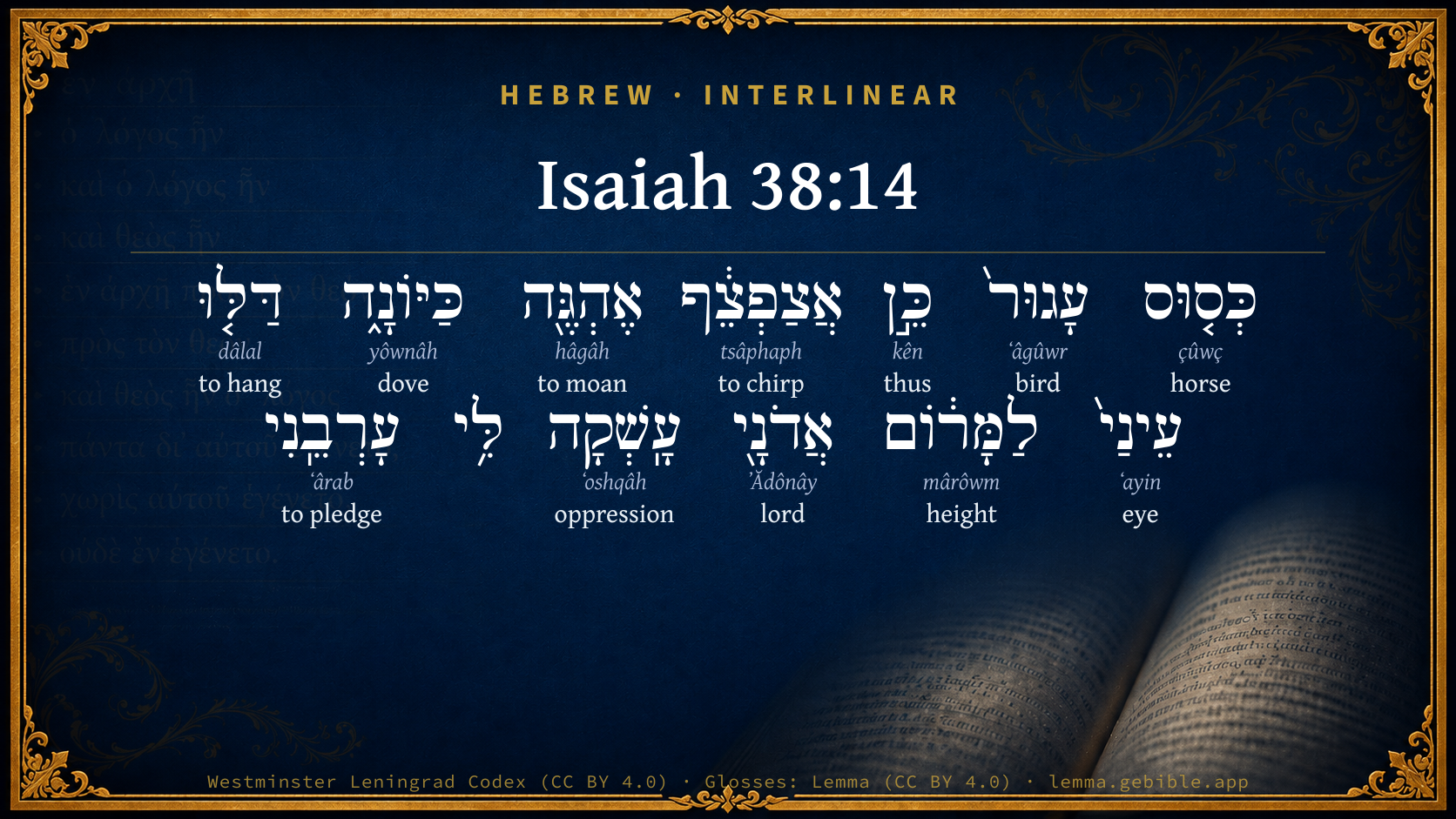
  1. כְּס֤וּס çûwç H5483 “like/as · horse of” Preposition + Noun, Common, Masculine, Singular, Construct
  2. עָגוּר֙ ʻâgûwr H5693 “bird” Noun, Common, Masculine, Singular, Absolute
  3. כֵּ֣ן kên H3651 “thus” Particle, Demonstrative
  4. אֲצַפְצֵ֔ף tsâphaph H6850 “to chirp” Verb, Pilpel, Imperfect, 1st Person, Common, Singular
  5. אֶהְגֶּ֖ה hâgâh H1897 “to moan” Verb, Qal, Imperfect, 1st Person, Common, Singular
  6. כַּיּוֹנָ֑ה yôwnâh H3123 “like/as the · dove” Preposition, Determined + Noun, Common, Feminine, Singular, Absolute
  7. דַּלּ֤וּ dâlal H1809 “to hang” Verb, Qal, Perfect, 3rd Person, Common, Plural
  8. עֵינַי֙ ʻayin H5869 “eyes · my” Noun, Common, Both, Dual, Construct + Suffix, Personal, 1st Person, Common, Singular
  9. לַמָּר֔וֹם mârôwm H4791 “to/for the · height” Preposition, Determined + Noun, Common, Masculine, Singular, Absolute
  10. אֲדֹנָ֖י ʼĂdônây H136 “Lord · my” Noun, Common, Masculine, Plural, Construct + Suffix, Personal, 1st Person, Common, Singular
  11. עָרְבֵֽנִי ʻârab H6148 “pledge · me” Verb, Qal, Imperative, 2nd Person, Masculine, Singular + Suffix, Personal, 1st Person, Common, Singular

About this verse

These counts appear in no published source. They are computed here, from the morphology-tagged text and Lemma’s own curated glosses. What Lemma adds →

13
words
12
distinct lemmas
Prophets
section

Notable vocabulary

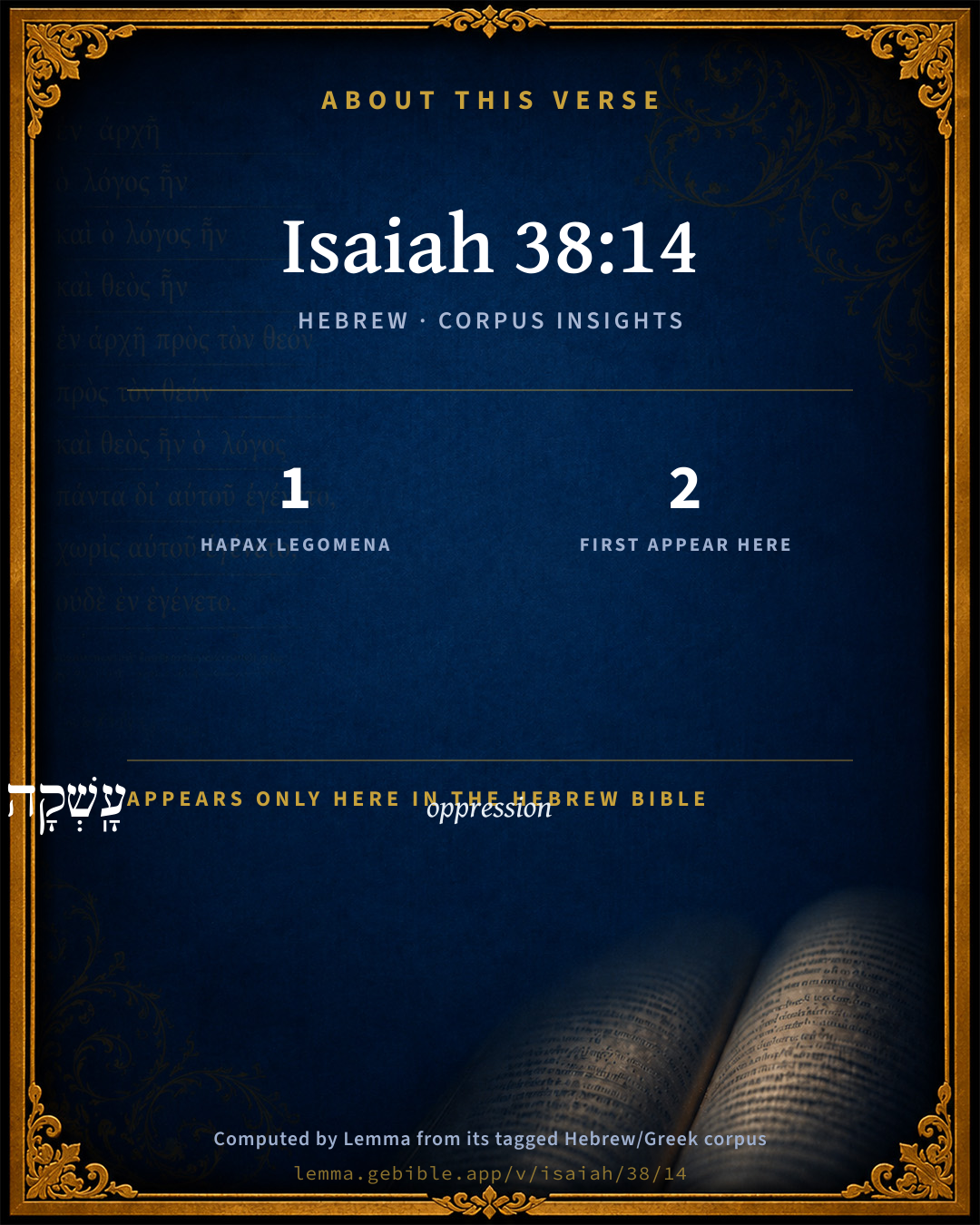
1 hapax legomenon — a word that appears only here in the entire Hebrew Bible:

  • עָֽשְׁקָה oppression H6234

First appearance in Scripture

These words make their first canonical appearance in the Hebrew Bible here:

  • עָגוּר֙ bird H5693
  • עָֽשְׁקָה oppression H6234

Shared distinctive vocabulary

עָגוּר֙ bird H5693 occurs in 2 verses of the Hebrew Bible. Also found in:

Grammatical profile

  • 4 verbs
  • 7 nouns
  • 1 preposition
  • 1 particle

Verb forms

  • אֲצַפְצֵ֔ף Pilpel · Imperfect
  • אֶהְגֶּ֖ה Qal · Imperfect
  • דַּלּ֤וּ Qal · Perfect
  • עָרְבֵֽנִי Qal · Imperative

Hebrew & Septuagint length

In English translation the verse runs 29 words from the Hebrew and 41 from the Septuagint (LXX English) — the Septuagint runs noticeably longer here. See the side-by-side →

A rough comparison of the two English renderings, which tokenize alike — not a word-level alignment.

Word counts can differ between the Hebrew and the Greek without any difference in meaning — e.g. the Hebrew direct-object marker אֵת has no separate Greek word, and Greek often adds the article ὁ.

Cross-references

12

Topical passages linked to Isaiah 38:14 in the Treasury of Scripture Knowledge — connected by theme and wording, ordered by reader-vote popularity; previews shown in the World English Bible.

  • Isaiah 59:11 We roar all like bears, and moan sore like doves: we look for justice, but there is none; for salvation, but it is far off from us.
  • Psalms 69:3 I am weary with my crying. My throat is dry. My eyes fail, looking for my God.
  • Job 30:29 I am a brother to jackals, And a companion to ostriches.
  • Psalms 119:122–123 Ensure your servant's well-being. Don't let the proud oppress me.
  • Psalms 123:1–4 To you I do lift up my eyes, You who sit in the heavens.
  • Ezekiel 7:16 But those of those who escape shall escape, and shall be on the mountains like doves of the valleys, all of them moaning, every one in his iniquity.
  • Nahum 2:7 It is decreed: she is uncovered, she is carried away; and her handmaids moan as with the voice of doves, beating on their breasts.
  • Job 17:3 "Now give a pledge, be collateral for me with yourself. Who is there who will strike hands with me?
  • Psalms 102:4–7 My heart is blighted like grass, and withered, For I forget to eat my bread.
  • Psalms 119:82 My eyes fail for your word. I say, "When will you comfort me?"
  • Psalms 143:7 Hurry to answer me, Yahweh. My spirit fails. Don't hide your face from me, So that I don't become like those who go down into the pit.
  • Lamentations 4:17 Our eyes do yet fail [in looking] for our vain help: In our watching we have watched for a nation that could not save.

Cross-references courtesy of OpenBible.info (CC BY 4.0).

Hebrew and Greek witnesses Masoretic Hebrew ↔ Greek Septuagint

The same verse in the two great witnesses to the Old Testament, shown verse-for-verse.

Here the Septuagint runs noticeably longer than the Hebrew — LXX2012 (modern English Septuagint) 41 words vs World English Bible 29. A rough length comparison of the two English translations, not a word-level alignment — read both below.

These are two independent witnesses, not word-aligned to each other, and the Septuagint is shown in lemma (dictionary) form.

Hebrew Isaiah 38:14 Masoretic · Westminster Leningrad Codex

כְּס֤וּס עָגוּר֙ כֵּ֣ן אֲצַפְצֵ֔ף אֶהְגֶּ֖ה כַּיּוֹנָ֑ה דַּלּ֤וּ עֵינַי֙ לַמָּר֔וֹם אֲדֹנָ֖י עָֽשְׁקָה לִּ֥י עָרְבֵֽנִי

Like a swallow [or] a crane, so did I chatter; I did moan as a dove; my eyes fail [with looking] upward: Lord, I am oppressed, be my collateral.

World English Bible · Public Domain

Greek LXX Isaiah 38:14 Septuagint · lemma form

ὡς χελιδών οὕτως φωνέω καί ὡς περιστερά οὕτως μελετάω ἐκλείπω γάρ ἐγώ ὁ ὀφθαλμός ὁ βλέπω εἰς ὁ ὕψος ὁ οὐρανός πρός ὁ κύριος ὅς ἐκαἱρέω ἐγώ

As a swallow, so will I cry, and as a dove, so do I mourn: for my eyes have failed with looking to the height of heaven to the Lord, who has delivered me, and removed the sorrow of my soul.

LXX2012 (modern English Septuagint) · Public Domain

On this verse, Adam Clarke's Commentary discusses the Septuagint’s reading. Read the note in Commentary ↓

Hebrew: Westminster Leningrad Codex (CC BY 4.0). Greek: Septuagint (public domain); English from LXX2012 (modern English Septuagint) (Public Domain). How the Septuagint differs from the Hebrew →

Targum (Aramaic paraphrase)

1

The Targum is the ancient Jewish Aramaic paraphrase of the Hebrew Scriptures — an interpretive translation, not the Hebrew text itself. Onkelos (literal) and Pseudo-Jonathan (expansive) render the Torah, and Jonathan the Prophets. Coverage is partial: where no permissively-licensed English translation exists for a verse, only the Aramaic is shown. This is verse-level text, not a word-by-word alignment to the Hebrew.

  1. Targum Jonathan Prophets (Joshua–Malachi)
    כְּסוּסְיָא דַאֲחִיד וּמְנַצֵיף כֵּן נְצֵיפַת וְנַהֲמֵית כְּיוֹנָה זְקָפִית עֵינַי דְיֵיתֵי לִי רְוַח מִן קֳדָם דִשְׁכִינְתֵּהּ בִשְׁמֵי מְרוֹמָא יְיָ קַבֵּיל צְלוֹתִי עֲבֵיד בָּעוּתִי:

    As a swallow chirps which is caught, so I chirped; and I moan like a dove: I lifted up mine eyes, that refreshing to might come to me from (before) Him whose Shekinah is in the highest heavens: O Lord, hear my prayer; grant my petition.

    Targum Jonathan — Aramaic: “Mikraot Gedolot” (public domain). English: “Sefaria Community Translation” (CC0 1.0 (public-domain dedication)); “London "Chaldee Paraphrase," 1871” (public domain). Text via Sefaria.

Commentary

Notes on Isaiah 38:14 from classic Christian and Jewish commentators (each source and its license shown beneath its notes). The classic Christian expositions comment on the surrounding passage and are grouped to its opening verse, so a note may address several verses; the Jewish commentaries on the Tanakh (Rashi and others) are per-verse, so they appear only where the commentator wrote on this verse.

Lemma curates 59 commentaries, every one of them public domain or Creative Commons licensed, each selected and text-cleaned for this edition rather than reprinted as found. About our sources →

Trapp's Complete Commentary

John Trapp

Isa 38:14 Like a crane [or] a swallow, so did I chatter: I did mourn as a dove: mine eyes fail [with looking] upward: O LORD, I am oppressed; undertake for me.

Ver. 14. Like a crane or a swallow, so did I chatter.] Ita pipiebam; peraptae sunt similitudines. Broken petitions coming from a broken heart are of singular avail with God. {Psa 51:17} Ah Pater brevissima quidem vex est, sed omnia complectitur, saith Luther - i.e., Ah, Father, is a short prayer, but very complexive and effectual. So is the prayer here recorded.

O Lord, I am oppressed; undertake for me.] {a} Miserere mihi misero. Hezekiah, though a most holy man, begged pardon at his death, and flees to Christ, his surety. So did Augustine (he prayed over the seven penitential psalms) and Fulgentius, and Archbishop Ussher. Some render it Pertexe me, weave me out, lengthen my life to its due period.

{a} Tu tuam fldem interpone.

John Trapp, A Commentary or Exposition upon All the Books of the Old and New Testament (1647–1656) — public domain. Text from a community e-Sword module.

The Biblical Illustrator

Joseph S. Exell

Isa_38:14

I did mourn as a dove

I did mourn as a dove

The possessions of the world are often the means of lightening lifes sorrows, and of increasing its enjoyments.

What experience teaches us in this respect the Word of God allows. Prosperity is recognised by it as a subject for gratitude. But that riches in themselves are insufficient to make us happy is undeniable. At all seasons the limitation of their power is obvious; but at no time does it appear more strikingly than when the king of terrors gives challenge to an earthly potentate, and he finds that there is no discharge in that war. The history connected with our text will furnish us with an instance.

I. THE CAUSES OF MOURNING. This image of mourning as a dove is not confined to this one passage (Isa_59:11; Eze_7:16; Nah_2:7). Now the plaintive mourning notes of the dove we will suppose to be descriptive of various classes of men of sorrow.

1. We will begin with those mourning from the same cause as the author of our text. It was pining sickness which wounded the monarchs spirit, and the prospect which it presented to him of certain dissolution. If, while as a dove you mourn plaintively, your mourning be dove-like because it is meek and submissive, still your mourning will be real.

2. Another source of mourning is the untowardness of worldly circumstances

3. Other sources of sorrow are to be found in the coldness of former friends, the treachery of those whom you trusted, or persecution from those who should encourage and support.

4. Another common cause of mourning like a dove is the departure of endeared ones.

5. A further source of mourning is remembrance of iniquity.

II. THEIR REMEDIES OR RELIEFS.

1. To the afflicted in body there is an obvious consolation--the possibility of their cure. The ease before us is thus encouraging. Another support in bodily affliction is the conformity which it gives us to our Lord. Again, Jesus Christ hath brought life and immortality to light through the Gospel.

2. What, next, is our relief in case of the wreck of worldly circumstances? The possession of wealth is no sure criterion of Gods approval. If your earthly losses have brought you to reflection, and led you to a right judgment of worldly goods; if the changes and chances of this mortal life have induced you to set your affection on things above; if they have broken your proud spirit, brought you to Christ, and ensured you an interest in His unsearchable riches, then mourn not as a dove, but sing as a lark.

3. We touch next on the grief which springs from dishonour done to us by familiar friends. We account this a curse: God may turn it into a blessing. We were wont to trust in man; we loved the creature with too ardent an attachment. Henceforth we think more of that Friend who sticketh closer than a brother; who is the same yesterday, to-day, and for ever; concerning whom it is our privilege to exclaim, Whom have I in heaven but Thee? &c. If the ill-treatment of which we complain consists in persecution for righteousness sake, our Lords words in the beatitude supply all necessary consolation: Blessed are ye when men shall revile you, &c. As the sufferings of Christ abound in us, so our consolation also aboundeth by Christ.

4. Separation from those we love was the fourth cause of mourning for which we were to seek for a relief. Though in lands remote, they tread the same earth. The rough ocean is kind to each of us: he bears on his bosom the swift messengers carrying the interchange of tokens that many waters cannot quench our love. The weeds of widowhood may be twined with flowers of cheerfulness; for a defender of the widow is God in His holy habitation. The orphans lamentation may be hushed; for God is a Father of the fatherless. God can give a place and a name better than of sons and of daughters. And is it a small thing that the righteous are taken away from the evil to come; that they rest from their labours; that they are present with the Lord?

5. The last source of mourning which we noticed was the remembrance of iniquity. Is the wound incurable? Is there no balm in Gilead; is there no physician there? (T. W. Thomson, M. A.)

Affliction the occasion of murmuring

Like a crane, &c.

I. AFFLICTIONS OFTEN LEAD TO RASH AND FOOLISH MURMURINGS. They often--

1. Obscure Gods goodness.

2. Lead us to forget past mercies.

3. Darken our future.

II. AFFLICTIONS LEADING TO RASH AND FOOLISH MURMURINGS EXPOSE US TO GREAT MORAL DANGERS. We may, then--

1. Wrongly interpret Gods providence.

2. Lose the benefit which God intended.

3. Dishonour Him.

4. Bring discredit upon our religious profession.

III. AFFLICTIONS HAVING LED TO RASH AND FOOLISH MURMURINGS, SUCH MURMURINGS SHOULD BE ACKNOWLEDGED. This will--

1. Show our sense of the evil of our conduct.

2. Tend to repair the injury we may have done.

3. Obtain pardon from God. (W. O. Lilley.)

O Lord, I am oppressed; undertake for me

The oppressed soul seeking Divine interposition

If language was ever uttered by man, which all men ought to adopt; if a petition was ever presented by man, which all men ought to present before the mercy-seat, it is this.

I. YOU ALL NEED SOME ONE TO UNDERTAKE FOR YOU. Some one to make your cause his own, and to assist you in performing that work on the performance of which your everlasting happiness depends. You need some one to undertake--

1. To support and comfort under the trials of life, and carry you safely through them.

2. To be your guide through life. You need a guide, a counsellor, who knows not only what is in man, but what every man will prove to be in future life. But if you need such a guide as it respects this world, how much more as it respects the world to come I

3. Still more do you need some one who will undertake to afford you effectual assistance in subduing your spiritual enemies, the enemies which oppose your salvation.

4. Most of all do you need some one who can and will undertake to plead your cause in heaven, and effect a reconciliation between you and Four justly offended God.

II. THERE IS NO ONE ON EARTH OR IN HEAVEN WHO IS BOTH ABLE AND WILLING TO UNDERTAKE FOR YOU, EXCEPT THE LORD JESUS CHRIST. (E. Payson, D. D.)

The Christians grand resource

There is scarcely any feeling more painful than that of desolation. The Scriptures frequently refer to it. Mic_7:1-2.) When this feeling first comes upon us, there is as it were a total prostration of strength. Consider--

I. THE CHRISTIAN UNDER TRIAL. The text is applicable--

1. To the young Christian just entering upon the duties of life.

2. To the young man entering upon his religious course.

3. To the Christian perplexed in the path of duty.

4. To the Christian under conviction of sin.

5. To the Christian in a state of grief for the loss of one near and dear to him.

6. To the Christian on his dying bed.

7. To the Christian as he stands before the Lord at His second advent.

II. THE CHRISTIANS RESOURCE. The world has many resources. The Christian has but one. But that one is of infinitely greater worth than all those possessed by an unconverted and ungodly world. (M. Villiers, M. A.)

The burdened souls relief

I. WHAT IS THE CAUSE OF YOUR OPPRESSION?

1. Is it some burden of sadness that has fallen upon you--some loss, or cross, or disappointment, that has shown you the fleeting uncertainty of all earthly treasures?

2. Is it some persecution of the ungodly?

3. Or do you stand perplexed by the foiling of some well-laid plan; or the unsuccessful issue of your efforts to remove the prejudices and enlighten the ignorance and improve the hearts of men?

4. Or do temptations beset you, almost too strong for flesh and blood to bear?

5. Is it not merely at the deceitfulness of your heart, but at its desperate wickedness that your heart sinks within you?

II. WILL YOU NOT GO ON TO SAY, O LORD, UNDERTAKE FOR ME?

1. How doth God undertake for us? Is it by removing from the sinner all temptation to sin? Is it by taking from the afflicted and mourner the immediate cause of his affliction, and restoring all things according to his shortsighted wish? No, it is by a far different process. He will suggest to his heart good resolutions, and holy impulses; and if he cherish these, the spirit of Jesus will afford him measures of special grace. And as to him that is bowed down with sorrow--it is not Gods way to reverse His sentence, and at once remove the cause. But He gives us such faith in Him, that we believe that the thoughts which He thinketh towards us, are thoughts of peace, and not of evil. And in proportion as faith makes herself heard, the voice of fretting dies away.

2. What ground of confidence we have that God will undertake for us.

(1) Have we not His own most sure promise?

(2) Have we not the experience of all the servants of the most High?

(3) But besides and beyond the Word of God and the experience of the saints--both of which the Israelites shared of old--we have the knowledge of the Incarnation of our Lord Jesus Christ, and of all the fruits and consequences which grow out of that blessed doctrine. (D. A.Beaufort, M. A.)

The yearning for sympathy met in Christ

There is such a vast disproportion between a man and some of his own feelings--between the inner and the outer life of a man--that the wonder is not that we should sometimes feel the burden of existence, but that there should be any man who should not be always saying, I am oppressed.

I. THERE ARE FEW MINDS WHO DO NOT LOOK OUT FOR SYMPATHY. It is an instinct of our nature, that we must lean somewhere. Almost all error, all superstition, all worldliness, resolves at last into the feeling that a man must lean; but he is leaning on a wrong base. It is upon this great principle in the mans breast that the Gospel lays hold and points it to Christ. It sets Him forth as the one great Undertaker for all His peoples wants.

II. WHAT ARE CHRISTS UNDERTAKINGS FOR US?

1. He has undertaken to pay all our debts: they are very great.

2. He has undertaken that we shall never be alone. I will never leave thee nor forsake thee.

3. He has undertaken that you shall never be really overcome. My strength is made perfect in weakness.

4. He has undertaken to place you on the sunny side of everything all life through; for He that followeth Me shall not walk in darkness, but shall have the light of life.

5. He has undertaken that you shall always have a place of refuge. Come unto Me, all ye that labour, &c.

6. He has undertaken that death shall be to you only a name, not a reality. He that believeth on Me shall never die. (J. Vaughan, M. A.)

Undertake for me

Hezekiah here represents his disease as a bailiff that had arrested him and was carrying him to the prison of the grave, and therefore prays that the Lord would bail him or rescue him out of his hands. (J. Gill, D. D.)

God needed in the dying hour

Ten days before the late Dean Burgon died he said, Nothing but the Everlasting Arms can support me now. (F. Harper, M. A.)

The cry of an oppressed spirit

Our individuality is strong in suffering. The ego rises to throw off the chains that bind it.

I. A CRY OF AN OPPRESSED SPIRIT. The human spirit is oppressed with--

1. Sin.

2. Circumstance.

3. Trouble.

4. Mysteries of life.

II. A CRY ADDRESSED TO THE TRUE HELPER.

1. God alone can undertake the cause of the soul.

2. He alone can bring true deliverance.

3. He will deliver those who seek Him.

4. His deliverances are eternal (W. O. Lilley.)

The Biblical Illustrator, edited by Joseph S. Exell (c. 1880s–1900s) — public domain. Text from a community e-Sword module.

The Preacher's Complete Homiletical Commentary

Joseph S. Exell (gen. ed.)

A CRY FOR HELP

Isa_38:14. O Lord, I am oppressed; undertake for me.

This prayer ascended from a sick-bed. State Hezekiah’s circumstances. From many sick-beds it still ascends.

1. From the sick-bed of the Christian who is distressed by thoughts of what may befall his wife and children after his removal from them.

2. From the sick-bed of the Christian who perceives that the world has been gaining much on his heart. Overtaken in the very strength and flower of his days by a sudden and dangerous illness, he sees that in the midst of the bustle and business of an honest calling he has been gradually drawn off from a life of watchfulness and prayer, and that, while keeping the forms of godliness, he has lost much of its power. Death apparently at hand, his soul starts up alarmed.

3. From the sick-bed of the worldly man, who at length perceives his guilt and danger. His awakened conscience fills him with distress and fear (H. E. I. 1334–1339), and the approach of death terrifies him (H. E. I. 1567).

Show how graciously God deals with all these suppliants when they sincerely call upon Him.—Richard Monks: Sermons, pp. 230–249.

A good prayer:—

1. For the young man entering upon the duties of life. Surrounded by the snares of the world, exposed to many temptations, and having in himself no strength or wisdom to deal with them aright.

2. For the young man entering upon his Christian course. Experimentally sensible of the deceitfulness of the heart, and conscious that there is one ever watchful, ever willing to encourage him in evil (H. E. I. 1061).

3. For the Christian perplexed in the path of duty.

4. For the Christian on his dying bed (H. E. I. 1570–1593).—H. Montagu Villiers, M.A.; Sermons, pp. 194–211.

Hezekiah’s prayer reminds us of man’s need of a Divine Helper. We need some one who can undertake to be our guide through life; to sustain us under the sorrows of life; to strengthen us against the temptations of life; to effect reconciliation between us and a justly offended God; to succour us in death; to welcome us to heaven, and to assign us our place in it.—Horace Monod.

THE SURETYSHIP OF CHRIST

Isa_38:14. Undertake for me.

I. That man needs a surety. This is evident from several considerations. Man—

1. Is an insolvent debtor;

2. a captive;

3. a criminal;

4. helpless and mortal.

II. That a surety has been provided (Heb_7:22; Heb_8:6; Heb_9:15; Heb_12:24). Christ was constituted a surety; not for God to us, but for us to God. He undertook to do for us, and in us, what we could not do for ourselves. Is man a debtor? Christ has paid the debt. Is man a captive? Christ came to set the captive free. Is man a criminal? Christ has endured the curse (Isa_53:6; 2Co_5:21). Is man helpless and mortal? Christ has provided everlasting strength (2Co_12:9).

III. That there must be a believing application made to that Surety. We must put in claim for share in the suretyship of Christ—must say in faith, “Lord, undertake for me; be surety for me.”

IV. The effects of such application. These are many and most important. In case of Hezekiah several are mentioned. God had sent him an alarming message. He wept and called upon God. His prayer was answered. A sign was given. During his sickness and after his recovery he had great exercises of soul He thought of death (Isa_38:10); was annoyed because he was about to be cut off from the worship of God (Isa_38:11), and that by a premature death (Isa_38:12). But was there not a remedy? Yes. What? A believing application to the Lord as surety. “O Lord, I am oppressed; undertake for me.” And what was the consequence? The whole tone of his thoughts was changed. He now recognises God’s hand in the dispensation (Isa_38:15); sees these things to be good for his soul (Isa_38:16); believes his recovery certain—realises the forgiveness of sin—is enabled to praise God (Isa_38:19); can now resolve to teach his children about God’s truth, and determine with them to bless and magnify God for ever (Isa_38:19-20). Thus the realisation of God as surety, and a believing application to Him for help, proved the turning-point for good in Hezekiah’s experience.

APPLICATION.—

1. In the way of warning.

(1.) Not to depend on ourselves for salvation.

(2.) Not to neglect the means of grace.

2. In the way of encouragement.

(1.) Jesus Christ is surety for all who believe in Him.

(2.) All who are oppressed in body or soul may and should, by God’s grace, believe in Jesus as their surety.—T. Oliver: The Study and the Pulpit, New Series, 1876, pp. 419–421.

The Preacher's Complete Homiletical Commentary (gen. ed. Joseph S. Exell; Funk & Wagnalls, c. 1892) — public domain (pre-1929). A full-Bible homiletical/sermon-outline anthology covering 65 of 66 books (2 John is absent from the source module). Text from a community e-Sword module.

Geneva Bible (1599)

Geneva Bible translators

To wit, sorrow and grief both of the body and mind.

I was so oppressed with sorrow, that I was not able to utter my words, but only to groan and sigh.

Geneva Bible (1599) marginal notes — public domain. Text via Bolls.life.

Jamieson, Fausset & Brown

Robert Jamieson, A. R. Fausset & David Brown

Rather, "Like a swallow, or a crane" (from a root; "to disturb the water," a bird frequenting the water) [MAURER], (Jer 8:7).

chatter--twitter: broken sounds expressive of pain.

dove--called by the Arabs the daughter of mourning, from its plaintive note (Isa 59:11).

looking upward--to God for relief.

undertake for--literally, "be surety for" me; assure me that I shall be restored (Psa 119:122).

Jamieson, Fausset & Brown — Commentary Critical and Explanatory on the Whole Bible (1871) — public domain (CC PDM 1.0). Text via the HelloAO Bible API.

Adam Clarke's Commentary

Verse 14. Like-a swallow - "Like the swallow"] כסיס kesis; so read two MSS., Theodot., and Hieron.

Mine eyes fail] For דלו dallu the Septuagint read כלו calu, εξελιπον. Compare Ps 69:4; Ps 119:82; Ps 119:123; La 2:11; La 4:17, in the Hebrew and in the Septuagint.

O LORD - "O Lord"] For יהוה Jehovah, thirty MSS. and eight editions read אדני Adonai.

Undertake for me - "Contend for me"] עשקה ashekah, with ש shin, Jarchi: this sense of the word is established by Ge 26:20: "He called the name of the well עשק esek, because they strove with him:" התעשקו hithasseku, equivalent to יריבו yaribu, at the beginning of the verse.

Adam Clarke's Commentary on the Bible (1810–1826) — public domain. Text from a community e-Sword/MySword module.

Ellicott's Commentary for English Readers

(14) Like a crane . . .—The three birds—strictly, the “swift,” the “crane,” the “dove”—each with its special note of lamentation, represent, as it were, the cries of pain and the low suppressed wail of the sufferer. The three appear again together in Jer_8:7.

Undertake for me—i.e., as in Gen_43:9; Gen_44:32; Job_17:3, Be surety for me. The idea is that of Death, who, yet in another sense, is but the minister of Jehovah, as being the creditor pressing for immediate payment. The words involve (as Cheyne points out) something like an appeal to the judge, who is also the accuser, to be bail for the accused.

A Bible Commentary for English Readers, edited by Charles John Ellicott (1878–1897) — public domain. Text from a community e-Sword module.

The Cambridge Bible for Schools and Colleges

gen. ed. J. J. S. Perowne

14. Like a crane or a swallow] Rather, as R.V., Like a swallow or a crane. Both words occur again only in Jer_8:7. The want of a copula in Heb., and the unsuitability of the verb “chirp” (E.V. “chatter”) to the note of the crane suggests that the latter may have been imported into the text from the passage in Jeremiah. It is wanting in the LXX.

I did mourn as a dove] Cf. ch. Isa_59:11; Eze_7:16; Nah_2:7.

with looking upward] lit. toward the height, where Jehovah dwells.

undertake for me] become surety for me (Job_17:3). The image is that of a debtor who is being committed to prison.

The Cambridge Bible for Schools and Colleges (gen. ed. J. J. S. Perowne; Cambridge University Press, 1878–1918) — public domain. Text from a community e-Sword module.

John Gill's Exposition

What shall I say?.... In a way of praise and thankfulness, for the mercies promised and received; I know not what to say; I want words to express the gratitude of my heart for the kindness bestowed. What shall I render to God for all his benefits? So the Targum,

"what praise shall I utter, and I will say it before him?''

for here begins the account of his recovery, and his thanksgiving for it:

he hath both spoken unto me, and himself hath done it; the Lord had sent him a message by the prophet, and assured him that he should recover, and on the third day go up to the temple; and now he had performed what he had promised, he was restored, and was come to the house of God with his thank offering; whatever the Lord says, he does; what he promises, he brings to pass:

I shall go softly all my years in the bitterness of my soul; before he did not reckon of a day to live, now he speaks of his years, having fifteen added to his days, during which time he should "go softly", in a thoughtful "meditating" frame of mind (r); frequently calling to remembrance, and revolving in his mind, his bitter affliction, and recovery out of it, acknowledging the goodness and kindness of God unto him: or leisurely,

step by step, without fear of any enemies, dangers, or death, having a promise of such a length of time to live: or go pleasantly and

cheerfully, after the bitterness of my soul (s), as it may be rendered; that is, after it is over, or because of deliverance from it. So the Targum,

"with what shall I serve him, and render to him for all the years he hath added to my life, and hath delivered me from the bitterness of my soul?''

(r) "motitando meditabor", Tigurine version; "leniter, vel pedetentim incedam" Vatablus; "alacriter incedam", Piscator, Vitringa. (s) "post amaritudinem", Piscator.

John Gill's Exposition of the Whole Bible (1746–1763) — public domain (CC PDM 1.0). Text via the HelloAO Bible API.

Albert Barnes' Notes on the Bible

Like a crane - The word used here (סוּס sûs) usually denotes a horse. The rabbis render it here ‘a crane.’ Gesenius translates it ‘a swallow;’ and in his Lexicon interprets the word which is translated ‘a swallow’ (עגוּר 'āgûr) to mean “circling,” making gyrations; and the whole phrase, ‘as the circling swallow.’ The Syriac renders this, ‘As the chattering swallow.’ The Vulgate, ‘As the young of the swallow.’ The Septuagint simply reads: ‘As the swallow.’ That two birds are intended here, or that some fowl is denoted by the word עגוּר 'āgûr, is manifest from Jer 8:7, where it is mentioned as distinct from the סוּס sûs (the crane) ועגוּר וסוּס vesûs ve‛āgûr. On the meaning of the words Bochart may be consulted (Hieroz. i. 2. p. 602). It is probable that the swallow and the crane are intended. The swallow is well known, and is remarkable for its twittering. The crane is also a well-known bird with long limbs made to go in the water. Its noise may be expressive of grief.

So did I chatter - Peep, or twitter (see the note at Isa 8:19). The idea here is doubtless that of pain that was expressed in sounds resembling that made by birds - a broken, unmeaning unintelligible sighing; or quick breathing, and moaning.

I did mourn as a dove - The dove, from its plaintive sound, is an emblem of grief. It is so used in Isa 59:11. The idea is that of the lonely or solitary dove that is lamenting or mourning for its companion:

‘Just as the lonely dove laments its mate.’

Mine eyes fail - The word used here (דלוּ dâllû) means properly to hang down, to swing like the branches of the willow; then to be languid, feeble, weak. Applied to the eye, it means that it languishes and becomes weak.

With looking upward - To God, for relief and comfort. He had looked so long and so intensely toward heaven for aid, that his eyes became weak and feeble.

O Lord, I am oppressed - This was his language in his affliction. He was so oppressed and borne down, that he cried to God for relief.

Undertake for me - Margin, ‘Ease me.’ The word (ערב ‛ârab) more properly means, to become surety for him. See it explained in the the note at Isa 36:8. Here it means, be surety for my life; give assurance that I shall be restored; take me under thy protection (see Psa 119:122): ‘Be surety for thy servant for good.’

Albert Barnes' Notes on the Bible (1834–1885) — public domain. Text from a community e-Sword/MySword module.

Haydock's Catholic Bible Commentary

For me. He represents his disease, as an inexorable creditor.

George Leo Haydock (1774–1849), Haydock's Catholic Family Bible and Commentary, 1859 edition — public domain. Excludes Psalms (Douay-Rheims chapter numbering differs from Protestant) and Deuterocanonical books (Catholic canon only).

Matthew Poole's English Annotations

Like a crane or a swallow; or, a crane and a swallow; the conjunction and being here, as it is Hab 3:11, and elsewhere, understood, as is manifest from Jer 8:7, where it is expressed with these very words.

So did I chatter; my complaint and cry was like to the noise of a swallow, quick and frequent; and like that of a crane, loud and frightful. And this very comparison is used of mourners, not only in Scripture, but in other authors; concerning which the learned reader may consult my Latin Synopsis.

I did mourn as a dove; whose mournful tone is observed Isa 59:11; Eze 7:16, and elsewhere.

Mine eyes fail with looking upward; whilst I lift up mine eyes and heart to God for relief, but in vain.

I am oppressed by my disease, which like a serjeant hath seized upon me, and is haling me to the prison of the grave.

Undertake for me; stop the execution, and rescue me out of his hands.

Matthew Poole's English Annotations on the Holy Bible (1683–1685) — public domain. Text from a community e-Sword/MySword module.

Whedon's Commentary on the Bible

Daniel D. Whedon

14. Like a crane or a swallow, so did I chatter — Mournfully twittering. So Furst, decidedly, and Gesenius with wavering views.

I did mourn — I sorrowed vocally as a dove does when it has lost its mate. The attempt here is to indicate the sounds made by him in his extreme pain of body and mind.

Mine eyes fail — Because weak from constant looking upward for help. In his pain the poor man cried,

I am oppressed — Overwhelmed.

Undertake for me — Be surety for me. Hezekiah seems not to have surrendered all hope.

Daniel D. Whedon (gen. ed.), Commentary on the Old and New Testaments (1874–1909) — public domain. Text from a community e-Sword module.

The Pulpit Commentary

Like a crane or a swallow. The sus, here translated "crane," is probably "the swift," which has a loud, shrill note. The, agur is, perhaps, "the crane;" but this is very uncertain. The two words occur as the names of birds only here and in Jer_8:7. So did I chatter; rather, so did I scream (Cheyne). I did mourn; rather, I did moan. Mine eyes fail with looking upward; rather, mine eyes are weak to look upward ; i.e. I have scarcely the courage or the strength to look to Jehovah; yet still I do look to him falteringly, and make my appeal: O Lord, I am oppressed; undertake for me; (comp. Job_17:3) literally, be Surety for me. "The image," as Mr. Cheyne says, "is that of a debtor, who is being dragged to prison" at the suit of an exacting creditor, and for whom there is but one hope of relief; viz. if he can obtain a sufficient surety. Hezekiah calls on God to be the Surety; but God is the Creditor! Still, there is an appeal from God"s justice to God"s mercy from Jehovah who punishes to Jehovah who forgives sin; and this appeal Hezekiah seems to intend to make when he beseeches God to "undertake for him.

Life a burden.

"Jehovah, I am hard pressed; be Surety for me" (Cheyne). Life has its shadow as well as its sunshine; and in our depressed times we fancy that the shadow almost blots out the shine. There is a poem which, with the touch of genius, pictures the shadow that, since the failure of our race-parents in Eden, lies close against everything for man. Go where he may, do what he will, man cannot get away from his shadow. It tracks his feet. This side or that it is found, whichever way he may stand to the light. It lies down with him; it rises with him; it goes forth with him; it comes back with him; until he even gets to fear it, and, seeing it flung everywhere, says, "Life is dark, and life is hard." This sentence of the text is an utterance of genuine feeling. It is Old Testament feeling rather than Christian feeling; but the poetical form of it gives it largeness enough to cover and include the very best Christian thoughts. Hezekiah expresses what he felt when he lay on the "border-land." His idea is that death is his creditor, and pressing for immediate payment, and he calls on God to be Surety for him, and release him from the clutch of this death. Some, oppressed, cry against advancing death. Others, as Tennyson"s "Mariana," cry for it, saying"I"m aweary, I"m aweary, I would that I were dead!

Can it be profitable for us to dwell on this despairing mood of Hezekiah? Perhaps, as we meditate, the clouds may part a little, and glints of glory may break through. Our soul may take wing and fly to God, and find rest in him.

I LIFE A BURDEN It is such

(1) in view of the responsibilities under which we come; it is

(2) as a matter of feeling and sentiment oftentimes.

No man, indeed, ever comes to use life aright until he regards it as a sacred burden. It will be heavy or light, it will crush or it will ennoble, according to the spirit in which we accept it, and deal with it. Too readily we say that life always looks bright to youth and maiden. Is it so? We could find some of the saddest poetry ever written which had been composed by the young. Every right-hearted youth loosens the home ties, stands free, and stoops to lift up his own life-burden with a great sigh of anxiety and fear. What does the man of middle age say? However brightly and bravely a man may take up his daily care, still he feels that each new child, and each lengthening year with its new claims, adds to his burden. Business life, in modern times, seems a heavier burden than it ever was a daily bearing and struggling to win daily bread, because we, and those related to us, want so much more than bread. Ask the old men what they think of life. The very best among them will reply, "I thank God for life, but he only knows what a burden it has been to me. His grace has enabled me to carry it, but sometimes oftentimes it has crushed me down on my knees." Or take the faculties with which we are endowed, and the spheres in which those faculties find expression and operation. This body: what a constant care to keep it in health, and to get it fed, clothed, and wisely ruled! And sometimes it lies like a heavy log upon our souls, and from under it we can scarcely get our breath! This mind. The infinite realms of knowledge stretch out on either side, and it is our agony that life will only let us touch, with a passing foot, the mere skirts and edges of one or two of them. The soul our very selves what a prison-house for us this body is! Wherever we go we must carry the body. Our souls can neither fly nor go. " Quaintly, but effectively, our fathers drew an emblem. The skeleton was represented as the cage within which the living man was imprisoned. At some time in our lives we all have thanked God for the Book of Ecclesiastes, which is precisely this a man who felt life as a burden, letting his heart out. But turn to consider

II GOD IS THE ONLY TRUE BURDEN-BEARER. If the three words, Undertake for me," could be put into a Christian form of speech, they would be found to express that full surrender," that perfect submission," that rest of faith," which is the secret of the higher life," the true beginning and proper foundation of Scripture holiness. But, practically, how can the man who feels life to be a burden commit that burden to the Lord? It" you do not believe in a living God, in the living Christ-God, actually present, ruling and overruling, you will never find out how. If God is away in the heavens, and Christ back in the centuries, our text has no real meaning; it is a vague sentiment. But if God is here, and Christ is with us in us; if the Father does see in secret, and the Son abide with us always; then it will be easy to unfold the secret of the rolled burden. One idea at least we can give. If we have a heart-sorrow we can relieve it by making a confidant. Robert Alfred Vaughan had long been ill, but one morning his wife saw signs which struck her with hopelessness. In her grief she thought of going to unbosom her trouble to her friend Mrs. George Dawson. Ere she could leave her house, that friend came in, she had come to open a new sorrow to her friend her only girl had been seized with fits of a kind which put in peril intellect and life. Those women lifted each others" burdens by opening them in the confidences of friendship. We lose our burdens by freely telling God all about them. There is another way of rolling burdens on God, which is less easy to put into words which is a matter of soul-feeling. We can give up the self-management of our lives. It can become a conscious ruling thought with us that we live, not for self, but for God; we can inwardly realize that God takes our life-rule into his hands; we go where he sends, we do what he bids. Come to the simplicities of life. How does a wearied child roll his burden on his mother? How does the husband lighten his life-care by rolling it upon a loving wife? Verily, the little things of man will help us to understand the great things of God. R.T.

The Pulpit Commentary (1880–1919), ed. H.D.M. Spence-Jones & Joseph S. Exell — public domain. Text from a community e-Sword module.

J. A. Alexander on Isaiah

Joseph Addison Alexander

“Like a swallow (or) a crane (or like a twittering swallow), so I chirp; I moan like the dove; my eyes are weak (with looking) upward (or on high); O Jehovah, I am oppressed, undertake for me (or be my surety).” In the first clause the meanings of the sufferer are compared, as in many other cases, to the voice of certain animals. The dove is often spoken of in such connections, and the mention of it here makes it probable that the parallel expressions are also descriptive of a bird or birds. The comparison is evidently meant to be descriptive of inarticulate moans or murmurs. The reference of the verbs in the first clause to past time (I chirped, I moaned), though assumed by most interpreters, is perfectly gratuitous, when the future proper yields so good a sense. This violation of the syntax has arisen from assuming that the clause must be a retrospective description of something already past, and not an expression of present feeling such as he might have uttered at the moment. That this last is no unnatural hypothesis, is certain from the fact that all interpreters adopt it in the other clause. But if that may be the language of the sufferer at the time of his distress, it is equally natural, or rather more so, to explain the first clause in the same way. The same word is used in Psa 119:122, in the sense of ‘undertake for me’ or ‘be my surety’, (i.e., interpose between me and my enemies). The reference is rather to protection than to justification.

Joseph Addison Alexander, The Prophecies of Isaiah (1846–1847; New York: Scribner, 1870–1878) — public domain. Text from a community e-Sword module.

unfoldingWord translationNotes

Door43 World Missions Community

General Information:

Hezekiah continues his written prayer.

Like a swallow I chirp; I coo like a dove

Both of these clauses mean the same thing and they emphasize how sad and pitiful Hezekiah's cries were. A swallow and a dove are types of birds. AT: "My cries are pitiful--they sound like the chirp of a swallow and the coo of a dove" (See: Parallelism and Simile)

my eyes

Here Hezekiah refers to himself my his "eyes" to emphasize that he is looking for something. AT: "I" (See: Synecdoche)

with looking upward

This refers to Hezekiah looking to heaven for God to help him. The full meaning of this statement can be made clear. AT: "of waiting for help to come from heaven" or "of waiting for you to help me" (See: Assumed Knowledge and Implicit Information)

I am oppressed

This can be stated in active form. AT: "My sickness oppresses me" (See: Active or Passive)

What shall I say?

Hezekiah uses a question to emphasize he has nothing left to say. This can be written as a statement. AT: "I have nothing left to say." (See: Rhetorical Question)

I will walk slowly

This is an idiom. Here "walking" refers to living. AT: "I will like humbly" (See: Idiom)

all my years

This refers to the rest of his life. The meaning of this can be made clear. AT: "the rest of my life" (See: Assumed Knowledge and Implicit Information)

because I am overcome with grief

"because I am full of grief" or "because I am very sad"

translationWords

lord

oppress

unfoldingWord translationNotes — © Distant Shores Media and the Door43 World Missions Community, licensed CC BY-SA 4.0. Source: git.door43.org/Door43/en_tn.

Rashi

Rabbi Shlomo Yitzchaki (Rashi)

like a crane (סוּס) same as (Jer. 8:7), סִיס, and that is the name of a bird.

like a crane, a swallow like a crane and a swallow. (Alternatively,) like this bird, seized by the neck, and it screeches. So did Jonathan render: Like a crane that is caught and screeches.

Rob me (עָשְׁקָה), like עֲשֹׁק. Rob me, take me out of the hand of the angel of death, and pledge Yourself to save me. This (עָרְבֵנִי) is an expression of surety (garantieh in O.F.). Comp. (Ps. 119) “Pledge Yourself (עֲרוֹב) to Your servant for good.”

Rob me (לִי) Rob me from his hand. Comp. (Num. 12:13) “Please cure her (לָהּ),” like, cure her (אוֹתָהּ).

Rashi on the Tanakh — English translations: “The Judaica Press complete Tanach with Rashi, translated by A. J. Rosenberg” (CC BY 4.0); “Pentateuch with Rashi's commentary by M. Rosenbaum and A.M. Silbermann, 1929-1934” (public domain); “The Metsudah Tanach series, Lakewood, N.J” (CC BY 4.0); and “The Book of Joshua, Metsudah Publications, 1997” (CC BY 4.0). Text via Sefaria.

Ibn Ezra

Rabbi Abraham ibn Ezra

כסוס כעגור═כסוס עגור. Comp. כרע כאח לי as though he had been my friend, my brother (Ps. 35:14). In the same way ככבש כאלוף ═ אלוף ככבש like a lamb, like an ox (Jer. 14:19). סיס and עגור are names of birds, a crane, a swallow. So did I chatter. The patient in his heavy illness mutters and speaks what no one is able to understand.

דלו They are lifted up. Root דלל, comp. דליו they are high (Prov. 26:7).

עשקה לי It oppresseth me. The illness oppresseth me.

ערבני Undertake for me. Comp. ערוב be surety (Ps. 119:112); according to some הרבני ═ ערבני destroy me; this is nonsense. The word ערבני, lit. pledge thyself for me, is an anthropomorphism; it means, sympathise with me in my troubles.

Ibn Ezra on the Tanakh — English translations: “Sefaria Community Translation” (CC0 1.0 (public-domain dedication)); “Yalkut, Sifsei Chachomim Chumash, Metsudah Publications, 2009” (CC BY 4.0); and “Commentary of Ibn Ezra on Isaiah - trans. by M. Friedlander, 1873” (public domain). Text via Sefaria.

Lesson kit

Teaching starters — assembled from the data on this page, not authored interpretation. Every prompt links to the verse data it draws on. Edit before teaching.

Isaiah, in the Prophets, opens this verse with 13 words (12 distinct Hebrew lemmas). Its most distinctive word is ʻoshqâh (“oppression”). The Greek Septuagint runs longer here. A historical commentator’s framing appears above. Read the whole chapter for the surrounding context.

Discussion questions

  1. How does “oppression” (ʻoshqâh) shape what this verse is saying?
  2. 1 word here appears nowhere else in the Hebrew Bible. Why might the author reach for such rare wording?
  3. 2 words make their first appearance in Scripture here. What does this debut establish?
  4. How does Jeremiah 8:7, which shares the word «bird», read alongside this verse?
  5. The Septuagint runs longer here than the Hebrew. What might account for the difference?
  6. These translations render this verse differently; the difference is in the English rendering, not the original. What questions does that raise?
  7. «אֲצַפְצֵ֔ף» is a Pilpel Imperfect verb. How does that grammatical form shape the action described?
  8. Compare how Trapp's Complete Commentary and The Biblical Illustrator read this verse. Where do they agree or differ?

Things to notice

  • 1 word in this verse appears nowhere else in the Hebrew Bible.
  • 2 words make their first canonical appearance in Scripture here.
  • These translations choose different wording for 22 words in this verse.
  • 12 distinct Hebrew lemmas span 13 words in this verse.

Reading settings

Reading text

Shown beneath each verse's original-language words.

Old Testament
Old Testament edition

Read the OT as the Masoretic Hebrew (MT) or the Greek Septuagint (LXX).

English shown for the Greek Septuagint (in the Hebrew ↔ Greek comparison).

Comparing translations? Open the Compare panel on any verse page to stack up to four side by side.