
Jeremiah 4:10

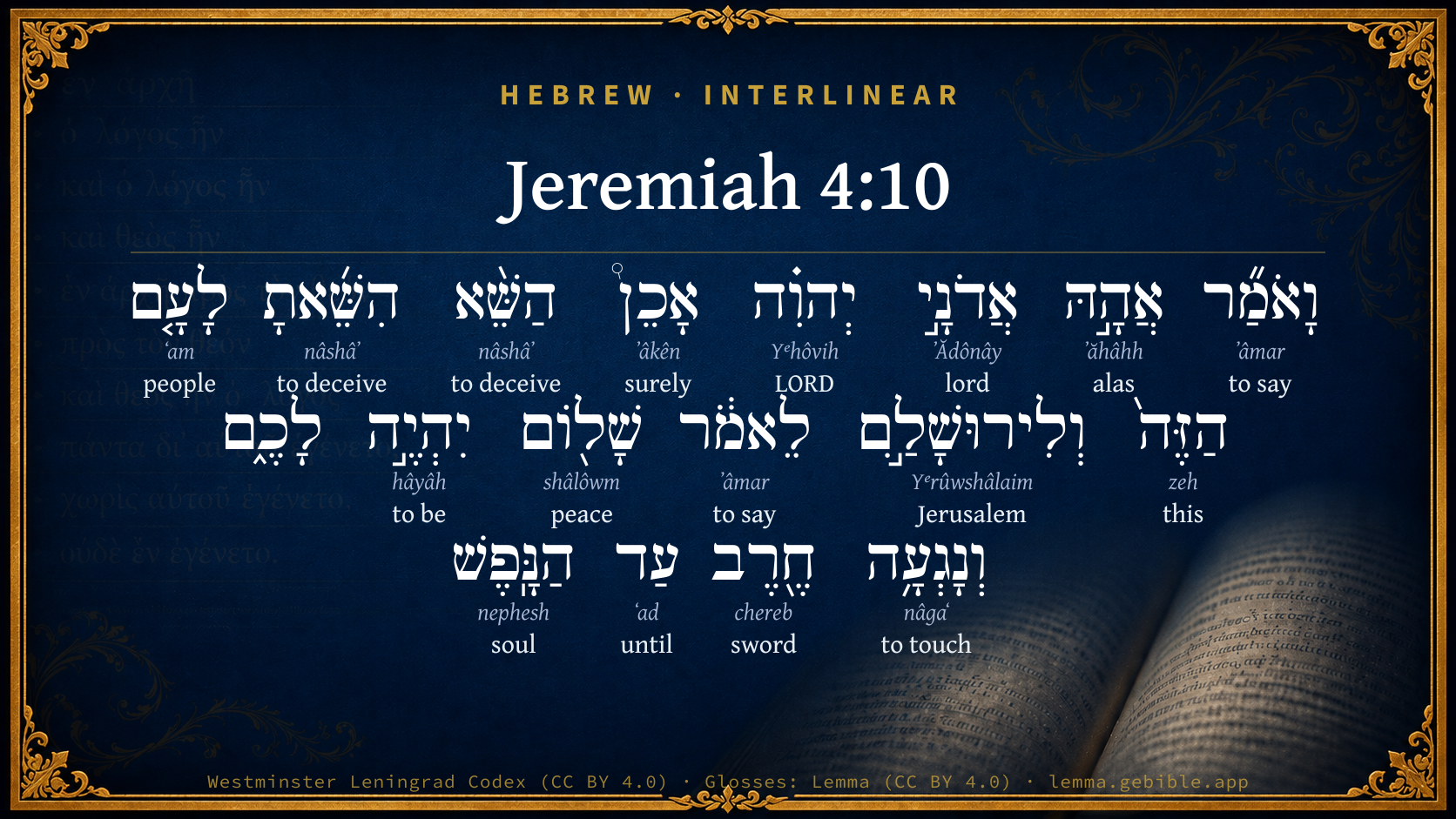
Hebrew (Westminster Leningrad Codex) Jeremiah 4:10 appears in the Hebrew Old Testament. The text above is from the Westminster Leningrad Codex. Each word links to its Strong’s number, a concise gloss, and parsing drawn from the Open Scriptures Hebrew Bible morphology. Click any word for its full Brown-Driver-Briggs (BDB) entry.
Download image
Cite this verse

Jeremiah 4:10 (World English Bible). Public Domain. Lemma interlinear Bible study tool, https://lemma.gebible.app/v/jeremiah/4/10.

Show BibTeX & RIS
BibTeX
RIS
English Translation
Then said I, Ah, Lord Yahweh! surely you have greatly deceived this people and Jerusalem, saying, You shall have peace; whereas the sword reaches to the life.
World English Bible · Public Domain
Download a study sheet

One document with this verse’s original text, its word-by-word gloss line, the meaning frame, cross-references with their text, attributed commentary, and full source and license credits — printable, and it pastes into notes with its structure intact.

This verse Autodidact and up

Study sheet (.html) Plain text (.txt)

A passage Seminary Student

Up to 50 verses in one chapter. A passage sheet keeps up to 6 commentary sources and 12 cross-references per verse, in the order this page ranks them, and says so on the sheet whenever that leaves anything out. Ask for a single verse and you get the Autodidact verse sheet above.

Everything on this page stays free to read, with no account — the sheet is a download of what is already on screen, not access to it.

Want to remove ads? Support Godless Engineer
Compare translations 3

The same verse in 3 English versions, stacked beneath the original-language interlinear above. Click any original word for its lexicon entry.

Each is an independent rendering of the whole verse — the interlinear is not word-aligned to these translations.

Highlighted words mark where these versions differ — a whole-verse word diff, not a word-by-word alignment.

  • World English Bible Public Domain
    Then said I, Ah, Lord Yahweh! surely you have greatly deceived this people and Jerusalem, saying, You shall have peace; whereas the sword reaches to the life.
  • King James Version Public Domain
    Then said I, Ah, Lord GOD! surely thou hast greatly deceived this people and Jerusalem, saying, Ye shall have peace; whereas the sword reacheth unto the soul.
  • unfoldingWord Literal Text CC BY-SA 4.0
    And I said, “Alas! Lord Yahweh, surely you have completely deceived this people and Jerusalem, saying, ‘It will be peace for you.’ Yet the sword will reach as far as the life.”

unfoldingWord Literal Text — © unfoldingWord, licensed CC BY-SA 4.0. Word-aligned USFM3 via Door43 (git.door43.org/unfoldingWord/en_ult).

Versions to compare (up to 4)

3 of 4 selected

Show all 18 translations

Every available English version of this verse, each an independent rendering of the whole verse.

  • World English Bible Public Domain
    Then said I, Ah, Lord Yahweh! surely you have greatly deceived this people and Jerusalem, saying, You shall have peace; whereas the sword reaches to the life.
  • Berean Standard Bible Public Domain
    Then I said, “Ah, Lord GOD, how completely You have deceived this people and Jerusalem by saying, ‘You will have peace,’ while a sword is at our throats.”
  • Majority Standard Bible Public Domain
    Then I said, “Ah, Lord GOD, how completely You have deceived this people and Jerusalem by saying, ‘You will have peace,’ while a sword is at our throats.”
  • King James Version Public Domain
    Then said I, Ah, Lord GOD! surely thou hast greatly deceived this people and Jerusalem, saying, Ye shall have peace; whereas the sword reacheth unto the soul.
  • American Standard Version (1901) Public Domain
    Then said I, Ah, Lord Jehovah! surely thou hast greatly deceived this people and Jerusalem, saying, Ye shall have peace; whereas the sword reacheth unto the life.
  • Revised Version (1885) Public Domain
    Then said I, Ah, Lord GOD! surely thou hast greatly deceived this people and Jerusalem, saying, Ye shall have peace; whereas the sword reacheth unto the soul.
  • Geneva Bible (1599) Public Domain
    Then saide I, Ah, Lord God, surely thou hast deceiued this people and Ierusalem, saying, Ye shall haue peace, and the sworde perceth vnto the heart.
  • Douay-Rheims (1899) Public Domain
    And I said: Alas, alas, alas, O Lord God, hast thou then deceived this people and Jerusalem, saying: You shall have peace: and behold the sword reacheth even to the soul?
  • Young's Literal Translation Public Domain
    And I say, `Ah, Lord Jehovah, Surely thou hast entirely forgotten this people and Jerusalem, saying, Peace is for you, And struck hath a sword unto the soul!'
  • Literal Standard Version CC BY-SA 4.0
    And I say, “Aah! Lord YHWH, || Surely you have entirely forgotten this people and Jerusalem, || Saying, Peace is for you, || And a sword has struck to the soul!”
  • Unlocked Literal Bible CC BY-SA 4.0
    So I said, “Ah! Lord Yahweh. Surely you have completely deceived this people and Jerusalem by saying, 'There will be peace for you.' Yet the sword is striking against their life.”
  • unfoldingWord Literal Text CC BY-SA 4.0
    And I said, “Alas! Lord Yahweh, surely you have completely deceived this people and Jerusalem, saying, ‘It will be peace for you.’ Yet the sword will reach as far as the life.”
  • Darby Bible Public Domain
    And I said, Alas, Lord Jehovah! surely thou hast greatly deceived this people and Jerusalem, saying, Ye shall have peace; whereas the sword reacheth unto the soul.
  • World Messianic Bible Public Domain
    Then I said, “Ah, Lord GOD! Surely you have greatly deceived this people and Jerusalem, saying, ‘You will have peace;’ whereas the sword reaches to the heart.”
  • Webster's Bible Public Domain
    Then said I, Ah, Lord GOD! surely thou hast greatly deceived this people and Jerusalem, saying, Ye shall have peace; whereas the sword reacheth to the soul.
  • Free Bible Version CC BY-SA 4.0
    Then I said, “Oh, Lord God, you have completely fooled the people of Jerusalem by telling them, ‘You will have peace,’ while holding a sword to our throats.”
  • Bible in Basic English Public Domain
    Then said I, Ah, Lord God! your words were not true when you said to this people and to Jerusalem, You will have peace; when the sword has come even to the soul.
  • JPS Tanakh (1917) Public Domain
    Then said I: 'Ah, Lord GOD! surely Thou hast greatly deceived this people and Jerusalem, saying: Ye shall have peace; whereas the sword reacheth unto the soul.'

Literal Standard Version (2020), Covenant Press — licensed CC BY-SA 4.0. Text via the HelloAO Bible API (eBible.org). Unlocked Literal Bible (unfoldingWord) — licensed CC BY-SA 4.0. Text via the HelloAO Bible API (eBible.org). unfoldingWord Literal Text — © unfoldingWord, licensed CC BY-SA 4.0. Word-aligned USFM3 via Door43 (git.door43.org/unfoldingWord/en_ult). Free Bible Version, Dr. Jonathan Gallagher — licensed CC BY-SA 4.0. Text via the HelloAO Bible API (eBible.org).

Word by word

More ways to search: Search by grammar → Find every occurrence → Compare this word →

Practice this passage: Drill this verse → Learn its vocabulary →

אֲהָ֣הּ
ʼăhâhh
H162
“alas”
Particle, Interjection
Part of Speech
Particle
Type
Interjection
Full BDB Definition

Origin: apparently a primitive word expressing pain exclamatorily, Oh!

TWOT: 30

alas!, oh!, ah!
  1. וָאֹמַ֞ר ʼâmar H559 “and · to say” Conjunction + Verb, Qal, Sequential Imperfect, 1st Person, Common, Singular
  2. אֲדֹנָ֣י ʼĂdônây H136 “Lord · my” Noun, Common, Masculine, Plural, Construct + Suffix, Personal, 1st Person, Common, Singular
  3. יְהוִ֗ה Yᵉhôvih H3069 “LORD” Noun, Proper
  4. אָכֵן֩ ʼâkên H403 “surely” Adverb
  5. הַשֵּׁ֨א nâshâʼ H5377 “to deceive” Verb, Hiphil, Infinitive Absolute
  6. הִשֵּׁ֜אתָ nâshâʼ H5377 “to deceive” Verb, Hiphil, Perfect, 2nd Person, Masculine, Singular
  7. לָעָ֤ם ʻam H5971 “to/for the · people” Preposition, Determined + Noun, Common, Masculine, Singular, Absolute
  8. הַזֶּה֙ zeh H2088 “the · this” Particle, Definite Article + Pronoun, Demonstrative, Masculine, Singular
  9. וְלִירוּשָׁלִַ֣ם Yᵉrûwshâlaim H3389 “and · to/for · Jerusalem” Conjunction + Preposition + Noun, Proper
  10. לֵאמֹ֔ר ʼâmar H559 “to say” Preposition + Verb, Qal, Infinitive Construct
  11. שָׁל֖וֹם shâlôwm H7965 “peace” Noun, Common, Masculine, Singular, Absolute
  12. יִהְיֶ֣ה hâyâh H1961 “to be” Verb, Qal, Imperfect, 3rd Person, Masculine, Singular
  13. וְנָגְעָ֥ה nâgaʻ H5060 “and · to touch” Conjunction + Verb, Qal, Sequential Perfect, 3rd Person, Feminine, Singular
  14. חֶ֖רֶב chereb H2719 “sword” Noun, Common, Feminine, Singular, Absolute
  15. עַד ʻad H5704 “until” Preposition
  16. הַנָּֽפֶשׁ nephesh H5315 “the · soul” Particle, Definite Article + Noun, Common, Both, Singular, Absolute

About this verse

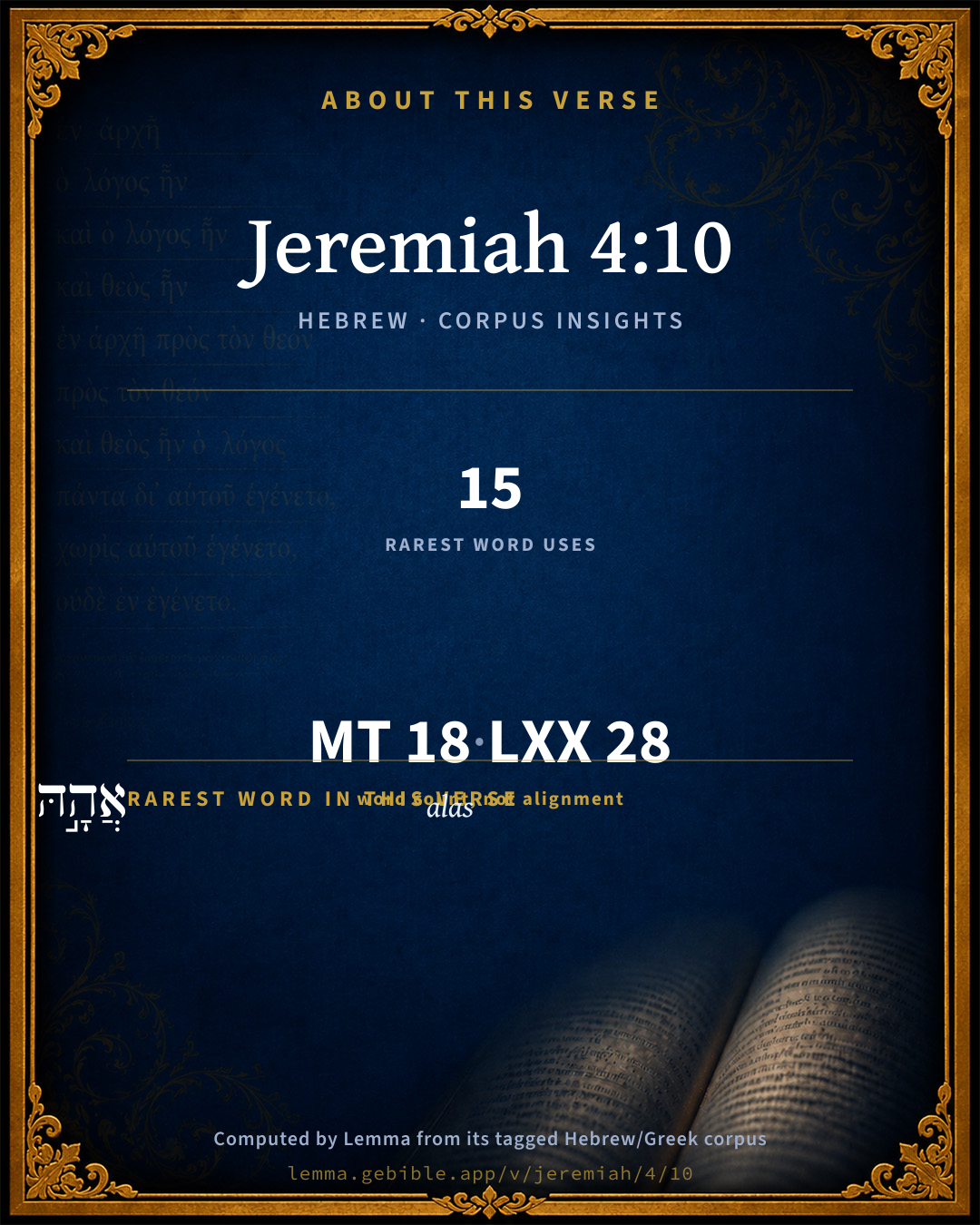
These counts appear in no published source. They are computed here, from the morphology-tagged text and Lemma’s own curated glosses. What Lemma adds →

18
words
15
distinct lemmas
Prophets
section

Notable vocabulary

The rarest word here is אֲהָ֣הּ alas H162 — appearing just 15 times in the whole Hebrew Bible.

Shared distinctive vocabulary

אֲהָ֣הּ alas H162 occurs in 15 verses of the Hebrew Bible. Also found in:

Grammatical profile

  • 6 verbs
  • 7 nouns
  • 1 pronoun
  • 2 prepositions
  • 1 adverb
  • 1 particle

Verb forms

  • וָאֹמַ֞ר Qal · Sequential Imperfect
  • הַשֵּׁ֨א Hiphil · Infinitive Absolute
  • הִשֵּׁ֜אתָ Hiphil · Perfect
  • לֵאמֹ֔ר Qal · Infinitive Construct
  • יִהְיֶ֣ה Qal · Imperfect
  • וְנָגְעָ֥ה Qal · Sequential Perfect

Repetition

Words recur within this verse — often emphatic in Hebrew:

  • וָאֹמַ֞ר to say H559 ×2
  • הַשֵּׁ֨א to deceive H5377 ×2

Hebrew & Septuagint length

In the original languages it is 18 Hebrew tokens and 28 Greek tokens — but the two are counted differently (Hebrew bundles its prefixes and suffixes into one token; the Greek is in lemma form), so that isn’t a like-for-like length.

Cross-references

20

Topical passages linked to Jeremiah 4:10 in the Treasury of Scripture Knowledge — connected by theme and wording, ordered by reader-vote popularity; previews shown in the World English Bible.

  • Jeremiah 5:12 They have denied Yahweh, and said, It is not he; neither shall evil come on us; neither shall we see sword nor famine:
  • 2 Thessalonians 2:9–12 even he whose coming is according to the working of Satan with all power and signs and lying wonders,
  • Isaiah 37:35 For I will defend this city to save it, for my own sake, and for my servant David's sake.
  • Jeremiah 14:13–14 Then said I, Ah, Lord Yahweh! behold, the prophets tell them, You shall not see the sword, neither shall you have famine; but I will give you assured peace in this place.
  • Exodus 9:14 For this time I will send all my plagues against your heart, against your officials, and against your people; that you may know that there is none like me in all the earth.
  • 1 Kings 22:20–23 Yahweh said, Who shall entice Ahab, that he may go up and fall at Ramoth-gilead? One said on this manner; and another said on that manner.
  • Isaiah 30:10 who tell the seers, "Don't see;" and to the prophets, "Don't prophesy to us right things, speak to us smooth things, prophesy deceits,
  • Isaiah 63:17 O Yahweh, why do you make us to err from your ways, and harden our heart from your fear? Return for your servants' sake, the tribes of your inheritance.
  • Jeremiah 1:6 Then said I, Ah, Lord Yahweh! behold, I don't know how to speak; for I am a child.
  • Jeremiah 4:18 Your way and your doings have procured these things to you; this is your wickedness; for it is bitter, for it reaches to your heart.
  • Jeremiah 6:14 They have healed also the hurt of my people slightly, saying, Peace, peace; when there is no peace.
  • Jeremiah 8:11 They have healed the hurt of the daughter of my people slightly, saying, Peace, peace; when there is no peace.
  • Jeremiah 23:17 They say continually to those who despise me, Yahweh has said, You shall have peace; and to everyone who walks in the stubbornness of his own heart they say, No evil shall come on you.
  • Jeremiah 32:17 Ah Lord Yahweh! behold, you have made the heavens and the earth by your great power and by your outstretched arm; there is nothing too hard for you,
  • Lamentations 2:21 The youth and the old man lie on the ground in the streets; My virgins and my young men are fallen by the sword: You have killed them in the day of your anger; you have slaughtered, [and] not pitied.
  • Ezekiel 11:13 It happened, when I prophesied, that Pelatiah the son of Benaiah died. Then fell I down on my face, and cried with a loud voice, and said, Ah Lord Yahweh! will you make a full end of the remnant of Israel?
  • Ezekiel 14:9–10 If the prophet be deceived and speak a word, I, Yahweh, have deceived that prophet, and I will stretch out my hand on him, and will destroy him from the midst of my people Israel.
  • Romans 1:24 Therefore God also gave them up in the lusts of their hearts to uncleanness, that their bodies should be dishonored among themselves,
  • Romans 1:26 For this reason, God gave them up to vile passions. For their women changed the natural function into that which is against nature.
  • Romans 1:28 Even as they refused to have God in their knowledge, God gave them up to a reprobate mind, to do those things which are not fitting;

Cross-references courtesy of OpenBible.info (CC BY 4.0).

Hebrew and Greek witnesses Masoretic Hebrew ↔ Greek Septuagint

The same verse in the two great witnesses to the Old Testament, shown verse-for-verse.

These are two independent witnesses, not word-aligned to each other, and the Septuagint is shown in lemma (dictionary) form.

Hebrew Jeremiah 4:10 Masoretic · Westminster Leningrad Codex

וָאֹמַ֞ר אֲהָ֣הּ אֲדֹנָ֣י יְהוִ֗ה אָכֵן֩ הַשֵּׁ֨א הִשֵּׁ֜אתָ לָעָ֤ם הַזֶּה֙ וְלִירוּשָׁלִַ֣ם לֵאמֹ֔ר שָׁל֖וֹם יִהְיֶ֣ה לָכֶ֑ם וְנָגְעָ֥ה חֶ֖רֶב עַד הַנָּֽפֶשׁ

Then said I, Ah, Lord Yahweh! surely you have greatly deceived this people and Jerusalem, saying, You shall have peace; whereas the sword reaches to the life.

World English Bible · Public Domain

Greek LXX Structure differs

In the Septuagint, Jeremiah is about an eighth shorter than the Hebrew and arranges its material differently — the Oracles Against the Nations (Hebrew chapters 46–51) appear in the middle of the Greek book, after 25:13. Because the chapter and verse boundaries do not line up, a verse-for-verse comparison with the Hebrew is not shown.

A verse-for-verse comparison isn’t shown here because the chapters and verses don’t line up. Switch to the LXX edition with the MT / LXX toggle above to read the Greek directly.

Hebrew: Westminster Leningrad Codex (CC BY 4.0). Greek: Septuagint (public domain); English from a public-domain English Septuagint. How the Septuagint differs from the Hebrew →

Targum (Aramaic paraphrase)

1

The Targum is the ancient Jewish Aramaic paraphrase of the Hebrew Scriptures — an interpretive translation, not the Hebrew text itself. Onkelos (literal) and Pseudo-Jonathan (expansive) render the Torah, and Jonathan the Prophets. Coverage is partial: where no permissively-licensed English translation exists for a verse, only the Aramaic is shown. This is verse-level text, not a word-by-word alignment to the Hebrew.

  1. Targum Jonathan Prophets (Joshua–Malachi)
    וַאֲמָרֵית קַבֵּיל בָּעוּתִי יְיָ אֱלֹהִים בְּכֵן הָא נְבִיֵי שִׁקְרָא מַטְעַן לְעַמָא הָדֵין וּלְיַתְבֵי יְרוּשְׁלֵם לְמֵימָר שְׁלָמָא יְהֵי לְכוֹן וּכְעַזְהָא חַרְבָּא מְקַטְלָא בְעַמָא:

    (no public-domain English translation for this verse)

    Targum Jonathan — Aramaic: “Mikraot Gedolot” (public domain). English: “Sefaria Community Translation” (CC0 1.0 (public-domain dedication)); “London "Chaldee Paraphrase," 1871” (public domain). Text via Sefaria.

Commentary

Notes on Jeremiah 4:10 from classic Christian and Jewish commentators (each source and its license shown beneath its notes). The classic Christian expositions comment on the surrounding passage and are grouped to its opening verse, so a note may address several verses; the Jewish commentaries on the Tanakh (Rashi and others) are per-verse, so they appear only where the commentator wrote on this verse.

Lemma curates 59 commentaries, every one of them public domain or Creative Commons licensed, each selected and text-cleaned for this edition rather than reprinted as found. About our sources →

Trapp's Complete Commentary

John Trapp

Jer 4:10 Then said I, Ah, Lord GOD! surely thou hast greatly deceived this people and Jerusalem, saying, Ye shall have peace; whereas the sword reacheth unto the soul.

Ver. 10. Surely thou hast greatly deceived this people,] sc., By those false prophets. {Jer 4:9} Compare 1Ki 18:22-29 Eze 14:9. This God doth as a just judge, punishing sin with sin. The words may be rendered as a question, "Hast thou indeed thus deceived this people?" Is it possible that thou shouldst have an active, or so much as a permissive, hand in such a business?

Whenas the sword reacheth unto the soul,] i.e., To the heart, it goes as far as it can. Capulo tenus abdidit ensem. See Psa 69:11.

John Trapp, A Commentary or Exposition upon All the Books of the Old and New Testament (1647–1656) — public domain. Text from a community e-Sword module.

Joseph Benson's Commentary

Jer 4:10. Then said I, Ah, Lord God! — The Hebrew word, Aha, is a word expressive both of admiration and lamentation. Surely thou hast greatly deceived this people — Hast suffered them to be deceived by their false prophets. These pretenders to prophecy studied only to speak pleasing things to the people, and sooth them up in their impenitency and carnal security; and thou hast, in thy just judgment, given them up to follow these delusions: compare 2Th 2:11-12. Saying, Ye shall have peace — The word peace here comprises all good, signifying that all things should go on prosperously with them; whereas the sword reacheth unto the soul — Whereas the sword is at the door, not only to take away the comforts of life, but even life itself.

Joseph Benson's Commentary on the Old and New Testaments (1811–1818) — public domain. Text from a community e-Sword module.

Tyndale Open Study Notes

Tyndale Open Resources

4:10 Jeremiah was confused and offended because he and the people thought that God had promised peace for Jerusalem. However, these promises were false prophecies (6:14; 14:13; 23:16-17).

Tyndale Open Study Notes — © Tyndale Open Resources, licensed CC BY-SA 4.0. Text via the HelloAO Bible API.

Geneva Bible (1599)

Geneva Bible translators

By the false prophets which promised peace and tranquility: and thus thou hast punished their rebellious stubbornness by causing them to hearken unto lies which would not believe thy truth, 1 Kings 22:23; Ezek. 14:9; 2 Thess. 2:11.

Geneva Bible (1599) marginal notes — public domain. Text via Bolls.life.

Jamieson, Fausset & Brown

Robert Jamieson, A. R. Fausset & David Brown

thou hast . . . deceived--God, having even the false prophets in His hands, is here said to do that which for inscrutable purposes He permits them to do (Exo 9:12; Th2 2:11; compare Jer 8:15; which passage shows that the dupes of error were self-prepared for it, and that God's predestination did not destroy their moral freedom as voluntary agents). The false prophets foretold "peace," and the Jews believed them; God overruled this to His purposes (Jer 5:12; Jer 14:13; Eze 14:9).

soul--rather, "reacheth to the life."

Jamieson, Fausset & Brown — Commentary Critical and Explanatory on the Whole Bible (1871) — public domain (CC PDM 1.0). Text via the HelloAO Bible API.

Adam Clarke's Commentary

Verse 10. Ah, Lord God! surely thou hast greatly deceived this people] The Targum paraphrases this verse thus: "And I said, Receive my supplication, O Lord God; for, behold, the false prophets deceive this people and the inhabitants of Jerusalem, saying, Ye shall have peace." The prophet could not reconcile this devastation of the country with the promises already made; and he appears to ask the question, Hast thou not then deceived this people in saying there shall be peace, i.e., prosperity?

Whereas the sword reacheth unto the soul.] That is, the life; the people being generally destroyed.

Adam Clarke's Commentary on the Bible (1810–1826) — public domain. Text from a community e-Sword/MySword module.

John Calvin's Commentaries

Some so understand this passage as though the Prophet brought forward what was said by the people; for all the most wicked, when oppressed by God’s hand, usually cast the blame on him, and in their complaints contend and dispute with him. Hence they think that the Prophet here, not in his own person, but in that of the whole people, speaks thus: “O Lord, what can this be? thou surely hast deceived us.” Others give somewhat a looser explanation, that the Prophet here indirectly expostulates with God, because he had suffered the false prophets to flatter the people so as to stupefy the minds of all. But a different meaning is what I approve of: the Prophet, I think, tauntingly exposes those false adulations, by which the prophets had caused the ruin of the miserable Jews, by promising them God’s forgiveness, and by ever announcing favorable predictions.

God no doubt rendered the Jews their just reward, when he suffered them to be deceived by impostors: we, indeed, know that the world is ever afflicted with this disease, — that they seek flatteries, as God upbraids them by Micah:

“Ye seek prophets who promise to you an abundant harvest, an abundant vintage.” (Micah 2:11)

Since, then, the Jews wished their vices to be spared, and not only disliked their faithful and severe reprovers, but also hated them, they had deserved to be thus dealt with: it was God’s will that many impostors should assume the prophetic name. Thus it happened, that the Jews thought that their peaceable condition would be perpetual; and this, as I have said, is usual with hypocrites. Now the Prophet, in a biting strain, exposes here these deceptions, and says, Ah, ah, Jehovah! surely thou hast deceived this people: for the Prophet does not speak in the person of the people, nor does he complain, that God permitted so much liberty to false prophets; but he derides these impostors as well as the people. And further, as they were all deaf, he turns to God, as though he had said, “Behold, Lord, worthy of this reward are they, who have sought flatteries, and have not attended to the holy warnings of thy servants: as, then, no kind of correction was what they could endure, let them now begin to learn that they have been deceived by others rather than by thee.”

We then see that the Prophet ridicules that stupidity in which the Jews had been so long asleep; and the simple meaning is, that he turned to God: I have said, O Lord Jehovah, surely thou hast deceived this people. “Surely” is to be taken in an ironical sense; that is, “It now really appears that they have been deceived; but by whom? They wish, indeed, to throw the blame on thee; but they are justly chargeable with foolish credulity, so that they, whom the false prophets have deceived, have been rightly dealt with.” What they said was, Peace shall be to you

This never came from the mouth of God; for Jeremiah daily thundered and threatened approaching ruin; for he was like a celestial herald, who filled every place with terror; but he was not heard: and at the same time the Jews praised the false prophets, who soothed them with various promises. We hence perceive, that God had not spoken peace to them; but that the Jews, not only willingly, but with avidity, laid hold on those things by which the false prophets sought to gratify them.

He afterwards adds, And reached has the sword unto the soul; that is, “Yet we are now destroyed by fatal evils.” The Prophet here indirectly sets before them those delusive flatteries with which the Jews pleased themselves, and shews that they would at length really find how falsely they pretended the name of God. It follows —

John Calvin's Commentaries (1540-1563) — public domain. Text from the Calvin Translation Society English edition (1840s-50s) via the Christian Classics Ethereal Library (ccel.org). Calvin's coverage is partial (roughly two-thirds of the Bible); uncommented books and verses are honest gaps, never fabricated. The 19th-century editor's footnotes and remarks are omitted so the notes are faithfully Calvin's own voice.

Ellicott's Commentary for English Readers

(10) Ah, Lord God! (literally, my Lord Jehovah!) surely thou hast greatly deceived this people.—The words are startling, but are eminently characteristic. Jeremiah had been led to utter words that told of desolation and destruction. But if these were true, what was he to think of the words of the other prophets, who, speaking in the name of the Lord, had promised peace through the reign of Josiah, and even under Jehoiakim? Had not Jehovah apparently sanctioned those prophets also? and, if so, had He not deceived the people? (Comp. Jer_20:7.) This seems, on the whole, preferable to the interpretations which see in it a dramatic irony representing the prophet as having shared in the hopes of the people and awakening to a terrible disappointment, or refer the words to the contrast between the glorious visions of the future in Isaiah and his own terrible predictions, or to the bolder course of an alteration of the text, so that the words would run “it is said,” the complaint being represented as coming from the people.

A Bible Commentary for English Readers, edited by Charles John Ellicott (1878–1897) — public domain. Text from a community e-Sword module.

The Cambridge Bible for Schools and Colleges

gen. ed. J. J. S. Perowne

10. Then said I] We should doubtless, by a slight change, read, And they shall say. The false prophets, who had foretold peace (Jer_6:14, Jer_14:13, Jer_23:17), shall in their dismay charge God with deception. Doubtless an argument in the mouths of those prophets and their supporters had hitherto been, “Isaiah assured us (Isa_37:33 ff.), when the City and Temple were in danger, that Jehovah would protect His own dwelling place. His words were justified by the event. May we not have the same assurance now?”

The Cambridge Bible for Schools and Colleges (gen. ed. J. J. S. Perowne; Cambridge University Press, 1878–1918) — public domain. Text from a community e-Sword module.

John Gill's Exposition

Then said I, ah, Lord God!.... Expressing great sorrow and concern: this "ah" is by way of lamentation. The Targum interprets it as a petition,

"and I said, receive my prayer, O Lord God:''

surely thou hast greatly deceived this people and Jerusalem: what the false prophets did, that God is said to do, because he suffered them to deceive the people; see Kg1 22:20. The Targum ascribes the deception to the false prophets, and not to God,

"surely behold the false prophets deceive this people, and the inhabitants of Jerusalem;''

or this may be ironically said, because the false prophets pretended to speak in the name of the Lord; wherefore Jeremiah says, "surely thou hast greatly deceived", &c. "saying, ye shall have peace"; as the false prophets did, Jer 6:14,

whereas the sword reacheth unto the soul; takes away the life, many are slain by it; so the Targum,

"and now behold the sword killeth among the people;''

great slaughter is made by it. L'Empereur (w) observes that the word here used signifies, in the Arabic language, to educate or bring up; and then the sense is,

"ah, Lord, thou hast brought up this people with great tenderness, and promised them all manner of happiness; but now thou thunderest out threatenings of calamities of all sorts, and death itself; and assigned a place for the sword to enter into their very souls;''

so the Arabic word used in the version of Act 22:2.

(w) Not. ad Mosis Kimchi, p. 186.

John Gill's Exposition of the Whole Bible (1746–1763) — public domain (CC PDM 1.0). Text via the HelloAO Bible API.

Albert Barnes' Notes on the Bible

Ah, Lord God! - Alas! my Lord Yahweh: an expression of disapproval on Jeremiah’s part. Jeremiah had constantly to struggle against the misgivings of his own melancholy nature, but he never let them prevent him from doing his duty. See the introduction of Jeremiah.

Ye shall have peace - These words are generally referred to the false prophets; they rather refer to real prophecies of future blessedness promised to the Jews. Jeremiah could not reconcile the doom he was now commanded to pronounce, either with his previous prophecy, or with what he read in the writings of his predecessors. Time only could solve the difficulty. Upon the struggles of the prophets to understand their own predictions see 1Pe 1:10-11.

Unto the soul - The sword has reached the life. i. e., has inflicted a mortal wound.

Albert Barnes' Notes on the Bible (1834–1885) — public domain. Text from a community e-Sword/MySword module.

Haydock's Catholic Bible Commentary

Alas! Protestants, "Then I said: Ah! Lord God, surely thou hast deceived," &c., (Haydock) by permitting the people to follow false prophets, Isaias lxi. 17., and Psalm xliii. 19.

George Leo Haydock (1774–1849), Haydock's Catholic Family Bible and Commentary, 1859 edition — public domain. Excludes Psalms (Douay-Rheims chapter numbering differs from Protestant) and Deuterocanonical books (Catholic canon only).

Matthew Poole's English Annotations

Ah, Lord God: the Hebrew aha is a word both of admiration and lamentation together; they are Jeremiah’s words and complaint breathed out in the great sorrow and. sighing of soul, which he expresseth more emphatically Jer 23:9.

Surely thou hast greatly deceived this people; either hast suffered them to be thus deluded by these false prophets, Isa 63:17; Eze 14:9; compare 1Ki 22:21-23; 2Th 2:11; or possibly it may be read better by way of interrogation: q.d. How can it possibly be that thou shouldst suffer thy people to be thus deluded by their false prophets, Num 23:19, thou being a God that canst not lie? Tit 1:2.

Ye shall have peace: under the word peace is comprised and intended all good, intimating all things should go on prosperously with them. Gen 37:14; and seems the rather to be thus expressed, because it was the common language and phrase of the false prophets, Jer 8:11; 23:17.

Whereas the sword reacheth unto the soul: to persuade them it should be well with them, when the sword is at the door, not only ready to take away the comforts of life, but even life itself, soul being put for life, Jer 4:30; Psa 69:1; Mat 16:25,26. It may intimate also a great cutting off and slaughter among them, especially their great ones; they being, as it were, the soul of the people.

Matthew Poole's English Annotations on the Holy Bible (1683–1685) — public domain. Text from a community e-Sword/MySword module.

Whedon's Commentary on the Bible

Daniel D. Whedon

10. Ah, Lord God, etc. — This is interjectional. It is Jeremiah’s sigh of sorrow and deprecation. He confronts what seems to be a vision of utter ruin and extermination, and protests that it is incongruous with God’s promises to his people.

Thou hast greatly deceived this people — In assuring them of thine everlasting covenant, while the sword reacheth unto the soul. It is better to take this view than to assume a reference to the lying spirits in false prophets, as do most commentators.

Daniel D. Whedon (gen. ed.), Commentary on the Old and New Testaments (1874–1909) — public domain. Text from a community e-Sword module.

The Pulpit Commentary

Ah, Lord God! rather, Alas! O Lord Jehovah. (see on Jer_1:6) Thou hast greatly deceived this people, etc. Much difficulty has been felt in interpreting this verse, partly because it seems directly to charge Jehovah with "deceit," and partly because the prophecy, Ye shall have peace, on which this charge is founded, accords exactly with the strain of the "false prophets". (see Jer_6:14 Jer_14:13 Jer_23:17) Hence some (e.g. Ewald) have altered the points of the verb at the beginning of the verse., so as] to enable them to render. "And one shall say," the subject understood being either a "false prophet" or one of the people. This view is not in itself impossible (Keil"s objection will not bear examination), but is not absolutely necessary, for the present is not the only passage in which Jeremiah, under the influence of strong emotion, charges Jehovah with "deceit", (see Jer_20:7, a synonymous word is used; and comp. 1Ki_22:23) and the words, "Ye shall have peace, may be meant to summarize the cheering promises in Jer_3:14-18. Jeremiah may (it is not incorrect to conjecture) have supposed the fulfillment of his prophecy to be nearer than it really was; (comp. 1Pe_1:11) hence his disappointment, and hence his strong language. So St. Jerome, "Quia supra dixerat, In illo tempore vocabunt Jerusalem solium Dei, etc.. et nunc dicit, Peribit cor regis, turbatur propheta et in se Deum putat esse meutitum; nec intelligit, illud multa post tempera repromissum, hoc autem vicino futurum tempore." To suppose, with Keil, that Jeremiah refers the prophecies of the "false prophets" to God as their ultimate Author, seems inconsistent with Jeremiah"s own statements in Jer_14:14. (comp. Jer_5:13) Moreover, we have parallels elsewhere in the prophets, as well as in the Book of Job, for the use of language with regard to Providence which a calmer judgment would condemn. A notable instance is Isa_63:17, where the Jewish Church, through its mouthpiece the prophet, throws the responsibility of its errors upon Jehovah. Depressed by melancholy, they give way for the moment to those human "thoughts" which are not as "My thoughts." They felt the "burden of the mystery." Unto the soul; i.e. unto the life.

Divine illusions.

I GOOD MEN MAY MISJUDGE GOD"S ACTIONS. The words of the text are not spoken with Divine authority; on the contrary, they are given in historical narrative as a record of the personal utterance of the prophet. He does not preface them with the august claim of authority, "Thus saith the Lord;" he distinctly says, "Then said I" Without needing to look for any other rendering of the text, we may consider it as throwing light on the condition of the prophet"s mind, rather than as a difficult scriptural declaration of God"s character and mode of acting. Thus we may see in it an expression of hasty judgment, misunderstanding, irritable impatience, complaint. If so, it warns us to beware of the prejudiced or impassioned utterances of the best and wisest men, (Psa_116:11) and to be more cautious in forming judgments on difficult aspects of providence and religion, since even prophets err.

II IT IS DIFFICULT TO JUDGE RIGHTLY OF GOD"S ACTIONS WHILE WE ARE IN THE MIDST OF THEM. We are too near to have the right perspective. The character of an action cannot be judged till its ultimate design is revealed. Many things look wrong because they are parts of a whole the remainder of which is unseen. Pride, passion, self-interest, and prejudice pervert our judgment. We must wait for time to clear up many dark passages in earthly providence. (Joh_13:7) The inconsistency which seemed palpable to Jeremiah is less felt by us.

III GOD"S ACTIONS ARE SOMETIMES ILLUSORY TO US. There was a measure of truth in the rash cry of the prophet. God never deceives. Yet his utterance may be misunderstood by us. God is said to harden the heart when his action results in this evil condition through the misconduct of men, and not at all through his wish to bring that evil about. So God might almost be said to deceive (though the expression is misleading) when his Word is such that we fall into a misconception in hearing it.

IV THE ILLUSORY CHARACTER OF SOME OF GOD"S ACTIONS IS DETERMINED BY COMMON LIMITATIONS AND IMPERFECTIONS. Some truths are revealed, while qualifying truths are necessarily hidden because we could not understand them. No mention is made of the time of the fulfillment of a promise; hence we think it will be immediate, and are disappointed when we see delay and find unexpected troubles coming first. One part of God"s Word may seem to contradict another when they refer to different conditions, but conditions not yet revealed to us.

V TRUTH AND HUMAN WELFARE ARE BETTER SERVED BY THESE ILLUSIONS THAN BY REVELATIONS WHICH ADMIT OF NO MISCONSTRUCTION. If the child were never allowed to stumble, he would never learn to walk. We are educated by temporary illusions for higher truths than could be attained by plainer paths. Thus we know more of God and of heaven through the anthropomorphic and materialistic language of much of Scripture, which has resulted in gross misconceptions at times, than we should have learnt from language made bare enough to be unmistakable.

Human uncertainty coexisting with Divine illumination.

The prophecy now uttered does not harmonize with that of Jer_3:12-25. The times of fulfillment are unknown to the prophet. This element of uncertainty in all prophecies, even those of Christ ("for of the times and the seasons knoweth no man," etc.) is noteworthy. This outburst of annoyance and misconception illustrates

I THE TEMPTATION LATENT IN SUPERIOR DIVINE KNOWLEDGE. The moral balance and perspective are threatened with disturbance. Hence the impulse to expostulate with God to speak as if from a superior standpoint of morality. Seeming contradictions are encountered which would have no existence to a simpler or less illuminated spirit. It is as if the moral nature of man were only practically sufficient for what is revealed to him by the ordinary faculties and means of knowledge.

II THE SORROW ACCOMPANYING EXCEPTIONAL GIFTS. The prophet, no more than the poet or man of genius, is to be envied. How hard to be the custodian of a truth men will not receive! To be conscious of evils impending which one cannot avert! The intentional sensitiveness of the prophetic temperament, and the keener vision of the seer, are the occasions of an incommunicable sadness, and even, at times, of overwhelming concern. Especially is this the case where patriotic feeling identifies the prophet on the one side with his people, and devout spirituality leads him nevertheless to acknowledge the righteousness of God. There was no more human or loving heart in Israel than Jeremiah"s, and if they would not heed his counsels, he was helpless. To be "before the age" in such a sense is not so enviable as we might imagine.

III THE RESERVE THAT MARKS THE COMMUNICATION OF TRUTH. Partly necessitated by limitation of human nature; partly due to the subordination of the prophet, teacher, etc., to the special task before him. We should lose more than we should gain if, constituted as we are, we were to receive unlimited revelations of the future. The practical and immediate import of Divine revelation is therefore our first concern. Today is a little space cleared for duty. Opportunities of well-doing occur in constant succession. "What is that to thee?" might well be asked of many a one that concerns himself with things beyond his ken: "follow thou me. M.

"Ah, Lord God! surely thou," etc. Inflicted infatuation, or the deceived of God.

I THERE ARE SUCH. How else can they be described who, in spite of the plainest declarations of God against their wickedness, persist therein, persuading themselves that they have no cause to fear? Such was the way of these to whom Jeremiah spoke. They and their false prophets were continually saying, We shall have peace". (cf. Jer_5:12, Jer_5:31) And there have been other instances (cf. Pharaoh, hardening his heart against God). And there are many now. The Bible speaks, providence speaks, conscience speaks, Christ"s ministers speak, the Holy Spirit speaks pleading with them; but they heed not, they turn a deaf ear to every voice. What can this be called but infatuation? And it can only be explained as Jeremiah here explains it, as a Divine judgment. "Ah, Lord God! surely thou hast deceived them." The evidence that their course was one that must bring punishment was so glaring, so strong, so irresistible, that none but the infatuated could possibly disregard it. Now, it is the testimony the Word of God that such blindness is judicial, is from God. God hardened Pharaoh"s heart. Our Lord refers more often than to any other Old Testament Scripture, to that word of Isaiah"s which tells of the Divine will, that "seeing, they his enemies may see and not perceive, and hearing, they may hear and not understand." Men who will not hear come at length to find they cannot. So with Judah and Jerusalem; they were at this time "given up to a strong delusion, that they should believe the lie that peace could be their lot in spite of what they were. We speak of gospel-hardened men, and, alas! we too often see such. And this is in keeping with God"s law of habit a law most beneficent to those who obey him, but terrible in its effects on the disobedient. For separate actions crystallize into habits, whereby such actions, no matter what their character, become easy to us, and at last can be performed without any effort of our will. So that separate acts of obedience to God will at length become a blessed and holy habit of obedience, and separate acts of sin repeated again and again will become a direful habit of sin, from which we cannot break away. And because all this is in accordance with a Divine law, therefore God is said to harden men"s hearts, to hinder their understanding of his Word, to give them over to strong delusions and, as here, to "deceive the people.

II THE CAUSE IS CLEAR. Ver. 18, "Thy way and thy doings have procured these things unto thee." It is from no decree of reprobation, from no predestination to sin, but from the inevitable action of the law of God which ordains that "ways" and "doings" such as Judah"s were shall at length so utterly deceive those who are guilty of them that the most glaring falsehood is not too glaring for them to believe.

III ITS DOOM IS JUST. Is it unjust that a man shall be filled with the fruit of his own ways? that what a man soweth that he shall also reap? Holiness must become impossible if its opposite be not possible too. The same law necessitates both. It is no arbitrary infliction, but the natural outcome of what a man has been and of what he has persistently done. It is as natural as that the harvest should follow the sowing of its own seed. The most dreadful element in the sinner"s doom the worm that dieth not will be the ever-present reflection that he has brought it all upon himself. He himself made the bed on which he has to lie. And if still the doom of these wicked men be objected to, as it is, we reply, remembering how it is ever the necessity of any moral condition to be seeking to assimilate its surroundings to itself, so that goodness seeks to make others good, and evil seeks to make others evil remembering this we say, with the late Dr. Arnold, "It is better that the wicked should be destroyed a hundred times over than that they should tempt those who are yet innocent to join their company." And this is what they would be sure, from the very necessity which arises from what they are, to be ever seeking to accomplish. Therefore we say their doom is just.

IV THE AWAKENING AWFUL. (Ver. 9) See the picture of dismay and despair which the prophet draws. (cf. Rev_6:17) Self-deception, however hardened into habit by long years" use, cannot endure forever. There will be an awakening.

V THE LESSON PLAIN. Break away at once from sin lest it coil round thee like a serpent, lest repeated transgression become links, and the links a chain which will bind thee so fast that thou canst not escape. Therefore break away now, turn to the Lord Jesus, invoke his aid, day by day look to him, and thou art saved. C.

The Pulpit Commentary (1880–1919), ed. H.D.M. Spence-Jones & Joseph S. Exell — public domain. Text from a community e-Sword module.

John Wesley's Explanatory Notes

Deceived - Hast suffered them to be deceived by their false prophets. Whereas - To persuade them it should be well with them, when the sword is at the door, not only ready to take away the comforts of life, but even life itself.

John Wesley, Explanatory Notes Upon the Whole Bible (1754–1765) — public domain. Text via the GEBible commentary corpus.

Keil & Delitzsch

C. F. Keil & F. Delitzsch

"Then said I, Ah, Lord Jahveh, truly Thou hast deceived this people and Jerusalem in saying, Peace shall be to you, and the sword is reaching unto the soul." This verse is to be taken as a sign addressed to God by Jeremiah when he heard the announcement of the judgment about to fall on Judah, contained in Jer 4:5-9. The Chald. has well paraphrased ואמר thus: et dixi: suscipe deprecationem meam, Jahveh, Deus. but Hensler and Ew. wish to have ואמר changed to ואמר, "so that they say," quite unnecessarily, and indeed unsuitably, since השּׁאת, thou hast deceived, is out of place either in the mouth of the people or of the lying prophets. That the word quoted, "Peace shall be to you," is the saying of the false prophets, may be gathered from the context, and this is directly supported by Jer 14:13; Jer 23:17. The deception of the people by such discourse from the false prophets is referred back to God: "Lord, Thou hast deceived," inasmuch as God not only permits these lying spirits to appear and work, but has ordained them and brought them forth for the hardening of the people's heart; as He once caused the spirit of prophecy to inspire as a lying spirit the prophets of Ahab, so that by promises of victory they prevailed upon him to march to that war in which, as a punishment for his godlessness, he was to perish; Kg1 22:20-23. Umbr. takes the words less correctly as spoken in the name of the people, to whom the unexpected turn affairs had now taken seemed a deception on the part of God; and this, although it was by itself it had been deceived, through its revolt from God. For it is not the people's opinion that Jeremiah expresses, but a truth concerning which his wish is that the people may learn to recognise it, and so come to reflect and repent before it be too late. On the use of the perf. consec. ונגעה, see Ew. 342, b. As to the fact, cf. Jer 5:18, Psa 69:2.

Keil & Delitzsch — Biblical Commentary on the Old Testament (1861–1891) — public domain (CC PDM 1.0). Text via the HelloAO Bible API. (Old Testament only.)

Rashi

Rabbi Shlomo Yitzchaki (Rashi)

Surely You have misled Heb. השא השאת (fa)tenter in O.F.), tempting, an expression like (Gen. 3: 13) “The serpent misled me (השיאני),” for the false prophets prophesy for them, You will have peace.

Rashi on the Tanakh — English translations: “The Judaica Press complete Tanach with Rashi, translated by A. J. Rosenberg” (CC BY 4.0); “Pentateuch with Rashi's commentary by M. Rosenbaum and A.M. Silbermann, 1929-1934” (public domain); “The Metsudah Tanach series, Lakewood, N.J” (CC BY 4.0); and “The Book of Joshua, Metsudah Publications, 1997” (CC BY 4.0). Text via Sefaria.

Lesson kit

Teaching starters — assembled from the data on this page, not authored interpretation. Every prompt links to the verse data it draws on. Edit before teaching.

Jeremiah, in the Prophets, opens this verse with 18 words (15 distinct Hebrew lemmas). Its most distinctive word is ʼăhâhh (“alas”). A historical commentator’s framing appears above. Read the whole chapter for the surrounding context.

Discussion questions

  1. The word ʼăhâhh carries the sense “alas.” How does it shape the verse?
  2. Joshua 7:7 shares the word «alas» with this verse. How do the two illuminate each other?
  3. “to say” occurs 2× in this one verse. What is the effect of the repetition?
  4. These translations render this verse differently. What is at stake in choosing one wording over another?
  5. The verb «וָאֹמַ֞ר» is Qal Sequential Imperfect. How does its form color the action?
  6. Reading how Trapp's Complete Commentary and Joseph Benson's Commentary read this verse, where do the two commentators agree and where do they part?

Things to notice

Reading settings

Reading text

Shown beneath each verse's original-language words.

Old Testament
Old Testament edition

Read the OT as the Masoretic Hebrew (MT) or the Greek Septuagint (LXX).

English shown for the Greek Septuagint (in the Hebrew ↔ Greek comparison).

Comparing translations? Open the Compare panel on any verse page to stack up to four side by side.