
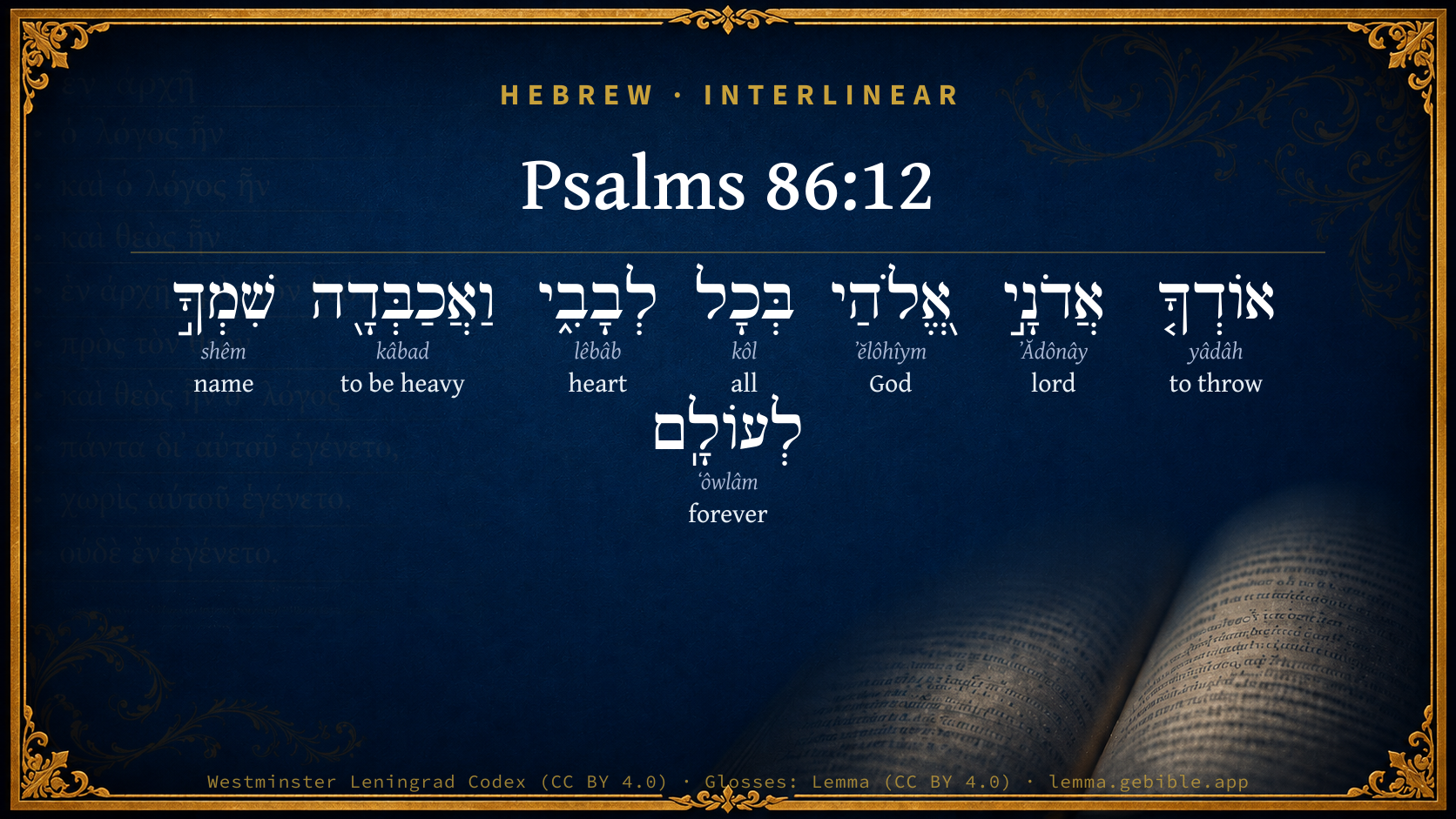
Psalms 86:12

Hebrew (Westminster Leningrad Codex) Psalms 86:12 appears in the Hebrew Old Testament. The text above is from the Westminster Leningrad Codex. Each word links to its Strong’s number, a concise gloss, and parsing drawn from the Open Scriptures Hebrew Bible morphology. Click any word for its full Brown-Driver-Briggs (BDB) entry.
Download image
Cite this verse

Psalms 86:12 (World English Bible). Public Domain. Lemma interlinear Bible study tool, https://lemma.gebible.app/v/psalms/86/12.

Show BibTeX & RIS
BibTeX
RIS
English Translation
I will praise you, Lord my God, with my whole heart. I will glorify your name forevermore.
World English Bible · Public Domain
Download a study sheet

One document with this verse’s original text, its word-by-word gloss line, the meaning frame, cross-references with their text, attributed commentary, and full source and license credits — printable, and it pastes into notes with its structure intact.

This verse Autodidact and up

Study sheet (.html) Plain text (.txt)

A passage Seminary Student

Up to 50 verses in one chapter. A passage sheet keeps up to 6 commentary sources and 12 cross-references per verse, in the order this page ranks them, and says so on the sheet whenever that leaves anything out. Ask for a single verse and you get the Autodidact verse sheet above.

Everything on this page stays free to read, with no account — the sheet is a download of what is already on screen, not access to it.

Want to remove ads? Support Godless Engineer
Compare translations 3

The same verse in 3 English versions, stacked beneath the original-language interlinear above. Click any original word for its lexicon entry.

Each is an independent rendering of the whole verse — the interlinear is not word-aligned to these translations.

Highlighted words mark where these versions differ — a whole-verse word diff, not a word-by-word alignment.

  • World English Bible Public Domain
    I will praise you, Lord my God, with my whole heart. I will glorify your name forevermore.
  • King James Version Public Domain
    I will praise thee, O Lord my God, with all my heart: and I will glorify thy name for evermore.
  • unfoldingWord Literal Text CC BY-SA 4.0
    I will thank you, Lord my God, with all of my heart, and I will glorify your name forever.

unfoldingWord Literal Text — © unfoldingWord, licensed CC BY-SA 4.0. Word-aligned USFM3 via Door43 (git.door43.org/unfoldingWord/en_ult).

Versions to compare (up to 4)

3 of 4 selected

Show all 18 translations

Every available English version of this verse, each an independent rendering of the whole verse.

  • World English Bible Public Domain
    I will praise you, Lord my God, with my whole heart. I will glorify your name forevermore.
  • Berean Standard Bible Public Domain
    I will praise You, O Lord my God, with all my heart; I will glorify Your name forever.
  • Majority Standard Bible Public Domain
    I will praise You, O Lord my God, with all my heart; I will glorify Your name forever.
  • King James Version Public Domain
    I will praise thee, O Lord my God, with all my heart: and I will glorify thy name for evermore.
  • American Standard Version (1901) Public Domain
    I will praise thee, O Lord my God, with my whole heart; And I will glorify thy name for evermore.
  • Revised Version (1885) Public Domain
    I will praise thee, O Lord my God, with my whole heart; and I will glorify thy name for evermore.
  • Geneva Bible (1599) Public Domain
    I wil prayse thee, O Lord my God, with all mine heart: yea, I wil glorifie thy Name for euer.
  • Douay-Rheims (1899) Public Domain
    I will praise thee, O Lord my God: with my whole heart, and I will glorify thy name for ever:
  • Young's Literal Translation Public Domain
    I confess Thee, O Lord my God, with all my heart, And I honour Thy name to the age.
  • Literal Standard Version CC BY-SA 4.0
    I confess You, O Lord my God, with all my heart, || And I honor Your Name for all time.
  • Unlocked Literal Bible CC BY-SA 4.0
    Lord my God, I will praise you with my whole heart; I will glorify your name forever.
  • unfoldingWord Literal Text CC BY-SA 4.0
    I will thank you, Lord my God, with all of my heart, and I will glorify your name forever.
  • Darby Bible Public Domain
    I will praise thee, O Lord my God, with my whole heart; and I will glorify thy name for evermore.
  • World Messianic Bible Public Domain
    I will praise you, Lord my God, with my whole heart. I will glorify your name forever more.
  • Webster's Bible Public Domain
    I will praise thee, O Lord my God, with all my heart: and I will glorify thy name for evermore.
  • Free Bible Version CC BY-SA 4.0
    Lord my God, I thank you from the bottom of my heart. I will praise your character forever.
  • Bible in Basic English Public Domain
    I will give you praise, O Lord my God, with all my heart; I will give glory to your name for ever.
  • JPS Tanakh (1917) Public Domain
    I will thank Thee, O Lord my God, with my whole heart; and I will glorify Thy name for evermore.

Literal Standard Version (2020), Covenant Press — licensed CC BY-SA 4.0. Text via the HelloAO Bible API (eBible.org). Unlocked Literal Bible (unfoldingWord) — licensed CC BY-SA 4.0. Text via the HelloAO Bible API (eBible.org). unfoldingWord Literal Text — © unfoldingWord, licensed CC BY-SA 4.0. Word-aligned USFM3 via Door43 (git.door43.org/unfoldingWord/en_ult). Free Bible Version, Dr. Jonathan Gallagher — licensed CC BY-SA 4.0. Text via the HelloAO Bible API (eBible.org).

Word by word

More ways to search: Search by grammar → Find every occurrence → Compare this word →

Practice this passage: Drill this verse → Learn its vocabulary →

אוֹדְךָ֤
yâdâh
H3034
“to throw · you”
Verb, Hiphil, Imperfect, 1st Person, Common, Singular + Suffix, Personal, 2nd Person, Masculine, Singular
Part of Speech
Verb
Stem
Hiphil
Form
Imperfect
Person
1st Person
Gender
Common
Number
Singular
Full BDB Definition

Origin: a primitive root; used only as denominative from H3027

TWOT: 847

to throw, shoot, cast - (Qal) to shoot (arrows) - (Piel) to cast, cast down, throw down - (Hiphil) - to give thanks, laud, praise - to confess, confess (the name of God) - (Hithpael) - to confess (sin) - to give thanks
  1. אֲדֹנָ֣י ʼĂdônây H136 “Lord · my” Noun, Common, Masculine, Plural, Construct + Suffix, Personal, 1st Person, Common, Singular
  2. אֱ֭לֹהַי ʼĕlôhîym H430 “God(s) · my” Noun, Common, Masculine, Plural, Construct + Suffix, Personal, 1st Person, Common, Singular
  3. בְּכָל kôl H3605 “in/at · all of” Preposition + Noun, Common, Masculine, Singular, Construct
  4. לְבָבִ֑י lêbâb H3824 “heart · my” Noun, Common, Masculine, Singular, Construct + Suffix, Personal, 1st Person, Common, Singular
  5. וַאֲכַבְּדָ֖ה kâbad H3513 “and · to be heavy” Conjunction + Verb, Piel, Imperfect, 1st Person, Common, Singular
  6. שִׁמְךָ֣ shêm H8034 “name · your” Noun, Common, Masculine, Singular, Construct + Suffix, Personal, 2nd Person, Masculine, Singular
  7. לְעוֹלָֽם ʻôwlâm H5769 “to/for · forever” Preposition + Noun, Common, Masculine, Singular, Absolute

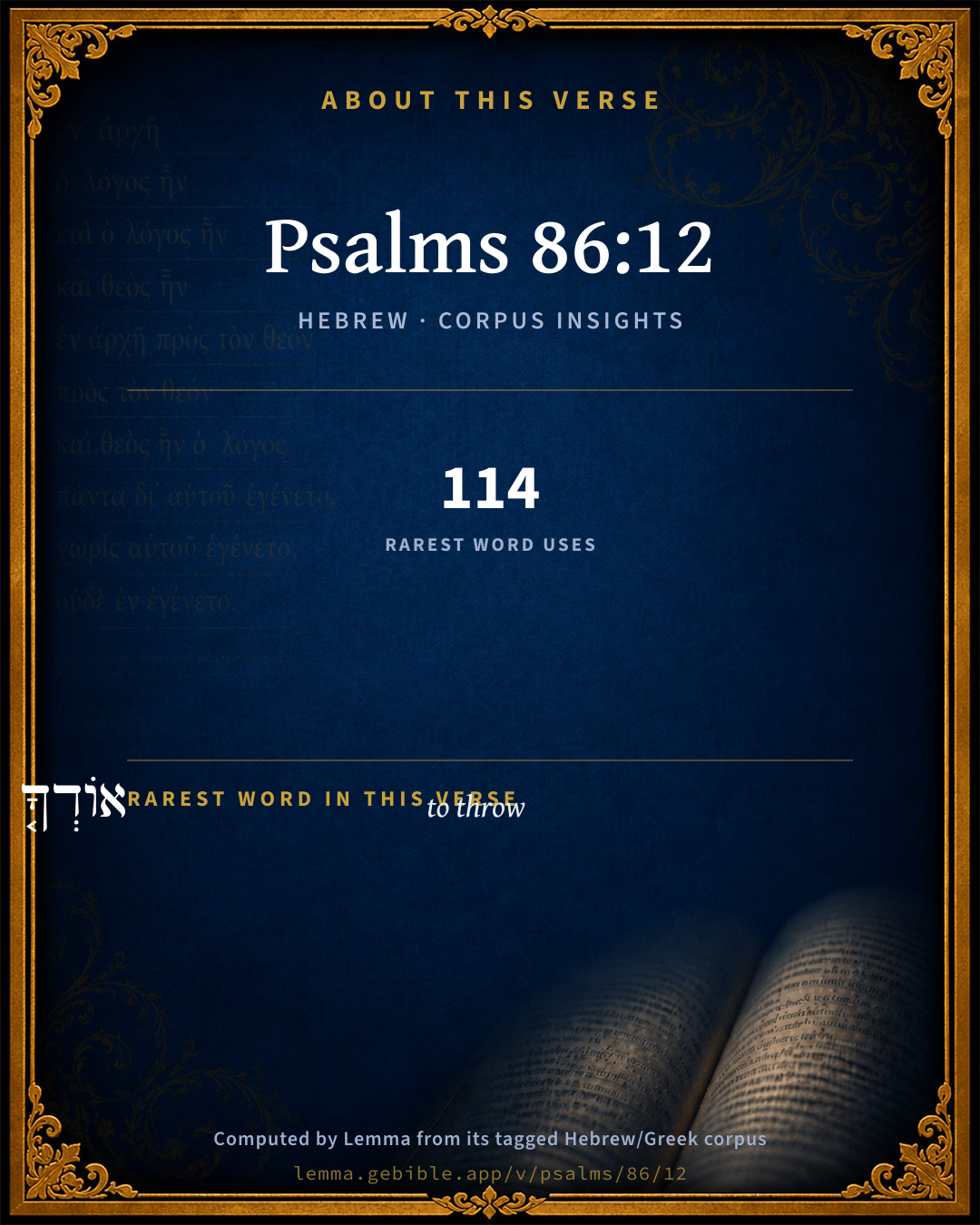
About this verse

These counts appear in no published source. They are computed here, from the morphology-tagged text and Lemma’s own curated glosses. What Lemma adds →

8
words
8
distinct lemmas
Wisdom
section

Grammatical profile

  • 2 verbs
  • 6 nouns

Verb forms

  • אוֹדְךָ֤ Hiphil · Imperfect
  • וַאֲכַבְּדָ֖ה Piel · Imperfect

Hebrew & Septuagint length

In English translation the verse runs 17 words from the Hebrew and 21 from the Septuagint (LXX English) — closely comparable.

A rough comparison of the two English renderings, which tokenize alike — not a word-level alignment.

Word counts can differ between the Hebrew and the Greek without any difference in meaning — e.g. the Hebrew direct-object marker אֵת has no separate Greek word, and Greek often adds the article ὁ.

Cross-references

17

Topical passages linked to Psalms 86:12 in the Treasury of Scripture Knowledge — connected by theme and wording, ordered by reader-vote popularity; previews shown in the World English Bible.

  • Deuteronomy 6:5 and you shall love Yahweh your God with all your heart, and with all your soul, and with all your might.
  • Psalms 146:1–2 Praise Yah! Praise Yahweh, my soul.
  • Romans 15:6 that with one accord you may with one mouth glorify the God and Father of our Lord Jesus Christ.
  • Revelation 19:5–6 A voice came forth from the throne, saying, "Give praise to our God, all you his servants, you who fear him, the small and the great!"
  • Isaiah 12:1 In that day you will say, "I will give thanks to you, Yahweh; for though you were angry with me, your anger has turned away and you comfort me.
  • 1 Corinthians 6:20 for you were bought with a price. Therefore glorify God in your body and in your spirit, which are God's.
  • 1 Corinthians 10:31 Whether therefore you eat, or drink, or whatever you do, do all to the glory of God.
  • Psalms 104:33 I will sing to Yahweh as long as I live. I will sing praise to my God while I have any being.
  • Proverbs 3:5–6 Trust in Yahweh with all your heart, And don't lean on your own understanding.
  • Ephesians 5:19 speaking to one another in psalms, hymns, and spiritual songs; singing, and singing praises in your heart to the Lord;
  • 1 Chronicles 29:13 Now therefore, our God, we thank you, and praise your glorious name.
  • Psalms 9:1 I will give thanks to Yahweh with my whole heart. I will tell of all your marvelous works.
  • Psalms 103:1–3 Praise Yahweh, my soul! All that is within me, praise his holy name!
  • Psalms 145:1–5 I will exalt you, my God, the King. I will praise your name forever and ever.
  • Revelation 5:9–13 They sang a new song, saying, "You are worthy to take the book, And to open its seals: For you were killed, And bought us for God with your blood, Out of every tribe, language, people, and nation,
  • 1 Chronicles 29:20 David said to all the assembly, Now bless Yahweh your God. All the assembly blessed Yahweh, the God of their fathers, and bowed down their heads, and worshiped Yahweh, and the king.
  • Psalms 34:1 I will bless Yahweh at all times. His praise will always be in my mouth.

Cross-references courtesy of OpenBible.info (CC BY 4.0).

Hebrew and Greek witnesses Masoretic Hebrew ↔ Greek Septuagint

The same verse in the two great witnesses to the Old Testament, shown verse-for-verse.

You’re reading Greek Psalm 85 (Hebrew Psalm 86). The Septuagint counts the superscription, so verse numbers can differ from the Hebrew — chapter-level alignment, not verse-by-verse. Numbering follows Rahlfs.

These are two independent witnesses, not word-aligned to each other, and the Septuagint is shown in lemma (dictionary) form.

Hebrew Psalms 86:12 Masoretic · Westminster Leningrad Codex

אוֹדְךָ֤ אֲדֹנָ֣י אֱ֭לֹהַי בְּכָל לְבָבִ֑י וַאֲכַבְּדָ֖ה שִׁמְךָ֣ לְעוֹלָֽם

I will praise you, Lord my God, with my whole heart. I will glorify your name forevermore.

World English Bible · Public Domain

Greek LXX Greek Psalm 85:12 Septuagint · lemma form

ἐκὁμολογέω σύ κύριος ὁ θεός ἐγώ ἐν ὅλος καρδία ἐγώ καί δοξάζω ὁ ὄνομα σύ εἰς ὁ αἰών

I will give you thanks, O Lord my God, with all my heart; and I will glorify your name for ever.

LXX2012 (modern English Septuagint) · Public Domain

Hebrew: Westminster Leningrad Codex (CC BY 4.0). Greek: Septuagint (public domain); English from LXX2012 (modern English Septuagint) (Public Domain). How the Septuagint differs from the Hebrew →

Commentary

Notes on Psalms 86:12 from classic Christian and Jewish commentators (each source and its license shown beneath its notes). The classic Christian expositions comment on the surrounding passage and are grouped to its opening verse, so a note may address several verses; the Jewish commentaries on the Tanakh (Rashi and others) are per-verse, so they appear only where the commentator wrote on this verse.

Lemma curates 59 commentaries, every one of them public domain or Creative Commons licensed, each selected and text-cleaned for this edition rather than reprinted as found. About our sources →

Trapp's Complete Commentary

John Trapp

Psa 86:12 I will praise thee, O Lord my God, with all my heart: and I will glorify thy name for evermore.

Ver. 12. I will praise thee] While he prayed, he found his prayer answered; and therefore thus breaketh forth into praises.

John Trapp, A Commentary or Exposition upon All the Books of the Old and New Testament (1647–1656) — public domain. Text from a community e-Sword module.

Joseph Benson's Commentary

Psa 86:12-13. I will praise thee, O Lord, &c. — Not only as the Lord, but as my God. And I will do it with all my heart — That is, with readiness, cheerfulness, and fervency, and with a sincere regard to thy honour; for I will glorify thy name — And that not for a time merely, but for evermore — I will glorify thee as long as I live, and hope to be glorifying thee to all eternity. For great is thy mercy toward me — It is a fountain inexhaustibly full, sending forth streams inestimably rich, and the benefits which I have derived from it are as invaluable as they are innumerable, and lay me under unspeakable obligations to praise and glorify the giver of them. Nor is this more my duty than my interest; for I know that gratitude for mercies already received will be recompensed by a continuance and increase of those mercies. Of the greatness of God’s mercy the psalmist gives this instance. Thou hast delivered my soul from the lowest hell — Hebrew, משׁאול תחתיה, mesheol tachtijah, which Green renders, From the grave beneath: “Thou hast often snatched me from extreme dangers, which, like an abyss, or bottomless pit, were ready to swallow me up.” But sheol often means hell, properly so called, or eternal death; and of this even some of the Jewish writers understand the word here. David knew he had deserved to be cast off for ever, and to be doomed to the lowest hell for his sin in the matter of Uriah; but Nathan assured him the Lord hath taken away thy sin: and by that word he was delivered from the lowest hell, and herein God’s mercy was great toward him. Even the best saints, we must remember, owe it, not to their own merit, but to the mercy of God, that they are saved from the lowest hell; and the consideration of that should greatly enlarge their hearts in praising the mercy of God, which they are obliged to glorify for evermore. So glorious, so gracious a rescue from everlasting misery, justly requires the return of everlasting praise.

Joseph Benson's Commentary on the Old and New Testaments (1811–1818) — public domain. Text from a community e-Sword module.

J. A. Alexander on Psalms

Joseph Addison Alexander

12. (Psa 86:12) I will thank thee, O Lord my God, with all my heart, and I will honour thy name for ever. The first verb means not merely to praise in general, but to praise for benefits received. See above, on Psa 6:5. This verse describes the effect that is to follow from the granting of the prayer at the close of the preceding verse. When his heart is once united to fear God, cordial and perpetual thanksgiving will follow as a necessary consequence.

Joseph Addison Alexander, The Psalms Translated and Explained (1850) — public domain. Text from a community e-Sword module.

Tyndale Open Study Notes

Tyndale Open Resources

86:12-13 In anticipation of God’s rescue, the psalmist praises him and trusts in his goodness.

Tyndale Open Study Notes — © Tyndale Open Resources, licensed CC BY-SA 4.0. Text via the HelloAO Bible API.

Adam Clarke's Commentary

Verse 12. I will praise thee - with all my heart] When my heart is united to fear thy name, then shall I praise thee with my whole heart.

Adam Clarke's Commentary on the Bible (1810–1826) — public domain. Text from a community e-Sword/MySword module.

John Calvin's Commentaries

12. I will praise thee, O Lord my God! David engages, when he shall have experienced God to be in all respects a beneficent father, to yield to him the tribute of gratitude. He expressed in the preceding verse a desire to have his heart united to God, that he might fear him; and now he affirms it to be his resolution to publish or celebrate his praises, not only with the mouth or tongue, but also with sincere affection of heart; yea, even to continue with steadfast perseverance in that exercise.

John Calvin's Commentaries (1540-1563) — public domain. Text from the Calvin Translation Society English edition (1840s-50s) via the Christian Classics Ethereal Library (ccel.org). Calvin's coverage is partial (roughly two-thirds of the Bible); uncommented books and verses are honest gaps, never fabricated. The 19th-century editor's footnotes and remarks are omitted so the notes are faithfully Calvin's own voice.

Ellicott's Commentary for English Readers

(12, 13) Comp. Psa_56:13; Psa_57:9-10.

A Bible Commentary for English Readers, edited by Charles John Ellicott (1878–1897) — public domain. Text from a community e-Sword module.

The Cambridge Bible for Schools and Colleges

gen. ed. J. J. S. Perowne

12, 13. Cp. Psa_57:9-10; Psa_9:1; Psa_50:15; Psa_50:23.

with all my heart] R.V. with my whole heart; when the prayer of Psa_86:11 is granted.

thy mercy] Thy lovingkindness.

and thou hast delivered my soul from the lowest hell] From the nethermost Sheol. From Psa_56:13 (= Psa_116:8); Deu_32:22. Deliverance from imminent danger of death may be meant; yet here the Psalmist may identify himself with the nation, and refer to its deliverance from the death of the exile. Cp. Psa_85:6.

The Cambridge Bible for Schools and Colleges (gen. ed. J. J. S. Perowne; Cambridge University Press, 1878–1918) — public domain. Text from a community e-Sword module.

John Gill's Exposition

I will praise thee, O Lord my God, with all my heart,.... And under that consideration, that he was his God, and which itself is sufficient matter of praise; this makes him amiable, and such he is, love itself: this is a blessing of pure grace, and is the foundation of all other blessings, and continues for ever: this work of praise, which is no other than ascribing glory to God, and giving thanks unto him for mercies received, the psalmist determines to do with his whole heart, which is to be engaged in every spiritual service; even all of it, all that is within it, every power and faculty of the soul, Psa 103:1, which is expressive not of perfection, but sincerity:

and I will glorify thy name for evermore; by celebrating the perfections of his nature, by giving him the glory of the works of his hands, by praising him for all favours, by devoting himself unto him, and by doing all things for his glory, and that for ever, in time as long as he lived, and to all eternity.

John Gill's Exposition of the Whole Bible (1746–1763) — public domain (CC PDM 1.0). Text via the HelloAO Bible API.

Albert Barnes' Notes on the Bible

I will praise thee, O Lord my God, with all my heart - This is but carrying out the idea in the previous verse. He would give his whole heart to God. He would allow nothing to divide or distract his affections. He would withhold nothing from God.

And I will glorify thy name for evermore - Not merely in the present emergency; but I will do it ever onward - even to eternity. The meaning is, that he would in all cases, and at all times - in this world and in the world to come - honor God. He would acknowledge no God but him, and he would honor him as God.

Albert Barnes' Notes on the Bible (1834–1885) — public domain. Text from a community e-Sword/MySword module.

Matthew Poole's English Annotations

Either,

1. If thou grantest my request, Psa 86:11; or,

2. Because thou hast done what is expressed Psa 86:13.

Matthew Poole's English Annotations on the Holy Bible (1683–1685) — public domain. Text from a community e-Sword/MySword module.

The Treasury of David

Charles H. Spurgeon

Ver. 12. I will praise thee, O Lord my God, with all my heart. When my heart is one, I will give thee all of it. Praise should never be rendered with less than all our heart, and soul, and strength, or it will be both unreal and unacceptable. This is the second time in the psalm that David calls the Lord "my God", the first time he was in an agony of prayer (Ps 86:2), and now he is in an ecstacy of praise. If anything can make a man pray and praise, it is the knowledge into that the Lord is his God.

And I will glorify thy name for evermore, eternity gratitude will prolong its praise. God has never done blessing us, let us never have done blessing him. As he ever gives us grace, let us ever render to him the glory of it.

Ver. 12. I will praise thee, O Lord my God, with all my heart: and I will glorify thy name. We glorify God by praising him. Doxology, or praise, is a God exalting work. Ps 50:23. "Whoso offereth praise glorifieth me." The Hebrew word, Bara, to create, and Barak, to praise, are little different, because the end of creation is to praise God. Though nothing can add to God's essential glory, yet praise exalts him in the eyes of others. When we praise God, we spread his fame and renown, we display the trophies of his excellency. In this manner the angels glorify him; they are the choristers of heaven, and do trumpet forth his praise. Praising God is one of the highest and purest acts of religion. In prayer we act like men; in praise we act like angels. Believers are called "temples of God", 1Co 3:16. When our tongues praise, then the organs of God's spiritual temple are sounding. How sad it is that God hath no more glory from us in this way! Many are full of murmuring and discontent, but seldom bring glory to God, by giving him the praise due to his name. We read of the saints having harps in their hands, the emblems of praise. Many have tears in their eyes and complaints in their mouths, but few have harps in their hands, blessing and glorifying God. Let us honour God this way. Praise is the quit rent we pay to God: while God renews our lease, we must renew our rent. Thomas Watson.

Ver. 12. I will praise thee, O Lord, & c. Such a soul as David was is enlarged to talk high of God: I will praise thee, O Lord my God, with all my heart; and I will glorify thy name for evermore. Alas! poor creature, how canst thou proclaim him "for evermore"? A soul fired with desire to praise God, burns after both more perfect things and more lasting than it is able to perform. "To will is present with it", etc. See but the reachings and longings of such a soul, how it swells in desires to glorify God! Thomas Goodwin.

Ver. 12. With all my heart. When my heart is united to fear thy name, then shall I praise thee with my whole heart. Adam Clarke.

Ver. 12. The art of praising God by heart.

Psalms 86:13*

Charles H. Spurgeon's The Treasury of David (1869–1885) — public domain. Psalms only. Text from a community e-Sword/MySword module.

The Pulpit Commentary

I will praise thee, O Lord my God, with all my heart; i.e. "with an undivided heart." And I will glorify thy Name (see ver. 9) forevermore. A belief in immortality is implied, if not formally asserted.

A comprehensive prayer.

"Unite my heart to fear thy Name," etc. This rich and elevated psalm is well called in the title "a prayer," rather than "a psalm." It is more devout than poetical. Its distinctive character is the remarkable union of intense personal feeling with large views of God"s character and relation to mankind (ver. 9). This has led critics to speak of it as "liturgical," overlooking the deep strain of personal feeling, leading the psalmist even (ver. 16) to plead that he is the child of a godly mother, as well as (ver. 2) that he is "holyq.d. either consecrated to God, or one on whom God bestows grace. This petition, "Unite my heart," etc., is one of great compass, grandeur, simplicity, bespeaking a heart already fixed on God. It seeks

I A SUPREME AFFECTION. A. master passion, to which all other desires and affections shall be subordinate. The worldly mind, just because it is worldly, is torn by conflicting desires the prey of passions or feelings, each of which seeks mastery. For the world (as St. John describes it. 1Jn_2:16) has no unity; a mass of contradictions, rivalries, inconsistent objects of desire. Only the heart which has learned to say, "Thou art my Portion", (Psa_119:57) has found the principle of unity, the keynote which can put all the heart"s pure and true affections in tune.

II A SINGLE AIM. A master purpose, to which all other objects must yield, and which gives back colour to the whole life. Successful men are characterized by singleness and earnestness of aim. A limited and narrow man will carry his point, if it be the one thing he lives for; while men of splendid genius waste their powers, and become splendid failures for lack of concentration and motive power. (see Php_3:13, 14) The hottest diffused sunshine kindles no flame; but concentrate but a few rays with a glass on one point, and flame bursts forth. Supreme love to Christ, and a single eye to his service and approval, give a unity to life which is a great element of success, even in what we call worldly affairs. (Col_3:3)

III UNDOUBTING CONVICTION. Strong, unwavering faith. Doubt distracts, agitates, unsettles, weakens. (Jam_1:8) A doubting temper, fond of dwelling on difficulties and objections, is fatal to unity of mind, heart, and will. Doubts, if they assail you, are neither to be timidly shrunk from nor idly played with, but honestly faced and fought. But the grand secret of conviction is to dwell first and constantly on the positive evidence of truth. If that is adequate, unanswerable, then a thousand questions we cannot at present answer need not trouble us. They can wait; but facts will not wait. Here is a great secret, not only of strength, but of rest. And in rest is a reservoir of energy. (Isa 26:3Jo Isa_14:1)

What grand possibilities there are in the Christian life! If an Old Testament saint could put up such a prayer, and have it answered, how much more may it be fulfilled in our experience!

The Pulpit Commentary (1880–1919), ed. H.D.M. Spence-Jones & Joseph S. Exell — public domain. Text from a community e-Sword module.

Lesson kit

Teaching starters — assembled from the data on this page, not authored interpretation. Every prompt links to the verse data it draws on. Edit before teaching.

Psalms, in the Wisdom, opens this verse with 8 words (8 distinct Hebrew lemmas). Its most distinctive word is yâdâh (“to throw”). A historical commentator’s framing appears above. Read the whole chapter for the surrounding context.

Discussion questions

  1. The word yâdâh carries the sense “to throw.” How does it shape the verse?
  2. How does Deuteronomy 6:5, which shares this passage’s theme, read alongside this verse?
  3. These translations render this verse differently; the difference is in the English rendering, not the original. What questions does that raise?
  4. «אוֹדְךָ֤» is a Hiphil Imperfect verb. How does that grammatical form shape the action described?
  5. Compare how Trapp's Complete Commentary and Joseph Benson's Commentary read this verse. Where do they agree or differ?

Things to notice

Reading settings

Reading text

Shown beneath each verse's original-language words.

Old Testament
Old Testament edition

Read the OT as the Masoretic Hebrew (MT) or the Greek Septuagint (LXX).

English shown for the Greek Septuagint (in the Hebrew ↔ Greek comparison).

Comparing translations? Open the Compare panel on any verse page to stack up to four side by side.