
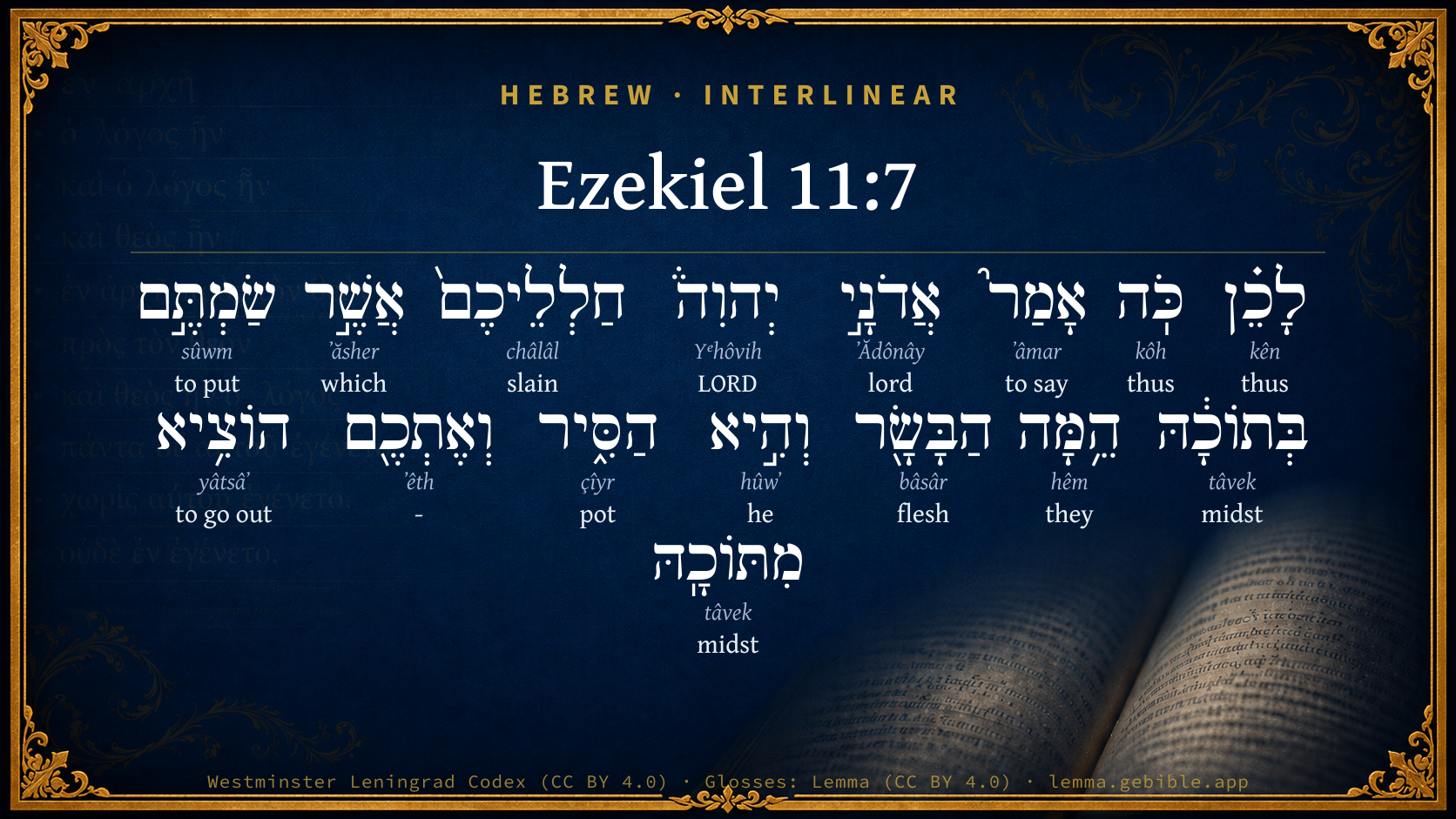
Ezekiel 11:7

Hebrew (Westminster Leningrad Codex) Ezekiel 11:7 appears in the Hebrew Old Testament. The text above is from the Westminster Leningrad Codex. Each word links to its Strong’s number, a concise gloss, and parsing drawn from the Open Scriptures Hebrew Bible morphology. Click any word for its full Brown-Driver-Briggs (BDB) entry.
Download image
Cite this verse

Ezekiel 11:7 (World English Bible). Public Domain. Lemma interlinear Bible study tool, https://lemma.gebible.app/v/ezekiel/11/7.

Show BibTeX & RIS
BibTeX
RIS
English Translation
Therefore thus says the Lord Yahweh: Your slain whom you have laid in the midst of it, they are the flesh, and this [city] is the caldron; but you shall be brought forth out of the midst of it.
World English Bible · Public Domain
Download a study sheet

One document with this verse’s original text, its word-by-word gloss line, the meaning frame, cross-references with their text, attributed commentary, and full source and license credits — printable, and it pastes into notes with its structure intact.

This verse Autodidact and up

Study sheet (.html) Plain text (.txt)

A passage Seminary Student

Up to 50 verses in one chapter. A passage sheet keeps up to 6 commentary sources and 12 cross-references per verse, in the order this page ranks them, and says so on the sheet whenever that leaves anything out. Ask for a single verse and you get the Autodidact verse sheet above.

Everything on this page stays free to read, with no account — the sheet is a download of what is already on screen, not access to it.

Want to remove ads? Support Godless Engineer
Compare translations 3

The same verse in 3 English versions, stacked beneath the original-language interlinear above. Click any original word for its lexicon entry.

Each is an independent rendering of the whole verse — the interlinear is not word-aligned to these translations.

Highlighted words mark where these versions differ — a whole-verse word diff, not a word-by-word alignment.

  • World English Bible Public Domain
    Therefore thus says the Lord Yahweh: Your slain whom you have laid in the midst of it, they are the flesh, and this [city] is the caldron; but you shall be brought forth out of the midst of it.
  • King James Version Public Domain
    Therefore thus saith the Lord GOD; Your slain whom ye have laid in the midst of it, they are the flesh, and this city is the caldron: but I will bring you forth out of the midst of it.
  • unfoldingWord Literal Text CC BY-SA 4.0
    Therefore, the Lord Yahweh says this: The people you have killed, whose bodies you have laid in the midst of Jerusalem, are the meat, and this city is the pot. But you are going to be brought out from the midst of this city.

unfoldingWord Literal Text — © unfoldingWord, licensed CC BY-SA 4.0. Word-aligned USFM3 via Door43 (git.door43.org/unfoldingWord/en_ult).

Versions to compare (up to 4)

3 of 4 selected

Show all 18 translations

Every available English version of this verse, each an independent rendering of the whole verse.

  • World English Bible Public Domain
    Therefore thus says the Lord Yahweh: Your slain whom you have laid in the midst of it, they are the flesh, and this [city] is the caldron; but you shall be brought forth out of the midst of it.
  • Berean Standard Bible Public Domain
    Therefore this is what the Lord GOD says: The slain you have laid within this city are the meat, and the city is the pot; but I will remove you from it.
  • Majority Standard Bible Public Domain
    Therefore this is what the Lord GOD says: The slain you have laid within this city are the meat, and the city is the pot; but I will remove you from it.
  • King James Version Public Domain
    Therefore thus saith the Lord GOD; Your slain whom ye have laid in the midst of it, they are the flesh, and this city is the caldron: but I will bring you forth out of the midst of it.
  • American Standard Version (1901) Public Domain
    Therefore thus saith the Lord Jehovah: Your slain whom ye have laid in the midst of it, they are the flesh, and this `city' is the caldron; but ye shall be brought forth out of the midst of it.
  • Revised Version (1885) Public Domain
    Therefore thus saith the Lord GOD: Your slain whom ye have laid in the midst of it, they are the flesh, and this city is the caldron: but ye shall be brought forth out of the midst of it.
  • Geneva Bible (1599) Public Domain
    Therefore thus saith the Lord God, They that ye haue slaine, and haue layed in the middes of it, they are the flesh, and this citie is the caldron, but I wil bring you foorth of the mids of it.
  • Douay-Rheims (1899) Public Domain
    Therefore thus saith the Lord God: Your slain, whom you have laid in the midst thereof, they are the flesh, and this is the caldron: and I will bring you forth out of the midst thereof.
  • Young's Literal Translation Public Domain
    Therefore, thus said the Lord Jehovah: Your wounded whom ye placed in its midst, They `are' the flesh, and it `is' the pot, And you he hath brought out from its midst.
  • Literal Standard Version CC BY-SA 4.0
    Therefore, thus said Lord YHWH: Your wounded whom you placed in its midst, || They [are] the flesh, and it [is] the pot, || And He has brought you out from its midst.
  • Unlocked Literal Bible CC BY-SA 4.0
    Therefore, the Lord Yahweh says this: The people you have killed, whose bodies you have laid in the midst of Jerusalem, are the meat, and this city is the pot. But you are going to be brought out from the midst of this city.
  • unfoldingWord Literal Text CC BY-SA 4.0
    Therefore, the Lord Yahweh says this: The people you have killed, whose bodies you have laid in the midst of Jerusalem, are the meat, and this city is the pot. But you are going to be brought out from the midst of this city.
  • Darby Bible Public Domain
    Therefore thus saith the Lord Jehovah: Your slain whom ye have laid in the midst of it, they are the flesh, and it is the cauldron; but you will I bring forth out of the midst of it.
  • World Messianic Bible Public Domain
    “‘Therefore the Lord GOD says: “Your slain whom you have laid in the middle of it, they are the meat, and this is the cauldron; but you will be brought out of the middle of it.
  • Webster's Bible Public Domain
    Therefore thus saith the Lord GOD; Your slain whom ye have laid in the midst of it, they are the flesh, and this city is the caldron: but I will bring you forth out of the midst of it.
  • Free Bible Version CC BY-SA 4.0
    So this is what the Lord God says: Those you've killed in this city are the meat, and the city is the pot; but I'm going to take you out of it.
  • Bible in Basic English Public Domain
    For this reason the Lord has said: Your dead whom you have put down in its streets, they are the flesh, and this town is the cooking-pot: but I will make you come out from inside it.
  • JPS Tanakh (1917) Public Domain
    Therefore thus saith the Lord GOD: Your slain whom ye have laid in the midst of it, they are the flesh, and this city is the caldron; but ye shall be brought forth out of the midst of it.

Literal Standard Version (2020), Covenant Press — licensed CC BY-SA 4.0. Text via the HelloAO Bible API (eBible.org). Unlocked Literal Bible (unfoldingWord) — licensed CC BY-SA 4.0. Text via the HelloAO Bible API (eBible.org). unfoldingWord Literal Text — © unfoldingWord, licensed CC BY-SA 4.0. Word-aligned USFM3 via Door43 (git.door43.org/unfoldingWord/en_ult). Free Bible Version, Dr. Jonathan Gallagher — licensed CC BY-SA 4.0. Text via the HelloAO Bible API (eBible.org).

Word by word

More ways to search: Search by grammar → Find every occurrence → Compare this word →

Practice this passage: Drill this verse → Learn its vocabulary →

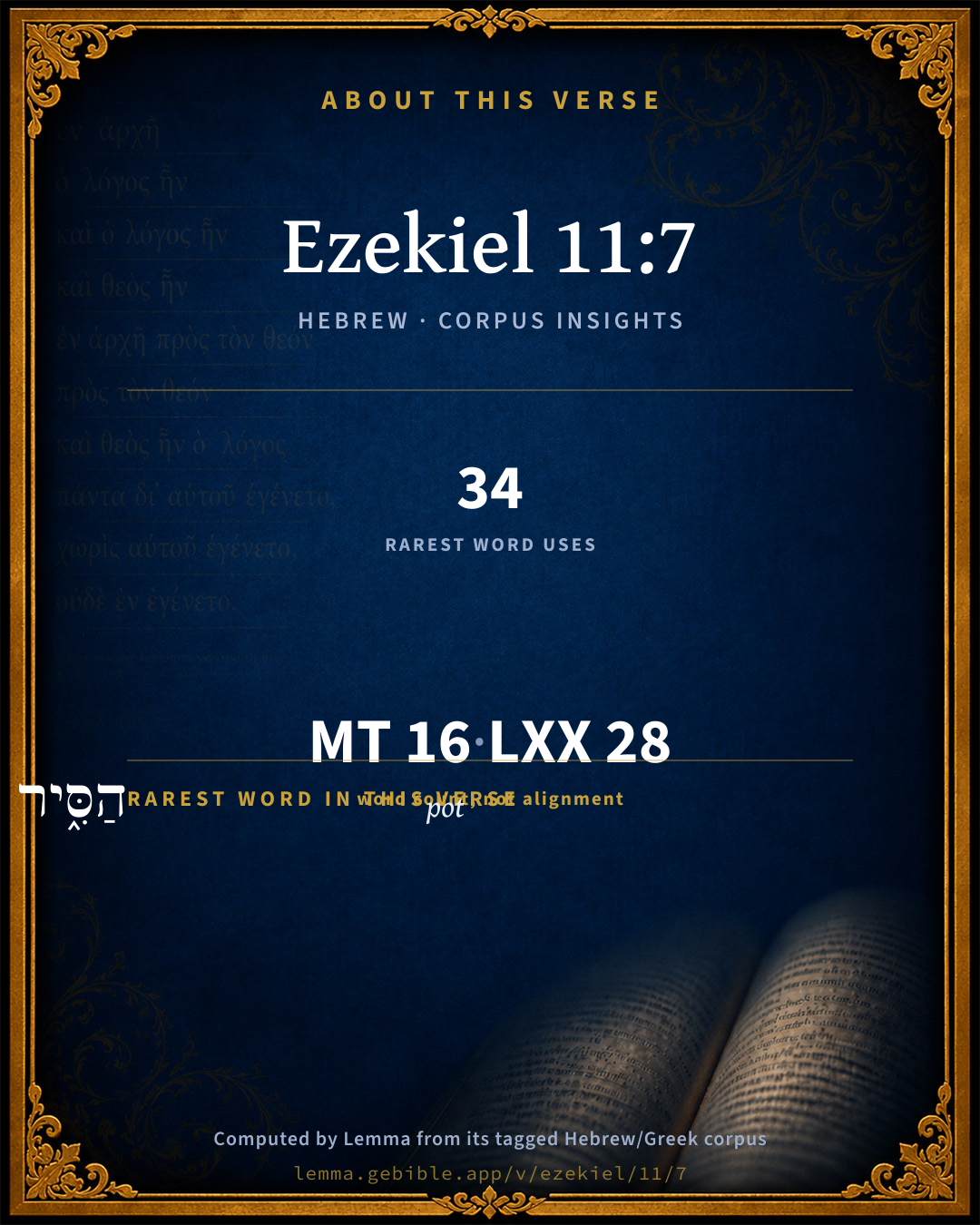
הַסִּ֑יר
çîyr
H5518
“the · pot”
Particle, Definite Article + Noun, Common, Both, Singular, Absolute
Part of Speech
Particle + Noun
Type
Common
Gender
Both
Number
Singular
State
Absolute
Full BDB Definition

Origin: from a primitive root meaning to boil up

TWOT: 1489 , 1490

pot - pot (household utensil) - pot (of temple) - thorn, hook, brier - thorns - hooks
  1. לָכֵ֗ן kên H3651 “to/for · thus” Preposition + Adverb
  2. כֹּֽה kôh H3541 “thus” Adverb
  3. אָמַר֮ ʼâmar H559 “to say” Verb, Qal, Perfect, 3rd Person, Masculine, Singular
  4. אֲדֹנָ֣י ʼĂdônây H136 “Lord · my” Noun, Common, Masculine, Plural, Construct + Suffix, Personal, 1st Person, Common, Singular
  5. יְהוִה֒ Yᵉhôvih H3069 “LORD” Noun, Proper
  6. חַלְלֵיכֶם֙ châlâl H2491 “slain · your” Adjective, Adjective, Masculine, Plural, Construct + Suffix, Personal, 2nd Person, Masculine, Plural
  7. אֲשֶׁ֣ר ʼăsher H834 “which” Particle, Relative
  8. שַׂמְתֶּ֣ם sûwm H7760 “to put” Verb, Qal, Perfect, 2nd Person, Masculine, Plural
  9. בְּתוֹכָ֔הּ tâvek H8432 “in/at · midst · her” Preposition + Noun, Common, Masculine, Singular, Construct + Suffix, Personal, 3rd Person, Feminine, Singular
  10. הֵ֥מָּה hêm H1992 “they” Pronoun, Personal, 3rd Person, Masculine, Plural
  11. הַבָּשָׂ֖ר bâsâr H1320 “the · flesh” Particle, Definite Article + Noun, Common, Masculine, Singular, Absolute
  12. וְהִ֣יא hûwʼ H1931 “and · he” Conjunction + Pronoun, Personal, 3rd Person, Feminine, Singular
  13. וְאֶתְכֶ֖ם ʼêth H853 “and · - · you” Conjunction + Particle, Direct Object + Suffix, Personal, 2nd Person, Masculine, Plural
  14. הוֹצִ֥יא yâtsâʼ H3318 “to go out” Verb, Hiphil, Perfect, 3rd Person, Masculine, Singular
  15. מִתּוֹכָֽהּ tâvek H8432 “from · midst · her” Preposition + Noun, Common, Masculine, Singular, Construct + Suffix, Personal, 3rd Person, Feminine, Singular

About this verse

These counts appear in no published source. They are computed here, from the morphology-tagged text and Lemma’s own curated glosses. What Lemma adds →

16
words
15
distinct lemmas
Prophets
section

Shared distinctive vocabulary

הַסִּ֑יר pot H5518 occurs in 32 verses of the Hebrew Bible. Also found in:

Grammatical profile

  • 3 verbs
  • 6 nouns
  • 1 adjective
  • 2 pronouns
  • 2 adverbs
  • 2 particles

Verb forms

  • אָמַר֮ Qal · Perfect
  • שַׂמְתֶּ֣ם Qal · Perfect
  • הוֹצִ֥יא Hiphil · Perfect

Repetition

A word recurs within this verse — often emphatic in Hebrew:

  • בְּתוֹכָ֔הּ midst H8432 ×2

Hebrew & Septuagint length

In English translation the verse runs 39 words from the Hebrew and 37 from the Septuagint (LXX English) — closely comparable.

A rough comparison of the two English renderings, which tokenize alike — not a word-level alignment.

Word counts can differ between the Hebrew and the Greek without any difference in meaning — e.g. the Hebrew direct-object marker אֵת has no separate Greek word, and Greek often adds the article ὁ.

In the original languages it is 16 Hebrew tokens and 28 Greek tokens — but the two are counted differently (Hebrew bundles its prefixes and suffixes into one token; the Greek is in lemma form), so that isn’t a like-for-like length.

Cross-references

5

Topical passages linked to Ezekiel 11:7 in the Treasury of Scripture Knowledge — connected by theme and wording, ordered by reader-vote popularity; previews shown in the World English Bible.

  • Ezekiel 24:3–13 Utter a parable to the rebellious house, and tell them, Thus says the Lord Yahweh, Set on the caldron, set it on, and also pour water into it:
  • Micah 3:2–3 You who hate the good, And love the evil; Who tear off their skin, And their flesh from off their bones;
  • 2 Kings 25:18–22 The captain of the guard took Seraiah the chief priest, and Zephaniah the second priest, and the three keepers of the threshold:
  • Jeremiah 52:24–27 The captain of the guard took Seraiah the chief priest, and Zephaniah the second priest, and the three keepers of the threshold:
  • Ezekiel 3:9–11 As an adamant harder than flint have I made your forehead: don't be afraid of them, neither be dismayed at their looks, though they are a rebellious house.

Cross-references courtesy of OpenBible.info (CC BY 4.0).

Hebrew and Greek witnesses Masoretic Hebrew ↔ Greek Septuagint

The same verse in the two great witnesses to the Old Testament, shown verse-for-verse.

These are two independent witnesses, not word-aligned to each other, and the Septuagint is shown in lemma (dictionary) form.

Hebrew Ezekiel 11:7 Masoretic · Westminster Leningrad Codex

לָכֵ֗ן כֹּֽה אָמַר֮ אֲדֹנָ֣י יְהוִה֒ חַלְלֵיכֶם֙ אֲשֶׁ֣ר שַׂמְתֶּ֣ם בְּתוֹכָ֔הּ הֵ֥מָּה הַבָּשָׂ֖ר וְהִ֣יא הַסִּ֑יר וְאֶתְכֶ֖ם הוֹצִ֥יא מִתּוֹכָֽהּ

Therefore thus says the Lord Yahweh: Your slain whom you have laid in the midst of it, they are the flesh, and this [city] is the caldron; but you shall be brought forth out of the midst of it.

World English Bible · Public Domain

Greek LXX Ezekiel 11:7 Septuagint · lemma form

διά οὗτος ὅδε λέγω κύριος ὁ νεκρός σύ ὅς πατάσσω ἐν μέσος αὐτός οὗτος εἰμί ὁ κρέας αὐτός δέ ὁ λέβης εἰμί καί σύ ἐκἄγω ἐκ μέσος αὐτός

Therefore thus says the Lord; Your dead whom you⌃ have struck in the midst of it, these are the flesh, and thiscity is the caldron: but I will bring you forth out of the midst of it.

LXX2012 (modern English Septuagint) · Public Domain

Hebrew: Westminster Leningrad Codex (CC BY 4.0). Greek: Septuagint (public domain); English from LXX2012 (modern English Septuagint) (Public Domain). How the Septuagint differs from the Hebrew →

Targum (Aramaic paraphrase)

1

The Targum is the ancient Jewish Aramaic paraphrase of the Hebrew Scriptures — an interpretive translation, not the Hebrew text itself. Onkelos (literal) and Pseudo-Jonathan (expansive) render the Torah, and Jonathan the Prophets. Coverage is partial: where no permissively-licensed English translation exists for a verse, only the Aramaic is shown. This is verse-level text, not a word-by-word alignment to the Hebrew.

  1. Targum Jonathan Prophets (Joshua–Malachi)
    בְּכֵן כִּדְנַן אֲמַר יְיָ אֱלֹהִים קְטִילֵיכוֹן דְשַׁוִיתוּן בְּגַוָהּ אִינוּן כְּבִסְרָא וְהָא כְדוּדָא וְיַתְכוֹן אַגְלֵי מִגַוָהּ:

    (no public-domain English translation for this verse)

    Targum Jonathan — Aramaic: “Mikraot Gedolot” (public domain). English: “Sefaria Community Translation” (CC0 1.0 (public-domain dedication)); “London "Chaldee Paraphrase," 1871” (public domain). Text via Sefaria.

Commentary

Notes on Ezekiel 11:7 from classic Christian and Jewish commentators (each source and its license shown beneath its notes). The classic Christian expositions comment on the surrounding passage and are grouped to its opening verse, so a note may address several verses; the Jewish commentaries on the Tanakh (Rashi and others) are per-verse, so they appear only where the commentator wrote on this verse.

Lemma curates 59 commentaries, every one of them public domain or Creative Commons licensed, each selected and text-cleaned for this edition rather than reprinted as found. About our sources →

Trapp's Complete Commentary

John Trapp

Eze 11:7 Therefore thus saith the Lord GOD; Your slain whom ye have laid in the midst of it, they [are] the flesh, and this [city is] the caldron: but I will bring you forth out of the midst of it.

Ver. 7. Your slain.] Whether ye have slain them outright, or have laid them bleeding and dying by your oppressions; for a poor man’s livelihood is his life. {Mar 12:44 Luk 8:43} He is in his house like a snail in his shell, crush that, and you kill him.

And this city is the caldron.] {a} Thus their own words, spoken in mockery, are wittily retorted upon them, and driven back again down their throats as it were.

But I will bring you forth out of the midst of it.] As rotten flesh, to be cast out; or as filthy scum, to boil over.

{a} Haec verba monachi funibus trahunt ad purgatorium probandum, nixi autoritate Originis.

John Trapp, A Commentary or Exposition upon All the Books of the Old and New Testament (1647–1656) — public domain. Text from a community e-Sword module.

Geneva Bible (1599)

Geneva Bible translators

Contrary to their vain confidence he showeth in what sense the city is the caldron: that is, because of the dead bodies that have been murdered therein, and so lie as flesh in the caldron.

Geneva Bible (1599) marginal notes — public domain. Text via Bolls.life.

Jamieson, Fausset & Brown

Robert Jamieson, A. R. Fausset & David Brown

The city is a caldron to them, but it shall not be so to you. Ye shall meet your doom on the frontier.

Jamieson, Fausset & Brown — Commentary Critical and Explanatory on the Whole Bible (1871) — public domain (CC PDM 1.0). Text via the HelloAO Bible API.

Adam Clarke's Commentary

Verse 7. Your slain - they are the flesh] Jerusalem is the caldron, and those who have been slain in it, they are the flesh; and though ye purpose to stay and share its fate, ye shall not be permitted to do so, ye shall be carried into captivity.

Adam Clarke's Commentary on the Bible (1810–1826) — public domain. Text from a community e-Sword/MySword module.

Ellicott's Commentary for English Readers

(7) Your slain . . . they are the flesh.—They had boasted of the protection of their strong city: it should be a security only to the dead who had fallen by their own violence. The living who vainly trusted in its strength should be brought out of it, and delivered as captives to the stranger. The prophecy here takes up their own simile of Eze_11:3, and shows that it shall not avail them. On the contrary, in Eze_11:11 it is expressly said that the figure, in their sense of it, shall not be true. The use of and repeated recurrence to this singular figure may illustrate the familiarity of the people with language of this kind, and help us to appreciate the figurative character of many of Ezekiel’s expressions.

A Bible Commentary for English Readers, edited by Charles John Ellicott (1878–1897) — public domain. Text from a community e-Sword module.

The Cambridge Bible for Schools and Colleges

gen. ed. J. J. S. Perowne

7. Those slain in the midst of Jerusalem will be the only “flesh” that will remain in the pot. The living conspirators who think they shall be safe shall be dragged forth and judged far away from the protecting city, on the borders of Israel. The figure of the pot and flesh is used differently in ch. 24. (The Heb. is probably to be spelled so as to give the meaning “I will bring you forth.”)

The Cambridge Bible for Schools and Colleges (gen. ed. J. J. S. Perowne; Cambridge University Press, 1878–1918) — public domain. Text from a community e-Sword module.

John Gill's Exposition

Therefore thus saith the Lord God,.... Applying the parabolical expressions they had derided, and explaining them, in a different sense from what they had put upon them:

your slain whom ye have laid in the midst of it, they are the flesh; the prophets they had killed; the persons, who had died innocently for crimes laid to their charge they had not been guilty of; and such who had fallen by one judgment or another since the siege, they were the persons intended by "the flesh", and not such as were alive; and therefore could promise themselves nothing from this proverb they had taken up, and scoffed at:

and this city is the cauldron; that holds the slain, and in which they will lie and continue, and not the living:

but I will bring you forth out of the midst of it: where they promised themselves safety, and a long continuance; yet should not abide, but be carried captive.

John Gill's Exposition of the Whole Bible (1746–1763) — public domain (CC PDM 1.0). Text via the HelloAO Bible API.

Albert Barnes' Notes on the Bible

All that shall remain in the city are the buried dead. Bloodshed and murder were at this time rife in Jerusalem, and these were among the chief crimes that were bringing down judgment upon the city. All the inhabitants that should yet survive were destined to be carried away into exile.

Albert Barnes' Notes on the Bible (1834–1885) — public domain. Text from a community e-Sword/MySword module.

Haydock's Catholic Bible Commentary

Cauldron. I will explain the prediction, which you turn to ridicule. Those whom you have slain, are like the flesh (Calmet) boiled. (Haydock) --- But you shall be treated still worse, being led captives and slain. (Calmet) --- They feared wars, but had no dread of captivity. (Worthington)

George Leo Haydock (1774–1849), Haydock's Catholic Family Bible and Commentary, 1859 edition — public domain. Excludes Psalms (Douay-Rheims chapter numbering differs from Protestant) and Deuterocanonical books (Catholic canon only).

Matthew Poole's English Annotations

Therefore; your murders are the cause of my severity, and such sins first or last are surely punished.

Your slain: see Eze 11:6. Or, your slain, because when they might and would have saved their life by a seasonable submission, you persuaded them to an obstinate opposition against the Chaldeans to their destruction.

Whom ye have laid, or placed (as the word bears); it is not unlike that they who persuaded all to stay did provide, or at least help, as many as did stay, to habitations, and placed them in houses or lodgings.

The flesh; the pieces which are to be east into the caldron, and here be punished.

But I, that is, the mighty, eternal, and just God, will bring you forth, not in mercy, but in wrath, by the conquering hand of Babylon; I will draw you out to greater torment.

Matthew Poole's English Annotations on the Holy Bible (1683–1685) — public domain. Text from a community e-Sword/MySword module.

Whedon's Commentary on the Bible

Daniel D. Whedon

7. They are the flesh, etc. — The only ones who will be left within the safe walls of the iron pot will be the slain. The dreams of escape from God’s judgment will fail. All of Jerusalem’s living population will be hurried into captivity. Jehovah had spoken it, and the city, if it remained unrepentant (see notes Eze_9:10), was doomed. The city should be a caldron whose walls would inclose none but the dead, and these captains of the people should not even lie among those heroes slain in the battle, but should fly from behind the strong walls in which they had boasted only to meet their death “in the border of Israel” (Eze_11:10).

Daniel D. Whedon (gen. ed.), Commentary on the Old and New Testaments (1874–1909) — public domain. Text from a community e-Sword module.

The Pulpit Commentary

They are the flesh, etc. The prophet is led to retort their derisive or defiant words. Not they, but the carcases of their victims, were as the "flesh" in the "caldron." For themselves, there was another fate in reserve. Neither to be protected by the caldron nor to meet their doom in it, but to be brought out of it. Death, by famine, sword, or pestilence, (Eze_5:12) might be the doom of some, but for others, perhaps specially for those whom the prophet addresses, there would be captivity first, and death from the sword which they feared, afterwards.

The Pulpit Commentary (1880–1919), ed. H.D.M. Spence-Jones & Joseph S. Exell — public domain. Text from a community e-Sword module.

John Wesley's Explanatory Notes

Bring you forth - Not in mercy, but in wrath, by the conquering hand of Babylon.

John Wesley, Explanatory Notes Upon the Whole Bible (1754–1765) — public domain. Text via the GEBible commentary corpus.

Rashi

Rabbi Shlomo Yitzchaki (Rashi)

take out Heb. הוֹצִיא, like לְהוֹצִיא to take out. In vain have you built the houses, for you will go into exile, both the fathers and the sons, and no one will inherit the houses.

Rashi on the Tanakh — English translations: “The Judaica Press complete Tanach with Rashi, translated by A. J. Rosenberg” (CC BY 4.0); “Pentateuch with Rashi's commentary by M. Rosenbaum and A.M. Silbermann, 1929-1934” (public domain); “The Metsudah Tanach series, Lakewood, N.J” (CC BY 4.0); and “The Book of Joshua, Metsudah Publications, 1997” (CC BY 4.0). Text via Sefaria.

Lesson kit

Teaching starters — assembled from the data on this page, not authored interpretation. Every prompt links to the verse data it draws on. Edit before teaching.

Ezekiel, in the Prophets, opens this verse with 16 words (15 distinct Hebrew lemmas). Its most distinctive word is çîyr (“pot”). A historical commentator’s framing appears above. Read the whole chapter for the surrounding context.

Discussion questions

  1. What does “pot” (çîyr) contribute to the verse as a whole?
  2. Exodus 16:3 shares the word «pot» with this verse. How do the two illuminate each other?
  3. “midst” occurs 2× in this one verse. What is the effect of the repetition?
  4. These translations render this verse differently. What is at stake in choosing one wording over another?
  5. The verb «אָמַר֮» is Qal Perfect. How does its form color the action?
  6. Reading how Trapp's Complete Commentary and Geneva Bible (1599) read this verse, where do the two commentators agree and where do they part?

Things to notice

Reading settings

Reading text

Shown beneath each verse's original-language words.

Old Testament
Old Testament edition

Read the OT as the Masoretic Hebrew (MT) or the Greek Septuagint (LXX).

English shown for the Greek Septuagint (in the Hebrew ↔ Greek comparison).

Comparing translations? Open the Compare panel on any verse page to stack up to four side by side.