
Ezekiel 7:5

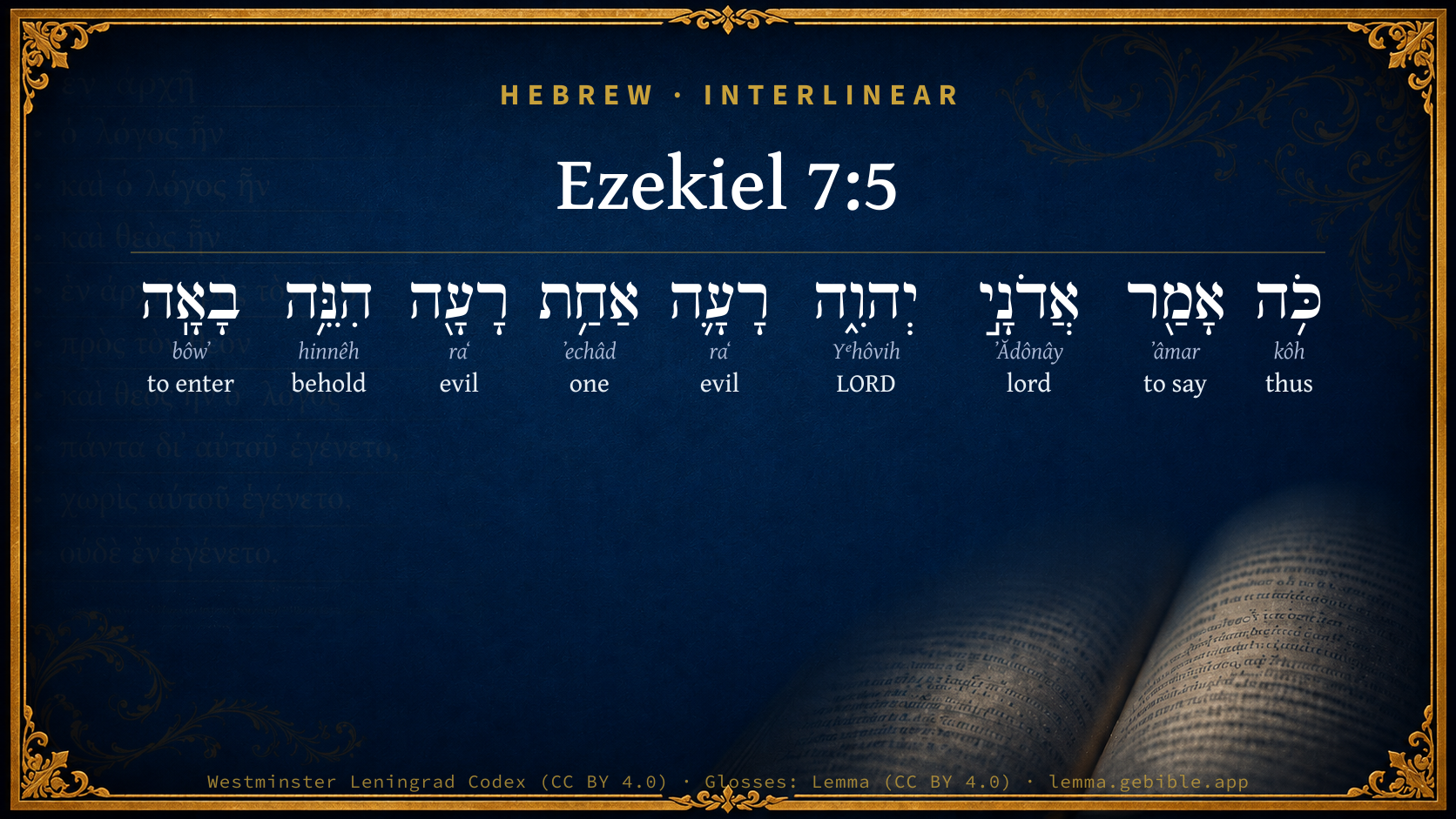
Hebrew (Westminster Leningrad Codex) Ezekiel 7:5 appears in the Hebrew Old Testament. The text above is from the Westminster Leningrad Codex. Each word links to its Strong’s number, a concise gloss, and parsing drawn from the Open Scriptures Hebrew Bible morphology. Click any word for its full Brown-Driver-Briggs (BDB) entry.
Download image
Cite this verse

Ezekiel 7:5 (World English Bible). Public Domain. Lemma interlinear Bible study tool, https://lemma.gebible.app/v/ezekiel/7/5.

Show BibTeX & RIS
BibTeX
RIS
English Translation
Thus says the Lord Yahweh: An evil, an only evil; behold, it comes.
World English Bible · Public Domain
Download a study sheet

One document with this verse’s original text, its word-by-word gloss line, the meaning frame, cross-references with their text, attributed commentary, and full source and license credits — printable, and it pastes into notes with its structure intact.

This verse Autodidact and up

Study sheet (.html) Plain text (.txt)

A passage Seminary Student

Up to 50 verses in one chapter. A passage sheet keeps up to 6 commentary sources and 12 cross-references per verse, in the order this page ranks them, and says so on the sheet whenever that leaves anything out. Ask for a single verse and you get the Autodidact verse sheet above.

Everything on this page stays free to read, with no account — the sheet is a download of what is already on screen, not access to it.

Want to remove ads? Support Godless Engineer
Compare translations 3

The same verse in 3 English versions, stacked beneath the original-language interlinear above. Click any original word for its lexicon entry.

Each is an independent rendering of the whole verse — the interlinear is not word-aligned to these translations.

Highlighted words mark where these versions differ — a whole-verse word diff, not a word-by-word alignment.

  • World English Bible Public Domain
    Thus says the Lord Yahweh: An evil, an only evil; behold, it comes.
  • King James Version Public Domain
    Thus saith the Lord GOD; An evil, an only evil, behold, is come.
  • unfoldingWord Literal Text CC BY-SA 4.0
    The Lord Yahweh says this: Disaster! A unique disaster! Behold, it is coming.

unfoldingWord Literal Text — © unfoldingWord, licensed CC BY-SA 4.0. Word-aligned USFM3 via Door43 (git.door43.org/unfoldingWord/en_ult).

Versions to compare (up to 4)

3 of 4 selected

Show all 18 translations

Every available English version of this verse, each an independent rendering of the whole verse.

  • World English Bible Public Domain
    Thus says the Lord Yahweh: An evil, an only evil; behold, it comes.
  • Berean Standard Bible Public Domain
    This is what the Lord GOD says: ‘Disaster! An unprecedented disaster—behold, it is coming!
  • Majority Standard Bible Public Domain
    This is what the Lord GOD says: ‘Disaster! An unprecedented disaster—behold, it is coming!
  • King James Version Public Domain
    Thus saith the Lord GOD; An evil, an only evil, behold, is come.
  • American Standard Version (1901) Public Domain
    Thus saith the Lord Jehovah: An evil, an only evil; behold, it cometh.
  • Revised Version (1885) Public Domain
    Thus saith the Lord GOD: An evil, an only evil; behold, it cometh.
  • Geneva Bible (1599) Public Domain
    Thus saith the Lord God, Beholde, one euil, euen one euill is come.
  • Douay-Rheims (1899) Public Domain
    Thus saith the Lord God: One affliction, behold an affliction is come.
  • Young's Literal Translation Public Domain
    Thus said the Lord Jehovah: Evil, a single evil, lo, it hath come.
  • Literal Standard Version CC BY-SA 4.0
    Thus said Lord YHWH: Calamity, a single calamity, behold, it has come.
  • Unlocked Literal Bible CC BY-SA 4.0
    The Lord Yahweh says this: Disaster! A unique disaster! Behold, it is coming.
  • unfoldingWord Literal Text CC BY-SA 4.0
    The Lord Yahweh says this: Disaster! A unique disaster! Behold, it is coming.
  • Darby Bible Public Domain
    Thus saith the Lord Jehovah: An evil, an only evil! behold, it is come.
  • World Messianic Bible Public Domain
    “The Lord GOD says: ‘A disaster! A unique disaster! Behold, it comes.
  • Webster's Bible Public Domain
    Thus saith the Lord GOD; An evil, an only evil, behold, is come.
  • Free Bible Version CC BY-SA 4.0
    This is what the Lord God says: Watch out! Disaster after disaster is coming!
  • Bible in Basic English Public Domain
    This is what the Lord has said: An evil, even one evil; see, it is coming.
  • JPS Tanakh (1917) Public Domain
    Thus saith the Lord GOD: An evil, a singular evil, behold, it cometh.

Literal Standard Version (2020), Covenant Press — licensed CC BY-SA 4.0. Text via the HelloAO Bible API (eBible.org). Unlocked Literal Bible (unfoldingWord) — licensed CC BY-SA 4.0. Text via the HelloAO Bible API (eBible.org). unfoldingWord Literal Text — © unfoldingWord, licensed CC BY-SA 4.0. Word-aligned USFM3 via Door43 (git.door43.org/unfoldingWord/en_ult). Free Bible Version, Dr. Jonathan Gallagher — licensed CC BY-SA 4.0. Text via the HelloAO Bible API (eBible.org).

Word by word

More ways to search: Search by grammar → Find every occurrence → Compare this word →

Practice this passage: Drill this verse → Learn its vocabulary →

About this verse

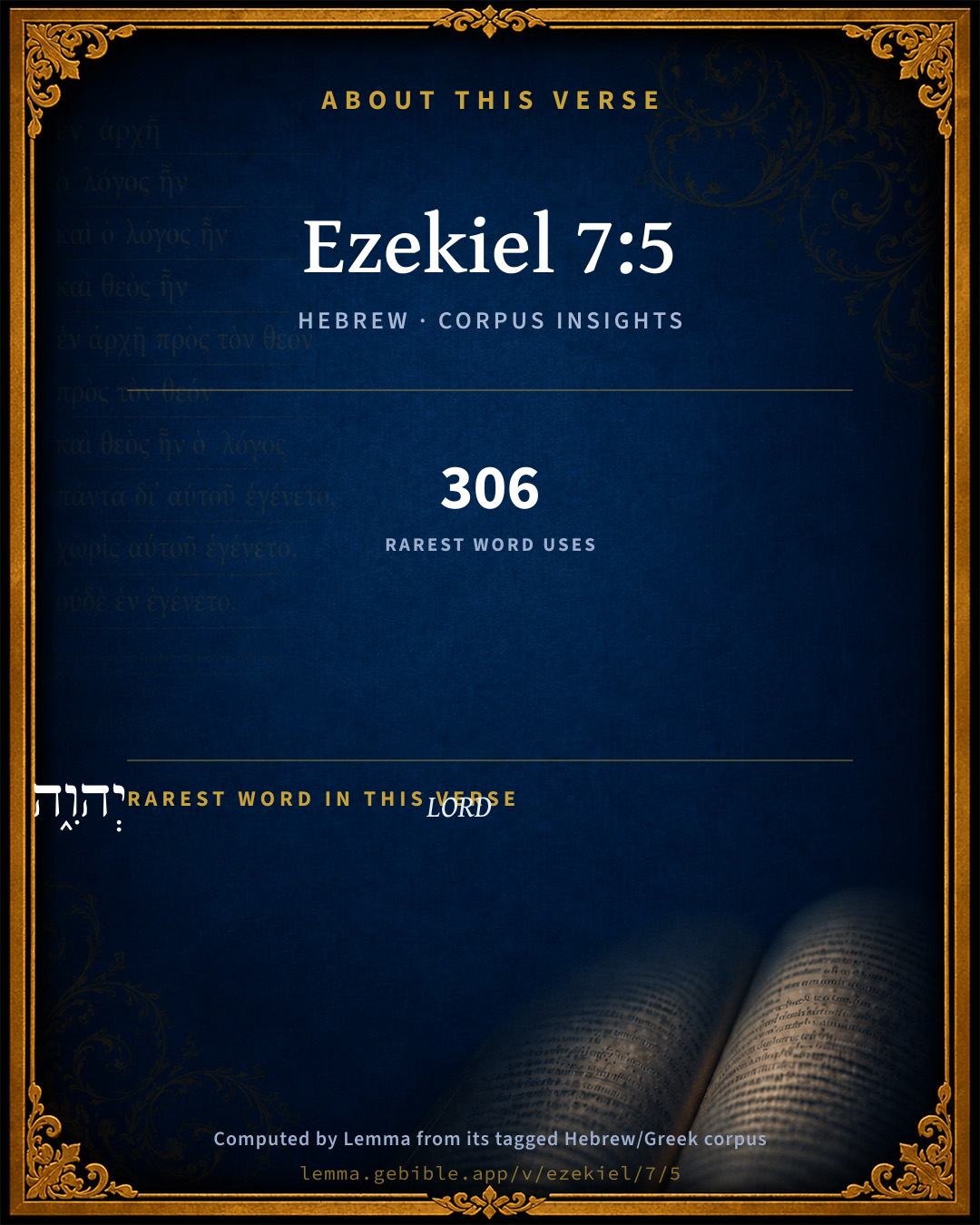
These counts appear in no published source. They are computed here, from the morphology-tagged text and Lemma’s own curated glosses. What Lemma adds →

9
words
8
distinct lemmas
Prophets
section

Grammatical profile

  • 2 verbs
  • 4 nouns
  • 1 adjective
  • 1 adverb
  • 1 particle

Verb forms

  • אָמַ֖ר Qal · Perfect
  • בָאָֽה Qal · Participle Active

Repetition

A word recurs within this verse — often emphatic in Hebrew:

  • רָעָ֛ה evil H7451 ×2

Hebrew & Septuagint length

In English translation the verse runs 13 words from the Hebrew and 35 from the Septuagint (LXX English) — the Septuagint runs noticeably longer here. See the side-by-side →

A rough comparison of the two English renderings, which tokenize alike — not a word-level alignment.

Word counts can differ between the Hebrew and the Greek without any difference in meaning — e.g. the Hebrew direct-object marker אֵת has no separate Greek word, and Greek often adds the article ὁ.

Cross-references

6

Topical passages linked to Ezekiel 7:5 in the Treasury of Scripture Knowledge — connected by theme and wording, ordered by reader-vote popularity; previews shown in the World English Bible.

  • 2 Kings 21:12–13 therefore thus says Yahweh, the God of Israel, Behold, I bring such evil on Jerusalem and Judah, that whoever hears of it, both his ears shall tingle.
  • Ezekiel 5:9 I will do in you that which I have not done, and whereunto I will not do any more the like, because of all your abominations.
  • Nahum 1:9 What do you plot against Yahweh? He will make a full end. Affliction won't rise up the second time.
  • Daniel 9:12 He has confirmed his words, which he spoke against us, and against our judges who judged us, by bringing on us a great evil; for under the whole sky has not been done as has been done on Jerusalem.
  • Amos 3:2 "You only have I chosen of all the families of the earth. Therefore I will punish you for all of your sins."
  • Matthew 24:21 for then there will be great oppression, such as has not been from the beginning of the world until now, no, nor ever will be.

Cross-references courtesy of OpenBible.info (CC BY 4.0).

Hebrew and Greek witnesses Masoretic Hebrew ↔ Greek Septuagint

The same verse in the two great witnesses to the Old Testament, shown verse-for-verse.

Here the Septuagint runs noticeably longer than the Hebrew — LXX2012 (modern English Septuagint) 35 words vs World English Bible 13. A rough length comparison of the two English translations, not a word-level alignment — read both below.

These are two independent witnesses, not word-aligned to each other, and the Septuagint is shown in lemma (dictionary) form.

Hebrew Ezekiel 7:5 Masoretic · Westminster Leningrad Codex

כֹּ֥ה אָמַ֖ר אֲדֹנָ֣י יְהוִ֑ה רָעָ֛ה אַחַ֥ת רָעָ֖ה הִנֵּ֥ה בָאָֽה

Thus says the Lord Yahweh: An evil, an only evil; behold, it comes.

World English Bible · Public Domain

Greek LXX Ezekiel 7:5 Septuagint · lemma form

νῦν ἐγγύθεν ἐκχέω ὁ ὀργή ἐγώ ἐπί σύ καί συντελέω ὁ θυμός ἐγώ ἐν σύ καί κρίνω σύ ἐν ὁ ὁδός σύ καί δίδωμι ἐπί σύ πᾶς ὁ βδέλυγμα σύ

Now I will pour out my anger upon you near at hand, and I will accomplish my wrath on you: and I will judge you for your ways, and recompense upon you all your abominations.

LXX2012 (modern English Septuagint) · Public Domain

Hebrew: Westminster Leningrad Codex (CC BY 4.0). Greek: Septuagint (public domain); English from LXX2012 (modern English Septuagint) (Public Domain). How the Septuagint differs from the Hebrew →

Targum (Aramaic paraphrase)

1

The Targum is the ancient Jewish Aramaic paraphrase of the Hebrew Scriptures — an interpretive translation, not the Hebrew text itself. Onkelos (literal) and Pseudo-Jonathan (expansive) render the Torah, and Jonathan the Prophets. Coverage is partial: where no permissively-licensed English translation exists for a verse, only the Aramaic is shown. This is verse-level text, not a word-by-word alignment to the Hebrew.

  1. Targum Jonathan Prophets (Joshua–Malachi)
    כִּדְנַן אֲמַר יְיָ אֱלֹהִים בִּישְׁתָא בָּתַר בִּישְׁתָא הָא אַתְיָא:

    (no public-domain English translation for this verse)

    Targum Jonathan — Aramaic: “Mikraot Gedolot” (public domain). English: “Sefaria Community Translation” (CC0 1.0 (public-domain dedication)); “London "Chaldee Paraphrase," 1871” (public domain). Text via Sefaria.

Commentary

Notes on Ezekiel 7:5 from classic Christian and Jewish commentators (each source and its license shown beneath its notes). The classic Christian expositions comment on the surrounding passage and are grouped to its opening verse, so a note may address several verses; the Jewish commentaries on the Tanakh (Rashi and others) are per-verse, so they appear only where the commentator wrote on this verse.

Lemma curates 59 commentaries, every one of them public domain or Creative Commons licensed, each selected and text-cleaned for this edition rather than reprinted as found. About our sources →

Joseph Benson's Commentary

Eze 7:5-7. Thus saith the Lord, An evil, an only evil — A sore affliction, a singular and uncommon one. An end is come — A destruction, which shall be fatal to a great part of those that go into captivity, as well as to those who are consumed in their own country. It is quite prepared to rush upon thee. Observe, reader, when the end is come upon the ungodly, then an only evil comes upon them. The sorest of temporal judgments have their allays; but the torments of the damned are an evil, an only evil. The morning is come upon thee — “God’s judgments shall overtake thee speedily and unexpectedly. The expression alludes to the time when magistrates use to give sentence against offenders, which was in the morning.” The time is come — The time of God’s vengeance, called elsewhere the day of the Lord. And not the sounding again of the mountains — The sound of war and slaughter, and not such a joyful sound as used to echo from the mountains, by which the treaders of grapes expressed their satisfaction at the time of the vintage: which the word הר, here used, properly signifies. Or, not a mere echo, not a fancy, but a real noise arising from the approach of the Chaldean army.

Joseph Benson's Commentary on the Old and New Testaments (1811–1818) — public domain. Text from a community e-Sword module.

Keil & Delitzsch

C. F. Keil & F. Delitzsch

The execution of the judgment announced in Eze 7:2-4, arranged in four strophes: Eze 7:5-9, Eze 7:10-14, Eze 7:15-22, Eze 7:23-27. - The first strophe depicts the end as a terrible calamity, and as near at hand. Eze 7:3 and Eze 7:4 are repeated as a refrain in Eze 7:8 and Eze 7:9, with slight modifications. Eze 7:5. Thus saith the Lord Jehovah: Misfortune, a singular misfortune, behold, it cometh. Eze 7:6. End cometh: there cometh the end; it waketh upon thee; behold, it cometh. Eze 7:7. The fate cometh upon thee, inhabitants of the land: the time cometh, the day is near; tumult and not joy upon the mountains. Eze 7:8. Now speedily will I pour out my fury upon thee, and accomplish mine anger on thee; and judge thee according to thy ways, and bring upon thee all thine abominations. Eze 7:9. My eye shall not look with pity upon thee, and I shall not spare; according to thy ways will I bring it upon thee, and thy abominations shall be in the midst of thee, that ye may know that I, Jehovah, am smiting. - Misfortune of a singular kind shall come. רעה is made more emphatic by אחת רעה, in which אחת is placed first for the sake of emphasis, in the sense of unicus, singularis; a calamity singular (unique) of its kind, such as never had occurred before (cf. Eze 5:9). In Eze 7:6 the poetical הקיץ, it (the end) waketh upon thee, is suggested by the paronomasia with הקּץ. The force of the words is weakened by supplying Jehovah as the subject to הקיץ, in opposition to the context. And it will not do to supply רעה (evil) from Eze 7:5 as the subject to הנּה באה (behold, it cometh). באה is construed impersonally: It cometh, namely, every dreadful thing which the end brings with it. The meaning of tzephirâh is doubtful. The only other passage in which it occurs is Isa 28:5, where it is used in the sense of diadem or crown, which is altogether unsuitable here. Raschi has therefore had recourse to the Syriac and Chaldee צפרא, aurora, tempus matutinum, and Hvernick has explained it accordingly, "the dawn of an evil day." But the dawn is never used as a symbol or omen of misfortune, not even in Joe 2:2, but solely as the sign of the bursting forth of light or of salvation. Abarbanel was on the right track when he started from the radical meaning of צפר, to twist, and taking tzephirâh in the sense of orbis, ordo, or periodical return, understood it as probably denoting rerum fatique vicissitudinem in orbem redeuntem (Ges. Thes. p. 1188). But it has been justly observed, that the rendering succession, or periodical return, can only give a forced sense in Eze 7:10. Winer has given a better rendering, viz., fatum, malum fatale, fate or destiny, for which he refers to the Arabic tsabramun, intortum, then fatum haud mutandum inevitabile. Different explanations have also been given of הד הרים. But the opinion that it is synonymous with הידד, the joyous vintage cry (Jer 25:30; Isa 16:10), is a more probable one than that it is an unusual form of הוד, splendor, gloria. So much at any rate is obvious from the context, that the hapax legomenon dh̀ is the antithesis of מהוּמה, tumult, or the noise of war. The shouting of the mountains, is shouting, a rejoicing upon the mountains. מקּרוב, from the immediate vicinity, in a temporal not a local sense, as in Deu 32:17 (= immediately). For כּלּה , see Eze 6:1-14;12. The remainder of the strophe (Eze 7:8 and Eze 7:9) is a repetition of Eze 7:3 and Eze 7:4; but מכּה is added in the last clause. They shall learn that it is Jehovah who smites. This thought is expanded in the following strophe.

Keil & Delitzsch — Biblical Commentary on the Old Testament (1861–1891) — public domain (CC PDM 1.0). Text via the HelloAO Bible API. (Old Testament only.)

Tyndale Open Study Notes

Tyndale Open Resources

7:5-9 A second message reiterates the personal nature of the coming judgment. The people would not simply know that God is the Lord, as in 7:4. The Lord, who once showed himself to his people as “the Lord who heals you” (Exod 15:26), had now become “the Lord who strikes you.” The day of the Lord had come (Joel 1:15; Amos 5:18-20).

Tyndale Open Study Notes — © Tyndale Open Resources, licensed CC BY-SA 4.0. Text via the HelloAO Bible API.

Geneva Bible (1599)

Geneva Bible translators

Or, behold, evil cometh after evil.

Geneva Bible (1599) marginal notes — public domain. Text via Bolls.life.

Jamieson, Fausset & Brown

Robert Jamieson, A. R. Fausset & David Brown

An evil, an only evil--a peculiar calamity such as was never before; unparalleled. The abruptness of the style and the repetitions express the agitation of the prophet's mind in foreseeing these calamities.

Jamieson, Fausset & Brown — Commentary Critical and Explanatory on the Whole Bible (1871) — public domain (CC PDM 1.0). Text via the HelloAO Bible API.

Adam Clarke's Commentary

Verse 5. An evil, an only evil] The great, the sovereign, the last exterminating evil, is come: the sword, the pestilence, the famine, and the captivity. Many MSS. read אחר achar, after. So evil cometh after evil; one instantly succeeds another.

Adam Clarke's Commentary on the Bible (1810–1826) — public domain. Text from a community e-Sword/MySword module.

John Calvin's Commentaries

If we read אחת, acheth, or אחר, acher, the sense seems to me the same, an evil, another evil is come: that is, one evil is come from another, or one evil is come and an evil: that is, when one evil is come another will soon follow. Some explain it in way which seems to me harsh and unsatisfactory: one evil is come; this is so severe that at its first impulse it suffices for complete slaughter, so subtilely do they explain it. But it seems to me that the sense of the Prophet flows best thus, one evil shall come upon another — that is, there will be no cessation in God’s heaping evils upon evils until the very name of the whole people shall become extinct. And this appears to me to be said, that the Israelites should not after their manner suppose themselves safe, if God gives them a short respite. For when a slight intermission happens, the impious erect their crests, and keep up their spirits, and think that God is at peace with them. Since, therefore, any intermission is taken by hypocrites, as if they had made their peace with God, therefore the Prophet says, one evil shall come upon another It follow —

John Calvin's Commentaries (1540-1563) — public domain. Text from the Calvin Translation Society English edition (1840s-50s) via the Christian Classics Ethereal Library (ccel.org). Calvin's coverage is partial (roughly two-thirds of the Bible); uncommented books and verses are honest gaps, never fabricated. The 19th-century editor's footnotes and remarks are omitted so the notes are faithfully Calvin's own voice.

Ellicott's Commentary for English Readers

(5) An only evil.—That is, an evil so all-embracing as to be complete in itself, and need no repetition. Compare the same thought in Nah_1:9, “affliction shall not rise up the second time.” Some MSS., and the Chaldee, by the alteration of one letter, read “evil after evil,” as in Eze_7:26.

A Bible Commentary for English Readers, edited by Charles John Ellicott (1878–1897) — public domain. Text from a community e-Sword module.

The Cambridge Bible for Schools and Colleges

gen. ed. J. J. S. Perowne

5. an only evil] Lit. one evil, scarcely a “unique” evil, to which there is nothing like, but an evil which is “one” and final, 1Sa_26:8; Hag_2:6, “Yet once, it is a little while, and I will shake the heavens and the earth” (Heb_12:26).

5–7. The dirge takes a fresh turn, announcing in nearly the same words that the end is come upon the inhabitants of the land

The Cambridge Bible for Schools and Colleges (gen. ed. J. J. S. Perowne; Cambridge University Press, 1878–1918) — public domain. Text from a community e-Sword module.

John Gill's Exposition

An end is come, the end is come,.... These words, so often repeated, show the eagerness and concern of the prophet's mind; the speed and haste destruction was making; and the great stupidity of the people, which required such a frequent repetition:

it watcheth for thee; that is, their damnation slumbered not, but was awake, and waited till the time was up, which was just at hand, for it to take place; see Pe2 2:3;

behold, it is come; either the end, or rather the evil before mentioned; it was just at the door; it denotes the certainty of it, and its near approach.

John Gill's Exposition of the Whole Bible (1746–1763) — public domain (CC PDM 1.0). Text via the HelloAO Bible API.

Albert Barnes' Notes on the Bible

An only evil - An evil singular and remarkable above all others.

Albert Barnes' Notes on the Bible (1834–1885) — public domain. Text from a community e-Sword/MySword module.

Haydock's Catholic Bible Commentary

One. A second shall not be necessary, Nahum i. 9. (Calmet)

George Leo Haydock (1774–1849), Haydock's Catholic Family Bible and Commentary, 1859 edition — public domain. Excludes Psalms (Douay-Rheims chapter numbering differs from Protestant) and Deuterocanonical books (Catholic canon only).

Matthew Poole's English Annotations

An evil and sore affliction, one misery enough to ruin the whole, so that there will be no need of another. Or, as the Chaldee paraphrase, one evil after another; and this bespeaks the extreme sadness of their condition who suffer under this evil. Open your eyes, you will see it is at the doors and breaking in upon you.

Matthew Poole's English Annotations on the Holy Bible (1683–1685) — public domain. Text from a community e-Sword/MySword module.

Whedon's Commentary on the Bible

Daniel D. Whedon

5. An only evil — Literally, one evil. The final evil (1Sa_26:8; Hag_2:6).

Daniel D. Whedon (gen. ed.), Commentary on the Old and New Testaments (1874–1909) — public domain. Text from a community e-Sword module.

The Pulpit Commentary

An evil, an only evil, etc. The words imply that the evil would be unique in character, attracting men"s notice, not needing repetition. Cornill, however, following Luther, gives "evil after evil," changing one letter m the Hebrew for "one," so as to get the word "after." For is come read, with the Revised Version, it cometh. It is the nearness, not the actual arrival, of the end, that is in the prophet"s thoughts. He writes in B.C. 595. Jerusalem was not taken till s.c. 588.

Vers. 5-11. Aspects of the execution of the Divine judgments.

saith the Lord God; An evil, an only evil, behold, is come. An end is come," etc. Nearly everything contained in these verses we have already noticed in previous paragraphs. Vers. 8 and 9 are almost a literal repetition of vers. 3 and 4, which came under consideration in our preceding homily. But certain aspects of the execution of the Divine judgment are here set forth which we have not hitherto contemplated. We shall confine our attention to a brief consideration of these.

I THE DELIBERATION WITH WHICH THE EXECUTION OF THE DIVINE JUDGMENTS IS PREPARED. "The rod hath blossomed, pride hath budded. Violence is risen up into a rod of wickedness." The rod is the emblem of power to execute the judgment; and pride, of disposition to execute it. Nebuchadnezzar the Chaldean monarch is thus indicated. And the text suggests that his power had long been in preparation for the stern work which he was about to do, and that now it was in readiness for it, like a rod which has been planted, taken root, and grown into vigorous development. "It illustrates," says Kitto, "the Lord"s deliberateness in executing his judgments, as contrasted with man"s haste, impatience, and precipitancy. Man, so liable to err in judgment and action and to whom, slow deliberation in inflicting punishment upon transgressors might seem naturally to result from his own consciousness of weakness, is in haste to judge and prompt to act; whereas he who cannot err, and whose immediate action must be as true and right as his most delayed procedure, works not after the common manner of men, but after the manner of a husbandman in sowing and planting. When the sin comes to that state, which must in the end render judgment needful for the maintenance of righteousness upon the earth, and for the vindication of the Lord"s justice and honour, the rod of punishment is planted; it grows as the sin grows; and it attains its maturity for action at the exact time that the iniquity reaches maturity for punishment. When Israel entered upon that course of sin which ended in ruin, the rod of the Babylonian power was planted; and as the iniquities of Israel increased, the rod went on growing, until, under Nebuchadnezzar, it became a great tree, overshadowing the nations; and when the full term was come, it was ripe and ready for the infliction upon Israel of the judgments which had so often been denounced, and were so greatly needed" ("Daily Bible Illustrations"). This principle of the Divine action in human history may be traced in the relation of the Israelites to the ancient Canaanites. And in the Babylonian power it receives twofold illustration. One of these we have in the text, where Babylon is the rod of judgment for Israel. And afterwards Babylon itself was smitten by the rod of the Medo-Persian power, which had been gradually growing into maturity and strength. And the same principle is in operation today in relation both to nations and to individuals. If by either sin be persisted in, the rod of God"s judgment for that sin will be planted, and when it has grown into power, God will sorely smite the nation or the individual with it. What the poet says of nature we may say of God.

Nature has her laws That will not brook infringement; in all time, All circumstance, all state, in every clime, She holds aloft the same avenging sword, And, sitting on her boundless throne sublime, The vials of her wrath, with justice stored, Shall, in her own good hour, on all that"s ill be poured (J.G. Percival. )

II THE SUDDENNESS WITH WHICH THE EXECUTION OF THE DIVINE JUDGMENTS TAKES PLACE. "An end is come, the end is come: it watcheth for thee; behold, it is come." Instead of "it watcheth for thee," the Hebrew is, as in the margin, "it awaketh against thee." The end which had long seemed to sleep, now awakes and comes; it comes in sharp judgments. "The repetition indicates the certainty, the greatness, and the swiftness" of the approaching end. The judgment which had so long and frequently been announced to Israel, would come upon them at last suddenly and unexpectedly. That which seemed to sleep, awakes, arises, and draws near, to their confusion and dismay. How often do the judgments of God come unexpectedly, and with a great shock of surprise! Thus came the Deluge upon the old world, and the fiery flood upon the cities of the plain. (Mat_24:38, Mat_24:39; Luk_17:26-29) Thus came the awful summons to the fool in the midst of his temporal prosperity and spiritual destitution. (Luk_12:16-20) And so will come the last, the great day of judgment. "The day of the Lord will come as a thief in the night," etc.. (2Pe_3:10) Although the wicked may persuade themselves that the Divine retribution lingers and slumbers, it is ever awake and active, and, unless they repent, it shall come upon them in "swift destruction.

III THE TRANSFORMATION WHICH THE EXECUTION OF THE DIVINE JUDGMENTS PRODUCES. "The time is come, the day of trouble is near, and not the sounding again of the mountains." Schroder translates more correctly, "The day is near, tumult, and not joyous shouting upon the mountains." Upon some of their hills the Israelites planted vines, and in the time of the gathering of the vintage the labourers made the hills to echo with shouts and songs of gladness. (cf. Isa_16:10) Perhapsthe prophet refers to this in the text. Or the reference may be to the altars which were upon the mountains (Eze_6:3, Eze_6:13; Jer_3:21, Jer_3:23) and from which the shouts and songs of revelling worshippers echoed far and wide. And instead of these shouts of joy there should arise the wild tumult of war, and the lamentable cries of the distressed, imploring succour or seeking deliverance. Terrible are the transformations wrought by the judgments of the Most High. The selfish rich man passed from his luxurious home, his purple and fine linen, and his sumptuous fare, "and in Hades he lifted up his eyes, being in torments," and was unable to obtain even a drop of water to cool his patched tongue. Blessed are they who, through repentance and faith in the Lord Jesus Christ, are delivered from condemnation, and made heirs of eternal life. W.J.

The Pulpit Commentary (1880–1919), ed. H.D.M. Spence-Jones & Joseph S. Exell — public domain. Text from a community e-Sword module.

John Wesley's Explanatory Notes

An evil - An evil and sore affliction, a singular, uncommon one.

John Wesley, Explanatory Notes Upon the Whole Bible (1754–1765) — public domain. Text via the GEBible commentary corpus.

unfoldingWord translationNotes

Door43 World Missions Community

General Information:

These are Yahweh's words to the people of Israel.

The Lord Yahweh says this

Yahweh speaks of himself by name to remind Ezekiel and the people that what he is saying is important. See how you translated this in Ezekiel 6:11. AT: "I, the Lord Yahweh, say this" (See: First, Second, or Third Person)

Lord Yahweh

See how you translated this in Ezekiel 2:4.

Disaster! A unique disaster! Behold, it is coming.

These exclamations are meant to make the passage very strong. AT: "Behold, a terrible disaster is coming, one that no one has ever experienced before"

Behold, it

"You can be absolutely sure that it"

The end has woken up against you

The judgment that is coming is treated as if it were an enemy waking up from sleep. (See: Personification)

the mountains will no longer be joyful

The word "mountains" is a metonym for the people who live on the mountains. AT: "the people on the mountains will not have any more joy" (See: Metonymy)

translationWords

Lord Yahweh

doom

joy

unfoldingWord translationNotes — © Distant Shores Media and the Door43 World Missions Community, licensed CC BY-SA 4.0. Source: git.door43.org/Door43/en_tn.

Rashi

Rabbi Shlomo Yitzchaki (Rashi)

An evil, a singular evil Heb. רָעָה אַחַתרָעָה, a total, special evil, worse than all evils; that is the destruction of the Temple.

behold it comes Heb. בָאָה. Its accent is on the ‘aleph.’ It is in the present tense.

Rashi on the Tanakh — English translations: “The Judaica Press complete Tanach with Rashi, translated by A. J. Rosenberg” (CC BY 4.0); “Pentateuch with Rashi's commentary by M. Rosenbaum and A.M. Silbermann, 1929-1934” (public domain); “The Metsudah Tanach series, Lakewood, N.J” (CC BY 4.0); and “The Book of Joshua, Metsudah Publications, 1997” (CC BY 4.0). Text via Sefaria.

Lesson kit

Teaching starters — assembled from the data on this page, not authored interpretation. Every prompt links to the verse data it draws on. Edit before teaching.

Ezekiel, in the Prophets, opens this verse with 9 words (8 distinct Hebrew lemmas). Its most distinctive word is Yᵉhôvih (“LORD”). The Greek Septuagint runs longer here. A historical commentator’s framing appears above. Read the whole chapter for the surrounding context.

Discussion questions

  1. What does “LORD” (Yᵉhôvih) contribute to the verse as a whole?
  2. How does 2 Kings 21:12–13, which shares this passage’s theme, read alongside this verse?
  3. What does the repetition of “evil” (2× in this one verse) do in this verse?
  4. The Septuagint runs longer here than the Hebrew. What might account for the difference?
  5. These translations render this verse differently. What is at stake in choosing one wording over another?
  6. «אָמַ֖ר» is a Qal Perfect verb. How does that grammatical form shape the action described?
  7. Compare how Joseph Benson's Commentary and Keil & Delitzsch read this verse. Where do they agree or differ?

Things to notice

Reading settings

Reading text

Shown beneath each verse's original-language words.

Old Testament
Old Testament edition

Read the OT as the Masoretic Hebrew (MT) or the Greek Septuagint (LXX).

English shown for the Greek Septuagint (in the Hebrew ↔ Greek comparison).

Comparing translations? Open the Compare panel on any verse page to stack up to four side by side.