

Daniel 9:17

Hebrew (Westminster Leningrad Codex) Daniel 9:17 appears in the Hebrew Old Testament. The text above is from the Westminster Leningrad Codex. Each word links to its Strong’s number, a concise gloss, and parsing drawn from the Open Scriptures Hebrew Bible morphology. Click any word for its full Brown-Driver-Briggs (BDB) entry.
Download image
Cite this verse

Daniel 9:17 (World English Bible). Public Domain. Lemma interlinear Bible study tool, https://lemma.gebible.app/v/daniel/9/17.

Show BibTeX & RIS
BibTeX
RIS
English Translation
Now therefore, our God, listen to the prayer of your servant, and to his petitions, and cause your face to shine on your sanctuary that is desolate, for the Lord's sake.
World English Bible · Public Domain
Download a study sheet

One document with this verse’s original text, its word-by-word gloss line, the meaning frame, cross-references with their text, attributed commentary, and full source and license credits — printable, and it pastes into notes with its structure intact.

This verse Autodidact and up

Study sheet (.html) Plain text (.txt)

A passage Seminary Student

Up to 50 verses in one chapter. A passage sheet keeps up to 6 commentary sources and 12 cross-references per verse, in the order this page ranks them, and says so on the sheet whenever that leaves anything out. Ask for a single verse and you get the Autodidact verse sheet above.

Everything on this page stays free to read, with no account — the sheet is a download of what is already on screen, not access to it.

Want to remove ads? Support Godless Engineer
Compare translations 3

The same verse in 3 English versions, stacked beneath the original-language interlinear above. Click any original word for its lexicon entry.

Each is an independent rendering of the whole verse — the interlinear is not word-aligned to these translations.

Highlighted words mark where these versions differ — a whole-verse word diff, not a word-by-word alignment.

  • World English Bible Public Domain
    Now therefore, our God, listen to the prayer of your servant, and to his petitions, and cause your face to shine on your sanctuary that is desolate, for the Lord's sake.
  • King James Version Public Domain
    Now therefore, O our God, hear the prayer of thy servant, and his supplications, and cause thy face to shine upon thy sanctuary that is desolate, for the Lord's sake.
  • unfoldingWord Literal Text CC BY-SA 4.0
    So now, our God, listen to the prayer of your servant and to his pleas for mercy; for your sake, O Lord, make your face shine on your desolate sanctuary.

unfoldingWord Literal Text — © unfoldingWord, licensed CC BY-SA 4.0. Word-aligned USFM3 via Door43 (git.door43.org/unfoldingWord/en_ult).

Versions to compare (up to 4)

3 of 4 selected

Show all 18 translations

Every available English version of this verse, each an independent rendering of the whole verse.

  • World English Bible Public Domain
    Now therefore, our God, listen to the prayer of your servant, and to his petitions, and cause your face to shine on your sanctuary that is desolate, for the Lord's sake.
  • Berean Standard Bible Public Domain
    So now, our God, hear the prayers and petitions of Your servant. For Your sake, O Lord, cause Your face to shine upon Your desolate sanctuary.
  • Majority Standard Bible Public Domain
    So now, our God, hear the prayers and petitions of Your servant. For Your sake, O Lord, cause Your face to shine upon Your desolate sanctuary.
  • King James Version Public Domain
    Now therefore, O our God, hear the prayer of thy servant, and his supplications, and cause thy face to shine upon thy sanctuary that is desolate, for the Lord's sake.
  • American Standard Version (1901) Public Domain
    Now therefore, O our God, hearken unto the prayer of thy servant, and to his supplications, and cause thy face to shine upon thy sanctuary that is desolate, for the Lord's sake.
  • Revised Version (1885) Public Domain
    Now therefore, O our God, hearken unto the prayer of thy servant, and to his supplications, and cause thy face to shine upon thy sanctuary that is desolate, for the Lord’s sake.
  • Geneva Bible (1599) Public Domain
    Nowe therefore, O our God, heare the prayer of thy serunant, and his supplications, and cause thy face to shine vpon thy Sanctuarie, that lyeth waste for the Lords sake.
  • Douay-Rheims (1899) Public Domain
    Now therefore, O our God, hear the supplication of thy servant, and his prayers: and shew thy face upon thy sanctuary which is desolate, for thy own sake.
  • Young's Literal Translation Public Domain
    and now, hearken, O our God, unto the prayer of Thy servant, and unto his supplication, and cause Thy face to shine on Thy sanctuary that `is' desolate, for the Lord's sake.
  • Literal Standard Version CC BY-SA 4.0
    and now, listen, O our God, to the prayer of Your servant, and to his supplication, and cause Your face to shine on Your sanctuary that [is] desolate, for the Lord’s sake.
  • Unlocked Literal Bible CC BY-SA 4.0
    Now, our God, listen to the prayer of your servant and to his pleas for mercy; for your sake, Lord, make your face shine on your sanctuary that is desolate.
  • unfoldingWord Literal Text CC BY-SA 4.0
    So now, our God, listen to the prayer of your servant and to his pleas for mercy; for your sake, O Lord, make your face shine on your desolate sanctuary.
  • Darby Bible Public Domain
    And now, our God, hearken to the prayer of thy servant, and to his supplications, and cause thy face to shine upon thy sanctuary that is desolate, for the Lord's sake.
  • World Messianic Bible Public Domain
    “Now therefore, our God, listen to the prayer of your servant and to his petitions, and cause your face to shine on your sanctuary that is desolate, for the Lord’s sake.
  • Webster's Bible Public Domain
    Now therefore, O our God, hear the prayer of thy servant, and his supplications, and cause thy face to shine upon thy sanctuary that is desolate, for the Lord's sake.
  • Free Bible Version CC BY-SA 4.0
    Now, our Lord, please listen to the prayer and pleading of your servant, and for your own sake look kindly on your abandoned sanctuary.
  • Bible in Basic English Public Domain
    And now, give ear, O our God, to the prayer of your servant and to his request for grace, and let your face be shining on your holy place which is made waste, because of your servants, O Lord.
  • JPS Tanakh (1917) Public Domain
    Now therefore, O our God, hearken unto the prayer of Thy servant, and to his supplications, and cause Thy face to shine upon Thy sanctuary that is desolate, for the Lord's sake.

Literal Standard Version (2020), Covenant Press — licensed CC BY-SA 4.0. Text via the HelloAO Bible API (eBible.org). Unlocked Literal Bible (unfoldingWord) — licensed CC BY-SA 4.0. Text via the HelloAO Bible API (eBible.org). unfoldingWord Literal Text — © unfoldingWord, licensed CC BY-SA 4.0. Word-aligned USFM3 via Door43 (git.door43.org/unfoldingWord/en_ult). Free Bible Version, Dr. Jonathan Gallagher — licensed CC BY-SA 4.0. Text via the HelloAO Bible API (eBible.org).

Word by word

More ways to search: Search by grammar → Find every occurrence → Compare this word →

Practice this passage: Drill this verse → Learn its vocabulary →

הַשָּׁמֵ֑ם
shâmêm
H8076
“the · desolate”
Particle, Definite Article + Adjective, Adjective, Masculine, Singular, Absolute
Part of Speech
Particle + Adjective
Type
Adjective
Gender
Masculine
Number
Singular
State
Absolute
Full BDB Definition

Origin: from H8074

TWOT: 2409a

devastated, deserted, desolate
  1. וְעַתָּ֣ה ʻattâh H6258 “and · now” Conjunction + Adverb
  2. שְׁמַ֣ע shâmaʻ H8085 “hear” Verb, Qal, Imperative, 2nd Person, Masculine, Singular
  3. אֱלֹהֵ֗ינוּ ʼĕlôhîym H430 “God(s) · our” Noun, Common, Masculine, Plural, Construct + Suffix, Personal, 1st Person, Common, Plural
  4. אֶל ʼêl H413 “to” Preposition
  5. תְּפִלַּ֤ת tᵉphillâh H8605 “prayer of” Noun, Common, Feminine, Singular, Construct
  6. עַבְדְּךָ֙ ʻebed H5650 “servant · your” Noun, Common, Masculine, Singular, Construct + Suffix, Personal, 2nd Person, Masculine, Singular
  7. וְאֶל ʼêl H413 “and · to” Conjunction + Preposition
  8. תַּ֣חֲנוּנָ֔יו tachănûwn H8469 “supplications · his” Noun, Common, Masculine, Plural, Construct + Suffix, Personal, 3rd Person, Masculine, Singular
  9. וְהָאֵ֣ר ʼôwr H215 “and · shine” Conjunction + Verb, Hiphil, Imperative, 2nd Person, Masculine, Singular
  10. פָּנֶ֔יךָ pânîym H6440 “face(s) · your” Noun, Common, Both, Plural, Construct + Suffix, Personal, 2nd Person, Masculine, Singular
  11. עַל ʻal H5921 “upon” Preposition
  12. מִקְדָּשְׁךָ֖ miqdâsh H4720 “sanctuary · your” Noun, Common, Masculine, Singular, Construct + Suffix, Personal, 2nd Person, Masculine, Singular
  13. לְמַ֖עַן maʻan H4616 “for the sake of” Preposition
  14. אֲדֹנָֽי ʼĂdônây H136 “Lord · my” Noun, Common, Masculine, Plural, Construct + Suffix, Personal, 1st Person, Common, Singular

About this verse

These counts appear in no published source. They are computed here, from the morphology-tagged text and Lemma’s own curated glosses. What Lemma adds →

15
words
14
distinct lemmas
Prophets
section

Notable vocabulary

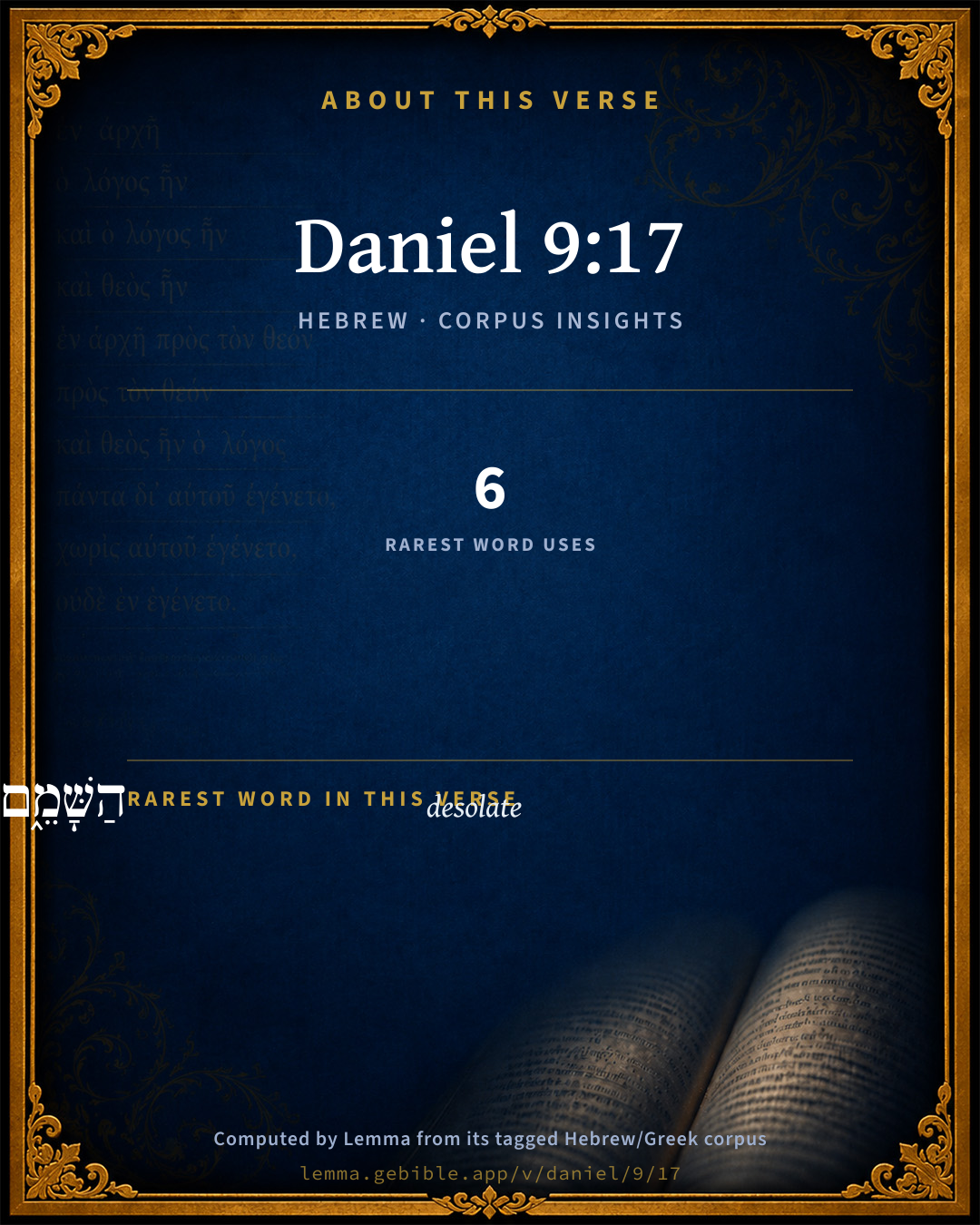
The rarest word here is הַשָּׁמֵ֑ם desolate H8076 — appearing just 6 times in the whole Hebrew Bible.

Shared distinctive vocabulary

הַשָּׁמֵ֑ם desolate H8076 occurs in 6 verses of the Hebrew Bible. Also found in:

Grammatical profile

  • 2 verbs
  • 7 nouns
  • 1 adjective
  • 4 prepositions
  • 1 adverb

Verb forms

  • שְׁמַ֣ע Qal · Imperative
  • וְהָאֵ֣ר Hiphil · Imperative

Repetition

A word recurs within this verse — often emphatic in Hebrew:

  • אֶל to H413 ×2

Hebrew & Septuagint length

In English translation the verse runs 31 words from the Hebrew and 32 from the Septuagint (LXX English) — closely comparable.

A rough comparison of the two English renderings, which tokenize alike — not a word-level alignment.

Word counts can differ between the Hebrew and the Greek without any difference in meaning — e.g. the Hebrew direct-object marker אֵת has no separate Greek word, and Greek often adds the article ὁ.

Cross-references

13

Topical passages linked to Daniel 9:17 in the Treasury of Scripture Knowledge — connected by theme and wording, ordered by reader-vote popularity; previews shown in the World English Bible.

  • Psalms 80:19 Turn us again, Yahweh God of hosts. Cause your face to shine, and we will be saved.
  • Lamentations 5:18 For the mountain of Zion, which is desolate: The foxes walk on it.
  • Psalms 80:3 Turn us again, God. Cause your face to shine, And we will be saved.
  • Psalms 80:7 Turn us again, God of hosts. Cause your face to shine, And we will be saved.
  • 2 Corinthians 1:20 For however many are the promises of God, in him is the "Yes." Therefore also through him is the "Amen," to the glory of God through us.
  • Numbers 6:23–26 "Speak to Aaron and to his sons, saying, 'This is how you shall bless the children of Israel.' You shall tell them,
  • Psalms 4:6 Many say, "Who will show us any good?" Yahweh, let the light of your face shine on us.
  • Psalms 67:1 May God be merciful to us, bless us, And cause his face to shine on us. Selah.
  • Psalms 80:1 Hear us, Shepherd of Israel, You who lead Joseph like a flock, You who sit above the cherubim, shine forth.
  • Psalms 119:135 Make your face shine on your servant. Teach me your statutes.
  • Daniel 9:19 Lord, hear; Lord, forgive; Lord, listen and do; don't defer, for your own sake, my God, because your city and your people are called by your name.
  • John 16:24 Until now, you have asked nothing in my name. Ask, and you will receive, that your joy may be made full.
  • Revelation 21:23 The city has no need for the sun, neither of the moon, to shine, for the very glory of God illuminated it, and its lamp is the Lamb.

Cross-references courtesy of OpenBible.info (CC BY 4.0).

Hebrew and Greek witnesses Masoretic Hebrew ↔ Greek Septuagint

The same verse in the two great witnesses to the Old Testament, shown verse-for-verse.

These are two independent witnesses, not word-aligned to each other, and the Septuagint is shown in lemma (dictionary) form.

Hebrew Daniel 9:17 Masoretic · Westminster Leningrad Codex

וְעַתָּ֣ה שְׁמַ֣ע אֱלֹהֵ֗ינוּ אֶל תְּפִלַּ֤ת עַבְדְּךָ֙ וְאֶל תַּ֣חֲנוּנָ֔יו וְהָאֵ֣ר פָּנֶ֔יךָ עַל מִקְדָּשְׁךָ֖ הַשָּׁמֵ֑ם לְמַ֖עַן אֲדֹנָֽי

Now therefore, our God, listen to the prayer of your servant, and to his petitions, and cause your face to shine on your sanctuary that is desolate, for the Lord's sake.

World English Bible · Public Domain

Greek LXX Daniel 9:17 Septuagint · lemma form

καί νῦν ἐπιἀκούω δεσπότης ὁ προσευχή ὁ παῖς σύ καί ἐπί ὁ δέησις ἐγώ καί ἐπιβλέπω ὁ πρόσωπον σύ ἐπί ὁ ὄρος ὁ ἅγιος σύ ὁ ἔρημος ἕνεκεν ὁ δοῦλος σύ δεσπότης

And now, O lord our God, listen to the prayer of your servant, and his supplications, and cause your face to shine on your desolate sanctuary, for your own sake, O Lord.

LXX2012 (modern English Septuagint) · Public Domain

On this verse, The Cambridge Bible for Schools and Colleges discusses the Septuagint’s reading. Read the note in Commentary ↓

Hebrew: Westminster Leningrad Codex (CC BY 4.0). Greek: Septuagint (public domain); English from LXX2012 (modern English Septuagint) (Public Domain). How the Septuagint differs from the Hebrew →

Commentary

Notes on Daniel 9:17 from classic Christian and Jewish commentators (each source and its license shown beneath its notes). The classic Christian expositions comment on the surrounding passage and are grouped to its opening verse, so a note may address several verses; the Jewish commentaries on the Tanakh (Rashi and others) are per-verse, so they appear only where the commentator wrote on this verse.

Lemma curates 59 commentaries, every one of them public domain or Creative Commons licensed, each selected and text-cleaned for this edition rather than reprinted as found. About our sources →

Trapp's Complete Commentary

John Trapp

Dan 9:17 Now therefore, O our God, hear the prayer of thy servant, and his supplications, and cause thy face to shine upon thy sanctuary that is desolate, for the Lord’s sake.

Ver. 17. Now therefore, O our God.] Since thou hast shown us our sins, and seen our reproach, whereof we are sure thou art very sensible. {Psa 79:4}

Hear the prayer of thy servant.] Who assumeth the boldness to plead his interest in thee, and his relation to thee.

And his supplications.] Which are nothing else but prayers redoubled and reinforced, {as Gen 32:11 Isa 63:16}

And cause thy face to shine upon thy sanctuary.] Do it, oh do it now; for "the time to favour Zion, yea, the set time is come." And this I can tell, because "thy servants take pleasure in her stones, and favour the dust thereof." {Psa 102:13-14; see the notes there} That whole psalm, being "A prayer for the afflicted," may seem ta have been made by this prophet Daniel.

For the Lord’s sake,] i.e., For thine own sake, or for thy Son Christ’s sake, the mediator and advocate of his people: for so he was in the Old Testament also, {Heb 9:15} like as still he is the high priest of the New. And while the people were praying outside, the priest was offering incense within the temple, {Luk 1:9-10} so is Christ interceding for us while we are praying. "Whatsoever therefore ye do in word or deed, do all in the name of the Lord Jesus, giving thanks to God and the Father by him." {Col 3:17}

John Trapp, A Commentary or Exposition upon All the Books of the Old and New Testament (1647–1656) — public domain. Text from a community e-Sword module.

Matthew Poole's English Annotations

1. Here the prophet is most concerned for the sanctuary, and place of worship, a type not only of the church, and the worship of God, but also of Christ; because in all these the Lord is greatly concerned in honour, especially considering,

2. His argument, for the Lord’s sake; for Christ’s sake, the Messiah, who is meant here: which I prove,

1. Because the concurrent testimony of the best interpreters, and the synod of Sardis, is for this interpretation.

2. Because this construction is most agreeable to the text and the Hebrew: the contrary is against it, and forced and figurative, when there is no need of it.

3. The plurality of persons is expressed thus.

4. The word Lord is often attributed to Christ in the Old Testament, Psa 110:1; and in the New Testament, Luk 1:43; 2:11; Joh 20:28; Rev 17:14

5. Because the Jews had none else to trust to for salvation, Joh 14:13; Act 15:11; Eph 3:12; 1Ti 2:5. Thus in the Old Testament, Psa 80:15-17; for the Son’s sake, whom he calls the Son of man, Dan 9:17, for so the Chaldee paraphrase, for the King Messiah. So upon that place, Psa 72:1,

Give the king thy judgments, and thy righteousness to the king’s son, i.e. the King the Messiah. 2Sa 7:21,

For thy word’s sake, i.e. Christ, Joh 1:1; 2Sa 12:25, He called his name Jedidiah, because of the Lord, of whom Solomon was a type.

Matthew Poole's English Annotations on the Holy Bible (1683–1685) — public domain. Text from a community e-Sword/MySword module.

The Biblical Illustrator

Joseph S. Exell

Dan_9:17-19

Cause thy face to shine upon thy sanctuary that is desolate.

The Christians Duty to the Church in the Present Times

I. THE STATE OF THE CHURCH WHEN DANIEL WROTE WAS ONE OF RUIN AND DESOLATION. Jerusalem, the city of God was desolate and without inhabitant, and the temple, which was the dwelling-place of the mysterious glory, was desolate. The whole nation and the whole church had gone into captivity. But does God ever forsake His people, or desert His church? The promise of God, on which the church of Israel was founded, was made to Abraham, and it was an unconditional promise. This promise was strengthened and confirmed by an oath. Such being the promise of God on which the church was founded, it is evident he could not utterly forsake His church. He might, for wise reasons, withdraw His countenance for a season from it. But the undisturbed possession of the land of Canaan, and safety from all their enemies round about them in that land--all these were no part of the original promise to Abraham. They were in a subsequent promise; a conditional promise--a promise on the condition of obedience. Wherever these temporal blessings are alluded to, it is always connected with this condition of obedience. God never suffered His truth or His faithfulness to fail. God sent His people into captivity. They had sinned; they ,were disobedient. God will never forsake His people, but for their sins He will suffer them to lose all their temporal prosperity. Our only remedy against such judgments is that of Daniel--going like him before God, humbling ourselves in His sight, confessing our sins, and asking forgiveness.

II. THE CHARACTER OF THE PRAYER OF THE PROPHET. It is characterised by a deep sense of sin, a most bumble acknowledgment of the sinfulness of the nation and of the church; and although the prayer has general reference to Israel as a nation, it is impossible to read it without feeling that the prophet is also confessing his own sins while he confesses the sins of the people. Here is a spirit of heartfelt penitence, a spirit of confession, a full and ample acknowledgment that all the captivity of the nation, and all the desolation of the church, ware fully and amply deserved. He also acknowledged that Gods dealings had been all foretold and forewarned, and, therefore, the sins were sins against light and knowledge and warning, and thus the judgment of God was consistent with all the justice of God and faithfulness to His own word. In the prophets prayer there is also a spirit of deep humility, deep self-abasement, and at the same time an earnest spirit of pleading with God, that he would spare, and pity, and restore, the church of Israel. And if we plead the righteousness of God as Daniel did, we shall never plead in vain. Ask what you will, it shall be granted . . . There is an impressive lesson to us in connection with the general history of Israel. We ought to think a little of the blessings, and consider a little the sins, of our own nation of England, and our own Church of England. (M. Hobart Seymour, M.A.)

Prayer for the Church

A true-hearted believer does not live for himself. Where there is abundance of grace, and great strength of mind in the service of God, there is sure to be a spirit of unselfishness. No presence of mighty monarch or of his festive guests could turn him aside from delivering his fateful message. Yet Daniel was not satisfied. Whatever might be his own condition, he remembered what Jerusalem was, and what the people to whom he belonged were; and, in the depths of his soul, he sorrowed notwithstanding all that Gods grace had wrought within himself. I firmly believe that, the better a mans own character becomes, and the more joy in the Lord he has in his own heart, the more capable is he of sympathetic sorrow; and, probably, the more of it he will have. Daniel was also a man of many visions. With the exception of John, whom Daniel greatly resembles, it has scarcely fallen to the lot of any man, unless it be Ezekiel, to have so many wondrous visions of God; yet his visions did not make him visionary. There are many persons who could not be trusted to see the tip of an angels wing; for they would become so proud, ever afterwards, that there would be no holding them; but he who is fully consecrated to God may see vision after vision, and he will make a practical use of what he sees, and try to find out something to be done, something to be repented of, something to be prayed for, something that shall be for the good of the Church of God. Daniel had also been studying the prophecies, and he knew, by what he had discovered, when certain predictions would be fulfilled; but he was not, like some students of prophecy in our day, utterly unpractical. They seem to be so taken up with the future that they do nothing in the present. What Daniel learned from the study of the Sacred Books he turned to practical account; and finding that a certain time was near, of which good things were foretold, be set his face toward the Lord, and began to pray--not for himself, but for his people, many of whom were at Jerusalem, hundreds of miles away from him or scattered in various places all over the face of the earth. For them, he used that bright and sparkling eye which had looked up into the fires supernal. Let it never be said that the Church of God has no feeling of patriotism for the Holy City, for the Heavenly Land, and for her glorious King enthroned above. To us, Christian patriotism means love to the Church of God.

I. First, then, Daniel speaks of THE HOLY PLACE: thy sanctuary. Of course, he refers to the temple at Jerusalem, which was then in utter ruin. It had been broken down and burned by the Chaldeans; and Daniel, therefore, rightly calls it desolate, but fervently prays that God would cause His face to shine even upon its ruins. My first remark is, that the temple at Jerusalem was typical of the Church of God. So we learn that, as the temple was typical, so also it was unique. There was but one temple, and there is but one Church. The temple at Jerusalem was, further, the fabric of wisdom. It could only have been built by a Solomon; and Solomon found a band of men, whom God had prepared to carry out the extraordinary work of the temple; for, from its marvellous foundations, which have been lately uncovered, even to its topmost pinnacle, it excelled all the architecture which the world had ever seen. But the Church, which God is erecting, is a far more wonderful work of a wisdom infinitely superior to that of Solomon. When it shall be all finished, it will be the marvel of all intelligences as they see what a matchless sanctuary God, and not man, has reared, and note how, in every single detail, His infinite wisdom is manifest. The temple that Solomon built was also the result of great cost. Immense wealth was lavished upon it; and you do not need that I should try to tell you at what cost the Lord is building up His true sanctuary here among men. The cost of any one of us, if we are indeed living stones, no arithmetic can ever calculate. Again, the temple, of old, was the shrine of Gods indwelling. It was the one place, under the old dispensation of types, now done away with, where God dwelt in visible manifestation amongst his ancient people. We are told that a peculiar light shone between the wings of the cherubim over the ark of the covenant, and from that pillar, which looked like a cloud by day, and flamed like a mighty beacon by night. It was there that men must go, or, at least, to that spot that they must look, if they sought the Lord; and therefore it was that Daniel worshipped and prayed with his windows open towards Jerusalem. At the present time, the one place, in all the world, where God dwells, is His Church. You can find Him anywhere upon the earth as the Creator; but the glory of the Godhead comes out most brilliantly in redemption, for it is of His redeemed people that it is written, I will dwell in them, and walk in them; and I will be their God, and they shall be my people. The temple at Jerusalem was also the place of Gods peculiar worship; and where is God worshipped now but in His living Church? The temple at Jerusalem was also the throne of Jehovahs power. It was out of Zion that He sent forth His rod; and from that sacred shrine that He spoke, by His ancient prophets, the Word that was full of power. Who could stand against Him when He was angry, and spoke in His fury out of His holy place? And Christs power, through the Holy Ghost, still goes forth from His Church.

II. Now, secondly, I must speak upon THE EARNEST PRAYER: Cause thy face to shine upon thy sanctuary. And, first, I note that it is a prayer quite free from selfishness. Daniel does not even say to the Lord, Cause thy face to shine upon me. Have not you sometimes felt that you could almost forego the light of Gods countenance yourself if He would but bless His Church? Further, Daniels prayer was the child of thought. He had thought over the condition of the temple at Jerusalem; and, thinking over it, he had become troubled in hie mind. It was lying desolate, but he knew that there was a promise that it should be rebuilt. He thought over these two things; he let his soul lie a-soak in the truth about Gods sanctuary, and then he prayed. It was also, a prayer which cast itself entirely upon God: Cause thy face to shine upon thy sanctuary. He does not say, Lord, send more prophets; or, Raise up new kings; or, Do this or that; but only, Cause thy face to shine upon thy sanctuary. Oh, that we might learn how to pray so that God should be the subject as well as the object of our supplications! O God, thy Church needs thee above everything else! There was also great faith in this prayer: Cause thy face to shine upon thy sanctuary. Daniel seems to say, Lord, it scarcely needs thy command, it only wants thee to smile upon thy sanctuary, and all shall be well. But, Daniel, the temple is all in ruins. Ah! saith he, that is true; but, Lord, cause thy face to shine upon thy sanctuary. The face of God is as the sun when it shineth in its strength. The favour of God is not merely something to His Church, but it is everything; the revelation of His love to Hie people is not simply a blessing, but it is all the blessings of the covenant in one. It was, however, a very comprehensive prayer; because, wherever Gods face shines upon His Church, note what happens. First, her walls are rebuilt. Desolations, when God shines upon them, glow into perfection. When the Lord shines upon a church, then its worship will be acceptable unto Him; even the humblest form of it will he acceptable in His sight. Then, too, truth will be proclaimed in all its clearness. We shall not have to complain of the cloudy preaching of which we hear so much nowadays. Then, too, we shall see the beauty of holiness in all the members of Gods spiritual Church. O Lord, cause thy face to shine upon thy Church, that all thy people may walk in the beauty of holiness! Then, also, there will be delightful fellowship. And, then, there will be power in the testimony. With Gods face shining upon His sanctuary, His Word goes forth from His servants with energy and force which none can resist. Join in this prayer. Do it for the Churchs own sake. Join in this prayer also for the worlds sake. If the Church has not the Lord to shine upon her, what is the poor world to do? And, then, for Gods sake, for Christs sake, for the Holy Spirits sake, for a lifeless church is a dishonour to God.

III. THE CONDUCT THAT IS CONSISTENT WITH THIS PRAYER. Well, first, we shall consider the state of the Church. Some professing Christians do not seem to me as if they ever thought of the Church at all. The next thing for us to do is to lay to heart the evil or the good of Zion. Consider it well, and then he grieved if you see sin triumphant, or error rampant, and do not perceive that the cause of God is advancing in the world. Then, if we begin to think, and begin to care, we shall try to do what we can for Gods Church. It is all very well for a man to pray, but the value of his prayer very much depends upon its sincerity, and that sincerity will be proved by his doing something that will help to answer his own prayer. The little finger would be missed if it were cut off, and there is not a tiny valve near the heart, nor a minute vessel anywhere in the human system, which could he taken away without inflicting an injury upon the whole body. Just so is it in the Church of Christ; we cannot afford to spare any part of the mystical body of Christ. But what use are you for the well-being of your fellow-members? But when we have done all that we can, let us pray much more than we have ever done. Oh! for a praying Church! (C. H. Spurgeon.)

The Depressed State of the Cause of God Deplored

1. Observe how Daniel deplores the desolations of Zion, and confesses his sins which had caused them. Daniel felt more as a saint for the ruin of the church than as a patriot for the desolations of Judea.

2. Observe how fervently Daniel prays for the restored favour of God to his people, and for the fulfilment of His gracious promises to them. He found in prayer his resource and refuge. Every good man has a steadfast assurance of the efficacy of prayer. This conviction causes them to fly to prayer, and to persevere till they succeed. Note what a prevailing plea Daniel employed--he appeals to Gods own honour, to His own interest in His Church. (A. W. Coggeshall.)

The Christian in Time of National Calamity

1.. What God is here entreated to behold. Our desolations, and the city which is called by thy name. However the developments may vary, the principles of Gods administration are, like His nature, immutable. Desolations are still the punishment of iniquity, deliverance is still vouchsafed in answer to prayer. The desolations of Jerusalem, as we are expressly told, were the direct consequence of her sin. Who can deny that the prophet pourtrayed but too faithfully our own metropolis when he said concerning the doomed and devoted city, no longer holy to the Lord--In thee, have they set light by father and mother; in the midst of thee have they dealt by oppression with the stranger; in thee have they vexed the fatherless and widow; thou hast despised mine holy things, and hast profaned my Sabbaths. Happily for us, the correspondence is not complete. In Jerusalem the degeneracy was total, the delinquency was universal. But it is not so among ourselves. And if the effectual fervent prayer of even a single righteous man availeth much, how can we doubt that the combined and concurrent supplications of the Church will find entrance into the ears of the Lord God of Sabaoth?

2. The manner in which we should entreat the Lord. Our special entreaty this day, whether in the house of prayer, in the domestic circle, or in the solitude of the inner chamber, should not only be that of contrite and lowly supplication, but of earnest intercession also. (T. Dale, M.A.)

The Biblical Illustrator, edited by Joseph S. Exell (c. 1880s–1900s) — public domain. Text from a community e-Sword module.

Tyndale Open Study Notes

Tyndale Open Resources

9:17 For your own sake: That is, for God’s own honor (9:19).

Tyndale Open Study Notes — © Tyndale Open Resources, licensed CC BY-SA 4.0. Text via the HelloAO Bible API.

Geneva Bible (1599)

Geneva Bible translators

That is, for thy Christ’s sake in whom thou wilt accept all our prayers.

Show thyself favorable.

Geneva Bible (1599) marginal notes — public domain. Text via Bolls.life.

Jamieson, Fausset & Brown

Robert Jamieson, A. R. Fausset & David Brown

cause thy face to shine--metaphor from the sun, which gladdens all that it beams upon (Num 6:25; Mal 4:2).

Jamieson, Fausset & Brown — Commentary Critical and Explanatory on the Whole Bible (1871) — public domain (CC PDM 1.0). Text via the HelloAO Bible API.

Adam Clarke's Commentary

Verse 17. And cause thy face to shine] Give us proof that thou art reconciled to us.

Adam Clarke's Commentary on the Bible (1810–1826) — public domain. Text from a community e-Sword/MySword module.

John Calvin's Commentaries

His next prayer is, Do thou who art our God hear the prayer of thy servant, and his supplications, and cause thy face to shine forth In these words Daniel wrestles with distrust, not for his own sake privately, but for that of the whole Church to whom he set forth the true method of prayer. And experience teaches all the pious how necessary this remedy is in those doubts which break into all our prayers, and make our earnestness and ardor in prayer grow dull and cold within us, or at least we pray without any composed or tranquil confidence, and this trembling vitiates whatever we had formerly conceived. As, therefore, this daily happens to all the pious when they leave off the duty of prayer for even a short period, and some doubt draws them off and shuts the door of familiar access to God, this is the reason why Daniel so often repeats the sentence, Do thou, O Lord, hear the prayer of thy servant David also inculcates such sentiments in his prayers, and has the greatest necessity for acting so. And those who are truly exercised in praying feel how God’s servants have good cause for such language whenever they pray to him. But I will complete the rest to-morrow.

John Calvin's Commentaries (1540-1563) — public domain. Text from the Calvin Translation Society English edition (1840s-50s) via the Christian Classics Ethereal Library (ccel.org). Calvin's coverage is partial (roughly two-thirds of the Bible); uncommented books and verses are honest gaps, never fabricated. The 19th-century editor's footnotes and remarks are omitted so the notes are faithfully Calvin's own voice.

Ellicott's Commentary for English Readers

(17) Cause thy face to shine.—See Num_6:25. The meaning is “let thy works show the fulfilment of “thy Word.”

For the Lord’s sake.—Comp. Dan_9:19, “because Thou art the Lord.” Never does prayer rise higher, than when the soul humbly appeals to God as the sovereign lord of all, and patiently waits for Him to do as He pleases. (Comp. Psa_44:9-26.)

A Bible Commentary for English Readers, edited by Charles John Ellicott (1878–1897) — public domain. Text from a community e-Sword module.

The Cambridge Bible for Schools and Colleges

gen. ed. J. J. S. Perowne

17. hearken unto the prayer, &c.] A reminiscence of 1Ki_8:28 (= 2Ch_6:19). Similarly Neh_1:6; Neh_1:11 (from 1Ki_8:29).

cause thy face to shine upon] i.e. be favourable to: Num_6:25; Psa_68:1; Psa_80:3; Psa_80:7; Psa_80:19 (in a prayer for help, as here), Psa_119:135.

desolate] The word (shâmçm) used in Lam_5:18, ‘mount Zion, which is desolate’ (cf. 1Ma_4:38), chosen perhaps at the same time with allusion to the transgression, or abomination, ‘causing appalment’ (shômçm, mìshômçm), of Dan_8:13, Dan_9:27, Dan_11:31, Dan_12:11.

for the Lord’s sake] The words in themselves occasion no difficulty (cf. Dan_9:19; Isa_48:11, ‘for mine own sake’), though for thy name’s sake would be more usual (Jer_14:7; Jer_14:21; Psa_79:9): Jehovah’s honour, or reputation, it is implied, would be impaired, if His sanctuary remained longer in a basement; out of regard to Himself, therefore, He is entreated to interfere. But the third person in the midst of a series of petitions in the second person, is very strange: it is probable, therefore, that either a letter or a word has dropped out in the Heb., and that we should read, either with Theod., Prince, for thine own sake, O Lord (cf. Dan_9:19), or with LXX, Bevan, Marti, for thy servants’ sake, O Lord as in the very similar appeal of Isa_63:17).

17–19. The supplication becomes more urgent, especially in Dan_9:18-19.

The Cambridge Bible for Schools and Colleges (gen. ed. J. J. S. Perowne; Cambridge University Press, 1878–1918) — public domain. Text from a community e-Sword module.

John Gill's Exposition

Now therefore, O our God,.... This being our miserable case, and the seventy years' captivity being at an end, and thou still our covenant God, whom we profess and worship:

hear the prayer of thy servant, and his supplications; which he had put up in an humble manner, consisting of various petitions for grace and mercy before expressed:

and cause thy face to shine upon thy sanctuary that is desolate; the temple; its walls demolished, its altars thrown down, and the whole in ruins; a melancholy scene! the Lord, suffering these things, seemed to frown upon it, and upon his people, that used to serve him there; wherefore it is entreated that he would smile upon it again, and upon them, and cause it to be rebuilt, and his worship restored in it: and this is asked

for the Lord's sake: that is, for Christ's sake, who is Lord of all, especially of his chosen people, by creation, redemption, and marriage, as well as by their own consent and profession; and for whose sake, and in whose name, all requests are to be made to God, he being the only Mediator between God and man; and for the sake of whose blood, righteousness, and mediation, all the blessings of goodness are given unto men; and who also was Lord and proprietor of the temple, and was to come into it, as well as was the antitype of it.

John Gill's Exposition of the Whole Bible (1746–1763) — public domain (CC PDM 1.0). Text via the HelloAO Bible API.

Albert Barnes' Notes on the Bible

Now, therefore, O our God, hear the prayer of thy servant - In behalf of the people. He pleaded for his people and country, and earnestly entreated the Lord to be merciful. His argument is based on the confession of sin; on the character of God; on the condition of the city and temple; on the former Divine interpositions in behalf of the people; and by all these considerations, he pleads with God to have mercy upon his people and land.

And cause thy face to shine upon thy sanctuary - Upon the temple. That is, that he would look upon it benignly and favorably. The language is common in the Scriptures, when favor and kindness are denoted by lifting up the light of the countenance, and by similar phrases. The allusion is originally, perhaps, to the sun, which, when it shines brightly, is an emblem of favor and mercy; when it is overclouded, is an emblem of wrath.

For the Lord’s sake - That is, that he would be propitious for his own sake; to wit, that his glory might be promoted; that his excellent character might be displayed; that his mercy and compassion might be shown. All true prayer has its seat in a desire that the glory of God may be promoted, and the excellence of his character displayed. That is of more consequence than “our” welfare, and the gratification of “our” wishes, and that should be uppermost in our hearts when we approach the throne of grace.

Albert Barnes' Notes on the Bible (1834–1885) — public domain. Text from a community e-Sword/MySword module.

The Pulpit Commentary

Now therefore, O our God, hear the prayer of thy servant, and his supplications, and cause thy face to shine upon thy sanctuary that is desolate, for the Lord"s sake. The Septuagint differs here, "Now give ear, O Lord, to the prayer of thy servant, and to my supplications; for thy servant"s sake lift up thy countenance upon thy holy mountain which is desolate, O Lord." The omission of the vav in tahenoonayiv would occasion the LXX rendering, "my supplications." They had read ynda before, Certainly the Septuagint rendering gives better sense than the violent change to the third person from the second. Keil would escape the difficulty by translating, "because thou art the Lord a translation that is independent of Hebrew grammar. The conjunction would not naturally be lemaan (ml), but possibly eqeb asher (rva bq). Further, the covenant name would certainly have been used in such a connection, and it would necessarily have been followed by "thou." As it stands, it really asserts that the desolations are on account of the Lord an assertion which would not be germane to the tenor of the prayer. The reading of the LXX is thus better here. Theodotion is closer to the Massoretic text, but instead of "O our God," reads, "O Lord our God," and avoids the change of person in the last clause by reading ynda as a vocative, and inserting sou. The Peshitta has, "our supplication," and avoids the awkward change of person by reading, "for thy Name"s sake." Jerome gives a fairly accurate rendering of the Massoretic. only in the last clause he omits "Lord" and renders temet ipsum. The influence of the Psalter is to be seen in this verse. The first clause is a slightly altered and condensed version of Psa_143:1. The verb that ought to open the second member is omitted. The word tahooneem is not a very common one. Cause thy face to shine upon thy sanctuary has a close resemblance to Psa_80:3, Psa_80:7, Psa_80:19. As they.had no temple sacrifices in Babylon, the captive Jews would have only the psalms of the sanctuary to keep the sense of worship alive in their hearts.

The Pulpit Commentary (1880–1919), ed. H.D.M. Spence-Jones & Joseph S. Exell — public domain. Text from a community e-Sword module.

John Wesley's Explanatory Notes

For the Lord's sake - For the sake of the Messiah: to whom the title Lord is frequently given in the Old Testament.

John Wesley, Explanatory Notes Upon the Whole Bible (1754–1765) — public domain. Text via the GEBible commentary corpus.

unfoldingWord translationNotes

Door43 World Missions Community

Now

This does not mean "at this moment", but it is a way to show that the next phase in Daniel's prayer is about to start.

your servant ... his pleas for mercy

The words "your servant" and "his" here refer to Daniel. He speaks about himself in the third person as a sign of respect for God. (See: First, Second, or Third Person)

pleas for mercy

"requests for mercy"

make your face shine on

The writer speaks of Yahweh acting favorably as if Yahweh's face shone a light. AT: "act kindly toward" or "act with favor toward" (See: Metaphor)

your sanctuary

This refers to the temple in Jerusalem.

open your ears and listen

To "open the ears" is an idiom that means to listen. These two phrases means the same thing and emphasize Daniel's desire for God to listen to his prayer. AT: "please listen" (See: Idiom and Doublet)

open your eyes and see

To "open the eyes" is an idiom that means to see. These two phrases means the same thing and emphasize Daniel's desire for God to pay attention to his prayer. AT: "notice us" or "pay attention" (See: Idiom and Doublet)

is called by your name

Here "name" represents ownership. AT: "is your city" or "belongs to you" (See: Metonymy)

do not delay

This can be stated in positive form. AT: "act quickly"

translationWords

God

pray

servant

mercy

face

sanctuary

desolate

lord

devastate

name

beg

righteous

forgive

people of God

unfoldingWord translationNotes — © Distant Shores Media and the Door43 World Missions Community, licensed CC BY-SA 4.0. Source: git.door43.org/Door43/en_tn.

Rashi

Rabbi Shlomo Yitzchaki (Rashi)

for the sake of the Lord For the sake of the holy Name that is called upon the Temple, as it says (Exod. 15:17): “the Sanctuary, O Lord, (אֲדֹנָי) which Your hands have established.”

Rashi on the Tanakh — English translations: “The Judaica Press complete Tanach with Rashi, translated by A. J. Rosenberg” (CC BY 4.0); “Pentateuch with Rashi's commentary by M. Rosenbaum and A.M. Silbermann, 1929-1934” (public domain); “The Metsudah Tanach series, Lakewood, N.J” (CC BY 4.0); and “The Book of Joshua, Metsudah Publications, 1997” (CC BY 4.0). Text via Sefaria.

Lesson kit

Teaching starters — assembled from the data on this page, not authored interpretation. Every prompt links to the verse data it draws on. Edit before teaching.

Daniel, in the Prophets, opens this verse with 15 words (14 distinct Hebrew lemmas). Its most distinctive word is shâmêm (“desolate”). A historical commentator’s framing appears above. Read the whole chapter for the surrounding context.

Discussion questions

  1. How does “desolate” (shâmêm) shape what this verse is saying?
  2. 2 Samuel 13:20 shares the word «desolate» with this verse. How do the two illuminate each other?
  3. “to” occurs 2× in this one verse. What is the effect of the repetition?
  4. The translations on this page render this verse differently — a whole-verse word diff, not a word-by-word alignment. What might account for the different wordings?
  5. The verb «שְׁמַ֣ע» is Qal Imperative. How does its form color the action?
  6. Reading how Trapp's Complete Commentary and Matthew Poole's English Annotations read this verse, where do the two commentators agree and where do they part?

Things to notice

Reading settings

Reading text

Shown beneath each verse's original-language words.

Old Testament
Old Testament edition

Read the OT as the Masoretic Hebrew (MT) or the Greek Septuagint (LXX).

English shown for the Greek Septuagint (in the Hebrew ↔ Greek comparison).

Comparing translations? Open the Compare panel on any verse page to stack up to four side by side.