
Ezekiel 6:3

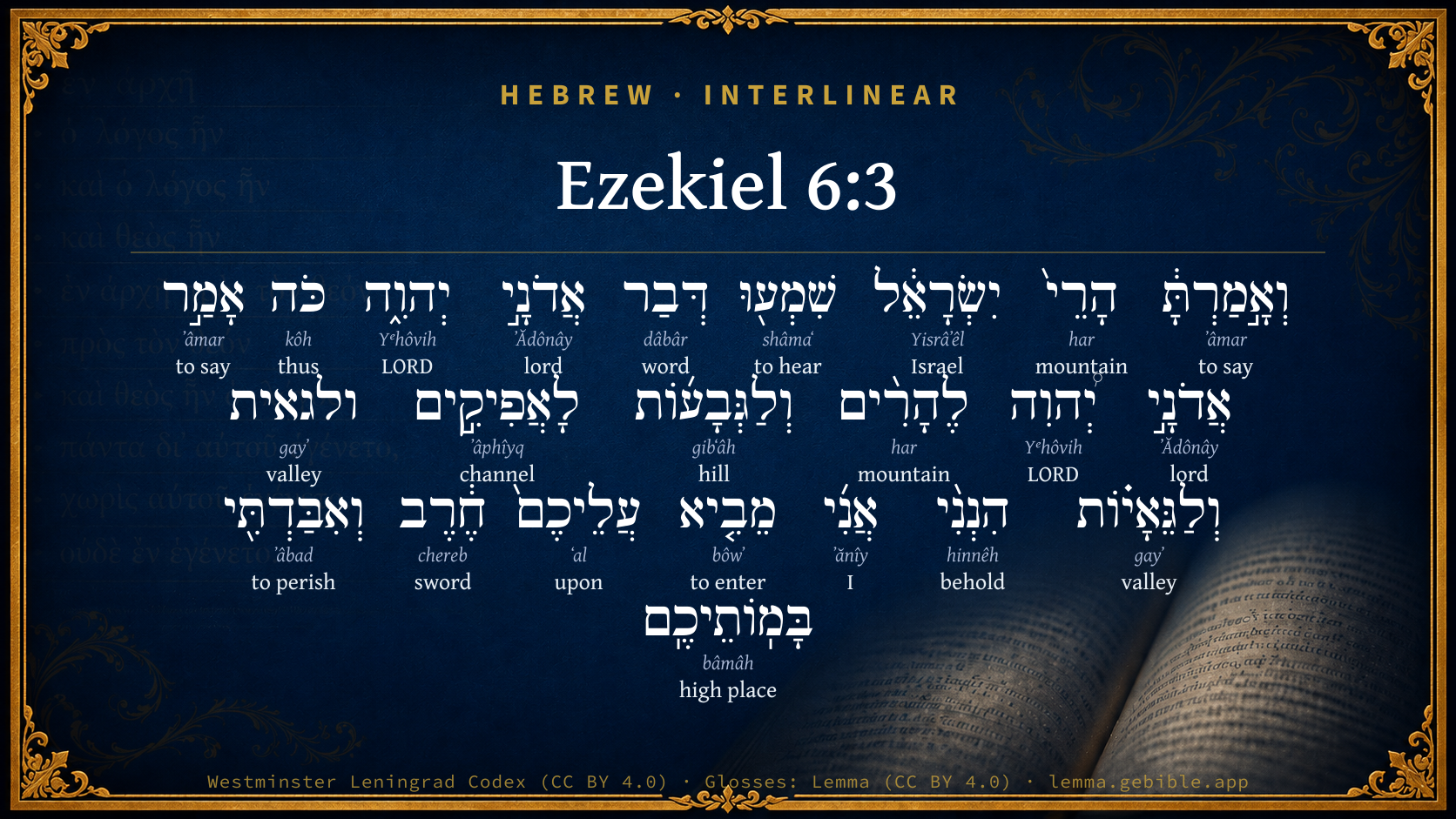
Hebrew (Westminster Leningrad Codex) Ezekiel 6:3 appears in the Hebrew Old Testament. The text above is from the Westminster Leningrad Codex. Each word links to its Strong’s number, a concise gloss, and parsing drawn from the Open Scriptures Hebrew Bible morphology. Click any word for its full Brown-Driver-Briggs (BDB) entry.
Download image
Cite this verse

Ezekiel 6:3 (World English Bible). Public Domain. Lemma interlinear Bible study tool, https://lemma.gebible.app/v/ezekiel/6/3.

Show BibTeX & RIS
BibTeX
RIS
English Translation
and say, You mountains of Israel, hear the word of the Lord Yahweh: Thus says the Lord Yahweh to the mountains and to the hills, to the watercourses and to the valleys: Behold, I, even I, will bring a sword on you, and I will destroy your high places.
World English Bible · Public Domain
Download a study sheet

One document with this verse’s original text, its word-by-word gloss line, the meaning frame, cross-references with their text, attributed commentary, and full source and license credits — printable, and it pastes into notes with its structure intact.

This verse Autodidact and up

Study sheet (.html) Plain text (.txt)

A passage Seminary Student

Up to 50 verses in one chapter. A passage sheet keeps up to 6 commentary sources and 12 cross-references per verse, in the order this page ranks them, and says so on the sheet whenever that leaves anything out. Ask for a single verse and you get the Autodidact verse sheet above.

Everything on this page stays free to read, with no account — the sheet is a download of what is already on screen, not access to it.

Want to remove ads? Support Godless Engineer
Compare translations 3

The same verse in 3 English versions, stacked beneath the original-language interlinear above. Click any original word for its lexicon entry.

Each is an independent rendering of the whole verse — the interlinear is not word-aligned to these translations.

Highlighted words mark where these versions differ — a whole-verse word diff, not a word-by-word alignment.

  • World English Bible Public Domain
    and say, You mountains of Israel, hear the word of the Lord Yahweh: Thus says the Lord Yahweh to the mountains and to the hills, to the watercourses and to the valleys: Behold, I, even I, will bring a sword on you, and I will destroy your high places.
  • King James Version Public Domain
    And say, Ye mountains of Israel, hear the word of the Lord GOD; Thus saith the Lord GOD to the mountains, and to the hills, to the rivers, and to the valleys; Behold, I, even I, will bring a sword upon you, and I will destroy your high places.
  • unfoldingWord Literal Text CC BY-SA 4.0
    Say, ‘Mountains of Israel, listen to the word of the Lord Yahweh! The Lord Yahweh says this to the mountains and to the hills, to the streambeds, and to the valleys: Behold! I am bringing a sword against you, and I will destroy your high places.

unfoldingWord Literal Text — © unfoldingWord, licensed CC BY-SA 4.0. Word-aligned USFM3 via Door43 (git.door43.org/unfoldingWord/en_ult).

Versions to compare (up to 4)

3 of 4 selected

Show all 18 translations

Every available English version of this verse, each an independent rendering of the whole verse.

  • World English Bible Public Domain
    and say, You mountains of Israel, hear the word of the Lord Yahweh: Thus says the Lord Yahweh to the mountains and to the hills, to the watercourses and to the valleys: Behold, I, even I, will bring a sword on you, and I will destroy your high places.
  • Berean Standard Bible Public Domain
    You are to say: ‘O mountains of Israel, hear the word of the Lord GOD! This is what the Lord GOD says to the mountains and hills, to the ravines and valleys: I am about to bring a sword against you, and I will destroy your high places.
  • Majority Standard Bible Public Domain
    You are to say: ‘O mountains of Israel, hear the word of the Lord GOD! This is what the Lord GOD says to the mountains and hills, to the ravines and valleys: I am about to bring a sword against you, and I will destroy your high places.
  • King James Version Public Domain
    And say, Ye mountains of Israel, hear the word of the Lord GOD; Thus saith the Lord GOD to the mountains, and to the hills, to the rivers, and to the valleys; Behold, I, even I, will bring a sword upon you, and I will destroy your high places.
  • American Standard Version (1901) Public Domain
    and say, Ye mountains of Israel, hear the word of the Lord Jehovah: Thus saith the Lord Jehovah to the mountains and to the hills, to the watercourses and to the valleys: Behold, I, even I, will bring a sword upon you, and I will destroy your high places.
  • Revised Version (1885) Public Domain
    and say, Ye mountains of Israel, hear the word of the Lord GOD: Thus saith the Lord GOD to the mountains and to the hills, to the watercourses and to the valleys: Behold, I, even I, will bring a sword upon you, and I will destroy your high places.
  • Geneva Bible (1599) Public Domain
    And say, Ye mountaines of Israel, heare the worde of the Lord God: thus sayth the Lord God to the mountaines and to the hilles, to the riuers and to the valleis, Beholde, I, euen I will bring a sworde vpon you, and I will destroy your hie places:
  • Douay-Rheims (1899) Public Domain
    And say: Ye mountains of Israel, hear the word of the Lord God: Thus Faith the Lord God to the mountains, and to the hills, and to the rocks, and the valleys: Behold, I will bring upon you the sword, and I will destroy your high places.
  • Young's Literal Translation Public Domain
    And thou hast said: Mountains of Israel, Hear ye a word of the Lord Jehovah: Thus said the Lord Jehovah To the mountains, and to the hills, To the streams, and to the valleys, Lo, I, I am bringing in against you a sword, And I have destroyed your high places.
  • Literal Standard Version CC BY-SA 4.0
    And you have said, Mountains of Israel, || Hear a word of Lord YHWH! Thus said Lord YHWH, || To the mountains, and to the hills, || To the streams, and to the valleys: Behold, I am bringing in a sword against you, || And I have destroyed your high places.
  • Unlocked Literal Bible CC BY-SA 4.0
    Say, 'Mountains of Israel, listen to the word of the Lord Yahweh! The Lord Yahweh says this to the mountains and to the hills, to the streambeds, and to the valleys: Behold! I am bringing a sword against you, and I will destroy your high places.
  • unfoldingWord Literal Text CC BY-SA 4.0
    Say, ‘Mountains of Israel, listen to the word of the Lord Yahweh! The Lord Yahweh says this to the mountains and to the hills, to the streambeds, and to the valleys: Behold! I am bringing a sword against you, and I will destroy your high places.
  • Darby Bible Public Domain
    and say, Mountains of Israel, hear the word of the Lord Jehovah: thus saith the Lord Jehovah to the mountains and to the hills, to the water-courses and to the valleys: Behold, I, [even] I, do bring a sword upon you, and will destroy your high places.
  • World Messianic Bible Public Domain
    and say, ‘You mountains of Israel, hear the word of the Lord GOD! The Lord GOD says to the mountains and to the hills, to the watercourses and to the valleys: “Behold, I, even I, will bring a sword on you, and I will destroy your high places.
  • Webster's Bible Public Domain
    And say, Ye mountains of Israel, hear the word of the Lord GOD: Thus saith the Lord GOD to the mountains, and to the hills, to the rivers, and to the valleys; Behold, I, even I, will bring a sword upon you, and I will destroy your high places.
  • Free Bible Version CC BY-SA 4.0
    Tell them: Mountains of Israel, listen to the message from the Lord God! This is what the Lord God says to the mountains and the hills, to the gorges and the valleys: I'm going to attack you and destroy your high places.
  • Bible in Basic English Public Domain
    You mountains of Israel, give ear to the words of the Lord: this is what the Lord has said to the mountains and the hills, to the waterways and the valleys: See, I, even I, am sending on you a sword for the destruction of your high places.
  • JPS Tanakh (1917) Public Domain
    and say: Ye mountains of Israel, hear the word of the Lord GOD: Thus saith the Lord GOD concerning the mountains and concerning the hills, concerning the ravines and concerning the valleys: Behold, I, even I, will bring a sword upon you, and I will destroy your high places.

Literal Standard Version (2020), Covenant Press — licensed CC BY-SA 4.0. Text via the HelloAO Bible API (eBible.org). Unlocked Literal Bible (unfoldingWord) — licensed CC BY-SA 4.0. Text via the HelloAO Bible API (eBible.org). unfoldingWord Literal Text — © unfoldingWord, licensed CC BY-SA 4.0. Word-aligned USFM3 via Door43 (git.door43.org/unfoldingWord/en_ult). Free Bible Version, Dr. Jonathan Gallagher — licensed CC BY-SA 4.0. Text via the HelloAO Bible API (eBible.org).

Word by word

More ways to search: Search by grammar → Find every occurrence → Compare this word →

Practice this passage: Drill this verse → Learn its vocabulary →

לָאֲפִיקִ֣ים
ʼâphîyq
H650
“to/for the · channels”
Preposition, Determined + Noun, Common, Masculine, Plural, Absolute
Part of Speech
Preposition + Noun
Type
Common
Gender
Masculine
Number
Plural
State
Absolute
Full BDB Definition

Origin: from H622

TWOT: 149a

channel - ravine - of hollow bones (figuratively)
  1. וְאָ֣מַרְתָּ֔ ʼâmar H559 “and · to say” Conjunction + Verb, Qal, Sequential Perfect, 2nd Person, Masculine, Singular
  2. הָרֵי֙ har H2022 “mountains of” Noun, Common, Masculine, Plural, Construct
  3. יִשְׂרָאֵ֔ל Yisrâʼêl H3478 “Israel” Noun, Proper
  4. שִׁמְע֖וּ shâmaʻ H8085 “hear” Verb, Qal, Imperative, 2nd Person, Masculine, Plural
  5. דְּבַר dâbâr H1697 “word of” Noun, Common, Masculine, Singular, Construct
  6. אֲדֹנָ֣י ʼĂdônây H136 “Lord · my” Noun, Common, Masculine, Plural, Construct + Suffix, Personal, 1st Person, Common, Singular
  7. יְהוִ֑ה Yᵉhôvih H3069 “LORD” Noun, Proper
  8. כֹּה kôh H3541 “thus” Adverb
  9. אָמַ֣ר ʼâmar H559 “to say” Verb, Qal, Perfect, 3rd Person, Masculine, Singular
  10. אֲדֹנָ֣י ʼĂdônây H136 “Lord · my” Noun, Common, Masculine, Plural, Construct + Suffix, Personal, 1st Person, Common, Singular
  11. יְ֠הוִה Yᵉhôvih H3069 “LORD” Noun, Proper
  12. לֶהָרִ֨ים har H2022 “to/for the · mountains” Preposition, Determined + Noun, Common, Masculine, Plural, Absolute
  13. וְלַגְּבָע֜וֹת gibʻâh H1389 “and · to/for the · hills” Conjunction + Preposition, Determined + Noun, Common, Feminine, Plural, Absolute
  14. ולגאית gayʼ H1516 “and · to/for the · valleys” Conjunction + Preposition, Determined + Noun, Common, Both, Plural, Absolute
  15. וְלַגֵּאָי֗וֹת gayʼ H1516 “and · to/for the · valleys” Conjunction + Preposition, Determined + Noun, Common, Both, Plural, Absolute
  16. הִנְנִ֨י hinnêh H2009 “behold · me” Particle, Demonstrative + Suffix, Personal, 1st Person, Common, Singular
  17. אֲנִ֜י ʼănîy H589 “I” Pronoun, Personal, 1st Person, Common, Singular
  18. מֵבִ֤יא bôwʼ H935 “entering” Verb, Hiphil, Participle Active, Masculine, Singular, Absolute
  19. עֲלֵיכֶם֙ ʻal H5921 “upon · you” Preposition + Suffix, Personal, 2nd Person, Masculine, Plural
  20. חֶ֔רֶב chereb H2719 “sword” Noun, Common, Feminine, Singular, Absolute
  21. וְאִבַּדְתִּ֖י ʼâbad H6 “and · to perish” Conjunction + Verb, Piel, Sequential Perfect, 1st Person, Common, Singular
  22. בָּמֽוֹתֵיכֶֽם bâmâh H1116 “high places · your” Noun, Common, Feminine, Plural, Construct + Suffix, Personal, 2nd Person, Masculine, Plural

About this verse

These counts appear in no published source. They are computed here, from the morphology-tagged text and Lemma’s own curated glosses. What Lemma adds →

23
words
18
distinct lemmas
Prophets
section

Notable vocabulary

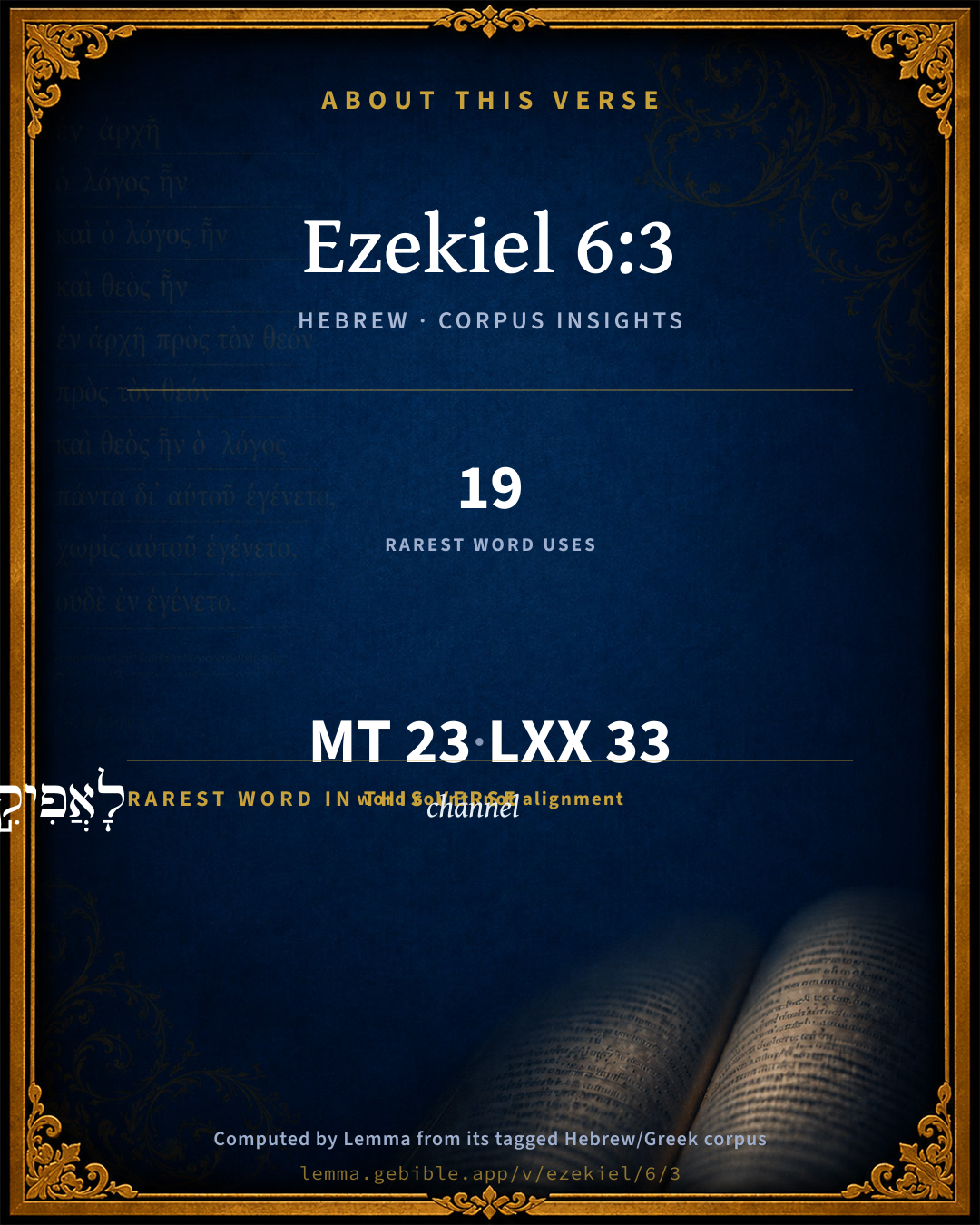
The rarest word here is לָאֲפִיקִ֣ים channel H650 — appearing just 19 times in the whole Hebrew Bible.

Shared distinctive vocabulary

לָאֲפִיקִ֣ים channel H650 occurs in 19 verses of the Hebrew Bible. Also found in:

Grammatical profile

  • 5 verbs
  • 14 nouns
  • 1 pronoun
  • 1 preposition
  • 1 adverb
  • 1 particle

Verb forms

  • וְאָ֣מַרְתָּ֔ Qal · Sequential Perfect
  • שִׁמְע֖וּ Qal · Imperative
  • אָמַ֣ר Qal · Perfect
  • מֵבִ֤יא Hiphil · Participle Active
  • וְאִבַּדְתִּ֖י Piel · Sequential Perfect

Repetition

Words recur within this verse — often emphatic in Hebrew:

  • וְאָ֣מַרְתָּ֔ to say H559 ×2
  • הָרֵי֙ mountain H2022 ×2
  • אֲדֹנָ֣י lord H136 ×2
  • יְהוִ֑ה LORD H3069 ×2
  • ולגאית valley H1516 ×2

Hebrew & Septuagint length

In English translation the verse runs 49 words from the Hebrew and 48 from the Septuagint (LXX English) — closely comparable.

A rough comparison of the two English renderings, which tokenize alike — not a word-level alignment.

Word counts can differ between the Hebrew and the Greek without any difference in meaning — e.g. the Hebrew direct-object marker אֵת has no separate Greek word, and Greek often adds the article ὁ.

In the original languages it is 23 Hebrew tokens and 33 Greek tokens — but the two are counted differently (Hebrew bundles its prefixes and suffixes into one token; the Greek is in lemma form), so that isn’t a like-for-like length.

Cross-references

9

Topical passages linked to Ezekiel 6:3 in the Treasury of Scripture Knowledge — connected by theme and wording, ordered by reader-vote popularity; previews shown in the World English Bible.

  • Leviticus 26:30 I will destroy your high places, and cut down your incense altars, and cast your dead bodies upon the bodies of your idols; and my soul will abhor you.
  • Isaiah 27:9 Therefore by this shall the iniquity of Jacob be forgiven, and this is all the fruit of taking away his sin: that he makes all the stones of the altar as chalk stones that are beaten in sunder, [so that] the Asherim and the sun-images shall rise no more.
  • Jeremiah 2:20 For of old time I have broken your yoke, and burst your bonds; and you said, I will not serve; for on every high hill and under every green tree you did bow yourself, playing the prostitute.
  • Jeremiah 3:6 Moreover Yahweh said to me in the days of Josiah the king, Have you seen that which backsliding Israel has done? she is gone up on every high mountain and under every green tree, and there has played the prostitute.
  • Jeremiah 3:23 Truly in vain is [the help that is looked for] from the hills, the tumult on the mountains: truly in Yahweh our God is the salvation of Israel.
  • Jeremiah 22:29 O earth, earth, earth, hear the word of Yahweh.
  • Ezekiel 36:1–4 You, son of man, prophesy to the mountains of Israel, and say, You mountains of Israel, hear the word of Yahweh.
  • Ezekiel 36:8 But you, mountains of Israel, you shall shoot forth your branches, and yield your fruit to my people Israel; for they are at hand to come.
  • Micah 6:2 Hear, you mountains, Yahweh's controversy, And you enduring foundations of the earth; For Yahweh has a controversy with his people, And he will contend with Israel.

Cross-references courtesy of OpenBible.info (CC BY 4.0).

Hebrew and Greek witnesses Masoretic Hebrew ↔ Greek Septuagint

The same verse in the two great witnesses to the Old Testament, shown verse-for-verse.

These are two independent witnesses, not word-aligned to each other, and the Septuagint is shown in lemma (dictionary) form.

Hebrew Ezekiel 6:3 Masoretic · Westminster Leningrad Codex

וְאָ֣מַרְתָּ֔ הָרֵי֙ יִשְׂרָאֵ֔ל שִׁמְע֖וּ דְּבַר אֲדֹנָ֣י יְהוִ֑ה כֹּה אָמַ֣ר אֲדֹנָ֣י יְ֠הוִה לֶהָרִ֨ים וְלַגְּבָע֜וֹת לָאֲפִיקִ֣ים ולגאית וְלַגֵּאָי֗וֹת הִנְנִ֨י אֲנִ֜י מֵבִ֤יא עֲלֵיכֶם֙ חֶ֔רֶב וְאִבַּדְתִּ֖י בָּמֽוֹתֵיכֶֽם

and say, You mountains of Israel, hear the word of the Lord Yahweh: Thus says the Lord Yahweh to the mountains and to the hills, to the watercourses and to the valleys: Behold, I, even I, will bring a sword on you, and I will destroy your high places.

World English Bible · Public Domain

Greek LXX Ezekiel 6:3 Septuagint · lemma form

καί εἶπον ὁ ὄρος ἰσραήλ ἀκούω λόγος κύριος ὅδε λέγω κύριος ὁ ὄρος καί ὁ βουνός καί ὁ φάραγξ καί ὁ νάπη ἰδού ἐγώ ἐπιἄγω ἐπί σύ ῥομφαία καί ἐκὀλεθρεύω ὁ ὑψηλός σύ

and you shall say, You⌃ mountains of Israel, hear the word of the Lord; thus says the Lord to the mountains, and to the hills, and to the valleys, and to the forests; Behold, I bring a sword upon you, and your high places shall be utterly destroyed.

LXX2012 (modern English Septuagint) · Public Domain

Hebrew: Westminster Leningrad Codex (CC BY 4.0). Greek: Septuagint (public domain); English from LXX2012 (modern English Septuagint) (Public Domain). How the Septuagint differs from the Hebrew →

Targum (Aramaic paraphrase)

1

The Targum is the ancient Jewish Aramaic paraphrase of the Hebrew Scriptures — an interpretive translation, not the Hebrew text itself. Onkelos (literal) and Pseudo-Jonathan (expansive) render the Torah, and Jonathan the Prophets. Coverage is partial: where no permissively-licensed English translation exists for a verse, only the Aramaic is shown. This is verse-level text, not a word-by-word alignment to the Hebrew.

  1. Targum Jonathan Prophets (Joshua–Malachi)
    וְתֵימַר טוּרֵי יִשְׂרָאֵל קַבִּילוּ פִתְגָמָא דַייָ אֱלֹהִים כִּדְנַן אֲמַר יְיָ אֱלֹהִים לְטוּרַיָא וּלְרָמָתָא וּלְפַצִידַיָא וּלְחֵילַיָא הָא אֲנָא מַיְתֵי עֲלֵיכוֹן דְקַטְלִין בְּחַרְבָּא וְאוֹבִיד בָּמָתֵיכוֹן:

    (no public-domain English translation for this verse)

    Targum Jonathan — Aramaic: “Mikraot Gedolot” (public domain). English: “Sefaria Community Translation” (CC0 1.0 (public-domain dedication)); “London "Chaldee Paraphrase," 1871” (public domain). Text via Sefaria.

Commentary

Notes on Ezekiel 6:3 from classic Christian and Jewish commentators (each source and its license shown beneath its notes). The classic Christian expositions comment on the surrounding passage and are grouped to its opening verse, so a note may address several verses; the Jewish commentaries on the Tanakh (Rashi and others) are per-verse, so they appear only where the commentator wrote on this verse.

Lemma curates 59 commentaries, every one of them public domain or Creative Commons licensed, each selected and text-cleaned for this edition rather than reprinted as found. About our sources →

Trapp's Complete Commentary

John Trapp

Eze 6:3 And say, Ye mountains of Israel, hear the word of the Lord GOD; Thus saith the Lord GOD to the mountains, and to the hills, to the rivers, and to the valleys; Behold, I, [even] I, will bring a sword upon you, and I will destroy your high places.

Ver. 3. Behold, I, even I, will bring a sword upon you.] Because ye are polluted by man’s sins, and so made hateful unto me. For as God thinks the better of the places wherein he is sincerely served, yea, where his saints are born, {Psa 87:5} or make abode, {Isa 49:16} so the worse of such places where Satan’s seat is.

John Trapp, A Commentary or Exposition upon All the Books of the Old and New Testament (1647–1656) — public domain. Text from a community e-Sword module.

Geneva Bible (1599)

Geneva Bible translators

He speaketh to all the places where the Israelites accustomed to commit their idolatries, threatening them destruction.

Geneva Bible (1599) marginal notes — public domain. Text via Bolls.life.

Jamieson, Fausset & Brown

Robert Jamieson, A. R. Fausset & David Brown

rivers--literally, the "channels" of torrents. Rivers were often the scene and objects of idolatrous worship.

Jamieson, Fausset & Brown — Commentary Critical and Explanatory on the Whole Bible (1871) — public domain (CC PDM 1.0). Text via the HelloAO Bible API.

John Calvin's Commentaries

Now a clearer expression follows in the third verse: Thou shalt say, ye mountains of Israel, hear the word of the Lord. Here an audience is required of the mountains which they could not give, but that has respect to mankind, as I have just said. God, therefore, requires the mountains to listen, so that men may understand that an inanimate thing may be endued with sense, if their stupidity is considered. For at length God enforced his judgments against the mountains of Israel. Although, therefore, they could not hear the Prophet speaking, yet they took up his instruction, because it was efficacious in them, and God at length in reality proved that he had not spoken in vain. The event, therefore, openly made the mountains in some way attentive. Neither could they escape the judgment which had been openly denounced. Now he adds, Thus saith Jehovah to the mountains and the hills Ezekiel now addresses not mountains only, as he had been commanded: hence he seems to exceed the prescribed command, for he had been sent to mountains and hills only, but now he says, hear ye mountains, hear ye hills, hear ye valleys. But we said yesterday that prophets sometimes speak briefly, and sometimes explain more fully what they had uttered but shortly. God, therefore, at the beginning spoke only of mountains, but he doubtless comprehended valleys, and the flowing down of rivers, because the Prophet only explains what he had said in one word: hence he speaks to mountains and hills, and then to the pouring down of waters or torrents Jerome translates it rocks, and the Hebrews call whatever is violent אפיק, aphik, hence when there is any violent course they use this word; and so we may understand in this place either rocks or flowing down of waters or torrents, no matter which. But since he afterwards adds valleys, this explanation is to me probable, that the Prophet indeed understands either torrents or the rushing down of waters. Here we must also remark, that those parts are marked out where the Israelites had erected perverse and adulterous worship: for we know that mountains were filled with superstitions, and so also valleys, though the reason was different: for when they erected their altars on the mountains they thought themselves near God, but when they descended into the valleys, their rites were thus performed in shade and obscurity, and thus they thought themselves in this way hidden as it were in a sanctuary. It is sufficiently known that they exercised their idolatries in the mountains as well as the valleys. This, therefore, is the reason why the Prophet here shows that the whole land of Israel was polluted with defilement. Behold, says he, I bring a sword against you. Hence we infer that when the Prophet addresses the mountains, yet he speaks for the sake of man. For the sword could not injure the mountains: for one stone would break a hundred, nay a thousand swords, and yet remain entire. God, therefore, had threatened the mountains with slaughter in vain, nay, when mention is made of the sword, we know that death is understood: for the cause is put for the effect. Hence God addresses men indirectly, but when he directs his discourse to the mountains he shows that men themselves are deaf, and therefore turns away his face from them, and addresses mute elements and inanimate things: and I will destroy, says he, your lofty things He now explains what I have taught before, that mountains, and hills, and valleys, and descending waters are named, because perverse and impure worship flourished there. For by “lofty things,” the Spirit doubtless intends whatever the Israelites had mixed of their own imaginations to corrupt the worship of God. They properly call altars lofty, because they were erected in high and conspicuous places. But the species is here put for the genus. Meanwhile, God signifies that he so abominates all fictitious worship that he cannot bear the sight of the places. The stones indeed of which the altars were built we know to be harmless: for places are not polluted by idolatry of their own will; for as far as the world was created by God it always retains its own nature, but as far as man is concerned, the places themselves were polluted, and the contagion renders them hateful to God. Hence this is put for the detestation of idolatry. He continues the same sentiment, and first denounces that altars should be laid waste. Now it follows —

John Calvin's Commentaries (1540-1563) — public domain. Text from the Calvin Translation Society English edition (1840s-50s) via the Christian Classics Ethereal Library (ccel.org). Calvin's coverage is partial (roughly two-thirds of the Bible); uncommented books and verses are honest gaps, never fabricated. The 19th-century editor's footnotes and remarks are omitted so the notes are faithfully Calvin's own voice.

Ellicott's Commentary for English Readers

(3) To the rivers, and to the valleys.—These words stand to each other in the same relation as “mountains and hills,” that is, they are specifications of the same general character. The word frequently occurring, and uniformly translated in Ezekiel rivers, would be better rendered ravines. It is a deep sort of valley, along which, at times, a stream might run. Such places were also favourite places for idolatrous rites (see 2Ki_23:10; Isa_57:5-6; Jer_7:31; Jer_32:35), especially for the worship of the Phoenician Astaroth, the female divinity worshipped in conjunction with Baal. The same putting together of mountains and hills, valleys and ravines, occurs again in Eze_35:8; Eze_36:4; Eze_36:6. By the expression, “I, even I,” strong emphasis is placed on the fact that these judgments are from God. Inasmuch as, like most other events in the world, they were to be wrought out by human instrumentality, the attention might easily be taken up with the secondary causes; but by thus declaring them beforehand, and claiming them as His own work, God would make it evident that all was from Him.

A Bible Commentary for English Readers, edited by Charles John Ellicott (1878–1897) — public domain. Text from a community e-Sword module.

The Cambridge Bible for Schools and Colleges

gen. ed. J. J. S. Perowne

3. to the rivers] the ravines; the gorges where there were streams and thick trees, and where idolatrous worship was practised (ch. Eze_35:8, Eze_36:4; Eze_36:6), cf. Isa_57:5, “that slay the children in the valleys (a different word) under the clefts of the rocks; among the smooth stones of the valley is thy portion; they, they are thy lot; even to them hast thou poured a drink offering, thou hast offered an oblation” (Jer_2:23).

your high places] The word properly means a height or hill (ch. Eze_36:2), then a sanctuary situated on such a height (1Sa_9:13), and finally any sanctuary (Isa_16:12, and so in Moabitish, Moabstone, 50:3), particularly in Israel the rural sanctuaries. These sanctuaries had probably been mainly Canaanitish (Deu_12:2; Lev_26:30), but had been adopted by Israel and devoted to the service of Jehovah (ch. Eze_20:28). Along with the sanctuaries themselves no doubt much of the native religious practice was also adopted. After a long struggle these rural high places were abolished by Josiah, and public service of Jehovah confined to the temple at Jerusalem, though they grew up again under Manasseh. Even the worship of Jehovah at such sanctuaries would be very corrupt, and in the last years of the kingdom the worship of other deities was no doubt also practised. This prophet condemns all worship at the high places as “abominations.” This does not appear to be with him a question of mere locality or number of sanctuaries; he considers the high places to be Canaanitish and the service at them no worship of Jehovah.

The Cambridge Bible for Schools and Colleges (gen. ed. J. J. S. Perowne; Cambridge University Press, 1878–1918) — public domain. Text from a community e-Sword module.

John Gill's Exposition

And your altars shall be desolate,.... Being pulled down; or because the priests and worshippers would now be slain, and there would be none to attend them:

and your images shall be broken; the "images of the sun" (b). The word for images has its derivation from heat; and were so called, either from the heat of the sun, to whose worship they were devoted, or from the heat of the love and affections of their worshippers:

and I will cast down your slain men before your idols; before your dung, or your "dunghill gods" (c); for the word used has the signification of dung, Eze 4:12. The Targum renders it,

"before the carcass of your idols;''

where they committed idolatry, there they should be slain; which points at the cause of their punishment.

(b) "simulacra vestra solis", Pagninus; "solaria vestra", Vatablus; "subdiales statuae vestrae", Junius & Tremellius, Piscator, Polanus. (c) "coram stercoreis diis vestris", Junius & Tremellius, Piscator, Polanus; "coram stercoribus vestris", Cocceius.

John Gill's Exposition of the Whole Bible (1746–1763) — public domain (CC PDM 1.0). Text via the HelloAO Bible API.

Albert Barnes' Notes on the Bible

Rivers - Or, “ravines,” which were, like the mountains, favorite seats of idol-rites 2Ki 23:10.

Albert Barnes' Notes on the Bible (1834–1885) — public domain. Text from a community e-Sword/MySword module.

Matthew Poole's English Annotations

Ye mountains; ye that dwell in the mountains, ye secure, fearless, and rude mountaineers, hear and consider what God speaks against you, for thus saith the Lord God to you, on mountains and hills of Israel ye dwell and commit idolatry.

To the rivers; to those who either by rivers’ sides worshipped idols, or who accounted rivers among their gods.

To the valleys; to those that worshipped their idols in low and shadowy valleys. In all these places the Jews had either their several gods, or performed a several kind of worship, or, contrary to command, worshipped their God and set up altars to him there.

A sword upon you; that shall slay you inhabitants, waste your mountains and valleys, destroy your altars, and abolish your worship.

I, by the enemy, will destroy your high places; places of your idolatrous or superstitious worship; by the sword of those that serve idols your idols shall be destroyed, and you with them, unless ye repent.

Matthew Poole's English Annotations on the Holy Bible (1683–1685) — public domain. Text from a community e-Sword/MySword module.

Whedon's Commentary on the Bible

Daniel D. Whedon

3. Ye mountains… hear the word of the Lord — This apostrophe to the “mountains and to the hills, to the gorges, and to the valleys,” is in accordance with the most effective style of speech. The places where these crimes against Jehovah were most commonly practiced (Eze_35:8; Eze_36:4; Eze_36:6; Isa_57:5-7; Jer_2:23) are made to represent the criminals themselves.

I will destroy your high places — Altars of sacrifice were always placed on elevations. These “high places” were, no doubt, chiefly idolatrous (see Lev_26:30; Num_22:41), although it is certain that on some of these altars had been erected to Jehovah (Eze_20:28). But the worship of Jehovah at such sanctuaries was made illegal after the erection of the temple; and it must have been almost as corrupt as the Canaanitish idolatry. When priests or Levites broke away from the prescribed form in Jerusalem they were no longer in good standing in the Jewish Church, and were under great temptation to introduce into their nominal worship of Jehovah novel and superstitious elements. They could hardly expect Jehovah’s favor while disobeying his explicit commands as to the place and manner of worship, and, therefore, the high places originally dedicated to Jehovah seem to have early degenerated into idolatrous sanctuaries (1Ki_13:33-34; 1Ki_14:23-24; Jer_7:31, etc.).

Daniel D. Whedon (gen. ed.), Commentary on the Old and New Testaments (1874–1909) — public domain. Text from a community e-Sword module.

John Wesley's Explanatory Notes

Rivers - To those who dwell by river sides, or in the valleys. High places - The places of your idolatrous worship.

John Wesley, Explanatory Notes Upon the Whole Bible (1754–1765) — public domain. Text via the GEBible commentary corpus.

Rashi

Rabbi Shlomo Yitzchaki (Rashi)

and to the hills [Heb. [ולגבעות is] a term expressing height.

and to the valleys [ולגאיות is] a term expressing valleys.

Rashi on the Tanakh — English translations: “The Judaica Press complete Tanach with Rashi, translated by A. J. Rosenberg” (CC BY 4.0); “Pentateuch with Rashi's commentary by M. Rosenbaum and A.M. Silbermann, 1929-1934” (public domain); “The Metsudah Tanach series, Lakewood, N.J” (CC BY 4.0); and “The Book of Joshua, Metsudah Publications, 1997” (CC BY 4.0). Text via Sefaria.

Lesson kit

Teaching starters — assembled from the data on this page, not authored interpretation. Every prompt links to the verse data it draws on. Edit before teaching.

Ezekiel, in the Prophets, opens this verse with 23 words (18 distinct Hebrew lemmas). Its most distinctive word is ʼâphîyq (“channel”). A historical commentator’s framing appears above. Read the whole chapter for the surrounding context.

Discussion questions

  1. How does “channel” (ʼâphîyq) shape what this verse is saying?
  2. 2 Samuel 22:16 shares the word «channel» with this verse. How do the two illuminate each other?
  3. “to say” occurs 2× in this one verse. What is the effect of the repetition?
  4. The translations on this page render this verse differently — a whole-verse word diff, not a word-by-word alignment. What might account for the different wordings?
  5. The verb «וְאָ֣מַרְתָּ֔» is Qal Sequential Perfect. How does its form color the action?
  6. Reading how Trapp's Complete Commentary and Geneva Bible (1599) read this verse, where do the two commentators agree and where do they part?

Things to notice

Reading settings

Reading text

Shown beneath each verse's original-language words.

Old Testament
Old Testament edition

Read the OT as the Masoretic Hebrew (MT) or the Greek Septuagint (LXX).

English shown for the Greek Septuagint (in the Hebrew ↔ Greek comparison).

Comparing translations? Open the Compare panel on any verse page to stack up to four side by side.