
Psalms 51:15

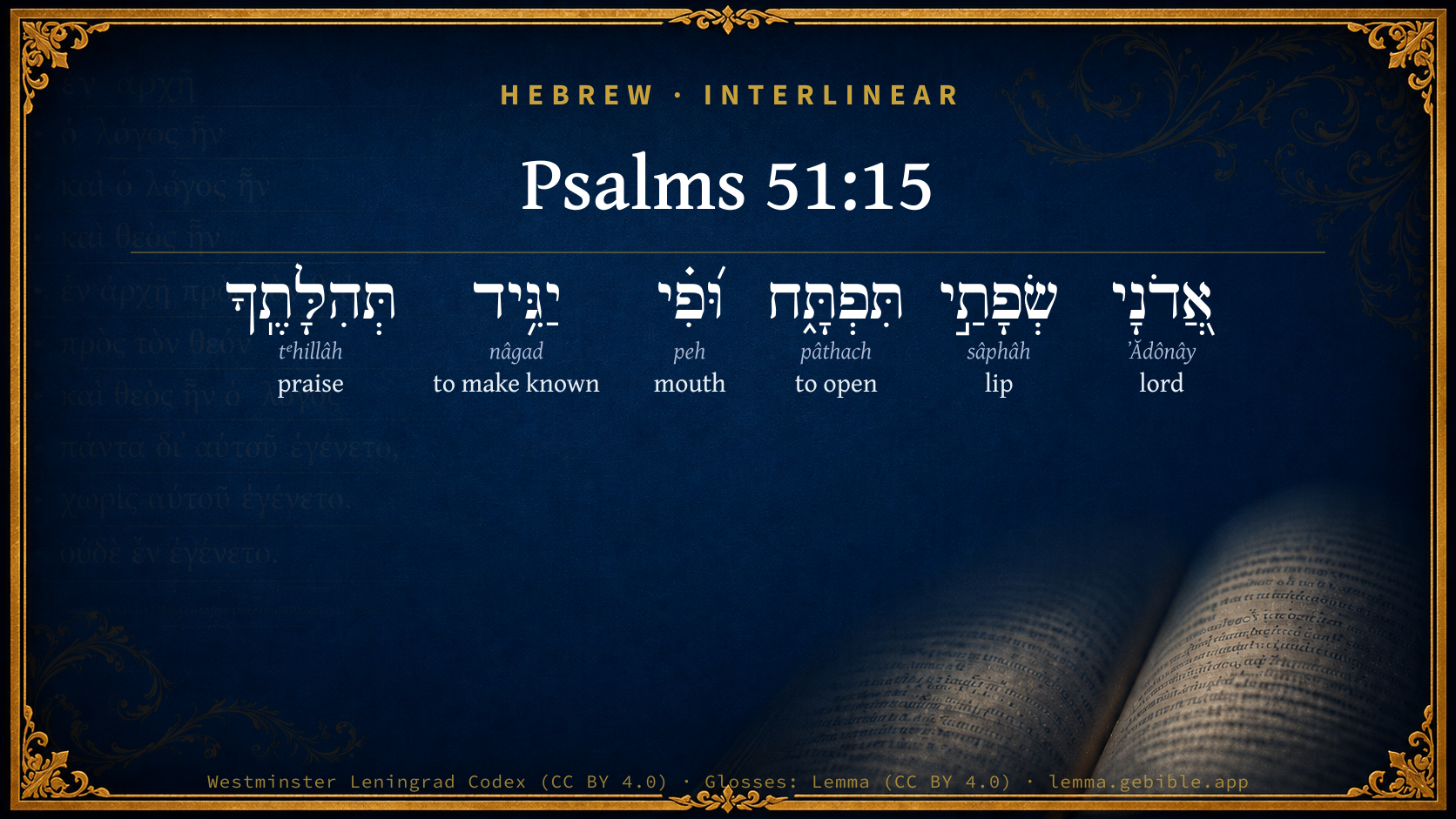
Hebrew (Westminster Leningrad Codex) Psalms 51:15 appears in the Hebrew Old Testament. The text above is from the Westminster Leningrad Codex. Each word links to its Strong’s number, a concise gloss, and parsing drawn from the Open Scriptures Hebrew Bible morphology. Click any word for its full Brown-Driver-Briggs (BDB) entry.
Download image
Cite this verse

Psalms 51:15 (World English Bible). Public Domain. Lemma interlinear Bible study tool, https://lemma.gebible.app/v/psalms/51/15.

Show BibTeX & RIS
BibTeX
RIS
English Translation
Lord, open my lips. My mouth shall declare your praise.
World English Bible · Public Domain
Download a study sheet

One document with this verse’s original text, its word-by-word gloss line, the meaning frame, cross-references with their text, attributed commentary, and full source and license credits — printable, and it pastes into notes with its structure intact.

This verse Autodidact and up

Study sheet (.html) Plain text (.txt)

A passage Seminary Student

Up to 50 verses in one chapter. A passage sheet keeps up to 6 commentary sources and 12 cross-references per verse, in the order this page ranks them, and says so on the sheet whenever that leaves anything out. Ask for a single verse and you get the Autodidact verse sheet above.

Everything on this page stays free to read, with no account — the sheet is a download of what is already on screen, not access to it.

Want to remove ads? Support Godless Engineer
Compare translations 3

The same verse in 3 English versions, stacked beneath the original-language interlinear above. Click any original word for its lexicon entry.

Each is an independent rendering of the whole verse — the interlinear is not word-aligned to these translations.

Highlighted words mark where these versions differ — a whole-verse word diff, not a word-by-word alignment.

  • World English Bible Public Domain
    Lord, open my lips. My mouth shall declare your praise.
  • King James Version Public Domain
    O Lord, open thou my lips; and my mouth shall shew forth thy praise.
  • unfoldingWord Literal Text CC BY-SA 4.0
    Lord, may you open my lips, that my mouth may declare your praise.

unfoldingWord Literal Text — © unfoldingWord, licensed CC BY-SA 4.0. Word-aligned USFM3 via Door43 (git.door43.org/unfoldingWord/en_ult).

Versions to compare (up to 4)

3 of 4 selected

Show all 18 translations

Every available English version of this verse, each an independent rendering of the whole verse.

  • World English Bible Public Domain
    Lord, open my lips. My mouth shall declare your praise.
  • Berean Standard Bible Public Domain
    O Lord, open my lips, and my mouth will declare Your praise.
  • Majority Standard Bible Public Domain
    O Lord, open my lips, and my mouth will declare Your praise.
  • King James Version Public Domain
    O Lord, open thou my lips; and my mouth shall shew forth thy praise.
  • American Standard Version (1901) Public Domain
    O Lord, open thou my lips; And my mouth shall show forth thy praise.
  • Revised Version (1885) Public Domain
    O Lord, open thou my lips; and my mouth shall shew forth thy praise.
  • Geneva Bible (1599) Public Domain
    Open thou my lippes, O Lord, and my mouth shall shewe foorth thy praise.
  • Douay-Rheims (1899) Public Domain
    I will teach the unjust thy ways: and the wicked shall be converted to thee.
  • Young's Literal Translation Public Domain
    O Lord, my lips thou dost open, And my mouth declareth Thy praise.
  • Literal Standard Version CC BY-SA 4.0
    O Lord, you open my lips, || And my mouth declares Your praise.
  • Unlocked Literal Bible CC BY-SA 4.0
    Lord, open my lips, and my mouth will express your praise.
  • unfoldingWord Literal Text CC BY-SA 4.0
    Lord, may you open my lips, that my mouth may declare your praise.
  • Darby Bible Public Domain
    Lord, open my lips, and my mouth shall declare thy praise.
  • World Messianic Bible Public Domain
    Lord, open my lips. My mouth will declare your praise.
  • Webster's Bible Public Domain
    \\51:13\\Then will I teach transgressors thy ways; and sinners shall be converted to thee.
  • Free Bible Version CC BY-SA 4.0
    Lord, open my lips so I can speak your praise!
  • Bible in Basic English Public Domain
    O Lord, let my lips be open, so that my mouth may make clear your praise.
  • JPS Tanakh (1917) Public Domain
    (51-17) O Lord, open Thou my lips; and my mouth shall declare Thy praise.

Literal Standard Version (2020), Covenant Press — licensed CC BY-SA 4.0. Text via the HelloAO Bible API (eBible.org). Unlocked Literal Bible (unfoldingWord) — licensed CC BY-SA 4.0. Text via the HelloAO Bible API (eBible.org). unfoldingWord Literal Text — © unfoldingWord, licensed CC BY-SA 4.0. Word-aligned USFM3 via Door43 (git.door43.org/unfoldingWord/en_ult). Free Bible Version, Dr. Jonathan Gallagher — licensed CC BY-SA 4.0. Text via the HelloAO Bible API (eBible.org).

Word by word

More ways to search: Search by grammar → Find every occurrence → Compare this word →

Practice this passage: Drill this verse → Learn its vocabulary →

תְּהִלָּתֶֽךָ
tᵉhillâh
H8416
“praise · your”
Noun, Common, Feminine, Singular, Construct + Suffix, Personal, 2nd Person, Masculine, Singular
Part of Speech
Noun
Type
Common
Gender
Feminine
Number
Singular
State
Construct
Full BDB Definition

Origin: from H1984

TWOT: 500c

praise, song or hymn of praise - praise, adoration, thanksgiving (paid to God) - act of general or public praise - praise-song (as title) - praise (demanded by qualities or deeds or attributes of God) - renown, fame, glory - of Damascus, God - object of praise, possessor of renown (figuratively)
  1. אֲ֭דֹנָי ʼĂdônây H136 “Lord · my” Noun, Common, Masculine, Plural, Construct + Suffix, Personal, 1st Person, Common, Singular
  2. שְׂפָתַ֣י sâphâh H8193 “lips · my” Noun, Common, Feminine, Dual, Construct + Suffix, Personal, 1st Person, Common, Singular
  3. תִּפְתָּ֑ח pâthach H6605 “to open” Verb, Qal, Imperfect, 2nd Person, Masculine, Singular
  4. וּ֝פִ֗י peh H6310 “and · mouth · my” Conjunction + Noun, Common, Masculine, Singular, Construct + Suffix, Personal, 1st Person, Common, Singular
  5. יַגִּ֥יד nâgad H5046 “to make known” Verb, Hiphil, Imperfect, 3rd Person, Masculine, Singular

About this verse

These counts appear in no published source. They are computed here, from the morphology-tagged text and Lemma’s own curated glosses. What Lemma adds →

6
words
6
distinct lemmas
Wisdom
section

Shared distinctive vocabulary

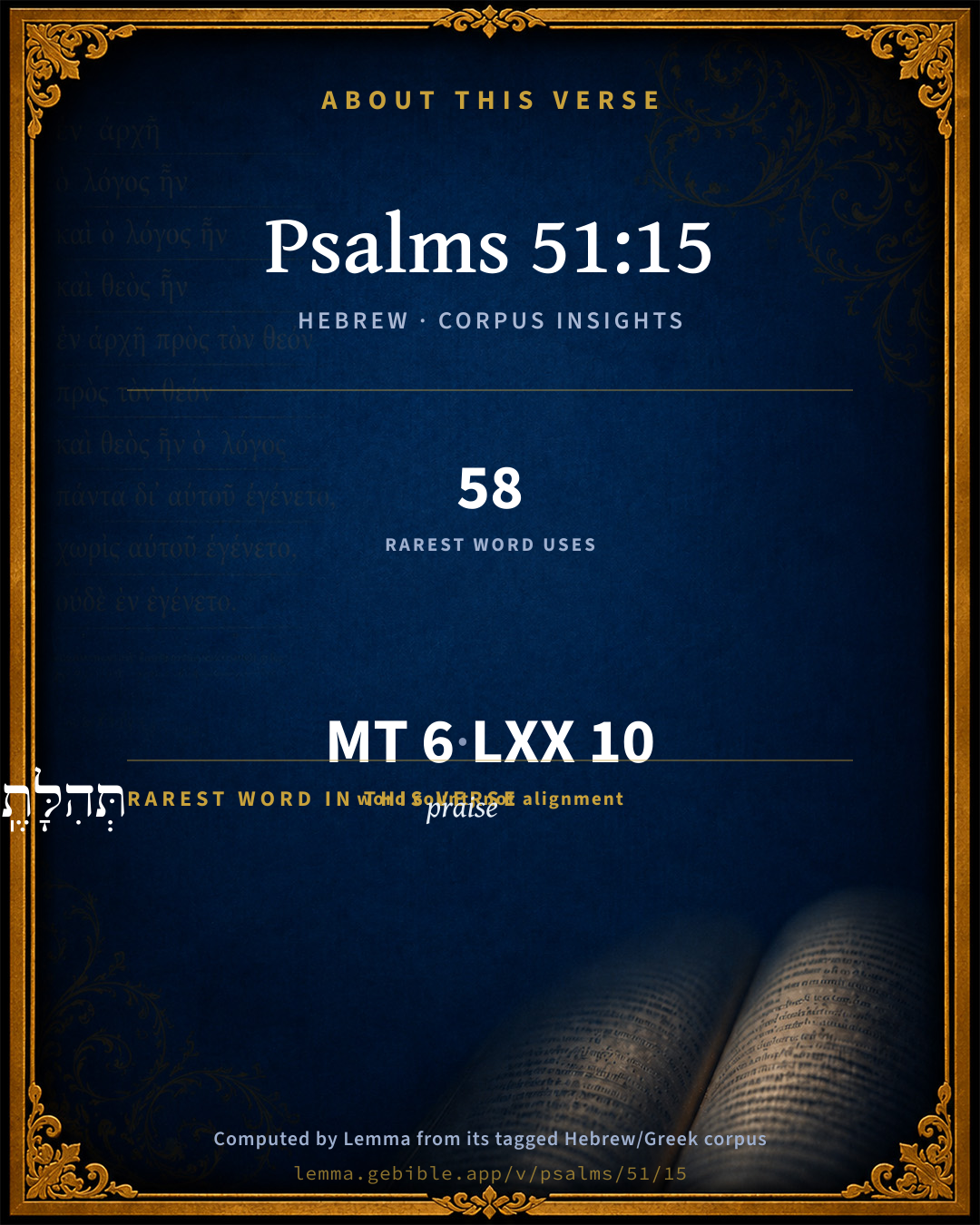
תְּהִלָּתֶֽךָ praise H8416 occurs in 57 verses of the Hebrew Bible. Also found in:

Grammatical profile

  • 2 verbs
  • 4 nouns

Verb forms

  • תִּפְתָּ֑ח Qal · Imperfect
  • יַגִּ֥יד Hiphil · Imperfect

Hebrew & Septuagint length

In English translation the verse runs 10 words from the Hebrew and 14 from the Septuagint (LXX English) — closely comparable.

A rough comparison of the two English renderings, which tokenize alike — not a word-level alignment.

Word counts can differ between the Hebrew and the Greek without any difference in meaning — e.g. the Hebrew direct-object marker אֵת has no separate Greek word, and Greek often adds the article ὁ.

In the original languages it is 6 Hebrew tokens and 10 Greek tokens — but the two are counted differently (Hebrew bundles its prefixes and suffixes into one token; the Greek is in lemma form), so that isn’t a like-for-like length.

Cross-references

13

Topical passages linked to Psalms 51:15 in the Treasury of Scripture Knowledge — connected by theme and wording, ordered by reader-vote popularity; previews shown in the World English Bible.

  • Psalms 63:3–5 Because your loving kindness is better than life, My lips shall praise you.
  • Hebrews 13:15 Through him, then, let us offer up a sacrifice of praise to God continually, that is, the fruit of lips which make confession to his name.
  • Psalms 9:14 That I may show forth all your praise. In the gates of the daughter of Zion, I will rejoice in your salvation.
  • Psalms 119:13 With my lips, I have declared all the ordinances of your mouth.
  • Ezekiel 29:21 In that day will I cause a horn to bud forth to the house of Israel, and I will give you the opening of the mouth in the midst of them; and they shall know that I am Yahweh.
  • Exodus 4:11 Yahweh said to him, "Who made man's mouth? Or who makes one mute, or deaf, or seeing, or blind? Isn't it I, Yahweh?
  • Ezekiel 3:27 But when I speak with you, I will open your mouth, and you shall tell them, Thus says the Lord Yahweh: He who hears, let him hear; and he who forbears, let him forbear: for they are a rebellious house.
  • 1 Samuel 2:9 He will keep the feet of his holy ones; But the wicked shall be put to silence in darkness; For by strength shall no man prevail.
  • Mark 7:34 Looking up to heaven, he sighed, and said to him, "Ephphatha!" that is, "Be opened!"
  • Ezekiel 16:63 that you may remember, and be confounded, and never open your mouth any more, because of your shame, when I have forgiven you all that you have done, says the Lord Yahweh.
  • Matthew 22:12 and he said to him, 'Friend, how did you come in here not wearing wedding clothing?' He was speechless.
  • Genesis 44:16 Judah said, "What will we tell my lord? What will we speak? Or how will we clear ourselves? God has found out the iniquity of your servants. Behold, we are my lord's bondservants, both we, and he also in whose hand the cup is found."
  • Romans 3:19 Now we know that whatever things the law says, it speaks to those who are under the law, that every mouth may be closed, and all the world may be brought under the judgment of God.

Cross-references courtesy of OpenBible.info (CC BY 4.0).

Hebrew and Greek witnesses Masoretic Hebrew ↔ Greek Septuagint

The same verse in the two great witnesses to the Old Testament, shown verse-for-verse.

You’re reading Greek Psalm 50 (Hebrew Psalm 51). The Septuagint counts the superscription, so verse numbers can differ from the Hebrew — chapter-level alignment, not verse-by-verse. Numbering follows Rahlfs.

These are two independent witnesses, not word-aligned to each other, and the Septuagint is shown in lemma (dictionary) form.

Hebrew Psalms 51:15 Masoretic · Westminster Leningrad Codex

אֲ֭דֹנָי שְׂפָתַ֣י תִּפְתָּ֑ח וּ֝פִ֗י יַגִּ֥יד תְּהִלָּתֶֽךָ

Lord, open my lips. My mouth shall declare your praise.

World English Bible · Public Domain

Greek LXX Greek Psalm 50:15 Septuagint · lemma form

διδάσκω ἄνομος ὁ ὁδός σύ καί ἀσεβής ἐπί σύ ἐπιστρέφω

O Lord, you shall open my lips; and my mouth shall declare your praise.

LXX2012 (modern English Septuagint) · Public Domain

Hebrew: Westminster Leningrad Codex (CC BY 4.0). Greek: Septuagint (public domain); English from LXX2012 (modern English Septuagint) (Public Domain). How the Septuagint differs from the Hebrew →

Commentary

Notes on Psalms 51:15 from classic Christian and Jewish commentators (each source and its license shown beneath its notes). The classic Christian expositions comment on the surrounding passage and are grouped to its opening verse, so a note may address several verses; the Jewish commentaries on the Tanakh (Rashi and others) are per-verse, so they appear only where the commentator wrote on this verse.

Lemma curates 59 commentaries, every one of them public domain or Creative Commons licensed, each selected and text-cleaned for this edition rather than reprinted as found. About our sources →

Trapp's Complete Commentary

John Trapp

Psa 51:15 O Lord, open thou my lips; and my mouth shall shew forth thy praise.

Ver. 15. O Lord, open thou my lips] Which now I find stopped and sealed up, as it were, with the sin that doth so easily beset me; so that whereas I promised before to "sing aloud of thy righteousness," this I shall never be able to do without thy special furtherance, nisi verba suppedites et tanquam praeeas, unless thou please to supply me both with affections and expressions, as well as with matter of praise.

And my mouth shall show forth thy praise] David had not been dumb till now, all the while he lay in his sin, but all he did was but liplabour, and therefore lost labour. Daniel confesseth the like of himself and his people, Dan 9:13, "All this evil is come upon us: yet made we not our prayer before the Lord our God, that we might turn from our iniquities, and understand thy truth." Prayed they had, but because they turned not from their iniquities, they got nothing by their prayers or praises. God is a fountain, and if he meet with a fit pipe (as is an ordinance rightly performed), there he usually conveyeth his grace; but if he meet with a foul pipe and obstructed, there he doth not confer a blessing. The Pharisees were not a button the better for all their long prayers, because rotten at heart.

John Trapp, A Commentary or Exposition upon All the Books of the Old and New Testament (1647–1656) — public domain. Text from a community e-Sword module.

The Biblical Illustrator

Joseph S. Exell

Psa_51:15

O Lord, open Thou my lips; and my mouth shall show forth Thy praise.

The lips Divinely opened

I. A humiliating fact implied. Sin seals the lips.

1. In our approaches to God, sin is a barrier to all spiritual freedom. When overwhelmed with guilt and shame, the soul is ready to exclaim with David (Psa_77:4; Psa_88:8).

2. Sin prevents us speaking for God as well as to God. When our conduct is consistent we say with Paul (2Co_6:11), and with David (Psa_66:16). But when our conduct gives a lie to our profession, our admonitions will be retorted upon us, Physician, heal thyself. When a man sins thus he has but little to say for God.

II. An important request made. O Lord, open Thou, etc.

1. To whom was this prayer offered? To God. He only can unloose our tongues.

2. By whom was this request made? A convinced sinner. His heart was humbled.

3. The request itself. Open, etc. He knew the cause must be removed. Sins must be pardoned. Guilt cancelled. The Spirits must be imparted before there is an ability to praise God (Psa_51:1; Psa_51:4; Psa_51:7; Psa_51:15).

III. Delightful service pledged. My lips shall praise Thee.

1. A deep conviction of Gods mercy.

2. A sensibility of personal obligation.

3. A fixed determination. My lips shall, etc. Here observe--

(1) Praise is the least return we can make for so great a blessing. When overwhelmed with guilt, we were ready to say (Mic_6:6-7), God does not require this (Psa_51:16). Surely we ought to praise Him.

(2) Praise is due to God alone. He has done the work, and the glory should be His (Psa_34:1-4; 1Pe_2:9).

(3) More praise is due for pardoning mercy than for all the blessings of this life. This comprehends all (Rom_8:32).

(4) A sense of forgiving love enlarges and fits the soul for acts of praise (Psa_126:1-2; Isa_38:17-22).

(5) Forgiveness of sins furnishes matter for praise (Psa_40:1-3; Psa_103:1-4). (H. Woodcock.)

The right use of speech

I. The faculty of speech, and the power of employing it to its right end, are the gifts of God. Is there anything among the abounding proofs of the fallen state of man more conclusive than the virtual declaration of practical infidelity everywhere to be heard--Our lips are our own, who is Lord over us? What is the general tenor of conversation among those who bear the Christian name, and who, in church, offer with their lips the psalmists prayer--O Lord, open Thou my lips? Is it in unison with the prayer they use; or rather, does it not discover a state of the affections diametrically opposed to the spiritual desires and devout aspirations breathed in the Liturgy in which they orally join?

II. The power of employing the faculty of speech to its right end, is lost to fallen creatures, and God only can renew it. The torpor, the pride, and the enmity of the human heart, in its unregenerated state, preclude the possibility of that devotion of the lips to the service of God, the restoration of which the penitent suppliant implored in the words of our text, But there is also a cause of sinful silence which continues to be operative after that the torpor of indifference has given place to spiritual sensibility. This cause is guilt--a consciousness of native and actual sin. The employment of the lips in praise must depend, therefore, on our apprehension of that atonement which alone can remove guilt from the conscience. The Ephphatha of a revealed Saviour is essential to the utterance of praise. Conviction of sin, and conversion to God, are the work of His Spirit; and these are necessary to the production of a grateful heart and its utterance in the new song of praise.

III. The renewal of this power ought to be the subject of earnest prayer to every fallen creature, and is so to every penitent sinner. Whatever may be the advancement made in knowledge and grace, all believers feel a remaining impediment in the spiritual faculty of speech, and long and wait for its removal. Our hearts are often dull and stupid, and never so grateful as we know they ought, and as we wish them to be. Sometimes a worldly spirit, and sometimes a sense of guilt, disqualifies us for the celebration of the praise which is due to our redeeming God. Our lips are too often closed again, after they have been once opened; and a repetition of the miracle of touching our tongue afresh with the finger of almighty love is as necessary as it was at first. The live coal, taken from the altar, must be continually laid on the mouth, in order that the lips may show forth the praise of Him who is the Lord of Hosts, the King of Glory. (T. Biddulph, M. A.)

Praise dependent on Gods assistance

1. When we say that without Gods assistance none can be able to praise Him, we must take it with two qualifications.

(1) Cannot do it commendably, in a holy and spiritual manner, as it becomes Christians to do it.

(a) There is a general aversion in our natures to any good work in s spiritual manner to be performed; there is no work of grace whatsoever but of ourselves we are indisposed much unto it; and without Christ we can do nothing at all (Joh_15:5).

(b) There is a more special averseness in our natures to this good works of thanksgiving in particular. Sometimes out of pride, because we will not acknowledge our dependence, which in thanksgiving is emphatically done; sometimes out of discontent and repining, as not thinking we have so much given us as we could expect or desire to have; and sometimes also out of a natural dulness, and sluggishness, and stupidity upon us; these things make the work averse unto us; and because they do so, they therefore convince us that without the help and assistance of God Himself, they cannot do it. Cannot do it, i.e. do it commendably, in an holy spiritual manner, as becometh Christians.

(2) Cannot do it acceptably, so as God Himself may be well-pleased with us in the doing of it. Those whose lips God Himself does not open, they cannot utter His praise so as He may accept of it, and take it well at their hands. All kind of praising of God, and from all persons, is not acceptable to Him (Pro_15:8; Isa_1:11; Psa_1:16). Therefore Scripture, when it speaks of giving thanks, and showing forth praise, it still makes Christ to be the only medium and conveyance of it (Eph_5:20; Col_3:17; Heb_13:15). Those that give thanks, and not in Christ, they cannot give thanks acceptably, which is consequently the condition of those whose lips God will not open for it; so as none partake of the Spirit of Christ, but those who are indeed the servants of Christ.

2. We see here, then, what great cause we have in all our undertakings of this service, to go to God Himself for it, and to desire Him to help us herein, and not to go about such a duty as this is in our own strength.

3. There is a double qualification considerable as to the performing of the work of praise among other good works. First, a general qualification of the person, sanctifying his lips and mouth for such a service at large. And, secondly, a particular qualification of the person, as enabling him to this particular performance and service which he is now undertaking; and this latter is that which David refers to in this particular place; God had opened his lips in general before, in his first conversion, when He had framed him according to His heart, and so fitted him for all the duties of religion to be performed by him, and this duty of praise amongst the rest. (Thomas Horton, D. D.)

Mans inability to praise without Gods help

There is naturally a kind of pollutedness in the lips of man, whereof Esau complained, a certain uncircumcisedness which, until it is reformed and taken away, no such thing can come through them by which God may be glorified. We are not sufficient of ourselves, to think anything as of ourselves, saith the apostle; and, Without Me ye can do nothing, saith our Saviour. The apprehension of this native unableness made David to commend unto God this request; and then there was another, a more particular reason, which moved David to say thus; and that was the effect which he felt in himself of his great sin. We have had often occasion in this psalm to note the havoc of the graces of God in him made by this noisome trespass. He felt himself much disabled by it every way. Never, indeed, can a man praise God aright until he hath matter for it ministered to him out of his own experience; when his soul is satisfied with marrow and fatness, which proceedeth from the love of God shed abroad into the heart; then shall his mouth sound out praise with joyful lips. It is but a cold, barren and superficial service, whatsoever a man doth herein, if he be not furnished with matter for it, out of the store-house of his own heart. If one have not within that joy which David terms joy of heart, and Paul joy in the Holy Ghost, he can never show forth the praise of God to any purpose. It is the inward feeling which must give life and being to this business. Thus there is a double reason by which this point is proved, that no man can be an utterer of Gods praise unless God enable him; the first reason is drawn from the consideration of the general insufficiency which is naturally in man for good performances; the second, from the nature of this act of praising God; which is such as can never be well discharged, unless a mans spirit within do rejoice in God, and have sweet peace sealed up unto it in the assurance of Gods favour. Now, this is natural to no man, it is Gods only free and gracious gift, and until the Lord be pleased to afford comfort to a mans soul, by some good testimony to him that his sins are pardoned, all his attempts and undertakings to be a praiser of God are utterly in vain. (S. Hieron.)

The Biblical Illustrator, edited by Joseph S. Exell (c. 1880s–1900s) — public domain. Text from a community e-Sword module.

J. A. Alexander on Psalms

Joseph Addison Alexander

17. (Psa 51:15). Lord, my lips thou wilt open, and my mouth shall declare thy praise. The relation of the clauses to each other is the same as in the foregoing verse. "If thou wilt open my lips, my mouth," etc. The first clause therefore really includes a petition that his lips may be opened; but it also includes more, to wit, a confident anticipation that his prayer will be granted. The sense is therefore only partially expressed by rendering the future as an imperative (open thou my lips). The exact form as well as the sense of the original is given in the Prayer-Book Version (thou shalt open my lips, O Lord). Open, my lips, i.e. enable me to praise thee by affording an occasion, and empower me to praise thee, by removing this oppressive sense of guilt, which condemns me to perpetual silence. Compare Isa 6:5-7. Declare, tell, utter, or proclaim. See above, Psa 19:2 (1).

Joseph Addison Alexander, The Psalms Translated and Explained (1850) — public domain. Text from a community e-Sword module.

Geneva Bible (1599)

Geneva Bible translators

By giving me occasion to praise thee, when thou shalt forgive my sins.

Geneva Bible (1599) marginal notes — public domain. Text via Bolls.life.

Jamieson, Fausset & Brown

Robert Jamieson, A. R. Fausset & David Brown

open . . . lips--by removing my sense of guilt.

Jamieson, Fausset & Brown — Commentary Critical and Explanatory on the Whole Bible (1871) — public domain (CC PDM 1.0). Text via the HelloAO Bible API.

Adam Clarke's Commentary

Verse 15. O Lord, open thou my lips] My heart is believing unto righteousness; give me thy peace, that my tongue may make confession unto salvation. He could not praise God for pardon till he felt that God had pardoned him; then his lips would be opened, and his tongue would show forth the praise of his Redeemer.

Adam Clarke's Commentary on the Bible (1810–1826) — public domain. Text from a community e-Sword/MySword module.

Ellicott's Commentary for English Readers

(15) My lips.—Comp. Psa_71:15. The sense of forgiveness is like a glad morning to song-birds.

A Bible Commentary for English Readers, edited by Charles John Ellicott (1878–1897) — public domain. Text from a community e-Sword module.

The Cambridge Bible for Schools and Colleges

gen. ed. J. J. S. Perowne

15. open thou] Lit. as P.B. V., thou shalt open, i.e. when thou openest. Not the occasion for praise only, but the power to praise aright is the gift of God. Cp. Psa_40:3. In this verse and the preceding one there may be an allusion to the public worship of God. Cp. Psa_26:6-7. He may be tacitly comparing himself to the leper who has been pronounced clean, and restored to that fellowship with the congregation from which he had been excluded.

The Cambridge Bible for Schools and Colleges (gen. ed. J. J. S. Perowne; Cambridge University Press, 1878–1918) — public domain. Text from a community e-Sword module.

John Gill's Exposition

O Lord, open thou my lips,.... The Targum adds, "in the late"; which were shut with a sense of sin, with shame of it, and sorrow for it; and though they were in some measure opened in prayer to God for the forgiveness of it, as appears by various petitions in this psalm, yet he still wanted a free spirit and boldness at the throne of grace, which the believer has when his heart is sprinkled from an evil conscience by the blood of Christ; and especially his lips were shut as to praise and thanksgiving; the guilt of sin had sealed up his lips, that he could not sing the praises of God as he had formerly done; and only a discovery of pardoning grace could open them, and for this he prays:

and my mouth shall show forth thy praise: the praise of his mercy, grace, goodness, truth, and faithfulness, in psalms, hymns, and spiritual songs; see Psa 103:1.

John Gill's Exposition of the Whole Bible (1746–1763) — public domain (CC PDM 1.0). Text via the HelloAO Bible API.

Albert Barnes' Notes on the Bible

O Lord, open thou my lips - That is, by taking away my guilt; by giving me evidence that my sins are forgiven; by taking this burden from me, and filling my heart with the joy of pardon. The original word is in the future tense, but the meaning is well expressed in our common translation. There was, in fact, at the same time a confident expectation that God “would” thus open his lips, and a desire that he should do it.

And my mouth shall show forth thy praise - Or, I will praise thee. Praise is the natural expression of the feelings when the sense of sin is removed.

Albert Barnes' Notes on the Bible (1834–1885) — public domain. Text from a community e-Sword/MySword module.

Matthew Poole's English Annotations

Open thou my lips; which are shut with shame, and grief, and horror. Restore unto me the opportunity, and ability, and liberty which formerly I had of speaking to thee with freedom, and boldness, and familiarity, as this phrase signifies, Eze 3:27; 24:27; Eph 6:19,20.

Matthew Poole's English Annotations on the Holy Bible (1683–1685) — public domain. Text from a community e-Sword/MySword module.

The Treasury of David

Charles H. Spurgeon

Ver. 15. O Lord, open thou my lips. He is so afraid of himself that he commits his whole being to the divine care, and fears to speak till the Lord unstops his shame silenced mouth. How marvellously the Lord can open our lips, and what divine things can we poor simpletons pour forth under his inspiration! This prayer of a penitent is a golden petition for a preacher, Lord, I offer it for myself and my brethren. But it may stand in good stead any one whose shame for sin makes him stammer in his prayers, and when it is fully answered, the tongue of the dumb begins to sing. And my mouth shall shew forth thy praise. If God opens the mouth he is sure to have the fruit of it. According to the porter at the gate is the nature of that which comes out of a man's lips; when vanity, anger, falsehood, or lust unbar the door, the foulest villainies troop out; but if the Holy Spirit opens the wicket, then grace, mercy, peace, and all the graces come forth in tuneful dances, like the daughters of Israel when they met David returning with the Philistine's head.

Ver. 15. O Lord, open thou my lips; and my mouth shall shew forth thy praise. As man is a little world in the great, so the tongue is a great world in the little. Nihil habet medium; aut grande malum est, aut grande bonum. (Jerome.) It has no mean; it is either a great evil, or a great good. If good (as Eunapius said of that famous rhetorician) a walking library, a whole university of edifying knowledge; but if bad (as St. James doth tell us, Jas 3:6), "a world of wickedness." No better dish for God's public service, when it is we; seasoned; again, none worse, when ill handled. So that if we desire to be doorkeepers in God's house, let us entreat God first to be a doorkeeper in our house, that he would shut the wicket of our mouth against unsavoury speeches, and open the door of our lips, that our mouth may shew forth his praise. This was David's prayer, and ought to be thy practice, wherein observe three points especially: who, the Lord; what, open my lips; why, that my mouth shall shew forth thy praise. For the first--man of himself cannot untie the strings of his own stammering tongue, but it is God only which opened "a door of utterance." Col 4:3. When we have a good thought, it is (as the school doth speak) gratia infusa; when a good word, gratia effusa; when a good work, gratia diffusa. Man is a lock, the Spirit of God has a key, "which openeth and no man shutteth; "again, "shutteth and no man openeth." Re 3:7. He did open the heart of Lydia to conceive well, the ears of the prophet to hear well, the eyes of Elisha servant to see well, and here the lips of David to speak well. Ac 16:1-40 Isa 50:1-11 2Ki 6:1-33. And therefore, whereas in the former verse he might seem too peremptory, saying, My tongue shall sing aloud of thy righteousness; he doth, as it were, correct himself by this later edition and second speech: O Lord, I find myself most unable to sing or say, but open thou my lips, and touch thou my tongue, and then I am sure my mouth shall shew forth thy praise. John Boys.

Ver. 15. O Lord, open thou my lips, etc. Again he seems to have the case of the leper before his mind, with the upper lip covered, and only crying unclean, unclean; and he prays as a spiritual leper to be enabled, with freedom and fulness, to publish abroad the praise of his God. W. Wilson.

Ver. 15. (first clause). He prays that his lips may be opened; in other words, that God would afford him matter of praise. The meaning, usually attached to the expression is, that God would so direct his tongue by the Spirit as to fit him for singing his praises. But though it is true that God must supply us with words, and that if he do not, we cannot fail to be silent in his praise, David seems rather to intimate that his mouth must be shut until God called him to the exercise of thanksgiving by extending pardon. John Calvin.

Ver. 15.

1. Confession. His lips are sealed on account--

1. Of his fall--and well they might be.

2. Of natural timidity.

3. Of want of zeal.

2. Petition, "Open thou, "etc. Not my understanding merely and heart, but "lips."

3. Resolution. Then he would speak freely in God's praise.

Ver. 15.

1. When God does not open our lips we had better keep them closed.

2. When he does open them we ought not to close them.

3. When he opens them it is not to speak in our own praise, and seldom in praise of others, but always in his own praise.

4. We should use this prayer whenever we are about to speak in his name. "O Lord, open, "etc.

Psalms 51:16*

Charles H. Spurgeon's The Treasury of David (1869–1885) — public domain. Psalms only. Text from a community e-Sword/MySword module.

Whedon's Commentary on the Bible

Daniel D. Whedon

15. Open thou my lips—His lips were closed as to praise and thanksgiving. How can a guilty soul speak the praises of God? He longs for the return of the spirit and freedom of praise. See Psa_40:3, which was written after his recovery.

Daniel D. Whedon (gen. ed.), Commentary on the Old and New Testaments (1874–1909) — public domain. Text from a community e-Sword module.

The Pulpit Commentary

O Lord (not Jehovah, but Adonai), open thou my lips; and my mouth shall show forth thy praise. A sense of his guilt has long kept the psalmist"s lips closed. Let his sins be forgiven, and his conscience relieved, then praise and thanksgiving will flow from his mouth freely and copiously.

The Pulpit Commentary (1880–1919), ed. H.D.M. Spence-Jones & Joseph S. Exell — public domain. Text from a community e-Sword module.

John Wesley's Explanatory Notes

My lips - Which are shut with shame and grief.

John Wesley, Explanatory Notes Upon the Whole Bible (1754–1765) — public domain. Text via the GEBible commentary corpus.

Rashi

Rabbi Shlomo Yitzchaki (Rashi)

I will teach transgressors Your ways and they will learn from me. They will repent if they see that You forgive me.

Rashi on the Tanakh — English translations: “The Judaica Press complete Tanach with Rashi, translated by A. J. Rosenberg” (CC BY 4.0); “Pentateuch with Rashi's commentary by M. Rosenbaum and A.M. Silbermann, 1929-1934” (public domain); “The Metsudah Tanach series, Lakewood, N.J” (CC BY 4.0); and “The Book of Joshua, Metsudah Publications, 1997” (CC BY 4.0). Text via Sefaria.

Lesson kit

Teaching starters — assembled from the data on this page, not authored interpretation. Every prompt links to the verse data it draws on. Edit before teaching.

Psalms, in the Wisdom, opens this verse with 6 words (6 distinct Hebrew lemmas). Its most distinctive word is tᵉhillâh (“praise”). A historical commentator’s framing appears above. Read the whole chapter for the surrounding context.

Discussion questions

  1. How does “praise” (tᵉhillâh) shape what this verse is saying?
  2. Exodus 15:11 shares the word «praise» with this verse. How do the two illuminate each other?
  3. These translations render this verse differently; the difference is in the English rendering, not the original. What questions does that raise?
  4. The verb «תִּפְתָּ֑ח» is Qal Imperfect. How does its form color the action?
  5. Reading how Trapp's Complete Commentary and The Biblical Illustrator read this verse, where do the two commentators agree and where do they part?

Things to notice

Reading settings

Reading text

Shown beneath each verse's original-language words.

Old Testament
Old Testament edition

Read the OT as the Masoretic Hebrew (MT) or the Greek Septuagint (LXX).

English shown for the Greek Septuagint (in the Hebrew ↔ Greek comparison).

Comparing translations? Open the Compare panel on any verse page to stack up to four side by side.