Ezekiel 12:10

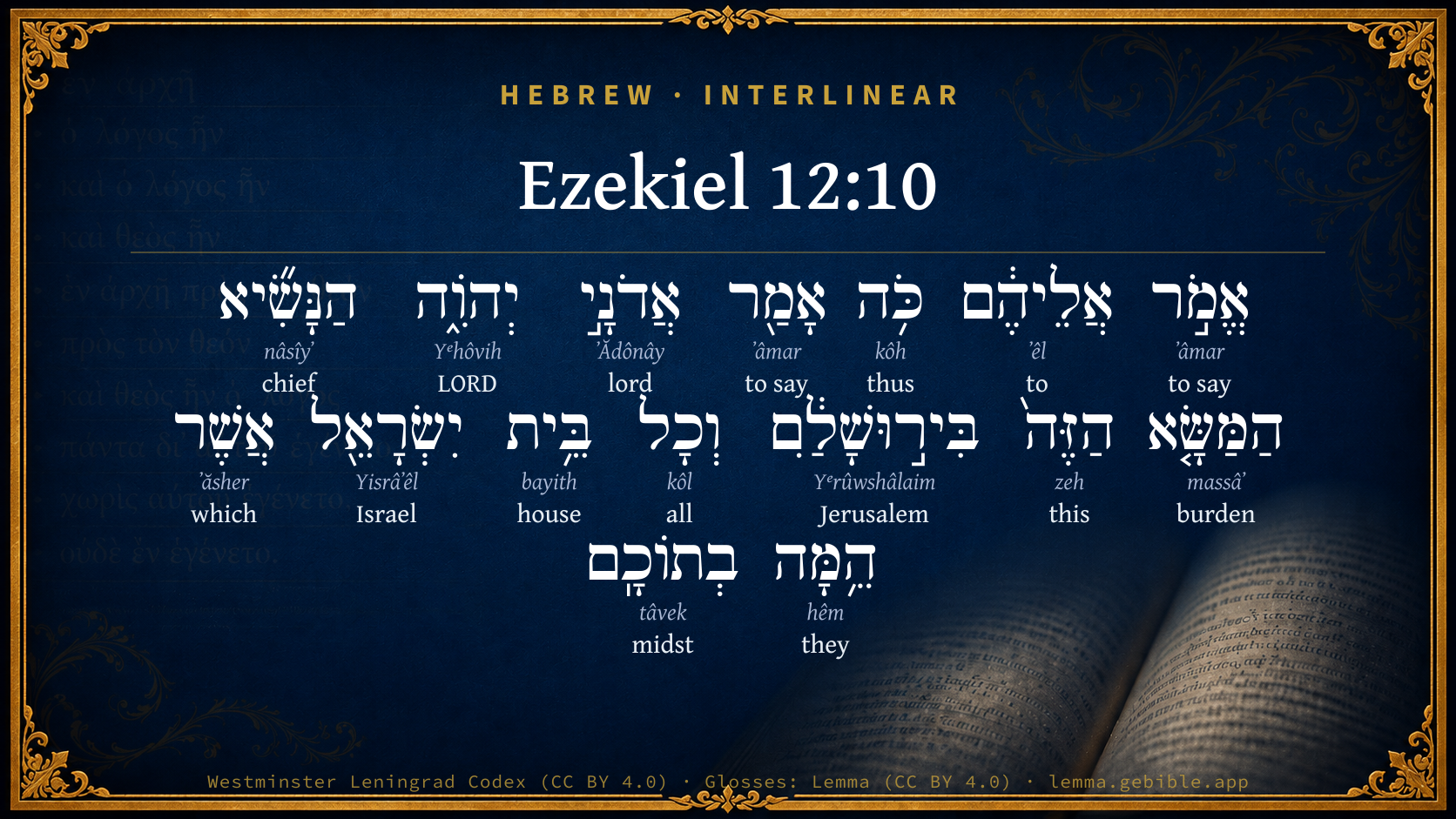
Hebrew (Westminster Leningrad Codex) Ezekiel 12:10 appears in the Hebrew Old Testament. The text above is from the Westminster Leningrad Codex. Each word links to its Strong’s number, a concise gloss, and parsing drawn from the Open Scriptures Hebrew Bible morphology. Click any word for its full Brown-Driver-Briggs (BDB) entry.
Download image
Cite this verse

Ezekiel 12:10 (World English Bible). Public Domain. Lemma interlinear Bible study tool, https://lemma.gebible.app/v/ezekiel/12/10.

Show BibTeX & RIS
BibTeX
RIS
English Translation
Say you to them, Thus says the Lord Yahweh: This burden [concerns] the prince in Jerusalem, and all the house of Israel among whom they are.
World English Bible · Public Domain
Download a study sheet

One document with this verse’s original text, its word-by-word gloss line, the meaning frame, cross-references with their text, attributed commentary, and full source and license credits — printable, and it pastes into notes with its structure intact.

This verse Autodidact and up

Study sheet (.html) Plain text (.txt)

A passage Seminary Student

Up to 50 verses in one chapter. A passage sheet keeps up to 6 commentary sources and 12 cross-references per verse, in the order this page ranks them, and says so on the sheet whenever that leaves anything out. Ask for a single verse and you get the Autodidact verse sheet above.

Everything on this page stays free to read, with no account — the sheet is a download of what is already on screen, not access to it.

Want to remove ads? Support Godless Engineer
Compare translations 3

The same verse in 3 English versions, stacked beneath the original-language interlinear above. Click any original word for its lexicon entry.

Each is an independent rendering of the whole verse — the interlinear is not word-aligned to these translations.

Highlighted words mark where these versions differ — a whole-verse word diff, not a word-by-word alignment.

  • World English Bible Public Domain
    Say you to them, Thus says the Lord Yahweh: This burden [concerns] the prince in Jerusalem, and all the house of Israel among whom they are.
  • King James Version Public Domain
    Say thou unto them, Thus saith the Lord GOD; This burden concerneth the prince in Jerusalem, and all the house of Israel that are among them.
  • unfoldingWord Literal Text CC BY-SA 4.0
    Say to them, ‘The Lord Yahweh says this: this prophetic action concerns the prince in Jerusalem, and all the house of Israel in whose midst they are.’

unfoldingWord Literal Text — © unfoldingWord, licensed CC BY-SA 4.0. Word-aligned USFM3 via Door43 (git.door43.org/unfoldingWord/en_ult).

Versions to compare (up to 4)

3 of 4 selected

Show all 18 translations

Every available English version of this verse, each an independent rendering of the whole verse.

  • World English Bible Public Domain
    Say you to them, Thus says the Lord Yahweh: This burden [concerns] the prince in Jerusalem, and all the house of Israel among whom they are.
  • Berean Standard Bible Public Domain
    Tell them that this is what the Lord GOD says: ‘This burden concerns the prince in Jerusalem and all the house of Israel who are there.’
  • Majority Standard Bible Public Domain
    Tell them that this is what the Lord GOD says: ‘This burden concerns the prince in Jerusalem and all the house of Israel who are there.’
  • King James Version Public Domain
    Say thou unto them, Thus saith the Lord GOD; This burden concerneth the prince in Jerusalem, and all the house of Israel that are among them.
  • American Standard Version (1901) Public Domain
    Say thou unto them, Thus saith the Lord Jehovah: This burden `concerneth' the prince in Jerusalem, and all the house of Israel among whom they are.
  • Revised Version (1885) Public Domain
    Say thou unto them, Thus saith the Lord GOD: This burden concerneth the prince in Jerusalem, and all the house of Israel among whom they are.
  • Geneva Bible (1599) Public Domain
    But say thou vnto them, Thus saith the Lord God, This burden concerneth the chiefe in Ierusalem, and all the house of Israel that are among them.
  • Douay-Rheims (1899) Public Domain
    Say to them: Thus saith the Lord God: This burden concerneth my prince that is in Jerusalem, and all the house of Israel, that are among them.
  • Young's Literal Translation Public Domain
    say unto them, Thus said the Lord Jehovah: `The prince `is' this burden in Jerusalem, and all the house of Israel who are in their midst.
  • Literal Standard Version CC BY-SA 4.0
    Say to them, Thus said Lord YHWH: This burden [concerns] the prince in Jerusalem, and all the house of Israel who are in their midst.
  • Unlocked Literal Bible CC BY-SA 4.0
    Say to them, 'The Lord Yahweh says this: this prophetic action concerns the prince in Jerusalem, and all the house of Israel in whose midst they are.'
  • unfoldingWord Literal Text CC BY-SA 4.0
    Say to them, ‘The Lord Yahweh says this: this prophetic action concerns the prince in Jerusalem, and all the house of Israel in whose midst they are.’
  • Darby Bible Public Domain
    Say unto them, Thus saith the Lord Jehovah: This burden [concerneth] the prince in Jerusalem, and all the house of Israel that are among them.
  • World Messianic Bible Public Domain
    “Say to them, ‘The Lord GOD says: “This burden concerns the prince in Jerusalem, and all the house of Israel among whom they are.”’
  • Webster's Bible Public Domain
    Say thou to them, Thus saith the Lord GOD, This burden concerneth the prince in Jerusalem, and all the house of Israel that are among them.
  • Free Bible Version CC BY-SA 4.0
    Tell them that this is what the Lord God says: ‘This prophetic sign concerns the prince who is ruling in Jerusalem and all the people of Israel who are living there.’
  • Bible in Basic English Public Domain
    You are to say to them, This is what the Lord has said: This word has to do with the ruler in Jerusalem and all the children of Israel in it.
  • JPS Tanakh (1917) Public Domain
    Say thou unto them: Thus saith the Lord GOD: Concerning the prince, even this burden, in Jerusalem, and all the house of Israel among whom they are,

Literal Standard Version (2020), Covenant Press — licensed CC BY-SA 4.0. Text via the HelloAO Bible API (eBible.org). Unlocked Literal Bible (unfoldingWord) — licensed CC BY-SA 4.0. Text via the HelloAO Bible API (eBible.org). unfoldingWord Literal Text — © unfoldingWord, licensed CC BY-SA 4.0. Word-aligned USFM3 via Door43 (git.door43.org/unfoldingWord/en_ult). Free Bible Version, Dr. Jonathan Gallagher — licensed CC BY-SA 4.0. Text via the HelloAO Bible API (eBible.org).

Word by word

More ways to search: Search by grammar → Find every occurrence → Compare this word →

Practice this passage: Drill this verse → Learn its vocabulary →

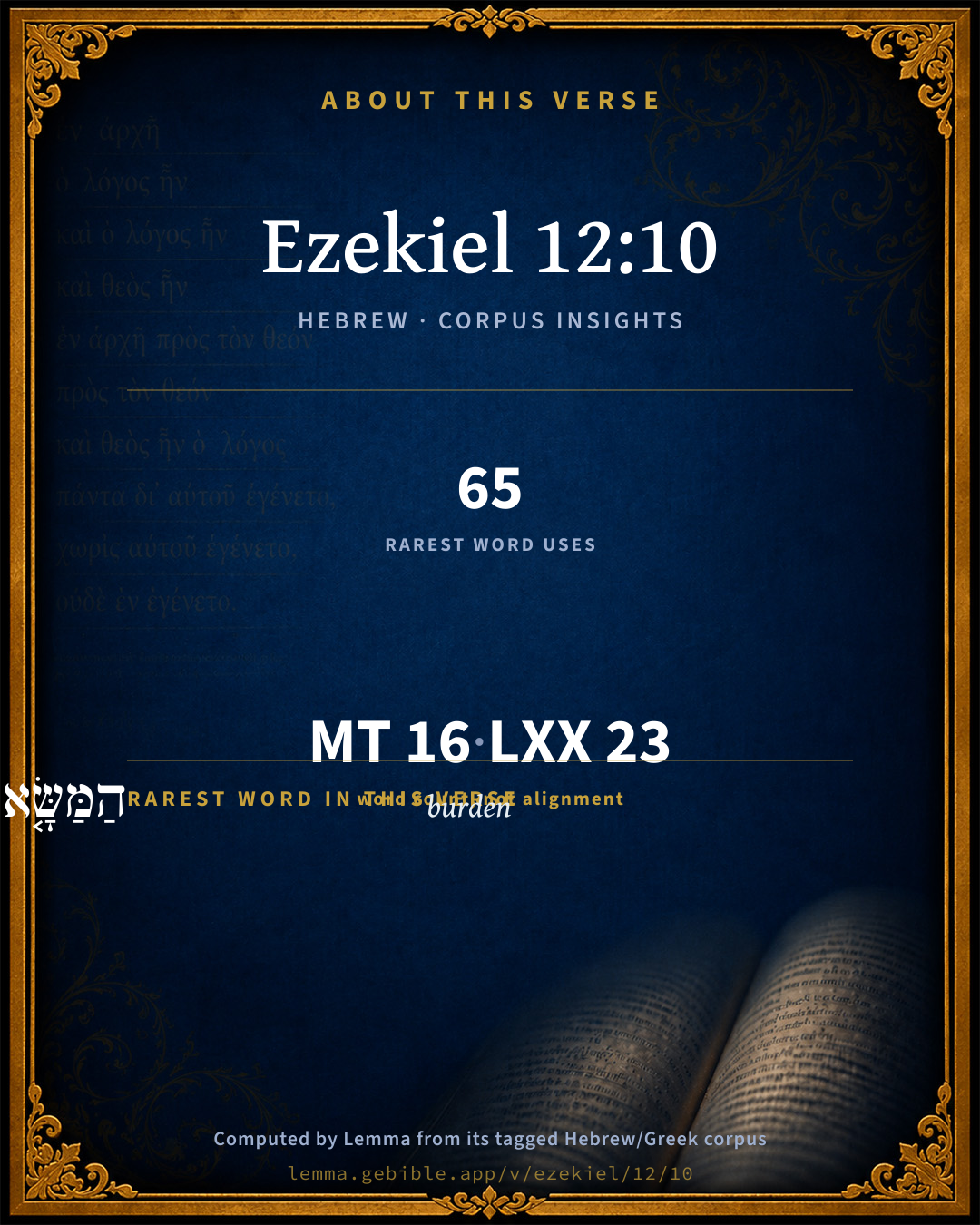
הַמַּשָּׂ֤א
massâʼ
H4853
“the · burden”
Particle, Definite Article + Noun, Common, Masculine, Singular, Absolute
Part of Speech
Particle + Noun
Type
Common
Gender
Masculine
Number
Singular
State
Absolute
Full BDB Definition

Origin: from H5375

TWOT: 1421d , 1421e

Massa = "burden" - load, bearing, tribute, burden, lifting (noun masculine) - load, burden - lifting, uplifting, that to which the soul lifts itself up - bearing, carrying - tribute, that which is carried or brought or borne - utterance, oracle, burden (noun masculine) - a son of Ishmael (noun proper masculine)
  1. אֱמֹ֣ר ʼâmar H559 “say” Verb, Qal, Imperative, 2nd Person, Masculine, Singular
  2. אֲלֵיהֶ֔ם ʼêl H413 “to · them” Preposition + Suffix, Personal, 3rd Person, Masculine, Plural
  3. כֹּ֥ה kôh H3541 “thus” Adverb
  4. אָמַ֖ר ʼâmar H559 “to say” Verb, Qal, Perfect, 3rd Person, Masculine, Singular
  5. אֲדֹנָ֣י ʼĂdônây H136 “Lord · my” Noun, Common, Masculine, Plural, Construct + Suffix, Personal, 1st Person, Common, Singular
  6. יְהֹוִ֑ה Yᵉhôvih H3069 “LORD” Noun, Proper
  7. הַנָּשִׂ֞יא nâsîyʼ H5387 “the · chief” Particle, Definite Article + Noun, Common, Masculine, Singular, Absolute
  8. הַזֶּה֙ zeh H2088 “the · this” Particle, Definite Article + Pronoun, Demonstrative, Masculine, Singular
  9. בִּיר֣וּשָׁלִַ֔ם Yᵉrûwshâlaim H3389 “in/at · Jerusalem” Preposition + Noun, Proper
  10. וְכָל kôl H3605 “and · all of” Conjunction + Noun, Common, Masculine, Singular, Construct
  11. בֵּ֥ית bayith H1004 “house of” Noun, Common, Masculine, Singular, Construct
  12. יִשְׂרָאֵ֖ל Yisrâʼêl H3478 “Israel” Noun, Proper
  13. אֲשֶׁר ʼăsher H834 “which” Particle, Relative
  14. הֵ֥מָּה hêm H1992 “they” Pronoun, Personal, 3rd Person, Masculine, Plural
  15. בְתוֹכָֽם tâvek H8432 “in/at · midst · their” Preposition + Noun, Common, Masculine, Singular, Construct + Suffix, Personal, 3rd Person, Masculine, Plural

About this verse

These counts appear in no published source. They are computed here, from the morphology-tagged text and Lemma’s own curated glosses. What Lemma adds →

16
words
15
distinct lemmas
Prophets
section

Grammatical profile

  • 2 verbs
  • 9 nouns
  • 2 pronouns
  • 1 preposition
  • 1 adverb
  • 1 particle

Verb forms

  • אֱמֹ֣ר Qal · Imperative
  • אָמַ֖ר Qal · Perfect

Repetition

A word recurs within this verse — often emphatic in Hebrew:

  • אֱמֹ֣ר to say H559 ×2

Hebrew & Septuagint length

In English translation the verse runs 26 words from the Hebrew and 29 from the Septuagint (LXX English) — closely comparable.

A rough comparison of the two English renderings, which tokenize alike — not a word-level alignment.

Word counts can differ between the Hebrew and the Greek without any difference in meaning — e.g. the Hebrew direct-object marker אֵת has no separate Greek word, and Greek often adds the article ὁ.

In the original languages it is 16 Hebrew tokens and 23 Greek tokens — but the two are counted differently (Hebrew bundles its prefixes and suffixes into one token; the Greek is in lemma form), so that isn’t a like-for-like length.

Cross-references

10

Topical passages linked to Ezekiel 12:10 in the Treasury of Scripture Knowledge — connected by theme and wording, ordered by reader-vote popularity; previews shown in the World English Bible.

  • 2 Kings 9:25 Then said [Jehu] to Bidkar his captain, Take up, and cast him in the portion of the field of Naboth the Jezreelite; for remember how that, when I and you rode together after Ahab his father, Yahweh laid this burden on him:
  • Isaiah 13:1 The burden of Babylon, which Isaiah the son of Amoz did see.
  • Isaiah 14:28 In the year that king Ahaz died was this burden.
  • Jeremiah 21:7 Afterward, says Yahweh, I will deliver Zedekiah king of Judah, and his servants, and the people, even such as are left in this city from the pestilence, from the sword, and from the famine, into the hand of Nebuchadrezzar king of Babylon, and into the hand of their enemies, and into the hand of those who seek their life: and he shall strike them with the edge of the sword; he shall not spare them, neither have pity, nor have mercy.
  • Jeremiah 24:8 As the bad figs, which can't be eaten, they are so bad, surely thus says Yahweh, So will I give up Zedekiah the king of Judah, and his princes, and the residue of Jerusalem, who remain in this land, and those who dwell in the land of Egypt,
  • Jeremiah 38:18 But if you will not go forth to the king of Babylon's princes, then shall this city be given into the hand of the Chaldeans, and they shall burn it with fire, and you shall not escape out of their hand.
  • Ezekiel 7:27 The king shall mourn, and the prince shall be clothed with desolation, and the hands of the people of the land shall be troubled: I will do to them after their way, and according to their deserts will I judge them; and they shall know that I am Yahweh.
  • Ezekiel 17:13–21 and he took of the seed royal, and made a covenant with him; he also brought him under an oath, and took away the mighty of the land;
  • Ezekiel 21:25–27 You, deadly wounded wicked one, the prince of Israel, whose day is come, in the time of the iniquity of the end,
  • Malachi 1:1 An oracle: the word of Yahweh to Israel by Malachi.

Cross-references courtesy of OpenBible.info (CC BY 4.0).

Hebrew and Greek witnesses Masoretic Hebrew ↔ Greek Septuagint

The same verse in the two great witnesses to the Old Testament, shown verse-for-verse.

These are two independent witnesses, not word-aligned to each other, and the Septuagint is shown in lemma (dictionary) form.

Hebrew Ezekiel 12:10 Masoretic · Westminster Leningrad Codex

אֱמֹ֣ר אֲלֵיהֶ֔ם כֹּ֥ה אָמַ֖ר אֲדֹנָ֣י יְהֹוִ֑ה הַנָּשִׂ֞יא הַמַּשָּׂ֤א הַזֶּה֙ בִּיר֣וּשָׁלִַ֔ם וְכָל בֵּ֥ית יִשְׂרָאֵ֖ל אֲשֶׁר הֵ֥מָּה בְתוֹכָֽם

Say you to them, Thus says the Lord Yahweh: This burden [concerns] the prince in Jerusalem, and all the house of Israel among whom they are.

World English Bible · Public Domain

Greek LXX Ezekiel 12:10 Septuagint · lemma form

εἶπον πρός αὐτός ὅδε λέγω κύριος κύριος ὁ ἄρχων καί ὁ ἀποἡγέομαι ἐν ἰερουσαλήμ καί πᾶς οἶκος ἰσραήλ ὅς εἰμί ἐν μέσος αὐτός

Say to them, Thus says the Lord God, the Prince and the Ruler in Israel, even to all the house of Israel who are in the midst of them:

LXX2012 (modern English Septuagint) · Public Domain

On this verse, John Gill's Exposition discusses the Septuagint’s reading. Read the note in Commentary ↓

Hebrew: Westminster Leningrad Codex (CC BY 4.0). Greek: Septuagint (public domain); English from LXX2012 (modern English Septuagint) (Public Domain). How the Septuagint differs from the Hebrew →

Targum (Aramaic paraphrase)

1

The Targum is the ancient Jewish Aramaic paraphrase of the Hebrew Scriptures — an interpretive translation, not the Hebrew text itself. Onkelos (literal) and Pseudo-Jonathan (expansive) render the Torah, and Jonathan the Prophets. Coverage is partial: where no permissively-licensed English translation exists for a verse, only the Aramaic is shown. This is verse-level text, not a word-by-word alignment to the Hebrew.

  1. Targum Jonathan Prophets (Joshua–Malachi)
    אֱמַר לְהוֹן כִּדְנָן אֲמַר יְיָ אֱלֹהִים עַל רַבָּא מַטַל נְבוּאֲתָא הָדָא בִירוּשְׁלֵם וְכָל בֵּית יִשְׂרָאֵל דְאִינוּן בֵּינֵיהוֹן:

    (no public-domain English translation for this verse)

    Targum Jonathan — Aramaic: “Mikraot Gedolot” (public domain). English: “Sefaria Community Translation” (CC0 1.0 (public-domain dedication)); “London "Chaldee Paraphrase," 1871” (public domain). Text via Sefaria.

Commentary

Notes on Ezekiel 12:10 from classic Christian and Jewish commentators (each source and its license shown beneath its notes). The classic Christian expositions comment on the surrounding passage and are grouped to its opening verse, so a note may address several verses; the Jewish commentaries on the Tanakh (Rashi and others) are per-verse, so they appear only where the commentator wrote on this verse.

Lemma curates 59 commentaries, every one of them public domain or Creative Commons licensed, each selected and text-cleaned for this edition rather than reprinted as found. About our sources →

The Cambridge Bible for Schools and Colleges

gen. ed. J. J. S. Perowne

10, 11. The general meaning of these verses is clear enough—the prophet’s action is a representation of what shall happen in Jerusalem in the case of prince and people, but Eze_12:10 is very obscure, and probably not in its original form.

This burden concerneth the prince] lit. the prince (is) this burden in Jerusalem. The term “burden” has also the sense of “oracle,” but Ez. does not use it in this sense and there is no reason to find any play upon the word as Jer_23:33. The allusion can only be to the last words of Eze_12:7—I bare it upon my shoulder; and the meaning would be: this bearing or loading has reference to the prince (Eze_12:12). With this sense the following words must run: and all the house of Israel which are in the midst of it (Jerusalem—with a change of one letter). The objection to this that if the relative were subject the pronoun would not be expressed after it (Hitz., Keil) is worthless. But there are other objections more valid: “all the house of Israel” could hardly be used of the inhabitants of Jerusalem, the phrase usually refers to the larger Israel, existing in all places. R.V. “this burden concerneth the prince … and all the house of Israel among whom they are;” but concerneth is said of the “prince” and of “all the house of Israel” in different senses. Notwithstanding the objections to it the easiest course is to read: in the midst of it (Jerusalem) as above. Corn. omits the verse as a gloss.

The Cambridge Bible for Schools and Colleges (gen. ed. J. J. S. Perowne; Cambridge University Press, 1878–1918) — public domain. Text from a community e-Sword module.

Trapp's Complete Commentary

John Trapp

Eze 12:10 Say thou unto them, Thus saith the Lord GOD; This burden [concerneth] the prince in Jerusalem, and all the house of Israel that [are] among them.

Ver. 10. This burden concerneth the princes in Jerusalem.] There is an elegance in the original. Princes who overburden their people shall one day have their back burden of miseries. Potentes potenter torquebuntur.

John Trapp, A Commentary or Exposition upon All the Books of the Old and New Testament (1647–1656) — public domain. Text from a community e-Sword module.

Geneva Bible (1599)

Geneva Bible translators

Or, prophecy.

Geneva Bible (1599) marginal notes — public domain. Text via Bolls.life.

Jamieson, Fausset & Brown

Robert Jamieson, A. R. Fausset & David Brown

burden--that is, weighty oracle.

the prince--The very man Zedekiah, in whom they trust for safety, is to be the chief sufferer. JOSEPHUS [Antiquities, 10.7] reports that Ezekiel sent a copy of this prophecy to Zedekiah. As Jeremiah had sent a letter to the captives at the Chebar, which was the means of calling forth at first the agency of Ezekiel, so it was natural for Ezekiel to send a message to Jerusalem confirming the warnings of Jeremiah. The prince, however, fancying a contradiction between Eze 12:13; "he shall not see Babylon," and Jer 24:8-9, declaring he should be carried to Babylon, believed neither. Seeming discrepancies in Scripture on deeper search prove to be hidden harmonies.

Jamieson, Fausset & Brown — Commentary Critical and Explanatory on the Whole Bible (1871) — public domain (CC PDM 1.0). Text via the HelloAO Bible API.

Adam Clarke's Commentary

Verse 10. This burden] This prediction concerning the prince. By this I point out the capture, misery, and ruin of Zedekiah.

Adam Clarke's Commentary on the Bible (1810–1826) — public domain. Text from a community e-Sword/MySword module.

Ellicott's Commentary for English Readers

(10) All the house of Israel.—The burden (or message of woe) was directed immediately to the king and his princes, but the people were also necessarily involved. Israel is here, as elsewhere, used. for the then existing nation, which was considered as representing the whole, although composed chiefly of the tribe of Judah.

A Bible Commentary for English Readers, edited by Charles John Ellicott (1878–1897) — public domain. Text from a community e-Sword module.

John Gill's Exposition

And the prince that is among them,.... Zedekiah their king that reigned over them, in whom they trusted, and under whose government they thought themselves safe and secure:

shall bear upon his shoulder in the twilight, and shall go forth; out of Jerusalem, where his palace and throne were, leaving the main of his riches behind him; only should carry away what he could on his shoulder, a bundle of his most valuable effects, or provisions for his flight: or, as Kimchi and Ben Melech think, his clothes, for lighter march, and more speedy haste:

they shall dig through the wall to carry out thereby; it seems by this, that when the king, and his nobles and servants, made their escape, they not only went forth between two walls, but broke through one, in order to get away; which was done, not by the king himself, but by his servants; so the Targum,

"in a wall shall they dig to bring him out by it;''

and therefore the number is changed, not "he", but "they, shall dig", &c. though in the following words the singular is again used:

he shall cover his face, that he see not the ground with his eyes; either through shame at leaving the city, his palace, and all his grandeur. The Targum is,

"he shall cover his face because he hath sinned:''

or that he might not be known and be discovered who he was; and so it was through fear of being betrayed by a false friend, or taken by the enemy: or else this may respect his having his eyes put out at Riblah, so that he could not see with them the land he was carried into; though it rather seems to refer to his first escape out of Jerusalem with a mask or vizor on him, which might hinder his seeing the ground he went upon; and which, in his fright, he could not attend to, looking out here and there, not being able to keep his eye long upon any place. The Septuagint, Vulgate Latin, and Arabic versions, render it, "that he may not be seen with the eye, and he shall not see the land".

John Gill's Exposition of the Whole Bible (1746–1763) — public domain (CC PDM 1.0). Text via the HelloAO Bible API.

Albert Barnes' Notes on the Bible

Burden - A word used to indicate a prediction of woe to be borne by some individual or people (Isa 13:1 note). Ezekiel, bearing his “stuff” on his shoulder was a sign of the weight of calamity coming upon king and people.

Albert Barnes' Notes on the Bible (1834–1885) — public domain. Text from a community e-Sword/MySword module.

Haydock's Catholic Bible Commentary

Jerusalem. The people regarded not Jeremias. This prediction would be sent to them to confirm what he said, while it would tend to keep up the spirits of those who were in captivity. (Theodoret) (Calmet) --- Israel. The people, or those of the ten tribes who had retired thither. (Menochius)

George Leo Haydock (1774–1849), Haydock's Catholic Family Bible and Commentary, 1859 edition — public domain. Excludes Psalms (Douay-Rheims chapter numbering differs from Protestant) and Deuterocanonical books (Catholic canon only).

Matthew Poole's English Annotations

Though they regard not to inquire, yet give them to know what I mean hereby.

Thus saith the Lord God: this to add weight and authority to the word.

This burden; this dreadful prognostic; this prophecy is a burden which the kingdom shall groan under, and your king and the inhabitants of Jerusalem with him.

The prince; Zedekiah.

All the house; none may be excepted.

Matthew Poole's English Annotations on the Holy Bible (1683–1685) — public domain. Text from a community e-Sword/MySword module.

Whedon's Commentary on the Bible

Daniel D. Whedon

10. This burden concerneth the prince in Jerusalem — This is a very difficult phrase. Jeremiah had already used the word “burden” for a heavy and fear-inciting utterance of Jehovah (Jer_23:33), and this may be the meaning here. Or does it mean that this bearing, or leading, has reference to the prince (Eze_12:12), David’s son? This reference to the prince must have been very dangerous to the popularity of the prophet.

Reverence for the king, “the son of David,” the “anointed of Jehovah,” was highly developed in Israel. The religion and Messianic hope of everlasting dominion seemed bound up with the Davidic dynasty. But Ezekiel, except in one doubtful passage, never calls Zedekiah king. He considered the glory of the state as well as of the temple to have departed. This so-called king is but a vassal of Nebuchadnezzar, and deserves no kingly dignity or allegiance (Skinner). He, as well as the priests and the captains, is involved in the universal guilt and must meet the penalty.

And all the house of Israel that are among them — R.V., “all the house of Israel, among whom they are,” or, all the house of Israel which is in the midst of it (Kautzsch, Davidson).

Daniel D. Whedon (gen. ed.), Commentary on the Old and New Testaments (1874–1909) — public domain. Text from a community e-Sword module.

The Pulpit Commentary

Vers. 10, 11. This burden concerneth the prince in Jerusalem; literally, the prince is this burden in Jerusalem. The word "burden," in the sense of "prophecy," so common in Isaiah and Jeremiah and other prophets, as Hosea (Hos_8:10) and Nahum, (Nah_1:1) is used by Ezekiel here only. Possibly he on the whole avoided it, as having fallen into discredit through its constant use by the false prophets, (Jer_23:33-38) and preferred the formula of "the word of Jehovah." As interpreted by Jer_39:4 and 2Ki_25:4, the "prince" is Zedekiah. Possibly Ezekiel avoided the title "king," as seeing in him one who was a ruler de facto, but not a king de jure. The facts related in Jer_39:4 exactly correspond with the symbolic act. Zedekiah and his men of war escape from the city by night, "by the way of the king"s garden, by the gate between the two walls," probably enough with faces covered, as David"s was in his flight, (2Sa_15:30) to avoid detection, or as a sign of mourning, and through some freshly made exit from the palace. The further significance of the covered face is found in the fact that Zedekiah was blinded at Riblah by Nebuchadnezzar"s orders, and from that time could not see the ground on which he trod. Those who see in every Old Testament prediction nothing but a prophecy ex eventu infer from this that this section of Ezekiel was written after the destruction of Jerusalem. I do not take that view, and place it in close connection with the preceding chapters. We note in ver. 11 the peculiar phrase," I am your sign." Ezekiel, in what he does in the presence of the exiles, is figuring that which, before long, will come to pass in Jerusalem. They were to go forth into captivity as he had gone. For they shall remove, the Revised. Version gives, they shall go into exile.

The Pulpit Commentary (1880–1919), ed. H.D.M. Spence-Jones & Joseph S. Exell — public domain. Text from a community e-Sword module.

John Wesley's Explanatory Notes

Say - Though they inquire not, yet tell them what I mean hereby, that this prophecy is a burden which the kingdom shall groan under. The prince - Zedekiah.

John Wesley, Explanatory Notes Upon the Whole Bible (1754–1765) — public domain. Text via the GEBible commentary corpus.

Scofield Reference Notes

C. I. Scofield

burden

See note 1, (See Scofield "Isa 13:1").

The Scofield Reference Bible (1917 edition), notes by C. I. Scofield — public domain. Text from a community e-Sword module.

Rashi

Rabbi Shlomo Yitzchaki (Rashi)

[Concerning] the prince is this burden Concerning King Zedekiah, I am showing this מַשָּׂא, burden, an expression denoting prophecy.

Rashi on the Tanakh — English translations: “The Judaica Press complete Tanach with Rashi, translated by A. J. Rosenberg” (CC BY 4.0); “Pentateuch with Rashi's commentary by M. Rosenbaum and A.M. Silbermann, 1929-1934” (public domain); “The Metsudah Tanach series, Lakewood, N.J” (CC BY 4.0); and “The Book of Joshua, Metsudah Publications, 1997” (CC BY 4.0). Text via Sefaria.

Lesson kit

Teaching starters — assembled from the data on this page, not authored interpretation. Every prompt links to the verse data it draws on. Edit before teaching.

Ezekiel, in the Prophets, opens this verse with 16 words (15 distinct Hebrew lemmas). Its most distinctive word is massâʼ (“burden”). A historical commentator’s framing appears above. Read the whole chapter for the surrounding context.

Discussion questions

  1. The word massâʼ carries the sense “burden.” How does it shape the verse?
  2. How does 2 Kings 9:25, which shares this passage’s theme, read alongside this verse?
  3. What does the repetition of “to say” (2× in this one verse) do in this verse?
  4. These translations render this verse differently; the difference is in the English rendering, not the original. What questions does that raise?
  5. «אֱמֹ֣ר» is a Qal Imperative verb. How does that grammatical form shape the action described?
  6. Compare how The Cambridge Bible for Schools and Colleges and Trapp's Complete Commentary read this verse. Where do they agree or differ?

Things to notice

Reading settings

Reading text

Shown beneath each verse's original-language words.

Old Testament
Old Testament edition

Read the OT as the Masoretic Hebrew (MT) or the Greek Septuagint (LXX).

English shown for the Greek Septuagint (in the Hebrew ↔ Greek comparison).

Comparing translations? Open the Compare panel on any verse page to stack up to four side by side.