
Isaiah 8:7

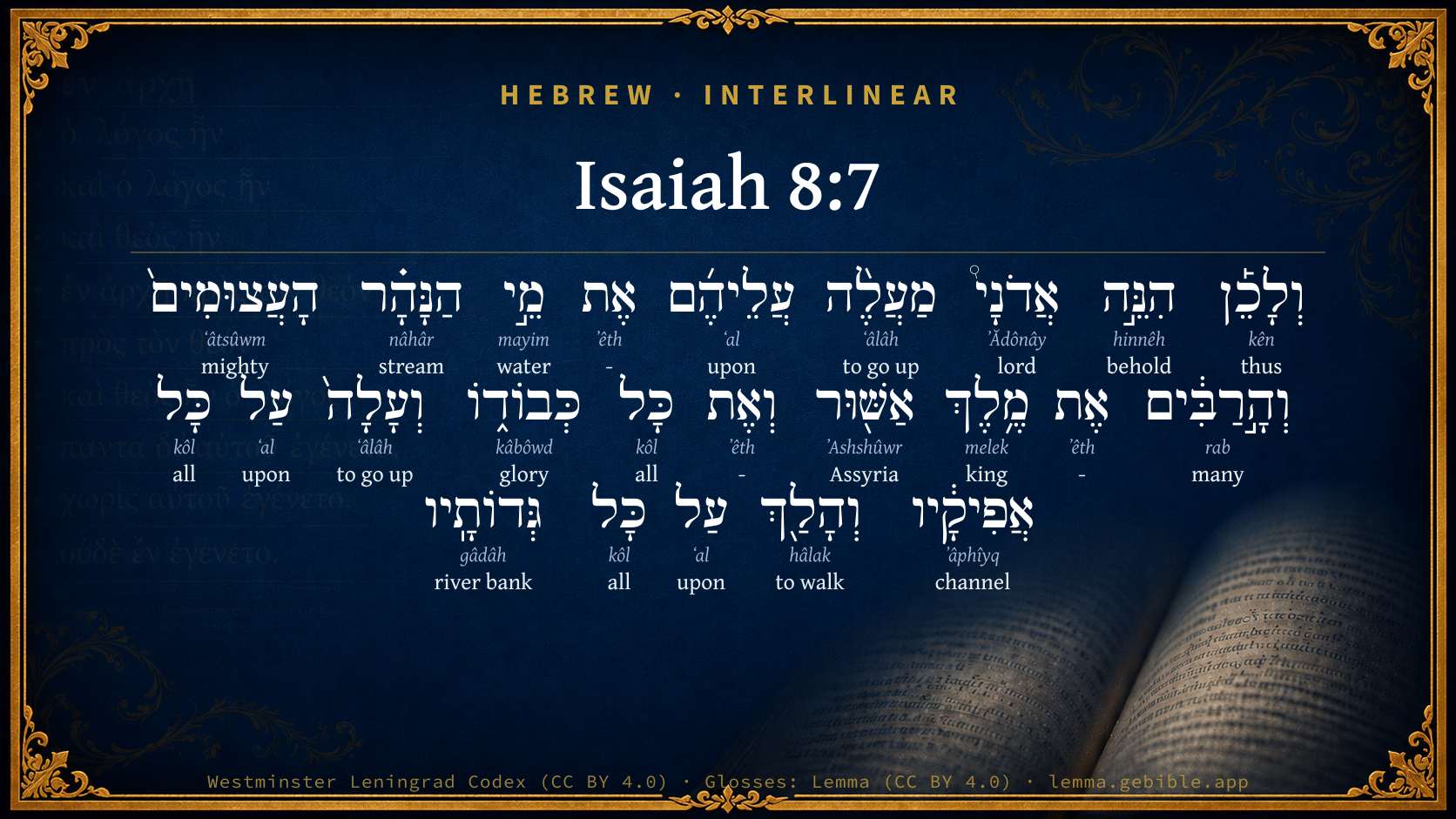
Hebrew (Westminster Leningrad Codex) Isaiah 8:7 appears in the Hebrew Old Testament. The text above is from the Westminster Leningrad Codex. Each word links to its Strong’s number, a concise gloss, and parsing drawn from the Open Scriptures Hebrew Bible morphology. Click any word for its full Brown-Driver-Briggs (BDB) entry.
Download image
Cite this verse

Isaiah 8:7 (World English Bible). Public Domain. Lemma interlinear Bible study tool, https://lemma.gebible.app/v/isaiah/8/7.

Show BibTeX & RIS
BibTeX
RIS
English Translation
now therefore, behold, the Lord brings up on them the waters of the River, strong and many, [even] the king of Assyria and all his glory: and it shall come up over all its channels, and go over all its banks;
World English Bible · Public Domain
Download a study sheet

One document with this verse’s original text, its word-by-word gloss line, the meaning frame, cross-references with their text, attributed commentary, and full source and license credits — printable, and it pastes into notes with its structure intact.

This verse Autodidact and up

Study sheet (.html) Plain text (.txt)

A passage Seminary Student

Up to 50 verses in one chapter. A passage sheet keeps up to 6 commentary sources and 12 cross-references per verse, in the order this page ranks them, and says so on the sheet whenever that leaves anything out. Ask for a single verse and you get the Autodidact verse sheet above.

Everything on this page stays free to read, with no account — the sheet is a download of what is already on screen, not access to it.

Want to remove ads? Support Godless Engineer
Compare translations 3

The same verse in 3 English versions, stacked beneath the original-language interlinear above. Click any original word for its lexicon entry.

Each is an independent rendering of the whole verse — the interlinear is not word-aligned to these translations.

Highlighted words mark where these versions differ — a whole-verse word diff, not a word-by-word alignment.

  • World English Bible Public Domain
    now therefore, behold, the Lord brings up on them the waters of the River, strong and many, [even] the king of Assyria and all his glory: and it shall come up over all its channels, and go over all its banks;
  • King James Version Public Domain
    Now therefore, behold, the Lord bringeth up upon them the waters of the river, strong and many, even the king of Assyria, and all his glory: and he shall come up over all his channels, and go over all his banks:
  • unfoldingWord Literal Text CC BY-SA 4.0
    so therefore, behold, the Lord is bringing up against them the waters of the River, mighty and many—the king of Assyria and all of his glory. And it will go up over all of its channels and go over all of its banks,

unfoldingWord Literal Text — © unfoldingWord, licensed CC BY-SA 4.0. Word-aligned USFM3 via Door43 (git.door43.org/unfoldingWord/en_ult).

Versions to compare (up to 4)

3 of 4 selected

Show all 18 translations

Every available English version of this verse, each an independent rendering of the whole verse.

  • World English Bible Public Domain
    now therefore, behold, the Lord brings up on them the waters of the River, strong and many, [even] the king of Assyria and all his glory: and it shall come up over all its channels, and go over all its banks;
  • Berean Standard Bible Public Domain
    the Lord will surely bring against them the mighty floodwaters of the Euphrates—the king of Assyria and all his pomp. It will overflow its channels and overrun its banks.
  • Majority Standard Bible Public Domain
    the Lord will surely bring against them the mighty floodwaters of the Euphrates—the king of Assyria and all his pomp. It will overflow its channels and overrun its banks.
  • King James Version Public Domain
    Now therefore, behold, the Lord bringeth up upon them the waters of the river, strong and many, even the king of Assyria, and all his glory: and he shall come up over all his channels, and go over all his banks:
  • American Standard Version (1901) Public Domain
    now therefore, behold, the Lord bringeth up upon them the waters of the River, strong and many, `even' the king of Assyria and all his glory: and it shall come up over all its channels, and go over all its banks;
  • Revised Version (1885) Public Domain
    now therefore, behold, the Lord bringeth up upon them the waters of the River, strong and many, even the king of Assyria and all his glory: and he shall come up over all his channels, and go over all his banks:
  • Geneva Bible (1599) Public Domain
    Nowe therefore, beholde, the Lord bringeth vp vpon them the waters of the Riuer mightie and great, euen the King of Asshur with all his glory, and he shall come vp vpon all their riuers, and goe ouer all their banks,
  • Douay-Rheims (1899) Public Domain
    Therefore behold the Lord will bring upon them the waters of the river strong and many, the king of the Assyrians, and all his glory: and he shall come up over all his channels, and shall overflow all his banks,
  • Young's Literal Translation Public Domain
    Therefore, lo, the Lord is bringing up on them, The waters of the river, the mighty and the great, (The king of Asshur, and all his glory,) And it hath gone up over all its streams, And hath gone on over all its banks.
  • Literal Standard Version CC BY-SA 4.0
    Therefore, behold, the Lord is bringing up on them, || The waters of the river, the mighty and the great || (The king of Asshur, and all his glory), || And it has gone up over all its streams, || And has gone on over all its banks.
  • Unlocked Literal Bible CC BY-SA 4.0
    therefore the Lord is about to bring up on them the waters of the River, mighty and many, the king of Assyria and all his glory. It will come up over all its channels and overflow its banks.
  • unfoldingWord Literal Text CC BY-SA 4.0
    so therefore, behold, the Lord is bringing up against them the waters of the River, mighty and many—the king of Assyria and all of his glory. And it will go up over all of its channels and go over all of its banks,
  • Darby Bible Public Domain
    therefore behold, the Lord will bring up upon them the waters of the river, strong and many, the king of Assyria and all his glory; and he shall mount up over all his channels, and go over all his banks:
  • World Messianic Bible Public Domain
    now therefore, behold, the Lord brings upon them the mighty flood waters of the River: the king of Assyria and all his glory. It will come up over all its channels, and go over all its banks.
  • Webster's Bible Public Domain
    Now therefore, behold, the Lord bringeth up upon them the waters of the river, strong and many, even the king of Assyria, and all his glory: and he shall come up over all its channels, and go over all its banks:
  • Free Bible Version CC BY-SA 4.0
    the Lord is going to bring the powerful floodwaters of the Euphrates River against them—the king of Assyria with all his glorious army. It will flood all its channels and overflow all its banks.
  • Bible in Basic English Public Domain
    For this cause the Lord is sending on them the waters of the River, deep and strong, even the king of Assyria and all his glory: and it will come up through all its streams, overflowing all its edges:
  • JPS Tanakh (1917) Public Domain
    Now therefore, behold, the Lord bringeth up upon them the waters of the River, mighty and many, even the king of Assyria and all his glory; and he shall come up over all his channels, and go over all his banks;

Literal Standard Version (2020), Covenant Press — licensed CC BY-SA 4.0. Text via the HelloAO Bible API (eBible.org). Unlocked Literal Bible (unfoldingWord) — licensed CC BY-SA 4.0. Text via the HelloAO Bible API (eBible.org). unfoldingWord Literal Text — © unfoldingWord, licensed CC BY-SA 4.0. Word-aligned USFM3 via Door43 (git.door43.org/unfoldingWord/en_ult). Free Bible Version, Dr. Jonathan Gallagher — licensed CC BY-SA 4.0. Text via the HelloAO Bible API (eBible.org).

Word by word

More ways to search: Search by grammar → Find every occurrence → Compare this word →

Practice this passage: Drill this verse → Learn its vocabulary →

גְּדוֹתָֽיו
gâdâh
H1415
“river banks · his”
Noun, Common, Feminine, Plural, Construct + Suffix, Personal, 3rd Person, Masculine, Singular
Part of Speech
Noun
Type
Common
Gender
Feminine
Number
Plural
State
Construct
Full BDB Definition

Origin: from an unused root (meaning to cut off)

TWOT: 314a

a river bank
  1. וְלָכֵ֡ן kên H3651 “and · to/for · thus” Conjunction + Preposition + Adverb
  2. הִנֵּ֣ה hinnêh H2009 “behold” Particle, Demonstrative
  3. אֲדֹנָי֩ ʼĂdônây H136 “Lord · my” Noun, Common, Masculine, Plural, Construct + Suffix, Personal, 1st Person, Common, Singular
  4. מַעֲלֶ֨ה ʻâlâh H5927 “going up” Verb, Hiphil, Participle Active, Masculine, Singular, Absolute
  5. עֲלֵיהֶ֜ם ʻal H5921 “upon · them” Preposition + Suffix, Personal, 3rd Person, Masculine, Plural
  6. אֶת ʼêth H853 “-” Particle, Direct Object
  7. מֵ֣י mayim H4325 “water(s) of” Noun, Common, Masculine, Plural, Construct
  8. הַנָּהָ֗ר nâhâr H5104 “the · stream” Particle, Definite Article + Noun, Common, Masculine, Singular, Absolute
  9. הָעֲצוּמִים֙ ʻâtsûwm H6099 “the · mighty” Particle, Definite Article + Adjective, Adjective, Masculine, Plural, Absolute
  10. וְהָ֣רַבִּ֔ים rab H7227 “and · the · many” Conjunction + Particle, Definite Article + Adjective, Adjective, Masculine, Plural, Absolute
  11. אֶת ʼêth H853 “-” Particle, Direct Object
  12. מֶ֥לֶךְ melek H4428 “king of” Noun, Common, Masculine, Singular, Construct
  13. אַשּׁ֖וּר ʼAshshûwr H804 “Assyria” Noun, Proper
  14. וְאֶת ʼêth H853 “and · -” Conjunction + Particle, Direct Object
  15. כָּל kôl H3605 “all of” Noun, Common, Masculine, Singular, Construct
  16. כְּבוֹד֑וֹ kâbôwd H3519 “glory · his” Noun, Common, Both, Singular, Construct + Suffix, Personal, 3rd Person, Masculine, Singular
  17. וְעָלָה֙ ʻâlâh H5927 “and · to go up” Conjunction + Verb, Qal, Sequential Perfect, 3rd Person, Masculine, Singular
  18. עַל ʻal H5921 “upon” Preposition
  19. כָּל kôl H3605 “all of” Noun, Common, Masculine, Singular, Construct
  20. אֲפִיקָ֔יו ʼâphîyq H650 “channels · his” Noun, Common, Masculine, Plural, Construct + Suffix, Personal, 3rd Person, Masculine, Singular
  21. וְהָלַ֖ךְ hâlak H1980 “and · to walk” Conjunction + Verb, Qal, Sequential Perfect, 3rd Person, Masculine, Singular
  22. עַל ʻal H5921 “upon” Preposition
  23. כָּל kôl H3605 “all of” Noun, Common, Masculine, Singular, Construct

About this verse

These counts appear in no published source. They are computed here, from the morphology-tagged text and Lemma’s own curated glosses. What Lemma adds →

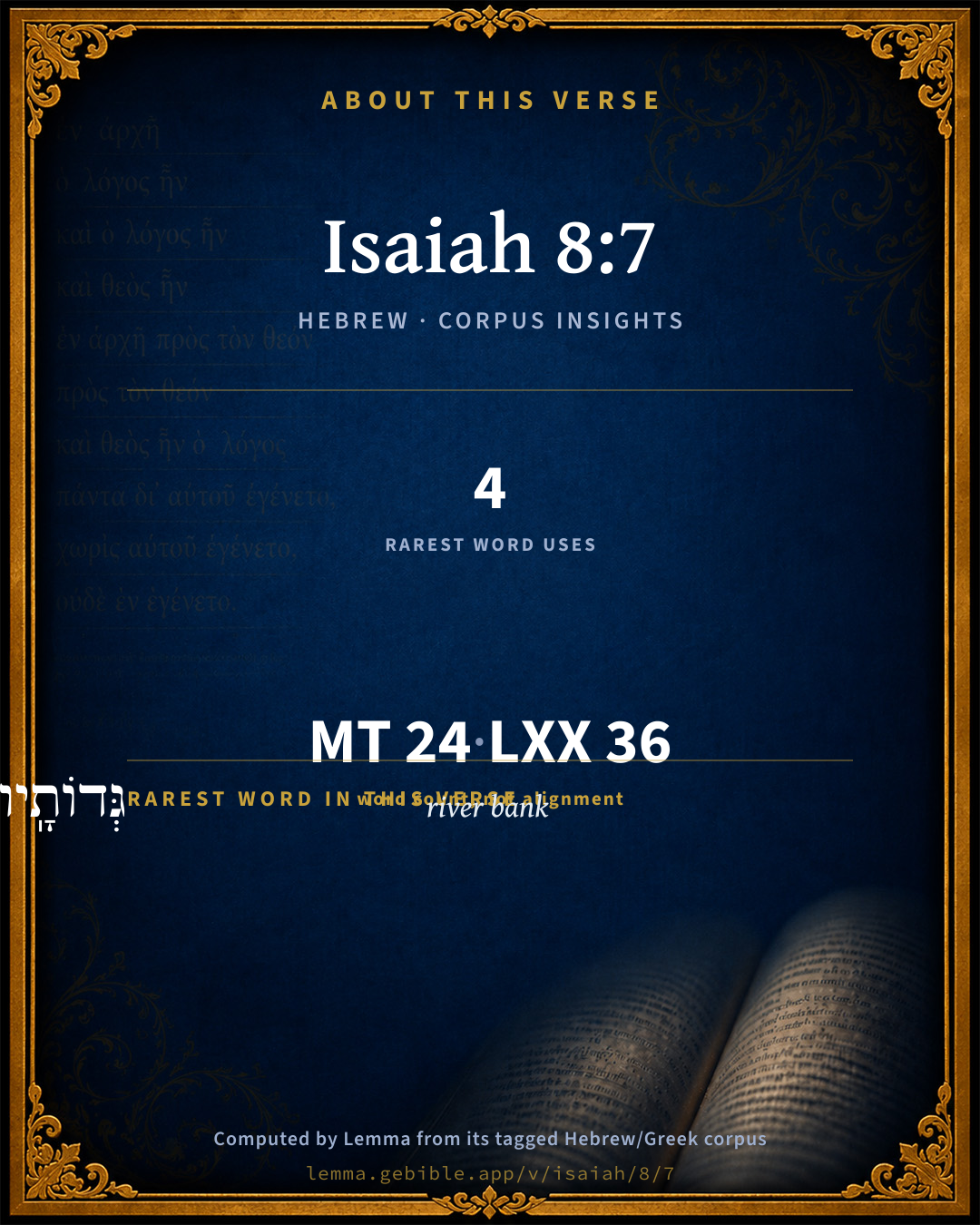
24
words
17
distinct lemmas
Prophets
section

Notable vocabulary

The rarest word here is גְּדוֹתָֽיו river bank H1415 — appearing just 4 times in the whole Hebrew Bible.

Shared distinctive vocabulary

גְּדוֹתָֽיו river bank H1415 occurs in 4 verses of the Hebrew Bible. Also found in:

Grammatical profile

  • 3 verbs
  • 11 nouns
  • 2 adjectives
  • 3 prepositions
  • 1 adverb
  • 4 particles

Verb forms

  • מַעֲלֶ֨ה Hiphil · Participle Active
  • וְעָלָה֙ Qal · Sequential Perfect
  • וְהָלַ֖ךְ Qal · Sequential Perfect

Repetition

Words recur within this verse — often emphatic in Hebrew:

  • עֲלֵיהֶ֜ם upon H5921 ×3
  • כָּל all H3605 ×3
  • מַעֲלֶ֨ה to go up H5927 ×2

Hebrew & Septuagint length

In English translation the verse runs 41 words from the Hebrew and 43 from the Septuagint (LXX English) — closely comparable.

A rough comparison of the two English renderings, which tokenize alike — not a word-level alignment.

Word counts can differ between the Hebrew and the Greek without any difference in meaning — e.g. the Hebrew direct-object marker אֵת has no separate Greek word, and Greek often adds the article ὁ.

In the original languages it is 24 Hebrew tokens and 36 Greek tokens — but the two are counted differently (Hebrew bundles its prefixes and suffixes into one token; the Greek is in lemma form), so that isn’t a like-for-like length.

Cross-references

24

Topical passages linked to Isaiah 8:7 in the Treasury of Scripture Knowledge — connected by theme and wording, ordered by reader-vote popularity; previews shown in the World English Bible.

  • Isaiah 17:12–13 Ah, the uproar of many peoples, who roar like the roaring of the seas; and the rushing of nations, that rush like the rushing of mighty waters!
  • Genesis 6:17 I, even, I do bring the flood of waters on this earth, to destroy all flesh having the breath of life from under the sky. Everything that is in the earth will die.
  • Isaiah 7:17 Yahweh will bring on you, on your people, and on your father's house, days that have not come, from the day that Ephraim departed from Judah; even the king of Assyria.
  • Isaiah 7:20 In that day the Lord will shave with a razor that is hired in the parts beyond the River, even with the king of Assyria, the head and the hair of the feet; and it shall also consume the beard.
  • Amos 8:8 Won't the land tremble for this, And everyone mourn who dwells in it? Yes, it will rise up wholly like the River; And it will be stirred up and sink again, like the River of Egypt.
  • Amos 9:5 For the Lord, Yahweh of Hosts, is he who touches the land and it melts, and all who dwell in it will mourn; and it will rise up wholly like the River, and will sink again, like the River of Egypt.
  • Deuteronomy 28:49–52 Yahweh will bring a nation against you from far, from the end of the earth, as the eagle flies; a nation whose language you shall not understand;
  • 2 Kings 17:3–6 Against him came up Shalmaneser king of Assyria; and Hoshea became his servant, and brought him tribute.
  • 2 Kings 18:9–12 It happened in the fourth year of king Hezekiah, which was the seventh year of Hoshea son of Elah king of Israel, that Shalmaneser king of Assyria came up against Samaria, and besieged it.
  • Psalms 72:8 He shall have dominion also from sea to sea, From the River to the ends of the earth.
  • Isaiah 7:1–6 It happened in the days of Ahaz the son of Jotham, the son of Uzziah, king of Judah, that Rezin the king of Syria, and Pekah the son of Remaliah, king of Israel, went up to Jerusalem to war against it, but could not prevail against it.
  • Isaiah 10:8–14 For he says, Aren't my princes all of them kings?
  • Isaiah 28:17 I will make justice the line, and righteousness the plummet; and the hail shall sweep away the refuge of lies, and the waters shall overflow the hiding-place.
  • Isaiah 59:19 So shall they fear the name of Yahweh from the west, and his glory from the rising of the sun; for he will come as a rushing stream, which the breath of Yahweh drives.
  • Jeremiah 46:7–8 Who is this who rises up like the Nile, whose waters toss themselves like the rivers?
  • Ezekiel 31:3–18 Behold, the Assyrian was a cedar in Lebanon with beautiful branches, and with a forest-like shade, and of high stature; and its top was among the thick boughs.
  • Daniel 9:26 After the sixty-two weeks the Anointed One shall be cut off, and shall have nothing: and the people of the prince who shall come shall destroy the city and the sanctuary; and the end of it shall be with a flood, and even to the end shall be war; desolations are determined.
  • Daniel 11:10 His sons shall war, and shall assemble a multitude of great forces, which shall come on, and overflow, and pass through; and they shall return and war, even to his fortress.
  • Daniel 11:22 The overwhelming forces shall be overwhelmed from before him, and shall be broken; yes, also the prince of the covenant.
  • Nahum 1:8 But with an overflowing flood, he will make a full end of her place, and will pursue his enemies into darkness.
  • Revelation 12:15–16 The serpent spewed water out of his mouth after the woman like a river, that he might cause her to be carried away by the stream.
  • Revelation 17:15 He said to me, "The waters which you saw, where the prostitute sits, are peoples, multitudes, nations, and languages.
  • Ezra 4:10 and the rest of the nations whom the great and noble Osnappar brought over, and set in the city of Samaria, and in the rest [of the country] beyond the River, and so forth.
  • Luke 6:48 He is like a man building a house, who dug and went deep, and laid a foundation on the rock. When a flood arose, the stream broke against that house, and could not shake it, because it was founded on the rock.

Cross-references courtesy of OpenBible.info (CC BY 4.0).

Hebrew and Greek witnesses Masoretic Hebrew ↔ Greek Septuagint

The same verse in the two great witnesses to the Old Testament, shown verse-for-verse.

These are two independent witnesses, not word-aligned to each other, and the Septuagint is shown in lemma (dictionary) form.

Hebrew Isaiah 8:7 Masoretic · Westminster Leningrad Codex

וְלָכֵ֡ן הִנֵּ֣ה אֲדֹנָי֩ מַעֲלֶ֨ה עֲלֵיהֶ֜ם אֶת מֵ֣י הַנָּהָ֗ר הָעֲצוּמִים֙ וְהָ֣רַבִּ֔ים אֶת מֶ֥לֶךְ אַשּׁ֖וּר וְאֶת כָּל כְּבוֹד֑וֹ וְעָלָה֙ עַל כָּל אֲפִיקָ֔יו וְהָלַ֖ךְ עַל כָּל גְּדוֹתָֽיו

now therefore, behold, the Lord brings up on them the waters of the River, strong and many, [even] the king of Assyria and all his glory: and it shall come up over all its channels, and go over all its banks;

World English Bible · Public Domain

Greek LXX Isaiah 8:7 Septuagint · lemma form

διά οὗτος ἰδού ἀναἄγω κύριος ἐπί σύ ὁ ὕδωρ ὁ ποταμός ὁ ἰσχυρός καί ὁ πολύς ὁ βασιλεύς ὁ ἀσσύριος καί ὁ δόξα αὐτός καί ἀναβαίνω ἐπί πᾶς φάραγξ σύ καί περιπατέω ἐπί πᾶς τεῖχος σύ

therefore, behold, the Lord brings up upon you the water of the river, strong and abundant, even the king of the Assyrians, and his glory: and he shall come up over every valley of yours, and shall walk over every wall of yours:

LXX2012 (modern English Septuagint) · Public Domain

Hebrew: Westminster Leningrad Codex (CC BY 4.0). Greek: Septuagint (public domain); English from LXX2012 (modern English Septuagint) (Public Domain). How the Septuagint differs from the Hebrew →

Targum (Aramaic paraphrase)

1

The Targum is the ancient Jewish Aramaic paraphrase of the Hebrew Scriptures — an interpretive translation, not the Hebrew text itself. Onkelos (literal) and Pseudo-Jonathan (expansive) render the Torah, and Jonathan the Prophets. Coverage is partial: where no permissively-licensed English translation exists for a verse, only the Aramaic is shown. This is verse-level text, not a word-by-word alignment to the Hebrew.

  1. Targum Jonathan Prophets (Joshua–Malachi)
    בְּכֵן הָא יְיָ מַיְתֵי וּמַסִיק עֲלֵיהוֹן יַת מַשִׁרְיַת עַמְמַיָא דְסַגִיאִין כְּמֵי נַהֲרָא תַּקִיפַיָא וַחֲסִינַיָא יַת מַלְכָּא דְאַתּוּר וְיַת כָּל מַשִׁרְיָתֵיהּ וְיִסַק עַל כָּל פַּצִידוֹהִי וִיהַךְ עַל כָּל כֵּיפוֹהִי:

    Therefore, behold, the Lord is bringing, and is causing to ascend upon them, the army of the people, who are many, as the waters of a river, strong and mighty, the king of Assyria, and his army; and he shall come up over all his channels, and go over all his banks.

    Targum Jonathan — Aramaic: “Mikraot Gedolot” (public domain). English: “Sefaria Community Translation” (CC0 1.0 (public-domain dedication)); “London "Chaldee Paraphrase," 1871” (public domain). Text via Sefaria.

Commentary

Notes on Isaiah 8:7 from classic Christian and Jewish commentators (each source and its license shown beneath its notes). The classic Christian expositions comment on the surrounding passage and are grouped to its opening verse, so a note may address several verses; the Jewish commentaries on the Tanakh (Rashi and others) are per-verse, so they appear only where the commentator wrote on this verse.

Lemma curates 59 commentaries, every one of them public domain or Creative Commons licensed, each selected and text-cleaned for this edition rather than reprinted as found. About our sources →

Trapp's Complete Commentary

John Trapp

Isa 8:7 Now therefore, behold, the Lord bringeth up upon them the waters of the river, strong and many, [even] the king of Assyria, and all his glory: and he shall come up over all his channels, and go over all his banks:

Ver. 7. Wow therefore behold the Lord bringeth.] They that slighted still running Shiloah, shall have the waters of Euphrates, strong and many, to overwhelm and swallow them up. God loveth to retaliate.

Even the king of Assyria and all his glory,] i.e., His armies and forces, wherein he glorieth. See Isa 10:8; Isa 36:9.

And he shall.] Or, It shall, viz., the river Euphrates, whose exundation is here graphically described, and thereby depainted to the life; {a} the practice of tyrants in overrunning whole countries as by a deluge, as did the Assyrian of old, and as doth the great Turk at this day.

{a} Kαθ υποτυπωσιν.

John Trapp, A Commentary or Exposition upon All the Books of the Old and New Testament (1647–1656) — public domain. Text from a community e-Sword module.

Joseph Benson's Commentary

Isa 8:7-8. Now, therefore — Because the Israelites and their army, combined with the Syrians, despise the weak state of the Jews, and the kingdom of David, now brought very low, and having no such defence as can be compared to a great river, but only one that resembles a small brook that glides gently along; behold, the Lord bringeth upon them the waters of the river — Of Euphrates, often called the river, for its eminent greatness; whereby he understands the Assyrian forces, as the next words explain the metaphor, which should overwhelm the whole kingdom of Israel under Tiglath-pileser and Shalmaneser; the king of Assyria and all his glory — His numerous and puissant army, in which he gloried, Isa 10:8. He shall come up over all his channels — This great river shall overflow its own proper channels: that is, this great monarch shall not keep within his own proper bounds, but invade and overrun the whole land of Syria and Israel, as an overflowing river does the neighbouring meadows. As multitudes of people are often spoken of in Scripture under the emblem of great waters, so an invading army is very fitly represented by the inundation of a rapid river, which carries all before it, and leaves the ground waste and desolate. And he shall pass through Judah — Having overrun the land of Israel he shall invade the land of Judah, as Sennacherib did a few years after the conquest of Samaria by Shalmaneser; see 2Ki 18:9; 2Ki 18:13. And he shall reach even to the neck — So that they shall be in great danger of being destroyed. He persists in the metaphor of a river swelling so high as to reach to a man’s neck, and be ready to overwhelm him. Such was the danger of Judah’s land when Sennacherib took all the fenced cities of Judah, (2Ki 18:13,) and sent his army against the capital city of Jerusalem. The stretching out of his wings — Of his forces, or of the wings of his army, as they anciently were, and still are, called. Shall fill the breadth of thy land — Of the land of Judah, so called, because the Messiah, who is called Immanuel, (Isa 7:14,) should certainly be born, and live, and die there. And this is added emphatically for the consolation of God’s people, to assure them, that notwithstanding this dreadful scourge, yet God would make a difference between Israel and Judah; and whereas Israel should be so broken by the Assyrian, that they should not be a people, Judah should be restored, for the sake of the Messiah, to be the place of his birth and ministry, according to Gen 49:10.

Joseph Benson's Commentary on the Old and New Testaments (1811–1818) — public domain. Text from a community e-Sword module.

Tyndale Open Study Notes

Tyndale Open Resources

8:7 The mighty flood from the Euphrates River represents the invading Assyrian army (see Jer 47:2). The river would overflow all its channels when the Assyrians marched deep into Judah. This stood as a frightening contrast with the gently flowing waters of Shiloah (Isa 8:6).

Tyndale Open Study Notes — © Tyndale Open Resources, licensed CC BY-SA 4.0. Text via the HelloAO Bible API.

Geneva Bible (1599)

Geneva Bible translators

That is, the Assyrians which dwell beyond Euphrates.

Geneva Bible (1599) marginal notes — public domain. Text via Bolls.life.

Jamieson, Fausset & Brown

Robert Jamieson, A. R. Fausset & David Brown

therefore--for the reason given in Isa 8:6, the Assyrian flood, which is first to overflood Syria and Samaria, shall rise high enough to reach rebel Judah also (Isa 8:8).

the river--Euphrates swollen in spring by the melting of the snow of the Armenian mountains (compare Isa 8:6; Isa 7:20).

all his glory--Eastern kings travel with a gorgeous retinue.

channels--natural and artificial in the level region, Mesopotamia.

Jamieson, Fausset & Brown — Commentary Critical and Explanatory on the Whole Bible (1871) — public domain (CC PDM 1.0). Text via the HelloAO Bible API.

Ellicott's Commentary for English Readers

(7) The waters of the river . . .—“The river” is, as elsewhere (Jos_24:2; Jos_24:14), the Euphrates; here used (1) as the symbol of the Assyrian monarchy, as Shiloah had been of that of Judah, and (2) of the Assyrian armies that were to pour down like that river in the time of its inundations. The “channels” and “banks” describe the intended course of that army as invading Syria and Israel; but it was to overflow those banks and sweep over Judah. In the former case, the kingdoms were to be utterly submerged as by the violence of the current. In Judah, it was to reach only “to the neck,” i.e., was not to work out so utter a destruction. Jeremiah (Jer_47:2) reproduces the image.

A Bible Commentary for English Readers, edited by Charles John Ellicott (1878–1897) — public domain. Text from a community e-Sword module.

The Cambridge Bible for Schools and Colleges

gen. ed. J. J. S. Perowne

7. Now therefore] lit. “and therefore,” introducing the apodosis; a combination not found elsewhere.

bringeth up upon them] Not North Israel, but Judah, “this people.”

the waters of the river] The Euphrates, explained in the next clause as a symbol of the Assyrian power. The figure of the verse is based on the fact that in summer the Euphrates overflows its banks,—an obvious emblem of the aggressive policy of the great world-power.

The Cambridge Bible for Schools and Colleges (gen. ed. J. J. S. Perowne; Cambridge University Press, 1878–1918) — public domain. Text from a community e-Sword module.

John Gill's Exposition

Now therefore the Lord bringeth up upon them the waters of the river, strong and many,.... Alluding to the river Euphrates, which ran by Babylon, which was a large river, full of water, and had a rapid torrent, and so is opposed to Shiloah and its waters; and these waters are explained as follows:

even the king of Assyria, and all his glory; his army, which was his glory, in which he gloried, and by which he got himself honour and glory. It is usual for mighty kings, kingdoms, and armies, to be signified by such waters, for their multitude and strength; see Rev 17:1,

and he shall come up over all his channels, and go over all his banks; that is, either of the land of Ephraim or Israel, and overflow the borders thereof, run over all the whole land, and possess its fortified towns and cities. The Targum is,

"therefore behold the Lord shall bring, and cause to ascend upon them, the army of the people, who are many, as the waters of a river, strong and mighty, the king of Assyria, and his army; and he shall come up upon all his rivers, and shall go upon all his banks;''

or rather "its own" (r) channels and banks, as it may be rendered; and so denotes, that the king of Assyria, and his army, should pass the Euphrates, and come out of their own land, and subdue the adjacent kingdoms and territories, and particularly the land of Judah, as follows.

(r) "omnes alvcos suos----ripas suas", Junius & Tremellius, Piscator, Cocceius.

John Gill's Exposition of the Whole Bible (1746–1763) — public domain (CC PDM 1.0). Text via the HelloAO Bible API.

Albert Barnes' Notes on the Bible

The waters of the river - By the river, in the Scripture, is commonly meant the river Euphrates, as being, by way of eminence, the largest river with which they were acquainted; and also as being that distinguished by the fact that Abraham had lived beyond it, and crossed it; see the note at Isa 7:20. In this verse the image is kept up which was commenced in Isa 8:6. The Jews rejected the gentle waters of Siloah, and sought the alliance of a foreign king, whose kingdom stretched along, and extended beyond the Euphrates. It was natural, therefore, to compare the invasion of the land to the overflowing of mighty waters that would sweep everything away. A similar comparison is found in Juvenal, who, in describing the introduction of Eastern customs into Rome, represents the Orontes as flowing into the Tiber: Jampridem Syrus in Tiberim defluxit Orontes. The comparison of an invading army with an overflowing stream, or an inundation, is not uncommon; see Lucan’s Phars. vi. 272. Hor. Car. iv. 14, 15ff.

Strong and many - Violent waves, and numerous. It means that a mighty host would come up upon the land.

Even the king of Assyria - It has been supposed by many that this is a gloss, or explanation, which has crept into the text. There is no doubt that it expresses the true sense of the passage, but it is remarkable that Isaiah himself should furnish a literal explanation in the midst of a figurative description.

And all his glory - Eastern kings marched in the midst of vast splendor. They moved with all the magnificence of the court, and were attended usually with their princes and nobles; with a splendid retinue; and with all the insignia of royalty. Such was the case with Xerxes when he invaded Greece; and such, too, with Darius, and with most of the Oriental conquerors.

And he shall come up ... - The figure of overflowing waters is here retained. To understand this, it is necessary to remark, that the Euphrates annually overflows its banks to a very considerable extent. It rises in the mountains of Armenia, and, flowing for a considerable distance in a region where the mountains are covered with snow, it falls into the level region of Mesopotamia or Syria, and flows through that region, almost parallel with the Tigris, toward the Persian Gulf. From its banks, vast numbers of canals were made, as in Egypt, to receive the water, and to render the country fertile. By the melting of the snows in Armenia, in the summer, the stream becomes greatly enlarged, and overflows vast portions of the adjacent country in a manner similar to the Nile. Usually the river is not very large. Otho says, that on the 12th of March, when he crossed the Euphrates, it was not more than 200 paces in width, but in its height, it extends 500 or 600 paces into the plains on the right. Thevenot observes, that near to Bir, the Euphrates seemed no larger than the Seine at Paris, but was very large when it was swollen. At Babylon, it is said to be about four hundred feet in breadth. That it overflows its banks, is abundantly attested by ancient as well as modern travelers; see Rosenmuller and Gesenius on this verse.

Its channels - This word means either brooks, or valleys, or canals, or channels of a river. The Euphrates flowed through a level region, and it is not improbable that it had at various times made for itself many channels. Besides this, there were many canals cut in various directions to convey its waters to the gardens, farms, etc. All these the prophet says would be full - and the water would extend even far beyond them.

Albert Barnes' Notes on the Bible (1834–1885) — public domain. Text from a community e-Sword/MySword module.

Haydock's Catholic Bible Commentary

River. Euphrates, (Calmet) with the overflowing of which the Assyrian is compared. (Haydock)

George Leo Haydock (1774–1849), Haydock's Catholic Family Bible and Commentary, 1859 edition — public domain. Excludes Psalms (Douay-Rheims chapter numbering differs from Protestant) and Deuterocanonical books (Catholic canon only).

Matthew Poole's English Annotations

Therefore; because they despise the opposition which they have from Shiloah and Jerusalem, they shall have a more potent enemy.

Upon them; upon Israel. See on the foregoing verse. Of the river of Euphrates, oft called

the river, for its eminent greatness; whereby he understands the Assyrian forces, as the next words explain the metaphor.

All his glory; his numerous and puissant army, in which he gloried. See Isa 10:8.

He shall come up over all his channels; this great river shall overflow its own proper channels. The meaning is, This great monarch shall enlarge his dominions, and add the lands of Syria and Israel to them. Some render the words, he shall come up with all his channels or streams; for the Hebrew particle all sometimes signifies with, as Job 38:30. But it seems hard to understand the same particle one way in this clause, and another in the last clause. Besides, the last clause favours the former interpretation, the same thing being repeated in it, as is usual in the sacred writings. Or this may be understood of the channels and banks of the people or land of Israel. The enemy being represented under the metaphor of a river breaking in upon their land, may fitly be said to overflow all their channels and banks, to wit, all places, both low and high, so that nothing shall be able to withstand his fury.

Matthew Poole's English Annotations on the Holy Bible (1683–1685) — public domain. Text from a community e-Sword/MySword module.

Whedon's Commentary on the Bible

Daniel D. Whedon

7. Therefore — As a direct consequence.

The Lord bringeth up upon them — By his willing permission they come, because all else has failed to correct and reform.

Waters of… river — Literally, the Euphrates; figuratively, the multitude of the invading army.

Strong and many — Expressive both of power and number. The Lord is about to permit the great nation to overrun Syria and Israel, and Judah too, in good time.

Daniel D. Whedon (gen. ed.), Commentary on the Old and New Testaments (1874–1909) — public domain. Text from a community e-Sword module.

The Pulpit Commentary

The waters of the river, strong and many. "The river" is, of course, the Euphrates, as in Isa_7:20. In its lower course the Euphrates often overflows its banks, and inundates the adjacent districts, causing vast damage to crops, and some-limes threatening to break down the walls of cities (Loftus, "Chaldea and Susiana," p. 7). It is scarcely likely, however, that Isaiah had any acquaintance with this fact. His experience would probably have been limited to the "swellings of Jordan". (Jer_12:5; comp. Jos_3:15) All his glory. (comp. Isa_10:12, Isa_10:16, Isa_10:18, etc.) He shall come up over all his channels. A graphic description of the swelling of rivers in the East. These, when they are low, contract their waters from the many channels, in which they ordinarily flow, into some one or two, leaving the others dry. The first effect of a flood is to fill all the channels, after which it may proceed further and overflow the banks.

The Pulpit Commentary (1880–1919), ed. H.D.M. Spence-Jones & Joseph S. Exell — public domain. Text from a community e-Sword module.

John Wesley's Explanatory Notes

The river - Of Euphrates, called the river, for its eminent greatness; whereby he understands the Assyrian forces. Glory - His numerous and puissant army. He - This great river shall overflow its own proper channels. That is, this great monarch shall enlarge his dominions, and add the lands of Syria and Israel to them.

John Wesley, Explanatory Notes Upon the Whole Bible (1754–1765) — public domain. Text via the GEBible commentary corpus.

J. A. Alexander on Isaiah

Joseph Addison Alexander

“Therefore (because the people had thus ceased to trust in the divine protection, and rejoiced in the success of their application to Assyria), behold (as if the event were actually present), Jehovah (is) bringing up upon them the waters of the river (i.e., the Euphrates, as an emblem of the Assyrian power), its strong and many waters (here contrasted with the gently flowing waters of Siloam), to wit, the king of Assyria and all his glory (with particular reference to military strength and display), and it (the river) shall come up over all its channels and go over all its banks,” which may either mean that it shall transcend its usual limits, or that after submerging Israel, it shall overflow into Judah also. In favor of this last interpretation is the language of the next verse, and the fact that otherwise the punishment of Ephraim or the ten tribes is not expressly mentioned. The figure of an overflowing river is peculiarly appropriate, not only as affording a striking antithesis to the fountain mentioned in the sixth verse, but because it is often used absolutely to denote the Euphrates, the great river of the Assyrian and Babylonian empires. The beauty of the metaphor is rendered still more striking by the frequent allusions, both in ancient and modern writers, to the actual inundation of this river. Here, as in Isa 7:17-18, the figures are explained in literal expressions by the Prophet himself.

Joseph Addison Alexander, The Prophecies of Isaiah (1846–1847; New York: Scribner, 1870–1878) — public domain. Text from a community e-Sword module.

Rashi

Rabbi Shlomo Yitzchaki (Rashi)

and it will overflow [i.e.,] the river [will overflow].

and all its distributaries Its waters will surge to rise over all the distributaries of the outflow of its waters.

and go over the swelling river [will go] over all its banks its high banks. Those are its upright banks in the place where the river flows between its upright banks, and it is like within a gutter.

Rashi on the Tanakh — English translations: “The Judaica Press complete Tanach with Rashi, translated by A. J. Rosenberg” (CC BY 4.0); “Pentateuch with Rashi's commentary by M. Rosenbaum and A.M. Silbermann, 1929-1934” (public domain); “The Metsudah Tanach series, Lakewood, N.J” (CC BY 4.0); and “The Book of Joshua, Metsudah Publications, 1997” (CC BY 4.0). Text via Sefaria.

Ibn Ezra

Rabbi Abraham ibn Ezra

Upon them. Upon the men of Judah, that conspired against Ahaz.

אפיקיו Its rapid parts. — comp. Ps. 42:2, Song 5:12 — or banks, according to the context.

גדותיו its banks; some supply; ר comp. שרשות ═ שרשרות (Exod. 28:14, 22), but this is a mistaken inference, for in שרשרות it is the ר of reduplication which is dropped in שרשת; the root is שרש, but we have no instance where a radical ר is dropped, since it does not belong to the silent letters.

Ibn Ezra on the Tanakh — English translations: “Sefaria Community Translation” (CC0 1.0 (public-domain dedication)); “Yalkut, Sifsei Chachomim Chumash, Metsudah Publications, 2009” (CC BY 4.0); and “Commentary of Ibn Ezra on Isaiah - trans. by M. Friedlander, 1873” (public domain). Text via Sefaria.

Lesson kit

Teaching starters — assembled from the data on this page, not authored interpretation. Every prompt links to the verse data it draws on. Edit before teaching.

Isaiah, in the Prophets, opens this verse with 24 words (17 distinct Hebrew lemmas). Its most distinctive word is gâdâh (“river bank”). A historical commentator’s framing appears above. Read the whole chapter for the surrounding context.

Discussion questions

  1. The word gâdâh carries the sense “river bank.” How does it shape the verse?
  2. Joshua 3:15 shares the word «river bank» with this verse. How do the two illuminate each other?
  3. “upon” occurs 3× in this one verse. What is the effect of the repetition?
  4. These translations render this verse differently. What is at stake in choosing one wording over another?
  5. The verb «מַעֲלֶ֨ה» is Hiphil Participle Active. How does its form color the action?
  6. Reading how Trapp's Complete Commentary and Joseph Benson's Commentary read this verse, where do the two commentators agree and where do they part?

Things to notice

Reading settings

Reading text

Shown beneath each verse's original-language words.

Old Testament
Old Testament edition

Read the OT as the Masoretic Hebrew (MT) or the Greek Septuagint (LXX).

English shown for the Greek Septuagint (in the Hebrew ↔ Greek comparison).

Comparing translations? Open the Compare panel on any verse page to stack up to four side by side.