Ezekiel 11:21

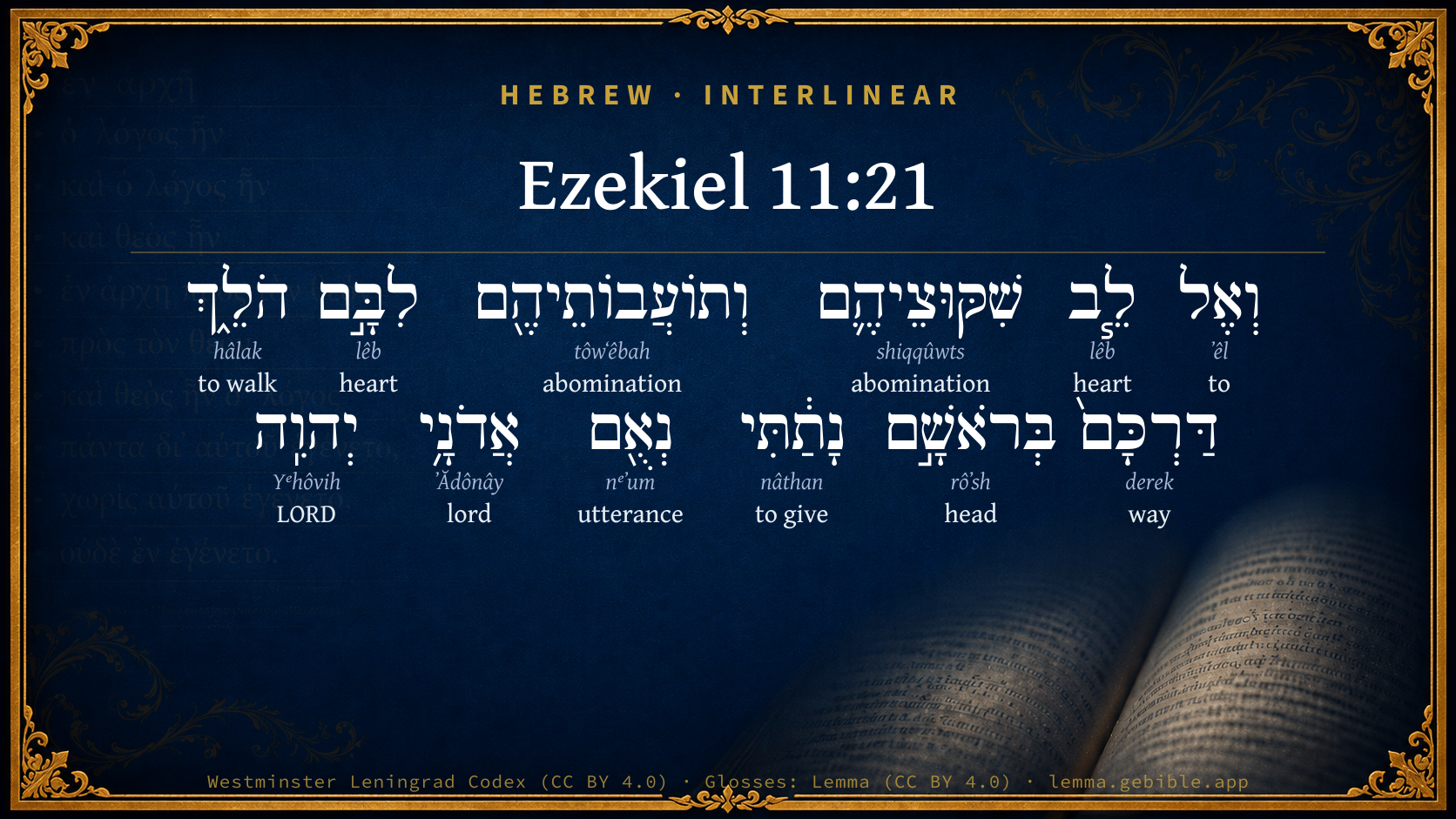
Hebrew (Westminster Leningrad Codex) Ezekiel 11:21 appears in the Hebrew Old Testament. The text above is from the Westminster Leningrad Codex. Each word links to its Strong’s number, a concise gloss, and parsing drawn from the Open Scriptures Hebrew Bible morphology. Click any word for its full Brown-Driver-Briggs (BDB) entry.
Download image
Cite this verse

Ezekiel 11:21 (World English Bible). Public Domain. Lemma interlinear Bible study tool, https://lemma.gebible.app/v/ezekiel/11/21.

Show BibTeX & RIS
BibTeX
RIS
English Translation
But as for them whose heart walks after the heart of their detestable things and their abominations, I will bring their way on their own heads, says the Lord Yahweh.
World English Bible · Public Domain
Download a study sheet

One document with this verse’s original text, its word-by-word gloss line, the meaning frame, cross-references with their text, attributed commentary, and full source and license credits — printable, and it pastes into notes with its structure intact.

This verse Autodidact and up

Study sheet (.html) Plain text (.txt)

A passage Seminary Student

Up to 50 verses in one chapter. A passage sheet keeps up to 6 commentary sources and 12 cross-references per verse, in the order this page ranks them, and says so on the sheet whenever that leaves anything out. Ask for a single verse and you get the Autodidact verse sheet above.

Everything on this page stays free to read, with no account — the sheet is a download of what is already on screen, not access to it.

Want to remove ads? Support Godless Engineer
Compare translations 3

The same verse in 3 English versions, stacked beneath the original-language interlinear above. Click any original word for its lexicon entry.

Each is an independent rendering of the whole verse — the interlinear is not word-aligned to these translations.

Highlighted words mark where these versions differ — a whole-verse word diff, not a word-by-word alignment.

  • World English Bible Public Domain
    But as for them whose heart walks after the heart of their detestable things and their abominations, I will bring their way on their own heads, says the Lord Yahweh.
  • King James Version Public Domain
    But as for them whose heart walketh after the heart of their detestable things and their abominations, I will recompense their way upon their own heads, saith the Lord GOD.
  • unfoldingWord Literal Text CC BY-SA 4.0
    But to those who walk with affection toward their detestable things and their abominations, I will bring their conduct on their own heads—this is the Lord Yahweh’s declaration.”

unfoldingWord Literal Text — © unfoldingWord, licensed CC BY-SA 4.0. Word-aligned USFM3 via Door43 (git.door43.org/unfoldingWord/en_ult).

Versions to compare (up to 4)

3 of 4 selected

Show all 18 translations

Every available English version of this verse, each an independent rendering of the whole verse.

  • World English Bible Public Domain
    But as for them whose heart walks after the heart of their detestable things and their abominations, I will bring their way on their own heads, says the Lord Yahweh.
  • Berean Standard Bible Public Domain
    But as for those whose hearts pursue detestable things and abominations, I will bring their conduct down upon their own heads, declares the Lord GOD.”
  • Majority Standard Bible Public Domain
    But as for those whose hearts pursue detestable things and abominations, I will bring their conduct down upon their own heads, declares the Lord GOD.”
  • King James Version Public Domain
    But as for them whose heart walketh after the heart of their detestable things and their abominations, I will recompense their way upon their own heads, saith the Lord GOD.
  • American Standard Version (1901) Public Domain
    But as for them whose heart walketh after the heart of their detestable things and their abominations, I will bring their way upon their own heads, saith the Lord Jehovah.
  • Revised Version (1885) Public Domain
    But as for them whose heart walketh after the heart of their detestable things and their abominations, I will bring their way upon their own heads, saith the Lord GOD.
  • Geneva Bible (1599) Public Domain
    But vpon them, whose heart is towarde their idoles, and whose affection goeth after their abominations, I will lay their way vpon their owne heades, saith the Lord God.
  • Douay-Rheims (1899) Public Domain
    But as for them whose heart walketh after their scandals and abominations, I will lay their way upon their head, saith the Lord God.
  • Young's Literal Translation Public Domain
    As to those whose heart is going unto the heart Of their detestable and their abominable things, Their way on their head I have put, An affirmation of the Lord Jehovah.'
  • Literal Standard Version CC BY-SA 4.0
    As for those whose heart is going to the heart || Of their detestable things and their abominations, || I have put their way on their head, || A declaration of Lord YHWH.”
  • Unlocked Literal Bible CC BY-SA 4.0
    But to those who walk with affection toward their detestable things and their abominations, I will bring their conduct on their own heads—this is the Lord Yahweh's declaration.”
  • unfoldingWord Literal Text CC BY-SA 4.0
    But to those who walk with affection toward their detestable things and their abominations, I will bring their conduct on their own heads—this is the Lord Yahweh’s declaration.”
  • Darby Bible Public Domain
    But as for them whose heart walketh well-pleased with their detestable things and their abominations, I will recompense their way upon their heads, saith the Lord Jehovah.
  • World Messianic Bible Public Domain
    But as for them whose heart walks after the heart of their detestable things and their abominations, I will bring their way on their own heads,’ says the Lord GOD.”
  • Webster's Bible Public Domain
    But as for them whose heart walketh after the heart of their detestable things and their abominations, I will recompense their way upon their own heads, saith the Lord GOD.
  • Free Bible Version CC BY-SA 4.0
    But for those who still choose to worship offensive idols and engage in disgusting practices, I will let them experience the consequences of their own actions, declares the Lord God.”
  • Bible in Basic English Public Domain
    But as for those whose heart goes after their hated and disgusting things, I will send on their heads the punishment of their ways, says the Lord.
  • JPS Tanakh (1917) Public Domain
    But as for them whose heart walketh after the heart of their detestable things and their abominations, I will bring their way upon their own heads, saith the Lord GOD.'

Literal Standard Version (2020), Covenant Press — licensed CC BY-SA 4.0. Text via the HelloAO Bible API (eBible.org). Unlocked Literal Bible (unfoldingWord) — licensed CC BY-SA 4.0. Text via the HelloAO Bible API (eBible.org). unfoldingWord Literal Text — © unfoldingWord, licensed CC BY-SA 4.0. Word-aligned USFM3 via Door43 (git.door43.org/unfoldingWord/en_ult). Free Bible Version, Dr. Jonathan Gallagher — licensed CC BY-SA 4.0. Text via the HelloAO Bible API (eBible.org).

Word by word

More ways to search: Search by grammar → Find every occurrence → Compare this word →

Practice this passage: Drill this verse → Learn its vocabulary →

שִׁקּוּצֵיהֶ֛ם
shiqqûwts
H8251
“abominations · their”
Noun, Common, Masculine, Plural, Construct + Suffix, Personal, 3rd Person, Masculine, Plural
Part of Speech
Noun
Type
Common
Gender
Masculine
Number
Plural
State
Construct
Full BDB Definition

Origin: from H8262

TWOT: 2459b

detestable thing or idol, abominable thing, abomination, idol, detested thing
  1. וְאֶל ʼêl H413 “and · to” Conjunction + Preposition
  2. לֵ֧ב lêb H3820 “heart of” Noun, Common, Masculine, Singular, Construct
  3. וְתוֹעֲבוֹתֵיהֶ֖ם tôwʻêbah H8441 “and · abominations · their” Conjunction + Noun, Common, Feminine, Plural, Construct + Suffix, Personal, 3rd Person, Masculine, Plural
  4. לִבָּ֣ם lêb H3820 “heart · their” Noun, Common, Masculine, Singular, Construct + Suffix, Personal, 3rd Person, Masculine, Plural
  5. הֹלֵ֑ךְ hâlak H1980 “walking” Verb, Qal, Participle Active, Masculine, Singular, Absolute
  6. דַּרְכָּם֙ derek H1870 “way · their” Noun, Common, Both, Singular, Construct + Suffix, Personal, 3rd Person, Masculine, Plural
  7. בְּרֹאשָׁ֣ם rôʼsh H7218 “in/at · head · their” Preposition + Noun, Common, Masculine, Singular, Construct + Suffix, Personal, 3rd Person, Masculine, Plural
  8. נָתַ֔תִּי nâthan H5414 “to give” Verb, Qal, Perfect, 1st Person, Common, Singular
  9. נְאֻ֖ם nᵉʼum H5002 “utterance of” Noun, Common, Masculine, Singular, Construct
  10. אֲדֹנָ֥י ʼĂdônây H136 “Lord · my” Noun, Common, Masculine, Plural, Construct + Suffix, Personal, 1st Person, Common, Singular
  11. יְהוִֽה Yᵉhôvih H3069 “LORD” Noun, Proper

About this verse

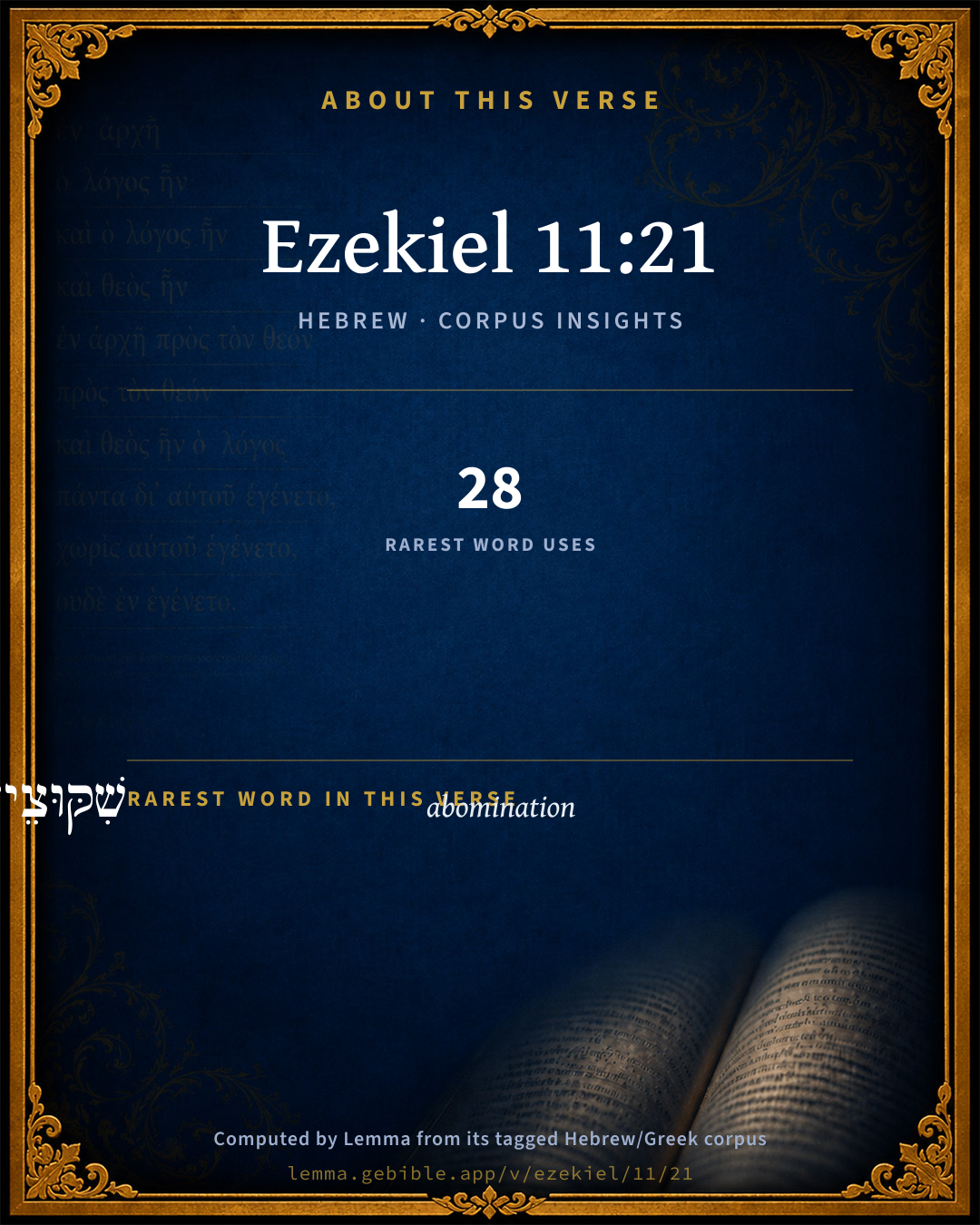
These counts appear in no published source. They are computed here, from the morphology-tagged text and Lemma’s own curated glosses. What Lemma adds →

12
words
11
distinct lemmas
Prophets
section

Shared distinctive vocabulary

שִׁקּוּצֵיהֶ֛ם abomination H8251 occurs in 26 verses of the Hebrew Bible. Also found in:

Grammatical profile

  • 2 verbs
  • 9 nouns
  • 1 preposition

Verb forms

  • הֹלֵ֑ךְ Qal · Participle Active
  • נָתַ֔תִּי Qal · Perfect

Repetition

A word recurs within this verse — often emphatic in Hebrew:

  • לֵ֧ב heart H3820 ×2

Hebrew & Septuagint length

In English translation the verse runs 30 words from the Hebrew and 29 from the Septuagint (LXX English) — closely comparable.

A rough comparison of the two English renderings, which tokenize alike — not a word-level alignment.

Word counts can differ between the Hebrew and the Greek without any difference in meaning — e.g. the Hebrew direct-object marker אֵת has no separate Greek word, and Greek often adds the article ὁ.

Cross-references

16

Topical passages linked to Ezekiel 11:21 in the Treasury of Scripture Knowledge — connected by theme and wording, ordered by reader-vote popularity; previews shown in the World English Bible.

  • Ecclesiastes 11:9 Rejoice, young man, in your youth, And let your heart cheer you in the days of your youth, And walk in the ways of your heart, And in the sight of your eyes; But know that for all these things God will bring you into judgment.
  • Ezekiel 9:10 As for me also, my eye shall not spare, neither will I have pity, but I will bring their way on their head.
  • Jeremiah 1:16 I will utter my judgments against them touching all their wickedness, in that they have forsaken me, and have burned incense to other gods, and worshiped the works of their own hands.
  • Ezekiel 11:18 They shall come there, and they shall take away all the detestable things of it and all the abominations of it from there.
  • Ezekiel 22:31 Therefore have I poured out my indignation on them; I have consumed them with the fire of my wrath: their own way have I brought on their heads, says the Lord Yahweh.
  • James 1:14–15 But each one is tempted, when he is drawn away by his own lust, and enticed.
  • Jeremiah 2:20 For of old time I have broken your yoke, and burst your bonds; and you said, I will not serve; for on every high hill and under every green tree you did bow yourself, playing the prostitute.
  • Jeremiah 17:9 The heart is deceitful above all things, and it is exceedingly corrupt: who can know it?
  • Jeremiah 29:16–19 thus says Yahweh concerning the king who sits on the throne of David, and concerning all the people who dwell in this city, your brothers who haven't gone forth with you into captivity;
  • Ezekiel 16:43 Because you have not remembered the days of your youth, but have raged against me in all these things; therefore, behold, I also will bring your way on your head, says the Lord Yahweh: and you shall not commit this lewdness with all your abominations.
  • Ezekiel 20:31 and when you offer your gifts, when you make your sons to pass through the fire, do you pollute yourselves with all your idols to this day? and shall I be inquired of by you, house of Israel? As I live, says the Lord Yahweh, I will not be inquired of by you;
  • Ezekiel 20:38 and I will purge out from among you the rebels, and those who disobey against me; I will bring them forth out of the land where they sojourn, but they shall not enter into the land of Israel: and you shall know that I am Yahweh.
  • Mark 7:21–23 For from within, out of the hearts of men, proceed evil thoughts, adulteries, sexual sins, murders, thefts,
  • Hebrews 3:12–13 Beware, brothers, lest perhaps there be in any one of you an evil heart of unbelief, in falling away from the living God;
  • Hebrews 10:38 But the righteous will live by faith. If he shrinks back, my soul has no pleasure in him."
  • Jude 1:19 These are they who cause divisions, and are sensual, not having the Spirit.

Cross-references courtesy of OpenBible.info (CC BY 4.0).

Hebrew and Greek witnesses Masoretic Hebrew ↔ Greek Septuagint

The same verse in the two great witnesses to the Old Testament, shown verse-for-verse.

These are two independent witnesses, not word-aligned to each other, and the Septuagint is shown in lemma (dictionary) form.

Hebrew Ezekiel 11:21 Masoretic · Westminster Leningrad Codex

וְאֶל לֵ֧ב שִׁקּוּצֵיהֶ֛ם וְתוֹעֲבוֹתֵיהֶ֖ם לִבָּ֣ם הֹלֵ֑ךְ דַּרְכָּם֙ בְּרֹאשָׁ֣ם נָתַ֔תִּי נְאֻ֖ם אֲדֹנָ֥י יְהוִֽה

But as for them whose heart walks after the heart of their detestable things and their abominations, I will bring their way on their own heads, says the Lord Yahweh.

World English Bible · Public Domain

Greek LXX Ezekiel 11:21 Septuagint · lemma form

καί εἰς ὁ καρδία ὁ βδέλυγμα αὐτός καί ὁ ἀνομία αὐτός ὡς ὁ καρδία αὐτός πορεύομαι ὁ ὁδός αὐτός εἰς κεφαλή αὐτός δίδωμι λέγω κύριος

And as for the heart set upon their abominations and their iniquities, as their heart went after them, I have recompensed their ways on their heads, says the Lord.

LXX2012 (modern English Septuagint) · Public Domain

Hebrew: Westminster Leningrad Codex (CC BY 4.0). Greek: Septuagint (public domain); English from LXX2012 (modern English Septuagint) (Public Domain). How the Septuagint differs from the Hebrew →

Targum (Aramaic paraphrase)

1

The Targum is the ancient Jewish Aramaic paraphrase of the Hebrew Scriptures — an interpretive translation, not the Hebrew text itself. Onkelos (literal) and Pseudo-Jonathan (expansive) render the Torah, and Jonathan the Prophets. Coverage is partial: where no permissively-licensed English translation exists for a verse, only the Aramaic is shown. This is verse-level text, not a word-by-word alignment to the Hebrew.

  1. Targum Jonathan Prophets (Joshua–Malachi)
    בָּתַר פּוּלְחַן שִׁקוּצֵיהוֹן וְתוֹעֲבָתְהוֹן לִבְּהוֹן טָעֵי פּוּרְעֲנוּת אוֹרְחֵיהוֹן בְּרֵישֵׁיהוֹן יְהָבֵית אֲמַר יְיָ אֱלֹהִים:

    (no public-domain English translation for this verse)

    Targum Jonathan — Aramaic: “Mikraot Gedolot” (public domain). English: “Sefaria Community Translation” (CC0 1.0 (public-domain dedication)); “London "Chaldee Paraphrase," 1871” (public domain). Text via Sefaria.

Commentary

Notes on Ezekiel 11:21 from classic Christian and Jewish commentators (each source and its license shown beneath its notes). The classic Christian expositions comment on the surrounding passage and are grouped to its opening verse, so a note may address several verses; the Jewish commentaries on the Tanakh (Rashi and others) are per-verse, so they appear only where the commentator wrote on this verse.

Lemma curates 59 commentaries, every one of them public domain or Creative Commons licensed, each selected and text-cleaned for this edition rather than reprinted as found. About our sources →

Trapp's Complete Commentary

John Trapp

Eze 11:21 But [as for them] whose heart walketh after the heart of their detestable things and their abominations, I will recompense their way upon their own heads, saith the Lord GOD.

Ver. 21. But as for them.] This is added lest any wicked men should misapply the promises, as they do qui sperando praesumunt et praesumendo pereunt.

John Trapp, A Commentary or Exposition upon All the Books of the Old and New Testament (1647–1656) — public domain. Text from a community e-Sword module.

Joseph Benson's Commentary

Eze 11:21. But as for them — Whoever they be, and some there will be in the best times, who will refuse to own God for their God, and truly to love and obey him. Whose heart walketh after their detestable things — Whose judgment and choice, or whose will and affections, go after their idols and iniquities, their lusts and vices. I will recompense their way upon their own heads — Their state shall differ as much as their practice does, from that of the people of God: I will treat them according to their ways.

Joseph Benson's Commentary on the Old and New Testaments (1811–1818) — public domain. Text from a community e-Sword module.

Tyndale Open Study Notes

Tyndale Open Resources

11:21 Those who remained in the land would reap what they had sown. God would repay them fully for their sins, especially those involving vile images and detestable idols.

Tyndale Open Study Notes — © Tyndale Open Resources, licensed CC BY-SA 4.0. Text via the HelloAO Bible API.

Jamieson, Fausset & Brown

Robert Jamieson, A. R. Fausset & David Brown

whose heart . . . after . . . heart of . . . detestable things--The repetition of "heart" is emphatic, signifying that the heart of those who so obstinately clung to idols, impelled itself to fresh superstitions in one continuous tenor [CALVIN]. Perhaps it is implied that they and their idols are much alike in character (Psa 115:8). The heart walks astray first, the feet follow.

recompense . . . way upon . . . heads--They have abandoned Me, so will I abandon them; they profaned My temple, so will I profane it by the Chaldeans (Eze 9:10).

Jamieson, Fausset & Brown — Commentary Critical and Explanatory on the Whole Bible (1871) — public domain (CC PDM 1.0). Text via the HelloAO Bible API.

Adam Clarke's Commentary

Verse 21. But as for them whose heart walketh] Them whose affections are attached to idolatry, they shall have such reward as their idols can give them, and such a recompense as Divine justice shall award them.

Adam Clarke's Commentary on the Bible (1810–1826) — public domain. Text from a community e-Sword/MySword module.

John Calvin's Commentaries

The phrase which the Prophet uses is indeed harsh: he says, their heart goes after heart, so that some interpret this of imitation: namely, since God promises that he will be an avenger if any of the people conduct themselves after bad examples and unite in alliance with the wicked, just as if they glued together their hearts and affections, but that is harsh. The repetition is therefore superfluous, and the Prophet means nothing else than that God will be avenged if the Israelites follow their own heart, so as to walk in their own foulness and abominations. First of all we must understand the reason why the Prophet uses this sentiment. God had liberally poured out the treasures of his mercy, but since, hypocrites have always been mixed with the good, at the same time that they confidently boast themselves members of the Church, and use the name of God with great audacity; so that the Prophet uses this threat that they may not think all the promises which we hear of to belong to themselves promiscuously. For there were always many reprobate among the elect people, because not all who sprang from father Abraham were true Israelites. (Romans 9:6, 7.)

Since therefore it was so, the Prophet properly shows here that what he had previously promised was peculiar to God’s elect, and to the true and lawful members of the Church, but not to the spurious, nor to the degenerate, nor to those who are unregenerated by the true and incorruptible seed. This is the Prophet’s intention. But lest there might seem to be too much rigor when God, as it were, armed comes down into the midst to destroy all who do not repent, the Prophet here declares their crime — namely, because their heart walks after their heart, that is, thine heart draws itself, and so the word heart is twice repeated. It is indeed a superfluous repetition but emphatic, when he says, that the heart of those who so pertinaciously adhere to their own superstitions is then impelled by its own self to new motions, so that by its continual tenor it goes always towards superstitions. Hence I will be an avenger, says God. Hence as often as God proposes to us testimonies of his favor, let each descend into himself and examine all his affections. But when any one lays hold of his own vices let him not please himself in them, but rather groan over them, and strive to renounce his own affections that he may follow God: neither let him harden himself in obstinacy, so that his heart may not proceed and rush continually towards evil, as is here said.

John Calvin's Commentaries (1540-1563) — public domain. Text from the Calvin Translation Society English edition (1840s-50s) via the Christian Classics Ethereal Library (ccel.org). Calvin's coverage is partial (roughly two-thirds of the Bible); uncommented books and verses are honest gaps, never fabricated. The 19th-century editor's footnotes and remarks are omitted so the notes are faithfully Calvin's own voice.

Ellicott's Commentary for English Readers

(21) I will recompense their way.—In striking contrast to the mercy granted to the repentant, is set forth here, as in Rev_21:8, the Divine wrath upon the impenitent. It has never been promised that all men shall be brought to a true sense of their relations to God, for human responsibility, and consequently power of choice, is not removed; but God’s grace is never in vain, and if it does not lead to blessing through its acceptance, must result in greater condemnation through its rejection. (Comp. 2Co_2:16.)

The heart of their detestable things, is a figurative expression. Idols in themselves are inanimate things, but the heart of the people was so given to the spirit of idolatry and alienation from God, that the abstract, as usual with this prophet, is represented in this concrete, figurative form.

A Bible Commentary for English Readers, edited by Charles John Ellicott (1878–1897) — public domain. Text from a community e-Sword module.

The Cambridge Bible for Schools and Colleges

gen. ed. J. J. S. Perowne

21. But those who cleave to their abominations shall receive the recompense of their ways—there is no peace saith the Lord to the wicked (Isa_48:22).

The language “whose heart walketh after the heart of their detestable things” is without parallel or meaning; elsewhere it is: whose heart walketh after their idols (ch. Eze_20:16, Eze_33:31, after their covetousness). A different class of persons is referred to from those spoken of in Eze_11:17-20, either the population in Jerusalem or more naturally those in general who follow idols. The text requires some amendment: but as for those whose heart goeth after their detestable things … their way will I recompense.

Eze_11:22-25. The manifestation of Jehovah rises from over the city and moves eastward to the Mount of Olives. The city is abandoned by Jehovah (Hos_5:15). The prophet does not pursue the movement further. The glory passes out by the eastern gate, by which also it returns into the new temple (ch. Eze_43:1-4). The prophet is carried back by the spirit to the captivity; to which he narrates all he had seen.

The Cambridge Bible for Schools and Colleges (gen. ed. J. J. S. Perowne; Cambridge University Press, 1878–1918) — public domain. Text from a community e-Sword module.

John Gill's Exposition

But as for them,.... Who remained in Jerusalem, and were not carried captive, but continued in their, own land, and worshipped idols, the same as in Eze 11:15;

whose heart walketh after the heart of their detestable things and their abominations; not images of gold and silver, which cannot be said to have a heart; but devils and evil spirits worshipped in them, who are well pleased and delighted with the worship given them; so that the hearts of the devils worshipped, and the hearts of the idolatrous worshippers, were alike and agreed; wherefore their hearts were very different from those before mentioned; so far from having one heart, that their hearts were double and divided, partly after God, and partly after their idols; and so far from walking in the statutes of the Lord, that they were walking after the will of their idols, and in the worship of them; which were abominable and detestable to God, and all good men. The Targum is,

"and after the worship of their idols, and of their abominations, their heart wanders.''

I will recompense their ways upon their own heads, saith the Lord God, that is, punish them according to their deserts, by the sword, famine, pestilence, and captivity.

John Gill's Exposition of the Whole Bible (1746–1763) — public domain (CC PDM 1.0). Text via the HelloAO Bible API.

Haydock's Catholic Bible Commentary

Head. I will punish them as their crimes deserve. (Calmet)

George Leo Haydock (1774–1849), Haydock's Catholic Family Bible and Commentary, 1859 edition — public domain. Excludes Psalms (Douay-Rheims chapter numbering differs from Protestant) and Deuterocanonical books (Catholic canon only).

Matthew Poole's English Annotations

For all those promises, and in the best times, some there will be who will refuse to own God and obey him, whose state shall as much differ as their practices did from the people of God.

As for them, whoever they be.

Heart, soul and affections, whose choice and love,

walketh after; either secretly adhereth to or provideth for the service of idols, called here detestable things, as Eze 11:18, Eze 5:11; and to express the obstinacy of this idolatry, it is called a

heart walking after a heart: idolatry is a bewitching sin, and steals away the heart and the promoters of idolatry propose the plausiblest arguments, as if idols had hearts and affections toward their worshippers to do them good; the expression in the Hebrew is somewhat unusual and harsh to our ear, but this I take to be the meaning.

Their abominations; their idols, and idol worship, and dependencies.

Recompense; pay them in their own coin: they forsake me, I will forsake them; they profane my name and temple, I will give them up as common to be profaned by the Chaldeans. Their way tends to this, and shall end in this, and nothing more just.

Upon their heads, i.e. on each man, and in such manner as shall destroy the contumacious. Or, on those that are as heads of the people and ringleaders in obstinacy of sinning, such as the twenty-five, Eze 11:1, and who shall be examples of my speedy and irresistible vengeance, as Pelatiah was.

Matthew Poole's English Annotations on the Holy Bible (1683–1685) — public domain. Text from a community e-Sword/MySword module.

Whedon's Commentary on the Bible

Daniel D. Whedon

21. Whose heart walketh after the heart of their detestable things — Better, as Vulgate, whose heart goeth after their detestable things (Eze_20:16). As for the Jerusalemites whose hearts cleave impenitently to their idols,

I will recompense their way upon their own heads — the prophet’s intercession cannot avert that judgment (Eze_11:13).

Daniel D. Whedon (gen. ed.), Commentary on the Old and New Testaments (1874–1909) — public domain. Text from a community e-Sword module.

The Pulpit Commentary

But as for them, etc. We note the peculiar phraseology. The heart of the people walks not simply after their detestable things, but after the heart of those things. There is, as it were, a central unity in the evil to which they unite themselves, just as the heart of man turns to the heart of God when the two are in their ideal relation to each other. For those who did this, whether in Jerusalem or among the exiles, there was the prospect of a righteous retribution. The words close the message which Ezekiel heard in the courts of the temple in his visions, but which he was to deliver (ver. 25) to them of the Captivity.

The Pulpit Commentary (1880–1919), ed. H.D.M. Spence-Jones & Joseph S. Exell — public domain. Text from a community e-Sword module.

John Wesley's Explanatory Notes

Heart - Soul and affections. Walketh - Either secretly adhere to, or provide for the service of idols, called here detestable things.

John Wesley, Explanatory Notes Upon the Whole Bible (1754–1765) — public domain. Text via the GEBible commentary corpus.

Rashi

Rabbi Shlomo Yitzchaki (Rashi)

But to the heart of their detestations, etc. And as for those whose hearts go to every detestation and abomination, who remained in Jerusalem, who were not exiled, and who go astray after idolatry and detestations.

I have placed their way upon their heads for I will draw the sword upon them, and [place them in] captivity, and they will go into exile.

Rashi on the Tanakh — English translations: “The Judaica Press complete Tanach with Rashi, translated by A. J. Rosenberg” (CC BY 4.0); “Pentateuch with Rashi's commentary by M. Rosenbaum and A.M. Silbermann, 1929-1934” (public domain); “The Metsudah Tanach series, Lakewood, N.J” (CC BY 4.0); and “The Book of Joshua, Metsudah Publications, 1997” (CC BY 4.0). Text via Sefaria.

Lesson kit

Teaching starters — assembled from the data on this page, not authored interpretation. Every prompt links to the verse data it draws on. Edit before teaching.

Ezekiel, in the Prophets, opens this verse with 12 words (11 distinct Hebrew lemmas). Its most distinctive word is shiqqûwts (“abomination”). A historical commentator’s framing appears above. Read the whole chapter for the surrounding context.

Discussion questions

  1. How does “abomination” (shiqqûwts) shape what this verse is saying?
  2. Deuteronomy 29:17 shares the word «abomination» with this verse. How do the two illuminate each other?
  3. “heart” occurs 2× in this one verse. What is the effect of the repetition?
  4. These translations render this verse differently. What is at stake in choosing one wording over another?
  5. The verb «הֹלֵ֑ךְ» is Qal Participle Active. How does its form color the action?
  6. Reading how Trapp's Complete Commentary and Joseph Benson's Commentary read this verse, where do the two commentators agree and where do they part?

Things to notice

Reading settings

Reading text

Shown beneath each verse's original-language words.

Old Testament
Old Testament edition

Read the OT as the Masoretic Hebrew (MT) or the Greek Septuagint (LXX).

English shown for the Greek Septuagint (in the Hebrew ↔ Greek comparison).

Comparing translations? Open the Compare panel on any verse page to stack up to four side by side.