
Ezekiel 3:11

Hebrew (Westminster Leningrad Codex) Ezekiel 3:11 appears in the Hebrew Old Testament. The text above is from the Westminster Leningrad Codex. Each word links to its Strong’s number, a concise gloss, and parsing drawn from the Open Scriptures Hebrew Bible morphology. Click any word for its full Brown-Driver-Briggs (BDB) entry.
Download image
Cite this verse

Ezekiel 3:11 (World English Bible). Public Domain. Lemma interlinear Bible study tool, https://lemma.gebible.app/v/ezekiel/3/11.

Show BibTeX & RIS
BibTeX
RIS
English Translation
Go, get you to them of the captivity, to the children of your people, and speak to them, and tell them, Thus says the Lord Yahweh; whether they will hear, or whether they will forbear.
World English Bible · Public Domain
Download a study sheet

One document with this verse’s original text, its word-by-word gloss line, the meaning frame, cross-references with their text, attributed commentary, and full source and license credits — printable, and it pastes into notes with its structure intact.

This verse Autodidact and up

Study sheet (.html) Plain text (.txt)

A passage Seminary Student

Up to 50 verses in one chapter. A passage sheet keeps up to 6 commentary sources and 12 cross-references per verse, in the order this page ranks them, and says so on the sheet whenever that leaves anything out. Ask for a single verse and you get the Autodidact verse sheet above.

Everything on this page stays free to read, with no account — the sheet is a download of what is already on screen, not access to it.

Want to remove ads? Support Godless Engineer
Compare translations 3

The same verse in 3 English versions, stacked beneath the original-language interlinear above. Click any original word for its lexicon entry.

Each is an independent rendering of the whole verse — the interlinear is not word-aligned to these translations.

Highlighted words mark where these versions differ — a whole-verse word diff, not a word-by-word alignment.

  • World English Bible Public Domain
    Go, get you to them of the captivity, to the children of your people, and speak to them, and tell them, Thus says the Lord Yahweh; whether they will hear, or whether they will forbear.
  • King James Version Public Domain
    And go, get thee to them of the captivity, unto the children of thy people, and speak unto them, and tell them, Thus saith the Lord GOD; whether they will hear, or whether they will forbear.
  • unfoldingWord Literal Text CC BY-SA 4.0
    Then go to the captives, to your people, and speak to them. Say to them, ‘This is what the Lord Yahweh says,’ whether they will listen or not.”

unfoldingWord Literal Text — © unfoldingWord, licensed CC BY-SA 4.0. Word-aligned USFM3 via Door43 (git.door43.org/unfoldingWord/en_ult).

Versions to compare (up to 4)

3 of 4 selected

Show all 18 translations

Every available English version of this verse, each an independent rendering of the whole verse.

  • World English Bible Public Domain
    Go, get you to them of the captivity, to the children of your people, and speak to them, and tell them, Thus says the Lord Yahweh; whether they will hear, or whether they will forbear.
  • Berean Standard Bible Public Domain
    Go to your people, the exiles; speak to them and tell them, ‘This is what the Lord GOD says,’ whether they listen or refuse to listen.”
  • Majority Standard Bible Public Domain
    Go to your people, the exiles; speak to them and tell them, ‘This is what the Lord GOD says,’ whether they listen or refuse to listen.”
  • King James Version Public Domain
    And go, get thee to them of the captivity, unto the children of thy people, and speak unto them, and tell them, Thus saith the Lord GOD; whether they will hear, or whether they will forbear.
  • American Standard Version (1901) Public Domain
    And go, get thee to them of the captivity, unto the children of thy people, and speak unto them, and tell them, Thus saith the Lord Jehovah; whether they will hear, or whether they will forbear.
  • Revised Version (1885) Public Domain
    And go, get thee to them of the captivity, unto the children of thy people, and speak unto them, and tell them, Thus saith the Lord GOD; whether they will hear, or whether they will forbear.
  • Geneva Bible (1599) Public Domain
    And goe and enter to them that are led away captiues vnto the children of thy people, and speake vnto them, and tell them, Thus saith the Lord God: but surely they will not heare, neither will they in deede cease.
  • Douay-Rheims (1899) Public Domain
    And go get thee in to them of the captivity, to the children of thy people, and thou shalt speak to them, and shalt say to them: Thus saith the Lord: If so be they will hear and will forbear.
  • Young's Literal Translation Public Domain
    and go, enter in unto the Removed, unto the sons of thy people, and thou hast spoken unto them, and hast said unto them: Thus said the Lord Jehovah: whether they hear, or whether they forbear.'
  • Literal Standard Version CC BY-SA 4.0
    and go forth, go to the expulsion, to the sons of your people, and you have spoken to them, and have said to them: Thus said Lord YHWH; whether they hear, or whether they refrain.”
  • Unlocked Literal Bible CC BY-SA 4.0
    Then go to the captives, to your people, and speak to them. Say to them, 'This is what the Lord Yahweh says,' whether they will listen or not.”
  • unfoldingWord Literal Text CC BY-SA 4.0
    Then go to the captives, to your people, and speak to them. Say to them, ‘This is what the Lord Yahweh says,’ whether they will listen or not.”
  • Darby Bible Public Domain
    and go, get thee to them of the captivity, unto the children of thy people, and speak unto them, and tell them, Thus saith the Lord Jehovah, -- whether they will hear or whether they will forbear.
  • World Messianic Bible Public Domain
    Go to them of the captivity, to the children of your people, and speak to them, and tell them, ‘This is what the Lord GOD says,’ whether they will hear, or whether they will refuse.”
  • Webster's Bible Public Domain
    And depart, go to them of the captivity, to the children of thy people, and speak to them, and tell them, Thus saith the Lord GOD; whether they will hear, or whether they will forbear.
  • Free Bible Version CC BY-SA 4.0
    Go to your people who are in exile. Tell them this is what the Lord God says, whether they listen or not.”
  • Bible in Basic English Public Domain
    And go now to those who have been taken away as prisoners, to the children of your people, and say to them, This is what the Lord has said; if they give ear or if they do not.
  • JPS Tanakh (1917) Public Domain
    And go, get thee to them of the captivity, unto the children of thy people, and speak unto them, and tell them: Thus saith the Lord GOD; whether they will hear, or whether they will forbear.'

Literal Standard Version (2020), Covenant Press — licensed CC BY-SA 4.0. Text via the HelloAO Bible API (eBible.org). Unlocked Literal Bible (unfoldingWord) — licensed CC BY-SA 4.0. Text via the HelloAO Bible API (eBible.org). unfoldingWord Literal Text — © unfoldingWord, licensed CC BY-SA 4.0. Word-aligned USFM3 via Door43 (git.door43.org/unfoldingWord/en_ult). Free Bible Version, Dr. Jonathan Gallagher — licensed CC BY-SA 4.0. Text via the HelloAO Bible API (eBible.org).

Word by word

More ways to search: Search by grammar → Find every occurrence → Compare this word →

Practice this passage: Drill this verse → Learn its vocabulary →

הַגּוֹלָה֙
gôwlâh
H1473
“the · exile”
Particle, Definite Article + Noun, Common, Feminine, Singular, Absolute
Part of Speech
Particle + Noun
Type
Common
Gender
Feminine
Number
Singular
State
Absolute
Full BDB Definition

Origin: active participle of H1540

TWOT: 350a

exiles, exile, captivity - exiles (collective) - exile, captivity (abstract)
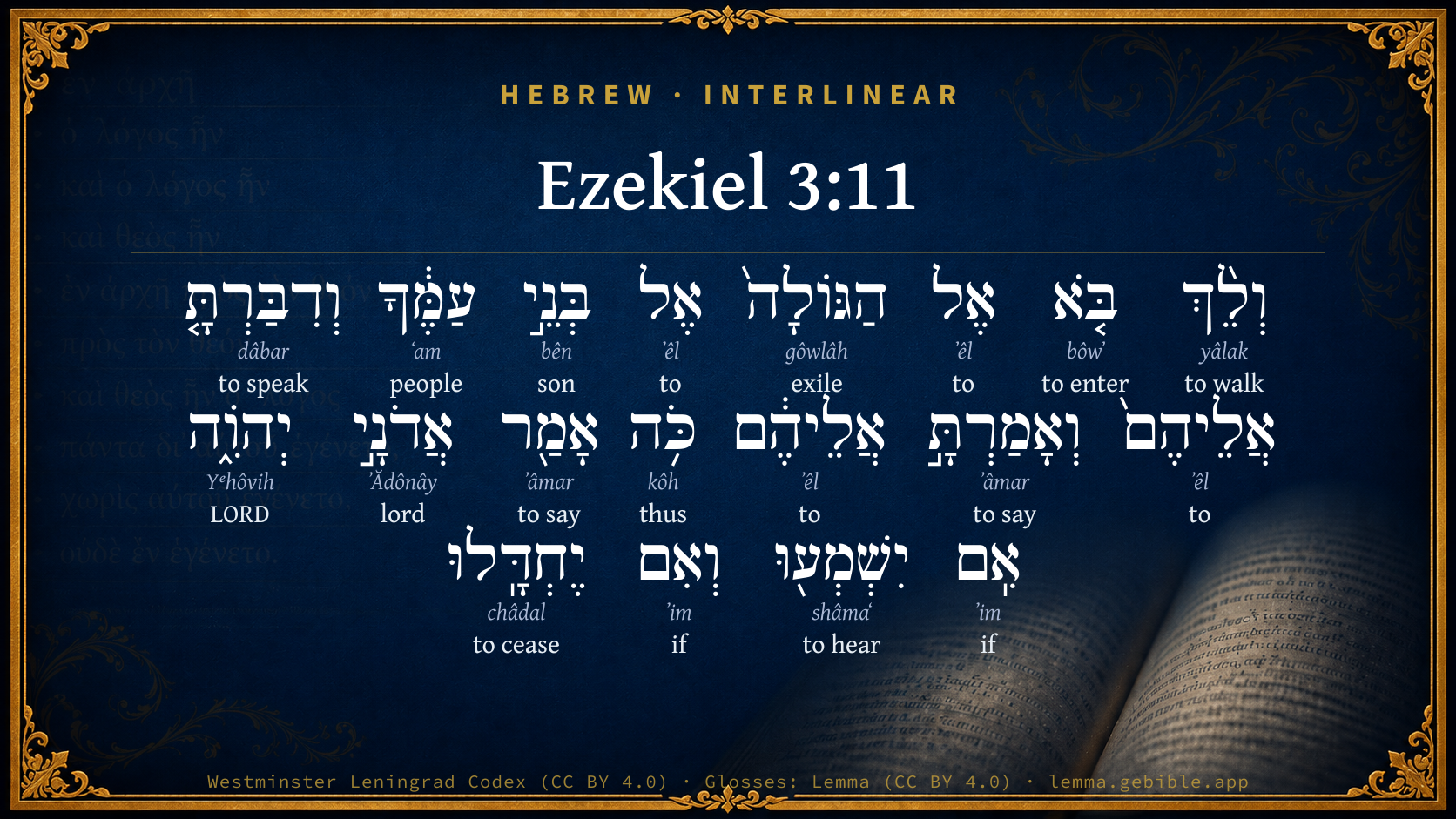
  1. וְלֵ֨ךְ yâlak H3212 “and · walk” Conjunction + Verb, Qal, Imperative, 2nd Person, Masculine, Singular
  2. בֹּ֤א bôwʼ H935 “enter” Verb, Qal, Imperative, 2nd Person, Masculine, Singular
  3. אֶל ʼêl H413 “to” Preposition
  4. אֶל ʼêl H413 “to” Preposition
  5. בְּנֵ֣י bên H1121 “sons of” Noun, Common, Masculine, Plural, Construct
  6. עַמֶּ֔ךָ ʻam H5971 “people · your” Noun, Common, Masculine, Singular, Construct + Suffix, Personal, 2nd Person, Masculine, Singular
  7. וְדִבַּרְתָּ֤ dâbar H1696 “and · to speak” Conjunction + Verb, Piel, Sequential Perfect, 2nd Person, Masculine, Singular
  8. אֲלֵיהֶם֙ ʼêl H413 “to · them” Preposition + Suffix, Personal, 3rd Person, Masculine, Plural
  9. וְאָמַרְתָּ֣ ʼâmar H559 “and · to say” Conjunction + Verb, Qal, Sequential Perfect, 2nd Person, Masculine, Singular
  10. אֲלֵיהֶ֔ם ʼêl H413 “to · them” Preposition + Suffix, Personal, 3rd Person, Masculine, Plural
  11. כֹּ֥ה kôh H3541 “thus” Adverb
  12. אָמַ֖ר ʼâmar H559 “to say” Verb, Qal, Perfect, 3rd Person, Masculine, Singular
  13. אֲדֹנָ֣י ʼĂdônây H136 “Lord · my” Noun, Common, Masculine, Plural, Construct + Suffix, Personal, 1st Person, Common, Singular
  14. יְהֹוִ֑ה Yᵉhôvih H3069 “LORD” Noun, Proper
  15. אִֽם ʼim H518 “if” Conjunction
  16. יִשְׁמְע֖וּ shâmaʻ H8085 “to hear” Verb, Qal, Imperfect, 3rd Person, Masculine, Plural
  17. וְאִם ʼim H518 “and · if” Conjunction + Conjunction
  18. יֶחְדָּֽלוּ châdal H2308 “to cease” Verb, Qal, Imperfect, 3rd Person, Masculine, Plural

About this verse

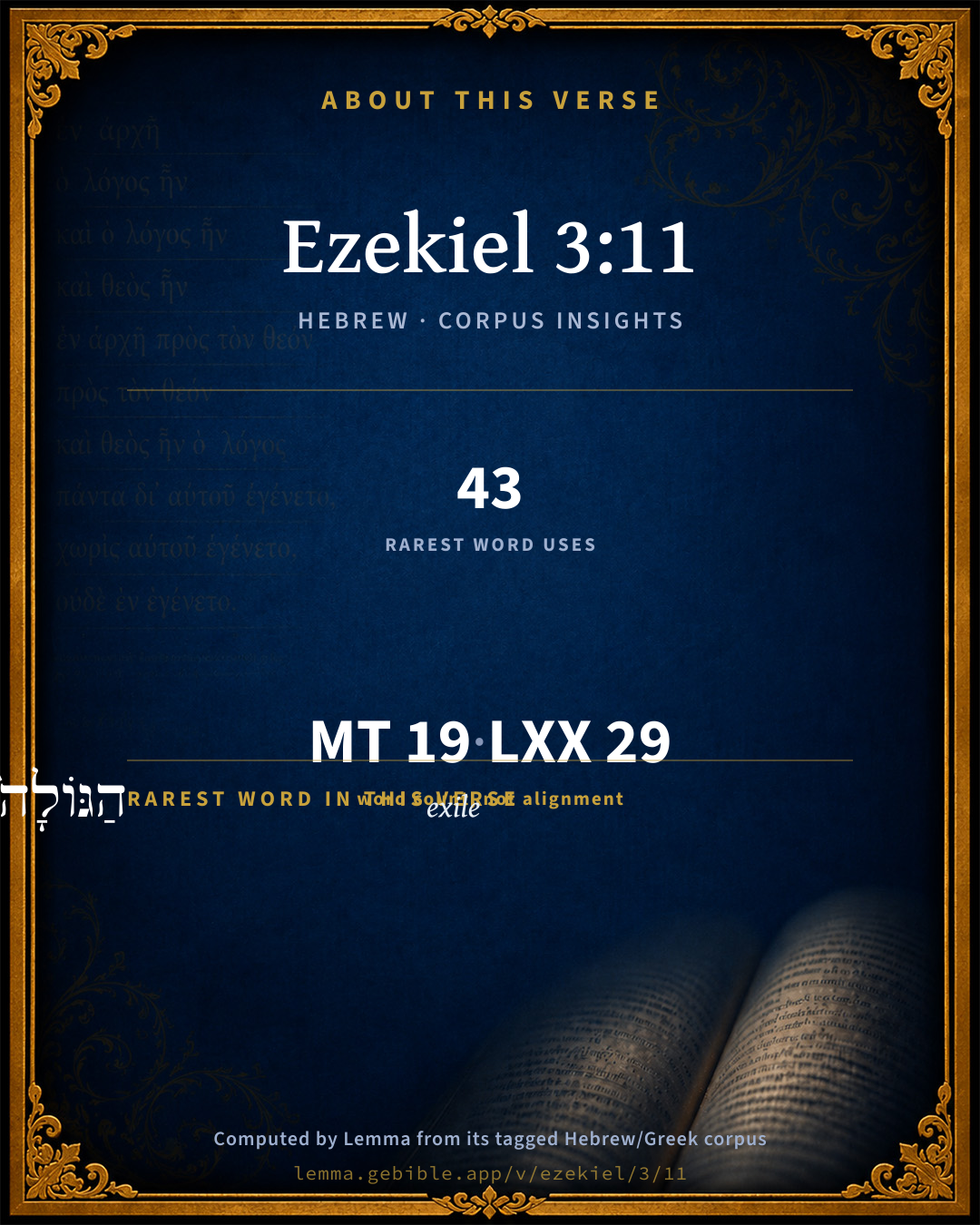
These counts appear in no published source. They are computed here, from the morphology-tagged text and Lemma’s own curated glosses. What Lemma adds →

19
words
14
distinct lemmas
Prophets
section

Shared distinctive vocabulary

הַגּוֹלָה֙ exile H1473 occurs in 42 verses of the Hebrew Bible. Also found in:

Grammatical profile

  • 7 verbs
  • 5 nouns
  • 4 prepositions
  • 2 conjunctions
  • 1 adverb

Verb forms

  • וְלֵ֨ךְ Qal · Imperative
  • בֹּ֤א Qal · Imperative
  • וְדִבַּרְתָּ֤ Piel · Sequential Perfect
  • וְאָמַרְתָּ֣ Qal · Sequential Perfect
  • אָמַ֖ר Qal · Perfect
  • יִשְׁמְע֖וּ Qal · Imperfect
  • יֶחְדָּֽלוּ Qal · Imperfect

Repetition

Words recur within this verse — often emphatic in Hebrew:

  • וְאָמַרְתָּ֣ to say H559 ×2
  • אֶל to H413 ×4
  • אִֽם if H518 ×2

Hebrew & Septuagint length

In English translation the verse runs 35 words from the Hebrew and 38 from the Septuagint (LXX English) — closely comparable.

A rough comparison of the two English renderings, which tokenize alike — not a word-level alignment.

Word counts can differ between the Hebrew and the Greek without any difference in meaning — e.g. the Hebrew direct-object marker אֵת has no separate Greek word, and Greek often adds the article ὁ.

In the original languages it is 19 Hebrew tokens and 29 Greek tokens — but the two are counted differently (Hebrew bundles its prefixes and suffixes into one token; the Greek is in lemma form), so that isn’t a like-for-like length.

Cross-references

15

Topical passages linked to Ezekiel 3:11 in the Treasury of Scripture Knowledge — connected by theme and wording, ordered by reader-vote popularity; previews shown in the World English Bible.

  • Ezekiel 2:7 You shall speak my words to them, whether they will hear, or whether they will forbear; for they are most rebellious.
  • Ezekiel 2:5 They, whether they will hear, or whether they will forbear, (for they are a rebellious house), yet shall know that there has been a prophet among them.
  • Ezekiel 3:27 But when I speak with you, I will open your mouth, and you shall tell them, Thus says the Lord Yahweh: He who hears, let him hear; and he who forbears, let him forbear: for they are a rebellious house.
  • Ezekiel 33:2 Son of man, speak to the children of your people, and tell them, When I bring the sword on a land, and the people of the land take a man from among them, and set him for their watchman;
  • Ezekiel 33:12 You, son of man, tell the children of your people, The righteousness of the righteous shall not deliver him in the day of his disobedience; and as for the wickedness of the wicked, he shall not fall thereby in the day that he turns from his wickedness; neither shall he who is righteous be able to live thereby in the day that he sins.
  • Ezekiel 33:17 Yet the children of your people say, The way of the Lord is not equal: but as for them, their way is not equal.
  • Ezekiel 33:30 As for you, son of man, the children of your people talk of you by the walls and in the doors of the houses, and speak one to another, everyone to his brother, saying, Please come and hear what is the word that comes forth from Yahweh.
  • Exodus 32:7 Yahweh spoke to Moses, "Go, get down; for your people, who you brought up out of the land of Egypt, have corrupted themselves!
  • Deuteronomy 9:12 Yahweh said to me, Arise, get you down quickly from hence; for your people whom you have brought forth out of Egypt have corrupted themselves; they have quickly turned aside out of the way which I commanded them; they have made them a molten image.
  • Ezekiel 3:15 Then I came to them of the captivity at Tel Aviv, that lived by the river Chebar, and to where they lived; and I sat there overwhelmed among them seven days.
  • Ezekiel 11:24–25 The Spirit lifted me up, and brought me in the vision by the Spirit of God into Chaldea, to them of the captivity. So the vision that I had seen went up from me.
  • Ezekiel 37:18 When the children of your people shall speak to you, saying, Will you not show us what you mean by these?
  • Daniel 6:13 Then answered they and said before the king, That Daniel, who is of the children of the captivity of Judah, doesn't regard you, O king, nor the interdict that you have signed, but makes his petition three times a day.
  • Daniel 12:1 "At that time shall Michael stand up, the great prince who stands for the children of your people; and there shall be a time of trouble, such as never was since there was a nation even to that same time: and at that time your people shall be delivered, everyone who shall be found written in the book.
  • Acts 20:26–27 Therefore I testify to you this day that I am clean from the blood of all men,

Cross-references courtesy of OpenBible.info (CC BY 4.0).

Hebrew and Greek witnesses Masoretic Hebrew ↔ Greek Septuagint

The same verse in the two great witnesses to the Old Testament, shown verse-for-verse.

These are two independent witnesses, not word-aligned to each other, and the Septuagint is shown in lemma (dictionary) form.

Hebrew Ezekiel 3:11 Masoretic · Westminster Leningrad Codex

וְלֵ֨ךְ בֹּ֤א אֶל הַגּוֹלָה֙ אֶל בְּנֵ֣י עַמֶּ֔ךָ וְדִבַּרְתָּ֤ אֲלֵיהֶם֙ וְאָמַרְתָּ֣ אֲלֵיהֶ֔ם כֹּ֥ה אָמַ֖ר אֲדֹנָ֣י יְהֹוִ֑ה אִֽם יִשְׁמְע֖וּ וְאִם יֶחְדָּֽלוּ

Go, get you to them of the captivity, to the children of your people, and speak to them, and tell them, Thus says the Lord Yahweh; whether they will hear, or whether they will forbear.

World English Bible · Public Domain

Greek LXX Ezekiel 3:11 Septuagint · lemma form

καί βαδίζω εἰςἔρχομαι εἰς ὁ αἰχμαλωσία πρός ὁ υἱός ὁ λαός σύ καί λαλέω πρός αὐτός καί εἶπον πρός αὐτός ὅδε λέγω κύριος ἐάν ἄρα ἀκούω ἐάν ἄρα ἐνδίδωμι

And go your way, go in to the captivity, to the children of your people, and you shall speak to them, and say to them, Thus says the Lord; whether they will hear, or whether they will forbear.

LXX2012 (modern English Septuagint) · Public Domain

Hebrew: Westminster Leningrad Codex (CC BY 4.0). Greek: Septuagint (public domain); English from LXX2012 (modern English Septuagint) (Public Domain). How the Septuagint differs from the Hebrew →

Targum (Aramaic paraphrase)

1

The Targum is the ancient Jewish Aramaic paraphrase of the Hebrew Scriptures — an interpretive translation, not the Hebrew text itself. Onkelos (literal) and Pseudo-Jonathan (expansive) render the Torah, and Jonathan the Prophets. Coverage is partial: where no permissively-licensed English translation exists for a verse, only the Aramaic is shown. This is verse-level text, not a word-by-word alignment to the Hebrew.

  1. Targum Jonathan Prophets (Joshua–Malachi)
    וֶאֱתָא אֱזֵיל לְוַת בְּנֵי גָלוּתָא לְוַת בְּנֵי עַמָךְ וְתִתְנַבֵּי לְהוֹן וְתֵימַר לְהוֹן כִּדְנַן אֲמַר יְיָ אֱלֹהִים אִם יְקַבְּלוּן אוּלְפַן וְאִם יִתְמַנְעוּן מִלְמֶחֱטֵי:

    (no public-domain English translation for this verse)

    Targum Jonathan — Aramaic: “Mikraot Gedolot” (public domain). English: “Sefaria Community Translation” (CC0 1.0 (public-domain dedication)); “London "Chaldee Paraphrase," 1871” (public domain). Text via Sefaria.

Commentary

Notes on Ezekiel 3:11 from classic Christian and Jewish commentators (each source and its license shown beneath its notes). The classic Christian expositions comment on the surrounding passage and are grouped to its opening verse, so a note may address several verses; the Jewish commentaries on the Tanakh (Rashi and others) are per-verse, so they appear only where the commentator wrote on this verse.

Lemma curates 59 commentaries, every one of them public domain or Creative Commons licensed, each selected and text-cleaned for this edition rather than reprinted as found. About our sources →

Trapp's Complete Commentary

John Trapp

Eze 3:11 And go, get thee to them of the captivity, unto the children of thy people, and speak unto them, and tell them, Thus saith the Lord GOD; whether they will hear, or whether they will forbear.

Ver. 11. Go, get thee to them of the captivity.] The fruit whereof they have lost in great part, because so little amended thereby.

Unto thy people.] For I can scarce find in my heart to own them. So Exo 32:7. God fathers that rebellious people upon Moses.

Whether they will hear, or whether they will forbear,] q.d., Let them choose; and if they have a mind to it, be miserable by their own election. See Eze 2:5.

John Trapp, A Commentary or Exposition upon All the Books of the Old and New Testament (1647–1656) — public domain. Text from a community e-Sword module.

Joseph Benson's Commentary

Eze 3:11-13. Go to them of the captivity — Namely, those made captives with thyself in the reign of King Jehoiachin. Then the spirit took me up — Carried me from the place where I was before, when I saw the vision mentioned Eze 1:3-4, to my countrymen and fellow-captives. And I heard behind me a voice of a great rushing — Emblematical, probably, of the great commotions and troubles he was to foretel, and which were to ensue. Or he means a great sound, arising from many articulate voices joined together, and pronouncing the following words: Blessed be the glory of the Lord — Praised be the gloriously holy and just God, or adored be the displays of his glory in all his dispensations. This sound seems to have been that of a chorus of angels, approving of and celebrating the judgments of God; from his place — “Whatever place God honours with his especial presence is equivalent to his temple, and there the angels always attend upon his Divine Majesty to give him the honour due unto his name: see Gen 28:13-19. The words imply, that though God should forsake his temple, and destroy the place that was called by his name, yet his presence would make a temple of every place, and multitudes of the heavenly host would always be ready to do him service.” Also the noise of the wings of the living creatures, and of the wheels over against them —

To signify that both angels and all inferior instruments were busy at work to execute judgment according to their commission; and that the wheels of providence moved in concert with the wings of the living creatures, or the efforts of angels, to accomplish the divine purposes.

Joseph Benson's Commentary on the Old and New Testaments (1811–1818) — public domain. Text from a community e-Sword module.

Tyndale Open Study Notes

Tyndale Open Resources

3:11 whether they listen to you or not: The Lord’s message was not subject to debate, negotiation, or rejection; things would happen as he said.

Tyndale Open Study Notes — © Tyndale Open Resources, licensed CC BY-SA 4.0. Text via the HelloAO Bible API.

Jamieson, Fausset & Brown

Robert Jamieson, A. R. Fausset & David Brown

thy people--who ought to be better disposed to hearken to thee, their fellow countryman, than hadst thou been a foreigner (Eze 3:5-6).

Jamieson, Fausset & Brown — Commentary Critical and Explanatory on the Whole Bible (1871) — public domain (CC PDM 1.0). Text via the HelloAO Bible API.

John Calvin's Commentaries

Now it is added, that he may go and proceed to the captivity, to the children of his own people We see, then, that God does not regard the Prophet so much as the Israelites, because they had never willingly yielded to the Prophet when he brought a message by no means pleasing. For nothing could be more sad and hateful to them than to hear threats and curses. Because, then, they had never willingly bent to obedience, he is sent with a testimony that he had learnt what he uttered in God’s school; then that he had so learnt from God, that he adds nothing of his own; lastly, that he so speaks, that; the obstinacy of the people is not overcome: Whether they will hear, or whether they will forbear, do thou nevertheless go forward Wherefore? Thou shalt say, thus saith the Lord. We have already explained the meaning of this phrase, namely, where we are persuaded that our labor is pleasing to God, although it be useless to men, yet this ought to suffice us, that God has sent us. Then he wishes to try our constancy, lest when we see ourselves laboring in vain, we should cease on that account, instead of being prepared to obey, whatever may happen.

John Calvin's Commentaries (1540-1563) — public domain. Text from the Calvin Translation Society English edition (1840s-50s) via the Christian Classics Ethereal Library (ccel.org). Calvin's coverage is partial (roughly two-thirds of the Bible); uncommented books and verses are honest gaps, never fabricated. The 19th-century editor's footnotes and remarks are omitted so the notes are faithfully Calvin's own voice.

Ellicott's Commentary for English Readers

(11) Get thee to them of the captivity.—Ezekiel’s mission is now made more definite. In Eze_3:10 he has been told in plain terms what had already been symbolically conveyed under the figure of the roll, and now he is further informed that his immediate mission to the house of Israel is limited to that part of it which, like himself, was already in captivity. At this time, and for several years to come, this was a comparatively small part of the whole nation; but before Ezekiel’s ministrations were finished it embraced the mass of them. (See Introd., III.) It is noticeable that God directs him to go, not to My, but to thy people; just as in Eze_2:3 He speaks of them as heathen, so here He refuses to recognise them in their present state as really His people. (Comp. Exo_32:7; Eze_33:2; Eze_33:12; Eze_33:17; Dan_9:24; Dan_10:14.) At the same time, there is thus indirectly suggested to the prophet a reminder that he is himself one of the same people, and needs therefore to be on his guard against the sin and obduracy which characterise them.

A Bible Commentary for English Readers, edited by Charles John Ellicott (1878–1897) — public domain. Text from a community e-Sword module.

John Gill's Exposition

And go, get thee to them of the captivity,.... Not in the times of Hoshea king of Israel, by Shalmaneser king of Assyria, for these were placed in the cities of the Medes, Kg2 17:6; but in the times of Jeconiah king of Judah, Eze 1:2;

unto the children of thy people; the Jews, which were in the land of Chaldea:

and speak unto them, and tell them: the words the Lord spoke to him:

thus saith the Lord God; whether they will hear, or whether they will forbear: See Gill on Eze 2:5.

John Gill's Exposition of the Whole Bible (1746–1763) — public domain (CC PDM 1.0). Text via the HelloAO Bible API.

Albert Barnes' Notes on the Bible

Thy people - God’s people.

Albert Barnes' Notes on the Bible (1834–1885) — public domain. Text from a community e-Sword/MySword module.

Matthew Poole's English Annotations

See Eze 3:4.

To them of the captivity; of the first captivity under Jeconiah’s reign, who succeeded his father Jehoiakim, slain for his conspiracy with Egypt against Nebuchadnezzar, as 2Ki 24:1,6,7. These are those good figs, Jer 24:5-7, of whom such good is spoken, and to whom those promises are made.

Thy people; Heb. the sons of thy people. Some will have God speaking here of this people as no more his, but I think it rather is to be interpreted of some that were amidst them who were disowned of God, and were now but children or sons of the people, the apostate idolaters and debauched sinners, which might possibly have embraced the conqueror’s religion and manners.

Speak unto them: here again the command is repeated and doubled.

Thus saith the Lord: see Eze 2:4,5.

Matthew Poole's English Annotations on the Holy Bible (1683–1685) — public domain. Text from a community e-Sword/MySword module.

The Pulpit Commentary

Get thee to them of the Captivity, etc. in Eze_2:3 and Eze_3:1, 4 the mission had been to "the house of Israel" generally; now it is specialized. He is sent "to them of the Captivity." They are the rebellious house. There is an obvious significance in the phrase, thy people." Jehovah can no longer recognize them as his. The words of Eze_2:7 are repeated. Here also, even among the exiles, who were better than those that remained in Judah, he was to expect partial failure, but he was not, on that account, to shirk the completion of his task. Thus saith the Lord God; Adonai Jehovah, as in Eze_2:4.

The Pulpit Commentary (1880–1919), ed. H.D.M. Spence-Jones & Joseph S. Exell — public domain. Text from a community e-Sword module.

John Wesley's Explanatory Notes

Captivity - Of the first captivity under Jeconiah's reign, who succeeded his father Jehoiakim, slain for his conspiracy with Egypt against Nebuchadnezzar.

John Wesley, Explanatory Notes Upon the Whole Bible (1754–1765) — public domain. Text via the GEBible commentary corpus.

Rashi

Rabbi Shlomo Yitzchaki (Rashi)

So said the Lord God this prophecy, to say it to you.

whether they will listen or they will forbear you say it to them.

Rashi on the Tanakh — English translations: “The Judaica Press complete Tanach with Rashi, translated by A. J. Rosenberg” (CC BY 4.0); “Pentateuch with Rashi's commentary by M. Rosenbaum and A.M. Silbermann, 1929-1934” (public domain); “The Metsudah Tanach series, Lakewood, N.J” (CC BY 4.0); and “The Book of Joshua, Metsudah Publications, 1997” (CC BY 4.0). Text via Sefaria.

Lesson kit

Teaching starters — assembled from the data on this page, not authored interpretation. Every prompt links to the verse data it draws on. Edit before teaching.

Ezekiel, in the Prophets, opens this verse with 19 words (14 distinct Hebrew lemmas). Its most distinctive word is gôwlâh (“exile”). A historical commentator’s framing appears above. Read the whole chapter for the surrounding context.

Discussion questions

  1. How does “exile” (gôwlâh) shape what this verse is saying?
  2. 2 Kings 24:14 shares the word «exile» with this verse. How do the two illuminate each other?
  3. “to say” occurs 2× in this one verse. What is the effect of the repetition?
  4. These translations render this verse differently; the difference is in the English rendering, not the original. What questions does that raise?
  5. The verb «וְלֵ֨ךְ» is Qal Imperative. How does its form color the action?
  6. Reading how Trapp's Complete Commentary and Joseph Benson's Commentary read this verse, where do the two commentators agree and where do they part?

Things to notice

Reading settings

Reading text

Shown beneath each verse's original-language words.

Old Testament
Old Testament edition

Read the OT as the Masoretic Hebrew (MT) or the Greek Septuagint (LXX).

English shown for the Greek Septuagint (in the Hebrew ↔ Greek comparison).

Comparing translations? Open the Compare panel on any verse page to stack up to four side by side.