
Psalms 68:19

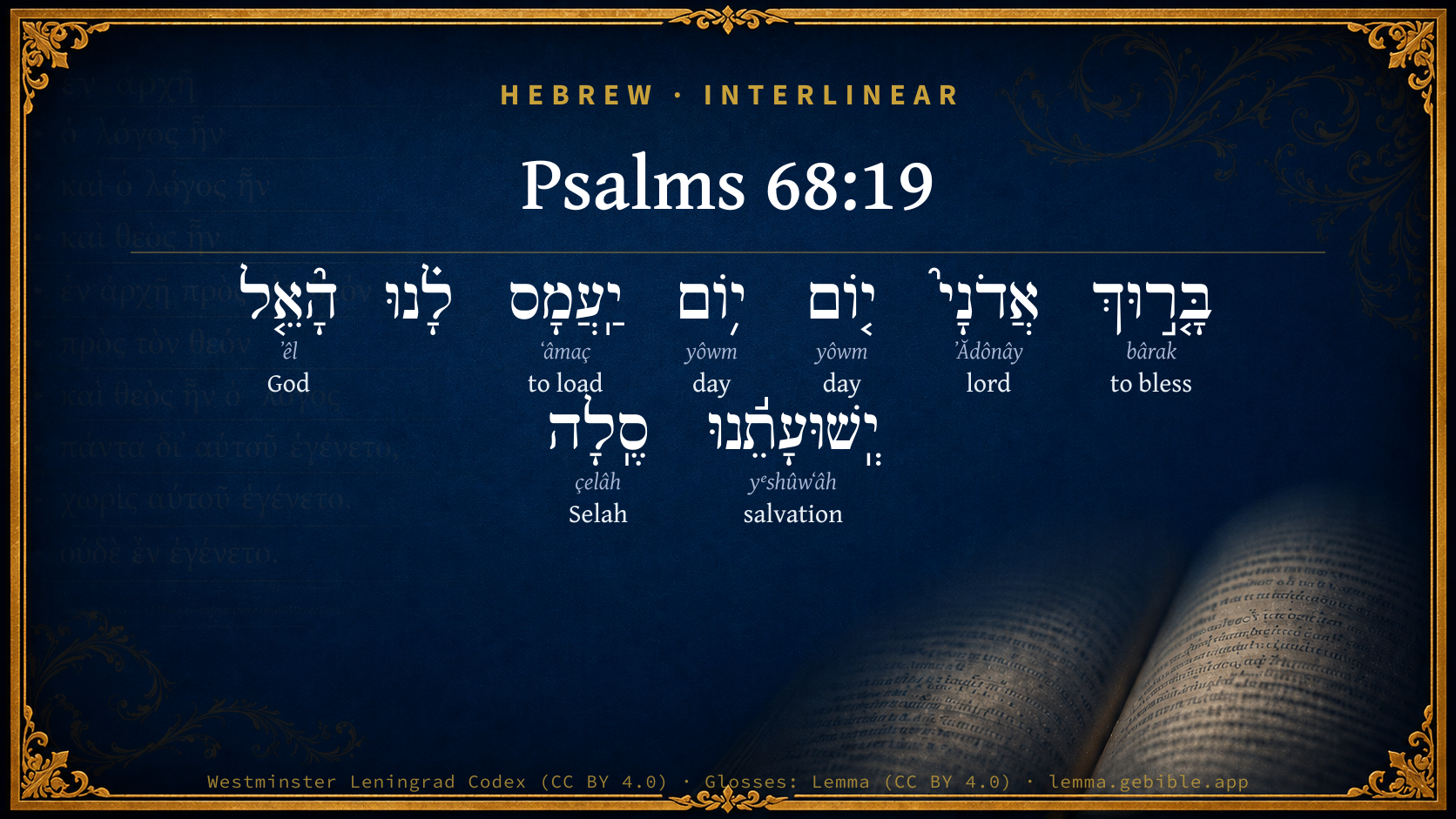
Hebrew (Westminster Leningrad Codex) Psalms 68:19 appears in the Hebrew Old Testament. The text above is from the Westminster Leningrad Codex. Each word links to its Strong’s number, a concise gloss, and parsing drawn from the Open Scriptures Hebrew Bible morphology. Click any word for its full Brown-Driver-Briggs (BDB) entry.
Download image
Cite this verse

Psalms 68:19 (World English Bible). Public Domain. Lemma interlinear Bible study tool, https://lemma.gebible.app/v/psalms/68/19.

Show BibTeX & RIS
BibTeX
RIS
English Translation
Blessed be the Lord, who daily bears our burdens, Even the God who is our salvation. Selah.
World English Bible · Public Domain
Download a study sheet

One document with this verse’s original text, its word-by-word gloss line, the meaning frame, cross-references with their text, attributed commentary, and full source and license credits — printable, and it pastes into notes with its structure intact.

This verse Autodidact and up

Study sheet (.html) Plain text (.txt)

A passage Seminary Student

Up to 50 verses in one chapter. A passage sheet keeps up to 6 commentary sources and 12 cross-references per verse, in the order this page ranks them, and says so on the sheet whenever that leaves anything out. Ask for a single verse and you get the Autodidact verse sheet above.

Everything on this page stays free to read, with no account — the sheet is a download of what is already on screen, not access to it.

Want to remove ads? Support Godless Engineer
Compare translations 3

The same verse in 3 English versions, stacked beneath the original-language interlinear above. Click any original word for its lexicon entry.

Each is an independent rendering of the whole verse — the interlinear is not word-aligned to these translations.

Highlighted words mark where these versions differ — a whole-verse word diff, not a word-by-word alignment.

  • World English Bible Public Domain
    Blessed be the Lord, who daily bears our burdens, Even the God who is our salvation. Selah.
  • King James Version Public Domain
    Blessed be the Lord, who daily loadeth us with benefits, even the God of our salvation. Selah.
  • unfoldingWord Literal Text CC BY-SA 4.0
    Blessed the Lord! Day, day he bears for us, the God of our salvation. Selah

unfoldingWord Literal Text — © unfoldingWord, licensed CC BY-SA 4.0. Word-aligned USFM3 via Door43 (git.door43.org/unfoldingWord/en_ult).

Versions to compare (up to 4)

3 of 4 selected

Show all 18 translations

Every available English version of this verse, each an independent rendering of the whole verse.

  • World English Bible Public Domain
    Blessed be the Lord, who daily bears our burdens, Even the God who is our salvation. Selah.
  • Berean Standard Bible Public Domain
    Blessed be the Lord, who daily bears our burden, the God of our salvation. Selah
  • Majority Standard Bible Public Domain
    Blessed be the Lord, who daily bears our burden, the God of our salvation. Selah
  • King James Version Public Domain
    Blessed be the Lord, who daily loadeth us with benefits, even the God of our salvation. Selah.
  • American Standard Version (1901) Public Domain
    Blessed be the Lord, who daily beareth our burden, Even the God who is our salvation. Selah
  • Revised Version (1885) Public Domain
    Blessed be the Lord, who daily beareth our burden, even the God who is our salvation. Selah
  • Geneva Bible (1599) Public Domain
    Praysed be the Lord, euen the God of our saluation, which ladeth vs dayly with benefites. Selah.
  • Douay-Rheims (1899) Public Domain
    Thou hast ascended on high, thou hast led captivity captive; thou hast received gifts in men. Yea for those also that do not believe, the dwelling of the Lord God.
  • Young's Literal Translation Public Domain
    Blessed `is' the Lord, day by day He layeth on us. God Himself `is' our salvation. Selah.
  • Literal Standard Version CC BY-SA 4.0
    Blessed [is] the Lord, day by day He lays on us. God Himself [is] our salvation. Selah.
  • Unlocked Literal Bible CC BY-SA 4.0
    Blessed be the Lord, who daily bears our burdens, the God who is our salvation. Selah
  • unfoldingWord Literal Text CC BY-SA 4.0
    Blessed the Lord! Day, day he bears for us, the God of our salvation. Selah
  • Darby Bible Public Domain
    Blessed be the Lord: day by day doth he load us [with good], the ùGod who is our salvation. Selah.
  • World Messianic Bible Public Domain
    Blessed be the Lord, who daily bears our burdens, even the God who is our salvation. Selah.
  • Webster's Bible Public Domain
    \\68:18\\Thou hast ascended on high, thou hast led captivity captive: thou hast received gifts for men; yes, for the rebellious also, that the LORD God might dwell among them.
  • Free Bible Version CC BY-SA 4.0
    May the Lord be blessed, for every day he carries our burdens. God is our salvation. Selah.
  • Bible in Basic English Public Domain
    Praise be to the Lord, who is our support day by day, even the God of our salvation. (Selah.)
  • JPS Tanakh (1917) Public Domain
    (68-20) Blessed be the Lord, day by day He beareth our burden, even the God who is our salvation. Selah

Literal Standard Version (2020), Covenant Press — licensed CC BY-SA 4.0. Text via the HelloAO Bible API (eBible.org). Unlocked Literal Bible (unfoldingWord) — licensed CC BY-SA 4.0. Text via the HelloAO Bible API (eBible.org). unfoldingWord Literal Text — © unfoldingWord, licensed CC BY-SA 4.0. Word-aligned USFM3 via Door43 (git.door43.org/unfoldingWord/en_ult). Free Bible Version, Dr. Jonathan Gallagher — licensed CC BY-SA 4.0. Text via the HelloAO Bible API (eBible.org).

Word by word

More ways to search: Search by grammar → Find every occurrence → Compare this word →

Practice this passage: Drill this verse → Learn its vocabulary →

About this verse

These counts appear in no published source. They are computed here, from the morphology-tagged text and Lemma’s own curated glosses. What Lemma adds →

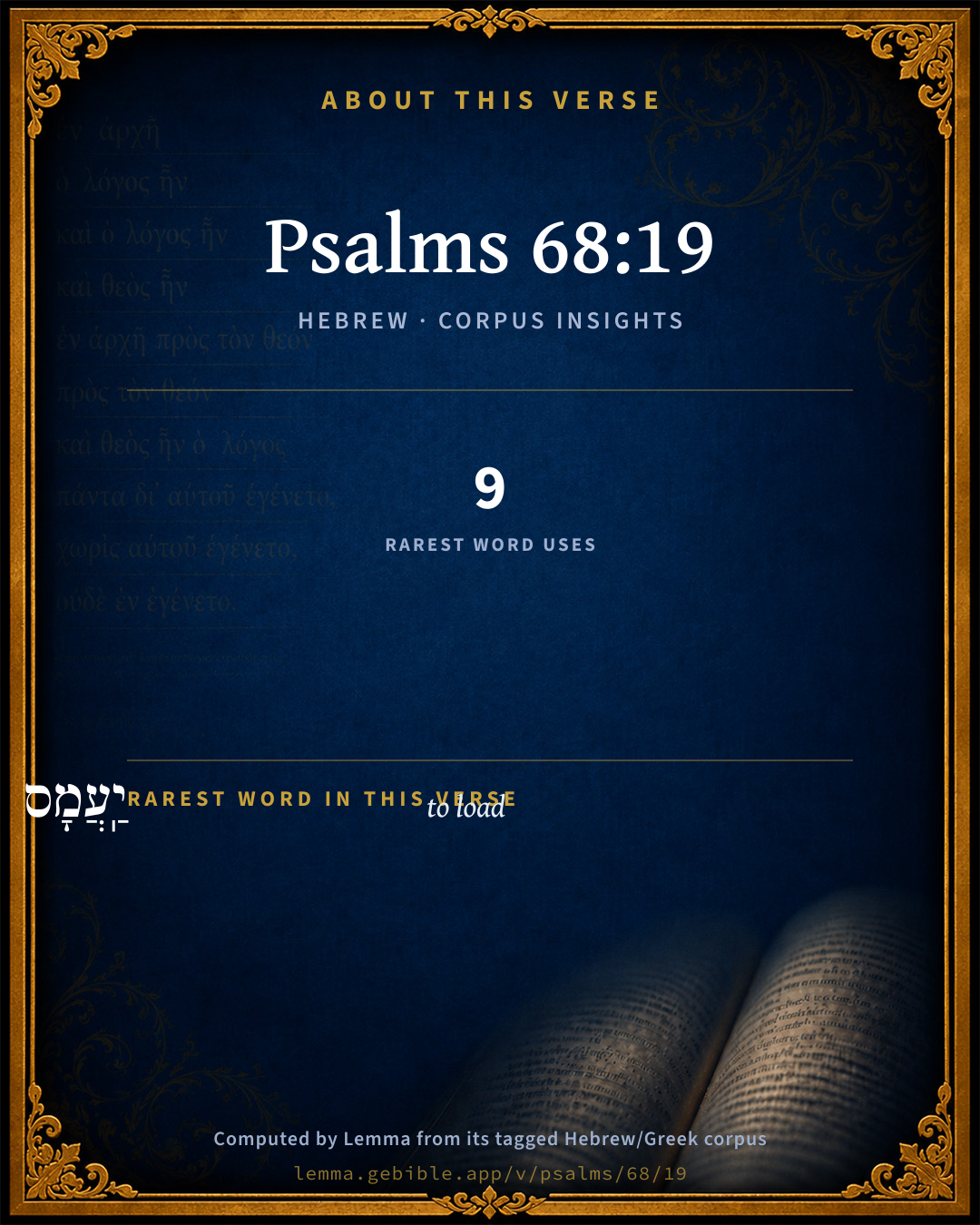
9
words
7
distinct lemmas
Wisdom
section

Notable vocabulary

The rarest word here is יַֽעֲמָס to load H6006 — appearing just 9 times in the whole Hebrew Bible.

Shared distinctive vocabulary

יַֽעֲמָס to load H6006 occurs in 9 verses of the Hebrew Bible. Also found in:

Grammatical profile

  • 2 verbs
  • 5 nouns
  • 1 preposition
  • 1 particle

Verb forms

  • בָּ֤ר֣וּךְ Qal · Participle Passive
  • יַֽעֲמָס Qal · Imperfect

Repetition

A word recurs within this verse — often emphatic in Hebrew:

  • י֤וֹם day H3117 ×2

Hebrew & Septuagint length

In English translation the verse runs 17 words from the Hebrew and 20 from the Septuagint (LXX English) — closely comparable.

A rough comparison of the two English renderings, which tokenize alike — not a word-level alignment.

Word counts can differ between the Hebrew and the Greek without any difference in meaning — e.g. the Hebrew direct-object marker אֵת has no separate Greek word, and Greek often adds the article ὁ.

Cross-references

9

Topical passages linked to Psalms 68:19 in the Treasury of Scripture Knowledge — connected by theme and wording, ordered by reader-vote popularity; previews shown in the World English Bible.

  • Isaiah 46:4 and even to old age I am he, and even to gray hairs will I carry you. I have made, and I will bear; yes, I will carry, and will deliver.
  • Lamentations 3:23 They are new every morning; great is your faithfulness.
  • Psalms 55:22 Cast your burden on Yahweh, and he will sustain you. He will never allow the righteous to be moved.
  • Ephesians 1:3 Blessed be the God and Father of our Lord Jesus Christ, who has blessed us with every spiritual blessing in the heavenly places in Christ;
  • Psalms 103:1–22 Praise Yahweh, my soul! All that is within me, praise his holy name!
  • Psalms 32:7 You are my hiding place. You will preserve me from trouble. You will surround me with songs of deliverance. Selah.
  • Psalms 65:5 By awesome deeds of righteousness, you answer us, God of our salvation. You who are the hope of all the ends of the earth, Of those who are far away on the sea;
  • Psalms 72:17–19 His name endures forever. His name continues as long as the sun. Men shall be blessed by him. All nations will call him blessed.
  • Psalms 139:17 How precious to me are your thoughts, God! How vast is the sum of them!

Cross-references courtesy of OpenBible.info (CC BY 4.0).

Hebrew and Greek witnesses Masoretic Hebrew ↔ Greek Septuagint

The same verse in the two great witnesses to the Old Testament, shown verse-for-verse.

You’re reading Greek Psalm 67 (Hebrew Psalm 68). The Septuagint counts the superscription, so verse numbers can differ from the Hebrew — chapter-level alignment, not verse-by-verse. Numbering follows Rahlfs.

These are two independent witnesses, not word-aligned to each other, and the Septuagint is shown in lemma (dictionary) form.

Hebrew Psalms 68:19 Masoretic · Westminster Leningrad Codex

בָּ֤ר֣וּךְ אֲדֹנָי֮ י֤וֹם י֥וֹם יַֽעֲמָס לָ֗נוּ הָ֘אֵ֤ל יְֽשׁוּעָתֵ֬נוּ סֶֽלָה

Blessed be the Lord, who daily bears our burdens, Even the God who is our salvation. Selah.

World English Bible · Public Domain

Greek LXX Greek Psalm 67:19 Septuagint · lemma form

ἀναβαίνω εἰς ὕψος αἰχμαλωτεύω αἰχμαλωσία λαμβάνω δόμα ἐν ἄνθρωπος καί γάρ ἀπειθέω ὁ κατασκηνόω κύριος ὁ θεός εὐλογητός

Blessed be the Lord God, blessed be the Lord daily; and the God of our salvation shall prosper us. Pause.

LXX2012 (modern English Septuagint) · Public Domain

On this verse, Adam Clarke's Commentary discusses the Septuagint’s reading. Read the note in Commentary ↓

Hebrew: Westminster Leningrad Codex (CC BY 4.0). Greek: Septuagint (public domain); English from LXX2012 (modern English Septuagint) (Public Domain). How the Septuagint differs from the Hebrew →

Commentary

Notes on Psalms 68:19 from classic Christian and Jewish commentators (each source and its license shown beneath its notes). The classic Christian expositions comment on the surrounding passage and are grouped to its opening verse, so a note may address several verses; the Jewish commentaries on the Tanakh (Rashi and others) are per-verse, so they appear only where the commentator wrote on this verse.

Lemma curates 59 commentaries, every one of them public domain or Creative Commons licensed, each selected and text-cleaned for this edition rather than reprinted as found. About our sources →

Trapp's Complete Commentary

John Trapp

Psa 68:19 Blessed [be] the Lord, [who] daily loadeth us [with benefits, even] the God of our salvation. Selah.

Ver. 19. Blessed be the Lord, who daily loadeth us] sc. With blessings, or with crosses turned into blessings, as being sanctified, and having their properties altered; for of themselves they are fruits of sin, and a piece of the curse. Let us not load him with our iniquities, &c.

John Trapp, A Commentary or Exposition upon All the Books of the Old and New Testament (1647–1656) — public domain. Text from a community e-Sword module.

The Biblical Illustrator

Joseph S. Exell

Psa_68:19-28

Blessed be the Lord, who daily loadeth us with benefits, even the God of our salvation.

God as the Deliverer of His people

I. A liberal dispenser of daily blessings (Psa_68:19). Daily beareth our burden (R.V.). Amongst the many ways in which He helps men to bear their burdens is by kindling within them and keeping burning the lamp of hope. The soul-vessel that is most heavily freighted, and most severely tossed by the tempest is buoyed up by hope. Day by day. When the day comes that God ceases to impart His strength, the man falls under his weight, and is crushed.

II. As the exclusive possessor of means for escaping death (Psa_68:20).

1. God alone has ways by which physical death can be escaped. Enoch; Elijah.

2. God alone has ways by which spiritual death can be escaped. Spiritual death is a thousand times the worst death, it is not the extinction of existence, but the extinction of all that makes existence worth having, and renders it an intolerable curse.

III. As the effectual subduer of persistent enemies (Psa_68:21). He could annihilate His universe by a volition. But the destruction of their enmity is a far more glorious work--a work that requires more time, and that, through Christ, He is prosecuting every day amongst men. Here He literally strikes at the head of His enemies, the spirit of antagonism to Himself. The ruling spirit of a man is the head of his being. It is at this that God strikes in the Gospel. Of the seed of the woman--viz. Christ--it was said, He shall bruise thy head. Christianity aims at the head of the evil, which is the governing disposition.

IV. As the willing repeater of needed interpositions (Psa_68:22; Psa_68:28). Truly, it is an encouraging thought that the great things that God has done for His people He is willing to do again, should they require it. He will take them through seas of trial and sorrow that threaten to swallow them up, put to flight the armies of their enemies, and make the land red with their blood. (Homilist.)

The burden-bearing God

The great objection to the rendering which has become familiar to us all, Who daily loadeth us with benefits, is that these essential words are not in the original, and need to be supplied in order to make out the sense. Whereas, on the other hand, if we adopt the suggested emendation, Who daily beareth our burdens, we get a still more beautiful meaning, which requires no force or addition in order to bring it out.

I. The remarkable and eloquent blending of majesty and condescension. What a thought that is--a God that carries mens loads! People talk much rubbish about the stern Old Testament Deity: is there anything sweeter, greater, more heart-compelling and heart-softening, than such a thought as this? How all the majesty bows itself and declares itself to be enlisted on our side when we think that He that sitteth on the circle of the heavens, and the inhabitants thereof are as grasshoppers, is the God that daily beareth our burdens!

II. The deep insight into the heart and ways of God here. He daily beareth our burdens. If there is any meaning in this word at all, it means that He so knits Himself with us as that all which touches us touches Him, that He takes a share in all our pressing duties, and feels the reflection from all our sorrows and pains. We have no impassive God in the heavens, careless of mankind, nor is His settled and changeless and unshaded blessedness of such a sort as that there cannot pass across it--if I may not say a shadow, I may at least say--a ripple from mens pangs and troubles and cares. God, in all our afflictions, is afflicted; and, in simple though profound verity, has that which is most truly represented to men, by calling it a fellow feeling with our infirmities and our sorrows.

III. The remarkable anticipation of the very heart of the Gospel. Ah! it were of small avail to know a God that bore the burden of our sorrows and the load of our duties, if we did not know a God who bore the weight of our sins. For that is the real crushing weight that breaks mens hearts and bows them to the earth. So the New Testament, with its message of a Christ on whom is laid the whole pressure of the worlds sin, is the deepest fulfilment of the great words of my text.

IV. What we should therefore do with our burdens. First, we should cast them on God, and let Him carry them. He cannot unless we do. One sometimes sees a petulant and self-confident little child staggering along with some heavy burden by the parents side, but pushing away the hand that is put out to help it to carry its load. And that is what too many of us do when God says to us, Here, My child, let Me help you, I will take the heavy end of it, and do you take the light one. And, last of all, let us see to it that we render Him praise. (A. Maclaren, D. D.)

The God of our salvation daily loadeth us with benefits

I. What God is: The God of our salvation. Man is a sinner, and sin exposes him to danger; for the wages of sin is death, and the soul that sinneth it shall die. But there is deliverance from this danger; this is attributed to God.

1. The scheme of salvation originated in God (Joh_3:17).

2. The means of salvation are afforded us by God. God sends us His Gospel, containing good news of salvation; His ministers to declare the way of salvation; He affords us Christian sabbaths, religious ordinances, and various means of grace, in order to promote our salvation.

3. The work of salvation is accomplished in the human soul by Gods immediate agency.

4. The sole glory of our final salvation will endlessly redound to God. In heaven we shall have clearer discoveries of the greatness, extent, and freeness of our salvation (Rev_7:10).

II. What God does for us: He daily loadeth us with benefits.

1. The nature of Gods gift. Benefits, not deserts.

2. Their number. Loadeth.

3. The frequency of their communication. Daily. And these benefits flow to us freely, unsolicited, unimplored, unsought. Seasonably, exactly as we need them. Critics state that it should be read who bears our burdens, or supports us, every day. In the wilderness God bare Israel as a man doth bear his son (Deu_1:31). Or as an eagle bears her young on her wings (Deu_32:11). The promise is (Isa_46:4). We have our cares, and burdens, and anxieties, but God invites us to cast them upon Him (Psa_55:22).

III. What we should do in return. Blessed be the Lord. To bless signifies to extol, exalt, or speak well of a person; and to bless the Lord is to speak good of His name.

1. We should bless the Lord sincerely. Hypocrisy is hateful to God.

2. We should bless the Lord affectionately. Our gratitude should be the effusion of love.

3. We should bless the Lord constantly. I will bless the Lord at all times.

4. We should bless the Lord practically. To say, We praise Thee, O God, we acknowledge Thee to be the Lord, while we practically violate His laws, must be abominable in His sight. Let us praise Him not only with our lips but by our lives, etc. (Sketches of Four Hundred Sermons.)

Unto God the Lord belong the issues from death.

The royal prerogative

Whatever may be said of the Old Testament dispensation, one thing is clear; in it the Lord God of Israel is ever most conspicuous. God is in all and over all. Here in our text, universal action and power over us are ascribed to the Lord--the mercies of life and the issues of death.

I. The sovereign prerogative of God. Unto God . . . the issues of death. Kings have been wont to keep the power of life and death in their own hands. The great King of kings does so. He can create and He destroy. This prerogative of life and death is His in a wide sense. It is true of our natural life, and of our spiritual. For we are under the condemnation of the law. But God determines whether the sentence shall be carried out. And in those deaths oft with which Christian experience is familiar, those dyings down of the heart and spirit which are the result of our old nature which still cleaveth to the dust, Gods Spirit can revive us again. And when we come actually to die, not to death but to God shall the issue belong. I am the Resurrection and the Life, saith the Lord: He that liveth and believeth in Me shall never die. And the resurrection day will make His words good.

2. He has the right to exercise this prerogative.

3. And He has exercised this prerogative in abundant instances.

4. Then let Him have all the glory of it.

II. The character of the sovereign in whom it is vested. He that is our God is the God of salvation. This name means--

1. That salvation is the most glorious of all His designs.

2. That His most delightful works have been works of salvation.

3. That we live at this moment under the dispensation of mercy. The sword is sheathed, the scales of justice put by.

4. That to those who can call Him our God He is especially and emphatically the God of salvation. We owe it all to Him. Twas He passed by and bid us live.

III. The solemn warning of the Sovereign Lord. A new God has lately been set up, all leniency, gentleness, mildness and indifference in the matter of sin. This God is made of honey or sugar of lead. Justice is not in him, nor the punishment of sin. But it is not so. Our text tells the awful truth to wicked men. God can smite, and ere long He will. The proud may vaunt themselves of their beauty and glory in their strength; their heavy scalp, like that of Absalom, may be their boast, but, as in his case, it may be their ruin. No man is out of the reach of God, and no nation either. Turn ye then, ye that know not God. (C. H. Spurgeon.)

The Biblical Illustrator, edited by Joseph S. Exell (c. 1880s–1900s) — public domain. Text from a community e-Sword module.

Joseph Benson's Commentary

Psa 68:19-20. Blessed be the Lord, &c. — Having surveyed God’s dispensations of grace and mercy to his church and people, thus manifested in their redemption and salvation, the psalmist is so overcome with gratitude for them, that he thus breaks forth abruptly in praise and thanksgiving; who daily loadeth us with his benefits — Who, besides the great and glorious blessing of our redemption, once wrought for us, is daily conferring new favours upon us. So many and so weighty are the gifts of God’s bounty to us, that he may be truly said to load us with them; and so incessant are they, and so unwearied is he in doing us good, that he daily loads us with them, according as the necessity of every day requires. Even the God of our salvation — The only author and finisher of our present and of our eternal salvation. He that is our God — Who is our Friend, Father, and God in covenant; is the God of salvation — He will not put us off with present things for a portion, but he will be the God of our salvation: and what he gives us now, he gives as the God of salvation, pursuant to his great design of bringing us to everlasting happiness. For that only will answer the vast extent of his covenant relation to us as our God. But has he power to complete this salvation? Yes, certainly; for unto the Lord our God belong the issues from death — The keys of hell and death are put into the hands of the Lord Jesus, Rev 1:18. He, having made an escape from death itself, in his resurrection, has both authority and power to rescue his followers from the dominion of it, by altering the property of it to them when they die, and giving them a complete victory over it when they shall rise again; for the last enemy that shall be destroyed is death.

Joseph Benson's Commentary on the Old and New Testaments (1811–1818) — public domain. Text from a community e-Sword module.

J. A. Alexander on Psalms

Joseph Addison Alexander

20. (Psa 68:19). Blessed be the Lord, day (by) day; (whoever) lays a load upon us, the Mighty (God is) our salvation. Selah. The second clause, which is obscure from brevity, also admits of this translation: (man) may lay a load upon us, (but) God is our salvation. Lay a load upon us, literally load to us, or as to us. According to both these constructions, loading means oppression. It is possible, however, to attach to it the sense of benefits or favours, put upon it in the English versions, but with a very different construction of the whole clause. The Mighty (God) will heap upon us our salvation, or, will load us with salvation. The depth of feeling and the strength of faith, on which this anticil ation rests, are indicated or betrayed by the meditative pause which follows.

Joseph Addison Alexander, The Psalms Translated and Explained (1850) — public domain. Text from a community e-Sword module.

MacLaren's Expositions of Holy Scripture

Alexander MacLaren

Psalms

THE BURDEN-BEARING GOD

Psa 68:19.

The difference between these two renderings seems to be remarkable, and a person ignorant of any language but our own might find it hard to understand how any one sentence was susceptible of both. But the explanation is extremely simple. The important words in the Authorised Version, ‘with benefits,’ are a supplement, having nothing to represent them in the original. The word translated ‘loadeth’ in the one rendering and ‘beareth’ in the other admits of both these meanings with equal ease, and is, in fact, employed in both of them in other places in Scripture. It is clear, I think, that, in this case, at all events, the Revision is an improvement. For the great objection to the rendering which has become familiar to us all, ‘Who daily loadeth us with benefits,’ is that these essential words are not in the original, and need to be supplied in order to make out the sense. Whereas, on the other hand, if we adopt the suggested emendation, ‘Who daily beareth our burdens,’ we get a still more beautiful meaning, which requires no forced addition in order to bring it out. So, then, I accept that varied form of our text as the one on which I desire to say a few words now.

I. The first thing that strikes me in looking at it is the remarkable and eloquent blending of majesty and condescension.

It is not without significance that the Psalmist employs that name for God in this clause, which most strongly expresses the idea of supremacy and dominion. Rule and dignity are the predominant ideas in the word ‘Lord,’ as, indeed, the English reader feels in hearing it; and then, side by side with that, there lies this thought, that the Highest, the Ruler of all, whose absolute authority stretches over all mankind, stoops to this low and servile office, and becomes the burden-bearer for all the pilgrims who will put their trust in Him. This blending together of the two ideas of dignity and condescension to lowly offices of help and furtherance is made even more emphatic if we glance back at the context of the psalm. For there is no place in Scripture in which there is flashed before the mind of the singer a grander picture of the magnificence and the glory of God, than that which glitters and flames in the previous verses. We read in them of God ‘riding through the heavens by His name Jehovah’; of Him as marching at the head of the people, through the wilderness, and of the earth quivering at His tread, and the heavens dropping at His presence. We read of Zion itself being moved at the presence of the Lord. We read of His word going forth so mightily as to scatter armies and their kings. We read of the chariots of God as ‘twenty thousand, even thousands of angels.’ All is gathered together in the great verse, ‘Thou hast ascended on high, Thou hast led captivity captive.’ And then, before he has taken breath almost, the Psalmist turns, with most striking and dramatic abruptness, from the contemplation, awe-struck and yet jubilant, of all that tremendous, magnificent, and earth-shaking power to this wonderful thought, ‘Blessed be the Lord! who daily beareth our burdens.’ Not only does He march at the head of the congregation through the wilderness, but He comes, if I might so say, behind the caravan, amongst the carriers and the porters, and will bear anything that any of the weary pilgrims intrusts to His care.

Oh, dear brethren! if familiarity did not dull the glory of it, what a thought that is-a God that carries men’s loads! People talk much rubbish about the ‘stern Old Testament Deity’; is there anything sweeter, greater, more heart-compelling and heart-softening, than such a thought as this? How all the majesty bows itself, and declares itself to be enlisted on our side, when we think that ‘He that sitteth on the circle of the heavens, and the inhabitants thereof are as grasshoppers’ is the God that ‘daily beareth our burdens’!

And that is the tone of the Old Testament throughout, for you will always find braided together in the closest vital unity the representation of these two aspects of the divine nature; and if ever we hear set forth a more than ordinarily magnificent conception of His power and majesty be sure that, if you look, you will find side by side with it a more than ordinarily tender representation of His gentleness and His grace. And if we look deeper, this is not a case of contrast, it is not that there are sharply opposed to each other these two things, the gentleness and the greatness, the condescension and the magnificence, but that the former is the direct result of the latter; and it is just because He is Lord, and has dominion over all, that, therefore, He bears the burdens of all. For the responsibilities of the Creator are in proportion to His greatness, and He that has made man has thereby made it necessary that He should, if they will let Him, be their Burden-bearer and their Servant. The highest must be the lowest, and just because God is high over all, blessed for ever, therefore is He the Supporter and Sustainer of all. So we may learn the true meaning of elevation of all sorts, and from the example of loftiest, may draw the lesson for our more insignificant varieties of height, that the higher we are, the more we are bound to stoop, and that men are then likest God, when their elevation suggests to them responsibility, and when he that is chiefest becomes the servant.

II. So, then, notice next the deep insight into the heart and ways of God here.

‘He daily beareth our burdens.’ If there is any meaning in this word at all, it means that He so knits Himself with us as that all which touches us touches Him, that He takes a share in all our pressing duties, and feels the reflection from all our sorrows and pains. We have no impassive God in the heavens, careless of mankind, nor is His settled and changeless and unshaded blessedness of such a sort as that there cannot pass across it-if I may not say a shadow, I may at least say-a ripple from men’s pangs and troubles and cares. Love is the identification of oneself with the beloved object. We call it sympathy, when we are speaking about the fellow feeling between man and man that is kindled of love. But there is something deeper than sympathy in that great Heart, which gathers into itself all hearts, and in that great Being, whose being underlies all our beings, and is the root from which we all live and grow. God, in all our afflictions, is afflicted; and in simple though profound verity, has that which is most truly represented to men, by calling it a fellow feeling with our infirmities and our sorrows.

‘Think not thou canst sigh a sigh,

And thy Maker is not nigh;

Think not thou canst weep a tear,

And thy Maker is not near.’

For want of a better word, we speak of the sympathy of God: but we need something far more intimate and unwearied than we understand by that word, to express the community of feeling between all who trust Him and His own infinite heart. If this bearing of our burden means anything, it gives us a deep insight, too, into His workings, as well as into His heart. For it covers over this great truth that He Himself comes to us, and by the communication of His own power to us, makes us able to bear the burdens which we roll upon Him. The meaning of His ‘lifting our load,’ in so far as that expression refers to the divine act rather than the divine heart, is that He breathes into us the strength by which we can carry the heavy task of duties, and can endure the crushing pressure of our sorrows. All the endurance of the saints is God in them bearing their burdens.

Notice, too, ‘daily beareth,’ or, as the Hebrew has it yet more emphatically because more simply, ‘day by day beareth.’ He travels with us, in the greatness of His might and the long-suffering of His unwearied patience, through all our tribulation, and as He has ‘borne and carried’ His people ‘all the days of old,’ so, at each new recurrence of new weights, He is with us still. Like some river that runs by the wayside and ever cheers the traveller on the dusty path with its music, and offers its waters to cool his thirsty lips, so, day by day, in the slow iteration of our lingering sorrows, and in the monotonous recurrence of our habitual duties, there is with us the ever-present help of the Ancient of Days, who measures out daily strength for the daily load, and never sends the one without proffering the other.

III. So, again, notice here the remarkable anticipation of the very heart of the Gospel.

‘The God who daily beareth our burdens,’ says the Psalmist. He spoke deeper things than he knew, and was wiser than he understood. For the hope that gleams in these words comes to fulfilment, in Him of whom it was written in prophetic anticipation, so clear and definite that it reads like historical narrative-’He bare our grief and carried our sorrows. The chastisement of our peace was upon Him. The Lord hath laid on Him the iniquity of us all.’

Ah! it were of small avail to know a God that bore the burden of our sorrows and the load of our duties, if we did not know a God who bore the weight of our sins. For that is the real crushing weight that breaks men’s hearts and bows them to the earth. So the New Testament, with its message of a Christ on whom is laid the whole pressure of the world’s sin, is the deepest fulfilment of the great words of my text.

IV. Note, lastly, what we should therefore do with our burdens.

First, we should cast them on God, and let Him carry them. He cannot unless we do. One sometimes sees a petulant and self-confident little child staggering along with some heavy burden by the parent’s side, but pushing away the hand that is put out to help it to carry its load. And that is what too many of us do when God says to us, ‘Here, My child! let Me help you, I will take the heavy end of it, and do you take the light one.’ ‘Cast thy burden upon the Lord’-and do it by faith, by simple trust in Him, by making real to yourselves the fact of His divine sympathy, and His sure presence, to aid and to sustain.

Having thus let Him carry the weight, do not you try to carry it too. As our good old hymn has it- ‘Why should I the burden bear?’ It is a great deal more God’s affair than yours. We have, indeed, in a sense, to carry it. ‘Every man shall bear his own burden.’ The weight of duty is not to be indolently shoved off our shoulders on to His, saying, ‘Let Him do the work.’ We have indeed to carry the weight of sorrow. There is no use in trying to deny its bitterness and its burden, and it would not be well for us that it should be less bitter and less heavy. In many lands the habit prevails, especially amongst the women, of carrying heavy loads on their heads; and all travellers tell us that the practice gives a dignity and a grace to the carriage, and a freedom and a swing to the gait, which nothing else will do. Depend upon it, that so much of our burdens of work and weariness as is left to us, after we have cast them upon Him, is intended to strengthen and ennoble us. But do not let there be the gnawings of anxiety. Do not let there be the self-torment of aimless prognostications of evil. Do not let there be the chewing of the bitter morsel of irrevocable sorrows; but fling all upon God. And remember what the Master has said, and His servant has repeated: ‘Take no anxious care . . . for your heavenly Father knoweth’; ‘Cast your anxiety upon Him, for He careth for you.’

And the last advice that comes from my text is, to see that your tongues are not silent in that great hymn of praise which ought to go up to ‘the Lord that daily beareth our burdens.’ He wants only our trust and our thanks, and is best paid by the praise of our love, and of our heaping still more upon His ever strong and ready arm. Bless the Lord! who beareth our burdens, and see that you give Him yours to bear. Listen to Him who hath said, ‘Come unto Me all ye that . . . are heavy laden, and I will give you rest.’

Alexander MacLaren, Expositions of Holy Scripture (1904–1910) — public domain. Text from a community e-Sword module.

Tyndale Open Study Notes

Tyndale Open Resources

68:19-20 The Divine Warrior cares for his people like a shepherd; the people praise him.

68:19 Like a caring father or a shepherd, God carries his people in his arms (see 55:22; 68:5-6).

Tyndale Open Study Notes — © Tyndale Open Resources, licensed CC BY-SA 4.0. Text via the HelloAO Bible API.

Jamieson, Fausset & Brown

Robert Jamieson, A. R. Fausset & David Brown

God daily and fully supplies us. The issues or escapes from death are under His control, who is the God that saves us, and destroys His and our enemies.

Jamieson, Fausset & Brown — Commentary Critical and Explanatory on the Whole Bible (1871) — public domain (CC PDM 1.0). Text via the HelloAO Bible API.

Adam Clarke's Commentary

Verse 19. Blessed be the Lord, who daily loadeth us] With benefits is not in the text. Perhaps it would be better to translate the clause thus: "Blessed be Adonai, our Prop day by day, who supports us." Or, "Blessed be the Lord, who supports us day by day." Or as the Vulgate, Septuagint, and Arabic: "Blessed be the Lord daily, our God who makes our journey prosperous; even the God of our salvation." The Syriac, "Blessed be the Lord daily, who hath chosen our inheritance." The word עמס amas, which we translate to load, signifies to lift, bear up, support, or to bear a burden for another. Hence it would not be going far from the ideal meaning to translate: "Blessed be the Lord day by day, who bears our burdens for us." But loadeth us with benefits is neither a translation nor meaning.

Adam Clarke's Commentary on the Bible (1810–1826) — public domain. Text from a community e-Sword/MySword module.

John Calvin's Commentaries

19. Blessed be the Lord, etc. David would have us to understand, that in recounting the more particular deliverances which God had wrought, he did not mean to draw our minds away from the fact, that the Church is constantly and at all times indebted for its safety to the Divine care and protection. He adds, Blessed be God daily And he intimates, that deliverances might be expected from him with great abundance of every blessing. Some read, he will load, others, he will carry; but it is of little importance which reading we adopt. He points at the fact, that God extends continued proofs of his kindness to his people, and is unwearied in renewing the instances of it. I read this Lord in the second part of the verse, for the letter ה, he, prefixed in the Hebrew, has often the force of a demonstrative pronoun; and he would point out, as it were with the finger, that God in whom their confidence ought to be placed. So in the next verse, which may be read, this our God is the God of salvation What is here said coincides with the scope of what immediately precedes, and is meant to convey the truth that God protects his Church and people constantly. In saying this God, he administers a check to the tendency in men to have their minds diverted from the one living and true God. The salvation of God is set before the view of all men without exception, but is very properly represented here as something peculiar to the elect, that they may recognize themselves as continually indebted to his preserving care, unlike the wicked, who pervert that which might have proved life into destruction, through their unthankfulness. The Hebrew word in the 20th verse is salvations, in the plural number, to convince us that when death may threaten us in ever so many various forms, God can easily devise the necessary means of preservation, and that we should trust to experience the same mercy again which has been extended to us once. The latter clause of the verse bears the same meaning, where it is said, that to the Lord belong the issues of death Some read, the issues unto death, supposing that the reference is to the ease with which God can avenge and destroy his enemies; but this appears a constrained interpretation. The more natural meaning obviously is, that God has very singular ways, unknown to us, of delivering his people from destruction. He points at a peculiarity in the manner of the Divine deliverances, that God does not generally avert death from his people altogether, but allows them to fall in some measure under its power, and afterwards unexpectedly rescues them from it. This is a truth particularly worthy of our notice, as teaching us to beware of judging by sense in the matter of Divine deliverances. However deep we may have sunk in trouble, it becomes us to trust the power of God, who claims it as his peculiar work to open up a way where man can see none.

John Calvin's Commentaries (1540-1563) — public domain. Text from the Calvin Translation Society English edition (1840s-50s) via the Christian Classics Ethereal Library (ccel.org). Calvin's coverage is partial (roughly two-thirds of the Bible); uncommented books and verses are honest gaps, never fabricated. The 19th-century editor's footnotes and remarks are omitted so the notes are faithfully Calvin's own voice.

Ellicott's Commentary for English Readers

(19) The verb, as the italics of the Authorised Version show, is of somewhat indefinite use. It appears to have both an active and passive sense, meaning to lay a burden, or to receive a burden. Here the context seems to require the latter: who daily takes our burden for us, i.e., either the burden of trial or of sin. (Comp. a somewhat similar passage, Psa_99:8, “thou art a God who liftest for us,” i.e., as Authorised Version, “forgivest us.”) But it is quite possible to render, if any put a burden on us, God is our help.

(19-23) The abrupt transition from the scene of triumph just described to the actual reality of things which the psalmist now for the first time faces, really gives the key to the intention of the poem. It is by God’s favour and might, and not by the sword, that deliverance from the enemies actually threatening the nation is to be expected.

A Bible Commentary for English Readers, edited by Charles John Ellicott (1878–1897) — public domain. Text from a community e-Sword module.

The Cambridge Bible for Schools and Colleges

gen. ed. J. J. S. Perowne

19. Blessed be the Lord] We are again reminded of the Song of Deborah, Jdg_5:2; Jdg_5:9.

who daily loadeth us with benefits] Better, as R.V., who daily beareth our burden: or, as Aq., Symm., Jer. and Targ., who daily beareth us. In Isa_46:3-4, the same word is used in the phrase, “O house of Jacob … which have been borne by me”: and in Exo_19:4; Deu_1:31; Psa_28:9; the idea, though not the word, is the same. The R.V. marg. Blessed be the Lord day by day: if one oppresseth us, God is our salvation, involves the abandonment of the traditional accentuation, and gives a less satisfactory sense.

even the God of our salvation] In order to avoid the appearance of a grammatical blunder, the R.V. gives, Even the God who is our salvation. The whole verse might be rendered more exactly and forcibly:

Blessed be the Lord; day by day he beareth our burden:

God is our salvation.

On the position of Selah see note on Psa_68:7.

19–23. The second part of the Psalm (19–35) begins here. From reviewing the triumphs of God in the past the Psalmist turns to the present and the future. God is an ever-present Saviour; He will take vengeance on the enemies of His people.

The Cambridge Bible for Schools and Colleges (gen. ed. J. J. S. Perowne; Cambridge University Press, 1878–1918) — public domain. Text from a community e-Sword module.

John Gill's Exposition

Blessed be the Lord, who daily loadeth us with benefits,.... With all spiritual blessings, with an abundance of grace, as well as with temporal mercies, for which he is, and ought to be, praised day by day: so Aben Ezra and Kimchi supply the text, and suppose the word "blessings" or "goodness" to be wanting; though the words may be rendered, "blessed be the Lord day by day, he will hear us", or "carry us" (o); as a father his child, or a shepherd his lambs; and so he does from the womb, even to hoary hairs; and therefore blessing and praise should be ascribed to him; see Isa 46:3; or "he will put a burden upon us" (p); meaning the burden of afflictions: these are of the Lord's laying upon his people; and he will lay no more upon them than he will enable them to bear; and will, in his own time and way, deliver them from them, and be the author of salvation to them, as follows; and therefore his name is to be praised, Co1 10:13; the Targum interprets it of the burdensomeness of the law;

"blessed be the Lord every day, he burdens us, adding precepts unto precepts;''

even the God of our salvation; the author of temporal, spiritual, and eternal salvation, as Christ is.

Selah; on this word; see Gill on Psa 3:2.

(o) "portal nos", Vatablus, Musculus; "bajulat nos", Cocceius. (p) "Onus imponit nobis", Lutherus, Gejerus.

John Gill's Exposition of the Whole Bible (1746–1763) — public domain (CC PDM 1.0). Text via the HelloAO Bible API.

Albert Barnes' Notes on the Bible

Blessed be the Lord, who daily loadeth us with benefits ... - literally, “day, day;” that is, day by day; or, constantly. The words “with benefits” are not in the original, and they do not convey the true idea of the passage. The word rendered “loadeth” means to take up; to lift, as a stone, Zec 12:3; to bear, to carry, Isa 46:3. Then it means “to take up and place upon a beast of burden;” to load, Isa 46:1; Gen 44:13. Hence, it means to impose or lay a burden or a load on one; and the idea here is, “Blessed be the Lord God even if he lays a burden on us, and if he does this daily, for he is the God of our salvation.” He enables us to bear it; he gives us strength; and finally he delivers us from it. “Though,” therefore, he constantly lays on us a burden, he as constantly aids us to bear it. He does not leave us. He enables us to triumph in him, and through him; and we have occasion constantly to honor and to praise his name. This accords with the experience of all his people, that however heavy may be the burden laid on them, and however constant their trials, they find him as constant a helper, and they daily have occasion to praise and bless him.

Albert Barnes' Notes on the Bible (1834–1885) — public domain. Text from a community e-Sword/MySword module.

Matthew Poole's English Annotations

Who daily loadeth us with benefits; and besides that great and glorious blessing of his ascension which once he wrought for us, he is daily conferring new favours upon us. Heb. who layeth load upon us; which may be understood either,

1. Of the burden of afflictions, for which God’s people have cause to bless God upon many accounts. Or rather,

2. Of mercies and favours, which is more agreeable to the context; wherewith in common speech men are said to be loaded by another when they receive them from him in great abundance.

The God of our salvation; the only Author and Finisher both of our present and of our eternal salvation.

Matthew Poole's English Annotations on the Holy Bible (1683–1685) — public domain. Text from a community e-Sword/MySword module.

The Treasury of David

Charles H. Spurgeon

Ver. 19. Blessed be the Lord. At the mention of the presence of God among men the singers utter an earnest acclamation suggested by reverential love, and return blessings to him who so plentifully blesses his people.

Who daily loadeth us with benefits. Our version contains a great and precious truth, though probably not the doctrine intended here. God's benefits are not few nor light, they are loads; neither are they intermittent, but they come "daily; "nor are they confined to one or two favourites, for all Israel can say, he loadeth us with benefits. Delitzsch reads it, "He daily bears our burden; "and Alexander, "Whoever lays a load upon us, the Mighty God is our salvation." If he himself burdens us with sorrow, he gives strength sufficient to sustain it; and if others endeavour to oppress us, there is no cause for fear, for the Lord will come to the rescue of his people. Happy nation, to be subdued by a King whose yoke is easy, and who secures his people from all fear of foreign burdens which their foes might try to force upon them.

Even the God of our salvation. A name most full of glory to him, and consolation to us. No matter how strong the enemy, we shall be delivered out of his hands; for God himself, as King, undertakes to save his people from all harm. What a glorious stanza this is! It is dark only because of its excessive light. A world of meaning is condensed into a few words. His yoke is easy, and his burden is light, therefore blessed be the Saviour's name for evermore. All hail! thou thrice blessed Prince of Peace! All thy saved ones adore thee, and call thee blessed.

Selah. Well may the strings need tuning, they have borne an unparalleled strain in this mighty song. Higher and yet higher, ye men of music, lift up the strain. Dance before the ark, ye maidens of Israel; bring forth the timbrel, and sing unto the Lord who hath triumphed gloriously.

Ver. 19. Blessed be the Lord, etc. I think the sweet singer of Israel seems to raise his note to the emulation of the choir of heaven in the melody of their Allelujahs; yea, let me say, now that he sings above in that blessed consort of glorious spirits, his ditty cannot be better than this that he sang here upon earth, and wherein we are about to bear our parts at this time. Prepare, I beseech you, both your ears for David's song, and your hearts and tongues for your own. And first, in this angelic strain your thoughts cannot but observe the descant and the ground. The descant of gratulation, Blessed be the Lord, wherein is both applause and excitation; an applause given to God's goodness, and an excitation of others to give that applause. The ground is a threefold respect. Of what God is in himself, God and Lord; of what God is and doth to us, which loadeth us daily with benefits; of what he is both in himself and to us, the God of our salvation; which last (like to some rich stone) is set off with a dark foil: To God the Lord belong the issues from death. So, in the first for his own sake, in the second for our sakes, in the third for his own and ours; as God, as Lord, as a benefactor; as a Saviour and deliverer. Blessed be the Lord. It is not hard to observe that David's Allelujahs are more that his Hosannas, his thanks more than his suits. Ofttimes doth he praise God when he begs nothing; seldom ever doth he beg that favour, for which he doth not raise up his soul to an anticipation of thanks; neither is this any other than the universal under song of all his heavenly ditties, Blessed be the Lord. Praises (as our former translation hath it) is too low; honour is more than praise; blessing is more than honour. Neither is it for nothing that from this word Krb, to bless, is derived Krb, the knee, which is bowed in blessing; and the crier before Joseph proclaimed Abrech, calling for the honour of the knee from all beholders. Ge 41:43. Every slight, trivial acknowledgment of worth is a praise; blessing is in a higher strain of gratitude, that carries the whole sway of the heart with it in a kind of divine rapture. Praise is a matter of compliment; blessing of devotion. The apostle's rule is, that the less is blessed of the greater, Abraham of the King of Salem, the prophet's charge is, that the greater should be blessed of the less, yea, the greatest of the least, God of man. This agrees well; blessing is an act that will bear reciprocation; God blesseth man imperatively; man blesseth God optatively. God blesseth man in the acts of mercy; man blesseth God in the notions, in the expressions of thanks. God blesses man when he makes him good and happy; man blesseth God when he confesseth how good, how gracious, how glorious he is; so as the blessing is wholly taken up in agnation, (acknowledgment), in celebration: in the one we acknowledge the bounty of God to us; in the other we magnify him vocally, really, for that bounty. O see, then, what high account God makes of the affections and actions that his poor, silly, earth creeping creatures; that he gives us in them power to bless himself, and takes it as an honour to be blessed of us. David wonders that God should so vouchsafe to bless man; how much more must we needs wonder at the mercy of God, that will vouchsafe to be blessed by man, a worm, an atom, a nothing? Yet both, James tells us, that with the tongue we bless God; and the psalmist calls for it here as a service of dear acceptation, Blessed be the Lord. Even we men live not (chameleon like) upon the air of thanks, nor grow the fatter for praises; how much less our Maker? O God, we know well that whatsoever men or angels do, or do not, thou canst not but be infinitely blessed in thyself; before ever any creature was, thou didst equally enjoy thy blessed self from all eternity: what can this worthless, loose film of flesh either add to or detract from thine infiniteness? Yet thou, that humbleth thyself to behold the things that are done in heaven and earth, humblest thyself also to accept the weak breath of our praises, that are sent up to thee from earth to heaven. How should this encourage the vows, the endeavours of our hearty thankfulness, to see them graciously taken? If men would take up with good words, with good desires, and quit our bonds for thanks, who would be a debtor? With the God of Mercy this cheap payment is current. If he, then, will honour us so far as to be blessed of us, Oh let us honour him so far as to bless him. Joseph Hall, in "A Sermon of Public Thanksgiving for the Wonderful Mitigation of the late Mortality." 1625.

Ver. 19. Blessed be the Lord. It is not a little remarkable to see the saints so burdened and overcharged with the duty of singing his praise, that,

1. They are forced to come off with an excess of praise, and offer to praise him and even leave it, as it were, as they found it, and say no more, lest they should spill his praises; but, as Re 5:12, "Worthy is the Lamb to receive glory and honour, "though I be not worthy or able to give it to him.

2. That they speak broken language and half sentences in their songs, when they are deeply loaden with the deep sense of his love, as Blessed be the Lord, who daily loadeth us with benefits; there is no more in the original but Blessed be the Lord, that loadeth us. John Spalding, in "Synaxis Sacra." 1703.

Ver. 19. Who daily loadeth us with benefits. Though some may have more than others, yet every one hath his load, as much as he can carry. Every vessel cannot bear up with the like sail, and therefore God, to keep us from oversetting, puts on so much as will safest bring us to heaven, our desired port. Ezekiel Hopkins.

Ver. 19. Who daily loadeth us with benefits. Such is man's self love that no inward worth can so attract his praises as outward beneficence. While thou makest much of thyself, every one shall speak well of thee; how much more while thou makest much of them! Here God hath met with us also. Not to perplex you with scanning the variety of senses wherewith I have observed this Psalm, above all other of David's, to abound; see here, I beseech you, a fourfold gradation of divine bounty. First, here are benefits. The word is not expressed in the original, but necessarily implied in the sense: for there are but three loads whereof man is capable from God, favours, precepts, punishments, the other two are out of the road of gratulation. When we might therefore have expected judgments, behold benefits. And those, secondly, not sparingly hand fulled out to us, but dealt to us by the whole load: loaded with benefits. Whom, thirdly, doth he load but us? Not worthy and well deserving subjects, but us, Myrrwm, rebels. And, lastly, this he doth, not at one dole and no more (as even churls' rare feasts use to be plentiful), but Mwy Mwy successively, unweariedly, perpetually. One favour were too much, here are benefits; a sprinkling were too much, here is a load; once were too oft, here is daily enlarging, (largeness, bounty). Cast your eyes, therefore, a little upon this threefold exaggeration of beneficence; the measure, a load of benefits; the subject, unworthy us; the time, daily. Who daily loadeth us with benefits. Where shall we begin to survey this vast load of mercies? Were it no more, but that he hath given us a world to live in, a life to enjoy, air to breathe in, earth to tread on, fire to warm us, water to cool and cleanse us, clothes to cover us, food to nourish us, sleep to refresh us, houses to shelter us, variety of creatures to serve and delight us; here were a just load. But now, if we yet add to these, civility of breeding, dearness of friends, competency of estate, degrees of honour, honesty or dignity of vocation, favour of princes, success in employments, domestic comforts, outward peace, good reputation, preservation from dangers, rescue from evils; the load is well mended. If yet, ye shall come closer, and add due proportion of body, integrity of parts, perfection of senses, strength of nature, mediocrity of health, sufficiency of appetite, vigour of digestion, wholesome temper of seasons, freedom from cares; this course must needs heighten it yet more. If still ye shall add to these, the order, and power, and exercise of our inward faculties, enriched with wisdom, art, learning, experience, expressed by a handsome elocution, and shall now lay all these together that concern estate, body, mind; how can the axle tree of the soul but crack under the load of these favours? But, if from what God hath done for us as men, we look to what he hath done for us as Christians; that he enlivened us by his Spirit, fed us by his word and sacraments, clothed us with his merits, bought us with his blood, becoming vile to make us glorious, a curse, to invest us with blessedness; in a word, that he hath given himself to us, his Son for us; Oh the height, and depth, and breadth of the rich mercies of our God! Oh the boundless, topless, bottomless, load of divine benefits, whose immensity reaches from the centre of this earth, to the unlimited extent of the very imperial heavens! "Oh that men would praise the Lord for his goodness, and declare the wonders that he hath done for the children of men." Joseph Hall.

Ver. 19.

I. The load of benefits.

II. The load of obligation.

III. The load of praise due in return.

Ver. 19.

I. Salvation is not to be forgotten in the midst of

daily mercies.

II. Daily mercies are not to be forgotten in the

enjoyment of salvation. G. R.

Psalms 68:20*

Charles H. Spurgeon's The Treasury of David (1869–1885) — public domain. Psalms only. Text from a community e-Sword/MySword module.

The Pulpit Commentary

Blessed be the Lord, who daily loadeth us with benefits, even the God of our salvation; rather, blessed be the Lord day by day; he will bear (our burden) for us, (he is) the God of our salvation.

God"s gentleness.

"Blessed be the Lord, who daily beareth our burden" (Revised Version).

I HERE IS A SWEET PICTURE OF GOD. It is sometimes said that the God of the Old Testament is a God stem and implacable, more to be feared than to be loved. This is to err. The picture here is very different. It is tender and winning. We see the Lord here stooping down in love, to help the weak, to relieve the weary, to bring deliverance to the oppressed. This is in accordance with his character. Thus he has dealt with his people, with Abraham and Isaac and Jacob, and countless others, in the time of their need. The thought of what God is and has done excites endless gratitude. Daily mercy calls forth daily praise. "Blessed be the Lord.

II HERE IS A BRIGHT FOREGLEAM OF THE GLORY OF CHRIST. It may be said that we have the gospel preached here in a figure. Take this word as a test, and Christ"s life is the comment. See how he came down to us. See how he bore the burden of our sins and weaknesses. See how gently he dealt with his first disciples, and so gave token of the way he would deal with his disciples to the end of the world. His love never faileth. From day to day, with unwearied patience and mercy, he hears our burden. Hear his voice ringing sweetly through the ages, "Come unto me, all ye that labour and are heavy laden, and I will give you rest." What Christ does for us we should endeavour to do, so far as lieth in us, for others. We should help one another. (Gal_6:1, Gal_6:2)

III HERE IS A BEAUTIFUL REPRESENTATION OF THE CHRISTIAN LIFE. What we cannot do for ourselves, Christ will do for us. We are not alone, Christ is with us. We are not called to face the trials and to bear the burdens of life in our own strength; Christ is our Burden bearer. Our sins, which would have crushed us clown to hell, he has already borne, and the lesser burdens, also too heavy for us, he will bear for us. He may not take them off us, but if not, he will enable us to carry them. He will make his grace sufficient for us. Every day brings to us its burden, and every day we need anew the help of Christ. Though we can do nothing without him, we can do all things through his strength. Thus our path is onward. We go from strength to strength. Nearer and nearer comes the time when we shall lay our burdens down forever, and enter into the rest of God. W.F.

The Pulpit Commentary (1880–1919), ed. H.D.M. Spence-Jones & Joseph S. Exell — public domain. Text from a community e-Sword module.

Keil & Delitzsch

C. F. Keil & F. Delitzsch

Now begins the second circuit of the hymn. Comforted by the majestic picture of the future that he has beheld, the poet returns to the present, in which Israel is still oppressed, but yet not forsaken by God. The translation follows the accentuation, regular and in accordance with the sense, which has been restored by Baer after Heidenheim, viz., אדני has Zarka, and יעמס לנוּ Olewejored preceded by the sub-distinctive Rebia parvum; it is therefore: Benedictus Dominator: quotidie bajulat nobis, - with which the Targum, Rashi, and Kimchi agree.

(Note: According to the customary accentuation the second יום has Mercha or Olewejored, and יעמס־לנוּ, Mugrash. But this Mugrash has the position of the accents of the Silluk-member against it; for although it does exceptionally occur that two conjunctives follow Mugrash (Accentsystem, xvii. 5), yet these cannot in any case be Mahpach sarkatum and Illui.)

עמס, like נשׂא and סבל, unites the significations to lay a burden upon one (Zac 12:3; Isa 46:1, Isa 46:3), and to carry a burden; with על it signifies to lay a burden upon any one, here with ל to take up a burden for any one and to bear it for him. It is the burden or pressure of the hostile world that is meant, which the Lord day by day helps His church to bear, inasmuch as He is mighty by His strength in her who of herself is so feeble. The divine name אל, as being the subject of the sentence, is האל: God is our salvation. The music here again strikes in forte, and the same thought that is emphasized by the music in its turn, is also repeated in Psa 68:21 with heightened expression: God is to us a God למושׁעות, who grants us help in rich abundance. The pluralet. denotes not so much the many single proofs of help, as the riches of rescuing power and grace. In Psa 68:21 למּות corresponds to the לנוּ; for it is not to be construed תּוצאות למּות: Jahve's, the Lord, are the outgoings to death (Bttcher), i.e., He can command that one shall not fall a prey to death. תוצאות, the parallel word to מושׁעות, signifies, and it is the most natural meaning, the escapings; יצא, evadere, as in Sa1 14:41; Kg2 13:5; Ecc 7:18. In Jahve's power are means of deliverance for death, i.e., even for those who are already abandoned to death. With אך a joyously assuring inference is drawn from that which God is to Israel. The parallelism of the correctly divided verse shows that ראשׁ here, as in Psa 110:6, signifies caput in the literal sense, and not in the sense of princeps. The hair-covered scalp is mentioned as a token of arrogant strength, and unhumbled and impenitent pride, as in Deu 32:42, and as the Attic koma'n directly signifies to strut along, give one's self airs. The genitival construction is the same as in Isa 28:1, Isa 32:13. The form of expression refers back to Num 24:17, and so to speak inflects this primary passage very similarly to Jer 48:45. If קדקד שׂער be an object, then ראשׁ ought also to be a second object (that of the member of the body); the order of the words does not in itself forbid this (cf. Psa 3:8 with Deu 33:11), but would require a different arrangement in order to avoid ambiguities.

In Psa 68:23 the poet hears a divine utterance, or records one that he has heard: "From Bashan will I bring back, I will bring back from the eddies of the sea (from צוּל = צלל, to whiz, rattle; to whirl, eddy), i.e., the depths or abysses of the sea." Whom? When after the destruction of Jerusalem a ship set sail for Rome with a freight of distinguished and well-formed captives before whom was the disgrace of prostitution, they all threw themselves into the sea, comforting themselves with this passage of Scripture (Gittin 57b, cf. Echa Rabbathi 66a). They therefore took Psa 68:23 to be a promise which has Israel as its object;

(Note: So also the Targum, which understands the promise to refer to the restoration of the righteous who have been eaten by wild beasts and drowned in the sea (Midrash: מבשׁן = מבין שׁני אריות); cf. also the things related from the time of the Khaliphs in Jost's Geschichte des Judenthums, ii. 399, and Grtz' Gesch. der Juden, v. 347.)

but the clause expressing a purpose, Psa 68:24, and the paraphrase in Amo 9:2., show that the foes of Israel are conceived of as its object. Even if these have hidden themselves in the most out-of-the-way places, God will fetch them back and make His own people the executioners of His justice upon them. The expectation is that the flight of the defeated foes will take a southernly direction, and that they will hide themselves in the primeval forests of Bashan, and still farther southward in the depths of the sea, i.e., of the Dead Sea (ים as in Isa 16:8; Ch2 20:2). Opposite to the hiding in the forests of the mountainous Bashan stands the hiding in the abyss of the sea, as the extreme of remoteness, that which is in itself impossible being assumed as possible. The first member of the clause expressing the purpose, Psa 68:24, becomes more easy and pleasing if we read תּרחץ (lxx, Syriac, and Vulgate, ut intingatur), according to Psa 58:11. So far as the letters are concerned, the conjecture תּחמץ (from which תמחץ, according to Chajug', is transposed), after Isa 63:1, is still more natural (Hitzig): that thy foot may redden itself in blood. This is certainly somewhat tame, and moreover מדּם would be better suited to this rendering than בּדם. As the text now stands, תּמחץ

(Note: The Gaja of the first closed syllable warns one to make a proper pause upon it, in order that the guttural of the second, so apt to be slurred over, may be distinctly pronounced; cf. תּבחר, Psa 65:5; הרחיק, Psa 103:12. So also with the sibilants at the beginning of the second syllable, e.g., תּדשׁא, Gen 1:11, in accordance with which, in Gen 14:1; 53:2, we must write השׁתיתו והתעיבו.)

is equivalent to תּמחצם (them, viz., the enemies), and רגלך בּדם is an adverbial clause (setting or plunging thy foot in blood). It is, however, also possible that מחץ is used like Arab. machaḍa (vehementer commovere): ut concutias s. agites pedem tuam in sanguine. Can it now be that in Psa 68:24 from among the number of the enemies of the one who goes about glorying in his sins, the רשׁע κατ ̓ ἐξοχήν (cf. Isa 11:4; Hab 3:13, and other passages), is brought prominently forward by מנּהוּ? Hardly so; the absence of תּלק (lambat) cannot be tolerated, cf. Kg1 21:19; Kg1 22:38. It is more natural, with Simonis, to refer מנּהוּ back to לשׁון (a word which is usually fem., but sometimes perhaps is masc., Psa 22:16; Pro 26:28); and, since side by side with ממּנוּ only מנהוּ occurs anywhere else (Ew. 263, b), to take it in the signification pars ejus (מן from מנן = מגה, after the form גּז, חן, קץ, of the same meaning as מגה, מנת, Psa 63:11), in favour of which Hupfeld also decides.

What is now described in Psa 68:25-28, is not the rejoicing over a victory gained in the immediate past, nor the rejoicing over the earlier deliverance at the Red Sea, but Israel's joyful celebration when it shall have experienced the avenging and redemptive work of its God and King. According to Psa 77:14; Hab 3:6, הליכות appears to be God's march against the enemy; but what follows shows that the pompa magnifica of God is intended, after He has overcome the enemy. Israel's festival of victory is looked upon as a triumphal procession of God Himself, the King, who governs in holiness, and has now subjugated and humbled the unholy world; בּקּדשׁ as in Psa 68:18. The rendering "in the sanctuary' is very natural in this passage, but Exo 15:11; Psa 77:14, are against it. The subject of ראוּ is all the world, more especially those of the heathen who have escaped the slaughter. The perfect signifies: they have seen, just as קדּמוּ, they have occupied the front position. Singers head the procession, after them (אחר,

(Note: This אחר, according to B. Nedarim 37b, is a so-called עטור סופרים (ablatio scribarum), the sopherim (sofrim) who watched over the faithful preservation of the text having removed the reading ואחר, so natural according to the sense, here as in Gen 18:5; Gen 24:55; Num 31:2, and marked it as not genuine.)

an adverb as in Gen 22:13; Exo 5:1) players upon citherns and harps (נגנים, participle to נגּן), and on either side virgins with timbrels (Spanish adufe); תּופפות, apocopated part. Poel with the retension of ē (cf. שׁוקקה, Psa 107:9), from תּפף, to strike the תּף (Arab. duff). It is a retrospective reference to the song at the Sea, now again come into life, which Miriam and the women of Israel sang amidst the music of timbrels. The deliverance which is now being celebrated is the counterpart of the deliverance out of Egypt. Songs resound as in Psa 68:27, "in gatherings of the congregation (and, so to speak, in full choirs) praise ye Elohim." מקהלות (מקהלים, Psa 26:12) is the plural to קהל (Psa 22:23), which forms none of its own (cf. post-biblical קהלּות from קהלּה). Psa 68:27 is abridged from ברכו אדני אשׁר אתם ממקור ישראל, praise ye the Lord, ye who have Israel for your fountainhead. אדני, in accordance with the sense, has Mugrash. Israel is here the name of the patriarch, from whom as from its fountainhead the nation has spread itself abroad; cf. Isa 48:1; Isa 51:1, and as to the syntax ממּך, those who descend from thee, Isa 58:12. In the festive assembly all the tribes of Israel are represented by their princes. Two each from the southern and northern tribes are mentioned. Out of Benjamin was Israel's first king, the first royal victor over the Gentiles; and in Benjamin, according to the promise (Deu 33:12) and according to the accounts of the boundaries (Jos 18:16., Jos 15:7.), lay the sanctuary of Israel. Thus, therefore, the tribe which, according both to order of birth (Gen 43:29.) and also extent of jurisdiction and numbers (Sa1 9:21), was "little," was honoured beyond the others.

(Note: Tertullian calls the Apostle Paul, with reference to his name and his Benjamitish origin, parvus Benjamin, just as Augustine calls the poetess of the Magnificat, nostra tympanistria.)

Judah, however, came to the throne in the person of David, and became for ever the royal tribe. Zebulun and Naphtali are the tribes highly praised in Deborah's song of victory (Jdg 5:18, cf. Psa 4:6) on account of their patriotic bravery. רדם, giving no sense when taken from the well-known verb רדם, falls back upon רדה, and is consequently equivalent to רדם (cf. Lam 1:13), subduing or ruling them; according to the sense, equivalent to רדה בם (1 Kings 5:30; Kg1 9:23; Ch2 8:10), like המּצלם, not "their leader up," but ὁ ἀναγαγὼν αὐτοὺς, Isa 63:11, not = רדיהם (like עשׂיהם, ראיהם), which would signify their subduer or their subduers. The verb רדה, elsewhere to subjugate, oppress, hold down by force, Eze 34:4; Lev 25:53, is here used of the peaceful occupation of the leader who maintains the order of a stately and gorgeous procession. For the reference to the enemies, "their subduer," is without any coherence. But to render the parallel word רגמתם "their (the enemies') stoning" (Hengstenberg, Vaihinger, and others, according to Bttcher's "Proben"), is, to say nothing more, devoid of taste; moreover רגם does not mean to throw stones with a sling, but to stone as a judicial procedure. If we assign to the verb רגם the primary signification congerere, accumulare, after Arab. rajama VIII, and rakama, then רגמתם signifies their closely compacted band, as Jewish expositors have explained it (קהלם או קבוצם). Even if we connect רגם with רקם, variegare, or compare the proper name regem = Arab. rajm, socius (Bttcher), we arrive at much the same meaning. Hupfeld's conjecture רגשׁתם is consequently unnecessary.

Keil & Delitzsch — Biblical Commentary on the Old Testament (1861–1891) — public domain (CC PDM 1.0). Text via the HelloAO Bible API. (Old Testament only.)

unfoldingWord translationNotes

Door43 World Missions Community

daily bears our burdens

"carries our heavy loads every day." The Lord's care for his people is spoken of as if he was physically carrying their troubles as a burden. (See: Metaphor)

the God who is our salvation ... Our God is a God who saves

These phrases mean the same thing. Here "is our salvation" can be translated with the verb "save." AT: "the God who saves us ... Our God is a God who saves us" (See: Parallelism and Abstract Nouns)

will strike through the heads of his enemies

God is spoken of as a warrior who will kill his enemies by striking them in their heads in order to kill them. AT: "will kill his enemies by striking them in the head" (See: Metaphor and Assumed Knowledge and Implicit Information)

the hairy scalps

It seems to have been the custom for soldiers not to cut their hair during the time of war. AT: "the long-haired skulls" (See: Assumed Knowledge and Implicit Information)

walk in offenses against him

Offending God is spoken of as walking among the offenses. AT: "habitually offend him" (See: Metaphor)

translationWords

bless

burden

save

selah

save

die

adversary

walk

unfoldingWord translationNotes — © Distant Shores Media and the Door43 World Missions Community, licensed CC BY-SA 4.0. Source: git.door43.org/Door43/en_tn.

Rashi

Rabbi Shlomo Yitzchaki (Rashi)

you, the leader of His people, Moses the son of Amram ascended on high and took captives.

and also rebellious ones for Yah God to dwell Also you brought about that the Holy One, blessed be He, rested in the Tabernacle of the Torah, and you took gifts from the celestial beings to give them to the sons of men, also among a people who were rebellious and were rebelling against Him and provoking Him.

Rashi on the Tanakh — English translations: “The Judaica Press complete Tanach with Rashi, translated by A. J. Rosenberg” (CC BY 4.0); “Pentateuch with Rashi's commentary by M. Rosenbaum and A.M. Silbermann, 1929-1934” (public domain); “The Metsudah Tanach series, Lakewood, N.J” (CC BY 4.0); and “The Book of Joshua, Metsudah Publications, 1997” (CC BY 4.0). Text via Sefaria.

Lesson kit

Teaching starters — assembled from the data on this page, not authored interpretation. Every prompt links to the verse data it draws on. Edit before teaching.

Psalms, in the Wisdom, opens this verse with 9 words (7 distinct Hebrew lemmas). Its most distinctive word is ʻâmaç (“to load”). A historical commentator’s framing appears above. Read the whole chapter for the surrounding context.

Discussion questions

  1. What does “to load” (ʻâmaç) contribute to the verse as a whole?
  2. Genesis 44:13 shares the word «to load» with this verse. How do the two illuminate each other?
  3. “day” occurs 2× in this one verse. What is the effect of the repetition?
  4. The translations on this page render this verse differently — a whole-verse word diff, not a word-by-word alignment. What might account for the different wordings?
  5. The verb «בָּ֤ר֣וּךְ» is Qal Participle Passive. How does its form color the action?
  6. Reading how Trapp's Complete Commentary and The Biblical Illustrator read this verse, where do the two commentators agree and where do they part?

Things to notice

Reading settings

Reading text

Shown beneath each verse's original-language words.

Old Testament
Old Testament edition

Read the OT as the Masoretic Hebrew (MT) or the Greek Septuagint (LXX).

English shown for the Greek Septuagint (in the Hebrew ↔ Greek comparison).

Comparing translations? Open the Compare panel on any verse page to stack up to four side by side.