Ezekiel 2:4

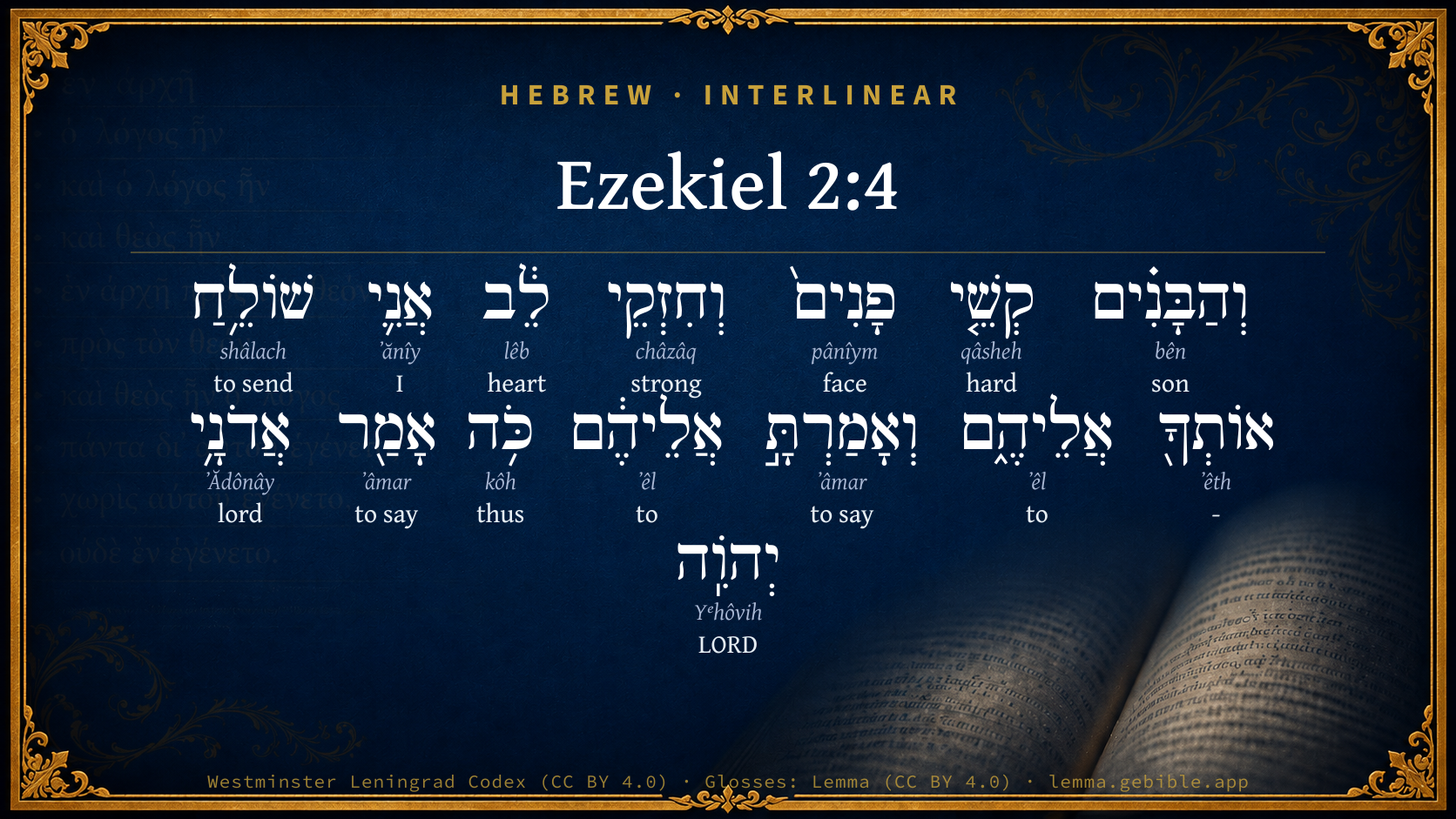
Hebrew (Westminster Leningrad Codex) Ezekiel 2:4 appears in the Hebrew Old Testament. The text above is from the Westminster Leningrad Codex. Each word links to its Strong’s number, a concise gloss, and parsing drawn from the Open Scriptures Hebrew Bible morphology. Click any word for its full Brown-Driver-Briggs (BDB) entry.
Download image
Cite this verse

Ezekiel 2:4 (World English Bible). Public Domain. Lemma interlinear Bible study tool, https://lemma.gebible.app/v/ezekiel/2/4.

Show BibTeX & RIS
BibTeX
RIS
English Translation
The children are impudent and stiff-hearted: I do sent you to them; and you shall tell them, Thus says the Lord Yahweh.
World English Bible · Public Domain
Download a study sheet

One document with this verse’s original text, its word-by-word gloss line, the meaning frame, cross-references with their text, attributed commentary, and full source and license credits — printable, and it pastes into notes with its structure intact.

This verse Autodidact and up

Study sheet (.html) Plain text (.txt)

A passage Seminary Student

Up to 50 verses in one chapter. A passage sheet keeps up to 6 commentary sources and 12 cross-references per verse, in the order this page ranks them, and says so on the sheet whenever that leaves anything out. Ask for a single verse and you get the Autodidact verse sheet above.

Everything on this page stays free to read, with no account — the sheet is a download of what is already on screen, not access to it.

Want to remove ads? Support Godless Engineer
Compare translations 3

The same verse in 3 English versions, stacked beneath the original-language interlinear above. Click any original word for its lexicon entry.

Each is an independent rendering of the whole verse — the interlinear is not word-aligned to these translations.

Highlighted words mark where these versions differ — a whole-verse word diff, not a word-by-word alignment.

  • World English Bible Public Domain
    The children are impudent and stiff-hearted: I do sent you to them; and you shall tell them, Thus says the Lord Yahweh.
  • King James Version Public Domain
    For they are impudent children and stiffhearted. I do send thee unto them; and thou shalt say unto them, Thus saith the Lord GOD.
  • unfoldingWord Literal Text CC BY-SA 4.0
    Their descendants have stubborn faces and hard hearts. I am sending you to them, and you will say to them, ‘This is what the Lord Yahweh says.’

unfoldingWord Literal Text — © unfoldingWord, licensed CC BY-SA 4.0. Word-aligned USFM3 via Door43 (git.door43.org/unfoldingWord/en_ult).

Versions to compare (up to 4)

3 of 4 selected

Show all 18 translations

Every available English version of this verse, each an independent rendering of the whole verse.

  • World English Bible Public Domain
    The children are impudent and stiff-hearted: I do sent you to them; and you shall tell them, Thus says the Lord Yahweh.
  • Berean Standard Bible Public Domain
    They are obstinate and stubborn children. I am sending you to them, and you are to say to them, ‘This is what the Lord GOD says.’
  • Majority Standard Bible Public Domain
    They are obstinate and stubborn children. I am sending you to them, and you are to say to them, ‘This is what the Lord GOD says.’
  • King James Version Public Domain
    For they are impudent children and stiffhearted. I do send thee unto them; and thou shalt say unto them, Thus saith the Lord GOD.
  • American Standard Version (1901) Public Domain
    And the children are impudent and stiffhearted: I do sent thee unto them; and thou shalt say unto them, Thus saith the Lord Jehovah.
  • Revised Version (1885) Public Domain
    And the children are impudent and stiffhearted; I do send thee unto them: and thou shalt say unto them, Thus saith the Lord GOD.
  • Geneva Bible (1599) Public Domain
    For they are impudent children, and stiffe hearted: I do send thee vnto them, and thou shalt say vnto them, Thus saith the Lord God.
  • Douay-Rheims (1899) Public Domain
    And they to whom I send thee are children of a hard face, and of an obstinate heart: and thou shalt say to them: Thus saith the Lord God:
  • Young's Literal Translation Public Domain
    And the sons `are' brazen-faced and hard-hearted to whom I am sending thee, and thou hast said unto them: Thus said the Lord Jehovah:
  • Literal Standard Version CC BY-SA 4.0
    And the sons [are] brazen-faced and hard-hearted to whom I am sending you, and you have said to them: Thus said Lord YHWH.
  • Unlocked Literal Bible CC BY-SA 4.0
    Their descendants have stubborn faces and hard hearts. I am sending you to them, and you will say to them, 'This is what the Lord Yahweh says.'
  • unfoldingWord Literal Text CC BY-SA 4.0
    Their descendants have stubborn faces and hard hearts. I am sending you to them, and you will say to them, ‘This is what the Lord Yahweh says.’
  • Darby Bible Public Domain
    and these children are impudent and hard-hearted: I am sending thee unto them; and thou shalt say unto them, Thus saith the Lord Jehovah.
  • World Messianic Bible Public Domain
    The children are impudent and stiff-hearted. I am sending you to them, and you shall tell them, ‘This is what the Lord GOD says.’
  • Webster's Bible Public Domain
    For they are impudent children and obstinate in heart. I send thee to them; and thou shalt say to them, Thus saith the Lord GOD.
  • Free Bible Version CC BY-SA 4.0
    They are pig-headed; they are hard-hearted children. I am sending you to tell them that this is what the Lord God says.
  • Bible in Basic English Public Domain
    And the children are hard and stiff-hearted; I am sending you to them: and you are to say to them, These are the words of the Lord.
  • JPS Tanakh (1917) Public Domain
    and the children are brazen-faced and stiff-hearted, I do send thee unto them; and thou shalt say unto them: Thus saith the Lord GOD.

Literal Standard Version (2020), Covenant Press — licensed CC BY-SA 4.0. Text via the HelloAO Bible API (eBible.org). Unlocked Literal Bible (unfoldingWord) — licensed CC BY-SA 4.0. Text via the HelloAO Bible API (eBible.org). unfoldingWord Literal Text — © unfoldingWord, licensed CC BY-SA 4.0. Word-aligned USFM3 via Door43 (git.door43.org/unfoldingWord/en_ult). Free Bible Version, Dr. Jonathan Gallagher — licensed CC BY-SA 4.0. Text via the HelloAO Bible API (eBible.org).

Word by word

More ways to search: Search by grammar → Find every occurrence → Compare this word →

Practice this passage: Drill this verse → Learn its vocabulary →

קְשֵׁ֤י
qâsheh
H7186
“hard of”
Adjective, Adjective, Masculine, Plural, Construct
Part of Speech
Adjective
Type
Adjective
Gender
Masculine
Number
Plural
State
Construct
Full BDB Definition

Origin: from H7185

TWOT: 2085a

hard, cruel, severe, obstinate - hard, difficult - severe - fierce, intense, vehement - stubborn, stiff of neck, stiff-necked - rigorous (of battle)
  1. וְהַבָּנִ֗ים bên H1121 “and · the · sons” Conjunction + Particle, Definite Article + Noun, Common, Masculine, Plural, Absolute
  2. פָנִים֙ pânîym H6440 “face(s)” Noun, Common, Both, Plural, Absolute
  3. וְחִזְקֵי châzâq H2389 “and · strong of” Conjunction + Adjective, Adjective, Masculine, Plural, Construct
  4. לֵ֔ב lêb H3820 “heart” Noun, Common, Masculine, Singular, Absolute
  5. אֲנִ֛י ʼănîy H589 “I” Pronoun, Personal, 1st Person, Common, Singular
  6. שׁוֹלֵ֥חַ shâlach H7971 “sending” Verb, Qal, Participle Active, Masculine, Singular, Absolute
  7. אוֹתְךָ֖ ʼêth H853 “- · you” Particle, Direct Object + Suffix, Personal, 2nd Person, Masculine, Singular
  8. אֲלֵיהֶ֑ם ʼêl H413 “to · them” Preposition + Suffix, Personal, 3rd Person, Masculine, Plural
  9. וְאָמַרְתָּ֣ ʼâmar H559 “and · to say” Conjunction + Verb, Qal, Perfect, 2nd Person, Masculine, Singular
  10. אֲלֵיהֶ֔ם ʼêl H413 “to · them” Preposition + Suffix, Personal, 3rd Person, Masculine, Plural
  11. כֹּ֥ה kôh H3541 “thus” Adverb
  12. אָמַ֖ר ʼâmar H559 “to say” Verb, Qal, Perfect, 3rd Person, Masculine, Singular
  13. אֲדֹנָ֥י ʼĂdônây H136 “Lord · my” Noun, Common, Masculine, Plural, Construct + Suffix, Personal, 1st Person, Common, Singular
  14. יְהֹוִֽה Yᵉhôvih H3069 “LORD” Noun, Proper

About this verse

These counts appear in no published source. They are computed here, from the morphology-tagged text and Lemma’s own curated glosses. What Lemma adds →

15
words
13
distinct lemmas
Prophets
section

Shared distinctive vocabulary

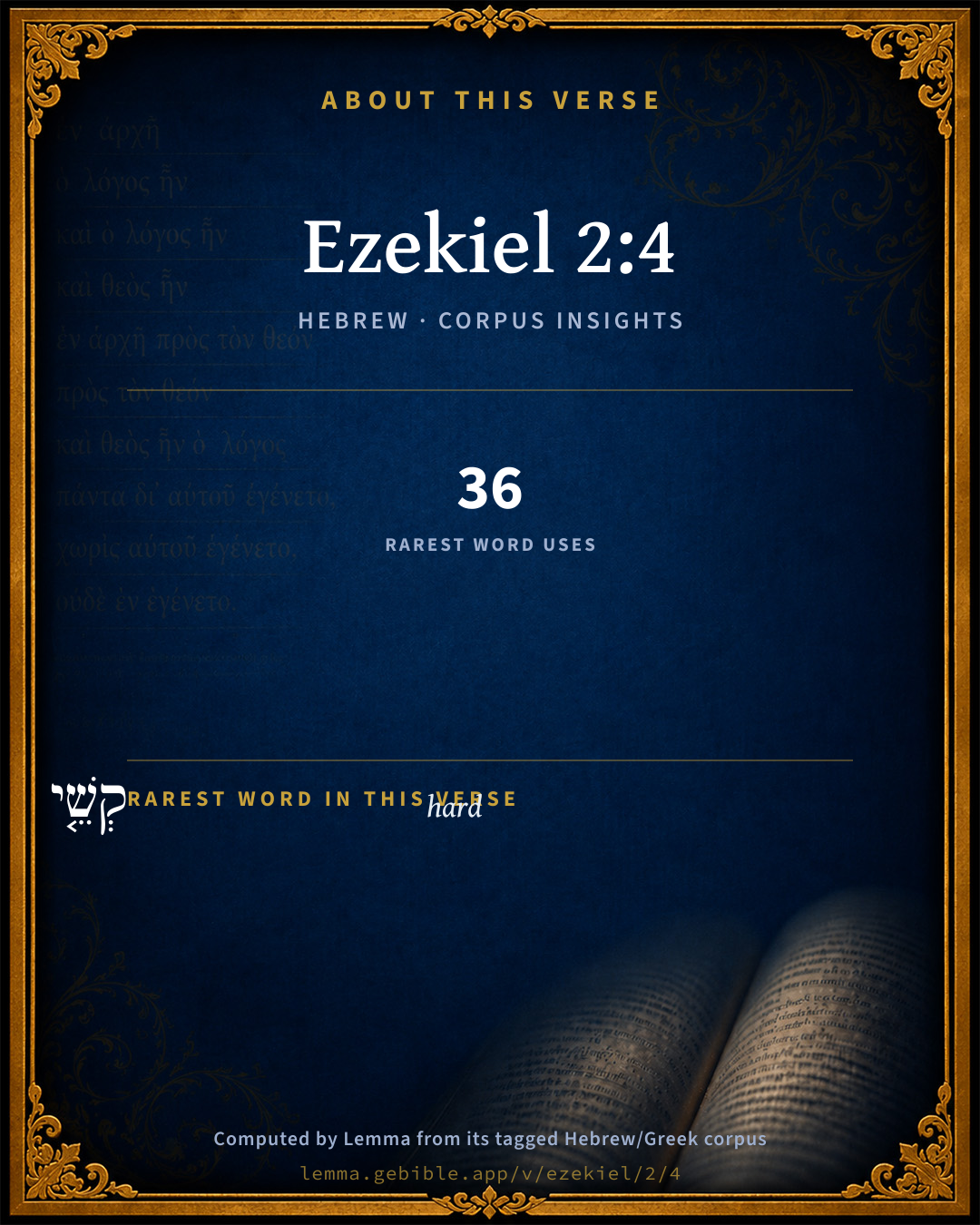
קְשֵׁ֤י hard H7186 occurs in 36 verses of the Hebrew Bible. Also found in:

Grammatical profile

  • 3 verbs
  • 5 nouns
  • 2 adjectives
  • 1 pronoun
  • 2 prepositions
  • 1 adverb
  • 1 particle

Verb forms

  • שׁוֹלֵ֥חַ Qal · Participle Active
  • וְאָמַרְתָּ֣ Qal · Perfect
  • אָמַ֖ר Qal · Perfect

Repetition

Words recur within this verse — often emphatic in Hebrew:

  • וְאָמַרְתָּ֣ to say H559 ×2
  • אֲלֵיהֶ֑ם to H413 ×2

Hebrew & Septuagint length

In English translation the verse runs 22 words from the Hebrew and 10 from the Septuagint (LXX English) — the Septuagint runs noticeably shorter here. See the side-by-side →

A rough comparison of the two English renderings, which tokenize alike — not a word-level alignment.

Word counts can differ between the Hebrew and the Greek without any difference in meaning — e.g. the Hebrew direct-object marker אֵת has no separate Greek word, and Greek often adds the article ὁ.

Cross-references

16

Topical passages linked to Ezekiel 2:4 in the Treasury of Scripture Knowledge — connected by theme and wording, ordered by reader-vote popularity; previews shown in the World English Bible.

  • Ezekiel 3:7 But the house of Israel will not listen to you; for they will not listen to me: for all the house of Israel are of hard forehead and of a stiff heart.
  • Psalms 95:8 Don't harden your heart, as at Meribah, As in the day of Massah in the wilderness,
  • Isaiah 48:4 Because I knew that you are obstinate, and your neck is an iron sinew, and your brow brass;
  • Jeremiah 5:3 O Yahweh, don't your eyes look on truth? you have stricken them, but they were not grieved; you have consumed them, but they have refused to receive correction: they have made their faces harder than a rock; they have refused to return.
  • Jeremiah 6:15 Were they ashamed when they had committed abomination? nay, they were not at all ashamed, neither could they blush: therefore they shall fall among those who fall; at the time that I visit them they shall be cast down, says Yahweh.
  • Deuteronomy 10:16 Circumcise therefore the foreskin of your heart, and be no more stiff-necked.
  • Deuteronomy 31:27 For I know your rebellion, and your stiff neck: behold, while I am yet alive with you this day, you have been rebellious against Yahweh; and how much more after my death?
  • 1 Kings 22:14 Micaiah said, As Yahweh lives, what Yahweh says to me, that will I speak.
  • 2 Chronicles 30:8 Now don't you be stiff-necked, as your fathers were; but yield yourselves to Yahweh, and enter into his sanctuary, which he has sanctified forever, and serve Yahweh your God, that his fierce anger may turn away from you.
  • 2 Chronicles 36:13 He also rebelled against king Nebuchadnezzar, who had made him swear by God: but he stiffened his neck, and hardened his heart against turning to Yahweh, the God of Israel.
  • Proverbs 21:29 A wicked man hardens his face; But as for the upright, he establishes his ways.
  • Jeremiah 3:3 Therefore the showers have been withheld, and there has been no latter rain; yet you have a prostitute's forehead, you refused to be ashamed.
  • Jeremiah 8:12 Were they ashamed when they had committed abomination? nay, they were not at all ashamed, neither could they blush: therefore shall they fall among those who fall; in the time of their visitation they shall be cast down, says Yahweh.
  • Jeremiah 26:2–3 Thus says Yahweh: Stand in the court of Yahweh's house, and speak to all the cities of Judah, which come to worship in Yahweh's house, all the words that I command you to speak to them; don't diminish a word.
  • Matthew 10:16 "Behold, I send you out as sheep in the midst of wolves. Therefore be wise as serpents, and harmless as doves.
  • Acts 20:26–27 Therefore I testify to you this day that I am clean from the blood of all men,

Cross-references courtesy of OpenBible.info (CC BY 4.0).

Hebrew and Greek witnesses Masoretic Hebrew ↔ Greek Septuagint

The same verse in the two great witnesses to the Old Testament, shown verse-for-verse.

Here the Septuagint runs noticeably shorter than the Hebrew — LXX2012 (modern English Septuagint) 10 words vs World English Bible 22. A rough length comparison of the two English translations, not a word-level alignment — read both below.

These are two independent witnesses, not word-aligned to each other, and the Septuagint is shown in lemma (dictionary) form.

Hebrew Ezekiel 2:4 Masoretic · Westminster Leningrad Codex

וְהַבָּנִ֗ים קְשֵׁ֤י פָנִים֙ וְחִזְקֵי לֵ֔ב אֲנִ֛י שׁוֹלֵ֥חַ אוֹתְךָ֖ אֲלֵיהֶ֑ם וְאָמַרְתָּ֣ אֲלֵיהֶ֔ם כֹּ֥ה אָמַ֖ר אֲדֹנָ֥י יְהֹוִֽה

The children are impudent and stiff-hearted: I do sent you to them; and you shall tell them, Thus says the Lord Yahweh.

World English Bible · Public Domain

Greek LXX Ezekiel 2:4 Septuagint · lemma form

καί εἶπον πρός αὐτός ὅδε λέγω κύριος

And you shall say to them, Thus says the Lord.

LXX2012 (modern English Septuagint) · Public Domain

On this verse, The Cambridge Bible for Schools and Colleges discusses the Septuagint’s reading. Read the note in Commentary ↓

Hebrew: Westminster Leningrad Codex (CC BY 4.0). Greek: Septuagint (public domain); English from LXX2012 (modern English Septuagint) (Public Domain). How the Septuagint differs from the Hebrew →

Targum (Aramaic paraphrase)

1

The Targum is the ancient Jewish Aramaic paraphrase of the Hebrew Scriptures — an interpretive translation, not the Hebrew text itself. Onkelos (literal) and Pseudo-Jonathan (expansive) render the Torah, and Jonathan the Prophets. Coverage is partial: where no permissively-licensed English translation exists for a verse, only the Aramaic is shown. This is verse-level text, not a word-by-word alignment to the Hebrew.

  1. Targum Jonathan Prophets (Joshua–Malachi)
    וּמִתְקְרַן בְּנַיָא אִינוּן חֲצִיפֵי אַפַּיָא וְתַקִיפֵי לִבָּא אֲנָא שָׁלַח יָתָךְ לְוַתְהוֹן וְתֵימַר לְהוֹן כִּדְנַן אֲמַר יְיָ אֱלֹהִים:

    (no public-domain English translation for this verse)

    Targum Jonathan — Aramaic: “Mikraot Gedolot” (public domain). English: “Sefaria Community Translation” (CC0 1.0 (public-domain dedication)); “London "Chaldee Paraphrase," 1871” (public domain). Text via Sefaria.

Commentary

Notes on Ezekiel 2:4 from classic Christian and Jewish commentators (each source and its license shown beneath its notes). The classic Christian expositions comment on the surrounding passage and are grouped to its opening verse, so a note may address several verses; the Jewish commentaries on the Tanakh (Rashi and others) are per-verse, so they appear only where the commentator wrote on this verse.

Lemma curates 59 commentaries, every one of them public domain or Creative Commons licensed, each selected and text-cleaned for this edition rather than reprinted as found. About our sources →

The Cambridge Bible for Schools and Colleges

gen. ed. J. J. S. Perowne

4. for they are impudent children] Rather, and the children are impudent and stiffhearted, to whom I send thee. The “children” are the present generation, who are like their fathers. Outwardly they are “impudent,” lit. hard in face, resolute and whose eyes do not quail before one that opposes them; and within they are strong of heart, unyielding and stubborn in will and feeling. The word here used of the face is said of the heart, ch. Eze_3:7, and the term applied to the heart is said of the face and forehead, ch. Eze_3:8. More often the term used of the face is applied to the neck, “stiffnecked” (Exo_33:3). For the idea comp. Isa_48:4, “I knew that thou art obstinate, and thy neck is an iron sinew, and thy brow brass.”

Thus saith the Lord God] lit. the Lord Jehovah. The word “Jehovah” was pronounced Adonai, “Lord,” and when Adonai, Lord, actually stood in the text, Jehovah was pronounced God, Elohim. In A.V. “God” is then printed in small capitals. This is what the prophet shall say on his part: “Thus saith the Lord Jehovah;” he shall announce himself a prophet from Jehovah, bearing his word. And the people shall eventually know that a prophet has been among them (Eze_2:5). By various omissions LXX. reads Eze_2:3-4 in a shorter form: Son of man I send thee to the house of Israel, who provoke me; who have provoked me they and their fathers unto this day, Eze_2:4 and thou shalt say unto them, &c. This reading certainly reflects a more natural Hebrew sentence than our present text.

The Cambridge Bible for Schools and Colleges (gen. ed. J. J. S. Perowne; Cambridge University Press, 1878–1918) — public domain. Text from a community e-Sword module.

Trapp's Complete Commentary

John Trapp

Eze 2:4 For [they are] impudent children and stiffhearted. I do send thee unto them; and thou shalt say unto them, Thus saith the Lord GOD.

Ver. 4. For they are impudent children.] Heb., Hard of face. Sin hath added such an impudence in their faces, that they can blush no more than a sackbut. Os tuum ferreum, saith Cicero to Piso, that brazen face of thine; and Durus hic vultus lachrimare nescit, thou canst not blush, much less bleed, for thine offences, saith Seneca to one.

And stiff hearted.] Duri cordes, incurvi cervicati, quosque citius fregeris quam flexeris, such as will sooner break than bend. Many of our hearers, alas! are no better. We do even wash a tile sheard, draw water with a sieve, &c.

I do send thee unto them.] About hard service; sed curare exegeris, non curationem, {a} It is the care, and not the cure, of the charge that is charged upon thee.

Thou shalt say unto them.] Proficiscere et prophetato. Thou shalt be as my mouth. {Jer 15:19}

{a} Bernard.

John Trapp, A Commentary or Exposition upon All the Books of the Old and New Testament (1647–1656) — public domain. Text from a community e-Sword module.

Tyndale Open Study Notes

Tyndale Open Resources

2:4-5 Israel was stubborn and hard-hearted—they would not heed Ezekiel, whose message would bear little immediate fruit. However, they would know that they had a prophet among them who was speaking God’s word.

Tyndale Open Study Notes — © Tyndale Open Resources, licensed CC BY-SA 4.0. Text via the HelloAO Bible API.

Geneva Bible (1599)

Geneva Bible translators

Hebrew, hard of face.

Geneva Bible (1599) marginal notes — public domain. Text via Bolls.life.

Jamieson, Fausset & Brown

Robert Jamieson, A. R. Fausset & David Brown

impudent--literally, "hard-faced" (Eze 3:7, Eze 3:9).

children--resumptive of "they" (Eze 2:3); the "children" walk in their "fathers'" steps.

I . . . send thee--God opposes His command to all obstacles. Duties are ours; events are God's.

Thus saith the Lord God--God opposes His name to the obstinacy of the people.

Jamieson, Fausset & Brown — Commentary Critical and Explanatory on the Whole Bible (1871) — public domain (CC PDM 1.0). Text via the HelloAO Bible API.

Adam Clarke's Commentary

Verse 4. Thou shalt say unto them, Thus saith the Lord] Let them know that what thou hast to declare is the message of the LORD, that they may receive it with reverence.

Every preacher of God's word should take heed that it is God's message he delivers to the people. Let him not suppose, because it is according to his own creed or confession of faith, that therefore it is God's word. False doctrines and fallacies without end are foisted on the world in this way. Bring the creed first to the Word of God, and scrupulously try whether it be right; and when this is done, leave it where you please; take the Bible, and warn them from God's word recorded there.

Adam Clarke's Commentary on the Bible (1810–1826) — public domain. Text from a community e-Sword/MySword module.

John Calvin's Commentaries

God proceeds in the same discourse, but expresses in other words the great rebellion of the people, for they were not only obstinate and unbending in heart, but also of a contumacious countenance: therefore he places hardness in face as well as in heart. The words indeed are different, קשי, keshi, and חזקי, chezki, “of brazen countenance,” for we may translate “winked” and “contumacious,” for this disposition appears in the countenance, nor is it objectionable to render it “impudent.” But. propriety of speech must be retained; for we must speak of the robust of heart as “broken down,” or if the allusion seems more apposite, we must render it “of broken countenance,” then of “broken spirits,” as we call the wicked “brazen-fronted.” The meaning is, that the Jews were not only rebellious against God and puffed up with proud contempt, but their impiety was so desperate that they opposed themselves to God without disguise, as if they had been horned oxen or furious bulls. We know that hypocrisy often lies hid in the mind, and although men swell with malice, yet they do not betray what they inwardly nourish. But the Prophet here signifies that the Israelites were so immersed in impiety, that they displayed themselves as the open enemies of God in their very countenances. The result is, that the Prophet, while he applied himself to perform the commands of God, ought so to determine with himself, when he approaches the people, that his teaching would be not only useless as to them, because it would not be received with the reverence which it deserves, but would be even exposed to many reproaches: since the Israelites were not only filled with a hidden contempt of God, but they openly showed their ferocity, so to speak, since they were of so brazen a front that they would without doubt purposely reject the Prophet. They are hard-hearted children, etc., yet I send thee unto them Here, again, God opposes his own command, as the Prophet simply acquiesces in this word alone, “I have a divine mission.” If he displeases men, he is content to have his labor approved of God. This is the meaning of the phrase which is now a second time repeated, I send thee unto them For the Prophet might object, What can I do? for if they are of a brazen heart and of an iron front, I shall labor in vain. But God answers in return, that the Prophet need not be anxious, it is enough to have a command: as if a prince should not explain the whole of his counsel to his ambassador, and yet should order him to discharge his embassy, thus God acts towards his servant. We see then how God here magnifies his authority: and we must mark this diligently, that we may not wish always to be bargaining with him, as we are accustomed. For unless God show us the present fruit of our labor, we languish, and so we endeavor by turning back to withdraw ourselves from his authority: but God opposes this single sentence, Behold I send thee The rest I leave till to-morrow.

John Calvin's Commentaries (1540-1563) — public domain. Text from the Calvin Translation Society English edition (1840s-50s) via the Christian Classics Ethereal Library (ccel.org). Calvin's coverage is partial (roughly two-thirds of the Bible); uncommented books and verses are honest gaps, never fabricated. The 19th-century editor's footnotes and remarks are omitted so the notes are faithfully Calvin's own voice.

Ellicott's Commentary for English Readers

(4) Impudent children.—Literally, as in margin, hard of face. The epithet is repeated in Eze_3:7, and it is with reference to this that in Eze_3:7-8 the prophet’s face is to be made strong, and his forehead “harder than flint.” “The Lord God” is in the original “the Lord Jehovah,” the second name taking the pointing of, and being translated “God,” because of the word “Lord” preceding.

A Bible Commentary for English Readers, edited by Charles John Ellicott (1878–1897) — public domain. Text from a community e-Sword module.

John Gill's Exposition

For they are impudent children,.... "Hard of face" (w); as is commonly said of impudent persons, that they are brasen faced; they had a whore's forehead, and refused to be ashamed, and made their faces harder than a rock, Jer 3:3; they declared their sin as Sodam, and hid it not; they sinned openly, and could not blush at it:

and stiffhearted; or, "strong of heart" (x); whose hearts were like an adamant stone, and harder than the nether millstone; impenitent, obdurate, and inflexible; they were not only stiff-necked, as Stephen says they were in his time, and always had been; but stiff-hearted; they were not subject to the law of God now, nor would they submit to the Gospel and ordinances of Christ in his time, and in the times of his apostles, nor to his righteousness, Rom 10:3;

I do send thee unto them; even to such as they are: this is a repetition, and a confirmation, of his mission; and suggests, that though they were such, he should not refuse to go to them, since he had sent him:

and thou shalt say unto them, thus saith the Lord God: that what he said came from the Lord, and was spoken in his name.

(w) "duri facie", Pagninus, Vatablus, Calvin, Cocceius, Starckius. (x) "duri corde", Pagninus, Montanus; "fortes carde", Vatablus, Polanus.

John Gill's Exposition of the Whole Bible (1746–1763) — public domain (CC PDM 1.0). Text via the HelloAO Bible API.

Matthew Poole's English Annotations

Impudent children; shameless, who cannot blush, else they could never have transgressed so highly, constantly, and obstinately. Sodom in her day did not hide her sin, nor blush; so did the Jews in Isaiah’s times, so they did to the days of their captivity, and under the captivity.

Stiffhearted; hard-hearted, resolute, and strongly bent to do whatever liked them. Of disposition that relenteth not, but rather more confidently going on in evil.

I, who appeared in so much glory, and on the throne,

send thee unto them; give thee authority that thou mayst, and I give thee charge that thou must, go to them, and say unto them what I shall say unto thee. They will scoff and persecute, but I command; and remember whom thou hast seen, who is with thee.

Thou shalt say unto them, Thus saith the Lord God; be sure to tell them who sends thee, read the commission,

Thus saith, & c.

Matthew Poole's English Annotations on the Holy Bible (1683–1685) — public domain. Text from a community e-Sword/MySword module.

Whedon's Commentary on the Bible

Daniel D. Whedon

4. For they are impudent children — Literally, And the children are stiff-faced and stiff-hearted. “The children of Israel are first described as rebellious heathen (Eze_2:3), then as heartless children.” — Curry. Centuries of disobedience had made them bold and stubborn, their brows like brass and their necks like iron sinews (Isa_48:4; Exo_33:3). When the heart is frozen the face soon shows it.

Thus saith the Lord God — Literally, Lord Jehovah. Jehovah — pronounced by the Hebrews yah-we and by the Babylonians ja’ava — was the national covenant-keeping name of the “merciful and gracious One, long-suffering and abundant in loving-kindness and truth,” whose nature is so beautifully described at the beginning of Hebrew history (Exodus xxxiv). It is in this most loving name, which is intertwined with the most glorious and patriotic memories of the nation, that the prophet is commanded to utter his warning and reproof. It has not been proved that Yah-we was worshiped outside the borders of the Israelite kingdom. (Journal of Biblical Literature, 13:101, etc.)

Daniel D. Whedon (gen. ed.), Commentary on the Old and New Testaments (1874–1909) — public domain. Text from a community e-Sword module.

The Pulpit Commentary

Impudent children and stiff-hearted; literally, hard of face (i.e. callous to their shame) and stiff of heart. The LXX gives aptly, sklhroproswpoi kairdioi. (compare the "past feeling" of Eph_4:19) Thus saith the Lord God. In the Hebrew, Adoaai Jehovah; which the LXX represents by Kuriov Kuriov, and Luther by "der Herr Herr." The two highest names of the God of Israel were "used to denote the fulness of the prophet"s inspiration. The same formula occurs in Eze_3:11, Eze_27:13:8 Eze_22:28, and passim. So also in 2Sa_7:18, 2Sa_7:19, 2Sa_7:20, 2Sa_7:29; and elsewhere.

Vers. 4, 5The prophet"s commission.

Nothing is clearer than that the prophets did not believe themselves to be acting and speaking simply upon the promptings of their own inclinations or their own convictions of what was right and expedient. Whether they were self-deluded or not, certain it is that they deemed themselves ministers and messengers of the Eternal. It was this which gave them both courage and authority. In the most explicit manner, Ezekiel in this passage records his commission to go among his fellow countrymen as the herald of God"s wisdom, authority, and grace.

I THE COMMISSION. "I do send thee unto them." There is great simplicity and great dignity in this language of authorization; he who heard it could never forget it. When disappointed in the result of his ministry, or alarmed at the threats of those whom he sought to benefit, these words must often have recurred to the mind of the prophet, inspiring him with fresh zeal and courage. If the ambassador of a powerful king is strengthened in the fulfilment of his trust by the recollection that he received his authority from a court honoured by friends and feared by foes, how much more must the ambassador from God derive courage and confidence from the knowledge that he is sent by the Supreme, who will never desert those who engage in his service and do his will!

II THE MESSAGE. At first the prophet received no other message than this: "Thus saith the Lord God." But this was the earnest of much to follow. And, indeed, the whole of the prophecies were amplifications of this. Ezekiel was to go among the children of the Captivity with words from Jehovah. A prophet is one who speaks for, on behalf of, the Divine Being by whom he is commissioned. If the speaker had his own special reasons for believing that the words he uttered were not his own, but God"s, those who listened to his declarations of warning and of promise had a witness within, in the testimony of their own conscience, assuring them that the prophet spoke with Divine authority. And this is so still with all who will listen reverently and obediently to the heavenly voice. It is thus that the Scriptures possess over our minds a preeminent power; their writers preface every authoritative utterance with the statement, "Thus saith the Lord.

III THE VARIOUS RECEPTION OF THE MESSAGE. It is in accordance with the reasonableness of the inspired writers that. they cherished such moderate expectations regarding the effect to be produced by their ministry. Fanatics would have felt assured that, in such circumstances, they must meet with ready credence and immediate obedience. Ezekiel certainly had no such delusive anticipations, and was indeed expressly warned that his message would meet with varying reception. Some would hear, some would forbear. It was with Ezekiel as in the Christian dispensation it was with Paul; we are told that the result of his ministry at Rome was that "some believed the things which were spoken, and some disbelieved.

IV THE IMPRESSION PRODUCED BY GOD"S MESSENGER UPON THOSE TO WHOM HE WAS SENT. "They shall know that there hath been a prophet among them." Even those who were so much under the influence of ignorance, prejudice, evil example, and sin, that they did not and would not turn unto God, nevertheless were well aware that their obstinate impiety was unjustifiable. They might ridicule the prophet in their language, but they reverenced him in their hearts. Beneath the laugh of incredulity was a deep-seated fear, springing from an inward conviction that the voice they rejected was indeed the voice of God. Had one come among them flattering their vanity and pride, and ministering to their sinful tastes, they would in their heart of hearts have despised him. But when one came fearlessly upbraiding them with their unfaithfulness, and denouncing their guilty defection, they could not but know that a prophet had been among them.

APPLICATION. This passage has an especial significance for ministers of God"s Word, and for all religious teachers. It shows them where their strength lies; warns them against enunciating their own speculations or inculcating precepts founded upon their own experience; and directs them to go among their fellow men with this dignified and effective message, "Thus saith the Lord." They may be tempted to court men"s favour and good will by uttering words of flattery. But it is well that, when so tempted, they should remember that there is in men a conscience, which may be repressed, but which cannot be crushed, which renders a homage, though silent, to the just authority of truth and righteousness, and which recognizes, even though it does not lead to practical obedience, the precepts and the warnings which are from God. T.

The Pulpit Commentary (1880–1919), ed. H.D.M. Spence-Jones & Joseph S. Exell — public domain. Text from a community e-Sword module.

unfoldingWord translationNotes

Door43 World Missions Community

General Information:

God continues to speak to Ezekiel.

Their descendants

the descendants of the past generations of Israel who had rebelled against God, referring to the people living in Israel at the time Ezekiel writes

have stubborn faces

"have expression on their faces that show that they are stubborn"

stubborn faces and hard hearts

The words "stubborn faces" refer to the way they act on the outside, and the words "hard hearts" refer to the way they think and feel. Together they emphasize that the people of Israel would not change how they lived in order to obey God. (See: Doublet)

stubborn

This describes a person who refuses to change what he thinks or what he is doing.

hard hearts

Rocks never change and become soft, and these people never change and become sorry when they do evil things. (See: Metaphor)

house

This is a metonym for the family that lives in the house, in this case the Israelites, the descendants of Jacob over many years. AT: "people group" (See: Metonymy)

a prophet has been among them

"the one whom they have refused to listen to was a prophet"

translationWords

hard

heart

Lord Yahweh

house

know

prophet

unfoldingWord translationNotes — © Distant Shores Media and the Door43 World Missions Community, licensed CC BY-SA 4.0. Source: git.door43.org/Door43/en_tn.

Rashi

Rabbi Shlomo Yitzchaki (Rashi)

And the sons Since He says, “their fathers rebelled against Me,” and these sons of theirs are brazen- faced.

Rashi on the Tanakh — English translations: “The Judaica Press complete Tanach with Rashi, translated by A. J. Rosenberg” (CC BY 4.0); “Pentateuch with Rashi's commentary by M. Rosenbaum and A.M. Silbermann, 1929-1934” (public domain); “The Metsudah Tanach series, Lakewood, N.J” (CC BY 4.0); and “The Book of Joshua, Metsudah Publications, 1997” (CC BY 4.0). Text via Sefaria.

Lesson kit

Teaching starters — assembled from the data on this page, not authored interpretation. Every prompt links to the verse data it draws on. Edit before teaching.

Ezekiel, in the Prophets, opens this verse with 15 words (13 distinct Hebrew lemmas). Its most distinctive word is qâsheh (“hard”). The Greek Septuagint runs shorter here. A historical commentator’s framing appears above. Read the whole chapter for the surrounding context.

Discussion questions

  1. How does “hard” (qâsheh) shape what this verse is saying?
  2. How does Genesis 42:7, which shares the word «hard», read alongside this verse?
  3. What does the repetition of “to say” (2× in this one verse) do in this verse?
  4. The Septuagint runs shorter here than the Hebrew. What might account for the difference?
  5. The translations on this page render this verse differently — a whole-verse word diff, not a word-by-word alignment. What might account for the different wordings?
  6. «שׁוֹלֵ֥חַ» is a Qal Participle Active verb. How does that grammatical form shape the action described?
  7. Compare how The Cambridge Bible for Schools and Colleges and Trapp's Complete Commentary read this verse. Where do they agree or differ?

Things to notice

Reading settings

Reading text

Shown beneath each verse's original-language words.

Old Testament
Old Testament edition

Read the OT as the Masoretic Hebrew (MT) or the Greek Septuagint (LXX).

English shown for the Greek Septuagint (in the Hebrew ↔ Greek comparison).

Comparing translations? Open the Compare panel on any verse page to stack up to four side by side.