
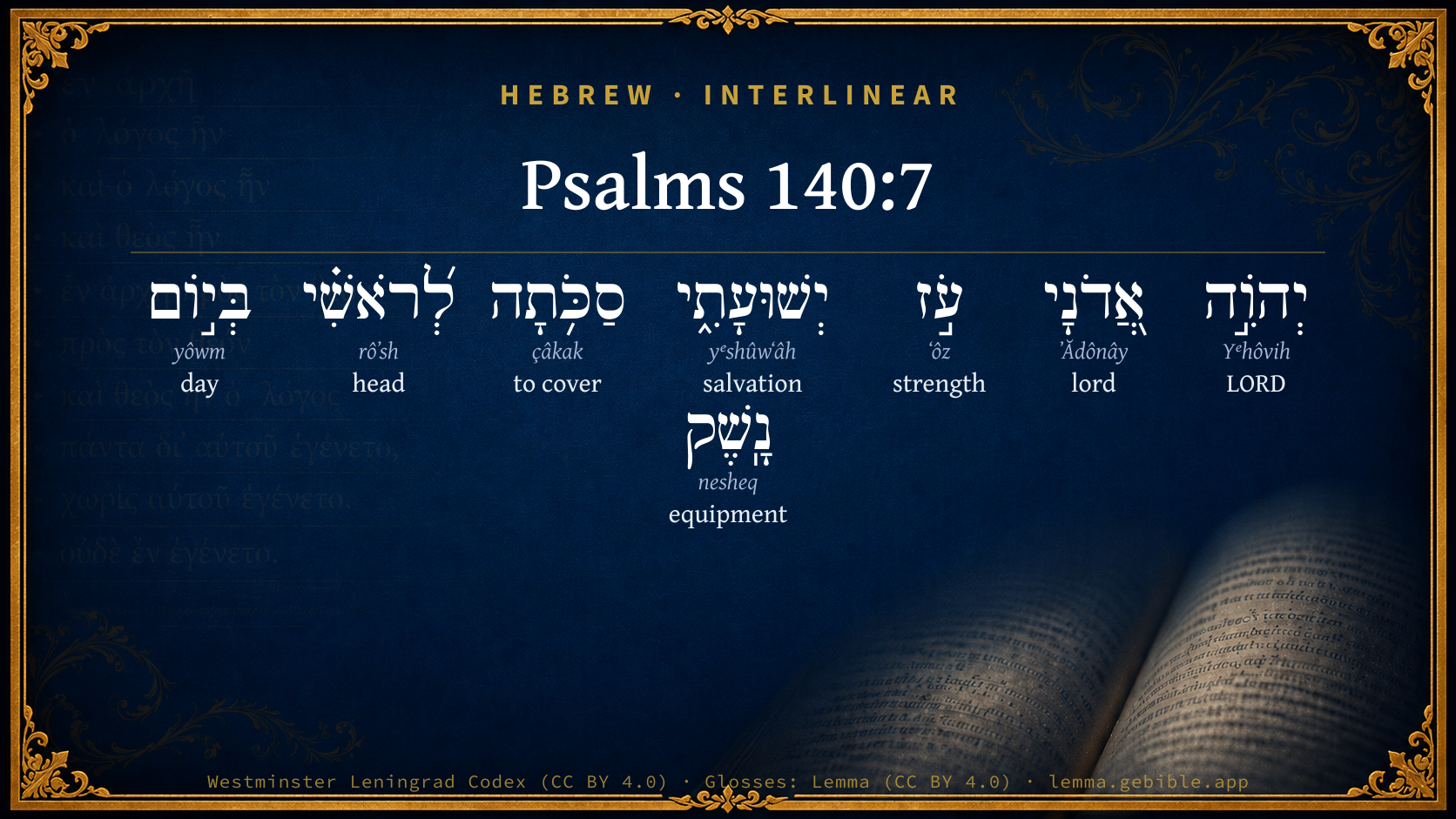
Psalms 140:7

Hebrew (Westminster Leningrad Codex) Psalms 140:7 appears in the Hebrew Old Testament. The text above is from the Westminster Leningrad Codex. Each word links to its Strong’s number, a concise gloss, and parsing drawn from the Open Scriptures Hebrew Bible morphology. Click any word for its full Brown-Driver-Briggs (BDB) entry.
Download image
Cite this verse

Psalms 140:7 (World English Bible). Public Domain. Lemma interlinear Bible study tool, https://lemma.gebible.app/v/psalms/140/7.

Show BibTeX & RIS
BibTeX
RIS
English Translation
Yahweh, the Lord, the strength of my salvation, You have covered my head in the day of battle.
World English Bible · Public Domain
Download a study sheet

One document with this verse’s original text, its word-by-word gloss line, the meaning frame, cross-references with their text, attributed commentary, and full source and license credits — printable, and it pastes into notes with its structure intact.

This verse Autodidact and up

Study sheet (.html) Plain text (.txt)

A passage Seminary Student

Up to 50 verses in one chapter. A passage sheet keeps up to 6 commentary sources and 12 cross-references per verse, in the order this page ranks them, and says so on the sheet whenever that leaves anything out. Ask for a single verse and you get the Autodidact verse sheet above.

Everything on this page stays free to read, with no account — the sheet is a download of what is already on screen, not access to it.

Want to remove ads? Support Godless Engineer
Compare translations 3

The same verse in 3 English versions, stacked beneath the original-language interlinear above. Click any original word for its lexicon entry.

Each is an independent rendering of the whole verse — the interlinear is not word-aligned to these translations.

Highlighted words mark where these versions differ — a whole-verse word diff, not a word-by-word alignment.

  • World English Bible Public Domain
    Yahweh, the Lord, the strength of my salvation, You have covered my head in the day of battle.
  • King James Version Public Domain
    O GOD the Lord, the strength of my salvation, thou hast covered my head in the day of battle.
  • unfoldingWord Literal Text CC BY-SA 4.0
    Yahweh, Lord, the strength of my salvation, you have covered my head in the day of weaponry. ts\*

unfoldingWord Literal Text — © unfoldingWord, licensed CC BY-SA 4.0. Word-aligned USFM3 via Door43 (git.door43.org/unfoldingWord/en_ult).

Versions to compare (up to 4)

3 of 4 selected

Show all 18 translations

Every available English version of this verse, each an independent rendering of the whole verse.

  • World English Bible Public Domain
    Yahweh, the Lord, the strength of my salvation, You have covered my head in the day of battle.
  • Berean Standard Bible Public Domain
    O GOD the Lord, the strength of my salvation, You shield my head in the day of battle.
  • Majority Standard Bible Public Domain
    O GOD the Lord, the strength of my salvation, You shield my head in the day of battle.
  • King James Version Public Domain
    O GOD the Lord, the strength of my salvation, thou hast covered my head in the day of battle.
  • American Standard Version (1901) Public Domain
    O Jehovah the Lord, the strength of my salvation, Thou hast covered my head in the day of battle.
  • Revised Version (1885) Public Domain
    O GOD the Lord, the strength of my salvation, thou hast covered my head in the day of battle.
  • Geneva Bible (1599) Public Domain
    O Lord God the strength of my saluation, thou hast couered mine head in the day of battel.
  • Douay-Rheims (1899) Public Domain
    Whither shall I go from thy spirit? or whither shall I flee from thy face?
  • Young's Literal Translation Public Domain
    O Jehovah, my Lord, strength of my salvation, Thou hast covered my head in the day of armour.
  • Literal Standard Version CC BY-SA 4.0
    O YHWH, my Lord, strength of my salvation, || You have covered my head in the day of armor.
  • Unlocked Literal Bible CC BY-SA 4.0
    Yahweh, my Lord, you are powerfully able to save me; you shield my head in the day of battle.
  • unfoldingWord Literal Text CC BY-SA 4.0
    Yahweh, Lord, the strength of my salvation, you have covered my head in the day of weaponry. ts\*
  • Darby Bible Public Domain
    Jehovah, the Lord, is the strength of my salvation: thou hast covered my head in the day of battle.
  • World Messianic Bible Public Domain
    LORD, the Lord, the strength of my salvation, you have covered my head in the day of battle.
  • Webster's Bible Public Domain
    \\140:6\\I said to the LORD, Thou art my God: hear the voice of my supplications, O LORD.
  • Free Bible Version CC BY-SA 4.0
    Lord God, my powerful Savior, you covered my head like a helmet on the day of battle.
  • Bible in Basic English Public Domain
    O Lord God, the strength of my salvation, you have been a cover over my head in the day of the fight.
  • JPS Tanakh (1917) Public Domain
    (140-8) O GOD the Lord, the strength of my salvation, who hast screened my head in the day of battle,

Literal Standard Version (2020), Covenant Press — licensed CC BY-SA 4.0. Text via the HelloAO Bible API (eBible.org). Unlocked Literal Bible (unfoldingWord) — licensed CC BY-SA 4.0. Text via the HelloAO Bible API (eBible.org). unfoldingWord Literal Text — © unfoldingWord, licensed CC BY-SA 4.0. Word-aligned USFM3 via Door43 (git.door43.org/unfoldingWord/en_ult). Free Bible Version, Dr. Jonathan Gallagher — licensed CC BY-SA 4.0. Text via the HelloAO Bible API (eBible.org).

Word by word

More ways to search: Search by grammar → Find every occurrence → Compare this word →

Practice this passage: Drill this verse → Learn its vocabulary →

About this verse

These counts appear in no published source. They are computed here, from the morphology-tagged text and Lemma’s own curated glosses. What Lemma adds →

8
words
8
distinct lemmas
Wisdom
section

Notable vocabulary

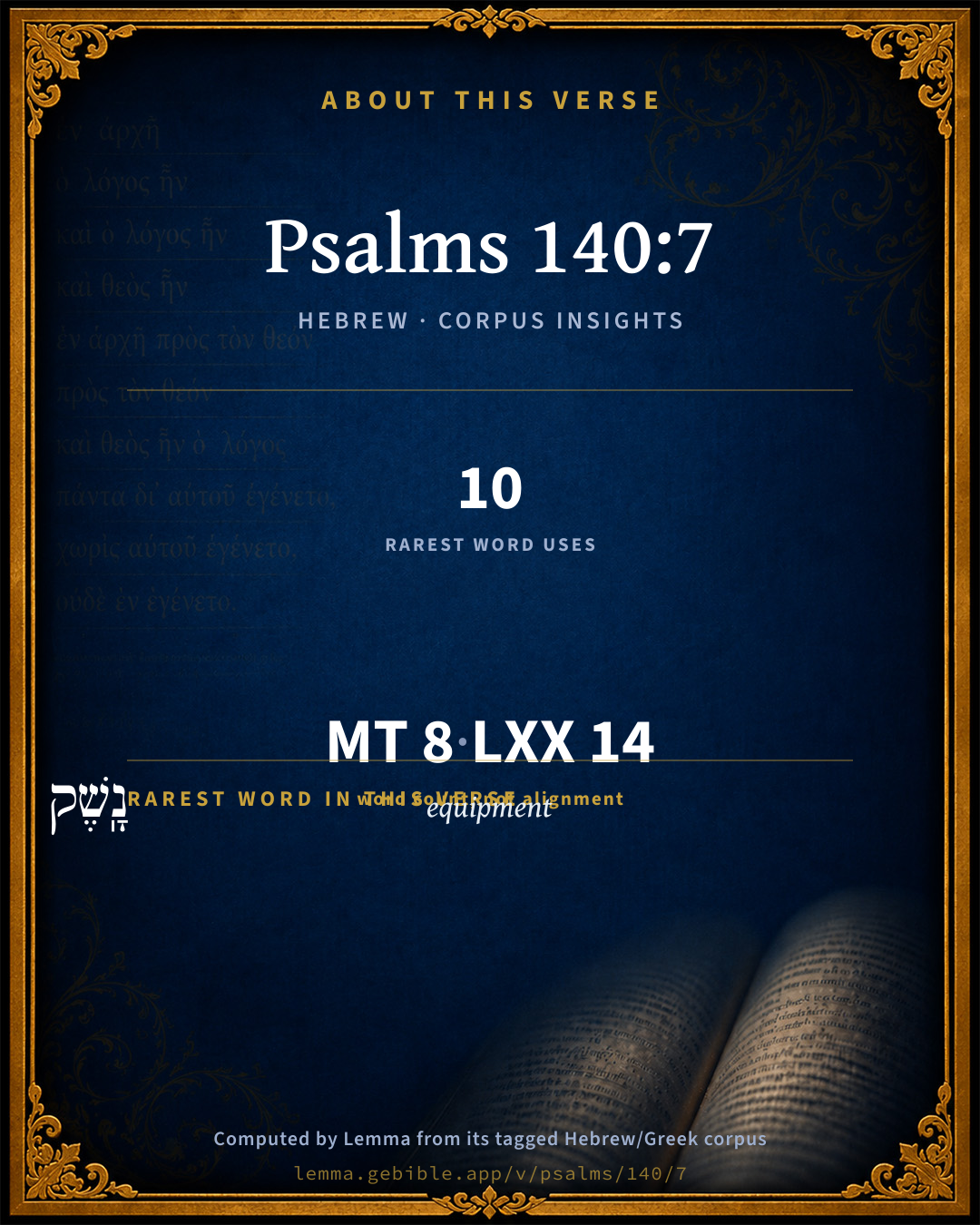
The rarest word here is נָֽשֶׁק equipment H5402 — appearing just 10 times in the whole Hebrew Bible.

Shared distinctive vocabulary

נָֽשֶׁק equipment H5402 occurs in 10 verses of the Hebrew Bible. Also found in:

Grammatical profile

  • 1 verb
  • 7 nouns

Verb forms

  • סַכֹּ֥תָה Qal · Perfect

Hebrew & Septuagint length

In English translation the verse runs 18 words from the Hebrew and 18 from the Septuagint (LXX English) — the same length.

A rough comparison of the two English renderings, which tokenize alike — not a word-level alignment.

Word counts can differ between the Hebrew and the Greek without any difference in meaning — e.g. the Hebrew direct-object marker אֵת has no separate Greek word, and Greek often adds the article ὁ.

In the original languages it is 8 Hebrew tokens and 14 Greek tokens — but the two are counted differently (Hebrew bundles its prefixes and suffixes into one token; the Greek is in lemma form), so that isn’t a like-for-like length.

Cross-references

16

Topical passages linked to Psalms 140:7 in the Treasury of Scripture Knowledge — connected by theme and wording, ordered by reader-vote popularity; previews shown in the World English Bible.

  • Psalms 62:7 With God is my salvation and my honor. The rock of my strength, and my refuge, is in God.
  • Psalms 18:1–2 I love you, Yahweh, my strength.
  • Psalms 89:26 He will call to me, 'You are my Father, My God, and the rock of my salvation!'
  • Deuteronomy 33:27–29 The eternal God is [your] dwelling-place, Underneath are the everlasting arms. He thrust out the enemy from before you, Said, Destroy.
  • Psalms 62:2 He alone is my rock and my salvation, my fortress-- I will never be greatly shaken.
  • Psalms 27:1 Yahweh is my light and my salvation. Whom shall I fear? Yahweh is the strength of my life. Of whom shall I be afraid?
  • Psalms 28:7–8 Yahweh is my strength and my shield. My heart has trusted in him, and I am helped. Therefore my heart greatly rejoices. With my song I will thank him.
  • Psalms 59:17 To you, my strength, I will sing praises. For God is my high tower, the God of my mercy.
  • Psalms 144:10 You are he who gives salvation to kings, Who rescues David, his servant, from the deadly sword.
  • 1 Samuel 17:45–51 Then said David to the Philistine, You come to me with a sword, and with a spear, and with a javelin: but I come to you in the name of Yahweh of hosts, the God of the armies of Israel, whom you have defied.
  • Psalms 18:35 You have also given me the shield of your salvation. Your right hand sustains me. Your gentleness has made me great.
  • Psalms 95:1 Oh come, let's sing to Yahweh. Let's shout aloud to the rock of our salvation!
  • Isaiah 12:2 Behold, God is my salvation. I will trust, and will not be afraid; for Yah, Yahweh, is my strength and song; and he has become my salvation."
  • 1 Samuel 17:36–37 Your servant struck both the lion and the bear: and this uncircumcised Philistine shall be as one of them, seeing he has defied the armies of the living God.
  • 2 Samuel 8:6 Then David put garrisons in Syria of Damascus; and the Syrians became servants to David, and brought tribute. Yahweh gave victory to David wherever he went.
  • 2 Samuel 8:14 He put garrisons in Edom; throughout all Edom put he garrisons, and all the Edomites became servants to David. Yahweh gave victory to David wherever he went.

Cross-references courtesy of OpenBible.info (CC BY 4.0).

Hebrew and Greek witnesses Masoretic Hebrew ↔ Greek Septuagint

The same verse in the two great witnesses to the Old Testament, shown verse-for-verse.

You’re reading Greek Psalm 139 (Hebrew Psalm 140). The Septuagint counts the superscription, so verse numbers can differ from the Hebrew — chapter-level alignment, not verse-by-verse. Numbering follows Rahlfs.

These are two independent witnesses, not word-aligned to each other, and the Septuagint is shown in lemma (dictionary) form.

Hebrew Psalms 140:7 Masoretic · Westminster Leningrad Codex

יְהֹוִ֣ה אֲ֭דֹנָי עֹ֣ז יְשׁוּעָתִ֑י סַכֹּ֥תָה לְ֝רֹאשִׁ֗י בְּי֣וֹם נָֽשֶׁק

Yahweh, the Lord, the strength of my salvation, You have covered my head in the day of battle.

World English Bible · Public Domain

Greek LXX Greek Psalm 139:7 Septuagint · lemma form

εἶπον ὁ κύριος θεός ἐγώ εἰμί σύ ἐνὠτίζομαι κύριος ὁ φωνή ὁ δέησις ἐγώ

O Lord God, the strength of my salvation; you have screened my head in the day of battle.

LXX2012 (modern English Septuagint) · Public Domain

On this verse, Ellicott's Commentary for English Readers discusses the Septuagint’s reading. Read the note in Commentary ↓

Hebrew: Westminster Leningrad Codex (CC BY 4.0). Greek: Septuagint (public domain); English from LXX2012 (modern English Septuagint) (Public Domain). How the Septuagint differs from the Hebrew →

Commentary

Notes on Psalms 140:7 from classic Christian and Jewish commentators (each source and its license shown beneath its notes). The classic Christian expositions comment on the surrounding passage and are grouped to its opening verse, so a note may address several verses; the Jewish commentaries on the Tanakh (Rashi and others) are per-verse, so they appear only where the commentator wrote on this verse.

Lemma curates 59 commentaries, every one of them public domain or Creative Commons licensed, each selected and text-cleaned for this edition rather than reprinted as found. About our sources →

Trapp's Complete Commentary

John Trapp

Psa 140:7 O GOD the Lord, the strength of my salvation, thou hast covered my head in the day of battle.

Ver. 7. In the day of battle] Heb. of armours; for battle David never had any with Saul, but declined it.

John Trapp, A Commentary or Exposition upon All the Books of the Old and New Testament (1647–1656) — public domain. Text from a community e-Sword module.

J. A. Alexander on Psalms

Joseph Addison Alexander

8. (Psa 140:7) Jehovah, Lord, the strength of my salvation; thou hast covered my head in the day of battle. My covenant God and sovereign, whose power saves me. Head is preceded by a preposition, thou hast been a covering (or afforded shelter) to (or for) my head. The day of battle, literally of armour or of weapons, i.e. the day when they are used. With this verse compare Psa 5:11; Psa 60:7; Psa 62:1; Psa 62:11; Psa 139:13, 1Sa 28:2.

Joseph Addison Alexander, The Psalms Translated and Explained (1850) — public domain. Text from a community e-Sword module.

Tyndale Open Study Notes

Tyndale Open Resources

140:7 The expression Sovereign Lord comes from combining the name Yahweh with the title Adonai (Master). See also 68:20; 69:6; 71:16; 73:28; 109:21; 141:8.

Tyndale Open Study Notes — © Tyndale Open Resources, licensed CC BY-SA 4.0. Text via the HelloAO Bible API.

Geneva Bible (1599)

Geneva Bible translators

He calleth to God with lively faith, being assured of his mercies, because he had before time proved, that God helped him ever in his dangers.

Geneva Bible (1599) marginal notes — public domain. Text via Bolls.life.

Adam Clarke's Commentary

Verse 7. Thou hast covered my head] Not only when I fought with the proud blaspheming Philistine; but in the various attempts made against my life by my sworn enemies.

Adam Clarke's Commentary on the Bible (1810–1826) — public domain. Text from a community e-Sword/MySword module.

Ellicott's Commentary for English Readers

(7) In the day of battle.—Literally, in the day of arms, i.e., when he was arming for fight. God covered the warrior’s head, i.e., provided the “helmet of salvation” (Isa_59:17). (Comp. also Psa_60:9 : “Strength of my head.”) Others, however, follow the LXX. and Authorised Version in understanding by “day of arms” the day of battle.

A Bible Commentary for English Readers, edited by Charles John Ellicott (1878–1897) — public domain. Text from a community e-Sword module.

The Cambridge Bible for Schools and Colleges

gen. ed. J. J. S. Perowne

7. O God the Lord] Jehovah, Lord. Cp. Psa_109:21 (note); Psa_141:8.

thou hast covered my head] Protected it as with a helmet. Cp. Psa_60:7; Isa_59:17; Eph_6:17; 1Th_5:8. The perfect tense might refer to past experience, but is probably to be taken as a perfect of certainty: thou wilt̄ assuredly cover.

the day of battle] Lit. of armour, when armour is needed. The language is of course figurative, for the ‘war’ which his enemies were making upon him was carried on with the weapons of slander and calumny.

The Cambridge Bible for Schools and Colleges (gen. ed. J. J. S. Perowne; Cambridge University Press, 1878–1918) — public domain. Text from a community e-Sword module.

John Gill's Exposition

O God the Lord, the strength of my salvation,.... Temporal and spiritual, which he was able to effect; the mighty God and mighty Saviour: and this encouraged David to believe he should have deliverance; and this secured, confirmed, and established it to him; and to which he was the more induced by what experience he had had of the divine goodness to him, as follows:

thou hast covered my head in the day of battle; with the helmet of salvation, as Kimchi, Aben Ezra, and Arama observe; which, in a spiritual sense, is to a believer the hope of salvation, Eph 6:17, Th1 5:8; a defensive weapon to him; and protects him while he is engaging with his spiritual enemies in this his state of warfare, sin, Satan, and the world. Perhaps David may have respect to the divine protection of him, when he fought with Goliath. Salvation was Christ's helmet, when he engaged with all his and our enemies; even with all the powers of darkness, and obtained deliverance for us, Isa 59:16.

John Gill's Exposition of the Whole Bible (1746–1763) — public domain (CC PDM 1.0). Text via the HelloAO Bible API.

Albert Barnes' Notes on the Bible

O God the Lord ... - literally, “Yahweh, Lord, the strength of my salvation” The word rendered “God,” in the original, is יהוה Yahweh. The address is to Yahweh as the Lord; that is, as the supreme Ruler - who presides over all things. Him the psalmist acknowledged as “his” Lord and Ruler. The phrase “the strength of my salvation” means the strength or power on which my safety depends. I have no other hope of deliverance but in thee.

Thou hast covered my head in the day of battle - Thou hast been a shield unto me. Literally, “In the day of arms,” or of armor, 1Ki 10:25; Eze 39:9-10.

Albert Barnes' Notes on the Bible (1834–1885) — public domain. Text from a community e-Sword/MySword module.

Matthew Poole's English Annotations

With thy powerful protection, as with a helmet or shield.

Matthew Poole's English Annotations on the Holy Bible (1683–1685) — public domain. Text from a community e-Sword/MySword module.

The Treasury of David

Charles H. Spurgeon

Ver. 7. O GOD the Lord, the strength of my salvation, thou hast covered my head in the day of battle. When he looked back upon past dangers and deliverances, the good man felt that he should have perished had not the Lord held a shield over his head. In the day of the clash of arms, or of the putting on of armour (as some read it), the glorious Lord had been his constant Protector. Goliath had his armour bearer, and so had Saul, and these each one guarded his master; yet the giant and the king both perished, while David, without armour or shield, slew the giant and baffled the tyrant. The shield of the Eternal is a better protection than a helmet of brass, When arrows fly thick and the battle axe crashes right and left, there is no covering for the head like the power of the Almighty. See how the child of providence glorifies his Preserver! He calls him not only his salvation, but the strength of it, by whose unrivalled force he had been enabled to outlive the cunning and cruelty of his adversaries. He had obtained a deliverance in which the strength of the Omnipotent was clearly to be seen. This is a grand utterance of praise, a gracious ground of comfort, a prevalent argument in prayer. He that has covered our head aforetime will not now desert us. Wherefore let us fight a good fight, and fear no deadly wound: the Lord God is our shield, and our exceeding great reward.

Ver. 7. Thou hast covered my head in the day of battle. Hebrew, of armour. For David had never indeed any battle with Saul, but declined it; but Saul often armed against him; but then God's providence covered him as a shield: but the head is only spoken of to set forth his whole body, because that is chiefly aimed at by the enemy, as where the life principally lieth. John Mayer.

Ver. 7. Thou hast covered my head, etc. That is, I had no other helmet or armour but thy Almighty power in the day when I fought with Goliath. 1Sa 17:39-40, 50. Thomas Fenton.

Ver. 7. Thou hast covered my head in the day of battle. A captain or prince had always beside him in battle an armour bearer, whose duty it was "to cover his master's head", that is, to ward off with the shield the blows aimed at his head, and which, in the heat of the fight, had escaped his own notice. Benjamin Weiss.

Psalms 140:8*

Charles H. Spurgeon's The Treasury of David (1869–1885) — public domain. Psalms only. Text from a community e-Sword/MySword module.

Whedon's Commentary on the Bible

Daniel D. Whedon

7. O God the Lord—The frequent use of the divine names is not tautological, but indicates the psalmist’s soul agony, and the earnestness of his appeal to the covenant faithfulness of God, bringing his piety imposingly into the foreground.

Covered my head—As a helmet.

Compare Psa_6:7; Eph_6:17.

In the day of battle— Hebrew, In the day of armour. The word neshek occurs ten times in the Old Testament, and never means battle, but always armour, armory, weapon. The reference is not to a battle, but to a preparation for a battle, and means, God had been his real shield or helmet (the cover of his head) when he armed himself for battle; or, more probably, it is an allusion to 1Sa_17:38-39, when Saul armed David to meet Goliath, and “put a helmet of brass upon his head,” which David declined, trusting alone in God. This coincides with the date we have given the psalm, and fully sustains the high import of the prayer.

Daniel D. Whedon (gen. ed.), Commentary on the Old and New Testaments (1874–1909) — public domain. Text from a community e-Sword module.

The Pulpit Commentary

O God the Lord. In the Hebrew, "Jehovah Adonai a comparatively rare address. The strength of my salvation. The solid strength upon which I ground all my hopes of salvation. (comp. Psa_89:26) Thou hast covered my head in the day of battle. In past combats thou hast protected me, as with a shield, (Psa_18:2 Psa_33:20) wherefore I put the greater trust in thee for the future. The "head" is mentioned as one of the chief vital parts.

The Pulpit Commentary (1880–1919), ed. H.D.M. Spence-Jones & Joseph S. Exell — public domain. Text from a community e-Sword module.

Lesson kit

Teaching starters — assembled from the data on this page, not authored interpretation. Every prompt links to the verse data it draws on. Edit before teaching.

Psalms, in the Wisdom, opens this verse with 8 words (8 distinct Hebrew lemmas). Its most distinctive word is nesheq (“equipment”). A historical commentator’s framing appears above. Read the whole chapter for the surrounding context.

Discussion questions

  1. What does “equipment” (nesheq) contribute to the verse as a whole?
  2. 1 Kings 10:25 shares the word «equipment» with this verse. How do the two illuminate each other?
  3. These translations render this verse differently. What is at stake in choosing one wording over another?
  4. The verb «סַכֹּ֥תָה» is Qal Perfect. How does its form color the action?
  5. Reading how Trapp's Complete Commentary and J. A. Alexander on Psalms read this verse, where do the two commentators agree and where do they part?

Things to notice

Reading settings

Reading text

Shown beneath each verse's original-language words.

Old Testament
Old Testament edition

Read the OT as the Masoretic Hebrew (MT) or the Greek Septuagint (LXX).

English shown for the Greek Septuagint (in the Hebrew ↔ Greek comparison).

Comparing translations? Open the Compare panel on any verse page to stack up to four side by side.