Isaiah 65:15

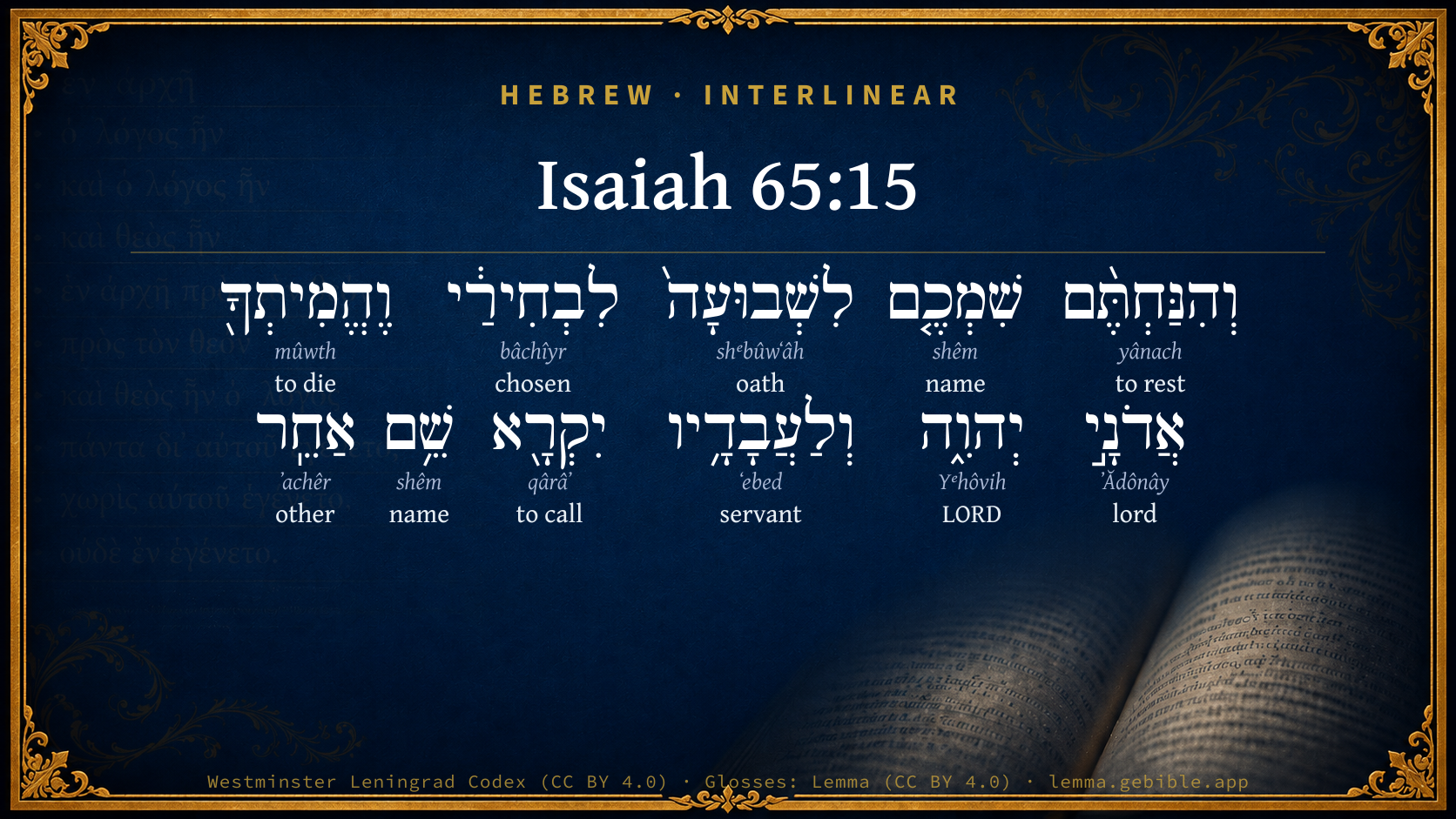
Hebrew (Westminster Leningrad Codex) Isaiah 65:15 appears in the Hebrew Old Testament. The text above is from the Westminster Leningrad Codex. Each word links to its Strong’s number, a concise gloss, and parsing drawn from the Open Scriptures Hebrew Bible morphology. Click any word for its full Brown-Driver-Briggs (BDB) entry.
Download image
Cite this verse

Isaiah 65:15 (World English Bible). Public Domain. Lemma interlinear Bible study tool, https://lemma.gebible.app/v/isaiah/65/15.

Show BibTeX & RIS
BibTeX
RIS
English Translation
You shall leave your name for a curse to my chosen; and the Lord Yahweh will kill you; and he will call his servants by another name:
World English Bible · Public Domain
Download a study sheet

One document with this verse’s original text, its word-by-word gloss line, the meaning frame, cross-references with their text, attributed commentary, and full source and license credits — printable, and it pastes into notes with its structure intact.

This verse Autodidact and up

Study sheet (.html) Plain text (.txt)

A passage Seminary Student

Up to 50 verses in one chapter. A passage sheet keeps up to 6 commentary sources and 12 cross-references per verse, in the order this page ranks them, and says so on the sheet whenever that leaves anything out. Ask for a single verse and you get the Autodidact verse sheet above.

Everything on this page stays free to read, with no account — the sheet is a download of what is already on screen, not access to it.

Want to remove ads? Support Godless Engineer
Compare translations 3

The same verse in 3 English versions, stacked beneath the original-language interlinear above. Click any original word for its lexicon entry.

Each is an independent rendering of the whole verse — the interlinear is not word-aligned to these translations.

Highlighted words mark where these versions differ — a whole-verse word diff, not a word-by-word alignment.

  • World English Bible Public Domain
    You shall leave your name for a curse to my chosen; and the Lord Yahweh will kill you; and he will call his servants by another name:
  • King James Version Public Domain
    And ye shall leave your name for a curse unto my chosen: for the Lord GOD shall slay thee, and call his servants by another name:
  • unfoldingWord Literal Text CC BY-SA 4.0
    And you will leave your name as a curse to my chosen ones, and the Lord Yahweh will kill you, but to his servants he will call another name.

unfoldingWord Literal Text — © unfoldingWord, licensed CC BY-SA 4.0. Word-aligned USFM3 via Door43 (git.door43.org/unfoldingWord/en_ult).

Versions to compare (up to 4)

3 of 4 selected

Show all 18 translations

Every available English version of this verse, each an independent rendering of the whole verse.

  • World English Bible Public Domain
    You shall leave your name for a curse to my chosen; and the Lord Yahweh will kill you; and he will call his servants by another name:
  • Berean Standard Bible Public Domain
    You will leave behind your name as a curse for My chosen ones, and the Lord GOD will slay you; but to His servants He will give another name.
  • Majority Standard Bible Public Domain
    You will leave behind your name as a curse for My chosen ones, and the Lord GOD will slay you; but to His servants He will give another name.
  • King James Version Public Domain
    And ye shall leave your name for a curse unto my chosen: for the Lord GOD shall slay thee, and call his servants by another name:
  • American Standard Version (1901) Public Domain
    And ye shall leave your name for a curse unto my chosen; and the Lord Jehovah will slay thee; and he will call his servants by another name:
  • Revised Version (1885) Public Domain
    And ye shall leave your name for a curse unto my chosen, and the Lord GOD shall slay thee; and he shall call his servants by another name:
  • Geneva Bible (1599) Public Domain
    And ye shall leaue your name as a curse vnto my chosen: for the Lord God shall slay you and call his seruants by another name.
  • Douay-Rheims (1899) Public Domain
    And you shall leave your name for an execration to my elect: and the Lord God shall slay thee, and call his servants by another name.
  • Young's Literal Translation Public Domain
    And ye have left your name For an oath for My chosen ones, And the Lord Jehovah hath put thee to death, And to His servants He giveth another name.
  • Literal Standard Version CC BY-SA 4.0
    And you have left your name || For an oath for My chosen ones, || And Lord YHWH has put you to death, || And He gives another name to His servants;
  • Unlocked Literal Bible CC BY-SA 4.0
    You will leave behind your name as a curse for my chosen ones to speak; I, the Lord Yahweh, will kill you; I will call my servants by another name.
  • unfoldingWord Literal Text CC BY-SA 4.0
    And you will leave your name as a curse to my chosen ones, and the Lord Yahweh will kill you, but to his servants he will call another name.
  • Darby Bible Public Domain
    And ye shall leave your name for a curse unto mine elect; for the Lord Jehovah will slay thee, and will call his servants by another name:
  • World Messianic Bible Public Domain
    You will leave your name for a curse to my chosen, and the Lord GOD will kill you. He will call his servants by another name,
  • Webster's Bible Public Domain
    And ye shall leave your name for a curse to my chosen: for the Lord GOD will slay thee, and call his servants by another name:
  • Free Bible Version CC BY-SA 4.0
    Your name will only be used as a curse by my chosen ones, for the Lord God will kill you and give his servants another name.
  • Bible in Basic English Public Domain
    And your name will become a curse to my people, and the Lord God will put you to death, and give his servants another name:
  • JPS Tanakh (1917) Public Domain
    And ye shall leave your name for a curse unto Mine elect: 'So may the Lord GOD slay thee'; but He shall call His servants by another name;

Literal Standard Version (2020), Covenant Press — licensed CC BY-SA 4.0. Text via the HelloAO Bible API (eBible.org). Unlocked Literal Bible (unfoldingWord) — licensed CC BY-SA 4.0. Text via the HelloAO Bible API (eBible.org). unfoldingWord Literal Text — © unfoldingWord, licensed CC BY-SA 4.0. Word-aligned USFM3 via Door43 (git.door43.org/unfoldingWord/en_ult). Free Bible Version, Dr. Jonathan Gallagher — licensed CC BY-SA 4.0. Text via the HelloAO Bible API (eBible.org).

Word by word

More ways to search: Search by grammar → Find every occurrence → Compare this word →

Practice this passage: Drill this verse → Learn its vocabulary →

לִבְחִירַ֔י
bâchîyr
H972
“to/for · chosen · my”
Preposition + Adjective, Adjective, Masculine, Plural, Construct + Suffix, Personal, 1st Person, Common, Singular
Part of Speech
Preposition + Adjective
Type
Adjective
Gender
Masculine
Number
Plural
State
Construct
Full BDB Definition

Origin: from H977

TWOT: 231c

chosen, choice one, chosen one, elect (of God)
  1. וְהִנַּחְתֶּ֨ם yânach H3240 “and · to rest” Conjunction + Verb, Hiphil, Perfect, 2nd Person, Masculine, Plural
  2. שִׁמְכֶ֤ם shêm H8034 “name · your” Noun, Common, Masculine, Singular, Construct + Suffix, Personal, 2nd Person, Masculine, Plural
  3. לִשְׁבוּעָה֙ shᵉbûwʻâh H7621 “to/for · oath” Preposition + Noun, Common, Feminine, Singular, Absolute
  4. וֶהֱמִיתְךָ֖ mûwth H4191 “and · to die · you” Conjunction + Verb, Hiphil, Sequential Perfect, 3rd Person, Masculine, Singular + Suffix, Personal, 2nd Person, Masculine, Singular
  5. אֲדֹנָ֣י ʼĂdônây H136 “Lord · my” Noun, Common, Masculine, Plural, Construct + Suffix, Personal, 1st Person, Common, Singular
  6. יְהוִ֑ה Yᵉhôvih H3069 “LORD” Noun, Proper
  7. וְלַעֲבָדָ֥יו ʻebed H5650 “and · to/for · servants · his” Conjunction + Preposition + Noun, Common, Masculine, Plural, Construct + Suffix, Personal, 3rd Person, Masculine, Singular
  8. יִקְרָ֖א qârâʼ H7121 “to call” Verb, Qal, Imperfect, 3rd Person, Masculine, Singular
  9. שֵׁ֥ם shêm H8034 “name” Noun, Common, Masculine, Singular, Absolute
  10. אַחֵֽר ʼachêr H312 “other” Adjective, Adjective, Masculine, Singular, Absolute

About this verse

These counts appear in no published source. They are computed here, from the morphology-tagged text and Lemma’s own curated glosses. What Lemma adds →

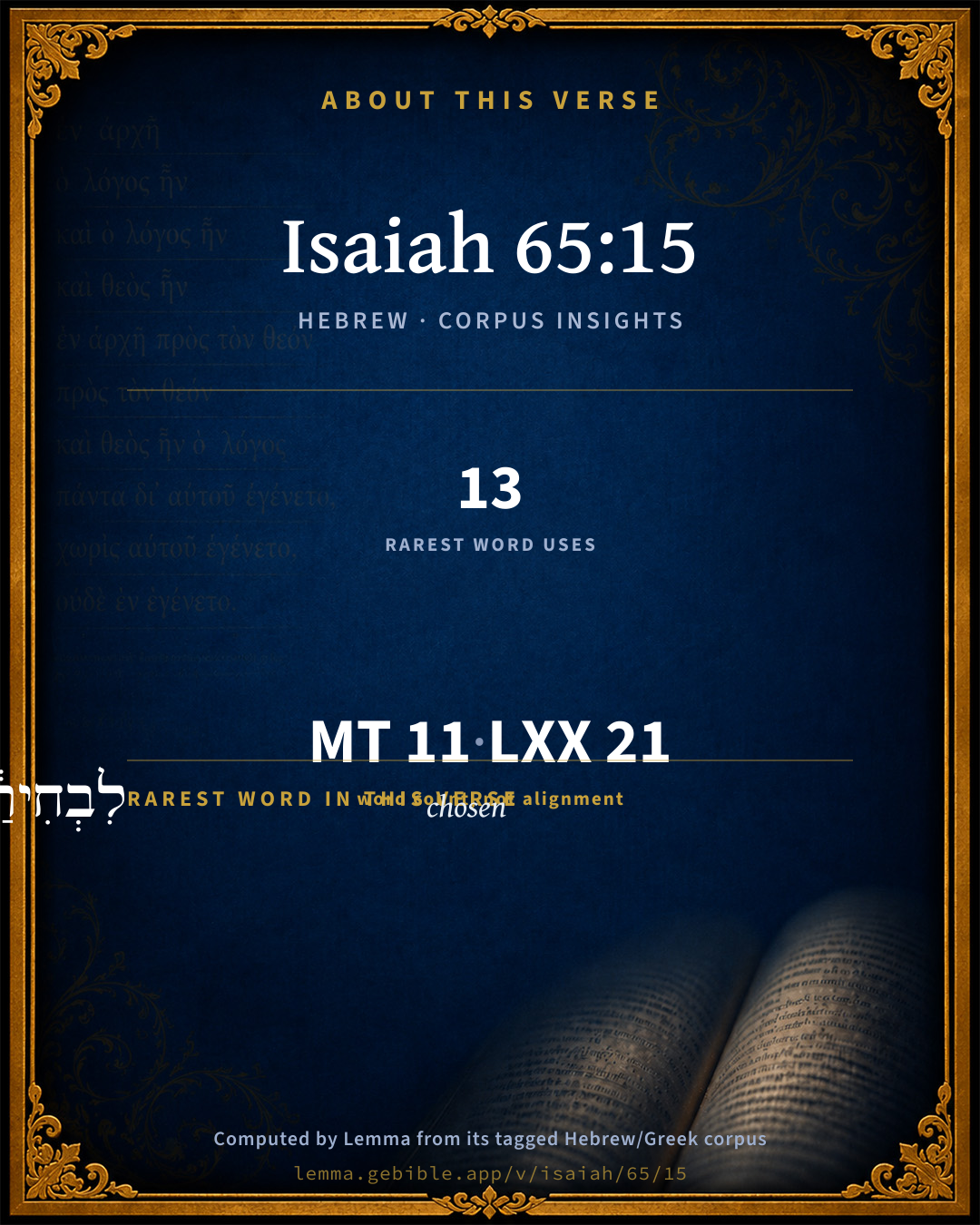
11
words
10
distinct lemmas
Prophets
section

Notable vocabulary

The rarest word here is לִבְחִירַ֔י chosen H972 — appearing just 13 times in the whole Hebrew Bible.

Shared distinctive vocabulary

לִבְחִירַ֔י chosen H972 occurs in 13 verses of the Hebrew Bible. Also found in:

Grammatical profile

  • 3 verbs
  • 6 nouns
  • 2 adjectives

Verb forms

  • וְהִנַּחְתֶּ֨ם Hiphil · Perfect
  • וֶהֱמִיתְךָ֖ Hiphil · Sequential Perfect
  • יִקְרָ֖א Qal · Imperfect

Repetition

A word recurs within this verse — often emphatic in Hebrew:

  • שִׁמְכֶ֤ם name H8034 ×2

Hebrew & Septuagint length

In English translation the verse runs 27 words from the Hebrew and 28 from the Septuagint (LXX English) — closely comparable.

A rough comparison of the two English renderings, which tokenize alike — not a word-level alignment.

Word counts can differ between the Hebrew and the Greek without any difference in meaning — e.g. the Hebrew direct-object marker אֵת has no separate Greek word, and Greek often adds the article ὁ.

In the original languages it is 11 Hebrew tokens and 21 Greek tokens — but the two are counted differently (Hebrew bundles its prefixes and suffixes into one token; the Greek is in lemma form), so that isn’t a like-for-like length.

Cross-references

13

Topical passages linked to Isaiah 65:15 in the Treasury of Scripture Knowledge — connected by theme and wording, ordered by reader-vote popularity; previews shown in the World English Bible.

  • Isaiah 62:2 The nations shall see your righteousness, and all kings your glory, and you shall be called by a new name, which the mouth of Yahweh shall name.
  • Romans 9:26 "It will be that in the place where it was said to them, 'You are not my people,' There they will be called 'children of the living God.'"
  • Zechariah 8:13 It shall come to pass that, as you were a curse among the nations, house of Judah and house of Israel, so will I save you, and you shall be a blessing. Don't be afraid. Let your hands be strong."
  • Acts 11:26 When he had found him, he brought him to Antioch. It happened, that for a whole year they were gathered together with the assembly, and taught many people. The disciples were first called Christians in Antioch.
  • Jeremiah 29:22 and of them shall be taken up a curse by all the captives of Judah who are in Babylon, saying, Yahweh make you like Zedekiah and like Ahab, whom the king of Babylon roasted in the fire;
  • Isaiah 65:9 I will bring forth a seed out of Jacob, and out of Judah an inheritor of my mountains; and my chosen shall inherit it, and my servants shall dwell there.
  • Isaiah 65:22 They shall not build, and another inhabit; they shall not plant, and another eat: for as the days of a tree shall be the days of my people, and my chosen shall long enjoy the work of their hands.
  • 1 Peter 2:9–10 But you are a chosen race, a royal priesthood, a holy nation, a people for God's own possession, that you may show forth the excellencies of him who called you out of darkness into his marvelous light:
  • Proverbs 10:7 The memory of the righteous is blessed, But the name of the wicked will rot.
  • Isaiah 65:12 I will destine you to the sword, and you shall all bow down to the slaughter; because when I called, you did not answer; when I spoke, you did not hear; but you did that which was evil in my eyes, and chose that in which I didn't delight.
  • Isaiah 66:15 For, behold, Yahweh will come with fire, and his chariots shall be like the whirlwind; to render his anger with fierceness, and his rebuke with flames of fire.
  • Matthew 21:41 They told him, "He will miserably destroy those miserable men, and will lease out the vineyard to other farmers, who will give him the fruit in its season."
  • 1 Thessalonians 2:16 forbidding us to speak to the Gentiles that they may be saved; to fill up their sins always. But wrath has come on them to the uttermost.

Cross-references courtesy of OpenBible.info (CC BY 4.0).

Hebrew and Greek witnesses Masoretic Hebrew ↔ Greek Septuagint

The same verse in the two great witnesses to the Old Testament, shown verse-for-verse.

These are two independent witnesses, not word-aligned to each other, and the Septuagint is shown in lemma (dictionary) form.

Hebrew Isaiah 65:15 Masoretic · Westminster Leningrad Codex

וְהִנַּחְתֶּ֨ם שִׁמְכֶ֤ם לִשְׁבוּעָה֙ לִבְחִירַ֔י וֶהֱמִיתְךָ֖ אֲדֹנָ֣י יְהוִ֑ה וְלַעֲבָדָ֥יו יִקְרָ֖א שֵׁ֥ם אַחֵֽר

You shall leave your name for a curse to my chosen; and the Lord Yahweh will kill you; and he will call his servants by another name:

World English Bible · Public Domain

Greek LXX Isaiah 65:15 Septuagint · lemma form

καταλείπω γάρ ὁ ὄνομα σύ εἰς πλησμονή ὁ ἐκλεκτός ἐγώ σύ δέ ἀνααἱρέω κύριος ὁ δέ δουλεύω αὐτός καλέω ὄνομα καινός

For you⌃ shall leave your name for a loathing to my chosen, and the Lord shall destroy you: but my servants shall be called by a new name,

LXX2012 (modern English Septuagint) · Public Domain

On this verse, Adam Clarke's Commentary discusses the Septuagint’s reading. Read the note in Commentary ↓

Hebrew: Westminster Leningrad Codex (CC BY 4.0). Greek: Septuagint (public domain); English from LXX2012 (modern English Septuagint) (Public Domain). How the Septuagint differs from the Hebrew →

Targum (Aramaic paraphrase)

1

The Targum is the ancient Jewish Aramaic paraphrase of the Hebrew Scriptures — an interpretive translation, not the Hebrew text itself. Onkelos (literal) and Pseudo-Jonathan (expansive) render the Torah, and Jonathan the Prophets. Coverage is partial: where no permissively-licensed English translation exists for a verse, only the Aramaic is shown. This is verse-level text, not a word-by-word alignment to the Hebrew.

  1. Targum Jonathan Prophets (Joshua–Malachi)
    וְתִשְׁבְּקוּן שׁוּמְכוֹן לְקַיָמָא לִבְחִירִי וִימִיתְכוֹן יְיָ אֱלֹהִים מוֹתָא תִנְיָנָא וּלְעַבְדוֹהִי צַדִיקַיָא יִקְרֵי שְׁמָא אוֹחֲרָנָא:

    And ye shall leave your name for a curse to my chosen: for the Lord God shall slay you with the second death, 10 and call His righteous servants by another name:

    Targum Jonathan — Aramaic: “Mikraot Gedolot” (public domain). English: “Sefaria Community Translation” (CC0 1.0 (public-domain dedication)); “London "Chaldee Paraphrase," 1871” (public domain). Text via Sefaria.

Commentary

Notes on Isaiah 65:15 from classic Christian and Jewish commentators (each source and its license shown beneath its notes). The classic Christian expositions comment on the surrounding passage and are grouped to its opening verse, so a note may address several verses; the Jewish commentaries on the Tanakh (Rashi and others) are per-verse, so they appear only where the commentator wrote on this verse.

Lemma curates 59 commentaries, every one of them public domain or Creative Commons licensed, each selected and text-cleaned for this edition rather than reprinted as found. About our sources →

Trapp's Complete Commentary

John Trapp

Isa 65:15 And ye shall leave your name for a curse unto my chosen: for the Lord GOD shall slay thee, and call his servants by another name:

Ver. 15. And ye shall leave your name for a curse.] So that when mine elect shall denounce my curse against any one, they shall say, God make thee such another as was such a cursed wretch. See Jer 24:9; Jer 29:22; Jer 44:8; Zec 8:13, {See Trapp on "Zec 8:13"} Iadaeus sim si fallo, say the Turks at this day; As hard-hearted and unhappy as a Jew, say we.

And call his servants by another name.] Jews inwardly, Israelites indeed, Christians, a chosen generation, a royal priesthood, a holy nation, a peculiar people. {1Pe 2:9} The wicked, when they die, go out in a snuff, leave a stench behind them, as they say the devil doth when he goeth out of a room; but when the saints depart, they leave a sweet smell behind them, as those lamps do that are fed with aromatical oil. Yea, it is more than probable that in the next world we shall look upon Bradford and such with thoughts of extraordinary love and sweetness through all eternity, as Bonner and such with execration and everlasting detestation.

John Trapp, A Commentary or Exposition upon All the Books of the Old and New Testament (1647–1656) — public domain. Text from a community e-Sword module.

Tyndale Open Study Notes

Tyndale Open Resources

65:15 The new name given to the faithful represents a new identity and a deeper relationship with the Lord (see also 62:2).

Tyndale Open Study Notes — © Tyndale Open Resources, licensed CC BY-SA 4.0. Text via the HelloAO Bible API.

Geneva Bible (1599)

Geneva Bible translators

Meaning, that he would call the Gentiles, who should abhor even the very name of the Jews for their infidelities’ sake.

Than by the name of the Jews.

Geneva Bible (1599) marginal notes — public domain. Text via Bolls.life.

Jamieson, Fausset & Brown

Robert Jamieson, A. R. Fausset & David Brown

curse--The name of "Jew" has been for long a formula of execration (compare Jer 29:22); if one wishes to curse another, he can utter nothing worse than this, "God make thee what the Jew is!" Contrast the formula (Gen 48:20) [MAURER].

my chosen--the elect Church, gathered from Jews and Gentiles, called by "another name," Christians (Act 11:26). However (see on Isa 65:13), as "My chosen," or "elect," in Isa 65:3, refers to the "seed of Jacob," the believing Jews, hereafter about to possess their land (Isa 65:19, Isa 65:22), are ultimately meant by "My chosen," as contrasted with the unbelieving Jews ("ye"). These elect Jews shall be called by "another," or a new name, that is, shall no longer be "forsaken" of God for unbelief, but shall be His "delight" and "married" to Him (Isa 62:2, Isa 62:4).

thee--unbelieving Israel. Isaiah here speaks of God, whereas in the preceding sentences God Himself spake. This change of persons marks without design how completely the prophet realized God with him and in him, so that he passes, without formally announcing it, from God's words to his own, and vice versa, both alike being from God.

Jamieson, Fausset & Brown — Commentary Critical and Explanatory on the Whole Bible (1871) — public domain (CC PDM 1.0). Text via the HelloAO Bible API.

Adam Clarke's Commentary

Verse 15. Shall slay thee - "Shall slay you"] For והמיתך vehemithecha, shall slay thee, the Septuagint and Chaldee read והמיתכם vehemithechem, shall slay you, plural.

Adam Clarke's Commentary on the Bible (1810–1826) — public domain. Text from a community e-Sword/MySword module.

Ellicott's Commentary for English Readers

(15) Ye shall leave your name for a curse . . .—The phrase has parallels in Num_5:21; Zec_8:13; Jer_29:22, the thought in each case being that the person named is under so heavy a penalty from the wrath of Jehovah that he becomes a representative instance of what that wrath can accomplish, and because the old name, say of Jacob or of Judah, has been thus identified with evil. He will call His chosen ones, the true Israel, as by another name, which shall be for blessing, and not for cursing. (Comp. Isa_62:2, Rev_2:17; Rev_3:12.)

A Bible Commentary for English Readers, edited by Charles John Ellicott (1878–1897) — public domain. Text from a community e-Sword module.

The Cambridge Bible for Schools and Colleges

gen. ed. J. J. S. Perowne

15. Their names shall be used in a formula of imprecation. Comp. in illustration Jer_29:22 : “And from them shall be taken a curse for all the captivity of Judah … saying, ‘Jehovah make thee like Zedekiah and like Ahab, whom the king of Babylon roasted in the fire!’.” Have we such a formula quoted in the clause following, “and the Lord Jehovah shall slay thee”? It is objected (1) that the formula would be incomplete, the essential words—“like so-and-so”—being omitted; (2) the “and” is unaccounted for, while to remove it would leave a perf. with a precative sense, a usage which is very doubtful in Hebr. (Driver, Tenses, § 20). On the other hand, the use of 2nd pers. sing. rather favours the view that the words are meant as a specimen of the curse.

and call his servants by another name] The LXX. (Cod. Vat.), with slight modifications of the text, reads: “And on my servants shall be called a new name” (τοῖς δὲ δουλεύουσί μοι κληθήσεται ὄνομα καινόν). The καινόν is no doubt a slip; but the change of “his” to “my” is an obvious improvement, and may safely be adopted. The promise must not be taken too literally, nor too closely connected with the preceding threat. It is hardly conceivable that the prophet contemplates the abrogation of the name “Israel,” because it has been degraded by unworthy Israelites (Cheyne, Comm.). This would be implied only if the name “Israel” were that which is to remain for a curse, which is again a too violent interpretation. The “other name” is contrasted, not with that which both parties had borne in common, but with names such as “Forsaken,” which describe the present condition of the true believers. Cf. ch. Isa_62:2; Isa_62:4; Isa_62:12.

The Cambridge Bible for Schools and Colleges (gen. ed. J. J. S. Perowne; Cambridge University Press, 1878–1918) — public domain. Text from a community e-Sword module.

John Gill's Exposition

And ye shall leave your name for a curse unto my chosen,.... Execrable and abominable to them, as the name of a Jew is to this day, and in all places; for their unbelief and impenitence, for their perfidy and insincerity, for their tricking and covetousness, and other crimes they are addicted to; see Jer 24:9,

for the Lord God shall slay them; by the sword of the Romans, and by his judgments, which continue upon them; the Targum says, with the second death; and so Jarchi interprets it of eternal death, which is the just wages of sin:

and call his servants by another name; a new name, as the Septuagint and Arabic versions; the name of the people of God, the Gentiles formerly were not called by; but now all that believe in Christ, whether Jews or Gentiles, are his people; the name of the sons of God, a name better than that of sons and daughters of the greatest potentate; the name which the mouth of the Lord calls, "Hephzibah" and "Beulah", being delighted in by the Lord, and married to him; or rather the name of Christians, first given to the disciples of Christ at Antioch, and ever since continued, Act 11:26.

John Gill's Exposition of the Whole Bible (1746–1763) — public domain (CC PDM 1.0). Text via the HelloAO Bible API.

Albert Barnes' Notes on the Bible

And ye shall leave your name for a curse unto my chosen - To my people; to those whom I have selected to be my friends. The word rendered here ‘curse’ (שׁבועה shebû‛âh) means properly “an oath,” or “a swearing”; and then “an imprecation” or “a curse” (see Num 5:21; Dan 9:11). The sense here seems to be, that their punishment would be so great that it would become the subject of imprecation when others wished to bind themselves in the most solemn manner by an oath. The pious, who wished to confirm a promise or a covenant in the most solemn manner, would say, ‘If we do not perform the promise, then let us experience the same punishment at the hand of God which they have done’ (compare Jer 29:22). Or it may mean, that their name would be used proverbially, like that of Sodom, as a signal example of wickedness and of the abhorrence of God.

And call his servants by another name - So disgraceful and dishonorable shall be that name, that Yahweh will apply another name to his people. Is there not an allusion here to the designed change of the name by which the people of God are known? Has it not been by the special providence of God that his true people are now known by another appellation? Is there any name on earth now that is more the subject of reproach and execration than all the appellations by which his ancient people were known? The name Jew - what ideas does it convey to all the nations of the earth? It is connected with reproach; a name regarded as belonging to a people accursed by God; a name more universally detested than any other known among people. And was it not because this name would be thus dishonored, reproached, and despised, that another was given to the true people of God - the name CHRISTIAN - an honored name - denoting true attachment to the Messiah?

Albert Barnes' Notes on the Bible (1834–1885) — public domain. Text from a community e-Sword/MySword module.

Haydock's Catholic Bible Commentary

Execration. They can wish to be preserved from nothing worse. --- Name. The faithful shall be no longer called Jews. (Calmet) --- They shall be hated, while the name of Christian shall point out God’s servants. (Worthington)

George Leo Haydock (1774–1849), Haydock's Catholic Family Bible and Commentary, 1859 edition — public domain. Excludes Psalms (Douay-Rheims chapter numbering differs from Protestant) and Deuterocanonical books (Catholic canon only).

Matthew Poole's English Annotations

Your name shall rot, as Pro 10:7, or only be used when men would curse others, saying, Let them be made like such persons. As the names of Leah and Rachel, Rth 4:11, and others of God’s servants, were used in blessing; so your names shall only be used in cursing; or when men will curse themselves, they shall use your names as examples of the eminent wrath of God upon sinners. For you shall not perish by an ordinary hand, but by the hand of the

Lord God; and as is the God, so is his justice, so is his strength; yea, God himself shall look upon your name as accursed, and not suffer his people to be called by it; they shall not be called Jews, but Christians, Act 11:26, the children of God, Joh 1:12. So detestable a sin is idolatry, that God will not suffer himself to be called by a name given to idols, how proper soever it be to express his perfection, Hos 2:16,17; nor yet suffer his own people to be called by a name by which idolaters are known.

Matthew Poole's English Annotations on the Holy Bible (1683–1685) — public domain. Text from a community e-Sword/MySword module.

Whedon's Commentary on the Bible

Daniel D. Whedon

15, 16. Ye shall leave your name for a curse unto my chosen — “Name for a curse,” is that by which an imprecation is called on one’s own head if he do not what he pledges to do, or if he do what he pledges himself not to do. Canaan is such a curse; “let what Canaan imports befall me, if,” etc.

He who blesseth — That is, one who invokes blessings on himself does so in the name, or in the personal attributes, of the true God. He neither needs nor desires any blessing except as the God of truth is willing to bestow it. Calling for a blessing in the name of an idol is invoking a curse. So then, every oath made, or any good asked for, is valid, is acceptable, only as it is made or asked in the name of the God of truth. Swearing and blessing, in this sense, are therefore acts of worship of the God of truth. They are acts of self-consecration and prayer to him. When these become universal with Jew and Gentile, then, and by very reason of their being so, the former troubles are forgotten. There is no more retribution for sin. All have become the spiritual Israel — the faithful followers of the true God.

Daniel D. Whedon (gen. ed.), Commentary on the Old and New Testaments (1874–1909) — public domain. Text from a community e-Sword module.

The Pulpit Commentary

Ye shall leave your name for a curse. (comp. Jer_29:22) In their formulas of imprecation the Jews were in the habit of saying, "The Lord make thee like" this or that person, or this or that class of persons. The name of the exiles should be used in this manner. Unto my chosen (see the comment on ver. 9). The Lord God shall slay thee (see the comment on ver. 12). Some, however, take the words as part of the formula of imprecation. And call his servants by another name. (compare what is said of "new name" in Isa_62:2)

The Pulpit Commentary (1880–1919), ed. H.D.M. Spence-Jones & Joseph S. Exell — public domain. Text from a community e-Sword module.

John Wesley's Explanatory Notes

A curse - They shall use your names as examples, of the eminent wrath of God upon sinners. Another name - He will not suffer his own people to be called by a name by which idolaters are known.

John Wesley, Explanatory Notes Upon the Whole Bible (1754–1765) — public domain. Text via the GEBible commentary corpus.

J. A. Alexander on Isaiah

Joseph Addison Alexander

“And ye shall leave your name for an oath to my chosen ones, and the Lord Jehovah shall slay thee, and shall call His servants by another name (literally, call another name to them).” The object of address is still the body of the Jewish nation, from which the believing remnant are distinguished by the names, ‘my chosen’ and ‘my servants’. ‘Oath’ is here put for curse, as it is added to it in Dan 9:11, and the two are combined in Num 5:21, where the oath of cursing may be regarded as the complete expression of which oath is here an ellipsis. To leave one’s name for a curse, according to Old Testament usage, is something more than to leave it to be cursed. The sense is that the name shall be used as a formula of cursing, so that men shall be able to wish nothing worse to others than a like character and fate. This is clear from Jer 29:22 compared with Zec 3:2, as well as from the converse or correlative promise to the patriarchs and their children that a like use should be made of their names as a formula of blessing (Gen 22:18; Gen 48:20). As in other cases where the use of names is the subject of discourse, there is no need of supposing that any actual practice is predicted, but merely that the character and fate of those addressed will be so bad as justly to admit of such an application. As the phrase ‘your name’ shows that the object of address is a plurality of persons bearing one name, or in other words an organized community, so the singular form ‘slay thee’ is entirely appropriate to this collective or ideal person. Of the last clause there are three interpretations. The rabbinical expounders understand it as the converse of the other clause. ‘As your name is to be a name of cursing, so my servants are to have another name,’ (i.e., a name of blessing, or a name by which men shall bless). Others give it a more general sense, as meaning their condition shall be altogether different. A third opinion is that it relates to the substitution of the Christian name for that of Jew, as a distinctive designation of God’s people. The full sense of the clause can only be obtained by combining all these explanations, or at least a part of each. The first is obviously implied, if not expressed. The second is established by analogy and usage, and the almost unanimous consent of all interpreters. The only question is in reference to the last, which is of course rejected with contempt by the neologists, and regarded as fanciful by some Christian writers. These have been influenced in part by the erroneous assumption that if this is not the whole sense of the words, it cannot be a part of it. But this is only true in cases where the two proposed are incompatible. The true state of the case is this: According to the usage of the prophecies the promise of another name imports a different character and state, and in this sense the promise has been fully verified. But in addition to this general fulfillment, which no one calls in question, it is matter of history that the Jewish commonwealth or nation is destroyed; that the name of Jew has been for centuries a by-word and a formula of execration, and that they who have succeeded to the spiritual honours of this once favored race, although they claim historical identity therewith, have never borne its name, but another, which from its very nature could have no existence until Christ had come, and which in the common parlance of the Christian world is treated as the opposite of Jew. Now all this must be set aside as mere fortuitous coincidence, or it must be accounted for precisely in the same way that we all account for similar coincidences between the history of Christ and the Old Testament in minor points, where all admit that the direct sense of the prophecy is more extensive. As examples, may be mentioned John the Baptist’s preaching in a literal wilderness, our Savior’s riding on a literal ass, His literally opening the eyes of the blind, when it is evident to every reader of the original passage that it predicts events of a far more extensive and more elevated nature. While I fully believe that this verse assures God’s servants of a very different fate from that of the unbelieving Jews, I have no doubt that it also has respect to the destruction of the Jewish state and the repudiation of its name by the true church or Israel of God.

Joseph Addison Alexander, The Prophecies of Isaiah (1846–1847; New York: Scribner, 1870–1878) — public domain. Text from a community e-Sword module.

unfoldingWord translationNotes

Door43 World Missions Community

General Information:

Yahweh continues speaking to those in Israel who worship idols.

will be blessed by me, the God of truth

This can be stated in active form. AT: "I, the God who always speaks the truth, will bless him" (See: Active or Passive)

the former troubles will be forgotten ... will be hidden

These clauses can be stated in active form. AT: "they will forget the former troubles, for these troubles will be out of my memory" (See: Active or Passive)

they will be hidden from my eyes

"hidden from my eyes" represents the attention and memory of Yahweh. AT: "I will not even think about them again" (See: Idiom and Personification)

translationWords

name

curse

chosen one

Lord Yahweh

servant

bless

earth

God

true

oath

unfoldingWord translationNotes — © Distant Shores Media and the Door43 World Missions Community, licensed CC BY-SA 4.0. Source: git.door43.org/Door43/en_tn.

Rashi

Rabbi Shlomo Yitzchaki (Rashi)

your name for an oath From your name shall be taken a curse and an oath for generations, “If it does not befall me as it befell So-and-so.”

and...shall slay you an eternal death.

but to His servants He shall call another name A good name and a mention for a blessing.

Rashi on the Tanakh — English translations: “The Judaica Press complete Tanach with Rashi, translated by A. J. Rosenberg” (CC BY 4.0); “Pentateuch with Rashi's commentary by M. Rosenbaum and A.M. Silbermann, 1929-1934” (public domain); “The Metsudah Tanach series, Lakewood, N.J” (CC BY 4.0); and “The Book of Joshua, Metsudah Publications, 1997” (CC BY 4.0). Text via Sefaria.

Ibn Ezra

Rabbi Abraham ibn Ezra

And ye shall leave your name for a curse. Comp. The Lord make thee a curse and an oath (Num. 5:21); The Lord make thee like Zedekiah and like Ahab (Jer. 29:22). The Lord God shall slay thee. Thus they will say to each other.

Another name. That is, a better name.

Ibn Ezra on the Tanakh — English translations: “Sefaria Community Translation” (CC0 1.0 (public-domain dedication)); “Yalkut, Sifsei Chachomim Chumash, Metsudah Publications, 2009” (CC BY 4.0); and “Commentary of Ibn Ezra on Isaiah - trans. by M. Friedlander, 1873” (public domain). Text via Sefaria.

Lesson kit

Teaching starters — assembled from the data on this page, not authored interpretation. Every prompt links to the verse data it draws on. Edit before teaching.

Isaiah, in the Prophets, opens this verse with 11 words (10 distinct Hebrew lemmas). Its most distinctive word is bâchîyr (“chosen”). A historical commentator’s framing appears above. Read the whole chapter for the surrounding context.

Discussion questions

  1. The word bâchîyr carries the sense “chosen.” How does it shape the verse?
  2. 2 Samuel 21:6 shares the word «chosen» with this verse. How do the two illuminate each other?
  3. “name” occurs 2× in this one verse. What is the effect of the repetition?
  4. These translations render this verse differently. What is at stake in choosing one wording over another?
  5. The verb «וְהִנַּחְתֶּ֨ם» is Hiphil Perfect. How does its form color the action?
  6. Reading how Trapp's Complete Commentary and Tyndale Open Study Notes read this verse, where do the two commentators agree and where do they part?

Things to notice

Reading settings

Reading text

Shown beneath each verse's original-language words.

Old Testament
Old Testament edition

Read the OT as the Masoretic Hebrew (MT) or the Greek Septuagint (LXX).

English shown for the Greek Septuagint (in the Hebrew ↔ Greek comparison).

Comparing translations? Open the Compare panel on any verse page to stack up to four side by side.