
Psalms 2:4

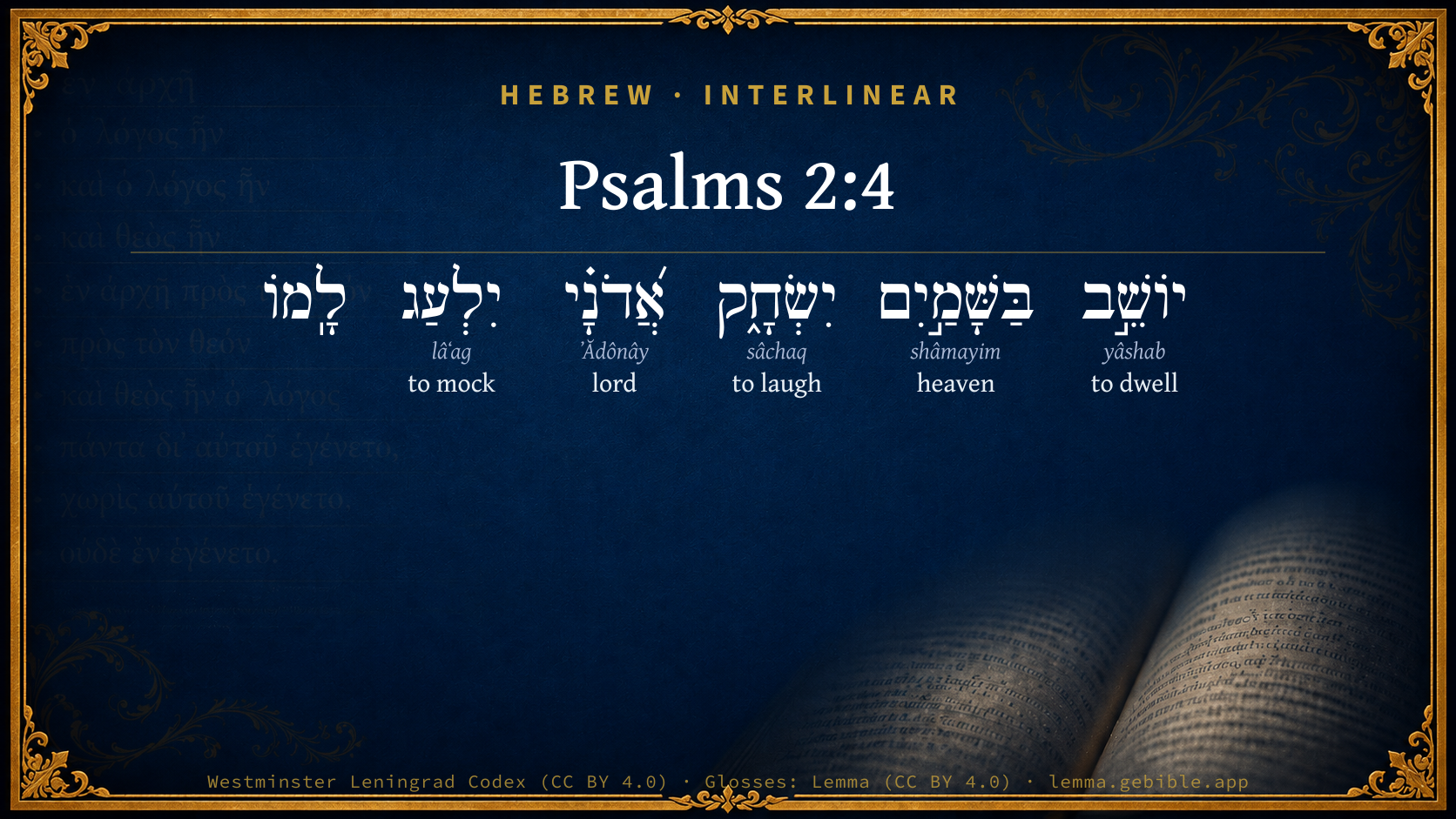
Hebrew (Westminster Leningrad Codex) Psalms 2:4 appears in the Hebrew Old Testament. The text above is from the Westminster Leningrad Codex. Each word links to its Strong’s number, a concise gloss, and parsing drawn from the Open Scriptures Hebrew Bible morphology. Click any word for its full Brown-Driver-Briggs (BDB) entry.
Download image
Cite this verse

Psalms 2:4 (World English Bible). Public Domain. Lemma interlinear Bible study tool, https://lemma.gebible.app/v/psalms/2/4.

Show BibTeX & RIS
BibTeX
RIS
English Translation
He who sits in the heavens will laugh. The Lord will have them in derision.
World English Bible · Public Domain
Download a study sheet

One document with this verse’s original text, its word-by-word gloss line, the meaning frame, cross-references with their text, attributed commentary, and full source and license credits — printable, and it pastes into notes with its structure intact.

This verse Autodidact and up

Study sheet (.html) Plain text (.txt)

A passage Seminary Student

Up to 50 verses in one chapter. A passage sheet keeps up to 6 commentary sources and 12 cross-references per verse, in the order this page ranks them, and says so on the sheet whenever that leaves anything out. Ask for a single verse and you get the Autodidact verse sheet above.

Everything on this page stays free to read, with no account — the sheet is a download of what is already on screen, not access to it.

Want to remove ads? Support Godless Engineer
Compare translations 3

The same verse in 3 English versions, stacked beneath the original-language interlinear above. Click any original word for its lexicon entry.

Each is an independent rendering of the whole verse — the interlinear is not word-aligned to these translations.

Highlighted words mark where these versions differ — a whole-verse word diff, not a word-by-word alignment.

  • World English Bible Public Domain
    He who sits in the heavens will laugh. The Lord will have them in derision.
  • King James Version Public Domain
    He that sitteth in the heavens shall laugh: the LORD shall have them in derision.
  • unfoldingWord Literal Text CC BY-SA 4.0
    He who is sitting in the heavens laughs; the Lord mocks them.

unfoldingWord Literal Text — © unfoldingWord, licensed CC BY-SA 4.0. Word-aligned USFM3 via Door43 (git.door43.org/unfoldingWord/en_ult).

Versions to compare (up to 4)

3 of 4 selected

Show all 18 translations

Every available English version of this verse, each an independent rendering of the whole verse.

  • World English Bible Public Domain
    He who sits in the heavens will laugh. The Lord will have them in derision.
  • Berean Standard Bible Public Domain
    The One enthroned in heaven laughs; the Lord taunts them.
  • Majority Standard Bible Public Domain
    The One enthroned in heaven laughs; the Lord taunts them.
  • King James Version Public Domain
    He that sitteth in the heavens shall laugh: the LORD shall have them in derision.
  • American Standard Version (1901) Public Domain
    He that sitteth in the heavens will laugh: The Lord will have them in derision.
  • Revised Version (1885) Public Domain
    He that sitteth in the heavens shall laugh: the Lord shall have them in derision.
  • Geneva Bible (1599) Public Domain
    But he that dwelleth in the heauen, shall laugh: the Lord shall haue them in derision.
  • Douay-Rheims (1899) Public Domain
    He that dwelleth in heaven shall laugh at them: and the Lord shall deride them.
  • Young's Literal Translation Public Domain
    He who is sitting in the heavens doth laugh, The Lord doth mock at them.
  • Literal Standard Version CC BY-SA 4.0
    He who is sitting in the heavens laughs, || The Lord mocks at them.
  • Unlocked Literal Bible CC BY-SA 4.0
    He who sits in the heavens will sneer at them; the Lord mocks them.
  • unfoldingWord Literal Text CC BY-SA 4.0
    He who is sitting in the heavens laughs; the Lord mocks them.
  • Darby Bible Public Domain
    He that dwelleth in the heavens shall laugh, the Lord shall have them in derision.
  • World Messianic Bible Public Domain
    He who sits in the heavens will laugh. The Lord will have them in derision.
  • Webster's Bible Public Domain
    He that sitteth in the heavens shall laugh: the Lord shall have them in derision.
  • Free Bible Version CC BY-SA 4.0
    But the one who sits enthroned in heaven laughs. The Lord mocks them.
  • Bible in Basic English Public Domain
    Then he whose seat is in the heavens will be laughing: the Lord will make sport of them.
  • JPS Tanakh (1917) Public Domain
    He that sitteth in heaven laugheth, the Lord hath them in derision.

Literal Standard Version (2020), Covenant Press — licensed CC BY-SA 4.0. Text via the HelloAO Bible API (eBible.org). Unlocked Literal Bible (unfoldingWord) — licensed CC BY-SA 4.0. Text via the HelloAO Bible API (eBible.org). unfoldingWord Literal Text — © unfoldingWord, licensed CC BY-SA 4.0. Word-aligned USFM3 via Door43 (git.door43.org/unfoldingWord/en_ult). Free Bible Version, Dr. Jonathan Gallagher — licensed CC BY-SA 4.0. Text via the HelloAO Bible API (eBible.org).

Word by word

More ways to search: Search by grammar → Find every occurrence → Compare this word →

Practice this passage: Drill this verse → Learn its vocabulary →

About this verse

These counts appear in no published source. They are computed here, from the morphology-tagged text and Lemma’s own curated glosses. What Lemma adds →

6
words
5
distinct lemmas
Wisdom
section

Notable vocabulary

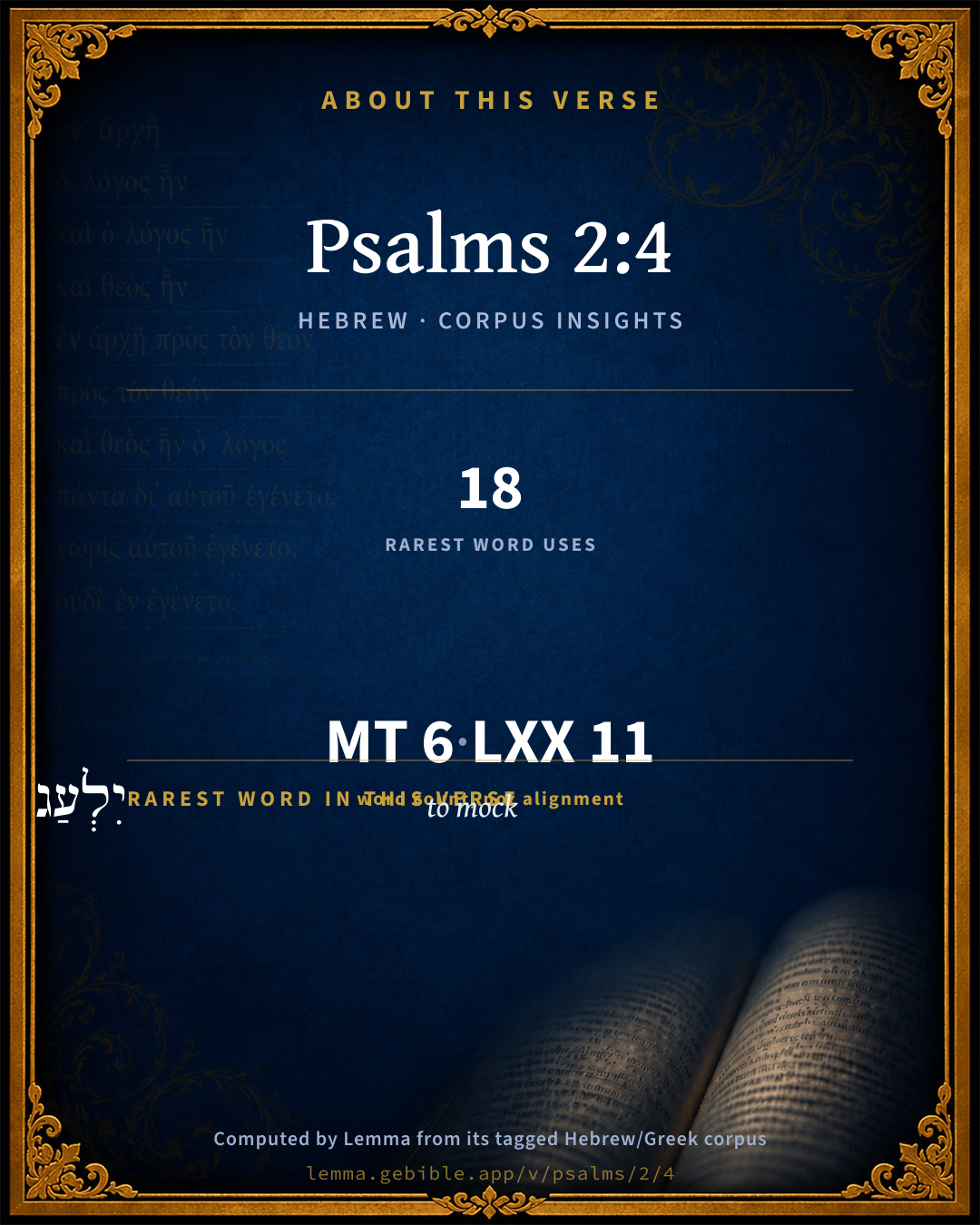
The rarest word here is יִלְעַג to mock H3932 — appearing just 18 times in the whole Hebrew Bible.

Shared distinctive vocabulary

יִלְעַג to mock H3932 occurs in 18 verses of the Hebrew Bible. Also found in:

Grammatical profile

  • 3 verbs
  • 2 nouns
  • 1 preposition

Verb forms

  • יוֹשֵׁ֣ב Qal · Participle Active
  • יִשְׂחָ֑ק Qal · Imperfect
  • יִלְעַג Qal · Imperfect

Hebrew & Septuagint length

In English translation the verse runs 15 words from the Hebrew and 17 from the Septuagint (LXX English) — closely comparable.

A rough comparison of the two English renderings, which tokenize alike — not a word-level alignment.

Word counts can differ between the Hebrew and the Greek without any difference in meaning — e.g. the Hebrew direct-object marker אֵת has no separate Greek word, and Greek often adds the article ὁ.

In the original languages it is 6 Hebrew tokens and 11 Greek tokens — but the two are counted differently (Hebrew bundles its prefixes and suffixes into one token; the Greek is in lemma form), so that isn’t a like-for-like length.

Cross-references

11

Topical passages linked to Psalms 2:4 in the Treasury of Scripture Knowledge — connected by theme and wording, ordered by reader-vote popularity; previews shown in the World English Bible.

  • Psalms 37:13 The Lord will laugh at him, For he sees that his day is coming.
  • Psalms 59:8 But you, Yahweh, laugh at them. You scoff at all the nations.
  • Proverbs 1:26 I also will laugh at your disaster. I will mock when calamity overtakes you;
  • Isaiah 40:22 [It is] he who sits above the circle of the earth, and the inhabitants of it are as grasshoppers; who stretches out the heavens as a curtain, and spreads them out as a tent to dwell in;
  • Psalms 11:4 Yahweh is in his holy temple. Yahweh is on his throne in heaven. His eyes observe. His eyes examine the children of men.
  • Isaiah 57:15 For thus says the high and lofty One who inhabits eternity, whose name is Holy: I dwell in the high and holy place, with him also who is of a contrite and humble spirit, to revive the spirit of the humble, and to revive the heart of the contrite.
  • Psalms 115:3 But our God is in the heavens. He does whatever he pleases.
  • Psalms 53:5 There they were in great fear, where no fear was, For God has scattered the bones of him who encamps against you. You have put them to shame, Because God has rejected them.
  • Psalms 68:33 To him who rides on the heaven of heavens, which are of old; Behold, he utters his voice, a mighty voice.
  • Isaiah 66:1 Thus says Yahweh, heaven is my throne, and the earth is my footstool: what manner of house will you build to me? and what place shall be my rest?
  • 2 Kings 19:21 This is the word that Yahweh has spoken concerning him: The virgin daughter of Zion has despised you and ridiculed you; the daughter of Jerusalem has shaken her head at you.

Cross-references courtesy of OpenBible.info (CC BY 4.0).

Hebrew and Greek witnesses Masoretic Hebrew ↔ Greek Septuagint

The same verse in the two great witnesses to the Old Testament, shown verse-for-verse.

You’re reading Greek Psalm 2 (Hebrew Psalm 2). The Septuagint counts the superscription, so verse numbers can differ from the Hebrew — chapter-level alignment, not verse-by-verse. Numbering follows Rahlfs.

These are two independent witnesses, not word-aligned to each other, and the Septuagint is shown in lemma (dictionary) form.

Hebrew Psalms 2:4 Masoretic · Westminster Leningrad Codex

יוֹשֵׁ֣ב בַּשָּׁמַ֣יִם יִשְׂחָ֑ק אֲ֝דֹנָ֗י יִלְעַג לָֽמוֹ

He who sits in the heavens will laugh. The Lord will have them in derision.

World English Bible · Public Domain

Greek LXX Greek Psalm 2:4 Septuagint · lemma form

ὁ καταοἰκέω ἐν οὐρανός ἐκγελάω αὐτός καί ὁ κύριος ἐκμυκτηρίζω αὐτός

He that dwells in the heavens shall laugh them to scorn, and the Lord shall mock them.

LXX2012 (modern English Septuagint) · Public Domain

On this verse, Keil & Delitzsch discusses the Septuagint’s reading. Read the note in Commentary ↓

Hebrew: Westminster Leningrad Codex (CC BY 4.0). Greek: Septuagint (public domain); English from LXX2012 (modern English Septuagint) (Public Domain). How the Septuagint differs from the Hebrew →

Commentary

Notes on Psalms 2:4 from classic Christian and Jewish commentators (each source and its license shown beneath its notes). The classic Christian expositions comment on the surrounding passage and are grouped to its opening verse, so a note may address several verses; the Jewish commentaries on the Tanakh (Rashi and others) are per-verse, so they appear only where the commentator wrote on this verse.

Lemma curates 59 commentaries, every one of them public domain or Creative Commons licensed, each selected and text-cleaned for this edition rather than reprinted as found. About our sources →

Trapp's Complete Commentary

John Trapp

Psa 2:4 He that sitteth in the heavens shall laugh: the Lord shall have them in derision.

Ver. 4. He that sitteth in the heavens shall laugh at them] Videt, ridet. He seeth and smileth, he looketh and laugheth, at these giants. He sitteth in heaven, far above their reach; neither doth he much trouble himself about the matter. No more should we; but trust in him, and know that there is a council in heaven that will dash the mould of all contrary counsels upon earth; as the stone cut out of the mountain did the four great monarchies, Dan 2:34. See an instance hereof in latter times. Luther, that heroic reformer, was excommunicated by the pope, proscribed by the emperor, hated and cursed all Christendom over almost, yet he prospered, and the work of Christ went on in his hands. And when the Elector of Saxony, his only patron, was much afraid what would become of him, and of the business of religion, Luther out of his Patmos (as he called it), where he lay hid, writeth him a rousing letter, wherein is read this among many other brave passages: Sciat celsitudo tua et nihil dubitet longe aliter in coelo quam Noribergae de hoc negotio conclusum est, Let your Highness rest well assured of this, that things are far otherwise carried and concluded in heaven, than they are at the Imperial Diet held at Norinberg. After this, in the year of grace 1526, there conspired against the gospel, and the professors thereof, the emperor and his prisoner in Spain, the French king, the princes also and bishops in Germany, stirred up by the pope. The French king was set at liberty, upon the condition that he join with the emperor to root out Lutheranism, that is, true religion. This was the agreement, but God broke it; for the French king was no sooner home but he made a league with the pope and the Venetians against the emperor. The pope excuseth his falling off from Caesar by a petulant and malapert epistle. Caesar, by another letter, lay open to the world the pope’s perfidy, exhorting him to peace, and concluding that they had more need to unite their forces for the extirpation of Lutheran heresy. By this means the Church had a happy halcyon, while these great ones were out, and at it.

The Lord shall have them in derision] Adonai, that is, the sustainer and upholder of all. Christ is King of kings and Lord of lords, Rev 19:16. Lords and lowlies are all his vassals and underlings, as Constantine, Theodosius, and Valentine, those great emperors, called themselves. This name or style Christ hath written on his vesture, that all may see it, and on his thigh, where hangs his sword, to show his absolute dominion, his unlimited empire, got and held out of the hands of his enemies, with his mind, and with his bow, Gen 48:22. And when he is said to deride them, this is no more than to laugh at them, as the following effects show.

John Trapp, A Commentary or Exposition upon All the Books of the Old and New Testament (1647–1656) — public domain. Text from a community e-Sword module.

Albert Barnes' Notes on the Bible

He that sitteth in the heavens - God, represented as having his home, his seat, his throne in heaven, and thence administering the affairs of the world. This verse commences the second strophe or stanza of the psalm; and this strophe Psa 2:4-6 corresponds with the first Psa 2:1-3 in its structure. The former describes the feelings and purposes of those who would cast off the government of God; this describes the feelings and purposes of God in the same order, for in each case the psalmist describes what is done, and then what is said: the nations rage tumultuously Psa 2:1-2, and then say Psa 2:3, “Let us break their bands.” God sits calmly in the heavens, smiling on their vain attempts Psa 2:4, and then solemnly declares Psa 2:5-6 that, in spite of all their opposition, he “has set his King upon his holy hill of Zion.” There is much sublimity in this description. While men rage and are tumultuous in opposing his plans, he sits calm and undisturbed in his own heaven. Compare the notes at the similar place in Isa 18:4.

Shall laugh - Will smile at their vain attempts; will not be disturbed or agitated by their efforts; will go calmly on in the execution of his purposes. Compare as above Isa 18:4. See also Pro 1:26; Psa 37:13; Psa 59:8. This is, of course, to be regarded as spoken after the manner of men, and it means that God will go steadily forward in the accomplishment of his purposes. There is included also the idea that he will look with contempt on their vain and futile efforts.

The Lord shall have them in derision - The same idea is expressed here in a varied form, as is the custom in parallelism in Hebrew poetry. The Hebrew word לעג lâ‛ag, means properly to stammer; then to speak in a barbarous or foreign tongue; then to mock or deride, by imitating the stammering voice of anyone. Gesenius, Lexicon Here it is spoken of God, and, of course, is not to be understood literally, anymore than when eyes, and hands, and feet are spoken of as pertaining to him. The meaning is, that there is a result in the case, in the Divine Mind, as if he mocked or derided the vain attempts of men; that is, he goes calmly forward in the execution of his own purposes, and he looks upon and regards their efforts as vain, as we do the efforts of others when we mock or deride them. The truth taught in this verse is, that God will carry forward his own plans in spite of all the attempts of men to thwart them. This general truth may lie stated in two forms:

(1) He sits undisturbed and unmoved in heaven while men rage against him, and while they combine to cast off his authority.

(2) He carries forward his own plans in spite of them. This he does:

(a) directly, accomplishing his schemes without regard to their attempts; and

(b) by making their purposes tributary to his own, so making them the instruments in carrying out his own plans. Compare Act 4:28.

Albert Barnes' Notes on the Bible (1834–1885) — public domain. Text from a community e-Sword/MySword module.

The Biblical Illustrator

Joseph S. Exell

Psa_2:4-5

He that sitteth in the heavens shall laugh . . . and vex them in His sore displeasure.

First a laugh then a smite

The heathen and the people, the kings and the rulers are answered with contempt, they are laughed at and derided; and if this be not enough to change their spirit and their purpose, they will be spoken to in wrath, and vexed in sore displeasure. It is interesting and instructive to remark how creation first laughs at and derides men who oppose it, and how in the next place it avenges the insults that are offered to its laws. When Canute rebuked the waves the sea laughed at him, and the waves had him in derision; had he remained upon the position he had chosen, laughter and derision would have been changed for vengeance and overthrow. Let a man attempt to put down the wind, and the only possible answer is derision; let him attempt to defy the lightning, and he may perish under its stroke. There is but a short distance between the derision of nature and its penal judgments. So every attempt to revile the power of God is contemned, and every insult offered to His holiness is avenged. A very curious process is indicated by these two verses. The laughter is expressive of an eternal law; things are not so constituted that they can be turned about at the pleasure of the wicked, nor is the purpose of the universe so fickle that the wrath of man can affect its fulfilment; great strength can afford to deride; infinite power can best express its own consciousness of almightiness by smiling upon all the hosts which array themselves against it. But this answer of contemptuous laughter must not be the only reply, for contempt can seldom have any moral issue of a really substantial and blessed kind; there must come a time when law must avenge itself upon those who would insult its majesty or mock its power. First, laughter, as a proof of the utter impossibility of injuriously affecting the standards and purposes of God; after laughter must come the judgment, which shows how dangerous it is to trifle with fire, and how awful a thing it is to defy the wrath of righteousness. It is for every man to consider under what particular phase of the Divine regard he is now living. For a period he may be amused, as it were, at certain phases of the opposition of nature, or the awkwardness of life; but let him not suppose that he sees the whole of the case: such opposition and awkwardness may suddenly be displaced by judgment, and vengeance, and destiny irrevocable. (Joseph Parker, D. D.)

The laughter of God

They scoff at us. God laughs at them. Severe Cato thought that laughter did not become the gravity of Roman consuls, and is it attributed to the majesty of heaven . . . Pharaoh imagined that by drowning the Israelite males he had found a way to root their name from the earth, but when at the same time his own daughter in his own court gave princely education to Moses, their deliverer, did not God laugh? Is Dagon put up in his place again? Gods smile shall take off his head and his hands and leave him neither wit to guide nor power to subsist He permitted His temple to be sacked and rifled, the holy vessels to be profaned and caroused in; but did not Gods smile make Belshazzar to tremble? Oh, what are His frowns if His smiles be so terrible? (Thomas Adams.)

The Biblical Illustrator, edited by Joseph S. Exell (c. 1880s–1900s) — public domain. Text from a community e-Sword module.

Joseph Benson's Commentary

Psa 2:4. He that sitteth in the heavens — As the judge upon his tribunal, weighing the actions of men, and as the king of the whole earth upon his royal throne; who, without moving from his place, can with one word or look destroy all his enemies. His sitting (or dwelling, as Dr. Waterland renders ושׁב, josheb, here) in the heavens is opposed to their being and reigning on the earth, (Psa 2:2,) and is mentioned here, as in other places of Scripture, as an evidence both of God’s clear and certain knowledge of all things that are done below, and of his sovereign and irresistible power. Shall laugh — Shall despise them and all their crafty devices. “This is spoken of God,” says Dr. Dodd, “after the manner of men, to denote his utter contempt of the opposition of his enemies; the perfect ease with which he was able to disappoint all their measures, and crush them for their impiety and folly; together with his absolute security, that his counsels should stand and his measures be finally accomplished; as men laugh at, and hold in utter contempt, those whose malice and power they know to be utterly vain and impotent. The introducing God as thus laughing at, and deriding his enemies, is in the true spirit of poetry, and with the utmost propriety and dignity. The whole description is grand: Jehovah is he who is seated in the heavens, far beyond the effects of their rage and malice: from thence he sees their secret counsels, confederate armies, and united obstinate endeavours to oppose what he had solemnly decreed.”

Joseph Benson's Commentary on the Old and New Testaments (1811–1818) — public domain. Text from a community e-Sword module.

J. A. Alexander on Psalms

Joseph Addison Alexander

4. As the first strophe or stanza of three verses is descriptive of the conduct of the rebels, so the next describes the corresponding action of their sovereign, in precisely the same order, telling first what he does (in Psa 2:4-5), and then what he says (in Psa 2:6), so that these two stanzas are not only regular in their internal structure, but exactly fitted to each other. This symmetrical adjustment is entitled to attention, as that feature of the Hebrew poetry which fills the place of rhythm and metre in the poetry of other nations. At the same time, it facilitates interpretation, when allowed to speak for itself without artificial or unnatural straining, by exhibiting the salient points of the passage in their true relation. The transition here is a sublime one, from the noise and agitation of earth to the safety and tranquillity of heaven. No shifting of the scene could be more dramatic in effect or form. While the nations and their kings exhort each other to cast off their allegiance to Jehovah, and thereby virtually to dethrone him, he reposes far above them, and beyond their reach. Sitting in the heavens, i.e. resident and reigning there, he laughs, or will laugh. This figure, strong and almost startling as it is, cannot possibly be misunderstood by any reader, as a vivid expression of contemptuous security on God's part, and of impotent folly on the part of men. At them may be supplied from Psa 37:18; Psa 109:9 (8) ; but it is not neces• sary, and the picture is perhaps more perfect, if we understand the laughter here to be simply expressive of contempt, and the idea. of directly laughing at them to be first suggested in the other clause. The Lord, not Jehovah, as in Psa 2:2, but Adhonai, the Hebrew word properly denoting Lord or Sovereign as a divine title, the Lord shall mock them, or mock at them, as the strongest possible expression of contempt. This verse conveys in the most vivid manner, one indeed that would be inadmissible in any uninspired writer, the fatuity of all rebellious opposition to God's will. That such is often suffered to proceed long with impunity is only, in the figurative language of this passage, because God first laughs at human folly, and then smites it. '' Who thought," says Luther, "when Christ suffered, and the Jews triumphed, that God was laughing all the time?" Beneath this bold anthropomorphism there is hidden a profound truth, namely, that to all superior beings, and above all, to God himself, there is some• thing in sin not only odious but absurd, something which cannot possibly escape the contempt of higher, much less of the highest, intelligence.

Joseph Addison Alexander, The Psalms Translated and Explained (1850) — public domain. Text from a community e-Sword module.

Tyndale Open Study Notes

Tyndale Open Resources

2:4-6 The Lord finds the human threat insignificant. He provided a solution long before their rebellion. He will end their agitation through the appointment of a human agent, a descendant of David’s line who will rule the nations.

2:4 rules in heaven: The Lord’s place in the universe is so certain that he scoffs at humans who boast that they can rebel against his power and authority (see 37:13; 59:8).

Tyndale Open Study Notes — © Tyndale Open Resources, licensed CC BY-SA 4.0. Text via the HelloAO Bible API.

Jamieson, Fausset & Brown

Robert Jamieson, A. R. Fausset & David Brown

By a figure whose boldness is only allowable to an inspired writer, God's conduct and language in view of this opposition are now related.

He that sitteth in the heavens--enthroned in quiet dignities (compare Psa 29:10; Isa 40:22).

shall laugh--in supreme contempt; their vain rage excites His derision. He is still the Lord, literally, "Sovereign," though they rebel.

Jamieson, Fausset & Brown — Commentary Critical and Explanatory on the Whole Bible (1871) — public domain (CC PDM 1.0). Text via the HelloAO Bible API.

Adam Clarke's Commentary

Verse 4. He that sitteth in the heavens] Whose kingdom ruleth over all, and is above all might and power, human and diabolical. Shall laugh. Words spoken after the manner of men; shall utterly contemn their puny efforts; shall beat down their pride, assuage their malice, and confound their devices.

Adam Clarke's Commentary on the Bible (1810–1826) — public domain. Text from a community e-Sword/MySword module.

John Calvin's Commentaries

After David has told us of the tumult and commotions, the counsels and pride, the preparation and resources the strength and efforts of his enemies, in opposition to all these he places the power of God alone, which he concludes would be brought to bear against them, from their attempting to frustrate his decree. And, as a little before, by terming them kings of the earth, he expressed their feeble and perishable condition; so now, by the lofty title of He that dwelleth in heaven, he extols the power of God, as if he had said, that power remains intact and unimpaired, whatever men may attempt against it. Let them exalt themselves as they may, they shall never be able to reach to heaven; yea, while they think to confound heaven and earth together, they resemble so many grasshoppers, and the Lord, meanwhile, undisturbed beholds from on high their infatuated evolutions. And David ascribes laughter to God on two accounts; first, to teach us that he does not stand in need of great armies to repress the rebellion of wicked men, as if this were an arduous and difficult matter, but, on the contrary, could do this as often as he pleases with the most perfect ease. In the second place, he would have us to understand that when God permits the reign of his Son to be troubled, he does not cease from interfering because he is employed elsewhere, or unable to afford assistance, or because he is neglectful of the honor of his Son; but he purposely delays the inflictions of his wrath to the proper time, namely, until he has exposed their infatuated rage to general derision. Let us, therefore, assure ourselves that if God does not immediately stretch forth his hand against the ungodly, it is now his time of laughter; and although, in the meantime, we ought to weep, yet let us assuage the bitterness of our grief, yea, and wipe away our tears, with this reflection, that God does not connive at the wickedness of his enemies, as if from indolence or feebleness, but because for the time he would confront their insolence with quiet contempt. By the adverb then, he points to the fit time for exercising judgment, as if he had said, after the Lord shall have for a time apparently taken no notice of the malpractices of those who oppose the rule of his Son, he will suddenly change his course, and show that he retards nothing with greater abhorrence than such presumption.

John Calvin's Commentaries (1540-1563) — public domain. Text from the Calvin Translation Society English edition (1840s-50s) via the Christian Classics Ethereal Library (ccel.org). Calvin's coverage is partial (roughly two-thirds of the Bible); uncommented books and verses are honest gaps, never fabricated. The 19th-century editor's footnotes and remarks are omitted so the notes are faithfully Calvin's own voice.

Ellicott's Commentary for English Readers

(4) He that sitteth.—Here the psalm, with a sublimity truly Hebrew, turns from the wild confusion on earth to the spectacle of God looking down with mingled scorn and wrath on the fruitless attempts of the heathen against His chosen people.

Laugh.—We speak of the “irony of events “; the Hebrew ascribes irony to God, who controls events.

A Bible Commentary for English Readers, edited by Charles John Ellicott (1878–1897) — public domain. Text from a community e-Sword module.

The Cambridge Bible for Schools and Colleges

gen. ed. J. J. S. Perowne

4. He that sitteth in the heavens] Enthroned in majesty (Psa_123:1), but withal watching and controlling the course of events upon the earth (Psa_11:4; Psa_103:19; Psa_113:4 ff.; Rev_5:13; Rev_6:16).

shall laugh … shall have them in derision] Or, laugheth … mocketh at them. Cp. Psa_37:13; Psa_59:8; Pro_1:26. The O.T. uses human language of God without fear of lowering Him to a human level.

the Lord] This is the reading of 1611, restored by Dr Scrivener. Most editions, and R.V., have the Lord, in accordance with the Massoretic Text, which reads Adonai, not Jehovah. The variation is perhaps significant. God is spoken of as the sovereign ruler of the world, rather than as the covenant God of Israel.

4–6. The poet-seer draws aside the veil, and bids us look from earth to heaven. There the supreme Ruler of the world sits enthroned in majesty. With sovereign contempt He surveys these petty plottings, and when the moment comes confounds them with a word.

The Cambridge Bible for Schools and Colleges (gen. ed. J. J. S. Perowne; Cambridge University Press, 1878–1918) — public domain. Text from a community e-Sword module.

John Gill's Exposition

He that sitteth in the heavens shall laugh,.... At the rage and tumult of the Heathen; at the vain imaginations of the people; at the opposition of the kings of the earth; at the mad counsel of the rulers, against him and his Messiah; and at their proposal to one another to throw off the yoke and government of them both. This is a periphrasis of God, "who dwells in the heavens", and sits there enthroned; though he is not included and comprehended in them, but is everywhere; and his being there is mentioned in opposition to the kings of the earth, and the people in it; and to show the vast distance there is between them, and how they are as nothing to him, Isa 40:1, Job 4:18; and how vain and fruitless their attempts must be against him and his Messiah: and his sitting there still and quiet, serene and undisturbed, is opposed to the running to and fro, and the tumultuous and riotous assembling of the Heathen. Laughing is ascribed unto him, according to the language of men, as the Jewish writers speak (d), by an anthropopathy; in the same sense as he is said to repent and grieve, Gen 6:6; and expresses his security from all their attempts, Job 5:22; and the contempt he has them in, and the certain punishment of them, and the aggravation of it; who will not only then laugh at them himself, but expose them to the laughter and scorn of others, Pro 1:26;

the Lord shall have them in derision; which is a repetition of the same thing in other words; and is made partly to show the certainty of their disappointment and ruin, and partly to explain who is meant by him that sits in the heavens. The Targum calls him, "the Word of the Lord"; and Alshech interprets it of the Shechinah.

(d) Kimchi, Aben Ezra, & R. Sol. Ben Melech in loc.

John Gill's Exposition of the Whole Bible (1746–1763) — public domain (CC PDM 1.0). Text via the HelloAO Bible API.

Matthew Poole's English Annotations

He that sitteth, as the Judge upon his tribunal, and as the King of the whole world upon his royal throne; who, without stirring from his place, can with one look or word destroy all his enemies.

In the heavens: this is opposed to their being and reigning upon earth, Psa 2:2, and is mentioned here, as it is in other places of Scripture, as an evidence both of God’s clear and certain knowledge of all things that are done below, as is noted, Psa 11:4, and of his sovereign and irresistible power, as is hence gathered, Psa 115:3. See the preface to the Lord’s prayer.

Shall laugh, i.e. shall both despise and deride them, and all their crafty devices, which he shall manifest to the world to be ridiculous and contemptible follies. Compare 2Ki 19:21; Psa 37:13.

Matthew Poole's English Annotations on the Holy Bible (1683–1685) — public domain. Text from a community e-Sword/MySword module.

The Treasury of David

Charles H. Spurgeon

Verse 4. Let us now turn our eyes from the wicked counsel-chamber and raging tumult of man, to the secret place of the majesty of the Most High. What doth God say? What will the King do unto the men who reject his only-begotten Son, the Heir of all things?

Mark the quiet dignity of the Omnipotent One, and the contempt which he pours upon the princes and their raging people. He has not taken the trouble to rise up and do battle with them he despises them, he knows how absurd, how irrational, how futile are their attempts against him he therefore laughs at them.

Verses 1 - 4. Herod, the fox, plotted against Christ, to hinder the course of his ministry and mediatorship, but he could not perform his enterprise; 'tis so all along, therefore it is said, "Why do the heathen imagine a vain thing?" A vain thing, because a thing successless, their hands could not perform it. It was vain, not only because there was no true ground of reason why they should imagine or do such a thing, but vain also because they laboured in vain, they could not do it, and therefore it follows, "He that sitteth in the heavens shall laugh: the Lord shall have them in derision." The Lord sees what fools they are, and men (yea, themselves) shall see it. The prophet gives us a elegant description to this purpose. Isaiah 59:5, 6. "They weave the spider's web . . . Their webs shall not become garments, neither shall they cover themselves with their works." As if he had said, they have been devising and setting things in a goodly frame to catch flies; they have been spinning a fine thread out of their brains, as the spider doth out of her bowels; such is their web, but when they have their web they cannot cut it out, or make it up into a garment. They shall go naked and cold, notwithstanding all their spinning and weaving, all their plotting and devising. The next broom that comes will sweep away all their webs and the spiders too, except they creep apace. God loves and delights to cross worldly proverbs and worldly craft.

Joseph Caryl, 1647.

Verse 4. "He that sitteth in the heavens." Hereby it is clearly intimated, (1) that the Lord is far above all their malice and power, (2) that he seeth all their plots, looking down on all; (3) that he is of omnipotent power, and so can do with his enemies as he lists. "Our God is in the heavens: he hath done whatsoever he pleased." Psalm 115:3.

Arthur Jackson, 1643.

Verse 4. "He that sitteth in the heavens shall laugh," etc. Sinners' follies are the just sport of God's infinite wisdom and power; and those attempts of the kingdom of Satan, which in our eyes are formidable, in his are despicable.

Matthew Henry.

Verse 4. "He that sitteth in the heavens shall laugh." They scoff at us, God laughs at them. Laugh? This seems a hard word at the first view: are the injuries of his saints, the cruelties of their enemies, the derision, the persecution of all that are round about us, no more but matter of laughter? Severe Cato thought that laughter did not become the gravity of Roman consuls; that it is a diminution of states, as another told princes, and it is attributed to the Majesty of heaven? According to our capacities, the prophet describes God, as ourselves would be in a merry disposition, deriding vain attempts. He laughs, but it is in scorn; he scorns, but it is with vengeance. Pharaoh imagined that by drowning the Israelite males, he had found a way to root their name from the earth; but when at the same time, his own daughter, in his own court gave princely education to Moses, their deliverer, did not God Laugh?

Short is the joy of the wicked. Is Dagon put up to his place again? God's smile shall take off his head and his hands, and leave him neither wit to guide nor power to subsist. . . . . We may not judge of God's works until the fifth act: the case, deplorable and desperate in outward appearance, may with one smile from heaven find a blessed issue. He permitted his temple to be sacked and rifled, the holy vessels to be profaned and caroused in; but did not God's smile make Belshazzar to tremble at the handwriting on the wall? Oh, what are his frowns, if his smiles be so terrible!

Thomas Adams.

Verse 4. The expression, "He that sitteth in the heavens," at once fixes our thoughts on a being infinitely exalted above man, who is of the earth, earthy. And when it is said, "HE shall laugh," this word is designed to convey to our minds the idea, that the greatest confederacies amongst kings and peoples, and their most extensive and vigorous preparations, to defeat HIS purposes or to injure HIS servants, are in HIS sight altogether insignificant and worthless. HE looks upon their poor and puny efforts, not only without uneasiness or fear, but HE laughs at their folly; HE treats their impotency with derision. He knows how HE can crush them like a moth when HE pleases, or consume them in a moment with the breath of HIS mouth. How profitable it is for us to be reminded of truths such as these! Ah! it is indeed "a vain thing" for the potsherds of the earth to strive with the glorious Majesty of Heaven.

David Pitcairn.

Verse 4. "The Lord," in Hebrew, Adonai, mystically signifieth my stays, or my sustainers my pillars. Our English word "Lord" hath much the same force, being contracted of the old Saxon word "Llaford," or "Hlafford," which cometh from "Laef," to sustain, refresh, cherish.

Henry Ainsworth.

Verse 4. "He that sitteth in the heavens shall laugh at them: the Lord shall have them in derision." This tautology or repetition of the same thing, which is frequent in the Scriptures, is a sign of the thing being established: according to the authority of the patriarch Joseph (Genesis 41:32), where, having interpreted the dreams of Pharaoh, he said, "and for that the dream was doubled unto Pharaoh twice; it is because the thing is established by God, and God will shortly bring it to pass." And therefore, here also, "shall laugh at them," and "shall have them in derision," is a repetition to show that there is not a doubt to be entertained that all these things will most surely come to pass. And the gracious Spirit does all this for our comfort and consolation, that we may not faint under temptation, but lift up our heads with the most certain hope; because, "he that shall come will come, and will not tarry." Hebrews 10:37.

Martin Luther.

Verse 4. God's derision of the rebellious, both now and hereafter.

Charles H. Spurgeon's The Treasury of David (1869–1885) — public domain. Psalms only. Text from a community e-Sword/MySword module.

Whedon's Commentary on the Bible

Daniel D. Whedon

4. Laugh… derision—A bold anthropomorphism, here signifying not only exultation, but the infinite ease with which God shall render abortive all their plans, which in Psa_2:1 are called “vain,”—nothing. See Psa_37:13; Psa_52:6

Daniel D. Whedon (gen. ed.), Commentary on the Old and New Testaments (1874–1909) — public domain. Text from a community e-Sword module.

The Pulpit Commentary

He that sitteth in the heavens shall laugh. God "laughs" at the vain and futile efforts of man to escape from the control of his laws and throw off his dominion. (comp. Psa_37:13 Psa_59:8) It is impossible that these efforts should.succeed. Men must obey God willingly, or else unwillingly. The Lord (Adonay in the ordinary Hebrew text, but a large number of manuscripts have Jehovah) shall have them in derision. "Laughter" and "derision" are, of course, anthropo-morphisms. It is meant that God views with contempt and scorn man"s weak attempts at rebellion.

The Pulpit Commentary (1880–1919), ed. H.D.M. Spence-Jones & Joseph S. Exell — public domain. Text from a community e-Sword module.

John Wesley's Explanatory Notes

Sitteth - As the king of the whole world. Heavens - As an evidence both of God's clear and certain knowledge of all things that are done below, and of his sovereign and irresistible power. Laugh - Shall despise them and all their crafty devices.

John Wesley, Explanatory Notes Upon the Whole Bible (1754–1765) — public domain. Text via the GEBible commentary corpus.

Keil & Delitzsch

C. F. Keil & F. Delitzsch

Above the scene of this wild tumult of battle and imperious arrogance the psalmist in this six line strophe beholds Jahve, and in spirit hears His voice of thunder against the rebels. In contrast to earthly rulers and events Jahve is called יושׁב בּשּׁמים: He is enthroned above them in unapproachable majesty and ever-abiding glory; He is called אדני as He who controls whatever takes place below with absolute power according to the plan His wisdom has devised, which brooks no hindrance in execution. The futt. describe not what He will do, but what He does continually (cf. Isa 18:4.). למו also belongs, according to Psa 59:9; Psa 37:13, to ישׂחק (שׂחק which is more usual in the post-pentateuchal language = צחק). He laughs at the defiant ones, for between them and Him there is an infinite distance; He derides them by allowing the boundless stupidity of the infinitely little one to come to a climax and then He thrusts him down to the earth undeceived. This climax, the extreme limit of the divine forbearance, is determined by the אז, as in Deu 29:19, cf. שׁם Psa 14:5; 36:13, which is a "then" referring to the future and pointing towards the crisis which then supervenes. Then He begins at once to utter the actual language of His wrath to his foes and confounds them in the heat of His anger, disconcerts them utterly, both outwardly and in spirit. בּהל, Arab. bhl, cogn. בּלהּ, means originally to let loose, let go, then in Hebrew sometimes, externally, to overthrow, sometimes, of the mind, to confound and disconcert.

Psa 2:5-6

Psa 2:5 is like a peal of thunder (cf. Isa 10:33); בּחרונו, Psa 2:5, like the lightning's destructive flash. And as the first strophe closed with the words of the rebels, so this second closes with Jahve's own words. With ואני begins an adverbial clause like Gen 15:2; Gen 18:13; Psa 50:17. The suppressed principal clause (cf. Isa 3:14; Ew. 341, c) is easily supplied: ye are revolting, whilst notwithstanding I.... With ואני He opposes His irresistible will to their vain undertaking. It has been shown by Bttcher, that we must not translate "I have anointed" (Targ., Symm.). נסך, Arab. nsk, certainly means to pour out, but not to pour upon, and the meaning of pouring wide and firm (of casting metal, libation, anointing) then, as in הצּיג, הצּיק, goes over into the meaning of setting firmly in any place (fundere into fundare, constituere, as lxx, Syr., Jer., and Luther translate), so that consequently נסיך the word for prince cannot be compared with משׁיח, but with נציב.

(Note: Even the Jalkut on the Psalms, 620, wavers in the explanation of נסכתי between אמשׁחתיה I have anointed him, (after Dan 10:3), אתיכתיה (I have cast him (after Exo 32:4 and freq.), and גדלתיו I have made him great (after Mic 5:4). Aquila, by rendering it καὶ ἐδιασάμην (from διάζεσθαι = ὑφαίνειν), adds a fourth possible rendering. A fifth is נסך to purify, consecrate (Hitz.), which does not exist, for the Arabic nasaka obtains this meaning from the primary signification of cleansing by flooding with water (e.g., washing away the briny elements of a field). Also in Pro 8:23 נסּכתּי means I am cast = placed.)

The Targum rightly inserts וּמניתיהּ (et praefeci eum) after רבּיתי (unxi), for the place of the anointing is not על־ציּון. History makes no mention of a king of Israel being anointed on Zion. Zion is mentioned as the royal seat of the Anointed One; there he is installed, that He may reign there, and rule from thence, Psa 110:2. It is the hill of the city of David (Sa2 5:7, Sa2 5:9; Kg1 8:1) including Moriah, that is intended. That hill of holiness, i.e., holy hill, which is the resting-place of the divine presence and therefore excels all the heights of the earth, is assigned to Him as the seat of His throne.

Keil & Delitzsch — Biblical Commentary on the Old Testament (1861–1891) — public domain (CC PDM 1.0). Text via the HelloAO Bible API. (Old Testament only.)

unfoldingWord translationNotes

Door43 World Missions Community

He ... the Lord

These phrases refer to Yahweh. Yahweh is often called "the Lord" but the words for "Yahweh" and "the Lord" are different.

sits in the heavens

Here sitting represents ruling. What he sits on can be stated clearly. AT: "rules in the heavens" or "sits on his throne in heaven" (See: Assumed Knowledge and Implicit Information and Metonymy)

the Lord mocks them

"the Lord mocks those people." Why he mocks them can be stated clearly. AT: "The Lord mocks them for their foolish plans" (See: Assumed Knowledge and Implicit Information)

terrify them in his rage

The abstract noun "rage" can be stated as "furious." AT: "he will be furious and terrify them" (See: Abstract Nouns)

terrify

greatly frighten

translationWords

heaven

lord

mock

anger

unfoldingWord translationNotes — © Distant Shores Media and the Door43 World Missions Community, licensed CC BY-SA 4.0. Source: git.door43.org/Door43/en_tn.

Rashi

Rabbi Shlomo Yitzchaki (Rashi)

laughs...mocks...speaks They are meant as the present tense.

Rashi on the Tanakh — English translations: “The Judaica Press complete Tanach with Rashi, translated by A. J. Rosenberg” (CC BY 4.0); “Pentateuch with Rashi's commentary by M. Rosenbaum and A.M. Silbermann, 1929-1934” (public domain); “The Metsudah Tanach series, Lakewood, N.J” (CC BY 4.0); and “The Book of Joshua, Metsudah Publications, 1997” (CC BY 4.0). Text via Sefaria.

Radak

Rabbi David Kimhi (Radak)

He that sitteth in the heavens shall laugh; The Lord shall have them in derision. – As he has said that they have taken counsel together against the Lord, to nullify His word, (so now) he says that He sits in heaven, and hears their words, and laughs at and derides them. And when he says of God – Blessed be He! – He shall laugh at and deride (them), it is metaphorical, an accommodation to human language; for a man laughs at and mocks one whom he despises and esteems as nothing at all. And so: “And Thou, Lord, shalt laugh at them, Thou shalt mock at all the nations” (Ps. 59:9); “The Lord shall laugh at him, for He sees that his day is coming” (Ps. 37:13). And when he says: He that sitteth in the heavens, the meaning of “sitting” is abiding (enduring), as “and Thou, Lord, remainest (lit. sittest) for ever” (Ps. 102:13). And so every expression of sitting, when it is used of God – Blessed be He! – as, “O Thou that sittest in the Heavens” (Ps. 123:1); “That hath His seat on high” (Ps. 113:5). And when he says in the heavens, it is because they are stable and endure for ever, and their individualities do not come to an end like those of the earth.

Radak on the Tanakh — English translations: “Sefaria Community Translation” (CC0 1.0 (public-domain dedication)); “Eliyahu Munk, HaChut Hameshulash” (CC BY 4.0); “Rabbi Mike Feuer, Jerusalem Anthology” (CC BY 4.0); and “R. David Kimhi on the first book of Psalms, Translated by R.G. Finch, London, 1919” (public domain). Text via Sefaria.

Lesson kit

Teaching starters — assembled from the data on this page, not authored interpretation. Every prompt links to the verse data it draws on. Edit before teaching.

Psalms, in the Wisdom, opens this verse with 6 words (5 distinct Hebrew lemmas). Its most distinctive word is lâʻag (“to mock”). A historical commentator’s framing appears above. Read the whole chapter for the surrounding context.

Discussion questions

  1. How does “to mock” (lâʻag) shape what this verse is saying?
  2. 2 Kings 19:21 shares the word «to mock» with this verse. How do the two illuminate each other?
  3. These translations render this verse differently. What is at stake in choosing one wording over another?
  4. The verb «יוֹשֵׁ֣ב» is Qal Participle Active. How does its form color the action?
  5. Reading how Trapp's Complete Commentary and Albert Barnes' Notes on the Bible read this verse, where do the two commentators agree and where do they part?

Things to notice

Reading settings

Reading text

Shown beneath each verse's original-language words.

Old Testament
Old Testament edition

Read the OT as the Masoretic Hebrew (MT) or the Greek Septuagint (LXX).

English shown for the Greek Septuagint (in the Hebrew ↔ Greek comparison).

Comparing translations? Open the Compare panel on any verse page to stack up to four side by side.