
Ezekiel 12:23

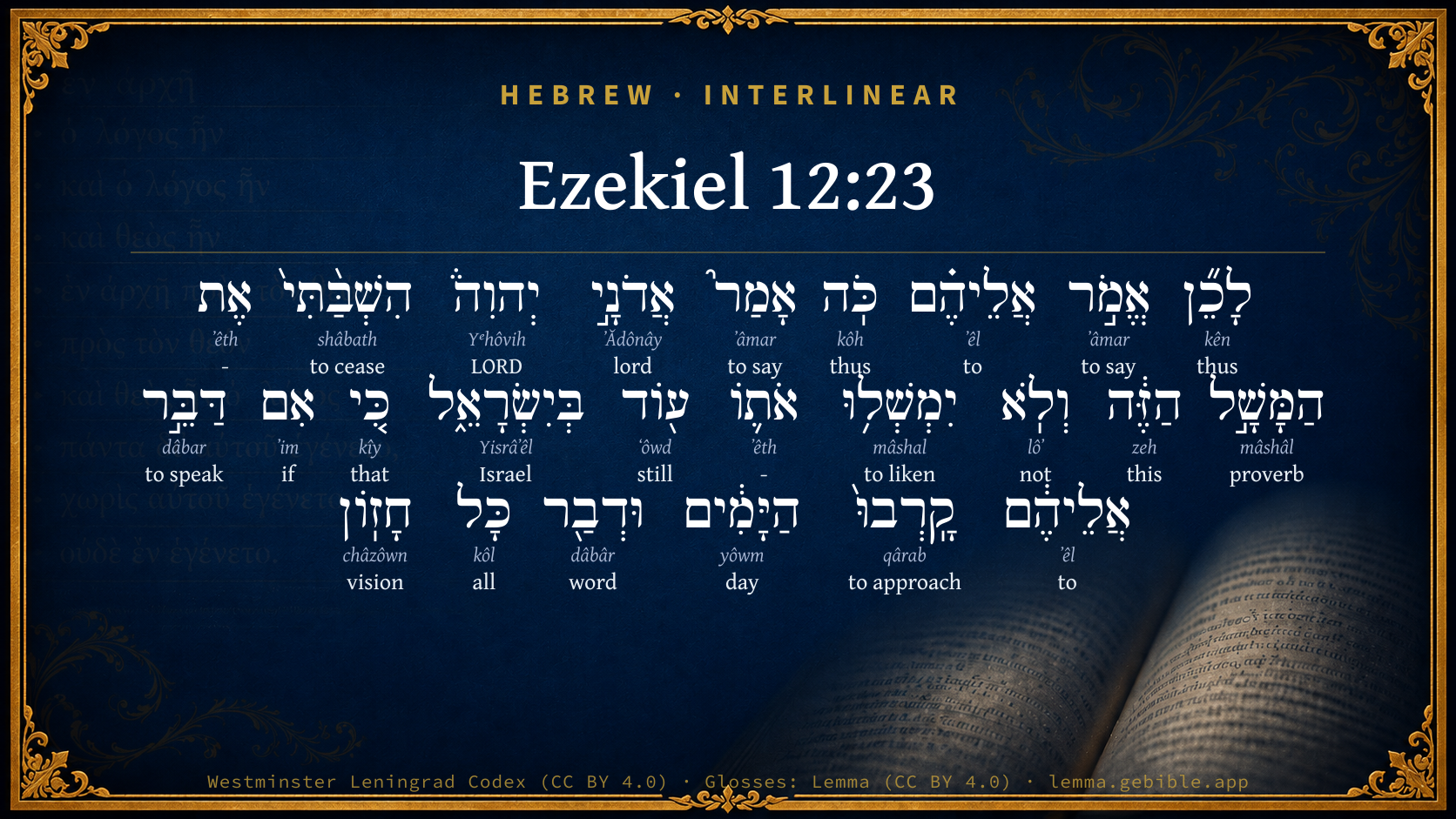
Hebrew (Westminster Leningrad Codex) Ezekiel 12:23 appears in the Hebrew Old Testament. The text above is from the Westminster Leningrad Codex. Each word links to its Strong’s number, a concise gloss, and parsing drawn from the Open Scriptures Hebrew Bible morphology. Click any word for its full Brown-Driver-Briggs (BDB) entry.
Download image
Cite this verse

Ezekiel 12:23 (World English Bible). Public Domain. Lemma interlinear Bible study tool, https://lemma.gebible.app/v/ezekiel/12/23.

Show BibTeX & RIS
BibTeX
RIS
English Translation
Tell them therefore, Thus says the Lord Yahweh: I will make this proverb to cease, and they shall no more use it as a proverb in Israel; but tell them, The days are at hand, and the fulfillment of every vision.
World English Bible · Public Domain
Download a study sheet

One document with this verse’s original text, its word-by-word gloss line, the meaning frame, cross-references with their text, attributed commentary, and full source and license credits — printable, and it pastes into notes with its structure intact.

This verse Autodidact and up

Study sheet (.html) Plain text (.txt)

A passage Seminary Student

Up to 50 verses in one chapter. A passage sheet keeps up to 6 commentary sources and 12 cross-references per verse, in the order this page ranks them, and says so on the sheet whenever that leaves anything out. Ask for a single verse and you get the Autodidact verse sheet above.

Everything on this page stays free to read, with no account — the sheet is a download of what is already on screen, not access to it.

Want to remove ads? Support Godless Engineer
Compare translations 3

The same verse in 3 English versions, stacked beneath the original-language interlinear above. Click any original word for its lexicon entry.

Each is an independent rendering of the whole verse — the interlinear is not word-aligned to these translations.

Highlighted words mark where these versions differ — a whole-verse word diff, not a word-by-word alignment.

  • World English Bible Public Domain
    Tell them therefore, Thus says the Lord Yahweh: I will make this proverb to cease, and they shall no more use it as a proverb in Israel; but tell them, The days are at hand, and the fulfillment of every vision.
  • King James Version Public Domain
    Tell them therefore, Thus saith the Lord GOD; I will make this proverb to cease, and they shall no more use it as a proverb in Israel; but say unto them, The days are at hand, and the effect of every vision.
  • unfoldingWord Literal Text CC BY-SA 4.0
    Therefore, say to them, ‘The Lord Yahweh says this: I will put an end to this proverb, and the people of Israel will no longer use it.’ Say to them, ‘The days have drawn near when every vision will be fulfilled.

unfoldingWord Literal Text — © unfoldingWord, licensed CC BY-SA 4.0. Word-aligned USFM3 via Door43 (git.door43.org/unfoldingWord/en_ult).

Versions to compare (up to 4)

3 of 4 selected

Show all 18 translations

Every available English version of this verse, each an independent rendering of the whole verse.

  • World English Bible Public Domain
    Tell them therefore, Thus says the Lord Yahweh: I will make this proverb to cease, and they shall no more use it as a proverb in Israel; but tell them, The days are at hand, and the fulfillment of every vision.
  • Berean Standard Bible Public Domain
    Therefore tell them that this is what the Lord GOD says: ‘I will put an end to this proverb, and in Israel they will no longer recite it.’ But say to them: ‘The days are at hand when every vision will be fulfilled.
  • Majority Standard Bible Public Domain
    Therefore tell them that this is what the Lord GOD says: ‘I will put an end to this proverb, and in Israel they will no longer recite it.’ But say to them: ‘The days are at hand when every vision will be fulfilled.
  • King James Version Public Domain
    Tell them therefore, Thus saith the Lord GOD; I will make this proverb to cease, and they shall no more use it as a proverb in Israel; but say unto them, The days are at hand, and the effect of every vision.
  • American Standard Version (1901) Public Domain
    Tell them therefore, Thus saith the Lord Jehovah: I will make this proverb to cease, and they shall no more use it as a proverb in Israel; but say unto them, The days are at hand, and the fulfilment of every vision.
  • Revised Version (1885) Public Domain
    Tell them therefore, Thus saith the Lord GOD: I will make this proverb to cease, and they shall no more use it as a proverb in Israel; but say unto them, The days are at hand, and the effect of every vision.
  • Geneva Bible (1599) Public Domain
    Tell them therefore, Thus sayeth the Lord God, I wil make this prouerbe to cease, and they shall no more vse it as a prouerbe in Israel: but say vnto them, The daies are at hand and the effect of euery vision.
  • Douay-Rheims (1899) Public Domain
    Say to them therefore: Thus saith the Lord God: I will make this proverb to cease, neither shall it be any more a common saying in Israel: and tell them that the days are at hand, and the effect of every vision.
  • Young's Literal Translation Public Domain
    therefore say unto them: Thus said the Lord Jehovah: I have caused this simile to cease, And they use it not as a simile again in Israel, But speak to them: Drawn near have the days, And spoken hath every vision.
  • Literal Standard Version CC BY-SA 4.0
    Therefore say to them, Thus said Lord YHWH: I have caused this allegory to cease, || And they do not use it as an allegory in Israel again, || But speak to them: The days have drawn near, || And every vision has spoken.
  • Unlocked Literal Bible CC BY-SA 4.0
    Therefore, say to them, 'The Lord Yahweh says this: I will put an end to this proverb, and the people of Israel will no longer use it.' Say to them, 'The days have drawn near when every vision will be fulfilled.
  • unfoldingWord Literal Text CC BY-SA 4.0
    Therefore, say to them, ‘The Lord Yahweh says this: I will put an end to this proverb, and the people of Israel will no longer use it.’ Say to them, ‘The days have drawn near when every vision will be fulfilled.
  • Darby Bible Public Domain
    Tell them therefore, Thus saith the Lord Jehovah: I will make this proverb to cease, and they shall no more use it as a proverb in Israel; but say unto them, The days are at hand, and the accomplishment of every vision.
  • World Messianic Bible Public Domain
    Tell them therefore, ‘The Lord GOD says: “I will make this proverb to cease, and they will no more use it as a proverb in Israel;”’ but tell them, ‘“The days are at hand, and the fulfillment of every vision.
  • Webster's Bible Public Domain
    Tell them therefore, Thus saith the Lord GOD: I will make this proverb to cease, and they shall no more use it as a proverb in Israel; but say to them, The days are at hand, and the effect of every vision.
  • Free Bible Version CC BY-SA 4.0
    So tell them that this is what the Lord God says: ‘I will put a stop to this proverb. No one in Israel will quote it anymore.’ Instead tell them: The time is soon coming when every vision will come true.
  • Bible in Basic English Public Domain
    For this cause say to them, This is what the Lord has said: I have made this saying come to an end, and it will no longer be used as a common saying in Israel; but say to them, The days are near, and the effect of every vision.
  • JPS Tanakh (1917) Public Domain
    Tell them therefore: Thus saith the Lord GOD: I will make this proverb to cease, and they shall no more use it as a proverb in Israel; but say unto them: The days are at hand, and the word of every vision.

Literal Standard Version (2020), Covenant Press — licensed CC BY-SA 4.0. Text via the HelloAO Bible API (eBible.org). Unlocked Literal Bible (unfoldingWord) — licensed CC BY-SA 4.0. Text via the HelloAO Bible API (eBible.org). unfoldingWord Literal Text — © unfoldingWord, licensed CC BY-SA 4.0. Word-aligned USFM3 via Door43 (git.door43.org/unfoldingWord/en_ult). Free Bible Version, Dr. Jonathan Gallagher — licensed CC BY-SA 4.0. Text via the HelloAO Bible API (eBible.org).

Word by word

More ways to search: Search by grammar → Find every occurrence → Compare this word →

Practice this passage: Drill this verse → Learn its vocabulary →

יִמְשְׁל֥וּ
mâshal
H4911
“to liken”
Verb, Qal, Imperfect, 3rd Person, Masculine, Plural
Part of Speech
Verb
Stem
Qal
Form
Imperfect
Person
3rd Person
Gender
Masculine
Number
Plural
Full BDB Definition

Origin: denominative from H4912

TWOT: 1258 , 1258b

to represent, liken, be like - (Niphal) to liken, be like, be similar - (Hiphil) to compare - (Hithpael) to become like - to speak in a proverb, use a proverb, speak in parables, speak in sentences of poetry - (Qal) to use a proverb, speak a parable or proverb - (Piel) to make a parable - maker of parables (participle)
  1. לָכֵ֞ן kên H3651 “to/for · thus” Preposition + Adverb
  2. אֱמֹ֣ר ʼâmar H559 “say” Verb, Qal, Imperative, 2nd Person, Masculine, Singular
  3. אֲלֵיהֶ֗ם ʼêl H413 “to · them” Preposition + Suffix, Personal, 3rd Person, Masculine, Plural
  4. כֹּֽה kôh H3541 “thus” Adverb
  5. אָמַר֮ ʼâmar H559 “to say” Verb, Qal, Perfect, 3rd Person, Masculine, Singular
  6. אֲדֹנָ֣י ʼĂdônây H136 “Lord · my” Noun, Common, Masculine, Plural, Construct + Suffix, Personal, 1st Person, Common, Singular
  7. יְהוִה֒ Yᵉhôvih H3069 “LORD” Noun, Proper
  8. הִשְׁבַּ֨תִּי֙ shâbath H7673 “to cease” Verb, Hiphil, Perfect, 1st Person, Common, Singular
  9. אֶת ʼêth H853 “-” Particle, Direct Object
  10. הַמָּשָׁ֣ל mâshâl H4912 “the · proverb” Particle, Definite Article + Noun, Common, Masculine, Singular, Absolute
  11. הַזֶּ֔ה zeh H2088 “the · this” Particle, Definite Article + Pronoun, Demonstrative, Masculine, Singular
  12. וְלֹֽא lôʼ H3808 “and · not” Conjunction + Particle, Negative
  13. אֹת֛וֹ ʼêth H853 “- · him” Particle, Direct Object + Suffix, Personal, 3rd Person, Masculine, Singular
  14. ע֖וֹד ʻôwd H5750 “still” Adverb
  15. בְּיִשְׂרָאֵ֑ל Yisrâʼêl H3478 “in/at · Israel” Preposition + Noun, Proper
  16. כִּ֚י kîy H3588 “that” Conjunction
  17. אִם ʼim H518 “if” Conjunction
  18. דַּבֵּ֣ר dâbar H1696 “speak” Verb, Piel, Imperative, 2nd Person, Masculine, Singular
  19. אֲלֵיהֶ֔ם ʼêl H413 “to · them” Preposition + Suffix, Personal, 3rd Person, Masculine, Plural
  20. קָֽרְבוּ֙ qârab H7126 “to approach” Verb, Qal, Perfect, 3rd Person, Common, Plural
  21. הַיָּמִ֔ים yôwm H3117 “the · days” Particle, Definite Article + Noun, Common, Masculine, Plural, Absolute
  22. וּדְבַ֖ר dâbâr H1697 “and · word of” Conjunction + Noun, Common, Masculine, Singular, Construct
  23. כָּל kôl H3605 “all of” Noun, Common, Masculine, Singular, Construct
  24. חָזֽוֹן châzôwn H2377 “vision” Noun, Common, Masculine, Singular, Absolute

About this verse

These counts appear in no published source. They are computed here, from the morphology-tagged text and Lemma’s own curated glosses. What Lemma adds →

25
words
22
distinct lemmas
Prophets
section

Notable vocabulary

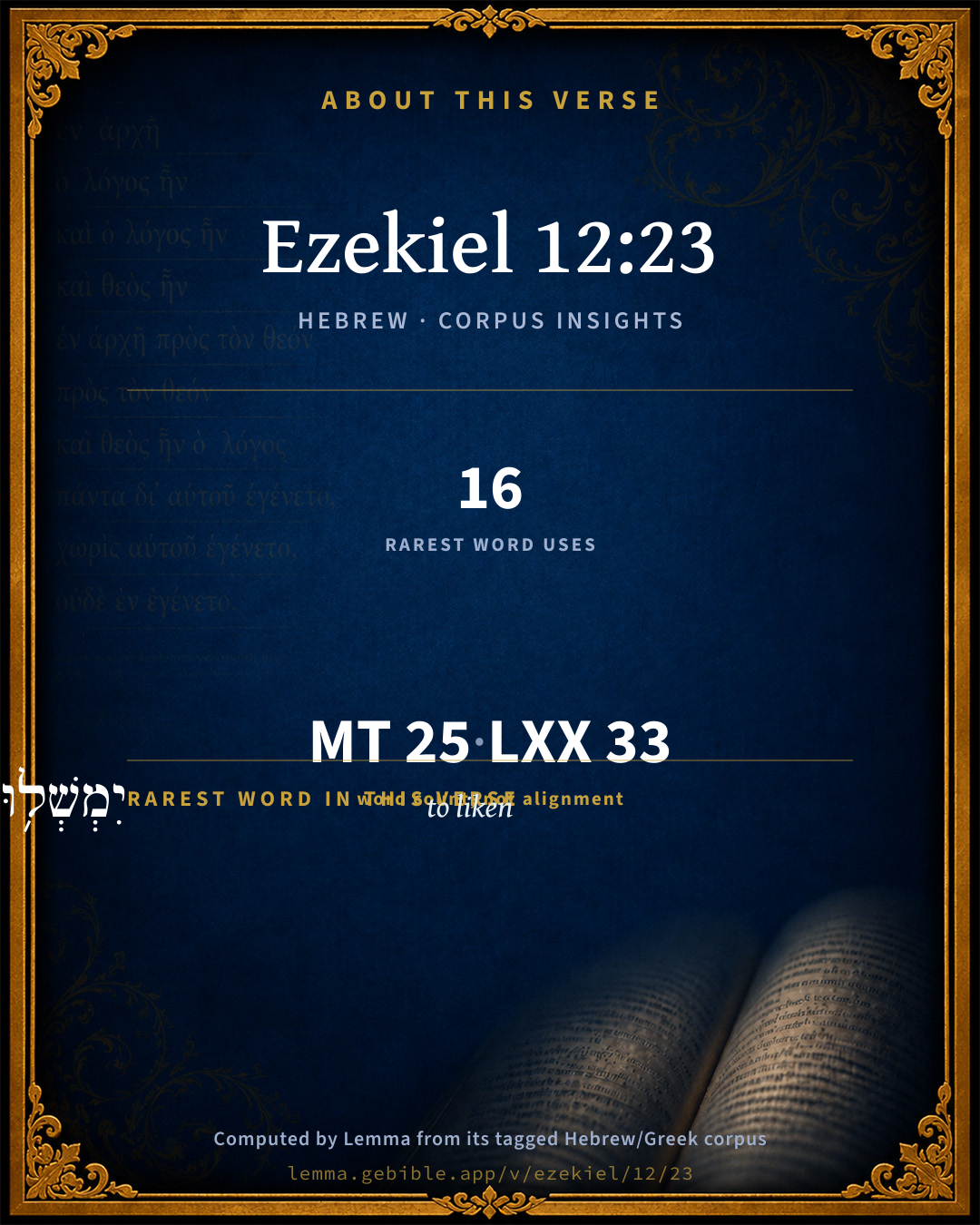
The rarest word here is יִמְשְׁל֥וּ to liken H4911 — appearing just 16 times in the whole Hebrew Bible.

Shared distinctive vocabulary

יִמְשְׁל֥וּ to liken H4911 occurs in 15 verses of the Hebrew Bible. Also found in:

Grammatical profile

  • 6 verbs
  • 8 nouns
  • 1 pronoun
  • 2 prepositions
  • 2 conjunctions
  • 3 adverbs
  • 3 particles

Verb forms

  • אֱמֹ֣ר Qal · Imperative
  • אָמַר֮ Qal · Perfect
  • הִשְׁבַּ֨תִּי֙ Hiphil · Perfect
  • יִמְשְׁל֥וּ Qal · Imperfect
  • דַּבֵּ֣ר Piel · Imperative
  • קָֽרְבוּ֙ Qal · Perfect

Repetition

Words recur within this verse — often emphatic in Hebrew:

  • אֱמֹ֣ר to say H559 ×2
  • אֲלֵיהֶ֗ם to H413 ×2

Hebrew & Septuagint length

In English translation the verse runs 41 words from the Hebrew and 45 from the Septuagint (LXX English) — closely comparable.

A rough comparison of the two English renderings, which tokenize alike — not a word-level alignment.

Word counts can differ between the Hebrew and the Greek without any difference in meaning — e.g. the Hebrew direct-object marker אֵת has no separate Greek word, and Greek often adds the article ὁ.

In the original languages it is 25 Hebrew tokens and 33 Greek tokens — but the two are counted differently (Hebrew bundles its prefixes and suffixes into one token; the Greek is in lemma form), so that isn’t a like-for-like length.

Cross-references

12

Topical passages linked to Ezekiel 12:23 in the Treasury of Scripture Knowledge — connected by theme and wording, ordered by reader-vote popularity; previews shown in the World English Bible.

  • Joel 2:1 Blow you the trumpet in Zion, And sound an alarm in my holy mountain! Let all the inhabitants of the land tremble, For the day of Yahweh comes, For it is close at hand:
  • Ezekiel 7:5–7 Thus says the Lord Yahweh: An evil, an only evil; behold, it comes.
  • Ezekiel 18:3 As I live, says the Lord Yahweh, you shall not have [occasion] any more to use this proverb in Israel.
  • Zephaniah 1:14 The great day of Yahweh is near. It is near, and hurries greatly, the voice of the day of Yahweh. The mighty man cries there bitterly.
  • Matthew 24:34 Most assuredly I tell you, this generation will not pass away, until all these things are accomplished.
  • James 5:8–9 You also be patient. Establish your hearts, for the coming of the Lord is at hand.
  • Psalms 37:13 The Lord will laugh at him, For he sees that his day is coming.
  • Isaiah 28:22 Now therefore don't you be scoffers, lest your bonds be made strong; for a decree of destruction have I heard from the Lord, Yahweh of Hosts, on the whole earth.
  • Ezekiel 7:2 You, son of man, thus says the Lord Yahweh to the land of Israel, An end: the end is come on the four corners of the land.
  • Ezekiel 7:10–12 Behold, the day, behold, it comes: your doom is gone forth; the rod has blossomed, pride has budded.
  • Ezekiel 12:25 For I am Yahweh; I will speak, and the word that I shall speak shall be performed; it shall be no more deferred: for in your days, rebellious house, will I speak the word, and will perform it, says the Lord Yahweh.
  • Malachi 4:1 "For, behold, the day comes, it burns as a furnace; and all the proud, and all who work wickedness, will be stubble; and the day that comes will burn them up," says Yahweh of Hosts, "that it shall leave them neither root nor branch.

Cross-references courtesy of OpenBible.info (CC BY 4.0).

Hebrew and Greek witnesses Masoretic Hebrew ↔ Greek Septuagint

The same verse in the two great witnesses to the Old Testament, shown verse-for-verse.

These are two independent witnesses, not word-aligned to each other, and the Septuagint is shown in lemma (dictionary) form.

Hebrew Ezekiel 12:23 Masoretic · Westminster Leningrad Codex

לָכֵ֞ן אֱמֹ֣ר אֲלֵיהֶ֗ם כֹּֽה אָמַר֮ אֲדֹנָ֣י יְהוִה֒ הִשְׁבַּ֨תִּי֙ אֶת הַמָּשָׁ֣ל הַזֶּ֔ה וְלֹֽא יִמְשְׁל֥וּ אֹת֛וֹ ע֖וֹד בְּיִשְׂרָאֵ֑ל כִּ֚י אִם דַּבֵּ֣ר אֲלֵיהֶ֔ם קָֽרְבוּ֙ הַיָּמִ֔ים וּדְבַ֖ר כָּל חָזֽוֹן

Tell them therefore, Thus says the Lord Yahweh: I will make this proverb to cease, and they shall no more use it as a proverb in Israel; but tell them, The days are at hand, and the fulfillment of every vision.

World English Bible · Public Domain

Greek LXX Ezekiel 12:23 Septuagint · lemma form

διά οὗτος εἶπον πρός αὐτός ὅδε λέγω κύριος ἀποστρέφω ὁ παραβολή οὗτος καί οὐκέτι μή εἶπον ὁ παραβολή οὗτος οἶκος ὁ ἰσραήλ ὅτι λαλέω πρός αὐτός ἐγγίζω ὁ ἡμέρα καί λόγος πᾶς ὅρασις

Therefore say to them, Thus says the Lord; I will even set aside this parable, and the house of Israel shall no more at all use this parable: for you shall say to them, The days are at hand, and the import of every vision.

LXX2012 (modern English Septuagint) · Public Domain

Hebrew: Westminster Leningrad Codex (CC BY 4.0). Greek: Septuagint (public domain); English from LXX2012 (modern English Septuagint) (Public Domain). How the Septuagint differs from the Hebrew →

Targum (Aramaic paraphrase)

1

The Targum is the ancient Jewish Aramaic paraphrase of the Hebrew Scriptures — an interpretive translation, not the Hebrew text itself. Onkelos (literal) and Pseudo-Jonathan (expansive) render the Torah, and Jonathan the Prophets. Coverage is partial: where no permissively-licensed English translation exists for a verse, only the Aramaic is shown. This is verse-level text, not a word-by-word alignment to the Hebrew.

  1. Targum Jonathan Prophets (Joshua–Malachi)
    בְּכֵן אֲמַר לְהוֹן כִּדְנַן אֲמַר יְיָ אֱלֹהִים אֲבַטֵל יַת מַתְלָא הָדֵין וְלָא יִמְתְלוּן יָתֵיהּ עוֹד בְּיִשְׂרָאֵל אֱלָהֵין אִתְנַבֵּי לְהוֹן אִתְקְרָבוּ יוֹמַיָא וּפִתְגַם כָּל נְבוּאָה:

    (no public-domain English translation for this verse)

    Targum Jonathan — Aramaic: “Mikraot Gedolot” (public domain). English: “Sefaria Community Translation” (CC0 1.0 (public-domain dedication)); “London "Chaldee Paraphrase," 1871” (public domain). Text via Sefaria.

Commentary

Notes on Ezekiel 12:23 from classic Christian and Jewish commentators (each source and its license shown beneath its notes). The classic Christian expositions comment on the surrounding passage and are grouped to its opening verse, so a note may address several verses; the Jewish commentaries on the Tanakh (Rashi and others) are per-verse, so they appear only where the commentator wrote on this verse.

Lemma curates 59 commentaries, every one of them public domain or Creative Commons licensed, each selected and text-cleaned for this edition rather than reprinted as found. About our sources →

Trapp's Complete Commentary

John Trapp

Eze 12:23 Tell them therefore, Thus saith the Lord GOD; I will make this proverb to cease, and they shall no more use it as a proverb in Israel; but say unto them, The days are at hand, and the effect of every vision.

Ver. 23. The days are at hand.] Opponit aliud dictum fere tot syllabarum; a plain and plenary confutation.

John Trapp, A Commentary or Exposition upon All the Books of the Old and New Testament (1647–1656) — public domain. Text from a community e-Sword module.

Tyndale Open Study Notes

Tyndale Open Resources

12:23-25 In response to the people’s unbelief (12:22), the Lord framed a new proverb for the people, using similar words but with an opposite meaning.

Tyndale Open Study Notes — © Tyndale Open Resources, licensed CC BY-SA 4.0. Text via the HelloAO Bible API.

Jamieson, Fausset & Brown

Robert Jamieson, A. R. Fausset & David Brown

effect--literally, "the word," namely, fulfilled; that is, the effective fulfilment of whatever the prophets have spoken is at hand.

Jamieson, Fausset & Brown — Commentary Critical and Explanatory on the Whole Bible (1871) — public domain (CC PDM 1.0). Text via the HelloAO Bible API.

Adam Clarke's Commentary

Verse 23. The days are at hand] Far from failing or being prolonged, time is posting on, and the destruction threatened is at the door.

Adam Clarke's Commentary on the Bible (1810–1826) — public domain. Text from a community e-Sword/MySword module.

Ellicott's Commentary for English Readers

(23) The effect of every vision.—The sense would be made clearer by rendering “the accomplishment” of every vision.

A Bible Commentary for English Readers, edited by Charles John Ellicott (1878–1897) — public domain. Text from a community e-Sword module.

The Cambridge Bible for Schools and Colleges

gen. ed. J. J. S. Perowne

23. Judgment had been so often threatened and so often deferred that the failure of prophecy to realize itself became a proverb. Too superficial to apprehend the meaning of its postponement these scoffers made light of the threatened judgment (2Pe_3:3; 2Pe_3:9). Now they shall be undeceived. For similar popular sentiments, cf. Jer_5:13-14; Jer_17:15.

the effect of every vision] Lit. the word—the contents, of every vision.

The Cambridge Bible for Schools and Colleges (gen. ed. J. J. S. Perowne; Cambridge University Press, 1878–1918) — public domain. Text from a community e-Sword module.

John Gill's Exposition

Therefore say unto them, thus saith the Lord God,.... Carry this message to them from me, whether they will hear it or not; so shall it be:

there shall none of my words be prolonged any more; the fulfilment of prophecies delivered in the name of the Lord by the prophets shall be no longer deferred, but shall quickly be:

but the word which I have spoken shall be done, saith the Lord God: one jot and tittle of it shall not pass away till all be fulfilled; sooner may heaven and earth pass away than that shall; it is for ever settled in heaven, and shall be fulfilled on earth; he that has said it is of one mind, and none can turn him; and is able to do whatsoever he pleases.

Next: Ezekiel Chapter 13

John Gill's Exposition of the Whole Bible (1746–1763) — public domain (CC PDM 1.0). Text via the HelloAO Bible API.

Haydock's Catholic Bible Commentary

CHAPTER XII.

George Leo Haydock (1774–1849), Haydock's Catholic Family Bible and Commentary, 1859 edition — public domain. Excludes Psalms (Douay-Rheims chapter numbering differs from Protestant) and Deuterocanonical books (Catholic canon only).

Matthew Poole's English Annotations

Tell them; either who use the proverb, or are stumbled at it; tell the one to convince, the other to instruct them.

I will make this proverb to cease: thus they abuse my patience, and affront my truth, and deride my justice; but when my patience at its period calls in my justice to vindicate it, and when calamities felt prove my truth and the presence of these sorrows, there can be no more place for such a proverb, the groundlessness of it being discovered to all.

Say unto them; assure them.

The days are at hand: see Eze 12:22; they draw near indeed, when within some three years Jerusalem shall see the enemy besieging it, and feel his sword cutting down her chosen men. All that which the vision contained shall, ere few years are over, clearly appear accomplished, according to what my prophets foretold.

Matthew Poole's English Annotations on the Holy Bible (1683–1685) — public domain. Text from a community e-Sword/MySword module.

Whedon's Commentary on the Bible

Daniel D. Whedon

23-25. I will make this proverb to cease — The execution of the prophetic threat has so often been withheld, because of the repentance of a few righteous men or the long-suffering of Jehovah (33; Jer_18:7-8; Jer_26:17-19), that the failure of the prophetic judgment had become a proverb. The mercy of God in postponing chastisement is used as a proof that God did not and could not rule in the affairs of men. (It is the same spirit which says that God is always on the side of the heaviest guns. But did not that general die in exile?) Besides this there were many, who claimed to be seers, who prophesied according to the wishes of the people, and painted Israel’s future as bright and prosperous (Eze_12:24). This made the work of the true prophet more difficult. But now “the effect” (literally, word) of every vision “is at hand” and will not again be delayed. Soon everyone will be able to discriminate between the false divination and the true prophecy (Eze_21:21; Deu_18:10; Jer_14:14; Jer_28:3; Isa_30:10).

Daniel D. Whedon (gen. ed.), Commentary on the Old and New Testaments (1874–1909) — public domain. Text from a community e-Sword module.

The Pulpit Commentary

The prophet meets the current proverb with a counter proverb of his own: "The days are not far off, but have come near." Compare the language of the Baptist, (Mat_3:2) of our Lord, (Mat_4:17) of St. Paul. (Rom_13:11) For the true prophet there is always a near fulfilment, though there may be also an ultimate and more complete reality of which that is the pledge and earnest. The "vision" shall not fail; every word (so in the Hebrew) shall become a reality.

The Pulpit Commentary (1880–1919), ed. H.D.M. Spence-Jones & Joseph S. Exell — public domain. Text from a community e-Sword module.

Rashi

Rabbi Shlomo Yitzchaki (Rashi)

use it as a proverb Heb. יִמְשְּׁלוּ, from the word מָשָּׁל, a proverb.

Rashi on the Tanakh — English translations: “The Judaica Press complete Tanach with Rashi, translated by A. J. Rosenberg” (CC BY 4.0); “Pentateuch with Rashi's commentary by M. Rosenbaum and A.M. Silbermann, 1929-1934” (public domain); “The Metsudah Tanach series, Lakewood, N.J” (CC BY 4.0); and “The Book of Joshua, Metsudah Publications, 1997” (CC BY 4.0). Text via Sefaria.

Lesson kit

Teaching starters — assembled from the data on this page, not authored interpretation. Every prompt links to the verse data it draws on. Edit before teaching.

Ezekiel, in the Prophets, opens this verse with 25 words (22 distinct Hebrew lemmas). Its most distinctive word is mâshal (“to liken”). A historical commentator’s framing appears above. Read the whole chapter for the surrounding context.

Discussion questions

  1. How does “to liken” (mâshal) shape what this verse is saying?
  2. How does Numbers 21:27, which shares the word «to liken», read alongside this verse?
  3. What does the repetition of “to say” (2× in this one verse) do in this verse?
  4. These translations render this verse differently; the difference is in the English rendering, not the original. What questions does that raise?
  5. «אֱמֹ֣ר» is a Qal Imperative verb. How does that grammatical form shape the action described?
  6. Compare how Trapp's Complete Commentary and Tyndale Open Study Notes read this verse. Where do they agree or differ?

Things to notice

Reading settings

Reading text

Shown beneath each verse's original-language words.

Old Testament
Old Testament edition

Read the OT as the Masoretic Hebrew (MT) or the Greek Septuagint (LXX).

English shown for the Greek Septuagint (in the Hebrew ↔ Greek comparison).

Comparing translations? Open the Compare panel on any verse page to stack up to four side by side.