Isaiah 21:16

Hebrew (Westminster Leningrad Codex) Isaiah 21:16 appears in the Hebrew Old Testament. The text above is from the Westminster Leningrad Codex. Each word links to its Strong’s number, a concise gloss, and parsing drawn from the Open Scriptures Hebrew Bible morphology. Click any word for its full Brown-Driver-Briggs (BDB) entry.
Download image
Cite this verse

Isaiah 21:16 (World English Bible). Public Domain. Lemma interlinear Bible study tool, https://lemma.gebible.app/v/isaiah/21/16.

Show BibTeX & RIS
BibTeX
RIS
English Translation
For thus has the Lord said to me, Within a year, according to the years of a hireling, all the glory of Kedar shall fail;
World English Bible · Public Domain
Download a study sheet

One document with this verse’s original text, its word-by-word gloss line, the meaning frame, cross-references with their text, attributed commentary, and full source and license credits — printable, and it pastes into notes with its structure intact.

This verse Autodidact and up

Study sheet (.html) Plain text (.txt)

A passage Seminary Student

Up to 50 verses in one chapter. A passage sheet keeps up to 6 commentary sources and 12 cross-references per verse, in the order this page ranks them, and says so on the sheet whenever that leaves anything out. Ask for a single verse and you get the Autodidact verse sheet above.

Everything on this page stays free to read, with no account — the sheet is a download of what is already on screen, not access to it.

Want to remove ads? Support Godless Engineer
Compare translations 3

The same verse in 3 English versions, stacked beneath the original-language interlinear above. Click any original word for its lexicon entry.

Each is an independent rendering of the whole verse — the interlinear is not word-aligned to these translations.

Highlighted words mark where these versions differ — a whole-verse word diff, not a word-by-word alignment.

  • World English Bible Public Domain
    For thus has the Lord said to me, Within a year, according to the years of a hireling, all the glory of Kedar shall fail;
  • King James Version Public Domain
    For thus hath the LORD said unto me, Within a year, according to the years of an hireling, and all the glory of Kedar shall fail:
  • unfoldingWord Literal Text CC BY-SA 4.0
    For thus the Lord has said to me: “Within a year like the years of a hired, then all of the glory of Kedar will end.

unfoldingWord Literal Text — © unfoldingWord, licensed CC BY-SA 4.0. Word-aligned USFM3 via Door43 (git.door43.org/unfoldingWord/en_ult).

Versions to compare (up to 4)

3 of 4 selected

Show all 18 translations

Every available English version of this verse, each an independent rendering of the whole verse.

  • World English Bible Public Domain
    For thus has the Lord said to me, Within a year, according to the years of a hireling, all the glory of Kedar shall fail;
  • Berean Standard Bible Public Domain
    For this is what the Lord says to me: “Within one year, as a hired worker would count it, all the glory of Kedar will be gone.
  • Majority Standard Bible Public Domain
    For this is what the Lord says to me: “Within one year, as a hired worker would count it, all the glory of Kedar will be gone.
  • King James Version Public Domain
    For thus hath the LORD said unto me, Within a year, according to the years of an hireling, and all the glory of Kedar shall fail:
  • American Standard Version (1901) Public Domain
    For thus hath the Lord said unto me, Within a year, according to the years of a hireling, all the glory of Kedar shall fail;
  • Revised Version (1885) Public Domain
    For thus hath the Lord said unto me, Within a year, according to the years of an hireling, and all the glory of Kedar shall fail:
  • Geneva Bible (1599) Public Domain
    For thus hath the Lord sayd vnto me, Yet a yeere according to the yeeres of an hireling, and all the glorie of Kedar shall faile.
  • Douay-Rheims (1899) Public Domain
    For thus saith the Lord to me: Within a year, according to the years of a hireling, all the glory of Cedar shall be taken away.
  • Young's Literal Translation Public Domain
    For thus said the Lord unto me: `Within a year, as years of a hireling, Consumed hath been all the honour of Kedar.
  • Literal Standard Version CC BY-SA 4.0
    For thus said the Lord to me: “Within a year, as years of a hired worker, || All the glory of Kedar has been consumed.
  • Unlocked Literal Bible CC BY-SA 4.0
    For this is what the Lord said to me, “Within a year, as a laborer hired for a year would see it, all the glory of Kedar will end.
  • unfoldingWord Literal Text CC BY-SA 4.0
    For thus the Lord has said to me: “Within a year like the years of a hired, then all of the glory of Kedar will end.
  • Darby Bible Public Domain
    For thus hath the Lord said unto me: Within a year, according to the years of a hired servant, and all the glory of Kedar shall fail;
  • World Messianic Bible Public Domain
    For the Lord said to me, “Within a year, as a worker bound by contract would count it, all the glory of Kedar will fail,
  • Webster's Bible Public Domain
    For thus hath the Lord said to me, Within a year, according to the years of a hireling, and all the glory of Kedar shall fail:
  • Free Bible Version CC BY-SA 4.0
    This is what the Lord told me: “Within one year, just as a contract worker precisely counts years, all the glory of Kedar will be gone.
  • Bible in Basic English Public Domain
    For so has the Lord said to me, In a year, by the years of a servant working for payment, all the glory of Kedar will come to an end:
  • JPS Tanakh (1917) Public Domain
    For thus hath the Lord said unto me: 'Within a year, according to the years of a hireling, and all the glory of Kedar shall fail;

Literal Standard Version (2020), Covenant Press — licensed CC BY-SA 4.0. Text via the HelloAO Bible API (eBible.org). Unlocked Literal Bible (unfoldingWord) — licensed CC BY-SA 4.0. Text via the HelloAO Bible API (eBible.org). unfoldingWord Literal Text — © unfoldingWord, licensed CC BY-SA 4.0. Word-aligned USFM3 via Door43 (git.door43.org/unfoldingWord/en_ult). Free Bible Version, Dr. Jonathan Gallagher — licensed CC BY-SA 4.0. Text via the HelloAO Bible API (eBible.org).

Word by word

More ways to search: Search by grammar → Find every occurrence → Compare this word →

Practice this passage: Drill this verse → Learn its vocabulary →

קֵדָֽר
Qêdâr
H6938
“Kedar”
Noun, Proper
Part of Speech
Noun
Type
Proper
Full BDB Definition

Origin: from H6937

TWOT: None

Kedar = "dark" - a son of Ishmael (noun proper masculine) - the descendants of Kedar (noun proper people)
  1. כִּי kîy H3588 “that” Conjunction
  2. כֹ֛ה kôh H3541 “thus” Adverb
  3. אָמַ֥ר ʼâmar H559 “to say” Verb, Qal, Perfect, 3rd Person, Masculine, Singular
  4. אֲדֹנָ֖י ʼĂdônây H136 “Lord · my” Noun, Common, Masculine, Plural, Construct + Suffix, Personal, 1st Person, Common, Singular
  5. אֵלָ֑י ʼêl H413 “to · me” Preposition + Suffix, Personal, 1st Person, Common, Singular
  6. בְּע֤וֹד ʻôwd H5750 “in/at · still” Preposition + Adverb
  7. שָׁנָה֙ shâneh H8141 “year” Noun, Common, Feminine, Singular, Absolute
  8. כִּשְׁנֵ֣י shâneh H8141 “like/as · year” Preposition + Adjective, Cardinal number, Masculine, Dual, Construct
  9. שָׂכִ֔יר sâkîyr H7916 “hired laborer” Adjective, Adjective, Masculine, Singular, Absolute
  10. וְכָלָ֖ה kâlâh H3615 “and · to finish” Conjunction + Verb, Qal, Sequential Perfect, 3rd Person, Masculine, Singular
  11. כָּל kôl H3605 “all of” Noun, Common, Masculine, Singular, Construct
  12. כְּב֥וֹד kâbôwd H3519 “glory of” Noun, Common, Both, Singular, Construct

About this verse

These counts appear in no published source. They are computed here, from the morphology-tagged text and Lemma’s own curated glosses. What Lemma adds →

13
words
12
distinct lemmas
Prophets
section

Notable vocabulary

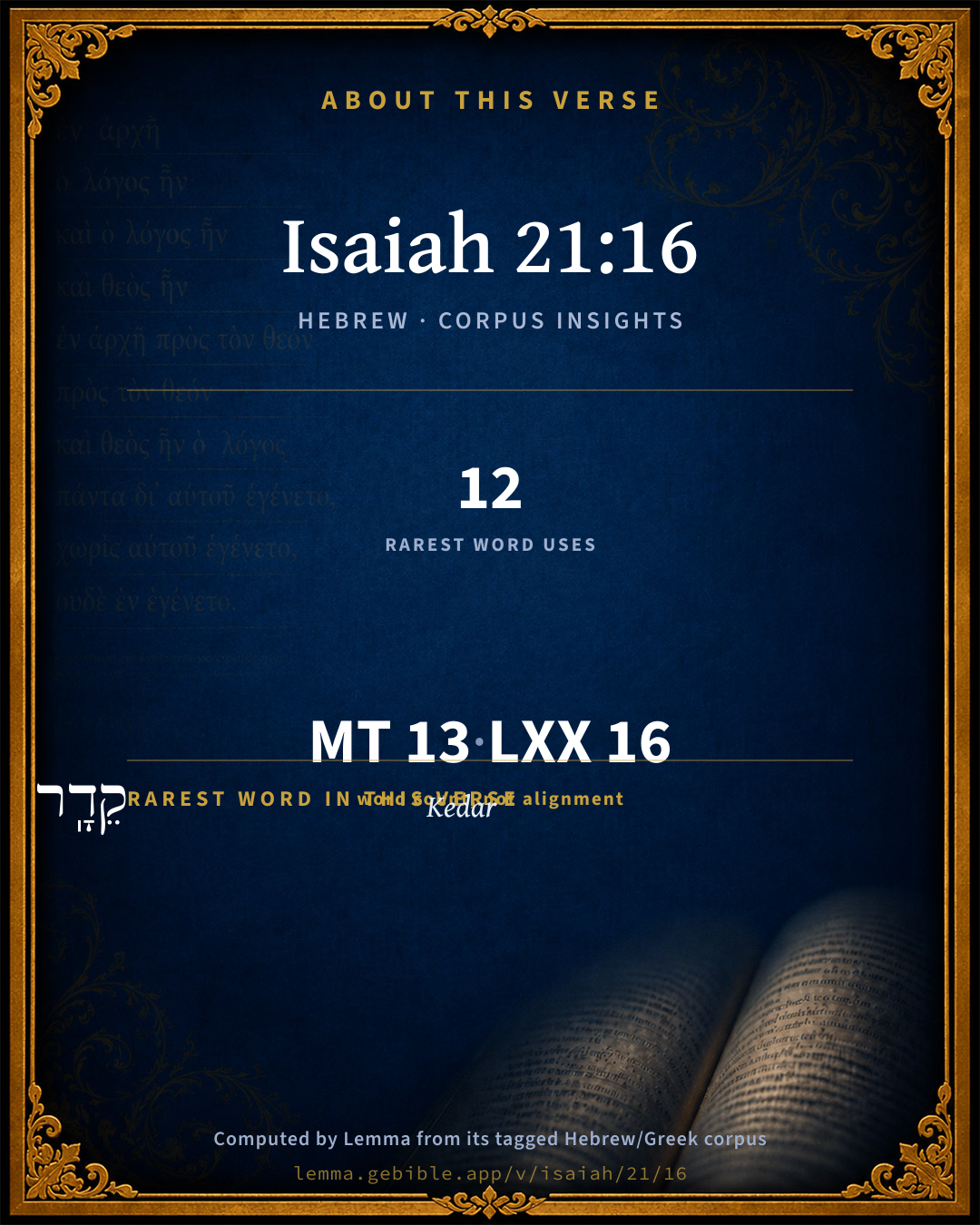
The rarest word here is קֵדָֽר Kedar H6938 — appearing just 12 times in the whole Hebrew Bible.

Shared distinctive vocabulary

קֵדָֽר Kedar H6938 occurs in 11 verses of the Hebrew Bible. Also found in:

Grammatical profile

  • 2 verbs
  • 5 nouns
  • 2 adjectives
  • 1 preposition
  • 1 conjunction
  • 2 adverbs

Verb forms

  • אָמַ֥ר Qal · Perfect
  • וְכָלָ֖ה Qal · Sequential Perfect

Repetition

A word recurs within this verse — often emphatic in Hebrew:

  • שָׁנָה֙ year H8141 ×2

Hebrew & Septuagint length

In English translation the verse runs 25 words from the Hebrew and 26 from the Septuagint (LXX English) — closely comparable.

A rough comparison of the two English renderings, which tokenize alike — not a word-level alignment.

Word counts can differ between the Hebrew and the Greek without any difference in meaning — e.g. the Hebrew direct-object marker אֵת has no separate Greek word, and Greek often adds the article ὁ.

In the original languages it is 13 Hebrew tokens and 16 Greek tokens — but the two are counted differently (Hebrew bundles its prefixes and suffixes into one token; the Greek is in lemma form), so that isn’t a like-for-like length.

Cross-references

10

Topical passages linked to Isaiah 21:16 in the Treasury of Scripture Knowledge — connected by theme and wording, ordered by reader-vote popularity; previews shown in the World English Bible.

  • Psalms 120:5 Woe is me, that I live in Meshech, That I dwell among the tents of Kedar!
  • Song of Solomon 1:5 I am dark, but lovely, You daughters of Jerusalem, Like Kedar's tents, Like Solomon's curtains.
  • Isaiah 16:14 But now Yahweh has spoken, saying, Within three years, as the years of a hireling, the glory of Moab shall be brought into contempt, with all his great multitude; and the remnant shall be very small and of no account.
  • Isaiah 60:7 All the flocks of Kedar shall be gathered together to you, the rams of Nebaioth shall minister to you; they shall come up with acceptance on my altar; and I will glorify the house of my glory.
  • Jeremiah 49:28 Of Kedar, and of the kingdoms of Hazor, which Nebuchadrezzar king of Babylon struck. Thus says Yahweh: Arise you, go up to Kedar, and destroy the children of the east.
  • Ezekiel 27:21 Arabia, and all the princes of Kedar, they were the merchants of your hand; in lambs, and rams, and goats, in these were they your merchants.
  • Genesis 25:13 These are the names of the sons of Ishmael, by their names, according to the order of their birth: the firstborn of Ishmael, Nebaioth, then Kedar, Adbeel, Mibsam,
  • Isaiah 42:11 Let the wilderness and the cities of it lift up [their voice], the villages that Kedar does inhabit; let the inhabitants of Sela sing, let them shout from the top of the mountains.
  • 1 Chronicles 1:29 These are their generations: the firstborn of Ishmael, Nebaioth; then Kedar, and Adbeel, and Mibsam,
  • Job 7:1 "Isn't a man forced to labor on earth? Aren't his days like the days of a hired hand?

Cross-references courtesy of OpenBible.info (CC BY 4.0).

Hebrew and Greek witnesses Masoretic Hebrew ↔ Greek Septuagint

The same verse in the two great witnesses to the Old Testament, shown verse-for-verse.

These are two independent witnesses, not word-aligned to each other, and the Septuagint is shown in lemma (dictionary) form.

Hebrew Isaiah 21:16 Masoretic · Westminster Leningrad Codex

כִּי כֹ֛ה אָמַ֥ר אֲדֹנָ֖י אֵלָ֑י בְּע֤וֹד שָׁנָה֙ כִּשְׁנֵ֣י שָׂכִ֔יר וְכָלָ֖ה כָּל כְּב֥וֹד קֵדָֽר

For thus has the Lord said to me, Within a year, according to the years of a hireling, all the glory of Kedar shall fail;

World English Bible · Public Domain

Greek LXX Isaiah 21:16 Septuagint · lemma form

ὅτι οὕτως εἶπον ἐγώ κύριος ἔτι ἐνιαυτός ὡς ἐνιαυτός μισθωτός ἐκλείπω ὁ δόξα ὁ υἱός κηδαρ

For thus said the Lord to me, Yet a year, as the year of an hireling, and the glory of the sons of Kedar shall fail:

LXX2012 (modern English Septuagint) · Public Domain

Hebrew: Westminster Leningrad Codex (CC BY 4.0). Greek: Septuagint (public domain); English from LXX2012 (modern English Septuagint) (Public Domain). How the Septuagint differs from the Hebrew →

Targum (Aramaic paraphrase)

1

The Targum is the ancient Jewish Aramaic paraphrase of the Hebrew Scriptures — an interpretive translation, not the Hebrew text itself. Onkelos (literal) and Pseudo-Jonathan (expansive) render the Torah, and Jonathan the Prophets. Coverage is partial: where no permissively-licensed English translation exists for a verse, only the Aramaic is shown. This is verse-level text, not a word-by-word alignment to the Hebrew.

  1. Targum Jonathan Prophets (Joshua–Malachi)
    אֲרֵי כִדְנַן אֲמַר יְיָ לִי בְּסוֹף שְׁנַיָא כִשְׁנֵי אֲגִירָא וְיָסוּף כָּל יְקָרְהוֹן דַעֲרָבָאֵי:

    For thus hath the Lord said unto me: at the end of the years, as the years of an hireling, all the glory of the Arabians shall come to an end.

    Targum Jonathan — Aramaic: “Mikraot Gedolot” (public domain). English: “Sefaria Community Translation” (CC0 1.0 (public-domain dedication)); “London "Chaldee Paraphrase," 1871” (public domain). Text via Sefaria.

Commentary

Notes on Isaiah 21:16 from classic Christian and Jewish commentators (each source and its license shown beneath its notes). The classic Christian expositions comment on the surrounding passage and are grouped to its opening verse, so a note may address several verses; the Jewish commentaries on the Tanakh (Rashi and others) are per-verse, so they appear only where the commentator wrote on this verse.

Lemma curates 59 commentaries, every one of them public domain or Creative Commons licensed, each selected and text-cleaned for this edition rather than reprinted as found. About our sources →

Trapp's Complete Commentary

John Trapp

Isa 21:16 For thus hath the Lord said unto me, Within a year, according to the years of an hireling, and all the glory of Kedar shall fail:

Ver. 16. Within a year, after the years of an hireling.] See on Isa 16:14; before the year be come about.

All the glory of Kedar.] Whose tents {Psa 120:5} were rude, but rich. {Son 1:5} {See Trapp on "Son 1:5"}

John Trapp, A Commentary or Exposition upon All the Books of the Old and New Testament (1647–1656) — public domain. Text from a community e-Sword module.

The Biblical Illustrator

Joseph S. Exell

Isa_21:16-17

Within a year, according to the years of an hireling, sad all the glory of Kedar shall fail

End of the year: a warning and a lesson

I.

A TERRIBLE THREATENING. We have here a prophecy of the fall of a nation, which had held a proud position by reason of prowess and skill in war. But glory founded on physical strength, upon wealth, or upon power, may speedily fade away. With all the study of economics we seem to know but little even now, and we have found, many times of late, how trifling a matter may lead to the overthrow of existing engagements and conditions. Much less stable is the glory of a nation built upon the strength of its arms. A nations glory is safe only when it is founded upon righteousness and obedience to God.

II. A TIME FIXED. Within a year. How different the feeling in looking back over a year and looking forward! The retrospect--bow short a time, how quickly passed, how little done, and yet what changes have taken place! How the number of the mighty have diminished! The prospect--what a long time, what hopes we have, what possibilities are in it! To us as a nation, to us in our families, to us as persons. Are we prepared for them! The fall of the glory of Kedar was announced to come within the year. Forbearance must have its limits. A boundary to life, to sin, to indulgence; but within a given period the time of reckoning must he fixed.

III. THE ATTITUDE WE SHOULD ADOPT. Standing on the threshold of a new year, let us consider our position. Certain it is that some will fall within the year. Men shall be diminished. Let our influence, by example and precept, be exerted to found our national glory, not upon our skill in arms, on our insular position, on our wealth, but upon true obedience to God. The number of those who form the glory of the Church will be diminished this year. Are the younger people preparing themselves to fill the vacant places? There is a warning here, that those who trust in aught but in Jehovah will find their glory naught but folly. There is also encouragement. The God of Israel hath spoken it. To him that walketh uprightly and serveth God humbly, shall glory be revealed from day to day, until the full glory of God is revealed to us in the life beyond. (Frank Mabin.)

According the years of an hireling

In a years time, calculated as exactly as is the custom between employers and employed, Kedars freedom, military strength, numbers, and wealth shall have vanished. (F. Delitzsch.)

The number of archers

They [the sons of Kedar] are numbered hero, not by heads, but by bows, so specifying the fighting men--a mode of numbering common, e.g., among the Indians of America. (F. Delitzsch.)

Within a year

A sensible person said he could never covet the office of chief magistrate of London, because that honour continued only one year. Might not the idea be justly extended to all the honours and enjoyments of this life? None of them are permanent. (Anon.)

.

The Biblical Illustrator, edited by Joseph S. Exell (c. 1880s–1900s) — public domain. Text from a community e-Sword module.

Joseph Benson's Commentary

Isa 21:16-17. For thus hath the Lord said — Hitherto the prophet had spoken figuratively: now he ceases to do so; within a year — From the time of the delivery of this prophecy, according to the years of a hireling — Namely, an exact year: for hirelings diligently observe and wait for the end of the year, when they are to receive their wages. And this prophecy “was probably delivered about the same time with the rest in this part of the book, that is, soon before or after the 14th of Hezekiah, the year of Sennacherib’s invasion. In his first march into Judea, or in his return from the Egyptian expedition, he might, perhaps, overrun these several clans of Arabians, whose distress, on some such occasion, is the subject of this prophecy.” — Bishop Lowth. And all the glory of Kedar shall fail — Their power and riches, and all things wherein they used to glory The Kedarenes were another division of the Arabians, descended from Kedar, Ishmael’s son, (Gen 25:13,) who were famous for the use of the bow, as is intimated in Isa 21:17, at which weapon their ancestor Ishmael was very expert, Gen 21:20. The same people are said to dwell in the tents of Kedar, (Psa 120:5; Son 1:5,) and were remarkable for their swarthiness, the word Kedar signifying black or tawny. It is here foretold that they should suffer a grievous slaughter, whereby their mighty men should be diminished, and that they should be deprived of their flocks, tents, furniture, and wealth, and be obliged to save themselves by fleeing into the interior parts of the desert.

Joseph Benson's Commentary on the Old and New Testaments (1811–1818) — public domain. Text from a community e-Sword module.

Keil & Delitzsch

C. F. Keil & F. Delitzsch

Thus does the approaching fate of Arabia present itself in picture before the prophet's eye, whilst it is more distinctly revealed in Isa 21:16, Isa 21:17 : "For thus hath the Lord spoken to me, Within a year, as the years of a hired labourer, it is over with all the glory of Kedar. And the remnant of the number of bows of heroes of the Kedarenes will be small: for Jehovah, the God of Israel, hath spoken." The name Kedar is here the collective name of the Arabic tribes generally. In the stricter sense, Kedar, like Nebaioth, which is associated with it, as a nomadic tribe of Ishmaelites, which wandered as far as the Elanitic Gulf. Within the space of a year, measured as exactly as is generally the case where employers and labourers are concerned, Kedar's freedom, military strength, numbers, and wealth (all these together constituting its glory), would all have disappeared. Nothing but a small remnant would be left of the heroic sons of Kedar and their bows. They are numbered here by their bows (in distinction from the numbering by heads), showing that the righting men are referred to - a mode of numbering which is customary among the Indian tribes of America, for example.

(Note: See the work of V. Martius on the Indians of Brazil, i. 395, 411, etc.)

The noun she'âr (remnant) is followed by five genitives here (just as peri is by four in Isa 10:12); and the predicate ימעטוּ is in the plural because of the copiousness of the subject. The period of the fulfilment of the prophecy keeps us still within the Assyrian era. In Herodotus (2, 141), Sennacherib is actually called "king of Arabians and Assyrians" (compare Josephus, Ant. x. 1, 4); and both Sargon and Sennacherib, in their annalistic inscriptions, take credit to themselves for the subjugation of Arabian tribes. But in the Chaldean era Jeremiah predicted the same things against Kedar (chapter 49) as against Edom; and Jer 49:30-31 was evidently written with a retrospective allusion to this oracle of Isaiah. When the period fixed by Isaiah for the fulfilment arrived, a second period grew out of it, and one still more remote, inasmuch as a second empire, viz., the Chaldean, grew out of the Assyrian, and inaugurated a second period of judgment for the nations. After a short glimmer of morning, the night set in a second time upon Edom, and a second time upon Arabia.

Keil & Delitzsch — Biblical Commentary on the Old Testament (1861–1891) — public domain (CC PDM 1.0). Text via the HelloAO Bible API. (Old Testament only.)

Tyndale Open Study Notes

Tyndale Open Resources

21:16 Kedar was an Arabian tribe that had great wealth and possessions (see 60:7; Ezek 27:21).

Tyndale Open Study Notes — © Tyndale Open Resources, licensed CC BY-SA 4.0. Text via the HelloAO Bible API.

Geneva Bible (1599)

Geneva Bible translators

He appointeth them respite for one year only, and then they should be destroyed.

Read Isa. 16:14.

Geneva Bible (1599) marginal notes — public domain. Text via Bolls.life.

Jamieson, Fausset & Brown

Robert Jamieson, A. R. Fausset & David Brown

years of . . . hireling--(See on Isa 16:14).

Kedar--a wandering tribe (Psa 120:5). North of Arabia-Petræa, and south of Arabia-Deserta; put for Arabia in general.

Jamieson, Fausset & Brown — Commentary Critical and Explanatory on the Whole Bible (1871) — public domain (CC PDM 1.0). Text via the HelloAO Bible API.

Ellicott's Commentary for English Readers

(16) According to the years of an hireling . . . The prophet uses, as in Isa_16:14, the formula which expressed the most precise measurement, and so gives a test as to his forecast of the future.

And all the glory of Kedar shall fail.—Kedar is used, as in Psa_120:5, Son_1:5, generically for the nomadic tribes of Arabia, including Dedan.

A Bible Commentary for English Readers, edited by Charles John Ellicott (1878–1897) — public domain. Text from a community e-Sword module.

The Cambridge Bible for Schools and Colleges

gen. ed. J. J. S. Perowne

16. according to the years of a hireling] See on Isa_16:14.

Kedar] a tribe of pastoral nomads (Isa_60:7; Eze_27:21) in the Syrian desert (Jer_2:10), is here apparently a comprehensive designation of the north Arabian tribes (cf. Son_1:5; Psa_120:5).

The Cambridge Bible for Schools and Colleges (gen. ed. J. J. S. Perowne; Cambridge University Press, 1878–1918) — public domain. Text from a community e-Sword module.

John Gill's Exposition

For thus hath the Lord said unto me,.... The prophet; which confirms what is before said, as well as assures the accomplishment of what follows:

within a year, according to the years of an hireling; that is, exactly and precisely, as soon as ever the year is come to an end; for the hireling, when his year is up, instantly demands dismissal from his service, or his wages, or both. The time is to be reckoned from the delivery of this prophecy; and so the calamity predicted was brought upon them by the Assyrians, perhaps under Sennacherib, when he invaded the cities of Judah, and might take Arabia in his way; less time is allowed than was the Moabites, who suffered by the same hand; see Isa 16:14,

and all the glory of Kedar shall fail; these were another sort of Arabians, as the Targum calls them: they descended from Kedar, a son of Ishmael, Gen 25:13 their "glory" were their multitude, their riches and substance, and which chiefly lay in their flocks; for the sake of which they moved from place to place for pasture, and dwelled in tents, which they carried with them, and pitched where it was most convenient for them; hence they were called Scenites; see Psa 120:5.

John Gill's Exposition of the Whole Bible (1746–1763) — public domain (CC PDM 1.0). Text via the HelloAO Bible API.

Albert Barnes' Notes on the Bible

Within a year - What has been said before was figurative. Here the prophet speaks without a metaphor, and fixes the time when this should be accomplished. It is not usual for the prophets to designate the exact “time” of the fulfillment of their prophecies in this manner.

According to the years of an hireling - Exactly; observing the precise time specified Job 7:1. See the phrase explained on Isa 16:14.

All the glory - The beauty, pride, strength, wealth, etc.

Of Kedar - Kedar was a son of Ishmael Gen 25:15. He was the father of the Kedareneans or “Cedrai,” mentioned by Pithy (“Nat. Hist.” v. 11). They dwelt in the neighborhood of the Nabatheans, in Arabia Deserta. These people lived in tents, and were a wandering tribe, and it is not possible to fix the precise place of their habitation. They resided, it is supposed, in the south part of Arabia Deserts, and the north part of Arabia Petrea. The name ‘Kedar’ seems to be used sometimes to denote Arabia in general, or Arabia Deserts particularly (see Psa 120:5; Son 1:5; Isa 42:11; Isa 60:7; Jer 2:10; Jer 49:28; Eze 26:21).

Shall fail - Shall be consumed, destroyed (כלה kâlâh).

Albert Barnes' Notes on the Bible (1834–1885) — public domain. Text from a community e-Sword/MySword module.

Haydock's Catholic Bible Commentary

Hireling; counting precisely, chap. xvi. 14. (Calmet) --- Cedar: Arabia, (Challoner) near to Edom. (Calmet)

George Leo Haydock (1774–1849), Haydock's Catholic Family Bible and Commentary, 1859 edition — public domain. Excludes Psalms (Douay-Rheims chapter numbering differs from Protestant) and Deuterocanonical books (Catholic canon only).

Matthew Poole's English Annotations

Within a year, from the time of this prophecy.

According to the years of an hireling, to wit, an exact year; for hirelings diligently observe and wait for the end of the year, when they are to receive their wages.

All the glory; their power, and riches, and all things wherein they used to glory. This was executed by the Assyrians.

Kedar; of whom see on Psa 120:5; Jer 49:28.

Matthew Poole's English Annotations on the Holy Bible (1683–1685) — public domain. Text from a community e-Sword/MySword module.

Whedon's Commentary on the Bible

Daniel D. Whedon

16. Years of a hireling — The desert carriers had probably become rich, and plunder was the object of assaults upon them. The prophet sees that God is to permit them, that is,

Kedar — the representative term for all Arabian carriers — to be impoverished. These, and all their glory of wealth and protective guards are to be ruined within a year, as the hireling figure runs — hired for one year.

Daniel D. Whedon (gen. ed.), Commentary on the Old and New Testaments (1874–1909) — public domain. Text from a community e-Sword module.

John Wesley's Explanatory Notes

A year - From the time of this prophecy: an exact year. Glory - Their power, and riches, and all things wherein they used to glory. This was executed by the Assyrians.

John Wesley, Explanatory Notes Upon the Whole Bible (1754–1765) — public domain. Text via the GEBible commentary corpus.

J. A. Alexander on Isaiah

Joseph Addison Alexander

“For thus saith the Lord to ye. In yet a year (or in a year longer) like the years of a hireling (i.e., strictly computed) shall fail (or cease) all the glory of Kedar.” This verse seems to fix a time for the fulfillment of the foregoing prophecy. Here, as in Isa 17:3, glory comprehends all that constitutes the dignity or strength of a people. On the meaning of the phrase, years of a hireling, see above, Isa 16:14. Kedar was the second son of Ishmael (Gen 25:13). The name is here put either for an Arab tribe or for Arabia in general (Isa 42:11; Isa 60:7; Eze 27:21). The Rabbins call the Arabic the language of Kedar. The chronological specification in this verse makes it necessary either to assume a later writer than Isaiah, as some do in Isa 16:14; or a terminus a quo posterior to his time, as if he had said, within a year after something else before predicted; or an abrupt recurrence from the days of Nebuchadnezzar or Cyrus to those of Hezekiah. The last would be wholly in accordance with the usage of the prophets; but the best solution seems to be afforded by the second hypothesis. The sense will then be that the Arabians who suffered with the Jews, so far from sharing their deliverance, should within a year after that event be entirely destroyed. At the same time, due allowance should be made for diversity of judgment in a case so doubtful.

Joseph Addison Alexander, The Prophecies of Isaiah (1846–1847; New York: Scribner, 1870–1878) — public domain. Text from a community e-Sword module.

unfoldingWord translationNotes

Door43 World Missions Community

as a laborer hired for a year would see it

"as a hired laborer would count the days of a year." A hired worker is careful to count the days so that he works exactly the amount of time he is paid to work. This means Kedar will be defeated in exactly one year. (See: Assumed Knowledge and Implicit Information)

of Kedar

This is a region in Arabia. Kedar represents the population of Kedar. AT: "of the people of Kedar" (See: How to Translate Names and Metonymy)

translationWords

year

labor

glory

archer

Yahweh

God

Israel

unfoldingWord translationNotes — © Distant Shores Media and the Door43 World Missions Community, licensed CC BY-SA 4.0. Source: git.door43.org/Door43/en_tn.

Rashi

Rabbi Shlomo Yitzchaki (Rashi)

like the year of a hireling I will be exact with them to limit the time like a hireling, hired by years, who is exact with the time of the completion of his year.

Rashi on the Tanakh — English translations: “The Judaica Press complete Tanach with Rashi, translated by A. J. Rosenberg” (CC BY 4.0); “Pentateuch with Rashi's commentary by M. Rosenbaum and A.M. Silbermann, 1929-1934” (public domain); “The Metsudah Tanach series, Lakewood, N.J” (CC BY 4.0); and “The Book of Joshua, Metsudah Publications, 1997” (CC BY 4.0). Text via Sefaria.

Ibn Ezra

Rabbi Abraham ibn Ezra

For thus hath the Lord said unto me, etc., because of this sin, that they did not show kindness; comp. because they did not prevent you, etc. (Deut. 23:5.)

Within a year, according to the years of an hireling. That is, within a year, that will seem to be as long as the year of an hireling.

Ibn Ezra on the Tanakh — English translations: “Sefaria Community Translation” (CC0 1.0 (public-domain dedication)); “Yalkut, Sifsei Chachomim Chumash, Metsudah Publications, 2009” (CC BY 4.0); and “Commentary of Ibn Ezra on Isaiah - trans. by M. Friedlander, 1873” (public domain). Text via Sefaria.

Lesson kit

Teaching starters — assembled from the data on this page, not authored interpretation. Every prompt links to the verse data it draws on. Edit before teaching.

Isaiah, in the Prophets, opens this verse with 13 words (12 distinct Hebrew lemmas). Its most distinctive word is Qêdâr (“Kedar”). A historical commentator’s framing appears above. Read the whole chapter for the surrounding context.

Discussion questions

  1. How does “Kedar” (Qêdâr) shape what this verse is saying?
  2. How does Genesis 25:13, which shares the word «Kedar», read alongside this verse?
  3. What does the repetition of “year” (2× in this one verse) do in this verse?
  4. The translations on this page render this verse differently — a whole-verse word diff, not a word-by-word alignment. What might account for the different wordings?
  5. «אָמַ֥ר» is a Qal Perfect verb. How does that grammatical form shape the action described?
  6. Compare how Trapp's Complete Commentary and The Biblical Illustrator read this verse. Where do they agree or differ?

Things to notice

Reading settings

Reading text

Shown beneath each verse's original-language words.

Old Testament
Old Testament edition

Read the OT as the Masoretic Hebrew (MT) or the Greek Septuagint (LXX).

English shown for the Greek Septuagint (in the Hebrew ↔ Greek comparison).

Comparing translations? Open the Compare panel on any verse page to stack up to four side by side.