
Jeremiah 49:5

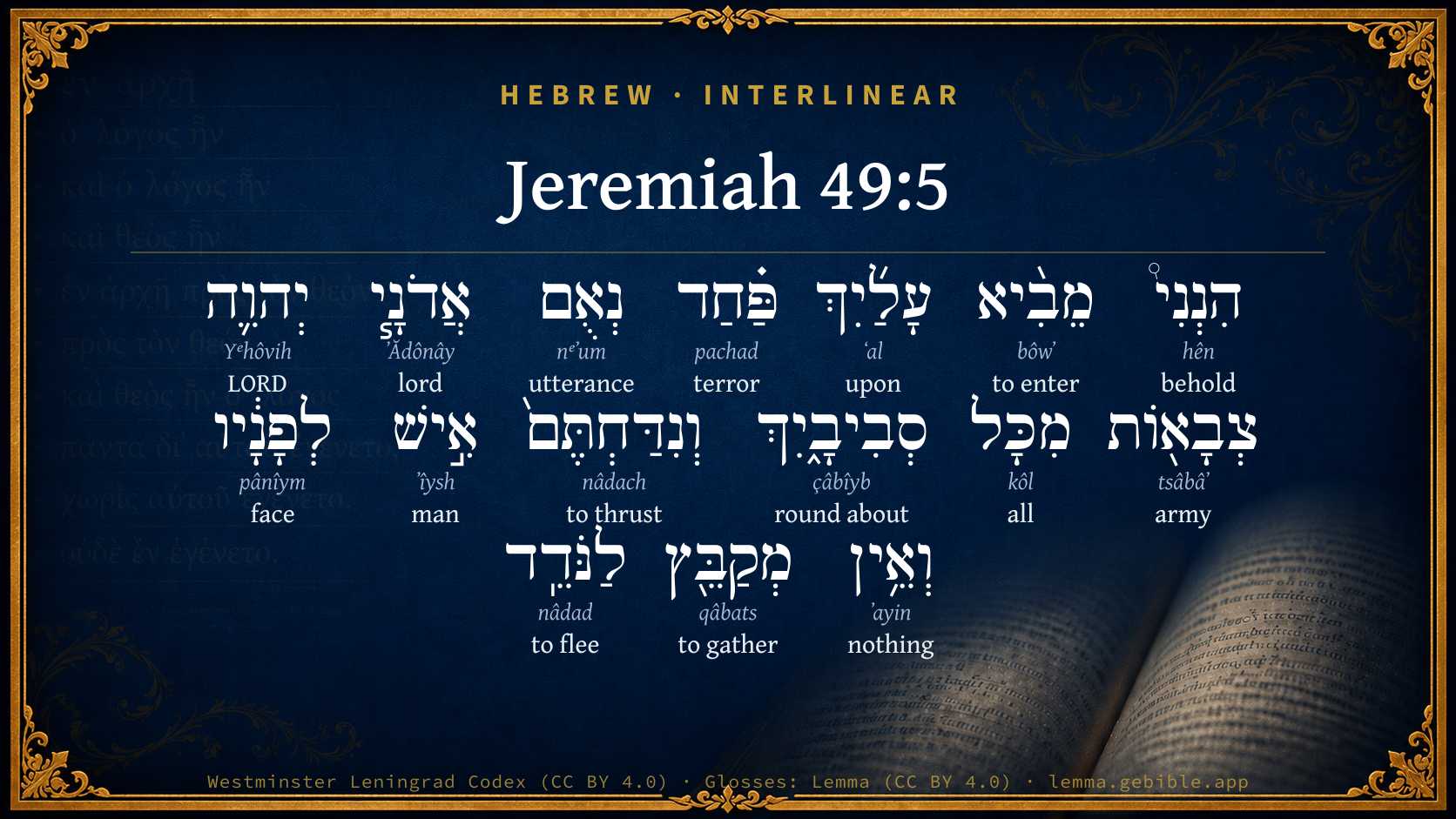
Hebrew (Westminster Leningrad Codex) Jeremiah 49:5 appears in the Hebrew Old Testament. The text above is from the Westminster Leningrad Codex. Each word links to its Strong’s number, a concise gloss, and parsing drawn from the Open Scriptures Hebrew Bible morphology. Click any word for its full Brown-Driver-Briggs (BDB) entry.
Download image
Cite this verse

Jeremiah 49:5 (World English Bible). Public Domain. Lemma interlinear Bible study tool, https://lemma.gebible.app/v/jeremiah/49/5.

Show BibTeX & RIS
BibTeX
RIS
English Translation
Behold, I will bring a fear on you, says the Lord, Yahweh of Hosts, from all who are round about you; and you shall be driven out every man right forth, and there shall be none to gather together the fugitives.
World English Bible · Public Domain
Download a study sheet

One document with this verse’s original text, its word-by-word gloss line, the meaning frame, cross-references with their text, attributed commentary, and full source and license credits — printable, and it pastes into notes with its structure intact.

This verse Autodidact and up

Study sheet (.html) Plain text (.txt)

A passage Seminary Student

Up to 50 verses in one chapter. A passage sheet keeps up to 6 commentary sources and 12 cross-references per verse, in the order this page ranks them, and says so on the sheet whenever that leaves anything out. Ask for a single verse and you get the Autodidact verse sheet above.

Everything on this page stays free to read, with no account — the sheet is a download of what is already on screen, not access to it.

Want to remove ads? Support Godless Engineer
Compare translations 3

The same verse in 3 English versions, stacked beneath the original-language interlinear above. Click any original word for its lexicon entry.

Each is an independent rendering of the whole verse — the interlinear is not word-aligned to these translations.

Highlighted words mark where these versions differ — a whole-verse word diff, not a word-by-word alignment.

  • World English Bible Public Domain
    Behold, I will bring a fear on you, says the Lord, Yahweh of Hosts, from all who are round about you; and you shall be driven out every man right forth, and there shall be none to gather together the fugitives.
  • King James Version Public Domain
    Behold, I will bring a fear upon thee, saith the Lord GOD of hosts, from all those that be about thee; and ye shall be driven out every man right forth; and none shall gather up him that wandereth.
  • unfoldingWord Literal Text CC BY-SA 4.0
    See, I am about to bring terror on you—this is the declaration of Lord Yahweh of hosts— this terror will come from all those who surround you. Each one of you will be scattered before it. There will be no one to gather those running away.

unfoldingWord Literal Text — © unfoldingWord, licensed CC BY-SA 4.0. Word-aligned USFM3 via Door43 (git.door43.org/unfoldingWord/en_ult).

Versions to compare (up to 4)

3 of 4 selected

Show all 18 translations

Every available English version of this verse, each an independent rendering of the whole verse.

  • World English Bible Public Domain
    Behold, I will bring a fear on you, says the Lord, Yahweh of Hosts, from all who are round about you; and you shall be driven out every man right forth, and there shall be none to gather together the fugitives.
  • Berean Standard Bible Public Domain
    Behold, I am about to bring terror upon you, declares the Lord GOD of Hosts, from all those around you. You will each be driven headlong, with no one to regather the fugitives.
  • Majority Standard Bible Public Domain
    Behold, I am about to bring terror upon you, declares the Lord GOD of Hosts, from all those around you. You will each be driven headlong, with no one to regather the fugitives.
  • King James Version Public Domain
    Behold, I will bring a fear upon thee, saith the Lord GOD of hosts, from all those that be about thee; and ye shall be driven out every man right forth; and none shall gather up him that wandereth.
  • American Standard Version (1901) Public Domain
    Behold, I will bring a fear upon thee, saith the Lord, Jehovah of hosts, from all that are round about thee; and ye shall be driven out every man right forth, and there shall be none to gather together the fugitives.
  • Revised Version (1885) Public Domain
    Behold, I will bring a fear upon thee, saith the Lord, the LORD of hosts, from all that are round about thee; and ye shall be driven out every man right forth, and there shall be none to gather up him that wandereth.
  • Geneva Bible (1599) Public Domain
    Beholde, I will bring a feare vpon thee, sayth the Lord God of hostes, of all those that be about thee, and ye shalbe scattered euery man right foorth, and none shall gather him that fleeth.
  • Douay-Rheims (1899) Public Domain
    Behold I will bring a fear upon thee, saith the Lord God of hosts, from all that are round about thee: and you shall be scattered every one out of one another's sight, neither shall there be any to gather together them that flee.
  • Young's Literal Translation Public Domain
    Lo, I am bringing in upon thee a fear, An affirmation of the Lord Jehovah of Hosts, From all round about thee, And ye have been driven out each before it, And there is no gatherer of the wandering.
  • Literal Standard Version CC BY-SA 4.0
    Behold, I am bringing fear in on you, || A declaration of Lord YHWH of Hosts, || From all around you, || And you have each been driven out before it, || And there is no gatherer of the wandering.
  • Unlocked Literal Bible CC BY-SA 4.0
    See, I am about to bring terror on you—this is the declaration of Lord Yahweh of hosts— this terror will come from all those who surround you. Each one of you will be scattered before it. There will be no one to gather those running away.
  • unfoldingWord Literal Text CC BY-SA 4.0
    See, I am about to bring terror on you—this is the declaration of Lord Yahweh of hosts— this terror will come from all those who surround you. Each one of you will be scattered before it. There will be no one to gather those running away.
  • Darby Bible Public Domain
    Behold, I will bring a fear upon thee, saith the Lord Jehovah of hosts, from all that are about thee; and ye shall be driven out every man right forth; and none shall assemble the fugitives.
  • World Messianic Bible Public Domain
    Behold, I will bring a terror on you,” says the Lord, GOD of Hosts, “from all who are around you. All of you will be driven completely out, and there will be no one to gather together the fugitives.
  • Webster's Bible Public Domain
    Behold, I will bring a fear upon thee, saith the Lord GOD of hosts, from all those that are about thee; and ye shall be driven out every man right forth; and none shall gather up him that wandereth.
  • Free Bible Version CC BY-SA 4.0
    Watch out! I'm going to bring the surrounding nations to terrorize you, declares the Lord God Almighty. You will all be driven out and scattered, and no one will be able to gather you refugees together again.
  • Bible in Basic English Public Domain
    See, I will send fear on you, says the Lord, the Lord of armies, from those who are round you on every side; you will be forced out, every man straight before him, and there will be no one to get together the wanderers.
  • JPS Tanakh (1917) Public Domain
    Behold, I will bring a terror upon thee, saith the Lord GOD of hosts, from all that are round about thee; and ye shall be driven out every man right forth, and there shall be none to gather up him that wandereth.

Literal Standard Version (2020), Covenant Press — licensed CC BY-SA 4.0. Text via the HelloAO Bible API (eBible.org). Unlocked Literal Bible (unfoldingWord) — licensed CC BY-SA 4.0. Text via the HelloAO Bible API (eBible.org). unfoldingWord Literal Text — © unfoldingWord, licensed CC BY-SA 4.0. Word-aligned USFM3 via Door43 (git.door43.org/unfoldingWord/en_ult). Free Bible Version, Dr. Jonathan Gallagher — licensed CC BY-SA 4.0. Text via the HelloAO Bible API (eBible.org).

Word by word

More ways to search: Search by grammar → Find every occurrence → Compare this word →

Practice this passage: Drill this verse → Learn its vocabulary →

לַנֹּדֵֽד
nâdad
H5074
“to/for the · fleeing”
Preposition, Determined + Verb, Qal, Participle Active, Masculine, Singular, Absolute
Part of Speech
Preposition + Verb
Stem
Qal
Form
Participle Active
Gender
Masculine
Number
Singular
State
Absolute
Full BDB Definition

Origin: a primitive root

TWOT: 1300

to retreat, flee, depart, move, wander abroad, stray, flutter - (Qal) - to retreat, flee - to flee, depart - to wander, stray - to flutter (of birds) - (Poal) to flee away, be chased - (Hiphil) to chase away - (Hophal) to be chased away - (Hithpolel) to flee away
  1. הִנְנִי֩ hên H2005 “behold · me” Particle, Demonstrative + Suffix, Personal, 1st Person, Common, Singular
  2. מֵבִ֨יא bôwʼ H935 “entering” Verb, Hiphil, Participle Active, Masculine, Singular, Absolute
  3. עָלַ֜יִךְ ʻal H5921 “upon · you” Preposition + Suffix, Personal, 2nd Person, Feminine, Singular
  4. פַּ֗חַד pachad H6343 “terror” Noun, Common, Masculine, Singular, Absolute
  5. נְאֻם nᵉʼum H5002 “utterance of” Noun, Common, Masculine, Singular, Construct
  6. אֲדֹנָ֧י ʼĂdônây H136 “Lord · my” Noun, Common, Masculine, Plural, Construct + Suffix, Personal, 1st Person, Common, Singular
  7. יְהוִ֛ה Yᵉhôvih H3069 “LORD” Noun, Proper
  8. צְבָא֖וֹת tsâbâʼ H6635 “armies” Noun, Common, Both, Plural, Absolute
  9. מִכָּל kôl H3605 “from · all of” Preposition + Noun, Common, Masculine, Singular, Construct
  10. סְבִיבָ֑יִךְ çâbîyb H5439 “surroundings · your” Noun, Common, Both, Plural, Construct + Suffix, Personal, 2nd Person, Feminine, Singular
  11. וְנִדַּחְתֶּם֙ nâdach H5080 “and · to thrust” Conjunction + Verb, Niphal, Sequential Perfect, 2nd Person, Masculine, Plural
  12. אִ֣ישׁ ʼîysh H376 “man” Noun, Common, Masculine, Singular, Absolute
  13. לְפָנָ֔יו pânîym H6440 “to/for · face(s) · his” Preposition + Noun, Common, Both, Plural, Construct + Suffix, Personal, 3rd Person, Masculine, Singular
  14. וְאֵ֥ין ʼayin H369 “and · nothing” Conjunction + Particle, Negative
  15. מְקַבֵּ֖ץ qâbats H6908 “gathering” Verb, Piel, Participle Active, Masculine, Singular, Absolute

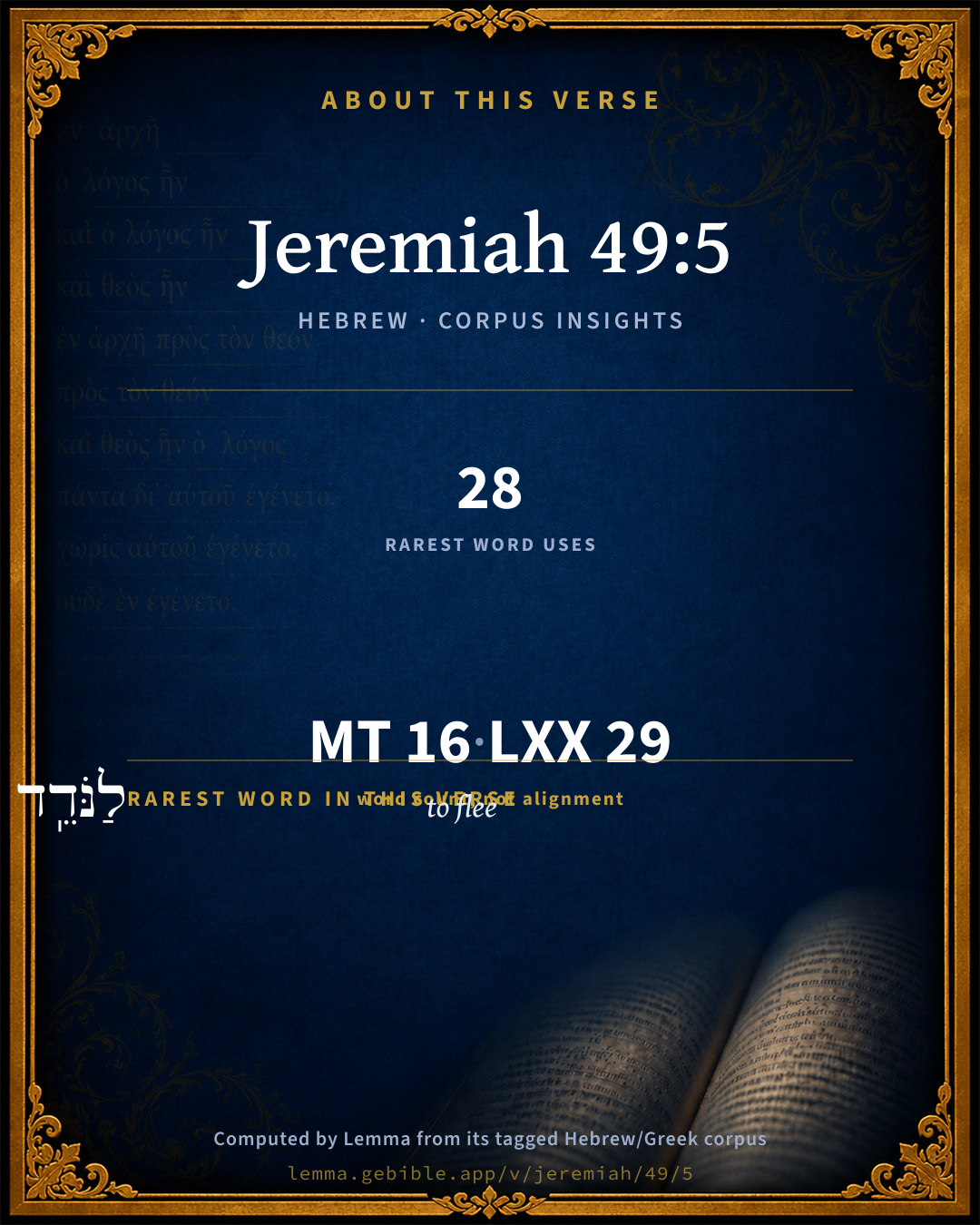
About this verse

These counts appear in no published source. They are computed here, from the morphology-tagged text and Lemma’s own curated glosses. What Lemma adds →

16
words
16
distinct lemmas
Prophets
section

Shared distinctive vocabulary

לַנֹּדֵֽד to flee H5074 occurs in 26 verses of the Hebrew Bible. Also found in:

Grammatical profile

  • 4 verbs
  • 9 nouns
  • 1 preposition
  • 2 particles

Verb forms

  • מֵבִ֨יא Hiphil · Participle Active
  • וְנִדַּחְתֶּם֙ Niphal · Sequential Perfect
  • מְקַבֵּ֖ץ Piel · Participle Active
  • לַנֹּדֵֽד Qal · Participle Active

Hebrew & Septuagint length

In the original languages it is 16 Hebrew tokens and 29 Greek tokens — but the two are counted differently (Hebrew bundles its prefixes and suffixes into one token; the Greek is in lemma form), so that isn’t a like-for-like length.

Cross-references

13

Topical passages linked to Jeremiah 49:5 in the Treasury of Scripture Knowledge — connected by theme and wording, ordered by reader-vote popularity; previews shown in the World English Bible.

  • Jeremiah 46:5 Why have I seen it? they are dismayed and are turned backward; and their mighty ones are beaten down, and have fled apace, and don't look back: terror is on every side, says Yahweh.
  • Jeremiah 49:29 Their tents and their flocks shall they take; they shall carry away for themselves their curtains, and all their vessels, and their camels; and they shall cry to them, Terror on every side!
  • Joshua 2:9 and she said to the men, I know that Yahweh has given you the land, and that the fear of you is fallen on us, and that all the inhabitants of the land melt away before you.
  • 2 Kings 7:6–7 For the Lord had made the host of the Syrians to hear a noise of chariots, and a noise of horses, even the noise of a great host: and they said one to another, Behold, the king of Israel has hired against us the kings of the Hittites, and the kings of the Egyptians, to come on us.
  • 2 Kings 19:7 Behold, I will put a spirit in him, and he shall hear news, and shall return to his own land; and I will cause him to fall by the sword in his own land.
  • Job 15:21 A sound of terrors is in his ears; In prosperity the destroyer shall come on him.
  • Proverbs 28:1 The wicked flee when no one pursues; But the righteous are as bold as a lion.
  • Isaiah 16:3 Give counsel, execute justice; make your shade as the night in the midst of the noonday; hide the outcasts; don't betray the fugitive.
  • Jeremiah 15:8 Their widows are increased to me above the sand of the seas; I have brought on them against the mother of the young men a destroyer at noonday: I have caused anguish and terrors to fall on her suddenly.
  • Jeremiah 20:4 For thus says Yahweh, Behold, I will make you a terror to yourself, and to all your friends; and they shall fall by the sword of their enemies, and your eyes shall see it; and I will give all Judah into the hand of the king of Babylon, and he shall carry them captive to Babylon, and shall kill them with the sword.
  • Jeremiah 48:41–44 Kerioth is taken, and the strongholds are seized, and the heart of the mighty men of Moab at that day shall be as the heart of a woman in her pangs.
  • Amos 4:3 You will go out at the breaks in the wall, Everyone straight before her; And you will cast yourselves into Harmon," says Yahweh.
  • Obadiah 1:12–14 But don't look down on your brother in the day of his disaster, and don't rejoice over the children of Judah in the day of their destruction. Don't speak proudly in the day of distress.

Cross-references courtesy of OpenBible.info (CC BY 4.0).

Hebrew and Greek witnesses Masoretic Hebrew ↔ Greek Septuagint

The same verse in the two great witnesses to the Old Testament, shown verse-for-verse.

These are two independent witnesses, not word-aligned to each other, and the Septuagint is shown in lemma (dictionary) form.

Hebrew Jeremiah 49:5 Masoretic · Westminster Leningrad Codex

הִנְנִי֩ מֵבִ֨יא עָלַ֜יִךְ פַּ֗חַד נְאֻם אֲדֹנָ֧י יְהוִ֛ה צְבָא֖וֹת מִכָּל סְבִיבָ֑יִךְ וְנִדַּחְתֶּם֙ אִ֣ישׁ לְפָנָ֔יו וְאֵ֥ין מְקַבֵּ֖ץ לַנֹּדֵֽד

Behold, I will bring a fear on you, says the Lord, Yahweh of Hosts, from all who are round about you; and you shall be driven out every man right forth, and there shall be none to gather together the fugitives.

World English Bible · Public Domain

Greek LXX Structure differs

In the Septuagint, Jeremiah is about an eighth shorter than the Hebrew and arranges its material differently — the Oracles Against the Nations (Hebrew chapters 46–51) appear in the middle of the Greek book, after 25:13. Because the chapter and verse boundaries do not line up, a verse-for-verse comparison with the Hebrew is not shown.

A verse-for-verse comparison isn’t shown here because the chapters and verses don’t line up. Switch to the LXX edition with the MT / LXX toggle above to read the Greek directly.

Hebrew: Westminster Leningrad Codex (CC BY 4.0). Greek: Septuagint (public domain); English from a public-domain English Septuagint. How the Septuagint differs from the Hebrew →

Targum (Aramaic paraphrase)

1

The Targum is the ancient Jewish Aramaic paraphrase of the Hebrew Scriptures — an interpretive translation, not the Hebrew text itself. Onkelos (literal) and Pseudo-Jonathan (expansive) render the Torah, and Jonathan the Prophets. Coverage is partial: where no permissively-licensed English translation exists for a verse, only the Aramaic is shown. This is verse-level text, not a word-by-word alignment to the Hebrew.

  1. Targum Jonathan Prophets (Joshua–Malachi)
    הָא אֲנָא מַיְתֵי עֲלָךְ דַחֲלָא אֲמַר יְיָ אֱלֹהִים צְבָאוֹת מִכָל סַחֲרָנָךְ וְתִתְבַּדְרוּן גְבַר לִקֳבֵיל אַפּוֹהִי וְלֵית דְמַכְנֵישׁ לִמְבַדְרַיָא:

    (no public-domain English translation for this verse)

    Targum Jonathan — Aramaic: “Mikraot Gedolot” (public domain). English: “Sefaria Community Translation” (CC0 1.0 (public-domain dedication)); “London "Chaldee Paraphrase," 1871” (public domain). Text via Sefaria.

Commentary

Notes on Jeremiah 49:5 from classic Christian and Jewish commentators (each source and its license shown beneath its notes). The classic Christian expositions comment on the surrounding passage and are grouped to its opening verse, so a note may address several verses; the Jewish commentaries on the Tanakh (Rashi and others) are per-verse, so they appear only where the commentator wrote on this verse.

Lemma curates 59 commentaries, every one of them public domain or Creative Commons licensed, each selected and text-cleaned for this edition rather than reprinted as found. About our sources →

Trapp's Complete Commentary

John Trapp

Jer 49:5 Behold, I will bring a fear upon thee, saith the Lord GOD of hosts, from all those that be about thee; and ye shall be driven out every man right forth; and none shall gather up him that wandereth.

Ver. 5. Behold, I will bring a fear upon thee.] Panicum vel bellicum. Panic or war.

John Trapp, A Commentary or Exposition upon All the Books of the Old and New Testament (1647–1656) — public domain. Text from a community e-Sword module.

Geneva Bible (1599)

Geneva Bible translators

Signifying, that power and riches cannot prevail, when as God will execute his judgments.

That is, without looking back, and as everyone can find a way to escape.

Geneva Bible (1599) marginal notes — public domain. Text via Bolls.life.

Jamieson, Fausset & Brown

Robert Jamieson, A. R. Fausset & David Brown

every man right forth--whithersoever chance may lead him (Jer 46:5; Gen 19:17); straight before him, onwards at random (Amo 4:3).

none . . . gather up him, &c.--There shall be none to gather together the wandering fugitives, so as to care for them and restore them to their own homes.

Jamieson, Fausset & Brown — Commentary Critical and Explanatory on the Whole Bible (1871) — public domain (CC PDM 1.0). Text via the HelloAO Bible API.

John Calvin's Commentaries

Jeremiah at length concludes his prophecy, by saying, that God would dissipate that foolish confidence through which the Ammonites were filled with pride, because he would bring a terror on them. He sets up terror in opposition to that security in which the Ammonites lay torpid; for they were inebriated, as it were, with their pleasures. And then the strongholds by which they thought themselves protected, so hardened their hearts, that they feared no danger. God then sets up this terror in opposition to the false arrogance by which they were inflated: I bring, then, a terror from all around thee. And this was not without reason added, for the Ammonites thought that they could, on some side, escape, if enemies pressed hard on them; and as there were many outlets, they thought it impossible that they should fall into the hands of enemies. But God declares that they would be in every way full of fear, for terror would surround and besiege them, so that they could not escape.

He then adds, Ye shall be driven out, every one to his face, or, before his face. This would be the effect of terror, because God would deprive them of all thought; for when we flee in haste, and only regard any opening that may present itself, it is evident that we are driven by terror. As we say in French, Il court devant soi; so the Prophet says here, Ye shall be driven out, every one before his face, that is, “ye shall flee wherever a place may be open to you.” He shews that they would be so full of fear, that they would not consider which would be the best way, nor think of a safe retreat; they would, in short, think of nothing but of flight. And to the same purpose is what follows: There will be none to gather the dispersed: for when trembling seizes the hearts of the multitude, they can yet be recalled, when one who has more courage than the rest encourages them to stop, as we know that many armies have been in this way saved; for as to soldiers, when suddenly seized with fear, a leader has often been able to gather them again. But the Prophet, when he says, that there would be none to call them back from flight, intimates their destruction. He at length subjoins —

John Calvin's Commentaries (1540-1563) — public domain. Text from the Calvin Translation Society English edition (1840s-50s) via the Christian Classics Ethereal Library (ccel.org). Calvin's coverage is partial (roughly two-thirds of the Bible); uncommented books and verses are honest gaps, never fabricated. The 19th-century editor's footnotes and remarks are omitted so the notes are faithfully Calvin's own voice.

Ellicott's Commentary for English Readers

(5, 6) I will bring a fear upon thee . . .—As in the case of Moab, there is the doom of exile for Ammon also, but the sentence of punishment is tempered with mercy, and there is to be a return from the seemingly hopeless captivity.

A Bible Commentary for English Readers, edited by Charles John Ellicott (1878–1897) — public domain. Text from a community e-Sword module.

John Gill's Exposition

Behold, I will bring a fear upon thee, saith the Lord God of hosts,.... The terrible army of the Chaldeans, which should strike them with a panic; who thought themselves so secure in their fortresses, trusting in their riches:

from all those that be about thee; meaning either from the Chaldeans, and the neighbouring nations, that should join and surround the Ammonites on all sides; or from all the borders of Ammon round about, where they should come; they would be a "magormissabib", "a fear all round", Jer 20:3,

and ye shall be driven out every man right forth; driven out of their houses, and cities, and villages, and steer their course right forward, and never look behind to see what were become of their families and their friends; everyone having enough to do to provide for his own safety:

and none shall gather up him that wandereth; that is straggling about, and knows not which way to take, and whither to flee for safety; all will be so intent on their own safety, that they will not concern themselves for others, to take them under their care; to take those that are on foot upon their horses or carriages, whom they overtake; or into their houses, as they pass by.

John Gill's Exposition of the Whole Bible (1746–1763) — public domain (CC PDM 1.0). Text via the HelloAO Bible API.

Albert Barnes' Notes on the Bible

Every man right forth - The Ammonites will live in terror of the tribes which rove in the neighborhood, and at the slightest alarm will flee straight away without resistance.

Albert Barnes' Notes on the Bible (1834–1885) — public domain. Text from a community e-Sword/MySword module.

Matthew Poole's English Annotations

As secure as you think yourselves, I will cause you to be afraid, and your enemies shall be all those that are round about you. And you shall be driven out every man, either right forth, into some country opposite to you, or apart one from another, or so that you shall be glad to flee right forth, and never look back, but only forward, for any place of safety that appeareth next before you. And when you are wandering, being driven by your enemies, you shall find none who will be willing to receive or entertain you.

Matthew Poole's English Annotations on the Holy Bible (1683–1685) — public domain. Text from a community e-Sword/MySword module.

Whedon's Commentary on the Bible

Daniel D. Whedon

5. Every man right forth — In the most precipitate flight, looking neither to the right nor left.

Daniel D. Whedon (gen. ed.), Commentary on the Old and New Testaments (1874–1909) — public domain. Text from a community e-Sword module.

The Pulpit Commentary

The Ammonitish community dissolved; every one earing for himself. Every man right forth; i.e. straight before him, in a wild panic which expels every thought but that of self-preservation. Him that wandereth. Collectively for "the wanderers," i.e. the fugitives. So it is said of the Babylonians, that they are "like sheep with none to gather them."

The Pulpit Commentary (1880–1919), ed. H.D.M. Spence-Jones & Joseph S. Exell — public domain. Text from a community e-Sword module.

John Wesley's Explanatory Notes

Right forth - So that you shall be glad to flee, and never look back. Gather up - None will receive or entertain you.

John Wesley, Explanatory Notes Upon the Whole Bible (1754–1765) — public domain. Text via the GEBible commentary corpus.

unfoldingWord translationNotes

Door43 World Missions Community

I am about to bring terror on you

The abstract noun "terror" can be stated as "terrified." AT: "I am about to cause you to be terrified" (See: Abstract Nouns)

you

The word "you" refers to the people of Ammon.

this is the declaration of Lord Yahweh of hosts

Yahweh speaks of himself by name to express the certainty of what he is declaring. Translate as you did the similar phrase in Jeremiah 1:8. AT: "this is what Lord Yahweh of hosts has declared" or "this is what I, Lord Yahweh of hosts, have declared" (See: First, Second, or Third Person)

this terror will come from all those who surround you. Each one of you will be scattered before it

The abstract noun "terror" can be stated as the verb "terrify." The phrase "will be scattered" can be stated in active form. AT: "I will cause all those around you to terrify you. Each one of you flee to different directions" (See: Abstract Nouns and Active or Passive)

I will restore the fortunes of the people of Ammon

"I will cause things to go well for the people of Ammon again" or "I will cause the people of Ammon to live well again." See how similar words are translated in Jeremiah 29:14.

translationWords

terror

declare

Yahweh

Yahweh of hosts

restore

Ammon

unfoldingWord translationNotes — © Distant Shores Media and the Door43 World Missions Community, licensed CC BY-SA 4.0. Source: git.door43.org/Door43/en_tn.

Rashi

Rabbi Shlomo Yitzchaki (Rashi)

each man forward Anyone who can hurry and flee.

the wanderer The term [לנדד] derives from נע ונד, “a wanderer and an exile” (Gen. 4:14).

Rashi on the Tanakh — English translations: “The Judaica Press complete Tanach with Rashi, translated by A. J. Rosenberg” (CC BY 4.0); “Pentateuch with Rashi's commentary by M. Rosenbaum and A.M. Silbermann, 1929-1934” (public domain); “The Metsudah Tanach series, Lakewood, N.J” (CC BY 4.0); and “The Book of Joshua, Metsudah Publications, 1997” (CC BY 4.0). Text via Sefaria.

Lesson kit

Teaching starters — assembled from the data on this page, not authored interpretation. Every prompt links to the verse data it draws on. Edit before teaching.

Jeremiah, in the Prophets, opens this verse with 16 words (16 distinct Hebrew lemmas). Its most distinctive word is nâdad (“to flee”). A historical commentator’s framing appears above. Read the whole chapter for the surrounding context.

Discussion questions

  1. How does “to flee” (nâdad) shape what this verse is saying?
  2. How does Genesis 31:40, which shares the word «to flee», read alongside this verse?
  3. These translations render this verse differently; the difference is in the English rendering, not the original. What questions does that raise?
  4. «מֵבִ֨יא» is a Hiphil Participle Active verb. How does that grammatical form shape the action described?
  5. Compare how Trapp's Complete Commentary and Geneva Bible (1599) read this verse. Where do they agree or differ?

Things to notice

Reading settings

Reading text

Shown beneath each verse's original-language words.

Old Testament
Old Testament edition

Read the OT as the Masoretic Hebrew (MT) or the Greek Septuagint (LXX).

English shown for the Greek Septuagint (in the Hebrew ↔ Greek comparison).

Comparing translations? Open the Compare panel on any verse page to stack up to four side by side.